Online Tutoring Explained: How It Works, Costs, and Results

Jump to section
Picture a student stuck on long division at 8 p.m. Their parent has tried twice, and their teacher has gone home for the night. Online tutoring puts a patient tutor on a screen, ready to help in real time.
Online tutoring is one-on-one or small-group help delivered over the internet, usually through a video platform and a shared digital whiteboard.
In this post, we'll walk through how sessions work, who the tutors are, which subjects are covered, what it costs, how matching works, and what to know about outcomes and safety.
We'll finish with a checklist for teachers who are thinking about tutoring alongside their classroom job.

How Online Tutoring Sessions Actually Work
Online tutoring is simpler than it sounds: a video session, a format that fits your student, and a schedule that works around real life. Here's how each piece runs.
Meeting your tutor through video
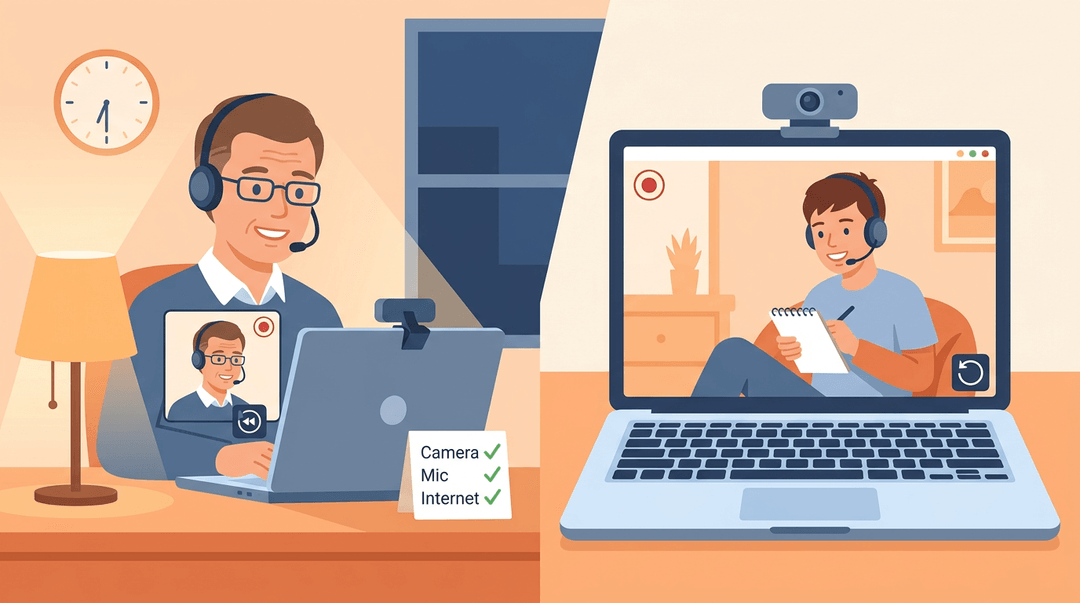
Sessions often run on Zoom-based video, and many are secure recorded sessions, so a student can rewatch a tricky explanation later.
You can join from a web browser or the app, and some providers offer a fully-featured online learning studio designed for teaching.
Tech tip: test your camera, microphone, and internet connection before the first session. Think of a high school math teacher picking up evening tutoring work. A quick check an hour early means no frozen screen when a student logs on.
One-on-one or small group sessions
You can choose 1-on-1 instruction or small-group sessions, depending on what your student needs. Both offer live, real-time interaction, which is less about watching a lesson and more about doing the work together.
Some programs use a bootcamp format: multi-week sessions that build skills step by step.
Scheduling that fits busy families
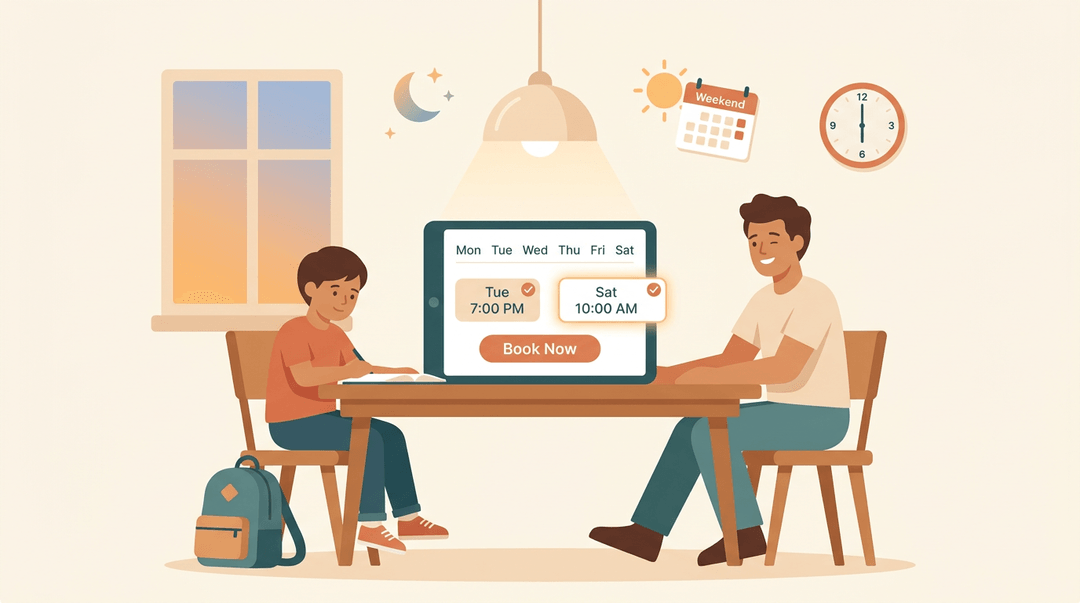
Evenings and weekends are available, which matters when the school day has already drained everyone. Families can self-schedule without registration, choosing a time directly. Session frequency is flexible too. Students who still need help once the school day ends can look into after school tutoring next.
A parent working until six can book a Tuesday evening session for their sixth grader, then add a weekend session before a unit test. That's how tutoring fits busy family schedules.
Who Are the Tutors Behind the Platform
Who's actually on the other end of that screen? Online tutoring pairs students with a surprisingly wide mix of people, from high schoolers close to their own age to certified teachers with years in front of a class.
Student tutors who relate to kids
Many platforms rely on near-peer tutoring, where the tutor is only a few years older than the learner. High school students are often a good fit because they remember exactly which step tripped them up last year.
Trained volunteer peer tutors and tutors who scored high on the SAT round out this group. Their explanations often land because they sound like a friend talking, not a textbook.
Picture a seventh grader stuck on equations who hears a junior explain the trick she learned last spring.
When your tutor is a certified teacher
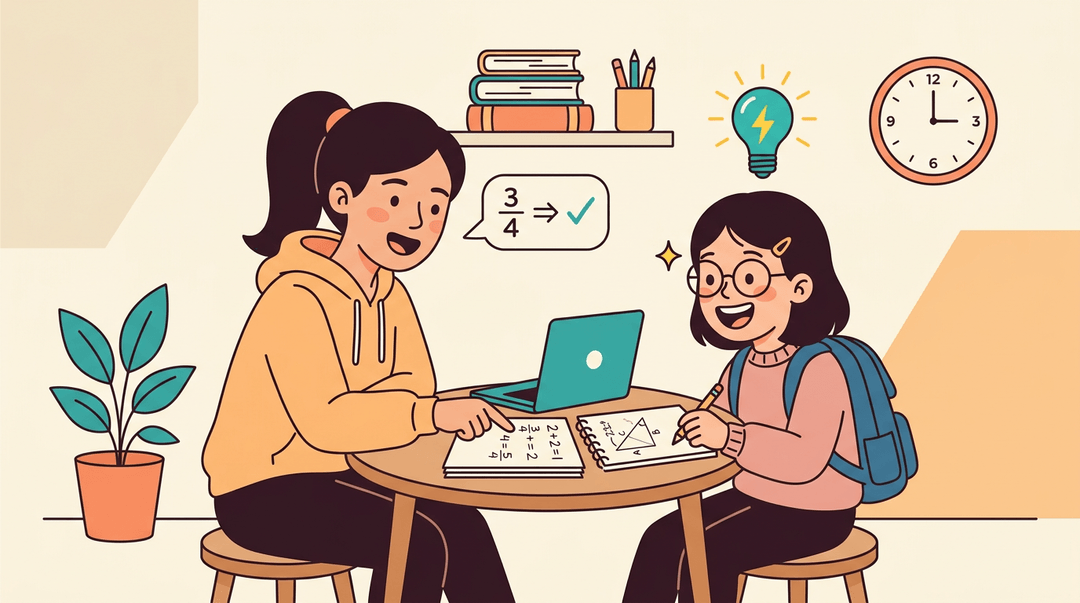
Some tutors are state-certified teachers who bring real classroom experience to every session. They aren't gig workers picking up random jobs, and many are vetted content experts in their subject.
Think of a teacher who spends her day with thirty students and tutors two evenings a week. For her, tutoring is side income that keeps her sharp in her subject. It can be the same for you.
What is the best online tutoring platform for teachers?
There isn't one perfect answer, but a large nationwide tutor marketplace is a strong starting point. These platforms connect students with independent tutors across a wide range of specialties.
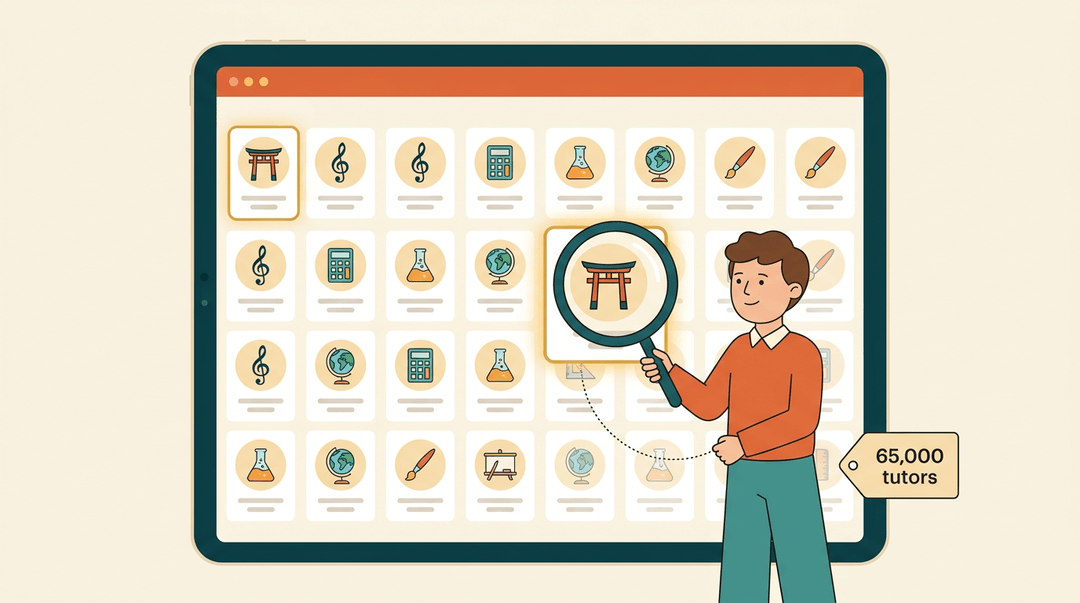
A content analysis of Japanese language tutors' ads in one online tutor marketplace captures the model. One large marketplace lists 65,000 expert tutors, so you'll likely find someone for a niche subject.
Because these tutors are independent contractors, they work for themselves rather than for the platform.
If you're a teacher considering tutoring yourself, compare platforms for teacher-tutors by specialty range and how they handle matching. How well a platform fits your subject matters more than its size.
Staying with the same tutor long term
Matching can happen fast, often within days. The bigger win comes from staying put. A tutor works with a student until goals are met, and that relationship continuity matters. Consider a student who meets the same tutor every Tuesday.
By week three, the tutor knows she freezes on word problems, so each session starts there. Compare that to a string of strangers starting from scratch. Consistency wins.
What Subjects You Can Get Tutoring In
Online tutoring covers far more ground than most people expect, and you'll see the range below. Learners with IEPs (individualized education programs) or English language learners (ESL) can also find support shaped to their needs.
Core subjects like math and reading
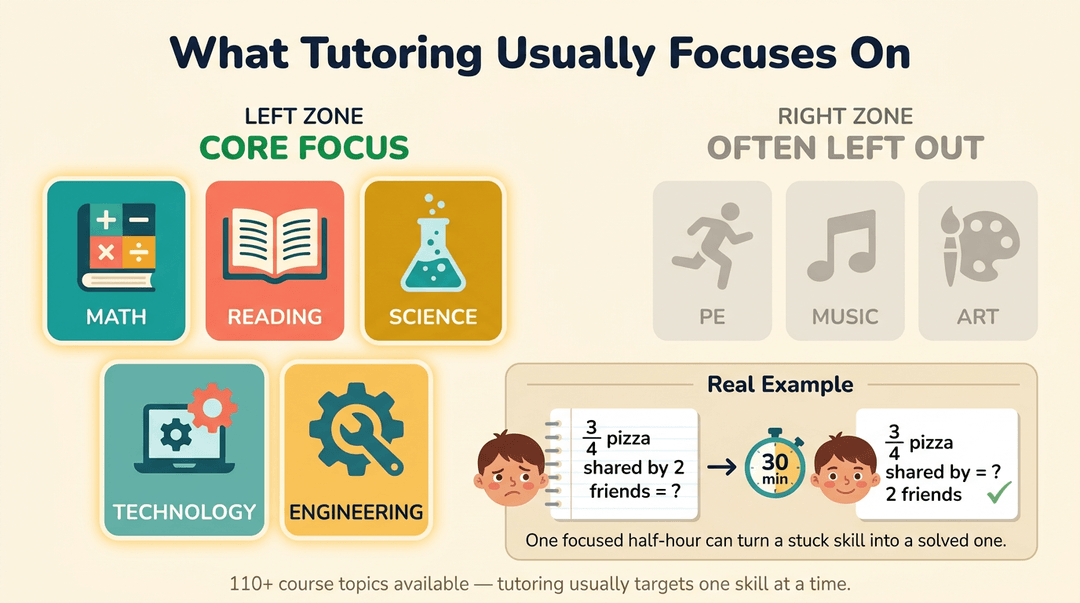
Most tutoring starts with the basics. A review of Shadow Education and K-12 Students' Learning notes that tutoring outside school (often called shadow education) focuses on STEM subjects, meaning:
- science
- technology
- engineering
- math
such as mathematics and science. It leaves out physical education, music, and arts. Reading, history, and other K-12 subjects round out the core. Think of a fifth grader who keeps losing points on fraction word problems.
A focused 30-minute session on that one skill can make homework feel manageable again. Some catalogs list 110+ courses, so a specific unit is often covered.
SAT and ACT test prep
Test prep is where an official partnership matters most. According to Schoolhouse's Help Center, Schoolhouse and College Board have partnered to offer free, official SAT tutoring to students around the world. Programs include:
- SAT bootcamps
- ACT and SAT tutors
- practice test review
Consider a junior who scores the same on every practice test. A tutor who reviews each missed question shows why the score isn't moving, which is less about the number and more about why it happened. When test scores stay flat even after every missed question is reviewed, dyscalculia tutoring is worth exploring.
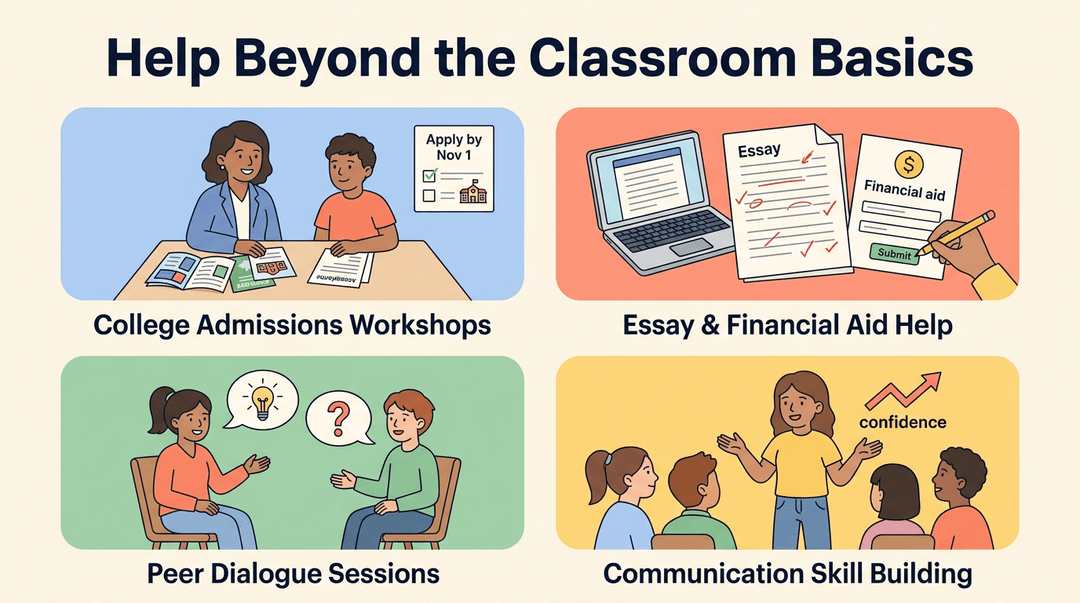
Help beyond the classroom basics
Tutoring also reaches past the textbook:
- College admissions workshops for students planning their next step.
- Essay and financial aid help for applications and aid forms.
- Peer dialogue sessions where students talk through ideas with others.
- Communication skill building for speaking and writing with confidence.
A huge range of subjects available
Beyond core subjects, catalogs can reach 300+ subjects, including electives and languages, plus business and test prep categories. Homework help runs across subjects too.
A student stuck on a chemistry worksheet at 8 p.m. has somewhere to turn, and you'll know the help is there when your class needs it.
Your Checklist for Starting Online Tutoring
This guide takes you from "maybe I'll tutor" to a first booked session without swallowing your evenings. Work through the three parts in order.
Choose your lane
- Pick one subject specialty
- Start with what you already teach, stated narrowly: "Grade 8 math, fractions through algebra."
- Choose marketplace or independent
- Use the table below to decide.
- Test your tech setup
- Confirm a stable connection, webcam, headset, and a shared whiteboard tool.
- Run a mock session with a colleague before any student sees it.
| Marketplace | Independent | |
|---|---|---|
| Finding students | Platform brings them | You find them |
| Setup | Quicker to start | Slower to build |
| Rates and policies | Platform sets terms | You set them |
Set rates and schedule
Fill in this grid once, then reuse it every term.
| Slot | Your entry (example) |
|---|---|
| Rate | Midpoint of three tutors in your subject and level |
| Teaching-day blocks | Tue and Thu, 4:30 to 6:30 p.m. |
| Weekly cap | 6 sessions, then a waitlist |
| Protected time | One weekday evening and one weekend block, always empty |
Benchmark before you price. Look up what three tutors at your level charge. Price near the middle, then raise it as your calendar fills.
⚠️ Watch out: Overbooking is how teacher-tutors burn out. Say no, or waitlist, before you feel stretched.
Prep your sessions efficiently
Your classroom already holds most of what you need. Run this once a week.
- Pull from your existing lesson plans
- Trim a whole-class lesson to its one core skill.
- Batch-prep the week's materials
- Prep every session in one sitting, not nightly.
- Save slides and practice sets in a folder by topic.
- Log progress after each session
- Keep it to one line per student.
Example: A middle school math teacher tutors Tuesday and Thursday. On Sunday she reuses her two-step equations lesson, cuts it to a ten-problem set, and saves it. After each session she jots: "Maya, 3/12: solved two-step equations alone. Next: negative coefficients." Next week's prep starts from that line.
Quick check before your first session:
- Specialty named in one narrow sentence
- Platform chosen and tech tested
- Rate set from real benchmarks
- Hours blocked, with a weekly cap
- Progress log ready to use
Draft and adapt tutoring session plans in minutes with EMStudio's AI Lesson Editor.
How to Get Started and Matched
Getting started is simpler than you might expect, and the matching step is where the right fit really gets made. Here's what to expect.
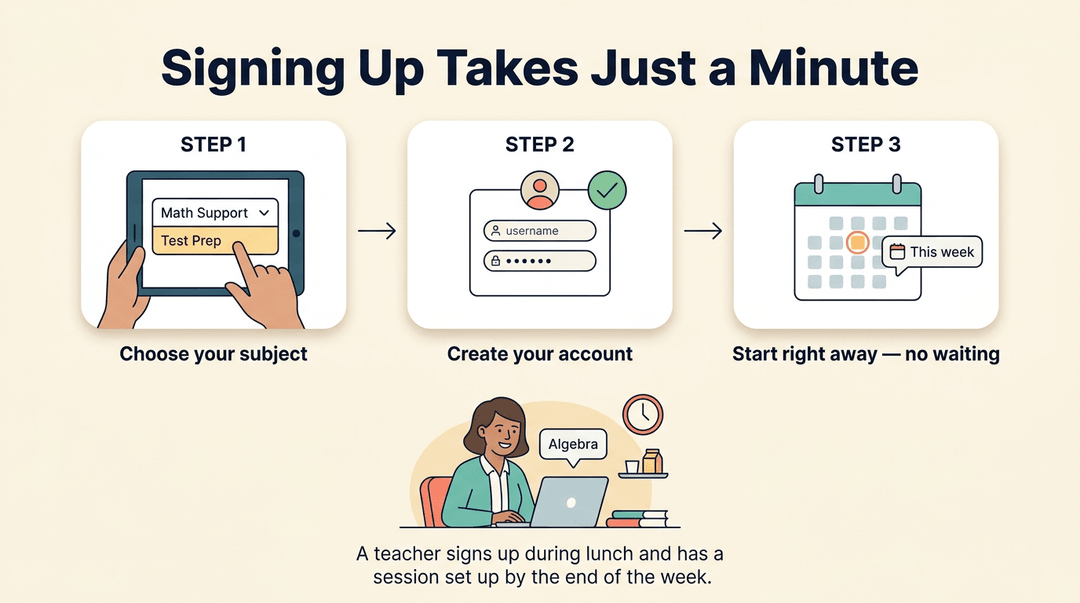
Signing up takes just a minute
Signing up is a quick online process. Start by choosing the program or subject you need, whether that's math support or test prep. Then create your account, which unlocks access.
You don't need to pre-register, so there's no waiting period before you begin.
For example, a middle school math teacher who wants extra help for one student can sign up during a lunch break, pick algebra, and have a session lined up that same week.
Finding the right tutor match
Once you're in, you can browse tutor profiles to see each tutor's background and specialties. Matching is based on student needs, so the pairing is chosen with your learner in mind. A good-fit guarantee stands behind the match.
Before you book, share your goals. Tell the tutor what the student is working on, where they feel stuck, and what success looks like. That conversation makes the difference between a generic session and one that targets the exact gap.
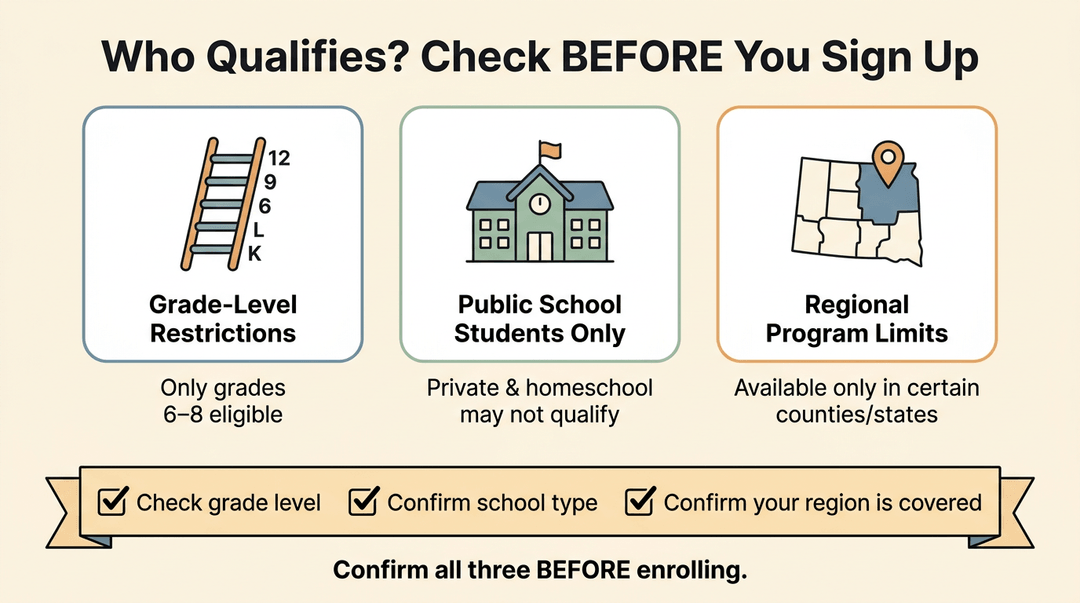
Who qualifies for the program
Eligibility depends on the student. Programs may have grade-level restrictions, and access is often limited to public school students.
Check K-12 eligibility against your student's grade, and confirm that your area is covered, since regional program limits may apply. Check these before you sign up, not after.
What Online Tutoring Actually Costs
Cost is usually the first question families ask. The answer runs from free to a typical $20 to $50 an hour, so let's see where the money goes.
Free tutoring programs worth knowing
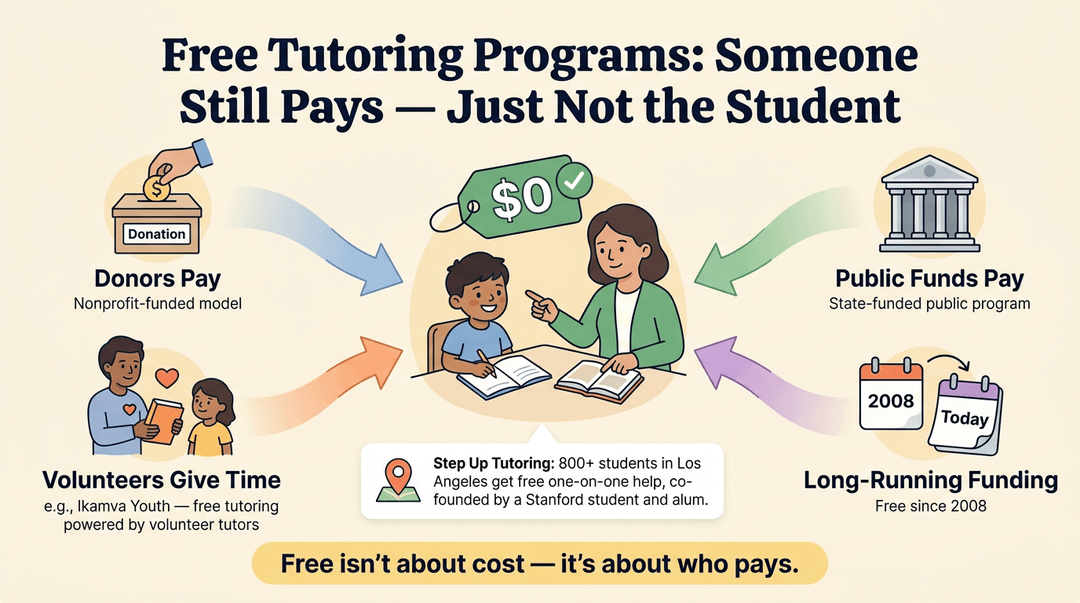
Some nonprofit tutoring programs provide sessions at no cost to students.
According to Stanford Report, more than 800 students in Los Angeles receive free one-on-one help through Step Up Tutoring, a program co-founded during the pandemic by a Stanford student and an alum.
Similarly, Ikamva Youth can offer extensive tutoring free of charge because of its committed volunteer tutors.
Free programs generally come in a few forms:
- 100% free sessions: students pay nothing per lesson.
- Nonprofit funded model: donors cover the costs.
- Free since 2008: some programs have offered free sessions for years.
- State-funded public program: public funds cover the sessions.
Free is less about cost and more about who pays.
Is $30 an hour for tutoring good?
Yes, for most subjects, $30 an hour sits comfortably within the typical range. The real question is what it buys. Pricing usually follows one of these models:
- Set-your-own-rate tutors: the tutor picks the price, so you can compare rates directly.
- First-hour guarantee: you can test the fit before committing to more.
- Fee-based lessons: you pay per session or per package.
- Independent pricing: rates are set outside any platform, so benchmarks can vary.
Consider a fifth-grade teacher who books a $30 session with a first-hour guarantee. If the fit is wrong, she's lost one hour, not a month's budget.
Trying a free session first
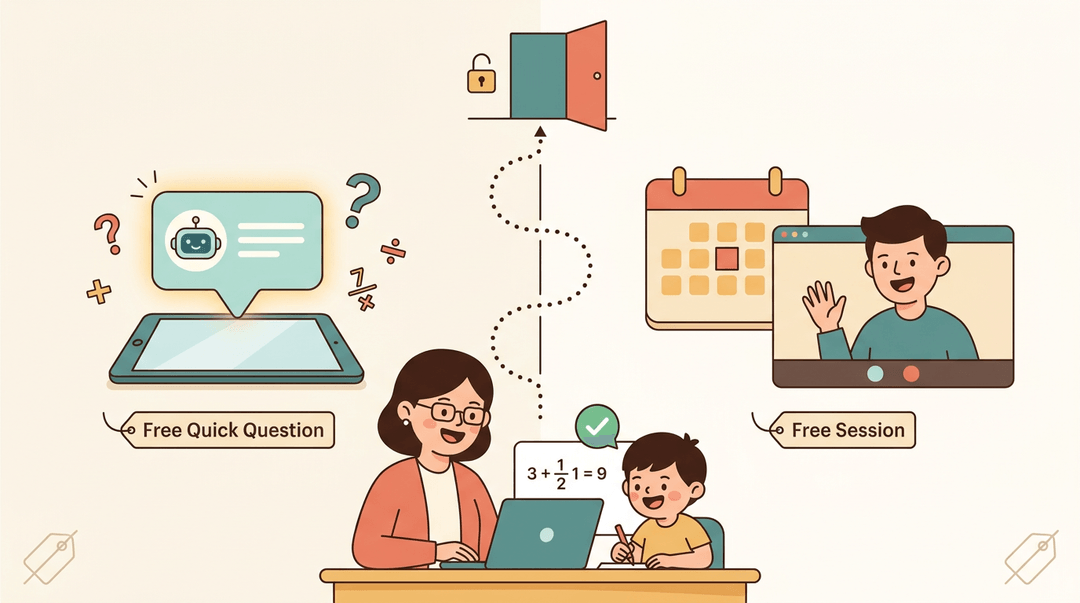
Before paying anything, you can try a free AI math helper for quick questions or schedule a free session with a live tutor. Either one works as an entry point before you commit to a paid plan.
Think of a fourth-grade teacher checking whether a tutor suits her student. One free session answers that question. That's a low-risk start.
Results, Trust, and Safety in Tutoring
Before you sign up for any tutoring service, you'll want to know two things: does it help, and can you trust it?
Better grades and more confidence
Good tutoring shows up in the work. Look for progress tracking that records each skill, so you can see where a student started and where they landed. Consider a seventh grader stuck on multi-step word problems.
When a tutor shows them mastering one step at a time, that proof builds the confidence to keep trying. Improved grades usually follow, but mastery matters more, since the skill carries into the next unit.
How tutors are vetted for safety
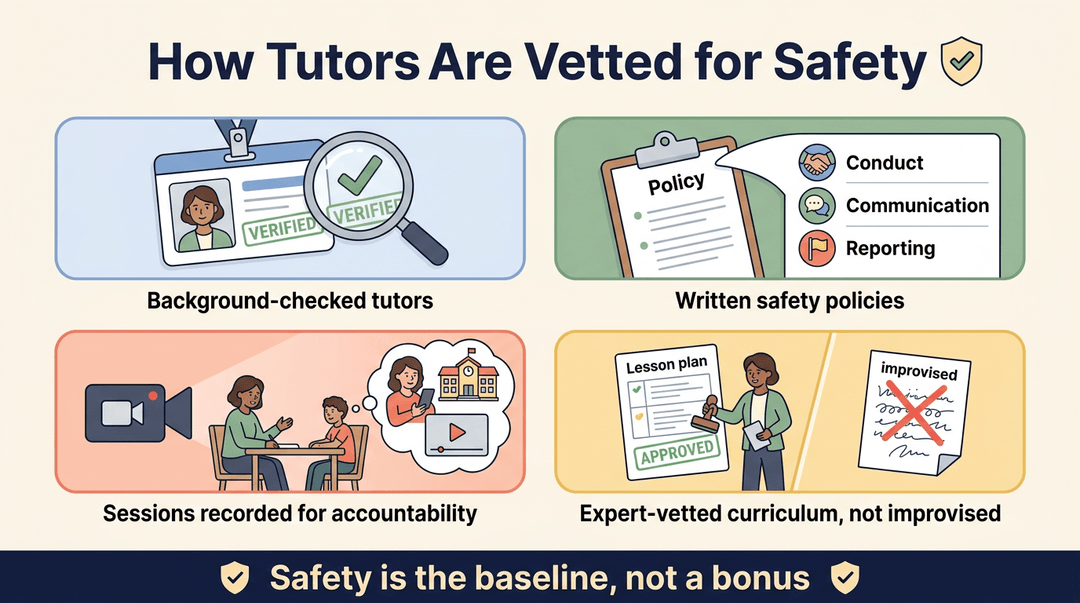
Trust starts before the first session. Reputable providers use background-checked tutors and publish clear trust and safety policies covering:
- conduct
- communication
- reporting
Ask whether sessions are recorded for accountability, so a parent or school can review what happened if a concern arises.
Look for an expert-vetted curriculum too, meaning lessons reviewed by educators rather than improvised on the spot. Safety is the baseline, not a bonus.
What parents and students say
Reviews offer a view from the families who lived it. Read the star ratings, but also the written comments, since a sentence about how a tutor explained fractions tells you more than an average.
Check the review counts too: a rating built on a few reviews is a thin signal. Some providers feature named tutor success stories. Treat those as a starting point and compare them with the wider reviews.
How Do I Start Online Tutoring?
Starting is more manageable than it sounds, and you can take it one step at a time. Here's the path, from building credentials to thinking through income.
Building a tutoring portfolio
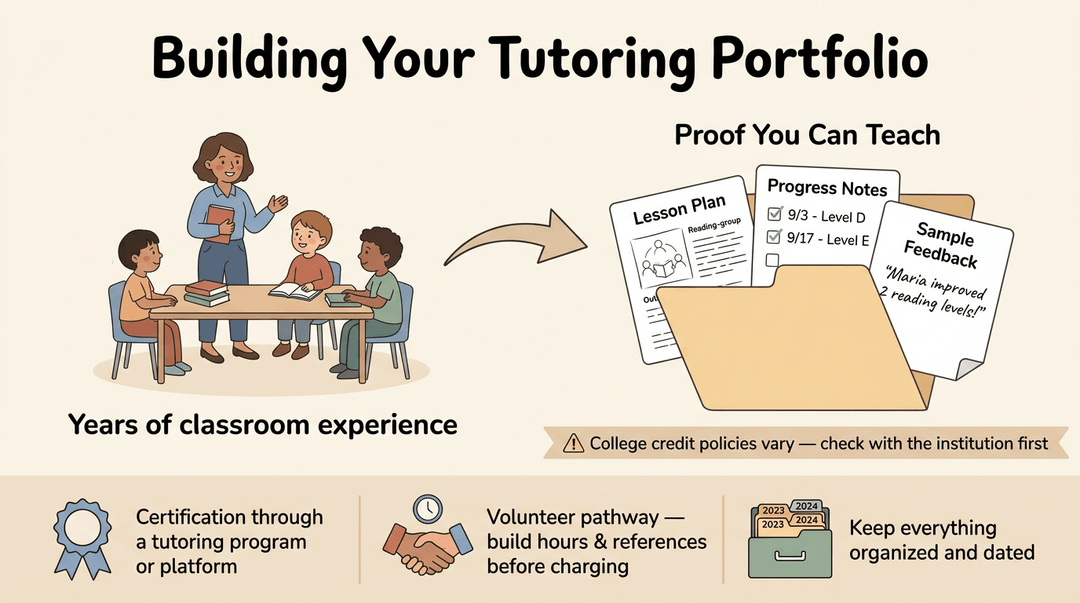
A verified tutoring portfolio shows families and platforms what you can actually do. Consider a fifth-grade teacher who has run small reading groups for years.
She can gather lesson plans, progress notes, and sample feedback, turning classroom experience into proof for a tutoring profile. Whether colleges recognize a portfolio depends on the institution, so check their policies first.
Many tutors also complete a certification process through a tutoring program or platform. If you're new, a volunteer tutor pathway lets you build hours and references before charging anyone.
Keep everything organized and dated so it's ready when you apply.
How much money can I make tutoring online?
Your income depends on your rates, your schedule, and the platform you choose, so no single number fits everyone. A science teacher who tutors two evenings a week will earn very differently from someone booking a few sessions a month.
- Apply to become a tutor through a platform or network that matches you with students.
- Set your own rates where the platform allows it, based on your credentials and subject.
- Get paid on the platform's schedule, which you should review before signing up.
- Join a tutor network to find steady sessions and peer support.
For balancing tutoring with your teaching load, build steady hours rather than maximum hours. Your classroom comes first. Start with one or two sessions a week and add more only once your grading and planning feel under control. Teachers weighing grading and planning time might also ask what ChatGPT for teachers is and how to start.
Whether you're a student looking for extra support or a teacher considering tutoring on the side, online tutoring works best when the fit is right and the plan is clear.
You'll have more confidence in your choices when you know what to expect at each step.
Ready to make your own planning easier? Check out our AI Lesson Editor, an all-in-one online teacher planner that helps you draft and refine lessons with built-in AI assistance.

References
- A review of Shadow Education and K-12 Students’ Learning — doi.org (2022)
- Nonprofit provides free tutoring for kids — news.stanford.edu
- Finding Ways to Attract Clients: A Content Analysis of Japanese Language Tutors’ Ads in an Online Tutor Marketplace — doi.org (2021)
- Ikamva Youth: Field Research Analysis — scholarcommons.scu.edu (2015)
- What is the partnership between College Board and Schoolhouse? — intercom.schoolhouse.world (2026)
Frequently asked questions
What is the best online tutoring website?
There is no single best online tutoring website for everyone. A strong choice is a reputable marketplace with a wide subject range, qualified or background-checked tutors, flexible scheduling, progress tracking, recorded sessions, and clear safety policies.
What are the top 10 online teaching websites?
Top online teaching websites include Tutor.com, Wyzant, Chegg Tutors, Preply, Outschool, Varsity Tutors, Cambly, Udemy, Coursera, and Khan Academy. The best option depends on whether you want live tutoring, language practice, self-paced courses, or a platform where you can teach independently.
How do I start online tutoring?
Choose a subject specialty, decide whether to use a marketplace or work independently, and prepare a stable internet connection, webcam, headset, and shared whiteboard. Create a profile or portfolio, set a rate based on comparable tutors, define your availability, and start with one or two sessions per week.
How much money can I make tutoring online?
Online tutoring income depends on your subject, credentials, hourly rate, schedule, and whether the platform takes fees. Typical tutoring prices often fall around $20 to $50 per hour, but your actual earnings depend on how many paid sessions you secure and your expenses.
How much do virtual tutors get paid?
Virtual tutors commonly earn roughly $20 to $50 per hour, although rates vary widely by subject, experience, location, and platform. Independent tutors may set their own rates, while marketplaces may set terms or deduct fees.
Is $30 an hour for tutoring good?
Yes, $30 an hour is generally a solid tutoring rate and falls within the typical range. It may be appropriate for many school subjects, though advanced subjects, test preparation, specialized support, and highly experienced tutors may charge more.
What platform is best for online tutoring?
The best platform depends on your needs rather than one universal winner. Look for a service with the right subject coverage, qualified tutors, flexible scheduling, transparent pricing, matching support, progress tracking, and strong trust and safety policies.
Which online tutor platform pays the most?
No single platform consistently pays the most because tutor earnings depend on subject demand, experience, rates, fees, and the number of students you attract. Platforms that let independent tutors set their own prices can offer higher gross rates, while managed networks may provide steadier student referrals but impose their own terms.