The Socratic Method of Teaching Explained, Step by Step

Jump to section
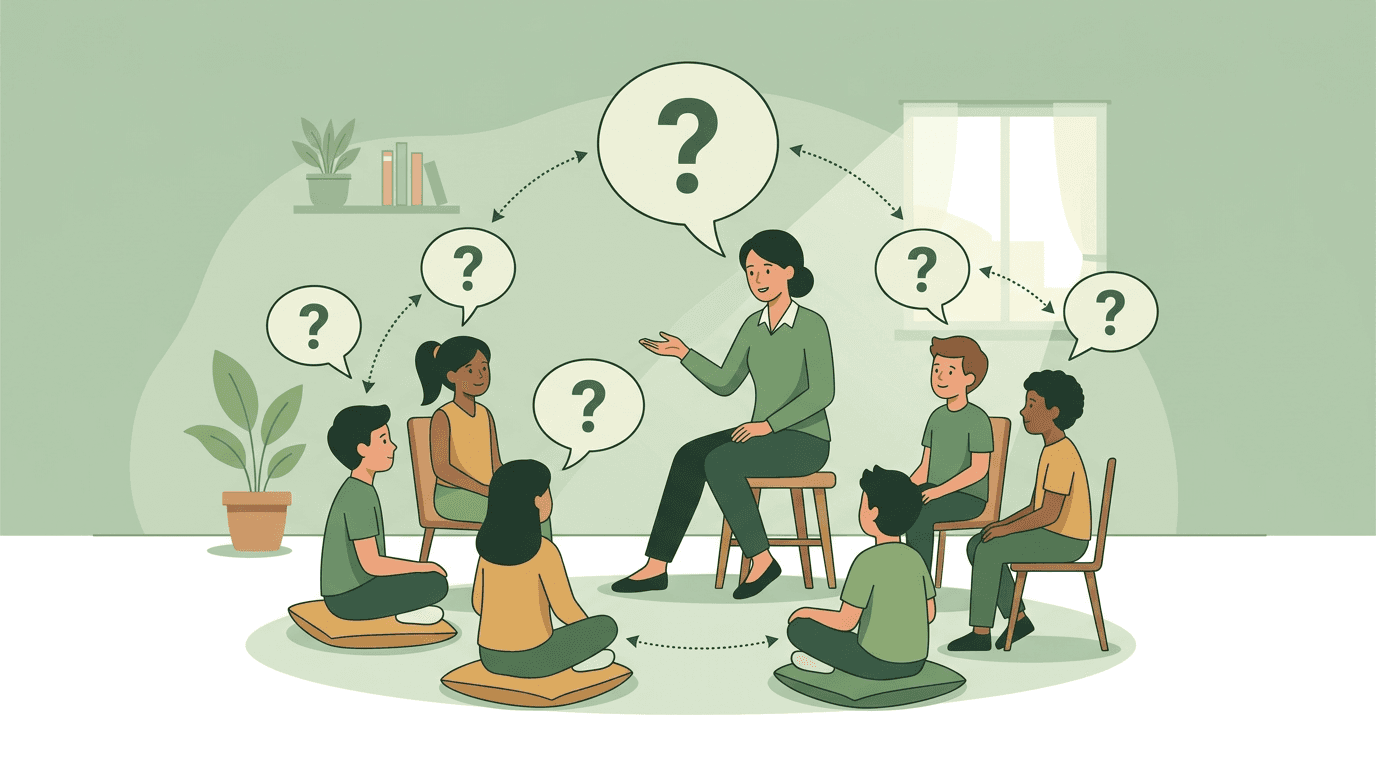
Think about the last time someone answered your question with another question, until you landed on the answer yourself. Teaching can work the same way.
That's the essence of the Socratic method: a style of teaching built on asking pointed questions instead of handing over answers. It's been shaping classrooms and courtrooms for centuries, and it's still relevant today.
In this post, we'll unpack where it came from, how it shows up in classrooms and law schools, and how you can run your own Socratic seminar step by step.

What Is the Socratic Method of Teaching?
Ask ten philosophers to define the Socratic method and you might get ten different answers. That's not a flaw in the research. It's baked into the method itself.
Why scholars can't agree on one definition
There's no official definition of the Socratic method, and that's surprised more than one teacher expecting a tidy checklist.
Instead, you'll find multiple scholarly interpretations, each emphasizing a different piece of what Socrates actually did in Plato's dialogues.
Some scholars even debate whether a single, consistent method exists at all, or whether Socrates simply improvised his questioning case by case.
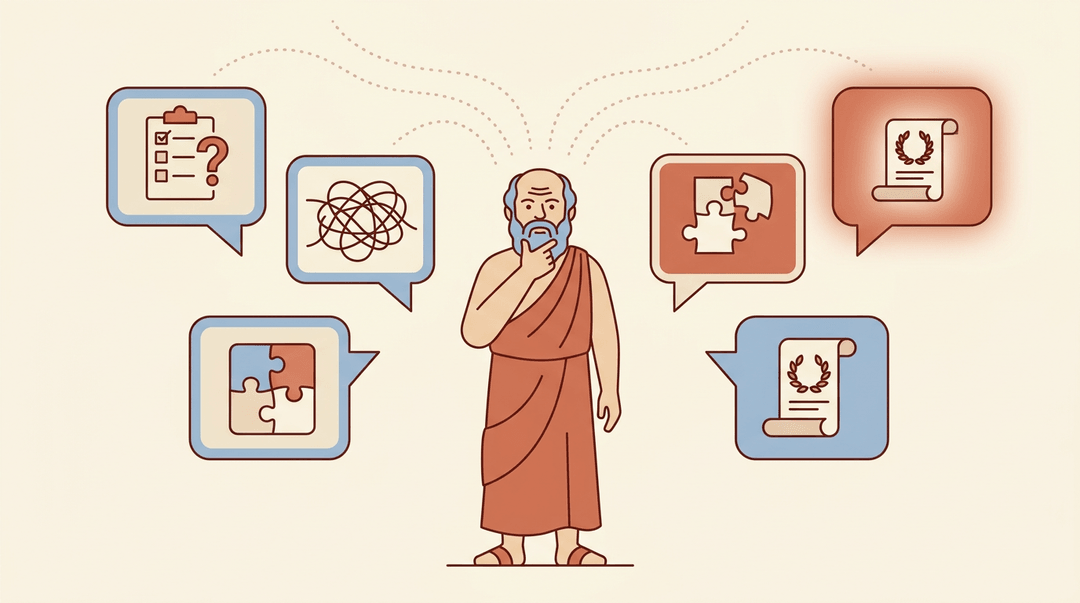
The most influential take comes from philosopher Gregory Vlastos, who named the practice the “Socratic elenchus”, a label that's shaped how later scholars argue about the method ever since.
What is another name for the Socratic method of teaching?
You'll also hear it called the elenctic method, the dialectic method, or simply elenchus, a term rooted in hypothesis elimination.
In practice, it's a form of cross-examination: a teacher asks pointed questions to expose a contradiction hiding inside a student's own belief.
The goal isn't to win an argument. It's the pursuit of truth and wisdom, even when that pursuit leaves the student in aporia, a state of productive doubt rather than a neat answer.
Why questions allow only two answers
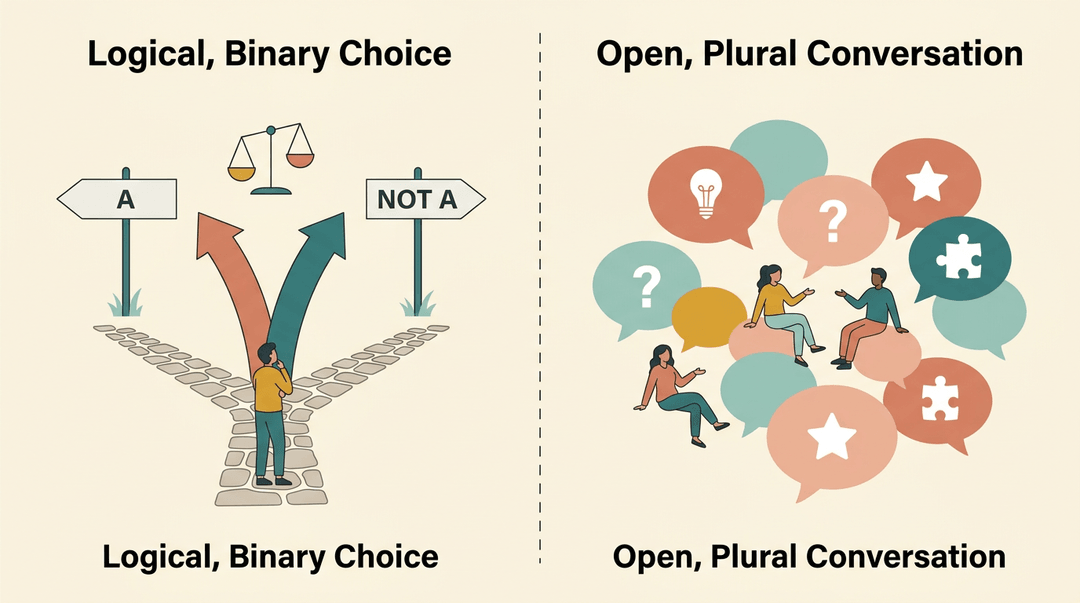
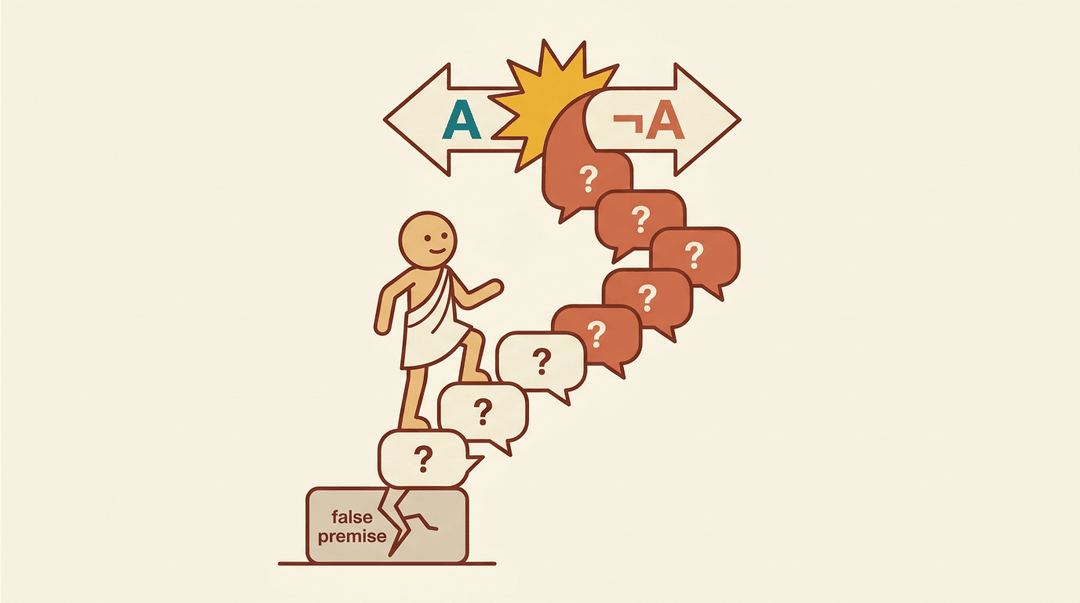
Socratic questions are built to allow only two possible answers: A or not-A.
That's the law of non-contradiction at work, and it's what makes the method so different from open-ended classroom discussion, where multiple answers can sit comfortably side by side.
Different Versions of the Socratic Method
Not every classroom calling itself "Socratic" runs the same way. What started as Socrates' own practice has split into several offshoots, each shaped by its setting and its goals.
The original method of Socrates
Socrates used his method for moral inquiry: probing what justice, courage, or virtue actually meant, not solving equations. He aimed to produce aporia, a state of puzzlement where a confident answer unravels under questioning. That unraveling came through elenchus, a logical refutation exposing contradictions in someone's claim. Each conversation chased a single philosophical question to its root rather than covering broad content.
What is didactic and Socratic?
Didactic teaching flips the dynamic: the teacher already holds the knowledge and steers questions toward a predetermined answer instead of open uncertainty. It centers on developmental reasoning, building a student's logic step by step, which is partly why its claim to Socrates' name is disputed: Socrates rarely led anyone to one "right" answer. That contrast still shapes how teachers run things today. Even in elementary grades, a fishbowl seminar (a small circle discusses while classmates observe, then swap in) can work if you narrow the question and keep turns short. Online classes adapt the same fishbowl using breakout rooms and a shared document for students who'd rather type than speak.

The Socratic method in law school
US law schools made cold-calling students their defining feature, which is why many associate "the Socratic method" with dread of being grilled on case facts. As Drexel Law Review notes, "The Socratic method... plays a significant role in the modern law school experience." Critics, famously dramatized in The Paper Chase, argue it intimidates more than it teaches.
Socratic Questioning Frameworks and Techniques
Asking a good Socratic question isn't guesswork: there's a real structure behind it. Here's what that structure looks like in practice, from the types of questions you'll ask to the stages a dialogue typically moves through.
The different types of Socratic questions
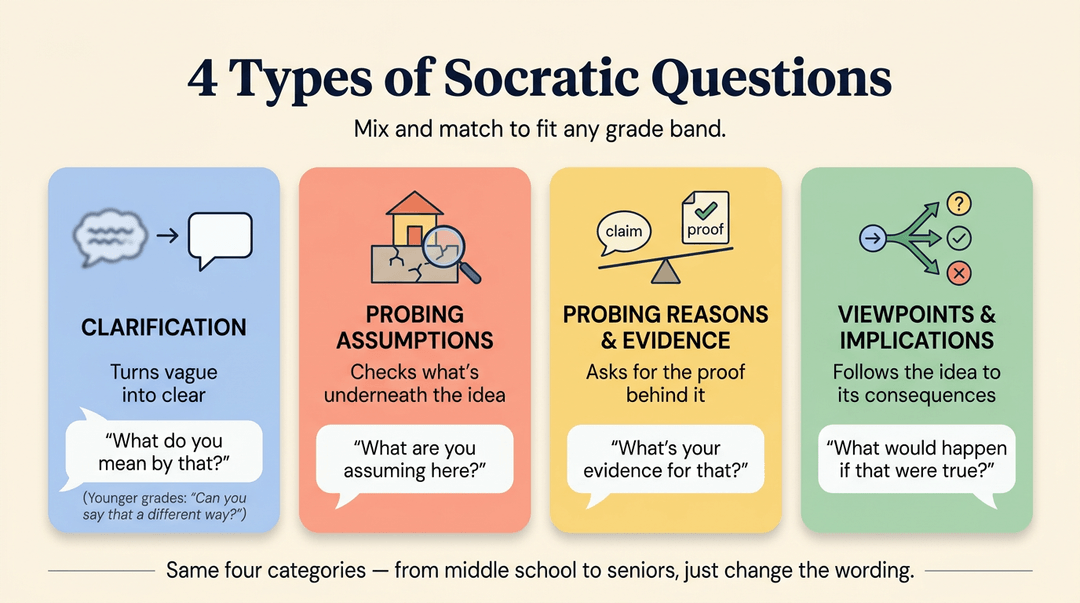
Most Socratic exchanges draw from four question types, each doing a different job:
- Clarification questions. "What do you mean by that?" (For younger grades: "Can you say that in a different way?")
- Probing assumptions. "What are you assuming here?"
- Probing reasons and evidence. "What's your evidence for that?"
- Viewpoints and implications. "What would happen if that were true?"
Mix and match these stems to fit the grade band, and the same four categories work whether you're teaching middle schoolers or seniors.
What are the five stages of Socratic dialogue?
Several thinkers have mapped the dialogue into steps. Boghossian's framework lays out five: wonder, hypothesis, elenchus (cross-examination), and on toward resolution. Lam's model condenses this into four steps:
- Eliciting preconceptions
- Clarifying them
- Testing hypotheses
- Deciding whether to accept them
Peterson outlines elements managers (and teachers) can use:
- Asking for justification
- Offering a counter-example
- Checking for agreement
- Drawing an analogy
Richmond et al. offer a similar four-part lens for keeping dialogue clear and purposeful.
How dialectical questioning builds to contradiction
Classic Socratic dialogue often runs on binary A/not-A questions, pushing a claim step by step until it meets its opposite. Each answer sets up the next question, tracing the reasoning back to a false premise.
That contradiction isn't a trick: it rests on the law of non-contradiction, the idea that two opposing claims can't both be true at once.
Running a Socratic Seminar Step by Step
A Socratic seminar runs on preparation: once it starts, your job is to ask, listen, and track, not to teach. Here's the full routine, from choosing the text to grading the discussion.
Before the seminar: four prep moves
- Pick a rich, debatable text. Run this test: could two reasonable students disagree about it?
- ✅ A short story with an unreliable narrator: plenty to argue about.
- ❌ A textbook passage of facts: nothing to debate, so no seminar.
- Write three to five open-ended guiding questions.
- Try: "Is the narrator someone we should trust? What makes you say so?"
- Skip anything answerable in one word.
- Post the norms where everyone can see them. On the board, exactly like this:
- "Cite the text. Build on ideas, don't repeat them. Disagree with ideas, not people."
- Assign fishbowl roles. Inner circle discusses; outer circle observes and takes notes.
- Give observers a job: track one speaker's evidence, or log the best question asked.
During the seminar: facilitate, don't lecture
- Ask your opening question, then step back. Let silence sit; students will fill it.
- Probe instead of answering. Your follow-ups do the teaching:
- Say: "Where in the text do you see that?"
- Say: "Can someone build on or push back against that idea?"
- Track participation on a roster checklist. One tally per contribution, a star for citing evidence.
- Redirect tangents calmly, without shutting anyone down.
- Say: "That's worth exploring. How does it connect back to our passage?"
⚠️ Watch out: the moment you answer your own question, the seminar becomes a lecture. Redirect every answer back to the circle instead.
After the seminar: close the loop
- Debrief with two questions. Ask the class: "What moved our thinking today? What got in the way?"
- Grade with a discussion rubric, not a gut feeling. Score what your checklist captured: textual evidence, building on peers, quality of questions asked.
- Bank your questions. The ones that sparked real debate will work again next unit with a new text.
Example: A seventh-grade teacher running a seminar on "The Giver" opens with one question: "Is sameness a fair price for safety?" She says nothing for twelve minutes, tallying contributions while the inner circle argues from the text. Her debrief takes three minutes; her rubric is already half filled in.
Adjusting for your grade level
| Your students | Adjust the format like this |
|---|---|
| Elementary | One-page text, 10 to 15 minutes, concrete questions ("Was the character fair?") |
| Middle and high school | Full inner-outer circle with observer notes and a midpoint swap |
| College and tutoring | Drop the circles: open dialectical dialogue where students pose the questions |
At a glance: prep the text, questions, norms, and roles; facilitate with probes and a tally sheet; debrief, grade, and bank what worked.
Save your seminar questions, norms, and rubric as a reusable lesson plan in EMStudio's online lesson planner so next unit's seminar takes minutes to prep.
Benefits and Drawbacks of the Socratic Method
Like any teaching method, this one comes with real trade-offs. Weighing what it does well against where it struggles helps you decide when to lean on it, and when to pull back.
What makes this method effective
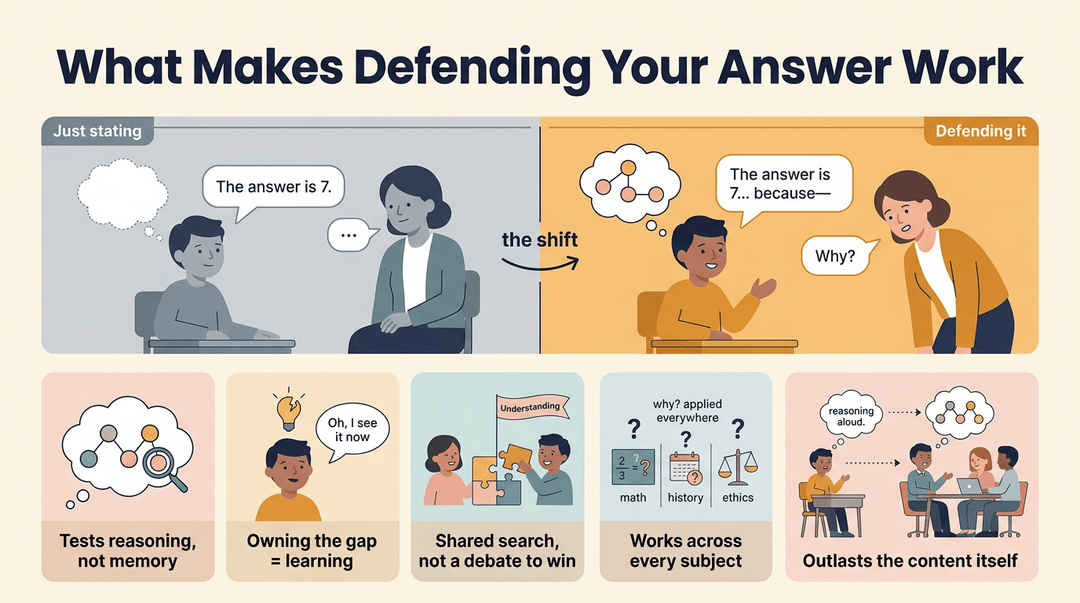
Ask a room full of students to defend an answer instead of just stating it, and something shifts. That shift is the whole point:
- Encourages critical thinking. Students have to test their own reasoning out loud, not just recall a fact.
- Builds intellectual humility. Getting questioned exposes gaps in your own logic, and owning that gap is part of the learning.
- Cooperative, not adversarial. Done well, it's a shared search for understanding, not a debate to win.
- Flexible across fields. It works as well in a math class as it does in a history or ethics discussion.
- Develops reasoning skills that carry over long after the specific content is forgotten.
Common criticisms and limitations
The same features that make it powerful also make it demanding:
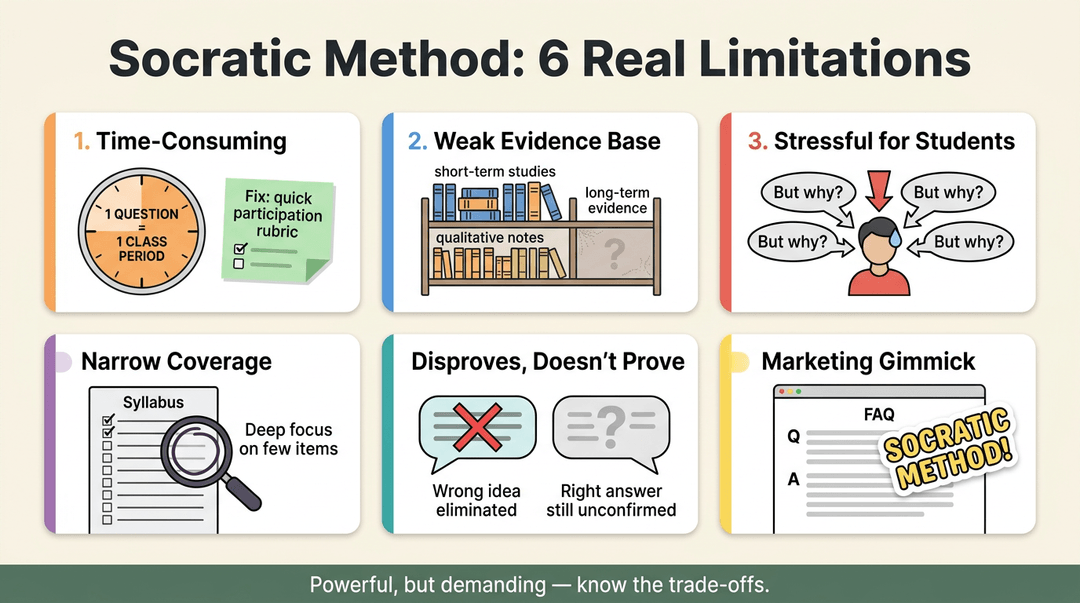
- Time consuming. A single question can eat up a whole period, which is why a simple rubric for grading seminar participation helps you track engagement without adding more prep.
- Lack of empirical support. A systematic review in Frontiers found that research on the Socratic method in math education leans on qualitative and short-term studies, not long-term evidence.
- Stressful for the interlocutor, especially a student who isn't used to being pressed for reasons.
- Limited content coverage, since depth comes at the cost of ground covered.
- Can't prove truth, only falsity: it's built to expose weak reasoning, not confirm a right answer.
- Misused as a marketing gimmick when brands slap the label on content that's really just a Q&A.
What Law School's Socratic Method Feels Like
Ask any law school graduate about their first year, and you'll likely hear one phrase: getting cold-called. This is the Socratic method at its most intense, and it shapes how an entire generation of lawyers learns to think on their feet.
How cold-calling works in class
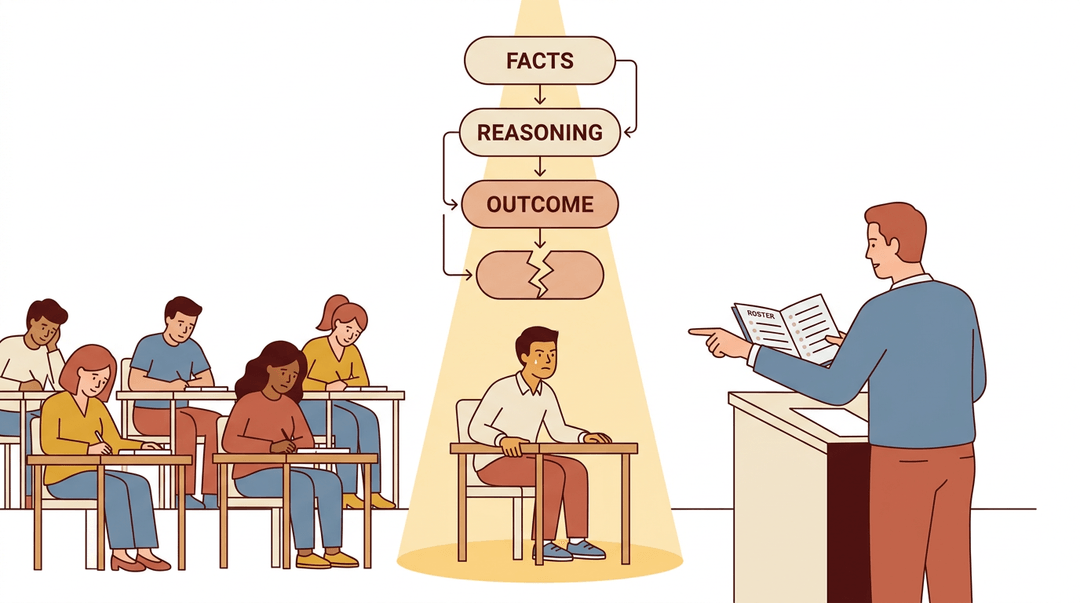
A professor might call on students at random, work through a prepared panel, or invite volunteers before circling back to anyone else.
Whatever the format, the pattern is the same: a series of probing questions that push a student to defend a case's facts, reasoning, and outcome, one layer at a time, until the logic either holds or cracks.
The fear and anxiety students feel
For a lot of first-year students, that pressure brings real fear and anxiety. Stumbling over a fact or missing a nuance in front of the whole room can feel embarrassing.
Professors often frame this as good confusion: the discomfort of not quite knowing is what pushes a student toward sharper understanding.
Plenty of law school anecdotes describe that first cold-call as the moment the method stopped being theoretical and started being personal.
How to survive being called on
Consider a first-year student who's just heard their name. The best move is to listen carefully to the actual question, not the one they expected. Being a good sport helps more than panicking does.
A short pause to think beats a rushed answer, and explaining why matters more than a flat yes or no. If they're unprepared, saying so plainly and reasoning through what they do know usually lands better than guessing.

Where the Socratic Method Came From
Every teaching method has an origin story, and this one starts with a single Athenian who never put a word of it on paper.
Who was Socrates
Socrates lived in ancient Athens in the 5th century BC, spending his days questioning soldiers, politicians, and craftsmen alike about what they really knew.
According to TheCollector, the Oracle at Delphi named him the wisest man in Athens, a claim he set out to test by cross-examining anyone who claimed expertise.
That same habit of asking hard questions eventually cost him his life: he was tried, convicted, and executed by drinking hemlock. He left behind no writings of his own.
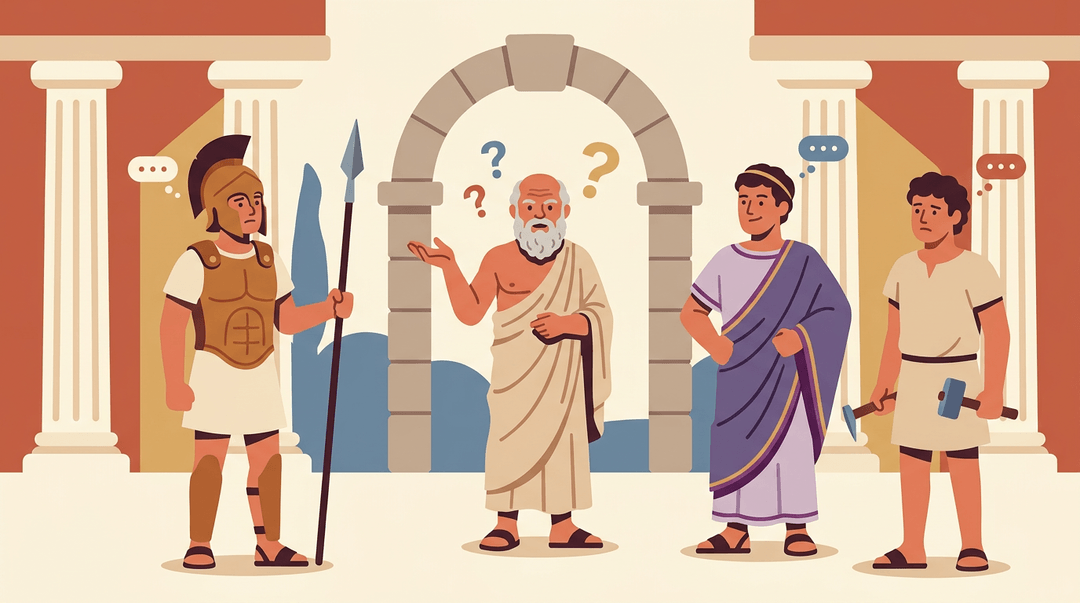
How we know about Socrates' teaching
Everything we know comes secondhand. Plato's dialogues are the main source, dramatized conversations that cast Socrates as the relentless questioner. Xenophon offers a secondary account, less philosophical and more biographical.
Aristotle, Plato's own student, later built on both. Scholars still debate how much of the "Socrates" in these texts is the real man and how much is Plato's own thinking.
How the method evolved after Socrates
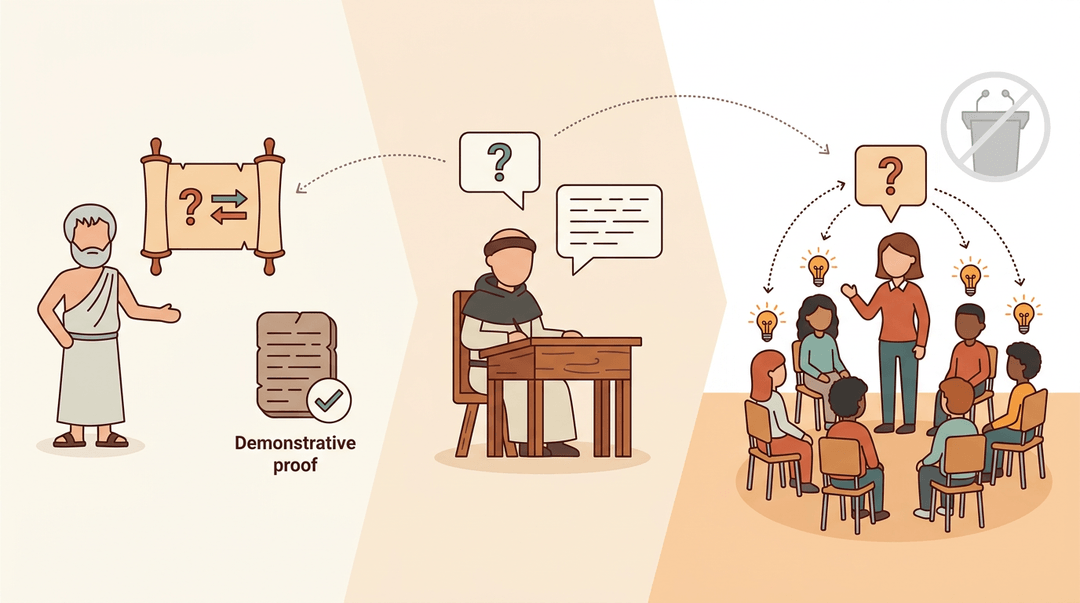
Aristotle split reasoning into two tracks: dialectical method (debate through question and answer) and demonstrative method (proof from fixed premises), laying it out in his Organon, his collected work on logic and argument.
Centuries later, Thomas Aquinas revived the question-and-answer structure in the Scholastic Method, used to work through theological debates. Over time, though, education drifted toward the systematic lecture, and dialogue slipped into the background.
The Socratic method isn't about stumping students. It's about handing them the tools to think for themselves, one well-placed question at a time.
Whether you're running a full seminar or just weaving a few questions into tomorrow's lesson, the goal stays the same: deeper thinking, not just right answers.
Ready to build that seminar into your week? Check out our Lesson Planning tool to plan it alongside everything else on your calendar.
References
- Frontiers | The Socratic method in mathematics learning: a systematic literature review — frontiersin.org (2026)
- Does Socrates Have a Method' Rethinking the Elenchus in Plato's Dialogues and Beyond | Reviews | Notre Dame Philosophical Reviews — ndpr.nd.edu
- Item - The Socratic Method as an Approach to Learning and Its Benefits - Carnegie Mellon University — kilthub.cmu.edu
- Ending the Chill of Cold Calling: A Multimodal Solution to the Pitfalls of the Socratic Method — drexel.edu
- Socratic Method as an Approach to Teaching — exa.ai (2016)
- Socratic Problem-Solving In The Business World — exa.ai (2009)
- Why Did the Oracle of Delphi Call Socrates the Wisest Man? — thecollector.com
Frequently asked questions
What is the Socratic method of discussion?
The Socratic method is a teaching and discussion approach based on asking pointed, sequential questions rather than directly providing answers. Questions test definitions, assumptions, evidence, and implications, helping participants examine their reasoning and discover contradictions or clarify their thinking.
What is another name for the Socratic method of teaching?
Another name for the Socratic method is the elenctic method, or elenchus. It is also sometimes called the dialectic method or Socratic questioning.
What is Socratic philosophy?
Socratic philosophy centers on examining beliefs through dialogue, questioning, and moral inquiry. It seeks wisdom by testing claims about concepts such as justice, courage, and virtue, often leading to aporia, or productive doubt, rather than a final answer.
What is didactic and Socratic?
Didactic teaching is teacher-directed and usually guides students toward predetermined knowledge or a correct answer. Socratic teaching relies on questioning and inquiry, allowing students to test their assumptions and reason through ideas rather than simply receive conclusions.
What are the five stages of Socratic dialogue?
There is no single universally accepted set of five stages. A commonly cited sequence is wonder or posing a question, forming a hypothesis, examining it through elenchus or cross-examination, identifying contradictions or weaknesses, and moving toward a revised understanding or resolution.
Who was Socrates?
Socrates was a Greek philosopher who lived in Athens during the fifth century BC. He wrote nothing himself and is known mainly through accounts by Plato and Xenophon; he questioned people about knowledge and virtue and was ultimately executed by drinking hemlock.
Did Socrates use the Socratic method?
Yes. Socrates used questioning and cross-examination to examine claims about knowledge, morality, and virtue. His dialogues often exposed contradictions in confident beliefs and led participants into aporia rather than supplying a predetermined answer.
Which statement best describes the Socratic method?
The Socratic method is best described as a structured dialogue in which a teacher or questioner uses probing questions to examine a person's claims, assumptions, reasons, and implications. Its purpose is to develop reasoning and uncover contradictions, not simply to lecture or deliver the correct answer.