After-School Tutoring: What to Expect and How to Get Started


Jump to section
Think about learning to drive. You can memorize the handbook all you want, but the real progress happens behind the wheel, with someone beside you who notices when you drift toward the curb.
After-school tutoring works the same way: it gives students extra time to practice, ask questions, and get back on track after the school day ends.
In this guide, we'll cover the types of programs available, the subjects they tackle, how sessions get scheduled, what they cost, and how you can spot the students who would benefit most.

What After-School Tutoring Programs Offer
After school is where a lot of learning either takes root or slips away. Here's a look at the main kinds of programs you'll run into and how a steady routine fits around them.
Free homework help through community programs
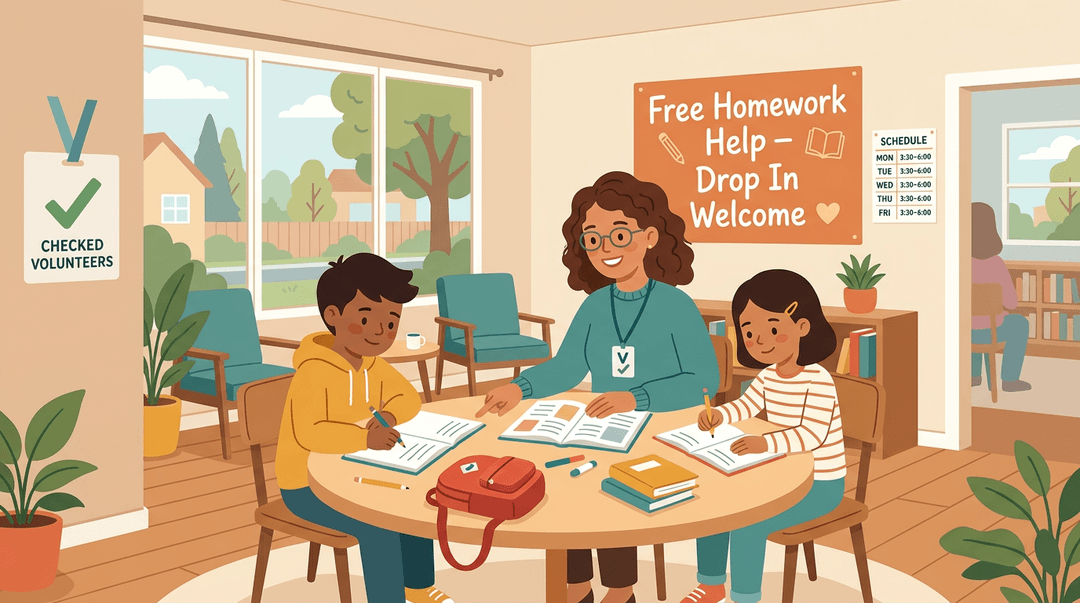
Community programs are often the first stop for families on a budget. Many offer drop-in homework assistance, so a student can walk in, get help with tonight's worksheet, and head home.
Volunteer and charitable tutors often cover multiple subjects, and sessions usually run on set weekly time slots. You'll find them on-site at youth centers and schools, which makes pickup simple.
Before you recommend one, ask how volunteers are screened. Good programs check backgrounds and train tutors before they work with kids.
Paid tutoring centers and learning businesses
Paid options include math-specific centers, reading or learning centers, and in-home or online tutors.
Franchise brands like Kumon, Sylvan, and Mathnasium follow set methods, while independent subject specialists in math or physics can go deeper on a single area.
Vet any provider the same way: confirm background checks, ask who will actually work with the student, and check that the tutor's training matches the subject.
Programs that combine childcare and tutoring
For working families, a program that pairs childcare with tutoring solves two problems at once. Boys & Girls Club style programs and STEM or enrichment clubs often serve kids from toddlers through teens, so one setting can grow with a child.
What does an after-school teacher do? They plan activities, supervise students, help with homework, and keep the routine steady from day to day. Duties vary by program, so ask for a written description before you enroll.

One-on-one instruction tailored to your child
One-on-one tutoring builds a customized learning plan around the student. A good tutor starts by identifying learning style, then focuses on strengths and weaknesses.
The plan is built around what the student knows rather than a one-size-fits-all worksheet, and that's what builds confidence.
What is a good after-school routine for kids? Keep it predictable: a snack, a short break, homework, then free time. Consistency does more than any single session.
Subjects and Skills Tutors Cover
Math often gets the spotlight in after-school tutoring, but tutors work across nearly every subject. Here's what you can expect to find, from core math to hands-on science labs.
Math topics from algebra to calculus
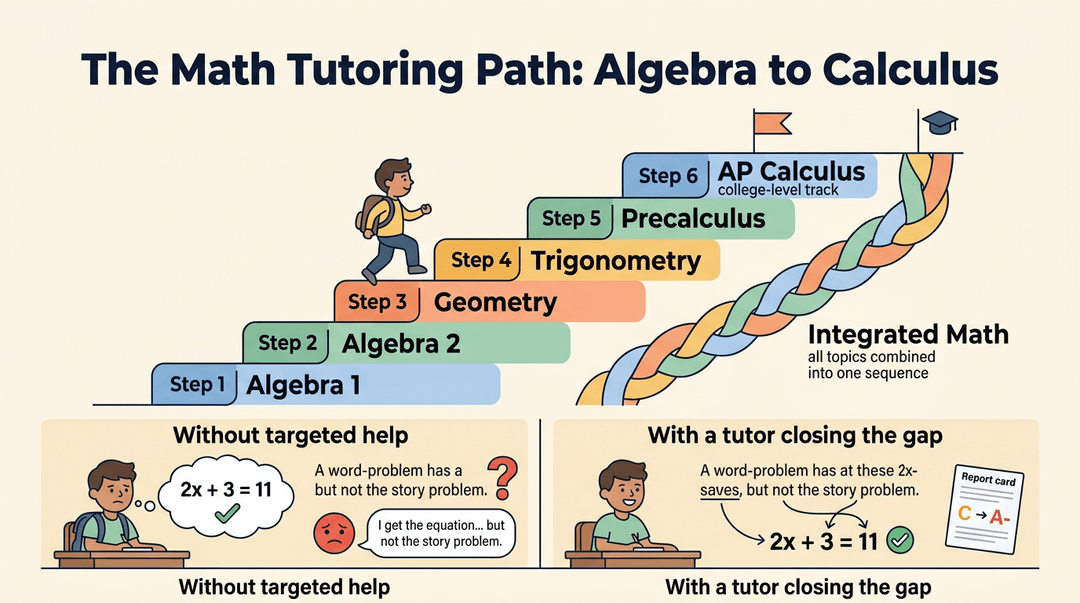
Math is where many students need the most help, and tutors typically cover a clear progression:
- Algebra 1 and Algebra 2
- Geometry
- Trigonometry
- Precalculus
- AP calculus (Advanced Placement, the college-level course track)
- Integrated math, which combines topics from several math courses into one sequence
Think of a ninth grader who understands linear equations in class but freezes when they're mixed into word problems. A tutor who works through that exact gap can turn a shaky grade into a solid one.
Reading comprehension and writing skills
Reading and writing are closely linked, so tutors often work on them together. Common focus areas include:
- Reading comprehension: understanding what a passage says and why it matters
- Vocabulary building: learning words in context so they stick
- Writing skills: organizing ideas, building arguments, and editing
- Critical thinking: asking why a claim holds up, not just what it says
Consider a middle schooler who reads every paragraph but can't explain the main idea. A tutor who asks guiding questions after each page builds the habit that makes the next chapter easier.
Science help including hands-on labs
Science tutoring usually splits into subject areas and practical work:
- Biology: cells, ecosystems, and the body systems students study
- Chemistry: reactions, measurements, and the periodic table
- Lab experiments: planning, running, and writing up hands-on investigations
A high school chemistry student might balance equations on paper but lose track during a lab. A tutor who walks through the procedure beforehand means the student spends lab time thinking instead of scrambling.

Learning a new language
Language tutoring focuses on practice, not just rules:
- Spanish instruction: vocabulary, grammar, speaking, and listening
- Culture study: the traditions, holidays, and everyday life behind the words
Learning a language is less about memorizing charts and more about using the words. A tutor who gives a student real conversation practice often builds confidence more quickly than a worksheet alone.
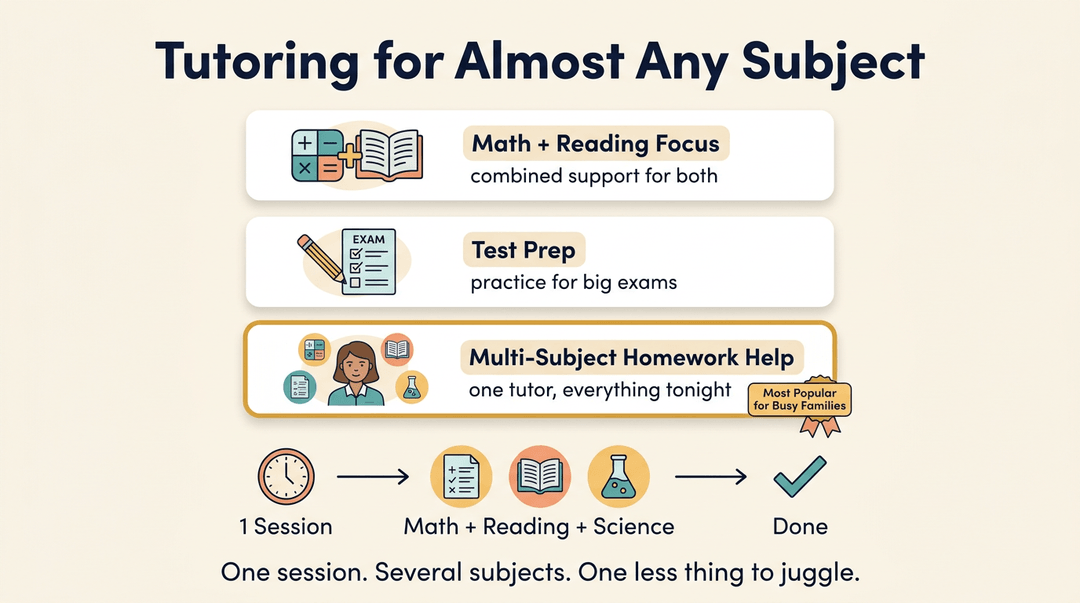
Tutoring available for almost any subject
Beyond the core subjects, you'll find tutors who focus on:
- Math and reading focus: a combined program for students who need support in both
- Test prep subjects: practice for standardized and entrance exams
- Multi-subject homework help: one tutor covering whatever the night's assignments bring
For a busy family, multi-subject homework help is often the simplest option. One session covers the math worksheet, the reading log, and the science question. One session, several subjects, and one less thing to juggle.
Connecting Classroom Learning to After-School Tutoring
Use this guide to notice who needs tutoring, hand a tutor what they need, and see whether it's working. It's one loop: spot, share, track.
Spot the need early
You see these students every day, so you'll notice before anyone else. Find your signal, read across.
| When you see... | Try... |
|---|---|
| Grades drop on two assessments in a row | Name the skill behind the drop, then contact home |
| Homework goes missing again and again | Ask what's getting in the way, then email parents |
| Focus slips during independent work | Jot down the topic and time of day it happens |
Then alert parents early, before report cards do it for you. Say: "We've noticed Maya's fraction quizzes dipping. Tutoring might help, and we'd like to plan it with you."
Brief the tutor
A tutor can only reinforce what they know about. Send one short page covering the current unit, specific skill gaps, supports, and a shared target. Here's what it looks like filled in:
Current unit: Adding fractions with unlike denominators Skill gaps: Finding common denominators; simplifying answers Supports (IEP/504): Extended time; directions in short chunks Shared target: Maya scores 80% on the unit quiz within three weeks
Keep the gaps specific. ✅ "Struggles to find common denominators" gives a tutor a place to start. ❌ "Bad at fractions" doesn't. The difference is that the first names a skill someone can practice.
⚠️ Watch out: Share IEP/504 notes only with family permission and within your school's privacy policy. Pass along the accommodations that help, not the whole file.
Track whether it's working
Tutoring only counts if it shows up in your classroom. Once a week, check:
- Homework completion: Is more of it coming in, and on time?
- Quiz trends: Are scores moving up across two or three quizzes, not just one?
- Progress notes: Did you log what you saw and what the tutor reported?
Then adjust your own support to match what the data shows.
| If you see... | Then... |
|---|---|
| Homework is up, quizzes flat | Ask the tutor to shift from completion to the target skill |
| Quizzes rising | Raise the target or reduce the tutoring frequency |
| Neither is moving | Call the tutor and family, and revisit the skill gaps |
Example: A sixth-grade math teacher logs one line after each Friday quiz: score, homework count, and one observation. After three weeks she sees homework is steady but ratio problems still stall. She emails the tutor, who spends the next two sessions on ratio tables.
A dated one-line log is enough. It gives you something concrete to share at the next parent conversation.
Keep rosters, notes, and progress logs organized in one place with EMStudio's class management tools.
Challenges Tutoring Can Help Solve
Not every struggling student needs the same kind of help. Some are stuck on one concept, while others hit roadblocks that show up in every subject, so knowing the difference helps you pick the right support.
Struggles With Study Skills and Time
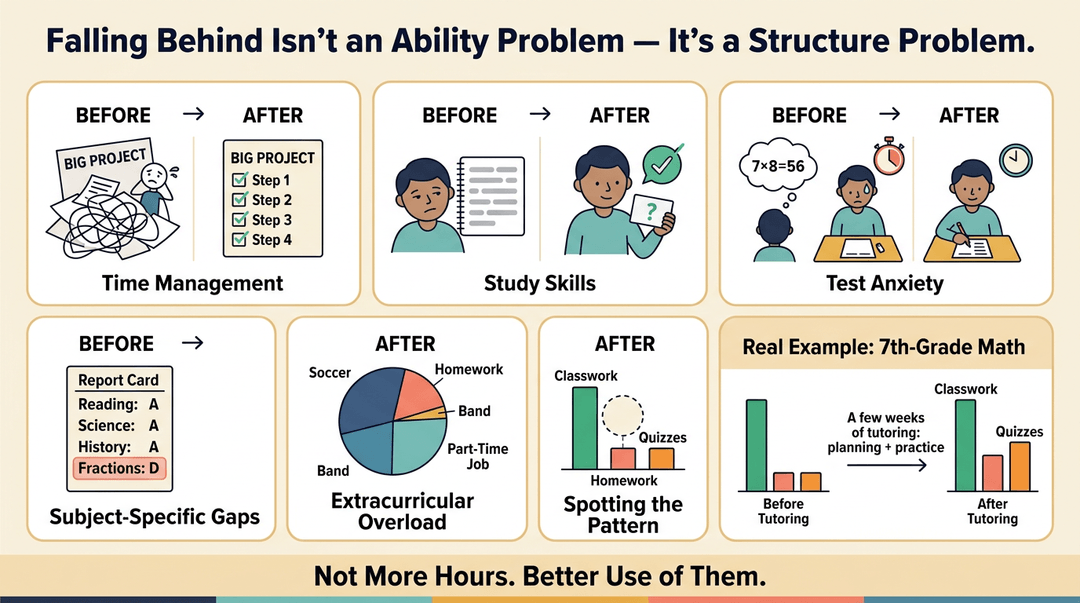
Many students who fall behind aren't short on ability. They're short on structure. Tutoring can address several common challenges:
- Time management issues: Assignments pile up because students don't know how to break big projects into smaller steps.
- Poor study skills: Students reread their notes instead of quizzing themselves, so little of it sticks.
- Test anxiety: Some students know the material but freeze when the timer starts.
- Subject-specific difficulty: A student may struggle with fractions or essay writing while doing fine everywhere else.
- Balancing extracurriculars: Sports, music, and part-time jobs can leave little room for homework.
- Spotting students who need tutoring: Look for patterns, such as strong classwork paired with missed homework or quizzes, rather than reacting to one bad grade.
Consider a seventh-grade math teacher who notices a student acing class work but skipping most homework and failing quizzes. A few weeks of after-school sessions focused on planning and practice can turn that pattern around.
The payoff is less about more hours and more about better use of them. Often, that's the whole problem.
Getting Ready for Big Tests
Big tests can feel like a make-or-break moment for students and teachers alike. Here's how to prep in a way that actually moves scores, so you can coach your students or point families toward the right kind of help.
Prepping for the SAT and ACT
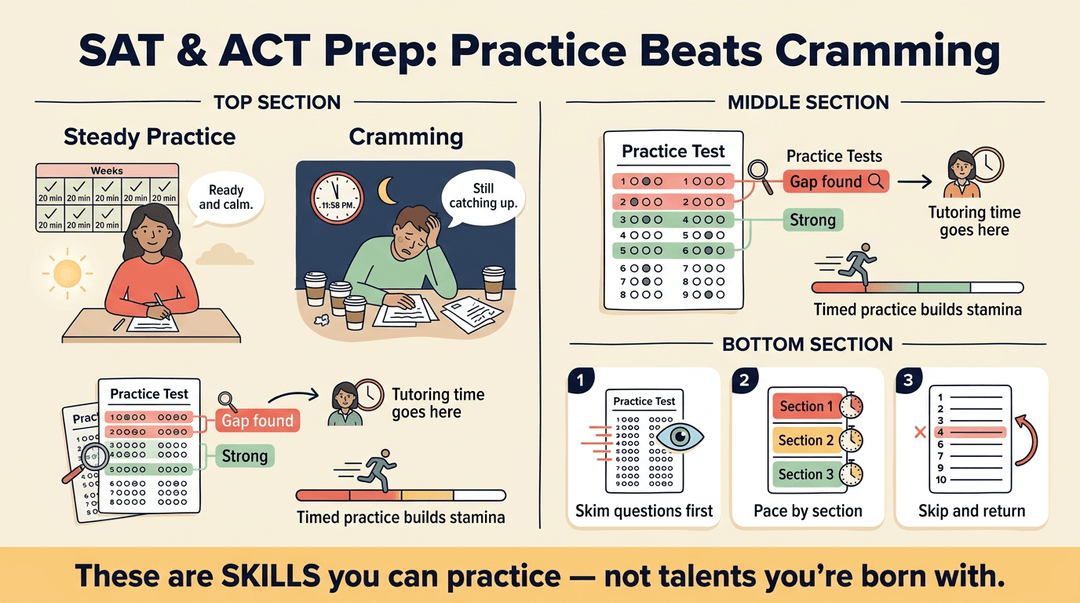
SAT prep and ACT prep are the college admissions tests most of your high schoolers will face. Both reward steady practice over last-minute cramming. Consider a junior who spends twenty minutes a day on reading passages for six weeks.
She'll sit down far more comfortable than a classmate who crams the night before.
Practice tests are where the real learning happens. Each one shows you where a student's gaps are, so tutoring time goes exactly where it's needed. Timed sessions also build stamina, which many students underestimate.
Test-taking strategies round out the plan. Teach students to:
- skim questions first
- pace themselves by section
- skip and return instead of stalling
These are skills you can practice, not talents a student either has or doesn't.
Studying for Other Standardized Exams
Not every big test is a college admissions test. Several others serve different students, and each needs its own focus:
- GED prep supports adults and older teens working toward a high school equivalency credential.
- Nurse exam prep helps students entering nursing programs build the content knowledge licensure requires.
- Magnet school test prep gets younger students ready for selective-entry placement tests.
- Bar and medical licensing exam prep is a longer-range commitment for graduate-level learners.
Match the prep to the test, and your students' time goes much further.
How Tutoring Sessions Get Scheduled
Scheduling decides whether tutoring actually helps, so it's worth getting the pieces right first. Here's how frequency, timing, and setting usually fit together.
How Many Hours of Tutoring Are Recommended?
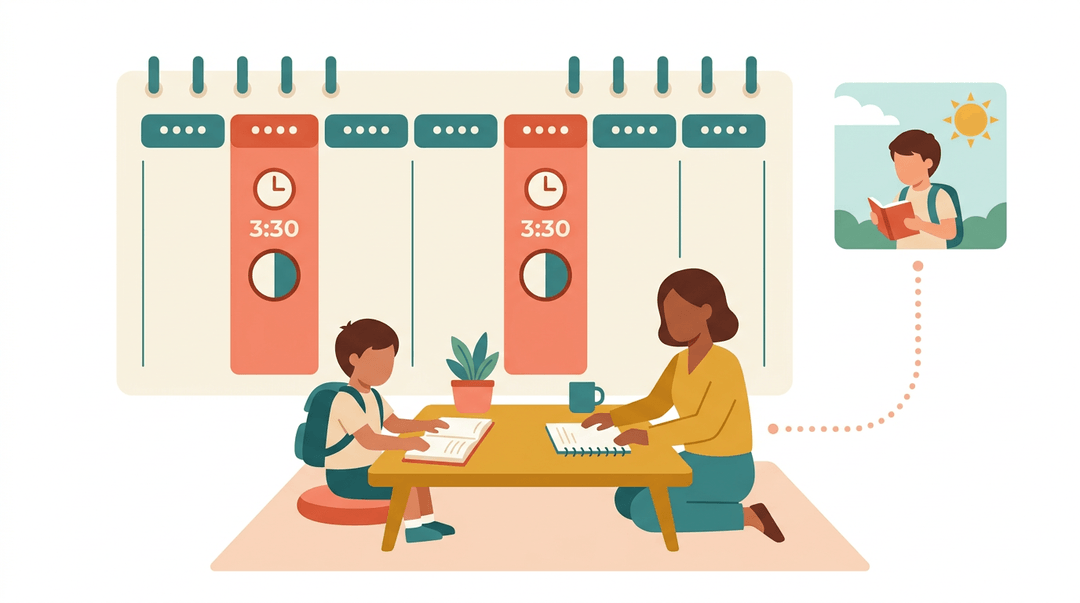
Start with frequency. Tutoring can run weekly or bi-weekly (every other week), and the right pace depends on how much support a student needs.
A Marzano Research article on peer tutoring suggests sessions be three times a week at most and last about half an hour. Pace matters, so how often you meet can count as much as how long each session runs.
Next, pick a structure. Fixed days and times, like every Tuesday and Thursday at 3:30, help students build a habit. Flexible scheduling suits busy families, though it can be harder to keep consistent.
Timing is flexible too. Sessions can happen after school, on weekends, or during breaks. Consider a sixth-grade student who meets a tutor on Monday afternoons and again during spring break. She stays sharp and returns to class ready for the next unit.
What Are the Best Online Tutoring Platforms?
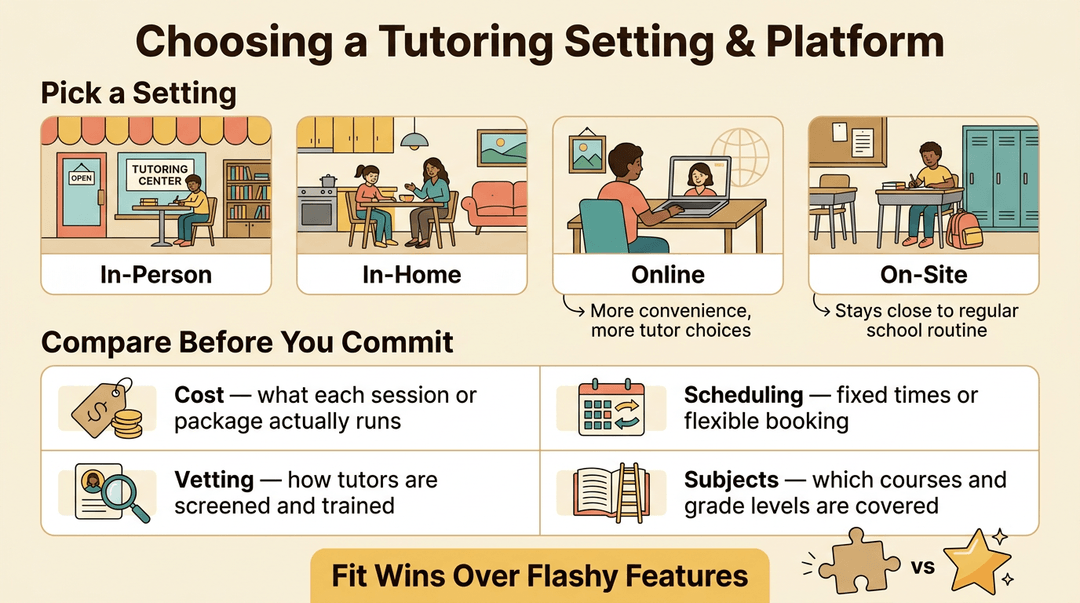
Setting is the next decision. In-person tutoring at a center, in-home tutoring, online tutoring, and on-site sessions at a school or youth center each suit different families.
Online options offer convenience and wider access to tutors, while on-site sessions keep students close to their regular classroom routine.
When you compare platforms, look at the details that matter most:
- Cost: what each session or package runs
- Tutor vetting: how tutors are screened and trained
- Scheduling: whether you can book fixed or flexible times
- Subjects: which courses and grade levels they cover
Ask each provider for these details before you commit. The right platform is less about flashy features and more about fit with your student's schedule. Fit wins.
What Tutoring Costs and How to Get It
Cost is often the first question families ask, and it shapes which option makes sense. Here's how the main routes compare and what to expect when you sign up.
Comparing Free and Paid Tutoring Options
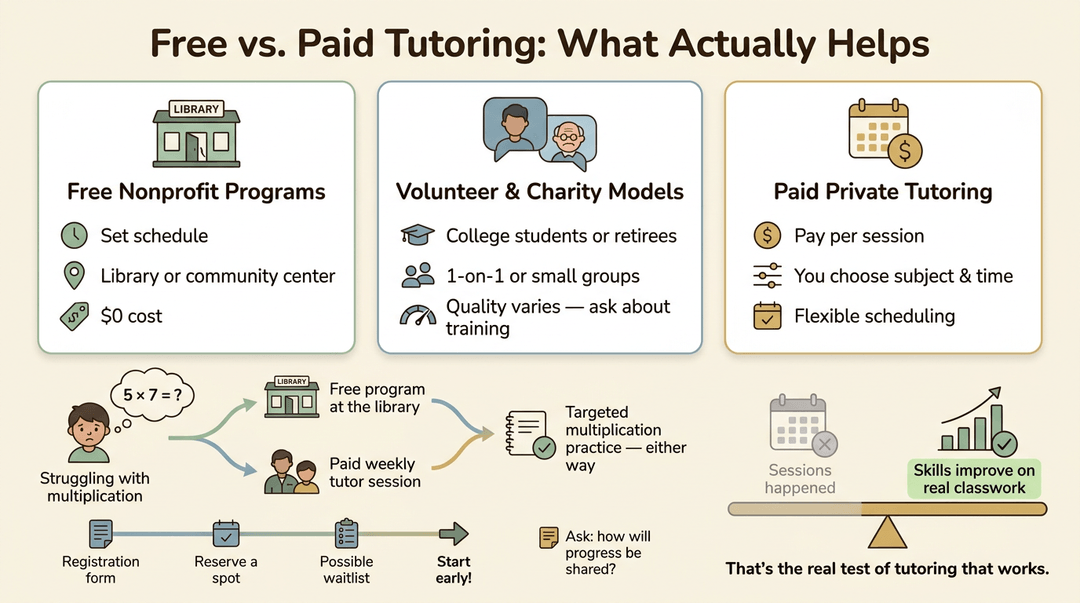
- Free nonprofit programs. Many community organizations offer tutoring at no charge, often on a set schedule at a library, community center, or school.
- Charitable and volunteer models. Volunteers, sometimes college students or retirees, work with students one-on-one or in small groups. Quality varies, so ask how tutors are trained.
- Paid private tutoring. A private tutor typically charges by the session or hour, and you choose the subject, time, and focus.
Consider a fifth-grade teacher whose student is struggling with multiplication. She can point the family toward a free program at the local library, while a family with a tighter budget might book a paid tutor for one weekly slot.
Either way, the student gets targeted practice.
Sign-up and reservation usually happen ahead of time. Most programs require a registration form and a reserved spot, and some keep waitlists. Start early. Once a student is enrolled, ask the provider how progress will be shared with you.
What separates tutoring that helps from tutoring that just fills time is whether skills improve on the classwork you're seeing, not just whether sessions happen.
Finding Tutoring Programs Near You
Before you compare subjects or prices, know what's available nearby. It's less about finding every program and more about finding the right one close to home.
Local Directories and Centers to Check
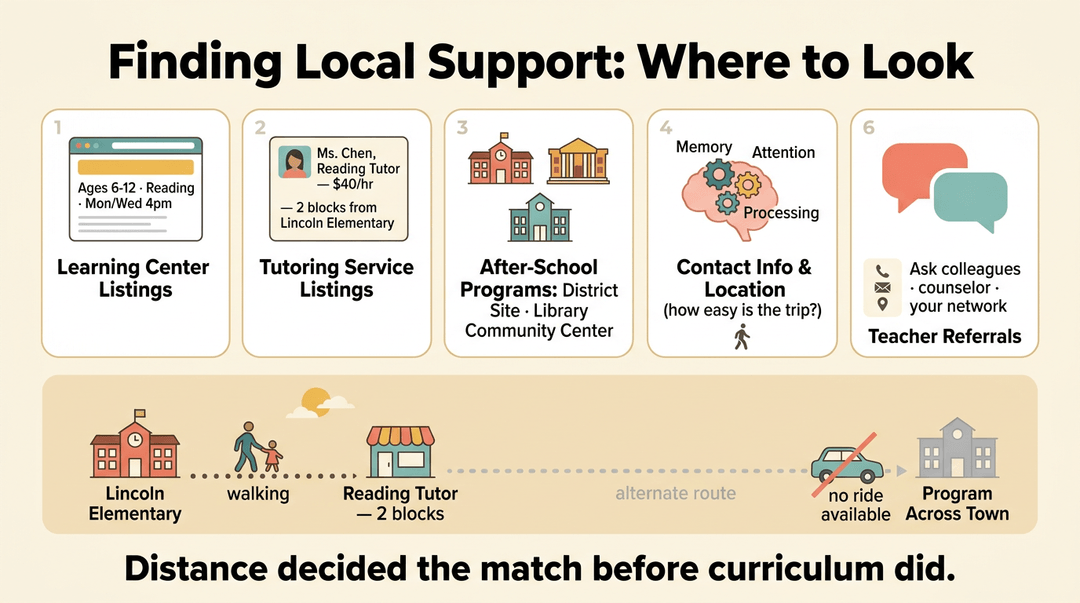
- Learning center listings: Many local learning centers post their subjects, age groups, and session times online.
- Tutoring service listings: Independent tutors and small tutoring companies often appear in community directories.
- After-school program listings: Check your district's website, the public library, and community centers.
- Cognitive skills centers: These programs target underlying skills like memory, attention, and processing that support reading and math.
- Contact info and locations: Record each provider's phone, email, and address, plus how easily families can get there.
- Teacher referrals to local programs: Colleagues, your school counselor, and your own network often know which providers families already trust.
Consider a fourth-grade teacher whose student Maya needs reading support, but whose family can't drive across town. The teacher finds a reading tutor two blocks from school, and Maya's family can walk there after dismissal.
Distance decided the match before curriculum did.
Extra Tools for Learning at Home
Sometimes the best extra help happens at the kitchen table, after the bell rings. Here are a few free sites you can point students toward when they want to practice on their own.
Free Websites for Self Study
These sites support self-study, where students work through material independently and at their own pace. Consider a fifth grader who struggled with multiplication today. A short session on one of these sites can reinforce the lesson before it fades.
Some options to explore:
- Khan Academy: a broad library of lessons and practice across many subjects.
- Brainly: a homework help community where students can ask and answer questions.
- Chegg: homework help and study resources.
- Funbrain: games and activities that make practice feel more like play.
- Mathblaster: math practice built around a game format.
- Hoodamath: math games and puzzles for building skills.
Don't hand out a long list and hope for the best. Preview each site first, then recommend the one that matches a student's specific gap. The goal is practice rather than passive watching.
Tutoring works best when it's connected to what happens in your classroom.
When you notice which students are struggling, share that insight with a provider and keep the focus on the skills they need most, and extra support becomes real progress instead of just more homework.
Ready to keep track of who needs help and when? Check out our Classroom Management feature, an all-in-one online teacher planner for organizing classes, rosters, and timetables in one place.

References
- Four considerations for developing a peer tutoring program — marzanoresearch.com
Frequently asked questions
What is a good after-school routine for kids?
A good after-school routine is predictable: have a snack, take a short break, complete homework or tutoring, and then allow free time. Consistency helps children manage their energy and responsibilities without making every afternoon feel different.
What are the best online tutoring platforms?
Good online tutoring platforms should match the student's subjects, grade level, schedule, and budget. Compare tutor screening and training, cost, scheduling flexibility, and subject coverage rather than choosing based only on flashy features. Khan Academy is also useful for free, independent practice, though it is not a substitute for live tutoring.
How many hours of tutoring are recommended?
There is no single recommended number of tutoring hours for every student. Sessions may be weekly or every other week, and a commonly suggested structure is up to three sessions per week lasting about 30 minutes each. The right amount depends on the student's skill gaps, workload, and progress.
What does an after school teacher do?
An after-school teacher plans activities, supervises students, helps with homework, and maintains a steady daily routine. Some programs also include childcare, enrichment, or subject support, so responsibilities can vary by setting.