Reading Levels, Decoded: From Measurement to Lesson Planning

Jump to section
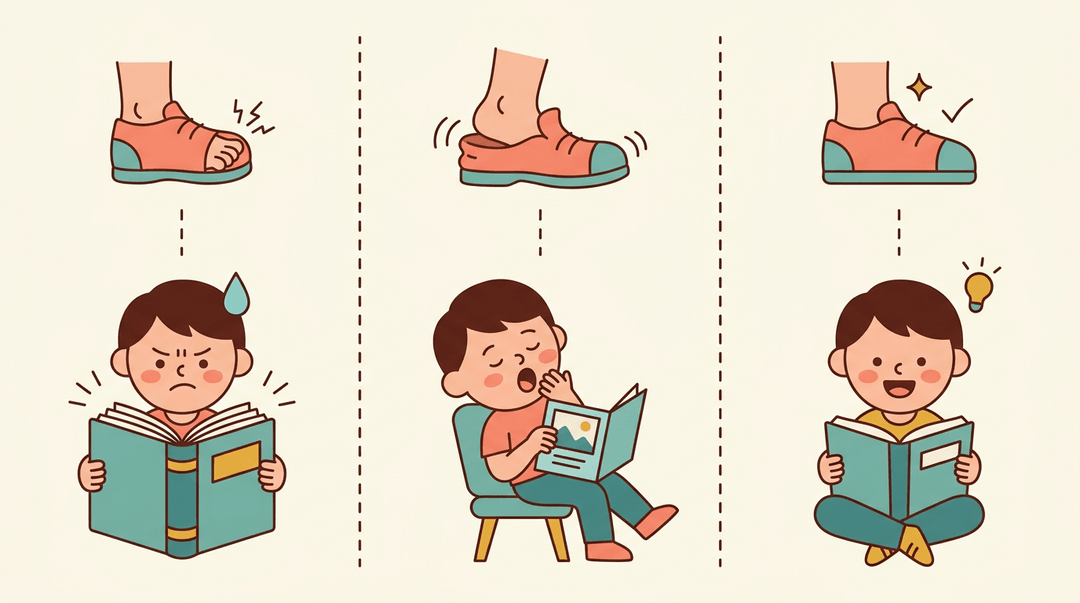
Ever tried to buy shoes for a kid who's grown three sizes since last fall? Guess wrong and they either pinch or flop around. Books work the same way: hand a student the wrong fit and they either stall out or tune out.
A reading level is simply a way to match a book's difficulty to a student's current skill, so the fit is right. In this post, we'll break down the major systems, show how they're measured, and turn those numbers into lesson plans you can actually reuse.
What Reading Levels Are and Why They Matter
A reading level is a starting point, not a verdict on a child. Used well, it's the tool that gets the right book into the right hands at the right moment.
Matching kids to the right books
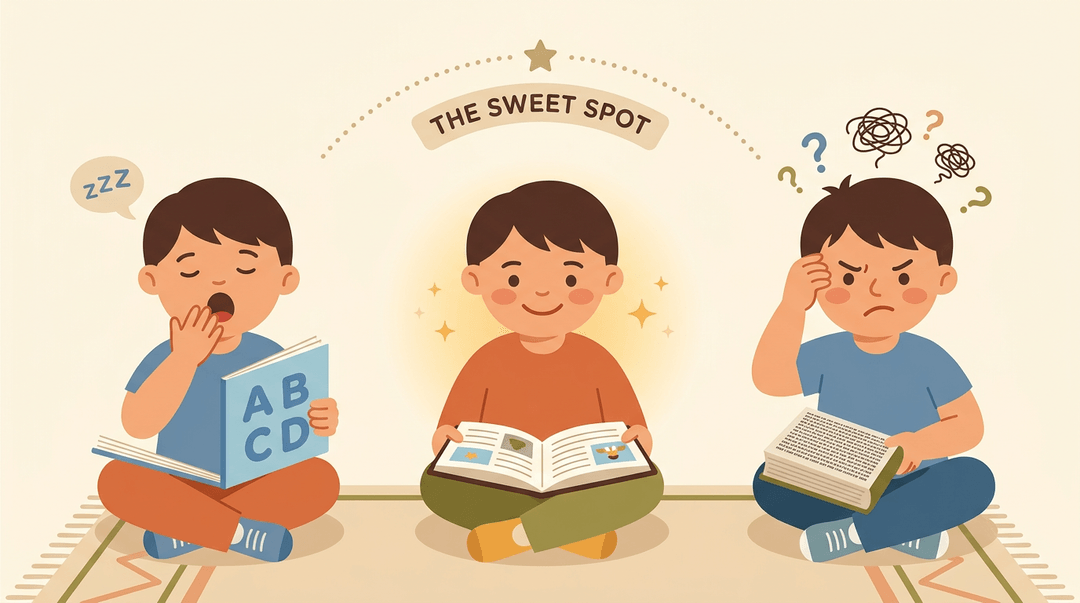
A reading level exists to match kids to appropriate books: not too easy, not too hard. Go too low and kids get bored. Go too high and they get frustrated and shut down.
The sweet spot depends on vocabulary, topic familiarity, and sentence complexity, not just a grade printed on a report card.
A fifth grader can read at a third-grade level in October and a sixth-grade level by spring, so reading level and grade level are related, not identical. Watch for the signs of below-level reading:
- slow, choppy decoding
- frequent word substitutions
- skipped punctuation
- a student who avoids reading time altogether
For example, a second-grade teacher who notices a student guessing at words instead of sounding them out can flag that early, before frustration turns into avoidance.
Do 54% of Americans read at a 6th grade level?
Not every child fits neatly into a single number, and a Lexile score isn't absolute: it's an estimate, not a ceiling.
That mismatch between grade level and reading level is exactly what discourages a bright fourth grader handed a grade-level text he can't yet decode. It's also real at scale.
National University reports that roughly 54% of U.S. adults aged 16 to 74 read below a sixth-grade level, a reminder that reading levels matter well past childhood.
Why publishers label levels differently
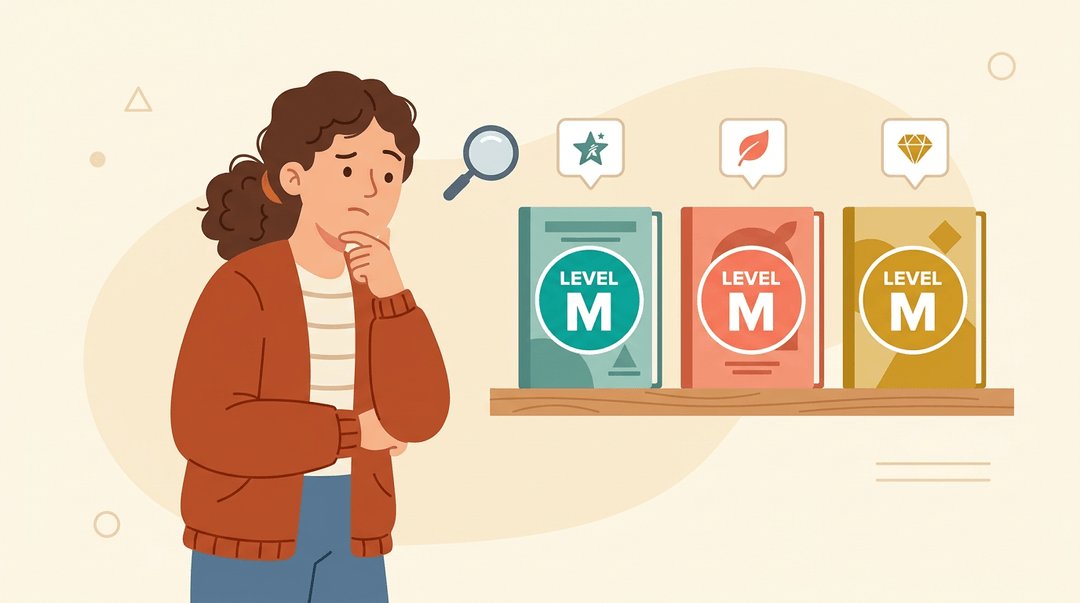
Publishers often use their own leveling systems, so the same label (say, a "Level M") can mean different things depending on the source. Always check the system behind the label.
What Are the 5 Reading Levels?
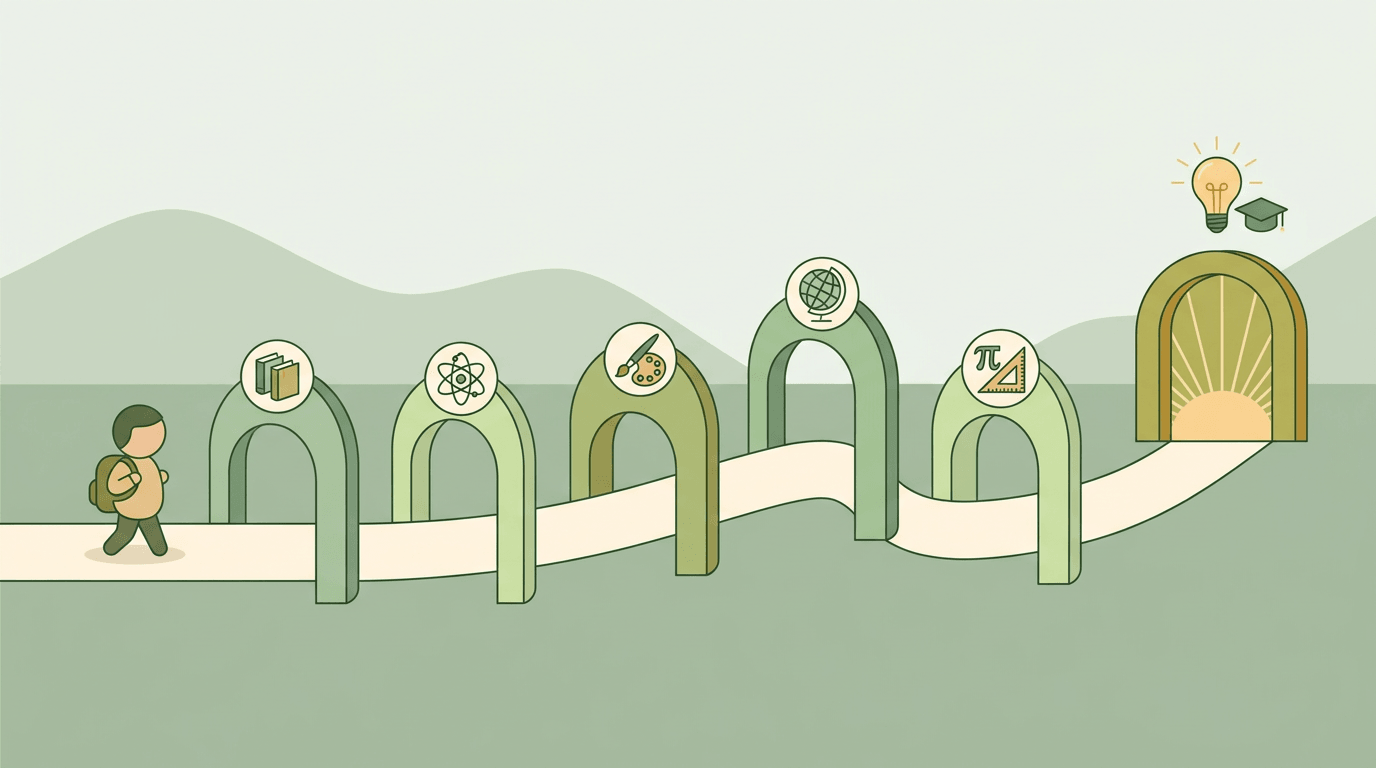
Ask any teacher what "reading level" means and you'll get several different answers, because there isn't one universal scale. There are five widely recognized stages a reader moves through on the way to strong literacy:
- emergent
- early
- transitional
- fluent
- proficient
Each stage marks a real jump in skill, and knowing where a student sits helps you hand them a book that stretches them without leaving them stranded.
The emergent pre-reading stage
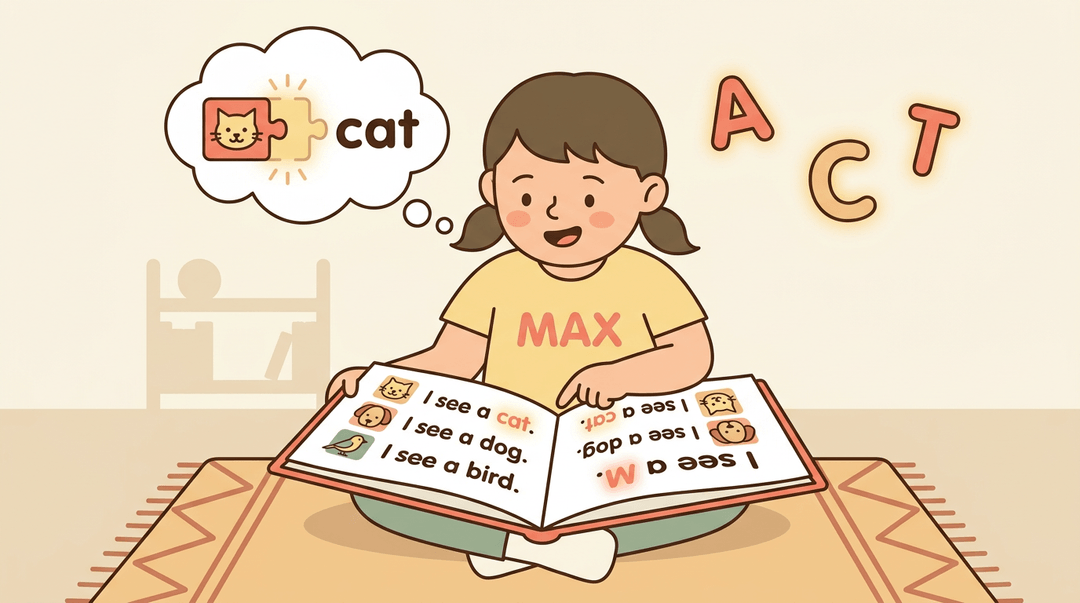
At this stage, readers are just cracking the code. They lean hard on picture cues, matching what's on the page to what they already know, and they're still building basic alphabet recognition:
- naming letters
- spotting them in their own name
- connecting sounds to shapes
A kindergarten teacher handing over a book built on simple, repeated sentence patterns isn't dumbing things down. That repetition is the scaffold that lets a beginner predict the next word and feel like a real reader.
Early and transitional reader skills
Here, the training wheels start coming off. Books get longer sentences and more pages, and high-frequency words (common words like "said" or "could" that show up constantly) get introduced so students stop sounding out every word from scratch.
Readers begin chunking: breaking new, unfamiliar vocabulary into smaller pieces instead of freezing on it. Topics and genres widen too, so a second-grade reader isn't stuck with only animal stories.
Fluent and proficient reading skills
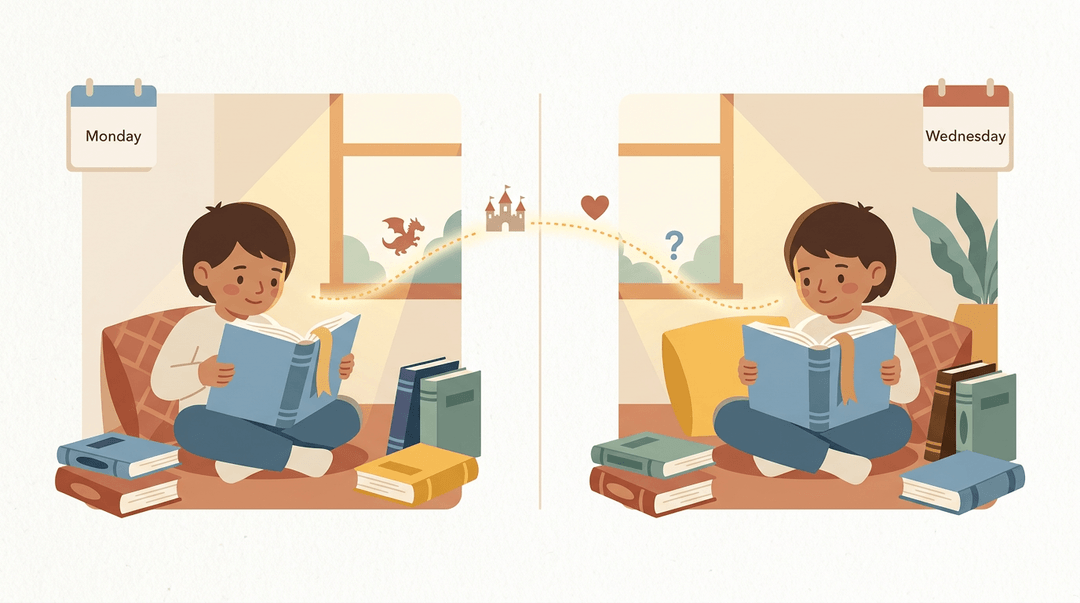
Fluent and proficient readers can hold a storyline in their head across multiple sittings: they can put a book down and pick it back up two days later without losing the thread.
They read comfortably across genres, work through independent silent reading without needing it read aloud, and at older levels, teachers start weighing mature content and themes, not just vocabulary difficulty.
What moves a reader up a level
A few concrete signals show a student is ready to move up:
- Words per page increase
- Sentences grow longer and more complex
- Vocabulary gets harder
- Pictures offer less support
Reassess every few weeks to months rather than once a year, so growth doesn't go unnoticed. A quick running record, a one-minute cold read, or a short comprehension check-in are all fast ways to confirm a student's ready for the next shelf.
How Do They Determine Reading Levels?
Every reading level comes from somewhere: a formula, a trained assessor, or a leveled book list built from real classroom use. Each system asks the same question in its own way: how ready is this reader for this text?
Here's how the five major ones actually work:
The Lexile Framework explained
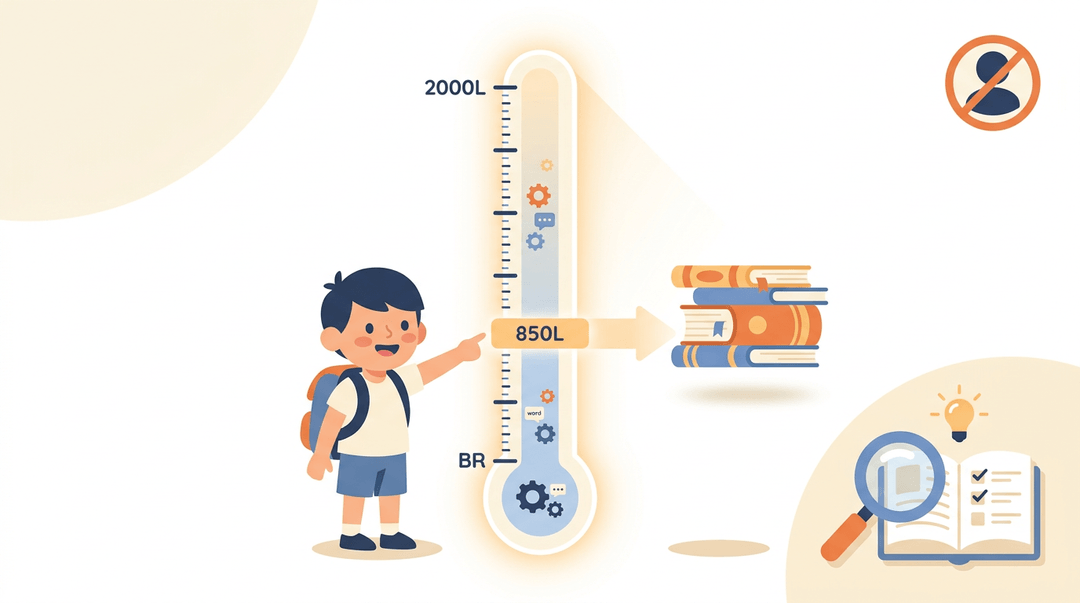
The Lexile Framework is a scientific measure of text complexity, built from sentence length and word frequency rather than a human's judgment call.
Measures run from BR (beginning reader) up to 2000L, and Lexile Hub confirms a student's score can range "below 0L for early readers to above 2000L for advanced readers."
Matching a student's Lexile measure to a book's Lexile measure predicts whether a text will stretch a reader without overwhelming them.
It's precise on complexity, but it says nothing about theme or classroom appropriateness, so you'll still want to preview a title yourself. A free lookup tool online lets you check any book's measure in seconds.
The Fountas and Pinnell guided reading system
Fountas and Pinnell's Guided Reading levels run A through Z, each letter marking a step up in vocabulary, sentence complexity, and repetition.
Fountas and Pinnell developed the system, often called the F&P Text Level Gradient, from years of real classroom teaching.
Unlike a pure formula, it factors in developmental appropriateness: whether a book's content and structure genuinely fit a child at that stage, not just its word count.
The Developmental Reading Assessment scale
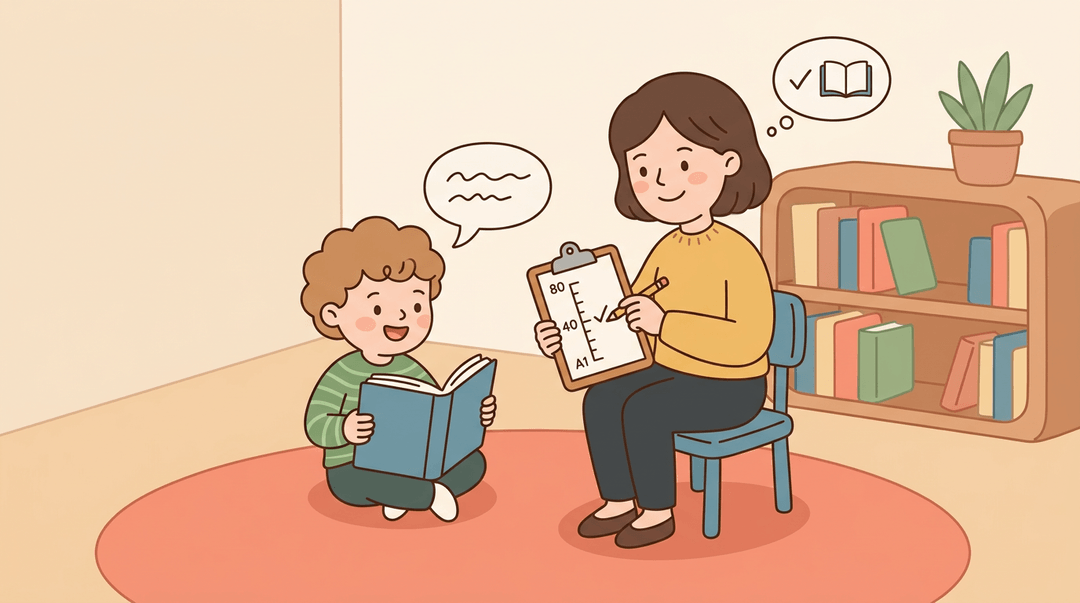
The Developmental Reading Assessment (DRA) uses a numeric scale from A1 to 80. Joetta Beaver developed it in 1977 "as an assessment tool in determining a student's ability to read unfamiliar text."
A teacher assigns the level by listening to a student read aloud and checking comprehension, not by running a formula. The assessment is published by Celebration Press.
What does a 4.5 reading level mean?
A number like 4.5 is a grade-and-month figure: fourth grade, fifth month.
Accelerated Reader (AR) pairs that number with an interest level (LG, MG, MG+, or UG, marking lower, middle, and upper grade content) and a readability formula that weighs sentence length and vocabulary.
Students earn AR points by passing quizzes on books at their level, so a 4.5 book is one a typical student at that point in fourth grade should read comfortably.
Reading Recovery for struggling first graders
Marie Clay, a New Zealand educator, developed Reading Recovery in the 1970s "to deal with the reading failure occurring there."
It's a one-on-one tutoring intervention, not a leveling formula, aimed at the lowest-achieving first graders who need intensive support to catch up.

Using Reading Levels to Plan Lessons
Once you know your students' levels, planning becomes a repeatable routine: check, group, differentiate, adjust. Here's how to run it without rebuilding your lesson from scratch every week.
Check a level in under five minutes
No assessment kit handy? Any of these gives you a workable snapshot:
- Five-finger rule. The student reads one page, raising a finger per unknown word.
- Four or five fingers up means the book's too hard: drop a level.
- Running record snapshot. Listen to a short read-aloud, tallying errors as they go.
- Frequent stumbles or word-by-word reading means back down a level.
- Informal cloze test. Delete every fifth word from a paragraph; the student fills the blanks.
- Missing most blanks signals the text sits above their level.
Build groups that move
- Form flexible small groups by level. Four to six students reading in the same band.
- Rotate groups by mastery, not the calendar.
- When a student nails two quick checks in a row, move them up.
- Pair below-level readers with peer support.
- Try partner reading: the stronger reader models a page, then they swap.
Key principle: Groups are placements, not labels. If nobody has moved in a month, re-check.
Differentiate one lesson, three ways
Everyone works toward the same objective; only these three pieces flex by level:
| Lesson piece | Below level | On or above level |
|---|---|---|
| Independent practice text | Same topic, simpler version | Grade-level or stretch text |
| Exit ticket | Sentence frame provided | Open response with evidence |
| Vocabulary list | Word, definition, picture cue | Word only, use it in a sentence |
Example: In a 3rd-grade main-idea lesson, the below-level exit ticket reads "The main idea is ___ because ___." The on-level ticket reads "State the main idea and one supporting detail." Same skill, same five minutes, different support.
Anchor to your grade band, then adjust
Use these ranges as starting points, not verdicts:
| Grade band | Typical range |
|---|---|
| 3rd grade | Guided Reading Levels M-P |
| Middle school | Lexile 700-900 |
The 3rd-grade band matches the Madison Library's reading level conversion chart, and East Tennessee State research on Lexile growth notes that equal-interval Lexile measures help pair students with right-fit texts.
Whatever the band, revisit placements weekly as your check data comes in: levels describe last week's reader, not next week's.
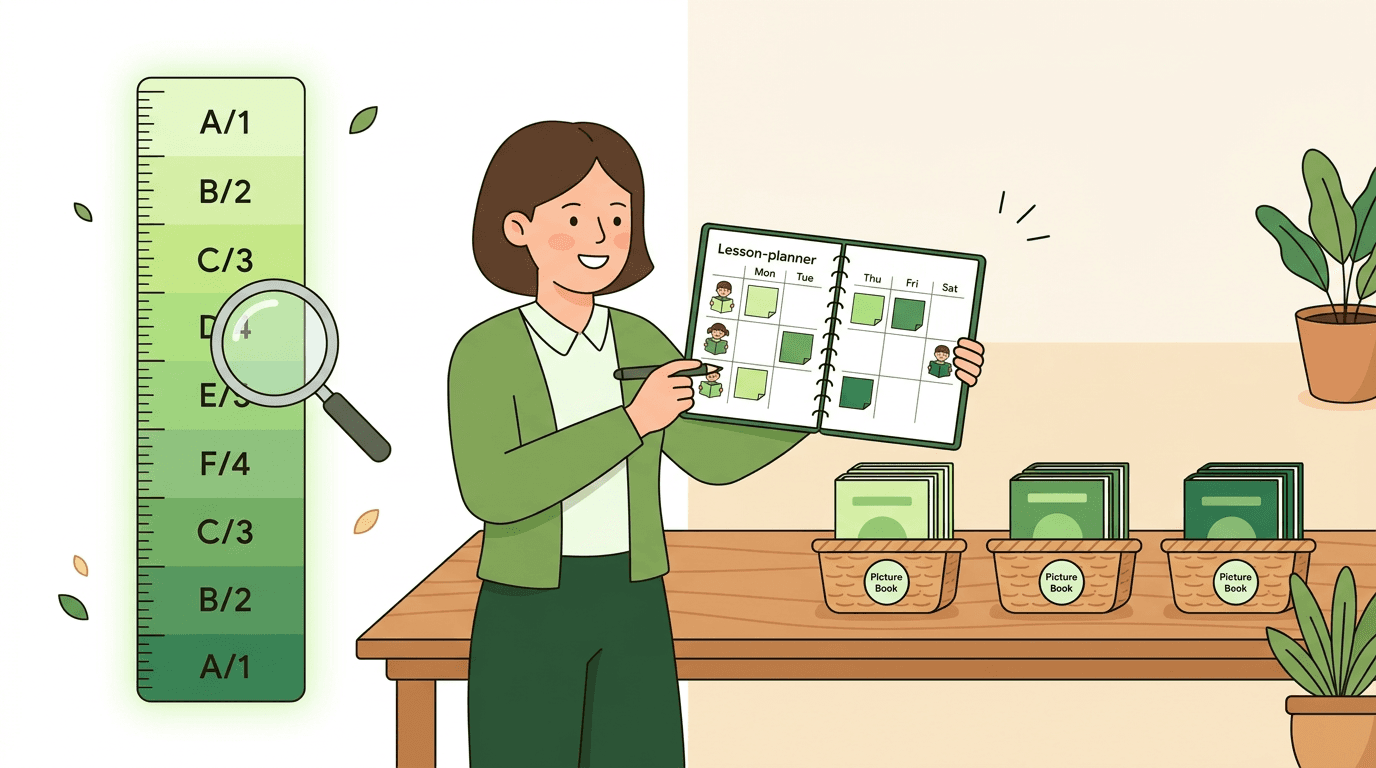
Once a tiered lesson works, don't rebuild it next term: reuse your leveled variations across classes with EMStudio's lesson planner.
What Are the Reading Levels by Grade?
So how do you actually match a level to a grade? A grade-by-grade level chart lines up the major systems side by side, showing roughly where a second grader sits compared to a fifth grader.
The exact numbers shift depending on which system you're using, which is exactly why having the right tools and charts on hand matters more than memorizing a single scale.
Tools to find books by level
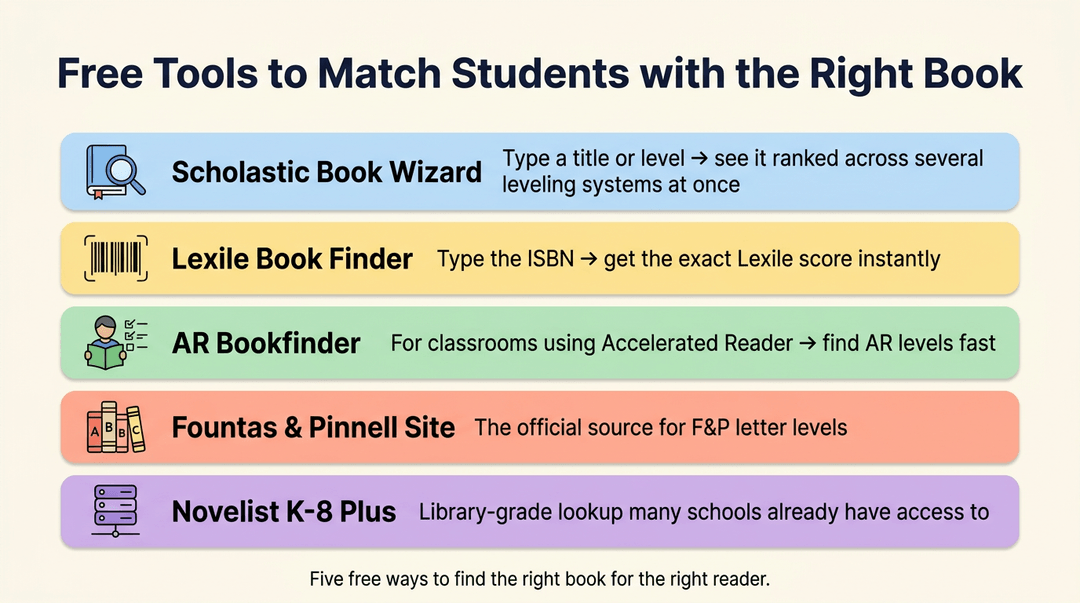
A handful of free lookup tools take the guesswork out of matching a student to a book:
- Scholastic Book Wizard. Search by title or level to see where a book lands across several systems at once.
- Lexile Book Finder by ISBN. Punch in an ISBN and get that title's Lexile measure instantly.
- AR Bookfinder search. Built for classrooms already running Accelerated Reader.
- Fountas & Pinnell leveled books site. The official source for F&P letter levels.
- Novelist K-8 Plus lookup. A library-grade database many schools already subscribe to.
Charts for comparing reading level systems
For instance, a fifth-grade teacher juggling F&P and Lexile scores for the same class needs a quick way to translate one into the other:
- Booksource reading level chart
- Cengage correlation chart
- Learning A-Z correlation chart
- Cross-system comparison tables, useful whenever a student transfers in with an unfamiliar level
Library databases for finding leveled books
Beyond the classroom, school and public libraries offer their own tools:
- Children's Literature Comprehensive Database
- TeachingBooks resource
- Library staff assistance, often the fastest route when you're stuck
- Catalog advanced search by level
Practical Tips for Parents and Teachers
A number only tells part of the story. Here's how to put reading levels to work without letting them run the show.
Balancing reading level with interest
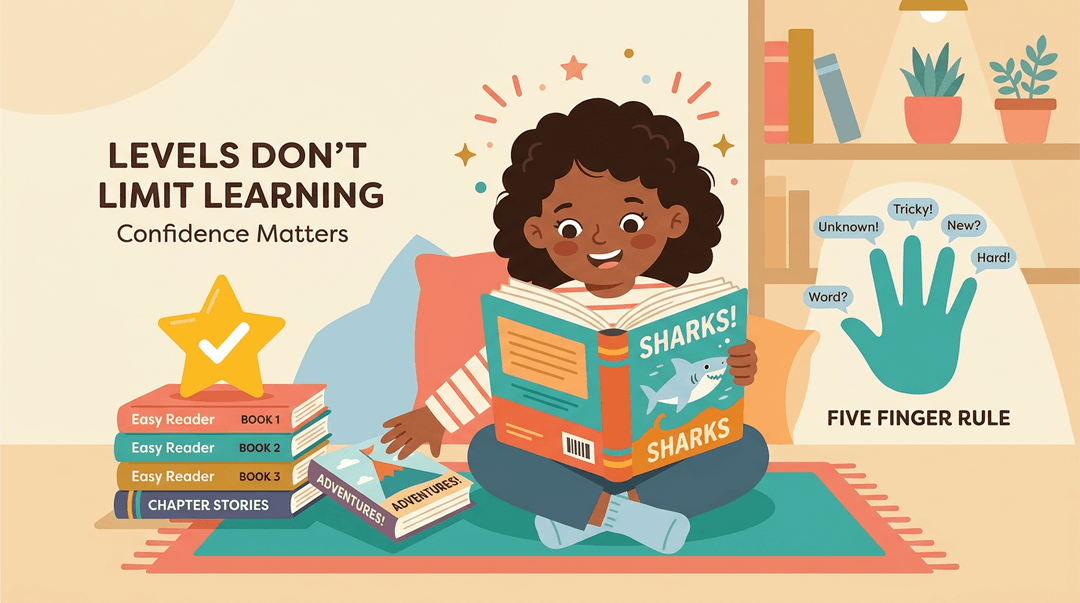
Interest should come first. A student who loves sharks will push through a book that's technically above their level just to find out more, and that kind of motivation beats any score.
Books slightly below level aren't a step backward either: they build confidence and fluency, letting a reader enjoy the story instead of decoding every third word.
Think of a second grader who breezes through an "easy" chapter book and finishes it in one sitting: that kid immediately asks for the next one, which does more for a lifelong reading habit than a perfectly matched level ever could.
When a book is a little too hard but your child really wants it, the five finger rule offers a quick gut check: have them read a page and hold up a finger for every word they don't know. Four or five fingers means it's a real stretch.
That's fine now and then, especially with your support, but it shouldn't be the daily diet.
Using your child's school assigned level
Start simple: ask what they've read at school this week. The title alone often tells you more than a letter or number ever could.
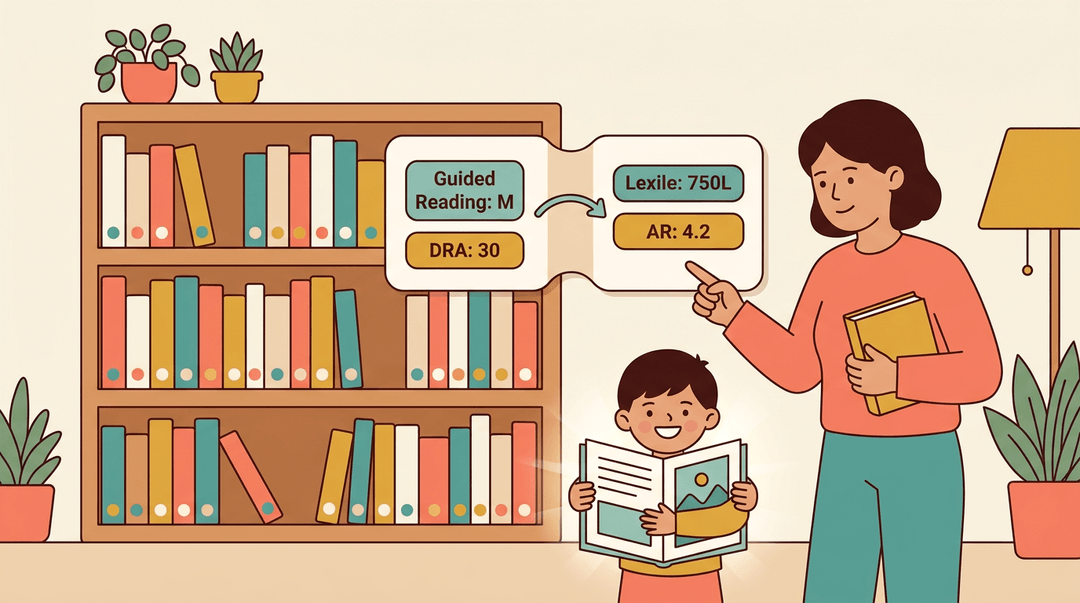
From there, lean on the Guided Reading or DRA level their teacher has already assigned, since it reflects real classroom assessment rather than a guess at home. Browsing a library shelf or bookstore that uses a different system?
A conversion chart can translate that Guided Reading or DRA level into its Lexile or AR equivalent in seconds, so you're not starting from scratch every time you shop for books.
Reading levels aren't a label to slap on a student. They're a tool: a way to find the right book at the right time, so reading builds confidence instead of frustration.
Once you know how Lexile, F&P, or DRA scores work, matching books to readers gets a lot less guesswork.
Ready to turn those levels into lessons you can reuse across every class? Check out our Lesson Planning feature to plan once and teach with less prep, more often.
References
- Reading Recovery: The Claims Versus the Facts — pages.uoregon.edu
- 49 Adult Literacy Statistics and Facts for 2026 — nu.edu
- 01.06.05: Developing and Assessing the Intelligence of a Kindergartner: A Practical Approach — teachersinstitute.yale.edu
- Test Review: Beaver, J. M., & Carter, M. A. (2006). The Developmental Reading Assessment—Second Edition (DRA2). Upper Saddle River, NJ: Pearson — journals.sagepub.com
- iReach Blended Learning Model and Reading Lexile Growth of Freshmen in Maryville City Schools — dc.etsu.edu (2016)
- For Educators — hub.lexile.com
- F&P Text Level Gradient™ & Guided Reading Levels, a continuum of progress for readers — fountasandpinnell.com
- Reading Level Conversion Chart — madisonlibrary.org
Frequently asked questions
What are the 5 reading levels?
The five widely recognized reading stages are emergent, early, transitional, fluent, and proficient. They describe broad skill development, from learning basic letter-sound connections to reading comfortably and independently across genres.
What are the signs of a low reading level?
Signs of a low reading level can include slow, choppy decoding, frequent word substitutions, skipped punctuation, guessing at words instead of sounding them out, and avoiding reading. These signs should be viewed as signals for support, not as a fixed label.
Do 54% of Americans read at a 6th grade level?
Roughly 54% of U.S. adults ages 16 to 74 are reported to read below a sixth-grade level. This statistic concerns adults and describes reading below sixth-grade difficulty, not necessarily reading exactly at sixth grade.
What reading level should my 7 year old be on?
A typical seven-year-old is often in the early reader stage, commonly around first or second grade, but children develop at different rates. The best placement depends on decoding, fluency, vocabulary, comprehension, and familiarity with the topic, so a teacher’s assessment is more useful than age alone.
What does 4.5 reading level mean?
A 4.5 reading level usually means fourth grade, fifth month. In the Accelerated Reader system, it describes a book’s estimated readability for a typical student at that point in fourth grade, alongside an interest-level designation.