Reading Fluency IEP Goals: How to Write and Track Them


Jump to section
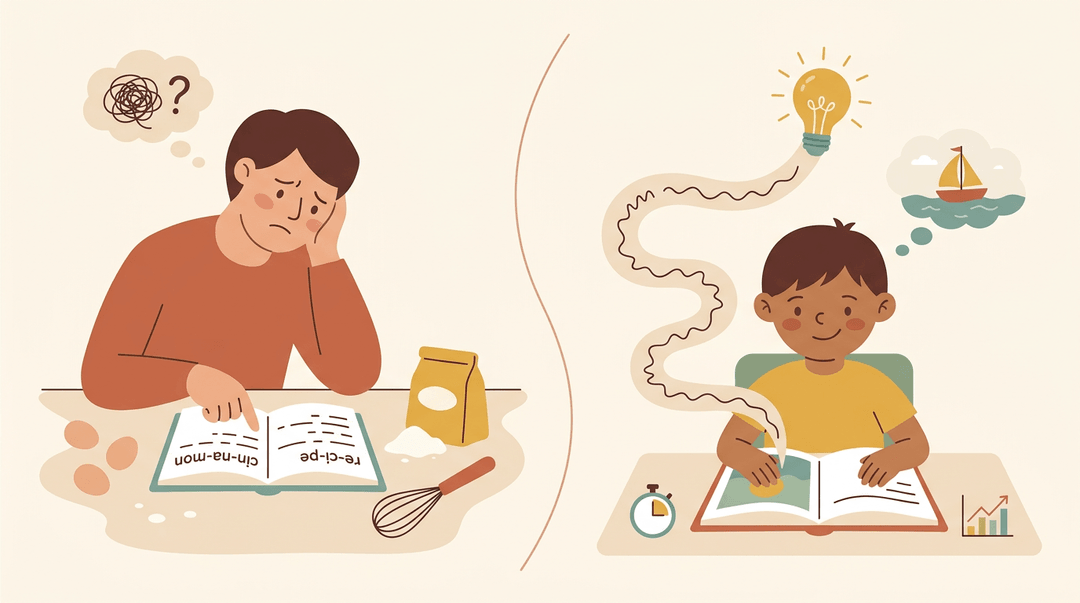
Think about the last time you read a recipe and had to stop after every other word to sound it out. By the time you reached the final step, you'd forgotten the first.
Students can feel that way during reading time, which is why reading fluency deserves a clear, measurable place in an individualized education program (IEP).
Fluency means reading accurately, at a steady pace, with natural expression. When students get there, their energy goes to meaning instead of decoding.
Here, we'll show you how to measure where a student starts, write goals you can track, and turn them into daily lessons.
Functional Reading and Reading Fluency IEP Goals
Fluency goals only matter when they lead to reading that works outside the classroom, so keep that in mind as you write them.
What functional reading means in everyday life
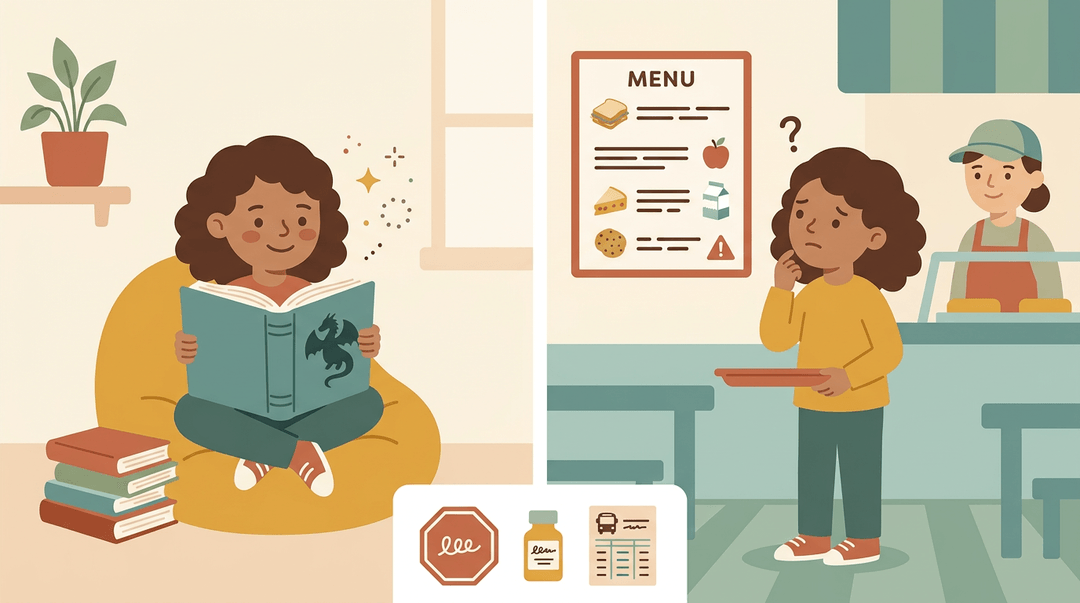
Functional reading is practical literacy, the reading people use in real life, like street signs and medicine labels.
UNESCO's definition calls a functionally literate person someone who can handle every activity that requires reading, writing, and calculation for their community. ScienceDirect research describes it in the same practical terms.
Literary analysis asks why an author chose a particular image. Functional reading asks what the sign says and where to go next. Both matter, but only one gets a student through a Tuesday.
Functional reading level is where a student can handle the everyday text they actually meet. Consider a fifth grader who reads a chapter book smoothly but freezes at the lunch menu.
Their grade-level score looks strong, but their functional reading level shows where support belongs.
Why these reading skills pay off later
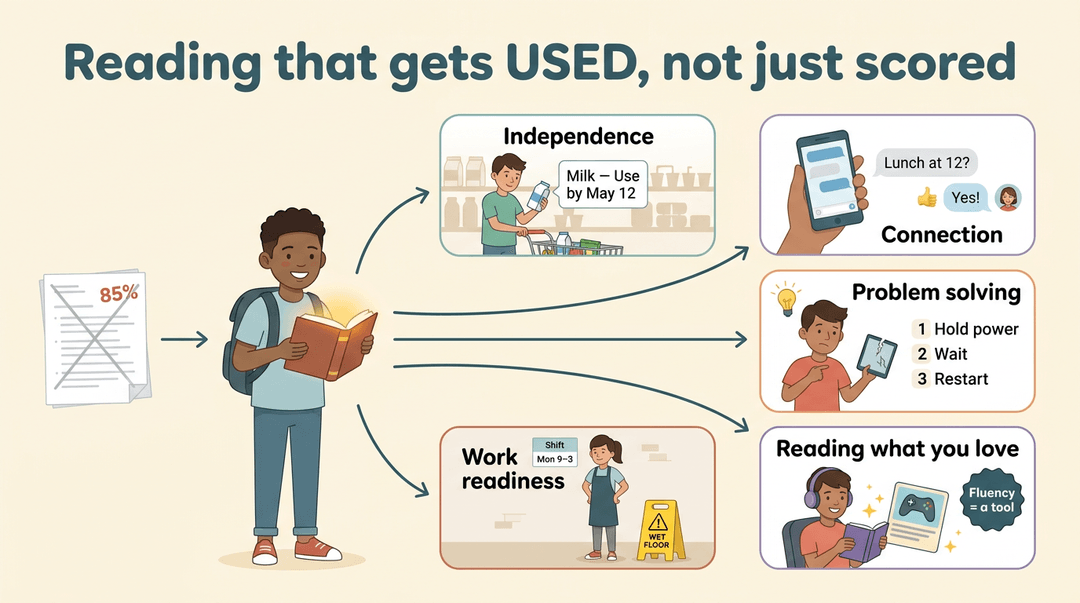
The real goal is reading that gets used, not reading that gets scored. Here's what that looks like:
- Independence. A student who can read a label or schedule makes more choices without asking for help.
- Communication and connection. Reading texts and messages keeps students in touch with the people around them.
- Problem solving. Reading instructions for a broken device lets a student work the problem instead of waiting.
- Employment readiness. Think of a special education teacher who sets a goal around reading a shift schedule and a safety sign.
- Support for neurodivergent students. Build practice around texts a student already cares about, like a favorite game's instructions. Fluency becomes a tool, not a chore.
Measuring Where a Student Starts Reading
A fluency goal is only as good as its starting point. Before you write one, you need a baseline: a snapshot of how the student reads right now.
Tests to find a starting point
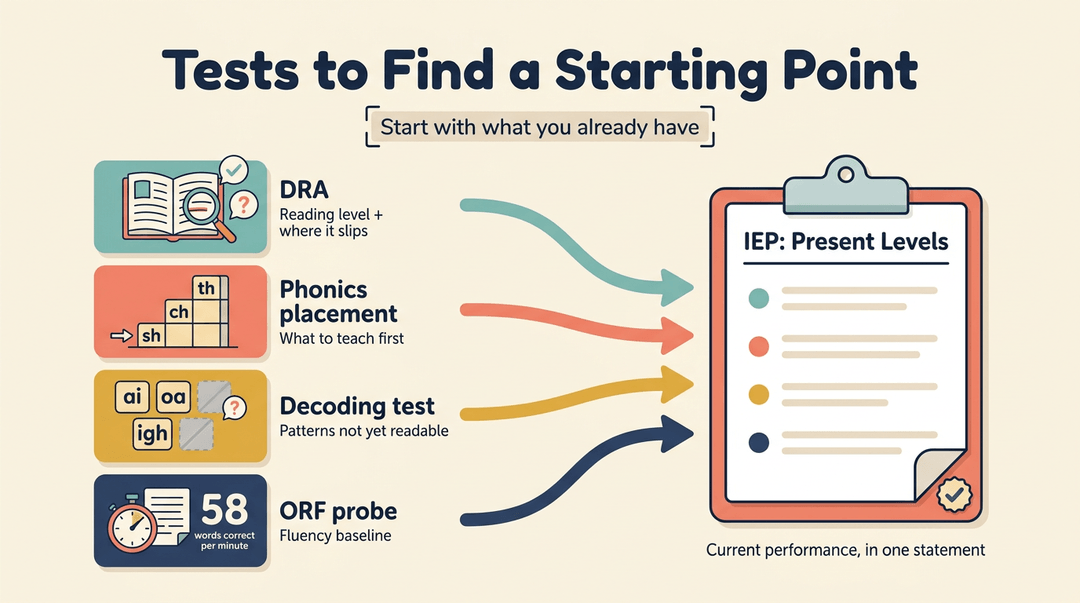
Start with what you already have. A Developmental Reading Assessment (DRA) shows reading level and where accuracy and comprehension slip.
A phonics placement test shows which skills to teach first, and a stand-alone decoding assessment reveals which letter patterns a student can't yet read.
Add an oral reading fluency (ORF) probe: a short, timed reading of a grade-level passage, scored by words read correctly. That number is your fluency baseline.
Then turn everything into a present levels statement, the section of the Individualized Education Program (IEP) that describes current performance. Your district's present levels resources can supply templates.
Sample statements describing where the student stands
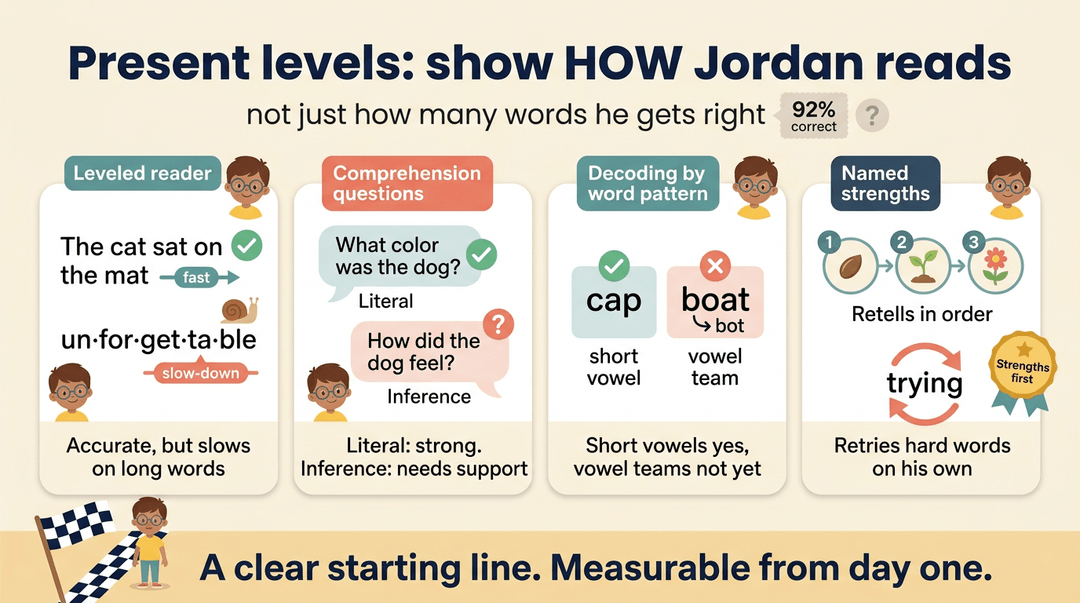
Good present levels describe how a student reads, not just how many words they get right. Meet Jordan, a fictional student:
- Accuracy on leveled reader: Jordan reads leveled text accurately but slows on multisyllabic words.
- Comprehension questions answered: Jordan answers literal questions well but struggles with inference.
- Decoding accuracy by word pattern: Jordan reads short-vowel words like cap but misreads vowel teams like boat.
- Student examples with named strengths: Jordan retells stories in clear sequence and retries hard words unprompted.
Consider a special education teacher drafting Jordan's present levels before his IEP meeting. She pulls the leveled reader results, decoding data, and ORF baseline, then writes his strengths before his needs.
Her payoff is a clear starting line. Measurable from day one.
Writing Measurable Fluency IEP Goals
A fluency goal only helps when you can tell whether the student met it.
What a strong goal should include
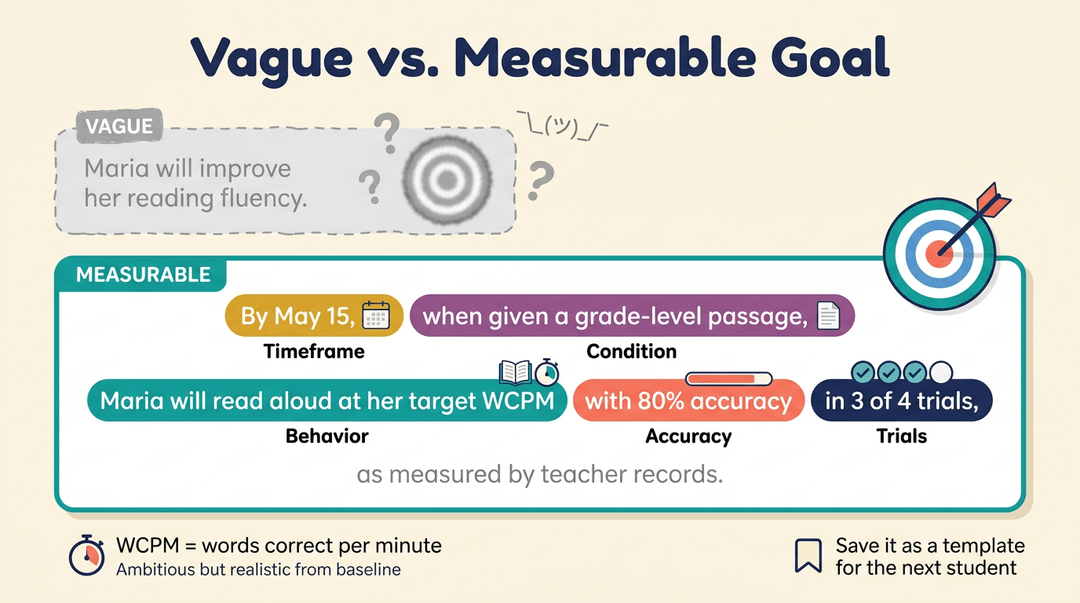
A strong goal names the condition (the passage or task), the behavior (reading aloud), the accuracy (how correct it must be), and the trials (how many attempts count), plus a timeframe like "by May 15."
Reading rate is measured in words correct per minute (WCPM), so set that target ambitious but realistic from baseline.
Vague: "Maria will improve her reading fluency." Specific: "By May 15, when given a grade-level passage, Maria will read aloud at her target WCPM with 80% accuracy in 3 of 4 trials, as measured by teacher records."
The vague one leaves you guessing. Aim for measurable rather than hopeful.
Save any goal that works as a reusable template for the next student.
Setting accuracy targets and trial counts
Many teachers start at 80% accuracy, then adjust. Raise the percentage for a student nearly reading smoothly, and lower it for one still decoding most words.
Trials test consistency rather than one good day. "3 of 4" means the student hit the mark in three of four attempts. Log each attempt in your teacher records so the data holds up.
Changing a goal to fit the student
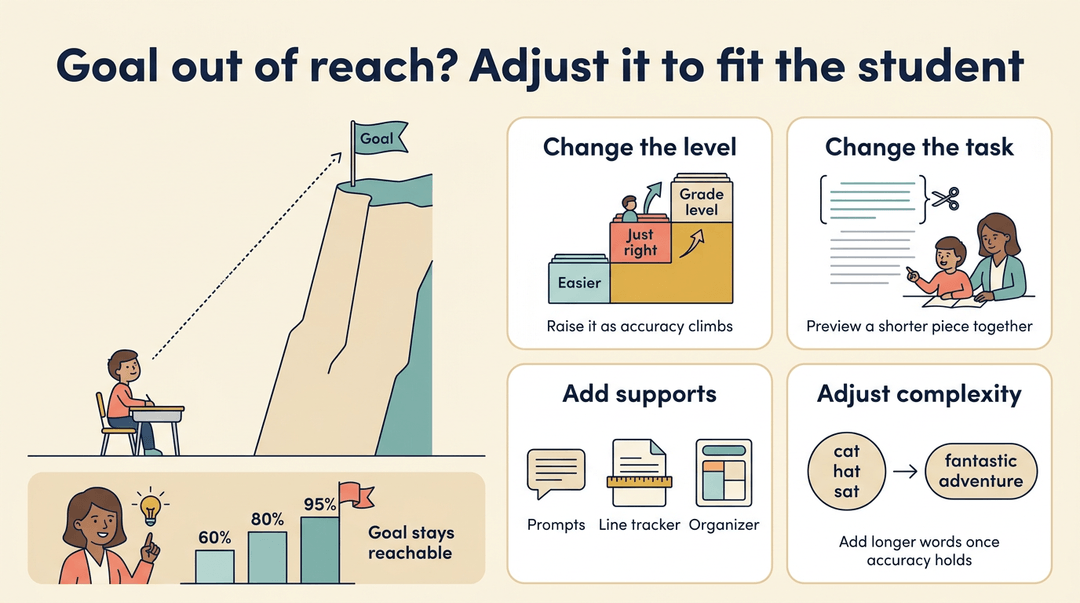
If the data shows a goal is out of reach, adjust it:
- Change the target level. Move to a passage the student can handle, then raise it as accuracy climbs.
- Change the task. Have the student preview a shorter passage with you first.
- Add supports. Prompts, a line tracker, or a graphic organizer help the student keep their place.
- Adjust complexity. Start with familiar word patterns, then add longer words once accuracy holds.
Picture a fourth-grade teacher whose student struggles with grade-level text but reads a lower-level passage easily. She adjusts the level, then raises the target once he's consistent, so the goal stays reachable.
Turn Fluency Goals into Daily Lessons
This guide helps you turn a fluency IEP goal into a short, repeatable routine you can run every day. Start with the 10-minute block, match your goal to a grade band, then use the weekly checklist to keep it moving.
The 10-minute fluency block
Run these five moves in order. Keep the pace brisk and use the same passage all week.
- Model the passage (2 min)
- Read it aloud with accuracy, pace, and expression while students follow along.
- Say: "Listen to how my voice drops at the period."
- Read it together, choral or echo (2 min)
- Choral: read in unison. Echo: you read a line, they repeat it.
- Use echo for students still decoding; use choral for those building pace.
- Have the student reread alone (3 min)
- Partner reading or solo reading both work, as long as the student reads the whole passage.
- Repeated reading builds fluency because each pass gets smoother.
- Run a quick timed probe (1 min)
- Time one minute of reading and mark errors on your copy.
- Record words correct per minute (WCPM) for this passage.
- Chart the score together (2 min)
- The student plots today's score on a simple line graph.
- Say: "Where was Monday? Where are we today?"
⚠️ Watch out: Don't probe on a passage that's too hard. A frustration-level text gives you a low score that shows the text is wrong, not that the student isn't growing.
Sample goals by grade band
Fill the brackets from your student's baseline. These stems show the focus at each band, not the targets.
| Grade band | Goal focus | Sample goal stem |
|---|---|---|
| K-1 | Decoding accuracy | Will read [X]% of words correctly in decodable text by [date]. |
| 2-3 | WCPM on passages | Will read [X] WCPM on grade-level passages by [date]. |
| 4-5 | Rate plus expression | Will read [X] WCPM and score [X] on a prosody rubric by [date]. |
Then link the goal to the day's lesson objective, so the block never drifts from the IEP:
Goal: Will read [X] WCPM with expression on grade-level passages. Today's objective: "I can reread this passage smoothly and pause at punctuation."
Weekly check
Run through this on Friday, or Monday before you plan:
- Goal copied into your plan. The exact wording sits on your lesson plan, not just in the IEP file.
- Passage level confirmed. Accuracy at this level is still in the range you chose from baseline.
- Probe data recorded. Every day's score is on the chart, with no gaps.
- Supports adjusted if stalled. If scores are flat, change the passage, add echo reading, or add practice.
- Progress shared with the team. Send the chart to the case manager, family, or related-service staff.
Plan fluency blocks and track IEP goal progress in EMStudio's online lesson planner.
Standards-matched Goal Banks for Each Skill
Every strong goal starts with its standard, so we've noted one beside each skill below.
Goals for fluency and reading level
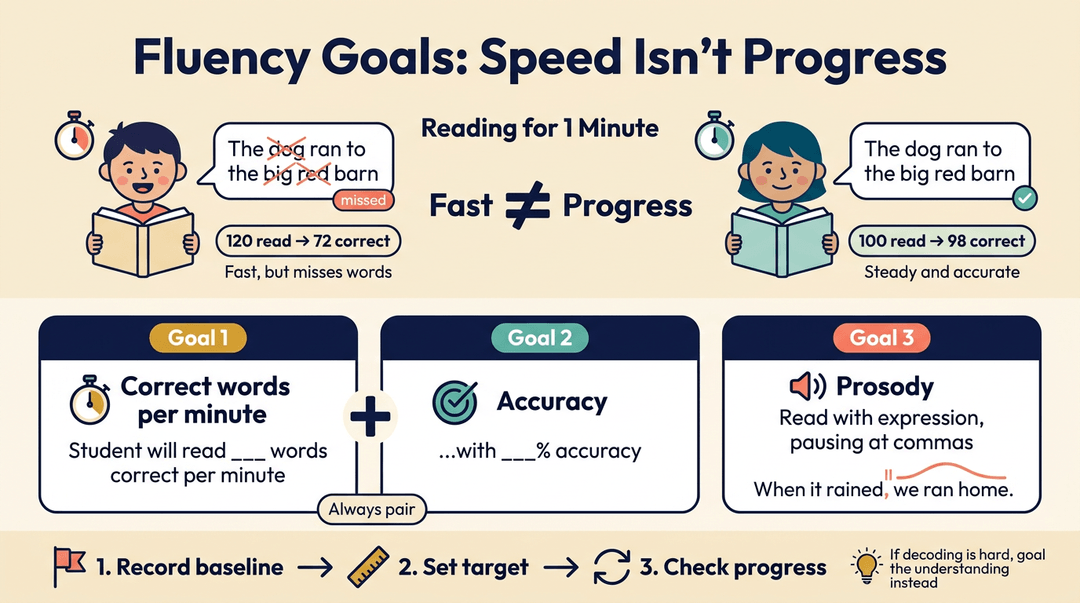
Pair speed with accuracy, or a fast reader who misses words will look like they're progressing. Speed isn't progress.
- Correct words per minute: '[student] will read [target] words correct per minute, given a grade-level passage.'
- Accuracy on grade-level text: '...with [target] percent accuracy.'
A fourth-grade teacher records a baseline first, so the target means something at the next check. When decoding drains attention, modify the comprehension goal to measure understanding, not speed.
The Common Core's fluency standards sit in Reading: Foundational Skills, as Fluency: Deep Roots in Reading Instruction explains.
Prosody, the expression and phrasing that make reading sound like speech, gets its own goal: '[student] will read with expression, pausing at commas.' Speed can't show whether a student reads for meaning or just words.
Goals that build comprehension
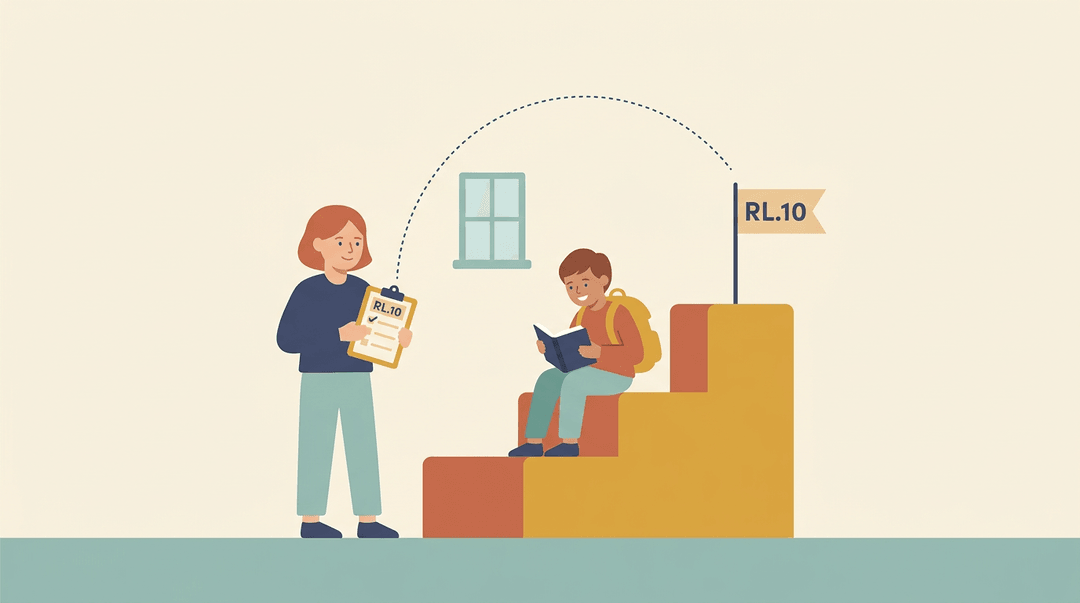
Anchor standard RL.10 asks students to read complex literary texts independently, with complexity rising across grade bands, as a University of North Dakota thesis on fiction-based close reading explains.
Measure understanding with a number, and name the support: 'After reading, [student] will answer [target] percent of questions correctly, with one teacher prompt.'
- K-1: retell a read-aloud using picture cues.
- Grades 2-3: point to the sentence that answers the question.
- Grades 4-5: explain a text idea using evidence from the passage.
Setting goals for phonics and decoding
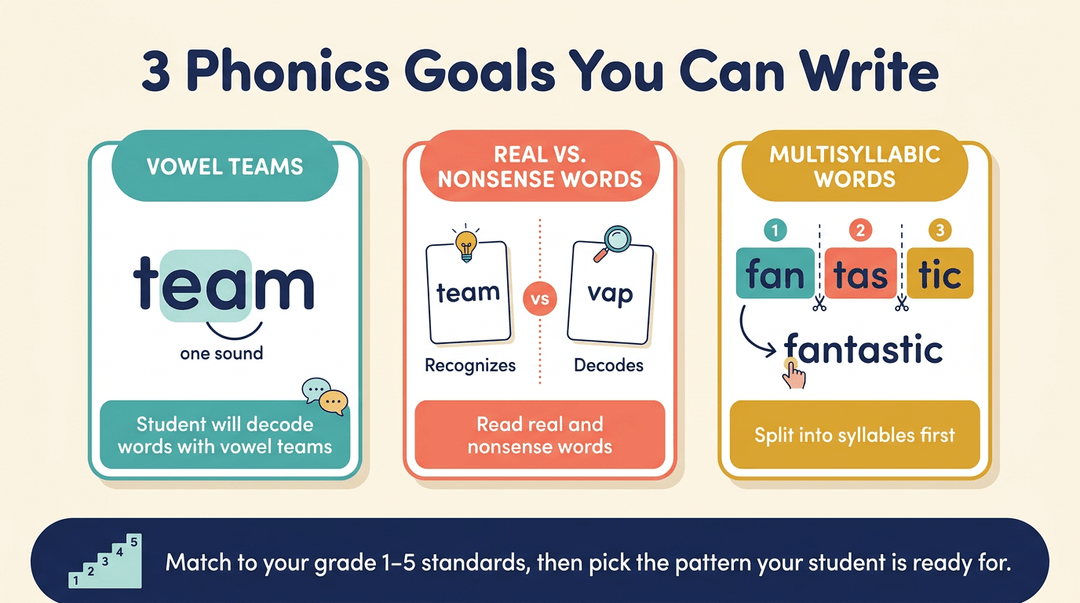
- Vowel teams and long vowels: '[student] will decode [target] words with vowel teams, such as ea in team.'
- Real and nonsense word lists: Real words show what a student recognizes, while nonsense words like vap show whether they decode the pattern.
- Multisyllabic word decoding: '[student] will read [target] two- and three-syllable words by splitting them into syllables first.'
Match these to the grade 1 through 5 Foundational Skills standards, and pick the pattern your student is ready for.
Goals for signs, labels, and directions
- Signs, symbols, and labels: '[student] will read [target] classroom signs, such as EXIT and RESTROOM, without help.'
- Following written directions: '[student] will complete a [number]-step written direction independently.'
- Social and safety words: '[student] will read STOP, EXIT, and DANGER on sight.'
Sort your bank by category so you can pull a goal in seconds. Grow it toward about fifty sample goals over time.
How goals line up with Common Core
Find the grade-level standard first, then write the goal in the skill's own words. Add the code to the notes, such as RL.10 for text complexity, so the team sees the link at a glance.
Past grade 5, a student reading below grade level gets a goal at their instructional level, with the grade-level standard kept in the notes.
For other grade bands, change the text level and target number, not the structure.
Checking Progress and Keeping Data
Goals only work if you know they're moving. Here's how to gather fluency data and read it honestly.
Ways to gather progress data
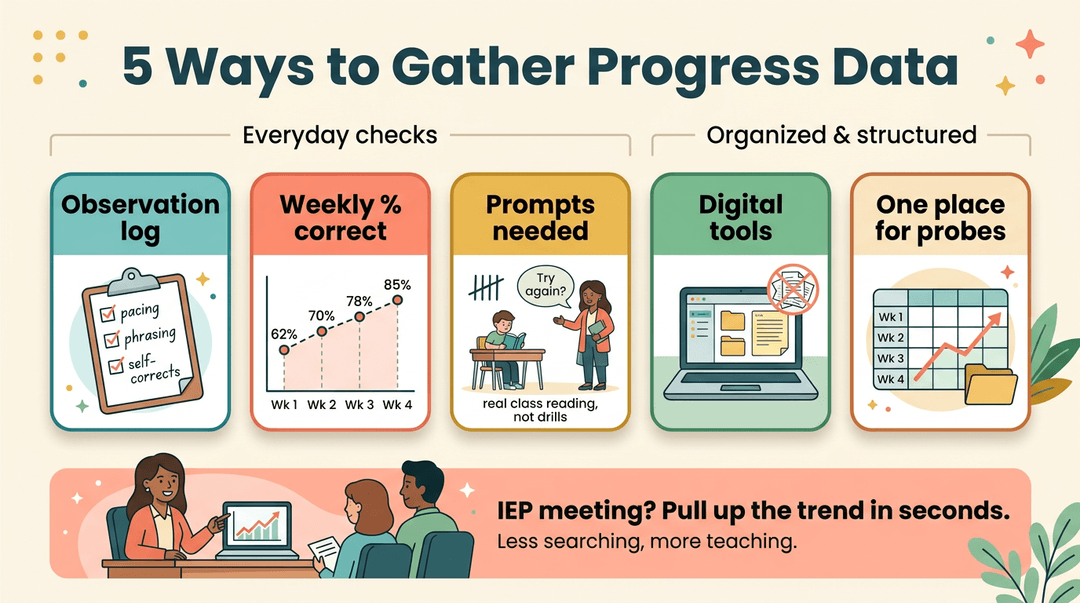
Mix everyday checks with structured ones:
- Checklists and observation logs. Jot down pacing, phrasing, and self-corrections during reading groups.
- Weekly percent-correct tracking. Record the percentage of words read correctly each week so changes stay visible.
- Prompts needed in authentic settings. Note how often a student needs a prompt during real classroom reading, not just drills.
- Digital tools like Google Classroom. Use them to keep work and notes organized, not stacked on your desk.
- Log weekly fluency probes in one place. A single folder or spreadsheet keeps your data easy to compare.
Consider a special education teacher prepping for an IEP meeting. Her weekly probes sit in one spreadsheet, so she pulls up the trend quickly. Less searching, more teaching.
What progress really looks like
- Small steady gains count. A few more words correct each week adds up over a semester.
- Progress isn't always linear. A rough week doesn't mean the plan failed, so look for trends, not single scores.
- Fade picture cues over time. Start with picture supports, then pull them back gradually so the student reads on their own.
- Adjust strategies at plateaus. When scores flatten for several weeks, change something, like the text level or the type of practice.
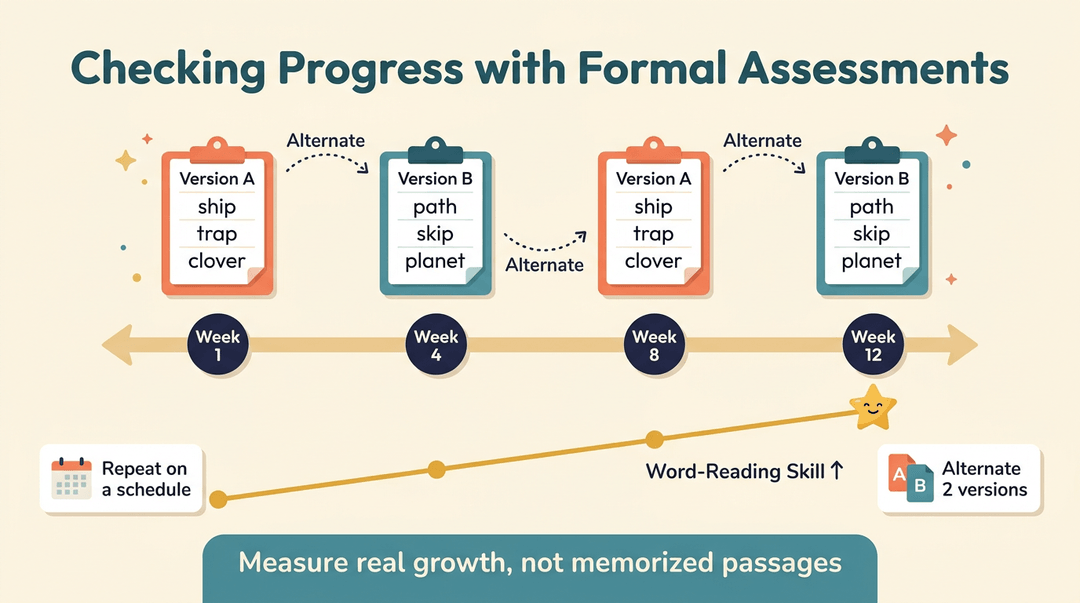
Checking progress with formal assessments
- Decoding assessment for progress monitoring. Repeat it on a regular schedule to see whether a student's word-reading skills are growing.
- Two assessment versions. Alternate between two versions so you measure growth, not memorized passages.
Teaching Strategies That Build Reading Skills
Fluency grows less from one big lesson and more from small, repeated practice your students can count on.
Daily practice that builds fluency
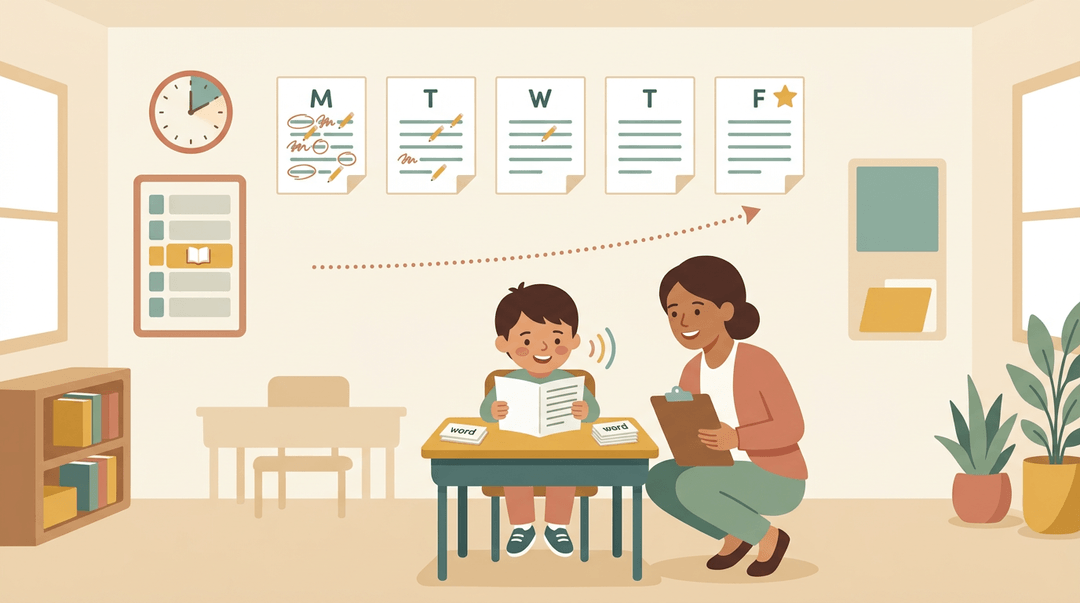
Start with repeated reading, where students reread the same short text until it flows smoothly. Picture a third-grade teacher who has each student reread one passage all week.
By Friday, the student who stumbled on Monday often reads the page with ease, and that visible progress keeps students willing to try.
Keep meaning first, though. Students should understand a passage before speed becomes the goal. Speed follows understanding.
Make it a habit with a few simple moves:
- Daily 5 to 10 minute practice. Short and consistent beats long and occasional.
- Reading aloud and word drills. Pair passage reading with quick drills on tricky words.
- A scheduled repeated-reading block. Put it on the daily schedule so it doesn't get bumped.
Teaching approaches to try in class
- Explicit instruction with modeling. Read the passage aloud first so students hear the pacing you want.
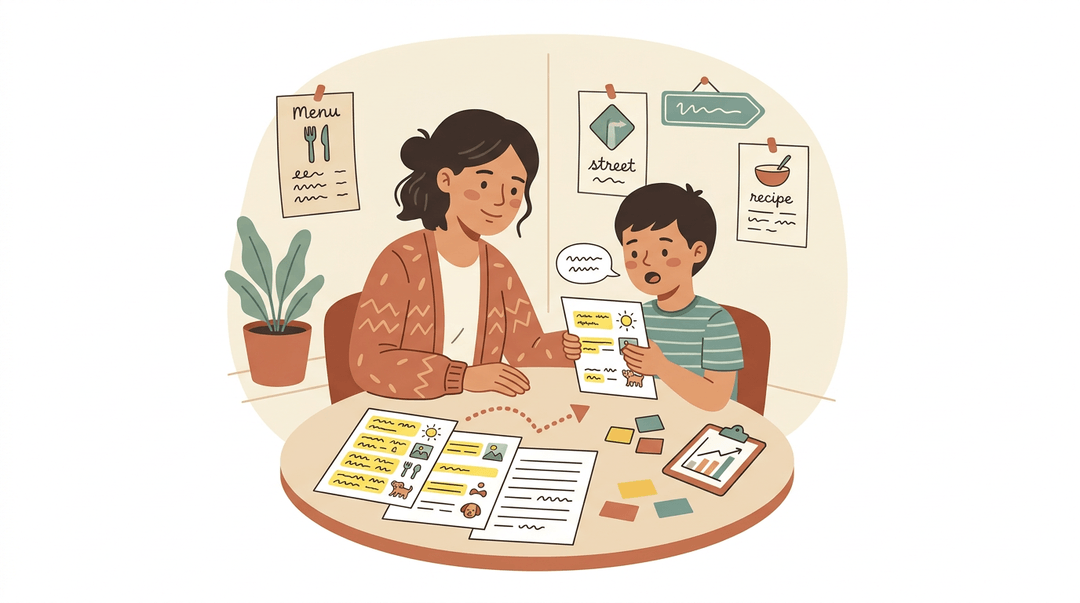
- Generalizing to real-life contexts. Practice words from menus, street signs, and recipes.
- Games and word-matching. Turn drills into a quick matching game so practice feels like play.
- Visual aids and scaffolds. Highlight key phrases or add picture cues until students need less help.
- Independent practice with reduced support. Shift from partner reading to solo reading gradually.
Think of a special education teacher whose student has a reading goal in his individualized education program (IEP). She models a paragraph, he rereads it with a phrase guide, and she hands over a little more each week.
Over time, he reads aloud without a prompt on every line. That's independence.
Reading fluency goals work best when they're measurable, grounded in a real baseline, and built into the lessons you already teach.
When you measure where a student starts, write clear goals, and track progress, you'll know what's working. Small, steady gains add up.
Ready to put this plan into action? Explore Lesson Planning to write, organize, and reuse your fluency lessons across classes from one place.
References
- Designing fiction-based close reading experiences for the high school English language arts classroom — commons.und.edu (2015)
- Fluency: Deep Roots in Reading Instruction — mdpi.com (2020)
- Revised Recommendation concerning the International Standardization of Educational Statistics — unesco.org (2026)