Teaching Vocabulary Strategies: A Complete Guide


Jump to section
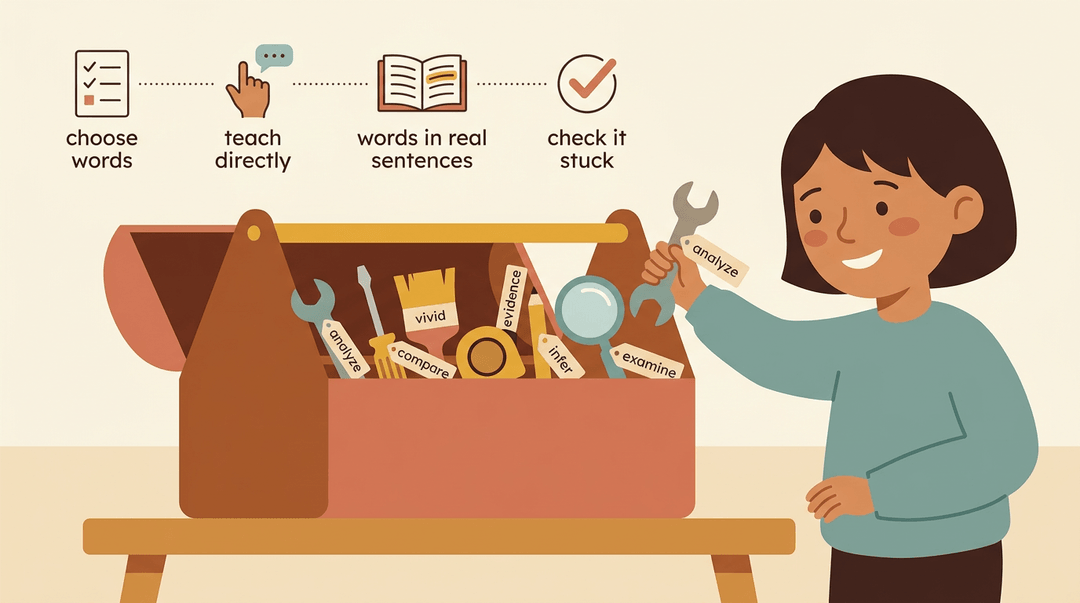
Think of a student's vocabulary as a toolbox. The more tools they have, and the better they know when to use each one, the more clearly they can read, write, and explain their thinking.
So how do you stock that toolbox without turning every lesson into a word list? Effective vocabulary instruction follows a clear sequence: choose the right words, teach them directly, let students meet them in real sentences, and check that they stuck.
We'll walk through each step, plus a routine you can plan once and reuse across grade bands.
Why Teaching Vocabulary Strategies Pays Off
Vocabulary isn't a side dish to reading class. It shapes how students understand texts and perform in every subject.
How vocabulary lifts reading and grades
A paper on vocabulary and reading comprehension calls the link reciprocal: rich vocabulary helps students comprehend, and skilled readers get better at inferring meaning.
Vocabulary also predicts academic success. A systematic review of English-medium instruction courses found that vocabulary knowledge is an important predictor of success in those classes.
A strong word bank also shows up in writing and speaking, since students express ideas with words they own. Terms like evidence and infer push critical thinking across math, science, and history.

What shapes how fast kids learn words
Four factors shape how quickly students learn words:
- Proficiency level. Students who know more words have more footholds for new ones.
- Age of acquisition. How early a student meets a word or language can shape how easily it sticks.
- Exposure length. Time spent with new words shapes how well they take hold.
- Motivation and learning styles. Interest pulls students in, and preferred ways of engaging shape what works.
Pace varies. You'll need to plan for it.
Why memorizing definitions falls short
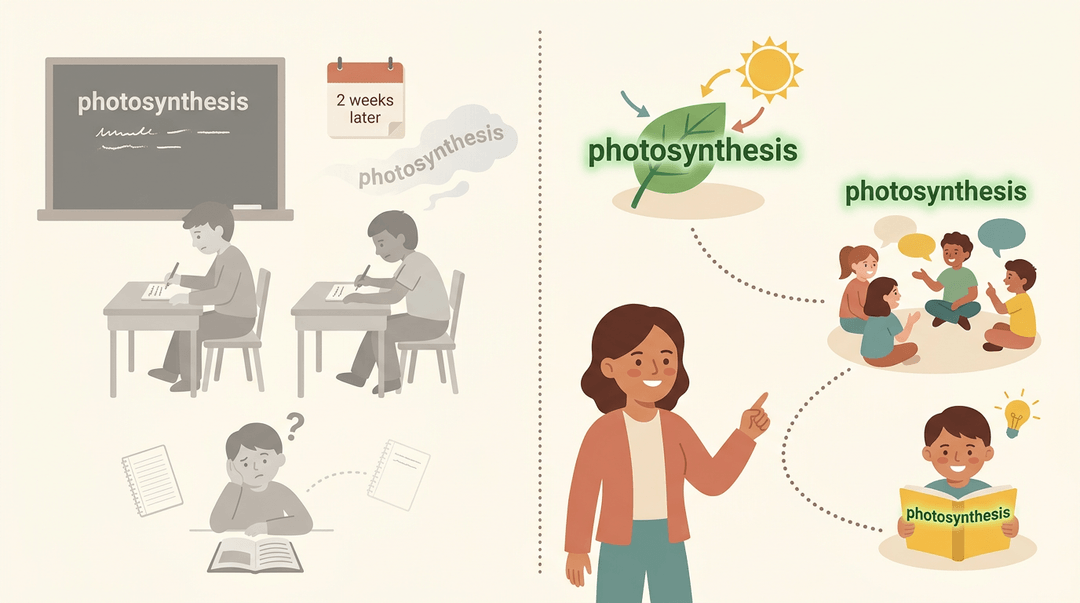
Vocabulary is less about memorizing a definition and more about meeting a word again. Consider a sixth-grade science teacher whose students copy photosynthesis from the board.
Two weeks later, the word appears in a reading passage, and that copied definition doesn't help much.
Copying definitions is ineffective, so we want students meeting words repeatedly, in varied contexts. A 2019 meta-analysis by Uchihara found a medium effect of repetition on incidental vocabulary learning, or words picked up from context.
A study in Studies in Second Language Acquisition notes that a single passive encounter may not be enough.
Instead, the teacher can bring photosynthesis back through a diagram, a class discussion, and a passage, so students meet it in new settings.
Choosing Which Words to Teach
Not every unfamiliar word earns a spot on your list. Choose well, and everything after gets easier.
Sorting words into three tiers
Sort words into three tiers:
- Tier 1 words are everyday words like table or happy.
- Tier 2 words are academic words that cross subjects, like analyze or evidence.
- Tier 3 words are content-specific, like photosynthesis.
Prioritize tier 2, since those words pay off in every class. Tier 3 words are best taught inside their unit. The goal is choosing which words to teach, not how many.
Letting students help pick words
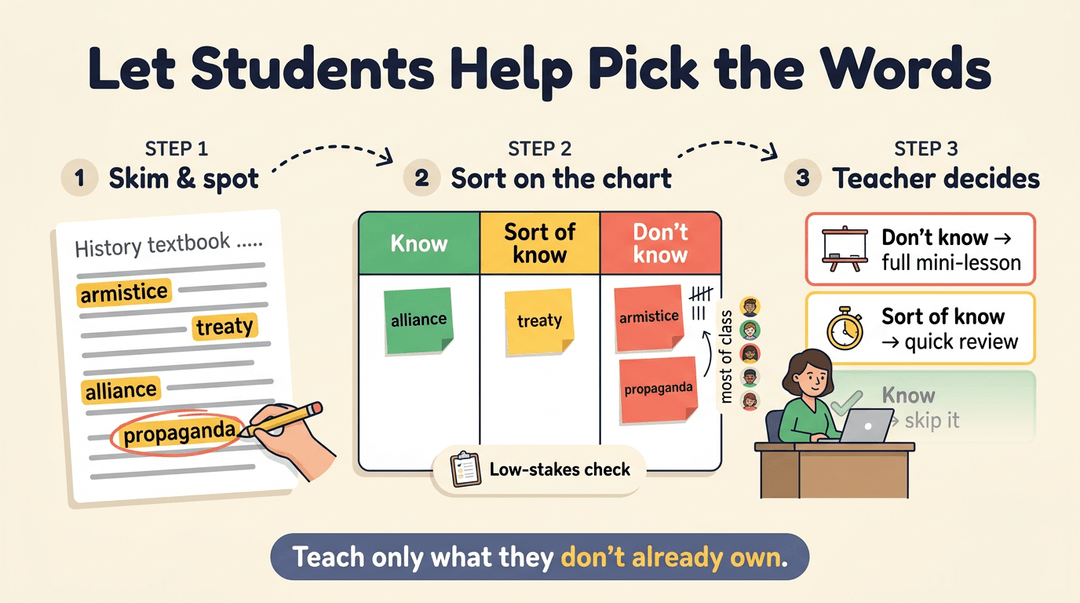
Have students skim a passage and pick out words they don't know. Then have them sort those words on a know/sort of know/don't know chart. The chart doubles as formative assessment, a low-stakes check on which words need direct teaching.
A high school history teacher reviews the results the next morning. Words most students marked don't know get a full mini-lesson, while sort of know words get a quick review. Nobody re-learns what they already own.
Keeping word lists short and useful
Aim for 10 to 20 words per lesson, and keep the core set small and high-value. Overloaded lists blur together, and students tune out. Fewer words, taught well, stick better.
Plan word lists per unit, not per day, and choose the tier 2 and tier 3 words the unit depends on. Grade band shifts the mix: early grades lean on tier 1 words, while upper grades lean on tiers 2 and 3.
Picture a special education teacher with a student who has an Individualized Education Program (IEP). She pre-teaches six key words with visuals before class, so that student starts the lesson with a foothold.

Teaching Words Inside Real Sentences
Students learn the most words through real sentences, stories, and conversations. Here's how we can build more of those moments into your day.
Picking up words by reading widely
Much vocabulary grows through implicit learning, picked up from repeated exposure in context. Make wide reading easy to reach:
- Stock a classroom library. Offer books at many levels and topics so every student finds something worth reading.
- Read aloud with rich language. Choose texts with words a step above everyday speech.
- Discuss unfamiliar words. When a word stops the room, pause and talk through what it might mean.
Telling stories that use target words
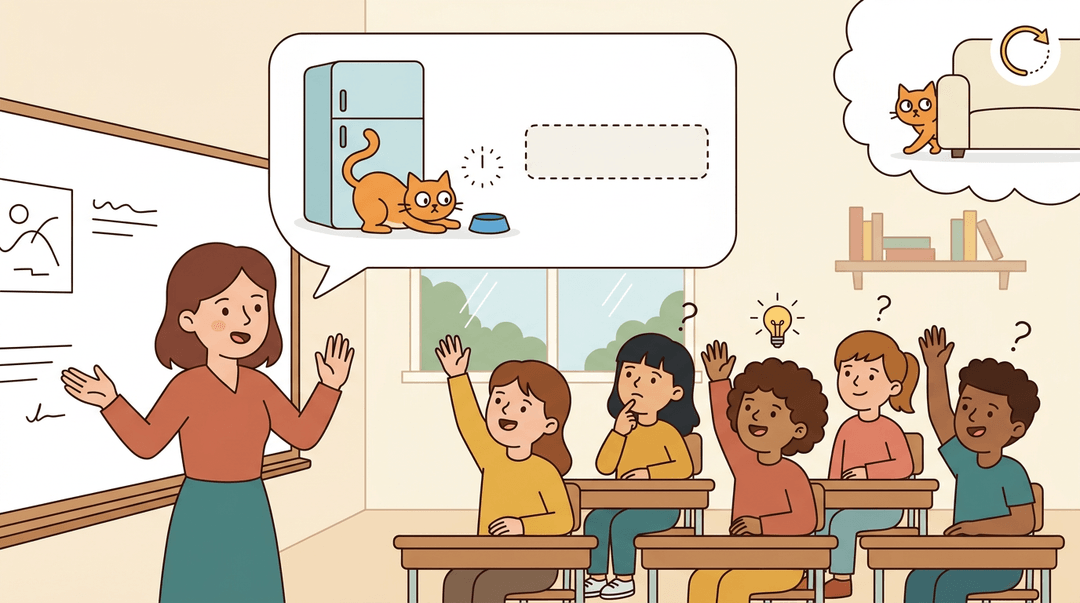
Tell a quick story and build in pauses. Stop just before the key word and have students elicit it, drawing it out of them rather than handing it over. Then have them infer the meaning from your details.
Picture a sixth-grade teacher describing a cat that keeps lurking by the fridge: she pauses before the word, and students guess from the staring and the waiting. Later, circle back in a new story. Revisiting a word beats hearing it once.
Thinking aloud and using rich language
A think-aloud lets students hear how you work a word out. Say something like, 'The sentence before this gives me a clue,' then point to the context clues you're using. Model the process rather than just the answer. Avoid watering down language.
Swapping a hard word for an easy one shortchanges students, so keep the word and explain it right where it appears: 'The river was turbulent, rough and churning after the storm.'
Real-life word learning for English learners
English learners benefit most when words live inside real sentences and situations.
- Words in sentences and situations. Teach each word in a sentence students will actually hear, paired with a gesture or picture.
- Word maps and graphic organizers. Pair each word with a definition, examples, non-examples, and a quick sketch.
- Connect to familiar experiences. Link the word to something students already know, like a sport or a family meal.
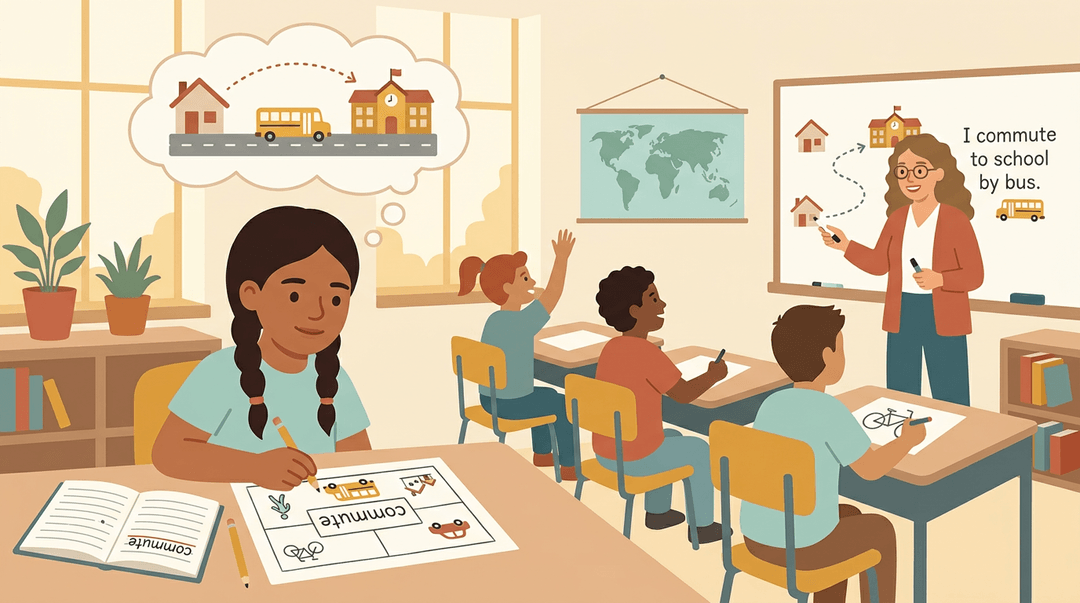
Consider a newcomer in a middle school class for English learners. Her teacher introduces commute by asking how everyone gets to school, then has students sketch a bus on a word map. Soon the word shows up in her writing about her mornings.
Introducing New Words Directly and Clearly
Students can't use words they don't understand, so we start by making each one clear.
Covering meaning, form, and pronunciation
Start every new word with the meaning, form, and pronunciation (MFP) pattern: what it means, how it's built, and how it sounds.
Model the word, then lead the class in choral repetition, where everyone says it together. Fix mispronunciations right away by modeling the word again.
Using pictures, drawings, and gestures
Pictures give a word something to hold onto:
- Images tied to words. Choose pictures that show the meaning directly, not decorative clip art.
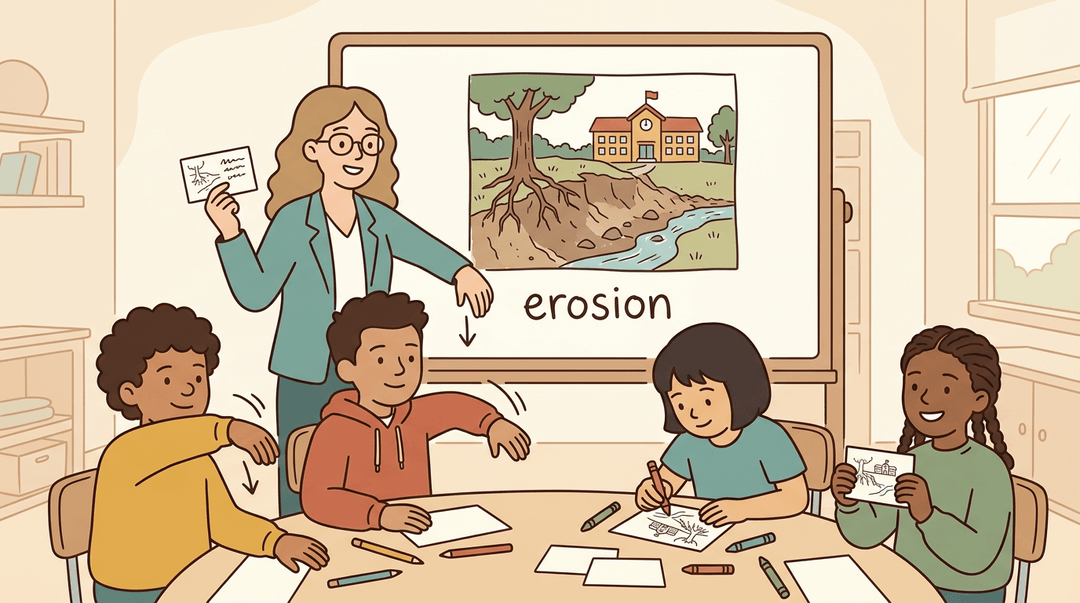
- Personalized or local pictures. A fourth-grade teacher teaching erosion snaps a photo of the worn creek bank behind the school, so students can picture the word.
- DIY (do-it-yourself) flashcards. Add a picture and plain definition, or have students make their own.
- Student-drawn representations. Students sketch the word, deciding what matters most in its meaning.
- Gestures. Pair each word with a motion, like a hand sliding down for descend.
Following Marzano's six steps
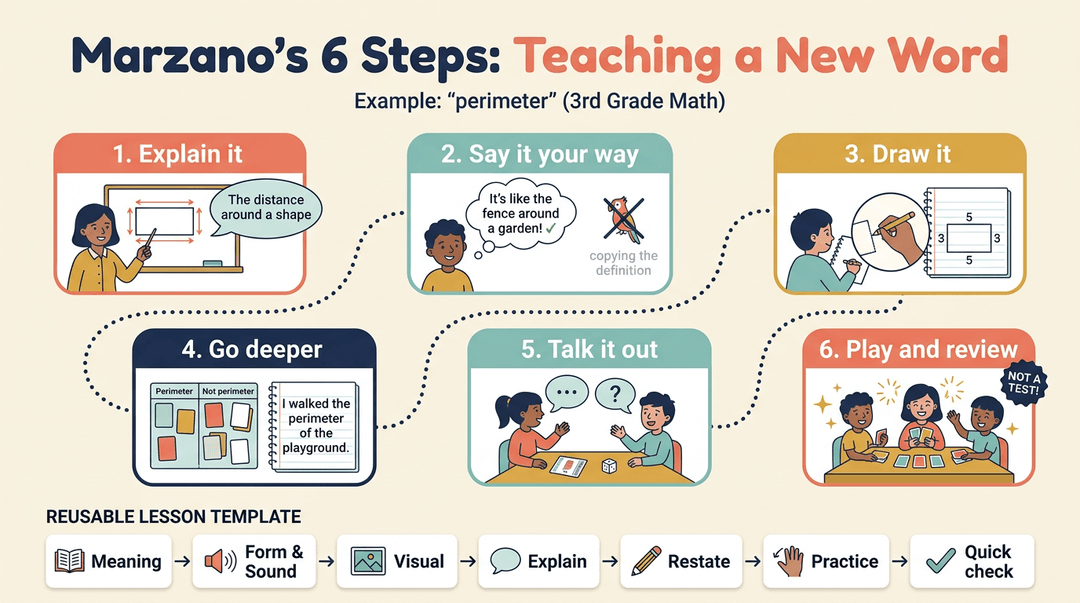
In Marzano's six-step vocabulary process, step one is to explain the word beyond its definition.
According to a thesis on delivering academic vocabulary in third-grade mathematics, that means “a student-friendly description, explanation, or example of a new term.”
Next, have students restate it in their own words. They've understood it, not just repeated it.
Then add deepening activities, like sorting examples or writing sentences with the word, plus discussion and review games that keep practice from feeling like a test.
Build these steps into a reusable lesson template: meaning, form, and pronunciation first, then a visual, the explanation, restatement, practice, and a quick check.
Helping students grasp abstract words
With abstract words like loyal, the goal is understanding why a word fits, not just what it means.
Start with creative prompts and elicitation, questions that draw out what students already know: “When have you stuck by a friend through something hard?”
Then offer a student-friendly definition, and show examples and non-examples: a friend who sticks around after a lost game is loyal, while one who vanishes is not.
Finish with concept-checking questions, like “Would a friend who shares your secrets with everyone be loyal?” Stumped? Go back to an example.
A Vocabulary Mini-Lesson You Can Use Tomorrow
This is a five-step routine you can run in about 15 minutes with any text, then adjust by grade band and review all week.
The five-step routine
- Choose 5-8 tier 2 words
- Tier 2 words are useful across subjects, like analyze or consequence.
- Pull them from the text your class is reading this week.
- Introduce with image and pronunciation
- Show a picture, then say: "Say it with me: con-se-quence."
- Give a student-friendly definition and examples
- Define it in everyday words: "something that happens because of what you did."
- Add one example and one non-example.
- Run partner talk with sentence frames
- Post a frame: "One consequence of ___ is ___."
- Close with an exit ticket word check
- Ask: "Pick one word from today and use it in a sentence."
Example: A fourth-grade teacher shows a photo of a spilled glass of milk, then defines consequence. Partners finish the frame aloud: "One consequence of running inside is slipping." The exit ticket sentence tells her who needs the word again tomorrow.
Adjust for your grade band
The routine stays the same. Only the way students handle the words changes.
| Grade band | Lean on | What it looks like |
|---|---|---|
| K-2 | Gestures and picture cards | Act out gather, then match it to a picture card |
| 3-5 | Word maps and games | Map definition, example, and picture; then play a guessing game |
| 6-8 | Roots and affixes | Split transport into trans- (across) + port (carry) |
| 9-12 | Academic word sorts | Sort analyze, evaluate, interpret by how they'd work in an essay |
Weekly review checklist
Confirm these before the week ends, so the words stick past Friday:
- Revisit words on day 2: a two-minute oral review of yesterday's list.
- Quick game midweek: a short guessing or matching round.
- Notebook entries updated: students add examples or sketches to each word.
- Quiz given, gaps reteach: reteach the words most students missed.
Save this routine as a reusable template in EMStudio's online lesson planner and drop it into any unit.
Building Deeper Word Knowledge
Knowing what a word means is only the start. Here's how you can help students take words apart and play with them.
Using word parts and word origins
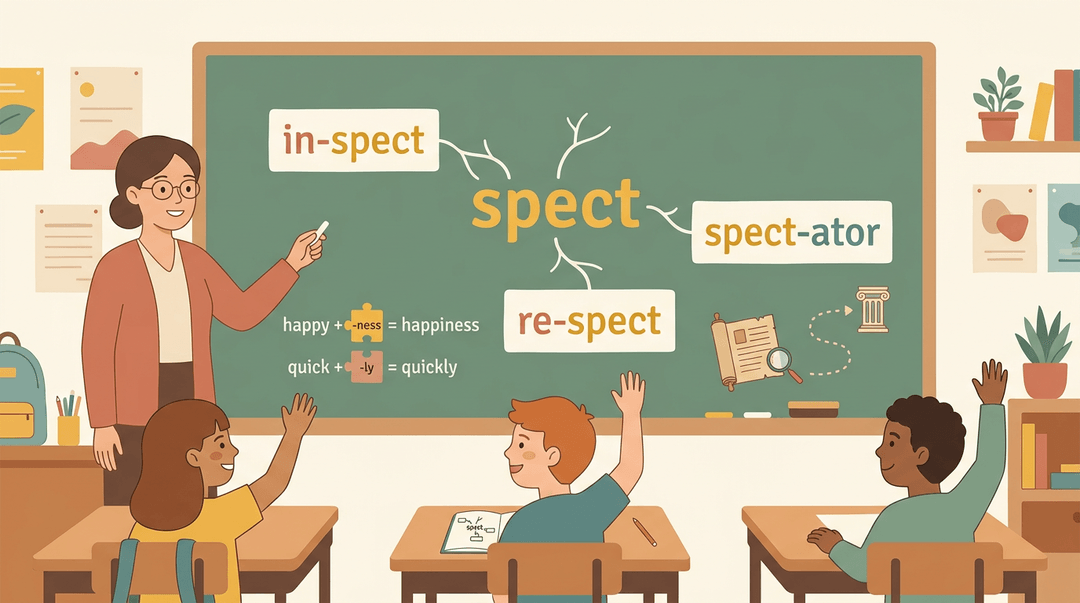
Start with word parts: roots carry core meaning, and prefixes and suffixes attach to them. A sixth-grade teacher who writes spect on the board and asks for words built from it might get inspect, respect, and spectator in minutes, all from one root.
Suffixes can change a word's class. Add -ness to happy for happiness, a noun, or -ly to quick for quickly, an adverb.
For words that don't split neatly, try etymology, the study of where a word came from. That origin story gives students something to hang the meaning on.
How words connect and pair up
Words rarely travel alone. Teach collocations, the phrases that naturally go together, like sign a contract or make a decision. Students who learn these chunks sound more natural.
Synonyms and antonyms reveal shades of meaning. Ask how large and huge differ, or what's the opposite of ancient. Students learn that similar doesn't mean identical.
Mind maps tie it together. Put the target word in the center, then branch out to:
- synonyms
- antonyms
- word parts
- sample phrases
Making sense of idioms and figurative language
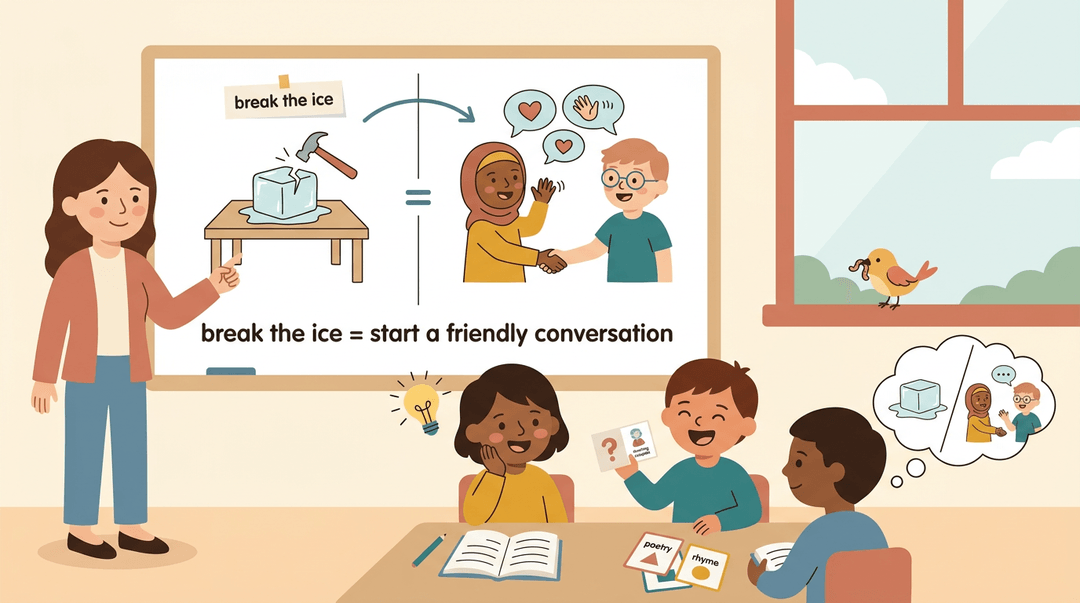
An idiom is a phrase whose meaning isn't obvious from its words, like break the ice. A proverb is a short saying with a lesson, like the early bird catches the worm.
Multilingual learners need explicit explanation. State the literal meaning, then the figurative one, and note that the phrase won't translate word for word. A note like break the ice means start a friendly conversation clears up confusion.
Riddles, poems, and rhymes give students low-stakes practice with figurative language. A riddle asks them to hold two meanings at once. Play makes it stick.
Fun Ways to Practice and Review Words
Practice is where new vocabulary sticks, and variety keeps students engaged. Here's how to mix it up.
Mixing up how students practice
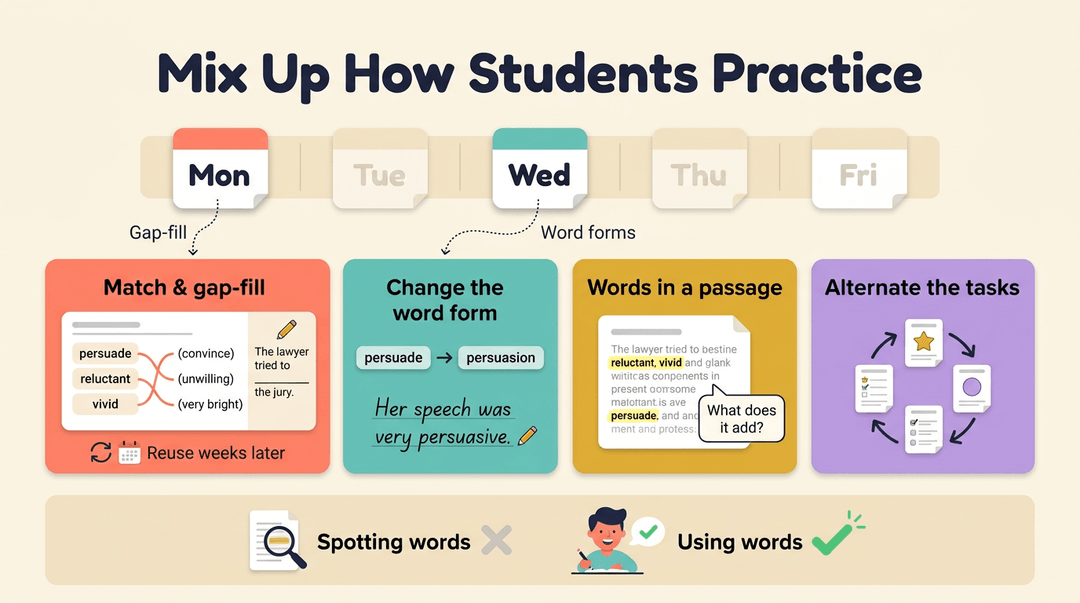
Rotate formats so students don't tire of one worksheet:
- Matching and gap-fill: Students match words to definitions or fill sentence blanks. Reuse these sets on a spaced review schedule, spreading them over several weeks.
- Changing word forms: Students turn persuade into persuasive and persuasion, then use each one in a sentence.
- Words in cohesive passages: Students read a short passage that uses the target words naturally, then explain what each one adds.
- Mix activity types: Alternate formats across the week so no single task becomes routine.
Consider a sixth-grade English teacher who runs gap-fill on Mondays and word forms on Wednesdays. The goal is students using words, not just spotting them.
Word games like bingo and charades
Bingo and charades keep the focus on meaning. Call out definitions for bingo, or have one student act out a word while the team guesses it.
Word sorts group words by category or part of speech, and students explain their choices.
Scavenger hunts work well in authentic texts. Hide target words in a class novel or news article, and have students explain each one in context.
For whole-class review, try Jeopardy and Pyramid rounds, where students answer clues or describe words without saying them. Keep the rules simple: the words do the heavy lifting.
Students keep their own word notebooks
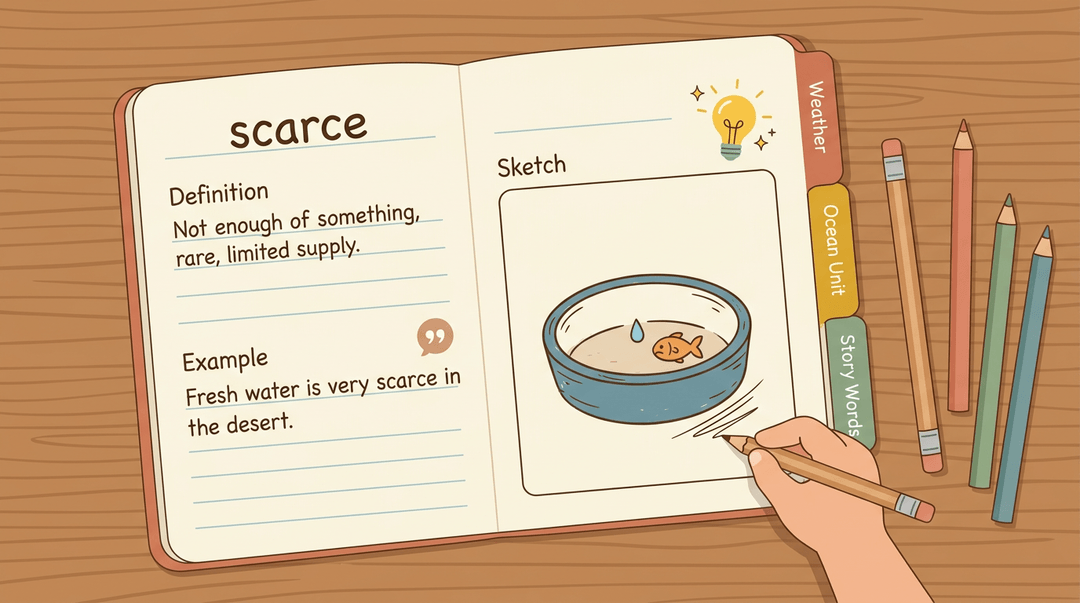
A word notebook lets students track their own growth. For each word, they record:
- The definition, in their own words
- An example sentence from something they read or heard
- A quick sketch
Personalize with pictures. A sketch for scarce becomes a memory hook students built themselves. Organize notebook sections by theme or unit so students can find a word fast at review time.
Repeating words with a weekly focus
Regular repeated practice matters because words need more than one visit to last. Post a small shared set each week and use it in warm-ups, exit tickets, and discussions. That's the weekly word focus in action.
Daily life involvement extends the practice: students spot target words at home and in what they read. Think of a fourth-grade teacher who posts one word each Monday and challenges students to use it on the bus ride home.
By Friday, the class has real examples to discuss.
Learning Words Together Through Talk
Vocabulary sticks when students use words out loud, not just when they see them on a page.
Pair-share and the 4 Ls of partnering
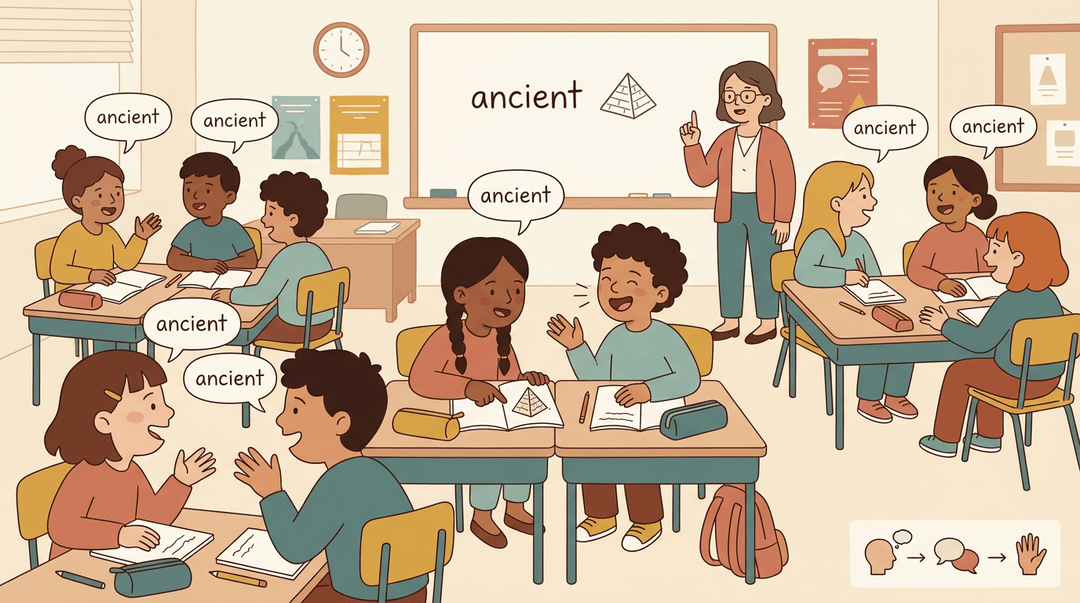
Group and partner work give every student a turn to use new words. Pair-share is simple: students think alone, talk with a partner, then share back.
A fourth-grade teacher has students use ancient in a sentence with a neighbor, and in a minute, every student has said it. The goal isn't the right answer so much as every student using it.
The 4 Ls of Productive Partnering give pairs a shared structure so partner time stays focused.
Building ideas together with peers
Talk gets richer when students respond to each other. Have them respond to peers' ideas by agreeing, adding, or questioning. Then probe reasoning with questions like 'Why does that word fit here?' that push past guesses.
Think of a student who freezes when called on. Response frames are scaffolds: sentence starters like 'Building on ___'s idea, ...' that give that student a place to start. Then they can join in and use the vocabulary too.
Practicing words by speaking them aloud
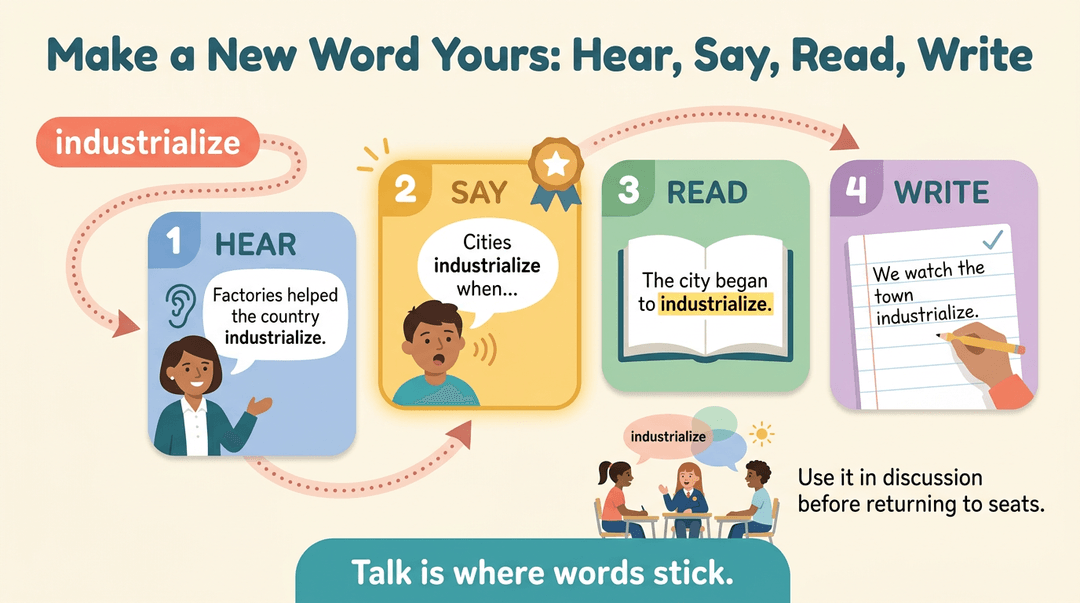
Students need to hear, say, read, and write a word before it really belongs to them. Walk each new word through four steps you can reuse:
- Hear it in a clear, modeled sentence.
- Say it aloud in a sentence of their own.
- Read it in context.
- Write it to lock in the meaning.
Conversation and discussion give words a reason to be used beyond the worksheet. A high school history teacher might have students use industrialize in discussion before they return to their seats. Talk is where words stick.
Checking Vocabulary Progress Along the Way
Vocabulary isn't something we teach once and check off. Quick, regular checks show us which words are sticking and which need another pass.
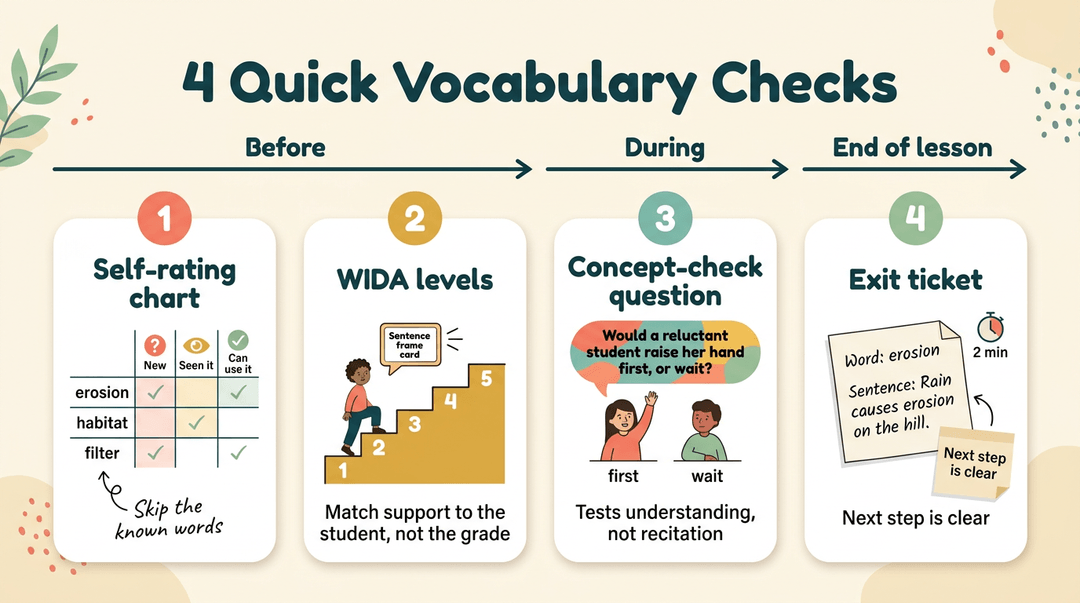
Quick checks before and during learning
Start with self-rating word charts. Students mark each target word as new, seen it, or can use it. A sixth-grade science teacher who uses one on day one can skip the words students already know.
WIDA (World-Class Instructional Design and Assessment) proficiency levels show where each English learner stands, so you can match support to the student, not the grade.
Concept-checking questions test whether students understand a word, not whether they can recite it. Ask, 'Would a reluctant student raise her hand first, or wait?' Their answer shows you more than a definition could.
Finally, exit tickets for words close the lesson. Students write a target word and a sentence using it. Two minutes of reading, and your next step is clear.
Tools for tracking progress over time
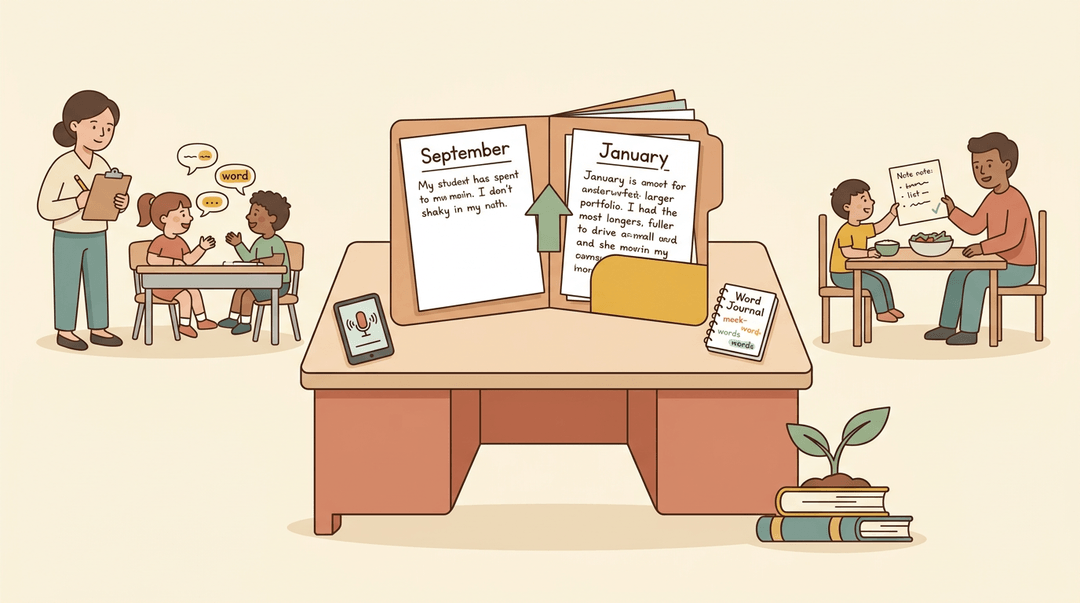
Shadowing and observation show what a worksheet can't. Follow one student through a block and listen for target words in conversation, not just on the page.
Language development portfolios collect:
- dated writing samples
- recordings
- word journals
An early paragraph next to a midyear one shows growth that a single test score rarely captures.
Periodic vocabulary quizzes are short, low-stakes checks at set intervals. Include words from earlier lessons, because they reward recall over cramming.
Share with families so learning continues at home. A short note listing the words a student now uses, plus two to practice at dinner, turns progress into a shared effort.
Vocabulary doesn't grow from one good lesson. It grows when you choose words with care, teach them clearly, show them in context, give students room to practice and talk, and check progress along the way.
Keep that sequence in mind, and each new word becomes a tool your students can actually use.
Ready to put it into practice? Use the Lesson Planner to write, organize, and reuse your vocabulary lessons across multiple classes from one place.
References
- The effects of contextual diversity on incidental vocabulary learning | Studies in Second Language Acquisition — cambridge.org (2026)
- Determinants of students’ academic success in English as a medium of instruction (EMI) classes: A systematic review — pmc.ncbi.nlm.nih.gov (2023)
- Vocabulary and Reading Comprehension: Direct, Indirect, and Reciprocal Influences — pmc.ncbi.nlm.nih.gov (2010)
- The Effects of Repetition on Incidental Vocabulary Learning: A Meta‐Analysis of Correlational Studies - Uchihara - 2019 - Language Learning — onlinelibrary.wiley.com (2019)
- Delivery of Academic Vocabulary in Third Grade Mathematics Instruction — red.mnstate.edu (2019)