Common State Standards: A Complete Guide to Common Core


Jump to section
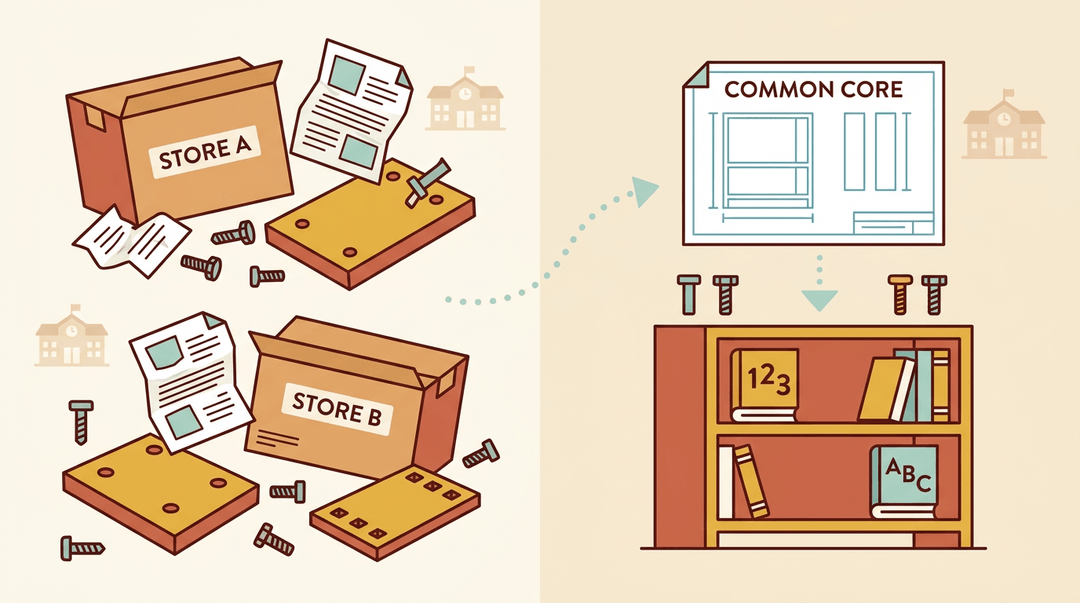
Think about assembling furniture from two different stores, each with its own instructions, its own hardware, its own idea of "finished." For years, that's what moving between school districts felt like.
Common Core state standards were built to fix that: one shared set of expectations for what students should know in math and English language arts, grade by grade. They matter more than ever as schools compare progress across state lines.
Here, we'll cover where they came from, how they were adopted, tested, and debated, and how to turn them into lessons that work in your classroom.
What Common State Standards Are
Strip away the debate, and Common Core boils down to three simple parts working together: grade-by-grade expectations, a literacy framework, and a math framework. It's not a curriculum, a textbook, or a pacing guide.
Think of it as the outline, not the lesson, and it connects loosely to other frameworks like the Next Generation Science Standards (NGSS) and each state's own standards for subjects Common Core doesn't touch.
What Are the Three Parts of Common Core?
The three components are straightforward: academic expectations by grade, covering English language arts (ELA) and math, a broad outline of what students should know by year's end, not a script for how to teach it. That distinction matters.
A fourth-grade teacher still decides the books, the labs, and the pacing. The real work is unpacking standards into learning targets: turning a broad statement like

How to Map Standards to Your Lessons
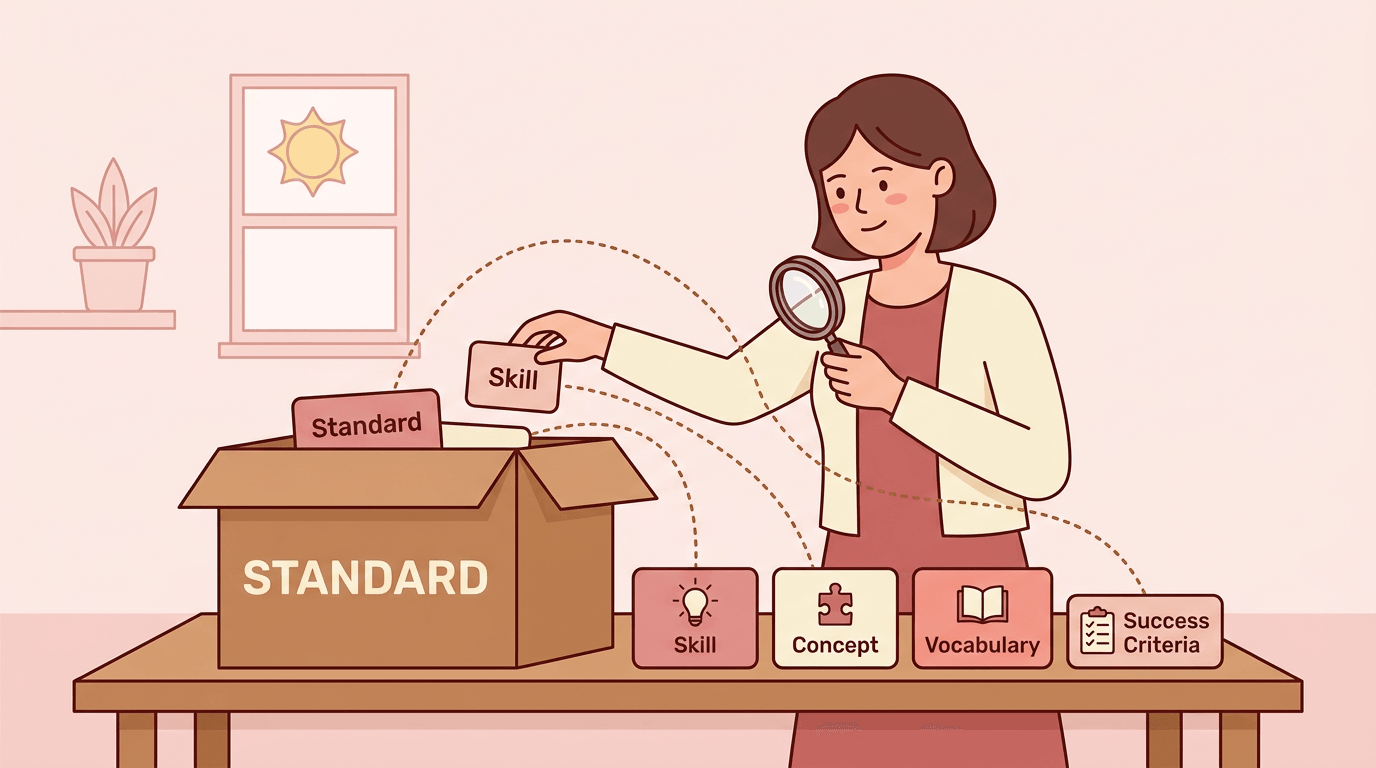
Mapping standards to lessons is a four-move workflow: unpack, sequence, align, localize. Work through it once before the year starts and your weekly planning gets dramatically faster.
Break one standard into teachable skills
A standard is a bundle, not a lesson. Unpack it first:
- Circle the verbs and nouns in the standard. Verbs name skills; nouns name content.
- A standard asking students to compare fractions with unlike denominators breaks into: model a fraction, find common denominators, justify a comparison.
- Turn each skill into a measurable learning target. One observable action per target.
- ❌ "Students will understand fractions."
- ✅ "Students can compare two fractions and defend the comparison in writing."
- The difference: the strong version names something you can watch a student do.
- Set a proficiency scale for the standard. Four levels, each described by student work.
| Level | What it looks like |
|---|---|
| 4 | Compares fractions in a new context, explains why the method works |
| 3 | Compares correctly and justifies in writing |
| 2 | Compares correctly with a provided model |
| 1 | Identifies fractions but can't yet compare them |
Build the year-long pacing guide
Now zoom out from one standard to all of them.
- Cluster standards into units by concept. Group standards that share prerequisites, not by their catalog order.
- Sketch a year-at-a-glance timeline. Every unit, every week, on a single page.
- Balance review against new content. Spiral old skills into warm-ups instead of standalone review units.
Your planning grid. Copy this format, one row per unit:
| Unit | Weeks | New standards | Spiraled review |
|---|---|---|---|
| 2: Fraction concepts | 5–9 | Compare and order fractions | Place value in warm-ups |
Check alignment across grades and classrooms
Before you commit, read the same standard's version one grade below and one above: your entry point should match last year's exit point. Then look sideways at parallel classrooms teaching the same course. When something's off, find your row:
| When you find... | Try... |
|---|---|
| A skill no unit teaches (a gap) | Assign it to the unit holding its prerequisites |
| The same skill in two units (an overlap) | Keep one to introduce it, one to deepen it |
| Your entry skills don't match last grade's exits | Add a short bridge review in unit 1 |
| Your unit order differs from the classroom next door | Agree on shared checkpoint dates, not identical lessons |
💡 Tip: Overlap isn't always a flaw. Cut it only when both units teach the skill at the same depth.
Adjust for your state's version
Common Core looks slightly different depending on where you teach. Before finalizing your map, confirm:
- Exact wording matches your state's document. Many adopting states revised or renamed standards after adoption.
- Codes are current. If your state renumbered standards, keep a one-page crosswalk from old codes to new.
- Non-adopting states still fit this workflow. Swap in your state's own standards; the unpack-sequence-align moves are identical.
The whole map lives or dies on upkeep, so keep it in one editable place rather than a printed binder. See how Curriculum Planner maps standards to units and pacing automatically.
Why Common State Standards Were Created
If you compared two states' math standards side by side back then, you'd often find one classroom demanding far more than the other, even in the same grade. That gap in expectations is exactly what pushed governors and education leaders to act.
Who Led the Effort to Create It
The push came from the states themselves, not a federal mandate.
In April 2009, McNeil (2009) reported that the National Governors Association (NGA) Center for Best Practices and the Council of Chief State School Officers (CCSSO) convened governors' education advisers and chief state school officers in Chicago to launch a state-led effort to build shared standards.

How the Standards Were Written
From that meeting, work groups made up of content experts, university professors, and testing-company specialists drafted the standards. Teachers added input along the way, and states reviewed and revised multiple drafts before signing off.
The Common Core State Standards Initiative notes that 48 states, two territories, and the District of Columbia took part through their membership in the NGA Center and CCSSO.
Why States Wanted Common Standards
The motivation went well beyond tidiness. Standards varied so much state to state that a strong student in one place could land in a far weaker program in another.
That worry traced back to the legacy of A Nation at Risk, which had long fueled concern that schools weren't setting the bar high enough, and No Child Left Behind had exposed those gaps between states without closing them.
Colleges, meanwhile, saw high remediation rates among incoming freshmen, and employers reported widespread dissatisfaction with new hires' literacy and math skills.
Common standards promised one clear way to raise the bar for every student, no matter their zip code.

How States Adopted the Standards
Common Core rolled out fast, and for a handful of states, it eventually rolled back out too. Getting the full picture means looking at both the wave in and the wave out, plus what's replaced it where it's gone.
What States Use the Common Core Standards?
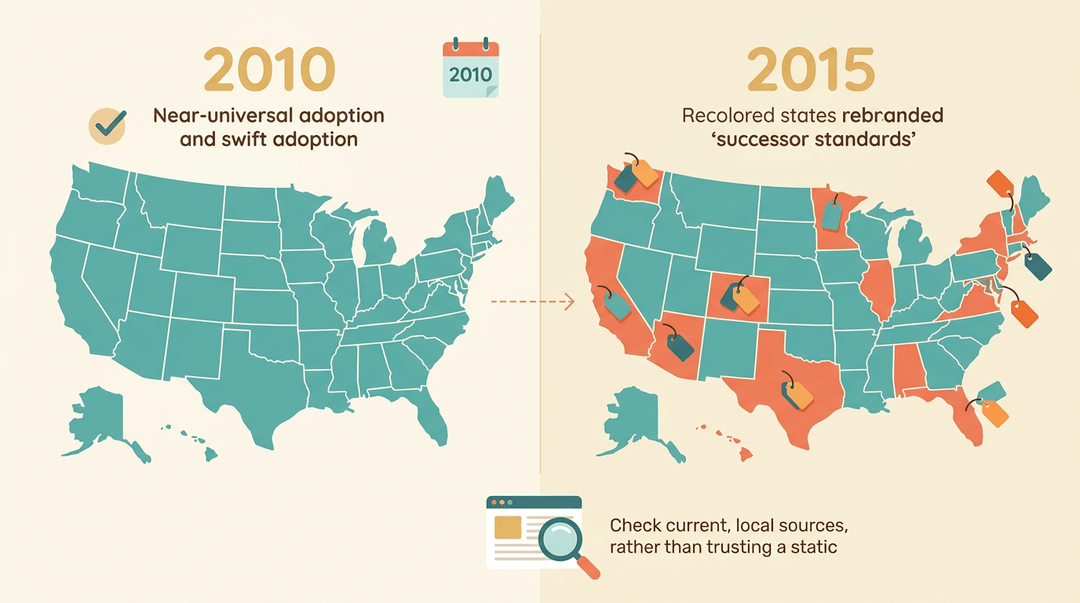
Nearly every state signed on almost immediately.
According to the Society for Research in Child Development, "The Common Core State Standards emerged in 2010 from a bipartisan effort by states to improve educational performance in ways that lead to enhanced college and career readiness for public-school students."
That's the 2010-2011 wave that put Common Core in classrooms across the country almost overnight.
The rollback came later. As a history of Common Core published in ERIC notes, "the standards have often been political fodder, with over 110 bills in 32 states proposing to revoke them or their testing apparatus."
By 2015, seven states had followed through, dropping Common Core for successor standards built on similar goals but branded and worded differently.
Because a state's status can shift with a single legislative session, the safest move is checking your own state department of education's current standards page rather than relying on a snapshot.
Tools for Putting Standards Into Practice
Adoption is only step one. Districts also lean on:
- Instructional shifts guidance: plain-language descriptions of what changes in daily teaching, not just what's tested.
- Alignment toolkits: checklists for matching curriculum materials to specific standards.
- EQuIP reviews: a quality rubric for scoring lesson and unit plans against the standards.
- Classroom material samples: vetted units teachers can adapt instead of building from zero.
- Progression documents: maps showing how a skill builds from grade to grade.
A fifth-grade teacher choosing a new math workbook can run it against an alignment toolkit before ordering a single copy, catching gaps early instead of mid-unit.
How Testing Groups Assessed the Standards
Adopting the standards was only half the job. States also needed a way to measure whether students were actually meeting them, and that meant building brand-new tests from scratch.
How the Consortium Tests Were Built
Two state consortia took on that work: the Partnership for Assessment of Readiness for College and Careers (PARCC) and Smarter Balanced.
Both groups set out to design exams that measured genuine mastery of the standards, not just rote recall, and both wanted something bigger than a single state's test.
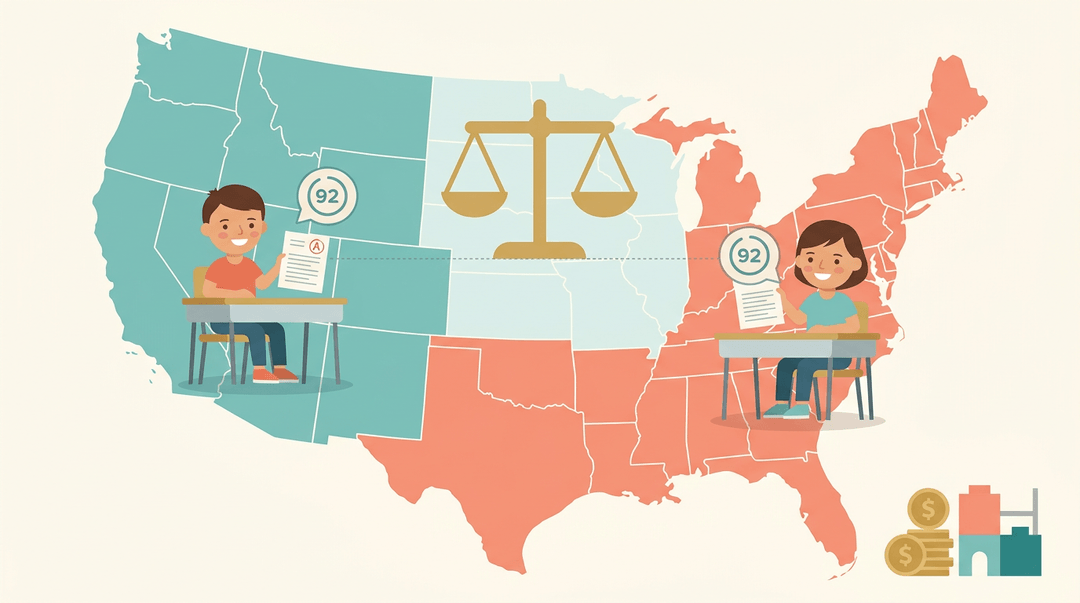
The goal was comparability: a fourth grader's score in one state should mean the same thing as a fourth grader's score in another.
According to Education Next, the consortia received $360 million in federal funding to build these next-generation assessments.
Why States Dropped the Consortium Tests
The tests hit classrooms fast. As Education Week reported, field-testing began in spring 2014, giving teachers and students their first real look at what these exams would demand.
What they found wasn't encouraging. The tests ran long, often eating up multiple class periods, and that alone drove plenty of frustration.
One by one, states walked away from PARCC and Smarter Balanced, choosing instead to build their own custom exams or buy off-the-shelf alternatives that fit their classrooms better.
The dream of one shared test across every state didn't survive contact with the school day.
Why Common Core Faced Backlash
No set of standards this big rolls out without friction, and Common Core hit plenty of it. The pushback split into three lanes: politics, rigor, and testing, and each one landed differently in classrooms.
Political Pushback Over States' Rights
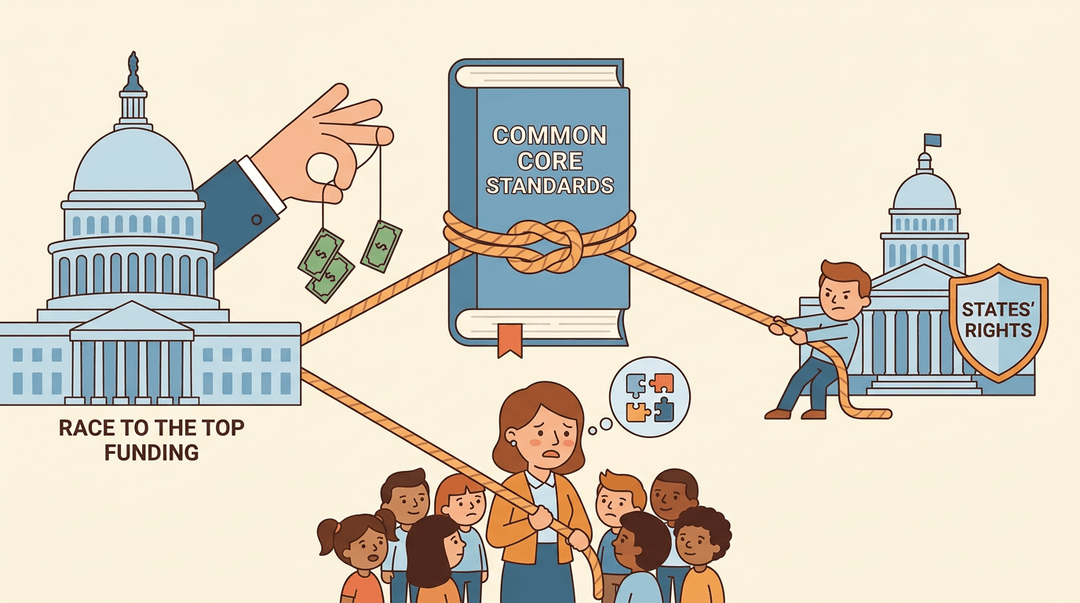
Common Core arrived with Race to the Top grants attached: federal dollars that nudged states toward adopting the standards fast, sometimes before local educators had fully weighed in. That funding tie sparked federal overreach concerns almost immediately.
Conservative states pushed back on states'-rights grounds, arguing that curriculum decisions belonged closer to home.
Meanwhile, some liberal educators raised a different worry: that standardized benchmarks left too little room for teachers to tailor instruction to the actual students in front of them.
Is Common Core Harder for Students?
This is one of the most searched questions about Common Core, and the honest answer is: it depends who you ask. Critics pointed to a heavier nonfiction focus in English language arts, arguing it crowded out literature.
Others took issue with cold-reading pedagogy, where students tackle unfamiliar texts without pre-reading support, questioning whether that's developmentally appropriate for younger learners.
On the math side, the rigor debate got specific: Pioneer Institute reported that Common Core math authors Jason Zimba and William McCallum acknowledged the standards fell short of true college-prep readiness.
Backlash Against Standardized Testing
Testing became its own flashpoint. Families fueled an opt-out movement, refusing state tests outright.
Educators criticized corporate testing vendors profiting from the shift, and many teachers felt instructional time was lost to test prep instead of actual teaching.
Common Core gave teachers a shared map: one set of expectations, tested and debated, built so a student's growth means the same thing in any classroom. What matters now isn't relitigating its history.
It's putting those standards to work in lessons that fit your students.
Ready to turn standards into a real plan? Check out our Curriculum & Standards feature to plan units, lessons, and standards across your whole school year.
References
- The Common Core State Standards Initiative — files.eric.ed.gov
- The 50 Year History of the Common Core — files.eric.ed.gov
- Democracy and National Education Standards — faculty.fordham.edu
- Development Process — thecorestandards.org
- The Common Core State Standards: Effects on Educational Practice — srcd.org
- Common-Core Field Tests Gain Foothold in States — edweek.org
- Remedial Education — americanprogress.org
- The Politics of the Common Core Assessments — educationnext.org
- Common Core Math Will Reduce Enrollment in High-Level High School Courses — pioneerinstitute.org
- The Common Core Explained — edweek.org (2015)
Frequently asked questions
What is a common standard?
A common standard refers to a shared set of expectations, often for what students should know in specific subjects like math and English language arts, grade by grade. It provides a consistent framework allowing for comparison of progress across different schools or states.
What is the Common Core Standards Initiative?
The Common Core Standards Initiative is a state-led effort launched by the National Governors Association (NGA) Center for Best Practices and the Council of Chief State School Officers (CCSSO) to create one shared set of academic expectations for K-12 students. Its goal was to ensure students across states were prepared for college and careers.
What is the purpose of the Common Core Standards?
The purpose of the Common Core Standards is to provide a consistent, clear understanding of what students are expected to learn. They aim to ensure that all students, regardless of where they live, are prepared for post-secondary education and the workforce by setting a common bar for academic achievement.
What are the 10 NCSS themes?
The 10 NCSS themes are: Culture; Time, Continuity, and Change; People, Places, and Environments; Individual Development and Identity; Individuals, Groups, and Institutions; Power, Authority, and Governance; Production, Distribution, and Consumption; Science, Technology, and Society; Global Connections; and Civic Ideals and Practices. These themes serve as an organizational framework for social studies curriculum.
What are state standards in education?
State standards in education are specific learning goals adopted by individual states that define what students should know and be able to do at each grade level. While some states adopt national standards like Common Core, others develop their own unique sets of standards for various subjects.
Why are people against Common Core?
People are against Common Core for several reasons, including concerns about federal overreach in education, which traditionally has been a state responsibility. Other criticisms include a perceived heavier focus on nonfiction in English language arts and questions about the development of math standards.
Why is Common Core so controversial?
Common Core is considered controversial due to political pushback over states' rights, as some viewed its adoption as a federal imposition, fueled by initiatives like Race to the Top grants. Debates also arose regarding the rigor and pedagogy of the standards, especially in math and English language arts, and extensive backlash against the associated standardized testing.
Do states still use Common Core standards?
Many states still use standards based on the Common Core, though some have revised or renamed them as "successor standards." While seven states dropped Common Core by 2015 for these branded alternatives, the underlying goals and content often remain similar to the original Common Core standards.