ACTFL Proficiency Scale: A Complete Guide to the Levels

Jump to section
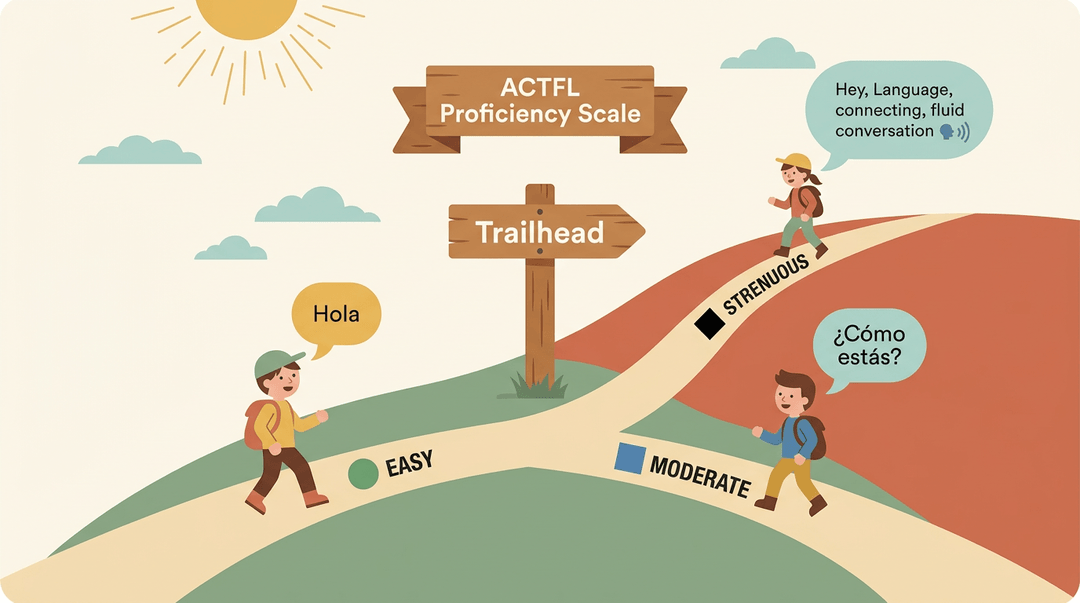
Think about checking a hiking trail's difficulty rating before you set out: easy, moderate, strenuous. Each label tells you what to expect before you take a single step. Language proficiency works the same way.
The ACTFL proficiency scale, built by the American Council on the Teaching of Foreign Languages (ACTFL), gives teachers a shared language for describing what a student can actually do, from a few memorized phrases to fluent, spontaneous conversation.
In this post, we'll walk through how the scale works, what each level looks like, and how to use it to assess and report progress.
How the ACTFL Proficiency Scale Works
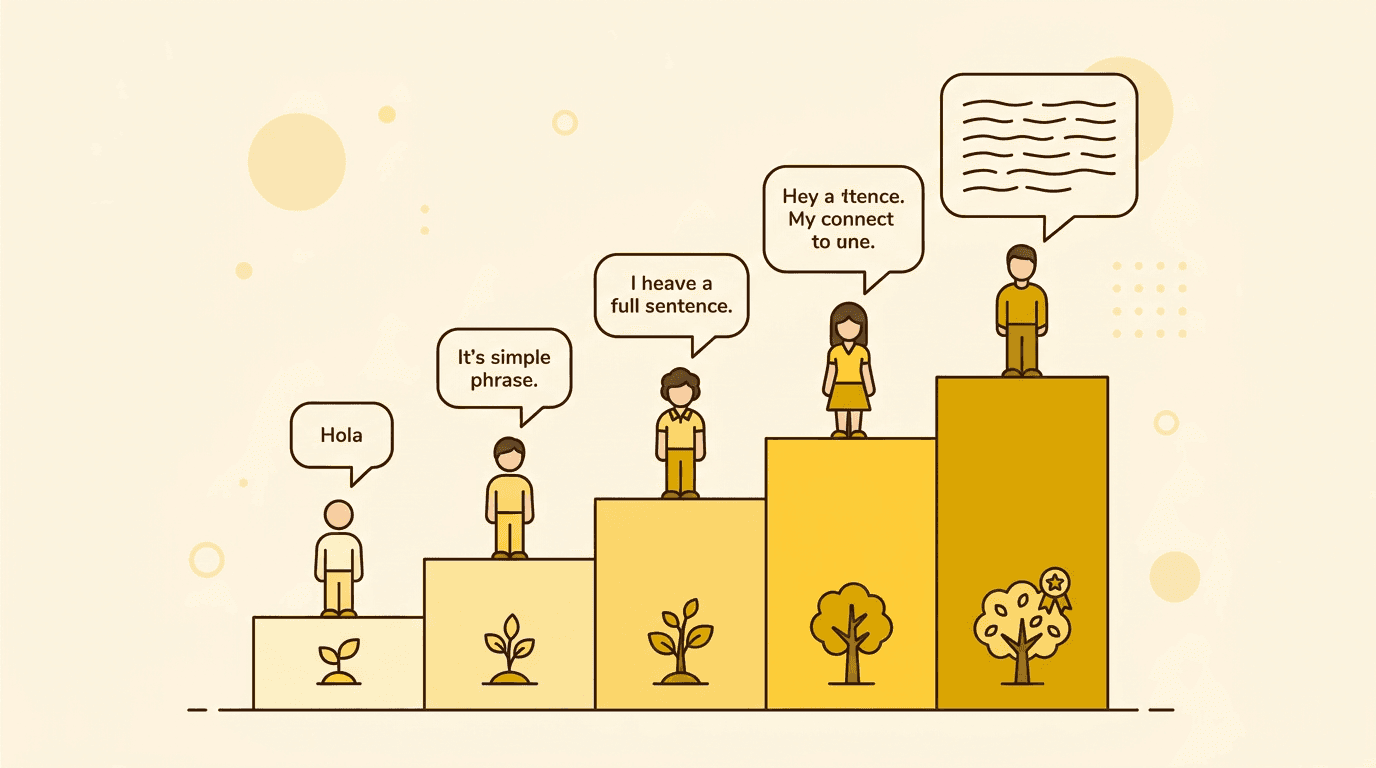
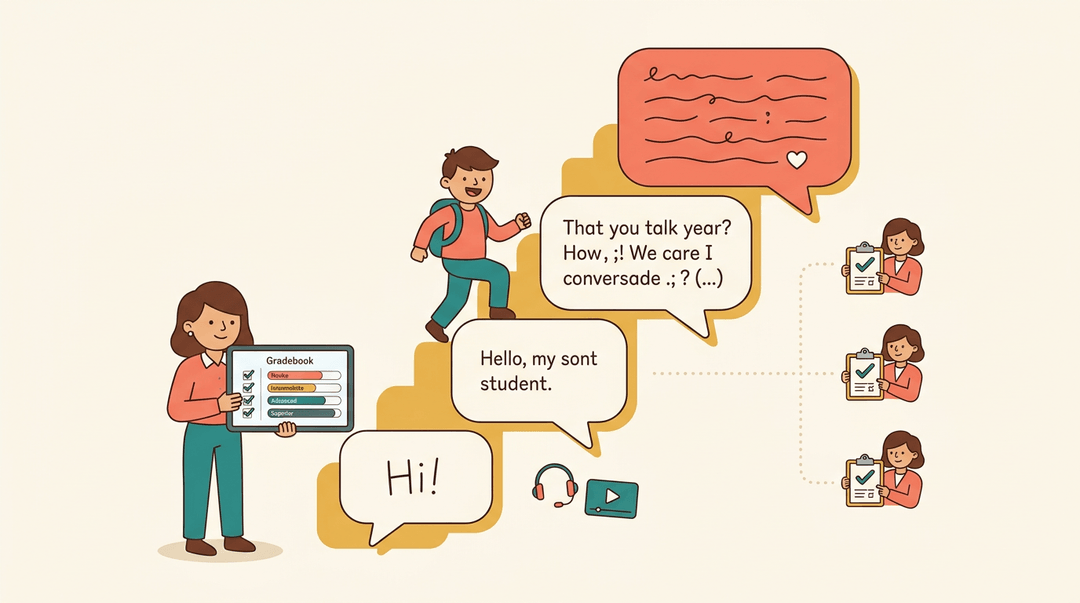
At its core, the scale is a ladder, not a checklist. Each rung tells you what a student can actually do with the language, and climbing it takes real, sustained growth rather than finishing a unit.
The five main proficiency levels
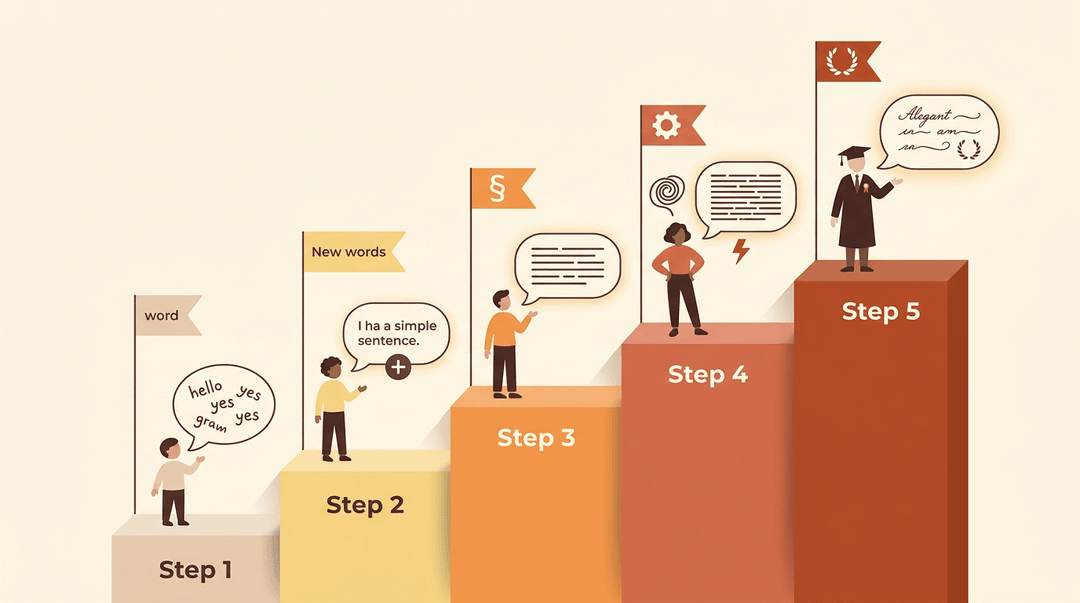
The scale runs through five main levels: Novice, Intermediate, Advanced, Superior, and Distinguished.
- Novice speakers work with memorized words and phrases.
- Intermediate speakers start creating their own sentences to handle everyday tasks.
- Advanced speakers narrate and describe with paragraph-length language across familiar topics.
- The Superior level marks a real turning point: speakers can discuss abstract and specialized topics with precision, even under pressure.
- The Distinguished level was added later, capturing the rare, highly refined command of language used in professional and academic settings, the kind you'd expect from a skilled diplomat or scholar.
Low, Mid, and High sublevels
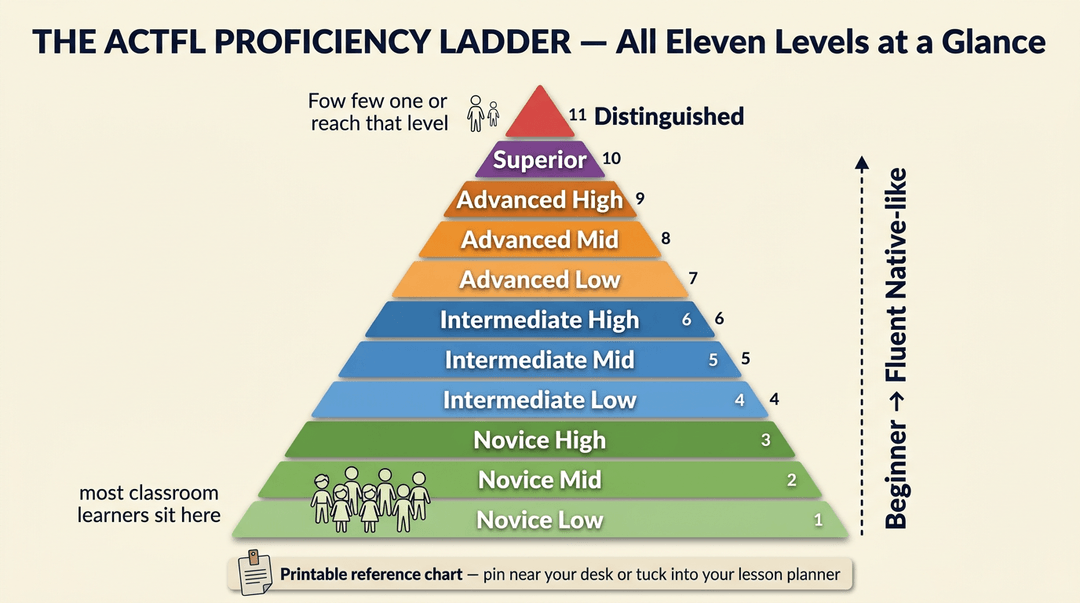
Novice, Intermediate, and Advanced each split into Low, Mid, and High sublevels, giving you nine total gradations before Superior even starts.
That's what lets a teacher say a student is "Intermediate High" instead of just "Intermediate," a distinction that matters when tracking growth over a semester.
Superior and Distinguished skip this division: by that point, the differences between speakers are less about range and more about consistency and depth.
All eleven levels at a glance
Put together, the full ladder looks like this:
- Novice Low
- Novice Mid
- Novice High
- Intermediate Low
- Intermediate Mid
- Intermediate High
- Advanced Low
- Advanced Mid
- Advanced High
- Superior
- Distinguished
ACTFL often visualizes this as a pyramid: wide at the Novice base, where most classroom learners sit, and narrowing sharply toward Distinguished at the top.
A printable version of this same list makes a handy reference chart to pin near your desk or tuck into a lesson planner.
Why proficiency builds on itself
Each level subsumes the ones below it: an Advanced speaker can still do everything a Novice speaker can, plus more. That's why proficiency is best thought of as a range a student operates in, not a fixed point they land on and stay at.
And because language use isn't one skill, every level applies separately across all four domains:
- speaking
- listening
- reading
- writing
What Each Proficiency Level Looks Like
So what does each rung on the ACTFL ladder actually sound like in a real classroom? Picture the five levels as a staircase: each step adds more length, more control, and more nuance to what a student can do with the language.
What novice learners can do
A novice speaker works almost entirely with isolated words and memorized phrases: greetings, numbers, a few stock questions pulled straight from a unit's vocabulary list.
Responses are short, often just a word or two, and comprehension is limited to familiar, highly predictable topics.
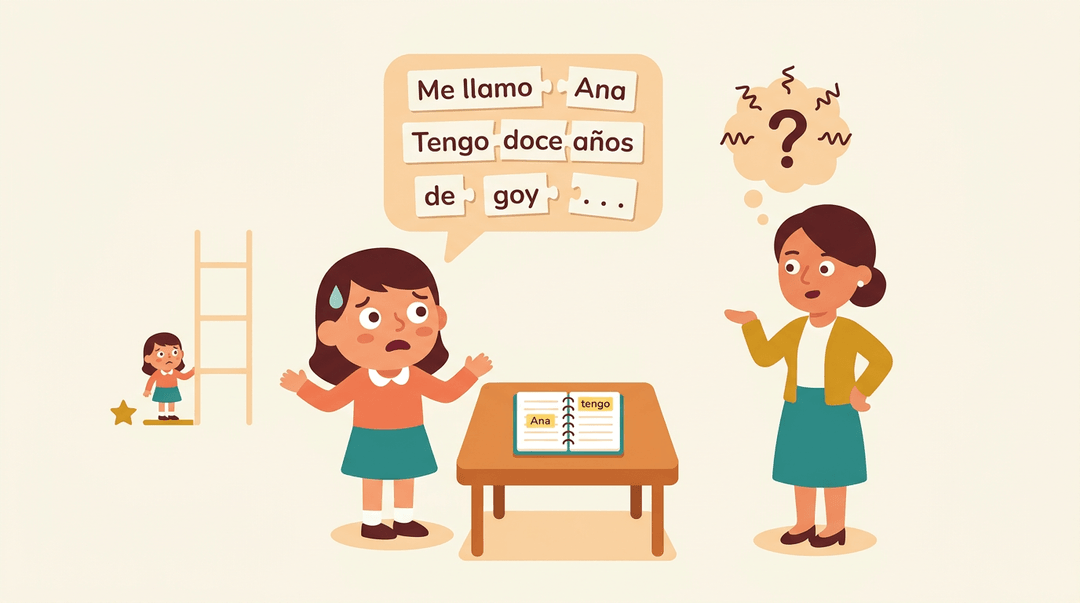
Think of a first-year Spanish student who can say "Me llamo Ana" and "Tengo doce años" but freezes the moment a question strays outside the script. That's novice-level language in action: recognizable, but not yet flexible.
What intermediate learners can do
An intermediate learner has moved from reciting to actually communicating, even if it's basic.
They can handle survival-level tasks (ordering food, asking for directions, answering simple personal questions) and start stringing sentences together, even if loosely connected.
A student at this level often leans on context clues to fill gaps in understanding rather than knowing every word.
A typical intermediate response might sound like: "Yo voy a la escuela, y después, yo estudio en mi casa." Simple, connected, but not yet fluid.
What advanced learners can do
Advanced speakers can narrate across time, past, present, and future, and hold their own when a conversation takes an unexpected turn.
Discourse stretches to paragraph length, and they can grasp the main idea of more complex material even without catching every detail.
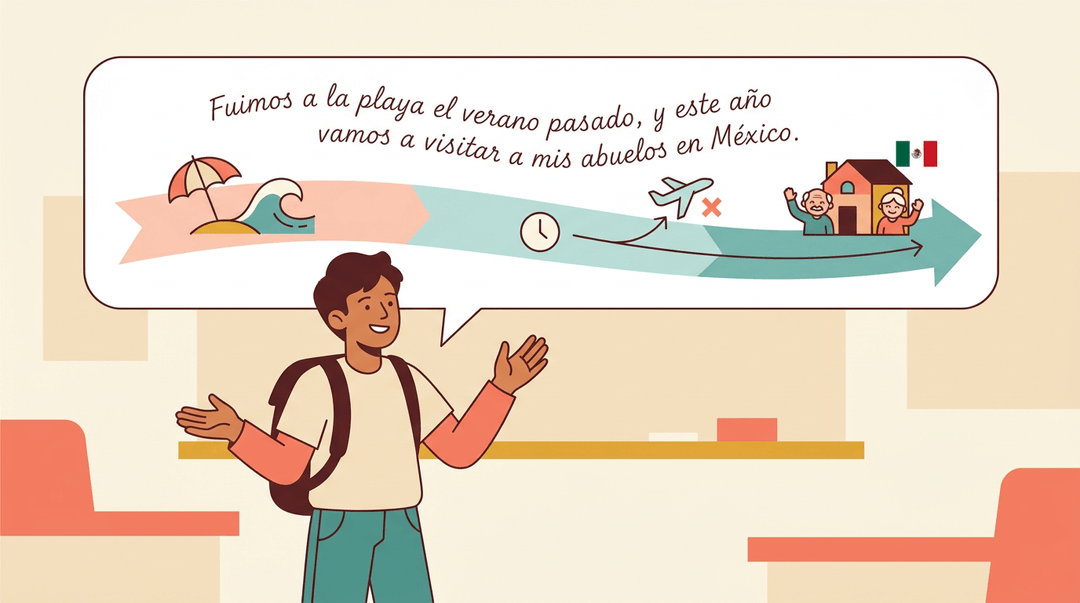
Consider a high school junior describing a family trip: "Fuimos a la playa el verano pasado, y este año vamos a visitar a mis abuelos en México." The story flows, and complications (a missed flight, a change of plans) no longer derail the conversation.
What superior speakers can do
A superior speaker handles extended discourse on abstract topics: politics, ethics, environmental policy, with structured argumentation and near-native fluency.
They can defend a position, anticipate counterpoints, and organize ideas the way a native speaker would in a formal discussion.
What distinguished speakers can do
At the top of the scale, a distinguished speaker communicates with exceptional, near-native fluency, weaving in cultural and historical references naturally.
Their language is highly organized and precise enough for professional or academic settings, the kind of command most classroom programs aren't designed to produce, but the benchmark still matters for understanding the full scale.
Using ACTFL Levels in Your Classroom
The scale only earns its keep when it changes how you assess and report. Here's a quick routine you can run in any language class: benchmark each student, know what's typical for your grade band, and report growth in proficiency terms instead of points.
Assess a baseline in five minutes
- Give a quick oral prompt.
- Say: "Tell me about your family. What do you like to do together?"
- Match the response to a sublevel.
- Memorized words and phrases: Novice.
- Created sentences on familiar topics: Intermediate.
- Connected paragraphs across time frames: Advanced.
- Confirm with a Can-Do checklist.
- Check statements like "I can ask and answer simple questions about familiar topics."
- Record the baseline score.
- Log it like an artifact: "Sept 12: Intermediate-Low (speaking)."
⚠️ Watch out: rate what the student does consistently, not their best flash of language. One perfect sentence doesn't lift a Novice-High speaker to Intermediate.
What to expect by grade band
| Grade band | Typical level | What it sounds like |
|---|---|---|
| Elementary | Novice-Mid | Memorized greetings: "¡Hola! Me llamo Ana." |
| Middle school | Intermediate-Low | Simple Q&A in their own sentences |
| High school | Advanced-Low | Narrating a past event in paragraphs |
| AP / college | Advanced-Mid to High | Detailed stories across present, past, and future |
These are targets, not ceilings. A motivated eighth grader can outpace the row above; use the table to set expectations, not limits.
Report progress in proficiency terms
- Translate levels to grades with a published scale, not gut feel.
- Example: meets the Intermediate-Low target = A; one sublevel below = B.
- Write proficiency-based comments that name what the student can do.
- ❌ "Good participation this term." (Describes behavior, not language.)
- ✅ "Maria now answers questions in full sentences: solid Intermediate-Low."
- The difference: the second one tells parents exactly what changed.
- Track growth each term with the same prompt.
- Reusing your baseline question makes sublevel movement easy to spot.
- Share Can-Do goals home so families see the path.
- Send one goal per term: "By December, I can order a meal in Spanish."
Example: A high school Spanish teacher benchmarks every student in September with the family prompt, logs sublevels, then repeats it in January. Report cards read "moved from Novice-High to Intermediate-Low," and parent conferences suddenly have something concrete to discuss.
The whole routine stays manageable when the records live in one place: log each student's proficiency level and growth notes directly in EMStudio's gradebook.
How Schools Use ACTFL Levels
The scale isn't just a research tool sitting in a binder. It shapes real decisions: how districts write curriculum, how colleges set placement rules, and how students earn recognition for their language skills. Here's where it shows up.
Planning curriculum with Can-Do statements
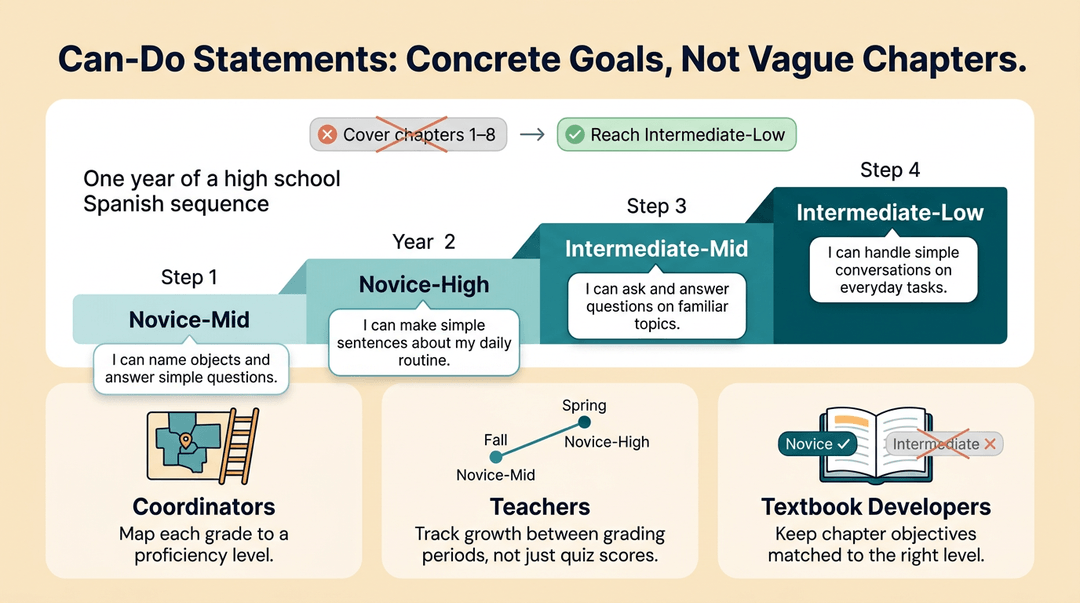
Districts use the Can-Do statements (plain-language descriptions of what a learner can do at each level) to set concrete goals for every course.
A world language coordinator building a four-year sequence might map Novice-Mid to first-year Spanish and Intermediate-Low to fourth-year, giving every grade a clear proficiency target instead of a vague "cover chapters 1 through 8."
Teachers then chart student progress against those same statements from one grading period to the next, rather than relying only on vocabulary quizzes.
Textbook developers use the same framework, aligning chapter objectives to ACTFL levels so a program built for Novice learners doesn't quietly demand Intermediate skills.
Meeting college language requirements
For students, ACTFL sublevels often decide how much language coursework they still owe.
Many colleges waive their foreign language requirement for students who test at Intermediate-Mid or higher, and course catalogs frequently list beginning and intermediate classes by expected proficiency band instead of just "Spanish 101."
Some institutions run their own proficiency testing using ACTFL-aligned rubrics to place incoming students, so a student who studied abroad doesn't end up repeating material they've already mastered.
Free tools to self-assess your level
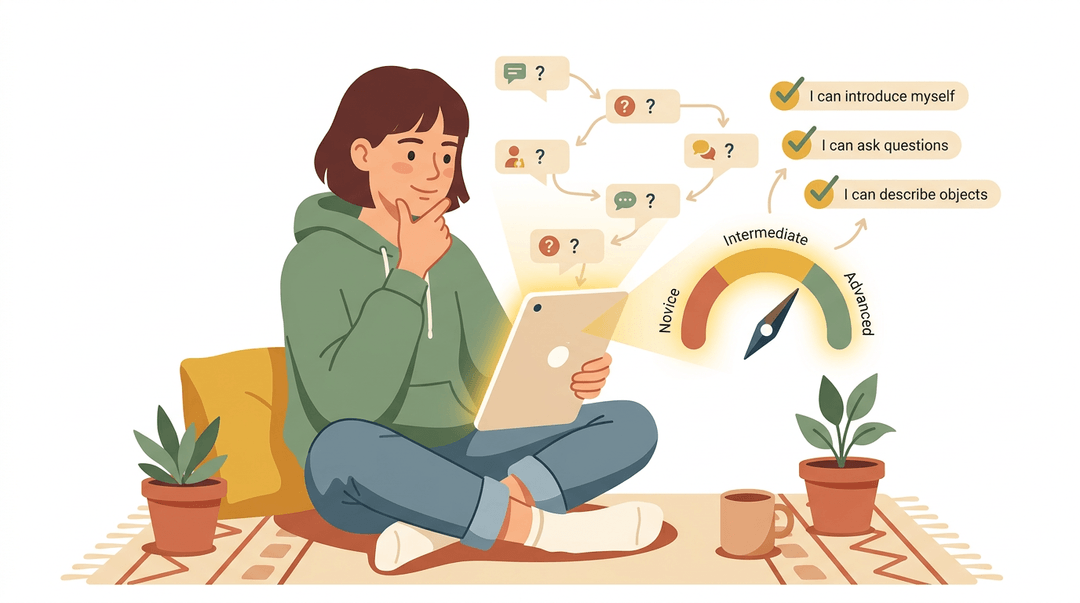
Students don't have to wait on a teacher's assessment to get a sense of where they stand. ACTFL's free adaptive self-assessment adjusts its questions based on how a learner responds, closing in on a level without a formal exam.
It's built directly on the Can-Do statements, and simplified guideline versions exist for students and parents who want a plain-language snapshot instead of the full technical descriptions.
Earning the Seal of Biliteracy
The Seal of Biliteracy gives students an official credential for their bilingual skills, and most states award it at three tiers correlating roughly to:
- Intermediate-Mid
- Advanced-Low
- Advanced-High proficiency
Think of a high school senior who reaches Advanced-Low in Mandarin alongside native-level English: that student can graduate with a gold seal on their diploma.
Some states have adopted the Global Seal of Biliteracy program, which recognizes proficiency across an even wider range of languages.
Official Testing and Ratings
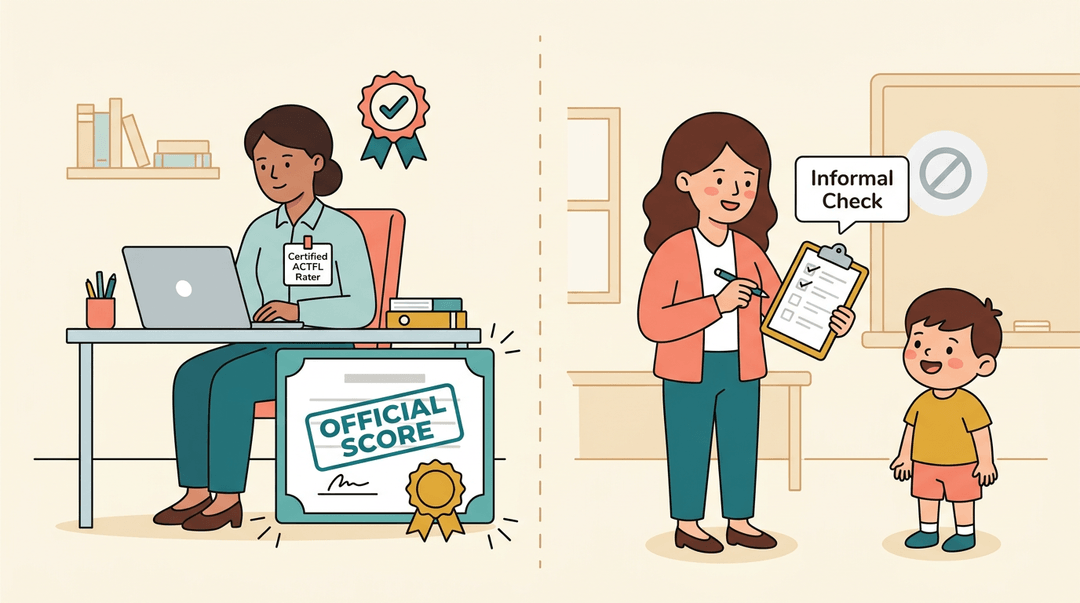
A classroom rubric and an official ACTFL rating aren't the same thing, and that distinction matters the moment a score leaves your gradebook and lands on a transcript or a job application.
Who can give official ratings
Only one organization can hand out an official score: Language Testing International (LTI) is, in ACTFL's own words, "ACTFL's exclusive licensee" for administering the tests.
Every rater working under LTI is a certified ACTFL rater, trained to apply the guidelines consistently across thousands of test-takers. A rating from anyone outside that certified pool, no matter how careful, simply isn't valid.
That includes a teacher's informal in-class check: useful for instruction, but not an official score.
How you're allowed to use the guidelines
ACTFL makes the proficiency guidelines available for classroom use, but with real limits.
You can use them for non-profit educational purposes only, and only if you reproduce the entire text unaltered: no trimming a level description down to a handout snippet. Any use also has to credit ACTFL directly.
What's the difference between ACTFL and CEFR?
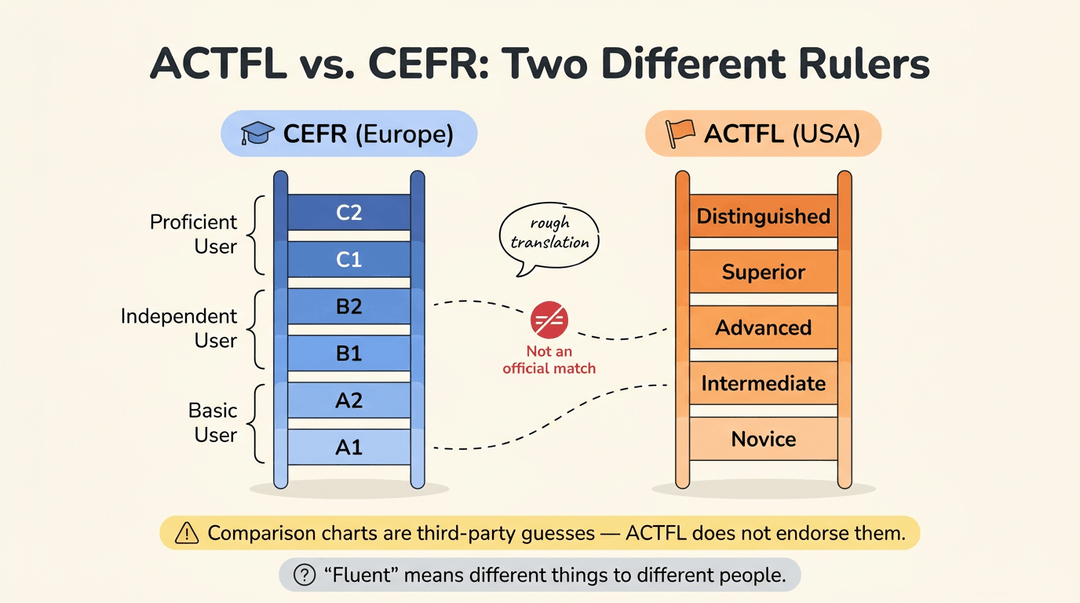
Europe's parallel system is the Common European Framework of Reference (CEFR), which runs A1 and A2 (basic user), through B1 and B2 (independent user), up to C1 and C2 (proficient user).
You'll often see charts online mapping ACTFL levels to CEFR levels, but that alignment is a third-party prediction, not something ACTFL endorses or guarantees.
It's a helpful rough translation, not an official rating: a B2 score doesn't automatically equal Advanced, and whether B2 counts as "fluent" depends entirely on who's defining fluency.
Why official assessments matter
Official ratings carry weight precisely because they're standardized. Academic placement, hiring and promotion decisions, program evaluation, and professional certification all lean on that consistency.
It's also why proficiency (what a student can do unrehearsed) gets measured separately from performance on a specific unit's content, and why critics note the scale can't capture everything about a learner's ability.
ACTFL's Organization and Resources
ACTFL is more than a proficiency scale: it's a professional home for language educators, with membership, resources, and publications we'll unpack here, all built to support you well beyond the classroom rubric.
Membership and professional development
ACTFL runs as an individual membership organization, open to any teacher who wants to join rather than requiring a school or district contract. Members get access to workshops and webinars covering everything from lesson design to assessment, plus a path toward tester and rater certifications for educators who want to officially score Oral Proficiency Interviews or writing samples. Special interest groups connect you with others teaching your specific language or grade band, so you're never troubleshooting alone.

Key resources for educators
Several core documents shape how ACTFL's thinking plays out in real classrooms:
- World Readiness Standards. The "5 Cs" framework (Communication, Cultures, Connections, Comparisons, Communities) that guides curriculum design.
- Performance Descriptors. Grade-band benchmarks that translate proficiency levels into what students can actually do.
- Guiding Principles. Research-based recommendations for building a language program.
- Position Statements. ACTFL's stance on issues like heritage language learners and early language study.
ACTFL's journals and publications
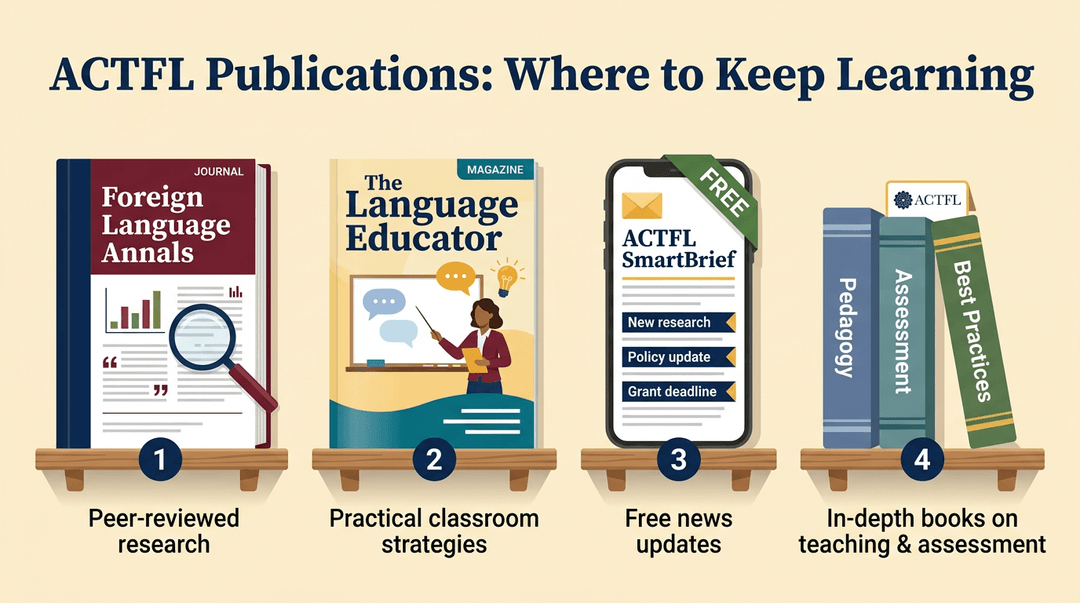
For ongoing learning, ACTFL publishes:
- Foreign Language Annals, a peer-reviewed research journal
- The Language Educator, a magazine geared toward practical classroom strategies
- The free ACTFL SmartBrief newsletter keeps you current on field news
- ACTFL's book publishing program offers deeper dives into pedagogy and assessment
The benefits of learning a language
The case for language study goes beyond the language itself. Research has linked it to academic achievement and skill transfer across languages, meaning students who wrestle with one language's patterns often find the next one easier. Researchers Bialystok, Craik, and Luk, in a review published in PMC, found that multilingualism provides benefits to people "at all points along the lifespan, from the youngest infants and children, to young adults, and to older adults." Bilingual students also tend to see socioeconomic advantages later on, and many take on language brokering, translating for family members, which builds real-world communication skill fast.
The History Behind the ACTFL Scale
Every grading system has an origin story, and ACTFL's traces back to a practical problem: teachers and government agencies were describing language ability in wildly different ways, with no shared yardstick.
How it grew from the ILR scale
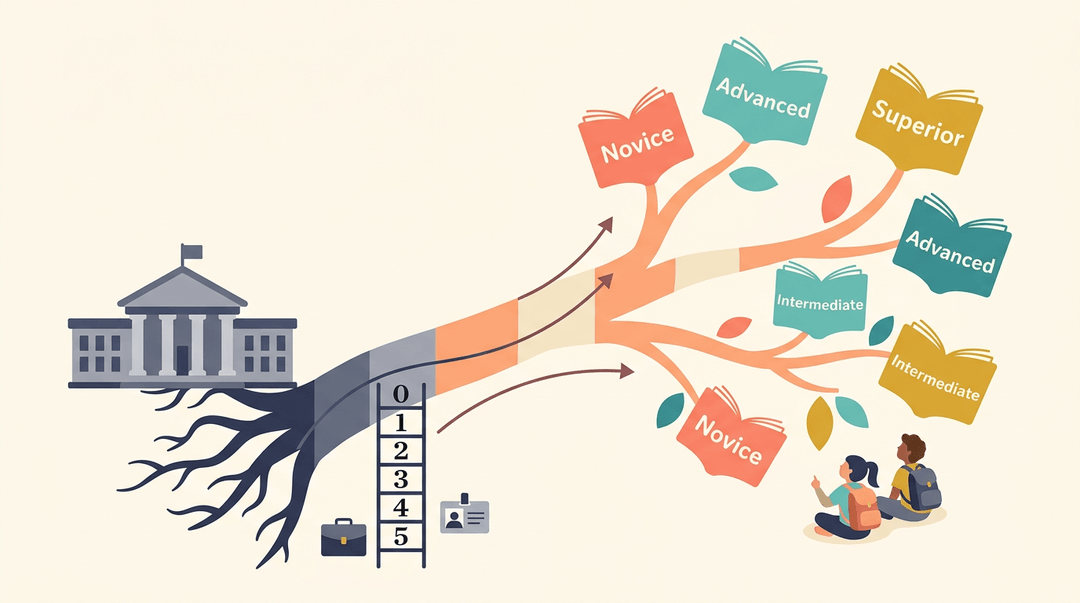
The American Council on the Teaching of Foreign Languages (ACTFL) scale didn't start from scratch. It grew out of the Interagency Language Roundtable (ILR) scale, the numeric 0-to-5 system federal agencies used to rate language skills for diplomats and analysts. ACTFL adapted that framework for classrooms, trading ILR's numbers for named levels like Novice and Advanced. The distinction matters: ILR serves a government need for standardized ratings, while ACTFL serves an academic one, tracking how students actually grow through a curriculum.
How the guidelines evolved over time
The scale itself has been revised repeatedly. ACTFL published its provisional Proficiency Guidelines in 1982, then finalized four levels, Novice, Intermediate, Advanced, and Superior, in 1986. A 1999 revision split Advanced into sublevels for finer distinctions, and ACTFL added a Distinguished level in 2012 to capture the rarest, most polished language use. Most recently, ACTFL revised the guidelines again in 2024 to improve clarity and accessibility, aligning them with related tools like the Can-Do Statements.
Building the ACTFL testing system
Guidelines only work if teachers can apply them consistently. That's why ACTFL built the Oral Proficiency Interview (OPI) to assess speaking skills directly, backed by an OPI Workshop that trains educators to administer it well. A partnership with the Peace Corps produced training videos still used to model ratings, and certification programs for testers and raters keep scoring consistent from classroom to classroom.
The ACTFL proficiency scale isn't just an academic framework: it's a practical way to describe real growth, from a beginner's first greetings to a confident, nuanced conversation.
When you can name exactly where a student stands and what comes next, feedback gets clearer and grading gets fairer for everyone in the room. Ready to turn those proficiency levels into organized, trackable grades?
Check out our Grading & Assessment feature to keep every student's progress in one place.
References
- The ACTFL Proficiency Guidelines and the Oral ... — web.pdx.edu
- The Benefits of Multilingualism to the Personal and Professional Development of Residents of The US — pmc.ncbi.nlm.nih.gov
- ACTFL | Use of ACTFL Proficiency Guidelines and Issuing of Official… — actfl.org
- ACTFL Proficiency Guidelines 2012 — resources.finalsite.net
- ACTFL | Revised ACTFL Proficiency Guidelines Released — actfl.org
- ACTFL | Protecting the ACTFL® Proficiency Guidelines — actfl.org (2026)
Frequently asked questions
What is A1, A2, B1, B2, C1, C2 language proficiency?
A1 and A2 are CEFR basic-user levels: A1 covers familiar words, simple phrases, and basic personal information, while A2 supports routine exchanges on familiar topics. B1 and B2 are independent-user levels: B1 handles everyday situations and connected speech, while B2 supports more fluent interaction, including discussions of abstract or technical topics. C1 and C2 are proficient-user levels: C1 allows flexible, effective communication in demanding settings, and C2 reflects highly precise, nuanced command of the language.
What is the difference between ACTFL and CEFR levels?
ACTFL and CEFR are different proficiency frameworks with different level structures and descriptors. ACTFL uses Novice, Intermediate, and Advanced levels with Low, Mid, and High sublevels, followed by Superior and Distinguished; CEFR uses six levels, A1 through C2. Comparisons between them are approximate third-party mappings, not official one-to-one equivalencies.
Is B2 considered fluent in a language?
B2 is often described as upper-intermediate and can support fairly fluent conversation, including discussion of unfamiliar or abstract topics. However, “fluent” has no single standardized definition, and B2 does not necessarily mean near-native accuracy, effortless expression, or equal ability in speaking, listening, reading, and writing.