Spelling Curriculum: How to Choose the Right One

Jump to section
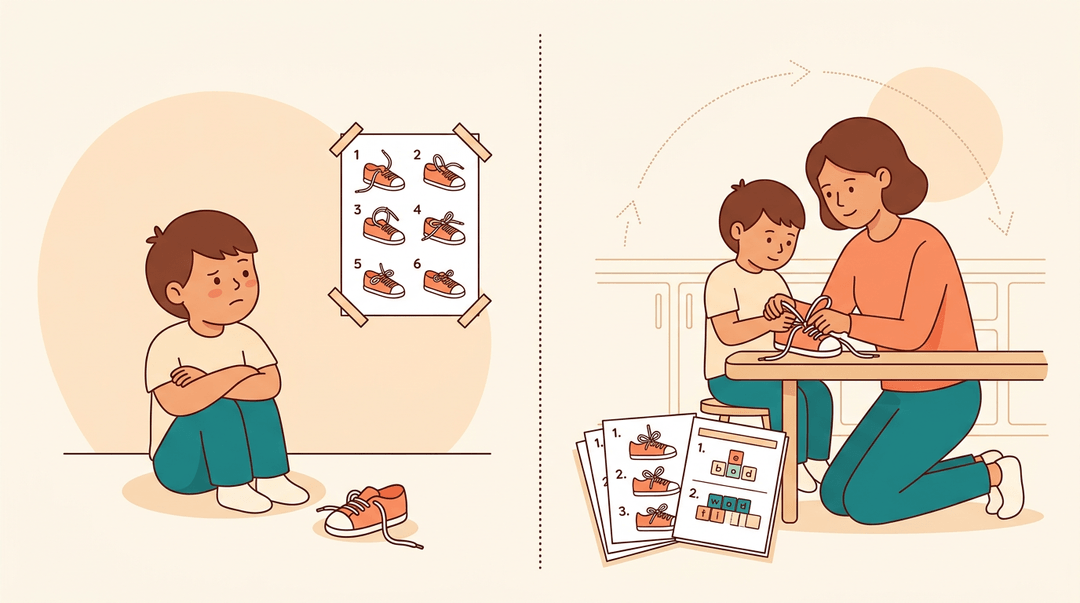
Think about teaching a child to tie their shoes: hand them a diagram and hope it clicks, or walk them through the same steps until their fingers know it without thinking. A spelling curriculum works the same way.
It's a sequenced set of lessons and practice that teaches students how words are built, not just a list to memorize.
Whether you're in a classroom, a homeschool, or tutoring at a kitchen table, the right structure matters more than the price tag attached to it.
Here, we'll cover how to choose one, look closely at a popular option, and hand you a ready-to-use weekly lesson framework.
How to Choose a Spelling Curriculum
A spelling curriculum is a structured, sequential program that teaches how English words are built: the sounds, patterns, and rules behind spelling, rather than a random list to memorize each week.
Picking the right one means weighing a few practical factors, starting with why spelling instruction matters at all.
Why spelling instruction matters
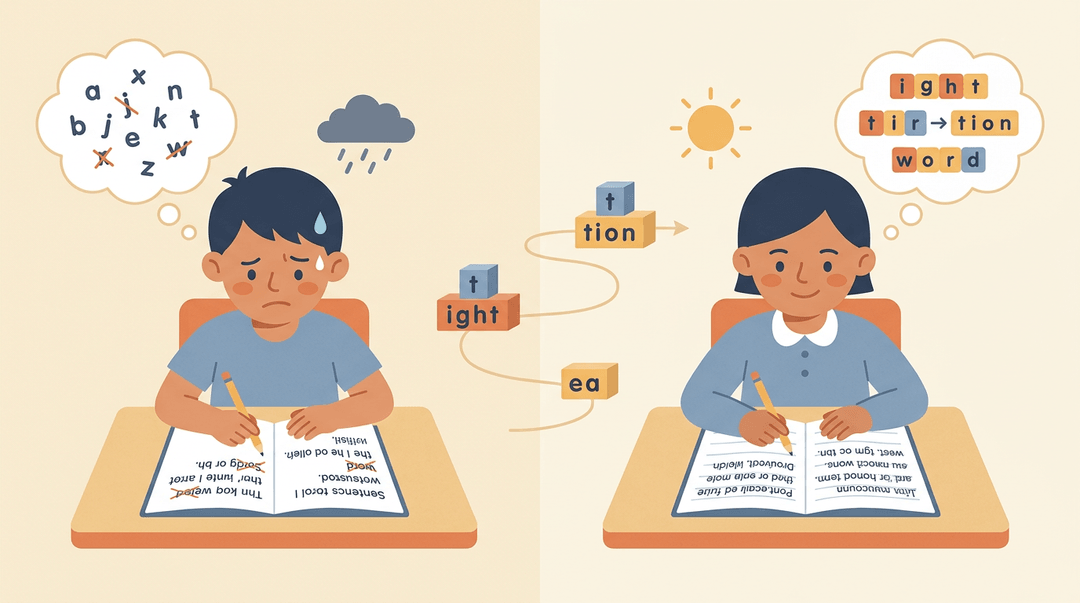
Spelling isn't a side skill. It's tied directly to reading and writing: a student who spells confidently reads more fluently and writes with less friction. A struggling speller often produces choppy, thin composition, not because the ideas are missing, but because so much effort goes into getting each word down. That's why systematic instruction, teaching patterns and rules in order, beats letting kids "pick it up naturally." Memorizing Friday's word list rarely survives past the following Monday. Skip real spelling instruction, and you're often looking at years of frustration ahead, for the student and for whoever's grading the papers.
Our top pick for most families
For most students, All About Spelling is our top recommendation. One parent who'd already tried three other programs said her dyslexic son finally had a breakthrough within weeks of switching: the multisensory, step-by-step approach met him where he was. It's not the only good option out there, but for most students, in most settings, it's the one we'd start with.
What age should you start a spelling curriculum?
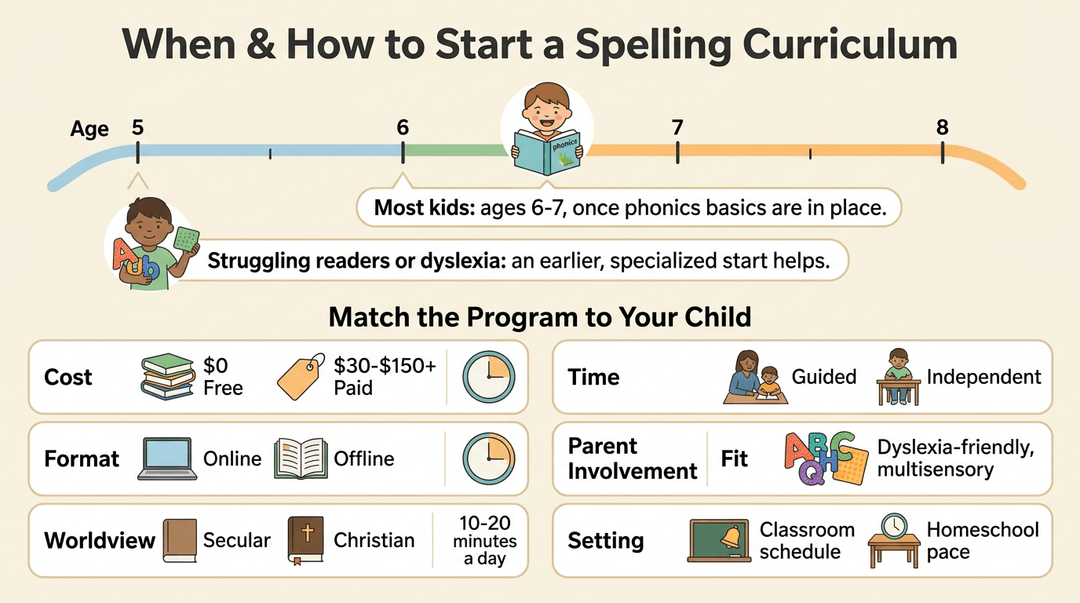
Most children are ready for formal spelling instruction around ages 6 to 7, once basic phonics is in place, though struggling spellers or kids with dyslexia often benefit from a specialized, earlier start. Beyond age, match the program to:
- Cost: free options exist, but many paid programs run $30 to $150 or more.
- Format: online vs. offline delivery.
- Worldview: secular vs. Christian content.
- Time: 10 to 20 minutes a day is typical.
- Parent involvement: some programs need heavy guidance, others run independently.
- Fit: look for dyslexia-friendly, multisensory design if your student struggles.
- Setting: a classroom's fixed schedule calls for a different pace than a homeschool day.
A Closer Look at All About Spelling
All About Spelling (AAS) built its reputation on one idea: spelling isn't something you memorize, it's a set of rules you can actually teach. Here's what that looks like in practice, and what you need to know before you buy.
Why it uses a rules-based approach
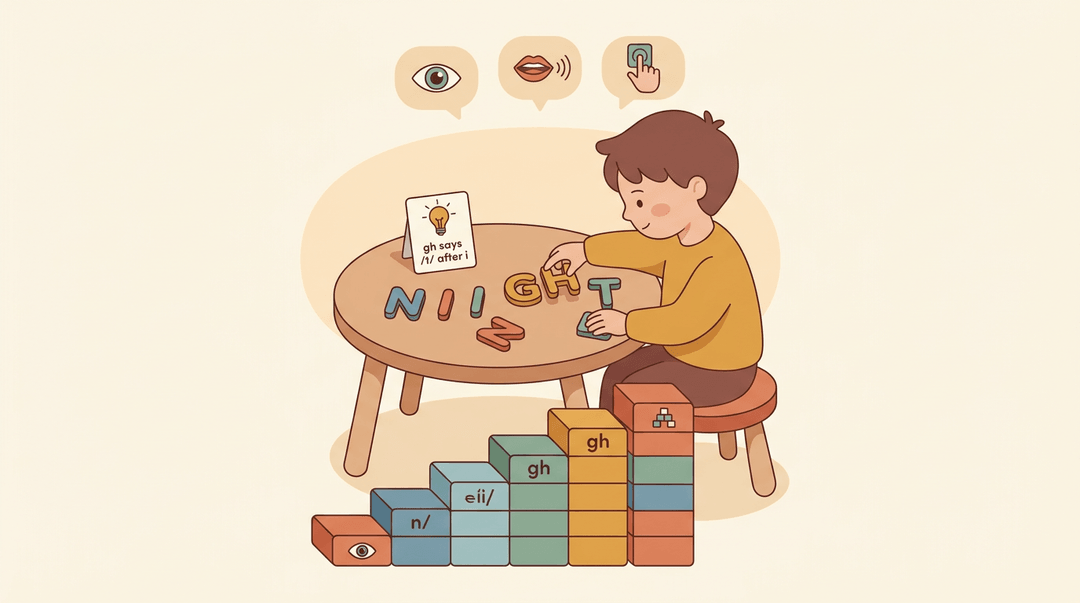
All About Spelling is built on the Orton-Gillingham method, a multisensory approach where students see, say, and touch their way through a word.
Instead of asking a student to memorize that "night" has a silent gh, it teaches the rule behind it, so spelling becomes something you understand rather than something you cram.
The program is mastery-based, not grade-level: a student moves on only once a skill sticks, not because the calendar says so.
Phonograms and rules build sequentially, one on top of the last, which is part of why the program works well for students with dyslexia or other learning differences.
The seven levels explained
AAS spans seven levels, each layering new phonograms and rules onto the last. A placement test helps you find the right starting point, though the program recommends every student, regardless of age, start at Level 1 to build a solid foundation.
Early levels cover basic phonograms and syllable rules; by Level 7, the content reaches high-school-level spelling patterns and multisyllable words.
For example, a homeschool parent teaching a bright but young speller can start at Level 1 without it feeling babyish, since pacing follows mastery, not grade.
What a daily lesson looks like
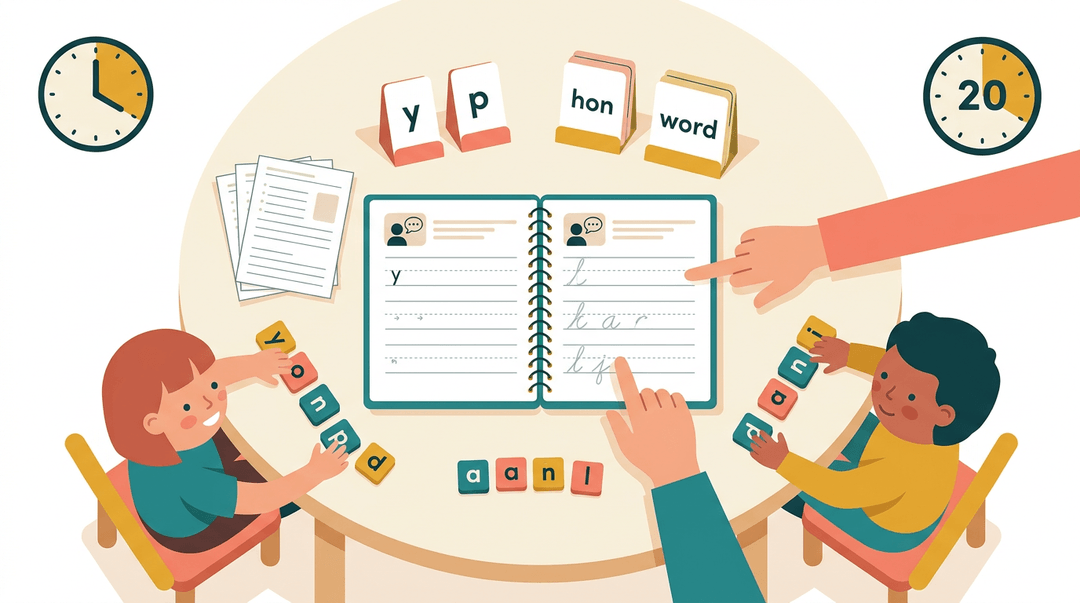
Lessons run about 20 minutes a day and are fully scripted: open the book and teach, no lesson planning required.
Each one uses letter tiles and other hands-on manipulatives alongside phonogram, word, and rule cards, and an optional activity book adds worksheets for extra practice. Prep is minimal, which matters.
Consider a classroom teacher running small-group rotations: the open-and-go format means AAS slots into a 20-minute station without eating into planning time.
How much it costs to buy
Each level runs $45 to $70, and letter tiles are a one-time purchase that carries across every level. A review box and other storage accessories help keep the growing stack of cards organized.
All About Spelling backs the program with a one-year money-back guarantee, so you can try it with little risk.
One catch for multi-child households: each student needs their own consumable packet, which adds up fast if you're teaching more than one speller at home.
A secular curriculum choice
AAS is explicitly secular, with no religious content built into its lessons, which makes it a fit for public school classrooms, tutors, and secular homeschoolers alike.
It's often paired with its sister program, All About Reading, for families who want reading and spelling instruction built on the same phonogram foundation.
Build a Weekly Spelling Lesson Plan
Here's the routine we'd hand any new teacher: pick words that match your grade band, run the same five-day cycle every week, and adjust the list, never the routine, for different learners.
Pick words by grade band
Choose one spelling pattern per week, not a grab bag of random words. The pattern is what students actually study.
| Grade band | Focus | A weekly list might include |
|---|---|---|
| K-2 | CVC words, digraphs, sight words | ship, chat, wish + said, was |
| 3-5 | Multisyllabic words, prefixes and suffixes | unhappiness, remake, careless |
| 6-8 | Greek and Latin roots, morphology | photograph, telephoto, photosynthesis |
Run the five-day cycle
- Day 1: pretest, then sort. Give the pretest cold, no studying first.
- Students sort the words into groups by what they notice.
- Say: "What do these words have in common? Make your piles, then defend them."
- Students sort the words into groups by what they notice.
- Days 2-3: practice the pattern through word study.
- Build words with letter tiles, hunt for the pattern in books, circle it in each word.
- Keep asking why: "Why does this word double the consonant?"
- Build words with letter tiles, hunt for the pattern in books, circle it in each word.
- Day 4: run peer dictation.
- Partners take turns: one reads five words aloud, the other writes, then both check together.
- Mistakes found on Day 4 are the cheapest mistakes of the week.
- Partners take turns: one reads five words aloud, the other writes, then both check together.
- Day 5: posttest and reflect. Score against Monday's pretest, then write a short reflection.
Example reflection prompt, ready to copy: "One word I missed Monday and spelled right today: ___. The pattern that helped me: ___."
Adjust the list, keep the routine
Everyone studies the same pattern all week; only the words change. Tier your lists by ability so the whole class can share Day 1 sorts and Day 4 dictation.
| When you see... | Try... |
|---|---|
| A student misses most of the pretest | A shorter tier: 5-8 core pattern words |
| Struggling spellers stuck on the pattern | Extra phonogram review (sh, ch, oa) before word study |
| A student aces Monday's pretest | Extension words: same pattern, harder words |
💡 Tip: Build extensions by stretching the pattern, not abandoning it. If the class list has remake, an advanced tier can carry reconsider and reconstruction.
At a glance: grade-band words, pretest and sort, pattern practice, peer dictation, posttest and reflect. Once the weekly rhythm is running, map your spelling scope and sequence to standards in EMStudio's curriculum planner.
Faith-Based Spelling Curriculum Options
For families and classrooms that want spelling practice woven into faith formation, a couple of programs build scripture and Christian values right into the lessons.
Learn spelling through BJU Press videos
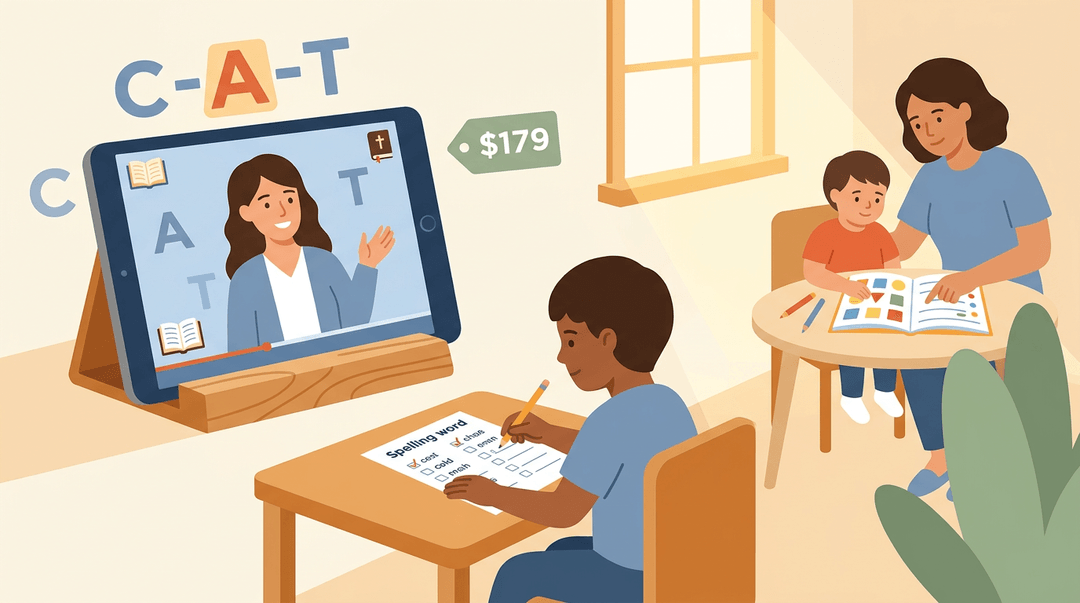
BJU Press delivers its spelling program through online video lessons taught from a biblical worldview, so scripture and character lessons show up alongside the rules of English spelling.
The format is built for independent learning: a student can watch, work through drills, and practice spelling rules with little day-to-day supervision.
For instance, a homeschool parent juggling multiple grade levels can hand a student the video course and check in only for review. The full online course runs about $179.
A Reason for Spelling uses scripture themes
A Reason for Spelling organizes each week's word list around a scripture-based theme, so spelling practice doubles as a memory verse or Bible story discussion.
The program spans grades 1 through 6 across levels A through F, and it integrates phonics and broader language arts skills rather than treating spelling as an isolated drill.
Unlike the BJU Press video model, these lessons are parent-dependent: a teacher or parent needs to lead each session and check the work directly. The full workbook set costs around $50, making it one of the more budget-friendly faith-based options here.
Other Spelling Program Approaches
Not every spelling curriculum works the same way, and that's a good thing. Some programs sort students by skill level before they start, others lean on listening and repetition, and a few just hand you a set of tools and get out of the way.
Here's a quick tour of four common approaches, so you can match the format to your classroom, your homeschool, or your one-on-one student.
Programs that start with a placement test
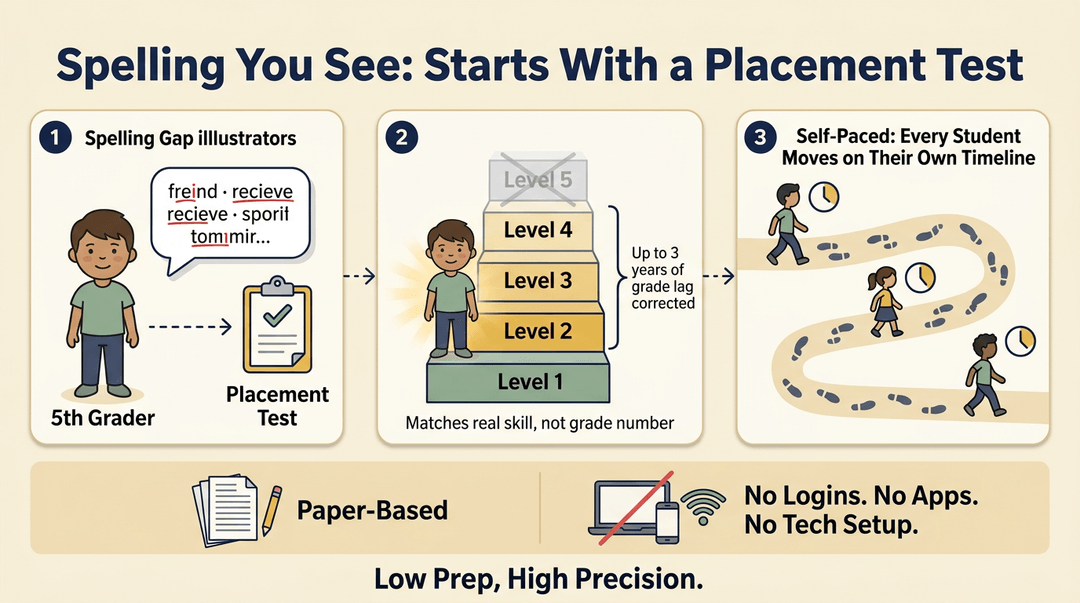
Spelling You See opens with a placement test rather than a grade-level guess, which matters because spelling gaps don't always line up neatly with age.
The program can address a grade lag of up to three years, so a fifth grader spelling like a second grader lands in the right level instead of the wrong one. From there, it's self-paced: students move through levels on their own timeline.
It's also paper-based, which means low prep for you and no logins, apps, or tech troubleshooting to manage before the lesson even starts.
Programs built around listening and audio
IEW's Phonetic Zoo works through CD or MP3 audio, so students spell by ear instead of copying from a worksheet. It's built for grades 3 and up, or roughly age 9 and older, once a student can sit with headphones and self-correct.
Flashcards come included for extra review, and placement tests are available if you're not sure where a student should start.
For an auditory learner who tunes out a page of print but locks in on a voice, this format can be the difference between frustration and progress.
Hands-on programs you buy once
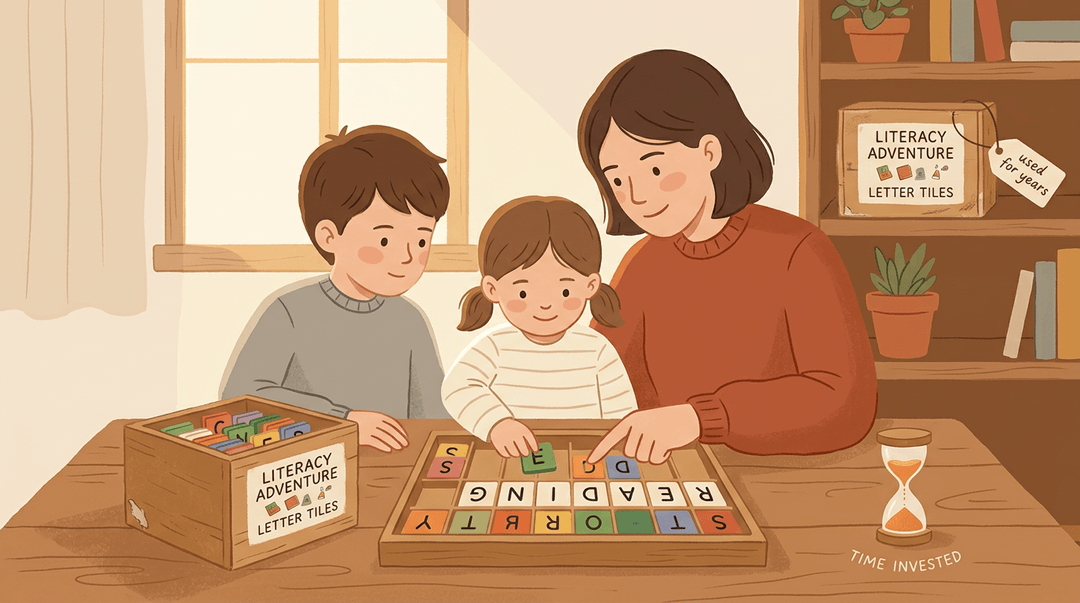
Spelling Power trades screens and worksheets for letter tiles: buy the program once, and you can use it for years across multiple children or even multiple ability levels, from age 8 through adult learners. The tradeoff is time.
It leans on more direct parent or teacher involvement than a self-paced workbook, so it fits best when someone can sit alongside the learner each session.
Online programs with quick daily lessons
Sequential Spelling targets ages 6 to 13 with sessions of just 10 minutes a day, available online or in book form, and often paired with grammar lessons for a fuller language block.
It's also budget-friendly: Numa's review of the program notes it's "more affordable, with books typically $30 per level compared to multi-component programs with manipulatives and consumables," putting most levels in the $20 to $30 range.
Other Spelling Curricula to Know
Beyond the heavyweights, a handful of other programs keep coming up in teacher forums and homeschool groups. They're worth a quick look, especially if your student needs something more specific than a general-purpose program.
More spelling programs worth knowing
A few names show up again and again:
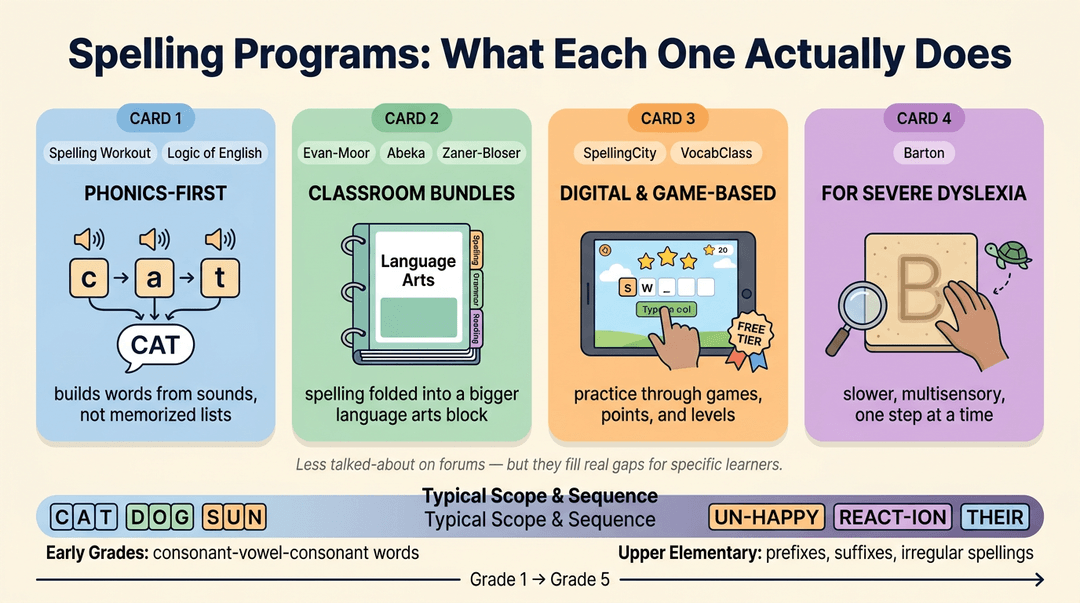
- Spelling Workout and Logic of English both lean phonics-first, and either one is a solid pick if you're searching for a good homeschool spelling curriculum for 1st grade: they build words from sound patterns instead of memorized lists.
- Evan-Moor, Abeka, and Zaner-Bloser are common choices in classrooms (not just homeschools), often bundled into a broader language arts block.
- SpellingCity and VocabClass are digital, game-based options. If you're looking for a free spelling curriculum for homeschooling, SpellingCity's free tier is the most practical starting point before upgrading.
- Barton is built specifically for severe dyslexia and moves far slower and more explicitly than mainstream programs.
According to homeschool forum discussions, several of these sit outside the most popular tier, but they still fill real gaps for specific learners.
Most of these programs follow a grade-by-grade scope and sequence: simple consonant-vowel-consonant patterns in early grades, building toward prefixes, suffixes, and irregular spellings by upper elementary.
How spelling and reading skills connect
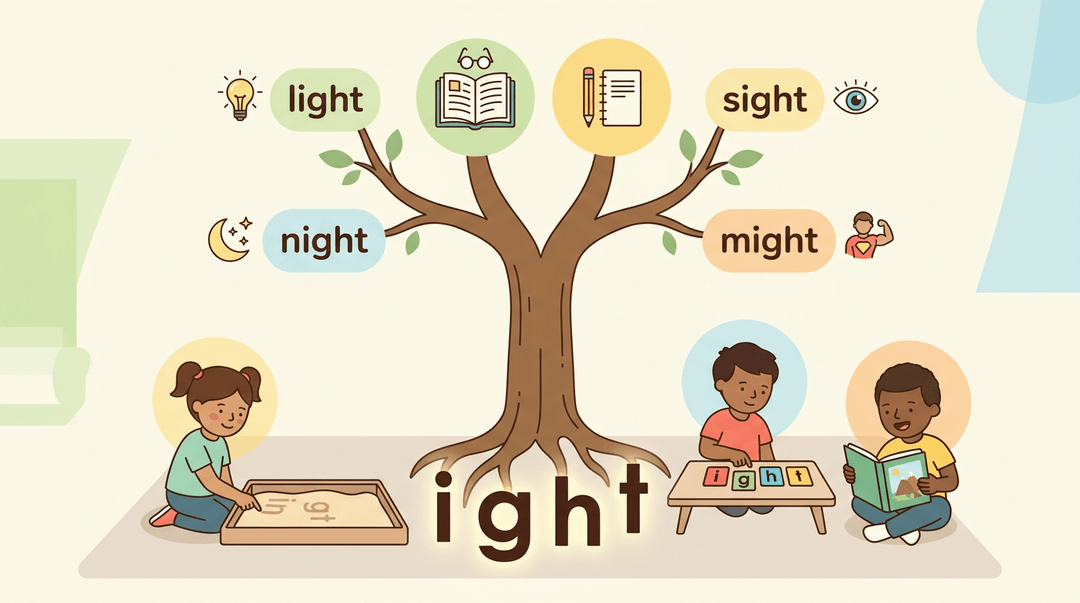
Spelling and reading share the same foundation: phonics patterns. When a student learns that ight makes one sound, that pattern shows up in both reading and spelling.
Struggling readers usually need spelling instruction tailored to their specific gaps, not a one-size-fits-all list.
For dyslexia or dysgraphia, that often means slower pacing, multisensory practice, and, where needed, dedicated resources built for those needs.
Whatever setting you teach in, a strong spelling curriculum comes down to the same thing: a clear sequence that helps students see the patterns behind words, not just the words themselves.
Free or paid, secular or faith-based, the best fit is the one that meets your students where they are.
Once you've settled on an approach, the next step is fitting it into the rest of your year. Ready to build that structure? Check out our Curriculum Planning tools to plan units, lessons, and standards across the whole school year.
References
- Sequential Spelling: Homeschool Curriculum Review — numaschool.com
Frequently asked questions
What is the best spelling curriculum?
For most students, All About Spelling is the best overall choice. It uses a systematic, rules-based Orton-Gillingham approach with multisensory activities, sequential phonograms, and mastery-based pacing.
What is a good homeschool spelling curriculum for 1st grade?
Good first-grade homeschool options include All About Spelling, Spelling Workout, and Logic of English. These programs build spelling from phonics patterns rather than relying mainly on memorized weekly lists.
What is a good spelling curriculum for struggling spellers?
All About Spelling is a strong choice for struggling spellers because it is multisensory, sequential, and mastery-based. Barton is another option for severe dyslexia, while Spelling You See can help students who need placement-based, self-paced instruction.
What is the #1 rated homeschool curriculum?
There is no universally recognized number-one homeschool curriculum because the best choice depends on the child, subject, learning needs, and family’s teaching style. For spelling specifically, All About Spelling is a strong overall recommendation.
What age to start spelling curriculum?
Most children are ready to begin formal spelling instruction around ages 6 to 7, after they have basic phonics skills. Children with dyslexia or significant spelling difficulties may benefit from specialized instruction earlier.
Is there a free spelling curriculum for homeschooling?
Yes. Free spelling resources are available for homeschooling, including the free tier of SpellingCity, which offers practical digital spelling activities. Families can also create no-cost word-study practice using phonics patterns, reading materials, and dictation.