Teaching to the Test Explained: Costs, Causes, and Fixes

Jump to section
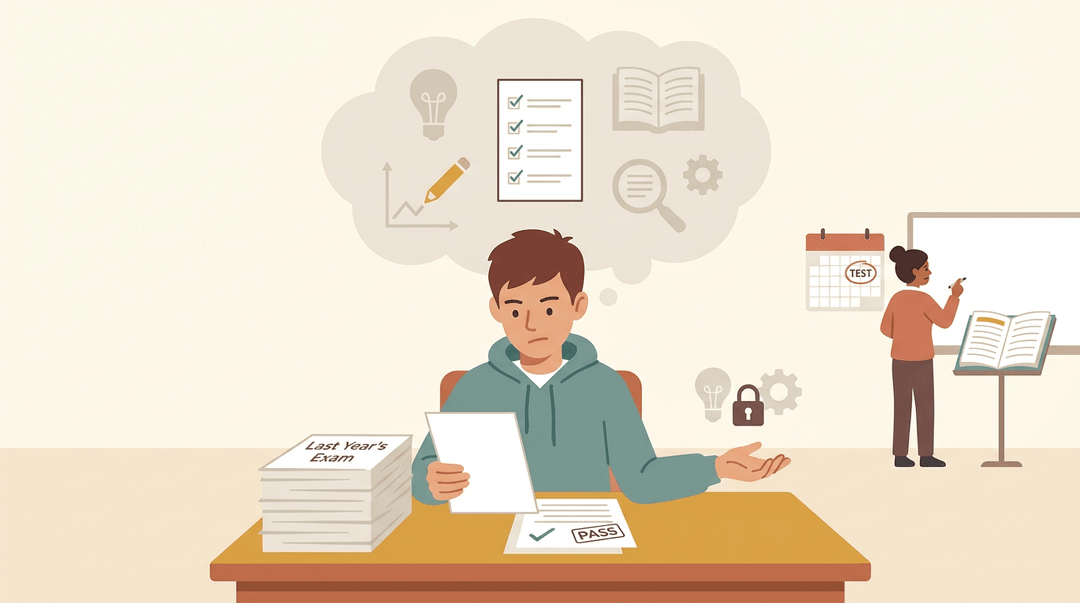
Picture a student who memorizes last year's exam questions. They might pass, but they still can't do what the test was meant to measure. That's the heart of teaching to the test: the exam quietly becomes the lesson, and learning shrinks to fit it.
Test scores matter, and you're often responsible for getting students ready for them. The tension is real.
In this post, we'll define the practice, weigh its benefits and costs, examine what drives it, and show how you can prepare students through lesson planning without narrowing instruction.
What Teaching to the Test Means
Teaching to the test gets used loosely, so let's pin it down. Here's what it looks like in practice and where it shows up most often.
How the practice works in class
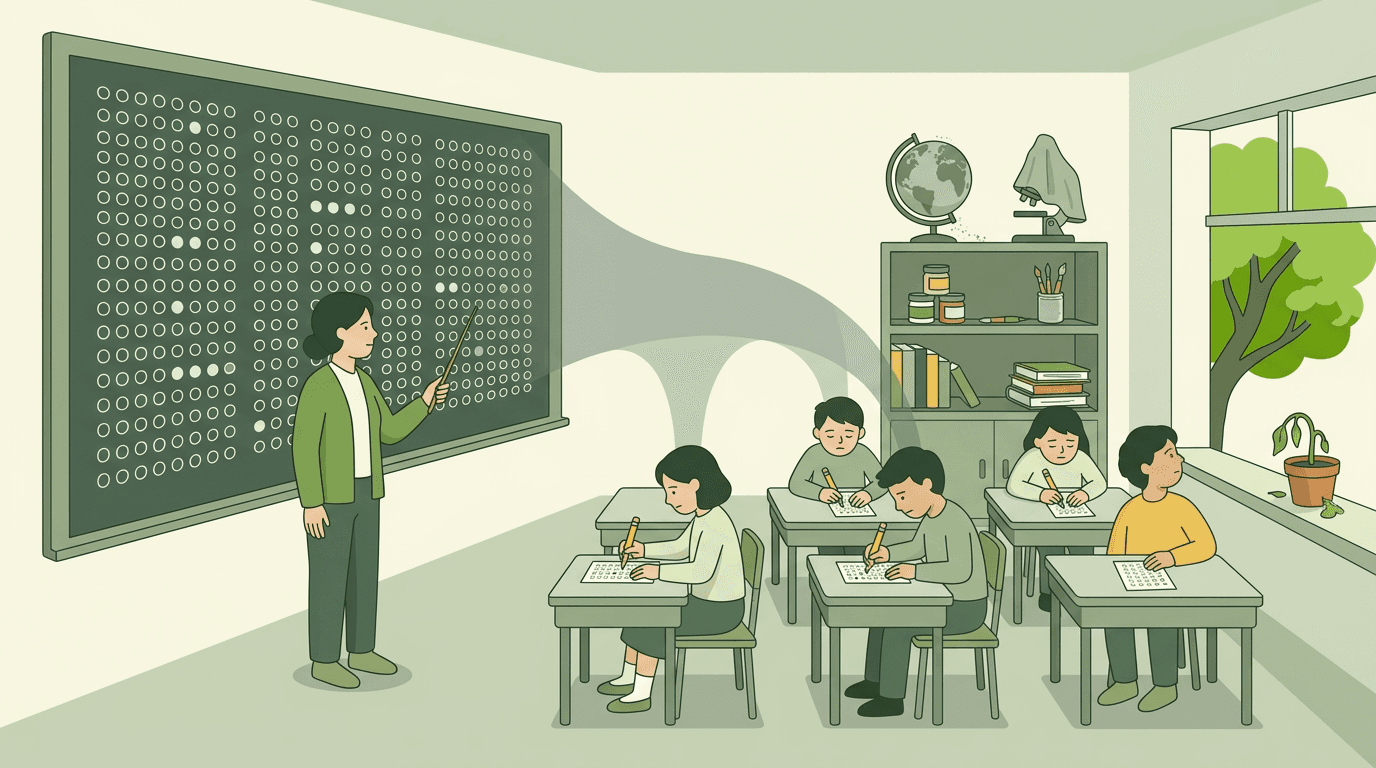
At its core, the practice means building instruction around the questions a test will ask. Some call it item teaching, because the test items themselves become the lesson plan.
Picture a fifth-grade teacher who spends three weeks running only released test questions in class. By test day, students know the format cold, but most of the curriculum has been pushed aside.
That narrowness is the defining feature. There's no deviation from test content, so anything the exam skips tends to disappear.
Some teachers slip into sprint-and-cover mode, racing through a long list of tested topics, touching each one briefly, and hoping depth comes later. That's the trap.
The difference from aligned instruction is worth spelling out. Teaching to the test starts and ends with the exam.
Aligned instruction starts with the standards and builds the understanding behind them, so students can apply what they learn, not just recognize a familiar question.

Where this happens most often
Pressure tends to build in four places:
- High-stakes state tests, where results carry the most weight for schools and students
- CTE certification exams, which check whether career and technical education students are ready for a credential in their field
- Teacher evaluation pressure, when test results feed into how your performance is judged
- Value-added scoring, a method that estimates a teacher's impact by tracking how much students' scores change over time
Why Some Teachers Defend Test-focused Lessons
Their case is practical, and it starts with the test itself.
Planning units around the exam outline
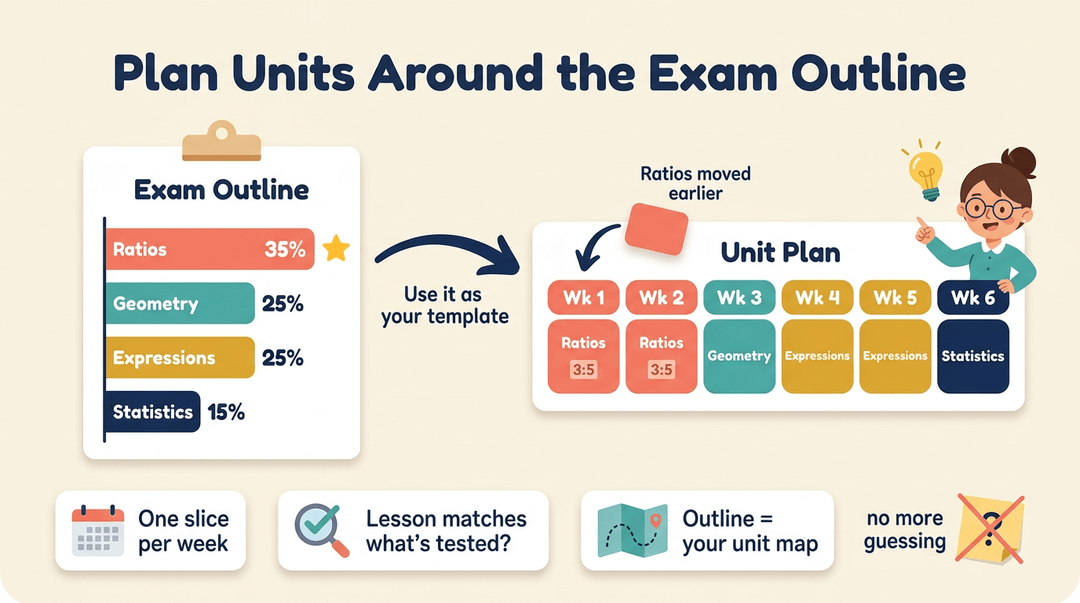
Many exams publish an exam outline showing topics and weighting. Use it as a template for your units. Consider a seventh-grade math teacher who notices ratios carry more weight than she planned. She moves them earlier and stops guessing.
- Weekly topic mapping. Give each week a slice of the outline so nothing gets crammed into review.
- Less guesswork on alignment. See at a glance whether a lesson matches what's assessed.
- Use the outline as your unit map. It becomes a plan you can actually follow.
Getting students ready for exam day
- Direct path to certification. If students are working toward a credential, every lesson can point straight at it.
- Use provider practice tests. They show students the format and pacing before exam day.
- Know what to skip. Not every topic carries equal weight, so spend less time on the low-weight ones.
- Higher end-of-year test scores. A study of the internal medicine clerkship found that students who completed more questions scored higher at the midpoint and the end. That's an association, not proof, but a useful signal.
Helping students see what matters
Students will ask, "Will this be on the test?" Answer honestly and show the link.
Keep the focus on understanding rather than test tricks. Students who grasp the content can handle questions they haven't seen before.
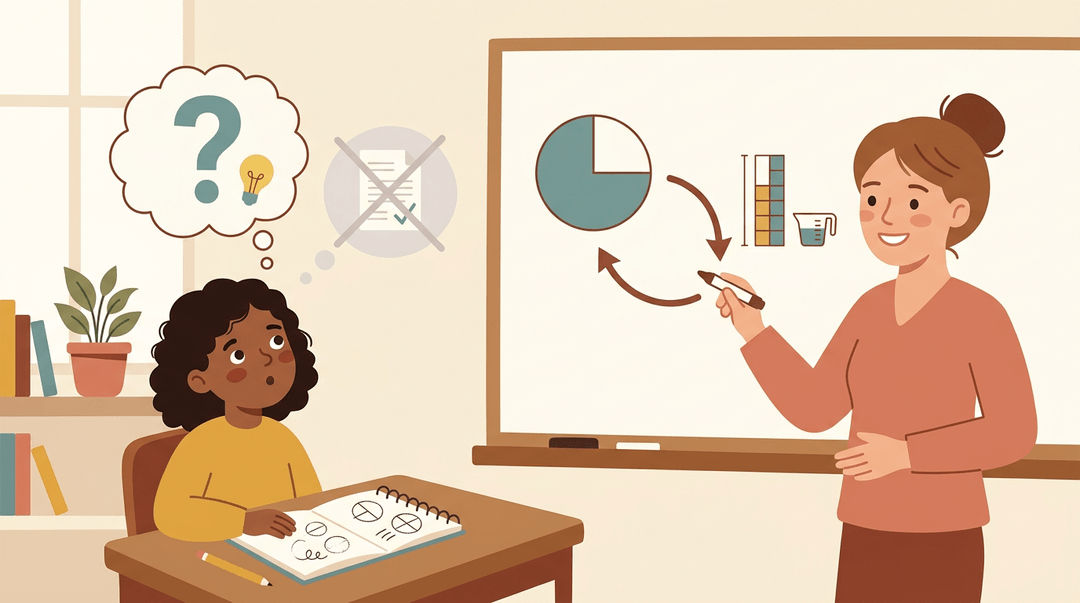
Consider a student who asks whether fractions will be tested. Her teacher says yes and links fractions to the next unit. The student stops asking whether it's tested and starts asking why it works. That shift is the goal.
The Real Costs of Test-focused Teaching
Test-focused teaching has a price, and it often shows up long after the scores are in. Here's where we see it.
Students memorize now and forget later
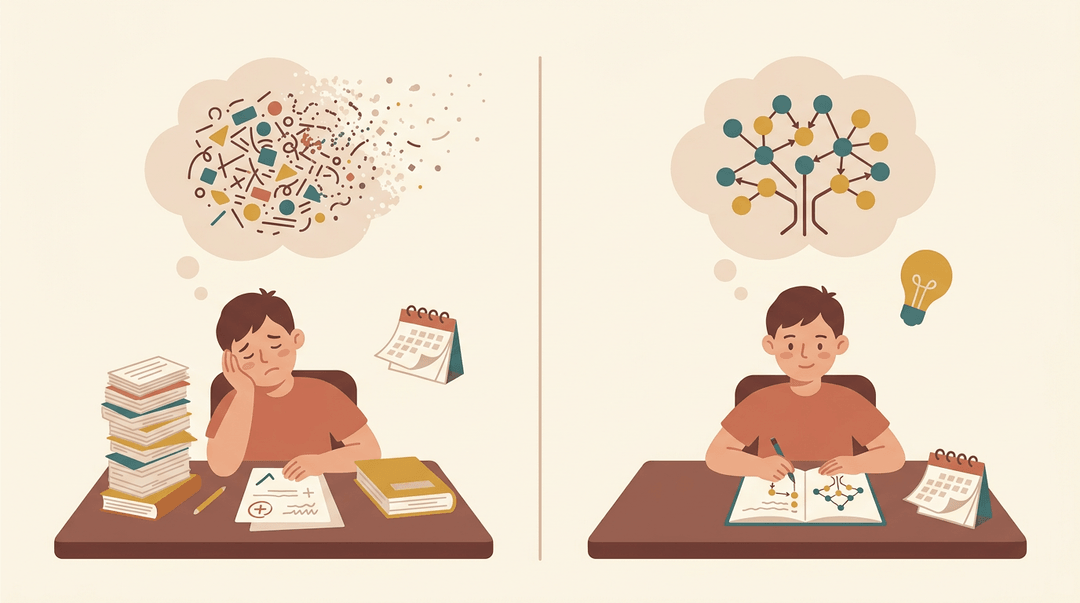
When the test is the finish line, rote memorization starts to look like success, and critical thinking gets squeezed out. Students learn what to answer rather than why it's true, and what's memorized often fades fast.
A study of undergraduate students at a dental teaching institution in India found a statistically significant, positive link between deeper learning approaches and academic performance.
Students taught through broad, shallow coverage may perform less well in college than students who develop deeper understanding.
Skipped topics leave narrower skills behind
When a topic isn't tested, it's often the first to go, and the missing concept becomes a gap every later lesson has to work around.
Students with fewer learning opportunities outside school often depend most on class time, so the gap between high-need students and their peers can widen.
Consider a medical assisting program where the exam focuses on terminology and the sterile technique chapter gets squeezed out. Graduates may know the vocabulary but struggle to set up a clean procedure room on their first day.
Skills left untaught also limit career growth and make graduates less employable.
Test pressure can push students to cheat
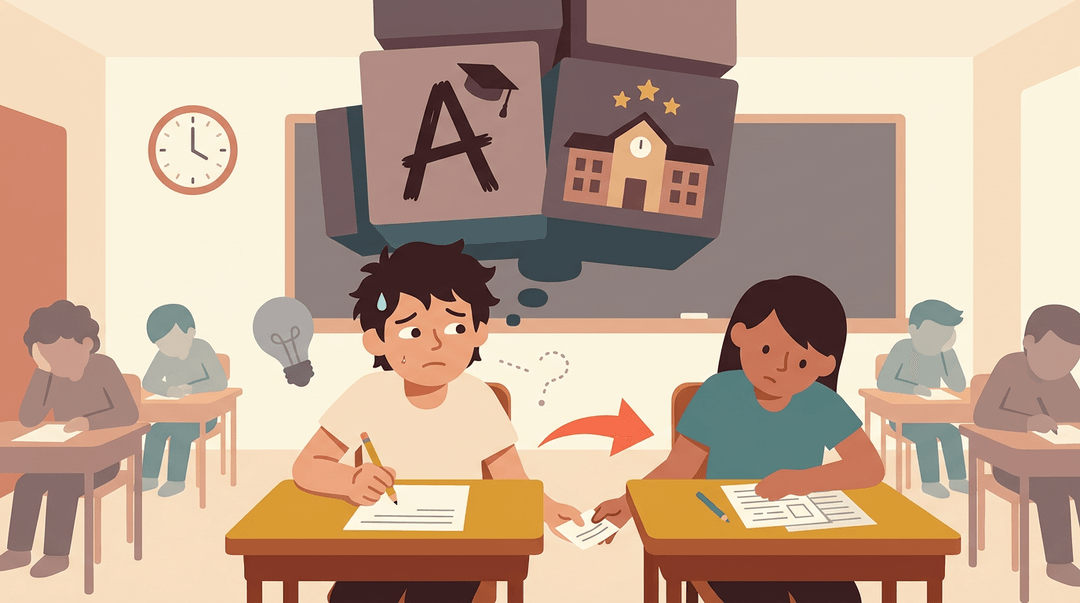
When one score decides promotion, graduation, or a school's rating, high-stakes pressure can shift the goal from understanding to passing. A student who feels lost may copy or share answers rather than admit they're stuck.
The more a single score matters, the greater the cheating risk. Fear makes shortcuts look safe.
Problems that surface on the job
Shallow learning doesn't stay in the classroom. Employees who missed core skills often have to re-learn them on the job, which is harder than learning them right the first time.
In healthcare, that gap carries real risk: a medical assistant who never truly mastered a procedure may be figuring it out with a patient in the room. Shallow lessons can also earn strong scores, so they get rewarded even when the learning doesn't hold.
The scores look fine. The learning doesn't.
Prepare Students Without Teaching to the Test
This guide helps you build test readiness into the lessons you already teach. Plan from the test backward, then let depth, not item drilling, carry the daily work.
Plan backward from the test
Start with what the test asks students to do, then plan the thinking that gets them there.
- Identify the tested skills
- Name skills, not items: "cite evidence to support an inference."
- Write a deeper learning objective
- Aim at the thinking the skill needs, not the test format.
- Map one unit at a time
- Jot the skill, a daily practice slot, and a check. Skip the full-year map.
Here's the difference between an objective that narrows and one that deepens:
❌ Students will practice main-idea multiple-choice questions.
✅ Students will explain a text's main idea and defend it with two details.
The first names the item format. The second names the thinking, so students can handle any format.
Weave test-style questions into daily lessons
Short, regular exposure beats a test-prep unit. Students get familiar with the format while the lesson stays about the content.
| Slot | Move | What it looks like |
|---|---|---|
| Bell ringer | One exam-style item | Students answer, then say why a wrong choice tempts |
| Exit ticket | One check on today's skill | "Which detail best supports your answer, and why?" |
| Across the week | Vary the formats | Multiple choice Monday, short answer Wednesday, explain-your-pick Friday |
Varying formats matters because students should know the skill, not just recognize one question shape.
⚠️ Watch out: If the bell ringer grows into a full period of practice items, you've drifted into teaching to the test. Keep it to one item.
Examples by grade band
Each band gets one daily move that practices the tested skill at full depth.
| Level | Focus | Try this |
|---|---|---|
| Elementary | Short constructed responses | Students answer in two sentences: answer, then one proof |
| Middle school | Evidence-based writing | Students write a claim and back it with a quoted detail |
| High school | Multi-step problem solving | Students label each step and say why it follows |
Example: A seventh-grade ELA teacher opens class with one exam-style passage question. Students write a claim and one quoted detail, then trade papers and mark the strongest evidence. The exit ticket asks them to rewrite the claim using a different detail. The skill gets practiced twice, and the lesson still belongs to the novel.
Quick check for your lessons
Before you teach, confirm:
- It goes beyond test content. Students would still learn something if the test vanished.
- Students explain their reasoning. Every answer gets a "how do you know?"
- Prep time is capped. Decide your limit up front, such as one bell ringer and one exit ticket.
Say: "Don't just pick it. Tell me what in the text or problem made you choose it."
Build and reuse these test-aligned, depth-first lessons with EMStudio's online lesson planner.
What in Testing Systems Drives This
Teaching to the test often traces back to decisions made well outside your classroom.
Why overloaded standards lists hurt depth
When standards lists run long, depth is what gets squeezed out. A comparative study of junior secondary biology syllabi in four jurisdictions found that breadth often takes priority over in-depth learning, resulting in curriculum overload.
Picture a science teacher who covers every standard once and cuts the water cycle lab she'd planned. Depth simply can't fit in the time.
A K-22 study claim points the same way, but verify it first. The standards themselves aren't the problem. Packing too many into one year is.
How test design rewards shallow thinking
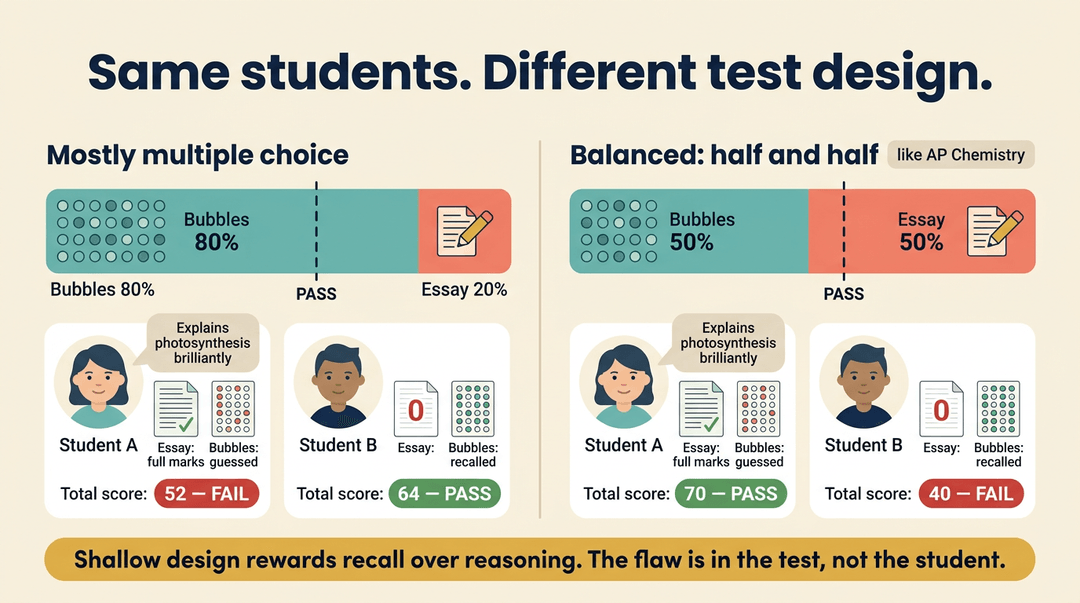
Multiple-choice questions dominate many tests. Constructed-response items, where students write their own answers, often get far less weight.
A study on combining multiple-choice and constructed response test scores shows that when an essay counts for less, a student's essay performance has limited effect on the total, so a zero on the essay can still mean a pass.
Design choices matter. The College Board's Advanced Placement (AP) Chemistry test gives half its testing time to each format. Multiple-choice items quietly reward recall over reasoning.
A student who explains photosynthesis well but guesses on the bubble sheet looks weaker on paper. That's a flaw in the design, not the student.
How value-added scoring rates teachers
Value-added scoring estimates how much a teacher contributes to student test growth. Public rankings like the Los Angeles Times' teacher rankings show how one number can label a teacher.
When the target is a passing line, not real growth, tests can ensure mediocrity.
We can welcome accountability in principle. Fix the system first, then judge the people working inside it.
What Schools Can Do Instead
Test prep doesn't have to crowd out everything else. Try backward design, where you decide what students should show first, then plan the assessment and lessons that build toward it.
Balancing test prep with broader learning
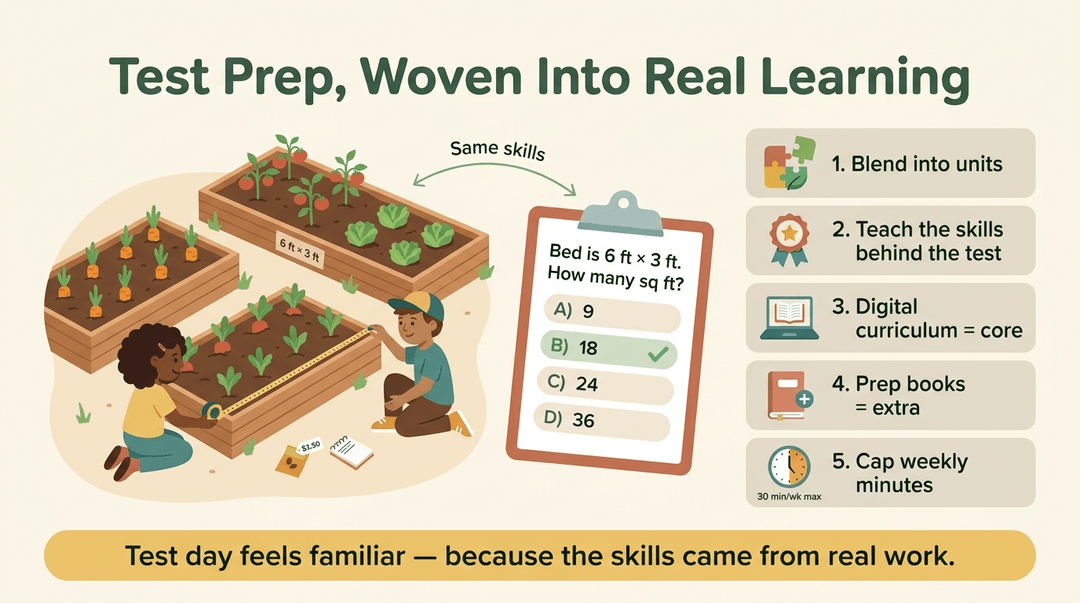
Consider a fifth-grade teacher whose measurement unit becomes a class garden. Students measure beds, compare seed costs, and solve test-style word problems along the way.
On test day, the format feels familiar, and the skills came from real work, not a worksheet.
- Mix test prep with curriculum. Weave test-style questions into regular units instead of stacking drills on top.
- Pair certification with broader skills. Teach the wider skills a certification is meant to show, not just the test format.
- Use digital curriculum as the core. Let a digital program carry the main content, with test prep as a supplement.
- Treat test prep materials as a supplement. Practice books fill gaps; they shouldn't be the main course.
- Cap weekly test-prep minutes. Set a limit so prep never takes over the week.
Slow down and aim for deeper thinking
Skimming teaches students to hurry. Slow down and go deeper on fewer topics. Depth beats speed. Aim to build problem-solvers, not test-takers.
- Redesign tests for writing. Ask students to explain their reasoning in writing. A written answer shows thinking that a bubbled answer can't.
- Choose assessments that demand critical thinking. Ask students to analyze, compare, or apply ideas, not just recall them.
- Tag questions by DOK level. Label each question by its Depth of Knowledge (DOK) level, a scale for how much thinking a task requires, from recall to extended reasoning.
What the Research and Other Countries Show
Does covering more content lead to better results? The evidence says otherwise, and so do high-achieving countries.
What studies say about depth versus coverage
A study reported in Science Education in 2008 looked at how much content high school science students covered and how those students fared in college science.
The key contrast is between depth and breadth: how deeply a topic is taught versus how many topics get covered.
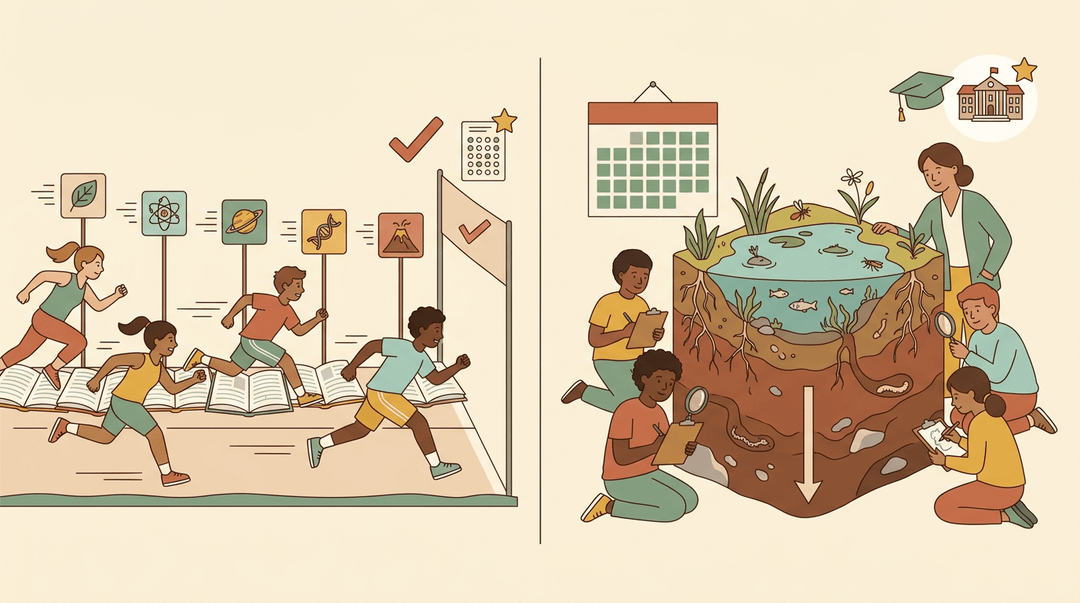
The sprinters, students who raced through a lot of content, scored higher on state tests. But students who went slow and deep did better in college. Think of a high school biology teacher who gives ecosystems a full month instead of skimming it.
That's the kind of depth the study tracked: students who covered at least one major topic for a month or longer earned higher college science grades than peers with no in-depth coverage. Depth pays off.
How high-achieving countries teach and test
Darling-Hammond's discussion of high-achieving countries points to a different playbook, built on three habits:
- Lean standards. Fewer, clearer learning goals leave room for depth instead of a race through a crowded checklist.
- Little multiple-choice testing. Students show what they understand through open-ended work, not by choosing from four options.
- Emphasis on research and writing. Students spend real time investigating ideas and explaining them in their own words.
The U.S. shows the gap clearly. Two Futures of Educational Reform notes that state test scores have improved, driven by strong threats and sanctions, while national assessment results have stagnated and international results have dropped.
State scores climbed. National results didn't.
Teaching to the test narrows learning when the exam becomes the goal. Good preparation works the other way around: students build real understanding, and that foundation carries over to any assessment.
Test readiness becomes a result of good teaching, not its purpose, and that's the balance worth aiming for.
Ready to plan for both? Check out Lesson Planning to write, organize, and reuse lesson plans across multiple classes from one place.

References
- Factors Associated with Higher NBME Practice and Shelf Exam Scores in the Internal Medicine Clerkship — pubmed.ncbi.nlm.nih.gov (2025)
- Learning approaches and their association with academic performance among undergraduate students in a dental teaching institution in India — pmc.ncbi.nlm.nih.gov (2026)
- A comparative study of breadth and depth of content in junior secondary biology syllabi in four jurisdictions — doi.org (2024)
- Depth versus breadth: How content coverage in high school science courses relates to later success in college science coursework — onlinelibrary.wiley.com
- COMBINING MULTIPLE‐CHOICE AND CONSTRUCTED RESPONSE TEST SCORES: TOWARD A MARXIST THEORY OF TEST CONSTRUCTION — doi.org (1992)
- Two Futures of Educational Reform: What Strategies will Improve Teaching and Learning? — doi.org (2018)