Project-Based Learning: How It Works and Why It Sticks

Jump to section
Think about the last time you actually remembered something you built, not just something you memorized for a test. That's not an accident.
Project-based learning flips the usual order: students dig into a real problem first, and the facts and skills follow because they're needed, not assigned. In this post, we'll unpack what it looks like, why it works, and how to plan your first unit.
What Is Project-based Learning?
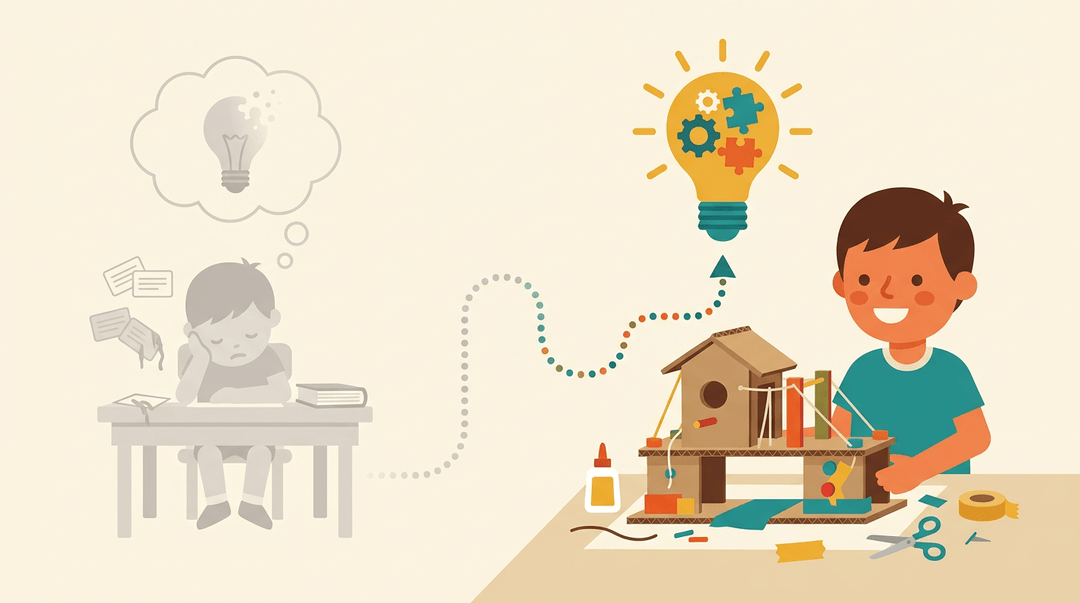
Ask a student to memorize a chapter on ecosystems, and you'll get a quiz score. Ask that same student to design a pollinator garden for the school courtyard, and you'll get something closer to real learning.
Project-based learning (PBL) is a teaching method built around that second scenario: students learn academic content by working through an extended, real-world project instead of a textbook chapter.
How students learn through projects
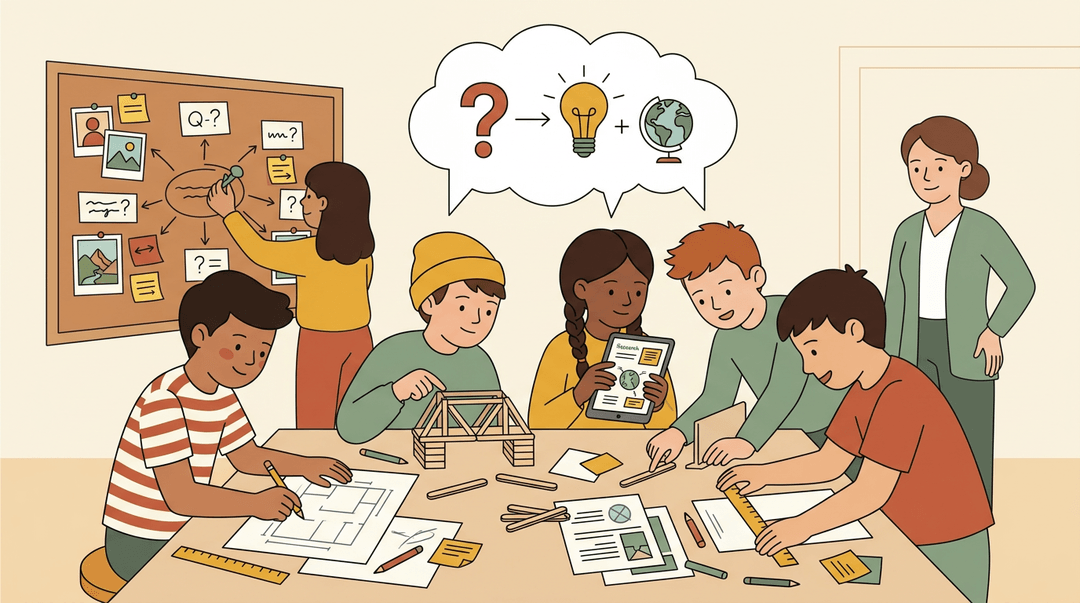
In PBL, students take on an extended inquiry into an authentic problem, one with no single right answer and real stakes outside the classroom. It's a student-driven learning method: your students ask the questions, research the answers, and decide how to present what they find. Along the way, they pick up knowledge and skills the same way professionals do, by using them. That makes PBL an active learning approach: students aren't just taking notes, they're doing the work.
How PBL differs from regular projects
Not every project is project-based learning. In PBL, the project is the vehicle for learning the content, not a summative add-on tacked onto the end of a unit. The process matters as much as the product: how students plan, revise, and problem-solve along the way. That's a sharp contrast to lecture or seminar teaching, where the teacher imparts information and students absorb it. In PBL, the teacher guides instead, coaching students through their own discovery.
How PBL relates to similar approaches
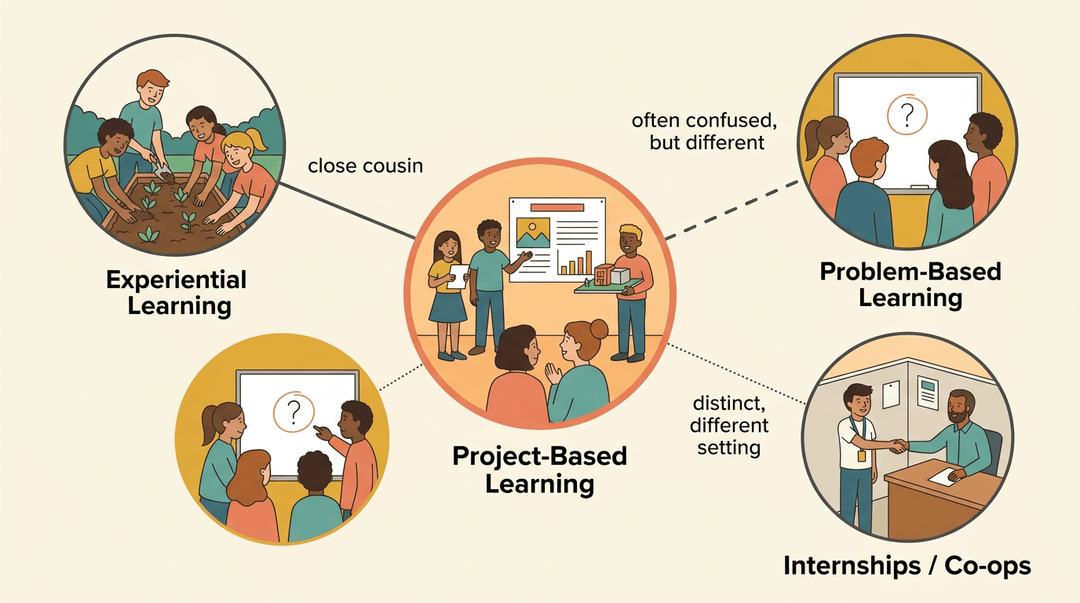
PBL sits in a family of active, hands-on, inquiry-based learning methods, closely related to experiential learning and education, where students learn by doing rather than by listening. It's often confused with problem-based learning, a narrower approach centered on solving one defined problem rather than building toward a public product. And it's distinct from internships or co-ops, which place students in a workplace instead of a classroom-driven inquiry.
What are the 7 elements of project-based learning?
The Gold Standard PBL model lays out seven essential elements that separate real PBL from a dressed-up worksheet. Among them:
- authenticity and relevance to a real-world problem
- an extended time frame rather than a single class period
- a public product or presentation that gives students a real audience
- an inquiry-driven process that starts with a question instead of an answer
- a teacher who acts as a coach, not a lecturer, throughout
Why Project-based Learning Works so Well
Ask any teacher who's watched a group of students hunched over a half-built cardboard bridge, arguing over the best way to reinforce it, and they'll tell you: something clicks that a worksheet never quite reaches.
Project-based learning (PBL) earns its reputation because it stacks up benefits for students, teachers, and the classroom as a whole, all at once, even though it takes real planning to pull off well.
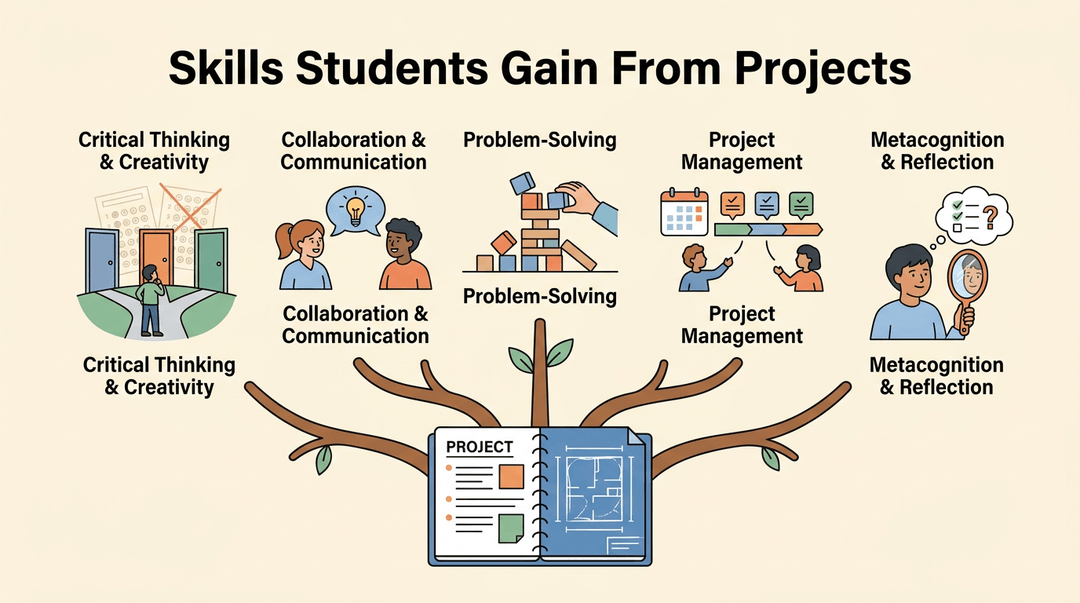
Skills students gain from projects
A genuine project asks for more than recall. It builds:
- Critical thinking and creativity, since students have to weigh options instead of picking from a multiple-choice list.
- Collaboration and communication, because a project only works if the group can actually talk it through.
- Problem-solving skills, sharpened every time a plan doesn't survive contact with reality.
- Project management ability, from setting a timeline to dividing the work.
- Metacognition and reflection, as students look back on what worked and why.
How PBL boosts learning and engagement
The research backs up what that hunched-over group is showing you. High-impact practices research from WPI shows PBL produces greater student learning gains than traditional teaching, particularly for students in underrepresented groups.
A study published in Humanities and Social Sciences Communications points to deeper, more relevant learning, with real gains in critical thinking, creativity, and collaboration.
UCLA's review of PBL research found increased engagement across grade levels and socioeconomic groups, and studies covered by The University Record show PBL classrooms outperforming typical ones on achievement.
Building real-world job skills
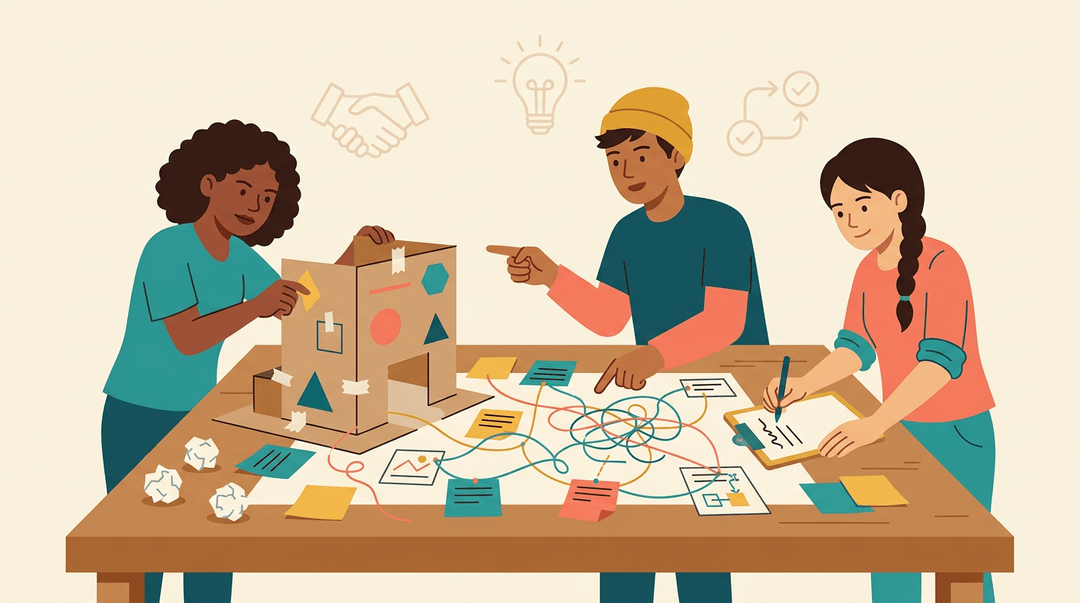
Projects mirror the messiness of actual work, which is exactly the point. Students practice the skills employers keep asking for:
- teamwork
- initiative
- follow-through
That translates into stronger job-readiness after graduation, along with resiliency and adaptability when a plan changes midstream. Just as valuable: comfort with ambiguity and complexity, since a good project rarely has one clean, obvious answer.
How PBL benefits teachers too
Is project-based learning hard? Planning your first unit can feel that way, since it asks more upfront design than a standard lesson. But that investment pays off.
PBL brings variety into your teaching instead of repeating the same lecture format, which tends to boost your own motivation and ease burnout over time.
It also opens the door to interdisciplinary collaboration with colleagues and genuine professional development as you refine your practice project by project.
Why PBL matters for underrepresented students
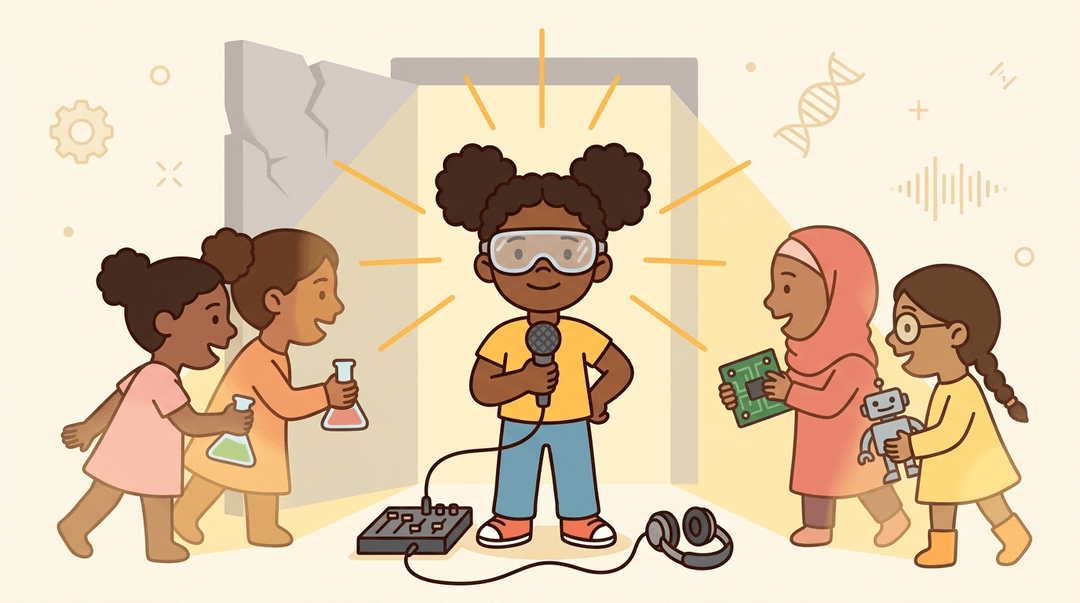
Research on informal, project-based STEM learning points to real benefits for underrepresented girls in STEM, giving them a hands-on way into subjects that can otherwise feel closed off.
That echoes the broader pattern noted earlier: PBL's learning gains show up most for students in underrepresented groups, making it one of the more equitable tools you have for closing gaps in your classroom.
What Teachers Do in Project-based Learning
Project-based learning (PBL) asks you to trade the podium for a clipboard. Your job shifts from delivering content to designing the conditions where students find it themselves.
Teacher as guide, not lecturer
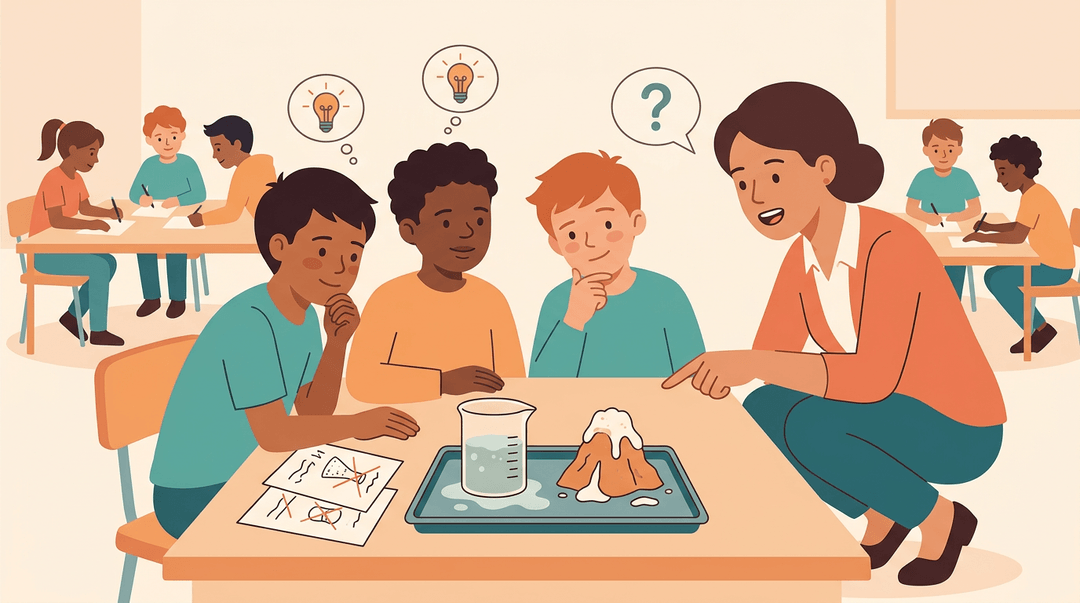
In PBL, you're guiding, not directing. Instead of handing students the answer, you ask the question that gets them closer to it themselves.
That means stepping out of the lecture role and mentoring the process instead: circulating, listening, nudging a stuck team back on track.
Consider a middle school teacher who, instead of explaining a science concept up front, lets a team's failed experiment become the lesson. You end up learning alongside your students, discovering the same surprises they do.
What effective PBL teaching looks like
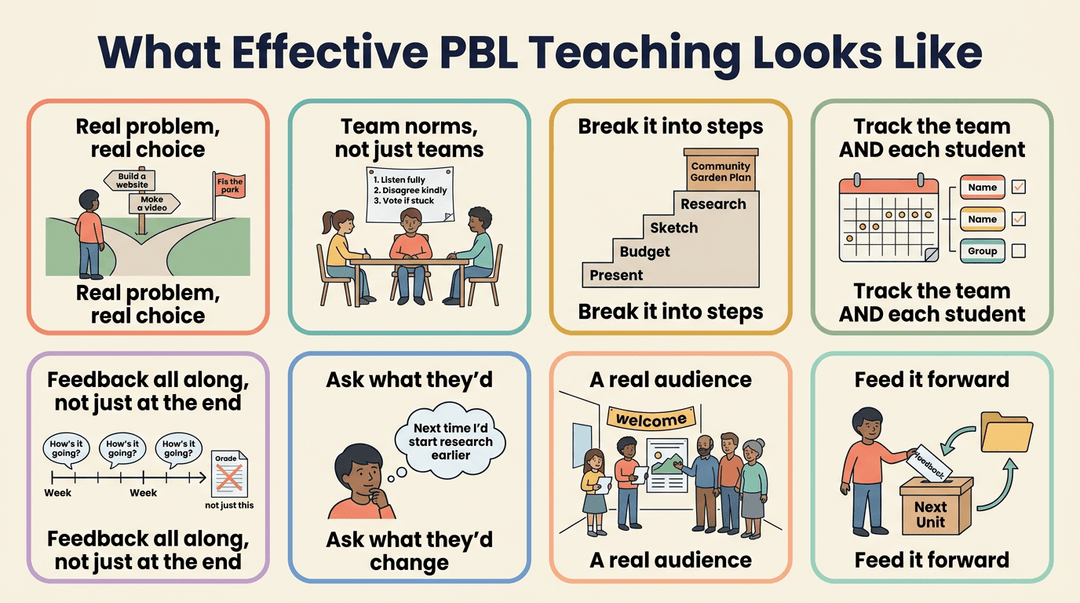
Strong PBL teaching rests on a few habits:
- Design for authenticity and agency. Give students a real problem and real choices in how to solve it.
- Build a collaboration culture. Set norms for how teams talk, disagree, and decide.
- Scaffold learning. Break big tasks into manageable steps.
- Manage teams and deadlines. Keep projects moving and hold each student individually accountable, not just the group.
- Provide ongoing feedback. Check in often, not just at the final grade.
- Create reflection opportunities. Ask students what they'd do differently next time.
- Showcase student work. Give the project a real audience.
- Collect student feedback. Use it to improve the next unit.
How to scaffold student learning
Scaffolding works best as shared leadership: you offer support while teams collaborate on their own strategies for tackling the work. Frame scaffolds as a strength, not a crutch.
A struggling reader and an advanced student don't need the same scaffold, so differentiate the support by ability and adjust it as the project moves along.
How a PBL Project Comes Together
A project doesn't just materialize because you hand out a rubric and cross your fingers. It moves through a deliberate sequence, and that sequence is what separates a unit students remember from one that fizzles by week two.
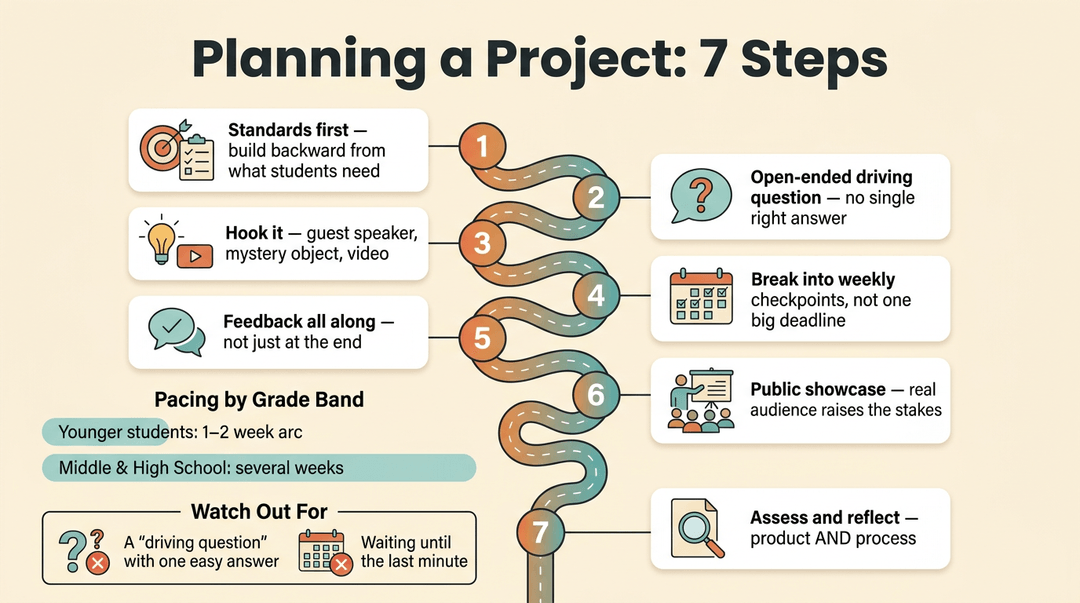
Steps to plan a project
- Identify standards and skills. Start with the content and skills your students actually need, then build backward from there.
- Craft an open-ended driving question. One with no single "right" answer keeps students exploring instead of guessing what you want to hear.
- Launch with a hook activity. A guest speaker, a mystery object, a short video: anything that makes the question feel urgent.
- Break it into manageable steps. A high school teacher running a semester-long project might map it into weekly checkpoints so it never feels overwhelming.
- Provide feedback throughout. Don't save comments for the end.
- Create a public demonstration. A showcase, gallery walk, or presentation to real audiences raises the stakes in a good way.
- Assess and reflect. Close the loop on both the product and the process.
Pacing shifts by grade band: younger students do well with a one- to two-week arc, while middle and high schoolers can sustain a project for several weeks.
Watch for two common pitfalls: driving questions that are secretly closed-ended, and timelines with no checkpoints. Simple digital tools like shared docs or project boards help you track progress without extra paperwork.
Giving feedback throughout the project
- Ongoing feedback. Short check-ins during work time catch problems while there's still time to fix them.
- Peer and self-assessment. Students spot gaps in their own thinking when they evaluate someone else's first.
- Rubric-based evaluation. A shared rubric keeps expectations clear and grading consistent.
- Final reflection. A short write-up on what worked and what they'd change next time makes the learning stick.
A Checklist for Planning Your First PBL Unit
Everything above explains what project-based learning is; this page is what you print when you're ready to run one. Work through the three phases in order: each has a small set of moves and a concrete instance you can adapt.
Before you launch
Confirm all three before day one. A project that stumbles usually skipped one of these.
- Driving question is open-ended and tied to a standard. It should require the standard, not just mention the topic.
- ✅ "How can we design a school garden that feeds our class all year?"
- ❌ "What do plants need to grow?"
- The difference: the first forces students to apply the science; the second has one right answer.
- Timeline and milestones are on the calendar. Jot it like this: Week 1 research → Week 2 prototype → Week 3 revise → Week 4 showcase.
- Group size and roles are set. Three or four students works for most classrooms.
- Write roles out: researcher, materials manager, recorder, presenter.
💡 Tip: Hand students the rubric on day one, not at the end. It's a map for them, not just a scoring tool for you.
Keeping it on track
Once groups are working, your job shifts from delivering to monitoring. Two routines do most of that work.
- Run short progress conferences. Five minutes per group, once or twice a week.
- Ask: "Show me what's finished, and tell me what's blocking you."
- Give rubric-based feedback on drafts. Mark work against one rubric row at a time, not all at once.
For scaffolds, adjust based on what you see:
| When you see... | Try... |
|---|---|
| A group stalled at research | Two pre-vetted sources to get them moving |
| Groups finishing far ahead | Removing sentence starters, adding a stretch criterion |
| One student doing all the work | Rotating roles and collecting a role log from each member |
Wrapping up and assessing
- Host a public showcase. An audience beyond you raises the stakes and the quality.
- Invite another class, families, or your principal: any real audience counts.
- Include peer and self-assessment. Give each student two prompts to answer in writing.
- "What did your group do well?" and "What would you do differently next time?"
- Gather student feedback for your next unit. A three-line exit ticket is enough.
Example exit ticket: "The most useful part of this project was ___. The most confusing part was ___. Next time, our class should ___."
Your first PBL unit won't be perfect, and that's fine: the reflection you collect at the end is the planning document for your second one. Draft, organize, and reuse your PBL unit plans across classes with EMStudio's online lesson planner.
Where Project-based Learning Fits Best
Project-based learning doesn't belong to one grade level or one subject.
Whatever you teach, there's likely a version of PBL that fits: it scales from a first-grade classroom to a graduate seminar, and it works as well in a chemistry lab as it does in a history class.
What grade levels PBL works for
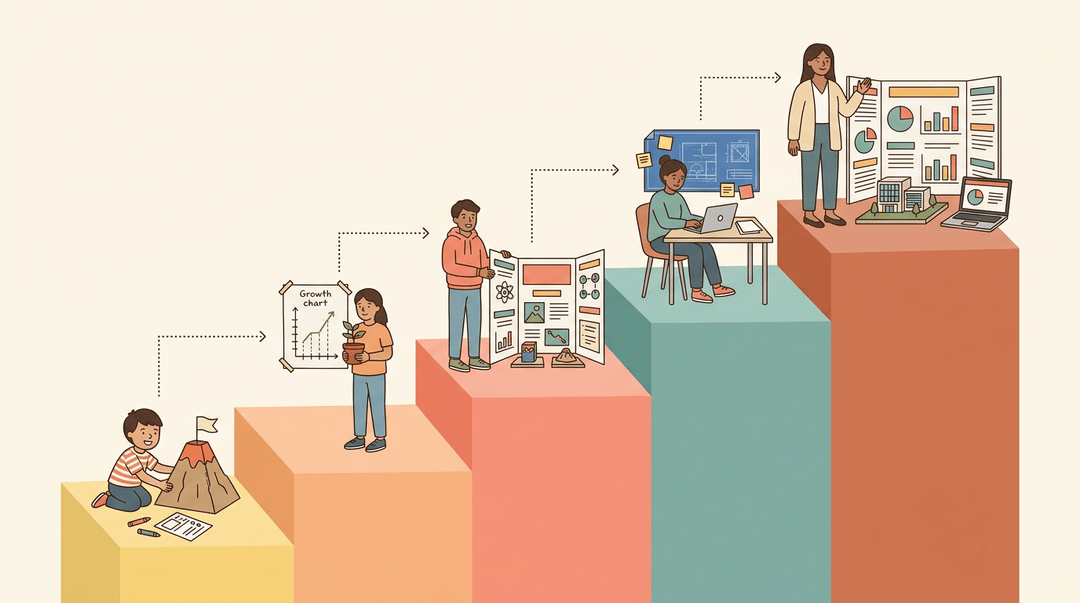
PBL spans the entire arc of education: elementary, middle, high school, college, and graduate school. Some schools introduce it as early as first grade, when students tackle simple, hands-on questions instead of worksheets.
On the other end, plenty of colleges build an entire capstone course around it, where seniors spend a semester producing a final project that pulls together everything they've learned.
Using PBL in college courses
In higher education, PBL tends to show up in a handful of familiar formats:
- Capstones and e-portfolios. Students assemble a final project alongside a digital record of their growth over time.
- Community-engaged and service learning. Students partner with a local organization to solve a real problem.
- First-year seminars. New college students get an early, low-stakes project that builds research and collaboration skills.
- Interdisciplinary learning communities. Students from different majors team up on a shared project that draws on more than one field.
PBL across different subjects
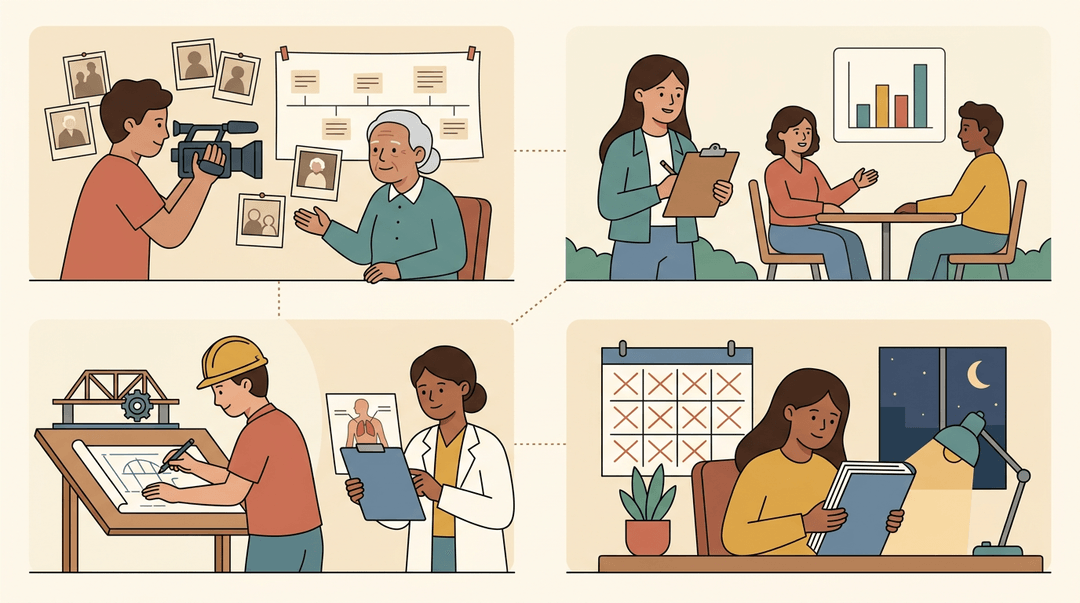
PBL isn't confined to STEM. It fits arts and humanities courses just as naturally: think a history class producing a documentary instead of a term paper.
We see it in social sciences too, where students might design a survey and analyze real community data. Engineering and medical schools lean on it heavily, since both fields depend on solving open-ended, real-world problems.
In graduate education, it often takes the shape of a thesis-length project built over a full year.
Real PBL examples for K-12
For example, an elementary teacher might have students plant a garden and use it to practice measurement, tracking plant height and spacing over several weeks.
A middle school class might design new playground equipment, applying geometry and budgeting to a real proposal. A high school team might take on an urban sustainability design project, mapping out a green space for their own neighborhood.
Elementary projects tend to stay concrete and short, while secondary projects push toward longer, more open-ended problems.
How schools support PBL rollout
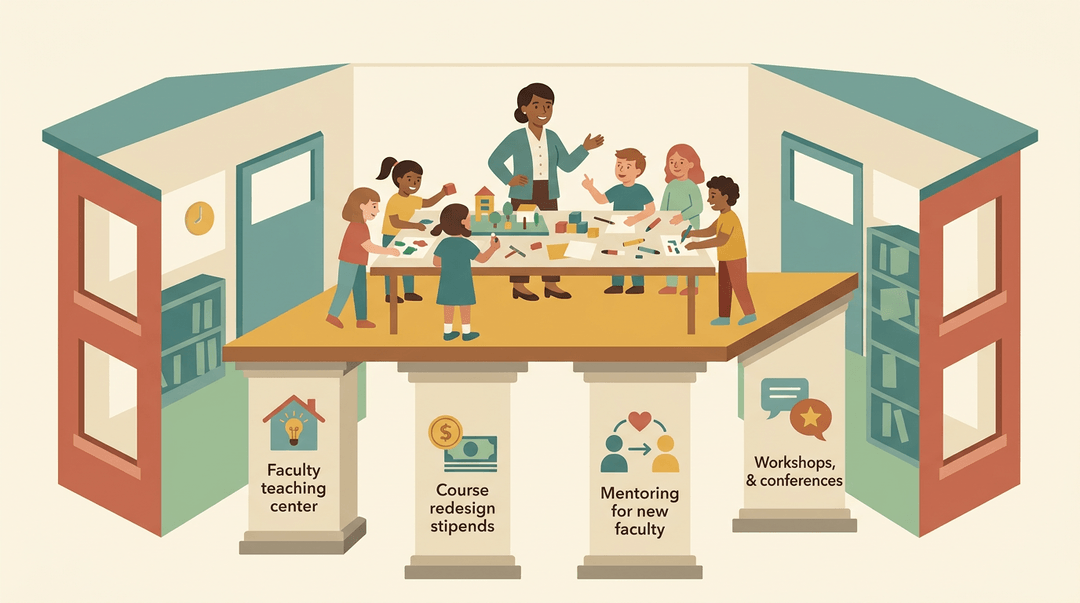
Rolling out PBL school-wide takes more than good intentions from individual teachers. Schools that do it well usually build support systems around it:
- A faculty teaching center that offers training and planning resources.
- Course redesign stipends that pay teachers for the extra time PBL planning requires.
- Mentoring for new faculty who haven't run a project-based unit before.
- PBL workshops and conferences that keep teachers connected to fresh ideas.
Project-based learning isn't a gimmick or an extra unit to squeeze in before break. It's a different route to the same destination: deeper understanding, stronger skills, and students who can explain not just what they learned but why it mattered.
Ready to plan your first PBL unit without losing track of the pieces? Check out our Lesson Planning tool to organize and reuse your plans across every class.
References
- Girls leading the conversation: harnessing the potential of podcasting for informal and project-based learning — par.nsf.gov (2025)
- Project-Based Learning for Educators | High-Impact Practices — wpi.edu
- Project-based learning in schools: a multi-complementary study of its effectiveness — nature.com
- Project Based Learning and Student Engagement — smhp.psych.ucla.edu
- Project-based learning yields better student outcomes, studies show — record.umich.edu
- Why-Project-Based-Learning — cacs.unt.edu
- Project based learning framework integrating industry collaboration to enhance student future readiness in higher education — pmc.ncbi.nlm.nih.gov
Frequently asked questions
What is the meaning of project-based learning?
Project-based learning is a teaching method in which students learn academic content and skills by investigating an authentic, open-ended problem over an extended period. They research, make decisions, create a product or presentation, receive feedback, and reflect on the process.
What is PBL project-based learning?
PBL usually means project-based learning. It is an active, student-driven approach in which a real-world project serves as the main vehicle for learning, rather than being an add-on after traditional instruction.
What is meant by project-based learning?
Project-based learning means learning by doing through a sustained project connected to a meaningful question or real-world challenge. Students use research, collaboration, problem-solving, and revision to create a public product or presentation.
What are the 7 steps of project-based learning?
The seven common steps are: identify standards and skills, craft an open-ended driving question, launch with a hook, break the work into manageable steps, provide ongoing feedback, create a public demonstration, and assess and reflect.
What are the 5 stages of PBL?
A practical five-stage version of PBL is: launch and engage, investigate and research, plan and develop, revise and present, and assess and reflect. Different frameworks use slightly different labels, but these stages capture the core project cycle.
What are the 7 elements of project-based learning?
The seven Gold Standard PBL elements are a challenging problem or question, sustained inquiry, authenticity, student voice and choice, reflection, critique and revision, and a public product.
What is a project-based learning example?
A class might design a pollinator garden for a school courtyard. Students would research ecosystems, choose suitable plants, plan the layout and budget, build or present their design, revise it using feedback, and explain their decisions to a real audience.
Is project-based learning hard?
Project-based learning can be challenging because it requires more upfront planning, careful scaffolding, teamwork, checkpoints, and ongoing feedback than a standard lesson. It becomes more manageable when the project has a clear driving question, defined roles, milestones, and a shared rubric.