What Is Peer to Peer Assessment, and How Do You Set It Up?

Jump to section
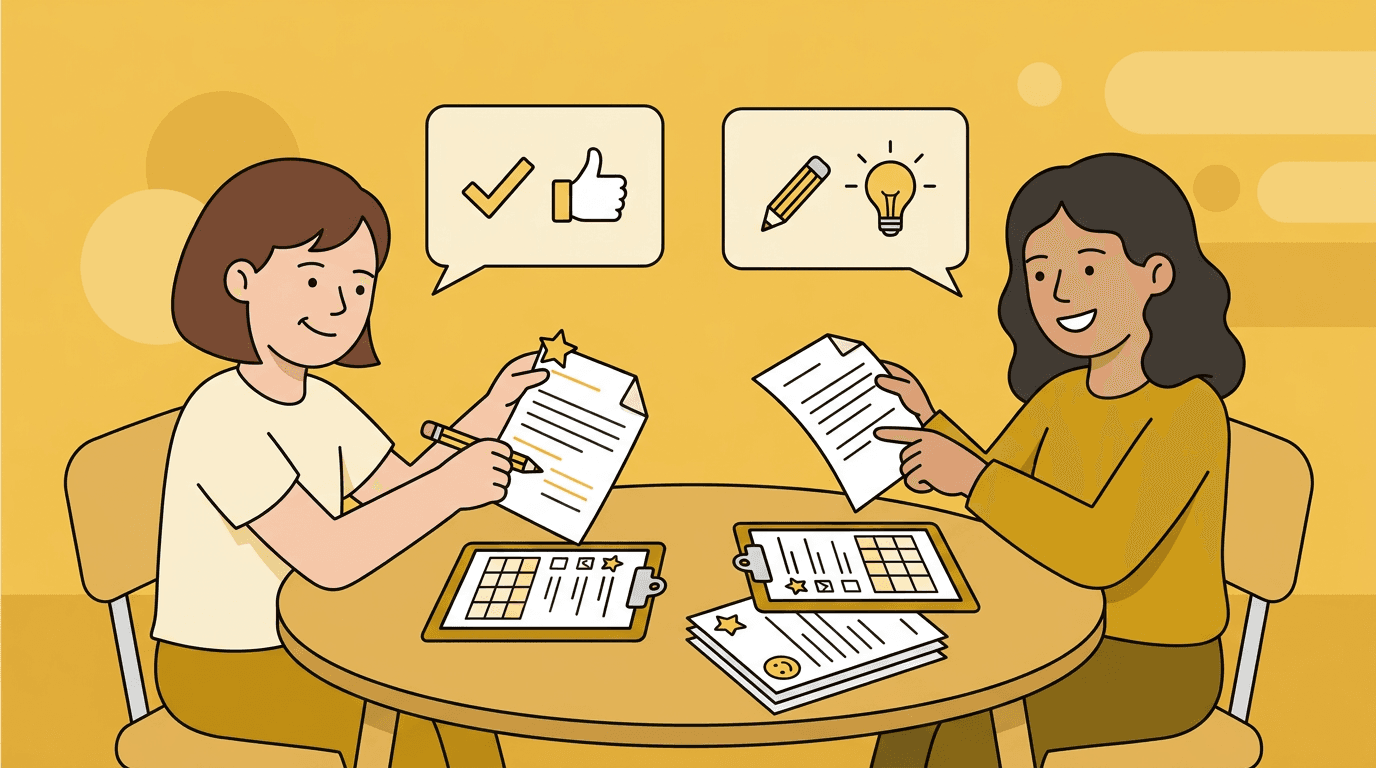
Think about the last time you asked a friend to read something before you sent it. A second pair of eyes catches what you can't see in your own work.
That's the whole idea behind peer assessment: students reviewing each other's work using clear criteria, learning as much from giving feedback as receiving it.
This post breaks down what it looks like, how to set it up, and how to avoid the pitfalls that trip up a first attempt.
Understanding Peer to Peer Assessment
Peer assessment turns your students into partners in the evaluation process, and it's more structured than a quick "trade papers and grade."
Here's what it actually involves, how it helps your students grow, why it can lighten your workload, and what the research says about it.
What are the types of peer assessment?
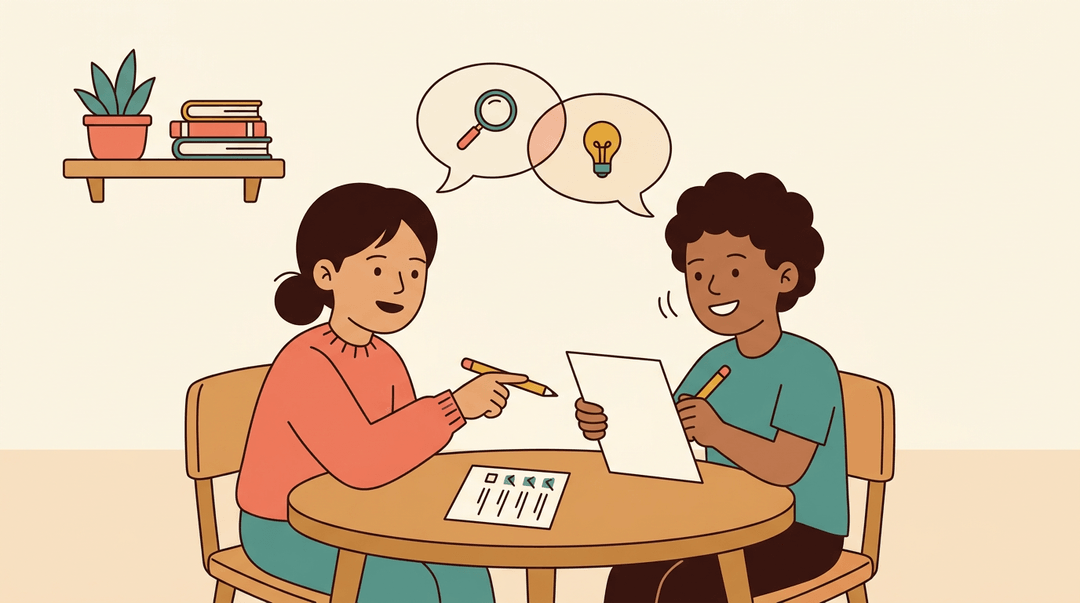
At its core, peer assessment means students evaluate a classmate's work against a shared set of criteria, usually a rubric or checklist you've already built for the assignment.
That shared criteria matters: it keeps the process focused and marks this as a structured educational practice, not a casual opinion swap.
It's worth separating two terms that get used interchangeably.
Peer feedback is the comments students give each other, while peer assessment goes a step further and hands over some of the actual judgment, often a score or rating, to the students themselves.
Types range from anonymous online reviews to in-class partner checks to small-group critique circles, but each shares that same feature: judgment shared with students, not held by you alone.
That's also the difference between self-assessment and peer assessment: self-assessment turns the evaluative lens on a student's own work, while peer assessment aims it at a classmate's. Both build the same reflective muscle, just from a different angle.
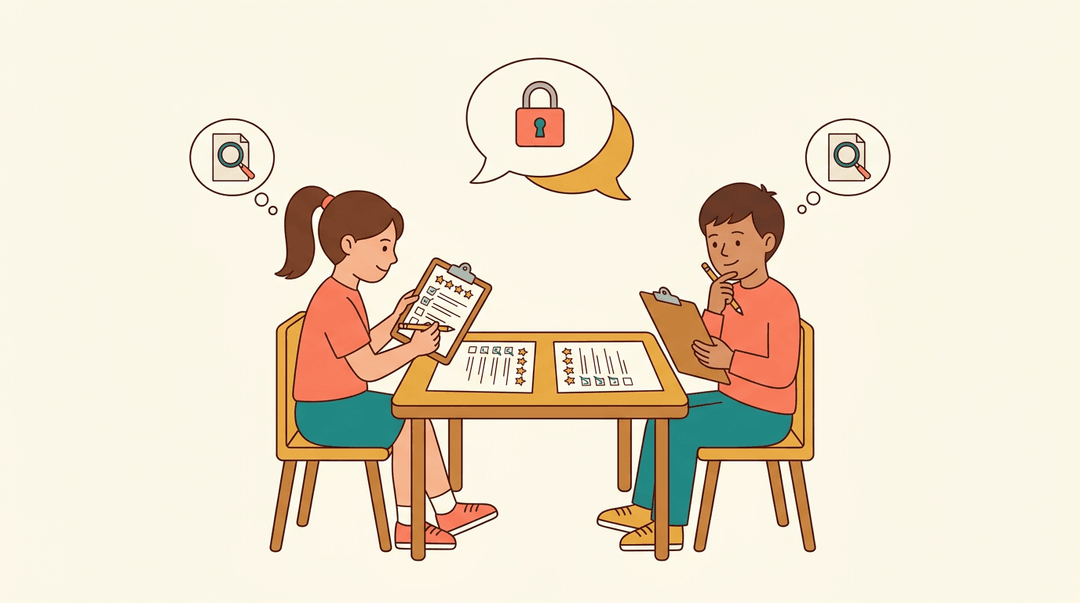
Before handing out papers for review, think through the privacy side too: students are reading a classmate's real work, so setting norms for respectful, confidential feedback protects everyone in the room.
How peer assessment helps students grow
Reviewing a classmate's work forces students to think critically about what "good" actually looks like, a skill that transfers straight back to their own writing.
Studies have found that peer assessment can improve students' writing quality, since students revise more carefully once they've had to explain someone else's mistakes.
The metacognitive payoff runs both ways: judging a peer's work sharpens a student's ability to judge their own.
Add in the motivation boost of feedback from someone their own age, plus the negotiation skills that come from justifying a rating to a classmate, and you've got a practice that mirrors real-world professional skill transfer, the same give-and-take students will use in a workplace review someday.
How peer assessment eases teacher workload
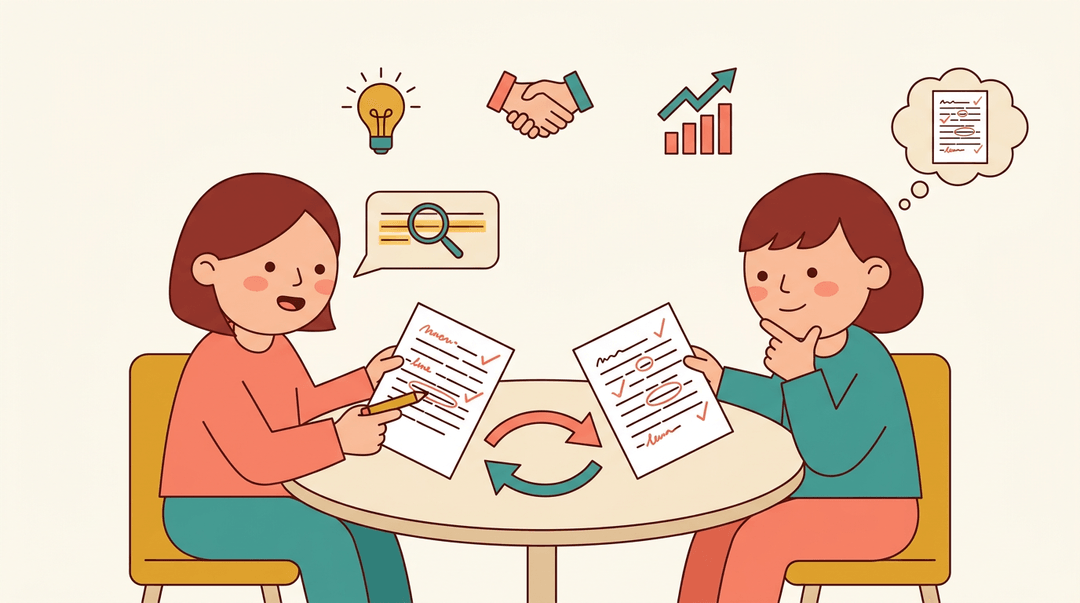
Peer assessment isn't only about student growth. It reduces your grading workload, since students catch a chunk of errors before work ever reaches your desk, and that frees up time for instruction instead of red ink.
Consider a middle school English teacher who builds a peer review round into the writing process: essays arrive already tightened, so grading goes faster and feedback lands deeper.
Beyond the time savings, the practice increases a sense of belonging: students see that their judgment counts in the classroom, not just yours.
What research says about peer assessment
A meta-analysis of 54 studies spanning primary, secondary, and tertiary students found peer assessment associated with improved academic performance across subjects.
On the theory side, evaluative judgement theory explains how students build the ability to judge the quality of their own and others' work, a skill that outlasts any single course.
The community of practice framework frames peer assessment as learning through participation: students grow by taking part in a shared community focused on evaluating and improving work together.

Designing Effective Peer Assessment Activities
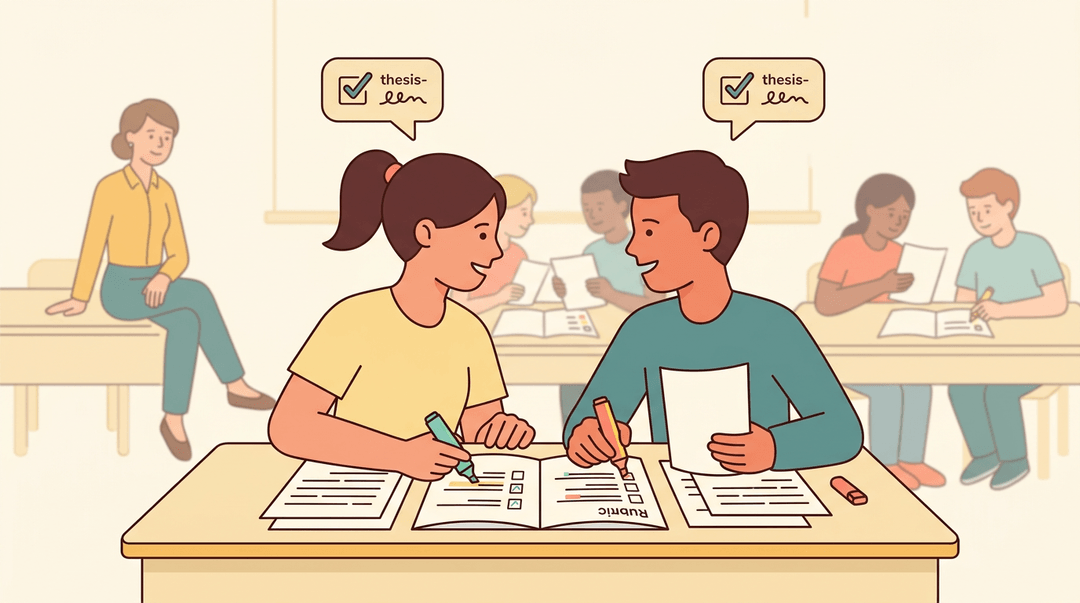
Picture a ninth-grade English class swapping argumentative essay drafts and marking up each other's thesis statements.
That's peer assessment in action, and it works best when you make a few design choices before students trade papers, the kind we'll walk through here.
What are the key elements of peer review?
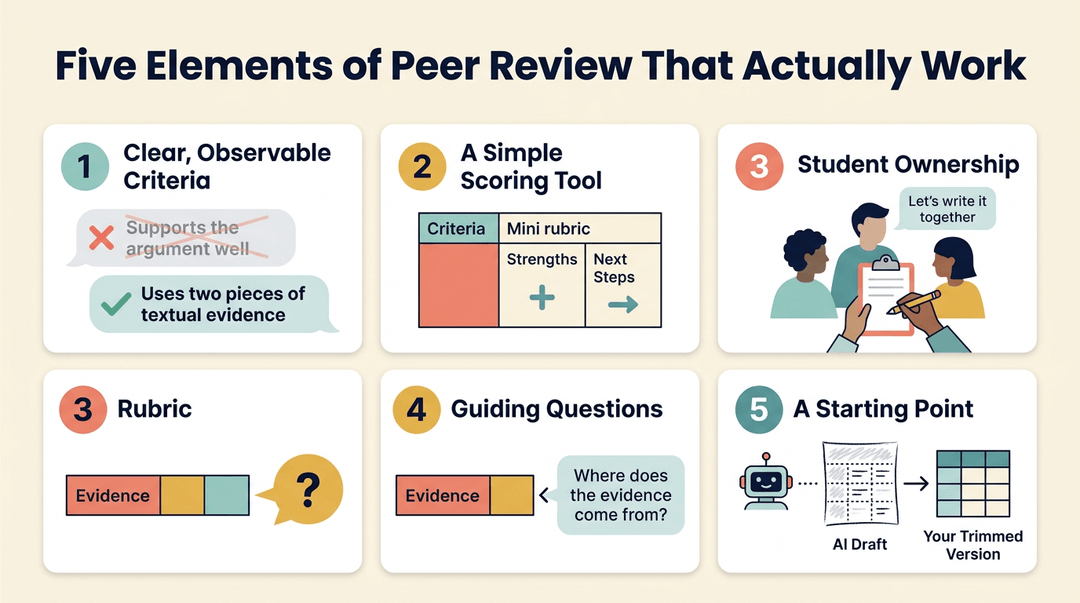
Five things make peer review actually useful:
- Clear, observable criteria. "Uses two pieces of textual evidence" beats "supports the argument well" every time.
- A simple scoring tool. Start with a checklist or a single-point rubric: one column of criteria, with room for strengths and next steps.
- Student ownership. Co-create the rubric with your class; students who help write it tend to apply it more carefully.
- Guiding questions. Pair each row of an analytic rubric with a question like "Where does the evidence come from?" so reviewers know exactly what to look for.
- A starting point. Short on time? Artificial intelligence (AI) tools can draft a rubric from your assignment description, which you then trim down to fit.
Training students to score consistently
Handing over a rubric isn't the same as teaching students to use it. Let them practice on a few sample papers first, then run a calibration exercise: everyone scores the same sample and compares results as a class.
Talk through any discrepancies openly, and treat it as a mini-lesson on the rubric itself. Check peer scores against your own occasionally to catch drift, and model the feedback language you want students to use: specific, kind, and actionable.
Why anonymous review matters
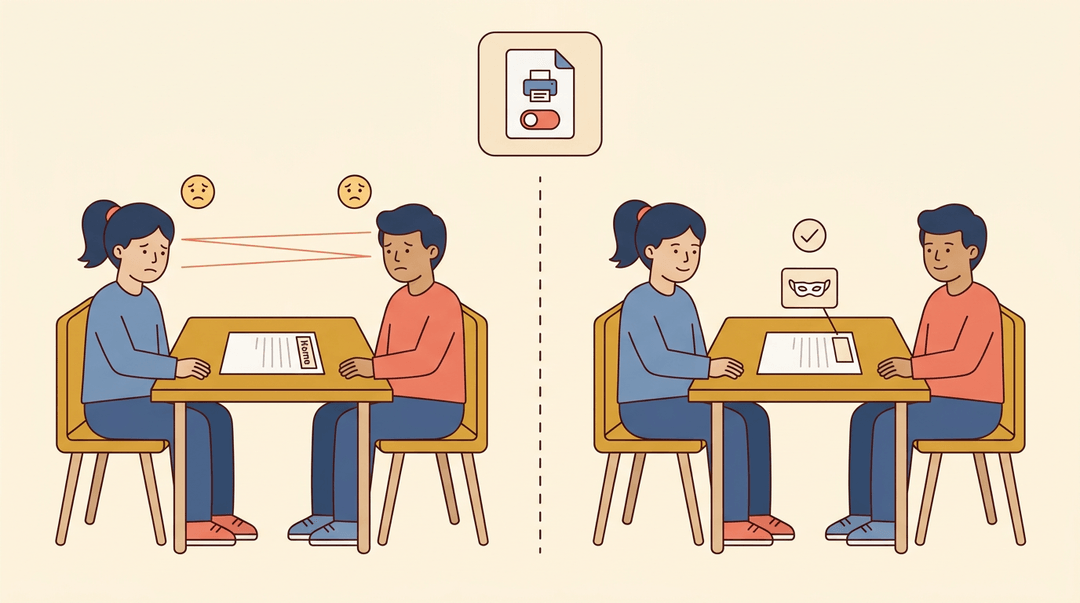
Keep peer review anonymous where you can. Microsoft Word's double-blind review setting strips names automatically, or you can simply keep a named copy for your records and hand out an unnamed one for review.
Anonymous submissions lower the pressure: students worry less about judging a friend or being judged themselves, and it removes friendship bias from the scores.
Choosing the right assignments for peer review
Use peer review on drafts and other formative work, not final grades. Start with low-stakes tasks, like a single paragraph or a rough outline, so students build confidence before tackling something bigger.
From there, it scales to multi-step projects, full essays, and evaluating each student's contribution to a group project. The real payoff comes when feedback feeds directly into a revision cycle.
Tools that make peer review easier
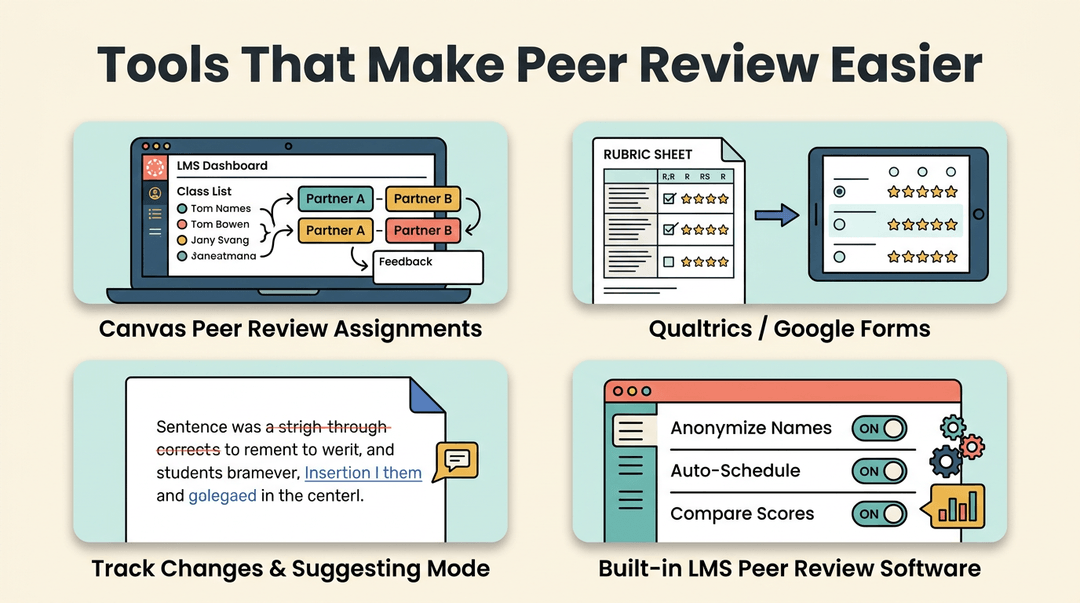
- Canvas peer review assignments auto-assign partners and collect feedback inside the learning management system (LMS) you already use.
- Qualtrics or Google Forms templates turn a rubric into a quick digital form.
- Track changes and suggesting features in Google Docs or Word let reviewers mark up a draft without erasing the original.
- Dedicated peer review software built into many LMS platforms can automate anonymization, scheduling, and score comparison all at once.
A Peer Assessment Activity to Try
Here's one activity you can run this week, in two grade-band versions. Both sit on the same five-step spine, so learn the spine once and swap the materials.
The five-step spine
- Set clear criteria before anyone reviews.
- Post two or three look-fors students can actually judge.
- On the board: "Did the reader pause at periods? Read loud enough to hear?"
- Model sample feedback out loud.
- Say: "I noticed you slowed down for the tricky word. That's my star."
- Assign reviewer pairs yourself.
- Mixed-ability pairs work; friend-picked pairs drift off task.
- Collect written responses.
- A half-sheet or online form: feedback that isn't written evaporates.
- Reflect and revise.
- Each student acts on one piece of feedback before turning work in.
Elementary version: two stars and a wish
Pair students as reading buddies: one reads a short passage aloud, the other gives two stars (things done well) and one wish (something to try next time).
Since young students can't yet write fluent feedback, hand them an icon-based visual rubric: a mouth icon for "loud and clear," an ear icon for "listened to my partner," a stop-sign icon for "paused at periods."
The buddy circles icons, then says the stars and wish aloud.
A filled-in card looks like: Star 1: "You read loud and clear." Star 2: "You stopped at the periods." Wish: "Try sounding out the long words instead of skipping them."
Secondary version: anonymous draft revision
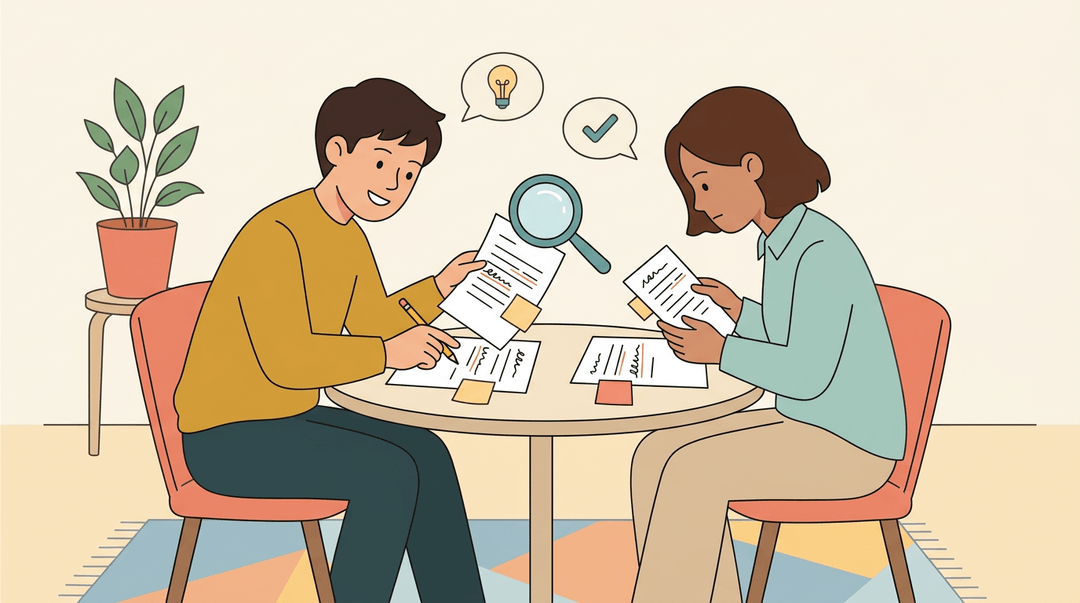
Older students trade essay drafts and score them with a structured scoring rubric: each criterion gets a number and an evidence line, so no score arrives unexplained.
| Criterion | Score 1-4 | Reviewer's evidence line |
|---|---|---|
| Clear thesis | 3 | "Your claim is in paragraph 2, so I had to hunt for it." |
| Supporting evidence | 4 | "Every body paragraph cites the text." |
Run the exchange as an anonymous online review through your LMS or a shared form: drafts get numbers, not names, and the honesty of the feedback jumps.
Then close with peer-guided draft revision: each writer revises one paragraph and jots a sentence naming which comment prompted the change.
⚠️ Watch out: anonymous to peers doesn't mean anonymous to you. Keep the reviewer roster so you can coach anyone whose feedback is thin or unkind.
Once the written responses come in, you've got real data on both the work and the reviewers. Log and average those peer assessment scores right in your gradebook with EMStudio.
How to Do a Peer Assessment
So how do you actually run a peer assessment without it turning into an awkward free-for-all? It comes down to four moves:
- Pair students thoughtfully
- Model what good feedback sounds like
- Build their comfort with giving critique
- Follow through once the reviews are in
Get those right, and peer review becomes a routine your students trust.
Pairing students for peer review
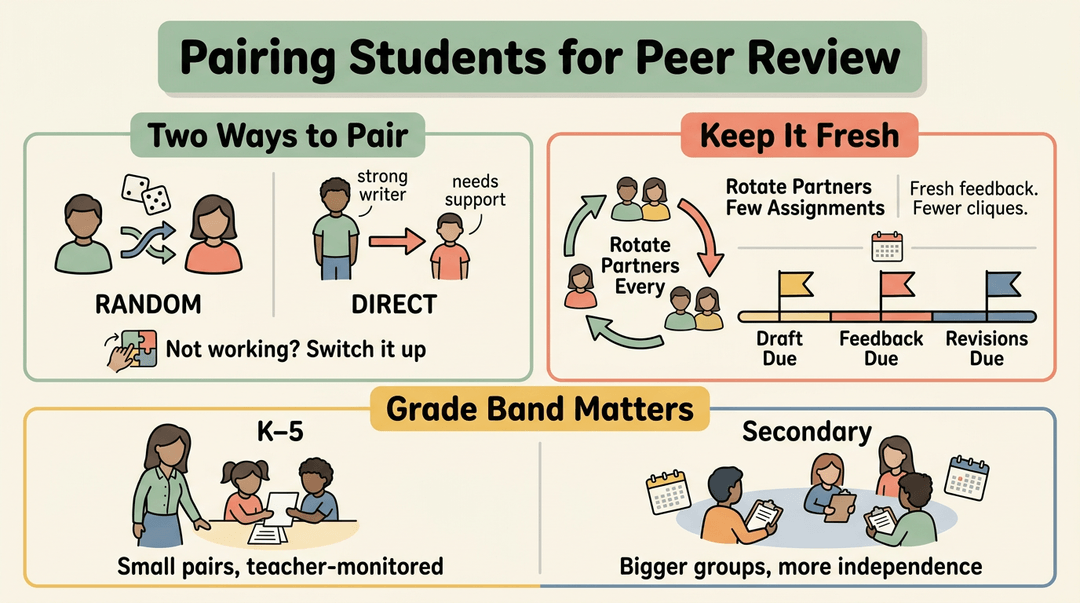
You can assign pairs randomly or directly, matching a strong writer with one who needs support. Either way, stay flexible: if a pairing isn't working, change it.
Rotating partners every few assignments keeps feedback fresh and stops cliques from forming. Set a clear timeline too:
- When the draft is due
- When feedback is due
- When revisions happen
Grade-band matters here. In K-5 classrooms, keep pairs small and teacher-monitored, often just two students trading one worksheet. In secondary classrooms, students can handle rotating groups of three or four and more independent timelines.
Modeling helpful feedback for students
Show students how to name a strength and an improvement point in the same comment. Sentence starters help: "I liked how you... " or "Have you considered..."
Make clear that reviewing isn't editing: a reviewer flags issues, they don't rewrite the sentence for their partner. And every comment should evaluate the work, never the person.
Compare "This paragraph doesn't fit" to "This is bad," and the difference is obvious.
Helping students feel comfortable giving critique
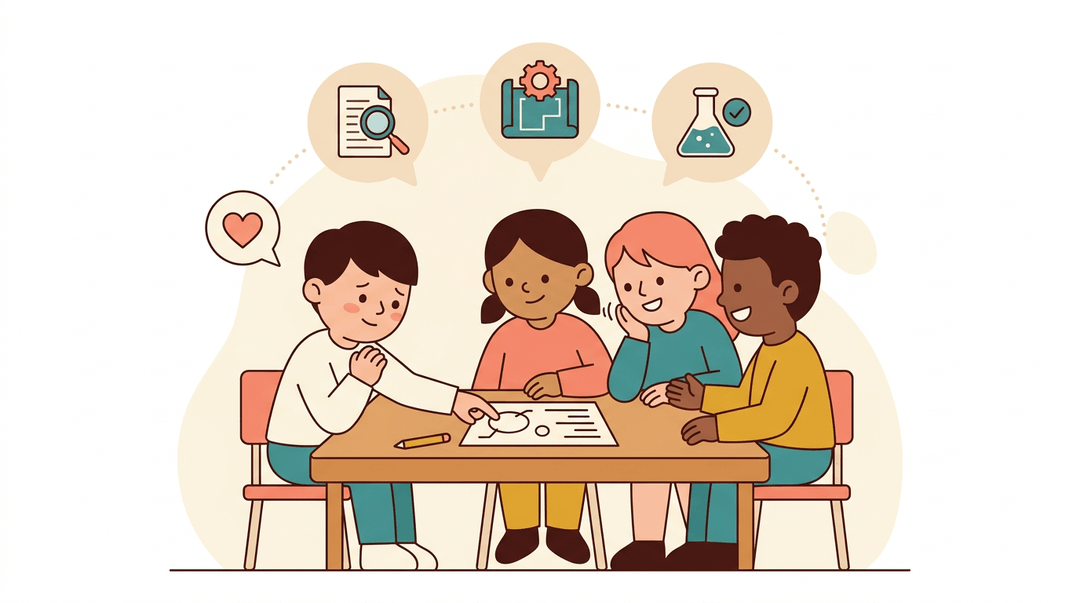
Some students come from homes or cultures where critiquing a peer feels rude. Frame feedback instead as a professional skill: editors, engineers, and scientists all rely on peer review to catch what they'd miss alone.
Normalize it early, with low-stakes practice rounds, so it feels routine by the time grades are on the line.
What happens after the peer review
Have students self-assess before and after reading feedback, then summarize what they'll change and justify what they won't.
You can synthesize the common themes across the class and discuss any sticking points directly with the student or reviewer involved.
Common Peer Assessment Mistakes to Avoid
Even a well-designed peer assessment routine can go sideways in a few predictable ways. Here's what usually trips it up, and how to head it off before it undercuts the process.
Fixing vague or unhelpful feedback
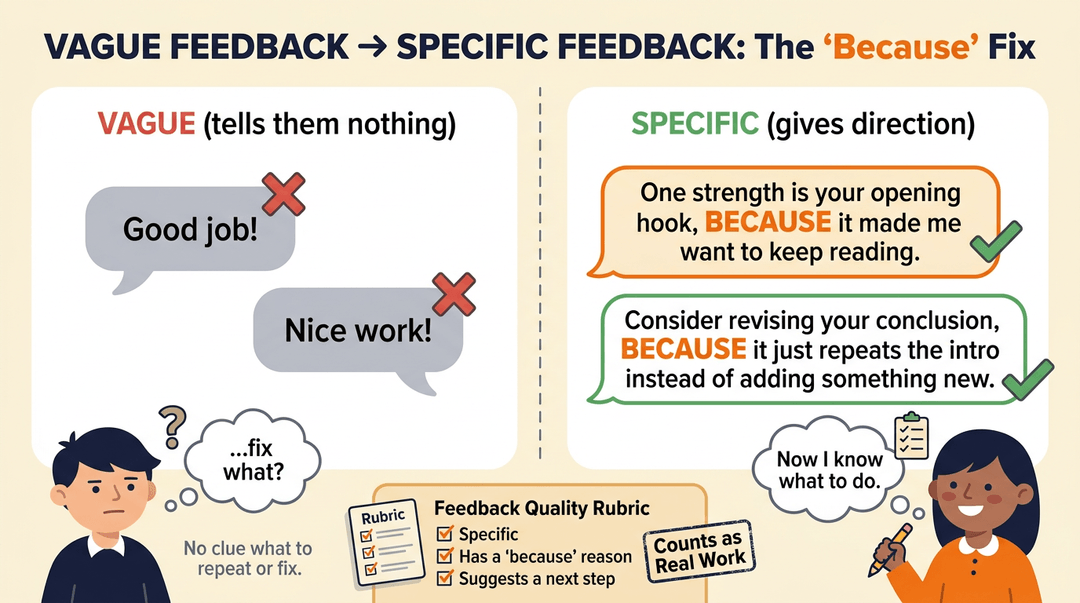
"Good job" and "nice work" feel encouraging, but they tell a student nothing about what to repeat or fix.
Generic comments are the number one complaint teachers have about peer review, and the fix is structural, not motivational: give students a rubric and sentence-starter prompts ("One strength is... because...", "Consider revising... because...") that force specifics.
The word "because" matters most. Comments need reasoning attached, not just a verdict. You can even grade the feedback itself against a short quality rubric so students see that thoughtful comments count as real work, not busywork.
Avoiding bias and popularity effects
Left unchecked, students rate friends higher and rivals lower, and different reviewers apply the same rubric in wildly different ways.
Two fixes handle most of this: keep submissions anonymous where possible, and anchor the rubric with sample responses at each score level so "proficient" means the same thing to every reviewer.
Managing peer review logistics and workload
Manually pairing up dozens of papers and tracking who reviewed whom eats an evening fast. Peer review tools that randomize and distribute submissions automatically solve that.
To keep participation from slipping, attach a small point value to completing thoughtful reviews, not just submitting the original work.
How Peer Assessment Changes Classroom Culture
Peer assessment doesn't just change how feedback gets delivered. It changes who holds the authority in the room, and that shift ripples through everything else.
A shift in classroom dynamics
When students review each other's work, the teacher stops being the only judge of quality. That authority moves outward, and students start to internalize what "good" actually looks like instead of waiting to be told.
This works because peer assessment builds a shared vocabulary around quality. Once a class agrees on what a strong thesis or a clear diagram looks like, that language becomes common currency, not just the teacher's private checklist.
The relationships shift too: less top-down, more side-by-side. Consider an eighth-grade English teacher whose students trade essay drafts and score them against a shared rubric.
Knowing a classmate (not just the teacher) will read their work, students write differently: more precisely, more aware of their audience, from the very first draft.
Building engagement and a sense of belonging
Students who evaluate each other's work tend to stay more engaged with it. Reading a peer's approach to a problem is more active than passively receiving a grade back.
That activity builds something else too: a sense of belonging. When students trust each other enough to hand over unfinished work, the classroom starts to feel less like a hierarchy and more like a community working toward the same goal.
And that community pays off academically. Students who practice spotting strengths and gaps in someone else's work get sharper at spotting them in their own, which supports real academic growth over time.
Peer assessment isn't about handing over your grading pen. It's about building students who can look at work (theirs and someone else's) and tell you why it works or doesn't.
Done well, it shifts a classroom from quiet compliance to real, shared ownership of learning.
Ready to pair strong feedback with strong record-keeping? Check out our Grading & Assessment tools to keep every score organized once the peer reviews are in.
References
- The Impact of Peer Assessment on Academic Performance: A Meta-analysis of Control Group Studies | Educational Psychology Review — doi.org
- Examining the Effectiveness of Peer Review in Improving Students’ Writing Performance: A Systematic Literature Review | Journal of Creative Research in English Literature and Culture — jcrelc.com
- Developing evaluative judgement: enabling students to make decisions about the quality of work | Higher Education — doi.org
- Implementing a Peer Feedback Intervention within a Community of Practice Framework: Community College Journal of Research and Practice: Vol 45 , No 3 — tandfonline.com
Frequently asked questions
What is peer to peer evaluation?
Peer-to-peer evaluation is a structured process in which students assess a classmate’s work using shared criteria, such as a rubric or checklist. It includes judgment, ratings, or scores, not only informal comments.
What is the meaning of peer assessment?
Peer assessment means students evaluate another student’s work against clear, shared criteria. It helps students learn by both giving feedback and receiving it.
What are the disadvantages of peer assessment?
Disadvantages can include biased scores, inconsistent use of criteria, overly vague or unkind feedback, and discomfort with criticizing classmates. It also requires teacher preparation, student training, and monitoring to work reliably.
What are the 5 key elements of peer review?
The five key elements are clear observable criteria, a simple scoring tool, student ownership of the criteria, guiding questions, and a useful starting point such as a draft rubric. Anonymous review and practice can further improve consistency.
How much does a pear assessment cost?
If you mean peer assessment, it usually costs nothing when done with classroom materials, a checklist, or tools already available through a school. Optional learning-management-system or peer-review software may have separate subscription or licensing costs.
Can you give me an example of peer assessment?
For example, students can exchange essay drafts and use a rubric to score the thesis and supporting evidence. Each reviewer records a score, gives an evidence-based comment, and the writer revises one paragraph using the feedback.
What are some examples of assessment?
Examples of assessment include teacher grading, quizzes, exams, projects, presentations, observations, self-assessment, peer assessment, portfolios, and formative checks such as exit tickets. Assessment may be formative, used during learning to guide improvement, or summative, used to evaluate learning at the end.
What does peer assessment mean?
Peer assessment means students judge and give feedback on a classmate’s work using agreed criteria, often through a rubric or checklist. Unlike peer feedback alone, it may include an actual rating or score.