Gagné's Nine Events of Instruction: A Complete Guide

Jump to section
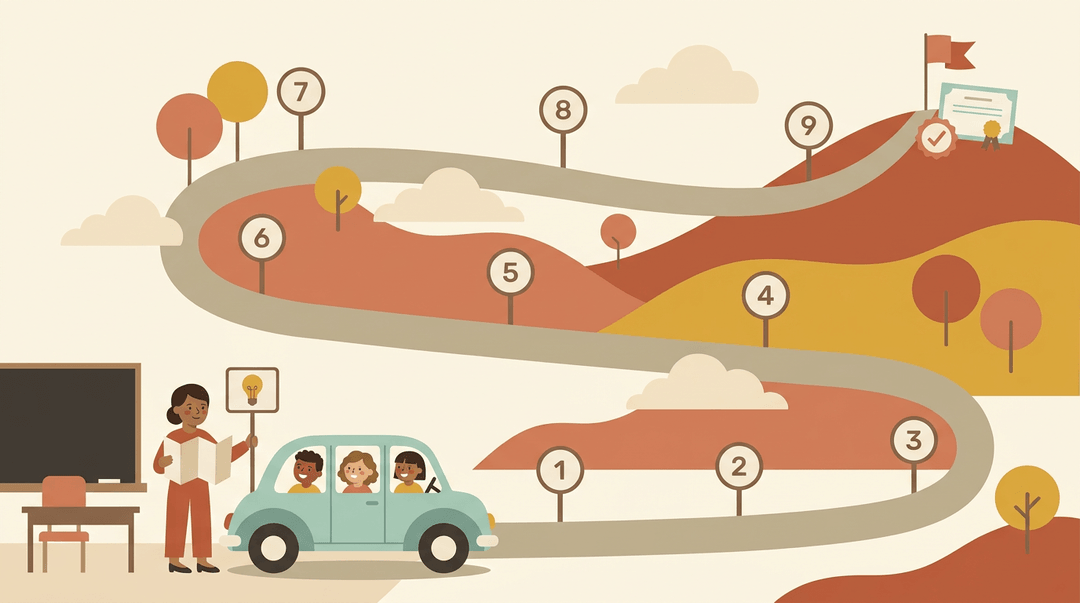
Ever wondered why some lessons click while others fall flat? Think of a road trip. You pick a destination, check the map, and keep an eye on the road. Good teaching works a similar way.
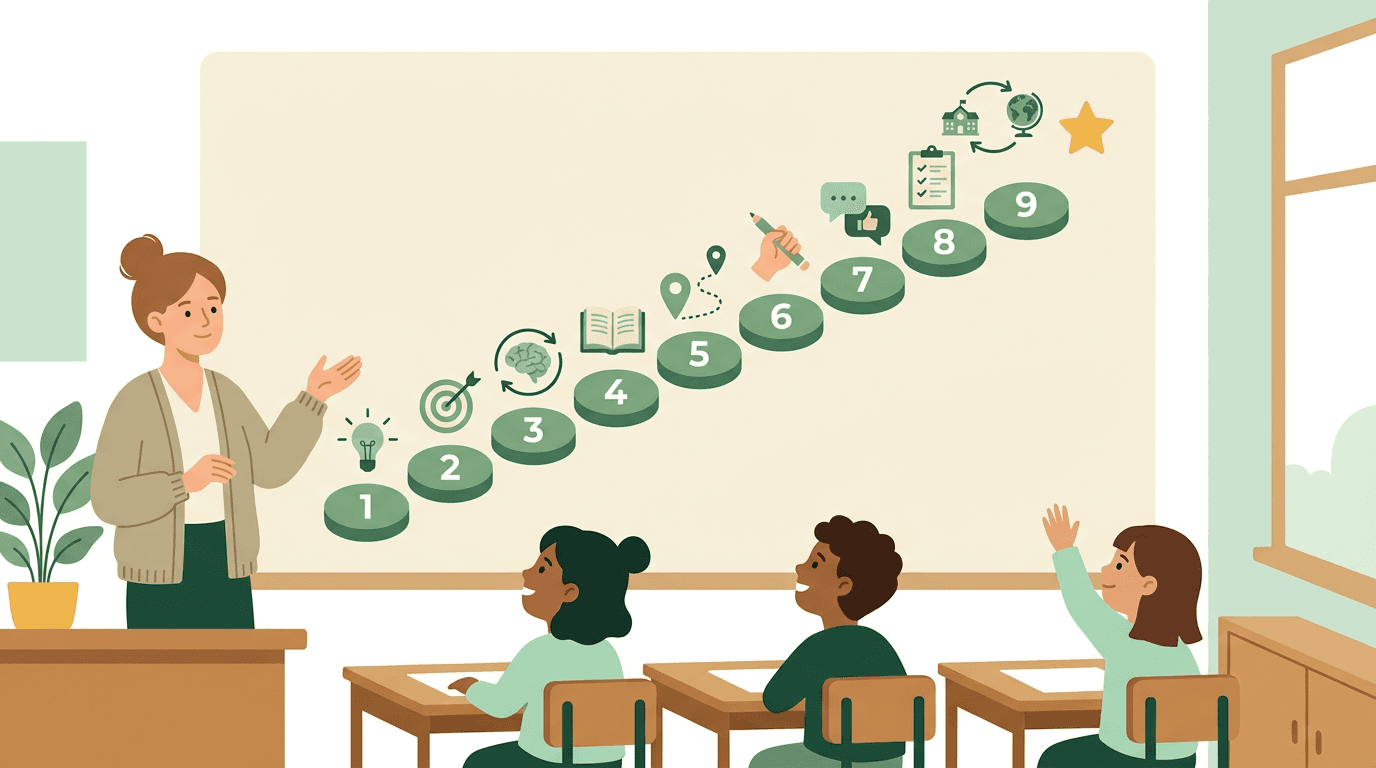
Gagné's nine events of instruction are a sequence of steps that guide learners from first attention to proof of what they can do.
In this post, we'll walk through each event in order, show what it looks like in a real classroom, and give you a template to put it to work.
Overview of Gagné's Nine Events of Instruction
Gagné's nine events give you a sequence for planning a lesson, one step at a time. Here's the big picture we'll walk through.
A nine-step framework for structuring learning
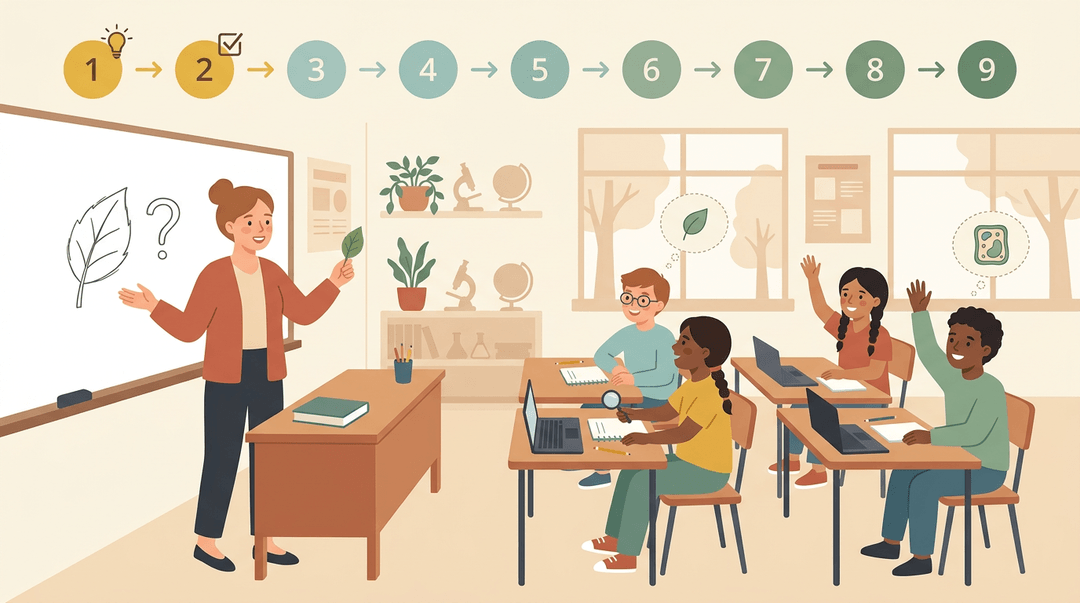
Gagné's nine events form an instructional design framework: nine steps that structure learning, with each one setting up the next. Think of a middle school science teacher planning a lesson on plant cells.
Before opening a textbook, she starts with a question that sparks curiosity, then checks what students already know. That's the framework at work. Order matters.
The framework is behaviorist with cognitivist influences. The behaviorist side focuses on the stimuli you present, while the cognitivist side supports information processing: how learners take in, store, and use new material.
It's less about what students see and more about how their minds handle it.
Who is Robert Gagné?
Robert Gagné created this framework, and his model was developed in 1965, the year he published The Conditions of Learning, which identified the mental conditions for learning.
The model predates computer-based instruction, yet it remains foundational to instructional design. That's staying power.
Conditions that make learning work
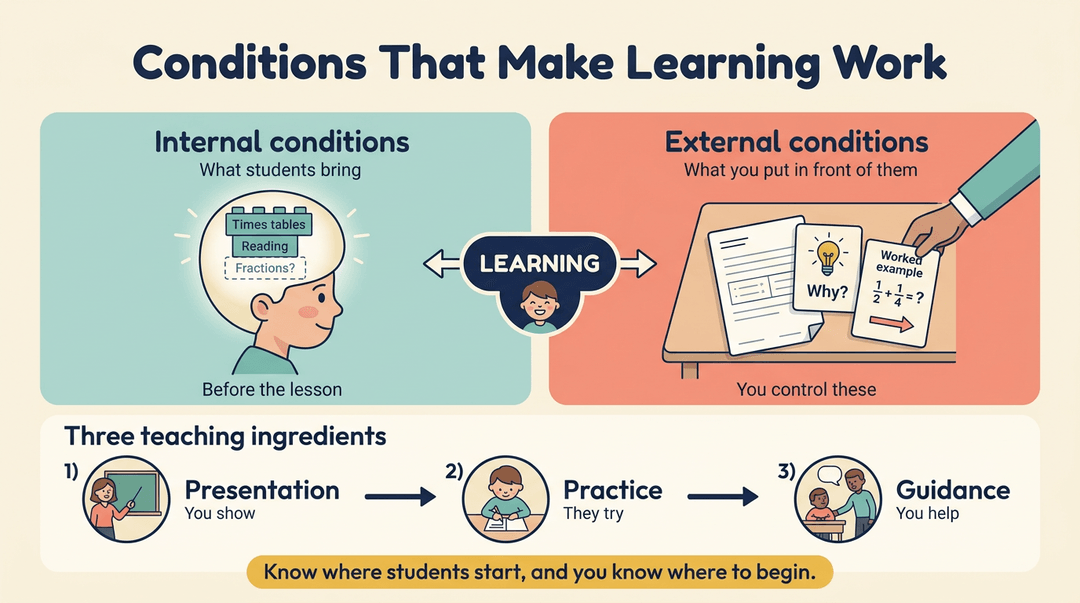
Gagné's model separates two kinds of conditions, and you can plan for both:
- Internal conditions. The prior capabilities students bring: what they already know and can do before the lesson.
- External conditions. The stimuli you control: the materials, prompts, and examples you put in front of them.
Those conditions rely on three essential teaching ingredients: presentation, practice, and guidance. You show new material, students try it, and you help them along the way. Know where students start, and you know where to begin.
What Each of the Nine Events Does
Gagné's nine events fall into four phases, and each one has a clear job. Each phase also tracks a step in how the brain processes information, from catching attention to storing what's learned.
Learning events are the moments you build into a lesson, like a dramatic photo that sparks a question, a worked problem, or an exit ticket at the end of class.
Hook attention, set goals, tap prior knowledge
Open with a problem students want to solve, then state what they'll be able to do by the end. Ask what they already know, building on their prior knowledge and linking new ideas to frameworks they already have.
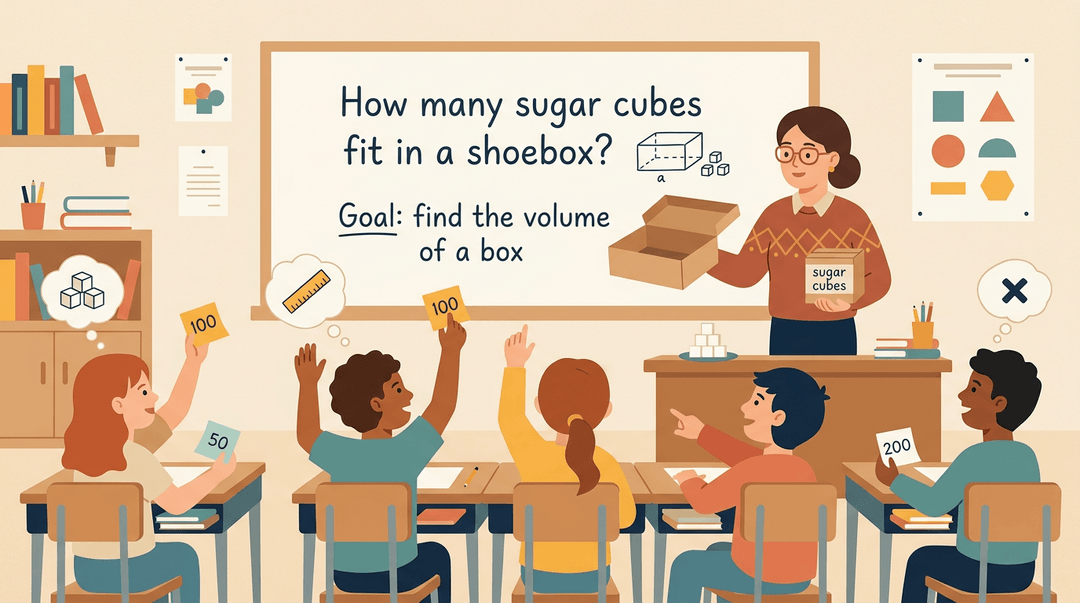
Think of a fifth-grade teacher starting a volume unit with “How many sugar cubes fit in a shoebox?” Those guesses reveal what students already understand, and the goal is clear before the lesson begins.
Present content with clear guidance
Deliver new material through text, graphics, and simulations, but chunk it into small pieces so students aren't overloaded. Add guidance as you go, like questions to answer or features to notice, and show a modeled example before students try one alone. Text-based material often brings unfamiliar words, so vocabulary strategies are worth planning for.
Picture a high school chemistry teacher working one titration problem aloud, pausing at each step to explain the reasoning. Students see how the thinking works, not just what the final answer is.
Let learners practice and get feedback
Next, students do the work. Elicit performance by having every learner respond in writing, speaking, or on a whiteboard, then move into guided practice while you stay close enough to steer. Kagan cooperative learning offers structured ways to get every learner responding.
Give informative feedback that names what's right and what to fix, not just a score. Offer hints and second attempts so mistakes become steps forward.
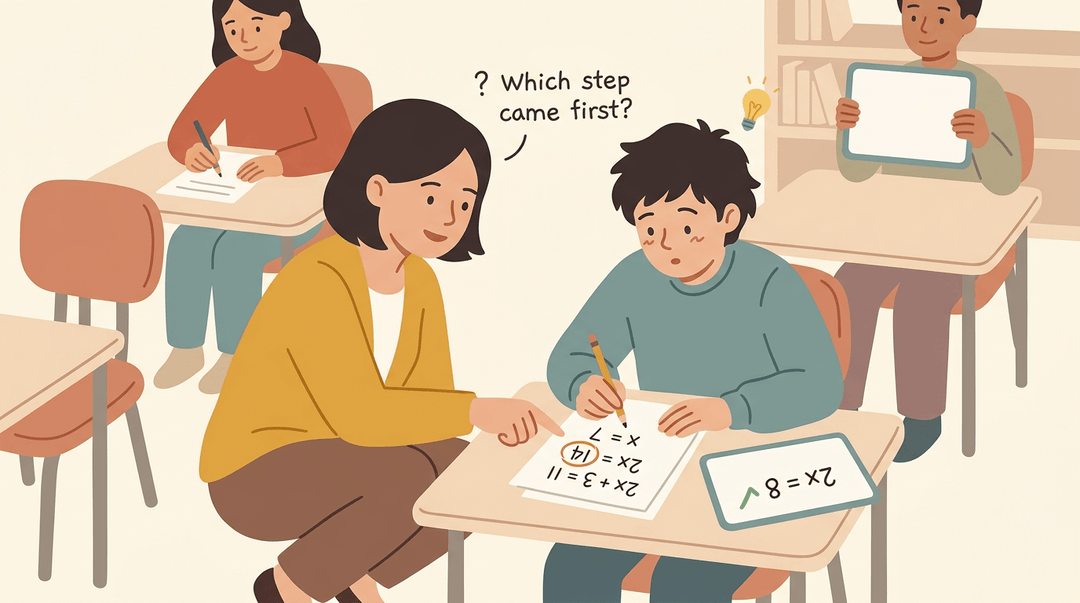
A middle school math teacher spots a sign error in a two-step equation, asks which step came first, and the student fixes it on the spot. That fix is the learning.
Test performance, reinforce memory, transfer skills
The final phase proves the learning and helps it last. Assess performance against the objective you stated at the start, using a task that matches it.
Enhance retention so skills stick, then transfer them to new situations, like applying a reading strategy to a science text. Review and additional practice close the loop so learning lasts beyond the unit.
Turn the Nine Events into a Lesson Plan
Use this guide when you're ready to turn the nine events into one page you can teach from. Fill in one line per event, then check the plan before the bell.
Build the template
- Write one planning line per event
- Nine rows, one sentence each: what you'll say or do.
- Write the objective in student terms
- "By the end, I can explain why the ice melted faster."
- Note a time estimate per event
- Jot minutes beside each row. If the total overshoots, trim Present content first.
- Plan feedback before practice
- Decide the answer key, partner check, or conference move first. Then write the practice task.
Here's the skeleton to copy:
| Event | Your planning line | Min |
|---|---|---|
| 1. Gain attention | Hook: question, demo, or problem | |
| 2. Inform of objective | Student-friendly "I can..." line | |
| 3. Recall prior learning | One quick question or warm-up | |
| 4. Present content | Model, explain, show | |
| 5. Provide guidance | Worked example, prompts, scaffolds | |
| 6. Elicit performance | Practice task | |
| 7. Provide feedback | Planned response to likely errors | |
| 8. Assess performance | Exit ticket tied to the objective | |
| 9. Enhance retention and transfer | Review date, new context |
See it across settings
The events stay in order. What changes is how you fill each row.
| Setting | Where it shines | What it looks like |
|---|---|---|
| Elementary | Event 1 | A story problem hook about sharing snacks, before any numbers appear |
| Middle school | Event 1 | A short science demo that makes students ask "why?" |
| High school | Event 9 | A case study where students apply the idea to a new situation |
| Tutoring | All nine, compressed | A short one-on-one cycle: hook, quick recall, model, try, feedback, check |
Example: A middle school science teacher opens with a quick demo, then posts "I can explain what the demo shows." Her exit ticket asks students to do exactly that. Hook, objective, and assessment all point at the same target.
Check before you teach
Confirm each of these:
- Hook ready in the first minutes: you know your opening line and materials.
- Prior knowledge check included: one question surfaces what students already know.
- Practice with feedback built in: every practice task has a planned response.
- Exit ticket assesses the objective: it asks for the skill the objective names.
- Retention review scheduled: a date for revisiting this lesson is on your calendar.
⚠️ Watch out: An exit ticket that tests something you never practiced tells you nothing. Compare it to your objective line.
Save your nine-event lesson template in EMStudio's online lesson planner and reuse it across classes.
Putting the Model to Work
Gagné's events become useful once they form a plan you can teach from, so let's build one.
Plan lessons starting from clear objectives
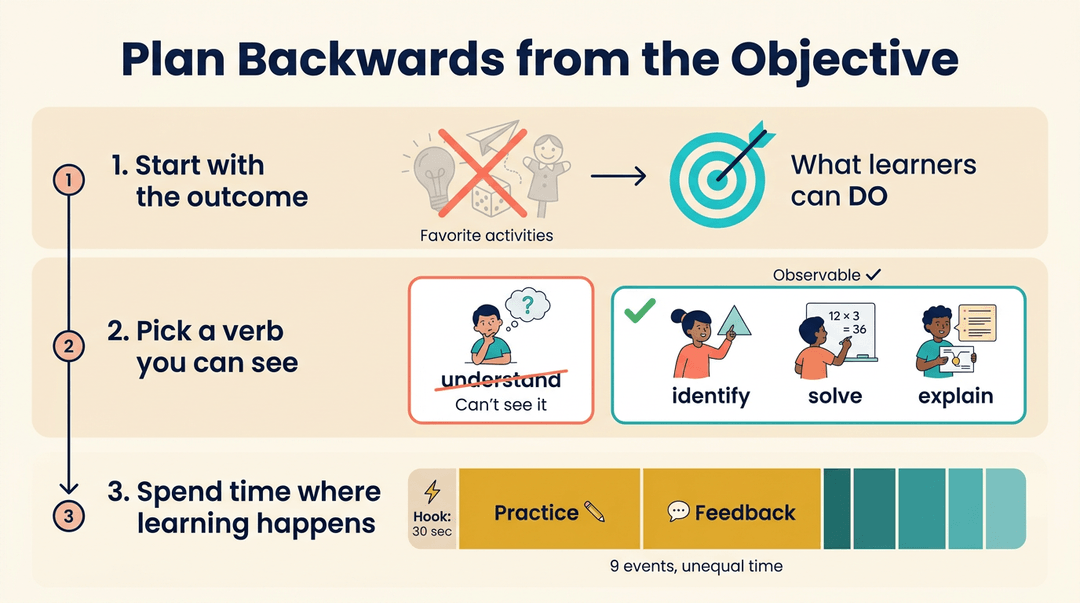
Start by determining what learners should be able to do, not your favorite activities. Those learning outcomes set priorities, and Gagné sorts them into categories like verbal information and intellectual skills.
Write each objective with a performance verb you can observe, like "identify" or "solve," not "understand," which leaves you guessing. Choose observable verbs over vague ones.
Use the nine events as your framework, but not every event needs equal time: a quick attention grabber might take thirty seconds, while practice and feedback fill most of the period.
Using the model in digital courses
Interactions and short videos keep learners responding, while animation and storytelling make content easier to follow. Simulations and branching scenarios let learners see each choice's consequence right away.
Consider a seventh-grade math teacher whose class uses an online linear-equations program. A real-world problem about saving for a bike gains attention, and a wrong step brings a hint instead of a dead end.
Class time goes to the students the program flags as stuck.
Teaching in classrooms and live sessions
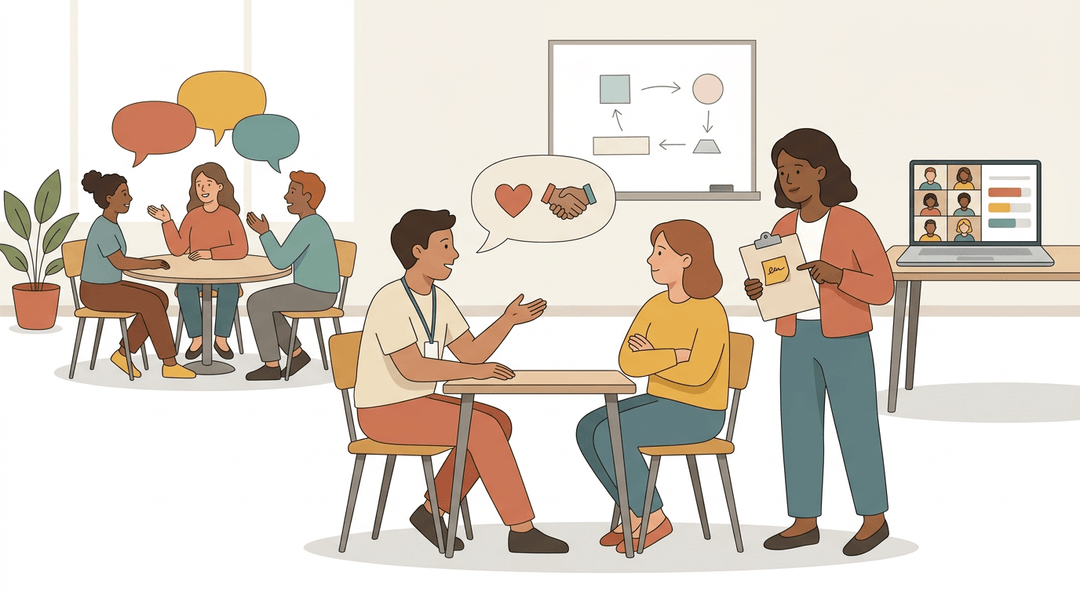
In a classroom, you deliver the events face to face. In virtual instructor-led training, keep segments short and use polls to draw out responses.
A hybrid course mixes both, and coaching adds one-on-one feedback: an instructional coach models a strategy, then watches the teacher try it. If you mix both formats, you may want to know what a flipped classroom is.
Discussion and role-play give learners doing time instead of listening time. A teacher rehearsing a tough parent conversation can try the move before the stakes are real, then get specific feedback on one thing to fix.
Hand responsibility to learners gradually
Shift from teacher support to independence in steps. Start with low-stakes practice, like a few unscored problems, so mistakes don't count. For errors, use scaffolding, such as a hint or worked example, and pull it back as learners gain control.
Set success criteria up front, such as "Solve two-step equations without help," so learners know what mastery looks like. Then map the events to a gradual release sequence:
- You model. Present the content and guidance.
- Learners practice with support. Elicit performance and give feedback.
- Learners work alone. Assess performance while you watch.
Support fades. Competence stays.
How It Compares and Stays Relevant
Gagné's events sit alongside other models you may already know. Here's how they compare and where they still show up.
How it differs from ADDIE
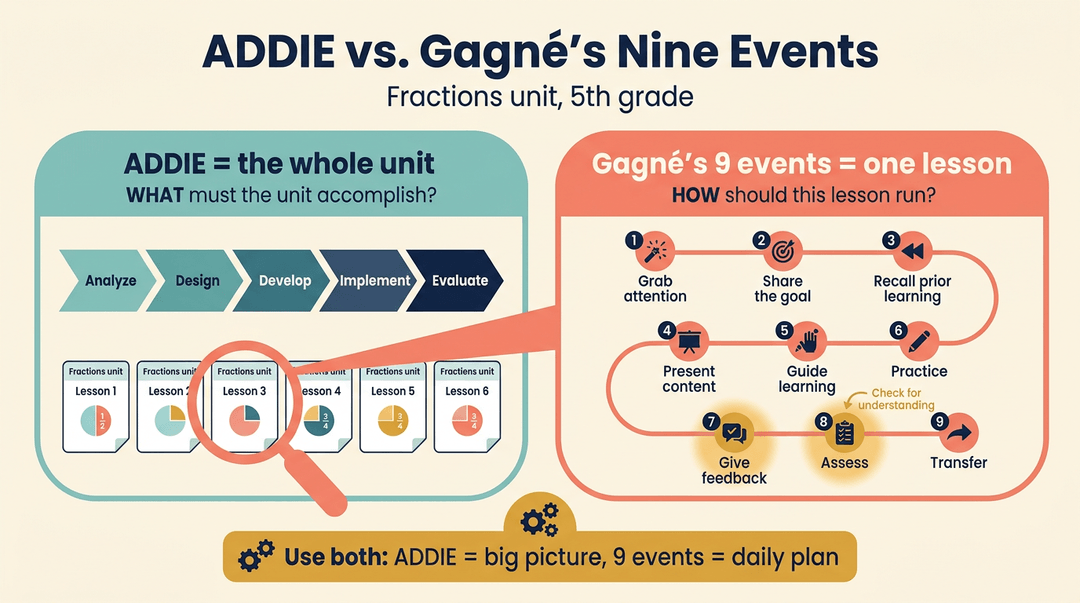
ADDIE (Analysis, Design, Development, Implementation, Evaluation) is a broad process for building a whole course or unit. Gagné's events zoom in on instruction, meaning how one lesson unfolds. Picture a fifth-grade teacher planning a fractions unit.
ADDIE maps the whole unit, while the nine events shape each lesson, so she knows exactly when to check for understanding. ADDIE asks what the unit must accomplish; Gagné asks how each lesson should run.
Often they work together: ADDIE shapes the big picture, and the nine events shape the daily plan. We don't have a verified source on the 5E model, so we won't detail its stages here. Check a dedicated source before you compare the two.
Where the model is still used today
Gagné's events are still used in:
- corporate training
- higher education
- the military
Used well, the model can improve learner engagement and retention. One study on teaching emergency medicine residents found that a structured lesson plan built on the events improved their knowledge and skills.
Its fixed order can feel rigid when a lesson needs to follow students' questions. Treat the nine events as a guide, not a script.
Is there a PDF version of Gagné's nine events?
We don't have a verified PDF, so we won't point you to one. Instead, make a printable cheat sheet: the nine events in order, with one line on each event's purpose. Keep it beside your lesson plan so the sequence stays in view.
Pair the events with a curriculum map (a plan showing what you teach and when) and a learning outcomes table that matches each event to the outcome it supports. For academic references, start with the study linked above.
When each event has its place, a lesson stops feeling like guesswork. You know how to grab attention, connect to what students already know, guide practice, and confirm what they can do.
That structure saves prep time and gives every learner a clearer route to success. Ready to turn these events into a plan you can reuse? Explore Lesson Planning to write, organize, and reuse your lessons across multiple classes from one place.
References
- AM last page. Robert Gagné's nine events of instruction, revisited — pubmed.ncbi.nlm.nih.gov (2012)
- Teaching Benign Paroxysmal Positional Vertigo to Emergency Medicine Residents by Using Gagne’s Nine Steps of Instructional Design — pmc.ncbi.nlm.nih.gov
Frequently asked questions
What is the 5'es format of constructivism?
The 5E instructional model is Engage, Explore, Explain, Elaborate, and Evaluate. It is a constructivist approach in which learners build understanding through curiosity, investigation, discussion, application, and assessment.
What are Gagne's 9 events of instruction?
Gagné’s nine events are: gain attention, inform learners of the objective, stimulate recall of prior learning, present the content, provide learning guidance, elicit performance, provide feedback, assess performance, and enhance retention and transfer.
What are some examples of learning events?
Learning events are planned moments that help learners engage with and work through new material. Examples include a striking image or question to spark curiosity, a worked example, a practice problem with feedback, a discussion or role-play, and an exit ticket.
Who is Robert Gagne?
Robert Gagné was an American educational psychologist known for his work on learning and instructional design. He developed the nine events of instruction, a framework for structuring lessons from gaining attention through assessing learning and supporting transfer.