Kagan Cooperative Learning: A Complete Guide to Structures

Jump to section
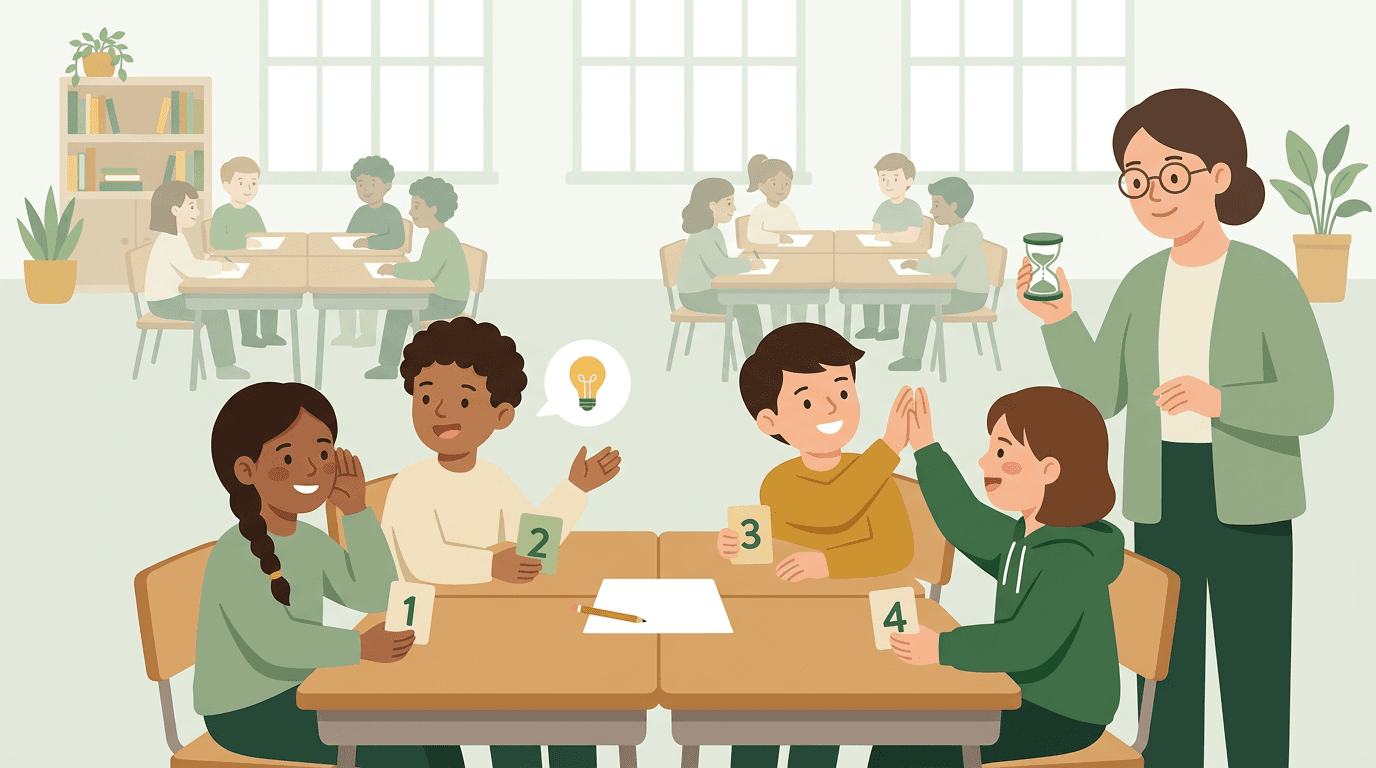
Ever watched a group project where one student does all the work while the rest drift off? Kagan cooperative learning is built to prevent that.
Rather than hoping students will collaborate, it organizes group work around short, repeatable routines called structures, so every learner knows exactly what to do.
In this post, we'll look at why those structures work, the core ones to know, and how to build one into your lesson plans this week.
Why Kagan Cooperative Learning Works
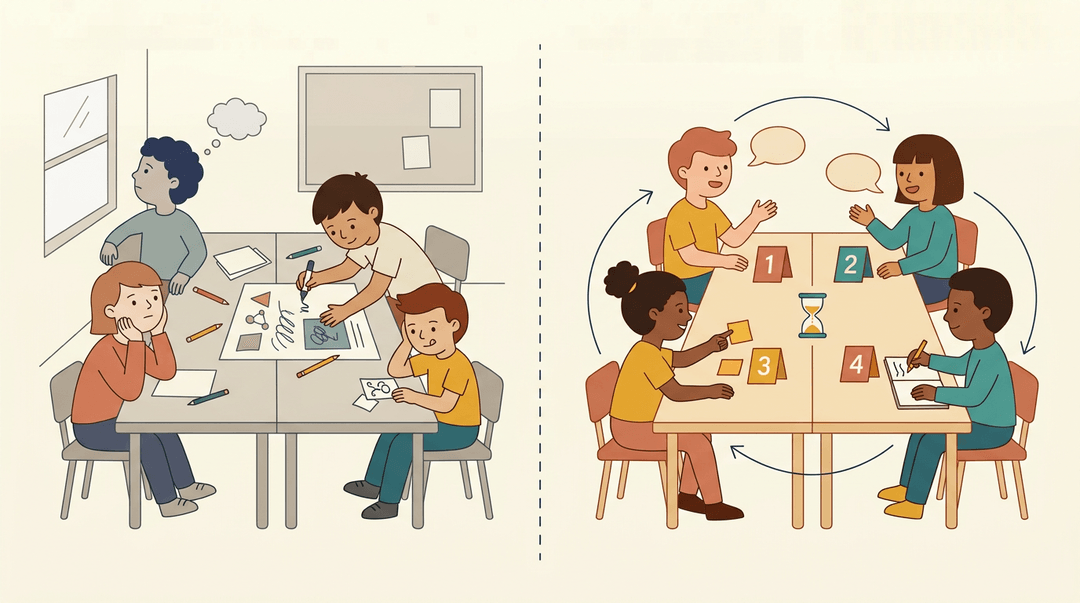
Kagan cooperative learning shifts the room from one student answering while everyone waits to every student engaged at once.
Where Spencer Kagan's research began
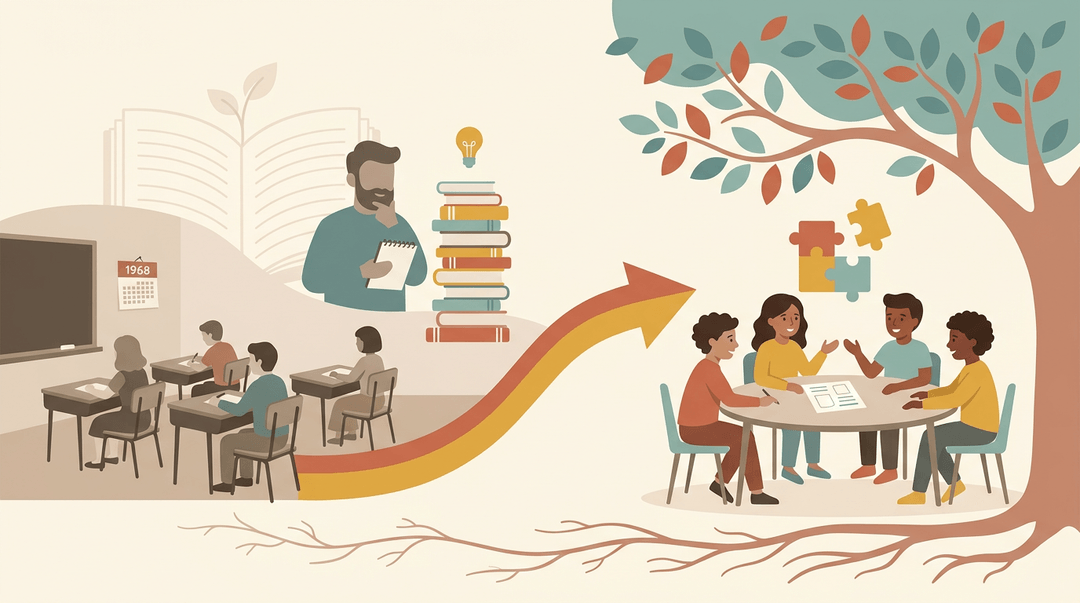
Spencer Kagan's research dates back to 1968, and a Harvard capstone on district implementation describes his system as built on research-based practices.
He's also the inventor of the cooperative learning structures, and his approach is the most widely used approach to cooperative learning. John Dewey's work is among its theoretical roots.
How it differs from traditional teaching
In traditional teaching, a teacher asks a question and calls on one student. Picture a fifth-grade teacher calling on the same confident hands while a shy student in the back quietly avoids participating.
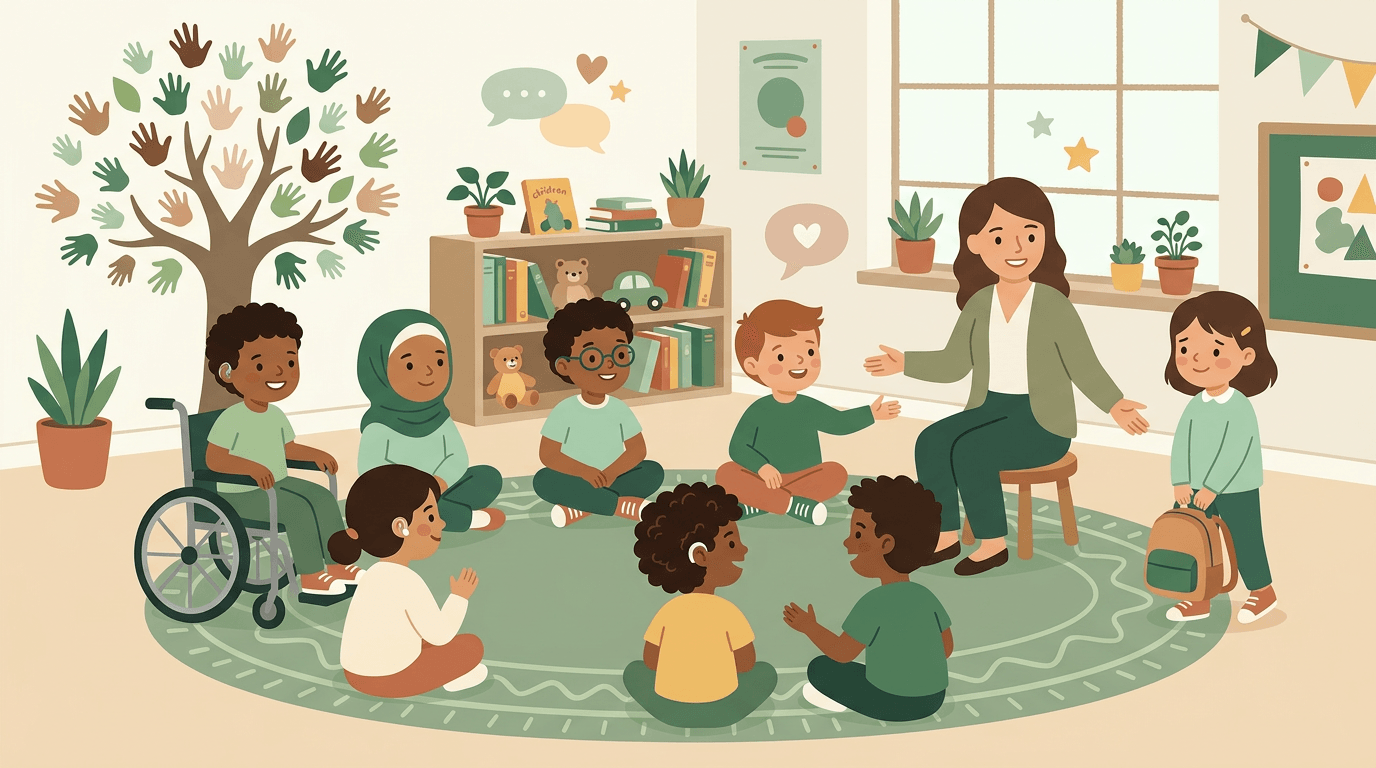
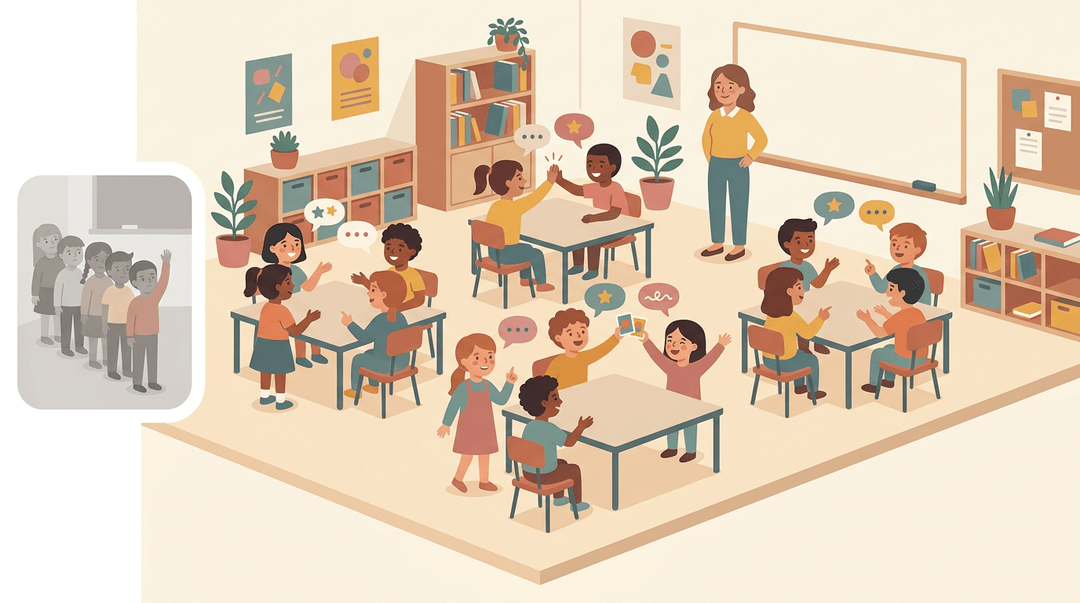
Kagan swaps that for simultaneous engagement, where every student responds. Students face each other, and they work as teammates instead of competitors. Nobody sits out.
A Harvard capstone says the use of structures is possibly the most defining characteristic of Kagan's approach, with routines that make engagement repeatable.
Jigsaw, STAD, and the Johnson model are other cooperative learning approaches, but structures set Kagan apart.
What is positive interdependence in cooperative learning?
Positive interdependence means students succeed only when the group does, so each person needs the others. Kagan's framework for this is PIES:
- positive interdependence
- individual accountability
- equal participation
- simultaneous interaction
Other models often list five elements, but PIES sticks to four.
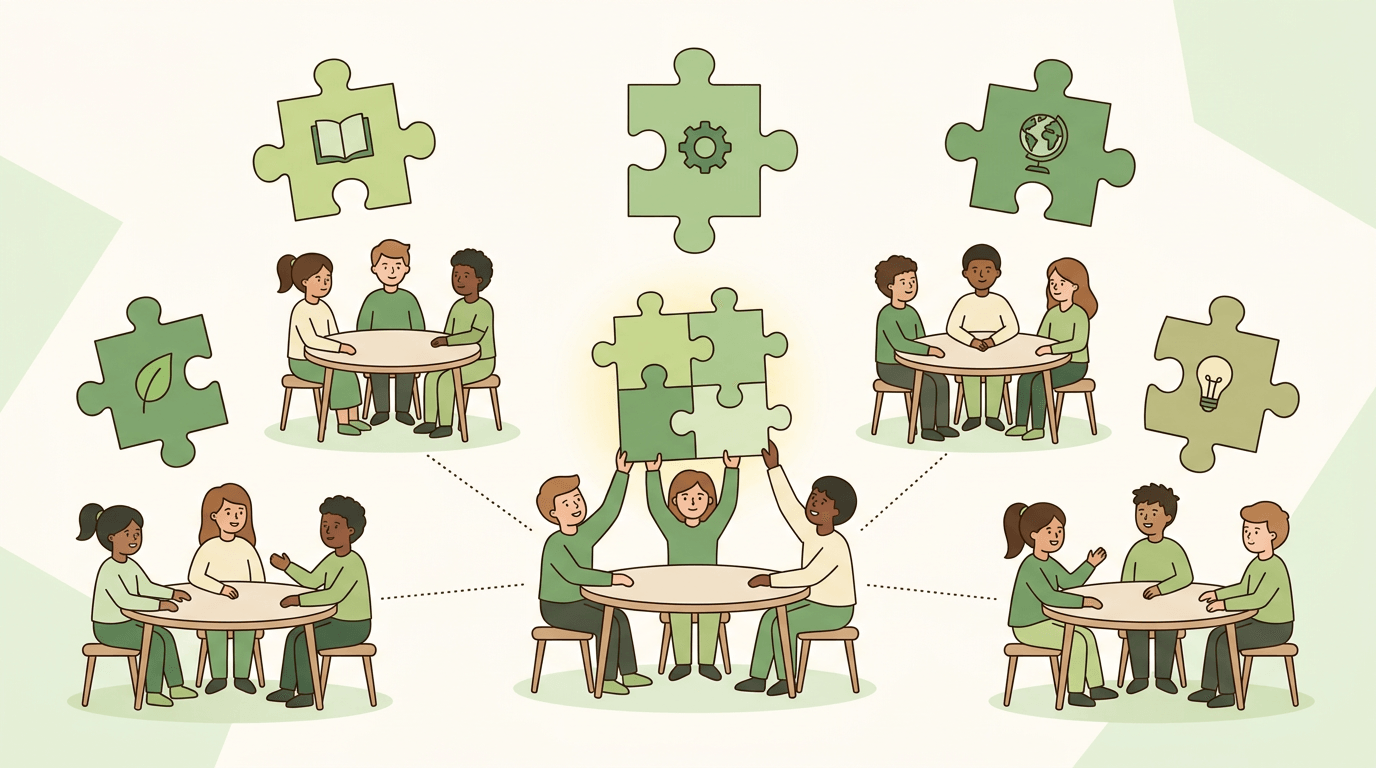
Think of a fourth-grade table team that must agree before anyone moves on. Each student's success depends on the others, so no one can coast, and quieter students speak up because the team needs every voice. A jigsaw teaching strategy is one way to build that kind of team dependence into a lesson.
Kagan's program also rests on seven key concepts. Everyone Answers is one structure that gets every student responding, and 3R and 3T peer coaching helps students coach one another.
Principles are built into structures, so when we pick one, PIES comes with it.
The Kagan Structures to Know
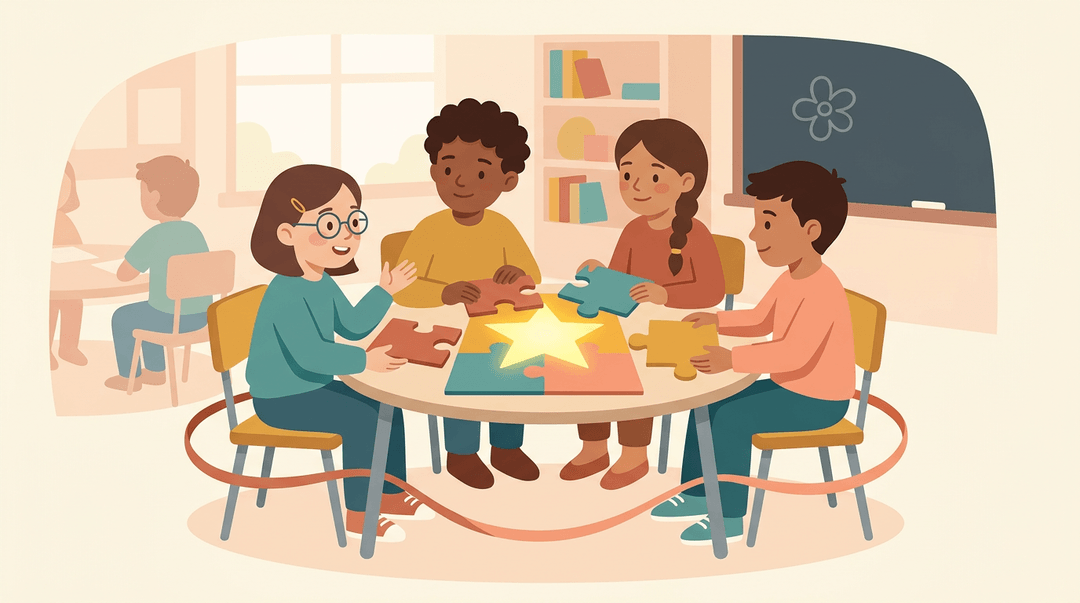
A structure is a repeatable routine that tells students how to talk and work together. Once they know it, you'll drop it into any lesson without re-explaining.
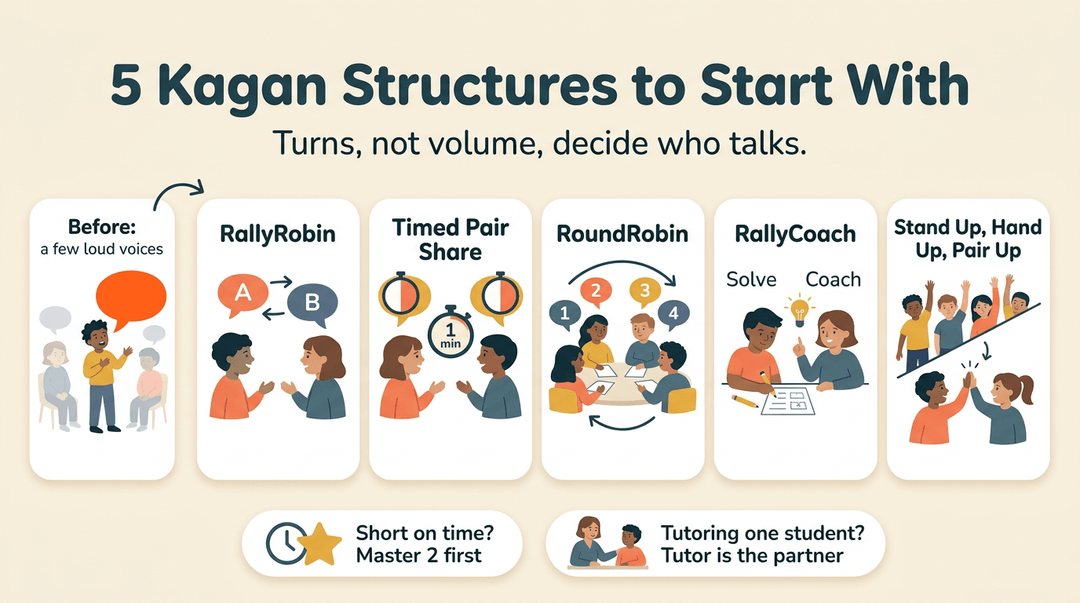
Start with these five essential structures
Brand new to Kagan? Start with these five. Picture a fifth-grade teacher whose discussions are dominated by a few confident voices. RallyRobin gives every partner a turn, so quieter students finally get heard. Turns, not volume, decide who talks.
- RallyRobin and Timed Pair Share: partners take turns, and the timed version gives each a set window to talk.
- RoundRobin and RallyCoach: teammates share in turn, or one partner solves while the other coaches.
- Stand Up, Hand Up, Pair Up: students stand, raise a hand, and share with a new partner.
Short on time? Two of these are the minimum worth learning well. Tutors working with one student can use the pairs-only versions, with the tutor as a partner.
Structures for getting to know classmates
- Find Someone Who: students circulate to find classmates who match a prompt.
- Line-ups: students line up by a shared trait, like birthday month.
- Mix-Pair-Share style mixing: students roam, pause, and pair with whoever is nearby.
- Corners activity: students gather in the corner that matches their answer and discuss it.
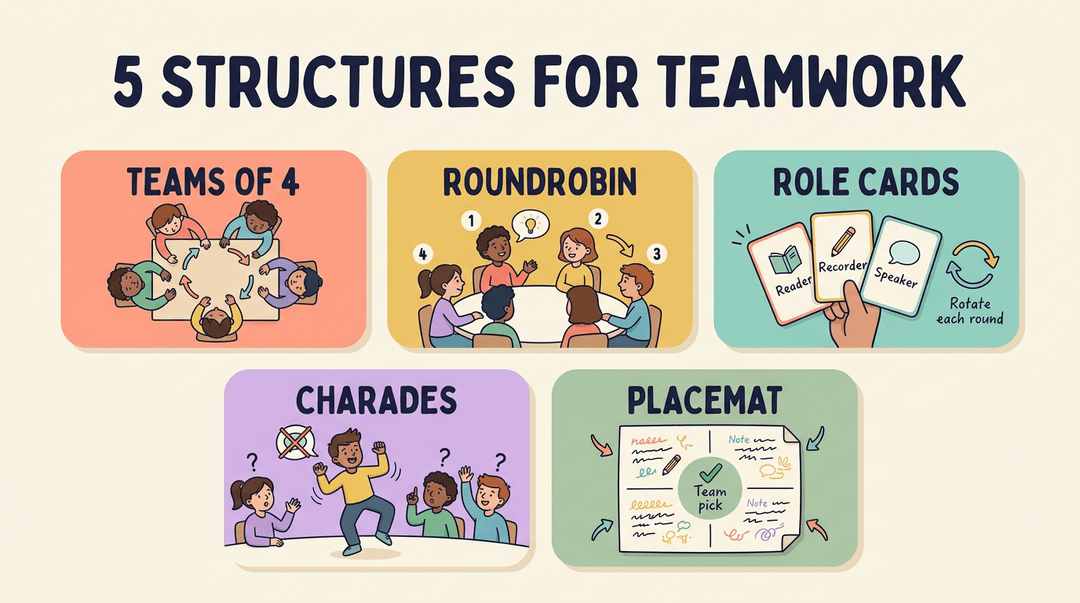
Structures that help teams work together
- Teams of four: a group size that gives every structure room to rotate roles.
- RoundRobin sharing: each member shares in turn before open discussion.
- Card-based roles and rotation: students draw roles, like reader or recorder, and rotate them each round.
- Charades-style kinesthetic activity: students act out a concept with movement and no talking while teammates guess.
- Placemat with consensus space: students write ideas in their own sections, then the team agrees on the best for the center.
Matching a structure to your goal
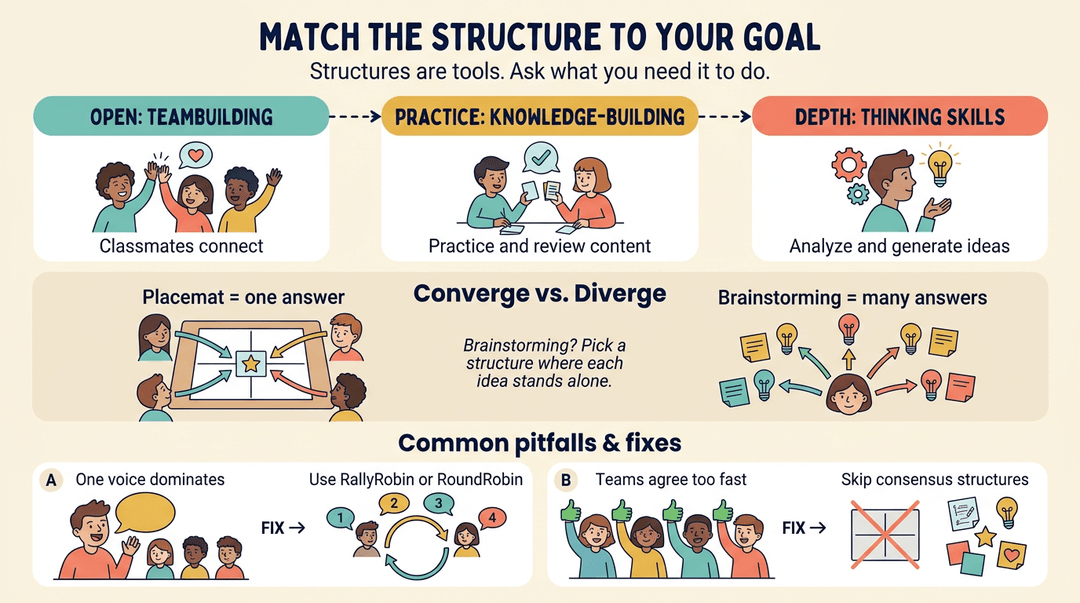
Structures are tools. Ask what you need them to do, not which one is best, and group them by function:
- Teambuilding: helping classmates connect, like the getting-to-know structures above.
- Knowledge-building: practicing and reviewing content.
- Thinking skills: pushing students to analyze or generate ideas.
Slot each into a lesson segment: teambuilding to open, knowledge-building for practice, thinking skills for depth.
Placemats and other high-consensus structures push teams toward one answer. That's useful for converging, but it works against divergent thinking, where many answers are the goal. For brainstorming, choose a structure where each idea stands alone.
Common pitfalls and fixes:
- One voice dominates. Use RallyRobin or RoundRobin so turns are built in.
- Teams agree too fast. Skip consensus structures when you want varied ideas.
Newer structures worth trying
- PairCoach and TeamCoach: students take a coaching role, guiding a partner or teammate.
- Numbered Heads Together: teammates huddle on a question, then you call a number and that student answers for the team.
- Timed PairShare: partners share within a set time, a routine you met above.
Start with one.
Plan a Kagan Structure into Your Lesson
Use this guide when you've picked a lesson and want to build a Kagan structure into it. It takes about ten minutes. We'll build around PIES: positive interdependence, individual accountability, equal participation, and simultaneous interaction.
Five planning moves
- Set the lesson objective
- Write it as students will see it: "I can explain why 3/4 is greater than 2/3."
- Pick a structure that matches the function
- Ask what students need to do: review, practice, generate ideas, or share.
- Review fits Numbered Heads Together. Partner practice fits RallyCoach.
- Assign teams and roles
- Use teams of four with a role for each, such as Reader, Recorder, Checker, Timekeeper.
- Post the roster so no one wastes time choosing seats.
- Script the prompt and timing
- Say: "You have 30 seconds each. Partner A, begin."
- Put the prompt on the board and set the timer before students arrive.
- Plan the debrief and closure
- Ask: "What helped your team finish? What would you change next time?"
- End with an exit ticket tied to the objective.
Examples by grade band
| Grades | Structure | What it looks like |
|---|---|---|
| K-2 | Timed Pair Share | Partners take 30 seconds each to answer a story question |
| 3-5 | RallyCoach for math | One partner solves, the other coaches, then they swap |
| 6-8 | Numbered Heads Together | Teams review, then you call a number to answer |
| 9-12 | Placemat for essay planning | Each student writes ideas alone, then the team agrees on a thesis |
Example: A seventh-grade science teacher ends a unit with Numbered Heads Together. Teams of four answer "What causes the seasons?" and make sure every member can explain it. She then calls a number, and that student answers for the team. Because anyone might be called, everyone prepares.
Before you teach
Run through these once. Each one should be a clear yes.
- Positive interdependence is built in. Teammates need each other, through shared roles or one shared product.
- Everyone answers simultaneously. No one waits for a turn while others sit idle.
- Individual accountability is included. Each student can be called on or must write their own response.
- Directions and timer are ready. The prompt is posted and the timer is set.
- An exit ticket is ready. One or two questions check who understood the objective.
⚠️ Watch out: If one student could do all the work while teammates watch, add a role or a number call before you teach.
Save your favorite structures as reusable lesson-plan blocks in EMStudio's online lesson planner.
What Students Gain from It
Here's what Kagan does for students, and where the evidence is thin.
How it lifts academic achievement
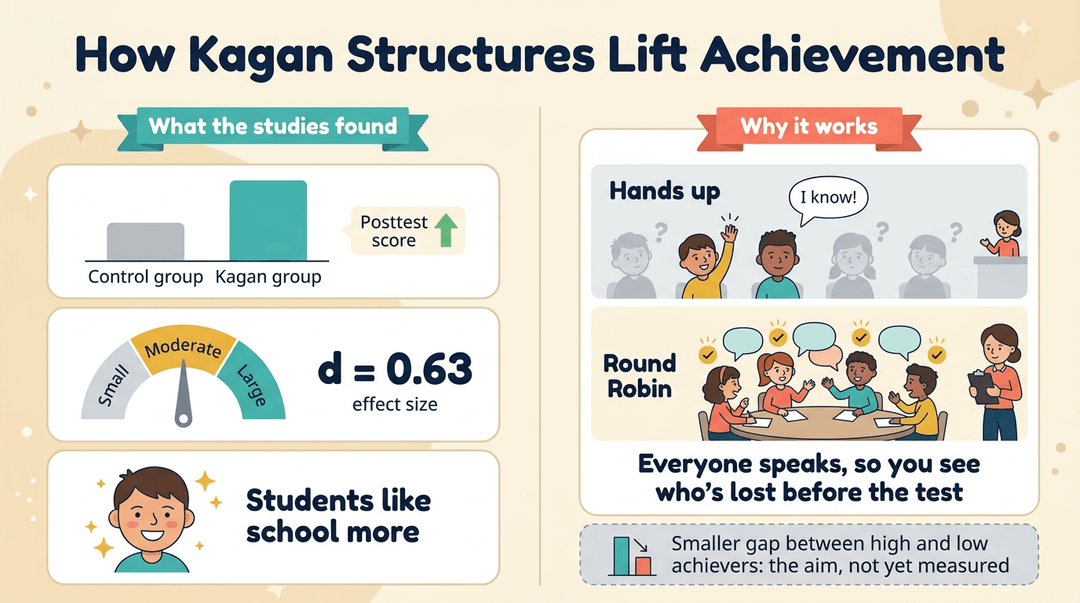
In a science study titled Application of Kagan Cooperative Learning Strategies in Science Learning, students who used the structures scored significantly higher on a posttest than the control group.
A second experimental study found a moderate effect size (d = 0.63), a measure of how strong a result is.
Kagan's research summary lists increased liking for school among its positive findings.
Because Equal Participation gives every student a turn, the structures aim to narrow the gap between high and low achievers, though none of our sources measure it.
Hearing from everyone gives you an informal check on understanding. A fourth-grade teacher running a quick Round Robin hears from every student, not just the first hand up, and catches who's lost before the unit test.
How it builds social and emotional skills
Kagan's research and rationale page also cites improved social skills. When everyone takes a turn leading, leadership is shared, not handed to the same confident few.
Equal turns can support self-esteem and empathy, and disagreements over answers give students low-stakes practice with conflict resolution, though these aren't measured directly.
A Mandarin-learning study reported more active engagement and a supportive climate, though it covers only Mandarin learners. Those habits add up to a positive classroom community.
Fewer discipline issues and more engagement
Kagan's own research page calls "a dramatic reduction of classroom discipline problems" a byproduct of implementing Kagan. It comes from the developer, so weigh it accordingly.
Full-class Simultaneous Interaction means every student responds at once, not in line for a turn. Nobody's on the sidelines.
Lessons feel more like games than worksheets, but the research here doesn't test whether that lasts.
Tools, Training, and What Teachers Say
Kagan Cooperative Learning comes in several forms, from printed cards to live training, so you'll find a starting point that fits your schedule. Here's what's available and what educators say about it.
Books and printed quick references
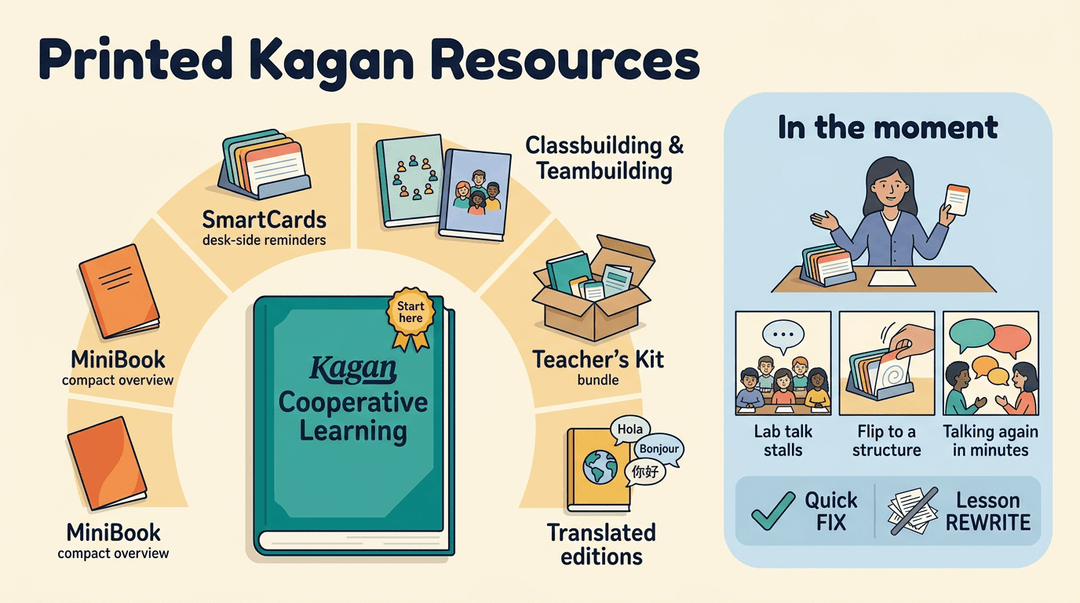
Start with the Kagan Cooperative Learning book. The other printed options include:
- MiniBook overview. A compact look at the model.
- SmartCards quick reference. Desk-side cards for a fast reminder.
- Classbuilding and Teambuilding books. Titles on building community and teams.
- Teacher's Kit combo. A bundled set of materials.
- Translated editions. Versions in other languages.
Consider a middle school science teacher who keeps SmartCards on her desk. When a lab discussion stalls, she flips to a structure and the room is talking again within minutes. The payoff is a fix in the moment, not a rewrite of the lesson.
Digital display software and visual slides
Digital tools put the structures on screen:
- Structures Digital Display software. Shows each step to the whole class at once.
- Numbered Heads Together software. A digital version of that structure for on-screen use.
- Step-by-step visual slides. Walk students through each move in order.
Fewer repeated directions.
Hands-on workshops and multi-day institutes
- Multi-day Kagan Institutes. Immersive training across several days.
- Hands-on, research-grounded workshops. You practice the structures yourself.
- Trainer mentoring. Trainers can coach you as you apply what you learn.
- Overview video. A video introduction to the model.
Workshops are about doing the structures, not just reading about them. Think of a first-year teacher who practices a structure at a workshop, then runs it with her own class the following Monday.
What researchers and teachers say about it
- Academic endorsements. Research voices that add weight beyond classroom anecdotes.
- Teacher testimonials. Firsthand accounts from classroom teachers.
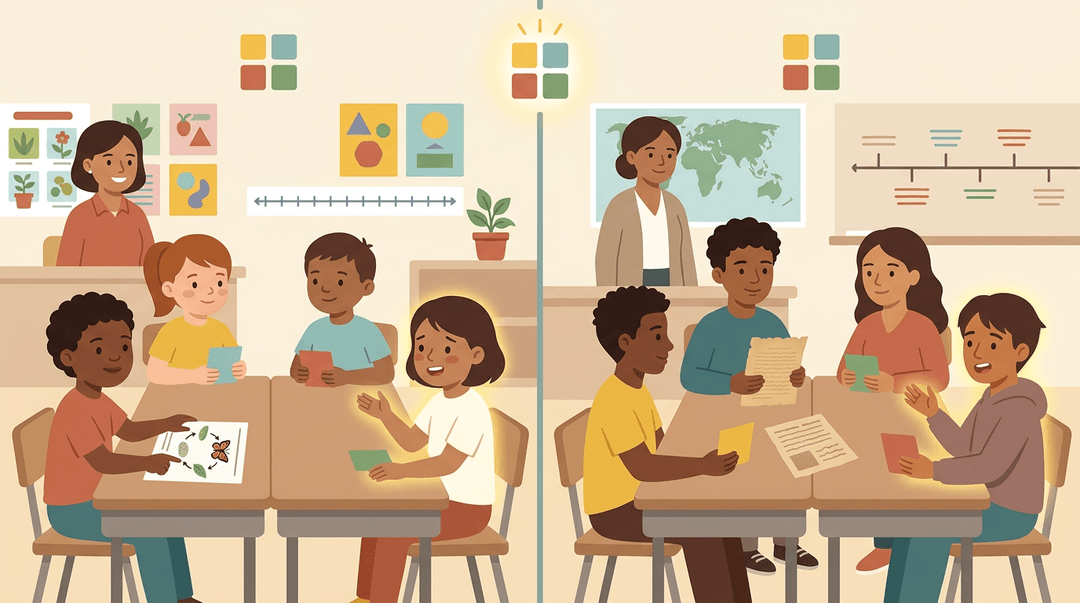
- Works across grades and subjects. According to a Kagan Cooperative Learning online lesson, the structures are used across grade levels and subject areas.
Picture a fourth-grade teacher and a high school history teacher running the same structure with their own content. Same structure, different content.
Kagan cooperative learning works because it turns collaboration into a routine instead of a hope. When every student has a clear role, participation becomes the norm, and the quiet learner gets a real turn.
Start small. Pick one structure, try it this week, and adjust from there. Ready to build your next lesson around one? Explore Lesson Planning, where you can write, organize, and reuse lesson plans across multiple classes from one place.
References
- Interpret, Improve, Implement, Iterate: Designing and Testing District Implementation of Cooperative Learning — dash.harvard.edu (2025)
- APPLICATION OF KAGAN COOPERATIVE LEARNING STRATEGIES IN SCIENCE LEARNING — doi.org (2026)
- Effect of Kagan Cooperative Learning Structures on Learning Achievement: An Experimental Study — doi.org (2024)
- Organizing classroom talk using Kagan cooperative learning structures to increase active participation and develop students’ oral skills in learning Mandarin as an additional language — ojs.sunderland.ac.uk (2026)
- Kagan Cooperative Learning — articulate.strayer.edu (2026)
- Kagan's FREE Articles — kaganonline.com
Frequently asked questions
What is the Kagan method?
The Kagan method is a cooperative learning approach that uses short, repeatable routines called structures to organize how students work together. Its structures aim to engage everyone through clear turns, roles, and individual responsibility.
What is Kagan's theory?
Kagan’s theory is that students learn and participate more effectively when cooperation is deliberately organized rather than left to chance. Its framework is PIES: positive interdependence, individual accountability, equal participation, and simultaneous interaction.
What are the 5 principles of cooperative learning?
The five commonly cited principles of cooperative learning are positive interdependence, individual accountability, promotive interaction, social skills, and group processing. Kagan’s framework uses four principles instead, summarized as PIES: positive interdependence, individual accountability, equal participation, and simultaneous interaction.
What are Kagan collaborative strategies?
Kagan collaborative strategies are structured routines that guide students’ interaction so everyone has a role and participates. Examples include RallyRobin, Timed Pair Share, RallyCoach, Numbered Heads Together, and Stand Up, Hand Up, Pair Up.
What are the five key components of cooperative learning?
The five key components commonly used to describe cooperative learning are positive interdependence, individual accountability, promotive interaction, social skills, and group processing. Together, they help ensure students depend on one another while each remains responsible for contributing and learning.
What are examples of Kagan strategies?
Examples of Kagan strategies include RallyRobin, where partners take turns sharing, and RallyCoach, where one partner solves while the other coaches before they switch. Numbered Heads Together, Timed Pair Share, and Stand Up, Hand Up, Pair Up are other examples.
What are some examples of Kagan Structures?
Examples of Kagan structures include Find Someone Who, Line-ups, Corners, Placemat, and Charades-style activities. Partner and team routines include RallyRobin, RoundRobin, RallyCoach, and Numbered Heads Together.
What are some examples of cooperative learning structures?
Examples of cooperative learning structures include Think-Pair-Share, Jigsaw, RoundRobin, Numbered Heads Together, and Placemat. These routines organize students’ interaction and can assign individual turns or responsibilities so participation is shared.