Mastery Learning Explained: Definition, Method, Evidence

Jump to section
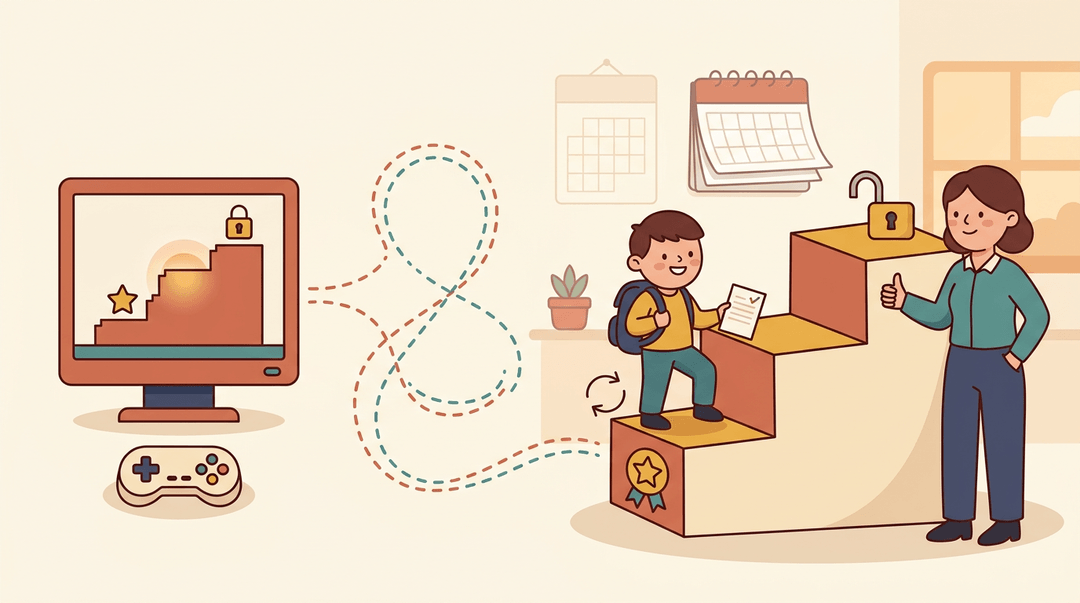
Think about a video game. You don't unlock the next level until you've beaten the current one, and you can replay the tricky parts as often as you need.
Mastery learning brings that same logic to the classroom: students move on once they've shown they understand the current material, not just because the calendar says it's time.
In this post, we'll cover its definition, key elements, planning steps, classroom practice, evidence, criticisms, and origins.
What Mastery Learning Really Means
Mastery learning means students move forward when they've shown they understand, not when the calendar says so.
The core idea behind mastery
- Demonstrate proficiency before advancing. Students prove they've got the skill before moving on.
- Flexible pacing per student. Some learners move quickly while others take more time.
- Every student can master. With support and time, the goal is within reach for every learner.
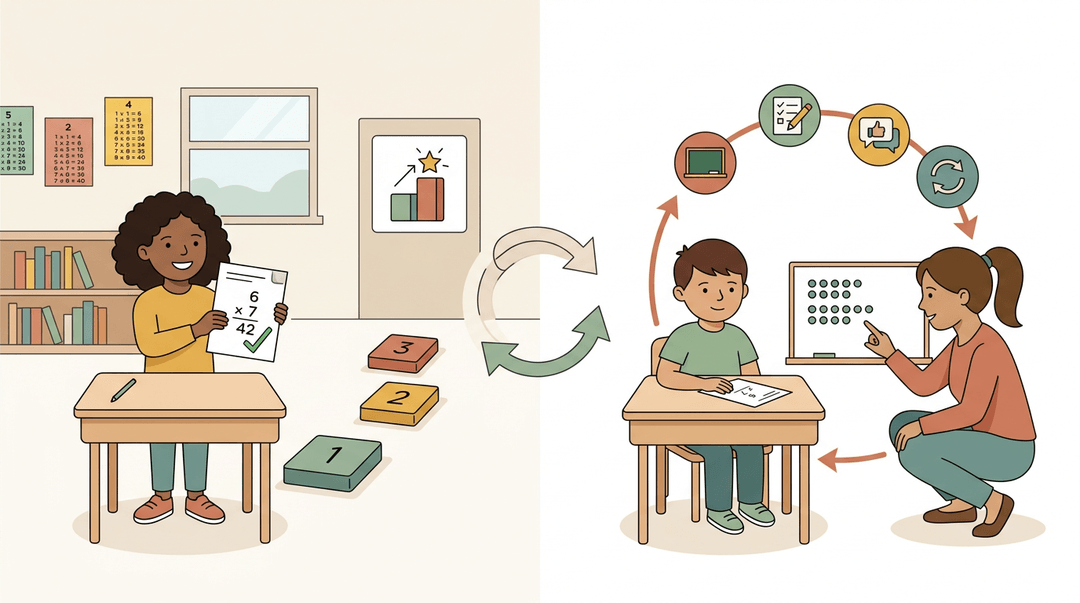
- Cyclic teach-assess-feedback process. You teach, check, give feedback, and repeat until the skill sticks.
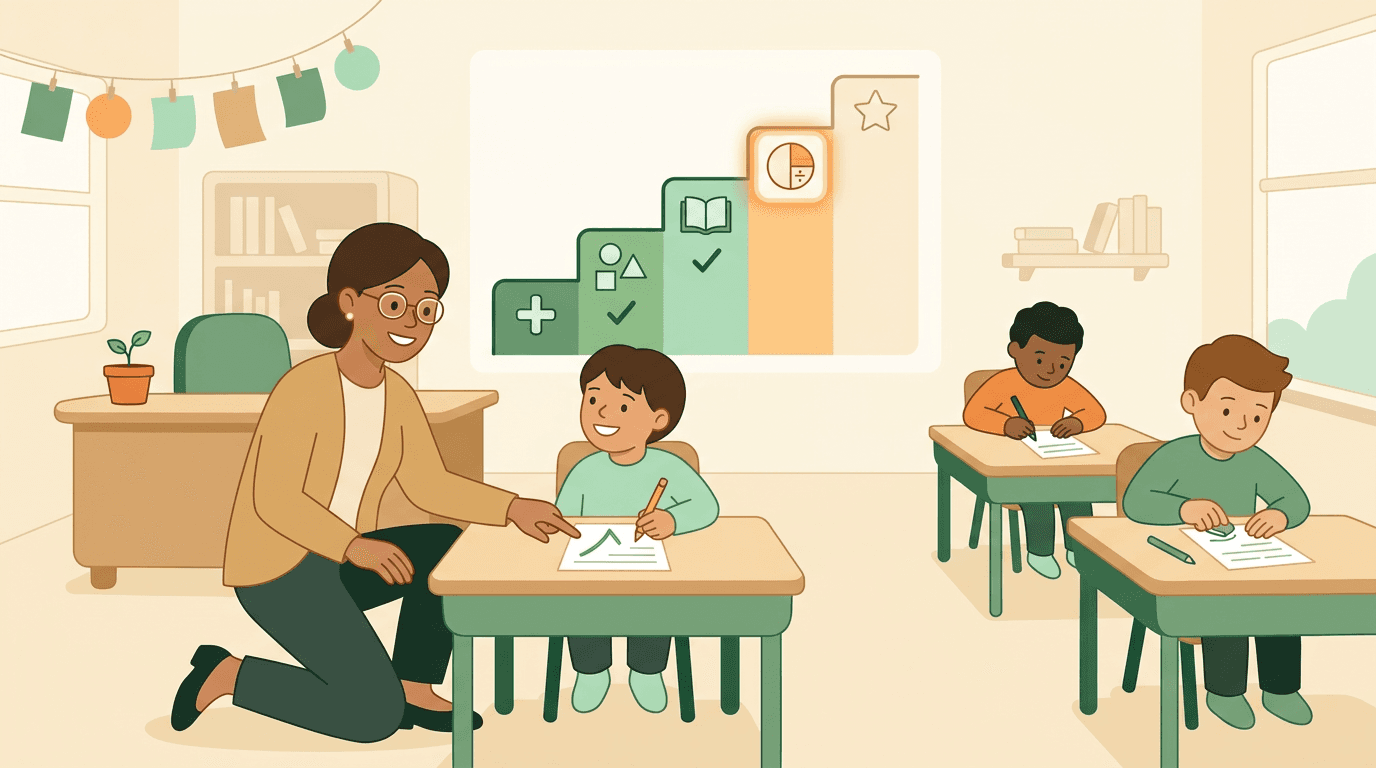
A fifth-grade teacher working on multiplication has Maya pass the check on Tuesday and move on, while Jordan gets a quick reteach and tries again. Neither student is held back.
What are the 5 steps of the learning process? Mastery learning runs on one loop instead: teach, assess, give feedback, and reteach until students show the skill.
How it differs from traditional classrooms
Traditional classrooms fix time and let mastery vary. Mastery learning does the opposite: it fixes the standard and lets time flex.
Students advance even when they haven't understood, so gaps pile up. Each missed concept becomes a shaky foundation, and gaps don't stay put.
Picture a same-pace train that leaves on schedule whether every passenger is aboard or not. Anyone who misses the boarding call falls further behind. The train doesn't wait.
Everyday comparisons that make it click
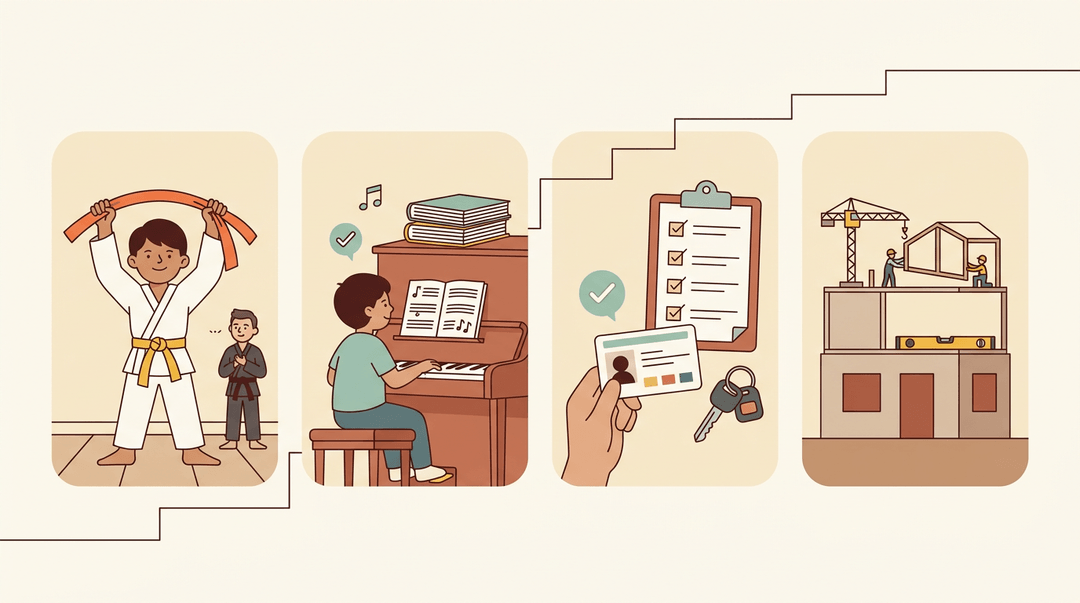
Karate belts follow the same logic: you earn the next one by showing the moves.
Piano works the same way: you move to harder pieces once the current one is solid.
Driver's tests and board exams work similarly: you pass by meeting the standard, not by putting in time.
Sal Khan compares learning to construction: you can't build the second floor until the first is solid.
The Key Elements Behind the Method
So what separates a mastery classroom from one that simply moves on? Mastery learning is about reaching the standard before moving on, while competency-based grading is about recording what students can actually do.
Deciding what counts as mastered
Before you teach, decide what done looks like. You might set a minimum grade, such as 90%, and require students to pass three times consecutively so one lucky score doesn't count.
Students are measured against the standard, not each other: the question is whether they can do it, not where they rank. Mastery is the bar, not the curve.
How teachers check and record progress
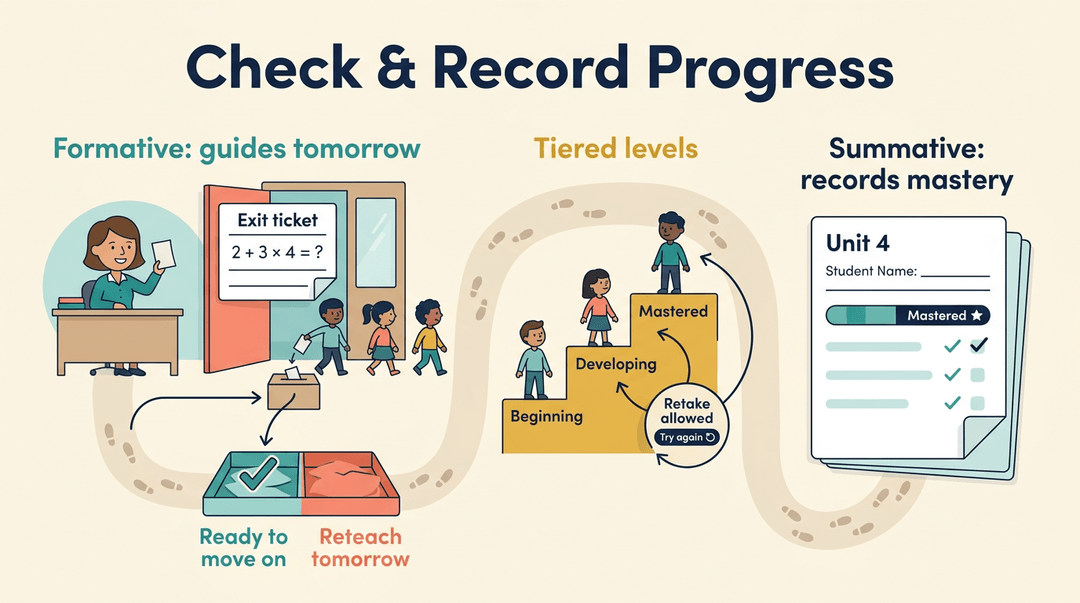
Formative assessment guides your teaching: a quick check that shows you what to reteach tomorrow. Summative assessment records each student's mastery level at the end of a unit.
Retakes are part of the design, so allow multiple attempts, and use tiered assessment levels to match each student's next step. Exit tickets are your everyday checkpoints, a quick slip at the door showing who's ready to move on.
Keeping families informed about progress
Families should never have to guess where their child stands. Share clear expectations early: what mastery means, and how retakes work. Report what a student has mastered separately from how they behaved, so a late arrival doesn't drag down a skill score.
Invite students into the design too, asking which practice helps and which checkpoints feel fair. Picture a fourth-grade teacher at conference week showing a parent a simple mastery chart. The conversation shifts from worry to a plan.
Planning a Mastery Unit Step by Step
Use this guide when you're turning a unit you already teach into a mastery unit. Work through the five moves in order, then run the readiness check before day one.
Build the unit in five moves
- Write one objective per checkpoint
- Make it observable. On the board: "I can solve a two-step equation and check my answer."
- Set the mastery threshold
- Pick one number and keep it fixed, like 85%.
- Say: "You've shown mastery at 85% or above. Below that, we practice and try again."
- Chunk the unit into checkpoints
- Order them by prerequisite: one-step equations → two-step equations → multi-step equations.
- Build the teach-assess-correct cycle
- Teach the chunk, then give a short quiz.
- Students under the threshold get corrective work. Finishers get enrichment.
- Plan retakes and reassessment
- Use an alternate version of the quiz, given only after correction work is done.
⚠️ Watch out: A retake without correction work in between just repeats the first attempt. Make the corrective activity the ticket to the retake.
Example: A seventh-grade math teacher splits an equations unit into three checkpoints, each with a five-question quiz and a mastery line of 85%. Students who miss it spend one class on targeted practice sheets, then take Version B. Students who pass work on a word-problem challenge. By checkpoint three, the class is working from the same foundation instead of the gaps piling up.
Get ready before day one
Confirm each of these before you teach checkpoint one:
- Objectives written per checkpoint: each one is on the board-ready line, not just in your head.
- Corrective activities prepared: practice sheets or mini-lessons aimed at the likely misses.
- Enrichment tasks for finishers: something deeper, not just more of the same.
- Alternate assessment versions ready: Version B exists before anyone needs it.
- Mastery tracking method chosen: a roster grid or checklist you'll actually update.
How it looks by grade
The five moves stay the same. The format changes.
| Level | What it can look like |
|---|---|
| Elementary | Skill checklists, fact fluency checks |
| Middle | Math unit quizzes with retakes |
| High school | Lab or essay rubrics |
| Homeschool | Self-paced workbooks |
Build and reuse mastery unit plans in EMStudio's online lesson planner.
Putting Mastery Learning into Practice
Mastery learning only works when it shows up in your daily plans. These four areas show you where to start.
Ways to structure lessons and units
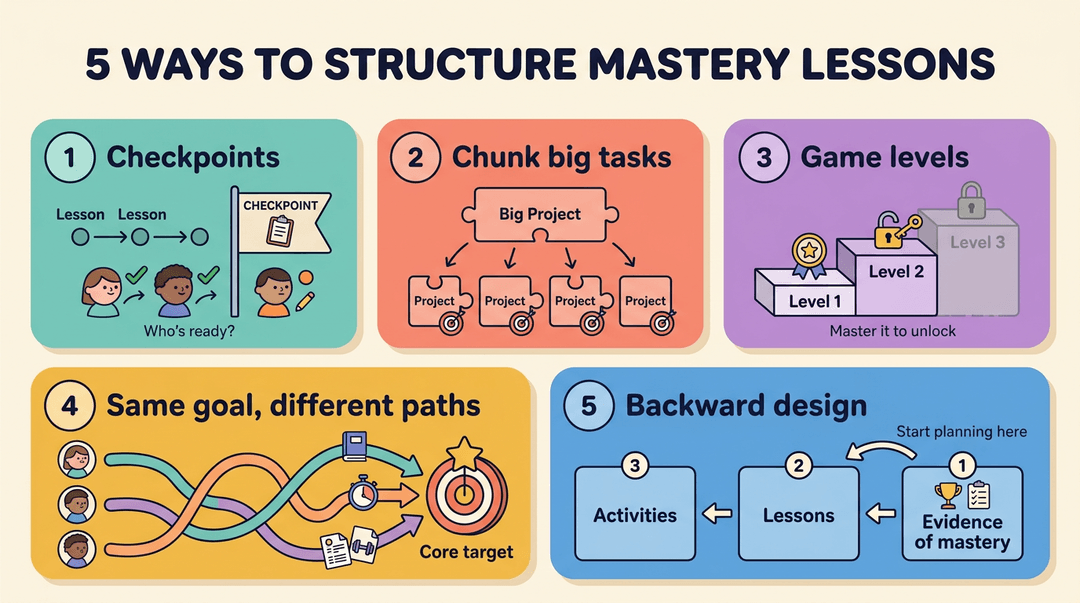
- Checkpoints during units. Pause every few lessons to check who has the skill, so you know who's ready to move on.
- Chunking large tasks. Break a big project into smaller pieces, each with its own mastery target.
- Gamified levels. Students unlock each new level only after they show mastery.
- Differentiating objectives. Keep the core target fixed, but vary the path, pace, or practice for each student.
- Backward design for mastery units. Start with the evidence of mastery you want, then plan the lessons that lead to it.
Helping students who fall behind
- Extra time and help. Offer another attempt, more time, or a quick one-on-one check-in.
- Small tutorial groups. Pull students missing the same skill into focused reteaching.
- Reviewing assessment results. Look at the skill behind each miss, not just the overall score.
- Flipped prework. Give students the basic content before class so lesson time goes to practice.
Consider a fifth-grade teacher who spots three students missing the same fraction skill on a checkpoint. A 15-minute group before the next lesson closes that gap. Catching it early is the whole point.
Working with families, specialists, and students
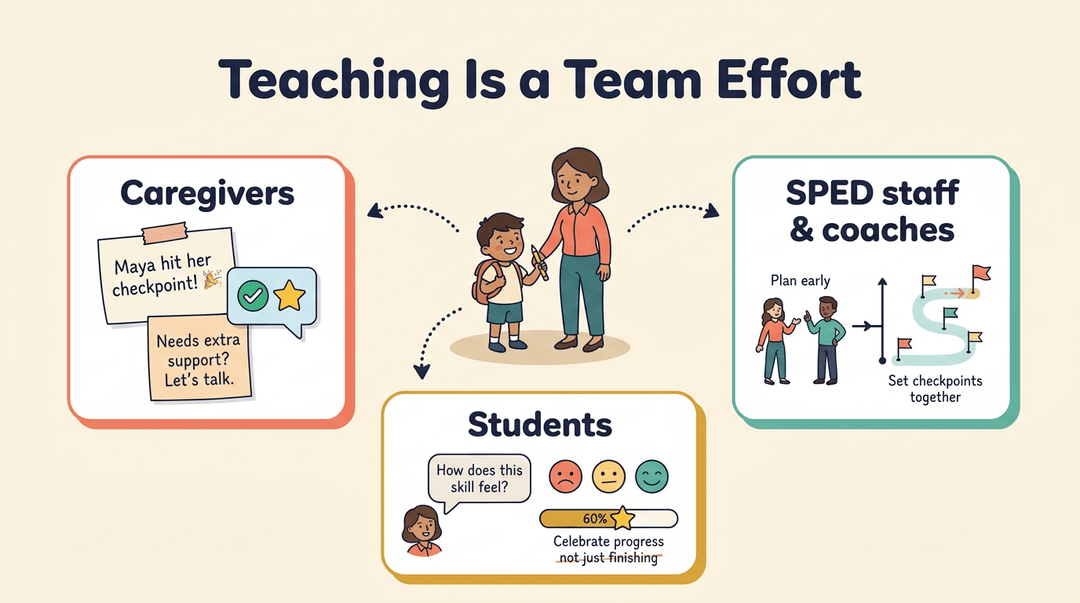
- Contact caregivers. Send a short note when a student hits a checkpoint or needs extra support.
- Involve special education (SPED) staff and coaches. Bring in SPED staff early when a student needs an adapted path, and ask coaches to help plan checkpoints.
- Build student relationships. Check in with each student about how the skill feels, and celebrate progress rather than completion.
Digital tools that track and guide progress
- On-demand video. Students rewatch a mini-lesson whenever they need it.
- Adaptive exercises. Practice adjusts to each student's answers, offering easier or harder items.
- Learning dashboards. See who has mastered which skills at a glance. Less guesswork, more teaching.
- Locked lesson steps. Students can't skip ahead until they pass the current step.
- Self-regulated lesson templates. Students set goals, monitor their progress, and check their own work.
What the Benefits and Research Show
Here's what we know it does for your students.
How it builds confidence and motivation
Mastery learning can support self-confidence and self-efficacy, or your students' belief that they can succeed. A self-paced physical science study found that self-efficacy rose as students grew more confident accessing help.
Students also gain autonomy over their pace, which builds independence. A missed quiz becomes a step, not a verdict, building perseverance and a growth mindset (effort builds ability).
Everyone works toward the same standard, so the class isn't a race. Think of a sixth grader who retakes a fractions check on Thursday, and nobody announces who's 'behind.'

What studies say about student results
The evidence starts with math. A meta-analysis of mastery learning across STEM disciplines reports gains in mathematics achievement.
It also reaches medical and nursing training. A nursing health assessment study found mastery learning let every student practice, get feedback, and gain confidence. A study of internal medicine residents applied it to advanced cardiac life support.
The Education Endowment Foundation's Teaching and Learning Toolkit puts the average impact at five extra months of progress over a year.
These studies back up the core idea: give students time, feedback, and another try, and their achievement grows. Simple, and well supported. Hattie's ideas on visible learning are one place to see where this research comes from.
Filling gaps and deepening understanding
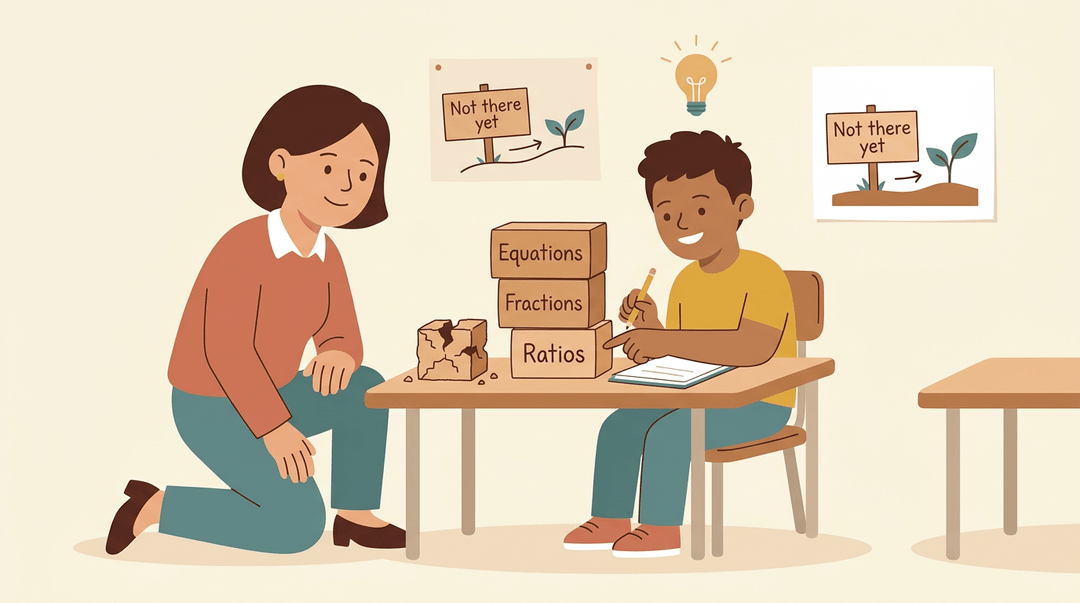
Mastery learning catches gaps early. A middle school math teacher might spot that a student never mastered ratios, so the student rebuilds that foundation first.
Early gaps can also shape identity. A student who keeps falling behind may see themselves as a 'weak student.' Another try shifts the message to "you're not there yet."
Mastery learning goes deeper than recall: it's less about covering content and more about understanding it.
Where Mastery Learning Runs into Trouble
Mastery learning asks a lot of teachers, and its critics raise fair concerns.
Why the workload can feel heavy
Mastery learning takes more planning up front, with checkpoints, backup activities, and extra material for students who need another pass. Frequent grading piles up fast. Picture a fifth-grade teacher with six students stuck on one fraction skill.
A quick small-group reteach gets them moving again, but doing that for every skill can swallow a whole planning period. Tracking students who are all at different places adds one more job.
The payoff is real, but only if your system keeps the load manageable.
Concerns about how students are affected
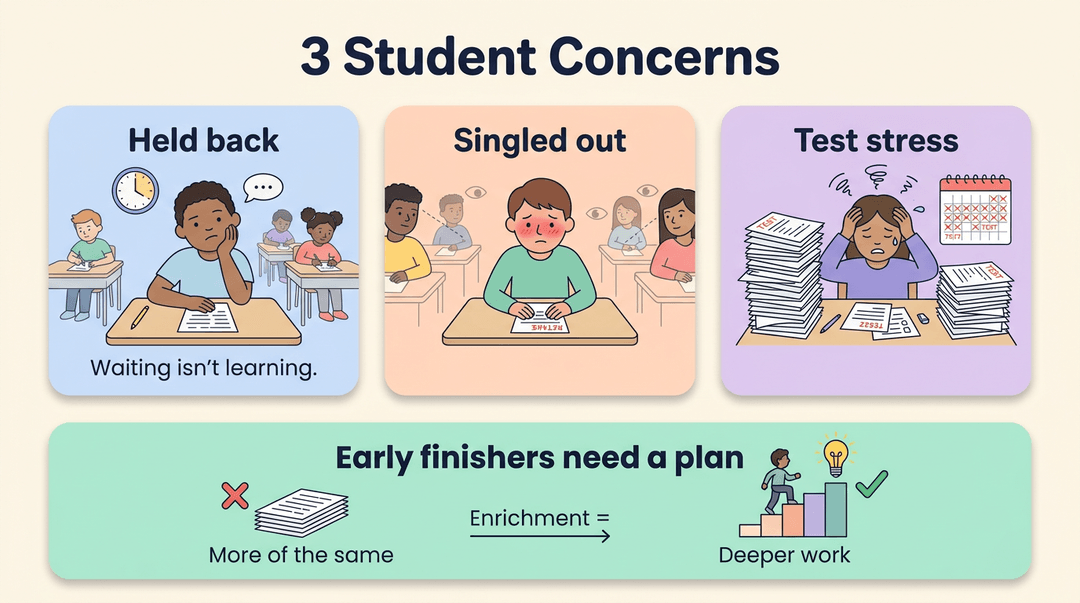
Advanced students can feel held back. One may wait while classmates catch up, and that wait can quietly turn into boredom. Waiting isn't learning.
Other students can feel singled out and embarrassed, especially when a retake happens where peers can see it.
Frequent testing is another worry: a systematic review from EdWorkingPapers notes that opponents point to frequent testing creating anxiety and stress. Early finishers need a plan too. Enrichment should mean deeper work, not just more of the same.
Can it work in large classes
Many teachers wonder whether this works in a crowded room. Logistically, checking mastery for every learner on every objective can seem impractical. Flexibility is harder too: pacing that suits a small group can stall a full class.
Technology makes it feasible. Digital quizzes can score checks automatically and point each student to the next step, so you spend class time with the students who need you most.
Where the Idea Came From
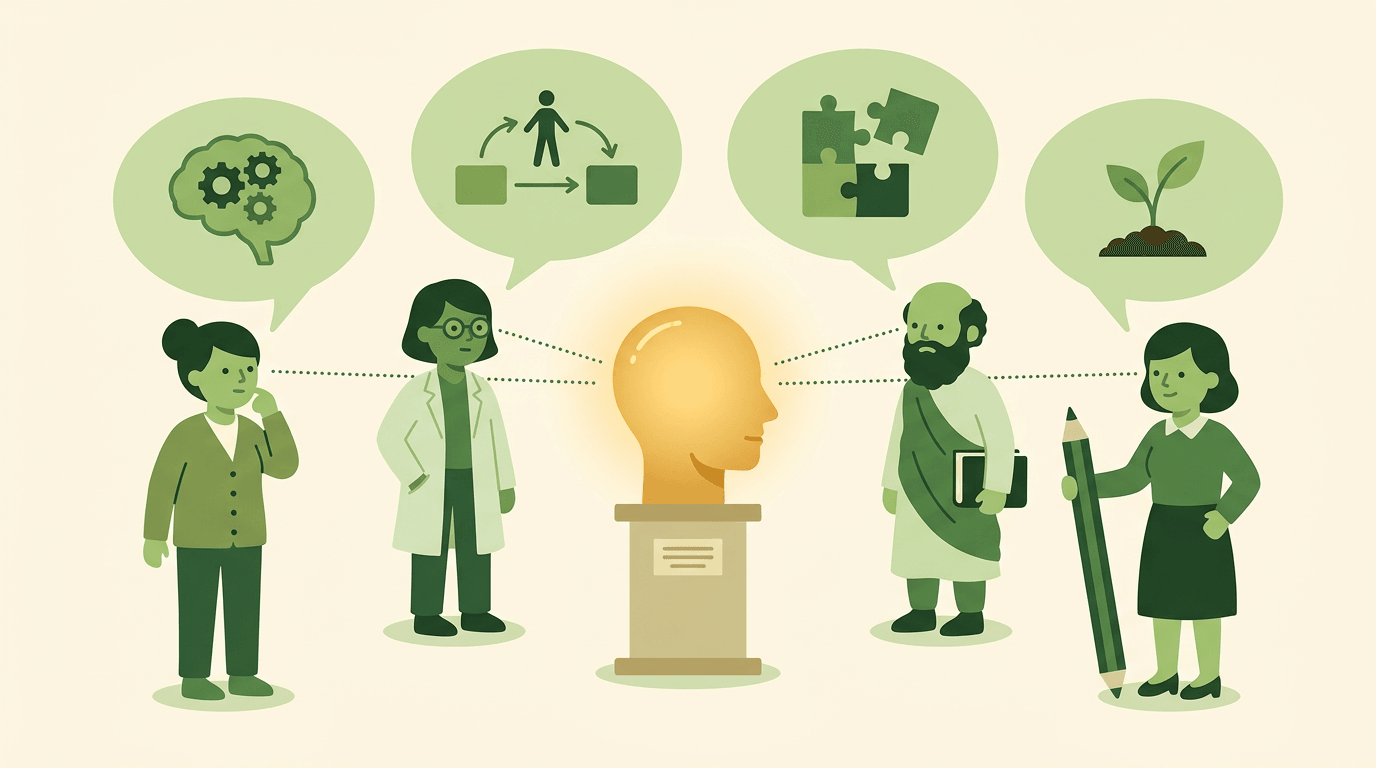
If you searched for the 7 types of learning theories, you'll find more than one list, and this section won't pick one. Instead, we'll trace where mastery learning came from and why it can shift what your whole class achieves. The learning pyramid is one such model, and it's worth a closer look.
How the idea developed over time
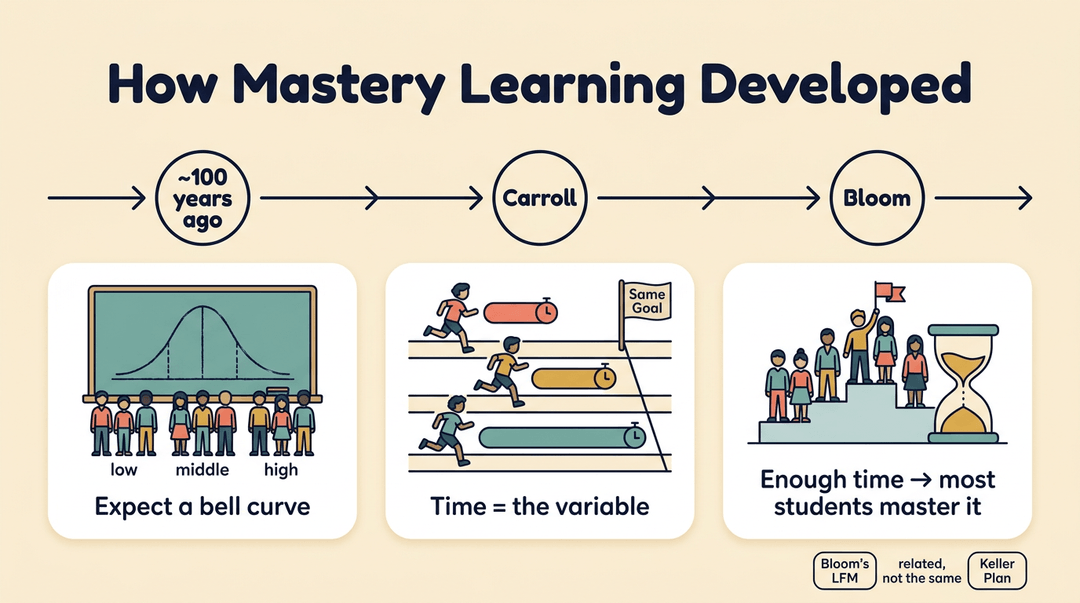
- Early experiments a century ago. Early mastery experiments took place roughly a century ago, before Carroll and Bloom. Benjamin Bloom noted that for at least a century, educators expected a normal distribution and compared students' performance.
- Carroll's time-as-variable model. Carroll treated time as the variable, not the constant. Students learn at different speeds, so the time each one needs will differ.
- Bloom's sufficient-time argument. Bloom argued that most students can reach mastery when they're given enough time. His Learning for Mastery (LFM) model and the Keller Plan, another mastery approach, are related but distinct.
Why the bell curve can shift upward
Writing about mastery learning in a nursing program, Roseman University of Health Sciences notes that traditional instruction tends to produce a bell curve, with most students clustered in the middle and fewer at the extremes.
Optimal instruction changes that picture. Instead of ranking students along a curve, it shifts the whole distribution upward.
A Harvard paper revisiting Bloom's Learning for Mastery model describes Bloom's seminal tutoring study, where students under tutoring performed two standard deviations (2-sigma) better than peers in traditional large-group instruction. The curve can move.
Think of a fourth-grade teacher who won't move on from fractions until most of the class can explain them. That's the shift you're aiming for: most students reaching mastery, not just a few standing out.
Mastery learning comes down to a simple idea: learning is about getting it, not just getting through it.
When students have time to practice, feedback to correct course, and another chance to show what they know, progress becomes something you can actually see.
Ready to build a unit around that idea? Explore Lesson Planning to write, organize, and reuse your mastery plans across multiple classes from one place.

References
- THE EFFECTIVENESS OF MASTERY LEARNING ON STUDENT ACHIEVEMENT ACROSS STEM DISCIPLINES: A META-ANALYSIS — repository.usfca.edu (2026)
- Testing frequency and student achievement: A systematic review — edworkingpapers.com (2026)
- Student Success Through Mastery Learning in a Nursing Health Assessment Course — pubmed.ncbi.nlm.nih.gov (2022)
- Mastery learning in a bachelor’s of nursing program: the Roseman University of Health Sciences experience — springerpflege.de
- Mastery Learning of Advanced Cardiac Life Support Skills by Internal Medicine Residents Using Simulation Technology and Deliberate Practice — ncbi.nlm.nih.gov
- Can Group Instruction Facilitate Personalized Education? Revisiting Bloom's Learning for Mastery Model — nrs.harvard.edu (2016)
- Self-paced mastery learning in an academic physical science class and its effect on student achievement, engagement and self-efficacy — scholarworks.montana.edu (2017)
- Benjamin Bloom — orientation94.org
- Mastery learning — educationendowmentfoundation.org.uk
- Using Self-efficacy to Build Student Confidence: Some Takeaways for Teachers — mindbrained.org
Frequently asked questions
What are the 5 steps of the learning process?
In mastery learning, the cycle is to teach a skill, assess understanding, give feedback, and reteach or provide corrective practice until students demonstrate mastery. Students then move on to the next skill.
What are the 7 types of learning theories?
There is no single universally accepted set of seven learning theories. Commonly discussed theories include behaviorism, cognitivism, constructivism, humanism, connectivism, social learning theory, and experiential learning.
What are the four models of teaching?
Four widely used models of teaching are information-processing, social-interaction, personal, and behavioral systems models. They describe different ways to organize instruction, such as developing thinking skills, learning through groups, supporting individual growth, or shaping learning through practice and feedback.
Who has given the concept of mastery learning?
Benjamin Bloom is most closely associated with the concept of mastery learning. His Learning for Mastery model argued that most students can reach mastery when given sufficient time and appropriate instruction.