What Is a Flipped Classroom? A Complete Guide

Jump to section
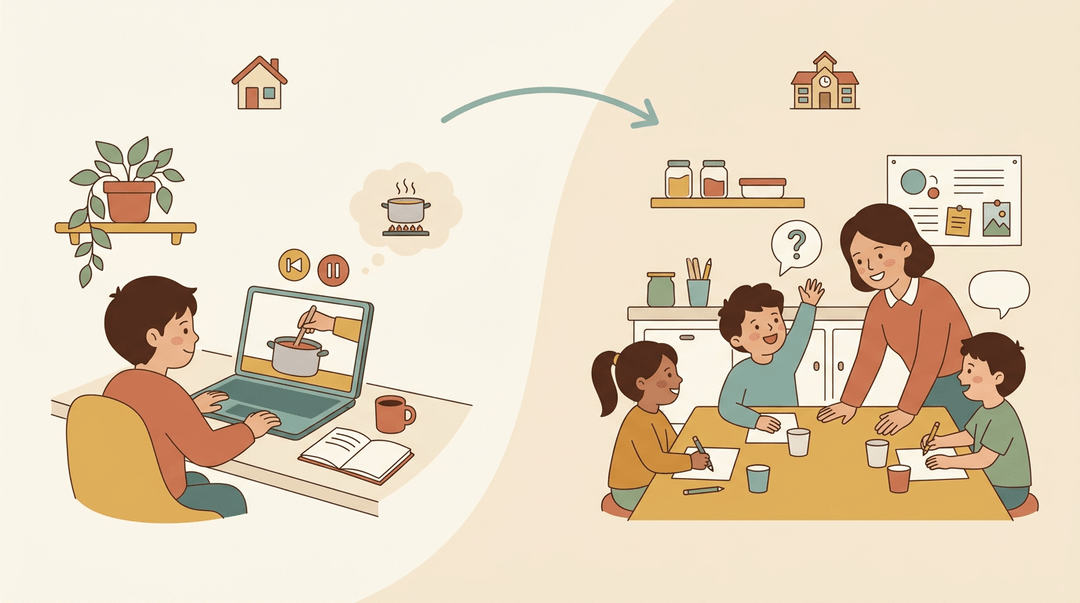
Picture learning a new recipe from a video. You pause, rewind the tricky part, and rewatch until it clicks. Then you head into the kitchen, where the real practice happens and you can ask questions when something goes wrong.
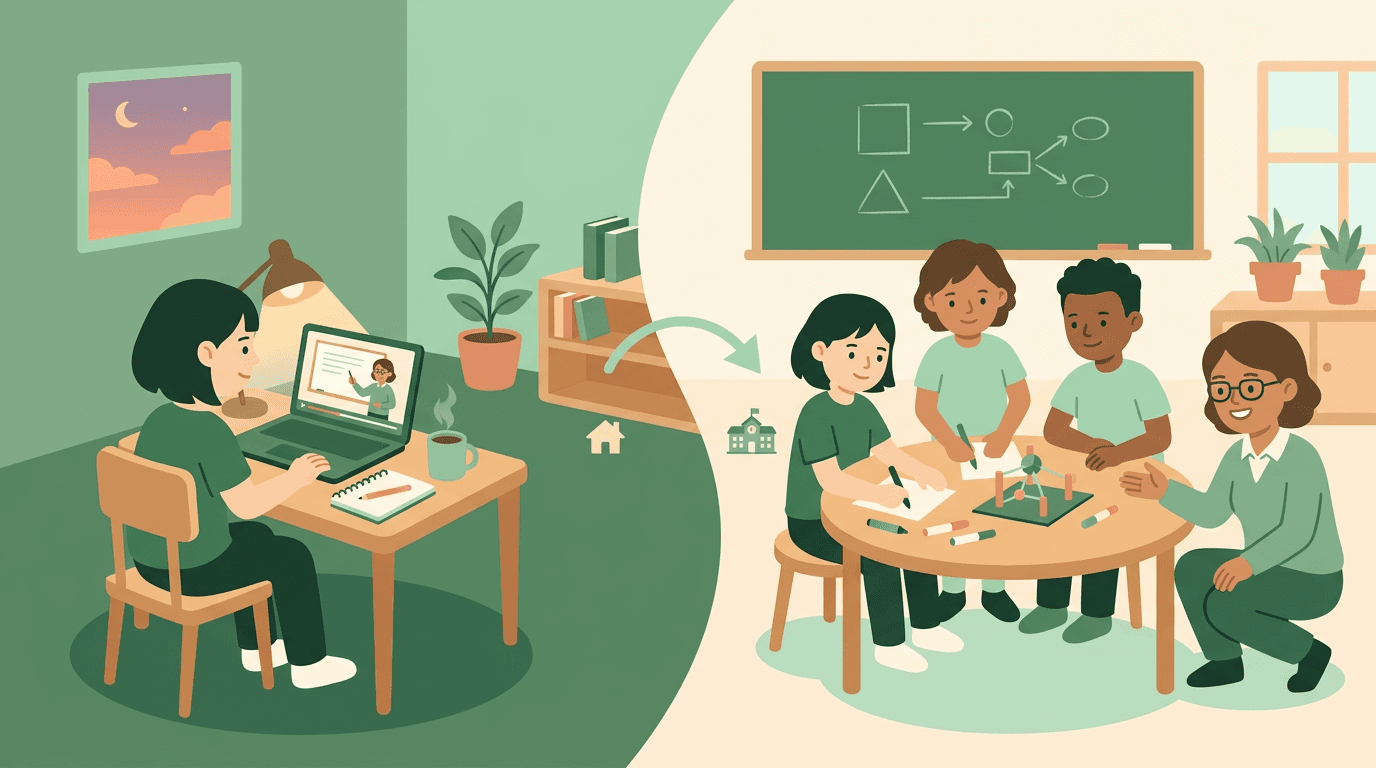
That's the core idea behind a flipped classroom: students meet new content on their own time, and class time goes to practice and questions with you right there.
We'll cover what a flipped classroom is, how to design one, the benefits, and the pitfalls that sink some flips. You'll also get a plan you can adapt across grade levels.
What Is a Flipped Classroom?
Ever wondered why some teachers send the lecture home and save class for the hard part? That's a flipped classroom, and it's simpler than it sounds.
Where lectures and homework trade places
The flip inverts lecture and homework: the lecture moves out of class and the practice moves in. Students learn content through videos, readings, or podcasts before class, then use class time to practice with you nearby. Those videos and podcasts raise a practical question about whether cell phones belong in class.
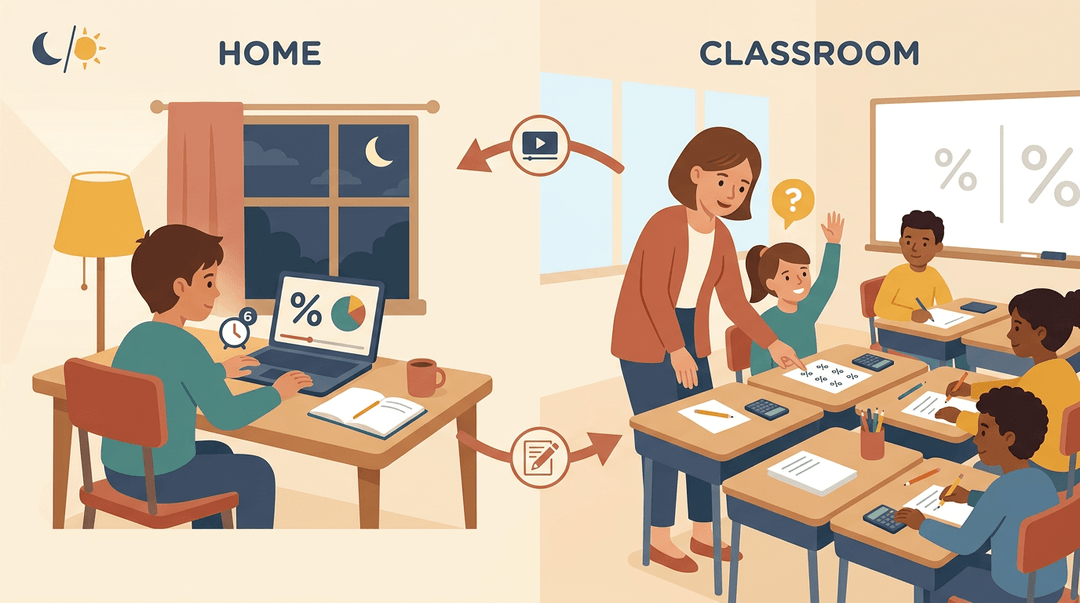
Think of a seventh-grade math teacher who posts a six-minute video on percentages. Students watch at home, and class time goes to hands-on problems where she can spot who's stuck and help.
The traditional classroom reverses that: lecture in class, practice alone at home. The real difference is when students meet the hard part, and whether you're there when they do.
Where the name flipped came from
The name is literal: the usual order of lecture first and homework second gets turned upside down.
The teacher's role flips too. Rather than standing at the front as the main source, you become a guide on the side, shifting from telling to guiding and nudging students toward answers.
Flipping has been around for decades
Flipping isn't a new trick. The approach has been practiced for decades, and it's back in the spotlight.
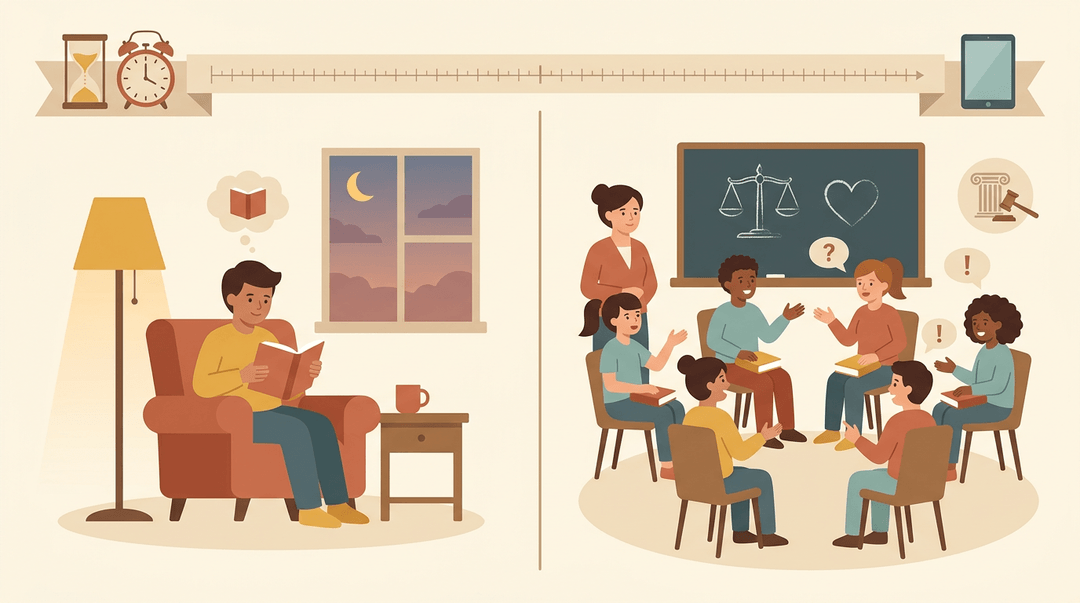
A literature teacher might assign a chapter to read at home, so class time goes to debating the characters' choices instead of recapping the plot.
Law schools have long used a similar model, with students preparing cases in advance and defending their reasoning in Socratic seminars. The idea is old. Its application is new.
Frameworks for Designing a Flipped Classroom
A flip works best when you plan backward from the goal, not forward from a pile of videos. Here's how we'd break that down. The first step is a map of what each unit covers and in what order, which is what a scope and sequence sets out.
The four pillars of F-L-I-P
The F-L-I-P model names four pillars:
- Flexible environment. Learning happens in more than one space and at more than one pace.
- Learning culture. Class time centers on active work, not passive listening.
- Intentional content. Every video or reading has a clear purpose.
- Professional educator. Your role shifts toward observing and responding in the moment.
Designing each lesson around its goals
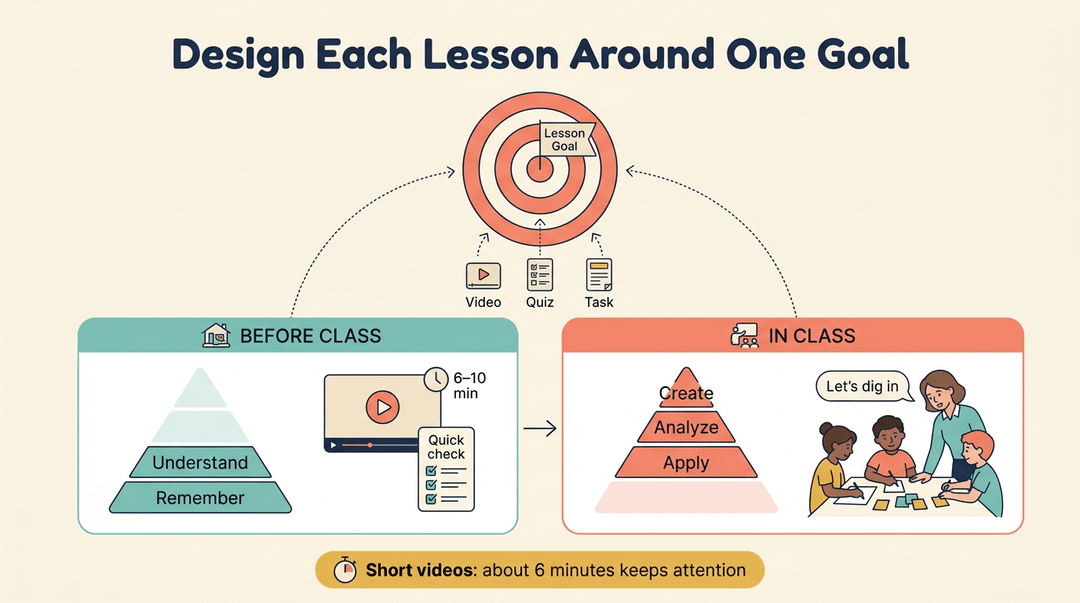
- Align objectives with activities. Every video, quiz, and task should point to the same goal.
- Lower-order skills before class. Definitions and basic facts move to the pre-class work.
- Higher-order skills in class. Analyzing and creating happen where you can coach them.
- Short 6–10 minute videos. Flipped-classroom design guidance often recommends keeping videos around 6 to 10 minutes. One Academic Medicine article suggests about 6 minutes for optimal engagement.
- Guiding questions and quizzes. Pair each video with a few checks to see who got it before class.
Making the most of class time
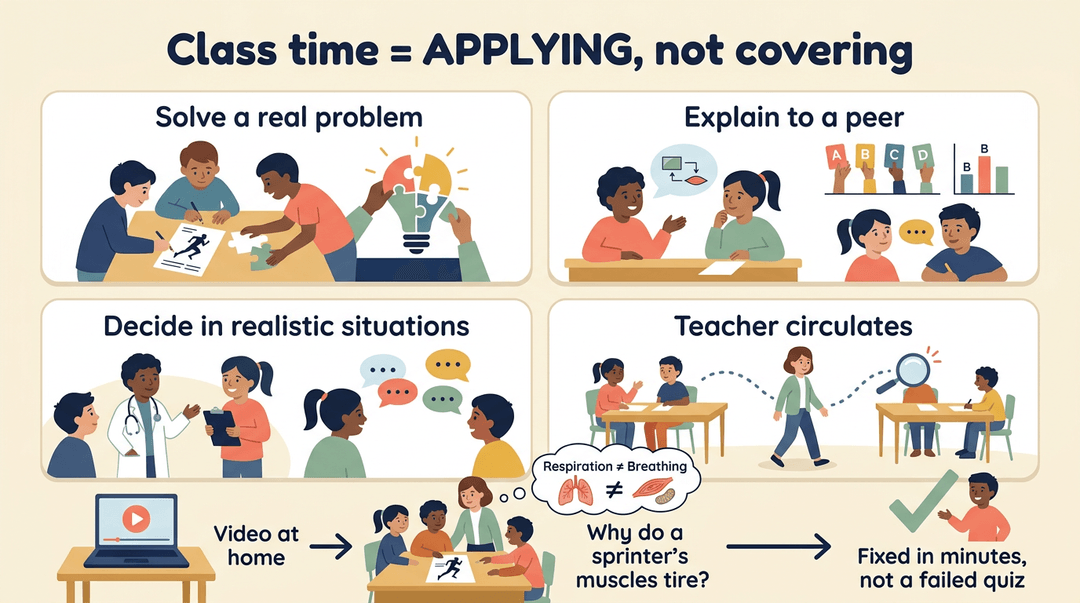
Class time is about applying ideas, not covering them.
- Problem-based learning. Students tackle a real problem that the pre-class ideas help them solve.
- Peer instruction. Students explain ideas to each other, and their answers show what to reteach.
- Case studies and role-plays. Students make decisions in realistic situations, then discuss the outcomes.
- Teacher circulates and gives feedback. You move from group to group, catching misconceptions early.
Consider a high school biology teacher whose students watch a short video at home. In class, groups work out why a sprinter's muscles tire while the teacher circulates and catches a mix-up between respiration and breathing.
The fix takes minutes, not a failed quiz.
Flipping a whole unit or course
Scaling up is mostly about repetition, with three supports in place:
- Library of pre-class resources. Each unit adds to a reusable collection.
- Continuous formative assessment. Quick checks throughout the unit show what's landing before the final test.
- Clear student responsibility. Students know exactly what to do before each class and why it matters.
Blended learning is the broader term for any mix of online and in-person learning. A flip is one specific design within it, moving direct instruction out of class. Less lecture, more doing.
Plan Your First Flipped Lesson
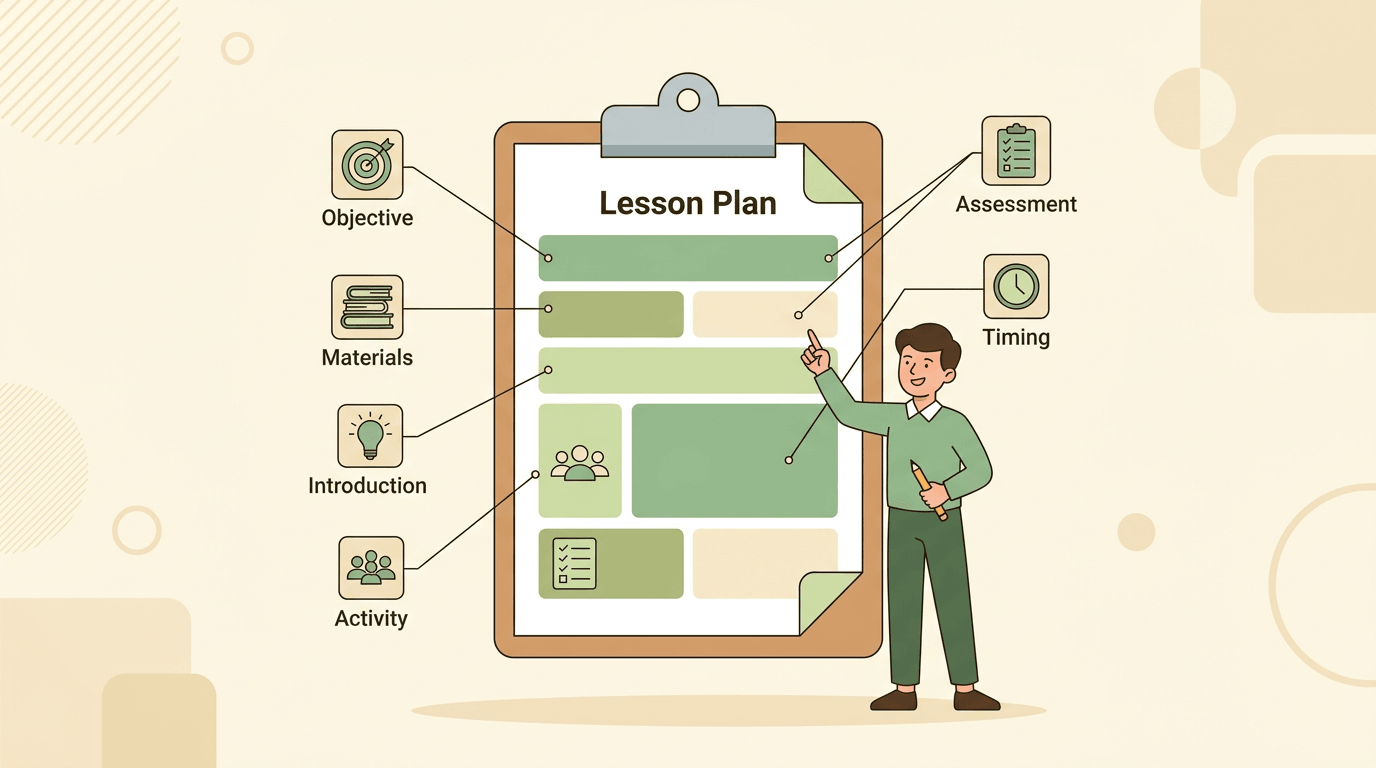
Use this when you're ready to flip one lesson, not a whole unit. Start small: one objective, one short piece of pre-class content, one active class period.
The five steps
- Set one clear objective
- Write it as students will see it: "I can compare two fractions using a number line."
- Choose pre-class content
- Pick one short video or reading that teaches only that objective.
- Add two or three guiding questions, like "What's the first step, and why?"
- Add an accountability check
- Open class with a three-question quiz on the pre-class content.
- Or ask for one sentence of notes at the door.
- Design in-class application
- Plan tasks where students practice, discuss, or build while you circulate.
- Skip re-lecturing the content. Class time is for using it.
- Close with an exit ticket
- Try: "What's one thing from the video that makes more sense after today's practice?"
The accountability check is the step teachers skip most. Without it, students learn that arriving unprepared costs nothing.
Starting points by grade level
Each row shows the same flow at a different level. Swap in your own subject.
| Level | Pre-class content | In-class application |
|---|---|---|
| Elementary | Short read-aloud video | Partners retell the story and draw it |
| Middle | Math concept video | Pairs solve problems, then explain their steps |
| High school | Primary source reading | Small groups annotate and debate the source |
Example: A middle school math teacher assigns an eight-minute video on solving one-step equations, with two guiding questions. Class opens with a three-question quiz. Pairs then work a problem set while the teacher pulls aside students who missed the quiz. An exit ticket asks each student to solve one new equation and explain the first move.
Before you teach
Run through this checklist the day before:
- Video under 10 minutes. Longer, and fewer students finish it.
- Guiding questions included. Students know what to listen or look for.
- Backup for no-access students. A printed copy, or a spot to watch at school.
- Active in-class tasks ready. Materials and directions are set before students walk in.
Draft, organize, and reuse flipped lesson plans across your classes with EMStudio's online lesson planner.
Why Flipping Helps Students Learn
Moving the lecture home frees class time for the work that's hard to do alone.
More interaction and active thinking in class
Class becomes the place for questions and problem-solving, and you catch misunderstandings as they happen. Higher-order thinking, like analyzing and creating, moves to the center, so less of the period goes to passive listening.
Students spend more time using ideas and less time receiving them.
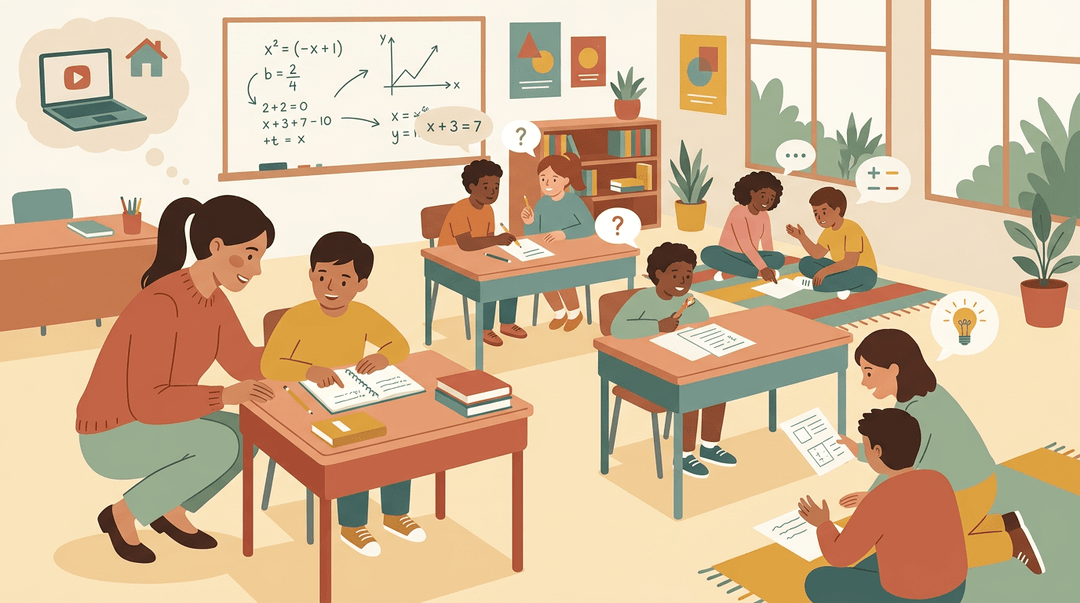
Think of a middle school math teacher whose students watch a video on solving equations at home. In class, she spends her time with the students who got stuck while everyone else practices with a partner.
Pacing and tasks that fit each learner
Students can learn at their own pace, pausing a video, rewatching a tricky step, or skipping what they already know. In class, differentiated tasks can stretch students who are ready and give others another pass.
Students also pick how they take in content, whether a video, a text, or a worked example, so the format adapts to different learning styles.
Growing skills for students and teachers
Flipping also builds:
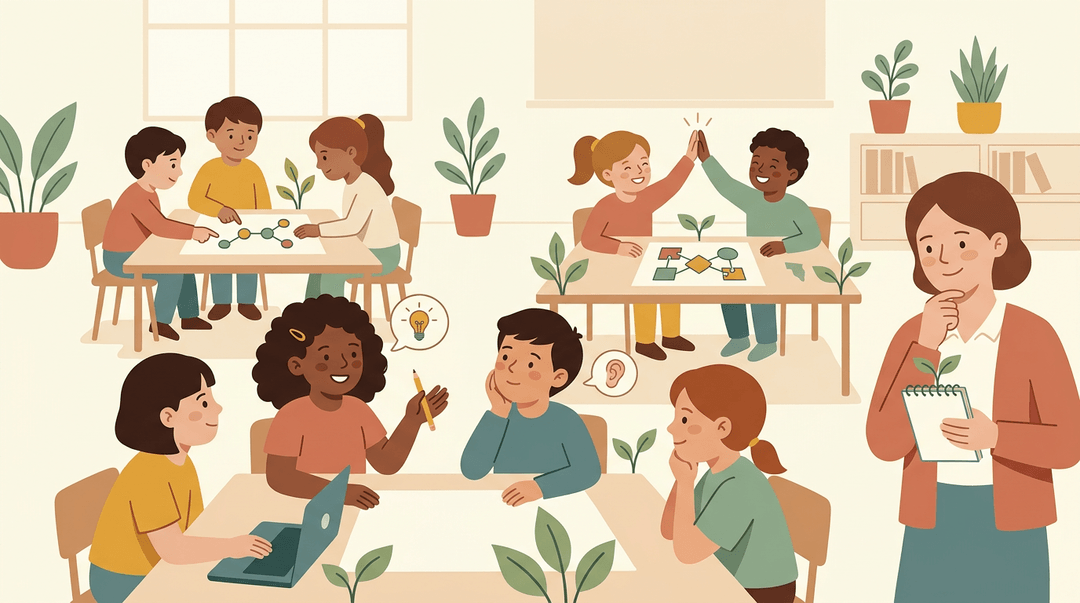
- Interpersonal skills. Students practice working with others, a skill that outlasts any unit.
- Cooperation and active listening. Explaining ideas to peers means hearing their reasoning before responding.
- 21st-century competencies. Collaboration, communication, and problem-solving get real practice in class.
- Teacher professional growth. Watching students work in real time shows you where your explanations miss.
Evidence that flipping improves learning
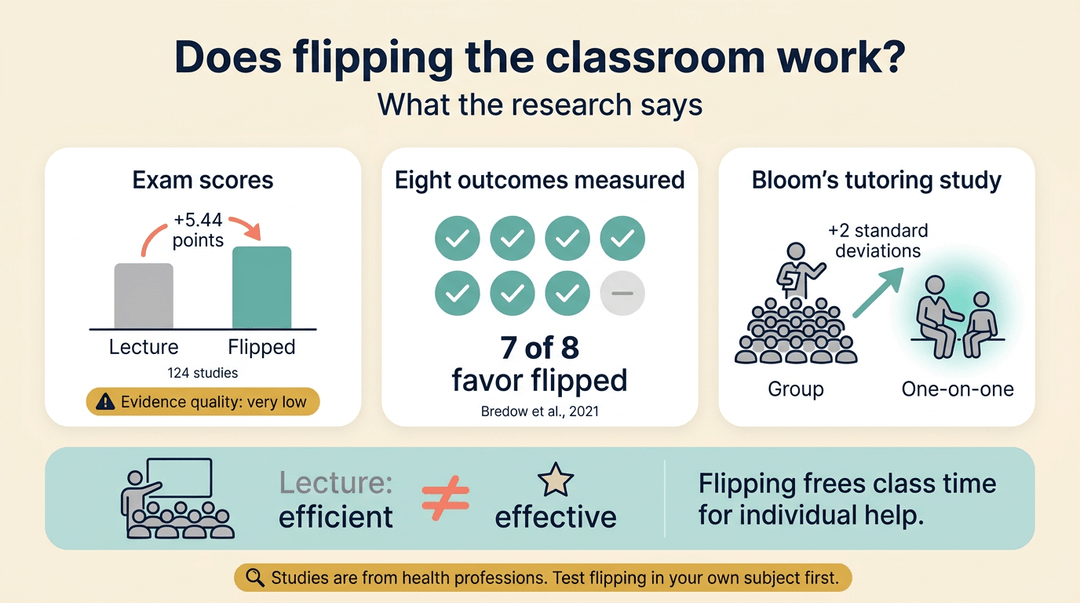
A meta-analytic review of flipped classrooms in health professions education combining 124 studies found exam scores were 5.44 percentage points higher than in lecture sections, though that evidence is rated very low quality.
Our sources cover health professions, not language or technology, so test flipping in your own subject first.
A 2021 review by Carrie A. Bredow and colleagues found significant advantages over lecture-based instruction on seven of eight outcomes.
Benjamin Bloom's seminal tutoring study found one-on-one attention beat large-group instruction by two standard deviations. Lecturing persists because it's efficient: one teacher reaches a whole room at once.
Bloom's finding shows the cost, since individual attention works better but is hard to give everyone at once. Flipping frees that time for individual help. Efficient isn't the same as effective.
The History Behind Flipping
The flipped classroom didn't start as a theory. It grew out of teachers solving everyday problems in their own rooms, and that's where the story begins.
How Bergmann and Sams started flipping
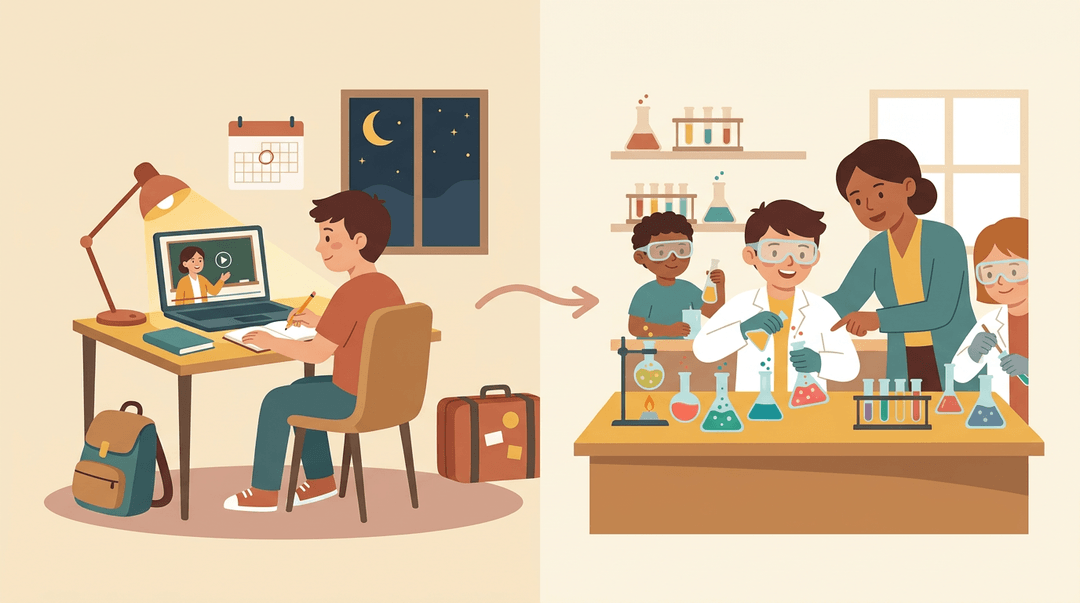
Jonathan Bergmann and Aaron Sams were chemistry teachers who kept running into the same snag: students who missed class fell behind, and the lesson was simply gone. Their fix was to record their lectures so absent students could catch up at home.
Picture a student who misses Tuesday's lab for a family trip. Instead of copying notes from a friend, they can watch the lecture that night and arrive ready to work.
According to a 2009 article in Learning & Leading with Technology, those recordings, which the article calls vodcasts, did more than help absent students.
They also let struggling students review a lesson and gave teachers high-quality lessons to count on when they were away. Struggling students may also need classroom accommodations beyond a replay of the lesson.
The article's own title frames the bigger goal: freeing up class time for hands-on activities. Once the lecture lived at home, class time could shift toward doing rather than listening.
Bergmann and Sams are credited with coining the phrase “flipped classroom,” and it stuck because it describes the reversal exactly. The lecture moved out of class, and the practice moved in.
Eric Mazur and other early adopters
Bergmann and Sams weren't the only ones thinking this way. Eric Mazur is known for peer instruction, a method that has students discuss concepts with each other rather than simply listen to an explanation.
Similar experiments were also happening in other classrooms, so the flipped approach grew out of many teachers' work rather than a single breakthrough. Different teachers, same question: how do we make class time count?
Easy Ways to Begin Flipping
Flipping doesn't have to mean rebuilding your whole year overnight. Here's how to ease in without the overwhelm:
Tips for putting it into practice
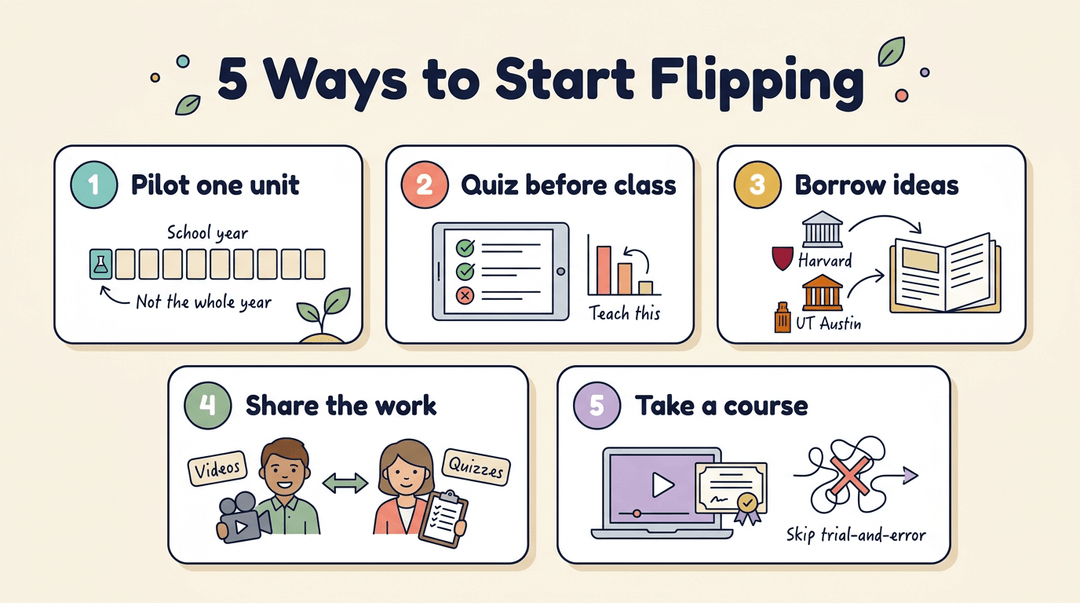
- Start with a few classes. Pilot the flip in a single unit rather than your entire year. Consider a seventh-grade science teacher who flips only her lab safety unit. By the end of two weeks, she knows which videos students actually watch and which activities need work, all before she commits to the rest of the course. Small wins build momentum.
- Use quizzes for accountability. A short pre-class quiz shows whether students watched the video or read the material before they arrive. It also tells you exactly where to spend your in-class time. A few quick questions go a long way.
- Browse resources from Harvard and the University of Texas at Austin. Both have published material on flipped teaching. Look through what's there and borrow ideas that fit your subject and grade level, instead of starting from a blank page.
- Collaborate with colleagues. Share videos, quiz questions, and lesson ideas with teammates so nobody builds from scratch alone. A grade-level team might split the work, with one teacher recording mini-lessons while another drafts the quizzes. That means less prep for everyone.
- Take a teacher training course. Look for a course on flipped learning through your district or an online provider. Structured training helps you skip the trial-and-error phase of every routine. You don't have to figure it all out alone.
What Are Some Creative Flipped Classroom Ideas?
The most creative flips move the content home and bring the thinking into class. You don't need new software to try it. Here's one lesson you can adapt to almost any unit.
Flipping a French Revolution lesson
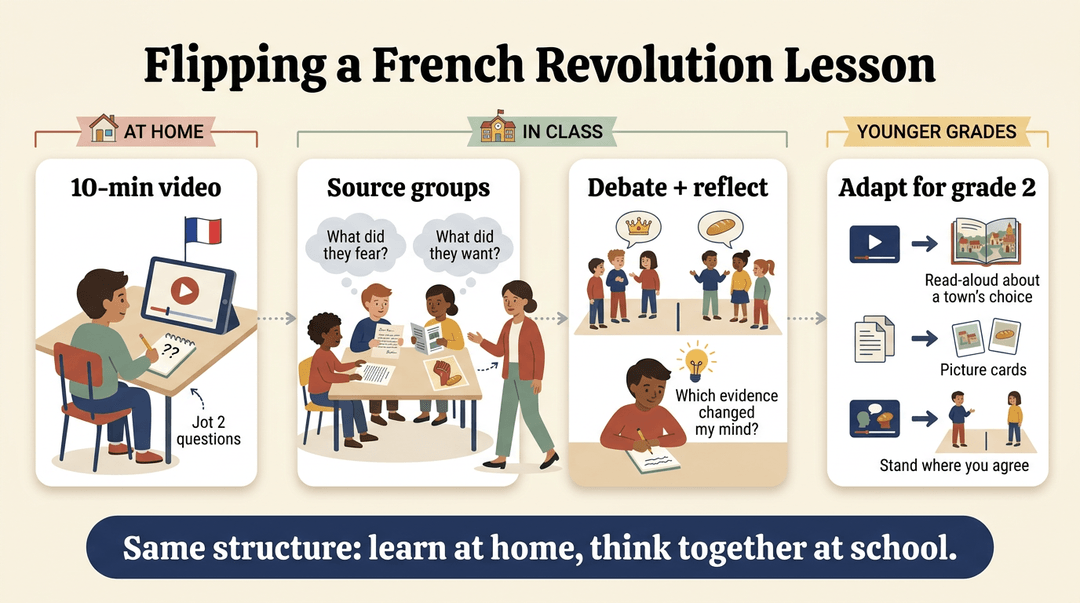
Picture a ninth-grade world history teacher who wants students arguing about causes instead of copying notes from a slide. Her flipped plan has four parts, and the payoff is class time spent on thinking instead of listening.
- 10-minute video at home. Students watch a short video on the period's key events and vocabulary, jotting down two questions as they go. Lecture time disappears, and students arrive already knowing the basics.
- Primary source group analysis. In class, small groups examine letters, speeches, and posters from the period, asking what people feared and what they wanted. The teacher circulates, nudging any group whose reading stalls.
- Class debate and reflection. Groups argue their positions in a structured debate. Afterward, each student writes a short reflection on which piece of evidence changed their thinking, so students learn to defend a claim rather than simply repeat one.
- Adapt for elementary grades. Younger learners need a simpler arc. A second-grade teacher might use a short read-aloud video about a town's decision, swap documents for picture cards, and replace the debate with a "stand where you agree" discussion. The structure stays the same: learn at home, think together at school.
Checking Learning in a Flipped Classroom
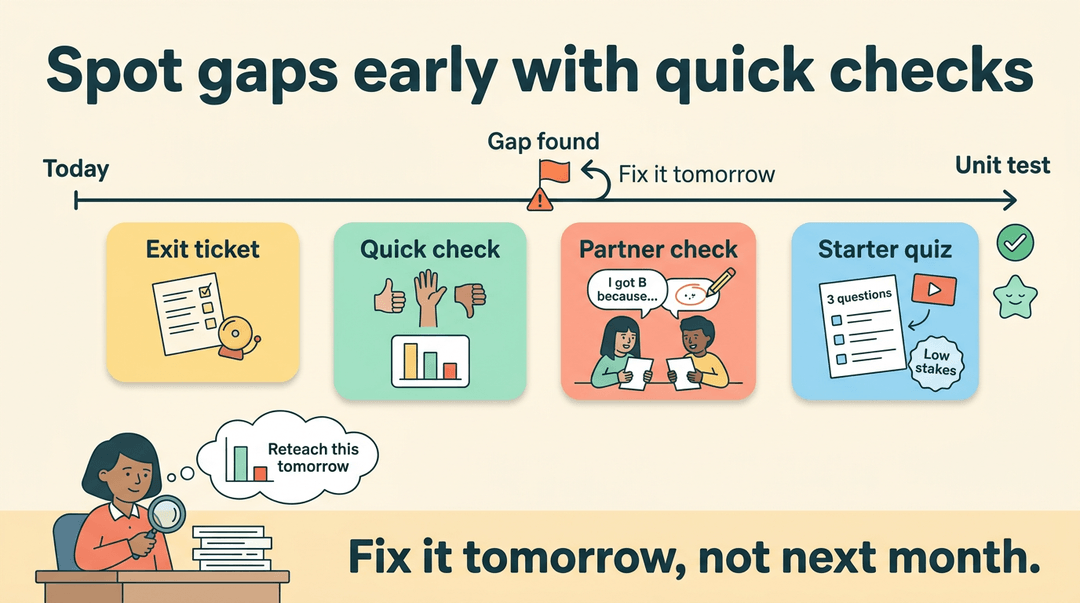
Students watch the lesson at home, so you can't see who's lost until they walk through the door. Formative checks are quick looks at understanding that tell you what to do next.
Ongoing checks and quizzes keep students prepared
Think of a ninth-grade biology teacher who asks students to answer three questions at the end of each video. She reads the responses that night and walks into class knowing which concept needs a reteach. Several tools make this work:
- Exit tickets. Two or three questions at the end of class show who got it before the bell rings.
- Quick checks. A show of thumbs, a poll, or a short online form gives you the room's pulse in under a minute.
- Peer assessment. Students compare answers with a partner and explain their reasoning, so you're not the only one catching errors.
- Quizzes. A short quiz at the start of class gives students a real reason to watch the video before they arrive. Keep it short and low-stakes so the focus stays on learning.
The goal is to spot gaps before the unit test, not after it. Fix it tomorrow, not next month.
Why Doesn't a Flipped Classroom Work?
A flipped classroom can stall when its hidden demands surface after launch. Most flips struggle in the gap between the video and class time, where the work gets assumed instead of planned.
The real downsides and extra prep
Here's what tends to catch teachers off guard:
- Heavy student responsibility. Learners manage their own pacing, which is a big ask for younger students and anyone still building study habits.
- Need to come prepared. Class time only works when most students arrive having watched the video or read the material.
- More instructor prep effort. Recording, editing, and organizing content can eat up hours before the first lesson runs.
- Not just recording videos. A video posted online isn't a lesson. It still needs a clear purpose and a check for understanding.
- Plan for students who skip prep. Some learners won't watch, so build a fallback, like a short recap at the start of class and a quick check that shows who needs help.
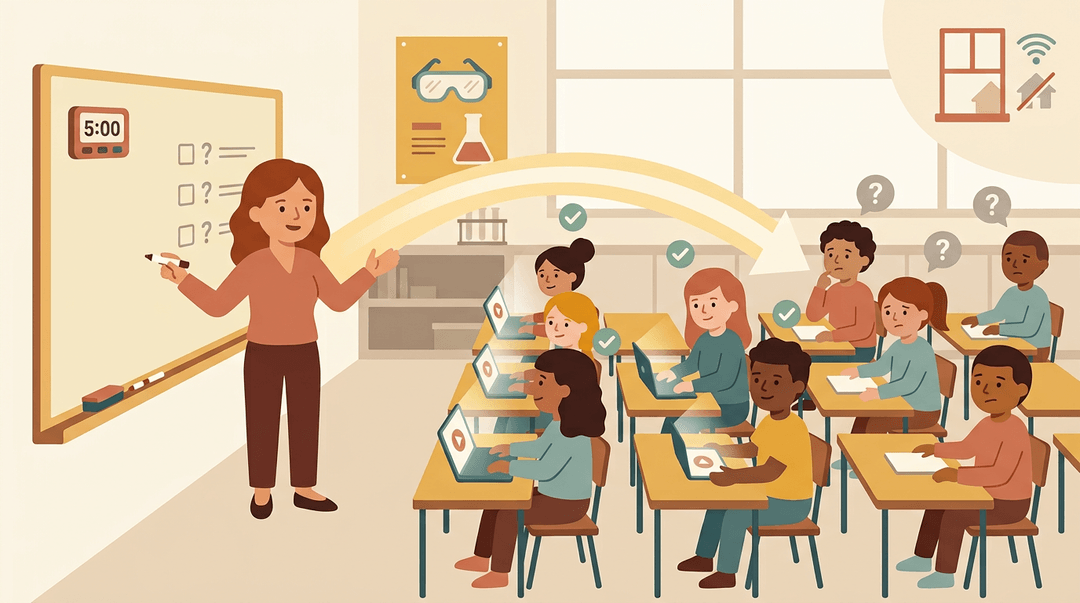
Equity matters here too. The model quietly assumes every student has a device and reliable internet at home, and a flip built on home video can leave some learners behind.
Check what your students can actually reach before you commit, and offer an in-class option for anyone who can't.
Consider a middle school science teacher who records a twelve-minute lab safety video, then finds half the class hasn't watched it.
Her fix is a five-minute recap and three quick questions at the start of class, so no one gets stranded and prepared students aren't stuck waiting. Flips succeed when prep is designed rather than assumed. Plan for the gap.
A flipped classroom isn't about recording more videos or piling on homework. It's about rethinking where learning happens, so class time goes to the questions and feedback that matter most.
Start small, watch where students get stuck, and adjust from there.
Ready to plan your first flipped lesson? Check out our Lesson Planning tool to write, organize, and reuse your plans across multiple classes from one place.
References
- Meta-analytic Review of Flipped Classrooms in Health Professions Education — doi.org (2025)
- 1. Prepare content — academic.oup.com
- To Flip or Not to Flip? A Meta-Analysis of the Efficacy of Flipped Learning in Higher Education - Carrie A. Bredow, Patricia V. Roehling, Alexandra J. Knorp, Andrea M. Sweet, 2021 — journals.sagepub.com (2021)
- Can Group Instruction Facilitate Personalized Education? Revisiting Bloom's Learning for Mastery Model — nrs.harvard.edu (2016)
- ERIC - EJ904290 - Remixing Chemistry Class: Two Colorado Teachers Make Vodcasts of Their Lectures to Free Up Class Time for Hands-On Activities, Learning & Leading with Technology, 2009-Jan — eric.ed.gov (2008)
Frequently asked questions
What is the difference between traditional classroom and flipped classroom?
In a traditional classroom, the teacher presents new material during class and students practice it alone as homework. In a flipped classroom, students first encounter material through videos or readings before class, then use class time to practice, ask questions, and get teacher feedback.
What are the disadvantages of a flipped classroom?
A flipped classroom can require substantial preparation and places more responsibility on students to complete work before class. Students may lack reliable internet or devices, or arrive unprepared, which can disrupt activities; teachers need accessible alternatives and a plan to support them.
What are some creative ideas for a flipped classroom?
Have students watch a short lesson at home, then use class for a primary-source investigation, debate, role-play, or problem-solving challenge. For example, students can review a short video about the French Revolution, analyze letters and speeches in groups, and debate the causes using evidence.
Why doesn't flipped classroom work?
A flip can fail when students do not complete the pre-class work, the content lacks a clear purpose, or class activities are not designed to apply it. Limited access to devices and internet, weak study habits, and insufficient teacher preparation can also create barriers. Short content, quick readiness checks, accessible alternatives, and a fallback recap can help.
What are the 5 methods of teaching with examples?
Five common teaching methods are direct instruction, discussion, demonstration or modeling, cooperative learning, and inquiry-based learning. For example, a teacher might explain a math procedure, lead a class discussion about a story, model a lab technique, have students solve problems in pairs, or guide groups through investigating a scientific question.
Who coined flipped classroom?
Jonathan Bergmann and Aaron Sams are credited with coining the phrase “flipped classroom.” They recorded chemistry lectures so students could catch up or review them, freeing class time for hands-on activities.
What does modeling look like in the classroom?
Modeling means showing students how to perform a task or think through a process, often by narrating each step. A teacher might solve an equation on the board while explaining the reasoning, then have students try a similar problem with guidance.