Teaching English as a Second Language: Complete Guide

Jump to section
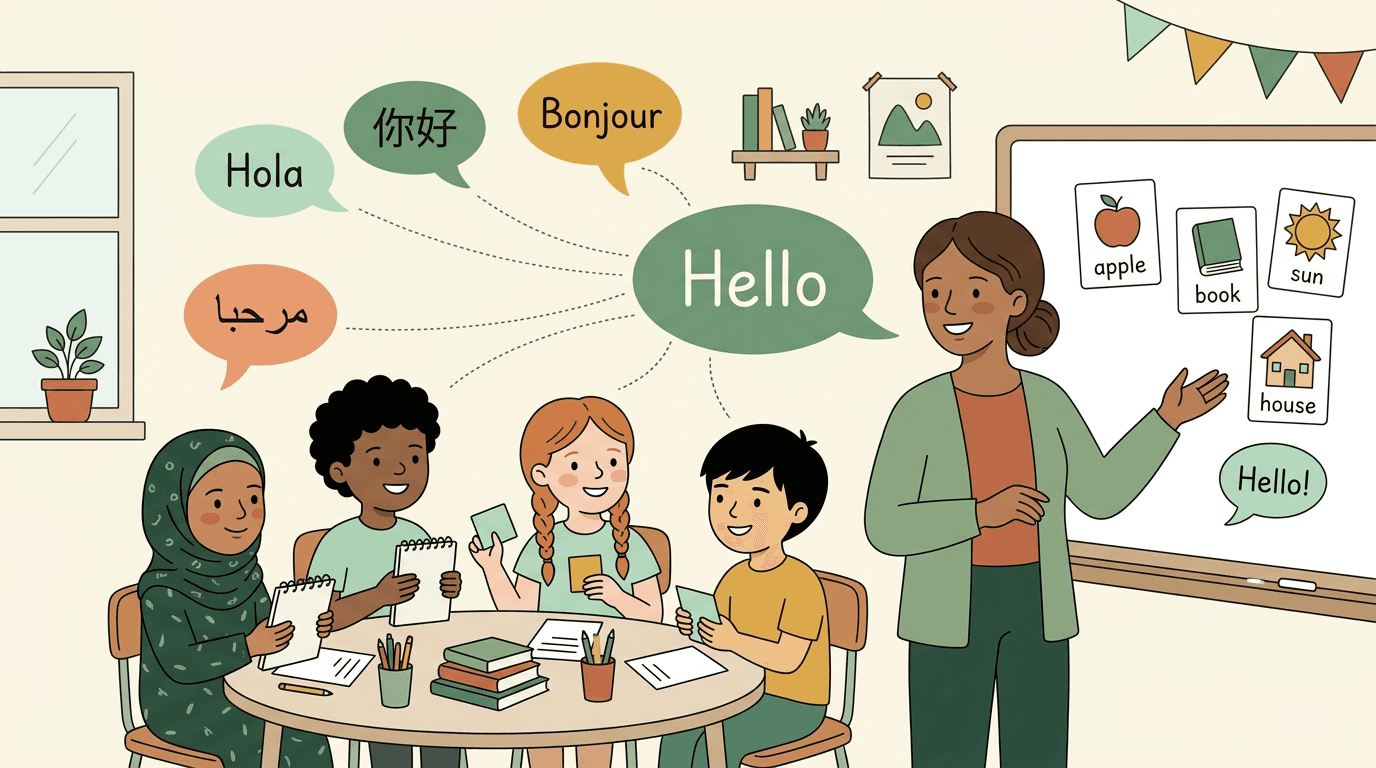
Imagine ordering a meal in a country where you don't speak the language. You point, you smile, and you hope for the best. That's what many of your students feel every day in an English-speaking classroom.
Teaching English as a Second Language (ESL) means helping learners build the reading, writing, speaking, and listening skills they need to communicate with confidence.
In this post, we'll cover the duties, methods, qualifications, pay, and demand, plus a step-by-step lesson-planning guide you can use right away.

Teaching English as a Second Language Duties
The job goes well beyond the lesson. Here's what we'll cover: the daily work, the goals, the traits that help, and the terms you'll meet.
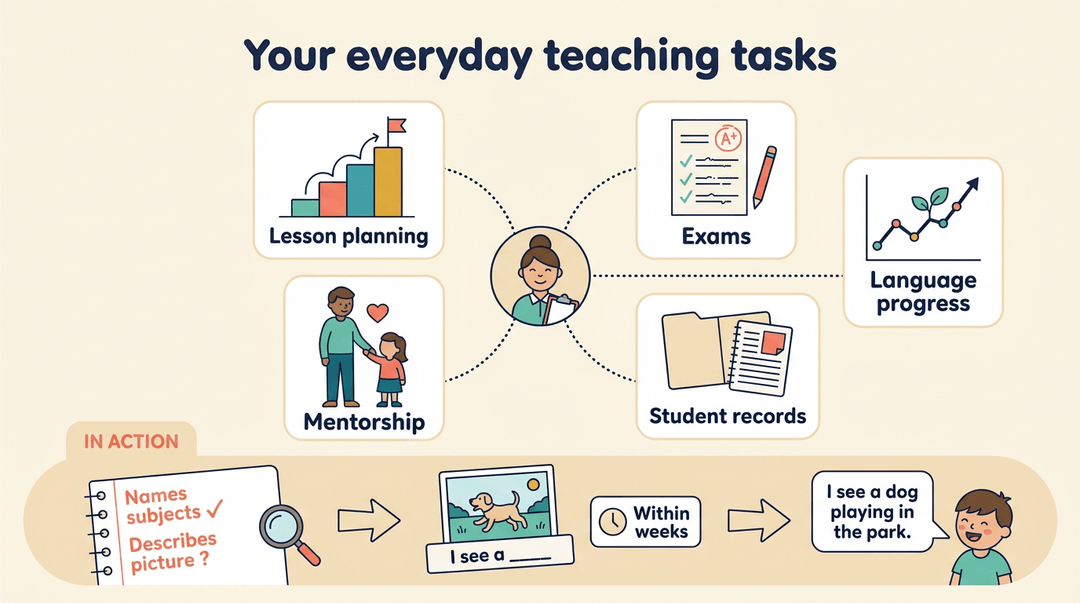
Your everyday teaching tasks
Lesson planning and instruction come first: you design lessons that build language step by step. Creating and grading exams shows what students have learned, while evaluating language progress tracks growth over time.
Maintaining student records keeps notes ready for planning and family conversations. Mentorship and support round it out, since you're often the adult helping a newcomer feel at home.
Think of a newcomer who names school subjects easily but freezes when asked to describe a picture. Your notes flag that gap, a picture-based sentence starter closes it, and within weeks the student answers in full sentences.
What ESL education aims to achieve
English as a second language (ESL) teaching aims for more than textbook mastery. The core goal is language acquisition: helping students use English in real situations, not just study it.
You help them clear grammar and pronunciation hurdles through practice with the sounds they actually need.
The payoff is academic and social success, supported by an inclusive learning environment where every home language is valued. Belonging matters as much as grammar.
Traits that make a strong teacher
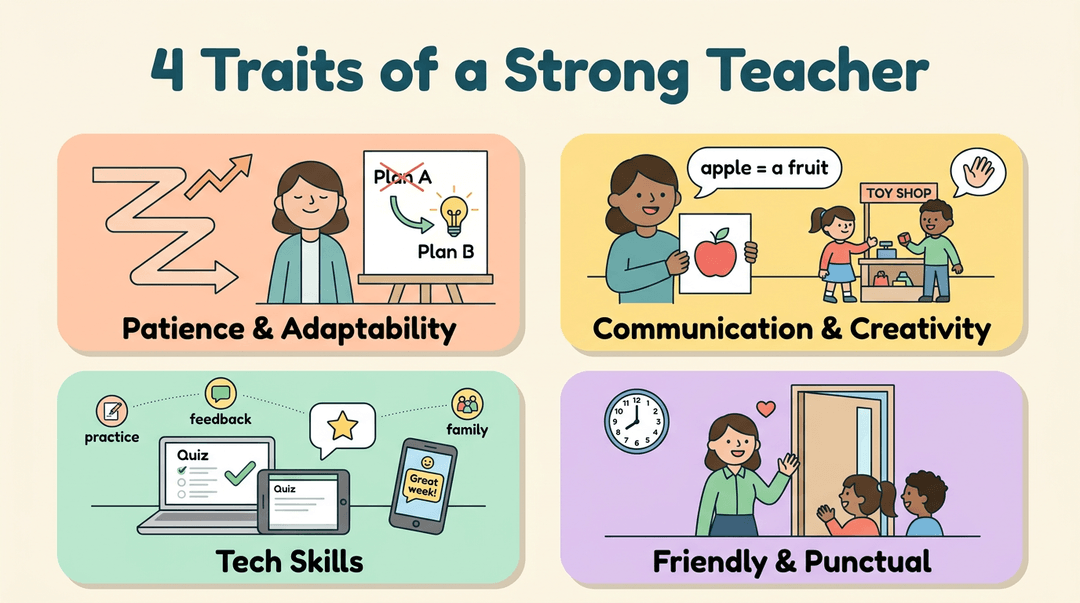
Four traits show up again and again:
- Patience and adaptability. Progress rarely runs in a straight line, so you stay calm and switch approaches when a lesson stalls.
- Communication and creativity. You explain grammar in plain words and show meaning with gestures, pictures, or role-play.
- Technological proficiency. Digital tools support practice, feedback, and family contact.
- A friendly, punctual personality. Warmth builds trust, and reliability shows students they can count on you.
Acronyms and how they differ
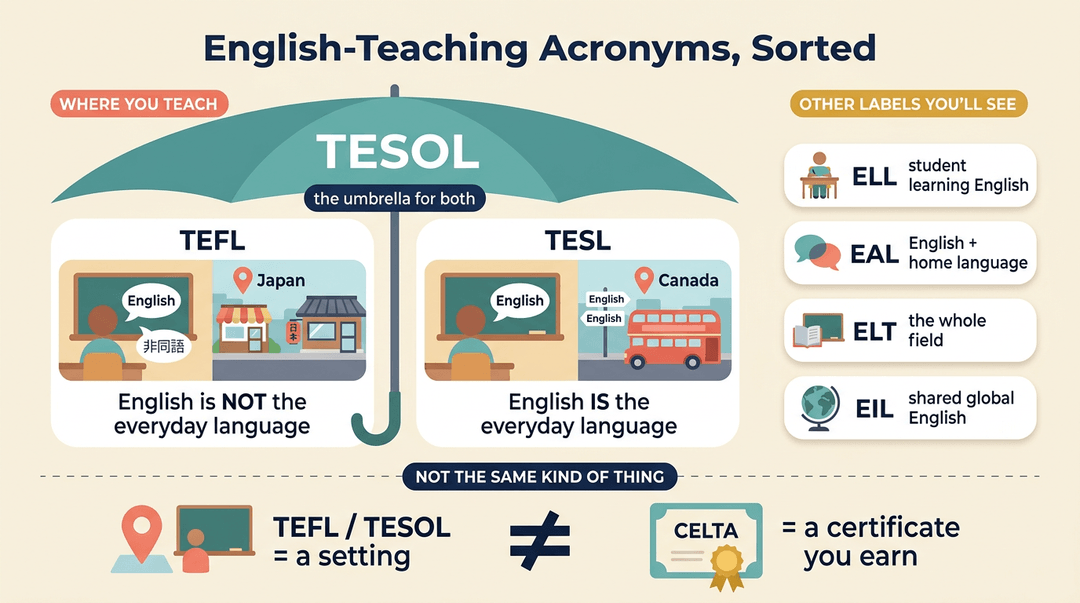
TEFL (Teaching English as a Foreign Language) covers places where English isn't the everyday language. TESL (Teaching English as a Second Language) covers places where it is.
TESOL (Teaching English to Speakers of Other Languages) is the umbrella term for both.
- ELL (English language learner): a common label for students learning English in school.
- EAL (English as an additional language): English added alongside a home language.
- ELT (English language teaching): the broad field of teaching English.
- EIL (English as an international language): English as a shared global language.
TEFL and TESOL describe the setting you teach in, while CELTA (Certificate in Teaching English to Speakers of Other Languages) is a specific training certificate you can earn.
That's why the three get mixed up, even though they aren't the same kind of thing.
Planning an ESL Lesson, Step by Step
Use this guide to build one ESL lesson from objective to exit ticket. Reach for it when you're planning tomorrow's class and want the flow, the activities, and the final checks in one place.
The five-part lesson flow
- Set a measurable language objective
- Write what students will do: "Students will order food using I'd like... and Can I have...?"
- Warm up and activate prior knowledge
- Say: "What did you eat today?" Let students use words they already know.
- Present the target language
- Show the phrase in a real context, say it, then have students repeat it together.
- Move from guided to free production
- Guided: partners complete a fill-in menu dialogue.
- Free: partners order from a menu with no script.
- Close with an exit ticket
- Each student writes one sentence using the target phrase before leaving.
Example: A teacher with a beginner adult class sets the objective above. The warm-up is a quick chat about lunch. Students practice with a scripted dialogue, then run a café scene on their own. The exit ticket is one sentence: "I'd like a sandwich, please." The lesson ends with proof that each student can use the phrase.
Activity ideas by age group
Keep the five-part flow the same and swap the activity to fit your learners.
| Learners | Activities | What it looks like |
|---|---|---|
| Early elementary | Songs, gestures, realia | Hold up a real apple, sing a fruit song, add a gesture per word |
| Middle and high school | Pair debates, sentence frames | Frame: "I agree because ___." Partners defend a side |
| Adults | Workplace role-plays | Interview, customer call, or a meeting with a coworker |
Checks to run before class
Confirm each of these while the plan is still on paper:
- Level match: the objective and language fit your students' proficiency level, not the textbook's page.
- Limited new vocabulary: teach a handful of new words, and recycle the rest.
- Four skills balanced: listening, speaking, reading, and writing each get at least a moment.
- Timed transitions: write a time beside each stage and a cue for moving on.
- Backup activity ready: keep one spare task, like a partner interview on today's topic.
⚠️ Watch out: Overloading the presentation stage is the most common planning slip. If students can't use a new word in guided practice, you've introduced too many.
Save and reuse your ESL lesson plans by level with EMStudio's online lesson planner.
Education and Certification You Need
Your path depends less on one universal rule and more on where you want to teach and who you'll teach. Here's how the main credentials break down.
Degree needs and exceptions
The minimum is a bachelor's degree, ideally in education or a related field, from an accredited university. Some online teaching companies hire without a degree, so read each posting carefully.

Getting your teaching license by state
Teaching licenses are issued state by state, so state-specific requirements shape your path. Expect classes, exams, and experience hours, and confirm the exact numbers with your state's education department.
Check license transferability before you move, since a license may not carry over automatically.
If you're aiming at public schools, you'll typically start with PreK-12 initial certification, which covers preschool through twelfth grade. Check early, not later.
Earning a TEFL, TESOL or CELTA
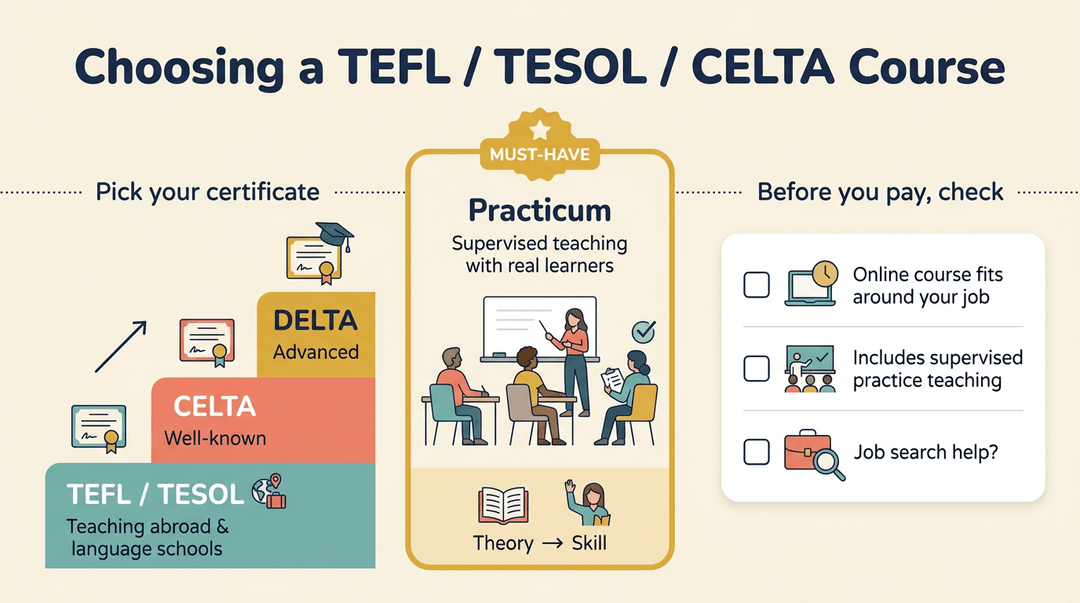
For teaching abroad or at private language schools, a TEFL (Teaching English as a Foreign Language) or TESOL (Teaching English to Speakers of Other Languages) certificate is a common credential.
Look for a practicum, a supervised stretch of teaching with real learners, because that's where theory becomes skill.
The CELTA (Certificate in Teaching English to Speakers of Other Languages) is a well-known option, and the DELTA (Diploma in Teaching English to Speakers of Other Languages) is its advanced counterpart.
Online TEFL courses can be taken around a day job, but confirm they include supervised practice teaching. Some programs also offer job search assistance, so ask before you pay.
Graduate degrees and ESL endorsements
Many teachers add an ESL endorsement (English as a Second Language) to a license they already hold, which lets them work with English learners. A master's degree is the route to college-level teaching, while an ESL-specific master's is optional.
A doctorate is needed only for some overseas posts, so treat it as a later step. Program tracks and credit hours vary, so compare them side by side.
Ways to build teaching experience
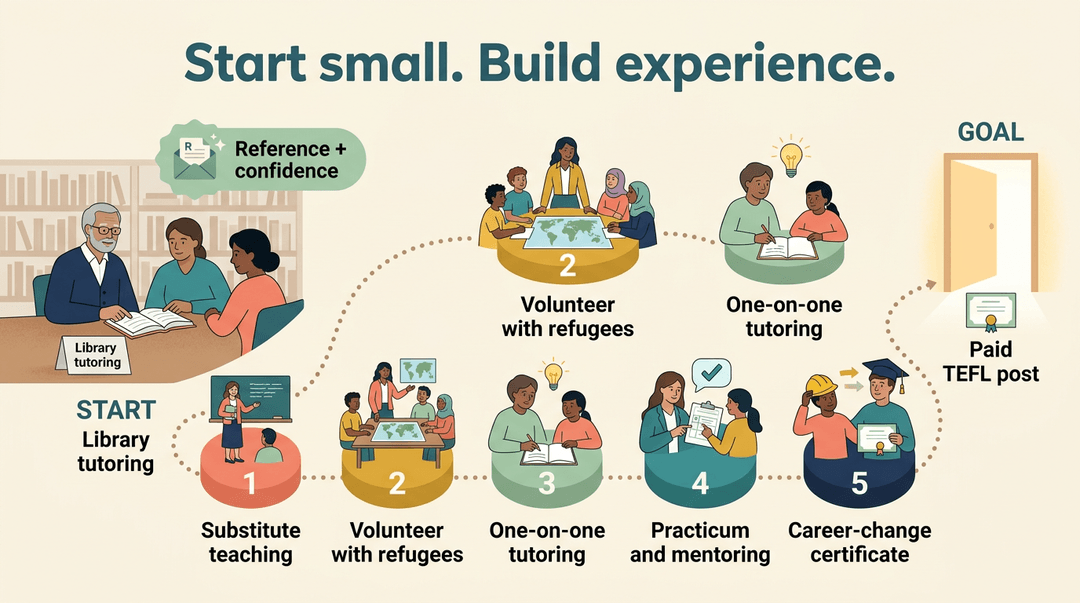
Consider a retired engineer who tutors two adult newcomers at his local library. After a year, he has a reference and the confidence to apply for a paid TEFL post. Start small. Here are a few routes:
- Substitute teaching puts you in unfamiliar classrooms.
- Volunteer teaching refugees gives you ESL practice with learners who need it most.
- Tutoring experience teaches you to adapt a lesson for one learner.
- Practicum and mentoring build skill and give you someone who knows your work.
- Career-change certificates bridge you from another field into teaching.
Classroom Techniques and Planning Your Lessons
Strong ESL teaching is less about the perfect method and more about what your students can understand right now.
Adjusting how you speak to learners
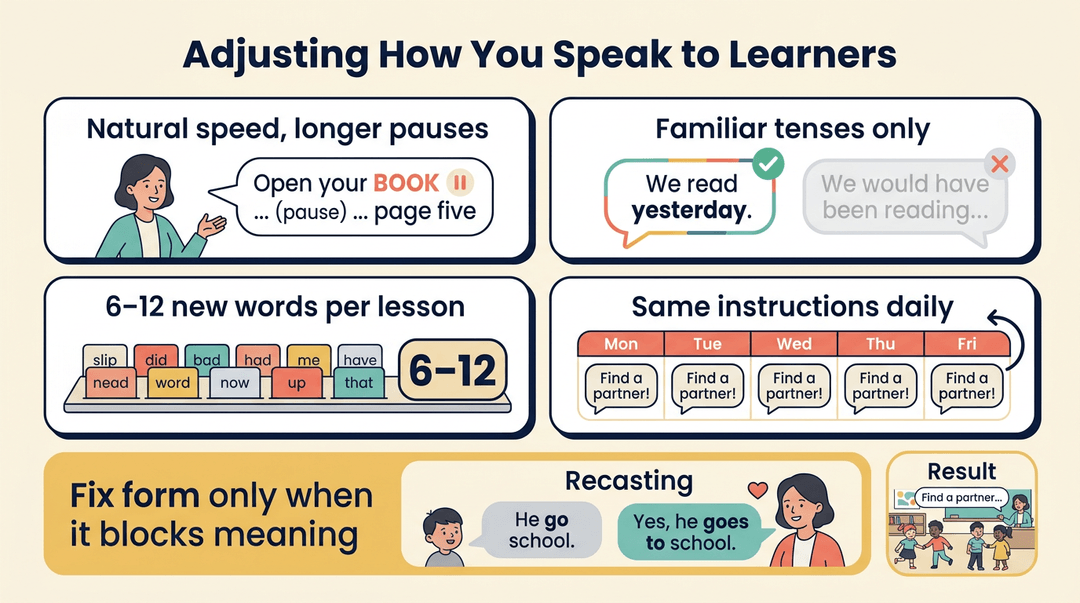
- Natural speed, longer pauses. Speak at a comfortable pace, and pause after key words.
- Simplified verb tenses. Stick to the tenses your learners already know.
- Limit new vocabulary. Introduce 6 to 12 new words per lesson.
- Practice giving instructions. Use the same wording daily so routines become automatic.
Correct form only when it blocks meaning, and use recasting (repeating a student's sentence correctly) to do it gently.
A first-grade teacher says 'Find a partner' the same way every day, and soon the class moves into pairs before she finishes the sentence.
Using pictures, gestures and body language
Bring in realia, which means real objects like a banana for food vocabulary. A quick diagram shows under and behind at a glance, and miming 'jump' gives students a physical memory hook. Read faces too: a puzzled look means rephrase, not repeat louder.
A newcomer who doesn't know 'scissors' nods in recognition when her teacher mimes cutting paper.
What goes into each lesson plan
Plan these parts in every lesson:
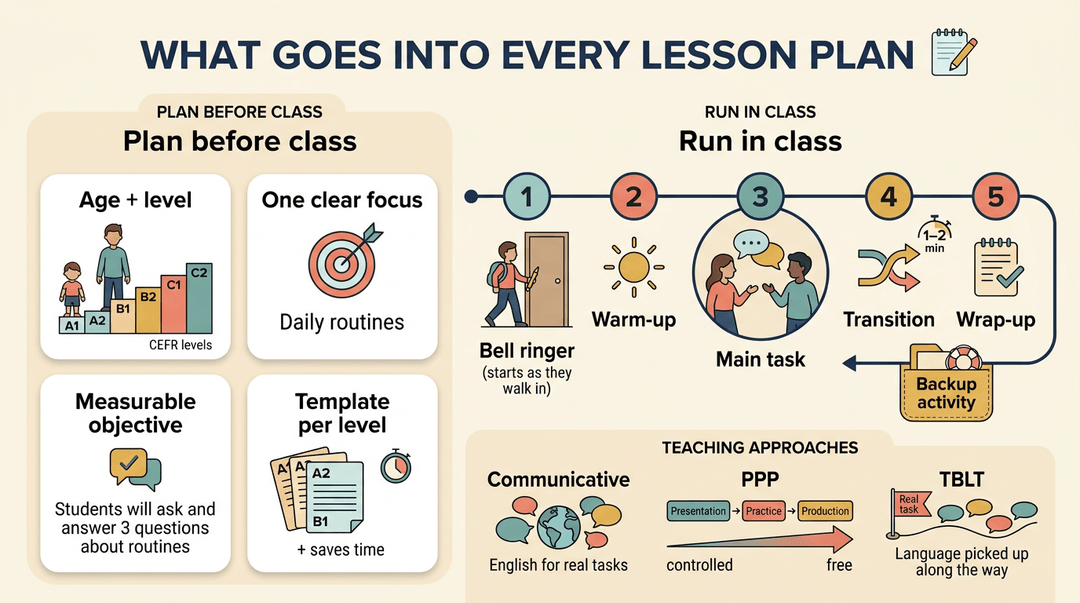
- Consider age and proficiency. A five-year-old and a sixteen-year-old need different activities. The Common European Framework of Reference (CEFR) sorts learners into six levels, A1 to C2.
- Pick a topic or grammar point. Choose one clear focus students can spot.
- Primary activity plus warm-up. Open with a short warm-up, then move into the main task.
- Time for transitions. Leave a minute or two to move or switch partners.
- Backup activities and bell ringers. Keep an extra activity ready, plus a bell ringer: a short task students start as they walk in.
- Write measurable language objectives. Name what students will do, such as 'ask and answer three questions about routines.'
- Reuse lesson templates by level. One template per level saves planning time.
The communicative approach guides much of this, putting English to work on real tasks. PPP (presentation, practice, production) moves from controlled practice to free use.
TBLT (task-based language teaching) starts with a real task and lets students pick up language along the way.
Skills to cover and games to try
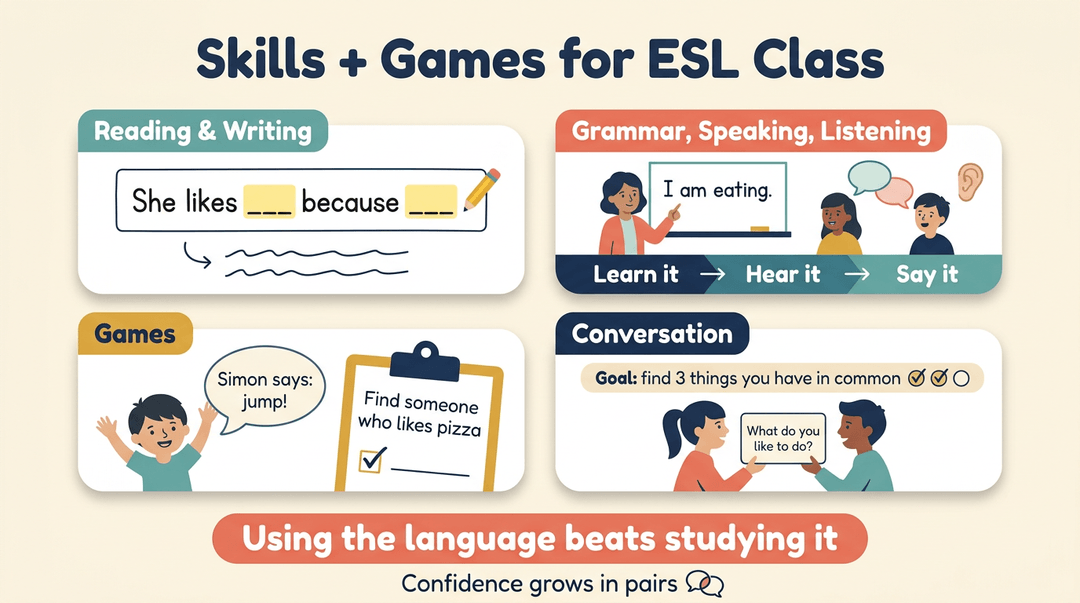
- Grammar, speaking, and listening. Teach grammar in context, then give students time to hear and use it.
- Reading and writing. Start with sentence frames like 'She likes ___ because ___' before open writing.
- ESL games and activities. Try Simon Says for commands or a 'find someone who' survey for questions.
- Conversation-based lessons. Give pairs a question card and a goal, like 'find three things you have in common.'
Games work because students are using the language, not just studying it. A high school student who freezes in front of the class often manages one partner and a question card. Confidence grows in pairs.
Websites and tools for lesson ideas
- ISL Collective and Teach This are worth browsing for ESL worksheets and lesson ideas.
- TeachersPayTeachers is a marketplace where teachers buy and sell classroom materials.
- Slidesgo offers customizable presentation templates for vocabulary slides.
- ChatGPT can brainstorm role-play scenarios for beginners, but check every suggestion before students see it.
Let these tools spark ideas. You'll still decide what fits your students.
Respecting Culture While Teaching Everyone
Your English learners bring their families, languages, and traditions into the room, and the strongest lessons build on them.
Respecting where students come from
Before you plan a unit, learn your students' backgrounds:
- what's spoken at home
- how they've been schooled
- the customs their families value
A short intake survey can reveal a lot.
Culture and grammar go hand in hand. Greetings, questions, and disagreements all carry cultural meaning, so treat those differences as part of the lesson.
Look for cultural integration opportunities that let students share their experiences. A fifth-grade teacher might ask students to describe a holiday from home using past-tense verbs. Everyone gets to be the expert on something.
Equity for multilingual learners is less about sameness and more about access. Language support should open doors, not lower the bar.

Teaching methods that include everyone
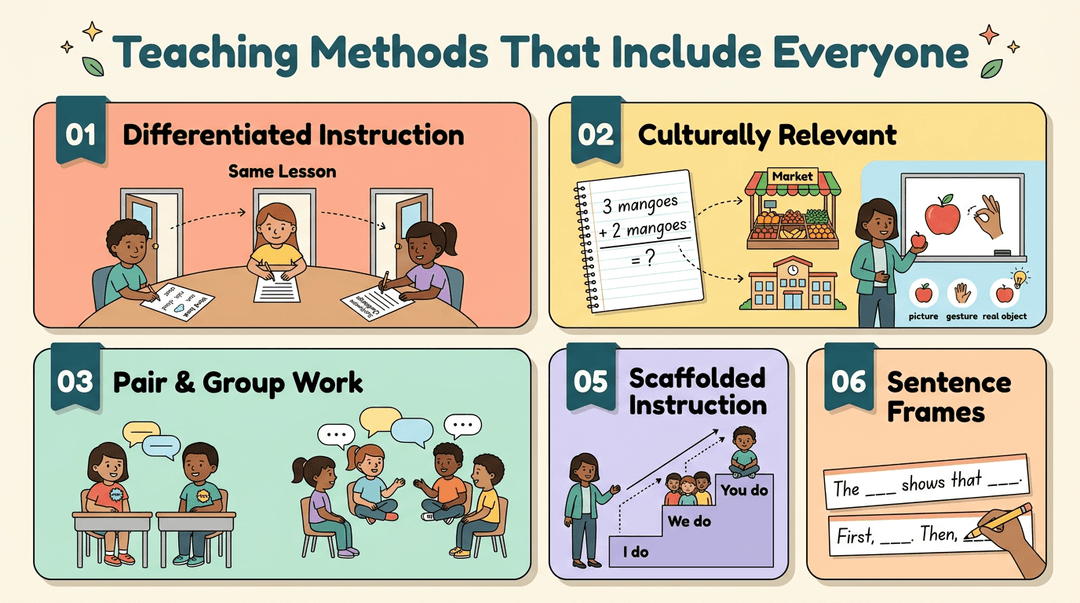
Start with differentiated instruction, which means knowing where each learner stands. Offer different entry points, such as a word bank for some learners and a sentence challenge for others.
Culturally relevant teaching ties lessons to students' lived experiences. Use local foods or community places in word problems and reading passages.
Collaborative pair and group work gives learners low-stakes chances to speak. A newcomer paired with a confident peer hears language in action.
Visual aids and multimodal resources, like pictures, gestures, and real objects, let meaning arrive before words do.
Scaffolded instruction breaks a task into manageable steps and gradually removes support. Picture a teacher modeling a science explanation, then guiding the class through it together.
Sentence frames give students a ready structure to speak and write, and they're easy to adapt:
- The ___ shows that ___.
- First, ___. Then, ___.
Keeping Order in the Classroom
Strong order makes every ESL lesson easier to teach. Here's how to set clear rules and pick tools that keep your room running.
Rules, rewards and consequences that work
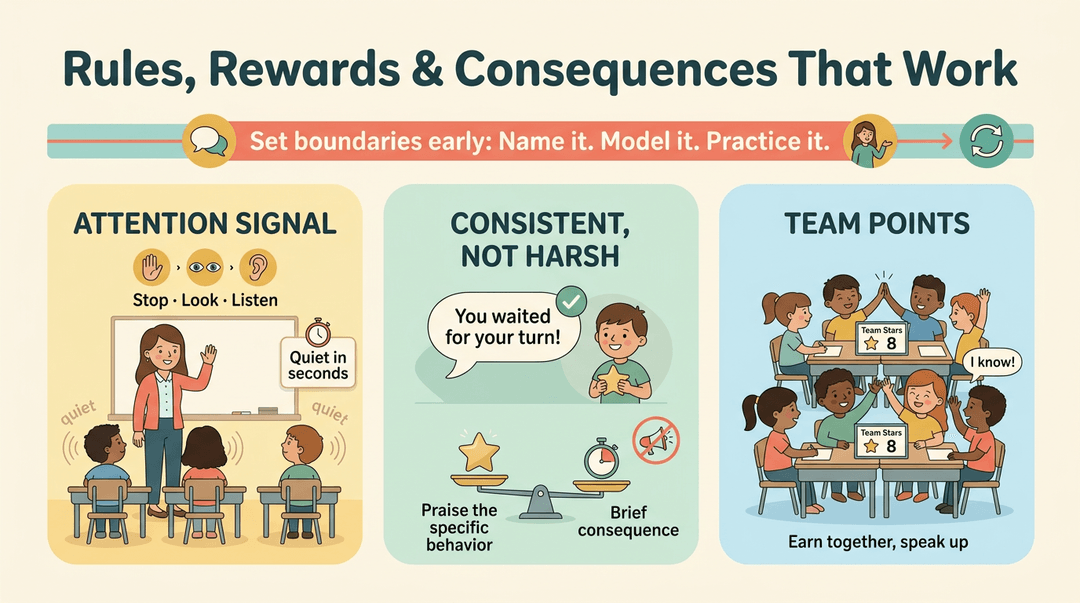
Set firm boundaries early, while routines are still forming. Name your expectations in simple language, model each one, and practice until it's automatic.
Attention-grabbing signals are short cues that say stop, look, and listen without raising your voice. Think of a second-grade ESL teacher who raises one hand and waits. Within seconds the room quiets, and she gets five more minutes of teaching.
Rewards and consequences work best when they're consistent rather than harsh. Praise the specific behavior, like "You waited for your turn," so students know what earned it. When a consequence is needed, keep it brief.
A team-based point system puts students in groups that earn points together. Peers cheer each other on, and quieter learners get a reason to speak up.
Tools that help you manage the room
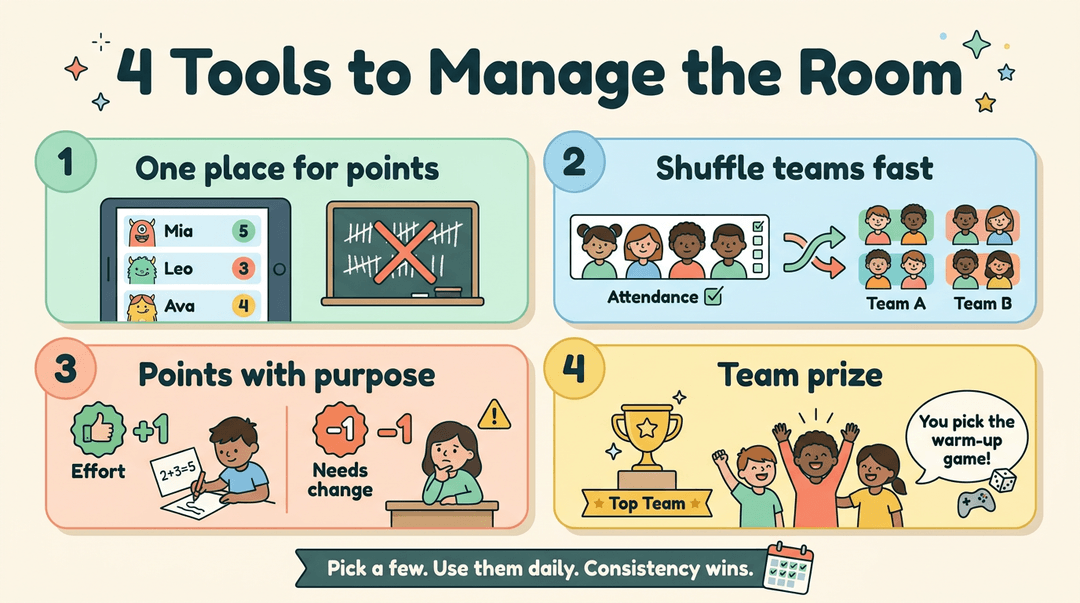
Four tools can make managing the room easier:
- ClassDojo app: This classroom app keeps points in one place, so you're not stopping mid-lesson to tally on the board.
- Random groups and attendance: A random group tool shuffles students into new teams in seconds, so the same confident speakers don't always pair up. A quick attendance check gets the lesson started sooner.
- Positive and negative points: Use positive points to celebrate effort rather than perfection. Save negative points for behavior you need to change.
- Prizes for top team: A small weekly prize gives teams a shared goal. Choosing the next warm-up game can be reward enough.
Pick a few, use them daily, and let routine do the work. Consistency wins.
Are ESL Teachers in Demand?
Demand for ESL (English as a second language) teachers isn't one story. According to MastersinEducation.org, job-market demand differs across public schools, private language schools, colleges, adult education, corporate training, and teaching abroad.
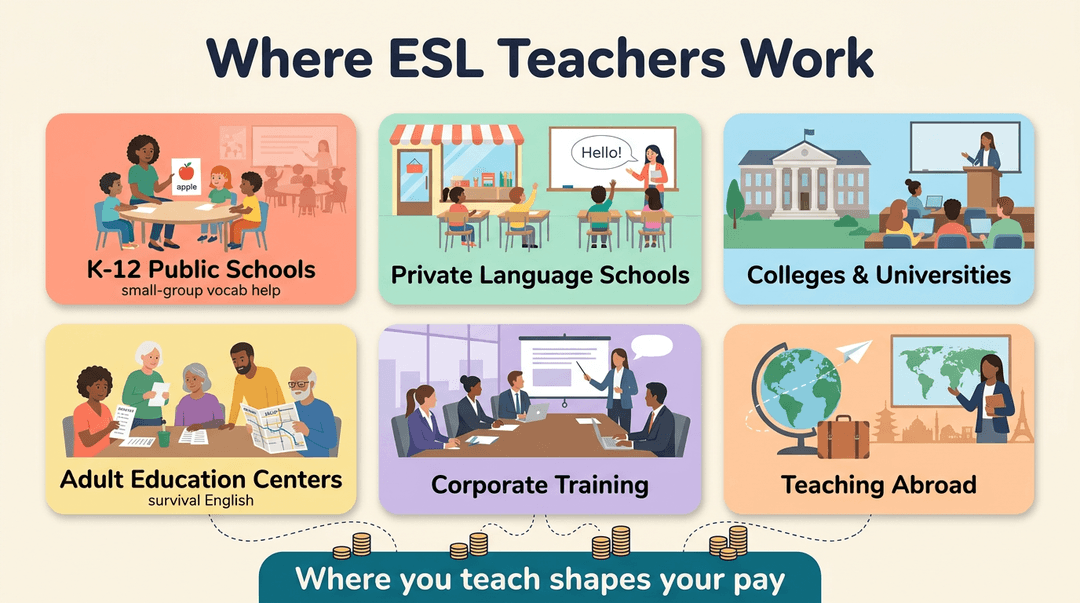
Places that hire ESL teachers
- K-12 (kindergarten through 12th grade) public schools: Think of a teacher who pulls three newcomers into a small group to build vocabulary, so they can keep up when the class moves on.
- Private language schools: Teaching English as the main focus of the job.
- Colleges and universities: Teaching English within higher education programs.
- Adult education centers: Instructors teach survival English to adult learners.
- Corporate employee training: Teaching English to working professionals.
- Teaching abroad: Working in schools or programs in other countries.
Pay follows the setting, too.
According to Watch Global Trends, there's no single national salary figure for ESL teachers, since the work spans public-school teachers, adult education, community colleges, private language schools, and contract instructors.
So it's where you teach that shapes your pay.
Other jobs you can move into
Several paths build on what you already know:
- Curriculum design: Creating the lessons and units other teachers use.
- Program administration: Coordinating an ESL program and its staff.
- Consulting: Advising schools or organizations on English learner support.
- Teacher training: Helping other educators sharpen their ESL methods.
- Specialized English niches: Focusing on areas such as business English or test preparation.
Keep growing your skills and career
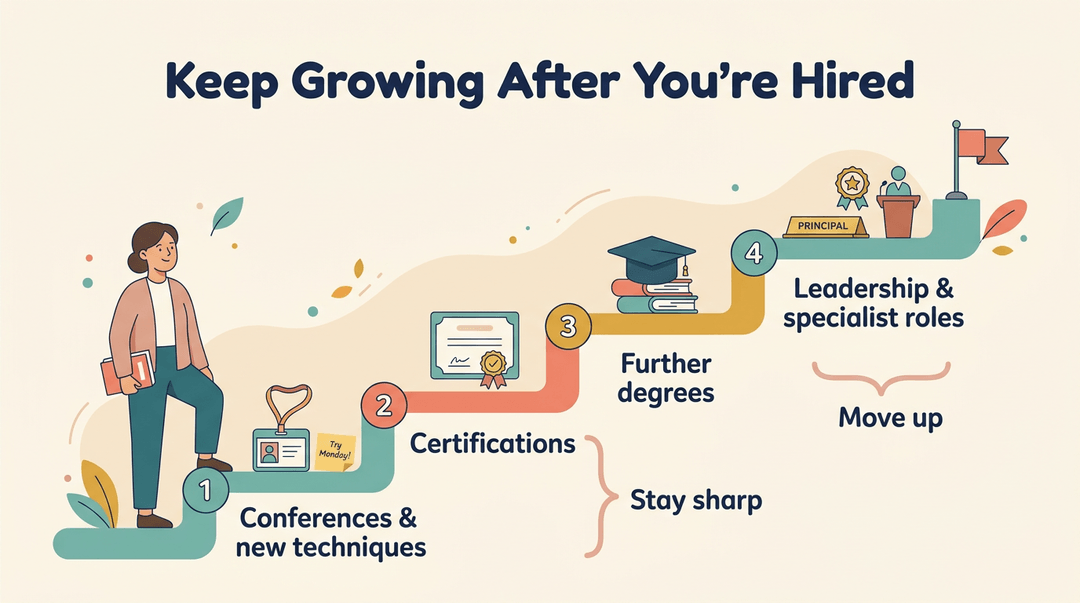
Learning doesn't stop once you're hired. Keep building skills that help you stay sharp in the classroom or move up beyond it:
- Conferences and new techniques: Pick up strategies you can use Monday morning.
- Additional certifications: Add credentials that strengthen your qualifications.
- Further degrees: Pursue an advanced degree when you're ready for more responsibility.
- Career advancement: Move into the leadership and specialist roles above.
Working as an Online English Teacher
Online English teaching, or ESL (English as a second language) work, can fit around your life, but it helps to know what to expect.
Perks and demand for online teaching
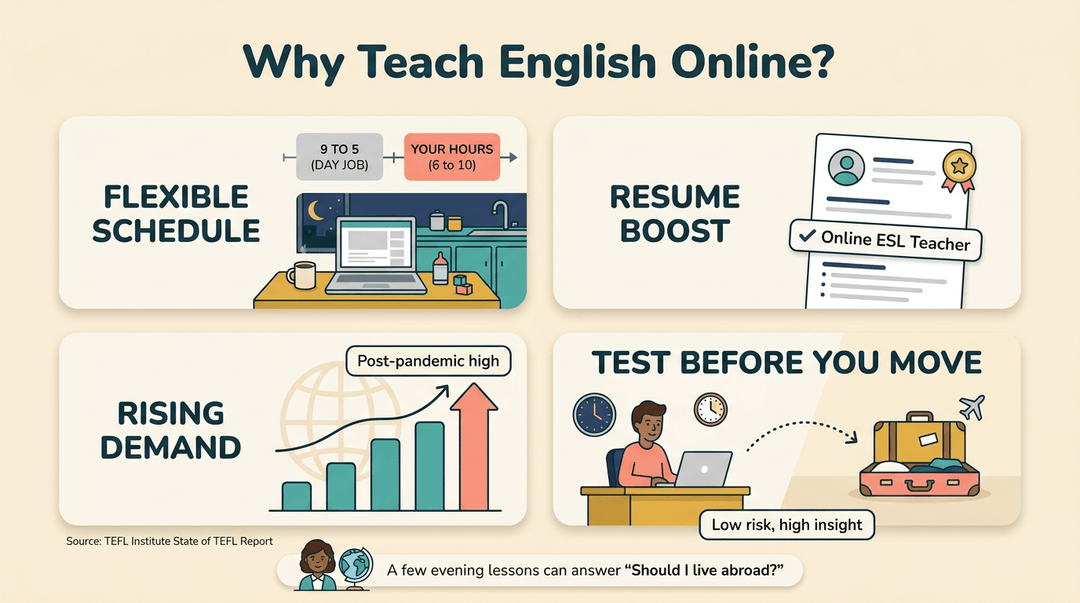
- Flexible schedule. Set your hours around a day job or family. This is less about how much you work and more about when.
- Resume building. Online classes add real teaching experience to your resume.
- Growing global demand. According to The TEFL Institute's State of TEFL Report, as covered by The Manila Times, demand for qualified online English teachers has surged to a post-pandemic high.
- Test the waters before moving abroad. Try the lifestyle, including the time-zone adjustments, from home first. Low risk, high insight.
Think of a first-year teacher curious about living overseas. A few evening lessons can answer that without packing a suitcase.
What you need to start teaching online
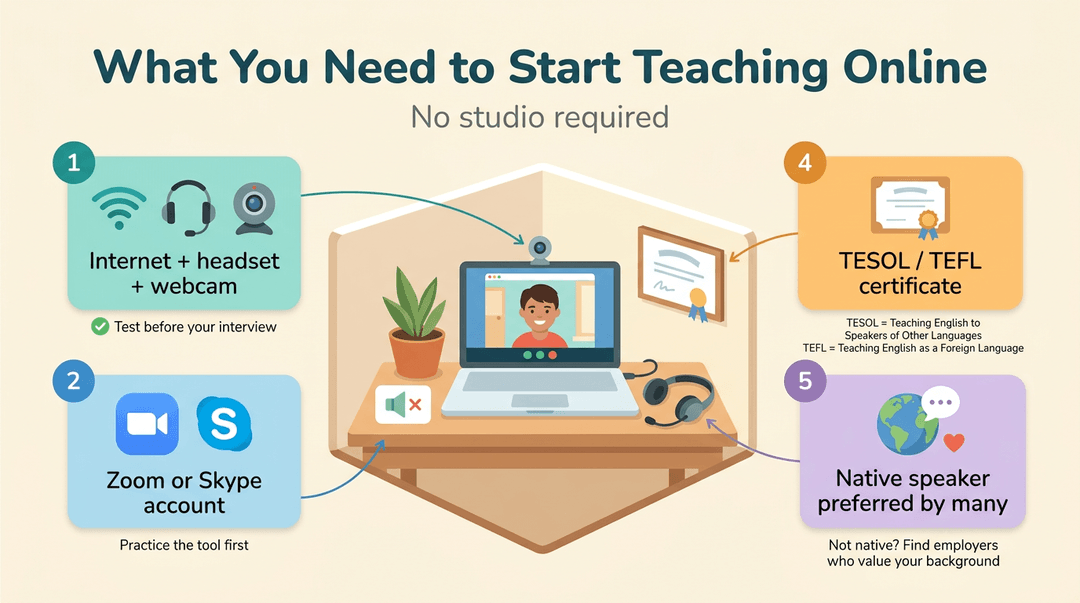
You don't need a studio, but you do need a few essentials:
- Reliable internet, a headset, and a webcam. Test everything before your first interview.
- A Zoom or Skype account. Get comfortable with the tool so setup doesn't eat into lesson time.
- A quiet teaching space. Background noise pulls attention away from the lesson.
- A TESOL or TEFL certificate. TESOL stands for Teaching English to Speakers of Other Languages, and TEFL stands for Teaching English as a Foreign Language. Requirements vary, but a certificate gives you a credential to point to.
- Native speaker preference. Many companies favor native speakers. If you're not one, look for employers who value your background.
Class types and what you can earn
Online English teachers can earn $10 to $40 USD per hour, according to TEFLcourse.net. Your rate depends on a few factors:
- 1-on-1 classes give one student your full attention.
- Group classes spread your attention across several learners.
- Bonuses and incentives can raise your earnings, so ask how they're earned.
Conversational lessons focus on speaking rather than grammar drills. Think of an adult learner practicing small talk before a trip abroad, with you as their patient partner.
Where to find online teaching jobs
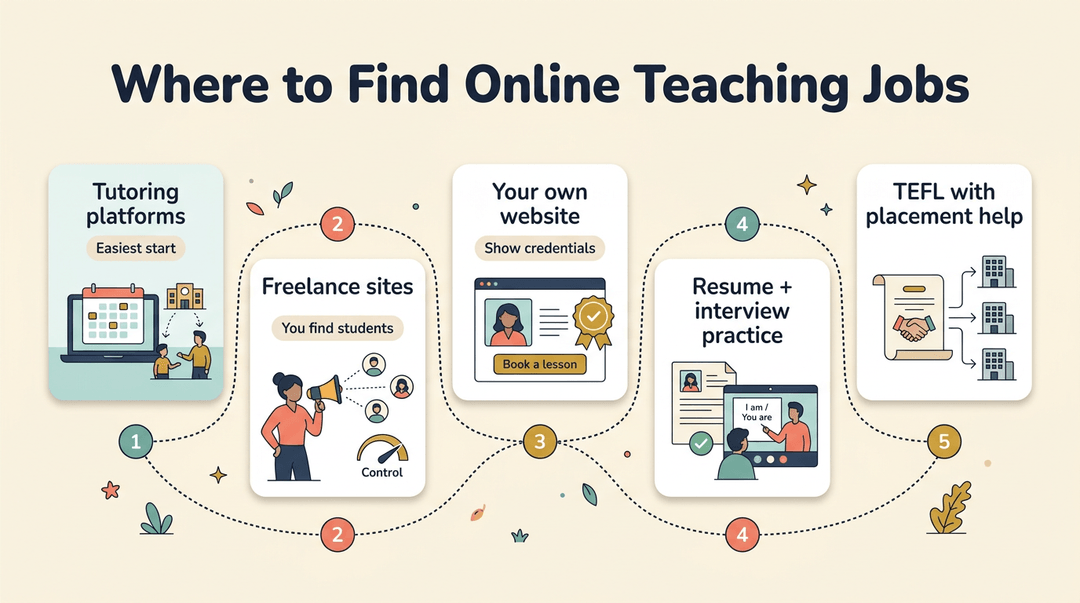
Knowing where to look saves time:
- Tutoring platforms. Companies hire teachers for scheduled classes, often the simplest start.
- Freelance tutoring sites. You find your own students, which means more control and more marketing.
- Personal website branding. A simple site with your credentials helps students find you.
- Application materials and interview. Polish your resume, then practice explaining a simple grammar point to a beginner.
- Choose TEFL with placement help. Pick a course that offers placement help, since that support can connect you with employers.
How to vet online teaching companies
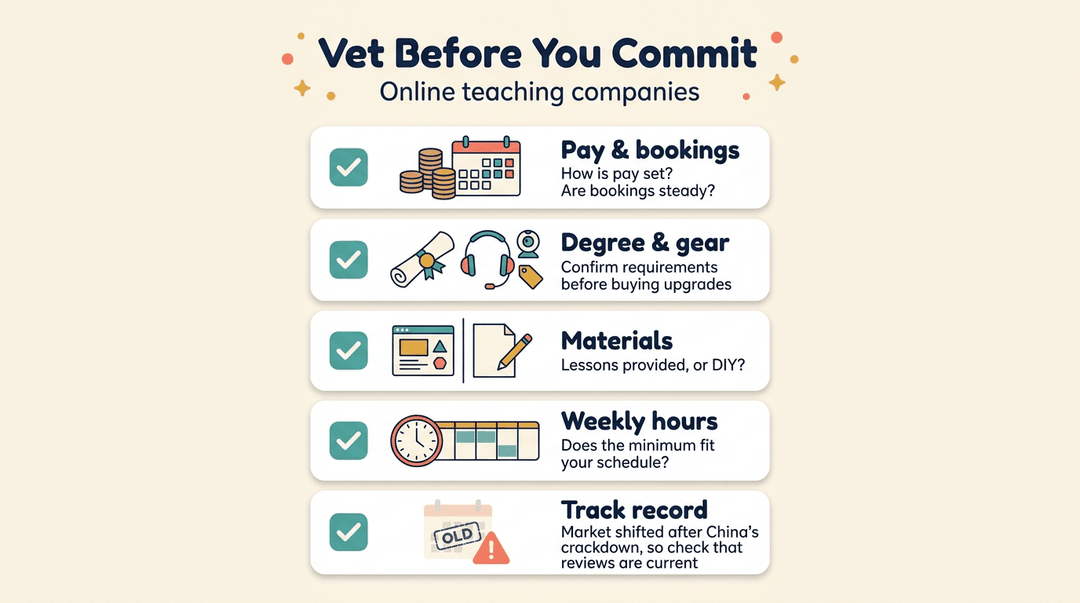
According to a journal article introducing private online language education, online English companies vary in pay, weekly hour requirements, qualifications, and the curriculum and materials they provide. Check these before you commit:
- Pay and consistency. Ask how pay is calculated and how steady bookings are.
- Degree and equipment requirements. Confirm what they require, such as a degree or equipment, before buying upgrades.
- Curriculum and materials provided. Some companies supply lessons; others expect you to build your own.
- Required weekly hours. Make sure the minimum fits your schedule.
- China crackdown shifted market. The crackdown in China shifted the market, so don't assume a company's track record is still current.
Remote ESL work tools and support
Once you're hired, the right tools keep lessons running smoothly.
- Videoconferencing and messaging tools. Learn your company's platforms so you can share screens and post links.
- Remote grading and support. Some companies offer grading tools and a support contact. Know who to reach when tech fails mid-lesson.
ESL teaching asks a lot of you: patience, cultural awareness, clear planning, and a steady hand with order in the room. Yet every moment a learner says something new in English makes the work worthwhile.
With clear goals and a repeatable planning process, even the busiest weeks get easier to manage.
Ready to save time on your ESL lessons? Check out our Lesson Planner to write, organize, and reuse plans across multiple classes from one place.

References
- How to Become an ESL Teacher: Certification, Degree & Salary — mastersineducation.org (2026)
- Introducing private online language education: Out‐of‐the‐shadows, technology‐powered foreign language teaching — doi.org (2023)
- How much can you earn as an online English teacher? — teflcourse.net (2025)
- Filipino teachers lead global online English teaching, according to new industry report — manilatimes.net (2026)
- ESL & International Teaching Jobs: Complete Career Guide — watchglobaltrends.com (2026)
Frequently asked questions
How much money can I make teaching English as a second language?
Online English teachers can earn about $10 to $40 USD per hour. Earnings vary by employer, location, teaching setting, qualifications, and how many hours you work; there is no single salary figure for all ESL teachers.
What qualifications do I need to teach English as a second language?
Requirements depend on where and whom you teach. A bachelor’s degree is commonly required, and public-school positions typically require state teaching certification; TEFL or TESOL certificates are common for private language schools and teaching abroad, while some online employers hire without a degree.
Are ESL teachers in demand?
Yes, ESL teachers are hired in public schools, private language schools, colleges, adult education, corporate training, and overseas programs. Demand varies by setting and location, and online English teaching is also a growing area for qualified teachers.