Cell Phones in Classroom Pros and Cons: A Complete Guide

Jump to section
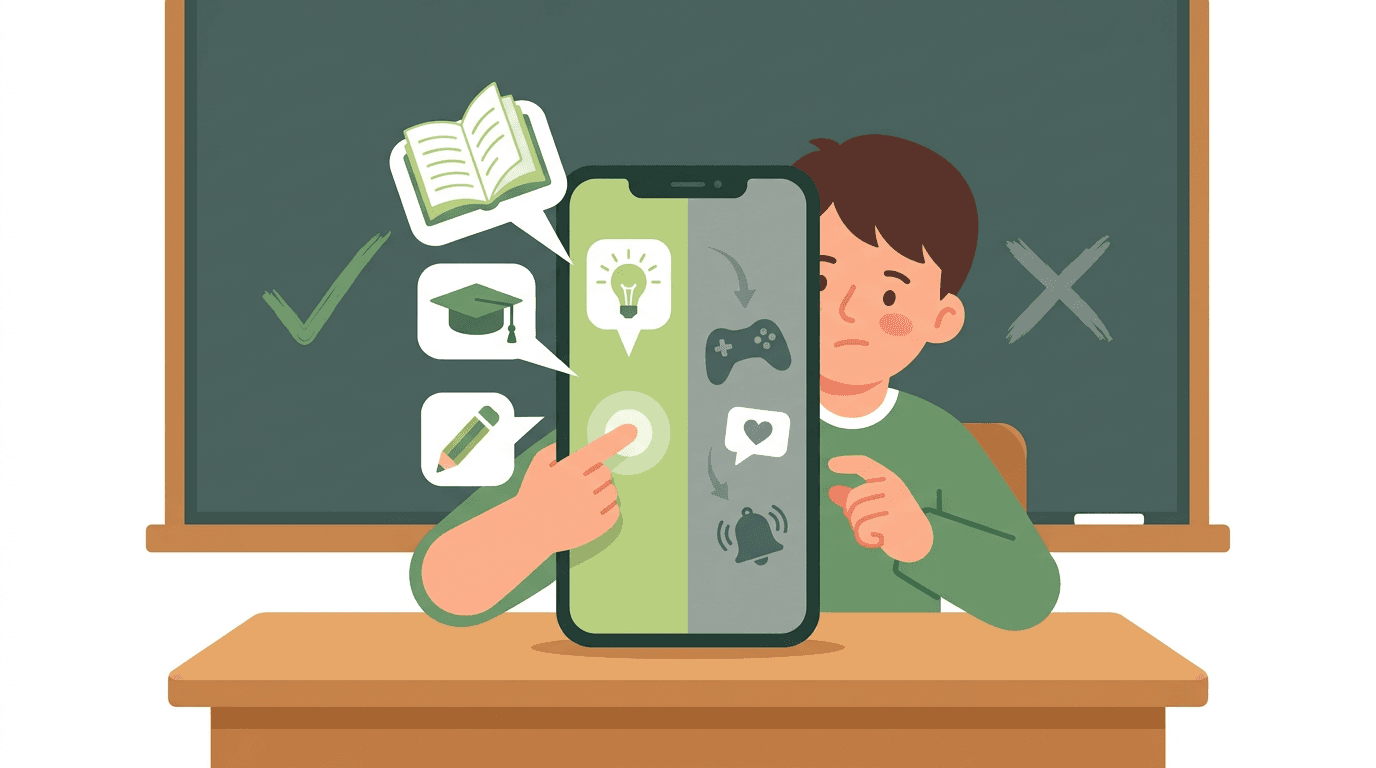
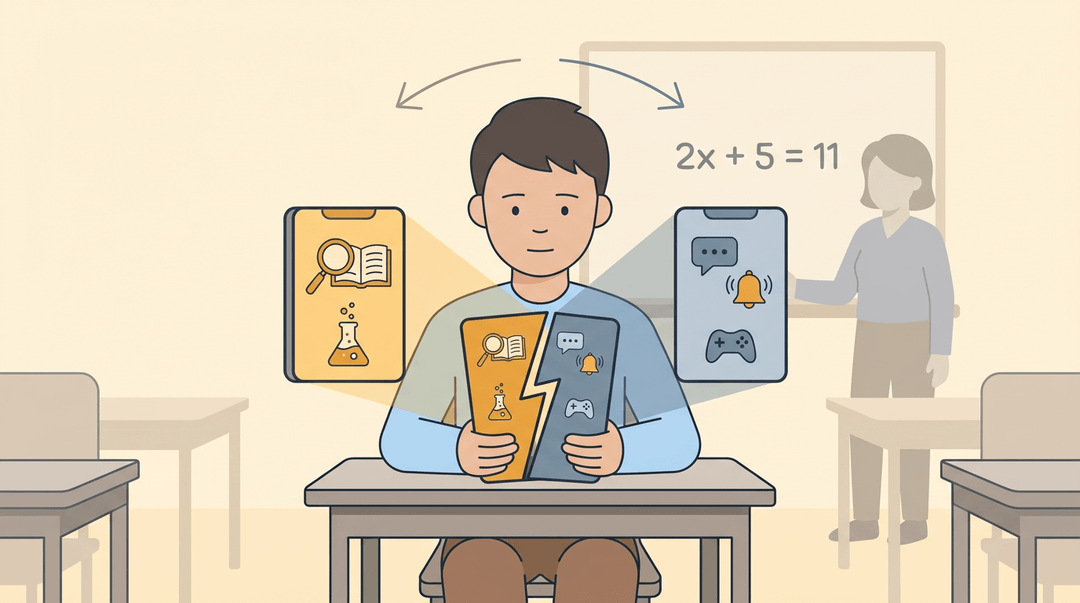
Picture a classroom where the phone in a student's pocket is a research tool one minute and a distraction the next. That tension sits at the heart of the cell phone debate.
You're likely seeing both sides every day: phones that help students look up a word or film a science demo, and phones that pull attention away from the lesson in front of them.
So, are cell phones good or bad for learning? The honest answer is that it depends on how they're used, and when.
This post covers the major pros and cons, from academics and safety to mental health, bullying, equity, and policy, then gives you a practical toolkit for building a classroom phone policy that works.
Cell Phones in Class Pros and Cons
The real question is less about whether phones matter and more about when they do.
How phones distract students in class
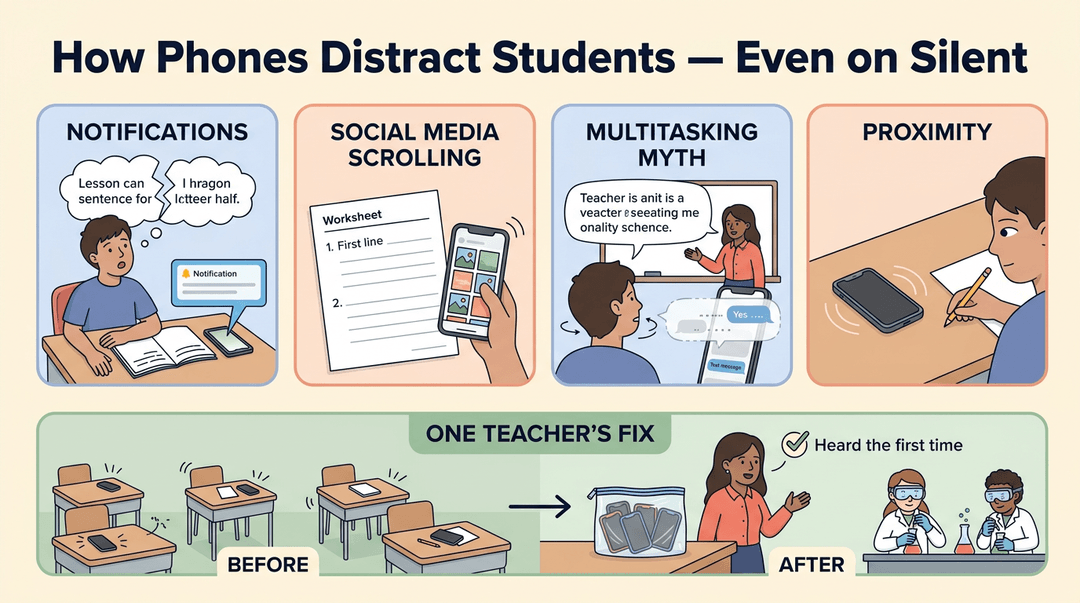
Even a silent phone pulls on attention. Common culprits include:
- Notifications that break a lesson mid-thought
- Social media scrolling during independent work
- Students who think they can multitask but can't keep up with both the lesson and the feed
- Proximity alone: a phone on the desk distracts, even face down
Consider a science teacher who has students bag their phones before labs. Her directions get heard the first time, and nobody is hunting for a buzzing screen.
Banning phones can boost test scores
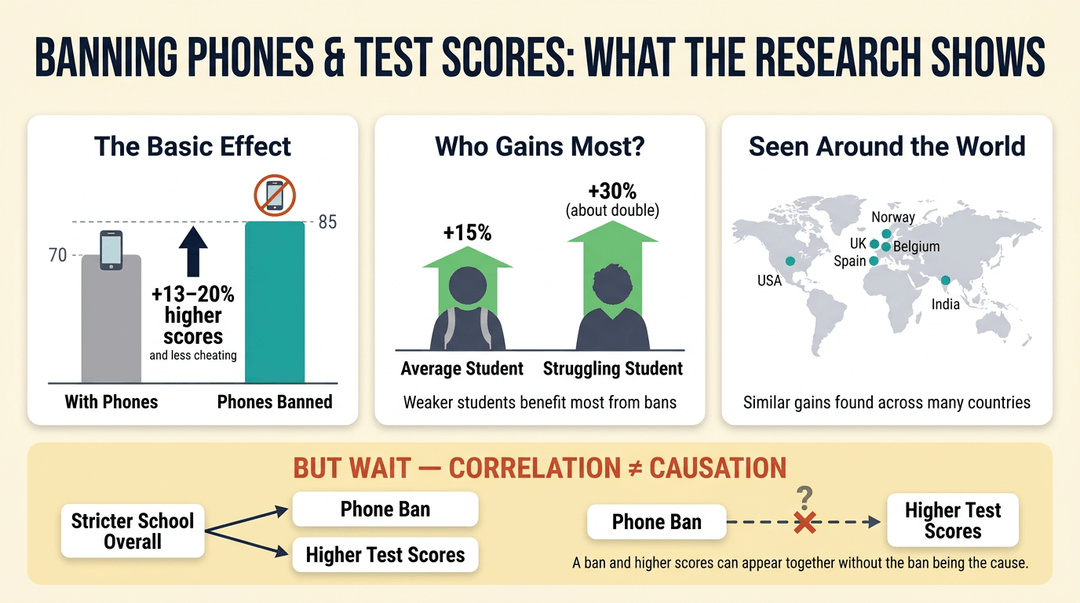
Some studies report exam gains of roughly 13 to 20 percent after bans, with less cheating.
Carleton University reports similar effect sizes in Spanish and Norwegian research, and Spanish press coverage summarizes Belgian, Spanish, and British findings with the biggest gains for weaker students.
A Wharton analysis found that struggling college students saw roughly double the average grade uplift, and an Indian study reported gains in non-STEM subjects.
Keep one caution in mind: bans and higher scores appearing together doesn't prove the ban caused the gain. That's the correlation versus causation gap, and it's worth remembering before you cite any single result.
Why devices hurt learning in general
The OECD warns that excessive leisure use of technology "can also negatively impact learning outcomes by reducing focus and engagement." UConn researchers found that students who multitasked often in class had lower grades.
Multitasking also weakens retention, so attention is the bottleneck.
How Phones Support Learning and Digital Skills
Phones can do more than sit in a backpack, and here's where they really help.
Why should cell phones be allowed in school?
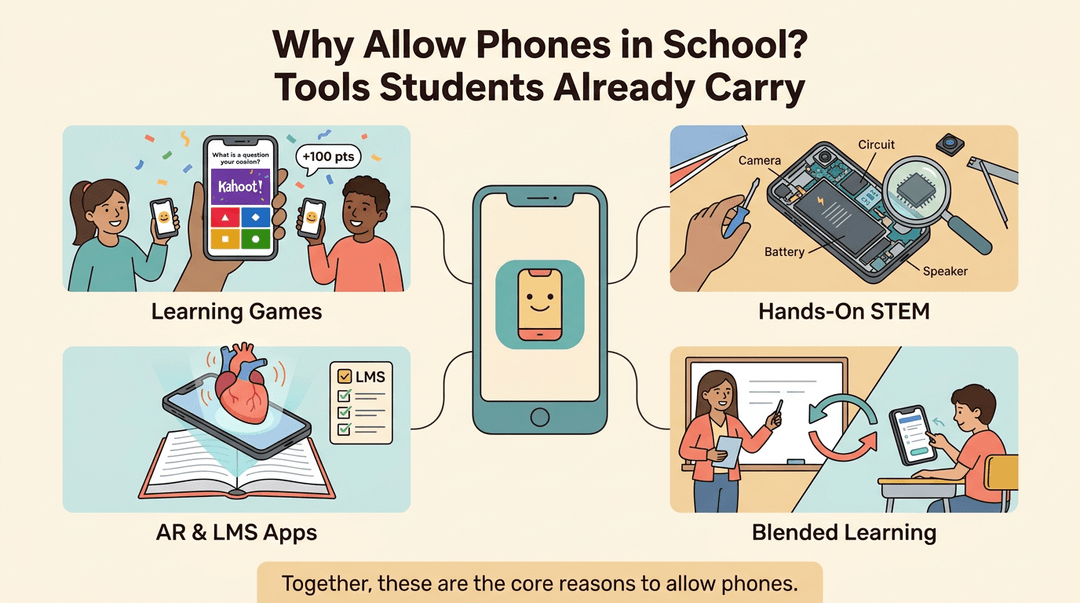
Phones give you tools your students already carry:
- Learning games. Kahoot and Wordle turn review into a quick game.
- Hands-on STEM. Students can explore the parts inside a phone.
- Augmented reality (AR) and learning-management system (LMS) apps. A study of AR in secondary STEM notes that AR applications keep growing and have potential in education.
- Blended learning. Phones let you mix screen and face-to-face work in one lesson.
Together, these are the core reasons to allow phones.
Teaching students responsible phone use
ISTE puts it plainly: digital citizenship "is about more than online safety." It's about teaching responsible technology use.
Teach when and how phones are appropriate, and build self-regulation, the habit of putting a phone away when it isn't helping.
Try a ten-minute mini-lesson: students sort scenarios like "look up a fact" or "scroll during a quiz" into use it now or hold off.
Why banning phones risks tech skills
A ban can shield students from some risks, but it can also leave them at a tech disadvantage.
Students need critical tech skills, the ability to judge what they find and use tools with purpose. The goal is to teach students to use technology well, not just to avoid it.
UNESCO frames educational technology as carrying both risks and opportunities, which should shape your policy.
Build Your Classroom Cell Phone Policy
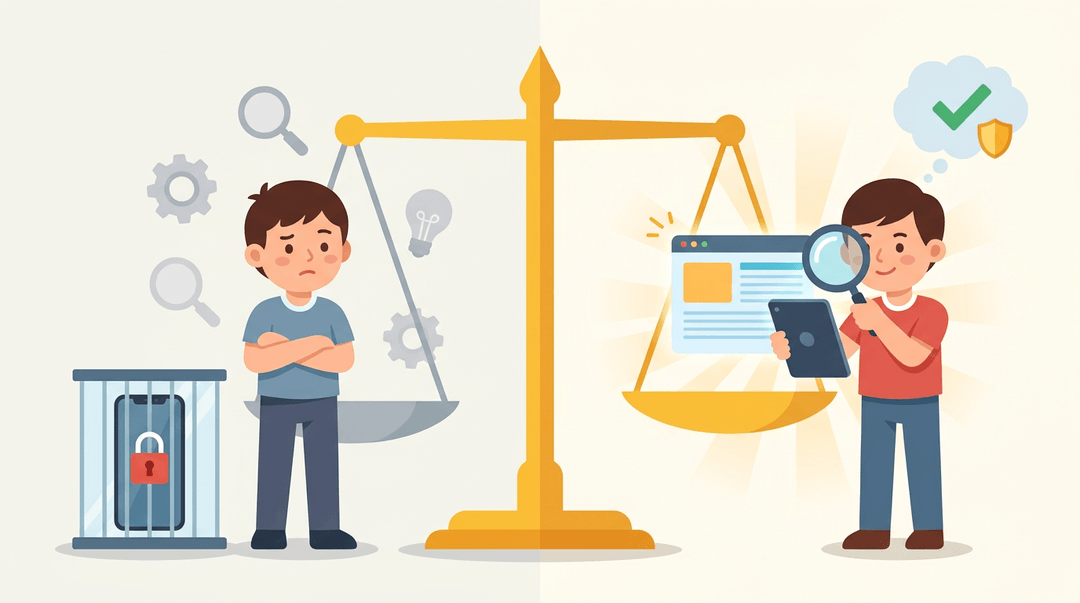
Use this guide to turn "it depends" into a one-page policy you can post, send home, and enforce the same way every day. Work through the four decisions in order.
Check your context first
Before you write a word, confirm three things:
- Grade level: younger students may need phones fully put away; older ones can handle set use windows.
- School-wide rules: your policy has to fit inside them, so read the handbook first.
- Parent expectations: many families want a way to reach their child, so plan for that now.
Pick a storage method
Choose one method and use it every single day. Consistency matters more than which one you pick.
| Method | Works best when | Watch for |
|---|---|---|
| Pouches or lockers | You want phones fully out of reach | Setup time at the start and end of class |
| Phone caddy stations | You want a visible, low-cost option | Students forgetting to grab phones back |
| Desk-pocket system | You use phones for short tasks | Phones in view still tempt students |
Write the expectations
Fill in three slots. Keep each one short enough to post on the wall.
Allowed use times. Name them by activity, not by minute.
- Try: "Phones stay in storage during instruction. They come out only when I announce a task."
Consequence tiers. Make them calm, predictable, and the same for everyone.
- Give a quiet reminder. The phone goes back to storage.
- Hold the phone for the period. It returns at the bell.
- Contact a parent. A short note or call, no lecture.
- Refer to the office. Follow your school's rules from here.
Emergency exceptions. Say them out loud so students never have to guess.
- Say: "If you need to reach home, ask me and we'll handle it together."
⚠️ Watch out: Only list consequences you'll really follow through on. A tier you skip teaches students the whole ladder is optional.
Share your policy with parents
Families follow rules they understand. Send the same message three ways.
Syllabus policy line. One sentence they can't miss:
"Phones are stored at the start of class and used only when the teacher announces a learning task. Families who need to reach a student can contact the school office."
Parent notice letter. Keep it to a few lines covering:
- The rule: where phones live and when they come out.
- The why: one sentence on focus and learning.
- The exception: how you handle emergencies.
- Your contact: how to reach you with questions.
First-week reminder routine. Repeat it until it's automatic:
- Post the policy on the board. Point to it as students enter.
- Rehearse storage on day one. Practice the drop-off and pickup.
- Restate the rule before each phone task. Say it, then start.
Example: A seventh-grade teacher uses caddy stations. On day one, students practice placing phones in the caddy and retrieving them at the bell. By Friday, the routine takes under a minute, and the parent letter has already answered the first emails.
Drop your phone-policy rules and routines straight into each day's agenda with EMStudio's online lesson planner.
Cell Phone Bans Around the World
Phone rules look very different from one school to the next. Here's where things stand, why a phone ban is harder to carry out than to write, and how teachers feel about it.
How widespread are school phone bans
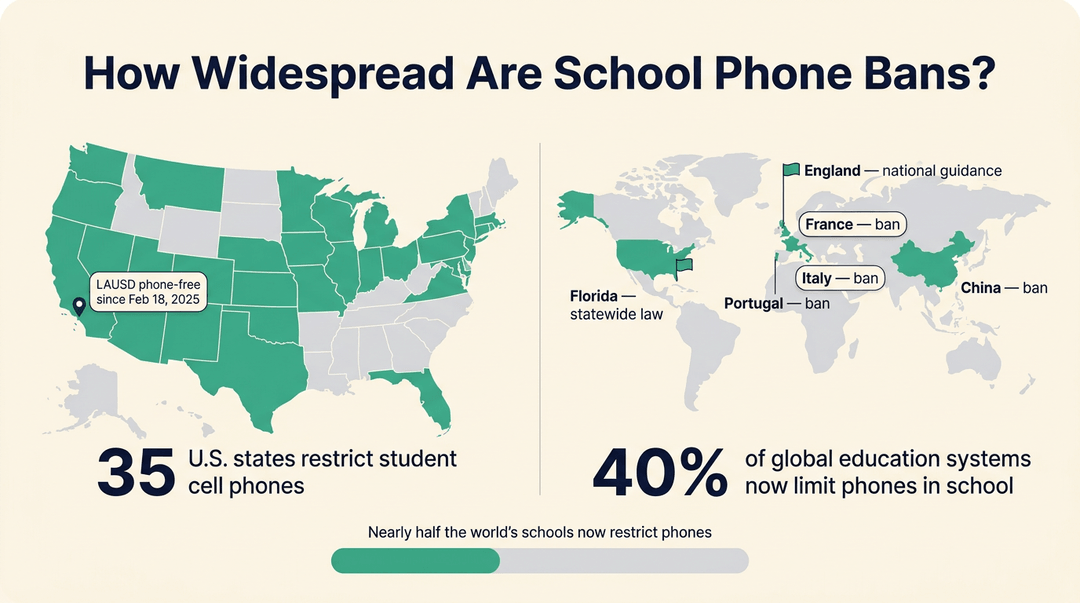
Restrictions are no longer rare. Thirty-five U.S. states have rules on student cell phones. The Los Angeles Unified School District (LAUSD) put its own ban in place on February 18, 2025.
Florida has gone further with a statewide law, England has issued guidance, and France, Italy, Portugal, and China have all set bans of their own. Globally, roughly 40% of education systems now limit phones in some way.
Why enforcing phone bans is hard
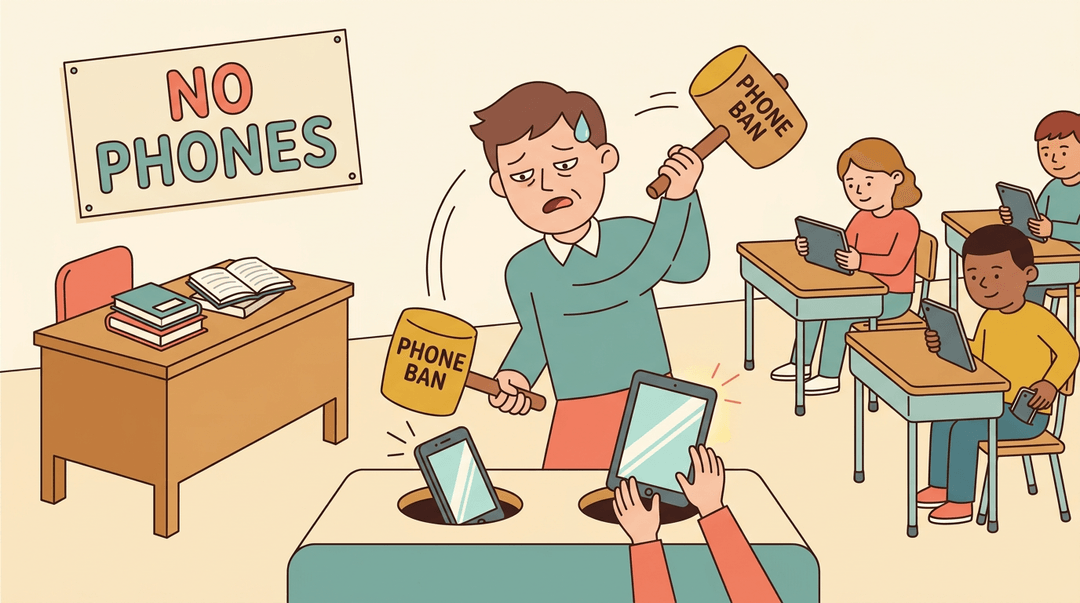
Writing a ban is the easy part. Enforcing it is where teachers feel the strain. Every rule adds to your workload, and phones are hard to police when a student can slip one out of a pocket in seconds.
Here's the catch: laptops and tablets still pull attention too. Picture a seventh-grade English teacher who bans phones, only to see the same students scrolling a tablet during reading time. The problem moved. It didn't disappear.
New York City's history with its own ban, including a repeal, shows how hard it is to keep a rule in place when the daily work falls on teachers.
Alternatives to an outright phone ban
Many schools are finding middle ground with options like these:
- Magnetized pouches that keep phones locked away during class
- Phone-free zones in specific areas, such as lunch tables or hallways
- Structured use during instruction, where phones come out only for a set task
- District-level discretion, letting each school choose what fits its students
Here's a routine you can copy. Students place phones in a labeled caddy at the door, you check the roster, and phones go back at dismissal. The payoff is that you spend your minutes teaching instead of chasing.
How do teachers feel about phones in class?
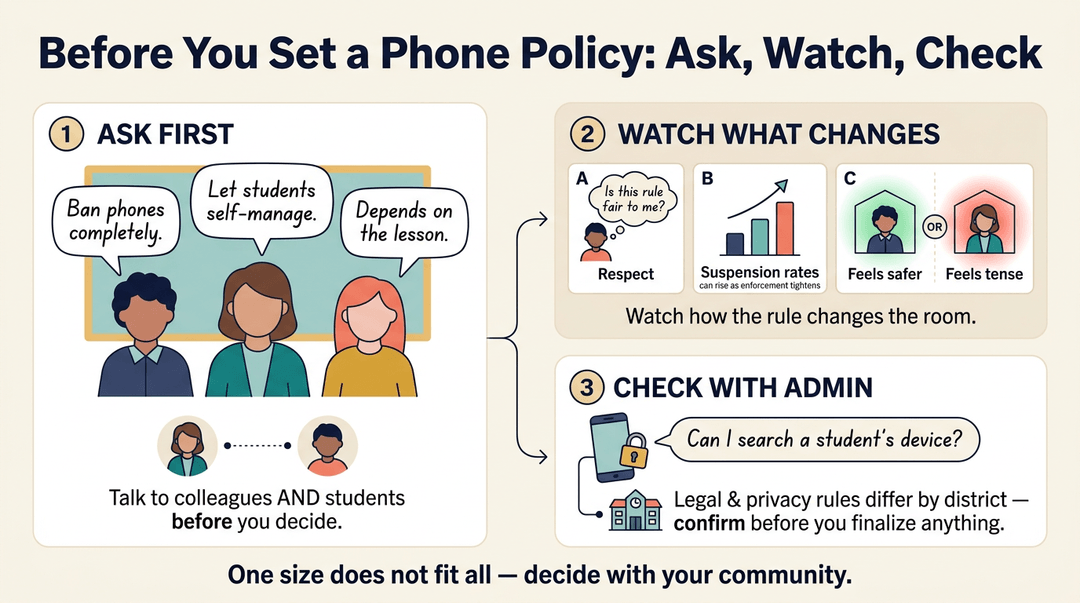
Opinions among teachers vary, so ask your colleagues and students before settling on a rule. Enforcement can shape school culture, and the question of respect comes up often: do students see the rule as fair?
Suspension rates are one thing to watch as enforcement tightens, and many teachers also notice how a rule changes the way they feel about safety in the room.
Before you finalize anything, check with your administration on legal and privacy questions, such as searching a student's device, since liability rules differ by district.
Phones as a Safety and Emergency Tool
When a lockdown drill starts, the first question many parents ask is simple: can I reach my child? Phones sit right at the center of that question, and they create a real tradeoff for school safety.
Phones as a lifeline in emergencies
For many families, a phone is the fastest way to contact parents in crisis. Parents may view student phones as an emergency communication lifeline, particularly amid fears about school shootings.
Research on social ties during crises backs this up: cell phones were the most heavily used communication technology by a majority of respondents, for both calls and texts.
- Parent peace of mind. Knowing a child can text home can ease a parent's worry on a hard day.
- School shooting fears. These concerns are a major reason parents want phones within reach.
- Broad support for safety. 67% of parents support student phone access for safety.
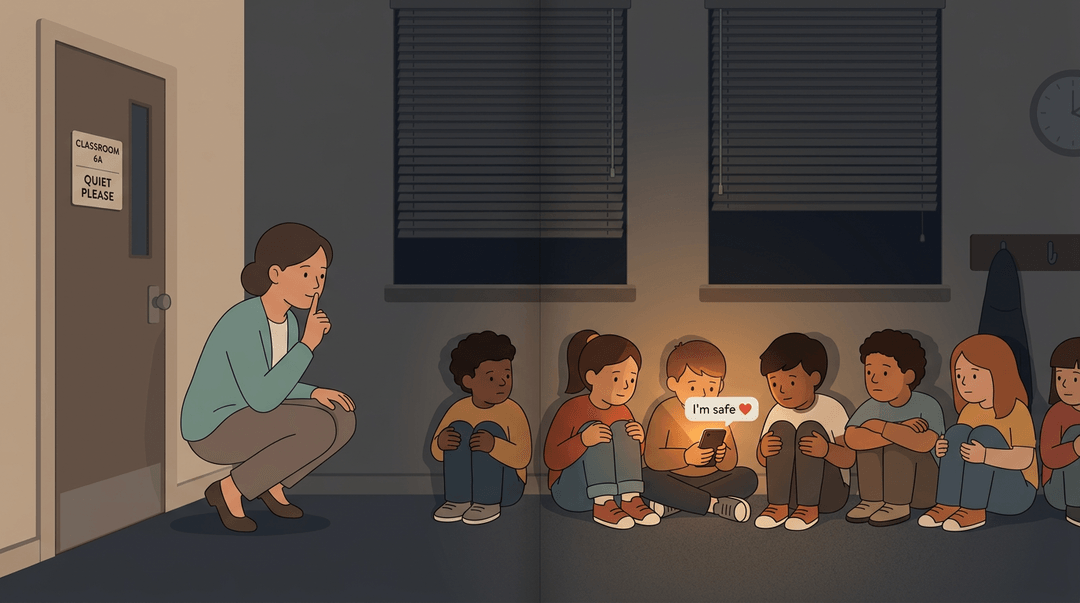
Phones may be a distraction during class, but in an emergency they can be a lifeline. Think of a sixth-grade teacher during a lockdown drill, keeping students quiet and out of sight.
A student who needs to tell a parent they're safe can do it in seconds, without the teacher stopping to hunt for a hall pass.
Safety tradeoffs when banning phones
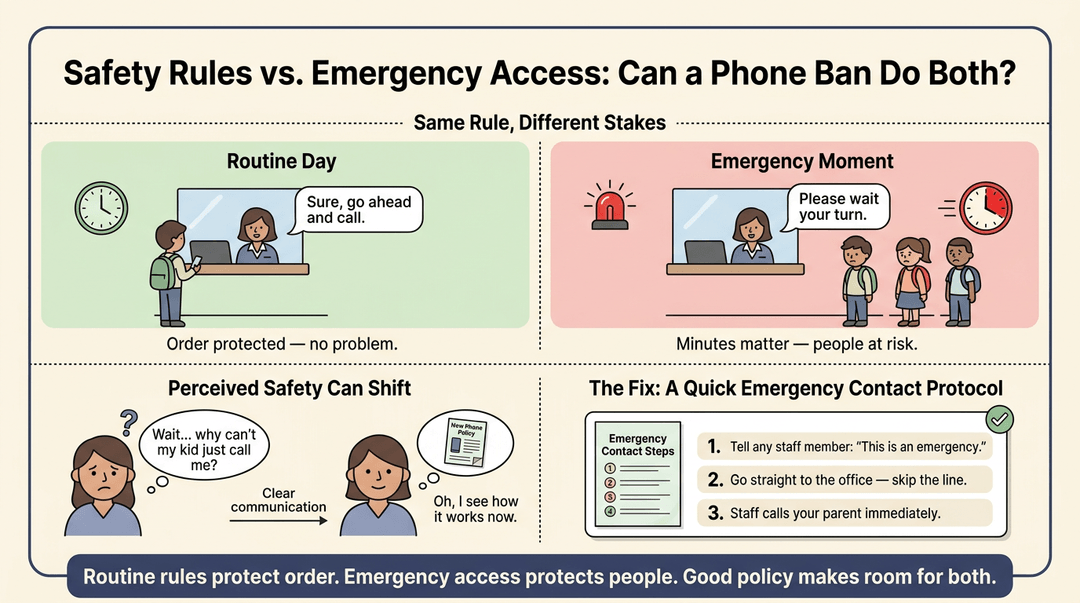
A ban is simpler to enforce, but it comes with a tradeoff. Schools often rely on routine safety procedures, such as requiring front-office permission before a student can call home.
Those rules make sense day to day, yet they can slow a student down when minutes matter.
- Day-to-day safety vs. emergency safety. Routine rules protect order, while emergency access protects people. Good policy handles both.
- Perceived safety. Families' sense of security can shift when a phone policy is put in place or lifted, so communicate changes clearly.
- Quick emergency contact protocol. A short, written path for students to reach the office or a parent fast keeps safety rules and emergency access working together.
Safety rules and emergency access don't have to compete.
Cell Phones and Cyberbullying at School
The rules around phones often matter more than the phones themselves. Here's what the evidence says about cyberbullying, harassment through texts, apps, and social media.
How banning phones cuts bullying
In Spain's Valencian Community, cyberbullying cases fell 60 percent after a phone ban, according to a report in ABC. A Norway study found lower bullying for both girls and boys.
In England, new Department for Education guidance backs head teachers in banning phones all day, break times included, to tackle disruptive behavior and online bullying.
In Florida, Timber Creek saw incidents decline after a policy change. Fewer phones meant fewer chances to pile on.
How phones can fuel bullying
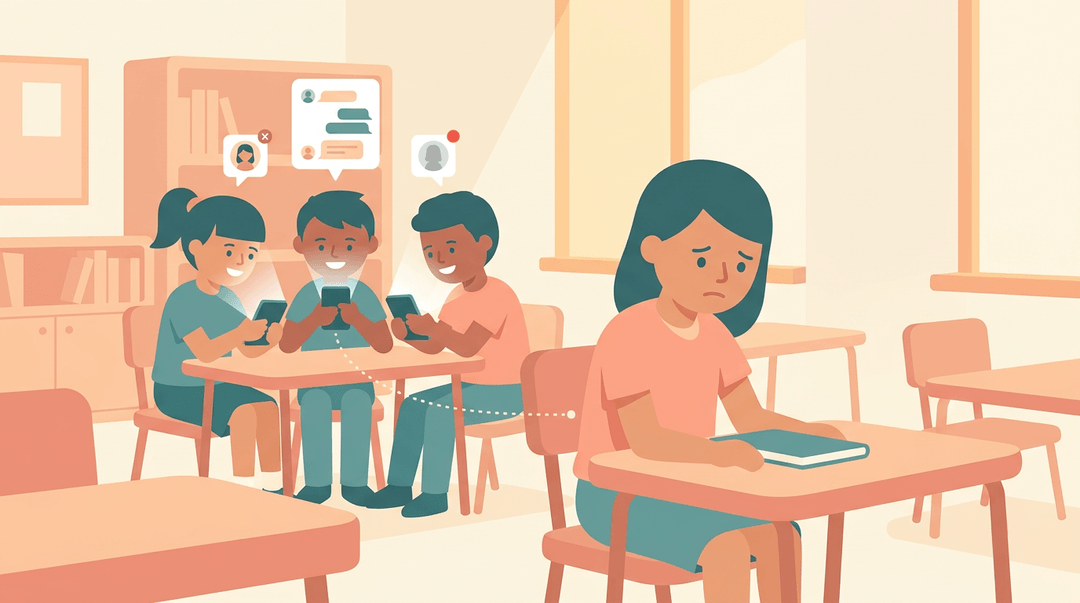
Group chats let a rumor reach a whole grade in minutes. Picture a sixth grader left out of one: the hurt follows her into class the next morning, even if nobody says a word in person.
Pew Research Center reports that 59% of teens have been cyberbullied. Filming classmates adds another risk, since a clip can spread far beyond the hallway.
Not every number agrees. NCES cyberbullying data conflict with some other surveys, and researchers comparing cross-national surveys have found big gaps in bullying rates within the same countries.
Cell Phones and Student Mental Health
Mental health is one of the biggest reasons teachers and parents argue about phones, so it's worth looking at what the research actually says. Here's how screens, anxiety, and face-to-face time connect.
How screen time affects mental health
For many students, school is one of the few places the day isn't built around a screen, which makes it a natural break. The trouble starts when use runs too high.
A review in PubMed Central (PMC) notes that excessive screen time can harm both physical and mental health.
Concerns go further: a review of child development research raises the possibility that heavy screen use may affect cognitive, linguistic, and social-emotional growth.
The biggest risk is addictive use, meaning phone use that's hard to control. A Weill Cornell Medicine study found that teens with high addictive use of social media, phones, or video games faced roughly double the risk of suicidal behavior.
The finding turns on addictive use, not total screen time.
Less anxiety when phones are away
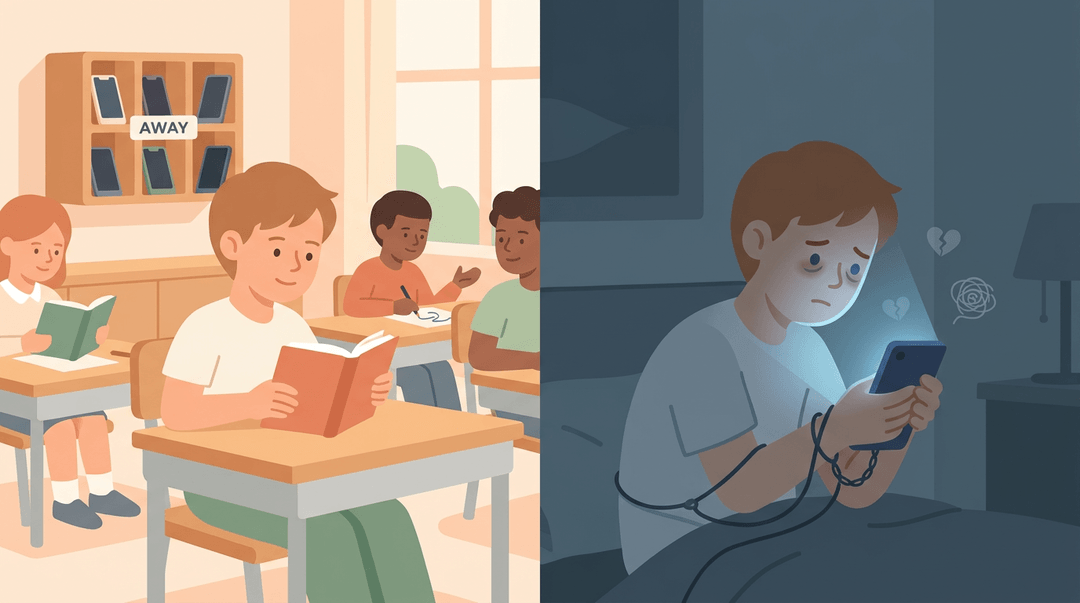
Picture a seventh-grade teacher whose quietest students stop hiding behind their phones once those phones are stored for the day. She can call on them without the whole room tensing up.
NPR reports that educators at schools with phone bans saw more student participation and watched student anxiety plummet, mainly because students weren't afraid of being filmed and embarrassing themselves.
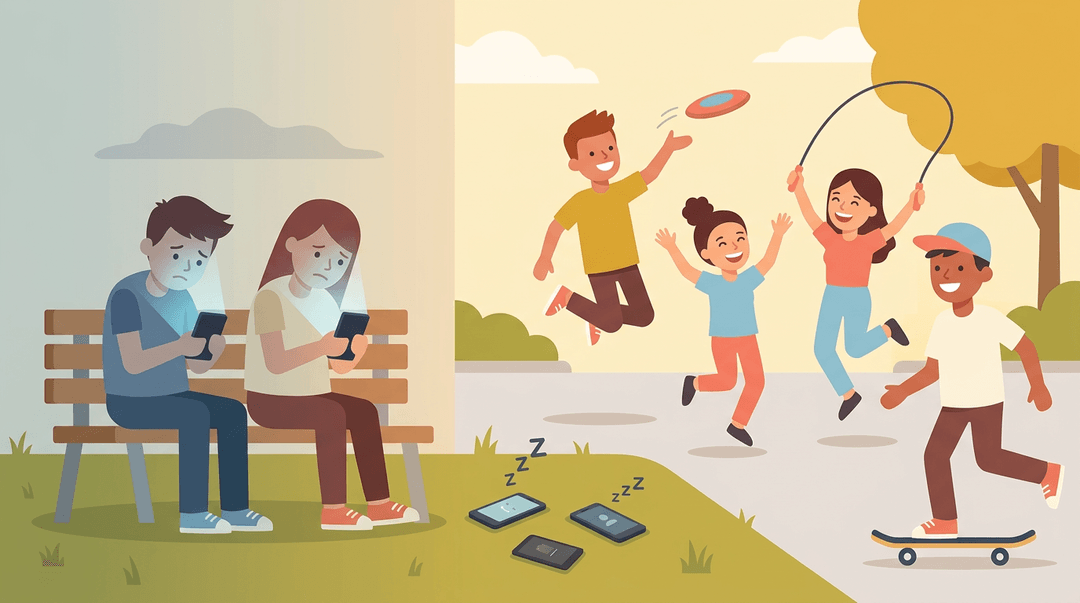
More activity and interaction without phones
Less screen time creates room for movement and conversation. A CDC study of US teenagers found that those with higher non-schoolwork screen use were more likely to be infrequently active. They were also more likely to report:
- depression and anxiety symptoms
- weaker social and emotional support
- irregular sleep
Phones aren't the only factor, but less scrolling means more talking and more time moving.
Equity and Access Issues with Phones
For some students, the phone isn't a distraction so much as a lifeline. Before you decide what a policy should look like, it helps to understand who relies on these devices and why.
Why some students rely on phones
For many students, a phone is their only connection to the internet. Educators often call this mobile-only internet access: the family has a phone data plan but no home broadband or computer.
A student in this situation may try to finish a homework portal assignment on a small screen.
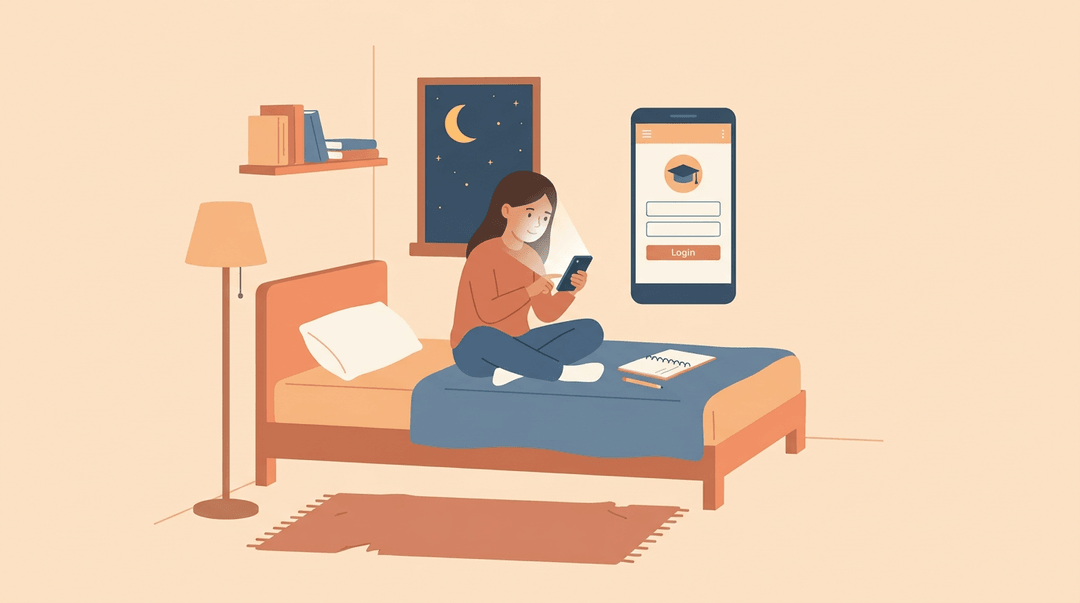
Some families also can't afford laptops or tablets. When a phone is the only device at home, it becomes the tool for research, assignments, and, increasingly, online classes. Consider a high school junior taking a credit-recovery course at night.
Her phone is the only way she can log in, so a blanket ban would cut off her coursework.
That's why equity concerns come up so often with bans. A rule that looks fair on paper can hit the students with the fewest resources the hardest. Policies work best when they're designed for the student who has the least. Students who need extra support can also benefit from classroom accommodations.
Phones help with jobs and family duties
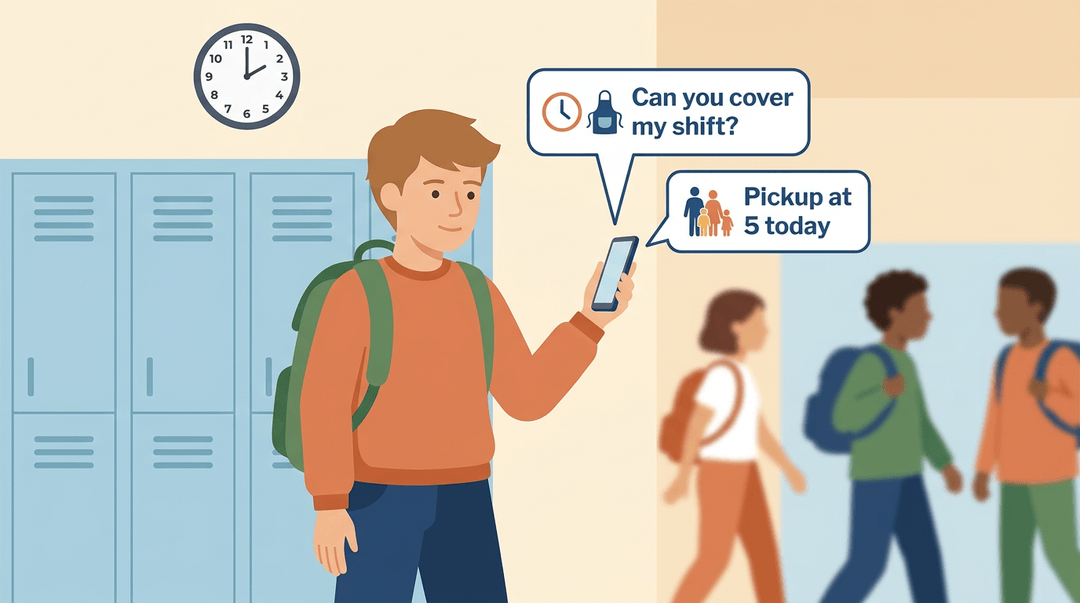
Many students hold jobs, and their schedules don't always fit around the school day. A teen checking shift times or swapping a shift with a coworker is handling real adult responsibilities.
Blanket bans can punish these working students for obligations they didn't choose.
Phones also keep families coordinated. A student might arrange pickup with a parent, text a younger sibling about after-school care, or check in during a long bus ride home.
That's not classroom learning, but it's part of your students' lives, and a thoughtful policy accounts for it.
Phones aren't going away, so the real question is how to make them work for your students. The best policies are clear, consistent, and built around learning, not just rules.
Start with one routine, test it for a couple of weeks, and adjust based on what you see.
Ready to plan lessons that make the most of your class time? Check out our Lesson Planning feature to write, organize, and reuse your plans across all your classes from one place.
References
- Can Classroom Cell Phone Bans Boost Grades? — knowledge.wharton.upenn.edu (2026)
- Smartphone Bans, Student Outcomes and Mental Health — jhr.uwpress.org (2026)
- Inconsistencies of prevalence rates of (cyber)bullying and (cyber)victimization in large-scale cross-national datasets: Country trumps definition — doi.org (2026)
- The Use of Apps Based on Augmented Reality as a Tool for Teaching STEM Subjects in Compulsory Secondary Education — doi.org (2025)
- Banning mobile phones in schools improves academic performance — carleton.ca
- The impact of digital technologies on students' learning in ... — assets.gov.ie
- Multitasking Increases Study Time, Lowers Grades — today.uconn.edu
- Cell Phones in Schools: School Safety — education.ohio.gov
- The hazards of excessive screen time: Impacts on physical health, mental health, and overall well-being — pmc.ncbi.nlm.nih.gov
- Effects of Excessive Screen Time on Child Development: An Updated Review and Strategies for Management — pmc.ncbi.nlm.nih.gov
- Study Finds Addictive Screen Use, Not Total Screen Time, Linked to Youth Suicide Risk | Newsroom — news.weill.cornell.edu
- Associations Between Screen Time Use and Health Outcomes Among US Teenagers — cdc.gov
- Mobile phone use to be banned in schools in England — gov.uk
- Cell Phone Use with Social Ties During Crises — doi.org (2011)
- Así regulan el móvil en clase las autonomías: Galice lo prohíbe, Madrid lo limita — elconfidencialdigital.com (2025)
- Los casos de ciberacoso se reducen un 60% tras prohibir el uso de móviles en los centros educativos valencianos — abc.es (2025)
- New Florida law targets cellphone use in schools — clickorlando.com (2025)
- A Majority of Teens Have Experienced Some Form of Cyberbullying — pewresearch.org
- Cell Phone Bans in Schools: What to Know — ewa.org (2025)
- LAUSD phone ban at 1 year — laist.com
- Test Scores Rise After Cell Phones Banned From Schools — time.com
- Electronic device distraction lowers students' academic performance: study - Xinhua — xinhuanet.com
- More states are banning cell phones in schools : NPR — npr.org
- Digital Citizenship — iste.org
- Technology in education: GEM Report 2023 — unesco.org
Frequently asked questions
What are the pros and cons of using cellphones in the classroom?
Using cellphones in the classroom can support research, learning games, STEM activities, augmented-reality apps, blended learning, emergency communication, and digital citizenship skills. However, notifications, social media, multitasking, cheating, cyberbullying, and filming can reduce attention and participation. Phones may also increase anxiety or worsen inequities when students rely on them as their only internet-connected device.
What are 10 reasons why cell phones should be allowed in schools?
Ten reasons to allow cell phones in schools are: quick research, learning games such as Kahoot, STEM exploration, augmented-reality activities, learning-management-system access, blended learning, digital citizenship practice, emergency contact with families, support for students without computers, and coordination of work or family responsibilities. These benefits depend on clear rules that limit use to appropriate learning tasks.
How do teachers feel about cell phones in the classroom?
Teachers have mixed views about cell phones. Many value them as learning and communication tools, while others find them distracting and difficult to enforce consistently. Teachers often prefer structured use, storage during instruction, and clear emergency exceptions rather than unrestricted access.
Why should we not use cellphones in class?
Cellphones should not be used in class when they distract students from instruction, encourage social media use or multitasking, enable cheating, or facilitate filming and cyberbullying. Excessive or addictive use can also reduce participation, movement, face-to-face interaction, and focus. Keeping phones stored during instruction can help protect attention and learning, while still allowing approved educational or emergency use.