Choosing a Co-Teaching Model That Works for Your Classroom

Jump to section
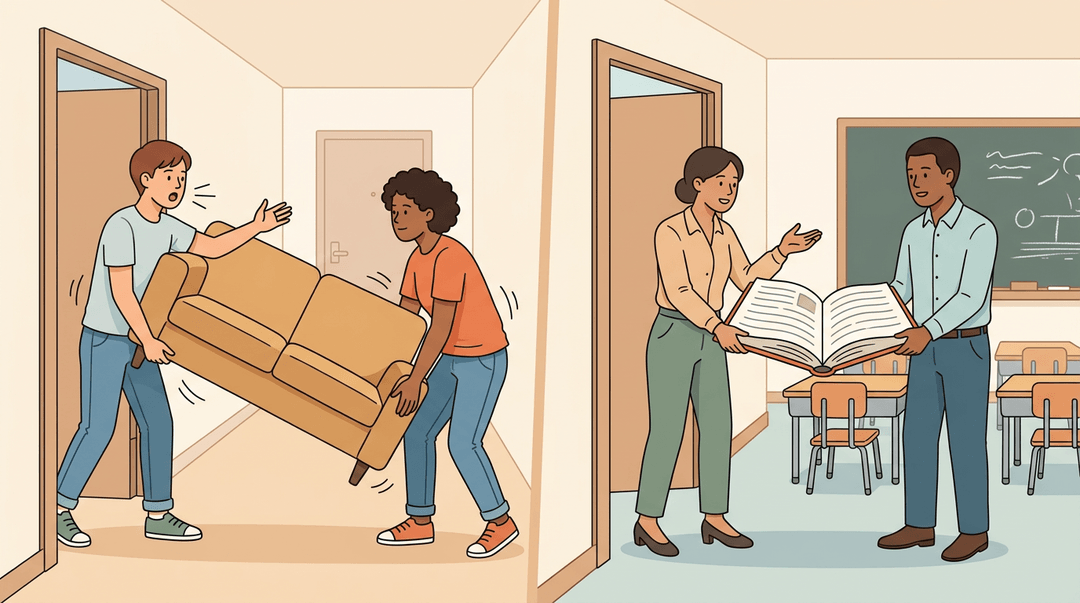
Ever watched two people move a couch through a narrow doorway? It only works if they call out moves, adjust on the fly, and trust each other's grip.
Co-teaching works the same way: two educators sharing one classroom, one set of students, and one shared goal. Done well, it's a structured partnership, not just an extra pair of hands.
This post breaks down what co-teaching really means, all six models, and how to plan and choose the right one for your classroom.
What the Co-Teaching Model Really Means
Two teachers, one classroom, one shared goal: reaching every student. That's the heart of co-teaching, also called collaborative teaching, and it looks different depending on who's standing at the front of the room.
What is another term for co-teaching?
Collaborative teaching is the phrase you'll hear most often in place of co-teaching, and it points to the same setup: two educators sharing one classroom, one plan, and one group of students.
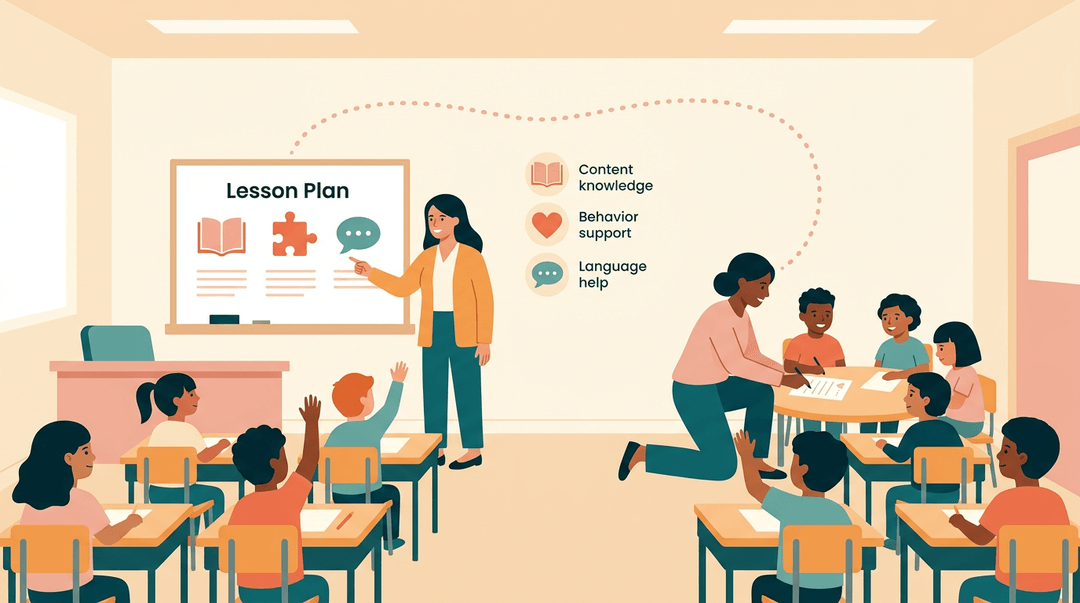
Rather than one teacher lecturing while the other watches, both partners handle shared planning and instruction together, blending their expertise (content knowledge, behavior strategies, language support) to support diverse learner needs neither could reach alone.
Common teacher pairings in co-teaching
The pairing shapes what co-teaching looks like day to day:
- General education + special education. The most common setup, built to support students with IEPs without pulling them out of the room.
- Content teacher + ESL specialist. Pairs subject expertise with language support for English language learners.
- Teacher + paraprofessional. Adds an extra set of hands for small-group support and behavior management.
- Novice + veteran teacher. Turns the classroom into an informal mentorship, with real-time modeling instead of a workshop.
Key benefits of the co-teaching model
Done well, co-teaching pays off in ways a single teacher rarely can alone:
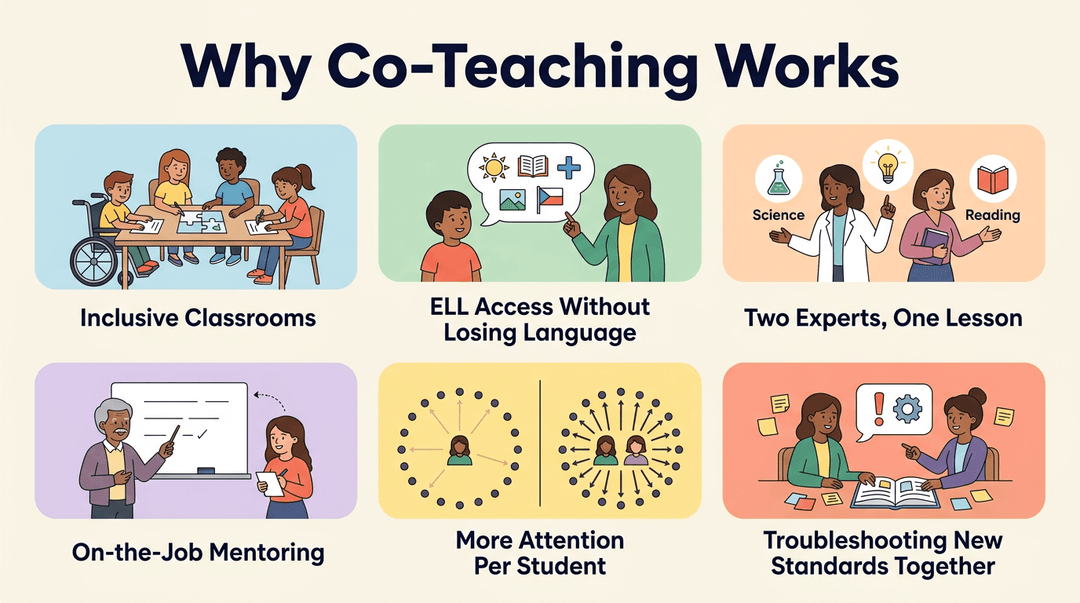
- Supports inclusive education, keeping students with disabilities learning alongside their peers.
- Helps English language learners access grade-level content without losing the language.
- Leverages content expertise from both partners instead of asking one teacher to know everything.
- Mentors new teachers through daily, in-the-room modeling.
- Lowers the class-size ratio, so more students get direct attention.
- Eases curriculum transitions when a new standard or program rolls out, since two teachers can troubleshoot it together.
The Six Co-Teaching Models Explained
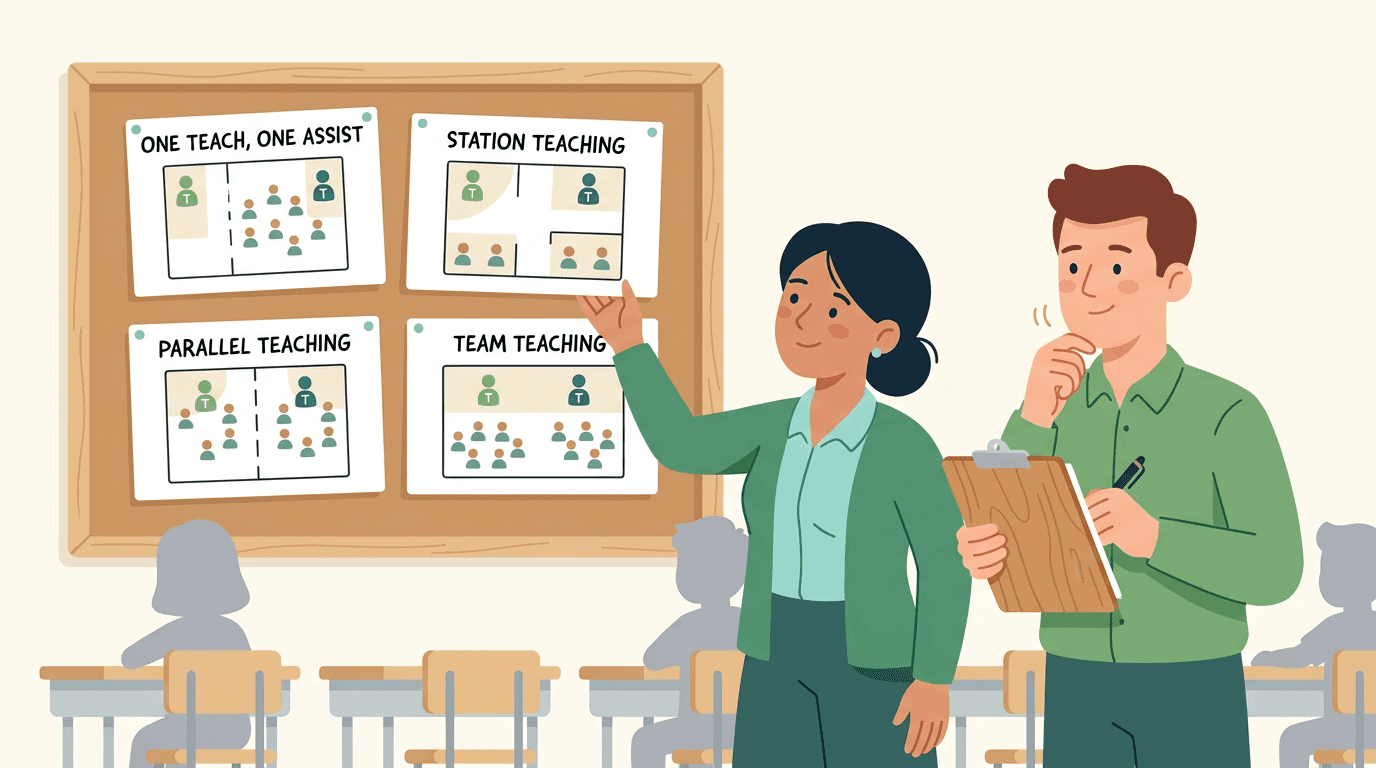
Six distinct models fall under the co-teaching umbrella, and the right one depends on the lesson, the students in the room, and how much planning time you and your partner actually have.
Here's what each looks like in practice, and where each one tends to fall short.
One teacher teaches, one observes
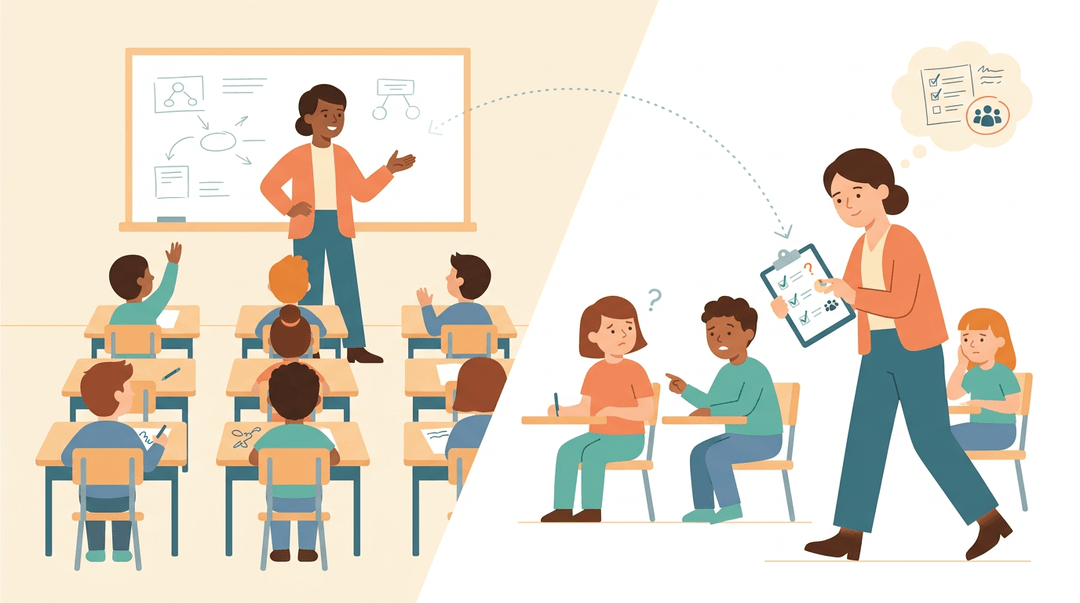
In one teach, one observe, one teacher delivers the lesson while the other moves through the room collecting data: who's tracking, who's lost, which group needs a regroup tomorrow.
That data should feed directly into future grouping and instruction, not just sit in a notebook.
This model needs minimal joint planning, which makes it a good relationship-building starting point for a pair working together for the first time.
The catch: done too often, the observing teacher can start to feel like an assistant rather than an equal partner in the room.
One teacher leads, one assists
Here, one teacher leads instruction while the other circulates, offering real-time behavior or academic support to students who need a nudge.
Consider a co-teaching pair where one partner runs the whole-group lesson while the other kneels beside a student who's stuck, redirecting without breaking the flow of class.
Planning requirements stay low, which makes this model tempting to default to. But roles need to swap regularly, or one teacher ends up permanently in front of the room and the other permanently in the background, an imbalance students notice.
What are the disadvantages of parallel teaching?
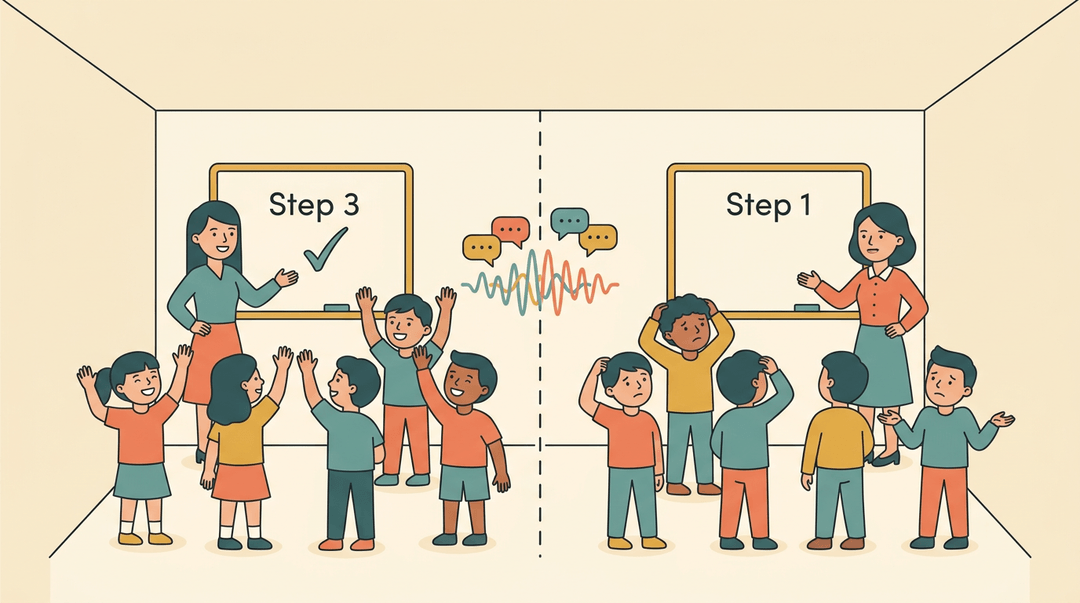
Parallel teaching splits the class into two groups, with each teacher teaching the same content at the same time. It effectively lowers the student-teacher ratio, so more students get called on and more work gets checked.
The disadvantages show up in the logistics: both teachers need to move through the material at nearly identical pace, or one group finishes ahead of the other with no clean way to catch up.
Two lessons running side by side also means double the noise, genuinely hard to manage in a smaller classroom.
What are the downsides of station teaching?
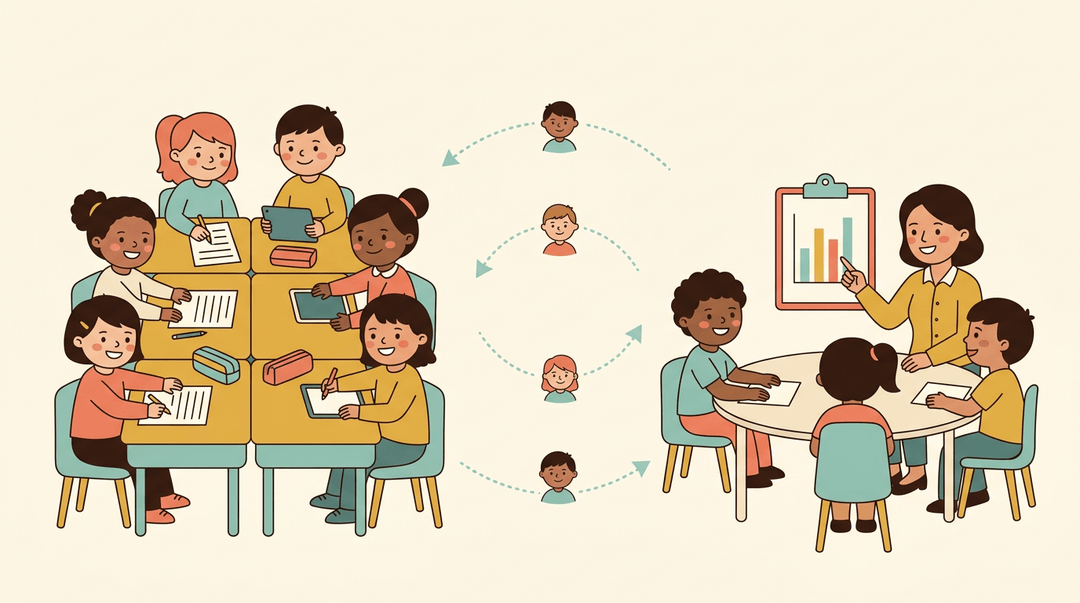
Station teaching breaks a lesson into multiple content stations, with students rotating through small groups, sometimes including an independent work station that needs no adult at all.
It's a strong way to capitalize on each teacher's strengths, since one partner can run the station that plays to their specialty while the other runs something entirely different.
The downside is upfront planning: three or four stations means three or four sets of materials, directions, and timing, all mapped out before students walk in.
Splitting into large and small groups
This model splits the class into one large group and one small group, typically for remediation or enrichment. Grouping should come from real student data, not a guess.
The risk is stigma: students pulled into the small group over and over can start to feel labeled. Keeping groups flexible, so the roster shifts as students grow, is what keeps this model from backfiring.
What is the difference between team teaching and co-teaching?
Co-teaching is the umbrella term for all six models.
Team teaching is just one of them: the tag-team, "two brains" style where both teachers teach the whole class together at the same time, finishing each other's sentences and modeling collaboration for students in real time.
It takes deep trust and heavy planning to pull off well, so it's not suited to every lesson, especially not for a pair still finding their rhythm together.
Putting Co-Teaching into Action
Co-teaching lives or dies in the routine around it. Here's the cycle we recommend: plan together before class, run your roles during class, then debrief and adjust after. Treat it as a loop you repeat every lesson, not a one-time setup.
Before class: build one shared plan
Fill in these four slots together, in one sitting, before either of you preps alone. Here's what a completed plan looks like:
| Plan slot | Example entry |
|---|---|
| Shared objective | "Students solve two-step equations with 80% accuracy" |
| Model | Station teaching |
| Roles | Teacher A: new content station; Teacher B: practice station |
| Materials | A: worked examples poster; B: practice sheets, answer keys |
One rule: prep materials for both roles as a pair. If only one of you could run either station tomorrow, the plan isn't shared yet.
⚠️ Watch out: if one teacher writes the plan and the other "helps," you've drifted into a teacher-and-assistant setup. Both names go on every slot.
During class: run the plan as a team
- Follow the roles you assigned. Don't drift into each other's station or group.
- Monitor both groups, not just yours.
- Scan the other group every few minutes; you'll catch pacing problems early.
- Adjust pacing together, out loud.
- Say: "Let's take two more minutes here before we rotate."
- Model collaboration live. Let students watch two adults disagree well.
- Say: "I'd solve it this way, but my co-teacher might do it differently. What do you think?"
After class: debrief and adjust
A five-minute debrief within a day is enough. Confirm these four things before you plan the next lesson:
- What worked, named specifically. Not "it went fine" but "stations rotated cleanly; wrap-up ran long."
- Roles swapped for next time. Whoever led content teaches practice next lesson, so neither of you gets typecast.
- The model rated. One line in your notes: "Station teaching: strong for practice day, transitions noisy."
- The shared plan updated. Change the actual document, not just your memory of it.
Example: Two middle school teachers ran parallel teaching for a fractions review. In the debrief, they noticed one group finished eight minutes early, so they added an extension task to the plan and swapped groups. The next run went smoothly. That's the whole loop: plan, teach, note, adjust.
At a glance: plan the four slots together, hold your roles in class, debrief in five minutes, update the plan. To make the loop easy to sustain, keep both teachers' plans, roles, and notes together in one shared lesson planner.
Picking the Right Co-Teaching Model
There's no single best co-teaching model, and the strongest pairs know it. The right structure depends on what you're teaching, what your students need that day, and how your partnership works best.
Match the model to your content
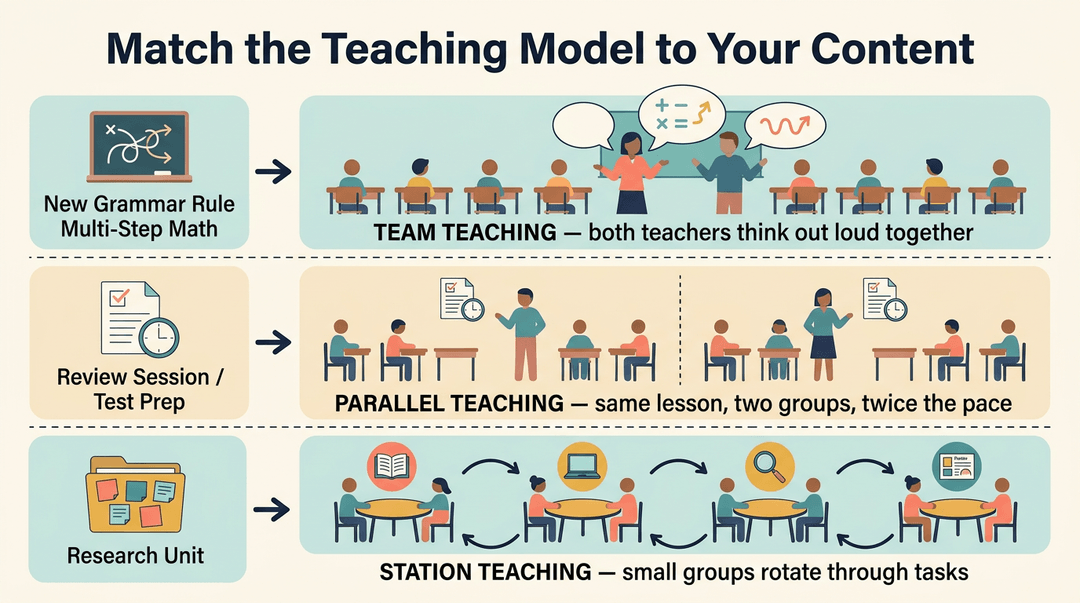
- Complex, layered content (a new grammar concept, a multi-step math strategy) often calls for team teaching, where both of you narrate the thinking out loud together.
- Review sessions and test prep fit parallel teaching: split the class in half and cover the same material twice, at double the pace.
- Multi-part projects, like a research unit with several tasks running at once, suit station teaching, where small groups rotate through different activities.
Match the model to student needs
If a handful of students need frequent redirection or check-ins, one teach, one assist keeps one of you circulating without breaking the lesson's flow.
Struggling students often do better with alternative teaching, where one of you pulls a small group aside for targeted reteaching while the rest of the class moves ahead.
Class dynamics matter too: a chatty group might need more physical separation, while a quieter one might thrive with everyone together.
Rotate models throughout the year
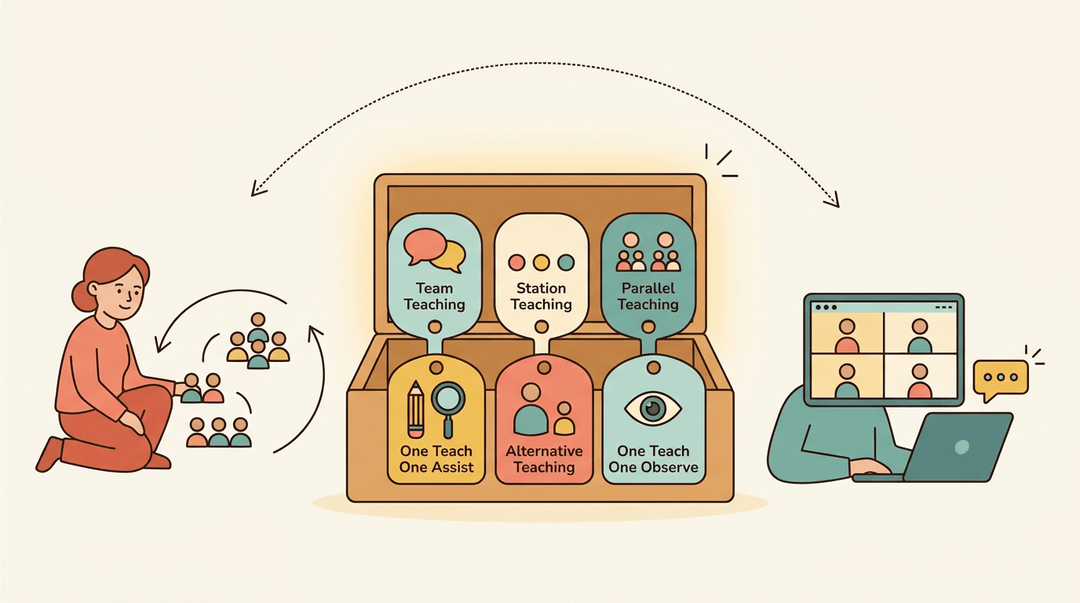
Most co-teaching pairs don't pick one model and stick with it. They rotate models by lesson or unit, matching the structure to the moment.
According to a study on elementary and ELL co-teaching teams, "teachers have flexibility when it comes to implementing co-teaching structures-such as team teaching-to meet diverse student needs."
Treat the six models as a toolbox, not a rulebook, and that same flexibility carries over to virtual co-teaching: station teaching can become breakout rooms, and one-assist can mean monitoring a chat window while your partner leads.
Building a Strong Co-Teaching Partnership
Even the best co-teaching model falls flat without a real partnership behind it. That takes intentional trust, clear communication, and a few shared systems that keep both teachers on the same page.
Building trust and equal authority
The fastest way to sink a co-teaching relationship is letting one teacher become the lead and the other slide into an assistant role.
Researchers who studied co-teaching partnerships found that the strongest ones treated both partners as equals, planning and teaching together with shared responsibility for every student in the room. That footing rarely shows up on day one.
It builds over weeks of small moments: swapping ideas in the hallway, laughing off a lesson that flopped, learning each other's quirks.
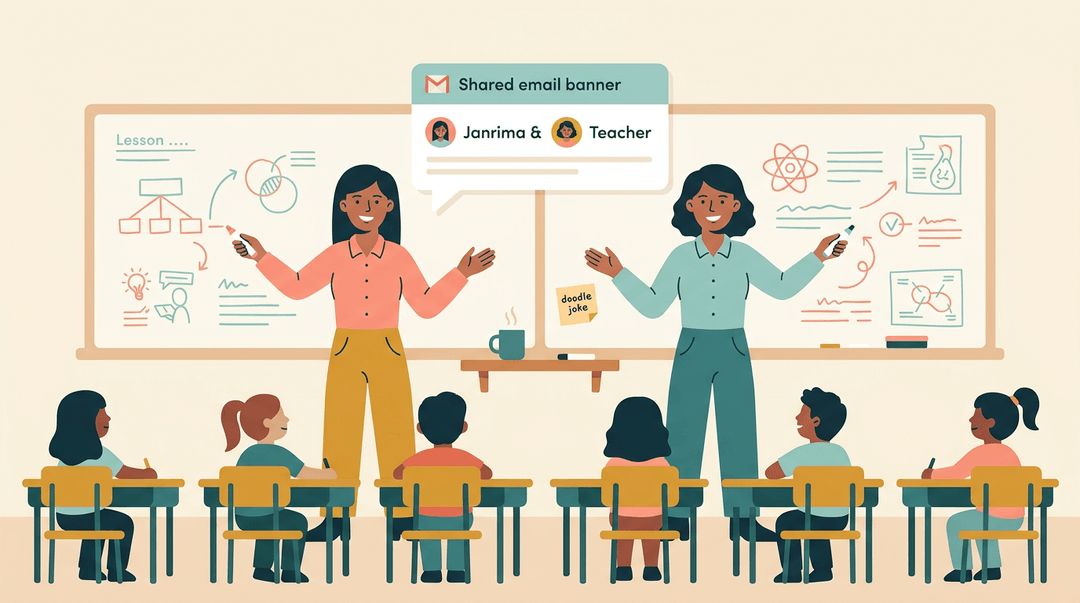
Equal status also means equal credit: both names belong on classroom emails, and both teachers own a lesson that goes well.
Planning and communicating as partners
Strong co-teaching runs on real planning time, not hallway chats squeezed between periods. Protect a recurring block on the calendar, but stay flexible when a tough week calls for an extra check-in. Use that time to divide responsibilities clearly:
- who leads instruction
- who monitors small groups
- who tracks data
A quick debrief after each lesson, even five minutes, catches what needs adjusting before it snowballs. A shared digital lesson planner keeps both teachers working from one document instead of two versions floating around.
What is the 80/20 rule in special education?
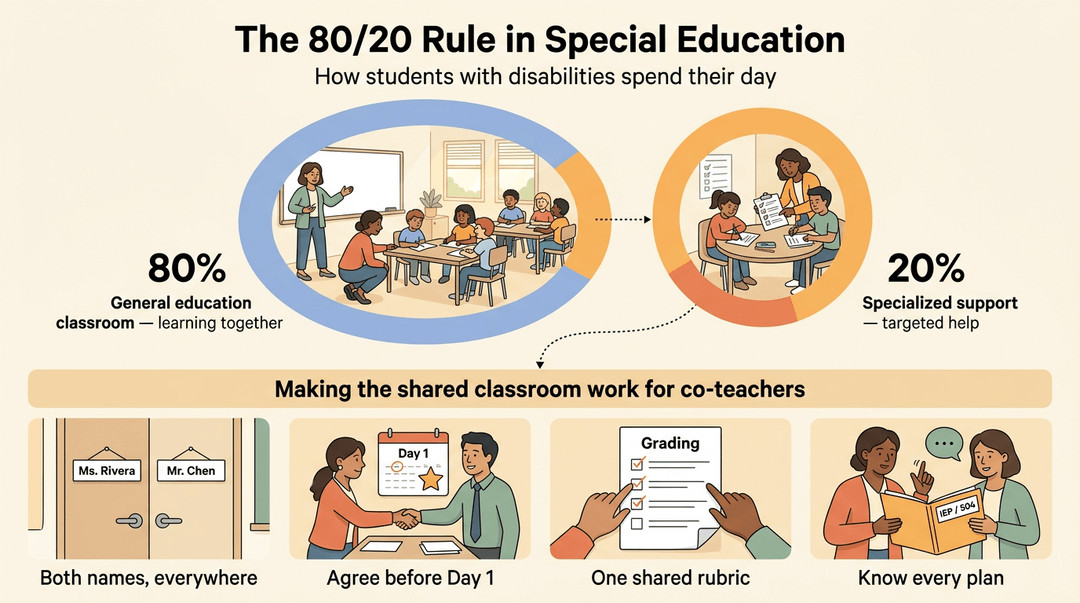
The 80/20 rule is a general guideline for inclusion time: students with disabilities spend roughly 80 percent of their day in the general education classroom, with the remaining 20 percent reserved for specialized support.
For co-teachers, that means the general education room has to genuinely function as shared space.
- Put both names on the door and on assignments.
- Agree on classroom expectations before the first day, not after a student tests the boundaries.
- Use shared grading rubrics so students see one consistent standard.
- And both teachers need a working understanding of each student's IEP or 504 plan, since accommodations only stick when everyone applies them the same way.
Common Co-Teaching Challenges and Tips
Co-teaching doesn't always click just because two teachers share a room. Most of the friction comes from a handful of predictable spots, and each one has a straightforward fix.
Challenges new co-teachers face
Many teachers walk into co-teaching with little formal training on how to actually share a classroom, so the first few weeks can feel like improvising.
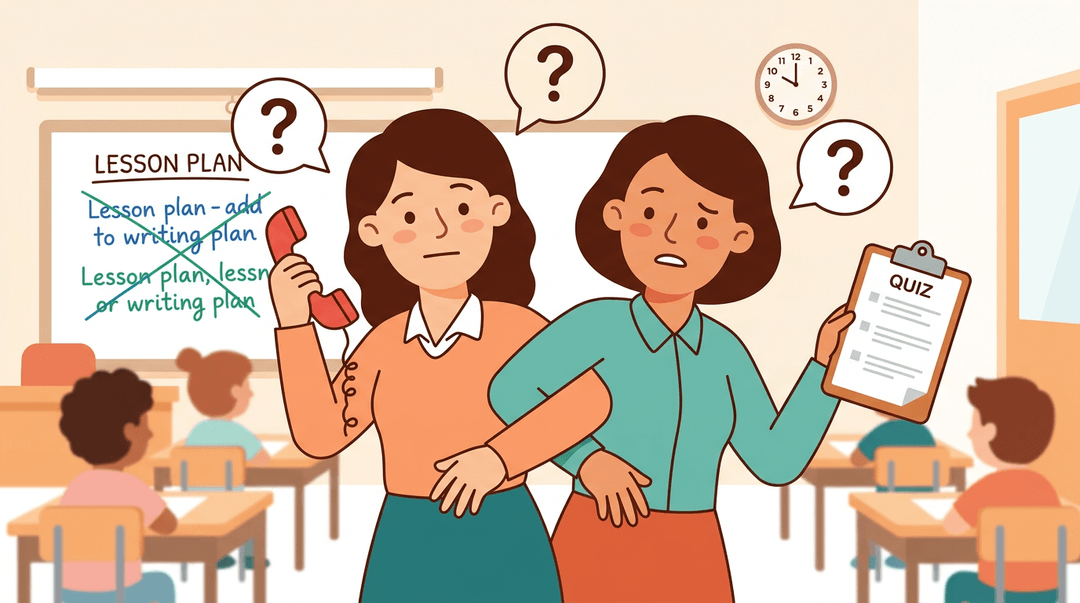
On top of that, you rarely get to pick your partner: you're paired based on schedules and certifications, not chemistry. That makes early, honest conversations about planning essential, because without them, roles blur fast. Who writes the quiz?
Who calls home about behavior? If it's never named, it stays murky.
When one teacher feels like an assistant
This is the most common complaint: one teacher, usually the special education teacher, ends up doing supply runs and behavior management while the other leads instruction.
Students pick up on it quickly and start treating one adult as the "real" teacher and the other as a helper. Left unaddressed, that imbalance leads to burnout, not engagement.
The fix is simple to say and harder to do consistently: swap leading and supporting roles across units so both teachers are seen delivering content.
Start simple, then build up
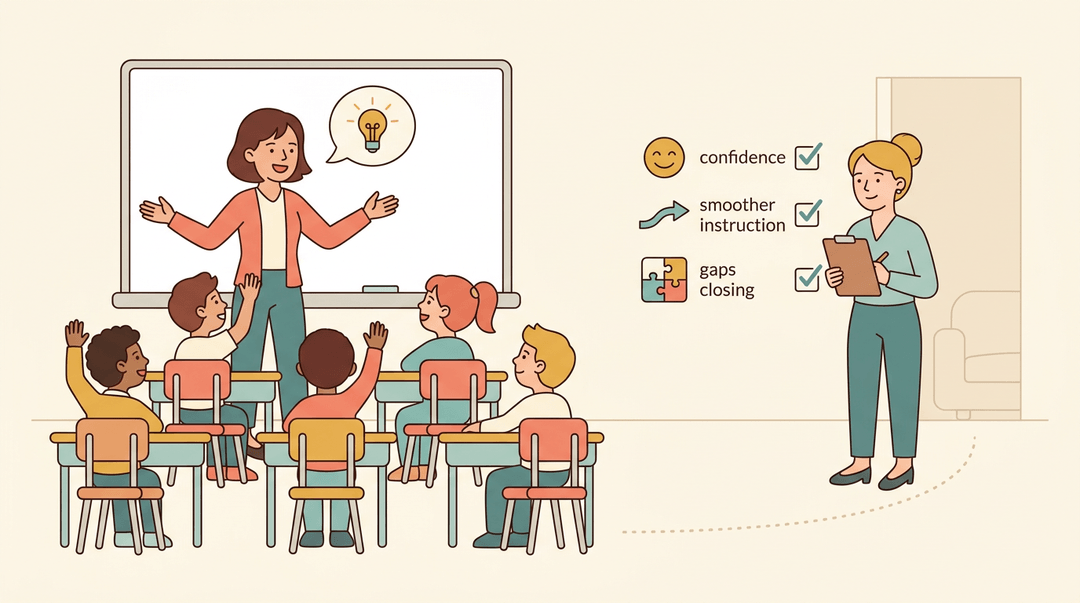
Don't open the year with team teaching. Start with a simpler model, like one teach, one observe, and use that time to check how well it's working:
- are both students and teachers more confident
- is instruction smoother
- are gaps closing
Once you can answer yes, layer in more shared responsibility, building toward full team teaching as trust and rhythm develop.
Co-teaching isn't about squeezing two teachers into one room and hoping it works. It's a deliberate partnership: the right model, clear roles, and a plan you both trust before the bell rings.
Get that foundation right, and the couch clears the doorway every time. Ready to build that plan? Check out our Lesson Planning feature to write, organize, and share co-taught lessons with your partner from one place.
Frequently asked questions
What is the co-teaching method?
Co-teaching is a structured partnership in which two educators share one classroom, one group of students, and responsibility for planning, instruction, and student support. Both teachers work toward shared learning goals while combining their expertise to meet diverse needs.
What is another term for co-teaching?
Another term for co-teaching is collaborative teaching. Both describe two educators sharing a classroom, lesson planning, instruction, and responsibility for the same students.
What are the 5 models of co-teaching?
The six co-teaching models are one teach, one observe; one teach, one assist; parallel teaching; station teaching; alternative teaching; and team teaching. Each model distributes instructional responsibility differently between the two teachers.
What are the advantages of co-teaching?
Co-teaching supports inclusive education, helps English language learners access grade-level content, combines the expertise of two educators, and provides mentoring for new teachers. It can also lower the student-teacher ratio, increase individual attention, and make curriculum transitions easier to manage.
What are the 6 co-teaching strategies?
The six co-teaching strategies are one teach, one observe; one teach, one assist; parallel teaching; station teaching; alternative teaching; and team teaching. Teachers can rotate among them based on the lesson, student needs, and available planning time.
What are the best practices for co-teaching?
Best practices include planning together, agreeing on shared objectives and roles, preparing materials for both teachers, and maintaining equal authority. Teachers should monitor all students, rotate leadership roles, apply accommodations consistently, debrief after lessons, and update a shared plan based on what worked.
What are the six main teaching styles?
The six main teaching styles are authoritative, authoritarian, permissive, indulgent, delegative, and facilitator. They differ in how much structure, teacher direction, student independence, and interaction they provide.
What does coteaching look like?
Co-teaching looks like two educators sharing instruction and responsibility in the same classroom. Depending on the model, they may teach the whole class together, divide students into groups, lead stations, support individuals while a partner teaches, or collect learning data for future instruction.