Contextual Teaching and Learning Explained Simply

Jump to section
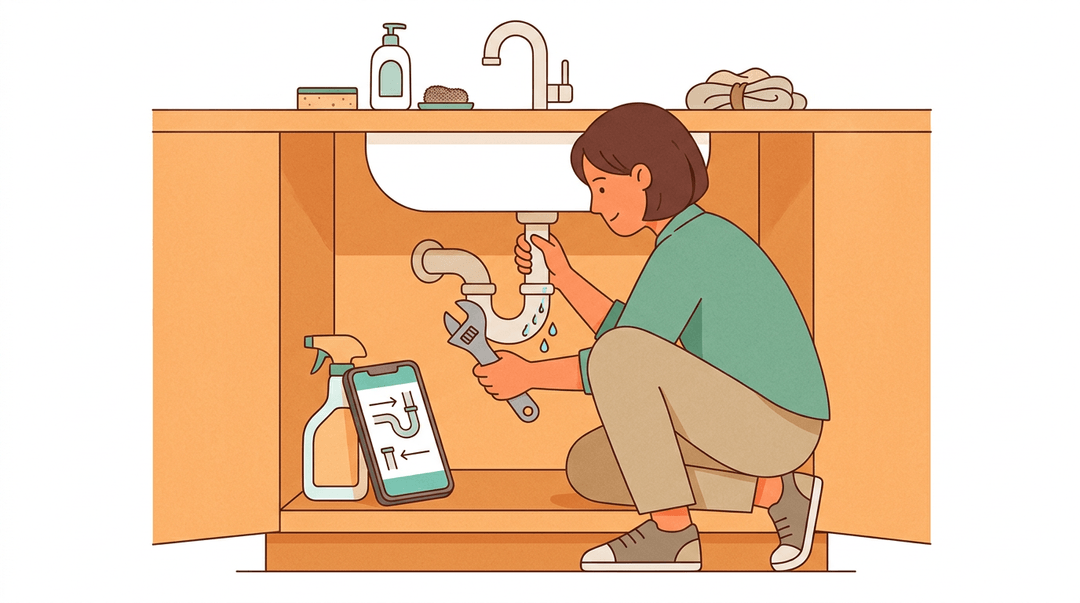
Think about the last time you learned something new outside of school, maybe fixing a leaky faucet, following a recipe, or figuring out a new phone. You probably didn't start with a textbook.
You started with a problem right in front of you, and the learning followed naturally from there.
That's the core idea behind contextual teaching and learning (CTL): students understand and remember more when new knowledge connects to something real and meaningful in their lives. It's not a gimmick or a trend.
It's a research-backed approach to instruction that puts context at the center of every lesson.
In this post, we'll cover what CTL actually means, where it comes from, which strategies make it work, and how to plan a lesson around it starting this week.
What Is Contextual Teaching and Learning?
Contextual teaching and learning (CTL) is an approach that connects academic content to real-world situations, giving students a reason to care about what they're learning.
The main goal is simple: help students construct meaning by experiencing ideas, not just receiving them.
How CTL connects content to real life
CTL is grounded in constructivist theory, which holds that people learn by actively building knowledge through experience. Instead of handing students information to memorize, CTL puts them in situations where they have to use it.
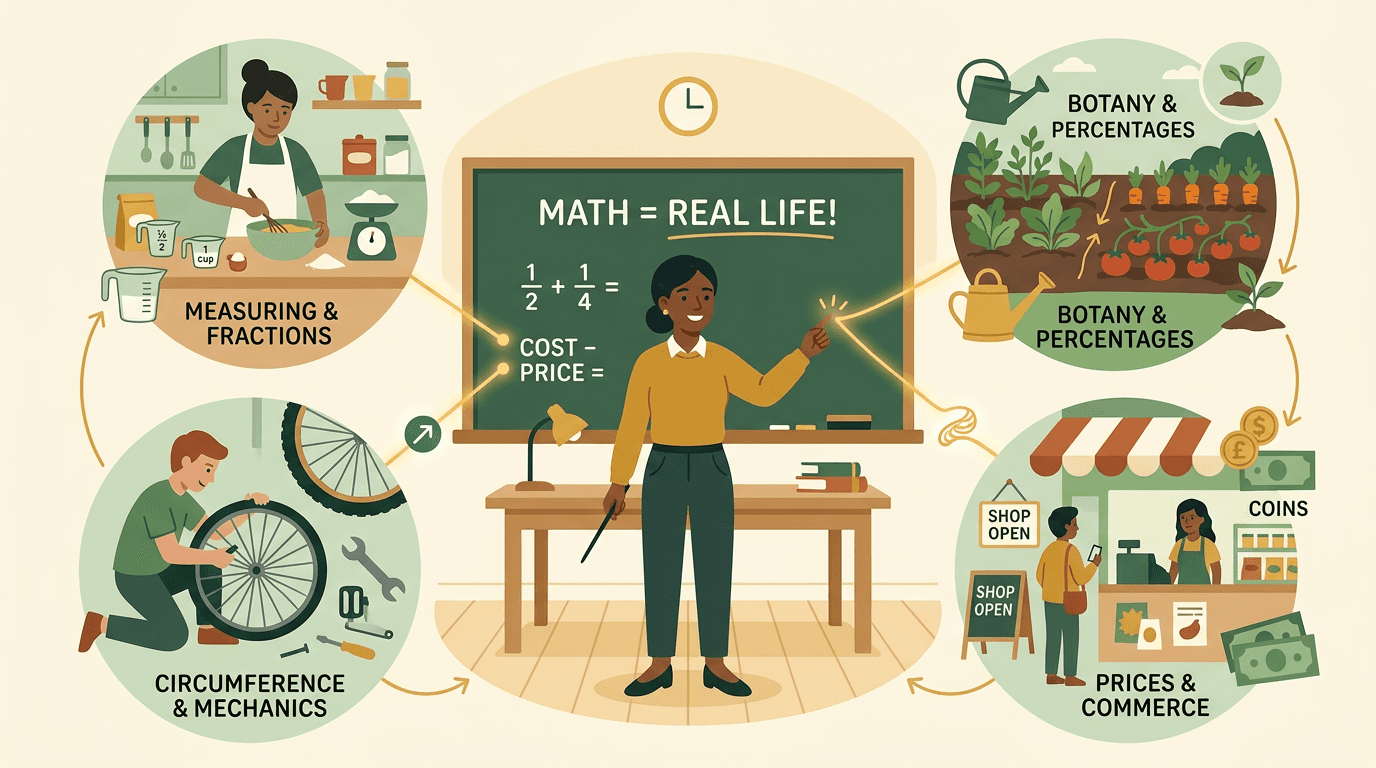
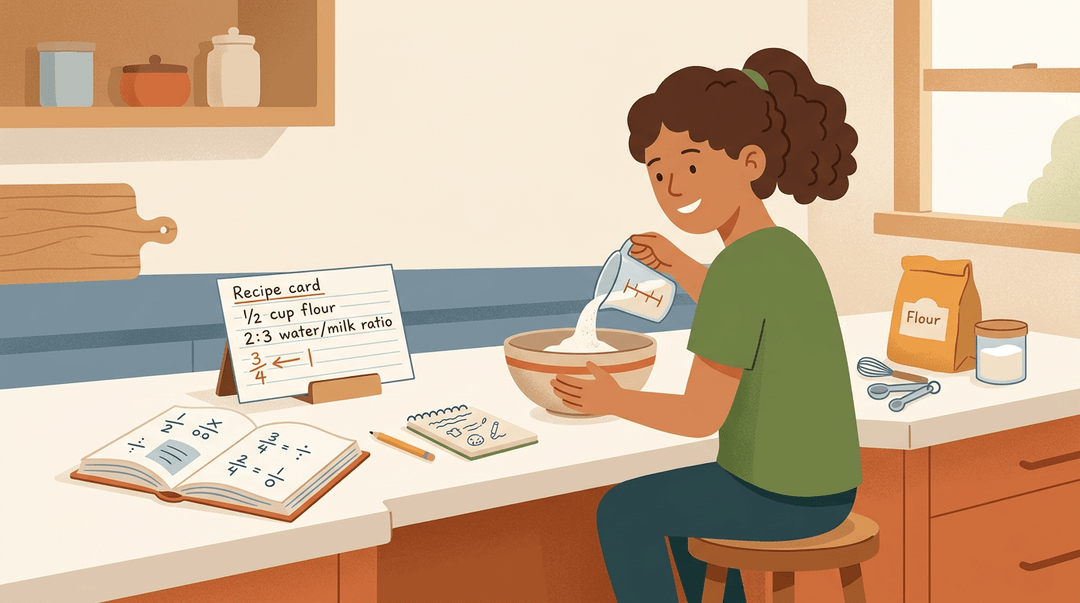
A student studying ratios isn't just solving textbook problems; they're scaling a recipe or reading a map. That relevance is what makes the learning stick.
Key characteristics of CTL
A few qualities set CTL apart from traditional instruction:
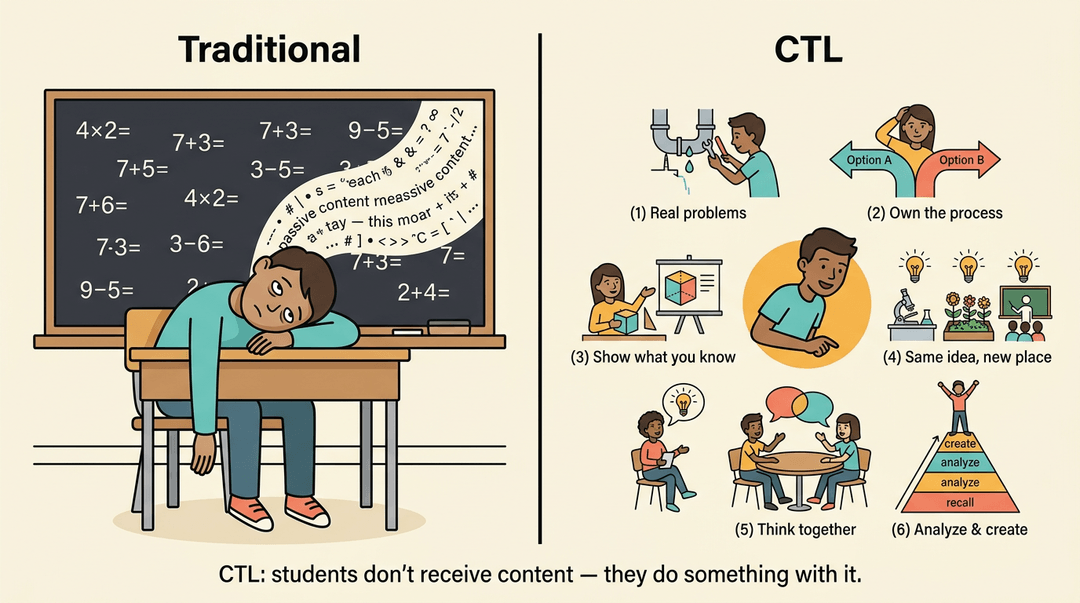
- Problem-solving emphasis. Students work through real or realistic challenges rather than isolated drills.
- Self-regulated learning. Learners take ownership of their process, deciding how to approach a task.
- Authentic assessment. Understanding is measured through performance and application, not just recall.
- Multiple learning contexts. The same concept shows up in different settings so students see its range.
- Collaboration and peer learning. Students work together, building understanding through discussion and shared effort.
- Higher-order thinking. CTL pushes beyond recall into analysis, evaluation, and creation.
Together, these characteristics shift the classroom from passive consumption to active inquiry. Students aren't sitting still while content washes over them; they're doing something with it.
Theoretical Roots of CTL
Contextual teaching and learning didn't appear out of nowhere. It grew from decades of research into how people actually think, remember, and apply what they know. Several theorists laid the groundwork, and their ideas still show up in classrooms today.
Theorists who shaped contextual learning
The intellectual foundation of CTL runs deep.
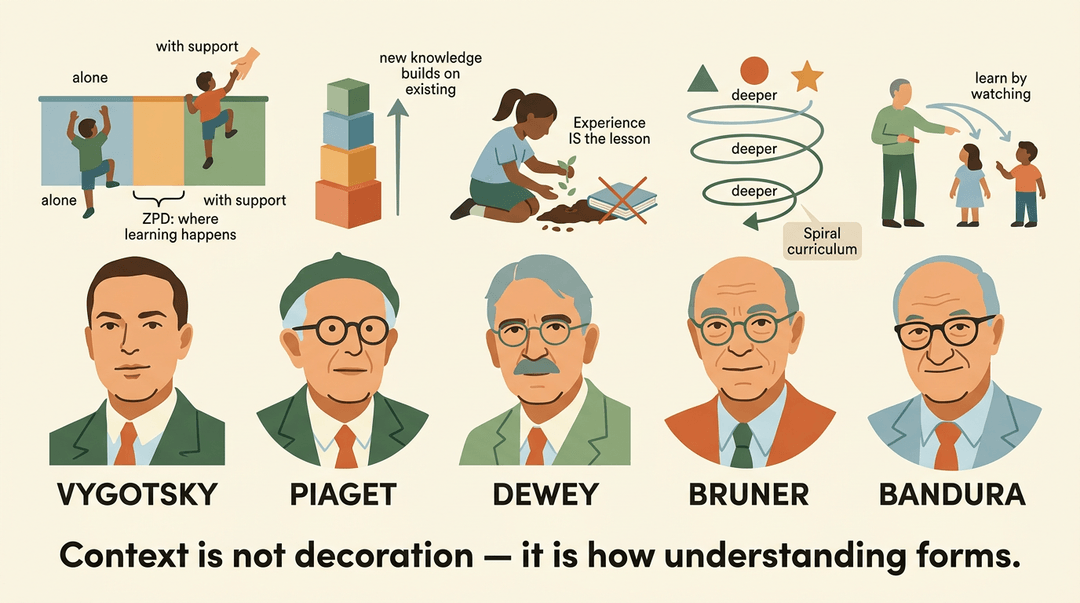
- Lev Vygotsky gave us the Zone of Proximal Development (ZPD): the gap between what a student can do alone and what they can do with support. Learning happens best in that space, with a more knowledgeable person guiding the way.
- Jean Piaget showed that children build understanding in stages, constructing new knowledge on top of what they already know.
- John Dewey argued that experience is the curriculum, not a supplement to it.
- Jerome Bruner extended this with scaffolding and the spiral curriculum, the idea that you revisit core concepts at increasing depth over time.
- Albert Bandura added that learners also grow by watching others: modeling, observing, and imitating in social settings.
Together, these thinkers point toward the same conclusion: context isn't decoration. It's the medium through which understanding forms.
How cognition depends on context
Cognition isn't a solo act performed inside a single brain.
- Situated cognition means that knowledge is tied to the circumstances in which it's learned and applied.
- Social cognition recognizes that understanding is often built through interaction with others.
- Distributed cognition goes further: knowledge lives not just in individuals but across people, tools, and environments.
And at the neurological level, researchers at UC Santa Barbara found that the brain processes context-rich information deeply, recruiting multiple regions to resolve ambiguity and make meaning.
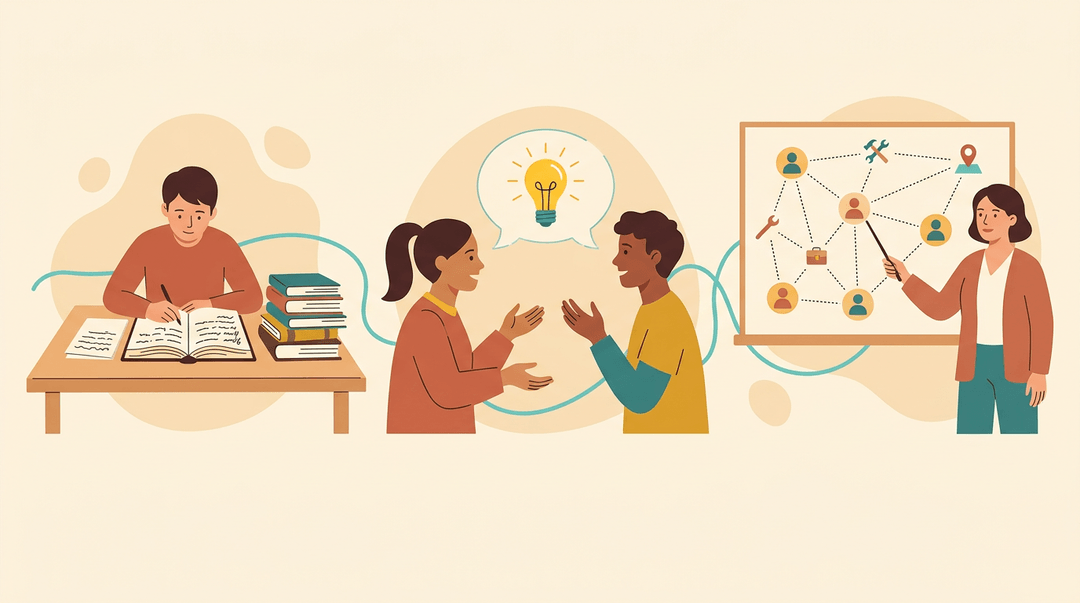
Why traditional schooling left students behind
Abstract, lecture-driven instruction has a poor track record.
A landmark analysis published in Educational Psychologist found that minimally guided approaches ignore how human cognitive architecture actually works, and a half-century of empirical evidence backs that up.
Textbook-driven curricula, disconnected from students' lives, made school feel irrelevant to many learners. Rote memorization produced knowledge that didn't travel, facts that vanished the moment the test ended. CTL emerged as the correction.

CTL Instructional Strategies That Work
Contextual teaching and learning (CTL) isn't a single method: it's a family of approaches that all share one goal, anchoring new knowledge to real experience. Here's how they break down.
Core teaching approaches in CTL
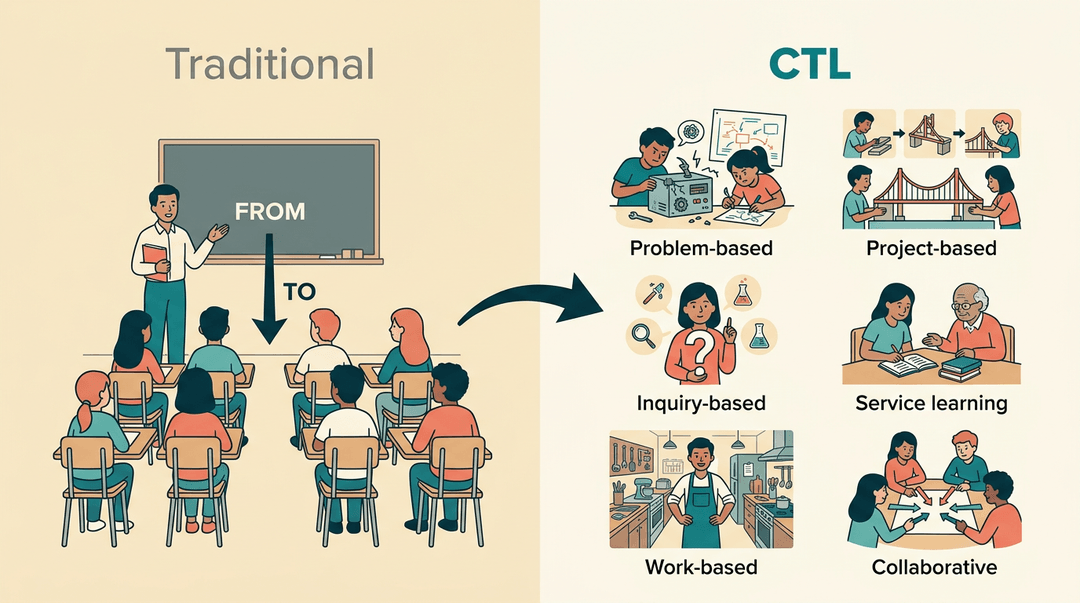
Unlike traditional direct instruction, where the teacher delivers content and students receive it, CTL puts students in the driver's seat. The main approaches include:
- Problem-based learning: students tackle a genuine challenge and build knowledge to solve it
- Project-based learning: a sustained, real-world project drives the content
- Inquiry-based learning: questions lead the way, with students investigating rather than just absorbing
- Service learning: academic skills meet community need in a single task
- Work-based learning: the workplace itself becomes the classroom
- Collaborative learning: students construct understanding together, not in isolation
Real-world examples across subject areas
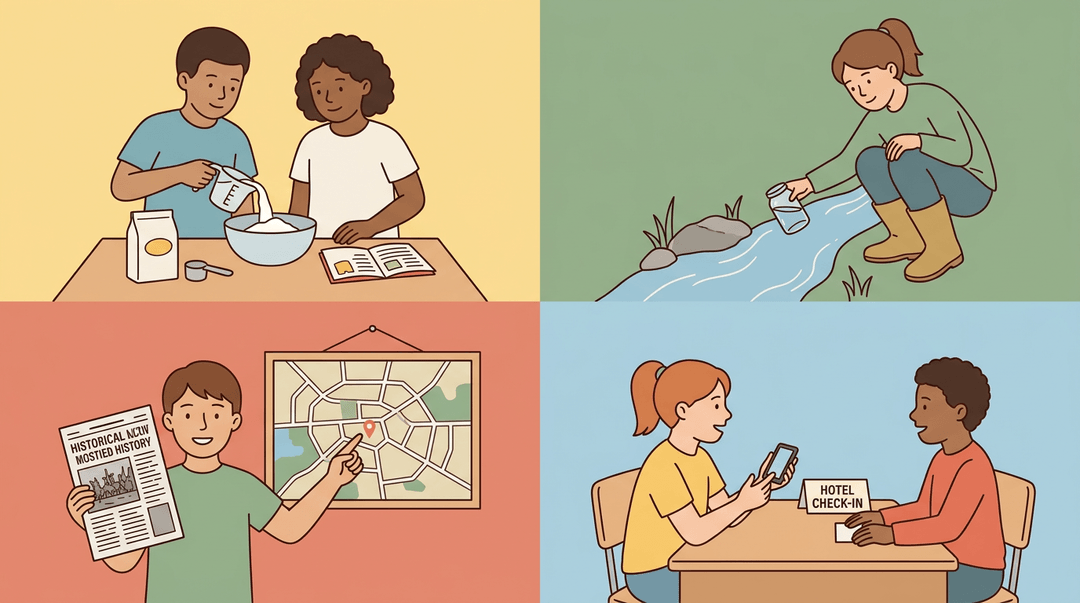
The context changes, but the principle doesn't. For example, a math teacher might frame fractions through a recipe-scaling activity or a simple building project. A science class can investigate the local watershed instead of a textbook ecosystem.
History students research how a past event shaped their own community. In language arts, students deconstruct a real advertisement to study persuasion.
An EFL class builds speaking confidence through contextual tasks like booking a hotel or negotiating a price.
Simulations, internships, and hands-on formats
When real-world access is limited, you can still bring context into the room. Simulations and role-playing recreate authentic scenarios. Case-based learning grounds analysis in real situations.
Internships and externships take students out of the building entirely. Hands-on, active formats keep learning physical and concrete. Study abroad programs offer full immersion when the opportunity exists.
Planning a CTL Lesson: Classroom Checklist
Use this when you're turning a topic into a contextual teaching and learning (CTL) lesson: one where students meet the concept through a real situation they recognize. Work through the four stages in order; each builds on the one before.
Stage 1: Choose a real-world anchor
The anchor is the local, lived situation your concept lives inside. Pick it first, then teach the content through it.
- Tie the concept to your students' context.
- Ask what your students already do, see, or argue about that touches this topic.
- Anchor a percentages unit in markdowns at a store near the school.
- Ask what your students already do, see, or argue about that touches this topic.
- Scale the anchor to your grade band.
- The same concept rides on different anchors across K–12.
| Grade band | Concept: measurement | Anchor |
|---|---|---|
| K–2 | Length | Measuring the class pet's growth |
| 3–5 | Area | Planning a school garden bed |
| 6–12 | Ratio and scale | Designing a skate-park layout |
Stage 2: structure the contextual task
Make the work clear before students touch the anchor: they should know what success looks like and where they'll think together.
- State one objective and its success criteria. Pin both where students can see them.
Objective: Students use ratios to scale a real floor plan. Success looks like: A scaled drawing where every measurement is proportional and labeled.
- Build in a collaborative or inquiry step. The thinking should be shared, not silent.
- Have pairs gather the real data first: measure, survey, or interview.
- Open with an inquiry question, not an answer.
💡 Tip: Phrase the launch as a question students genuinely can't yet answer. "How much paint do we actually need for this wall?"
Stage 3: Embed authentic assessment
In CTL, the assessment is the task: students perform in the same situation a real person would.
Checklist before you finalize the assessment:
- Performance task mirrors the real scenario. Students produce what a practitioner produces, not a worksheet about it.
- Rubric targets higher-order thinking. Score reasoning and transfer, not recall alone.
Pair a strong rubric line against a weak one so students know what you're really after:
- ✅ Justifies each design choice with evidence from the gathered data.
- ❌ Completes all sections of the worksheet.
Example: A seventh-grade class plans a class budget for a field trip. They quote real prices, build a spreadsheet, and pitch it to the "principal." The rubric rewards how they defend trade-offs, not whether the total is tidy.
Stage 4: Reflect and reuse your plan
The first run is data. Capture it the same day, while the lesson is fresh, so next cycle starts ahead.
- Note which context resonated. Write one line on what hooked students and what fell flat.
- "Store-markdown anchor landed; the garden one felt abstract for this group."
- Adapt and save the plan for next cycle. Swap the anchor, keep the structure.
At a glance:
| Stage | Key move | What you get |
|---|---|---|
| Anchor | Tie concept to local context | A reason to care |
| Structure | Objective + collaborative step | A clear, shared task |
| Assessment | Real performance + thinking rubric | Evidence that transfers |
| Reflect | Note and save | A reusable template |
Once a CTL plan works, keep it: use EMStudio's lesson planner to save and reuse your templates across classes.
Benefits of CTL for Students and Teachers
CTL doesn't just make lessons feel more relevant. It produces measurable gains for students and quietly transforms what teaching feels like for you, too.
How CTL improves student outcomes
When learning is anchored to real-world situations, students hold onto it.
According to the California Learning Resource Network, presenting information within a meaningful framework "facilitates the formation of stronger neural connections, leading to improved knowledge retention and transfer."
That's not just better test scores: it means students can actually use what they've learned somewhere new.
Deeper understanding follows, too. Glendale College's Active Learning resource puts it plainly: CTL "helps students gain a deeper understanding of subject matter by relating material to meaningful situations that students encounter in real life."
Add to that the motivation boost. Research published in the Journal of Educational Psychology found that contextualization, personalization, and choice all enhance students' intrinsic motivation. Students who see the point work harder.
And for critical thinking, a study on mathematical reasoning confirmed that a CTL approach measurably strengthens students' problem-solving ability.

Supporting diverse and inclusive learners
CTL is especially valuable for students with special educational needs and disabilities (SEND). Concrete, familiar references reduce cognitive load, making abstract ideas far less daunting.
Because CTL naturally offers multiple entry points to the same concept, whether through a visual, a story, a hands-on task, or a discussion, students with different learning profiles can all find a way in.
One-size-fits-all rarely fits anyone; CTL is built on the opposite assumption.
What teachers gain from CTL
For you, CTL opens up the curriculum rather than locking it down. Connecting content to real contexts invites creative lesson design and keeps planning from going stale.
Your classroom becomes more dynamic: students bring their own experiences in, and learning starts flowing in both directions. That shift, from delivering content to students toward discovering it with them, tends to make teaching feel worthwhile again.
Authentic Assessment in CTL
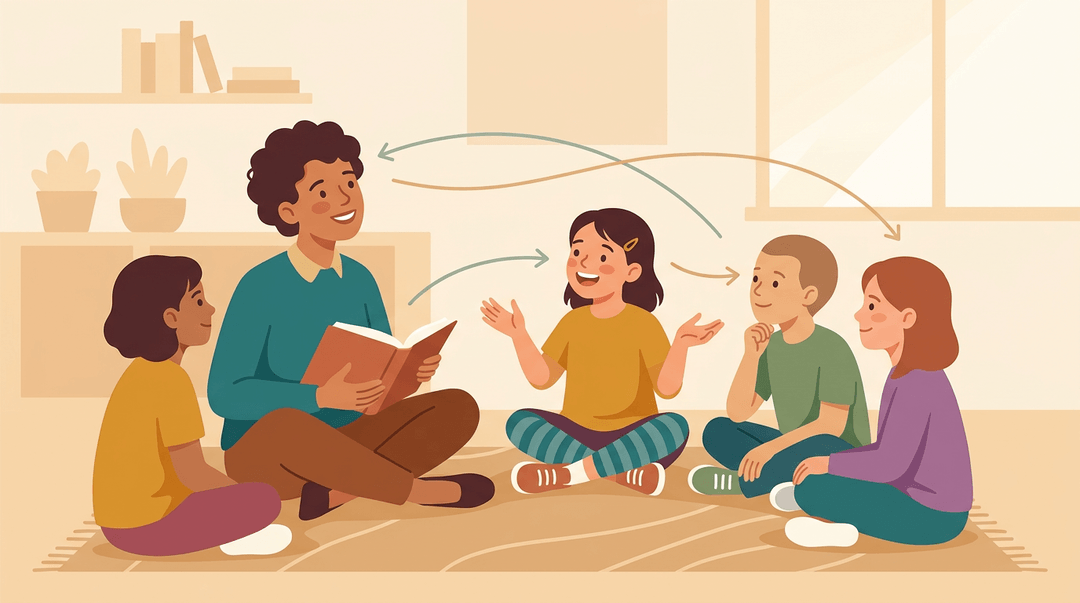
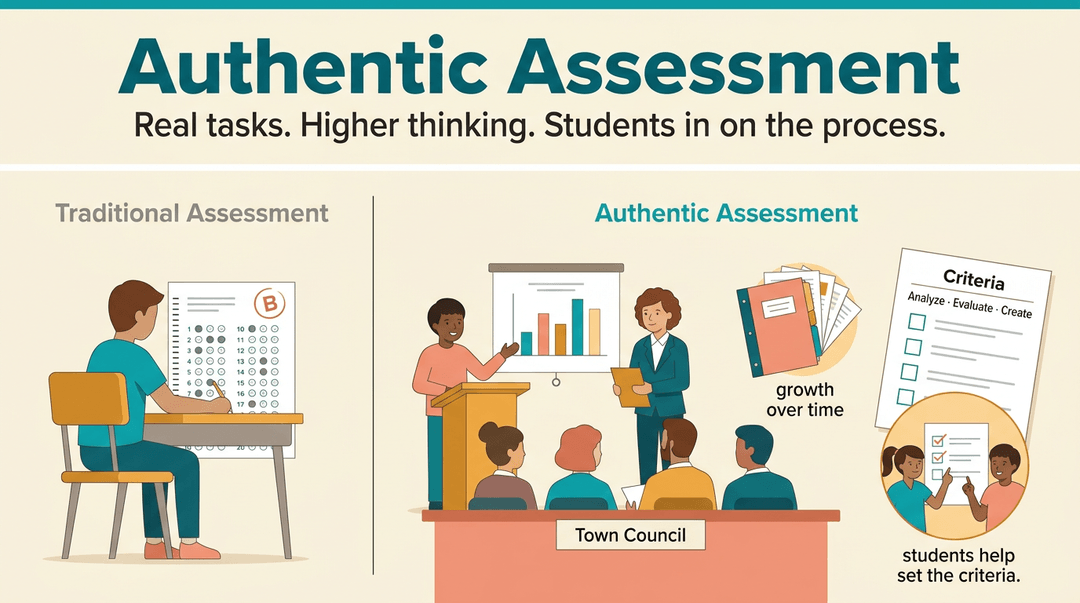
Traditional tests tell you what a student memorized. Authentic assessment tells you what they can actually do with it.
What authentic assessment actually involves
Authentic assessment puts students in situations that mirror real-world challenges: a science class presenting findings to a mock town council, a math student budgeting for a school event.
It asks for higher-order thinking (analysis, evaluation, creation) rather than recall.
Common formats include performance tasks, portfolios that document growth over time, and criteria-referenced rubrics that make expectations transparent before the work begins.
Students aren't just assessed on the task, either: involving them in setting criteria or self-evaluating builds the metacognitive habits that make learning stick.
Designing contextual assessment tasks
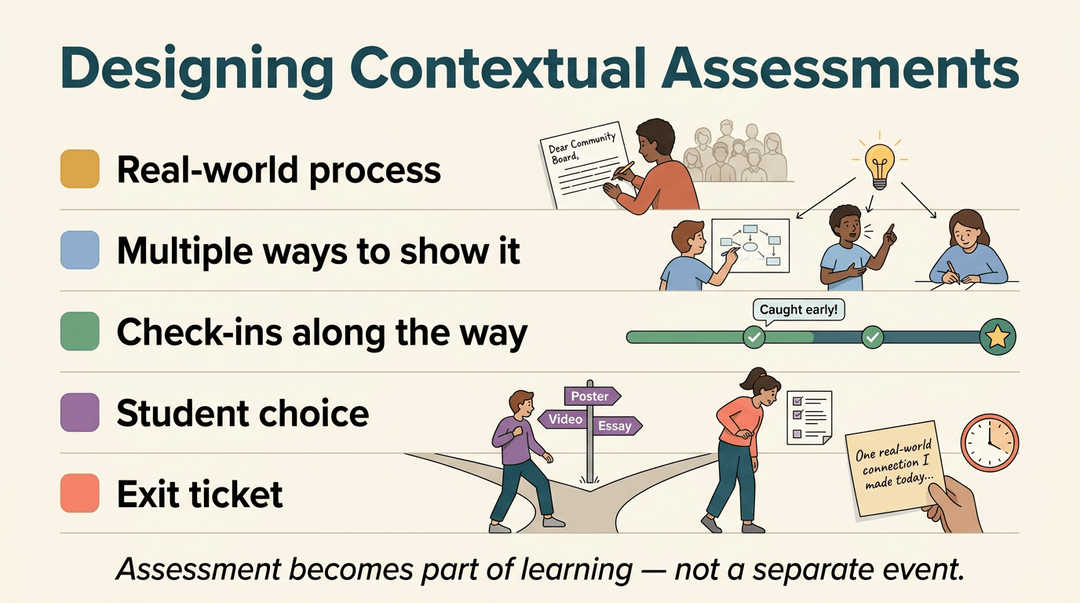
A well-designed contextual task starts with alignment: the task should map directly to your learning goals, not just feel hands-on. From there, a few principles keep the design honest:
- Simulate real-world processes. Ask students to write for a real audience, solve a problem someone outside school actually faces, or produce something a professional might make.
- Ensure inclusivity. Offer multiple ways to demonstrate understanding so the task measures learning, not a single modality.
- Build in formative feedback loops. Check-ins during the task catch misconceptions before the final product.
- Allow student choice and ownership. When students choose their format or angle, engagement follows.
- Use exit tickets tied to the task. A quick "What's one real-world connection you made today?" gives you fast, honest data before the bell rings.
When assessment reflects the same context students learned in, it stops feeling like a separate event and becomes part of the learning itself.
How Do You Contextualize Teaching and Learning?
Contextualizing your teaching isn't a single move: it's a series of deliberate choices that connect abstract content to the lives your students are already living. Here's how to make it work, step by step.
Steps to implement CTL in your classroom
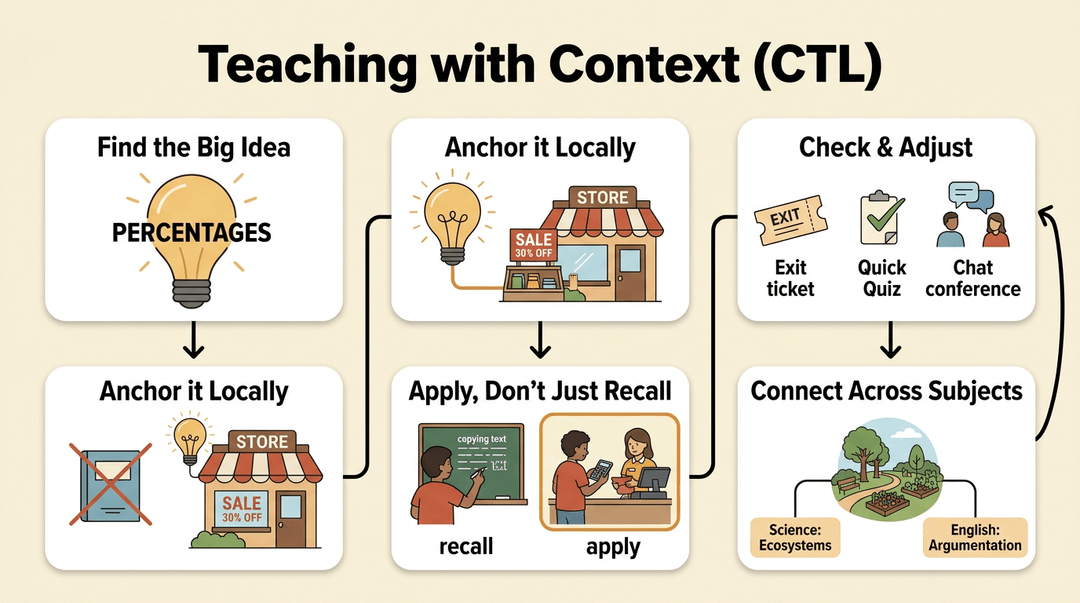
Start by identifying the core concept you need to teach: the big idea students must leave the lesson understanding. Then brainstorm real-world anchors from your students' local community.
A unit on percentages lands differently when it's framed around a neighborhood store's discount shelf than an abstract textbook scenario.
From there, design activities that ask students to apply rather than just recall. Use formative assessment throughout: exit tickets, quick checks, brief conferences. What you learn from those checks should feed directly into your next lesson.
Reflect regularly on what's working, and adapt. CTL isn't set-and-forget.
For cross-subject planning, look for concepts that overlap. A science unit on ecosystems and a writing unit on argumentation can share the same real-world anchor: a local park, a community garden, a nearby river.
Using CTL in EFL and language teaching
For English as a Foreign Language (EFL) teachers, CTL offers a practical exit from textbook-heavy methods.
Research published in Scope: Journal of English Language Teaching found that student learning outcomes improved significantly across instructional cycles when CTL was used, with completion rates climbing from 74% in the first cycle onward.
A study on CTL in EFL classrooms also found measurable gains in speaking skills across storytelling, speeches, and drama tasks.
Structured lesson planning and solid teacher preparation are non-negotiable: the approach only delivers results when it's implemented with intention.
Common CTL mistakes to avoid
Not every real-world example creates real learning. Contexts that feel irrelevant to students, or that are more complex than the concept itself, create confusion rather than clarity.
Skipping structured scaffolding is another common slip: students need support before they can apply ideas independently. And teacher preparation matters more than most people assume.
Showing up with a half-formed context and hoping engagement follows rarely works.
CTL won't transform your classroom overnight, but it will shift the way your students relate to what you're teaching. When learning feels connected to real life, students lean in rather than check out.
The content sticks, the skills transfer, and the work feels worth doing, for them and for you.
Ready to put it into practice? Our Lesson Planning tool can help you build CTL-aligned lessons faster, so you spend less time on prep and more time on the teaching that matters.
References
- Implementation of English Learning Model with Contextual Teaching and Learning (CTL) Approach to Improve Students’ Comprehension — newjournal.lppmunindra.ac.id (2025)
- Why Minimal Guidance During Instruction Does Not Work: An Analysis of the Failure of Constructivist, Discovery, Problem-Based, Experiential, and Inquiry-Based Teaching: Educational Psychologist: Vol 41, No 2 — tandfonline.com
- Contextualized Learning (CTL) - ACTIVE LEARNING at GCC — campusguides.glendale.edu
- Intrinsic motivation and the process of learning: Beneficial effects of contextualization, personalization, and choice. — psycnet.apa.org
- mathematical critical thinking ability through contextual teach — files.eric.ed.gov
- The Implementation of Contextual Teaching Learning (CTL ... — repository.metrouniv.ac.id
- What is contextual teaching and learning? — clrn.org (2025)
- Resolving ambiguity: How the brain uses context in decision-making and learning — sciencedaily.com
- Cognitive Load and Pupils with SEND — asset.nasen.org.uk
Frequently asked questions
What is contextual teaching and learning?
Contextual teaching and learning (CTL) is an educational approach that connects academic content to real-world situations, helping students understand and remember new knowledge by relating it to meaningful experiences in their lives. The goal is to help students construct meaning by actively experiencing ideas rather than just memorizing them, often grounded in constructivist theory.
What are the 4 principles of CLIL?
The four principles of CLIL (Content and Language Integrated Learning) are content, communication, cognition, and culture. These four elements are integrated to ensure that students learn subject matter while simultaneously developing their language skills. This approach emphasizes active learning and the use of language as a tool for understanding new concepts.
How do you contextualize teaching and learning?
To contextualize teaching and learning, identify core concepts and connect them to real-world anchors from the students' community. Design activities that require students to apply knowledge, not just recall it, and use formative assessments to guide subsequent lessons. Additionally, look for overlaps in concepts across different subjects to create interdisciplinary connections.
What are examples of contextual learning in the classroom?
Examples of contextual learning in the classroom include students using ratios to scale a recipe or read a map in math class. Science classes might investigate a local watershed instead of a textbook ecosystem. History students could research how a past event affected their community, while language arts students might deconstruct an advertisement to study persuasion.
What is an example of contextual learning?
An example of contextual learning is a math teacher framing a unit on fractions by having students engage in a recipe-scaling activity, where they adjust ingredient quantities. Another example is an EFL class using role-playing to practice booking a hotel or negotiating prices, simulating real-life communication scenarios.