Homeschool Curriculum Oak Meadow Explained, Grade by Grade

Jump to section
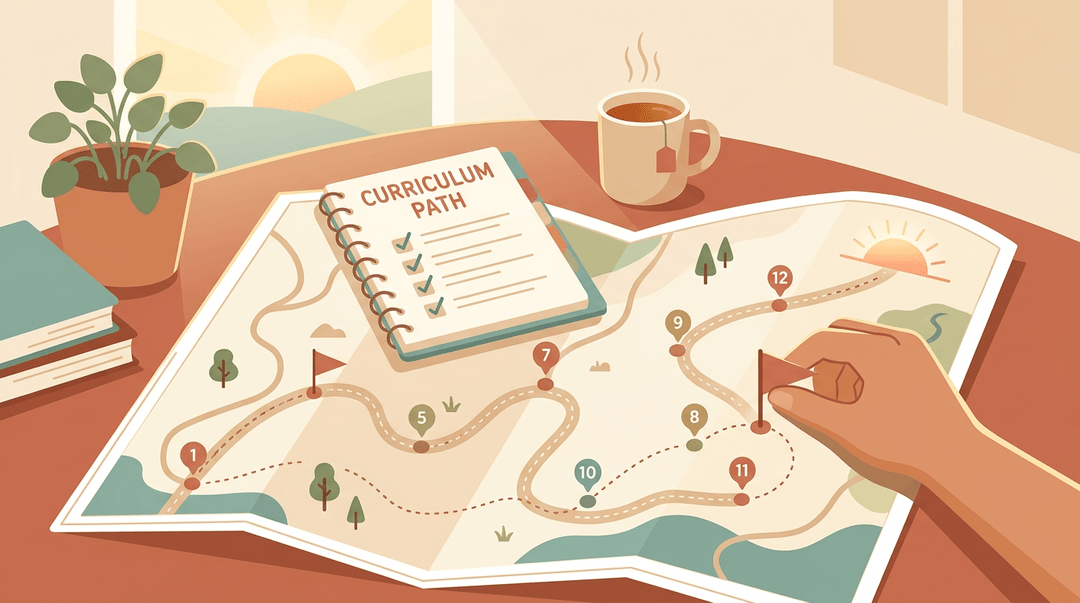
If you've ever planned a family road trip, you already know the value of a good map. Oak Meadow's homeschool curriculum works a lot like that: it shows you where your learner is headed, grade by grade, so you're never guessing at the next turn. If you want to know how that grade by grade view gets planned, curriculum mapping explains the process.
This guide walks through its teaching philosophy, how it changes across the grades, the courses and support it offers, and what it costs.
Along the way, you'll also get a quick start checklist for lining Oak Meadow units up with your standards and pacing guide, so the plan you build on paper matches the lessons you teach at the kitchen table.
The Teaching Philosophy Behind Oak Meadow's Homeschool Curriculum
What shapes the lessons in front of your child? Oak Meadow's approach rests on a few core ideas about how children learn best. Knowing them makes the curriculum easier to use well, whether your family's perspective is secular or faith-based.
Hands-on learning for head, hands and heart
Oak Meadow pairs rigorous academics with experiential learning, so students build skills through hands-on projects rather than worksheets alone. The goal is to engage the head, hands, and heart together.
In the early grades, multisensory learning keeps young children moving, touching, and discovering. As students grow, they can take on self-designed projects and follow their own academic curiosity.
Consider a homeschool parent whose nine-year-old loves bridges. That interest can become a building project that also covers math and science, and the child stays engaged because the question is hers.

How Waldorf ideas shape the curriculum
Oak Meadow draws on Waldorf education, which reflects the influence of Rudolf Steiner. Its view of the child is that the child is both physical and spiritual, and the child stays at the center of learning.
Rather than teaching Waldorf methods directly, the curriculum lets these ideas shape how lessons unfold in subtler ways.
Charlotte Mason style nature study and narration
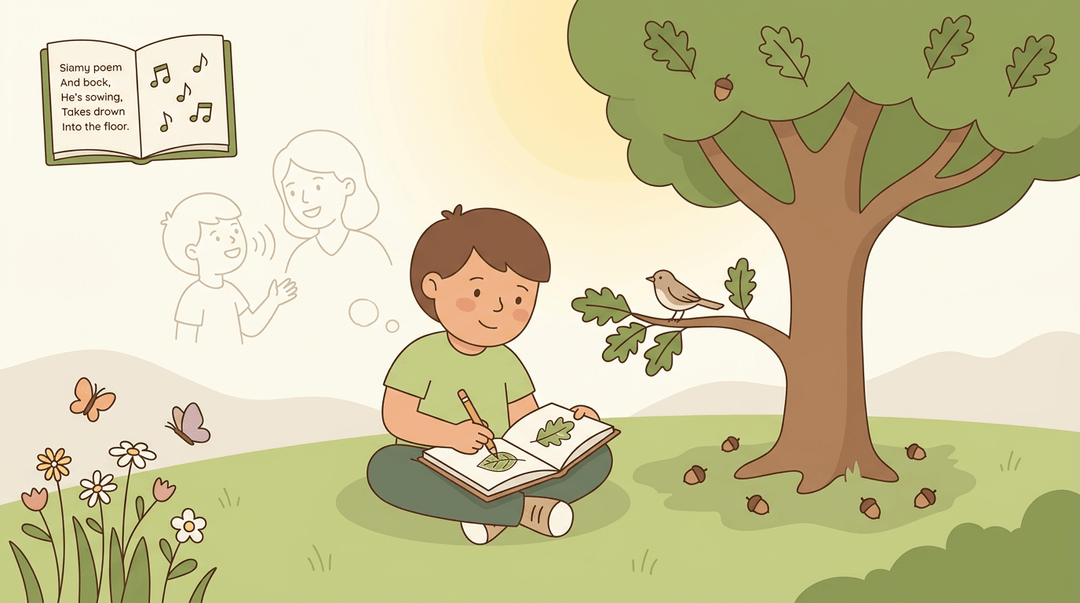
Oak Meadow also borrows from Charlotte Mason's methods. In narration, students tell back what they've read or heard in their own words.
Nature walks and drawing from nature build close observation, and poem recitation builds memory and a feel for language. Hands-on learning choices let students pick how they show what they know.
Rich stories from cultures around the world
Stories sit at the heart of the program. Folk tales, fables, and mythology from many cultures appear without added commentary, so students form their own interpretations.
Selections include works like Narnia and Native American legends, offering broad exposure to ideas and religions. Rich literature is often paired with science topics, so a story about the seasons can open a unit on weather.
Flexible enough to fit your family
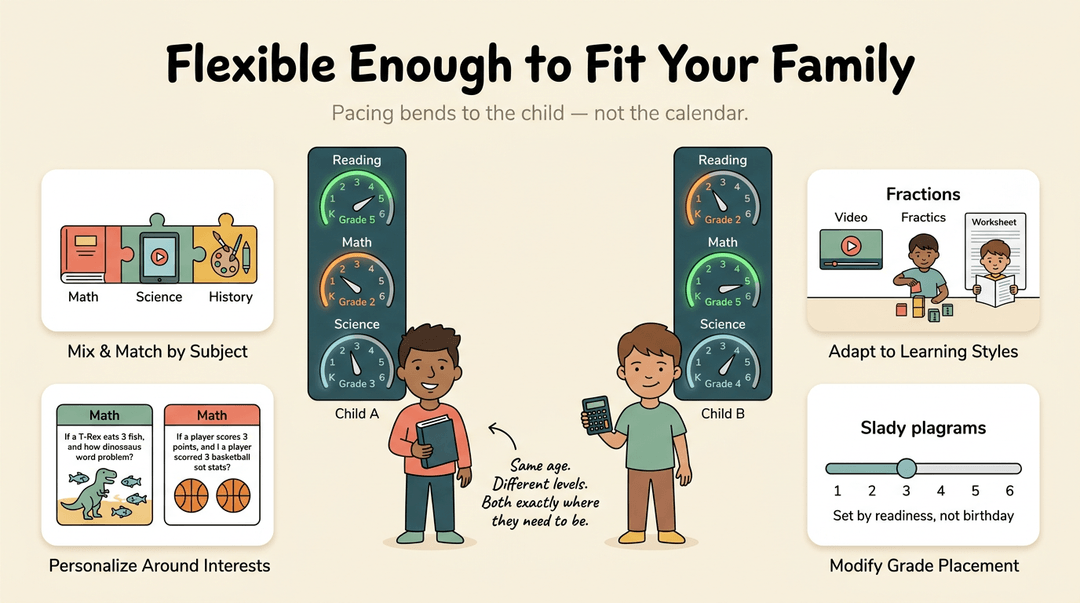
Pacing is flexible rather than tied to rigid timelines. You can slow down for a tricky concept or move ahead when your child is ready. You can:
- mix and match resources by subject
- adapt to different learning styles
- personalize around interests
- modify grade placement
Picture a parent with a strong reader and a struggling mathematician. Each child can work where they really are, not where their birthday says they should be. Flexibility is the point.
How the Curriculum Changes by Grade
Oak Meadow doesn't hand every child the same binder. The program shifts as students grow, and knowing how it changes helps you choose a starting point and plan how each level maps to your state standards.
What elementary grades look like
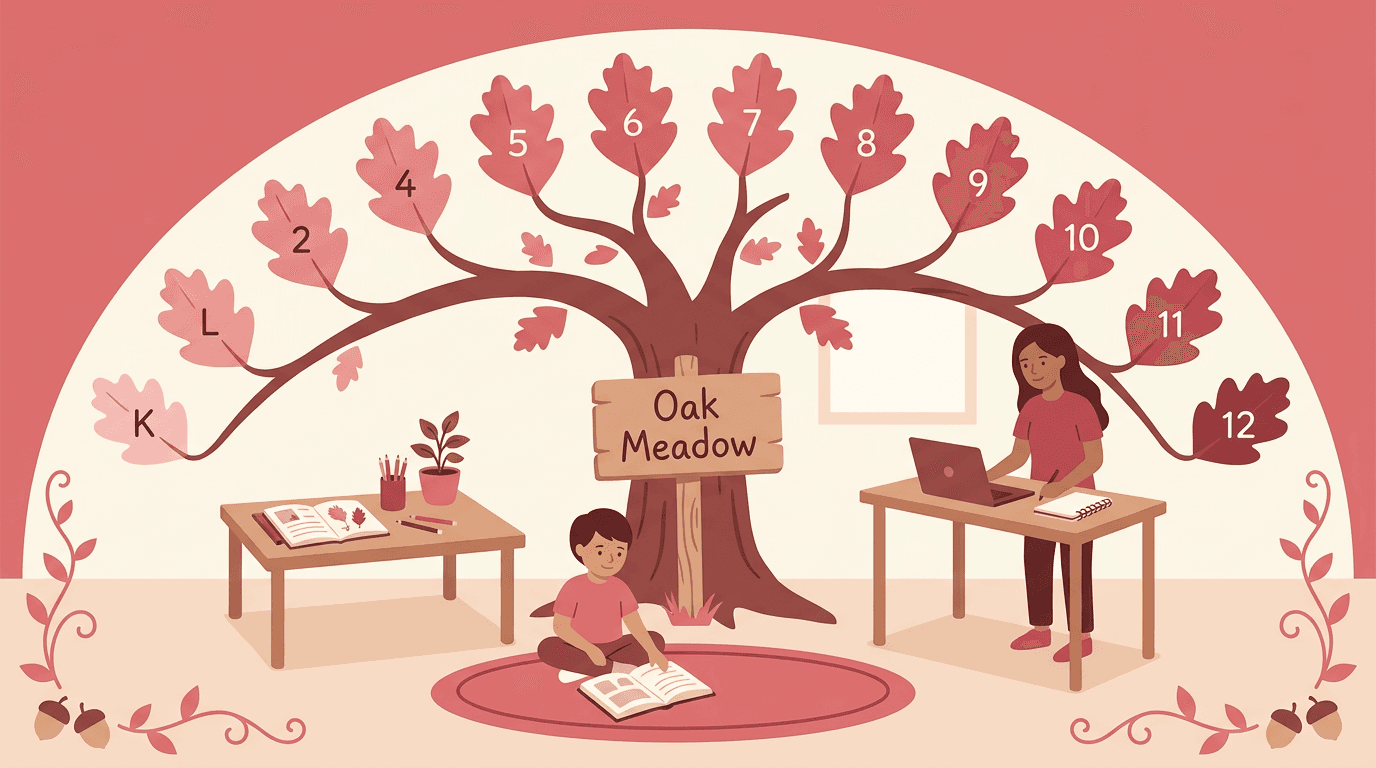
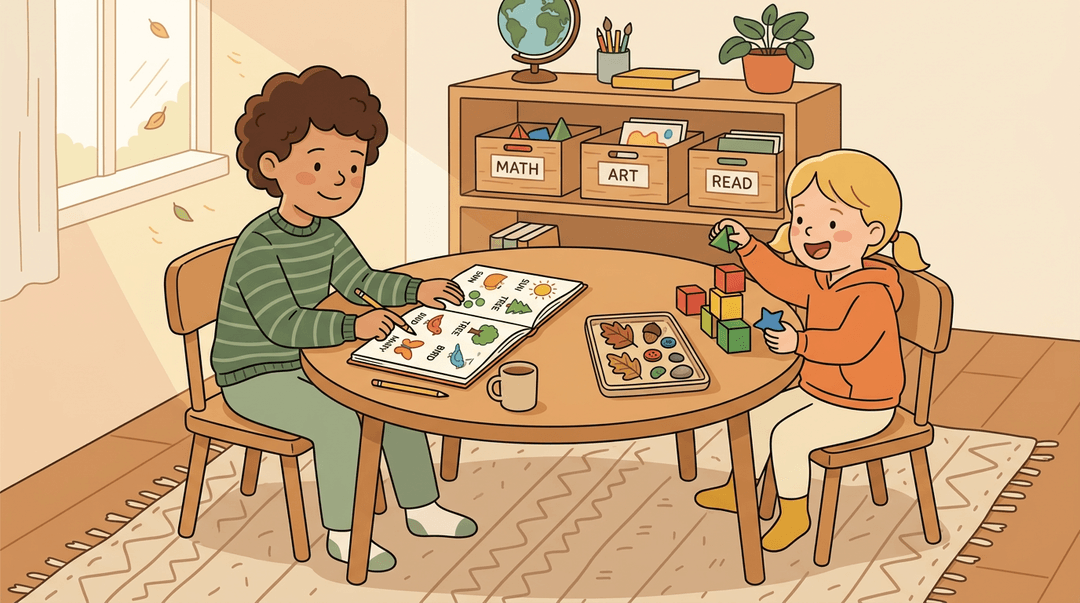
In the early years, the program takes an integrated approach. A single coursebook covers grades K-3, so subjects work together instead of living in separate books.
Activity and movement sit at the heart of the work, and lessons rely on experiential, multisensory learning, so children build, touch, and explore before they're asked to write it down. Kindergarten is deliberately less academically intense.
Math splits into its own book in 4th grade.
For example, a homeschool parent with a second grader and a kindergartner can use the same coursebook for both, while the younger child spends more of the week on hands-on activities. Everyone stays on track, and no one is stuck at a desk all morning.
What middle school grades look like
Fifth and sixth grade bring separate coursebooks for math and science. In seventh and eighth grade, all four core subjects get their own books. Students take on growing independence, and the work shifts toward writing and scientific inquiry skills.
The curriculum also explores human experience as a theme, so learning connects to people and their choices.
What high school courses look like
High school courses are rigorous and college-prep, with a separate syllabus for each subject. Math and science use Saxon texts, while other subjects draw on secular textbook publishers.
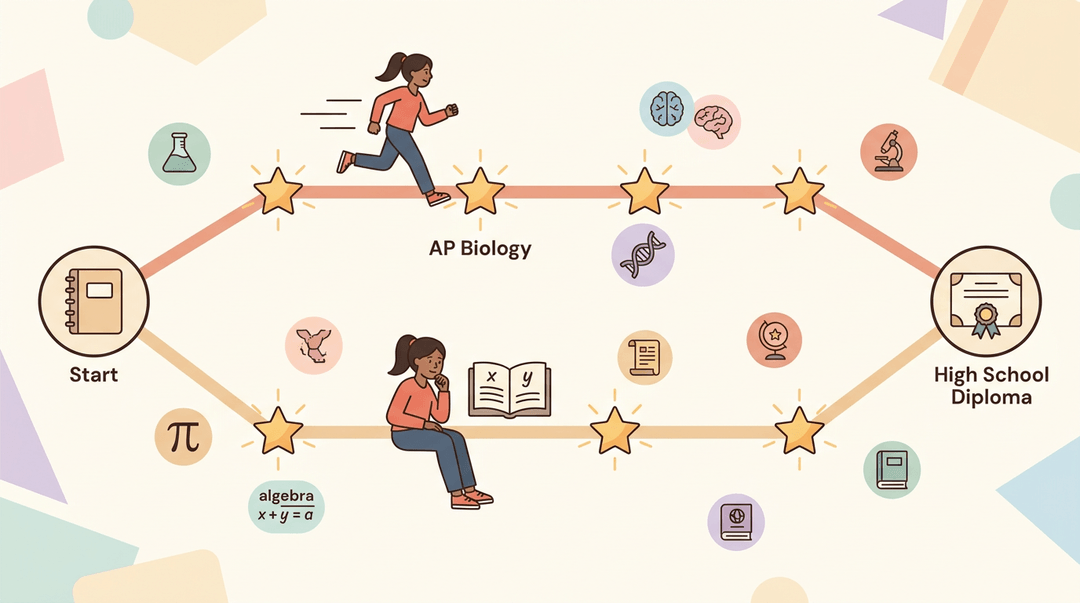
Electives include psychology, and Advanced Placement (AP) courses are available for enrolled students. Honors and AP-level work can be adapted to your student's pace. Consider a student who loves biology but needs more time on algebra.
You can keep her on a slower math track while moving quickly through science.
Choosing the right grade level
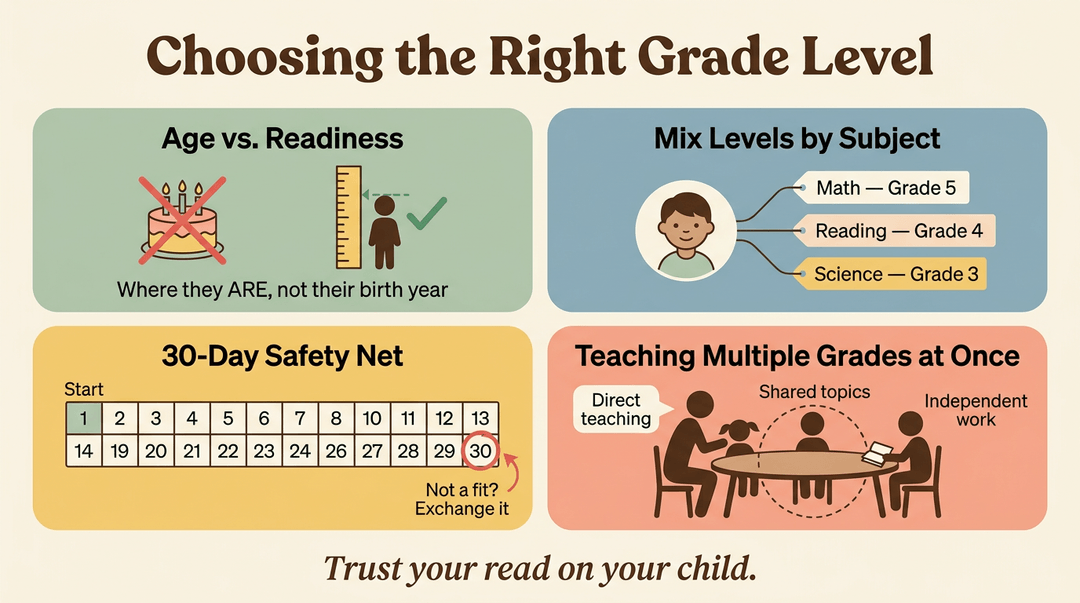
There are no placement tests to sit for, so parent judgment carries the weight, and Oak Meadow encourages it. The question is less about a birth year and more about where your child is right now.
If a level feels off, the 30-day exchange policy gives you room to adjust. You can also mix grade levels per subject, so a student might work at a higher level in math and at grade level in science.
Teaching several grades at once takes planning. Look for topics that overlap across levels, schedule independent work for older students, and save direct instruction for the youngest. Trust your read on your child.
Your Quick Start Checklist for Oak Meadow
Use this guide the week you open your Oak Meadow syllabus. It takes you from units to standards, then to a weekly pace, then to records you can hand over if anyone asks.
Map your units to standards
- Pull your state standards
- Gather them for each grade and subject you teach.
- Match each unit to a standard
- Jot it like this: Unit 3 ← Grade 4 reading: summarize a text.
- Build a year-at-a-glance view
- Put units across the top and subjects down the side, on one page.
- Flag gaps early
- Highlight any standard with no unit, then plan a supplement.
Example: A parent teaching a fourth grader marks each language arts unit against the state reading standards. Two writing standards have no matching unit, so she schedules a short supplement in the fall instead of discovering the hole in spring.
⚠️ Watch out: Don't wait until midyear to check alignment. Gaps found early cost you a few lessons; gaps found late cost you a scramble.
Build a weekly pacing guide
Start by dividing each syllabus into weekly targets: the lessons or projects you want finished by Friday. Then adjust when real life pushes back.
| When you see... | Try... |
|---|---|
| A unit runs longer than planned | Move the overflow into next week's target |
| A younger grade feels rushed | Cut the weekly load, keep the unit order |
| An older grade finishes early | Add a deeper project or extension task |
| Several children, different grades | Give each child a row on one shared schedule |
For multi-grade families, line up shared subjects (like science) on the same days. That frees your focused time for the subjects that need it.
Keep track of progress and records
Confirm these are in place by the end of each month:
- Grades logged. Each completed assignment has a score or note beside it.
- Attendance recorded. Every school day is marked, including partial days.
- Portfolio updated. You've saved one or two work samples per subject.
- Transcript current. Courses and grades are ready to copy onto a transcript.
- State report drafted. Your required paperwork matches what you've logged.
Check your state's reporting rules once, early, so you know exactly which records to keep.
At a glance:
| Phase | Key move | What you get |
|---|---|---|
| Map | Match units to standards | A gap-free year view |
| Pace | Set weekly targets | A schedule you can adjust |
| Record | Log monthly | Reports without the scramble |
Map your Oak Meadow units to standards and build a pacing guide in minutes with EMStudio's Curriculum Planner.
Independent Use Versus Full Enrollment
Oak Meadow lets you use its materials in two very different ways, and the choice shapes everything from paperwork to how much support you get. Here's how to tell them apart.
Is Oak Meadow a full curriculum?
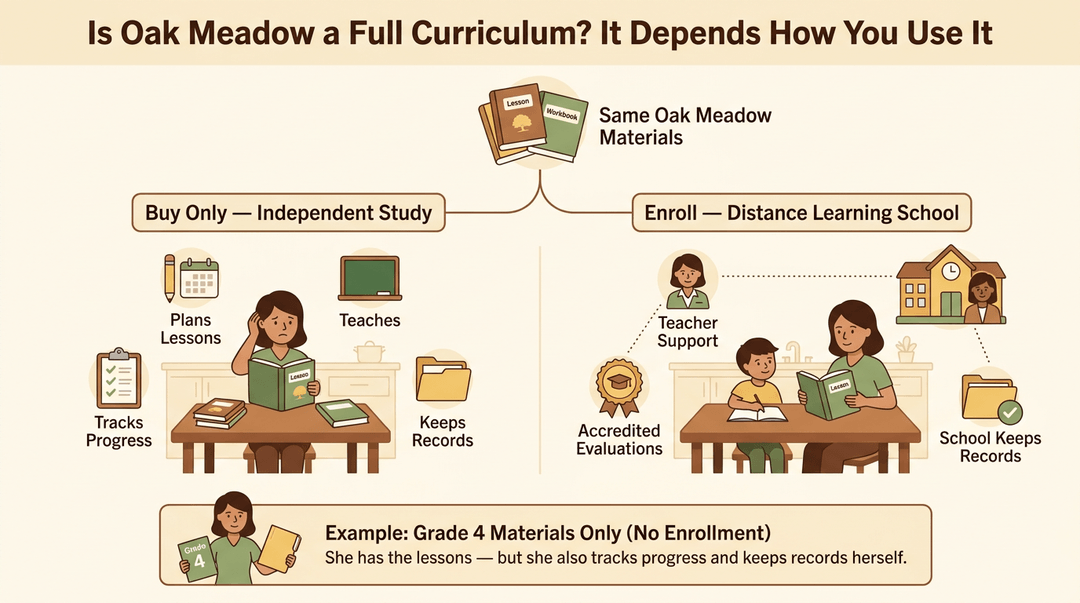
It depends on how you use it. You can simply purchase the curriculum and homeschool independently, planning and teaching the lessons yourself.
Or you can enroll, which brings in an accredited distance learning school with teacher support, evaluations, and record keeping. So whether Oak Meadow counts as a full curriculum for you depends on whether you enroll.
The materials are the same either way, but the support is not. Consider a parent who buys the grade 4 materials only: she has the lessons, but she also tracks progress and keeps records herself.
Oak Meadow's partnerships with schools
Oak Meadow also collaborates with schools and brings its curriculum into institutions, not only into individual homes. If you teach in a school or co-op, ask whether an arrangement like this already exists in your setting.
Deciding between independent and enrolled
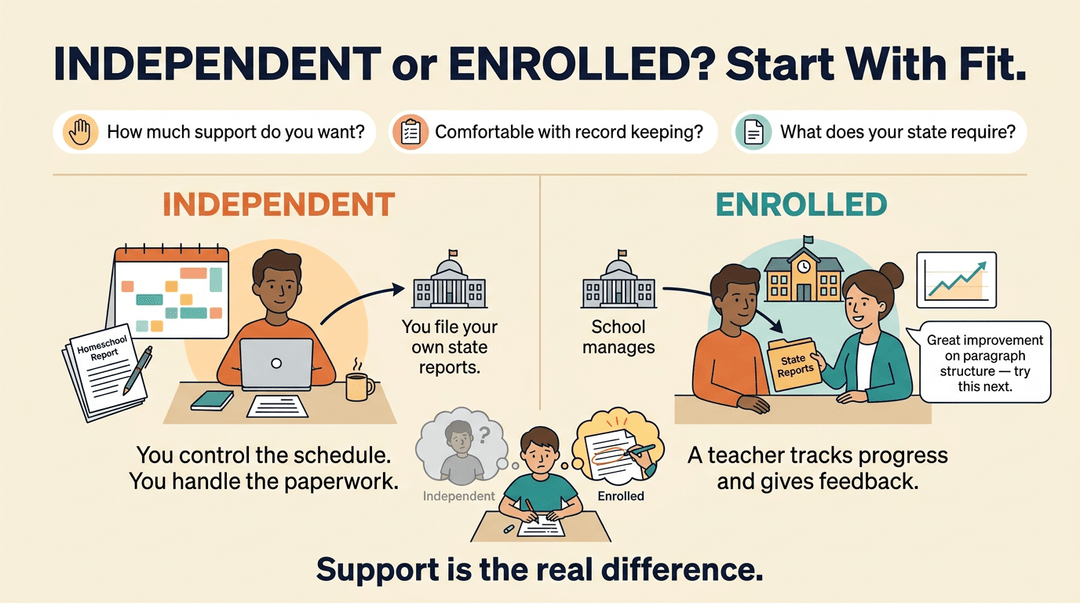
Start with fit. Ask how much support you want, how comfortable you are with record keeping, and what your state requires for homeschool reporting. Independent families may have reporting requirements to meet, so check your state's rules first.
- Independent use gives you flexibility and control over the schedule.
- Enrollment may remove the need to file on your own, since the school handles that side.
- Enrolled families get an ongoing relationship with a teacher who follows the student's progress.
For a student who struggles with writing, enrollment means regular feedback from a teacher instead of guessing alone. Support is the real difference.
Online classes for enrolled students
Enrolled students in grades 7 through 12 can join online classes with:
- class discussions
- student collaboration
- real-time teacher feedback
For a high schooler who thinks best by talking through ideas, that's the difference between working in isolation and learning alongside peers.
What Courses and Subjects Are Offered
Oak Meadow's catalog covers the core subjects, and each course can stand on its own or sit alongside materials you already use. Here's what to expect in each area.
English and literature courses explained
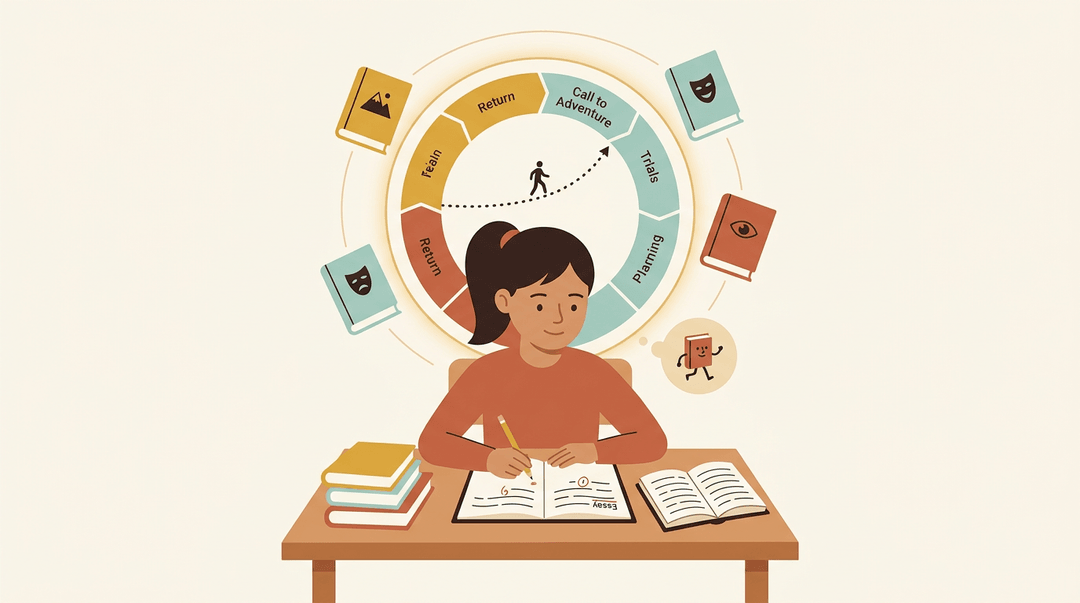
The English work centers on a Hero's Journey course that pairs literature with outside reading, so students see the same story patterns across several books.
Literature and composition are the focus, and grammar is reinforced through writing rather than taught in isolation. Think of a student drafting a short essay about a character's choices.
While she explains what the character learns, she also practices sentence structure. The selections include varied works of philosophical literature, which gives students plenty to think and talk about.
What science courses cover
Oak Meadow offers its own Biology course. You can also use the Miller & Levine Biology textbook with Savvas digital resources. Lab work is included, so students aren't only reading about experiments.
Experiments and hands-on activities help the material stick. Multiple science subjects are offered, so you can plan a full science sequence.
A parent building a unit on cells might pair the printed text with the digital resources, then have her child run the hands-on activities at the kitchen table. It's less about reading the lab and more about running it.
Math courses and how they work
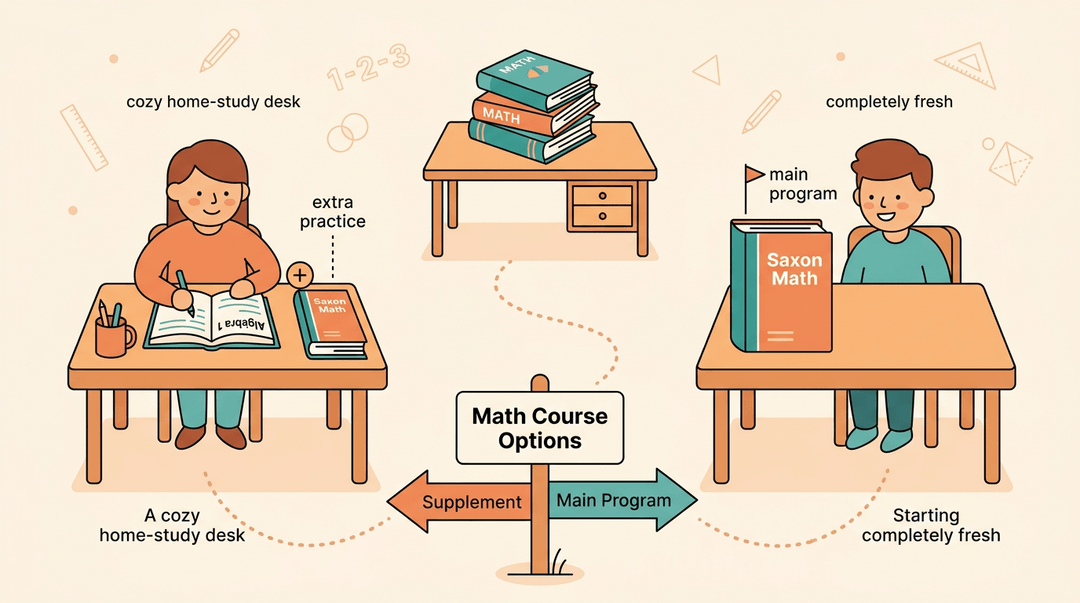
Oak Meadow Algebra 1 is available as its own course. Saxon Math is used in high school and can work either way: as a supplement or as the spine of your math sequence. A family happy with its current math plan might add Saxon for extra practice.
A family starting fresh might make it the main program.
Social studies and geography courses
The World Geography course covers both physical and human geography. Students study the land itself alongside the people who live, work, and settle on it. The social studies texts are secular, which matters to many families when they compare options.
Learning personal finance skills
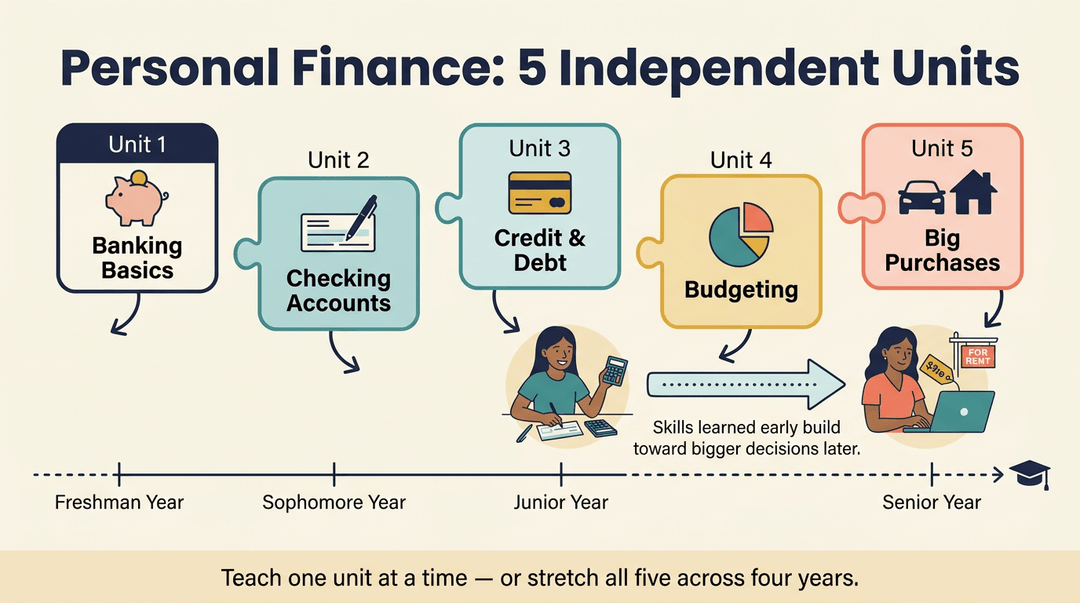
Personal finance is organized into five independent units, so you can teach one at a time or spread them out. The units cover banking and consumer skills. They're designed to stretch across the high school years rather than squeeze into a single semester.
Money skills take time to stick. A student who learns to balance a checking account in her junior year can build toward bigger consumer decisions later.
High School Features That Prep for College
Planning for college can feel like the hardest part of homeschooling high school, but Oak Meadow's features give you more to work with than you might expect.
Confirm the accreditation status and what it means for your diploma early, because that shapes every other choice.
Transcript and credit options explained
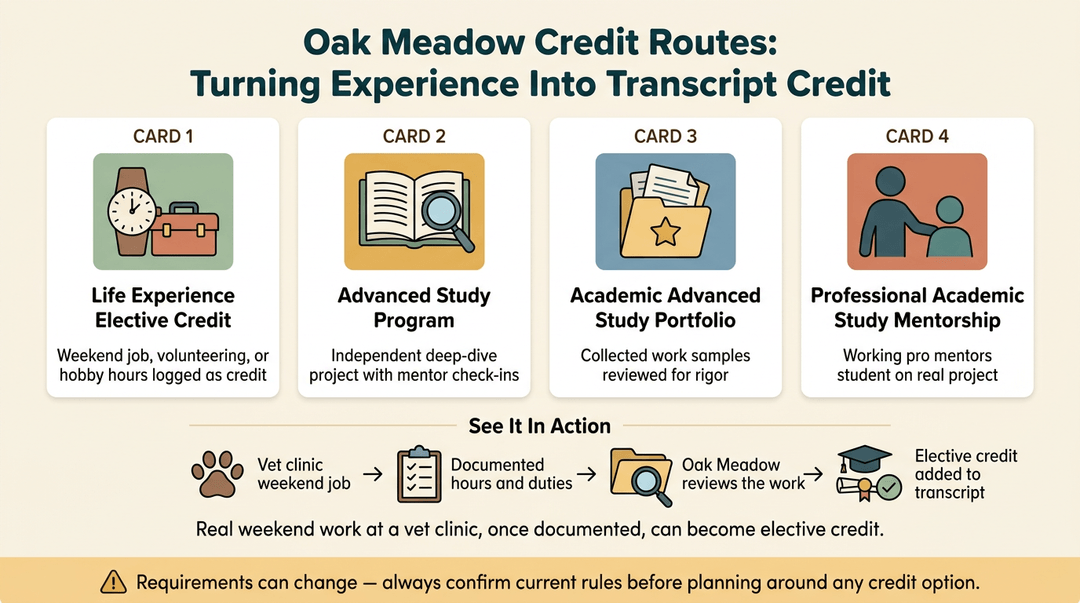
Oak Meadow offers several routes to credit, including:
- Life Experience Elective Credit
- the Advanced Study Program
- Academic Advanced Study portfolios
- Professional Academic Study mentorships
Some of these connect career skills to coursework. Consider a homeschool parent whose teen works weekends at a veterinary clinic. Documenting that work may let it count toward an elective, turning real experience into transcript credit.
Check current requirements before you plan around any option.
Building a well rounded transcript
A strong transcript shows more than course titles. Extracurricular activities, passion projects, community service, and career exploration all reveal who your student is. Keep an eye on avoiding burnout, though.
A packed calendar looks impressive but can wear a student down. The goal is depth over a long list of commitments.
A reputation for academic rigor
Ask your college counselor how they view Oak Meadow, since admissions readers weigh the whole record. Rigor shouldn't mean burnout, and structure shouldn't mean rigidity.
Look for enough schedule to keep your student on track and enough room to follow real interests.
Whether a program suits college-bound students depends on your goals, so compare its course list with the requirements of the schools you're considering. Short and steady wins.
Support Services for Homeschooling Families
Homeschooling doesn't have to mean going it alone. Oak Meadow offers help at several levels, from paid sessions to guidance for the college years.
Paid support and tutoring options
Need extra help beyond the curriculum? Oak Meadow offers hourly Homeschool Support sessions, along with teacher tutors and academic and special needs coaching to adapt the program to your child's learning profile.
A parent with a struggling reader, for example, can leave a session with a clear next step instead of guessing.
Ongoing teacher support for enrolled students
Enrolled students get ongoing contact by email, phone, or video, so questions don't pile up until the next lesson. Students also benefit from same teacher continuity, so the person who knows their work stays with them.
Teachers can even modify the curriculum, which means adjusting the path rather than just following it.

Help planning for college
For families planning for college, Oak Meadow offers:
- College Planning Seminars
- transcript templates
- planning pages on its website
Oak Meadow also provides college counselor validation. According to Oak Meadow's 2021 K-12 catalog, its experienced college counselor provides guidance on:
- academic planning
- SAT and ACT schedules
- the overall admission process
Less guesswork, more clarity.
Oak Meadow's History and Pricing
Wondering whether Oak Meadow is worth your time and your budget? Here's what we know about its track record and cost, plus where to confirm the details.
Is Oak Meadow a good homeschool program?
Oak Meadow was founded in 1975, and according to its own school page, it's one of the first distance learning programs in the United States. It serves homeschool students in grades K-12, and a preschool program is also available.
That's a long track record for an experienced provider.
Think of a homeschool parent with a first grader this year and a middle schooler next year. Staying with one program means less time re-learning a new system every time your child moves up a grade.
Whether it fits depends on your child and your teaching style, so compare it with other top curricula before you commit. We don't have verified comparison data here, so we won't rank them. When you compare other top curricula, start with our complete overview of The Good and the Beautiful Curriculum.
Overall, the history and K-12 range make it a solid contender, but fit matters more than reputation.

How much does Oak Meadow homeschool cost?
Oak Meadow's tuition is listed on its official pricing page, but prices are subject to change. Treat any figure you see as a starting point.
We don't have a verified grade-by-grade cost breakdown to share, so check the current tuition for each grade you're planning. Prices change. Check before you plan, and budget for current prices rather than last year's.
Oak Meadow gives homeschool families a complete path through each grade, and the checklist gives you a practical way to make that path fit your own standards and schedule.
Keeping units, lessons, and standards in one place is what helps that fit hold up through the whole school year.
Ready to see the entire year at a glance? Check out our Curriculum Planning feature page to plan units, lessons, and standards from start to finish.

References
- Oak Meadow — oakmeadow.com (2026)
- K-12 Curriculum and Distance Learning School — oakmeadow.com
Frequently asked questions
What are the top 5 homeschool curriculum?
Five widely considered leading homeschool curricula are Oak Meadow, Sonlight, The Good and the Beautiful, Saxon Math, and Abeka. The best choice depends on whether you want secular or faith-based materials, hands-on learning, online support, or a structured traditional approach.
How much does Oak Meadow homeschool cost?
Oak Meadow’s homeschool cost varies by grade, course, and whether you purchase materials independently or enroll in the distance-learning school. Tuition and materials prices can change, so check Oak Meadow’s current official pricing page for the exact cost.
Is Oak Meadow a good homeschool program?
Oak Meadow can be a good homeschool program for families seeking a flexible, secular, hands-on curriculum with options from preschool through high school. Its suitability depends on your child’s learning style, your teaching preferences, and whether you want independent materials or enrolled teacher support.
Is Oak Meadow a full curriculum?
Yes, Oak Meadow can function as a full curriculum, but the level of support depends on how you use it. Independent families purchase the materials and manage teaching, pacing, assessment, and records themselves, while enrolled students receive teacher support, evaluations, and record keeping through the distance-learning school.