Learning Objectives: What They Are and How to Write Them Well

Jump to section
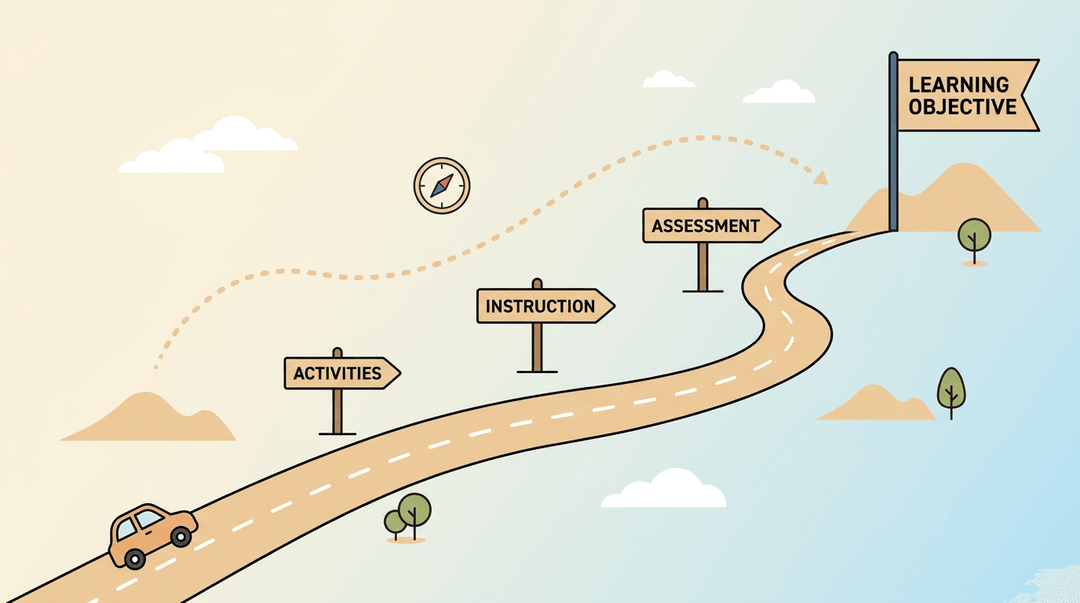
When you plan a road trip, you don't just start driving. You pick a destination first, then figure out the roads that get you there.
Lesson planning works the same way. A learning objective is that destination: a plain statement of what students should know or be able to do by the end of a lesson.
Get it right, and everything else, your activities, your assessments, your instruction, lines up behind it.
This post breaks down what makes an objective effective, how to write one step by step, and how to keep it aligned with what you actually teach and test.
What Learning Objectives Are and Why They Matter
Every strong lesson starts with a plain answer to one question: what should students walk away able to do? That answer is your learning objective, and it shapes everything that follows.
What learning objectives really mean
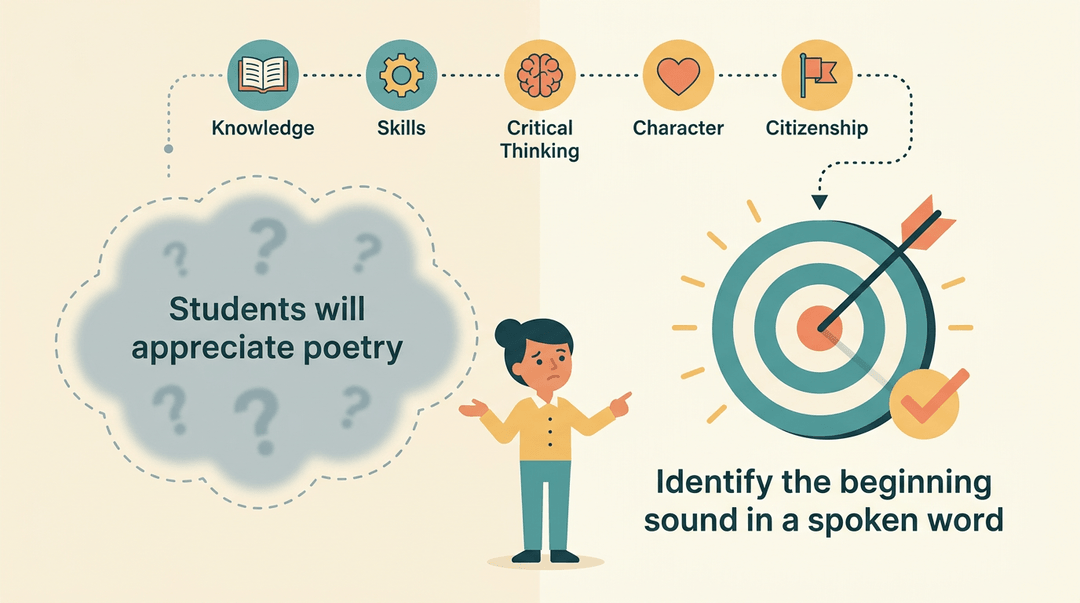
A learning objective is a measurable statement of what a student will know or do by the end of a lesson, unit, or course, distinct from a broad learning goal like "students will appreciate poetry," which doesn't say how you'd know it happened.
You'll sometimes see objectives called learning outcomes: the terms overlap, though outcomes usually describe the result and objectives the steps that get you there. A good objective also draws boundaries, marking what's in scope today and what isn't.
Zoom out and you'll find education's five broad aims sitting above any single lesson:
- Knowledge
- Skills
- Critical thinking
- Character
- Citizenship
Objectives translate one of those into something measurable this week, whether that's a kindergarten teacher targeting "identify the beginning sound in a spoken word" or a college instructor aiming for "critique primary sources using disciplinary methods."
How objectives shape your course design
Objectives are the starting point of backward design: decide what students must demonstrate, build the assessment that proves it, then choose the activities and materials that get them there.
Skip that order and you risk planning a fun activity first and hoping it teaches something. For you, objectives guide the planning; for students, they're the roadmap, a clear sense of where the lesson is headed and why today's work matters.
Why clear objectives benefit everyone
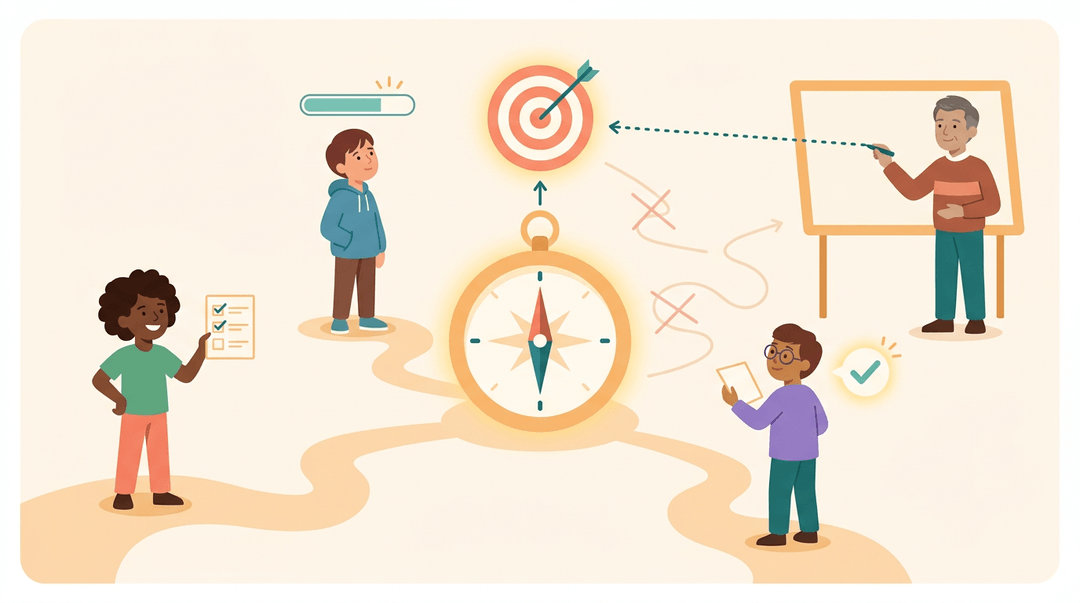
Clear objectives act as a compass, keeping your design choices pointed at what matters instead of what's easiest to grade. They set clear expectations for students, who can self-monitor their own progress instead of guessing whether they're on track.
And because everyone's aiming at the same target, fair assessment gets a lot easier: no one's penalized for missing something that was never actually the point.
What Makes an Objective Effective
Not every objective pulls its weight in a lesson plan. The strong ones share a few traits you can check for, and a familiar framework is a good place to start.
What are the 5 SMART goals for students?
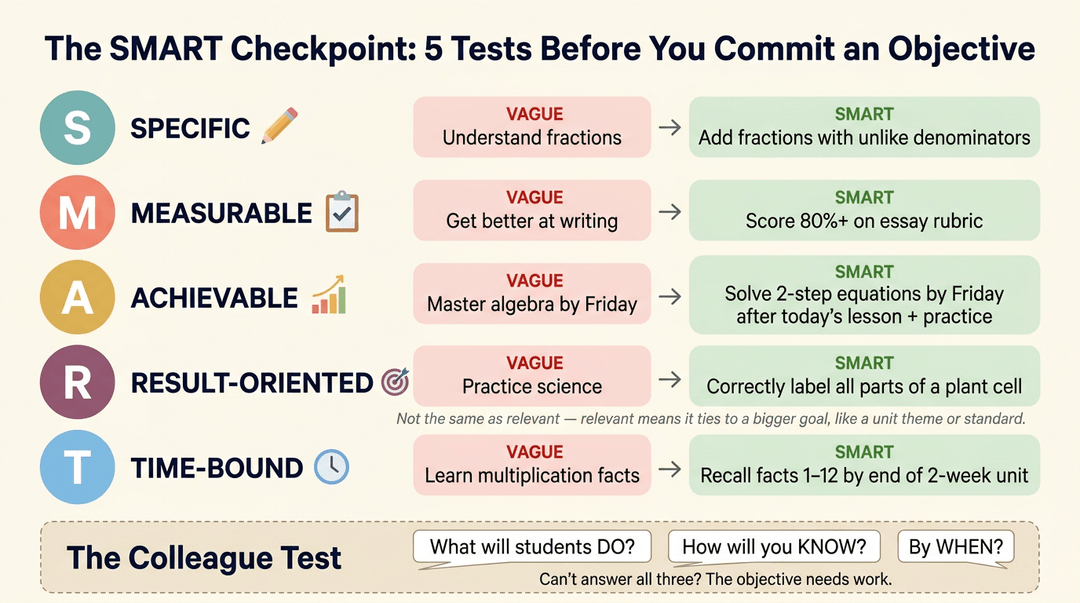
SMART is a quick filter for objective quality: run any objective through these five checkpoints before you commit it to a lesson plan.
- Specific. Name the exact skill or content, not a general topic.
- Measurable. Build in a way to check whether students actually got there.
- Achievable. Set a bar students can reach with the time and support you actually have.
- Result-oriented. This one's often confused with relevant: result-oriented means the objective points to a concrete outcome, while relevant means that outcome connects to a bigger goal, like a standard or unit theme.
- Time-bound. Attach a deadline: by the end of the lesson, the unit, or the week.
Try this as a quick exercise: hand a draft objective to a colleague and ask them to name what students will do, how you'll know, and by when. If they can't answer all three, the objective needs work.
Keep the focus on your students
An effective objective describes what students will do, not what you'll teach. Start with "students will be able to" and finish the sentence with their action. "Students will be able to identify the main idea of a passage" holds up.
"The teacher will explain main idea" doesn't, because it describes your activity, not their learning.
Use verbs you can actually observe
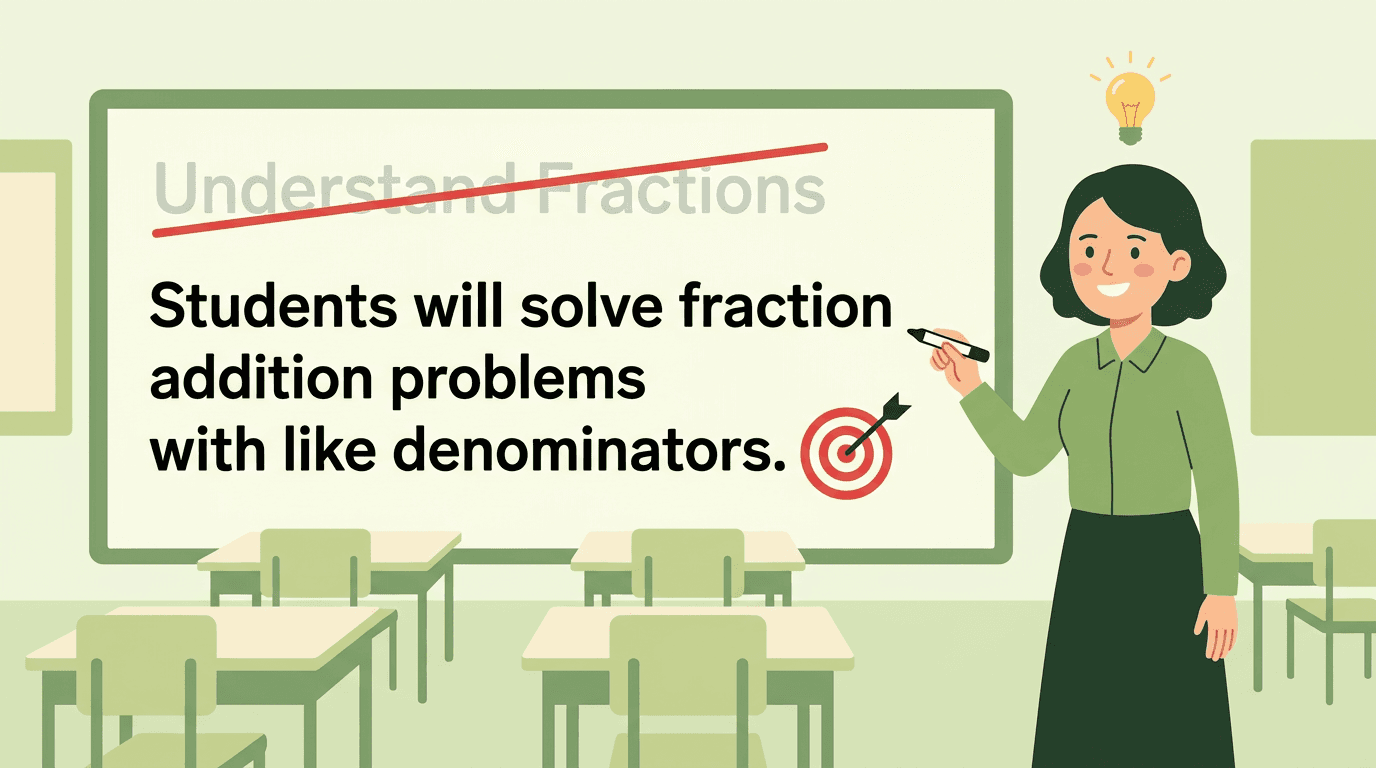
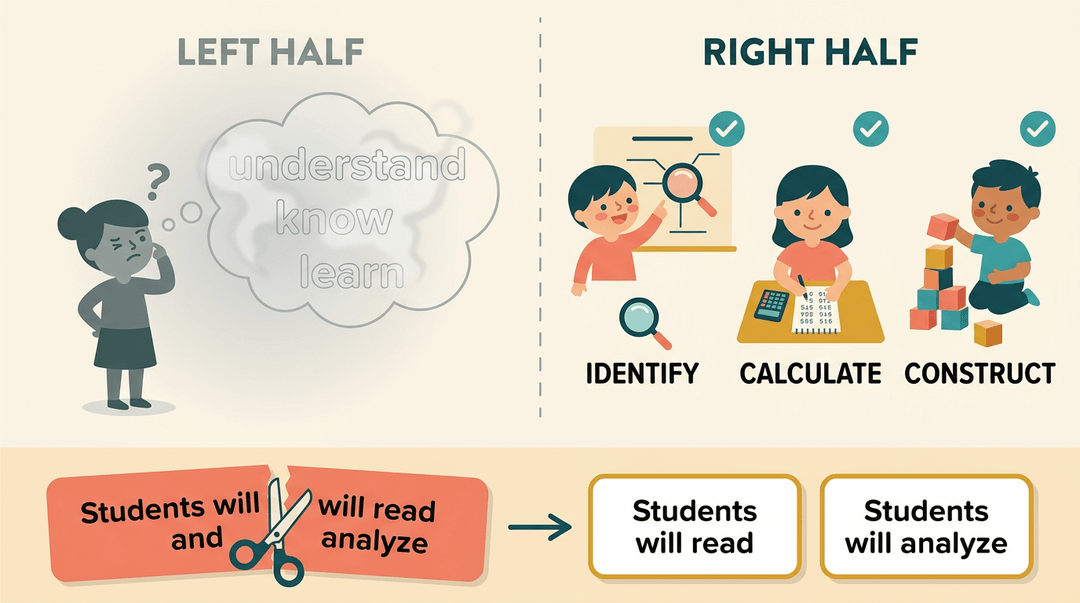
Skip vague verbs like understand, know, or learn: you can't see any of them happen. Lean on verbs you can watch or measure instead, like identify, calculate, or construct.
And keep objectives separate rather than conflated: "students will read and analyze" is really two objectives, so write two.
How to Write Learning Objectives
Once you know what an objective is, the next question is practical: how do you actually write one that works? The good news is that it comes down to a repeatable formula, not inspiration.
The basic parts of an objective
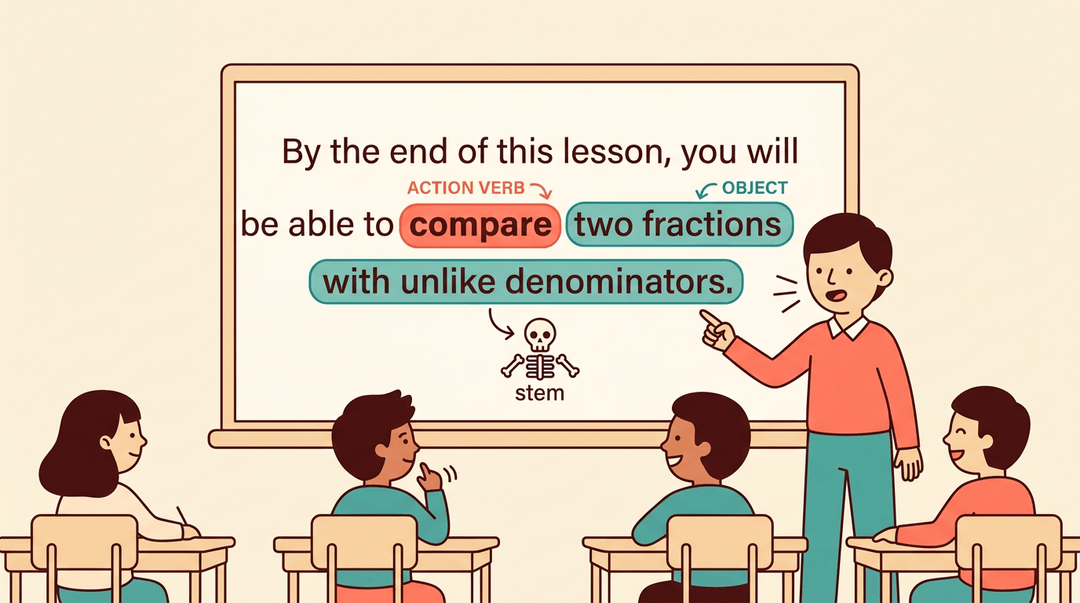
Every solid objective has the same skeleton: an action verb paired with an object (the specific knowledge or skill), built on a stem that names what students will know, do, or demonstrate.
Phrase it in second person, speaking directly to the student rather than about them: "By the end of this lesson, you will be able to compare two fractions with unlike denominators." Then display it and read it aloud at the start of class.
That small habit anchors the whole lesson before a single slide goes up.
A step-by-step process for writing them
- Identify the topic. What single concept or skill is this lesson actually about?
- Determine the mastery level. How deep does understanding need to go: recall, application, or something more complex?
- Complete the statement. Combine verb, object, and condition into one sentence.
- Tweak and refine. Run it against a quick checklist: Is it measurable? Specific? Written for the student, not the teacher?
How Bloom's Taxonomy guides your verbs
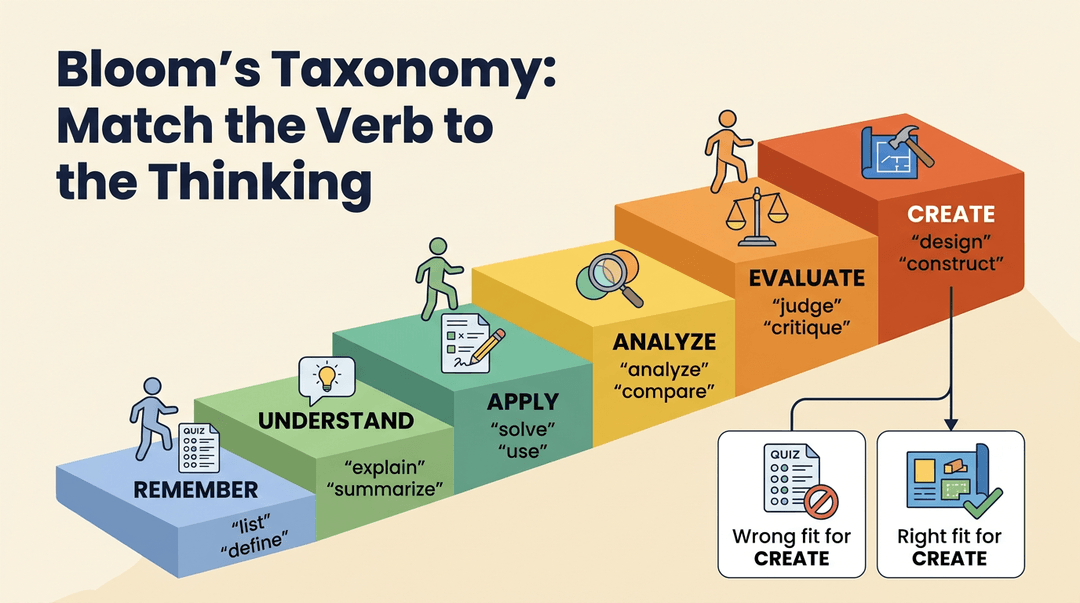
Bloom's Taxonomy sorts thinking into six cognitive categories:
- remember
- understand
- apply
- analyze
- evaluate
- create
Each level pairs with its own verbs:
- "list" and "define" for remembering
- "analyze" and "compare" for deeper reasoning
- "design" and "construct" for creating
Matching the verb to the level also matches the objective to the right assessment: a "create" objective needs a project, not a multiple-choice quiz.
Helpful prompts to get you started
When you're stuck, try finishing this sentence: "By the end of the unit, students will know / do / feel..." Push past pure content to consider skills, dispositions, and argumentation too.
For example, a middle school science teacher might write, "You will be able to argue, using evidence, why an ecosystem is out of balance," while a first-grade teacher aims lower and narrower: "You will be able to name the five senses."
Keep it tight: 3 to 5 objectives per course is plenty.
Writing a Learning Objective Step by Step
You know what a strong objective looks like; now let's build one. The five steps below take about two minutes once you've done them a few times, and the same recipe works from second grade to SAT prep.
The five steps
- Pick one topic or skill. One, not three.
- Write it as a phrase: "adding fractions with unlike denominators," not "fractions."
- Choose a Bloom's-level verb that matches the thinking you want.
- Remembering: identify, list. Analyzing: compare, analyze. Evaluating: justify, critique.
- Write the SWBAT statement (Students Will Be Able To).
- "Students will be able to compare fractions with unlike denominators."
- Add a measurable condition: how well, with what, or how many.
- "...in 4 of 5 practice problems" or "...using two examples from the text."
- Check it against SMART: specific, measurable, achievable, relevant, time-bound.
- ❌ "Students will understand fractions." (Can't see it, can't measure it.)
- ✅ "By the end of class, students will compare fractions in 4 of 5 problems."
- The difference: a visible verb and a countable condition.
⚠️ Watch out: "understand," "know," and "appreciate" are the three verbs that sink objectives. You can't watch a student understand. Swap in a verb you could film.
Example: As it would appear on your board: "By the end of today's lesson, you will be able to identify the main idea of a paragraph and support it with two details from the text."
The same recipe at every level
| Level | The objective, sketched |
|---|---|
| Elementary | Identify the main idea of a passage, citing one detail |
| Middle school | Analyze the cause-effect relationship in a historical event |
| High school | Evaluate an argument's evidence and name its strongest flaw |
| Tutoring / homeschool | Same verbs, but set the condition to the student's pace |
For one-on-one settings, the condition is where you personalize: "in 3 of 4 problems" this week can become "4 of 4, unassisted" next week.
Make it live in your classroom
An objective only works if students meet it more than once. Before and during the lesson, confirm:
- You've said it aloud. Try: "By the end of today, you'll be able to..."
- It's posted on the board. Same spot every day, so eyes find it automatically.
- Your exit ticket matches it. If the objective says "compare," the ticket asks students to compare.
- You're reusing it. A well-built objective works across sections and across years with small tweaks.
That last point is where the payoff compounds: save your objective templates once and reuse them across every class with EMStudio's online lesson planner.
Aligning Objectives with Assessments and Instruction
An objective only earns its keep when it connects to what you test and what you teach. Break that connection, and the whole lesson wobbles.
How backward design ties it together
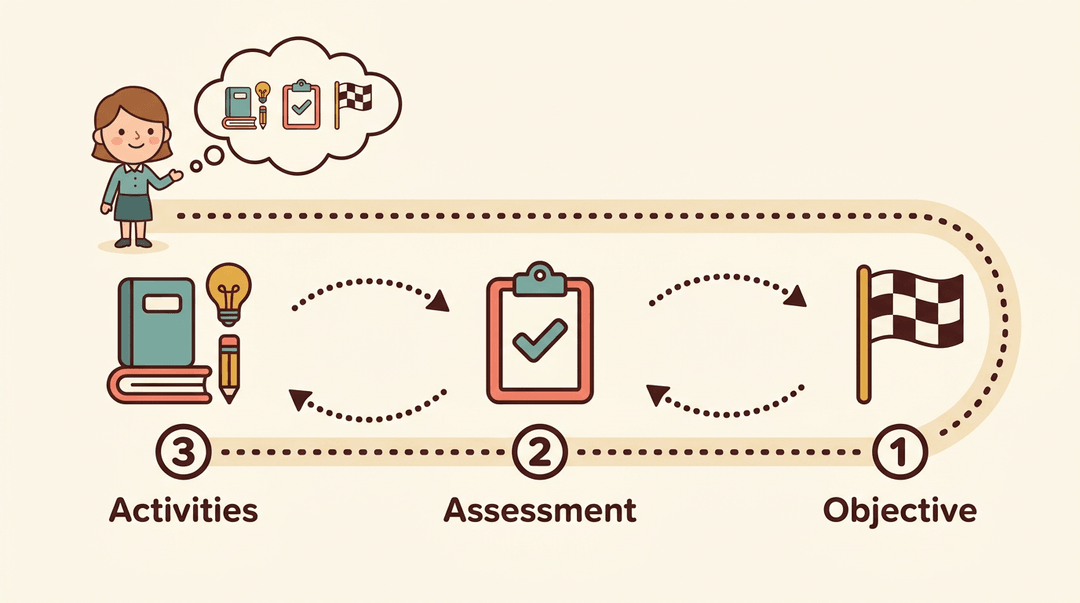
Backward design starts at the end: you write the objective first, then decide how students will prove they've met it, then pick the activities and content that get them there.
Objectives drive the assessment, and the assessment drives what you actually put in front of students.
Skip a step or work in the wrong order, and students end up confused about what actually matters, memorizing dates for a test that's really asking them to argue a point.
What good and bad alignment looks like
Consider a high school history teacher whose objective is "analyze the causes of the American Revolution," but whose test is a multiple-choice quiz on dates and names. That's misaligned: the assessment checks recall, not analysis.
A well-aligned version swaps the quiz for a short essay asking students to weigh two causes against each other. Same objective, but now the assessment matches the thinking it claims to measure.
Connecting objectives to broader expectations
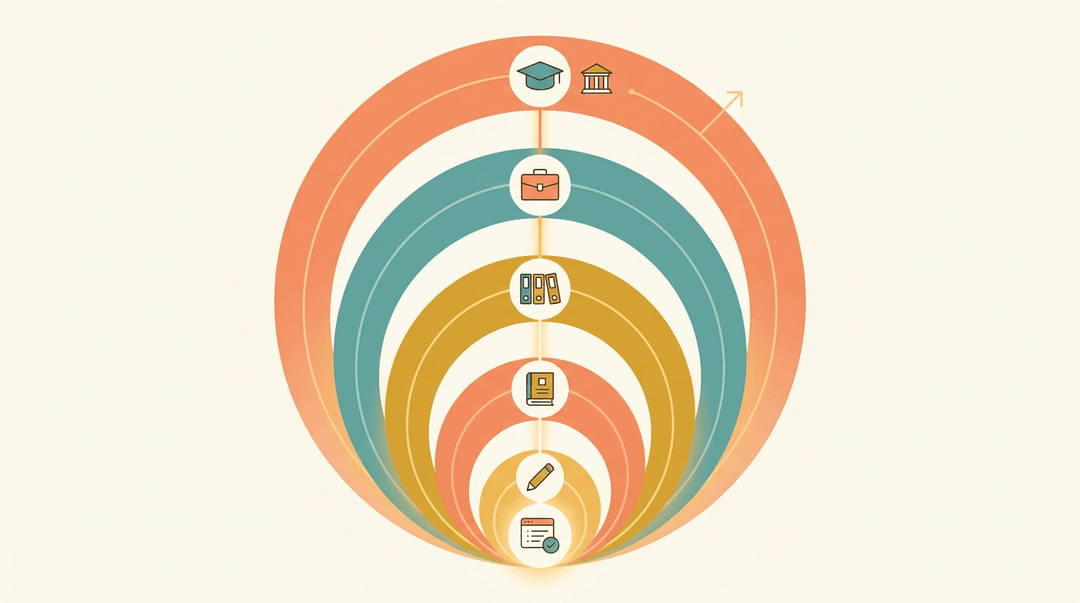
A single lesson's objectives should also nest inside something bigger:
- your course's goals
- your department's standards
- and where relevant, the expectations of the profession students are headed toward
Beyond the classroom, those objectives quietly answer to institutional accreditation and to what your community expects graduates to know and do. Alignment, done well, runs all the way up.
Context That Shapes Your Course Design
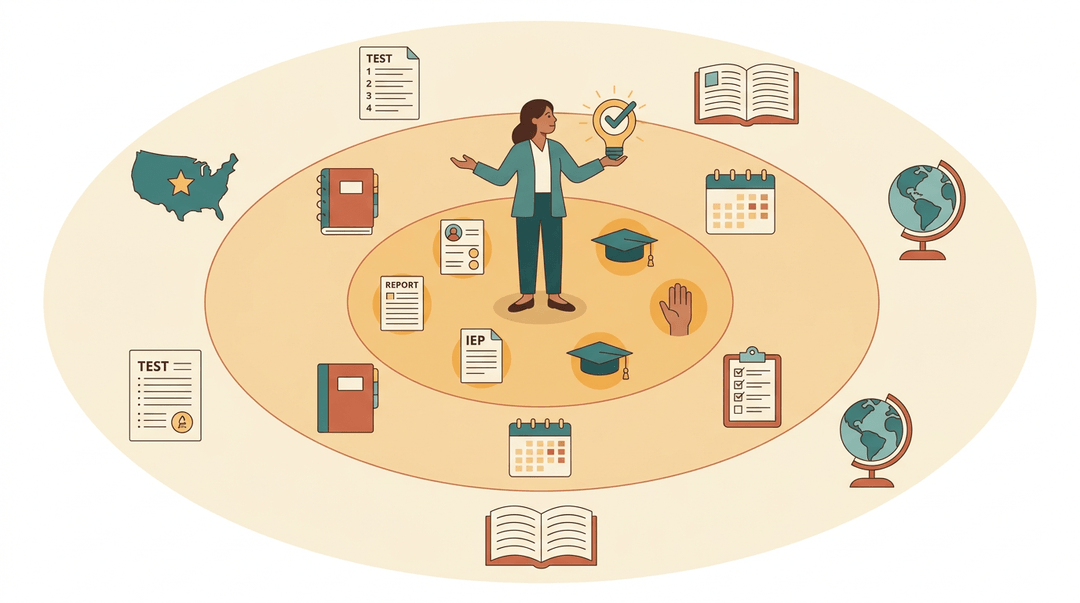
No objective gets written in a vacuum. Before you draft a single one, it helps to look outward: who's expecting what from this course, and where does it sit in the bigger picture of your students' education?
Expectations from students, department, and field
Your students walk in with their own expectations, shaped by grade-level standards, prior grades, and sometimes an IEP or 504 plan that spells out specific goals.
Your department or school adds another layer: curriculum maps, pacing guides, and shared assessments that your objectives need to align with, not contradict.
Beyond your building, the field itself sets expectations. State standards, standardized tests, and professional benchmarks (think NGSS for science or Common Core for math) shape what "mastery" actually means for your subject.
Zoom out further and you'll find broader societal expectations too: schools are asked to build not just test-takers, but readers, citizens, and problem-solvers. Good objectives hold all three layers in view at once.
Where your course fits in the program
A course rarely stands alone. Think of a middle school math teacher planning a unit on ratios: it only works if students already grasp fractions, and it needs to set them up for the proportional reasoning waiting in eighth grade.
Look at what came before and what comes next, then write objectives that build the bridge between them.
Once that trajectory is clear, write your objectives directly into your sub plans. A substitute (or a coach stepping in) should be able to open your plans and immediately see what students are meant to walk away knowing, no guesswork required.
Helpful Resources and Tools
Writing sharp learning objectives gets a lot easier when you're not starting from a blank page. A handful of checklists, institutional guides, and research threads can save you the guesswork.
Checklists and guides to get started
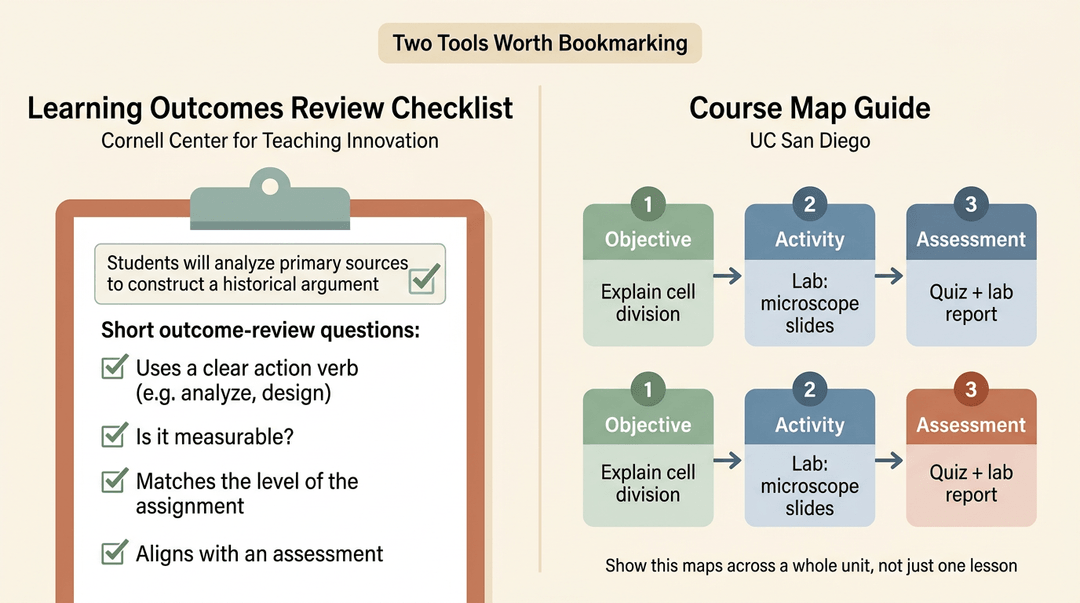
Two tools are worth bookmarking. Cornell Center for Teaching Innovation offers a Learning Outcomes Review Checklist built to help instructors evaluate their own outcomes line by line.
And for mapping objectives across a full unit or course, UC San Diego's Course Map Guide lays out a visual overview of how each objective connects to the activities and assessments that support it.
Resources specific to your institution
Many schools and districts publish their own objective-writing guidance, and it's worth checking what's already available before building from scratch.
The UCLA Registrar's catalog shows how program-level objectives get documented, while UCLA's Learning Outcomes Assessment site walks through establishing and assessing them course by course.
UCLA also maintains a syllabus policy and a graduate program objectives table for internal reference, and UCLA's CEILS program provides its own teaching guide checklist for building objectives into everyday lesson design.
Key research behind these ideas
The frameworks teachers lean on today didn't appear overnight.
- Anderson and Krathwohl's revision of Bloom's taxonomy reshaped how educators categorize thinking skills
- Wiggins and McTighe's backward design pushed planning to start with the end goal
- Melton's work untangled the terminology gap between objectives and outcomes
Together, they're the backbone behind most of the guidance above.
A clear learning objective isn't paperwork. It's the quiet decision that makes the rest of your lesson easier: what to teach, how to teach it, and how you'll know it worked.
Once you've got that destination set, the next challenge is keeping it organized across every class and every week. Ready to put these objectives into a plan you'll actually use?
Check out our Lesson Planning tool to write, organize, and reuse lesson plans from one place.
References
- Learning Objectives, Outcomes and IL Standards — guides.library.cornell.edu (2026)
- PEDAGOGICAL ESSENTIALS - Center for Education, Innovation, and Learning in the Sciences — ceils.ucla.edu (2026)
- Course Design Resources — digitallearning.ucsd.edu
- Majors and Degrees — catalog.registrar.ucla.edu
- UCLA Learning Outcomes Assessment | Establishing Student Learning Objectives/Competencies for Courses — learningoutcomes.ucla.edu
- UCLA Learning Outcomes Assessment — learningoutcomes.ucla.edu
- UCLA-Graduate-Degree-Programs-Learning-Objectives-and-Competencies-January-15-2019 — learningoutcomes.ucla.edu
- Overview of Revised Bloom's Taxonomy - Revised Bloom's Taxonomy — resources.nu.edu
- Learning Objectives — cteresources.bc.edu
- Understanding by Design: A Framework for Effecting Curricular Development and Assessment — pmc.ncbi.nlm.nih.gov (2007)
Frequently asked questions
What are the top 3 learning objectives?
The top three learning objectives are typically knowledge, skills, and critical thinking. These can be translated into measurable outcomes, such as identifying information, applying a procedure, or analyzing evidence.
What are the four learning objectives?
Four common learning objectives are knowledge, skills, critical thinking, and character. Broader educational aims may also include citizenship.
How do I write learning objectives?
Write a learning objective by naming one topic or skill, choosing an observable Bloom’s Taxonomy verb, and stating what students will do. Add a measurable condition and timeframe, such as: “By the end of class, students will compare fractions in four of five problems.”
What are examples of learning objectives?
Examples include: “Students will identify the main idea of a passage and cite one supporting detail”; “Students will analyze the causes of a historical event”; and “Students will evaluate an argument and identify its weakest evidence.” Each uses an observable action that can be assessed.
What is an example of a lesson objective?
By the end of the lesson, students will be able to identify and explain the three main causes of the American Revolution. A strong objective states what learners will do, the conditions or content involved, and the expected level of performance.
What is a good learning objective example?
A good learning objective is specific, measurable, achievable, result-oriented, and time-bound. For example: “By the end of class, students will compare fractions with unlike denominators in four of five practice problems.”
Can you provide some examples of objectives for students?
Examples include: “Students will define five vocabulary terms”; “Students will calculate the area of a triangle using the correct formula”; “Students will compare two sources using evidence”; and “Students will construct a model of an ecosystem.”
Which is the best example of a student learning goal?
The best example is specific, observable, and measurable: “By the end of the lesson, students will analyze a primary source and support one conclusion with two pieces of evidence.” It is stronger than “Students will understand primary sources” because the expected performance can be observed and assessed.