Examples of Extracurricular Activities: A Complete Guide by Category

Jump to section
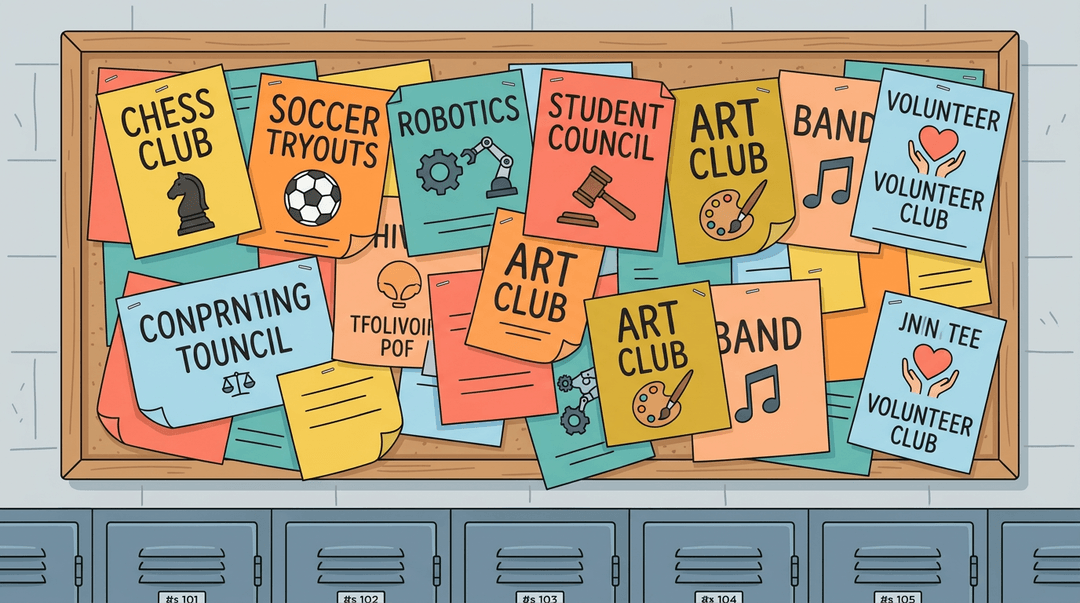
Walk past any school hallway in September and you'll see it: flyers for chess club, soccer tryouts, robotics, and student council all stapled up in a colorful jumble.
That messy board is basically extracurricular activities from the outside: a lot of options, not much order.
Extracurricular activities are simply the structured pursuits students take on outside regular class time: clubs, sports, arts, service, and more. They matter more than ever for building skills grades alone don't capture.
This post breaks down the full range, by category and grade band, plus how to help students choose and track them.
What Are Examples of Extracurricular Activities
So what actually counts? An extracurricular activity is anything you pursue outside your regular coursework: it happens alongside homework and tests, not as part of them, which is why it doesn't affect your grade point average (GPA).
The range is wider than most students assume. Clubs, sports teams, part-time jobs, volunteer shifts, and even a personal project built at the kitchen table all qualify.
For example, a student who spends weekends building a small app or running a neighborhood recycling drive is racking up the same kind of experience as one on the debate team.
When Your Hobbies Count as Extracurriculars
Not every hobby makes the cut, but plenty do. The test isn't how official it sounds: it's whether there's real commitment behind it.
Think of a student who spends three evenings a week practicing photography, entering local contests, and building a portfolio. That's not idle downtime; it's a demonstrated investment of time.
Teachers and colleges alike care less about the label and more about what the hobby shows: discipline, curiosity, and a skill built over months, not a weekend.
If a student can point to hours logged and growth achieved, that hobby belongs on the list right alongside clubs and sports.

Why Extracurricular Activities Matter
Ask any teacher what happens outside the regular school day, and you'll hear the same thing: it shapes who students become just as much as what happens in class. Extracurricular activities aren't a side note to education. They're part of it.
Building confidence and life skills
Juggling practice, rehearsal, or a club meeting alongside homework teaches students real time management skills they'll use long after graduation.
Trying something new, whether it's a debate tournament or a first solo in choir, builds confidence that classroom grades alone rarely provide.
For a student stressed about a test or friend drama, an afternoon on the field or in the art room offers genuine stress relief.
Activities also open the door to new friendships outside a student's usual circle, and they give students room to explore interests a packed academic schedule never touches.

Why colleges value extracurriculars
Admissions officers read thousands of transcripts that look alike. What sets an applicant apart is often what they did beyond it: extracurriculars show well-roundedness and demonstrate leadership, whether that's captaining a team or founding a club.
According to a 2023 survey by the National Association for College Admission Counseling (NACAC), nearly 44 percent of admission officers consider extracurriculars moderately to considerably important, especially at selective schools.
Increasingly, colleges value depth over breadth: one sustained commitment beats a long list of one-time clubs.
The link between activities and grades
This isn't just about a college application. The relationship between extracurricular participation and academic outcomes has been studied for decades, with historical evidence tying structured activities to stronger academic outcomes.
Researcher Fredricks (2011) found that students who participate frequently tend to earn higher grades and higher ACT scores. Other research, reported by Honor Society, points to a similar positive link between involvement and academic success.

Scholarships tied to extracurriculars
Extracurriculars can pay for college, literally. Many schools and outside organizations offer EC-specific scholarships tied to a single sport, art form, or service record.
Others weigh activities heavily in merit-based awards that combine grades with leadership and involvement.
For families worried about funding college pursuits, a student's activity record can turn into real financial aid, not just a line on an application.
What Are the Most Common Extracurriculars
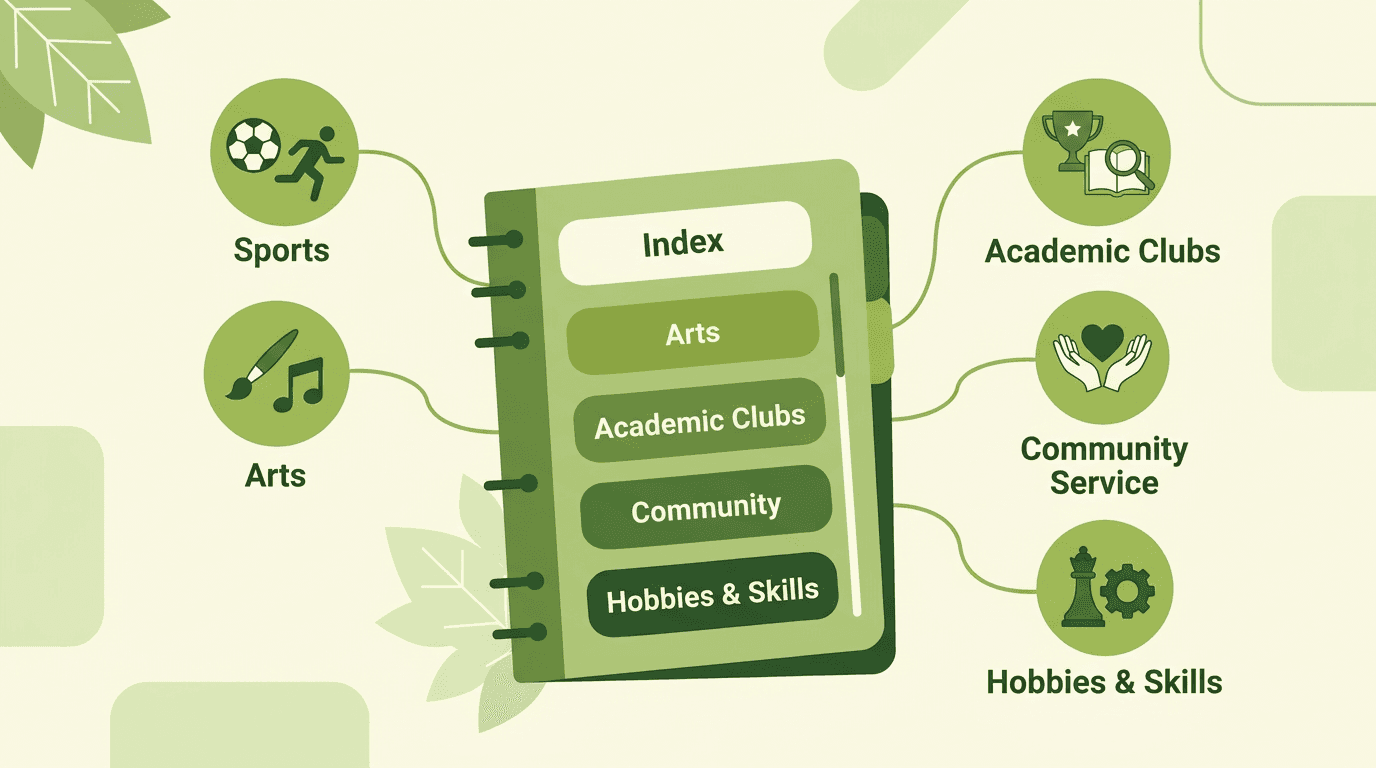
Ask a room full of teachers what counts as an extracurricular activity, and you'll get answers ranging from chess club to a part-time job at the local diner. Both are right. The most common extracurriculars fall into a handful of buckets:
- academics
- sports
- arts
- service
- work
- leadership
- tech
And almost every student can find a fit in at least one. If you only need five examples to start with, try these:
- Student council or class government
- A sports team (soccer, track, swim)
- Band, choir, or theater
- Volunteering at a food bank or animal shelter
- A part-time job or internship
Joining academic clubs and competitions
Academic clubs give students a place to chase a subject deeper than the curriculum allows. A debate team builds argument and research skills, while a robotics club turns coding into something you can watch move across a table.
Math competitions and Science Olympiad reward the kids who light up over a hard problem, and subject-specific clubs (French club, book club, chess club) let narrower interests find a home. Honor societies recognize the work once it's already been done.
Even in elementary and middle school, scaled-down versions exist: a fourth-grade chess club or a middle school Science Olympiad team works the same muscles on a smaller stage.

Sports and athletic teams
Team sports like soccer, basketball, and volleyball teach kids to win and lose together, while individual sports like swimming, tennis, and track sharpen personal discipline.
Either way, student athletes practice teamwork, learn to manage time between practice and homework, and for some, open the door to athletic scholarships down the road.
Creative and performing arts activities
For students who think best with their hands or their voice, the arts are the extracurricular that fits.
Visual arts, theater and music, and dance groups all build confidence in front of an audience, while writing and poetry clubs or a photography and film club give quieter students a way to be seen without ever stepping on a stage.

Volunteering and community service
Volunteering at a food bank or shelter puts a student's time to direct use in their own community, and tutoring or mentoring younger students does the same closer to home.
International volunteer programs stretch that impact further, but the lesson holds wherever it happens: service builds empathy and leadership in a way a classroom lecture rarely can.
Jobs, internships, and work experience
A part-time job, whether it's babysitting, retail, or a summer internship (paid or unpaid), counts as a real extracurricular. So does caregiving for a younger sibling or a grandparent.
It's easy to overlook, but it shows the same responsibility a resume line is trying to capture.

Student leadership and government roles
Running for student council, serving as a club president, or founding a brand-new club all show the same thing: initiative. Colleges and employers notice students who don't just join something, but start it.
Media, tech, and personal projects
Blogging, vlogging, or working on the yearbook or school newspaper gives students a public outlet for their voice, and coding or web design does the same for a more technical mind.
Entrepreneurial ventures and passion projects, from a small online shop to a self-taught coding portfolio, often start as extracurriculars and grow into something bigger.
Many of these work as virtual and remote options too: an online coding community or a remote internship fits a student without easy access to an in-person club.

STEM research and innovation projects
Research projects and science fairs reward curiosity that goes beyond a single class period, and gaming or robotics clubs channel that same curiosity into something built by hand.
Environmental and sustainability initiatives, like a school recycling program or a native-plant garden, give students a project with a visible, lasting result.
Helping Students Pick the Right Activities
A long list of activities only helps if students land on the right ones. Your role is part matchmaker, part record keeper: guide the choice, then watch how it plays out over the year.
Start with age-appropriate options
Match your suggestions to where students are, not where the most impressive résumé line sits.
| Grade band | Good starting points |
|---|---|
| Elementary | Intro clubs and recreational sports: low stakes, easy to try |
| Middle school | Student council, band: first real commitments with structure |
| High school | Leadership roles, internships: depth that builds toward what's next |
Run a short choice conversation
When a student asks "what should I join?", walk these four moves in order. Five minutes is enough.
- List the student's interests first, before any options.
- Say: "What do you find yourself doing when nobody assigns you anything?"
- Match the pick to their real time availability.
- A student with a part-time job has room for one club, not three.
- Encourage one deep commitment over several shallow ones.
- Two years in band beats one semester each in six clubs.
- Review the choice together each semester.
- Ask what to keep, drop, or add: interests shift fast at this age.
💡 Tip: Depth is where growth shows up. The student who sticks with debate long enough to mentor a newcomer gains more than the one collecting memberships.
Track involvement over time
A choice conversation only works if you remember last semester's answer. Keep a simple log per student: activity, start date, one line on growth. An entry can be this short:
Sample entry: Maya R. | Fall: debate (new), soccer (year 2) | Growth: led her first practice round | Watch: added yearbook mid-semester, now at three.
The log's real payoff is spotting patterns early:
| When the log shows... | Try... |
|---|---|
| Three or more activities plus slipping grades | A check-in before they add anything new |
| The same activity for two or more years | Suggesting a leadership step within it |
| Nothing logged all semester | A fresh interests conversation, not a sign-up push |
At the review point each semester, pull the log before the conversation: it turns "how's it going?" into "you mentioned soccer felt like a chore in October: still true?"
Use EMStudio's planner to log and revisit each student's activity choices all year.
How to Choose the Right Extracurriculars
A long list of activities looks impressive on paper, but it rarely tells the real story. Here's how to help students choose the few that actually count.
Why quality beats quantity
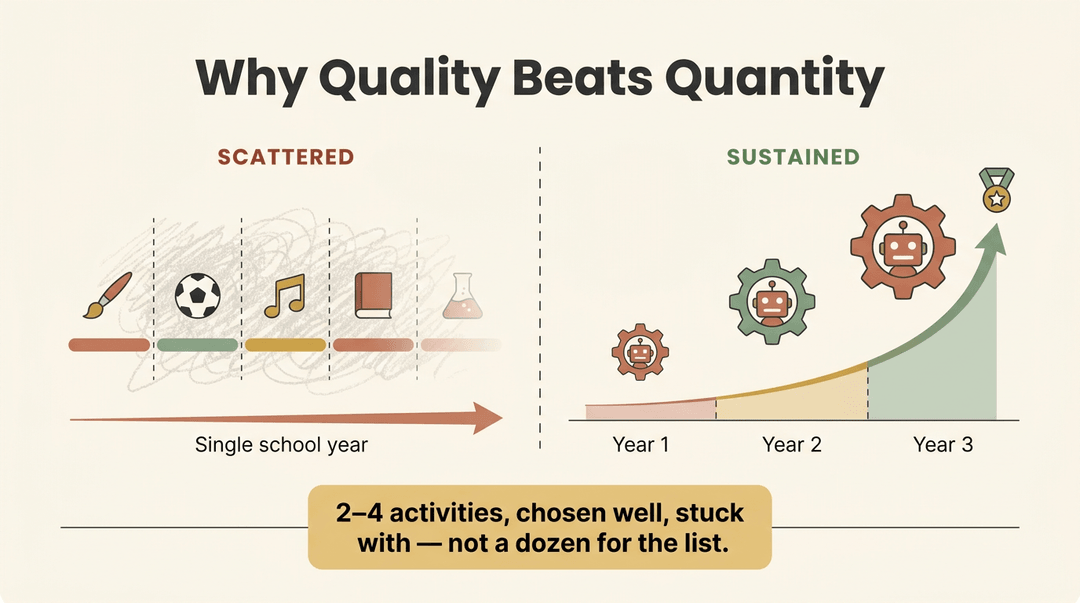
Depth beats breadth almost every time. A student who spends three years growing a robotics team into a competitive force shows far more than one who joins five clubs for a semester each and moves on.
Sustained involvement, not scattered participation, is what colleges and future employers actually notice.
That's why overcommitment backfires: a packed schedule with no follow-through reads as noise, not achievement. A good rule of thumb is two to four activities, chosen well and stuck with, rather than a dozen chased for the sake of the list.
Matching activities to your interests and goals
Encourage students to pick what genuinely interests them, not what they think will impress an admissions officer.
A student set on studying biology gets more from volunteering at a local clinic than from a student council seat that has nothing to do with their goals. When an activity connects to an intended major or career, it shows rather than tells.
Starting your own club or activity
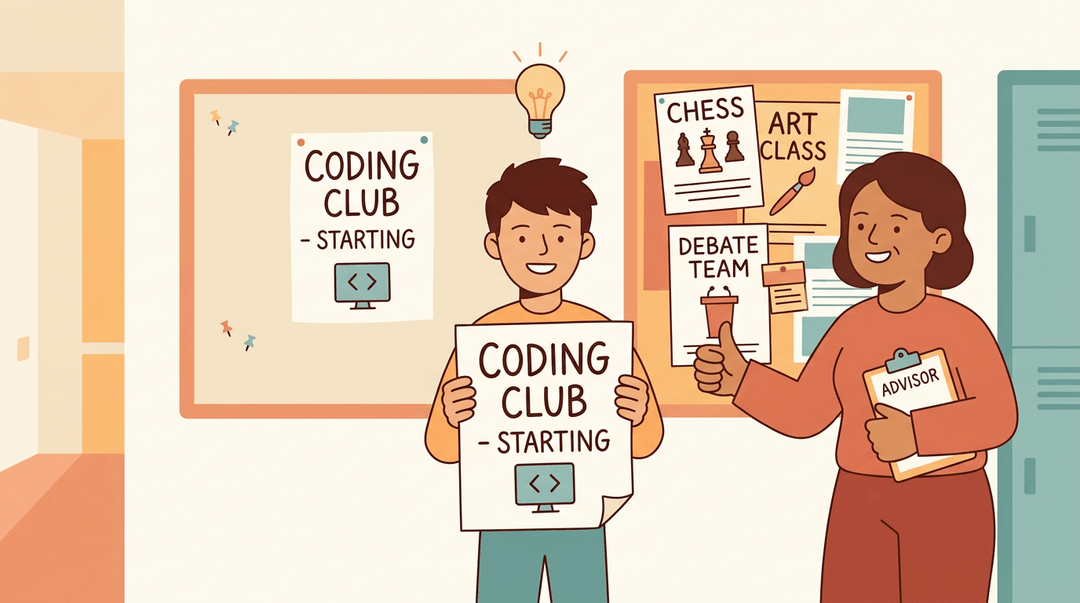
Sometimes the right activity doesn't exist yet. If a student notices a gap, say, no coding club at a school full of aspiring engineers, help them propose one. Founding a club fills a real need and demonstrates initiative in a way no existing group can.
As a teacher, offering to serve as an advisor can be the push a student needs to follow through.
Balancing schoolwork with activities
Extracurriculars matter, but coursework and GPA still come first. A shared planner helps students see everything at once: assignments, practices, meetings, and deadlines, so nothing sneaks up on them. Simple habits go a long way:
- Block out study time before committing to extra practices or events.
- Review the planner weekly, not just the night before something's due.
- Say no to a new commitment if the calendar's already full.
Checking that planner together during advisory time can catch burnout before it starts.
Showcasing Extracurriculars on Your College Application
A transcript tells admissions officers what a student studied. Extracurriculars tell them who that student is. Here's how to help your students present that story well.
Listing activities and writing about them
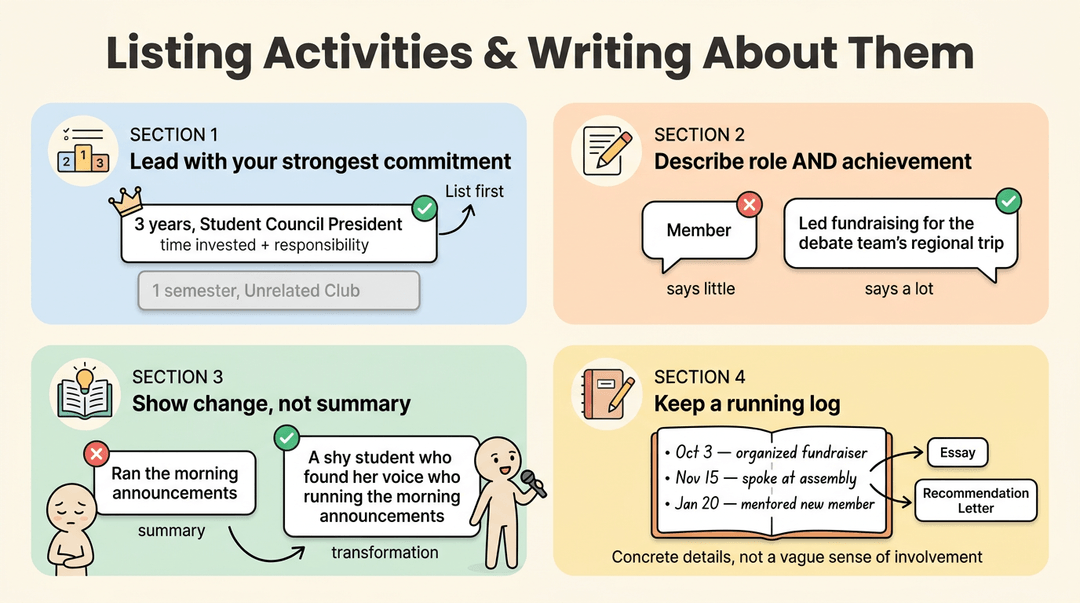
Most applications cap the number of activities you can list, so students should lead with their strongest commitments: the ones with the most time invested, the most responsibility, or the clearest growth.
A three-year commitment to student council belongs above a single semester of an unrelated club.
For each entry, students should describe their role and their achievements, not just the activity's name. "Member" says little. "Led fundraising for the debate team's regional trip" says a lot.
That same specificity should carry into supplemental essays. Instead of summarizing what an activity was, students should explain what it changed in them: a shy student who found their voice running the morning announcements, for instance.
Encourage students to keep a running log of these moments; it makes both the essay and the ask for a recommendation letter far easier, since a teacher or coach writing on their behalf needs concrete details to point to, not a vague sense that the student "was involved."
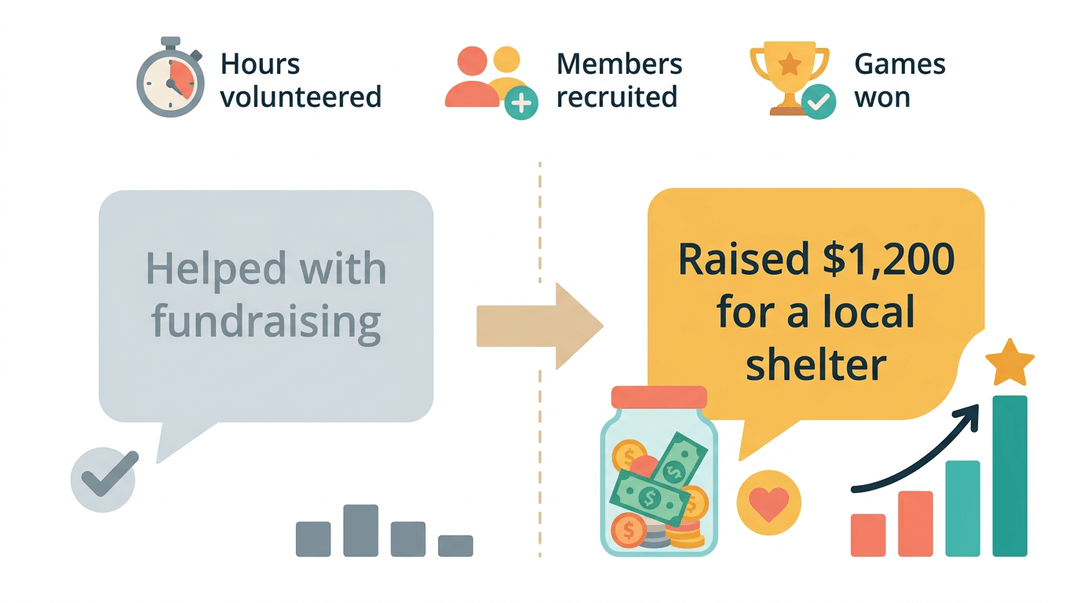
Show your impact with numbers
Wherever possible, students should trade vague claims for real numbers:
- funds raised
- hours volunteered
- members recruited
- games won
"Raised $1,200 for a local shelter" lands harder than "helped with fundraising."
Admissions readers care less about which activity a student chose and more about the impact they had within it. A modest club led well can outshine a prestigious one joined passively.
Extracurricular activities aren't a side note to a student's education: they're where curiosity turns into confidence, on the field, in the lab, or behind a lectern.
Whatever the category or grade band, the right fit comes down to matching interest with opportunity, then following through.
For teachers, keeping track of who's involved in what is its own small task. Ready to build that support into your regular routine?
Check out our Lesson Planning feature to organize and reuse plans that make room for every student's growth, in and out of class.
References
- The Effects of Extracurricular Activities on Academic Achievement ... — orc.library.atu.edu (2026)
- Strengthen Your College Application with These 9 Extracurricular Activities — stjohns.edu
- EJ1230758 — files.eric.ed.gov
- The Impact of Extracurricular Activities on Academic Success — honorsociety.org
Frequently asked questions
What are considered extracurricular activities?
Extracurricular activities are structured pursuits students do outside regular coursework and class time. They include clubs, sports, arts, volunteering, jobs, leadership roles, technology projects, and committed personal hobbies or projects.
What are the most common extracurriculars?
Common extracurriculars include sports teams, student council, academic clubs, debate, robotics, band, choir, theater, volunteering, part-time jobs, internships, and personal technology or creative projects.
What are 5 examples of activities?
Five examples are student council, a soccer team, band or choir, volunteering at a food bank, and a part-time job or internship.