Positive Reinforcement: How It Works and How to Use It Well

Jump to section
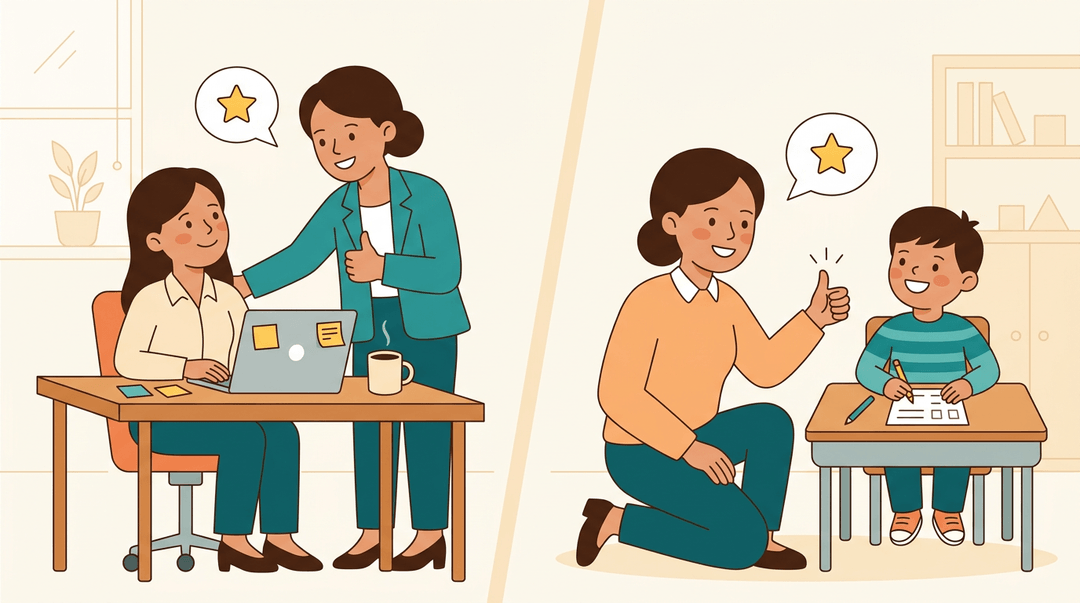
Think about the last time a coworker noticed your extra effort and said so. That small nod probably made you want to keep showing up strong.
Positive reinforcement works the same way in a classroom: you notice the behavior you want to see more of, and you respond in a way that makes the student want to repeat it.
It sounds simple, but doing it well takes more than handing out stickers.
This post walks through what positive reinforcement actually means, the different forms it takes, and how to use it effectively across grade bands, so it becomes a habit that sticks rather than a gimmick that fades.
What Positive Reinforcement Really Means
Every teacher praises students, but few realize it's a specific behavioral tool with research behind it. Here's what's actually happening when a reward changes behavior, and where it splits from punishment.
How Rewarding Good Behavior Makes It Stick
Positive reinforcement follows one rule: reward a behavior right after it happens, and the behavior becomes more likely to repeat.
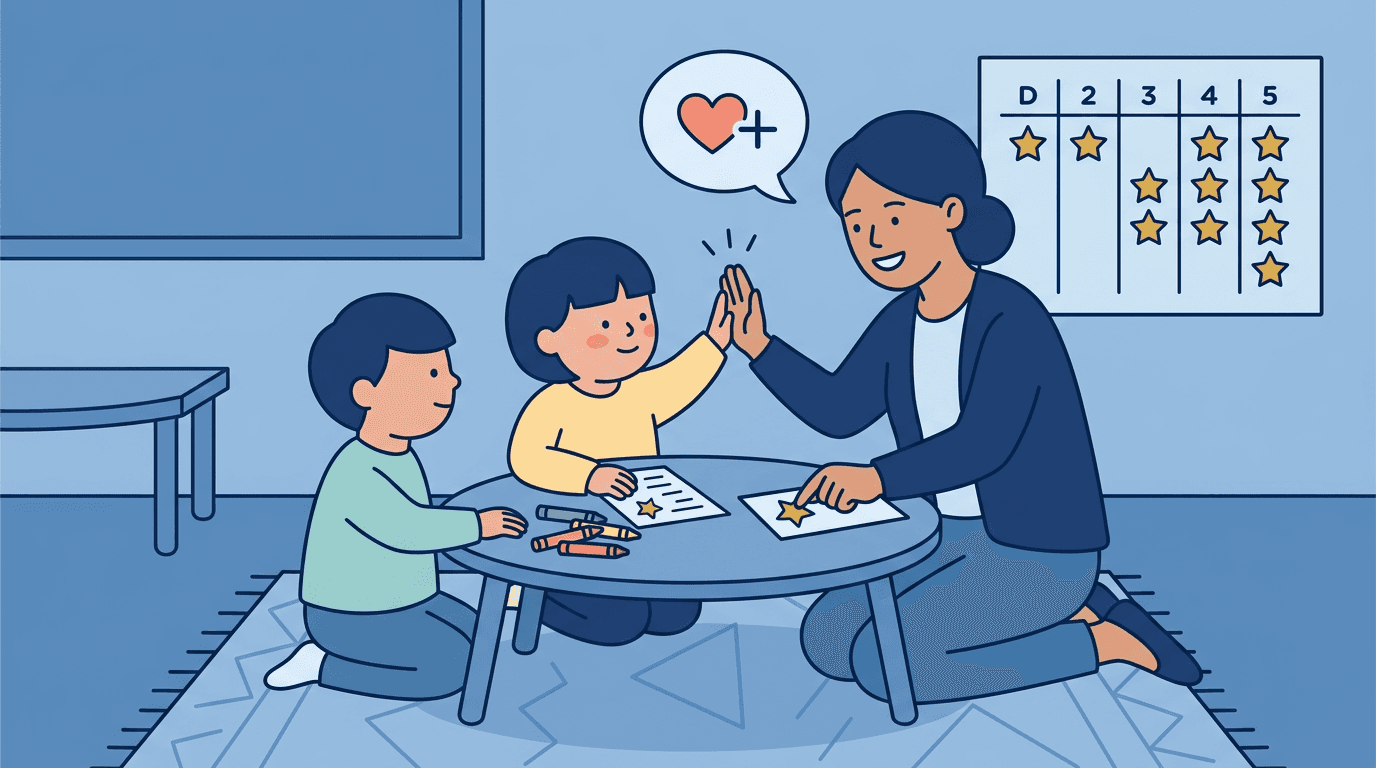
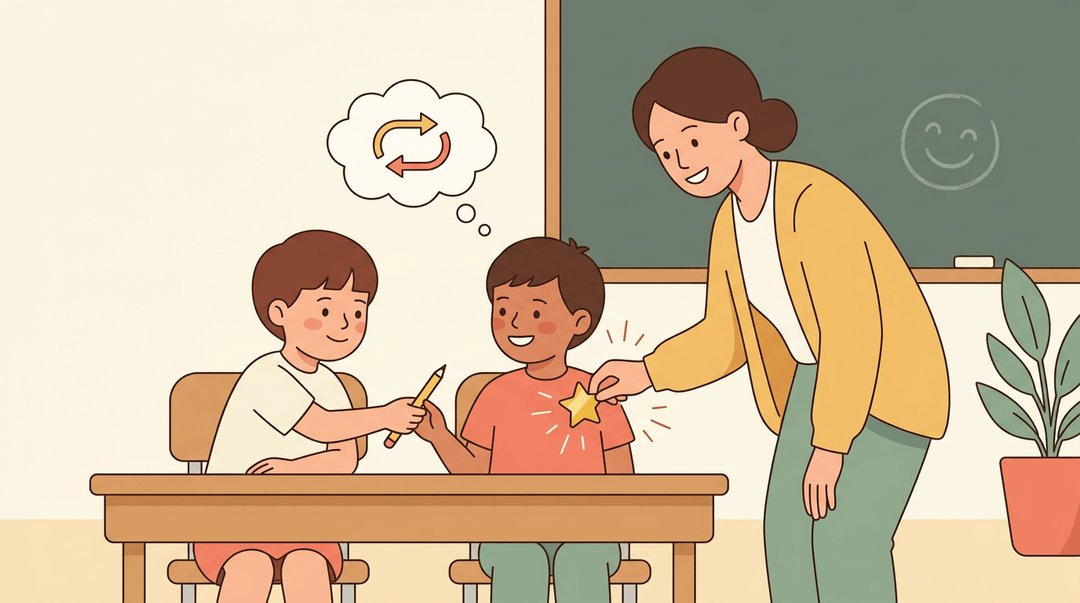
Consider a second-grade teacher who hands a sticker to a student who shares a pencil with a classmate; that sticker is operant conditioning in action.
B.F. Skinner's theory names this exact pattern: a behavior strengthens because a reward follows it, making repetition more likely.
How Reinforcement Differs From Punishment
Punishment adds a penalty or removes a privilege to make a behavior less likely, the opposite of positive reinforcement (adding something good) and negative reinforcement (removing something unpleasant).
It also differs from positive punishment (adding something unwanted) and negative punishment (taking something away). A study in the journal Behavior Modification shows reinforcement produces faster, longer-lasting change than punishment.
Punishment has a cost too: Palo Alto University notes it can breed resentment or aggression.
Negative Reinforcement Isn't Punishment
Negative reinforcement gets mistaken for punishment often, but it's reinforcement: it removes something unpleasant to make a behavior stick, rather than adding a penalty.
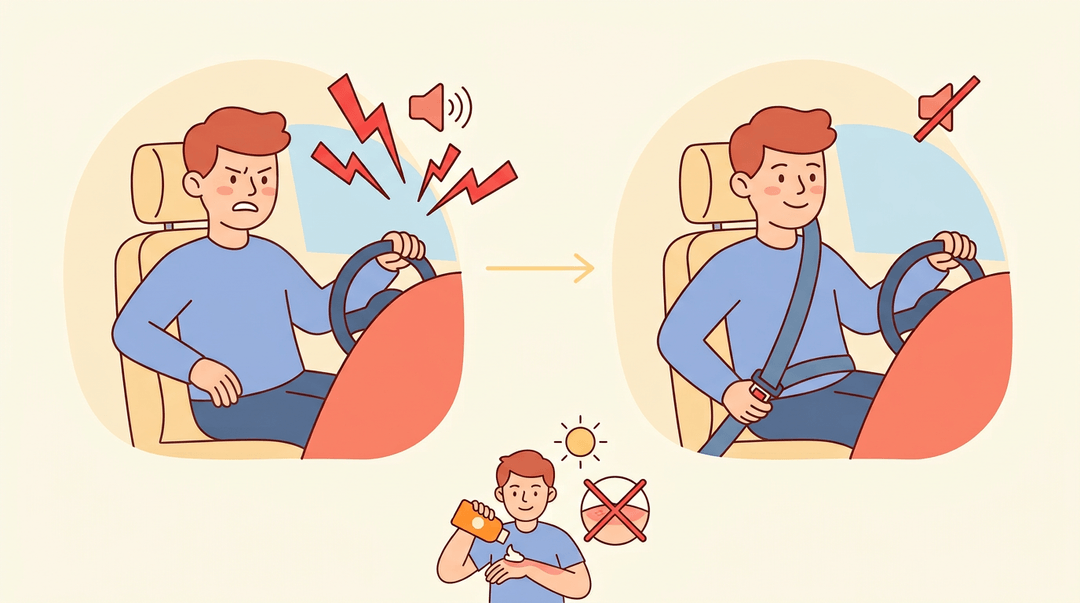
A seatbelt alarm shows this: the beep stops once you buckle up, reinforcing that habit. Sunscreen works the same way, avoiding sunburn reinforces applying it.
It's not the same as redirecting a student to a new task either; negative reinforcement removes discomfort, it doesn't swap behaviors.
Different Types of Positive Reinforcement
Not all reinforcement looks the same, and knowing your options helps you pick the right tool for the job.
It also helps to know how often you deliver it: continuous reinforcement (rewarding every instance) builds a new behavior fast, while intermittent reinforcement (rewarding it sometimes) keeps an established one going strong.
Different Kinds of Reinforcers to Use
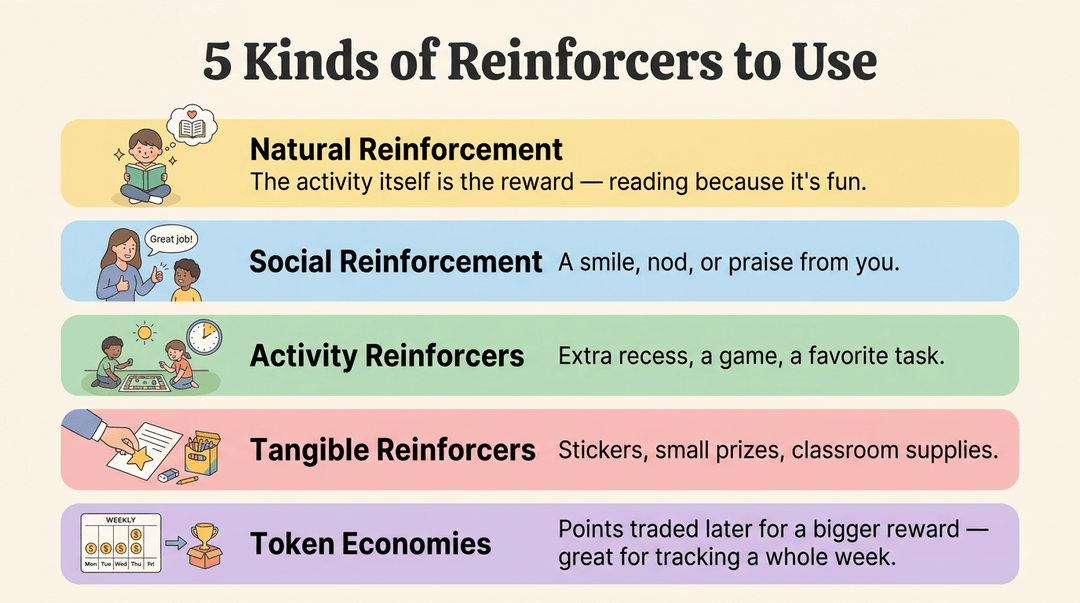
- Natural reinforcement. The behavior itself produces the payoff, like a student who reads more because reading is genuinely fun for them.
- Social reinforcement. A smile, a nod, or praise from you.
- Activity reinforcers. Extra recess, a class game, or a preferred task.
- Tangible reinforcers. Stickers, small prizes, or classroom supplies.
- Token economies. Points or tokens traded later for a bigger reward, useful for tracking progress over a whole week.
Using Praise Effectively
Verbal praise is the quickest tool you have, but how you say it matters more than how often. Behavior-specific praise names the exact action (
A Teacher's Quick Guide to Positive Reinforcement
Reinforcement only works when the reward fits the student and your delivery stays sharp. Find your grade band in the table, then run the four-line checklist on every reward you hand out.
Match the reinforcer to the age band
What lights up a second grader falls flat with a sophomore. Read across your row for a ready-to-use version of each idea.
| Grade band | Reinforcer | What it looks like |
|---|---|---|
| Elementary | Sticker or point chart | One sticker per finished task; ten earns free-choice time |
| Elementary | Specific verbal praise | "You lined up quietly the first time I asked." |
| Elementary | Class celebration goal | A marble jar that fills toward Friday game time |
| Middle school | Privilege-based rewards | Homework pass, seat choice, music during independent work |
| Middle school | Peer recognition moments | A shout-out board where students post weekly kudos |
| Middle school | Progress tracking charts | A private graph of each student's on-task points |
| High school & adults | Choice-based incentives | Pick the project format or the due date |
| High school & adults | Public acknowledgment | Credit a strong answer by name in discussion |
| High school & adults | Certificates or badges | A digital badge for finishing a skills unit |
Example: A seventh-grade teacher opens Friday with two minutes at the shout-out board, reading student-posted kudos aloud. Off-task chatter drops during the week because peers, not just the teacher, are watching for good moves.
Run this checklist every day
The reinforcer matters less than how you deliver it. Before the reward leaves your hands, confirm:
- Praise immediately. Reinforce within seconds; a delayed reward loses its link to the behavior.
- Name the specific behavior. Say exactly what earned it, so students know what to repeat.
- ❌ "Good job today." Praises the person but names nothing repeatable.
- ✅ "You showed every step of your solution." Names the exact action to do again.
- Vary reinforcers regularly. Any reward goes stale; rotate your options every week or two.
- Fade rewards over time. Stretch the schedule so the behavior stands on its own.
- A sticker for every task, then every third task, then specific praise alone.
Key principle: The reward is scaffolding, not the building. If a behavior collapses the moment the prize disappears, fade slower, not faster.
To spot which reinforcers are actually moving behavior, log behavior notes and reinforcement patterns right alongside attendance and grades in EMStudio.
Why Positive Reinforcement Works so Well
Why does a simple "nice work" from the front of the room carry so much weight for your students? Because positive reinforcement taps into a basic truth about motivation: behavior that gets noticed tends to get repeated.
How It Changes Behavior
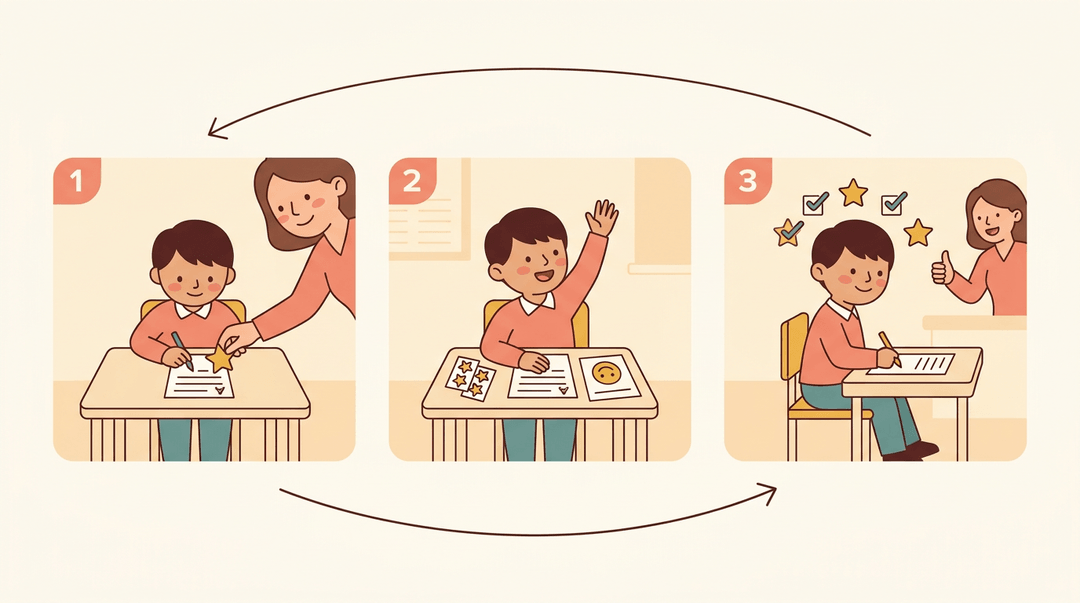
When a student's effort earns praise or a small reward, that behavior tends to show up again.
According to a study on grade three pupils in public elementary schools, students who receive praise, rewards, or recognition are more motivated to complete tasks, follow through on responsibilities, and meet classroom expectations, which sharpens their task focus.
The same consistency works in reverse, too: Youngstown State University's education program notes that teachers who apply positive reinforcement consistently can reduce disruptive behavior while improving academic performance and classroom culture.
Over time, students also build stronger self-regulation: Benjamin D. Rasmussen's research found that rewarding desirable behaviors promotes their repetition and yields beneficial long-term outcomes.
Emotional and Social Benefits for Students
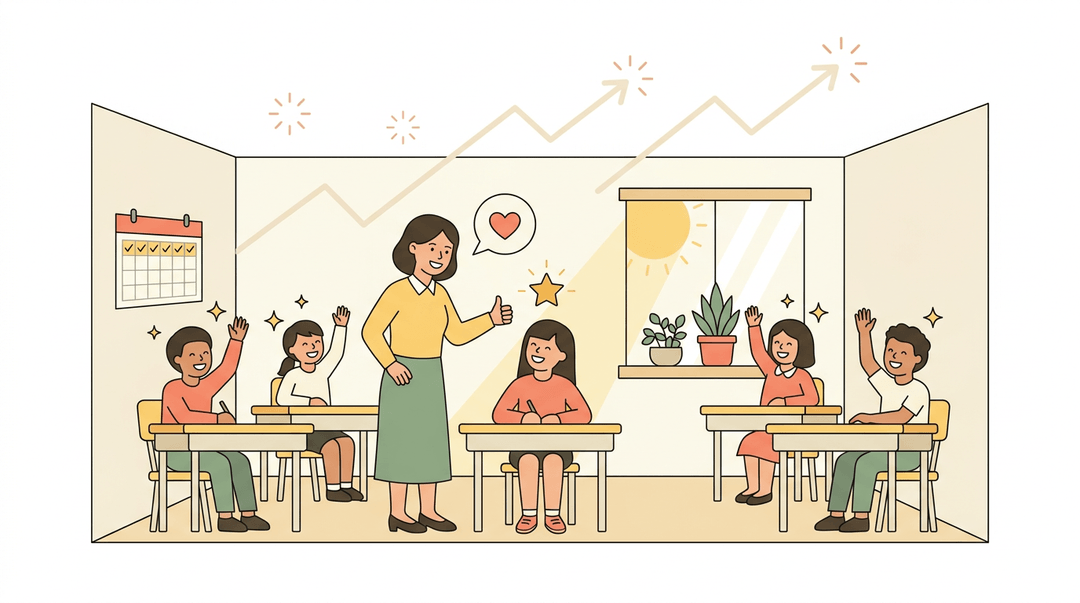
Beyond behavior, positive reinforcement shapes how students feel about themselves and their teacher. Consistent, genuine recognition builds self-esteem and confidence, and it deepens the student-teacher bond that makes kids feel safe taking risks.
It also fosters resilience: research on children with attention-deficit hyperactivity disorder (ADHD) found that higher positive parenting behavior and peer acceptance were both linked to greater resilience, a pattern that holds just as true in your classroom.
How It Shapes the Classroom Environment
When praise and encouragement become routine, the whole room shifts: engagement climbs, attendance improves, and even teacher well-being gets a lift. None of this is guesswork, and we don't have to take it on faith.
Research published in PMC shows that positive behavior recognition strengthens the likelihood of similar responses in the future, confirming what you probably already sense: encouragement works.
Using Praise and Language Effectively
How you praise a student matters just as much as whether you praise them at all. The right words build motivation that lasts; the wrong ones can quietly undercut it.
Praise Effort, Not Just Ability
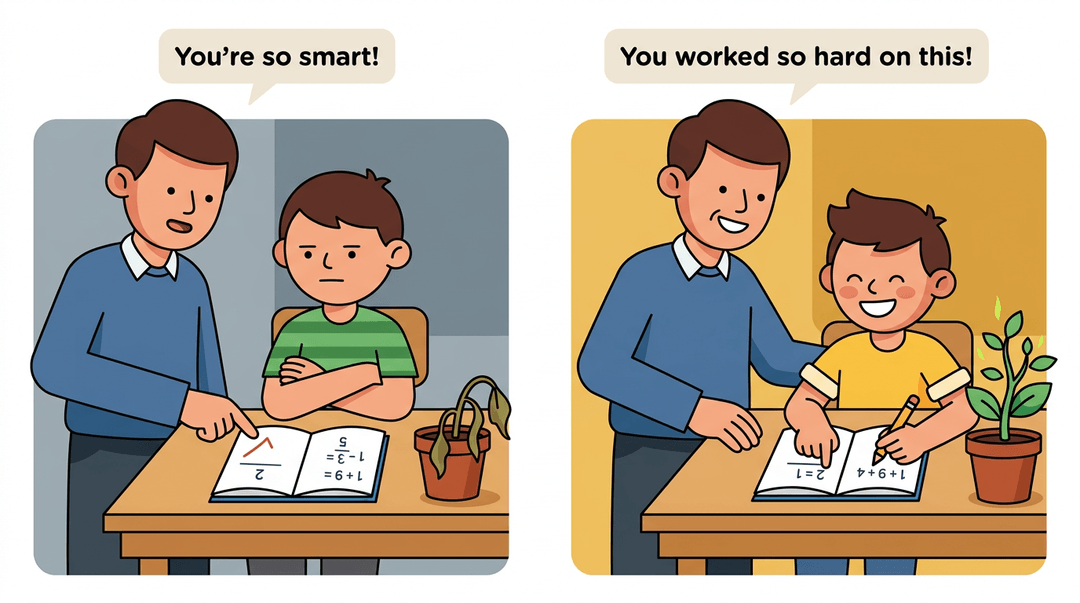
It's tempting to tell a student "you're so smart" when they nail a tough problem. Praise the effort instead of the innate ability.
Research on this is clear: six studies found that "praise for intelligence had more negative consequences for students' achievement motivation than praise for effort."
Ability-based praise can quietly plant a fixed mindset, the belief that intelligence is set in stone and can't grow. Effort-based praise does the opposite.
As Carol Dweck explains, praise for intelligence puts students in a fixed mind-set, while praise for effort tells them "you're developing these skills because you're working hard," the exact message that supports a growth mindset.
Be Specific When You Give Praise
Vague praise fades fast. "Great job" tells a student little. "You checked your work line by line and caught that sign error yourself" tells them exactly what worked, and it's personal enough to actually land.
Keep praise separate from criticism, too: tacking a correction onto a compliment ("nice try, but…") waters down both. Give detailed feedback that names the specific behavior, and deliver it right after you see it.
Immediate, specific praise sticks; delayed, generic praise doesn't.
Applying Positive Reinforcement by Age
Positive reinforcement doesn't look the same in a toddler room as it does in a middle school classroom. What motivates your students shifts as they grow, so the reward you choose should shift right along with them.
Tailoring Rewards to Each Age Group
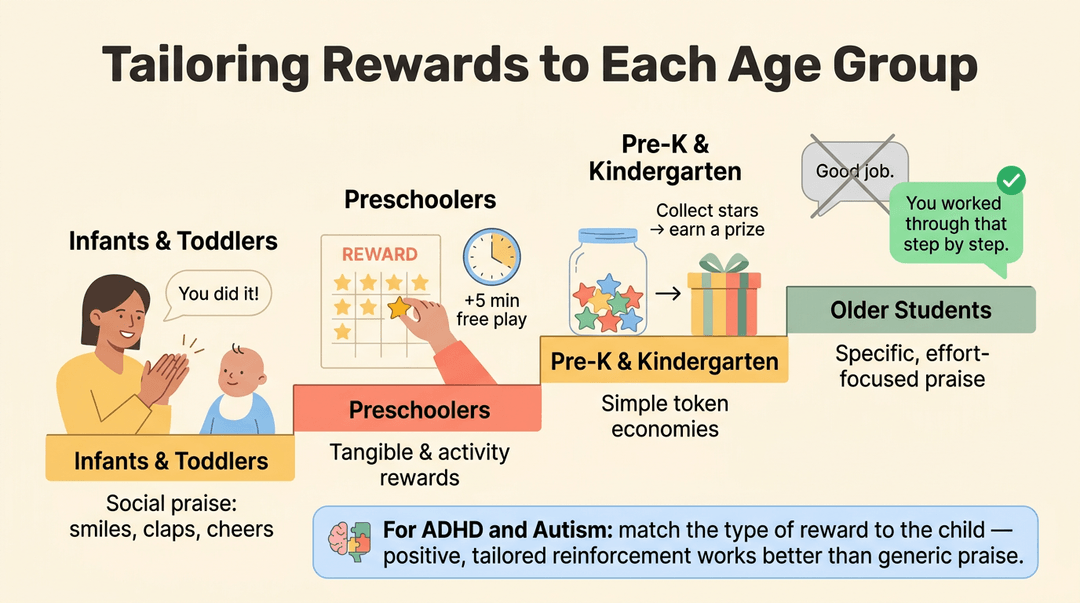
The right reinforcer depends heavily on developmental stage:
- Infants and toddlers respond best to social reinforcement: a warm smile, a clap, an enthusiastic "You did it!"
- Preschoolers are motivated by tangible and activity rewards, like a sticker or five extra minutes of free play.
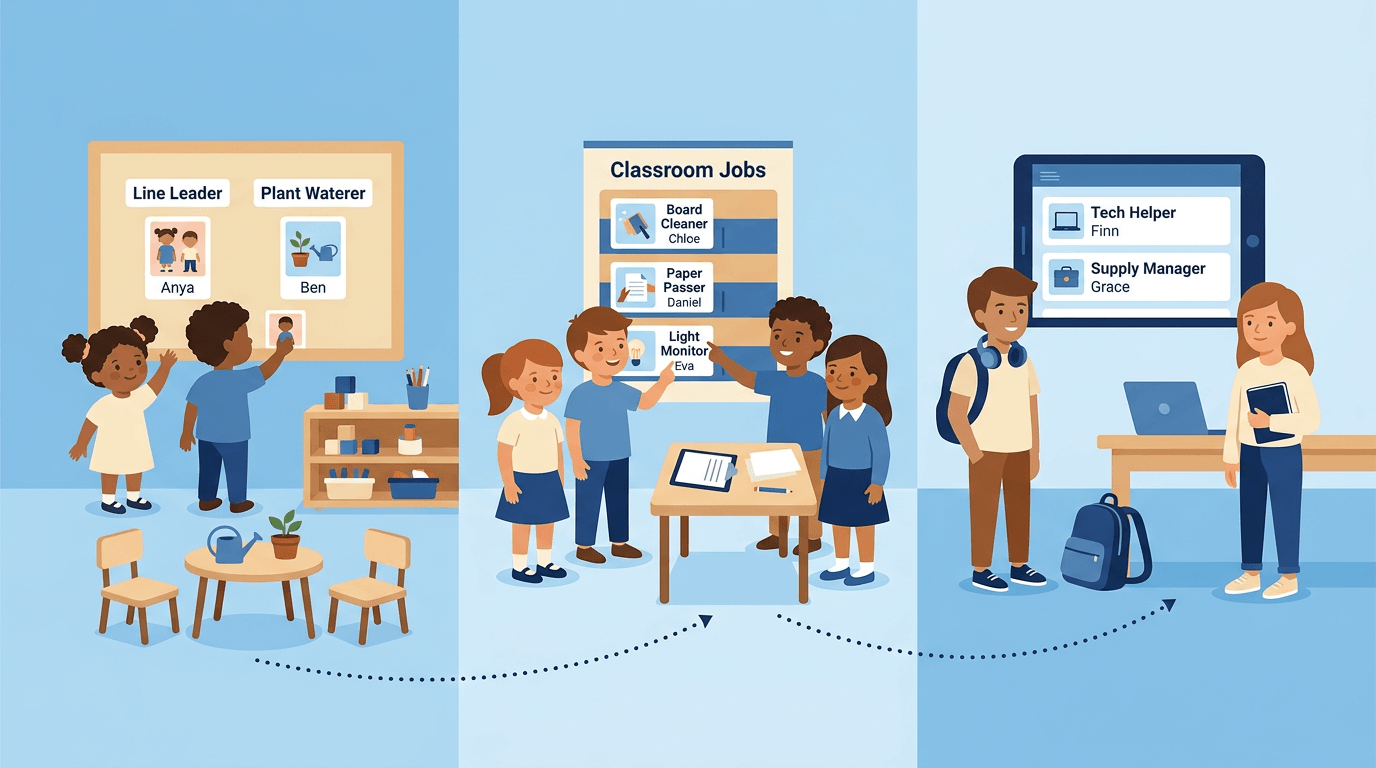
- Pre-K and kindergarten students can handle simple token economies: earning stars or chips that add up to a bigger reward.
- Older students respond better to specific, effort-focused praise ("You worked through that step by step") than to a generic "Good job."
For students with attention-deficit/hyperactivity disorder (ADHD), the type of reinforcement matters as much as using it at all.
A study comparing reinforcement effects in children with ADHD found that a “dose” of reinforcement is a function of the type and magnitude of the reinforcer and the schedule of reinforcement, so positive reinforcement tends to outperform negative reinforcement when it's tailored to the child rather than applied generically.
Positive reinforcement is also a cornerstone of autism support. According to Texas SPED Support, reinforcement and differential reinforcement belong in every educator's toolbox alongside prompting and modeling for students on the spectrum.
Programs That Use Positive Reinforcement
Several established programs build on these same principles.
According to a National Institute of Justice CrimeSolutions review, The Incredible Years trains parents to use positive parenting and behavior-management strategies for early conduct concerns at home.
Many teacher classroom management programs mirror this approach, and parent-teacher collaboration extends it from school to home.
Play-based learning methods weave reinforcement in naturally, and the same ideas carry over to virtual classrooms, where quick praise and digital token systems keep remote learners engaged.
Common Mistakes and Best Practices
Most classrooms wrestle with the same handful of behaviors: calling out, off-task chatter, missed transitions, low-level defiance. How you respond to them determines whether positive reinforcement keeps working or quietly stops.
What Are the Downsides of Positive Reinforcement?
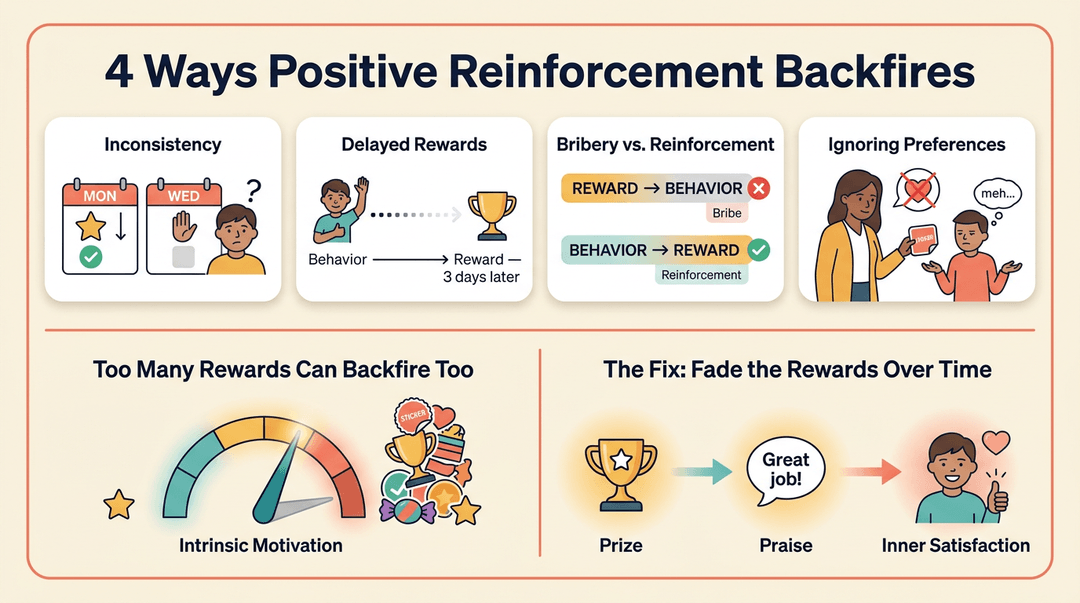
Even a solid strategy can backfire if it's applied carelessly. Watch for a few common traps:
- Inconsistency. Rewarding a behavior on Monday and ignoring it on Wednesday confuses students about what's actually expected.
- Delayed rewards. The longer the gap between the behavior and the payoff, the weaker the connection in a student's mind.
- Bribery vs. reinforcement. Offering a reward before the behavior happens is a bribe. Reinforcement comes after, and that timing matters.
- Ignoring individual preferences. A sticker means nothing to a student who doesn't care about stickers.
Over-reinforcing carries its own risk. As researchers writing in a PMC-published review note, "a major concern in psychology and education is that rewards decrease intrinsic motivation to perform activities."
The fix is fading rewards over time, shifting from tangible prizes to praise, then to the natural satisfaction of the work itself.
When and How to Use Punishment
Punishment has a place, but a small one. Use it sparingly, and only after you've clearly communicated expectations and consequences beforehand, so discipline never feels like a surprise.
It can suppress a behavior short-term, but it rarely teaches a replacement behavior for the long-term. Treat it as a last resort, after reinforcement and redirection.
Tools That Help Track Behavior
A few tools make consistency easier to maintain:
- Behavior tracking platforms for logging patterns over time.
- Reward and recognition software for keeping incentives fair and visible.
- Classroom management tools for handling routines and transitions in one place.
Positive reinforcement isn't about empty praise or bribing students into compliance.
Done well, it's a quiet, consistent signal that tells students their effort matters, and that signal builds the kind of classroom where good behavior becomes the norm, not the exception.
Getting consistent takes some structure behind the scenes. Ready to build habits that stick? Check out our Classroom Management feature to organize your classes, rosters, and routines in one place, so reinforcing the right behavior becomes second nature.
References
- Positive Reinforcement and Its Relationship to the Behavior and Academic Performance of Grade Three Pupils in Public Elementary Schools — doi.org (2026)
- Positive Parenting is Associated With Higher Self-reported Resilience in Children With Attention-Deficit Hyperactivity Disorder — repository.li.mahidol.ac.th (2026)
- Behavior Modification — pubmed.ncbi.nlm.nih.gov
- Reinforcement and Punishment — paloaltou.edu
- Positive Reinforcement in Education — online.ysu.edu
- "The Positives of Positive Reinforcement" by Benjamin D. Rasmussen — scholarsarchive.byu.edu
- Recognition for Positive Behavior as a Critical Youth Development Construct: Conceptual Bases and Implications on Youth Service Development — pmc.ncbi.nlm.nih.gov
- Praise for intelligence can undermine children's motivation and performance — pubmed.ncbi.nlm.nih.gov
- Dweck Perils of Promise & Praise — teaching.temple.edu
- Reinforcement Enhances Vigilance Among Children With ADHD: Comparisons to Typically Developing Children and to the Effects of Methylphenidate — pmc.ncbi.nlm.nih.gov
- Evidence-Based Practices for Students with Autism — spedsupport.tea.texas.gov
- Pervasive negative effects of rewards on intrinsic motivation: The myth continues — pmc.ncbi.nlm.nih.gov
- Program Profile: The Incredible Years BASIC–Parent Training Program — crimesolutions.ojp.gov
- Operant Conditioning In Psychology: B.F. Skinner Theory — simplypsychology.org
- How Positive Reinforcement Can Keep Students Engaged in a Virtual Setting — air.org
Frequently asked questions
What is the difference between positive and negative reinforcement?
Positive reinforcement adds a desirable consequence after a behavior, making that behavior more likely to happen again. Negative reinforcement removes an unpleasant condition after a behavior, also increasing the likelihood of repetition. Neither type is punishment, because punishment is intended to reduce a behavior.
What is reinforcement in simple words?
Reinforcement is something that makes a behavior more likely to happen again. It usually happens after the behavior, such as giving praise after a student completes work carefully.
What is the best definition of reinforcement?
Reinforcement is a consequence that strengthens a behavior and increases the chance that it will be repeated. Positive reinforcement adds something desirable, while negative reinforcement removes something unpleasant.
What are the four types of positive reinforcement?
Four common types of positive reinforcement are social reinforcement, tangible reinforcement, activity reinforcement, and natural reinforcement. Token economies are also widely used as a structured form of positive reinforcement, in which points or tokens are exchanged for rewards.
How to positively reinforce a child?
Notice the behavior you want to encourage and respond immediately with specific, genuine praise or a suitable reward. For example, say, “You put your toys away without being asked,” then offer a smile, extra playtime, a sticker, or another reward the child values. Gradually reduce tangible rewards as the behavior becomes established.
What is positive reinforcement and an example?
Positive reinforcement is adding something desirable after a behavior so the behavior is more likely to happen again. For example, praising a student immediately after they show every step of their solution can encourage them to continue explaining their work carefully.
Can you give me 10 examples of positive reinforcement?
1. Praise a child for sharing. 2. Give a student a sticker for finishing a task. 3. Offer extra recess for completing work. 4. Give a specific compliment for lining up quietly. 5. Award points for staying on task. 6. Let a student choose their seat after meeting expectations. 7. Provide a homework pass for consistent effort. 8. Give a class game after reaching a shared goal. 9. Offer a preferred activity after completing a less-preferred task. 10. Give a certificate or badge for completing a skills unit.
Do people with ADHD work better with negative or positive reinforcement?
People with ADHD generally respond well to positive reinforcement, especially when it is immediate, meaningful, and matched to their preferences. Research suggests reinforcement can improve attention and task performance, while the best approach depends on the individual and the type, size, and timing of the reinforcer. Negative reinforcement is not automatically better and should not be confused with punishment.