What Is a Token Economy and How Does It Work?

Jump to section
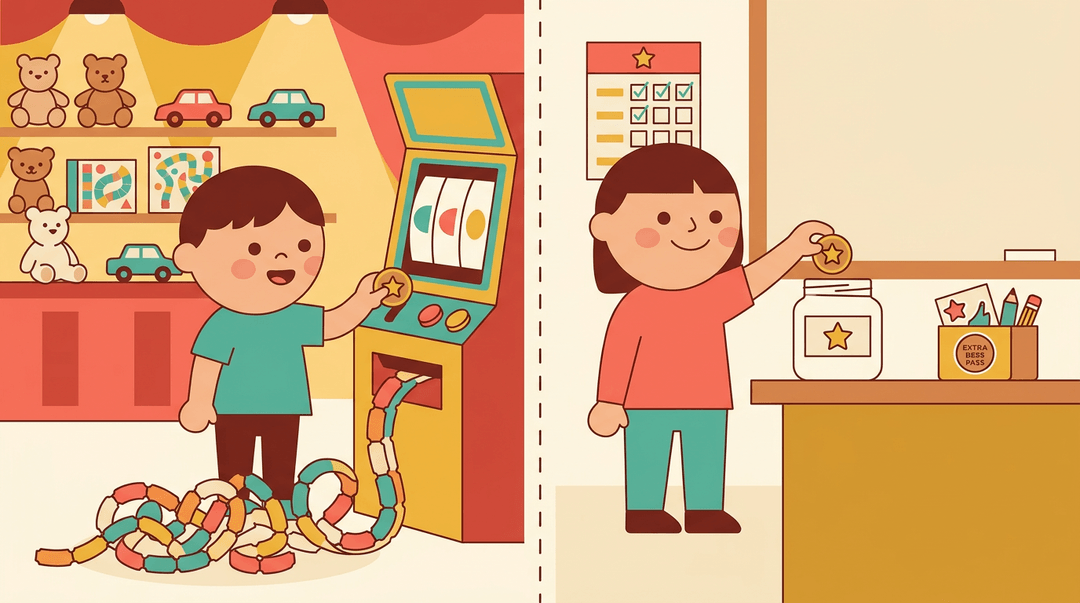
Think back to the last arcade you walked into: you feed in tokens, rack up tickets, then trade them for a prize at the counter. That loop is what keeps kids playing for hours.
A token economy borrows the same idea for your classroom: students earn tokens for behavior you want to see, then trade them for rewards that matter.
It's one of the most studied tools in behavior management, and this post covers where it comes from, the core pieces that make it work, and how to set one up by grade band.
What Is a Token Economy?
A token economy is a reinforcement system built on a simple deal: do the expected thing, earn a token, trade it in for something you actually want.
Tokens as stand-ins for real rewards
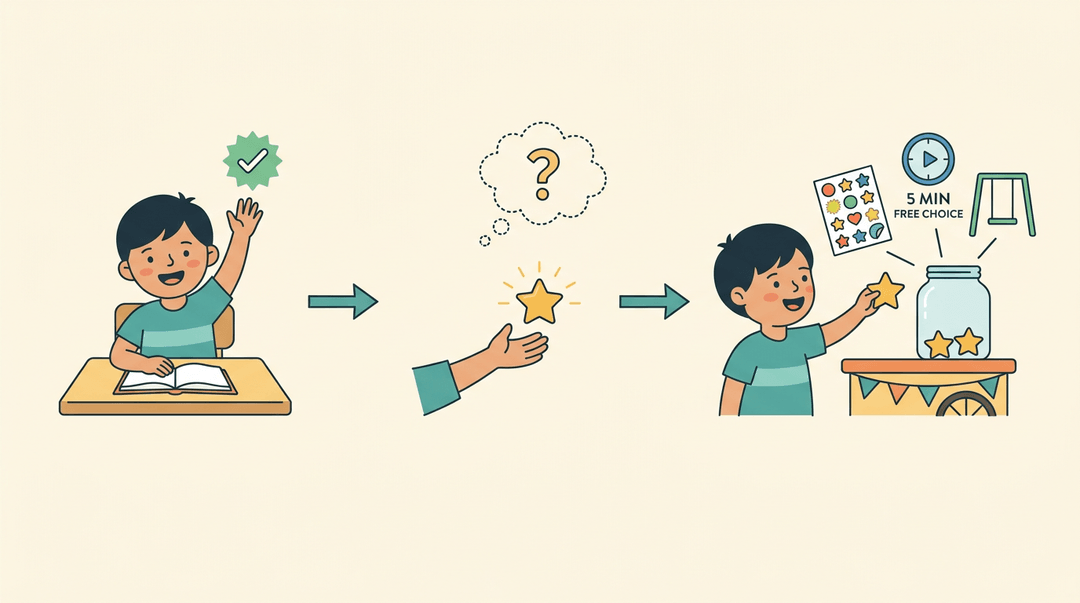
At its core, a token economy is a contingency management system: a behavior triggers a token, and the token later buys a backup reinforcer, the actual prize (extra recess, a sticker, five minutes of free choice).
The token itself works as a generalized secondary reinforcer. It carries no value on its own: it only means something because it can be exchanged for something that does.
Think of tokens like a paycheck
Think of your own paycheck. You don't eat it or wear it. You work, collect dollars, and exchange those dollars for groceries, rent, or a night out.
Tokens work the same way in a classroom: students "work" by following the target behavior, collect tokens, and later exchange them like currency for a reward they actually care about.
What are the 7 elements of a token economy?
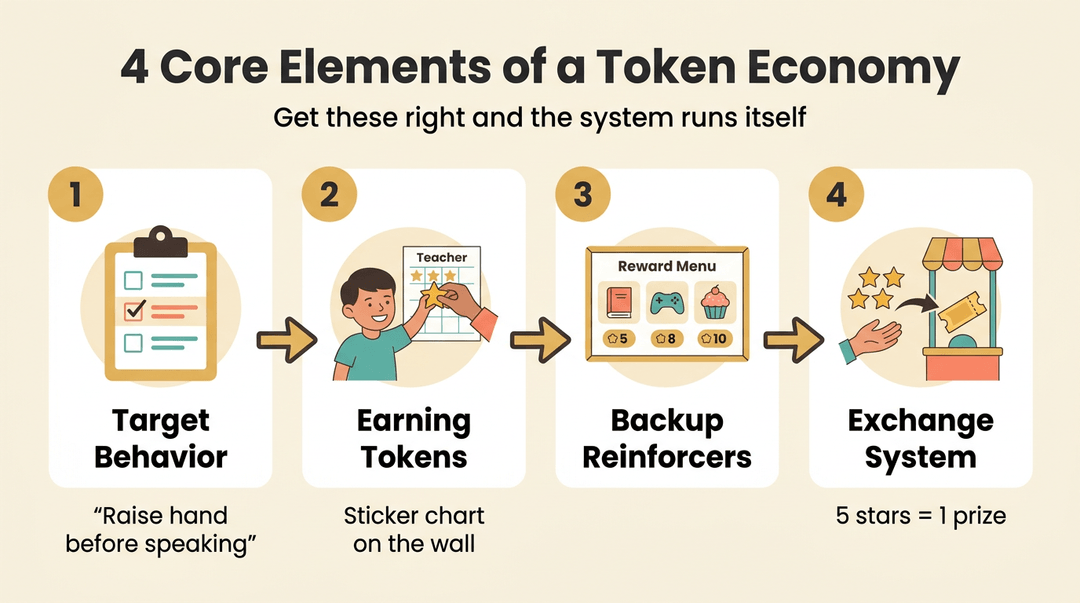
A working token economy rests on a set of core elements:
- A clearly specified target behavior, so students know exactly what earns a token.
- A visible way to earn tokens or points, tied directly to that behavior.
- A menu of backup reinforcers, giving students a real choice of what to work toward.
- A clear exchange system, spelling out how many tokens buy which reward.
Get those pieces right, and the system runs itself.
Where Token Economies Come From
Token economies didn't appear overnight. They grew out of decades of research into how behavior actually changes, long before anyone gave the system its name.
The behavioral science behind token economies
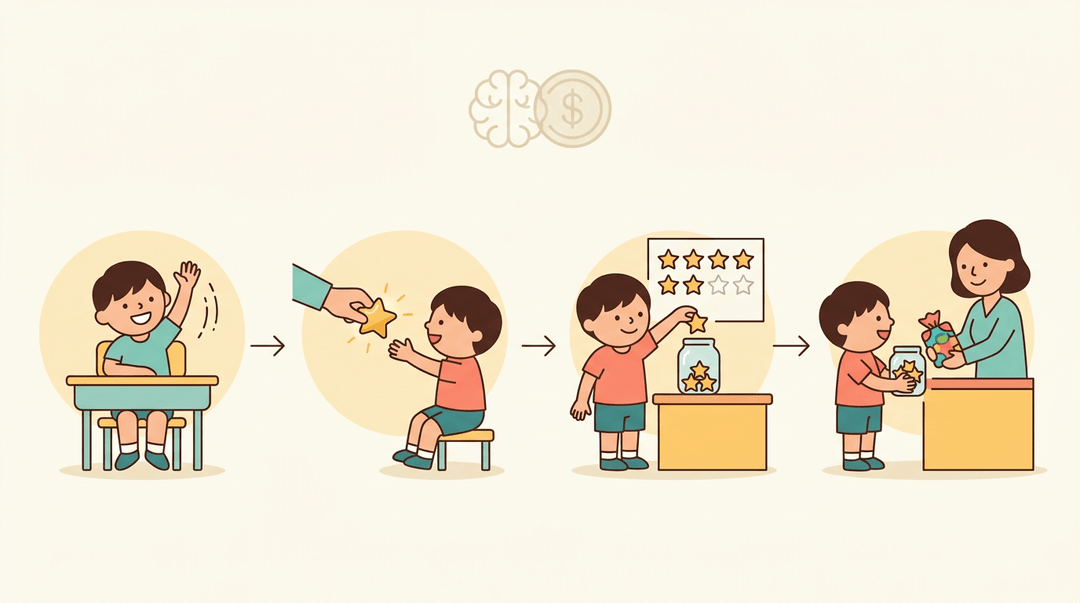
The system rests on operant conditioning: behavior that gets reinforced happens more often. Tokens work as secondary (or conditioned) reinforcers, standing in for a backup reward until the token itself starts to carry value on its own.
The idea also borrows from behavioral economics, treating tokens like a small currency that can be earned, saved, or traded in.
Applied behavior analysis (ABA), a field built on shaping behavior through reinforcement, made the token economy one of its core tools.
Are token economies still used today?
Token economies are still used today, though their popularity has shifted over time. Precursors go back to the 19th century: a textbook by Avendaño y Carderera from 1859 described an early version of the approach.
The modern token economy took shape with Ayllon and Azrin's 1961 work with psychiatric patients, and token economies became a fixture in psychiatric hospitals through the 1960s, including documented hospital programs presented at a 1968 symposium.
Use declined after the 1980s as institutional care changed, but classrooms, clinics, and ABA programs still lean on the same principles.
What the research says about token economies
Decades of research back the approach. Carnett and colleagues studied a token economy built around a child's perseverative interests, finding it reduced challenging behavior.
Kazdin's review of the token economy identified obstacles to effective use, work that still shapes how systematic reviews judge its efficacy today.
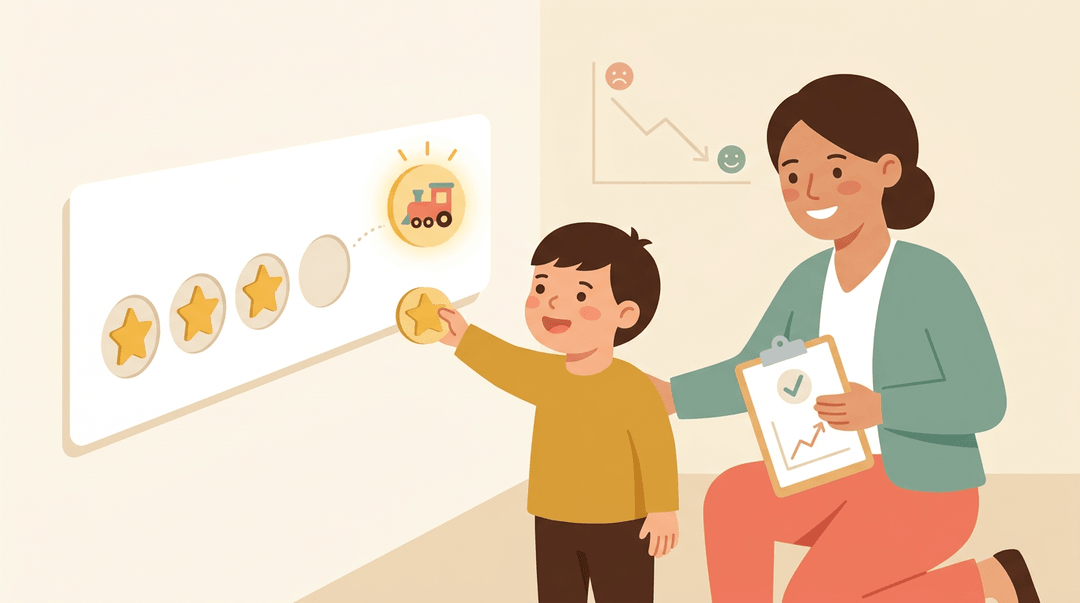
How to Set up a Token Economy
A token economy works best when you plan the mechanics before day one, then teach the system deliberately instead of explaining it once and hoping it sticks.
Decide the basics before you start
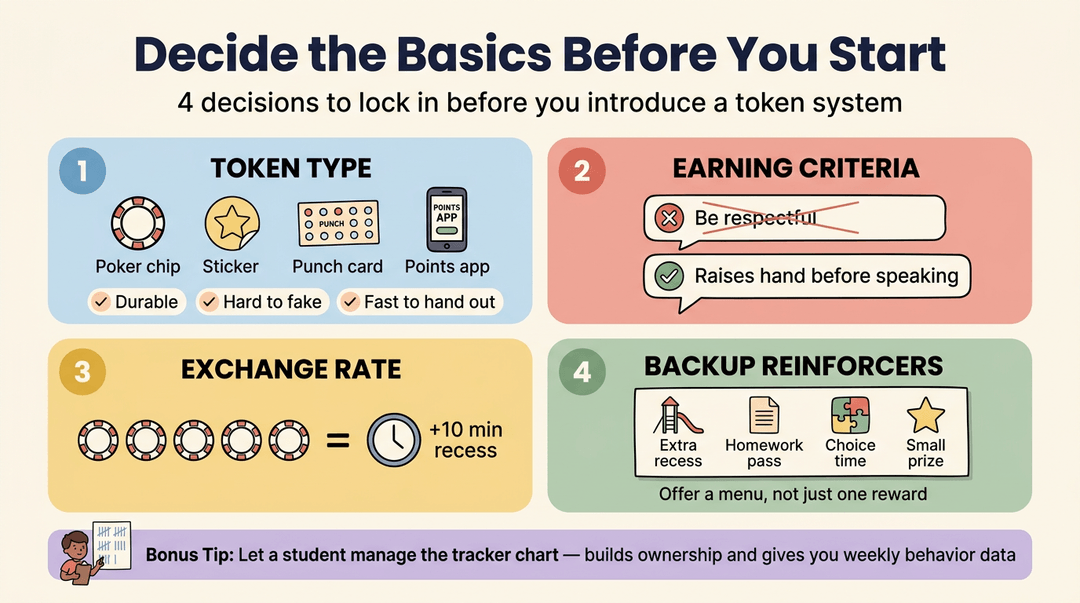
Lock in four decisions before you introduce anything to your class:
- Token type. Poker chips, stickers, hole-punches on a card, or points in a digital app all work. Pick whatever's durable, hard to counterfeit, and easy to hand out fast.
- Earning criteria. Name the exact behavior that earns a token ("raises hand before speaking"), not a vague goal like "be respectful."
- Exchange rate. Decide how many tokens buy which reward, and keep the math simple enough for young learners to track.
- Backup reinforcers. These are the actual prizes tokens trade for: extra recess, a homework pass, choice time. A common mistake is offering only one reinforcer; a small menu keeps it motivating longer.
Many teachers also hand a student the job of tracking the token chart, which builds ownership and gives you a running record of behavior data to review week over week.
Teaching kids what tokens are worth
Tokens mean nothing until you pair them with something a student already wants. Start with a near-full board: give tokens generously in the first few days so the connection between behavior and reward clicks fast, then gradually raise the bar.
As the system takes hold, fade the tangible reinforcers and lean more on privileges and attention. Always pair the token itself with specific praise: "You lined up quietly, here's your token," not a silent handoff.
Adjusting for different language abilities
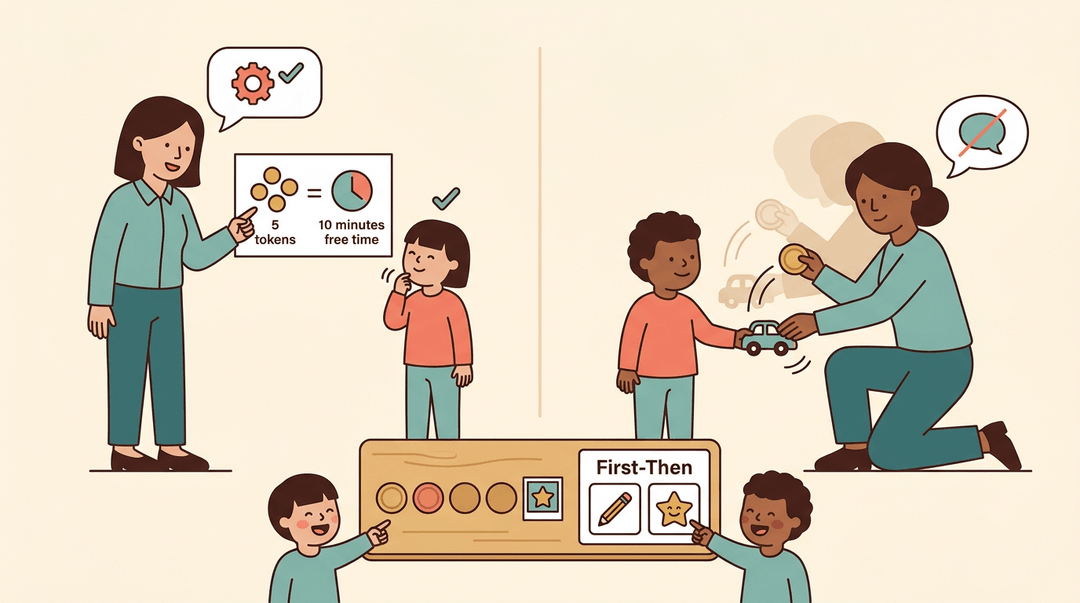
Strong language learners can be told the rules directly: explain the criteria and exchange rate up front and check for understanding.
Students with limited language need the token paired repeatedly with the reinforcer before it carries any meaning on its own; explanation alone won't do it.
For both groups, visual supports (token boards, first-then charts) show progress toward the reward without relying on words at all.
Principles that make it work
Four things separate a token economy that works from one that fizzles:
- Shaping. Start from what a student can already do and raise the target gradually.
- Immediacy. Deliver the token right after the behavior, not at the end of the day.
- Consistency. Every adult in the room reinforces the same criteria the same way; inconsistency is the most common way these systems break down.
- Clear, specified criteria. If you can't observe it, a student can't hit it.
Setting up Your Classroom Token System
You don't need a big budget or a complicated app to run a token economy: you need three clear decisions made before day one, and a plan to loosen the system later. Here's the setup we'd use, plus what it looks like at different grade levels.
Five steps to launch
- Pick one to three target behaviors.
- Keep each one observable and countable, not a general attitude.
- ✅ "Starts the warm-up within two minutes." ❌ "Shows respect."
- The first can be seen and tallied; the second is a judgment call.
- Choose your token type.
- Match it to the age: stickers for younger students, digital points for teens.
- Whatever you pick must take under five seconds to award mid-lesson.
- Set the exchange rate.
- Start cheap so students cash in early: 5 tokens = one small reward.
- Post the rate on the wall so nobody has to ask.
- List backup rewards students actually want.
- Ask the class first; a reward nobody values earns no behavior.
- Mix small items with privileges like seat choice or music during work time.
- Review and fade over time.
- Check weekly: are the target behaviors actually climbing?
- Fade by stretching exchanges (daily to weekly) and replacing tokens with praise.
⚠️ Watch out: if tokens are too hard to earn, students give up within the first week. Err generous at launch; you can raise prices once the routine sticks.
What this looks like by grade band
The five steps stay the same; the choices inside them change with age. Read down your column.
| Elementary | Middle & high school | |
|---|---|---|
| Token | Sticker on a reading-time chart | Digital points for participation |
| Backup rewards | Small toys from a prize bin | Weekly privileges: playlist pick, homework pass |
| Exchange rhythm | Daily, so the payoff stays vivid | Weekly, which builds delayed gratification |
| Who tracks | You, sticker awarded in the moment | Partners log each other's points for peer accountability |
Example: A second-grade teacher adds one sticker to each child's chart per completed reading block, with a daily trade-in before dismissal: three stickers buys a pick from the toy bin. The daily exchange keeps the connection between reading and reward tight enough for seven-year-olds to feel it.
Once your system's live, the real work is tracking: log token totals and rewards right alongside your rosters and timetables in EMStudio.
Types of Token Systems You Can Use
A token economy isn't a single product you buy off a shelf. It's a flexible format, and the version you pick should match your students, your setting, and how much setup time you actually have. Here's a tour of the most common options:
Simple token boards and charts
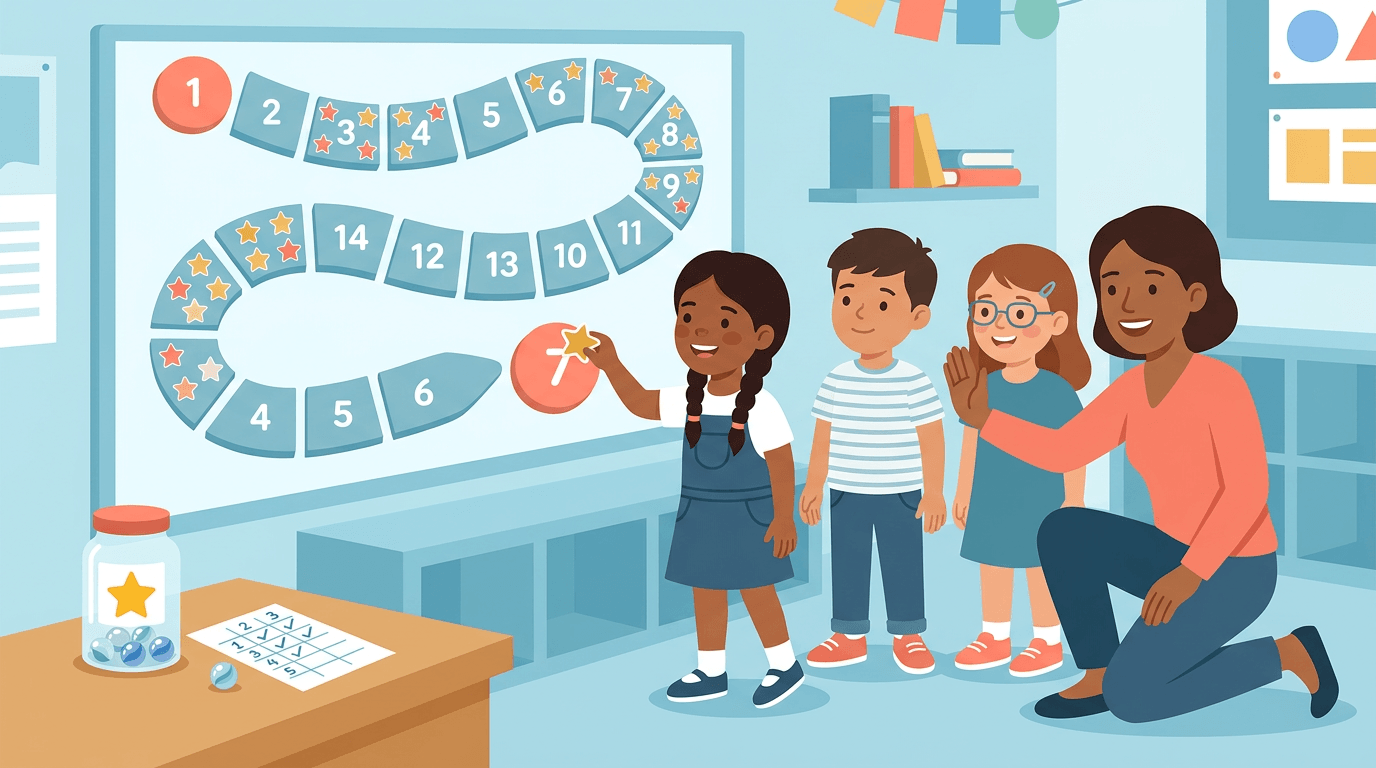
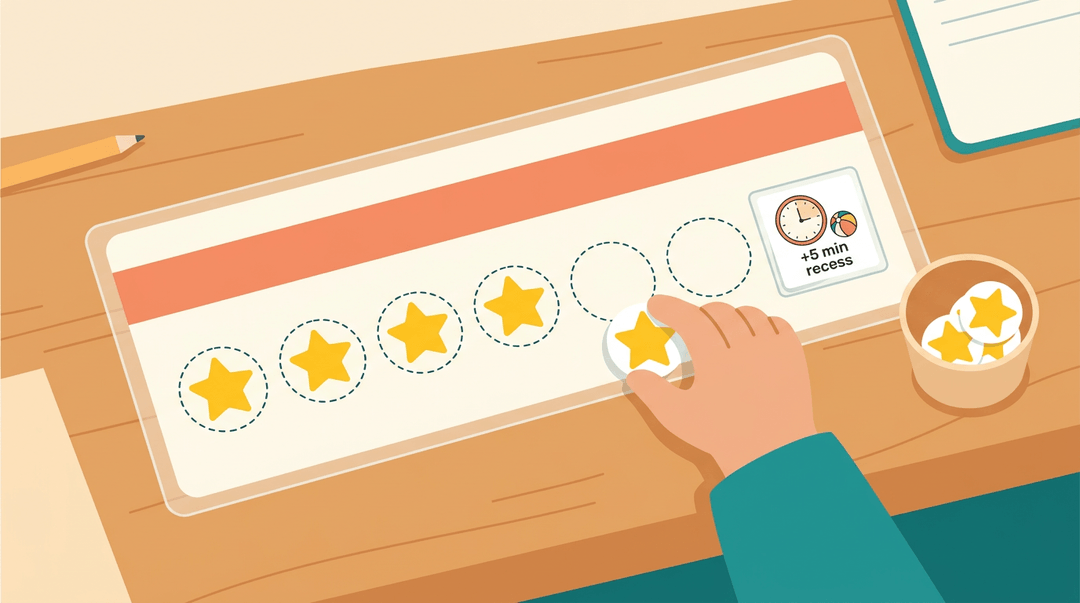
The simplest version is a board with a row of empty spaces, each one waiting to be filled.
A student earns a sticker, checkmark, or stamp for a target behavior, and once the row fills up, they trade it in for the backup reinforcer: the actual prize behind the points, whether that's five extra minutes of recess or first pick at the classroom store.
What makes this version so useful is the visual. A student can see their progress instead of just being told about it, and often a small picture of the backup reinforcer sits right at the end of the row as a reminder of what they're working toward.
Themed tokens built around interests
Swap plain checkmarks for rocket ships, dinosaurs, or animal stickers, and the board suddenly speaks the student's language. Tying tokens to a special interest doesn't just make the board look nicer: it can genuinely change how well the system works.
A study from Penn State on a perseverative interest-based token economy found that tokens built around a child's intense interest decreased challenging behavior and increased on-task behavior more than generic tokens did during an early literacy activity.
For a student obsessed with dinosaurs, a fossil-shaped token can carry more weight than any plain star ever could.
Digital points and apps
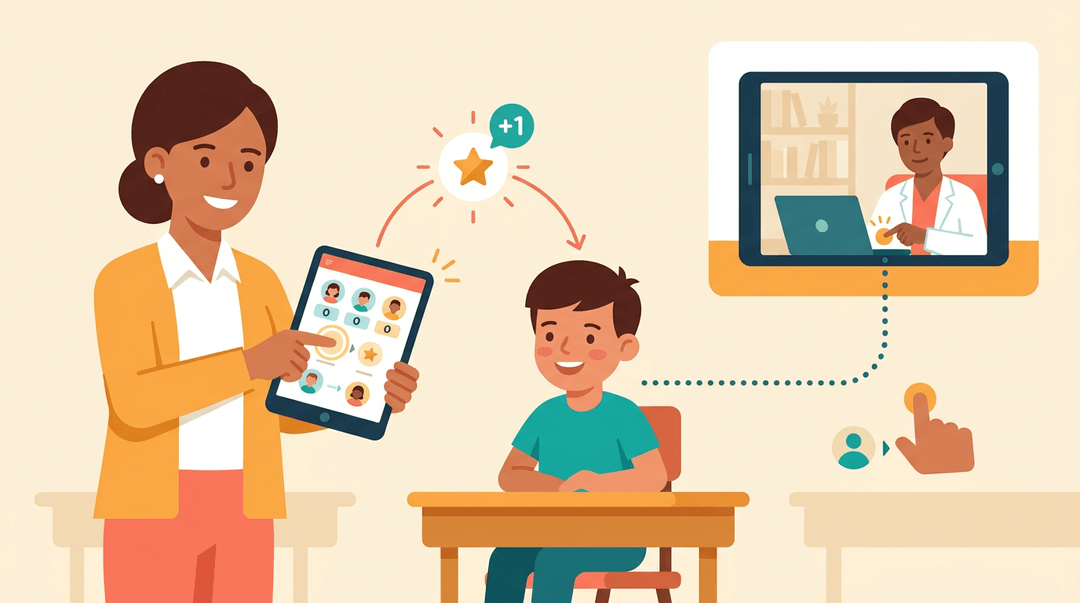
Some classrooms have gone fully digital, swapping the paper board for a screen. Apps like LiveSchool let teachers award points in real time, right from a phone or tablet, so feedback lands the moment the behavior happens instead of at the end of the day.
That immediacy matters. Digital tracking also travels well into telehealth sessions, where a clinician working with a student remotely still needs a way to award and track points without ever being in the room.
Jars and collection systems
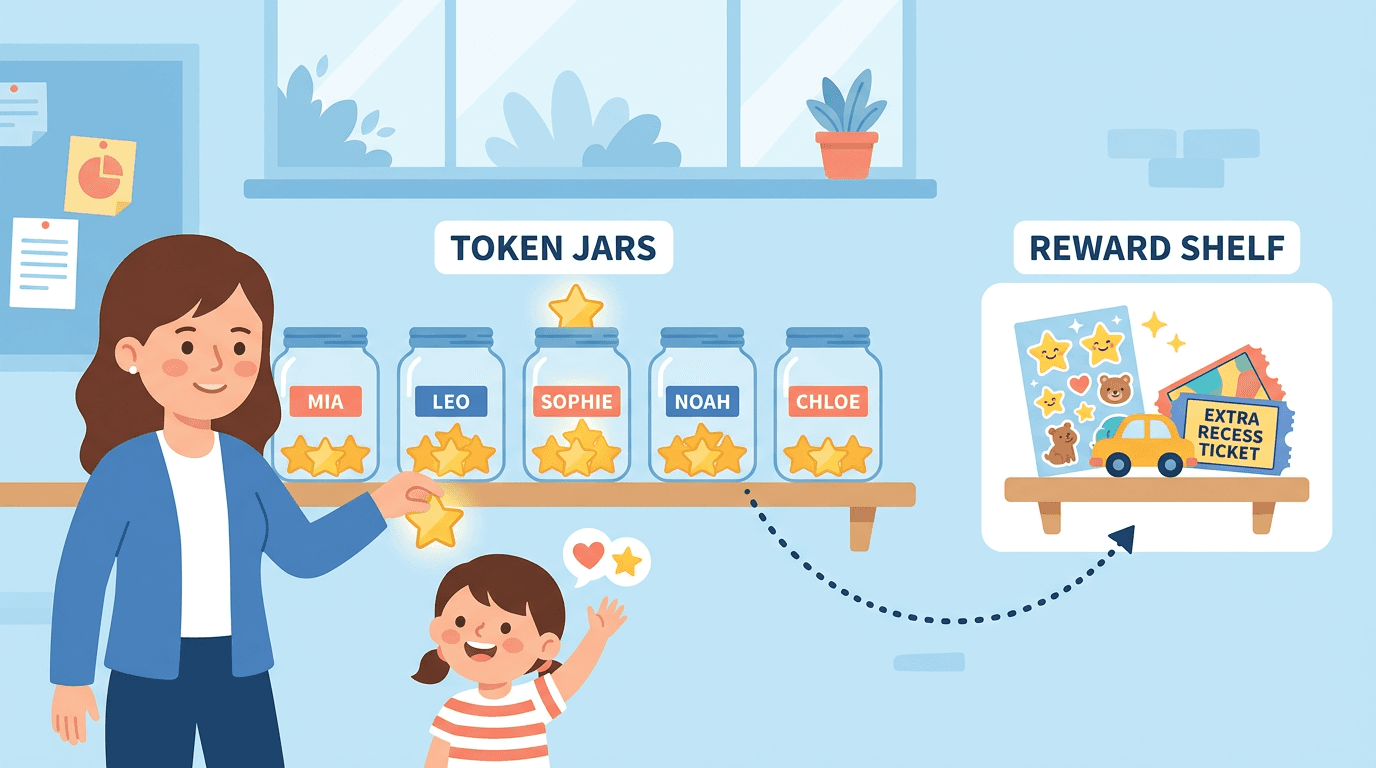
Instead of a board, picture a jar slowly filling with marbles, pom poms, or poker chips. Each one goes in for a specific behavior, and the whole jar becomes the goal.
This format works equally well for one student or an entire class working toward a shared reward, like a marble jar that earns everyone a movie afternoon once it's full.
The physical, audible plink of a marble hitting glass is its own small piece of feedback.
Play money and coin systems
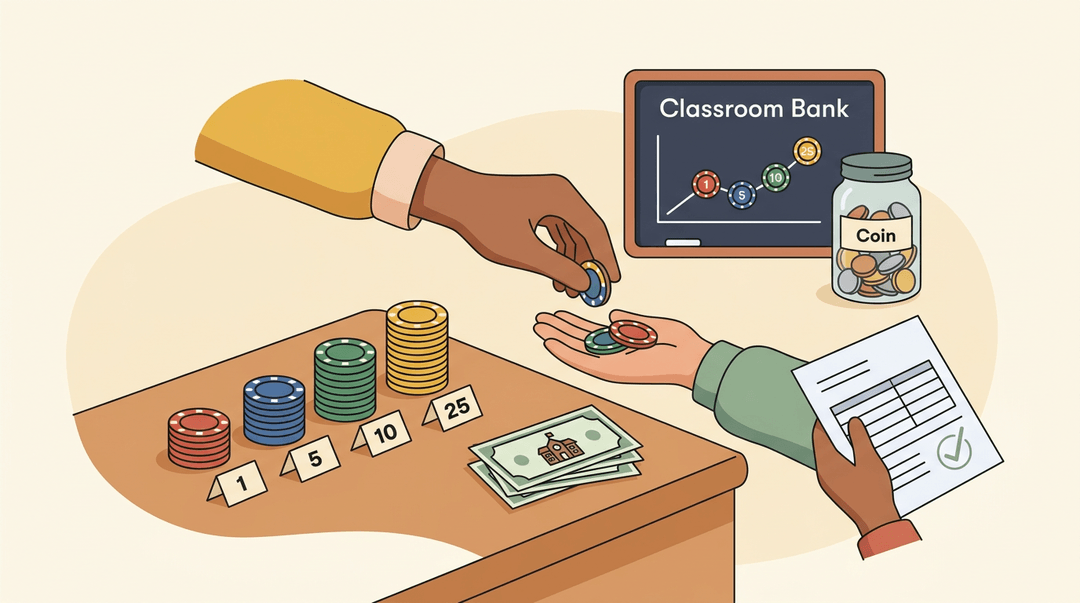
For older students, play money or coins modeled on a real currency can add a layer of practical math to the system. Poker chips work well too, especially when different colors represent different values.
A middle school teacher might set up a mini economy where students earn coins for completed work and
Where Token Economies Work Best
Token economies don't live in just one place. Once you know the core mechanics, you'll spot the same system reshaped for bedrooms, classrooms, hospital wards, and therapy rooms. Here's how each setting puts it to work:
How to set up a token economy at home
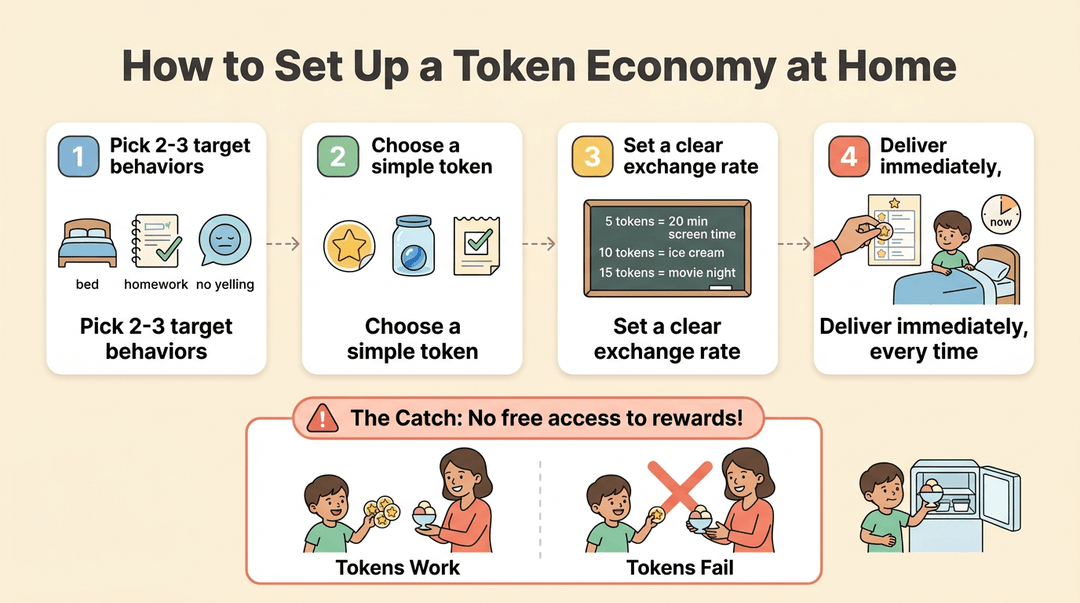
Parent-implemented systems work well for everyday chores and routines, and for manners and daily living skills like brushing teeth or using kind words at dinner. The catch: you have to limit non-contingent access.
If a child can get screen time or dessert without earning it, the tokens lose their pull fast.
Setting one up at home is simpler than it sounds:
- Pick two or three target behaviors (making the bed, finishing homework, no yelling).
- Choose a simple token: stickers, marbles, or checkmarks on a chart.
- Set a clear exchange rate tied to a small reward menu.
- Deliver the token immediately, every single time, at first.
Using token economies in the classroom
As a classroom management tool, a token economy can run with one student or a whole group, and it fits naturally inside a school's PBIS (Positive Behavioral Interventions and Supports) framework.
Researchers behind a registered report systematic review call it
How Token Economies Affect Motivation
Hand a student a token every time they raise a hand, and a fair question follows: are they learning to want to participate, or just learning to want the token? The answer depends on how you run the system.
Does it hurt intrinsic motivation?
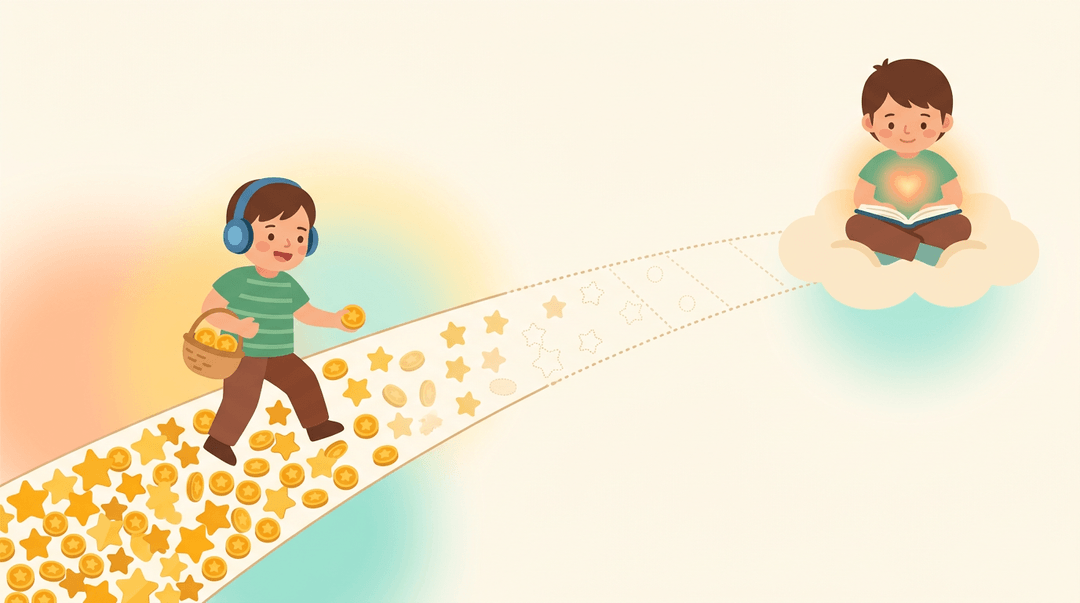
Some educators worry that constant external rewards crowd out a student's own desire to learn: the concern is that once the tokens stop, so does the behavior. That risk is real if tokens never fade.
But for many autistic learners, social praise alone doesn't carry the same motivating pull it does for other students, so tokens can bridge the gap, turning an abstract "good job" into something concrete and reinforcing.
Used well, a token economy doesn't replace intrinsic motivation. It scaffolds it, giving a student enough early wins to discover that the task itself feels good, then slowly stepping back.
Gradually reducing how often you reward
The fix for that fade-out worry is built into the system: reinforcement gets delayed on purpose. Start with a fixed ratio schedule (a token every time), then shift to a variable ratio schedule (tokens after an unpredictable number of correct responses).
That unpredictability is what builds endurance: students keep working because they don't know exactly when the next token lands, the same reason a slot machine holds attention far longer than a vending machine.
Keeping rewards from losing their appeal
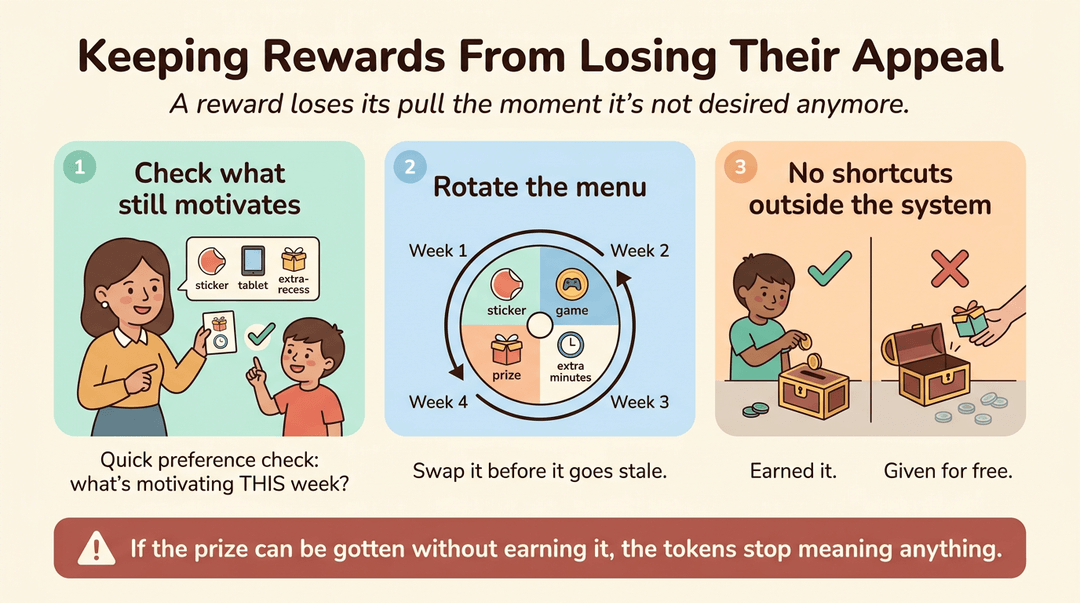
A reward loses its pull the moment it's not desired anymore.
- Run quick preference assessments to check what still motivates a given student
- Rotate the menu of reinforcers
- Never let the reward show up for free outside the system
If a student can get the prize without earning it, the tokens stop meaning anything.
Taking tokens away for misbehavior
Some programs remove tokens for problem behavior, a response cost. It can work, but use it with caution: pull too many tokens and you risk the rapport you've built.
Pair any removal with a clear path back to earning, so the system still feels like a way forward, not a punishment.
Pros and Cons of Token Economies
Like any classroom tool, token economies come with real strengths and real limits. Knowing both helps you decide whether one actually fits your room.
What makes token economies effective
Done well, a token system does more than hand out stickers. It builds real skills and holds up under pressure:
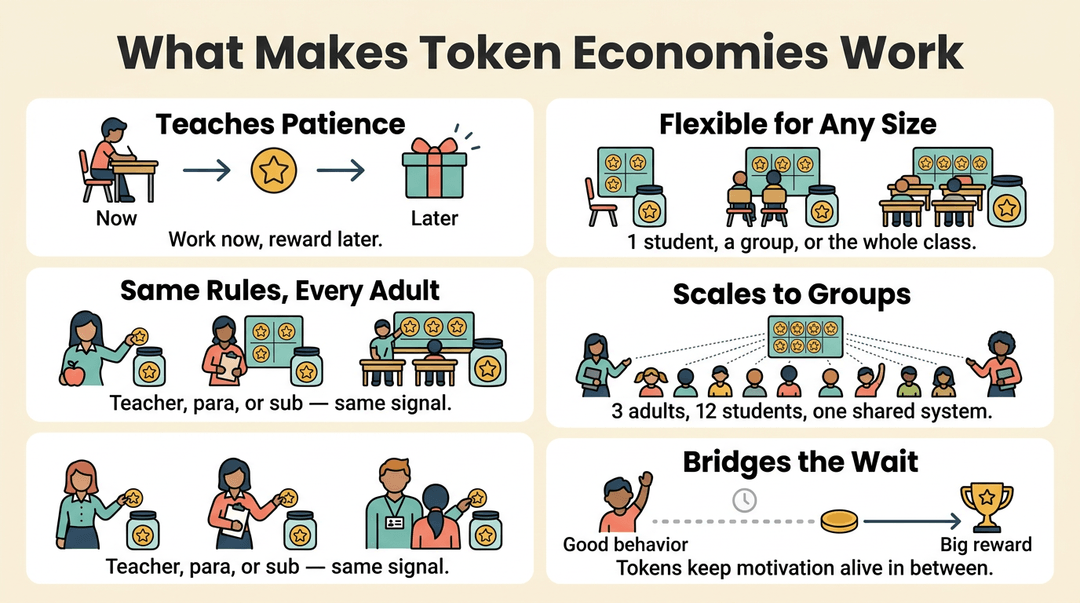
- Teaches delayed gratification. Students learn to work now for a payoff later, a skill that outlasts the chart itself.
- Highly flexible. You can adapt tokens for a single student, a small group, or the whole class, and adjust the target behaviors as needs change.
- Consistency across adults. When a paraprofessional, substitute, or co-teacher can all reinforce the same way, students get a clear, steady signal no matter who's in the room.
- Works for groups. Consider a special education teacher running one token system across three adults and a dozen students: everyone earns and cashes in by the same rules.
- Bridges reinforcement gaps. Tokens fill the space between a desired behavior and a delayed reward, keeping motivation alive in the meantime.
Common challenges and criticisms
The same features that make token economies powerful can also cause problems if you're not careful:
- Tokens lack innate value. A token only matters because it's backed by something students actually want, so a weak reward menu sinks the whole system.
- Requires planning. Setting fair values, tracking exchanges, and keeping the system consistent takes real upfront work.
- Frustration risk. Students can get upset over lost or denied tokens, so consequences need to feel fair, not punitive.
- Generalization and maintenance problems. Behavior earned for tokens doesn't always transfer once the system fades, so you'll need a plan to wean off it.
- Ethical and patient rights concerns, especially in clinical settings, where token systems must respect autonomy and avoid coercion.
A token economy works because it makes progress visible: students see exactly what earns a reward, and you spend less time repeating the same reminders.
Get the core elements right, match the system to your setting, and it becomes a steady, quiet motivator instead of another program to manage.
Ready to build the structure that makes a token system easy to run day to day? Check out our Classroom Management feature to organize your rosters and routines in one place.
References
- A 19th Century Predecessor of the Token Economy — pmc.ncbi.nlm.nih.gov
- The Social Validity of Token Economy Interventions in Instructional Settings: A Registered Report Systematic Review — doi.org (2026)
- The effects of token reinforcement on attending in a young ... — researchgate.net (2026)
- THE EFFECTS OF TOKEN ECONOMIES ON RESPONDING IN CHILDREN WITH AUTISM SPECTRUM DISORDER — opensiuc.lib.siu.edu (2025)
- The token economy for schizophrenia: Review of ... — pure.johnshopkins.edu (2005)
- Assessment of Token Economy Programmes in Psychiatric Hospitals — doi.org
- Effects of a Perseverative Interest-Based Token Economy on Challenging and On-Task Behavior in a Child with Autism — pure.psu.edu
- The token economy: a decade later — ncbi.nlm.nih.gov
- Token economy for schizophrenia — cochrane.org
- Effects of a Perseverative Interest-Based Token Economy on Challenging and On-Task Behavior in a Child with Autism — pure.psu.edu
Frequently asked questions
What is meant by token economy?
A token economy is a reinforcement system where individuals earn tokens for exhibiting desired behaviors. These tokens can then be exchanged for tangible rewards or privileges, known as backup reinforcers, functioning as a form of currency to incentivize target actions.
What is a token economy in psychology?
In psychology, a token economy is a behavior management system based on operant conditioning, where tokens act as secondary reinforcers. Individuals earn these tokens for specific behaviors and later exchange them for primary reinforcers or privileges that are intrinsically motivating.
What is the token economy for ADHD?
Token economies can be effective for ADHD by providing immediate, tangible rewards for desired behaviors, helping to reinforce task completion, focus, and organization. The visual and concrete nature of tokens can aid individuals with ADHD in understanding expectations and tracking their progress toward a reward.
What is token economics in psychology?
Token economics in psychology refers to a system rooted in operant conditioning and behavioral economics. It involves using tokens as a form of currency that individuals earn for performing target behaviors, which can then be traded for desired backup rewards, thereby shaping and reinforcing behavior.
What are the 7 elements of a token economy?
The 7 elements of a token economy generally include identifying target behaviors, choosing a token type, establishing a reinforcement schedule, specifying exchange rates, selecting backup reinforcers, implementing a token delivery method, and developing a fading plan.
What are the three main components of a token economy?
The three main components of a token economy are clearly specified target behaviors, a visible way to earn tokens (the tokens themselves), and a menu of backup reinforcers. These work together with a clear exchange system to motivate desired actions.
What is a real life example of a token economy?
A real-life example of a token economy is an arcade, where you feed in tokens to play games, earn tickets for your performance, and then trade those tickets for a prize. Another example is a classroom where students earn stickers for completing assignments and then trade a certain number of stickers for extra recess time or a small toy.
Who coined the term "token economy"?
The term "token economy" was coined by Teodoro Ayllon and Nathan Azrin in 1961, based on their work with psychiatric patients. Their research helped establish the modern token economy as a systematic approach to behavior management.