Childhood Discipline: A Complete Guide by Age and Stage

Jump to section
Think about teaching a toddler to ride a bike. You don't just let go and hope; you hold the seat, set boundaries, and adjust your grip as they get steadier. Childhood discipline works the same way.
It's less about punishment and more about guiding a child toward self-control, one developmentally appropriate step at a time.
In this post, we'll walk through what discipline is really for, how it shifts with age, which techniques actually work, and how you can translate all of it into your classroom.
What Childhood Discipline Is Really For
Ask most people what discipline means, and they'll picture consequences: a time-out, a lost privilege, a stern word. That's only half the picture.
Discipline means teaching, not punishing
Discipline shares its root with "disciple," someone who learns. Discipline is guidance toward better choices, not payback for bad ones. Punishment says, "You did wrong, now you'll pay for it."
Guidance says, "Here's what to do instead, and here's why it matters." The first shuts a conversation down. The second keeps it open.
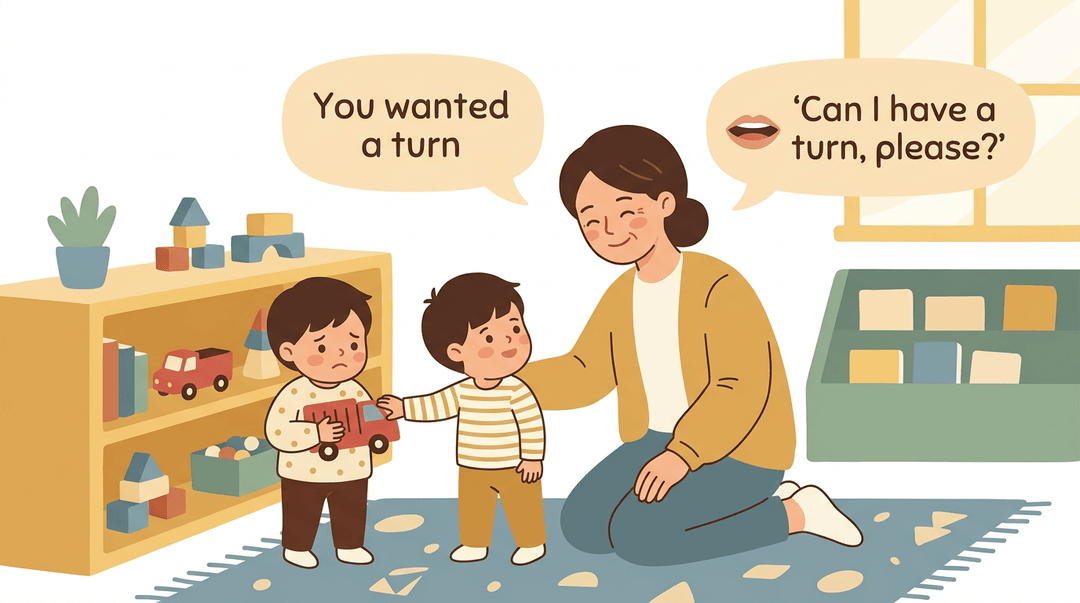
Consider a kindergarten teacher who redirects a child grabbing a toy by naming the feeling ("You wanted a turn") and modeling the ask ("Can I have a turn, please?"). That's training toward self-control, not punishment for impulse.
The goal isn't compliance in the moment. It's character: patience, honesty, and empathy, the traits that outlast any single classroom rule.
What good discipline aims to achieve
Good discipline has a destination. It aims to:
- Foster self-discipline, so a child manages behavior without someone watching.
- Internalize rules and values, so "don't hit" becomes "I don't want to hurt anyone."
- Build respect and trust between adult and child, not fear.
- Raise emotionally mature adults who can handle frustration without falling apart.
The real measure of discipline isn't obedience in the room. It's whether a child holds onto the value once the adult walks away: moral internalization, not mere compliance.
Discipline That Fits Your Child's Age
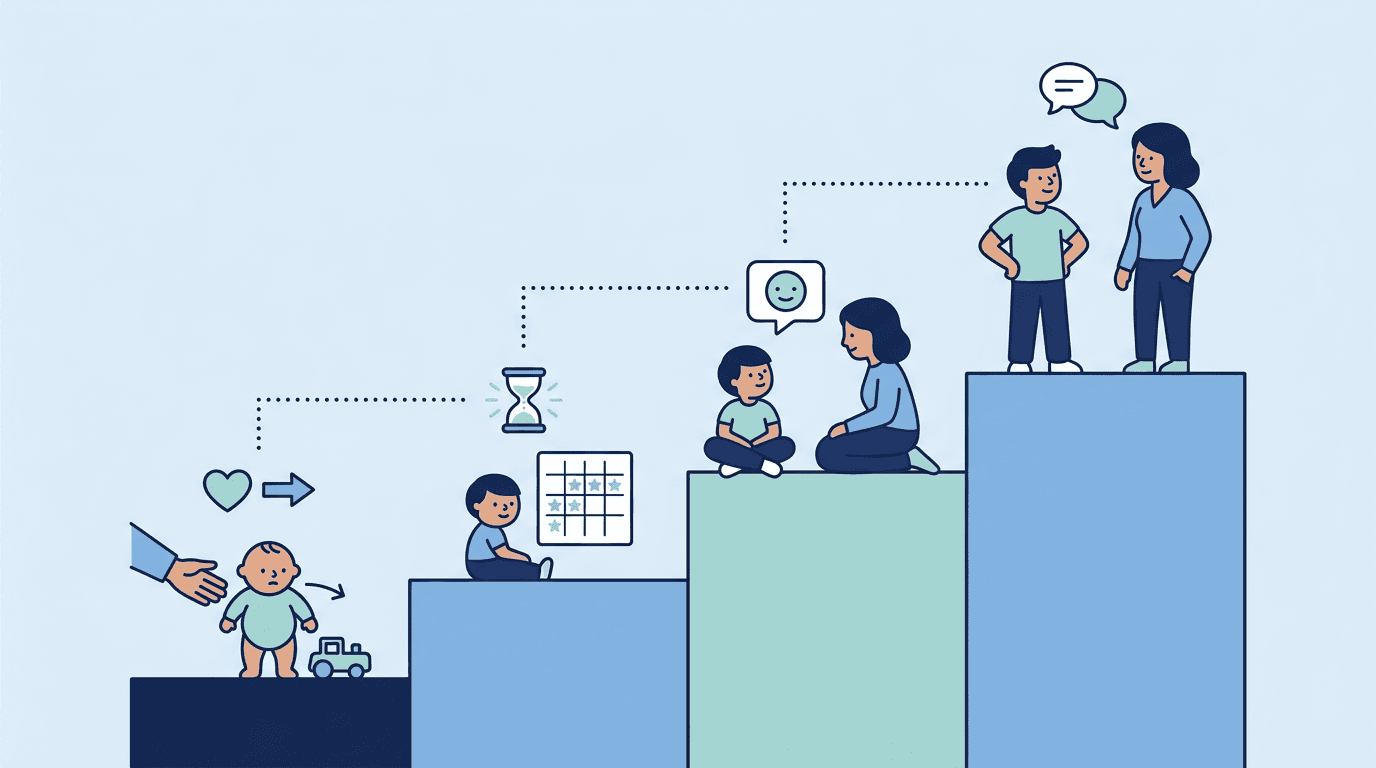
A three-year-old and a thirteen-year-old need very different responses to the same slammed door. What works, and what's fair, shifts as your child grows:
Guiding infants from birth to two
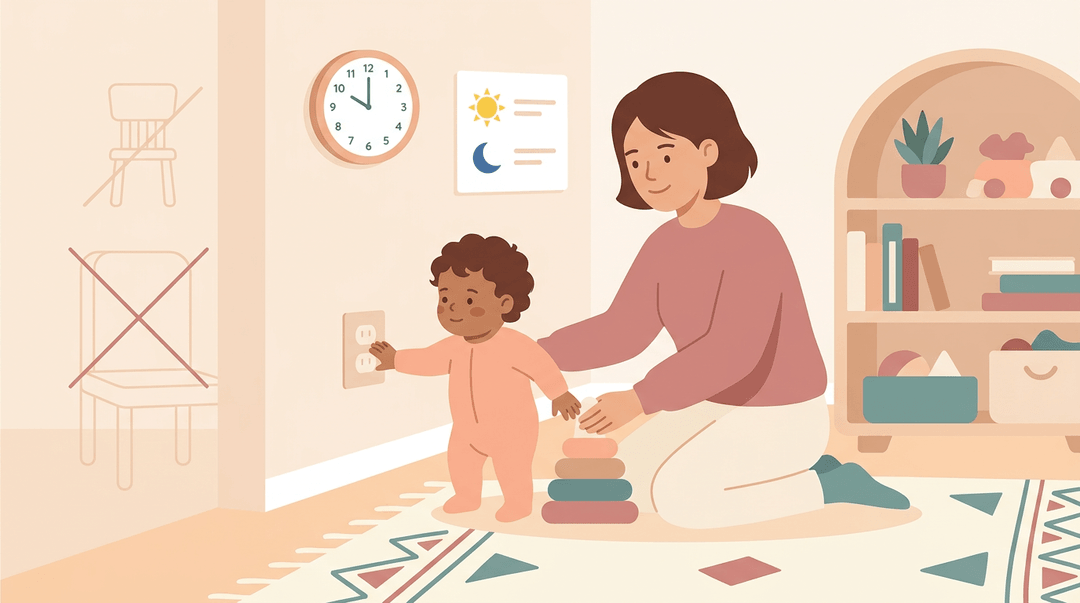
Infants aren't misbehaving; they're learning that the world is safe. Discipline this early means building trust and attachment: respond consistently, and redirect a busy toddler toward something safer instead of punishing them.
Skip time-outs altogether, since infants can't yet connect one to their action. Predictable routines for sleep and meals help more than any correction, and watch for overstimulation: a meltdown is often exhaustion, not misbehavior.
My 5-year-old is misbehaving. What should I do?
Tantrums at this age are normal, not defiance. A 5-year-old's brain is still building the words for big feelings, so reasoning alone often falls flat. Stay close, supervise, and redirect before things escalate.
Short time-outs, a minute or two, work as a reset rather than a punishment. If toilet training is part of the picture, go gently: accidents call for patience, never consequences.
What is a good punishment for an 8-year-old not listening?
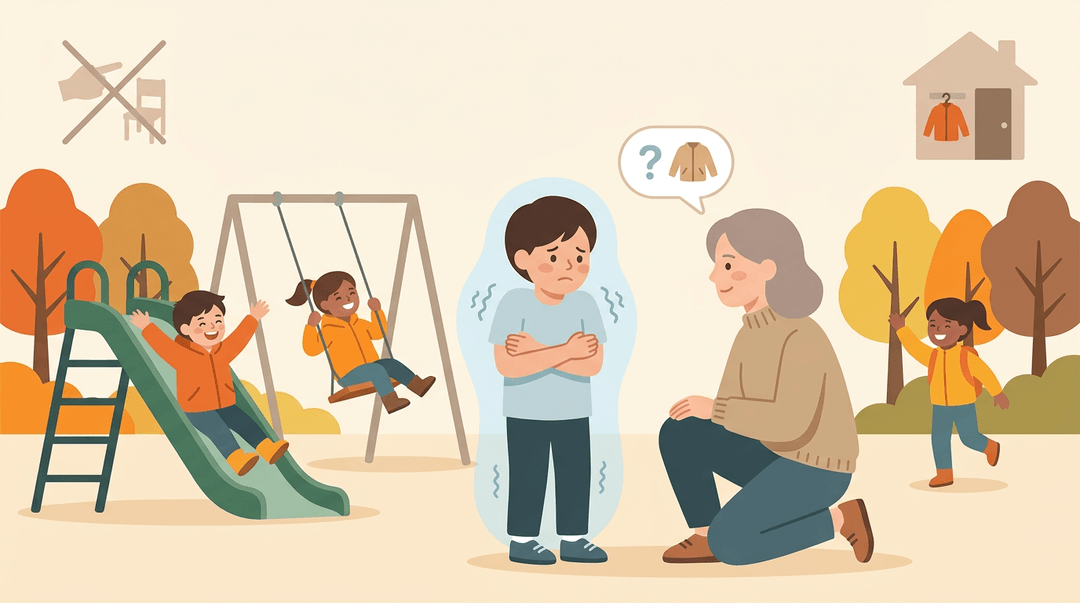
By eight, kids can reason and handle more independence, so lean on logical or natural consequences instead of punishment: a forgotten jacket means a chilly recess, not a lecture.
Bring your child into problem-solving ("What's a fair fix here?") rather than dictating the outcome. Tie privileges directly to behavior, so cause and effect stay obvious and consistent.
Negotiating rules with teenagers
Teens are wired for independence, and peer influence carries real weight now. Negotiate rules instead of lecturing: a teen who helps write the curfew is far more likely to keep it.
Logical consequences and behavior contracts work better than punishment for punishment's sake. Spanking has no place here. It damages trust exactly when a teen needs you most.
Techniques That Make Discipline Work
No single strategy works for every child or every moment. The techniques below cover the situations you'll actually face in a classroom: the meltdown, the shove on the playground, the kid who never seems to hear "no."
Here's what actually works, and when to use it.
Using time-outs effectively
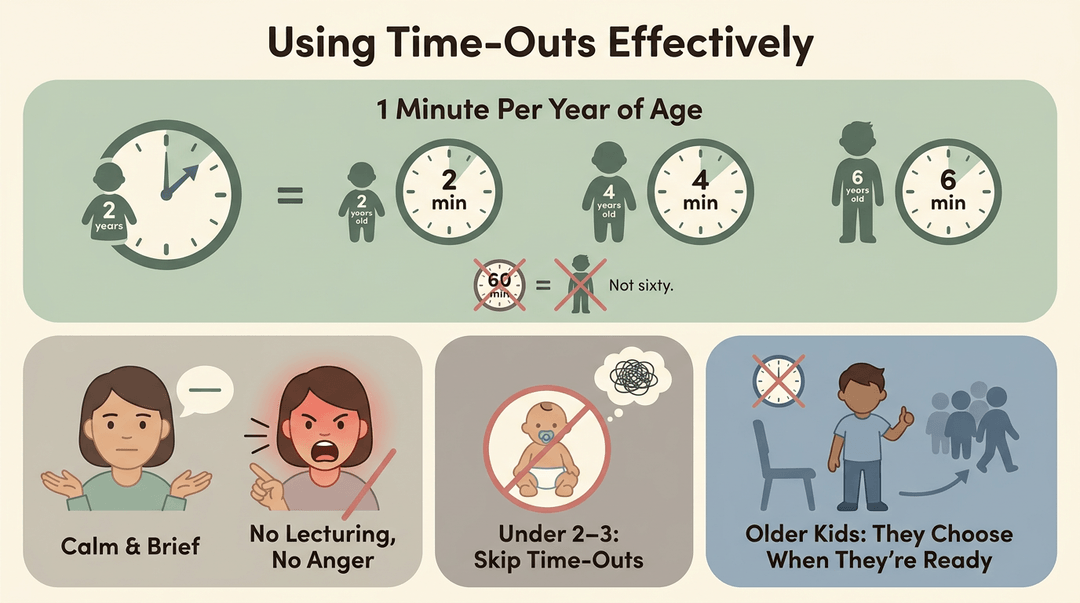
A time-out only works if it's short, calm, and consistent. The classic rule of thumb is one minute for each year of the child's age, according to healthychildren.org's guide on the technique. A 6-year-old gets six minutes, not sixty.
Deliver it unemotionally: no lecture, no anger, just a brief, matter-of-fact removal from the situation. Skip time-outs for kids under 2 to 3; they don't yet have the self-regulation to use them.
For older students, a child-led version, where they choose when they're ready to rejoin, often works better than a timer you control.
What's the appropriate punishment for a 6-year-old who hits others at school?
The best consequence is tied directly to the misbehavior: related, respectful, and reasonable. If a child breaks a toy in anger, they lose that toy, not screen time or recess.
If a student hits a classmate, a fitting consequence might mean sitting out of the game where the hitting happened, or helping repair what the conflict damaged.
The goal isn't to punish hard: it's to teach accountability by connecting the action to its result.
Catching your child being good
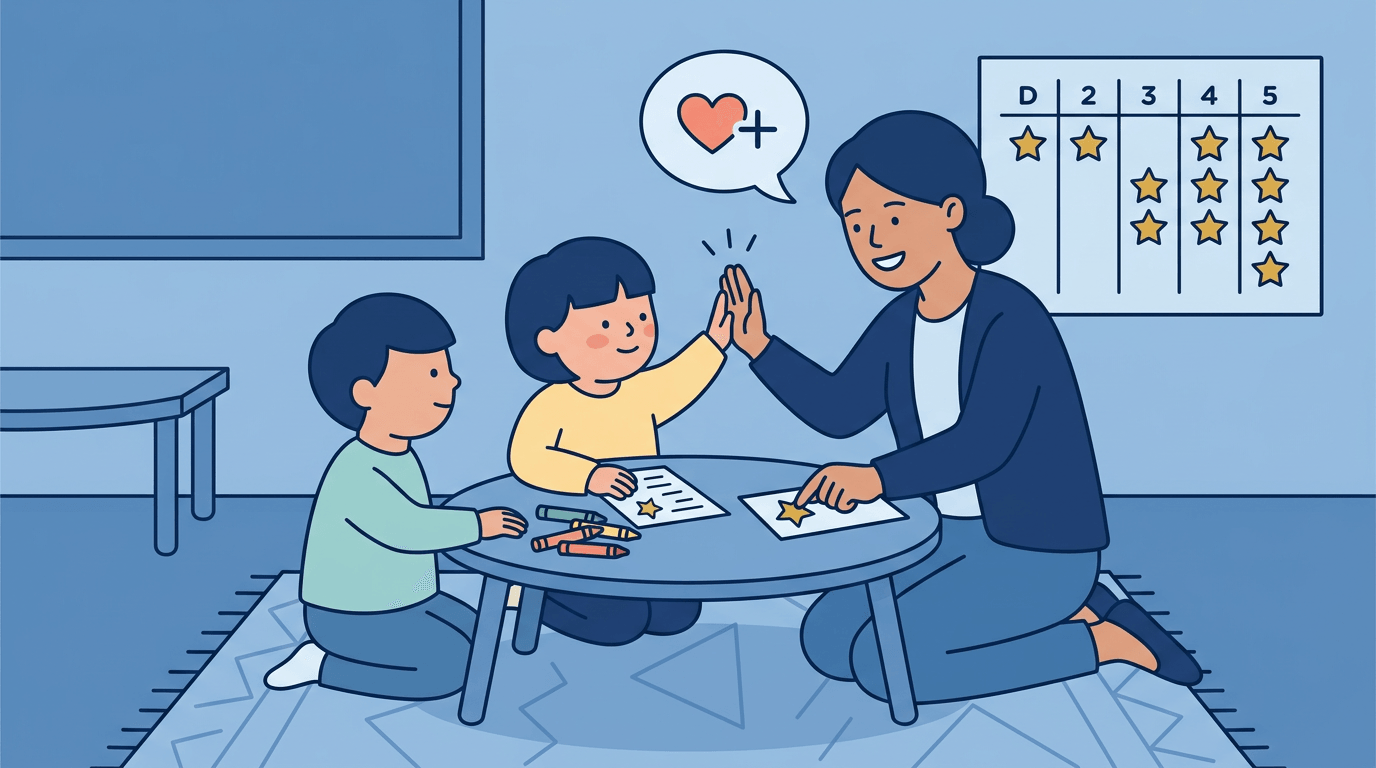
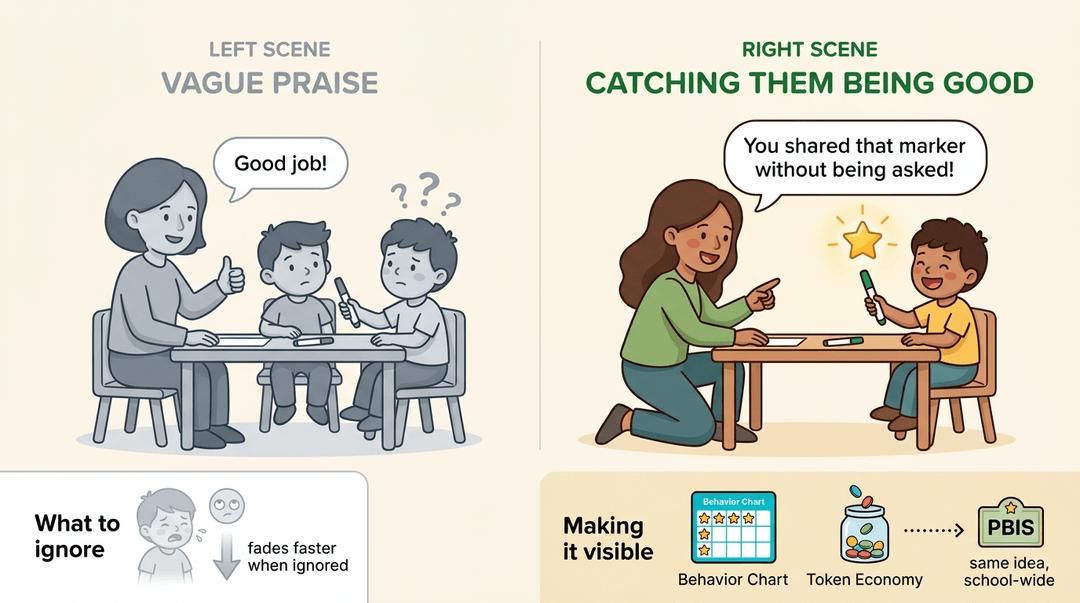
Attention is one of the most powerful reinforcers you have, and kids notice exactly where it goes. Catching a child being good means naming the behavior you want to see more of: "You shared that marker without being asked."
Specific praise strengthens the behavior it names, while minor misbehavior often fades faster if you ignore it than if you call it out.
Classroom frameworks like PBIS (Positive Behavioral Interventions and Supports) build on this same idea, and tools like token economies or behavior charts give that reinforcement a visible, trackable form.
Redirecting before problems start
Anticipate the trigger before it becomes a blowup. If you know a transition or a specific classmate tends to set a student off, redirect with an alternative activity before it escalates.
Save the bigger conversation for later, once everyone's calm, rather than in the heat of the moment. A quick heads-up beforehand ( "We're switching activities in five minutes" ) prepares a child to handle the shift.
Setting clear, consistent rules
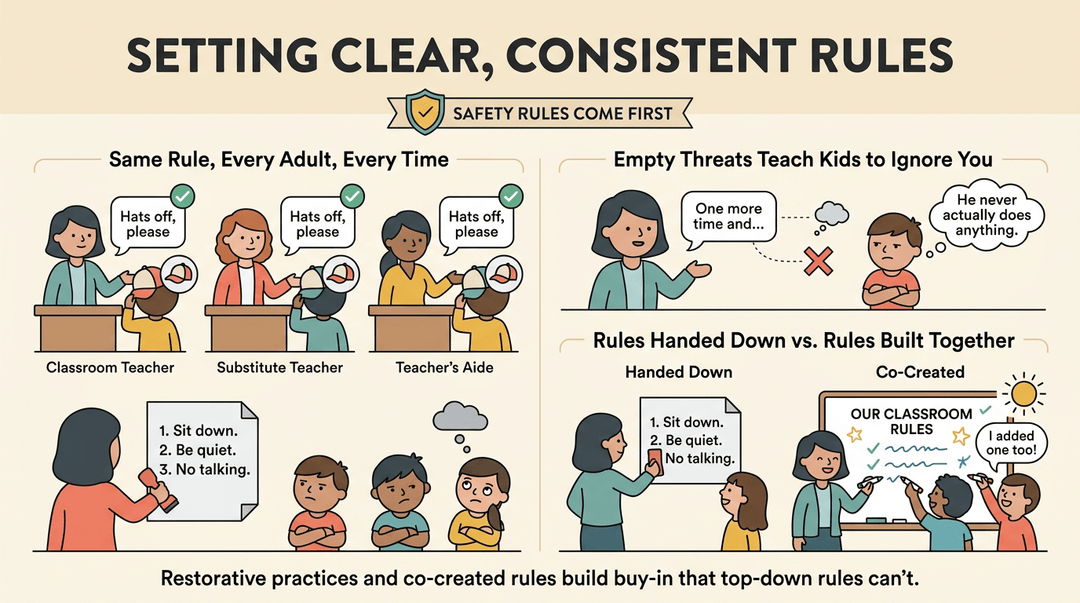
Rules work when they're clear, age-appropriate, and enforced the same way every time, by every adult in the room. Safety rules come first. Empty threats ( "one more time and..." with no follow-through) teach kids to ignore you.
Restorative practices, where students help repair harm after a conflict, tend to stick better than a rule handed down from above; co-creating classroom rules with students builds that same buy-in from day one.
Coaching your child through big feelings
Before you set a limit, name what's happening: "You're frustrated because it's not your turn." Labeling the emotion and listening with empathy first helps a child feel understood, which makes the limit that follows land better.
A calm-down corner gives them a concrete place to de-escalate before you talk it through together.
A Classroom Behavior Management Checklist
Here's the pin-up version: three routines that turn everything above into daily practice. Set up before students arrive, respond the same way every time, and review the week before it repeats.
Before day one: set up the room
Confirm each of these before a single student walks in:
- Rules are posted visually. Three to five rules, pictures plus words, at kid eye level.
- ✅ "Use walking feet." ❌ "No running." Name the do, not the don't.
- The seating chart is drawn. Easily distracted students sit near you, away from doors and windows.
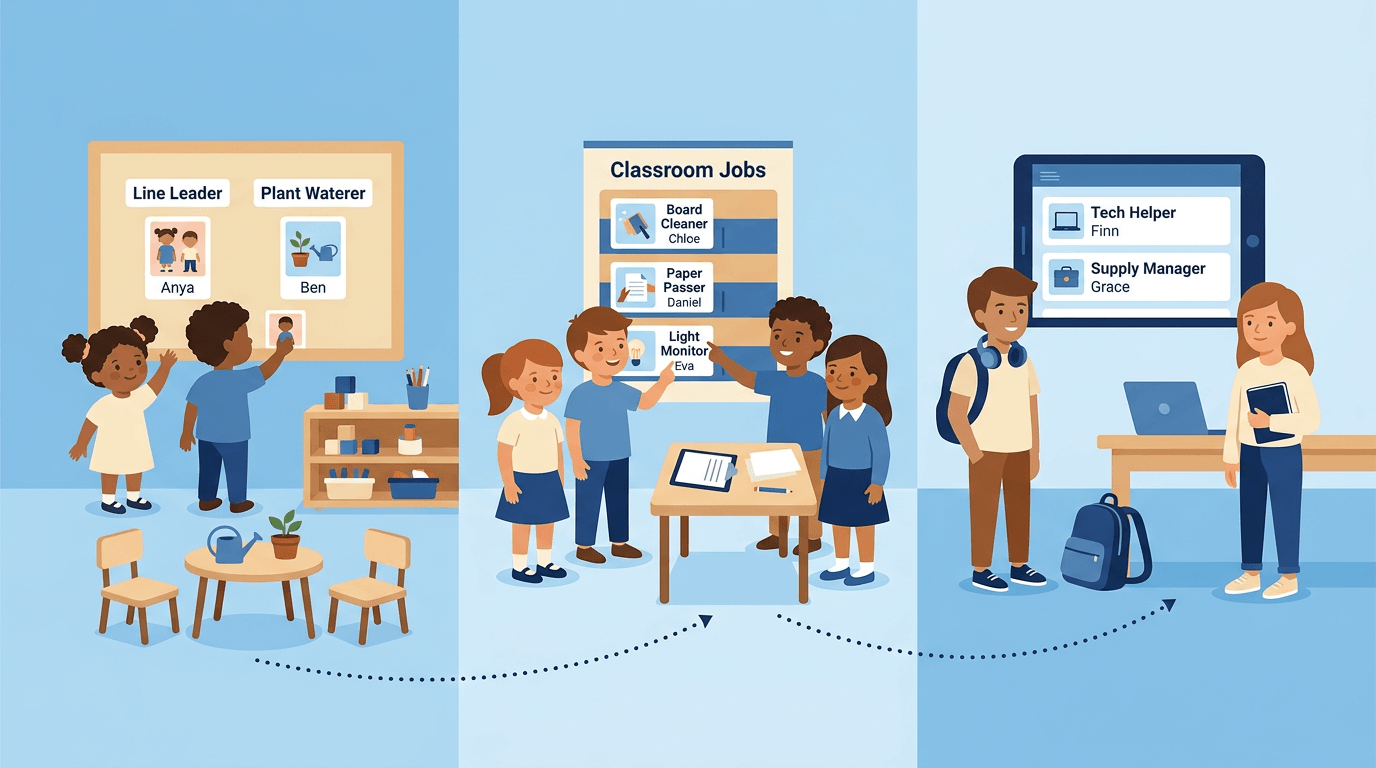
- Classroom jobs are assigned. Line leader, supply manager, plant waterer: every child owns something.
- A transition signal is chosen. One sound or phrase, practiced on day one until it's automatic.
- Try: lights off, a chime, or "Hands on top."
In the moment: the four-move response
When a rule is broken, run the same sequence every time. The predictability is the discipline.
- Give one clear warning. Name the behavior and the expectation, then keep teaching.
- Say: "That's your warning: hands stay on your own work."
- Offer the calm-down corner when emotion is driving the behavior.
- It's a reset spot with a timer, not a punishment seat.
- Apply a logical consequence tied directly to what happened.
- Scribbled on the desk? They clean the desk. Not "no recess."
- Catch the turnaround with praise the moment behavior improves.
- Say: "You got right back to work, that's exactly it."
⚠️ Watch out: skipping straight to the consequence teaches kids to fear you, not to follow the rule. The warning is what makes the consequence feel fair.
Each week: track and follow up
- Log every incident in one line. Date, student, behavior, consequence. Ten seconds, no essays.
- Scan for patterns each Friday. Same student, same time of day, same neighbor?
- Share small notes with parents early. A two-line email now beats a conference later.
- Try: "Quick note: Maya struggled with transitions twice this week. Here's what we're trying..."
- Adjust seating or jobs based on what the log actually shows, not on your worst memory.
Example: Your log shows three incidents this week, all right after lunch, all at table four. That's not three difficult kids; it's a transition problem. You re-teach the after-lunch routine, split the table, and the incidents stop.
The system only works if the pieces live together, so keep rosters, seating charts, and behavior notes organized in one place with EMStudio's classroom management tools.
What Affects How Well Discipline Works
No two children respond to the same approach the same way, and that's the real puzzle behind discipline.
A handful of forces, some coming from the child, some from the adults around them, decide whether a strategy actually changes behavior or just creates friction.
How your child's traits play a role
A child's temperament sets the starting point: a naturally cautious child often responds to a calm redirection, while a more intense, reactive child may need firmer, more immediate follow-through. Birth order matters too.
A firstborn used to being the center of attention might push back harder against new limits than a younger sibling who's watched consequences play out already.
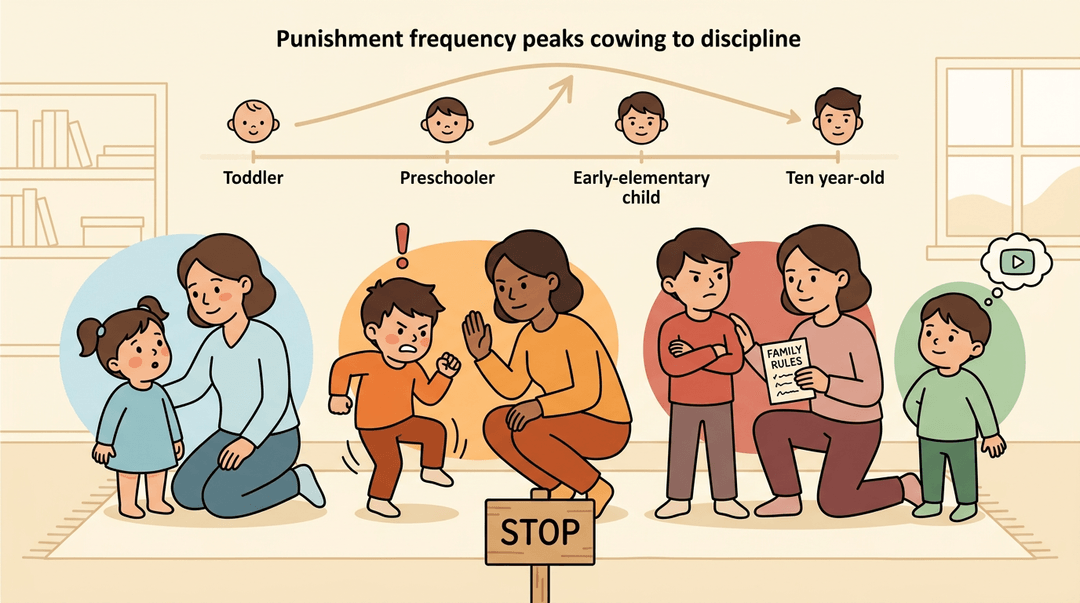
Developmental stage puts a ceiling on what discipline can reasonably ask for. A toddler simply can't reason through a long explanation the way a ten-year-old can, so the same lecture that works for one falls flat for the other.
This is also why punishment frequency tends to peak in the toddler and early elementary years: these ages test limits constantly as they figure out where the boundaries actually are.
How parents influence discipline success
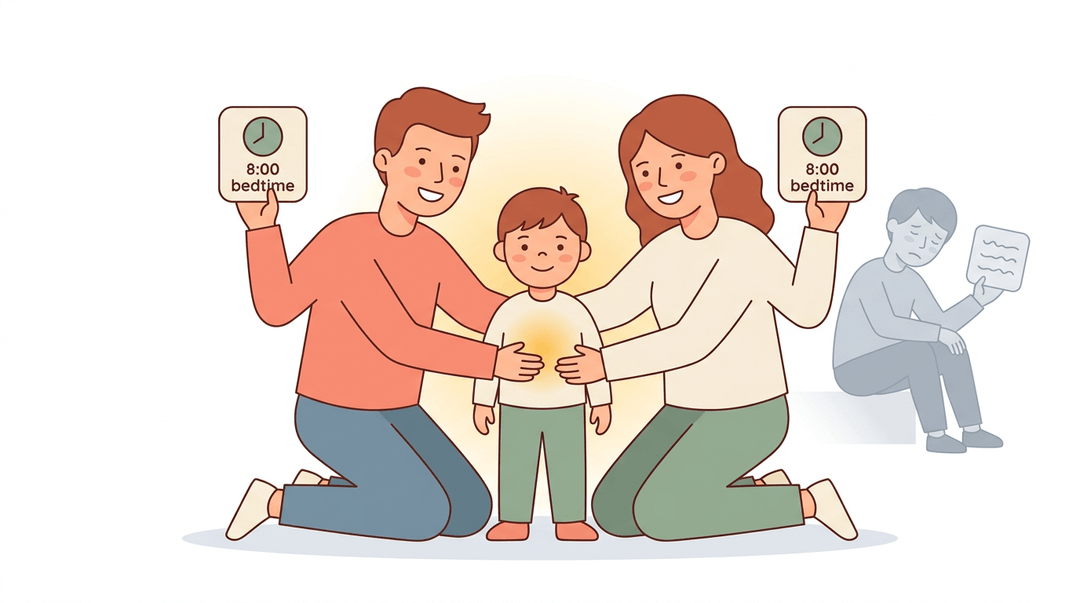
Consistency and role modeling do more work than any single technique. When you say a rule one day and let it slide the next, children learn the rule is optional.
A stable marriage or co-parenting relationship also matters: when caregivers back each other up, kids get one clear message instead of two competing ones.
Parental stress and mental health shape the tone of discipline, too. An exhausted or anxious parent is more likely to react harshly or inconsistently, not because they love their child less, but because their own reserves are low.
Underneath all of it, a warm parent-child relationship is what makes any discipline land. Children who feel secure with a caregiver are far more willing to accept correction from that adult.
How culture and environment shape discipline
- Socioeconomic conditions affect both the tools families have available and the stress they're managing day to day.
- Cultural and religious norms shape what counts as respectful behavior in the first place, and what response to misbehavior feels appropriate.
- Neighborhood risk factors, like exposure to violence or instability, can push parents toward stricter, more protective discipline.
- And attitudes toward physical punishment vary widely across these same lines: what one family considers a normal correction, another sees as harsh.
Why children misbehave in the first place
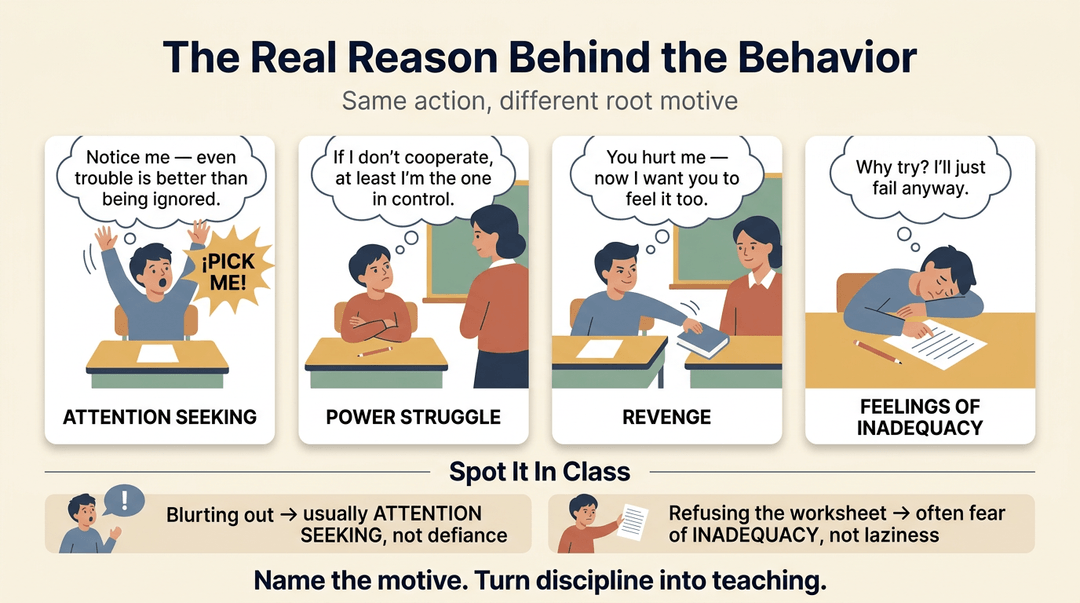
Most misbehavior traces back to one of a few root motives:
- Attention seeking. Acting up because any attention, even negative, beats being ignored.
- Power struggles. Testing limits to feel some control over a situation.
- Revenge motives. Acting out because they feel hurt or wronged and want the adult to feel it too.
- Feelings of inadequacy. Giving up or acting out because they don't believe they can succeed anyway.
These same motives show up constantly in the classroom. Consider a student who blurts out during a lesson: that's often attention seeking, not defiance.
A student who refuses a worksheet outright may be protecting themselves from feeling inadequate in front of peers. Naming the motive underneath the behavior is what turns a discipline moment into an actual teaching moment.
Spanking and Corporal Punishment
Few discipline topics carry as much weight, literally and figuratively, as spanking. Here's what the evidence shows about how common corporal punishment still is, what it does to kids, and where experts and policymakers stand today.
How common corporal punishment still is
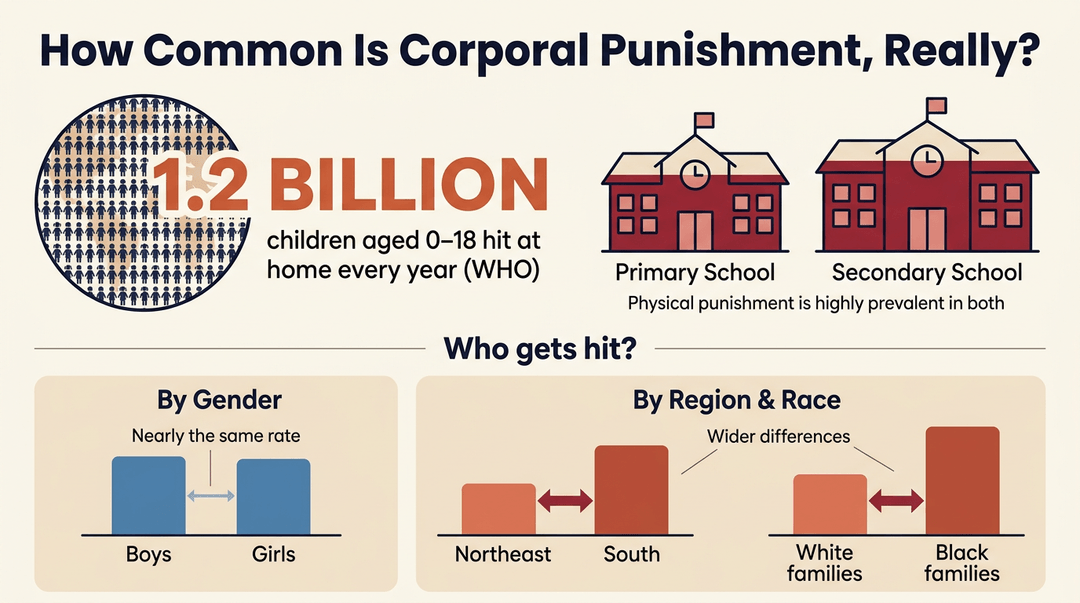
Corporal punishment is far more widespread than most teachers assume. Globally, an estimated 1.2 billion children aged 0 to 18 are subjected to corporal punishment at home each year, according to the World Health Organization (WHO). It's not confined to the home: the same report notes that physical punishment appears highly prevalent at both primary and secondary school levels. Rates aren't evenly spread, either. A national survey from the University of New Hampshire found spanking only slightly lower for girls than boys, so prevalence runs similar across genders, while regional gaps run wider: lower in the Northeast than the South, and lower among white families than Black families.
The harm physical punishment can cause
The costs are well documented. The WHO links corporal punishment to physical and mental ill-health, impaired cognitive and socio-emotional development, poor educational outcomes, and increased aggression, a pattern that tends to show up as more misbehavior over time, not less. And physical punishment isn't uniquely damaging: a multi-study analysis found verbal abuse carries a similarly significant increase in the risk of low adult mental well-being, with exposure to both types compounding the harm. Words can wound as deeply as a hand.
What experts and policies say about spanking
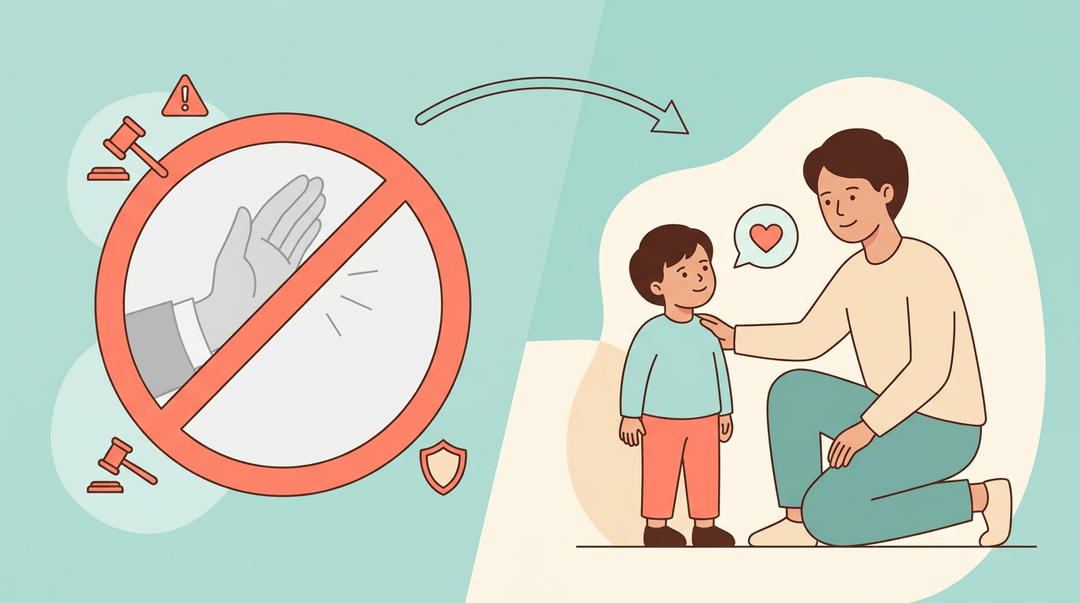
Pediatric and psychological bodies broadly discourage spanking, and a growing number of countries have moved to ban it outright, backed by real enforcement rather than guidance on paper. Alongside legal change, community-level programs work to shift the norms that treat spanking as ordinary, while parent-support interventions give caregivers other tools before frustration boils over. For your classroom, the research points one direction: away from physical punishment and toward strategies that build trust instead of fear.
How Professionals and Support Resources Help
You don't have to figure out discipline alone, and you shouldn't have to. A wider circle of professionals and programs exists specifically to back up the work you and families are already doing.
How pediatricians guide discipline choices
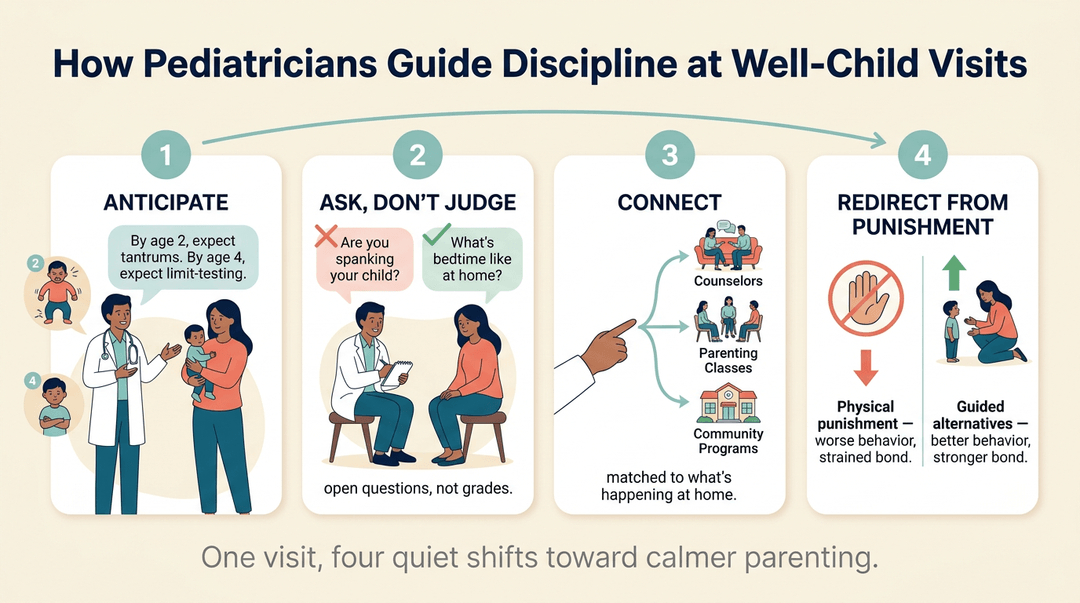
Pediatricians often build anticipatory guidance into well-child visits: brief, age-specific pointers on what to expect next, like toddler tantrums or a preschooler testing limits, so parents aren't caught off guard.
That guidance usually grows out of a nonjudgmental psychosocial interview, where the doctor asks open questions about home life and stress rather than grading a parent's choices. From there, pediatricians can point families toward referral resources:
- counselors
- parenting classes
- community programs suited to what's actually going on at home
Most also use the visit to gently discourage physical punishment, steering parents toward approaches with better long-term outcomes for behavior and the parent-child relationship.
Parent support programs worth knowing about
For families who need more than a single conversation can offer, a few options tend to come up again and again:
- Online parenting programs. Self-paced modules that walk parents through age-appropriate discipline strategies on their own schedule, useful for the family juggling shift work or multiple kids.
- Counseling services. One-on-one or family sessions that dig into what's driving a behavior pattern, not just how to react to it in the moment.
- Family advocacy resources. Community organizations that connect parents to housing, food, or financial support, since discipline struggles often ease once the underlying stress does.
For a homeroom teacher fielding a rough parent-conference week, knowing these resources exist means you can offer a next step instead of just a sympathetic nod.
Good discipline isn't about control for its own sake. It's about giving kids the structure they need to grow into their own self-control, at home and in your classroom.
Clarity, consistency, and age-appropriate expectations do far more than any punishment ever could.
Ready to put these ideas into practice? Check out our Classroom Management feature to organize your classes, rosters, and routines in one place, so consistent discipline becomes easier to sustain every day.
References
- Comparative relationships between physical and verbal abuse of children, life course mental well-being and trends in exposure: a multi-study secondary analysis of cross-sectional surveys in England and Wales — pubmed.ncbi.nlm.nih.gov (2025)
- Corporal punishment of children and health — who.int
- Corporal Punishment: Current Rates from a National Survey — unh.edu
- Evidence Against Physically Punishing Kids Is Clear, Researchers Say — news.utexas.edu
- Experts of the Committee on the Rights of the Child Commend Romania on Deinstitutionalisation Process, Raise Questions on Corporal Punishment and Segregation in Education — ohchr.org (2025)
- How to Give a Time-Out — healthychildren.org
- Effective Discipline to Raise Healthy Children — seekwellbeing.org
Frequently asked questions
What is a good punishment for an 8-year-old not listening?
For an 8-year-old, use a logical or natural consequence rather than a harsh punishment. Connect the consequence directly to the behavior, such as repairing or replacing something forgotten or damaged, and involve your child in deciding on a fair fix. Keep rules and follow-through calm, clear, and consistent.
What is the appropriate punishment for a 6-year-old who hits others at school?
Use a related, respectful, and reasonable consequence that teaches accountability. The child might sit out briefly from the game or activity where the hitting occurred and help repair any harm caused. Calmly reinforce that hitting is unsafe and practice a safer way to handle anger or conflict.
How can I discipline my 3-year-old child?
Discipline a 3-year-old through calm limits, redirection, and teaching rather than punishment. Name the feeling, state the rule simply, offer a safe alternative, and use a brief time-out only when needed, generally about three minutes. Avoid physical punishment and long explanations, especially during a meltdown.
My 5-year-old is misbehaving. What should I do?
Stay close and calm, name the feeling, and state the limit clearly. Redirect your child before the behavior escalates, and use a short time-out of one or two minutes as a reset when appropriate. Praise the specific behavior you want to see, and handle toilet-training accidents with patience rather than consequences.