IEP Meeting: A Complete Guide for Parents and Teachers

Jump to section
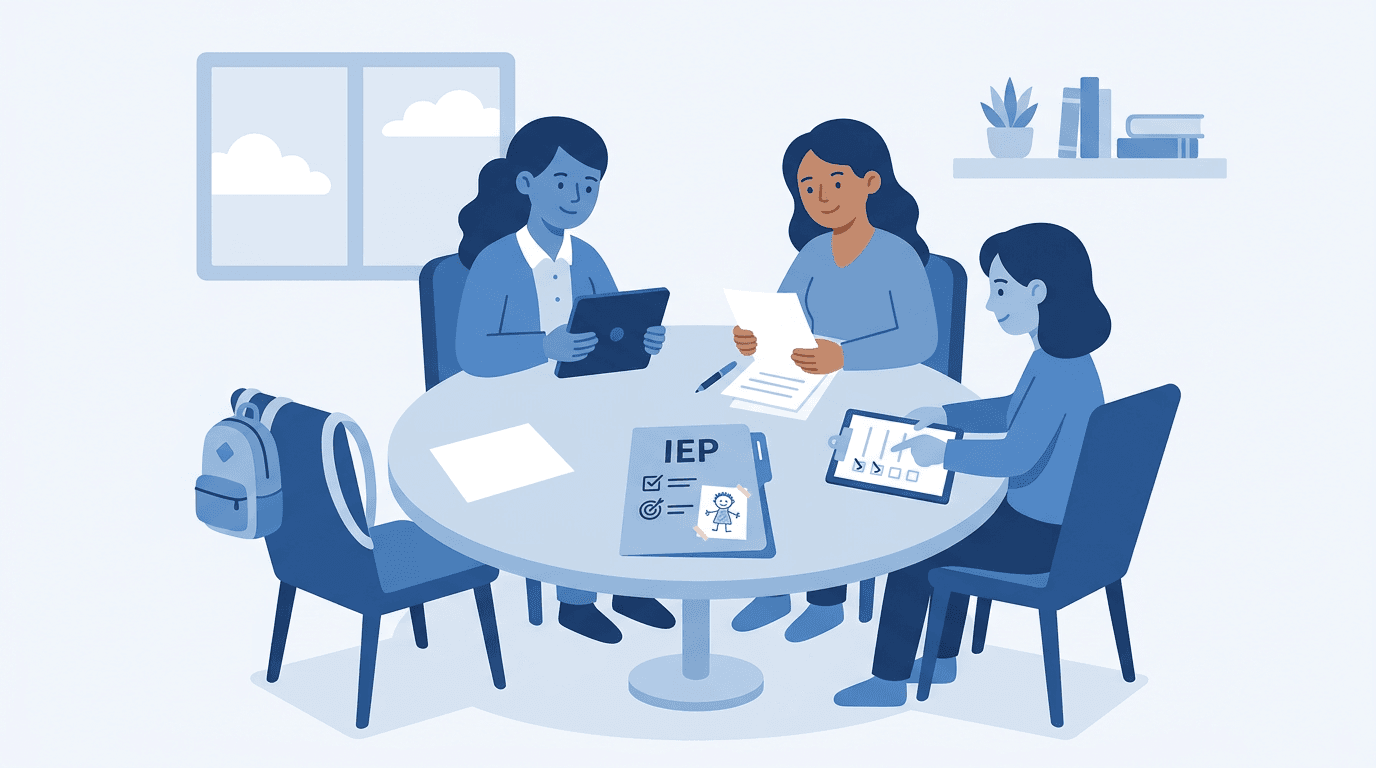
Think about the last time you sat down with a group of people to plan something that really mattered: a family trip, a home renovation. Everyone had a different piece of the puzzle.
An IEP meeting works the same way, except the plan is for a student's education, and the stakes are much higher. In this post, we'll walk through what these meetings are for, who's in the room, and what happens when you disagree.

What an IEP Meeting Is For
Every IEP meeting exists to answer one core question: what does this student need to succeed, and how will the school provide it? That single purpose shapes the agenda, the paperwork, and everyone's role in the room.
What gets decided at the meeting
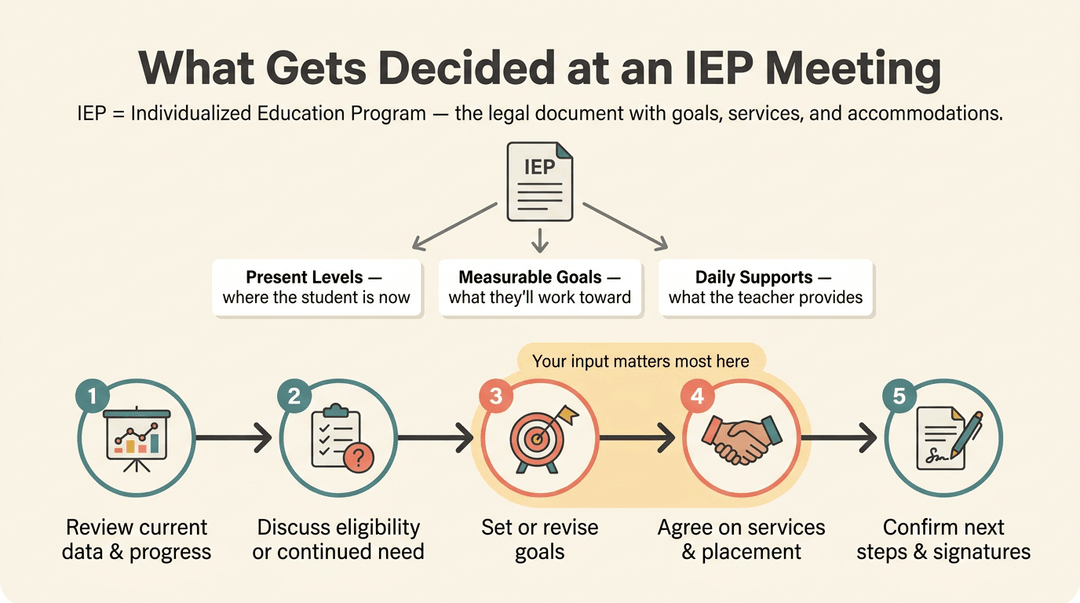
The team's job is to discuss, develop, or review the student's Individualized Education Program (IEP): the legal document that spells out goals, services, and accommodations.
For a student who hasn't been evaluated yet, the meeting first works out whether they're even eligible for special education services. Once eligibility is settled, the team builds the actual plan:
- present levels of performance
- measurable goals
- the specific supports a teacher will deliver day to day
Most meetings follow the same basic flow:
- Review current data and progress
- Discuss eligibility or continued need
- Set or revise goals
- Agree on services and placement
- Confirm next steps and signatures
Knowing that sequence ahead of time helps you know when your input is needed most.
Types of IEP meetings you'll encounter
Not every IEP meeting covers the same ground. You'll typically run into four kinds:
- Initial eligibility meeting. Decides whether a student qualifies for services after an evaluation.
- First IEP development meeting. Builds the plan from scratch once eligibility is confirmed.
- Annual review meeting. Revisits goals and services at least once a year to check what's working.
- Problem-solving or topic-specific meeting. Called mid-year to address one issue, like a behavior concern or a service change.
Knowing which type you're walking into tells you what to prep.
Who Sits on the IEP Team
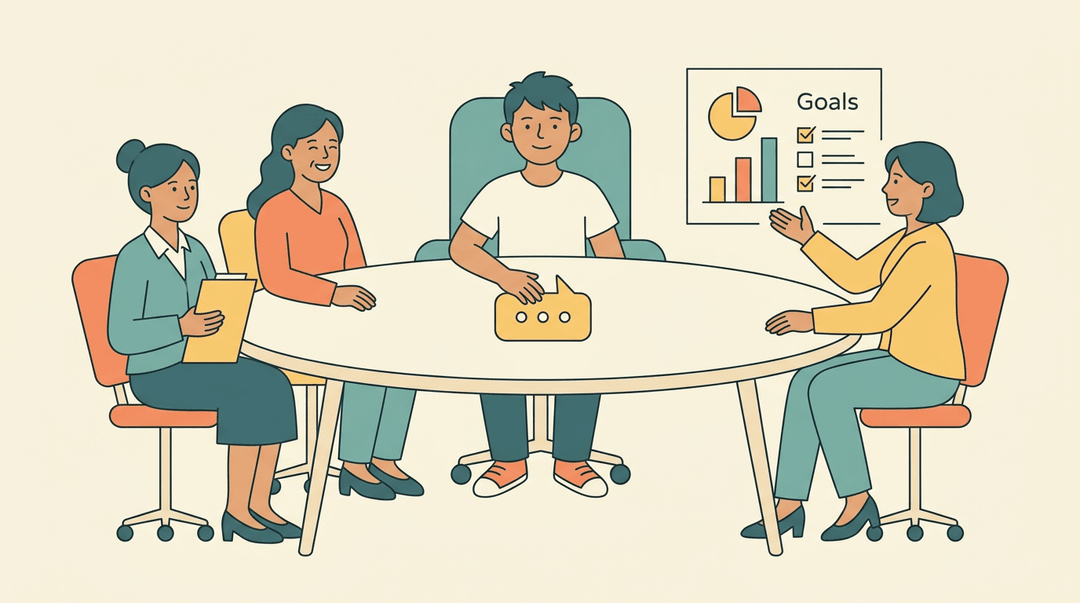
An IEP meeting can feel like a crowded room, but nobody's there by accident. Every seat has a purpose, and knowing who fills each one makes the whole process less intimidating.
Who must be in the room
Federal law spells out a required cast, and each member brings something the others can't:
- Parent or guardian. Their input is required, not optional. They know the student outside the classroom walls.
- General education teacher. Brings the day-to-day data: grades, work samples, behavior notes, and how the student handles the regular curriculum.
- Special education teacher. Designs and delivers the specialized instruction the IEP calls for.
- District representative with authority. Someone who can actually commit district resources, not just relay decisions made elsewhere.
- Evaluator or psychologist to interpret results. Turns test scores and assessment jargon into plain language everyone at the table can use.

Who else might join the meeting
Beyond the required members, several people can join when the student's needs call for it:
- Related service providers (speech, occupational, or physical therapists).
- School social worker, especially when behavior or family circumstances are part of the picture.
- School physician, if requested for a medical question.
- Certified IEP parent member, a trained parent advocate some districts provide.
- EI service coordinator, when a child is transitioning from Early Intervention into preschool services.
- Translator or advocate, so language is never a barrier to a parent's full participation.
When the student joins the meeting
Students don't wait forever to have a voice in their own plan. Michigan Alliance for Families notes that "by age 16, the student becomes a required IEP Team member," once transition planning takes center stage.
In New York City, the timeline moves earlier: the NYC Department of Education requires that "if your child is 14 years old or older he or she must be invited."
Plenty of teams invite students even younger, once a student is ready to talk about their own goals and accommodations.
When a team member can be excused
Sometimes a required member genuinely can't make it. A team member can be excused, but only if the parent agrees, usually in writing.
Even then, rescheduling is almost always the better move: a full team in the room, even a few days later, beats a decision made with a key voice missing.
Teacher Checklist for IEP Meetings
You're the person in the room who sees the student every day, and the meeting runs on what you bring. Use this checklist to prepare, contribute, and follow through.
Before the meeting: build your evidence file
The team can't act on impressions; it can act on dated evidence. Confirm you have:
- Work samples collected. Three to five dated pieces showing the skill in question.
- Label each one: "10/3 reading response: needed the prompt read aloud twice."
- Behavior data tracked. Counts and times, not adjectives.
- ❌ "He's often off task." ✅ "Off task 6 times in Tuesday's 20-minute independent work."
- The difference: the second version tells the team how often and in what setting.
- Accommodation notes ready. One line per accommodation: what you tried, what changed.
- "Extended time: quiz scores up. Preferential seating: no visible difference."
- Goal progress drafted. One sentence per IEP goal, with a number in it.
During the meeting: speak from your data
You have limited airtime, so make each contribution concrete.
- Share observations, not diagnoses. Describe what you see and where.
- Say: "In small groups she asks for help; in whole-class work she shuts down."
- Suggest accommodations you can actually deliver. Realistic beats impressive.
- Offer a swap: "Daily one-on-one check-ins aren't feasible, but a written checklist on his desk is."
- Clarify service logistics before you leave the room. Who pulls the student, when, and who covers missed content.
- Ask: "When does speech happen, and what class does she miss?"
⚠️ Watch out: if a proposed goal or service sounds vague to you in the meeting, it'll be impossible to implement Monday morning. Ask for specifics on the spot.
After the meeting: make the plan live
The IEP only works if it changes what happens in your room. In this order:
- Update your lesson plans within the week. Build the new accommodations into the plan itself.
- Log every new accommodation where you'll see it daily. Seating chart, plan book, class roster.
- Check goal progress weekly. One quick data point per goal, same day each week.
- Share updates with the team. A short monthly note to the case manager keeps small problems small.
Example: A fifth-grade teacher logs one Friday data point per goal: "Read 62 words per minute, up from 55." By the next meeting, she has a semester of evidence and writes her input in ten minutes.
Track accommodations, behavior notes, and goal progress in one class roster with EMStudio's classroom management tools.
Scheduling and Meeting Logistics
Once a student is referred for special education, the clock starts ticking, and it helps to know exactly what that timeline looks like before the first letter shows up in the mailbox.
How much notice you'll get
Before any IEP meeting, you'll get written notice spelling out the time, place, and purpose. This document is often called Prior Written Notice (PWN), and it's your paper trail of what the school plans to discuss and why.
Most districts send that notice within a 5 to 7 day window, since, as Kids Legal notes, "For ANY IEP meeting, the school must provide at least 7 days written notice of the time and location of the meeting."
If a parent wants to call a meeting themselves, a different clock applies. According to the New York State Education Department, "the parent(s) must make this request to the school district in writing at least 72 hours (three days) before the meeting."

How often meetings happen
Once a student is found eligible, the district can't sit on it. Maryland's IEP Essentials guide confirms that an IEP "must be implemented as soon as possible," typically within 30 days of eligibility.
After that, the team meets at least once a year to review progress and update goals. Parents aren't stuck waiting for that annual date, though: you can request a meeting anytime a concern comes up.
Where the meeting takes place
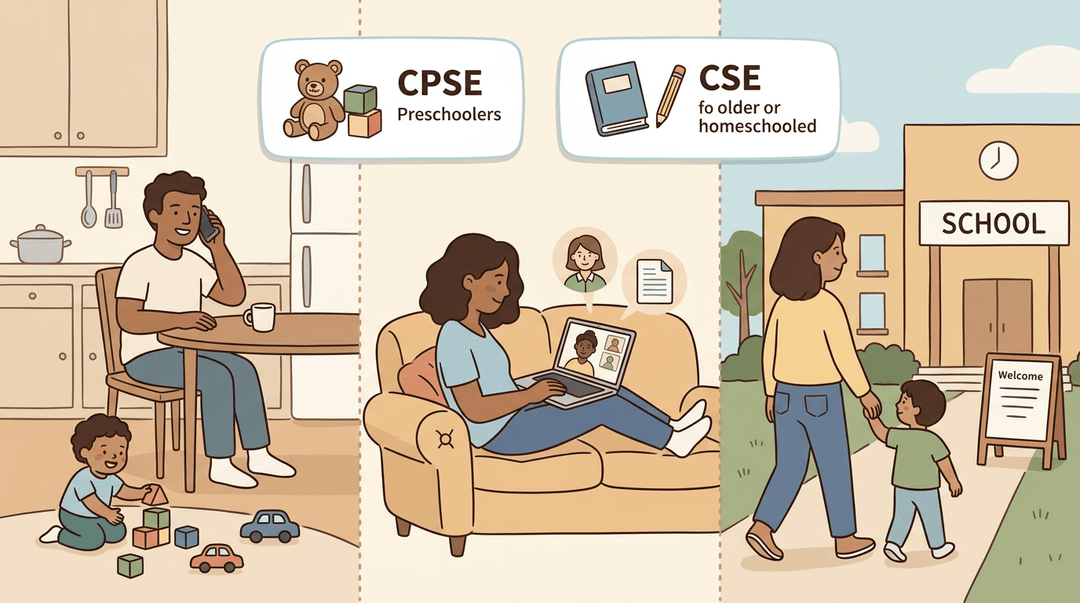
The meeting should happen somewhere convenient for parents, not just the school's calendar. Phone or video options are common now, especially for families juggling work or younger kids at home.
Where it's held often depends on the student's age and setting: preschoolers go through the Committee on Preschool Special Education (CPSE), while students who are homeschooled, enrolled in private or religious school, or not yet enrolled anywhere go through the Committee on Special Education (CSE).
Getting an interpreter if you need one
If English isn't a family's first language, or if a sign language interpreter is needed, that's a right, not a favor.
Put the request in writing, and reach out to the school's parent coordinator early: the more lead time you give, the smoother the meeting runs for everyone.
Your Role and Rights as a Parent
An individualized education program (IEP) meeting isn't something you sit through: it's something you help shape. You're not a guest at this table. You're a core member of the team, with real influence over what goes into the plan.
Speaking up as a parent
Nobody knows your child the way you do, and the team needs that perspective. Share your observations: how homework goes at the kitchen table, what frustrates your child, what actually motivates them.
Those details often don't show up in a classroom snapshot.
Don't hold back questions either. If a goal sounds vague or a service doesn't make sense, ask. You're entitled to push on the IEP's content until it reflects what your child truly needs, not just what's easiest to write down.
Think of a parent who notices her son reads fine aloud but freezes on written responses: that single observation can reshape a whole reading goal.
It's also worth naming what a lot of parents feel walking in: nerves, worry, sometimes grief over a diagnosis that's still new. Do parents cry at IEP meetings? Often, yes, and that's completely normal. A good team expects it and gives you room for it.

Knowing your procedural safeguards
Your procedural safeguards are a written explanation of your legal rights throughout this process, and the school must provide them.
Two matter most day to day: you can request and review your child's educational records at any time, and you can formally dispute a decision you disagree with, whether that's eligibility, services, or placement.
Knowing these rights before the meeting means you walk in as a partner, not a bystander.
What the Meeting Covers
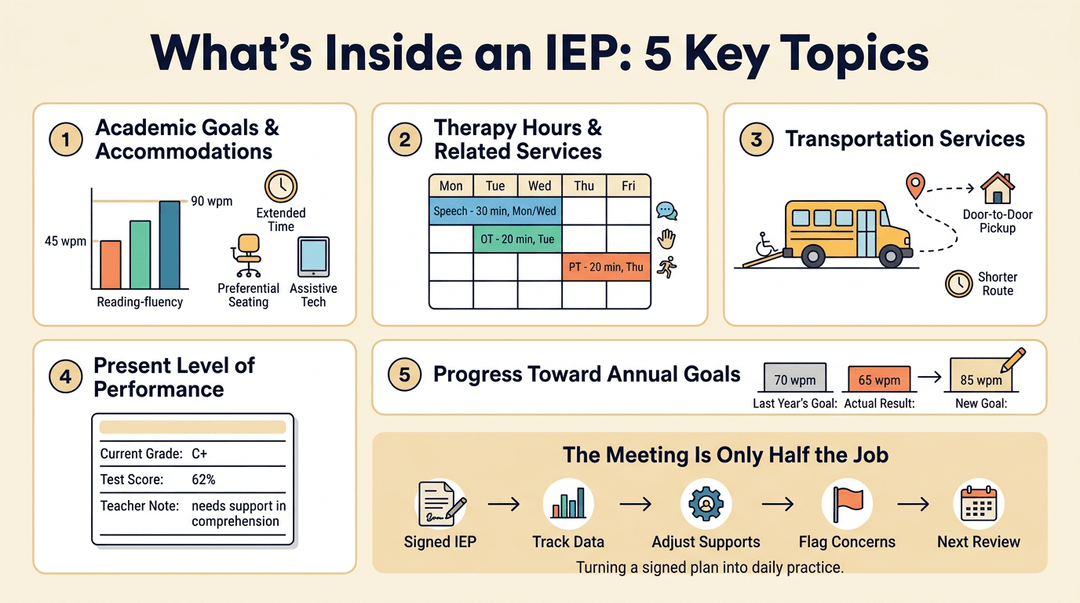
An IEP meeting isn't just a box to check: it's where the team lays out exactly how a student will be taught, supported, and measured for the year ahead. Here's what actually lands on the table:
Key topics covered in the IEP
- Academic goals and accommodations. The team sets specific, measurable targets, like improving reading fluency by a set number of words per minute, and lists the classroom supports (extended time, preferential seating, assistive technology) that make those targets reachable.
- Therapy hours and related services. Speech, occupational, or physical therapy sessions get scheduled here, including how many minutes per week and who's responsible for delivering them.
- Transportation services. For students who need specialized transport (a wheelchair-accessible bus, a shorter route, door-to-door pickup), the plan spells out the details so nothing falls through the cracks on day one.
- Present level of performance review. Before anyone sets new goals, the team looks at where the student stands right now: current grades, test scores, and teacher observations all factor in.
- Progress toward annual goals. If this isn't the student's first IEP, the team checks last year's goals against actual results: what worked, what didn't, and what needs adjusting.
The meeting itself is only half the job. Consider a special education teacher who leaves with a new fluency goal and a fresh set of accommodations: the real work starts the next morning, turning that plan into daily practice instead of a file drawer.
Post-meeting implementation and monitoring, tracking data, adjusting supports, and flagging concerns before the next review, is what turns a signed document into real progress for the student.
How Eligibility Gets Decided
Eligibility for an individualized education program (IEP) comes down to two questions: does your child have a qualifying disability, and does that disability affect their ability to learn? A "yes" to only the first question isn't enough on its own.
What is the most common reason for an IEP?
The most common reason a student qualifies for an IEP is a specific learning disability.
According to Partners in PROMISE, specific learning disabilities account for 32 percent of students receiving special education services, more than any other category.
Sec. 300.8 Child with a disability lists 14 disability categories under IDEA, including intellectual disability, hearing impairment, speech or language impairment, visual impairment, and emotional disturbance, among others.
Your child's IEP team reviews the evaluation and selects whichever category fits best.
Some conditions, like a processing disorder paired with anxiety, touch more than one category, so the team weighs which label best captures the support your child actually needs.

Why the disability must affect learning
A diagnosis alone doesn't open the door to an IEP. The team also has to show the disability affects your child's education, not just a health record outside school.
That means looking past a single test score: grades, behavior, and social skills all factor into the decision. It's a whole-child review, not a checklist of academic gaps.
Reviewing your child's evaluation results
Before the team decides anything, everyone reviews the evaluation reports together.
You'll receive a copy of your procedural safeguards, the document spelling out your rights as a parent, and a member of the team (often the school psychologist) walks you through what the assessment results mean.
The team also weighs teacher observations and classroom work samples alongside the formal testing, so the picture includes how your child performs day to day, not just how they tested on one afternoon.

What happens after the decision
If the team finds your child eligible, the next step is drafting the IEP itself. If they don't qualify, that's not necessarily the end of the conversation.
The team might discuss a 504 plan instead, which offers accommodations like extended time or preferential seating without the individualized instruction goals an IEP includes.
Other supports, like targeted tutoring or a classroom intervention plan, might come up too. The short version: an IEP changes how your child is taught, while a 504 plan changes the conditions they're taught under.
How to Prepare for the Meeting
Walking into an IEP meeting without a plan is a lot like showing up to parent-teacher night with no grades in hand. You can still talk, but you're not going to say much that sticks.
A little prep turns the meeting from a conversation you're reacting to into one you're actively shaping.
What not to say in an IEP meeting?
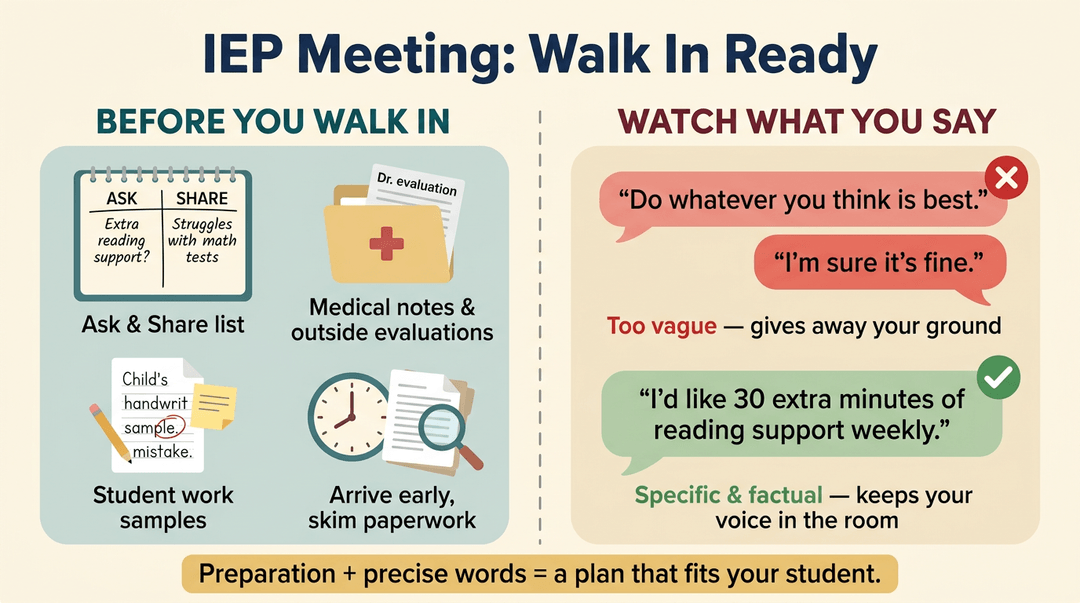
Start by writing down your questions beforehand. Once you're in the room, it's easy to nod along and forget the thing you meant to ask.
Bring any medical notes or outside evaluations too: they give the team hard evidence to work from instead of just impressions.
A simple Ask & Share guide helps here: jot down what you need to ask the team and what you want to share about your student, so nothing gets lost in the moment. Arrive early and skim the paperwork one more time.
It's much easier to spot something needs updating before the meeting starts than to catch it halfway through.
Bringing a few student work samples grounds the conversation in real evidence rather than general impressions.
As for what to avoid saying: skip absolute statements like "do whatever you think is best" or "I'm sure it's fine." They can sound agreeable, but they hand over ground you may not mean to give up. Stick to specific, factual language instead.
Bringing extra support with you
You don't have to sit through this alone. Inviting a doctor, relative, advocate, or trusted friend gives you another set of ears and, often, another voice backing up your concerns. Just notify the school in advance so there's no confusion at the door.
One thing worth knowing: if you bring an advocate, the school may invite its own legal representative in response. That's not a reason to leave support at home, just something to expect going in.
If You Disagree with the Team
Disagreement doesn't mean the process has failed. It just means the next step looks a little different.
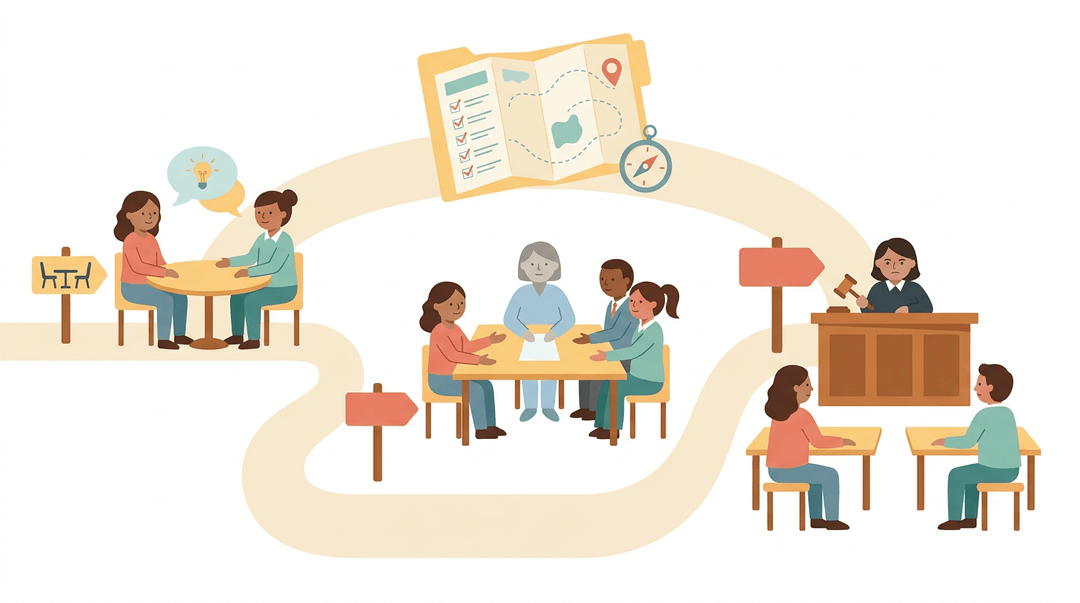
Ways to resolve disagreements
Start with the simplest option: request another IEP meeting. Think of a parent who leaves a meeting uneasy about a proposed service reduction.
A follow-up meeting gives everyone a chance to bring new information to the table and revisit the decision with fresh eyes, before anything becomes a bigger conflict.
If a second meeting doesn't resolve things, mediation is worth considering. A neutral mediator sits down with the school team and the family to work toward an agreement everyone can live with.
It's less formal than a hearing, and it often preserves the relationship between parents and the school far better than a drawn-out dispute would.
When mediation doesn't get you there, families can request an impartial due process hearing. This is a formal, legal proceeding where an independent hearing officer reviews the evidence and issues a binding decision.
It's a bigger step, so it's usually the option after the others haven't worked.
At every stage, the procedural safeguards notice is the roadmap. This document spells out parents' rights, filing deadlines, and exactly how each option works.
Whenever a disagreement arises, that's the first place to look for next steps, and it's worth keeping a copy on hand well before you ever need it.
An IEP meeting doesn't have to feel like uncharted territory. Once you know who's supposed to be there, what gets decided, and what to do if something feels off, you can walk in ready instead of reactive.
That's true whether you're the parent, the case manager, or the classroom teacher gathering notes beforehand.
Ready to keep every student's plan, schedule, and roster organized before the next meeting rolls around? Check out our Classroom Management feature to keep your classes and timetables in one structured workspace.
References
- IEP Essentials: Timelines, Notices, and Consents — marylandpublicschools.org (2025)
- State and Federal Requirements and Additional Questions and Answers — nysed.gov
- IEP Meeting — schools.nyc.gov
- Sec. 300.8 Child with a disability — sites.ed.gov (2017)
- Special Education: Timelines — kidslegal.org
- Transition IEP — michiganallianceforfamilies.org
- The IEP meeting: An overview — understood.org
- Special Education Eligibility & The 13 Categories — thepromiseact.org
Frequently asked questions
What is the IEP meeting?
An IEP meeting is a gathering where a team collaborates to plan a student's education, similar to how individuals plan a family trip or home renovation. Its core purpose is to determine what a student needs to succeed, and how the school will provide it. During the meeting, the Individualized Education Program (IEP) document is discussed, developed, or reviewed, outlining goals, services, and accommodations for the student.
What is the most common reason for an IEP?
The most common reason for a student to qualify for an Individualized Education Program (IEP) is a specific learning disability. This category accounts for 32 percent of students receiving special education services, surpassing all other categories. For a student to be eligible, the disability must also affect their ability to learn, not just be a diagnosis on its own.
What are the 13 disabilities required for an IEP?
The 13 disabilities required for an IEP under IDEA (Individuals with Disabilities Education Act) are: autism, deaf-blindness, deafness, emotional disturbance, hearing impairment, intellectual disability, multiple disabilities, orthopedic impairment, other health impairment, specific learning disability, speech or language impairment, traumatic brain injury, and visual impairment, including blindness.
Why would a student get an IEP?
A student would get an IEP if they have a qualifying disability that affects their ability to learn. The IEP team evaluates whether the disability impacts the student's educational performance. An IEP then provides a legal document outlining specific goals, services, and accommodations to help the student succeed in their education.
Do parents cry at IEP meetings?
Yes, it is not uncommon for parents to experience a range of emotions, including crying, during IEP meetings. These meetings often involve discussing a child's struggles and special needs, which can be emotionally overwhelming for parents. The stakes are high as the decisions made directly impact their child's education and future.