What Is Explicit Direct Instruction and Why Does It Work?


Jump to section
Think about the last time you learned something completely new, maybe a recipe, a software tool, or a skill you'd never tried before. Chances are, you didn't figure it out through trial and error.
Someone showed you the steps, explained the reasoning, and let you practice until it clicked. That's the core idea behind explicit direct instruction (EDI): a structured, teacher-led approach where nothing important is left to chance.
EDI isn't a rigid script or a throwback to chalk-and-talk. It's a research-backed framework built around clear explanations, guided practice, and timely feedback.
In this post, we'll cover what it really means, the components that make it work, what the evidence shows, and how you can plan and deliver EDI lessons your students will actually learn from.

What Explicit Direct Instruction Actually Means
At its core, explicit direct instruction (EDI) is unambiguous, teacher-led teaching with nothing left to guesswork. You state the goal, model the skill, and guide students through it step by step.
What explicit instruction looks like in a classroom
A teacher using EDI doesn't hint at a concept and hope students piece it together. She names it, defines it, shows it, and checks for understanding before moving on.
Goals are clear, explanations are precise, and the lesson follows a structured, systematic sequence.
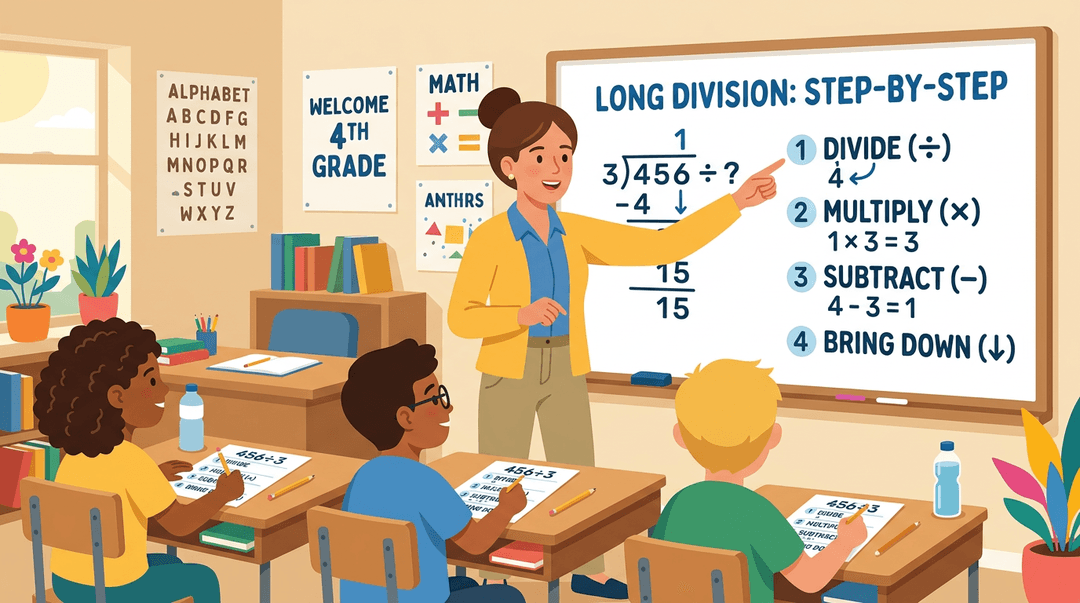
For example, a fourth-grade teacher introducing long division doesn't just put a problem on the board: she says exactly what the steps are, thinks aloud while modeling the first problem, then walks students through a guided attempt together before anyone works independently.
Explicit vs. implicit instruction
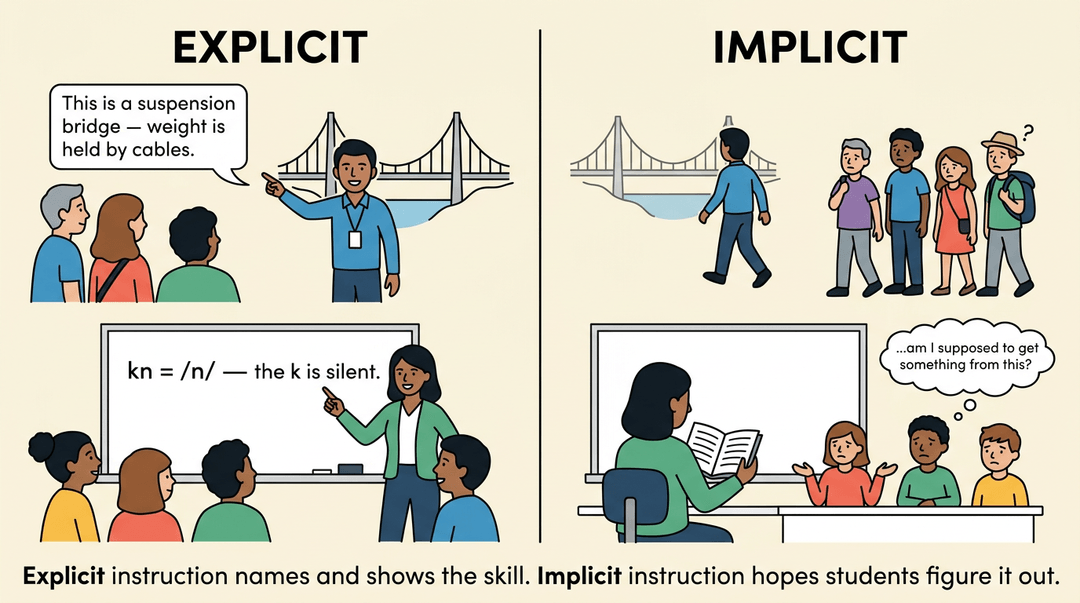
The contrast is straightforward. Explicit instruction names and models skills directly. Implicit instruction assumes students will infer what they're supposed to learn from exposure or experience alone.
Think of the difference between a tour guide who points out every landmark and explains its significance versus one who just walks ahead and hopes the group keeps up.
In a reading lesson, explicit means teaching a decoding strategy out loud; implicit means simply reading aloud and expecting students to absorb the pattern.
How explicit instruction differs from direct instruction
The two terms are related but not identical. Direct instruction (DI) is a specific, highly scripted model: exact wording, sequenced curriculum, little deviation. Explicit instruction is broader.
Both are firmly teacher-directed, but explicit instruction allows for guided exploration and teacher judgment within that structure, making it more flexible for everyday classroom use.
Key Components of Explicit Instruction
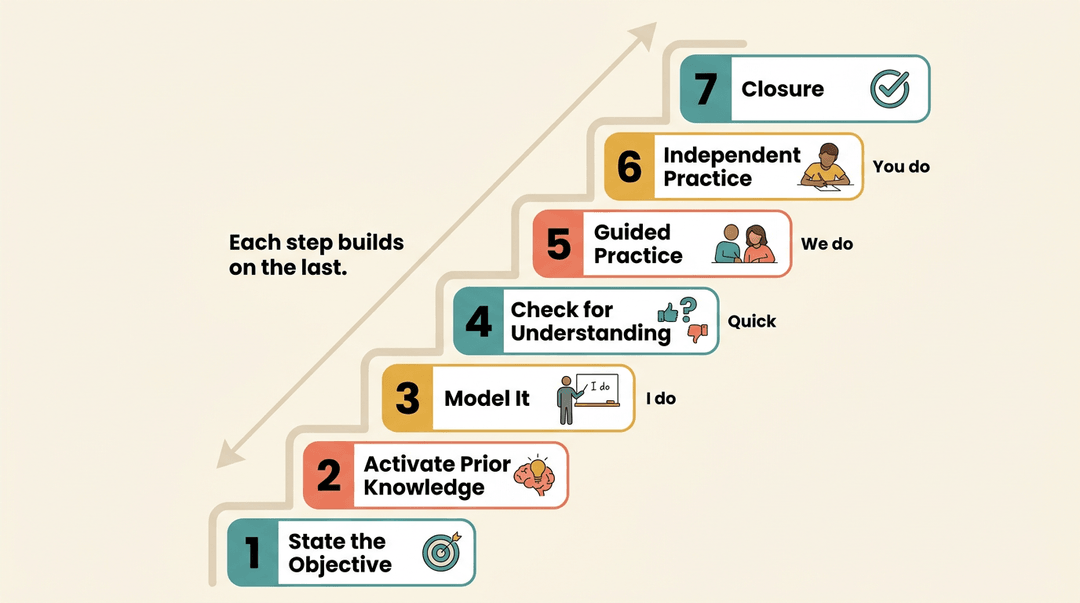
Explicit instruction isn't one move: it's a sequence of deliberate steps, each building on the last. Most frameworks identify seven core components:
- Stating the objective
- Activating prior knowledge
- Modeling
- Checking for understanding
- Guided practice
- Independent practice
- Closure
Here's how they work together.
How to sequence a lesson from simple to complex
Every EDI lesson opens with a clear objective statement so students know exactly what they're learning and why. From there, you activate prerequisite skills before introducing anything new.
Once the groundwork is laid, you move from simple to complex: break the target skill into the smallest logical steps, sequence those steps carefully, and keep the lesson focused on one skill at a time.
A scattered lesson loses students before modeling even starts.
Modeling and thinking aloud for students
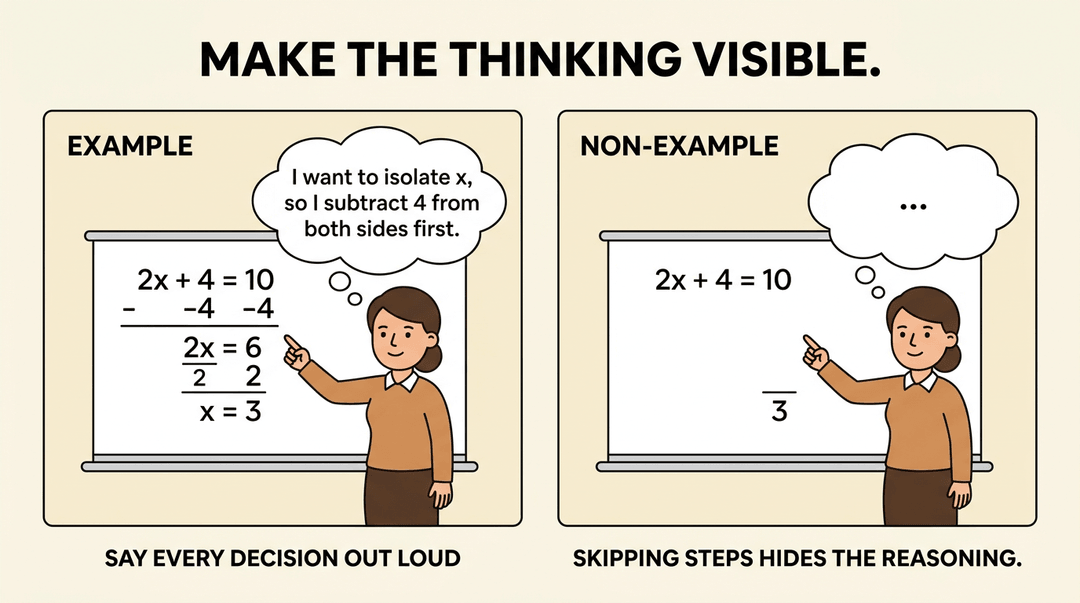
This is the show, not just the tell. Walk through each step out loud, naming your decisions as you make them so the thinking is visible, not implied.
Use clear, concise language and pair every example with a non-example: showing students what doesn't fit the concept sharpens their understanding just as much as showing what does.
Guided practice before students work alone
The gradual release of responsibility model moves through three stages: I do (you model), we do (students practice with your support), you do (students work independently). Don't rush the middle stage.
A few pacing tips by grade band:
- Primary grades (K–2): Keep "we do" long and interactive, with frequent choral responses and partner talk before any solo work.
- Elementary (3–5): Alternate between whole-class and paired practice; pull small groups during independent work.
- Middle and high school: Move to independence faster, but build in a quick partner check before students work solo.
Practice should also be distributed and cumulative: revisit skills across lessons rather than front-loading everything into one session.
Checking for understanding and giving feedback
Don't wait until the test. Require frequent student responses throughout the lesson: thumbs up, mini whiteboards, cold-call questioning. Monitor closely, and when you spot a misconception, correct it immediately.
Those real-time adjustments are what keep the whole class moving forward instead of one student quietly falling behind.

How to Plan an Explicit Direct Instruction Lesson
Here's the whole EDI cycle as one planning routine: set up, deliver, follow up. Build a lesson from it once, and the same skeleton carries any topic.
Before you teach: set up three things
One clear objective. Write it exactly as it'll appear on the board:
I can solve two-step equations using inverse operations.
The prerequisite chain. Jot it backwards from the objective: two-step equations ← one-step equations ← inverse operations. If students are shaky on the earliest link, that's where the lesson actually starts.
A worked example and a non-example. Pair a clean solution with a near-miss, and know the one difference you'll name:
- ✅ 3x + 4 = 19 → subtract 4 first, then divide by 3.
- ❌ 3x + 4 = 19 → divide by 3 first. The slip: undoing operations out of order.
During the lesson: five moves in order
- State the objective in student-friendly language.
- Say: "By the end of today, you'll be able to solve equations with two steps."
- Model with a think-aloud.
- Narrate each decision: "I see plus 4, so I subtract 4 from both sides first."
- Check for understanding right away.
- Try: "On your whiteboard, show me my first move for this one."
- Run guided practice together.
- Work problems as a class, fading your prompts one at a time.
- Release to independent work only when most students succeed.
⚠️ Watch out: the most common EDI mistake is releasing too early. If guided practice is shaky, stay in it; independent practice of errors only cements them.
After the lesson: close the loop
Collect one exit ticket that matches the objective exactly:
Solve: 3x + 4 = 19. Show both steps.
Then sort the results and pick your next move:
| If exit tickets show... | Then... |
|---|---|
| Most students got it | Move on; pull the few who missed it into a small group |
| Half or more missed it | Re-teach tomorrow with a fresh worked example |
Log the adjustment while it's fresh. One line in your plan is enough: "Re-teach inverse operations to the row 3 group; needs a new example."
Once this skeleton works for you, use EMStudio's lesson planner to save your EDI template and reuse it across classes.
What the Research Says About Effectiveness
The evidence behind explicit direct instruction isn't a matter of opinion. Decades of controlled studies, large-scale government research, and literacy reviews all point the same direction.
Effect sizes across hundreds of studies
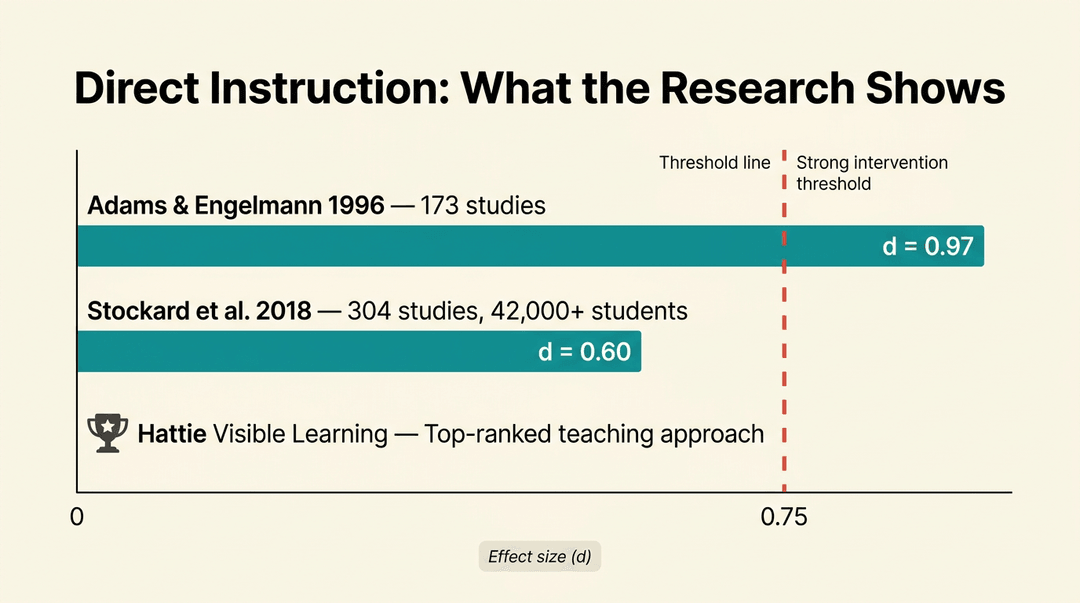
In their 1996 meta-analysis, Adams and Engelmann reviewed the existing literature on direct instruction and found an overall effect size of d = 0.97 across 173 comparisons spanning both general and special education, well above the 0.75 threshold that signals a strong intervention.
A later synthesis by Stockard et al. (2018) confirmed the pattern, finding an effect size of d = 0.60 across 304 studies involving more than 42,000 students.
John Hattie's Visible Learning synthesis consistently places direct instruction among the highest-ranked teaching approaches in education research.
What Project Follow Through found
Project Follow Through remains the largest government-funded education study ever conducted. Researchers compared multiple instructional models across 19 sites, varying widely in geography and student demographics.
Direct instruction ranked first across all of them. It was the only intervention to produce positive outcomes on every measure tested, for every demographic group studied. That's not a narrow win.
Reading research and literacy outcomes
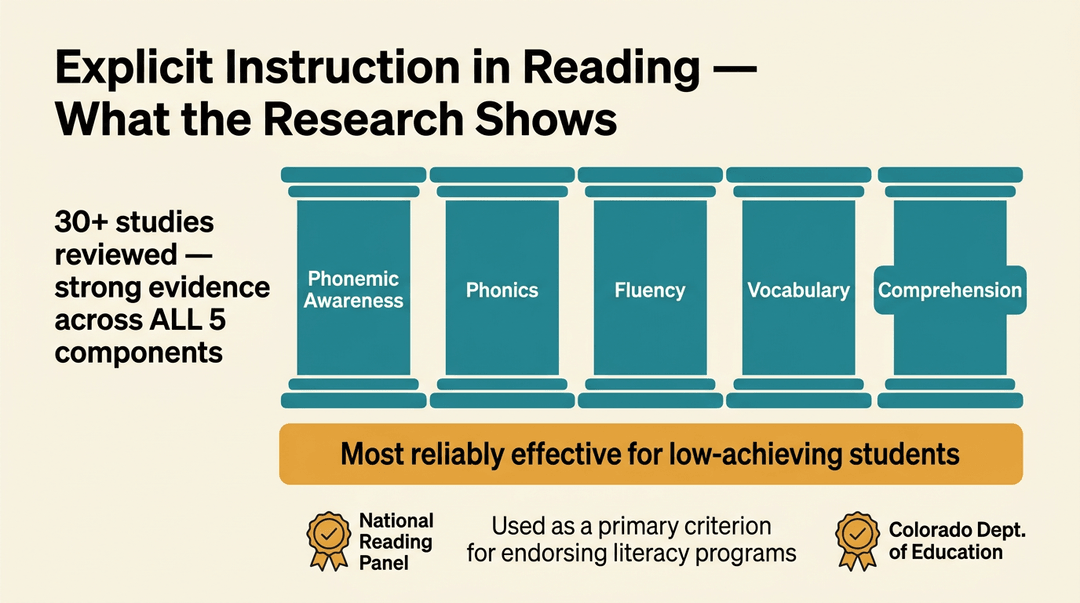
The case for explicit instruction is especially strong in reading. A review of more than 30 studies by Adams and Engelmann found compelling evidence across all five core reading components.
Research cited in a report aligned with National Reading Panel findings confirms that systematic and explicit instruction is the most reliably effective approach for improving outcomes among low-achieving students.
The Colorado Department of Education makes explicit instruction a primary criterion when evaluating and endorsing evidence-based literacy programs.
Who Explicit Instruction Helps Most
Explicit direct instruction isn't a one-size-fits-all fix, but research shows it works especially well for learners who need structure to close a gap fast. Here's where the evidence is strongest.
Structured literacy and reading instruction
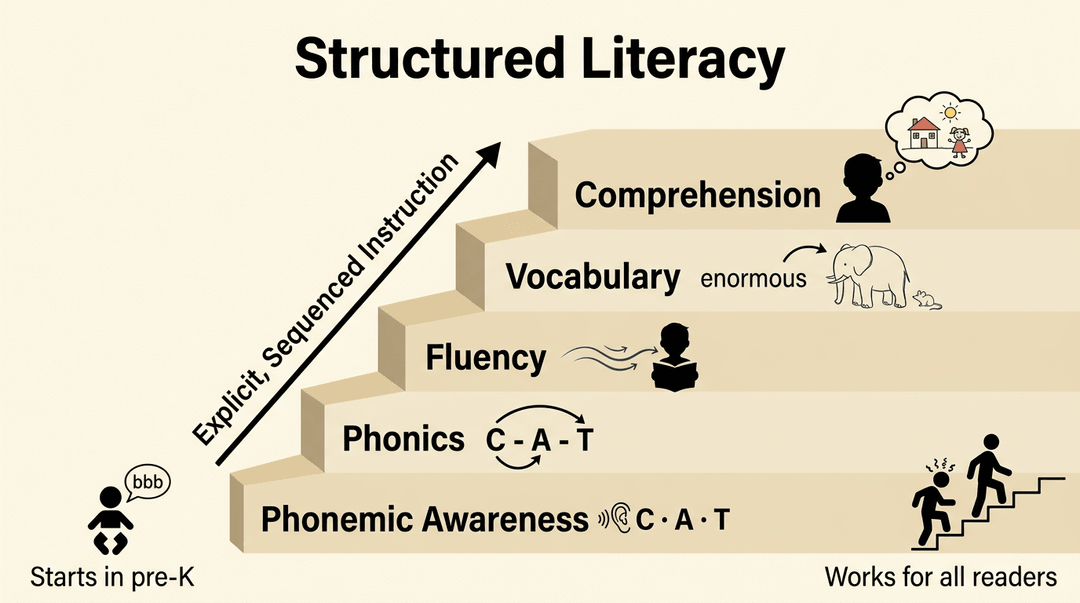
Structured literacy builds the five pillars of reading through explicit, sequenced instruction that integrates listening, speaking, reading, and writing:
- Phonemic awareness
- Phonics
- Fluency
- Vocabulary
- Comprehension
It works for struggling readers and for typically developing ones. The Success for All scripted reading program is one of the most studied examples, showing consistent gains when teachers follow its structured routines closely.
Early childhood and preschool classrooms benefit too: explicit phonological awareness lessons in pre-K give young learners a running start before formal reading begins.
Students with learning disabilities
Resource rooms have used explicit instruction for decades, and for good reason. The research shows strong effects for students with learning disabilities (LD), including groups with lower IQ scores who often struggle with discovery-based approaches.
Combining direct instruction with strategy instruction (teaching a procedure and how to think through it) tends to produce the best outcomes.
Peer delivery models, where trained classmates provide structured practice with feedback, also show meaningful results for students with LD.
English language learners
For English language learners (ELLs), small, homogeneous skill-level groups let teachers pitch instruction at exactly the right level.
Scripted bilingual direct instruction programs support a gradual shift from native-language instruction toward English, giving students a structured bridge rather than an abrupt switch.
What is explicit direct instruction in math?
In math, explicit instruction doesn't mean scripting every move. Instead, teachers point out mathematical landmarks: key relationships, structures, and patterns students might otherwise miss during exploration.
The teacher guides, names what's important, and models how to reason through a problem without prescribing every step.
Think of a fifth-grade teacher who lets students explore area models first, then stops the class to explicitly name the distributive property at work. That moment of direct instruction anchors the discovery and makes it stick.

Training Teachers to Deliver Explicit Instruction
Good EDI lessons don't happen by accident. Delivering them well takes real skill, and that skill develops through deliberate practice and feedback.
What teacher training actually requires
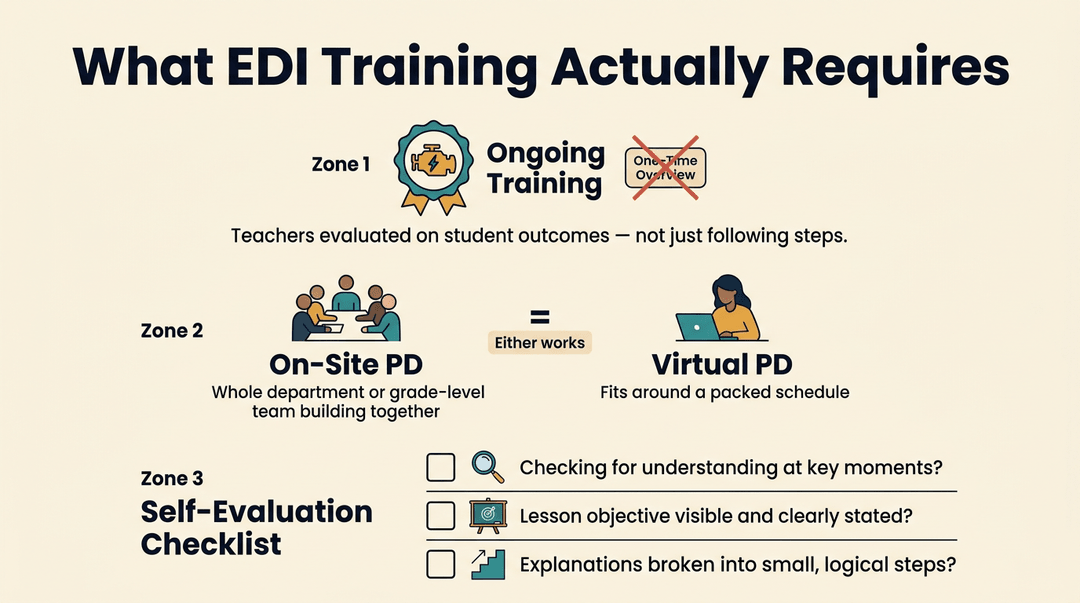
Highly trained instructors are the engine behind effective explicit instruction. That means schools can't treat EDI as a one-time overview: teachers need to be evaluated on actual student outcomes, not just on whether they followed the steps.
Training options are flexible. On-site professional development (PD) works well when whole departments or grade-level teams are building the approach together. Virtual PD suits teachers who need to fit training around a packed schedule.
Either way, a simple self-evaluation checklist helps teachers audit their own delivery:
- Are you checking for understanding at key moments?
- Are your lesson objectives visible and stated clearly?
- Are explanations broken into small, logical steps?
Workshops and coaching for ongoing support
A single workshop can introduce the model, but one day is rarely enough. One-day or multi-day workshops give teachers time to practice components, ask questions, and rehearse before they're standing in front of a class.
Lesson demonstrations take that further. Watching a coach model an EDI lesson, then debriefing together, accelerates growth faster than any slide deck. Ongoing instructional coaching keeps the feedback loop open after the workshop ends.
Instructional leadership support matters here too. When school leaders understand what good EDI looks like, they can observe with sharper eyes and give teachers feedback that actually helps.
Across all of it, checking for understanding is the skill worth developing most. Teachers who can read a room, spot confusion early, and adjust on the fly are the ones whose students make the biggest gains.
Criticisms and Real Limitations
No teaching method is perfect, and explicit direct instruction (EDI) has drawn real criticism over the years. Before adopting it wholesale, it helps to know where the pushback comes from.
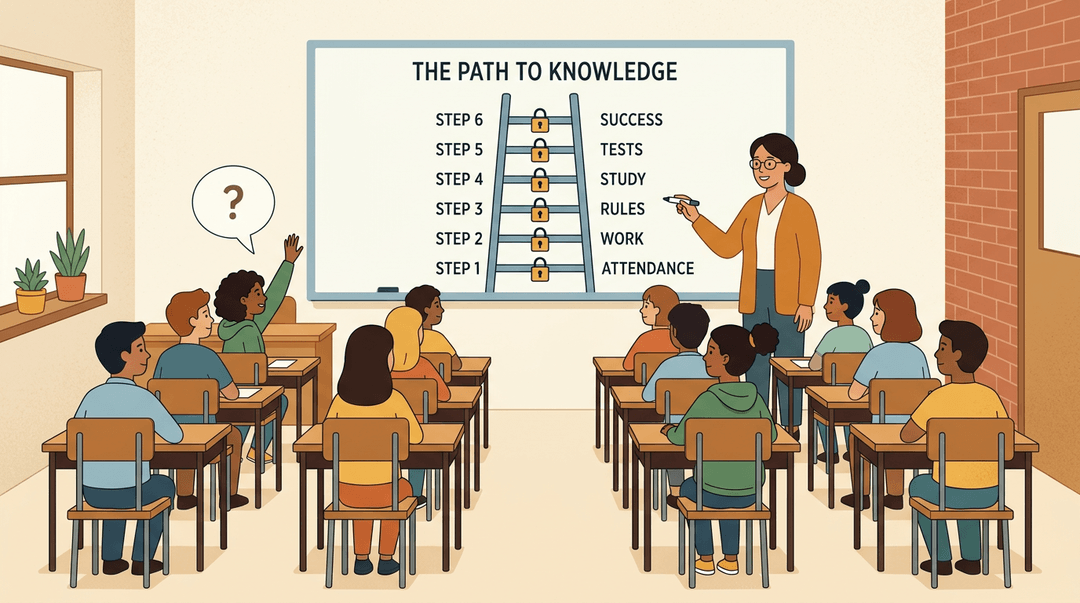
The six principles of explicit instruction (clear learning objectives, activation of prior knowledge, direct explanation, modeling, guided practice, and independent practice) form a tight, teacher-led sequence.
That tightness is exactly what critics question.
Does scripted teaching limit creativity
The most common complaint is that scripted EDI lessons box teachers in. When every step is pre-written, there's little room to follow a student's unexpected question down a fascinating path, or to let the class linger on something genuinely confusing.
Some critics call it a "teacher-proof" curriculum, implying the goal is uniformity over judgment. Students feel it too: a heavily scripted lesson can reduce their autonomy, turning them into passive recipients rather than active thinkers.
That tension sits at the heart of most humanistic objections to the EDI philosophy.
Cost barriers for under-resourced schools
EDI programs often come with a price tag. Student workbooks, teacher editions, and training materials can add up quickly, putting full implementation out of reach for low-income schools that need effective instruction most.
The schools with the fewest resources are sometimes the least equipped to access the method.

Cultural fit and contextual concerns
EDI's origins are largely American, and its content can feel foreign or even alienating to students from different cultural backgrounds.
Critics have raised particular concerns about its use with indigenous students, noting that materials can be insensitive to culture, poverty, and race.
In Australia, a Ninti One case study of the Cape York Aboriginal Australian Academy found that applying this approach in remote indigenous communities generated significant controversy, raising hard questions about whose knowledge and whose norms get centered in the classroom.
Where flexible and inquiry methods pull ahead
For some learning goals, a looser structure wins.
Research published in Frontiers in Education found that guided, discourse-rich inquiry supported conceptual understanding and higher-order thinking in science, suggesting scripted instruction isn't always the right fit for subjects that reward exploration.
As an ERIC comparison of the two approaches notes, many educators see inquiry as more consistent with constructivist learning theory. EDI is a powerful tool, not the only one.
Explicit direct instruction works because it respects what learning actually requires: clarity, practice, and support before independence. It's not about lowering expectations or talking at students.
It's about making sure every student, not just the ones who pick things up quickly, has a real shot at mastering what you're teaching.
Ready to put it into practice? Check out our Lesson Planning tool to build EDI lessons that are structured, scannable, and ready for Monday morning.

References
- Just How Effective is Direct Instruction? — pmc.ncbi.nlm.nih.gov
- Frontiers | Guided inquiry in school science: a mini review of orchestration, assessment, and AI — frontiersin.org (2025)
- A Closer Look at the Five Essential Components of Effective ... — files.eric.ed.gov
- Selecting Scientifically and Evidence-Based Instructional Programs — ed.cde.state.co.us
- Experimental Comparison of Inquiry and Direct Instruction ... — files.eric.ed.gov
- Just How Effective is Direct Instruction? | Perspectives on Behavior Science — link.springer.com (2021)
- A case study of controversy: The Cape York Aboriginal Australian Academy — nintione.com.au (2025)
- Visible Learning: A Synthesis of Over 800 Meta-Analyses ... — inspirasifoundation.org
- Project Follow Through — nifdi.org
- Project Follow Through: — behavior.org
Frequently asked questions
What is explicit direct instruction in teaching?
Explicit direct instruction (EDI) is a structured, teacher-led teaching approach that leaves nothing to guesswork. It involves stating the goal, modeling the skill, and guiding students through steps with clear explanations, guided practice, and timely feedback.
What is explicit direct instruction in math?
In math, explicit instruction means that teachers highlight mathematical landmarks like key relationships, structures, and patterns that students might otherwise miss during exploration. The teacher guides, names what is important, and models how to reason through a problem without prescribing every step, anchoring discovery and helping it stick.
What are the 7 components of explicit instruction?
The seven core components of explicit instruction are: stating the objective, activating prior knowledge, modeling, checking for understanding, guided practice, independent practice, and closure. These steps are sequenced deliberately, with each one building on the last.
What are the 6 principles of explicit instruction?
The six principles of explicit instruction are clear learning objectives, activation of prior knowledge, direct explanation, modeling, guided practice, and independent practice. These principles form a structured, teacher-led sequence designed to ensure clarity and support for student learning. They emphasize a systematic progression from introduction to mastery.
What is an example of direct and explicit instruction?
An example of explicit direct instruction in the classroom is a fourth-grade teacher introducing long division. Instead of just putting a problem on the board, she explicitly states the steps, thinks aloud while modeling the first problem, and then guides students through an attempt together before they work independently.
What does SDI look like in the classroom?
In a classroom, explicit direct instruction (EDI) involves the teacher explicitly stating learning goals, precisely defining concepts, and clearly modeling skills step by step. For example, a teacher introducing long division would state the steps, think aloud while solving a problem, and guide students through practice before they work independently. This approach leaves nothing to guesswork, ensuring every student understands the material.
What does direct instruction mean in teaching?
In teaching, direct instruction (DI) is a specific, highly scripted model that includes exact wording, a sequenced curriculum, and little deviation. It is a more rigid approach compared to explicit instruction, which allows for more flexibility and teacher judgment within its structured framework.