Montessori Education: Principles, Curriculum, and Benefits
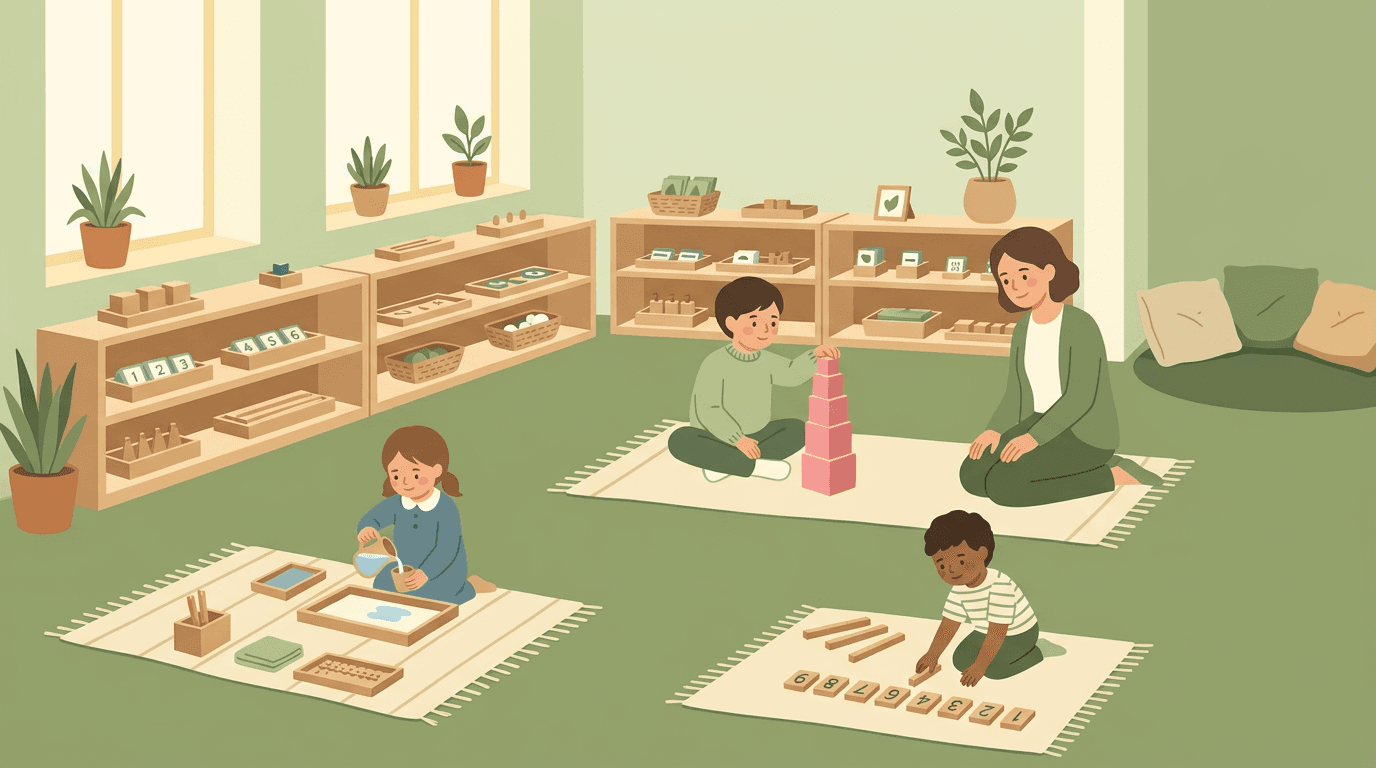

Jump to section
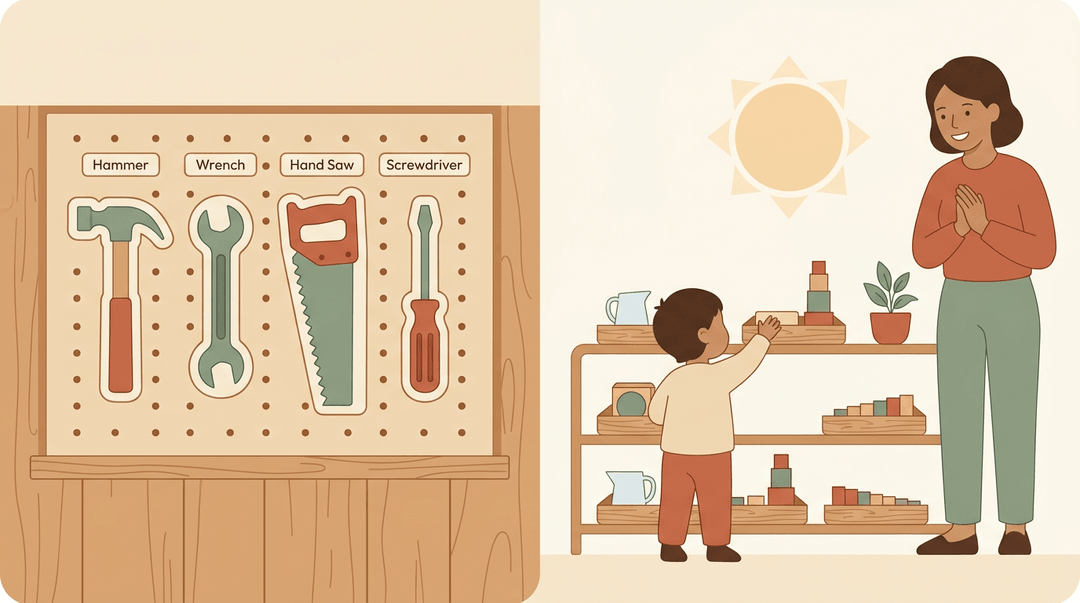
Think about a well-stocked toolshed: every tool has its place, and you reach for exactly what the job calls for, nothing more. Montessori education works the same way.
It's a child-led approach where students choose purposeful, hands-on activities while teachers guide rather than direct. It's grown from a century-old method into one of today's most trusted alternatives to traditional schooling.
In this guide, we'll unpack its principles, curriculum, and benefits, and show you how to bring its ideas into your own classroom.
What Montessori Education Really Means
So what actually sets Montessori apart? It comes down to one core belief: children learn best when they're trusted to lead their own discovery, not simply told what to know.
How Maria Montessori Created This Approach
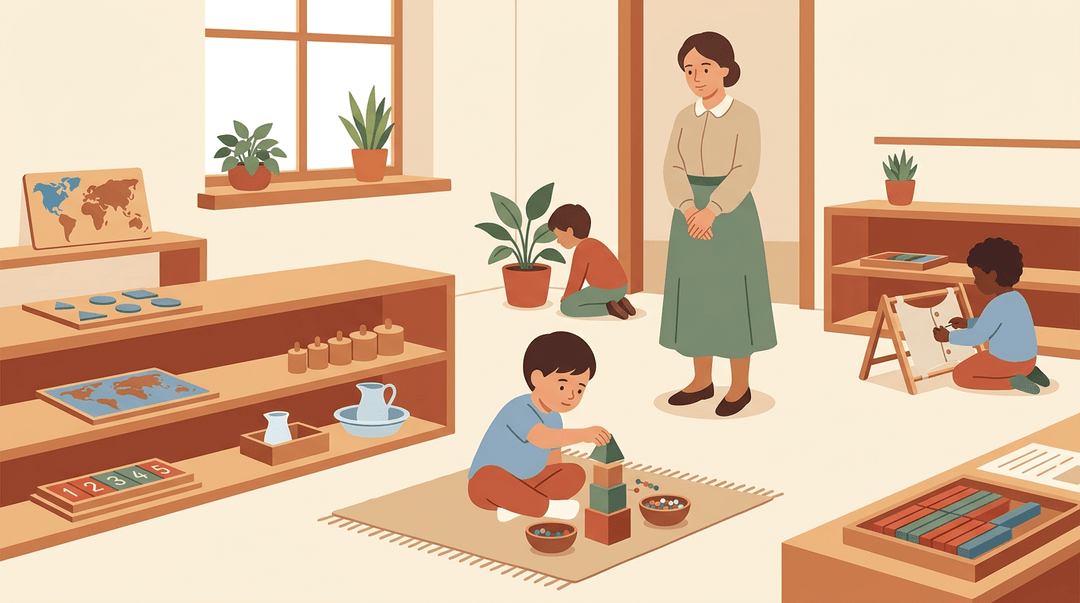
Maria Montessori, an Italian physician, built her method after years spent observing real classrooms rather than starting from a theory.
What she saw convinced her that kids thrive with child-led, self-directed learning: given the freedom to choose their own work, they stay engaged far longer than when they're simply lectured at.
That observation shaped everything that followed. Montessori classrooms favor a hands-on, exploratory approach, where students learn by handling materials and working through problems themselves. The goal isn't just academic mastery.
It's developing the whole child: intellectually, socially, emotionally, and physically.
What Are the Key Differences Between Montessori and Regular Education?
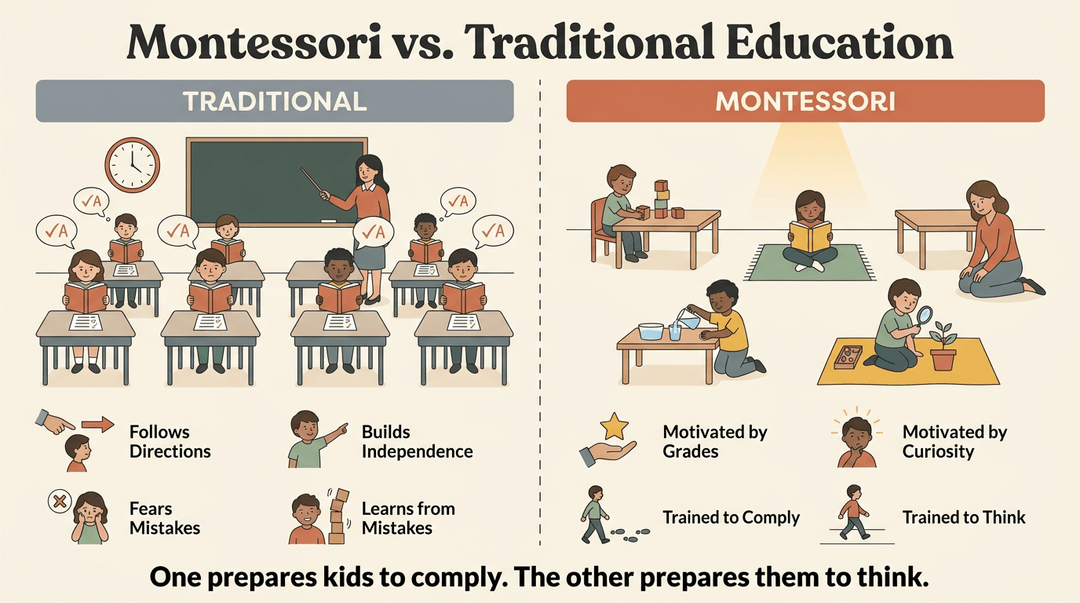
Traditional education usually runs on a fixed schedule, whole-class lessons, and a teacher directing every step. Montessori flips that script. The differences show up in a few consistent ways:
- Independence and confidence. Students choose their own work and pace, so they learn to trust their own judgment.
- Resilience and adaptability. Mistakes become part of the process, not something to fear.
- Intrinsic motivation. Kids work because they're curious, not because a grade is waiting.
- Lifelong readiness. These habits carry into adulthood, where self-direction matters more than following instructions.
That's the heart of Montessori vs. traditional education: one prepares students to comply, the other prepares them to think for themselves.
The Core Building Blocks of Montessori
Strip away the wooden materials and the quiet hum of a Montessori room, and you'll find a handful of ideas doing all the work. Get these right, and everything else about the method starts to make sense.
The Five Elements Every Montessori Classroom Has
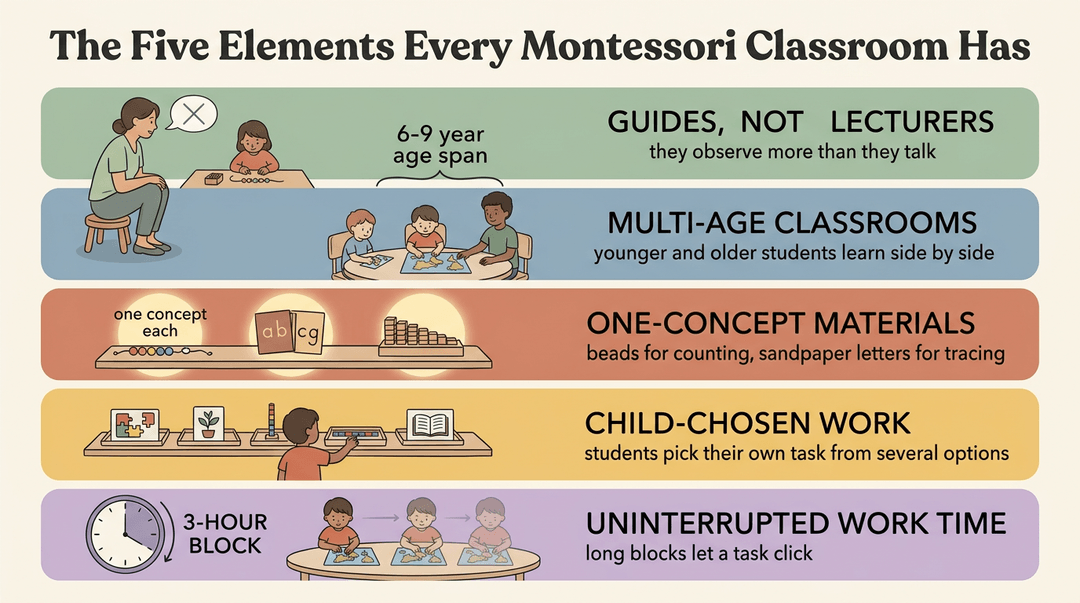
Walk into any authentic Montessori classroom and you'll spot the same five ingredients:
- Trained Montessori teachers, often called guides, who observe more than they lecture.
- Multi-age classrooms that group students in three-year spans, so a first-grader can learn alongside a third-grader.
- Specialized hands-on materials designed to teach one concept at a time, from beads for counting to sandpaper letters for tracing.
- Child-directed work choices, where students pick their own tasks from a set of options rather than following a single class-wide lesson.
- Uninterrupted work periods, long blocks of time that let a student stay with a task until it clicks.
What Is the Golden Rule of Montessori?
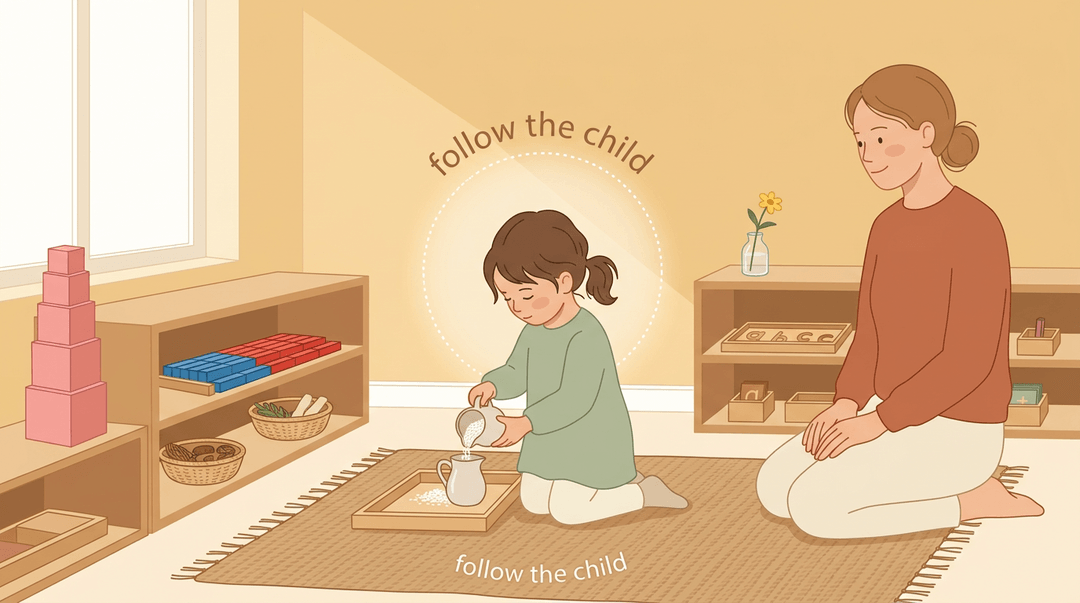
If Montessori has one golden rule, it's this: follow the child. Instead of forcing every student through the same lesson on the same day, the teacher watches for what each child is ready for and builds from there.
That rule rests on a few core beliefs:
- Respect for the child as a capable, whole person, not a blank slate waiting to be filled.
- The absorbent mind, the idea that young children soak up their environment effortlessly, without formal teaching.
- Sensitive periods, windows when a child is naturally primed to master a specific skill, like language or order.
- A carefully prepared environment, where materials are arranged for independence and discovery.
- Auto-education, the belief that children teach themselves when given the right conditions.
The Main Areas of Montessori Curriculum
Montessori classrooms aren't sorted by subject the way traditional schools are. They're built around five interconnected areas that grow with the child, and you don't need a certification to borrow the materials or ideas for your own room.
Here's what each area looks like in practice:
Practical Life Skills Kids Learn First
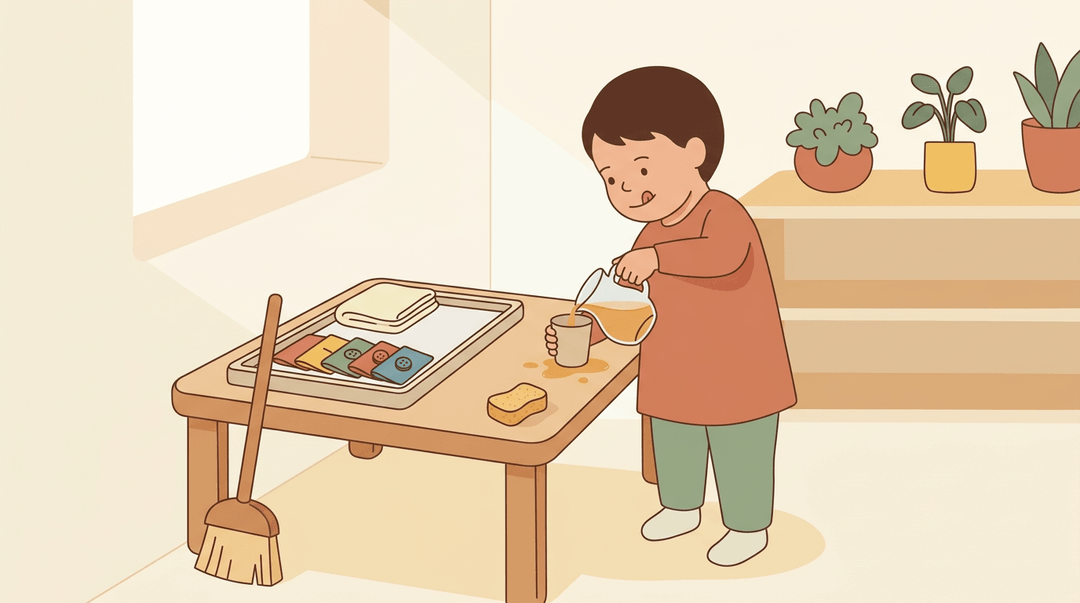
Before children pick up a pencil, Montessori classrooms hand them a pitcher, a broom, or a set of buttons.
These practical life activities, dressing, cleaning, food prep, teach self-care skills while building the fine motor control kids need later for writing.
Consider a preschool teacher setting up a snack station where students pour their own juice and wipe up spills: the child isn't just learning to be tidy, they're practicing the independence and concentration that carries into every other subject.
Sharpening the Senses Through Sensorial Work
Sensorial materials refine the five senses through direct, hands-on exploration:
- sorting blocks by size
- matching color tablets
- feeling textured fabrics
That sorting work isn't just busywork. It builds the same skills of comparison and classification that show up later in math and language lessons.
Making Math Concrete with Hands-On Materials
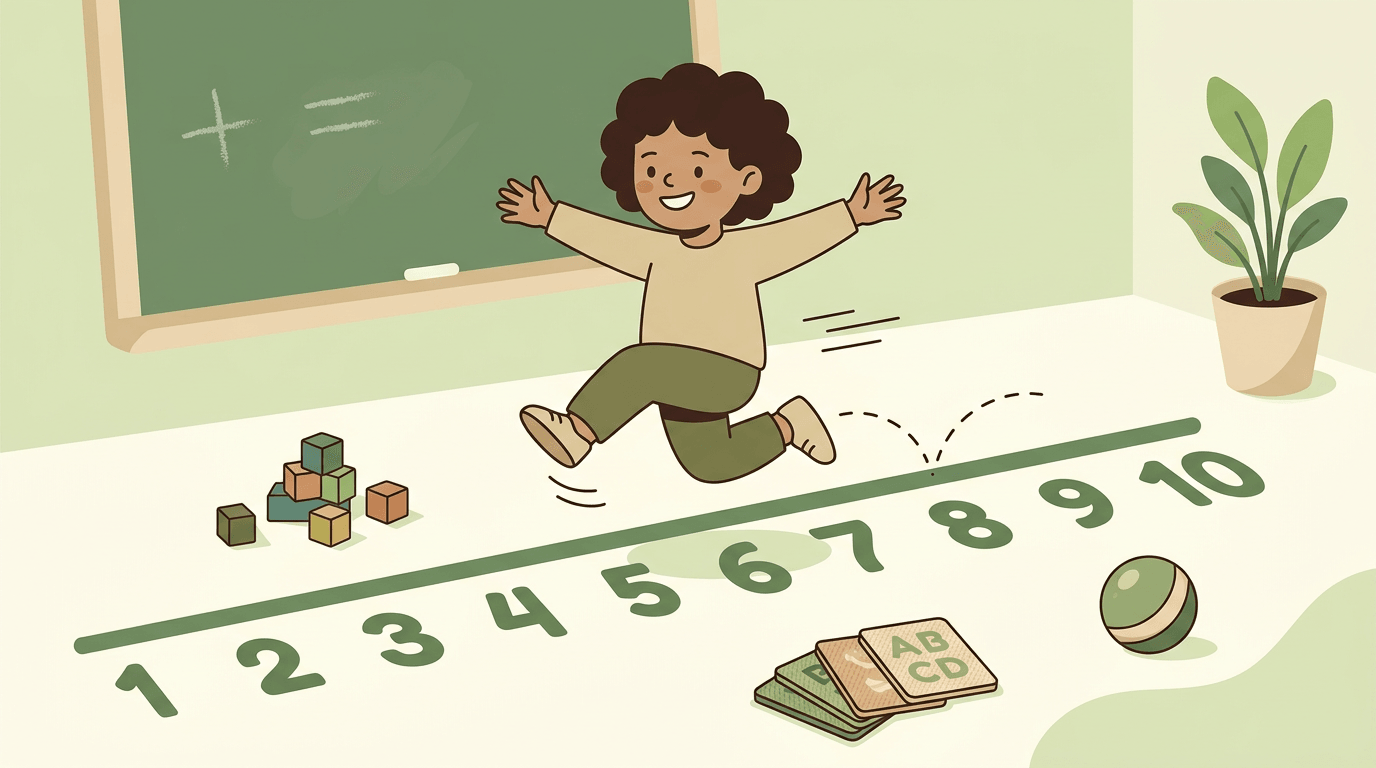
Numbers stay abstract until a child can hold them. Montessori math starts with hands-on materials like number rods and bead chains, letting kids count and see quantity before they ever touch a worksheet.
That concrete-to-abstract progression means a student building a bead chain today is laying the groundwork for mental math tomorrow.
Building Language Skills Through Phonics and Play
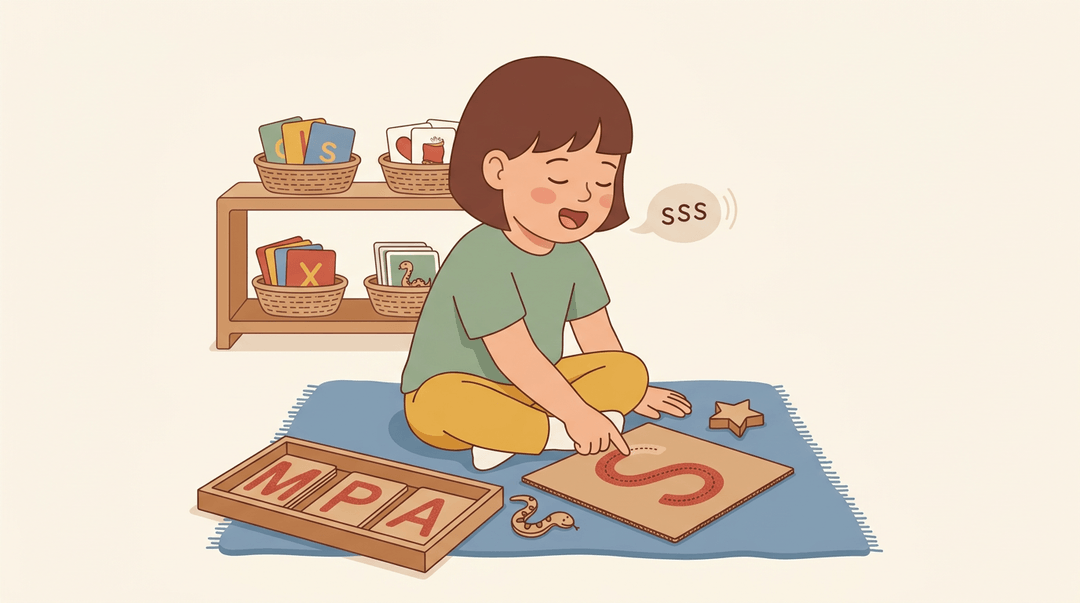
Language work leans on that same sensory approach: kids trace sandpaper letters to feel their shape while saying the sound aloud, linking phonics to touch.
From there, lessons build vocabulary and comprehension alongside writing and oral skills, all through materials kids can touch, move, and repeat at their own pace.
Exploring Geography, History, and Culture
The cultural subjects, geography, history, science, art, and music, round out the curriculum and widen a child's view of the world.
Puzzle maps and cultural studies build diversity and community awareness, while nature-based lessons often fold in sustainability, giving students an early sense of their place in a bigger picture.
Bringing Montessori Principles into Your Lesson Plans
You don't need a full Montessori classroom to borrow what works. This guide helps you check whether the approach fits your students, add four core Montessori moves, and match them to your grade level.
First, check the fit
Spend one ordinary lesson observing before you change anything. Confirm:
- Pace preference: note who races ahead and who needs longer; uneven pacing means choice will help.
- Independence level: most students can start a task from written directions without asking you.
- Collaboration needs: watch who seeks a partner and who works best alone, then plan stations for both.
If your class leans independent with mixed pacing, these moves will land fast. If not, start smaller: one station, short choice windows, and build from there.
Four moves you can add this week
Offer child-led choice. Give two or three real options, not open-ended freedom.
- Say: "Pick which station you start at; you'll finish all three by Friday."
Create work stations. Set up three spots students rotate through at their own speed.
- Example setup: a reading corner, a practice table, a partner game, each with a self-check answer key.
Use hands-on materials. Swap one worksheet per unit for something students physically manipulate.
- Fraction strips, letter tiles, counters: the hands do the first rep, the paper comes second.
Add real-life tasks. Fold purposeful, real work into the lesson itself.
- Measuring ingredients for a class recipe, writing a real letter, logging plant growth daily.
⚠️ Watch out: choice collapses when options are unlimited. Cap every choice at two or three, and every option should lead to the same learning goal.
Match the moves to your grade
| Grade band | Montessori anchor | Try this |
|---|---|---|
| Preschool | Sensory bins | Rice bin with hidden letters; students dig, name, and sort them |
| Elementary | Independent projects | A two-week "expert topic" with a one-page student contract |
| Middle school | Research stations | Four source stations; students choose their own route through |
Once a station or project works, save it so next term takes minutes: build reusable Montessori-inspired lesson plans fast with EMStudio's online lesson planner.
How Montessori Programs Are Structured by Age
Montessori classrooms don't sort students by a single birth year. Instead, they're built around developmental stages, with each room designed to match how children actually grow.
Why Classrooms Mix Different Ages
A typical Montessori room spans three years instead of one, so a six-year-old and an eight-year-old might share the same space. That's not an accident.
It gives younger students a model to watch and older students a reason to explain what they already know.
Consider a nine-year-old walking a younger classmate through a math material she mastered last year. She's not just reviewing the concept: she's practicing patience, clarity, and leadership long before a report card ever asks her to.
Peer mentorship like this builds confidence on both sides, and it happens daily, not as a special occasion.
How Is Montessori Different from Preschool?
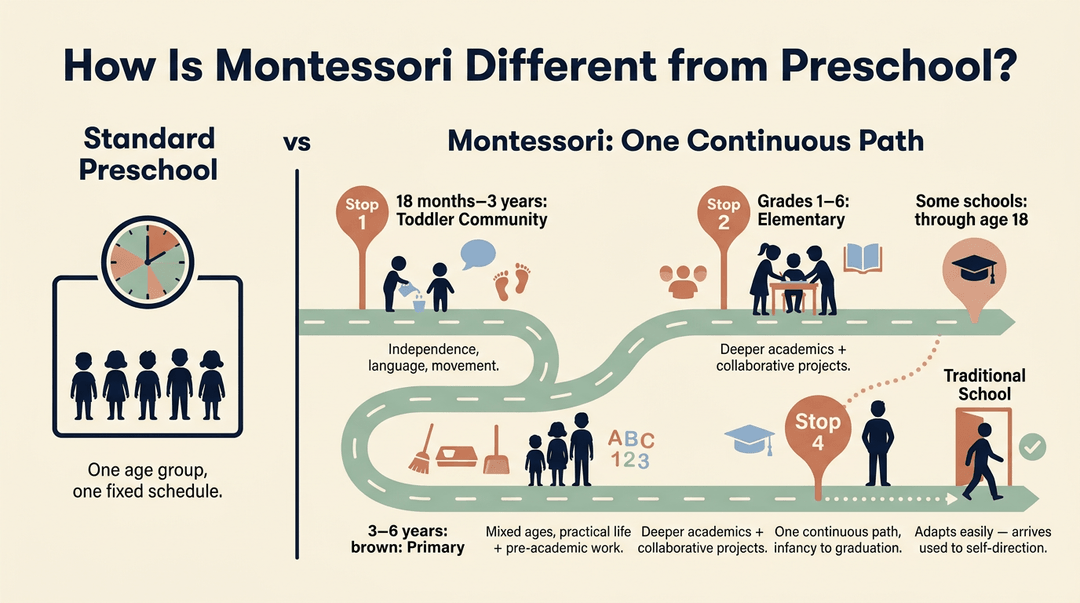
A standard preschool usually groups kids tightly by age and runs on a fixed daily schedule. Montessori spans a much wider arc, and that's the core difference:
- Toddler community (18 months to 3 years): focused on independence, language, and movement.
- Primary (3 to 6 years): the classic mixed-age room, blending pre-academic work with practical life skills.
- Elementary (grades 1 to 6): deeper academic study paired with ongoing collaborative projects.
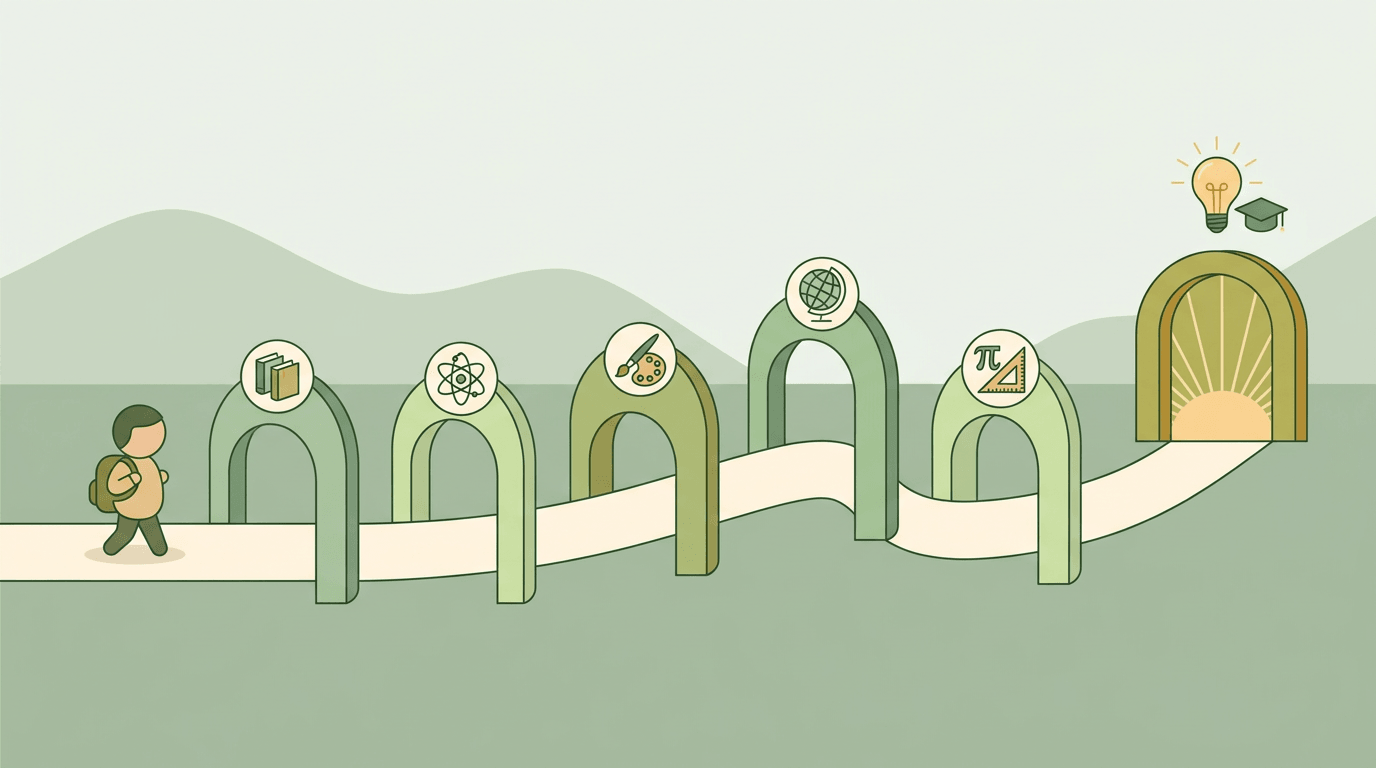
Some schools extend this all the way through age 18, so a student can stay on one continuous path from infancy to graduation.
Students transitioning to a traditional school afterward usually adapt fine. They arrive used to self-direction, which serves them well even in a more conventional room.
Designing the Montessori Classroom Environment
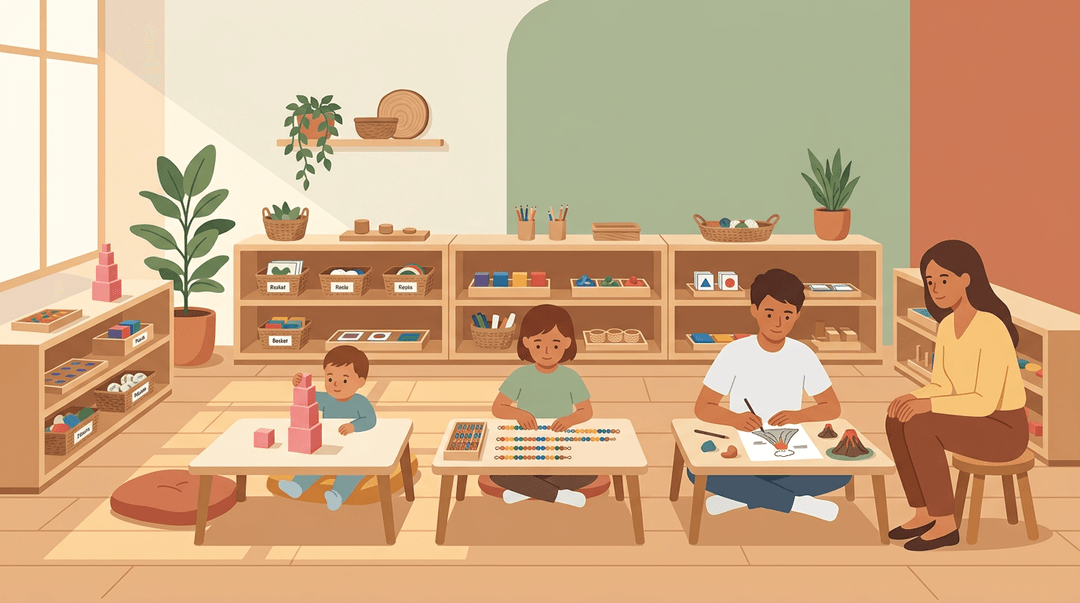
Step into a well-run Montessori room and you'll notice something before you notice anything else: the space itself is teaching. Every shelf, chair, and wall is doing quiet work, and building that kind of room doesn't take a big budget, just a clear plan.
Setting Up the Physical Classroom
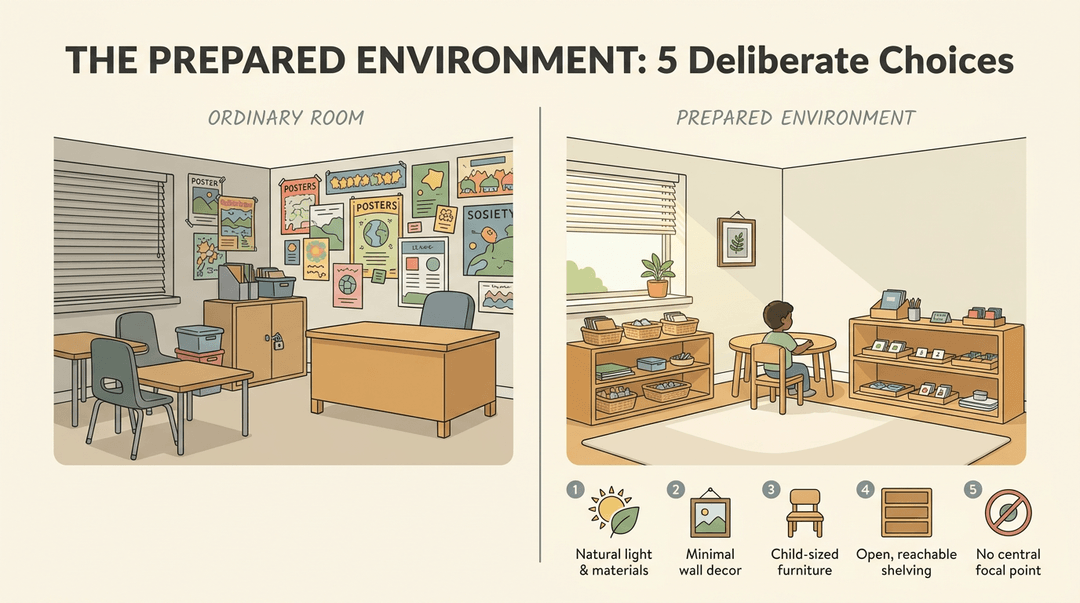
A few deliberate choices turn an ordinary room into a prepared environment: one set up to invite independence rather than demand attention. Here's what to prioritize:
- Natural lighting and materials. Open blinds, add a plant, swap plastic bins for wood or wicker where you can. It calms the room without costing much.
- Minimal wall decor. A few purposeful pieces beat a wall crowded with posters. Less visual noise means more focus.
- Child-sized furniture. Chairs and tables your students can actually manage on their own, no adult help required to sit down or reach a shelf.
- Open shelving for materials. Everything visible and within reach, so students can choose, use, and return work without asking permission.
- No central focal point. Skip the
The Benefits of Montessori Education
Ask any teacher who's spent time in a Montessori classroom what stands out, and you'll likely hear the same word: calm. That calm isn't an accident.
It's the product of a handful of benefits that show up again and again in classrooms, and increasingly, in long-term outcome research.
Learning at Your Own Pace
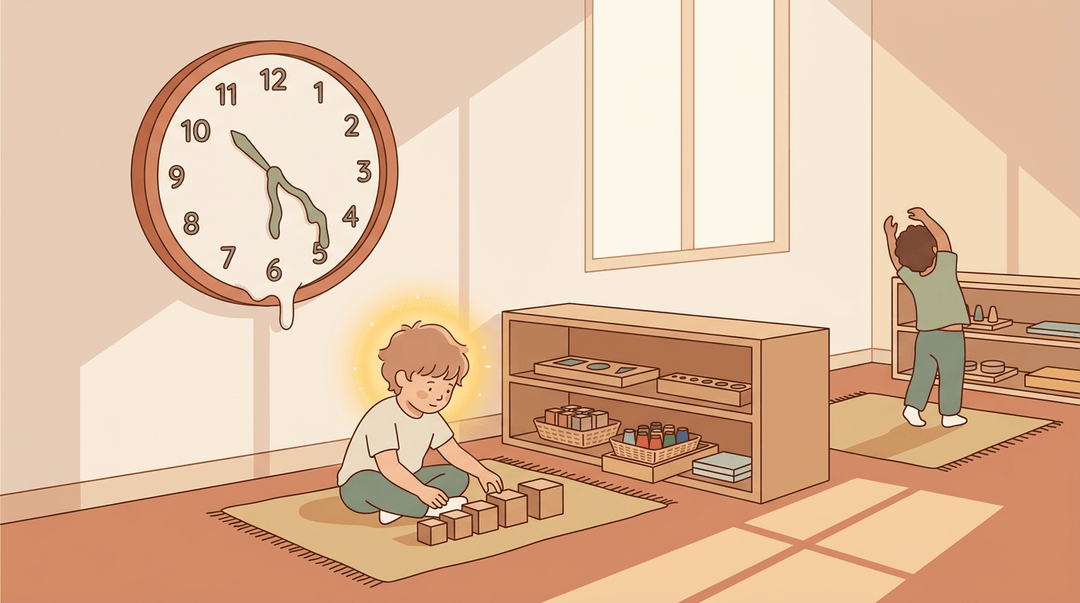
In a Montessori classroom, the child controls the pace, not the clock. A student who needs three weeks with a material moves on when they're ready, not when the calendar says so.
That freedom builds real confidence: mastery comes before the next challenge, not the other way around. The payoff is self-directed exploration, students who learn to trust their own curiosity instead of waiting for a teacher to hand them the next step.
Building Social and Emotional Skills
Mixed-age classrooms turn older students into mentors almost by default. Think of a six-year-old showing a four-year-old how to roll a work mat: the older child practices patience, the younger one gets a peer model instead of only an adult one.
That daily exchange builds empathy and resilience, and over time it grows into a genuinely community-minded spirit.
Sparking a Lifelong Love of Learning
Because Montessori work is chosen, not assigned, it taps intrinsic motivation instead of leaning on grades or gold stars. Students stay engaged and curious for longer stretches, and that habit doesn't vanish at graduation.
It becomes a lifelong learning habit, one that keeps paying off long after the classroom.
Supporting Kids with Special Needs
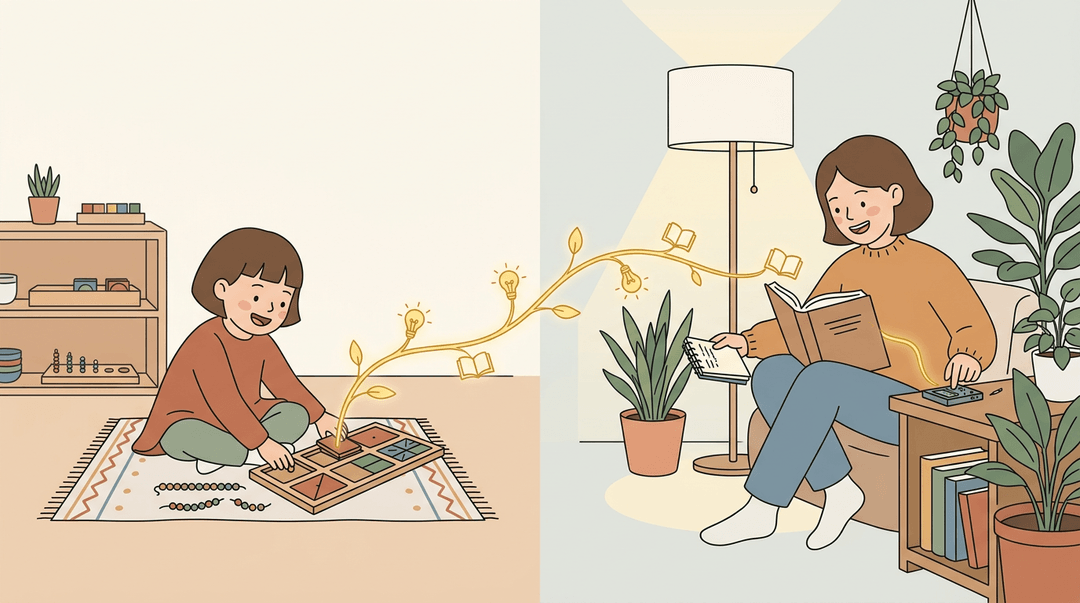
Every Montessori plan is already an individualized learning path, which makes it a natural fit for a student with an IEP or simply a different pace of development.
The same teacher often stays with a class across a multi-year cycle, giving that child the stability of one consistent adult who already knows how they learn.
That flexibility is what makes the method adaptable to all needs, not just the ones it was originally designed around.
Getting Kids Ready for School Success
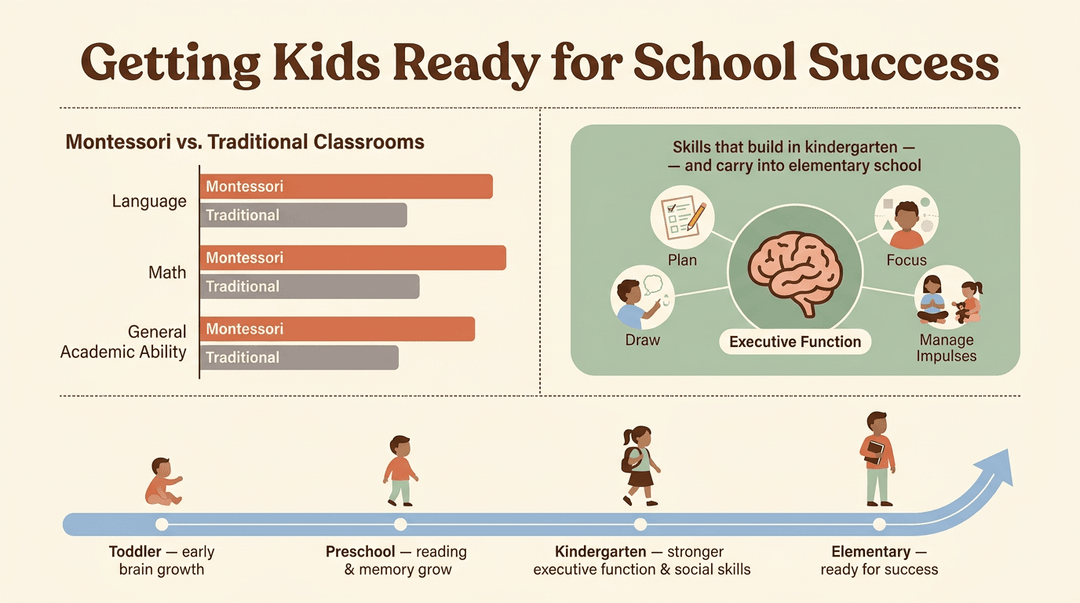
The research backs up what many Montessori teachers see firsthand. A study covered by K-12 Dive found that students in Montessori programs show higher performance in language, math, and general academic ability compared to students in traditional schools.
A University of Virginia-led national study found that children who attended public Montessori preschool showed better reading ability, executive function, short-term memory, and social understanding in kindergarten than peers without an early Montessori education.
That strong executive function, the ability to plan, focus, and manage impulses, helps set kids up for a successful transition to elementary school.
Even at the toddler level, the benefits start early: research comparing Montessori and traditional classrooms suggests that learning environments may shape both children's cognitive outcomes and the maturation of large-scale neural dynamics.
Is Montessori Right for Your Child?
Not every child learns the same way, and Montessori isn't a fit for all of them.
Before you recommend it to a parent or consider it for your own classroom approach, it helps to know which learners tend to flourish and which ones might need something different.
Kids Who Tend to Thrive
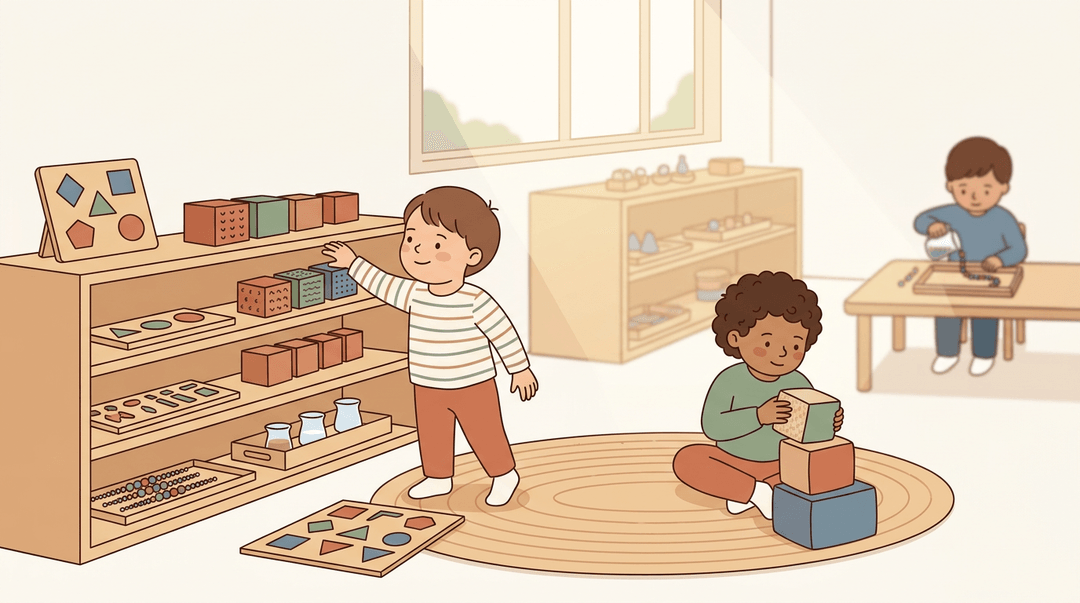
Montessori tends to click for curious, independent learners: kids who ask a lot of "why" questions and don't need constant direction to get moving. Think of a student who finishes a puzzle, then wanders off to find a new one without being told to.
That instinct to explore is exactly what a Montessori classroom rewards.
It also suits kids with a kinesthetic learning style, the ones who understand best through touch and movement rather than sitting still and listening.
And because Montessori lets each child work at their own speed, self-paced learners who get frustrated rushing through a worksheet (or bored waiting for the class to catch up) often settle in nicely.
Kids Who Might Struggle
On the other side, some kids need more structure than Montessori typically offers. A child who needs external rewards, like stickers or a grade, to stay motivated may feel unmoored without that scaffolding.
The same goes for a student who prefers teacher-directed lessons over open-ended exploration: without a clear "do this next," they can feel lost rather than free.
Finally, kids who need frequent praise to feel confident might find Montessori's quieter, more independent feedback style a hard adjustment at first.
How to Spot an Authentic Montessori School
With so many schools slapping the Montessori name on a sign, how do you know if what's happening inside actually matches the method? The answer comes down to two accrediting bodies and the standards they enforce.
What AMI and AMS Standards Require
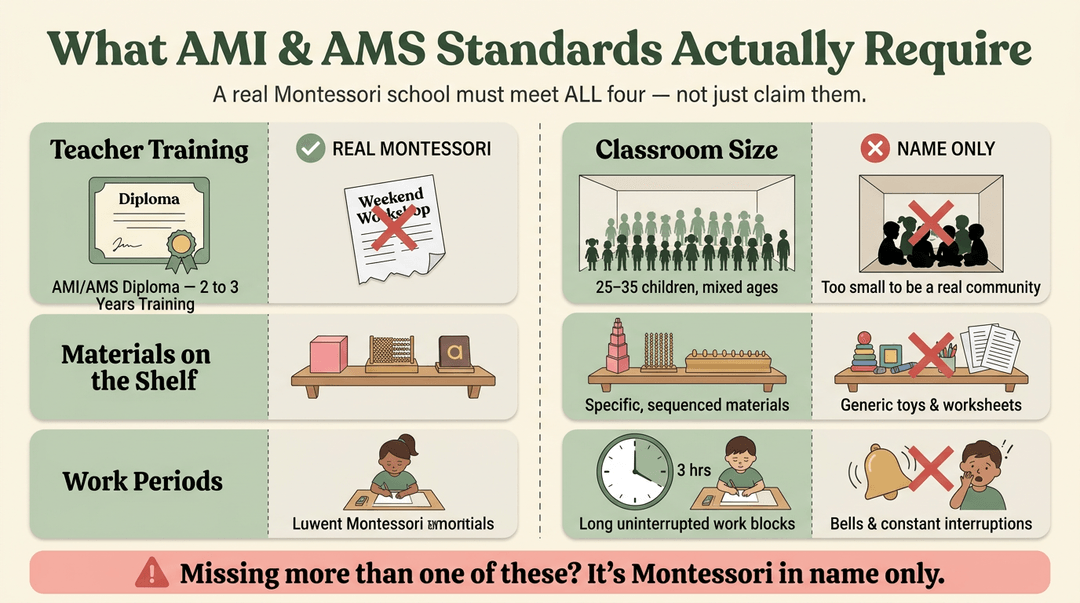
Both the Association Montessori Internationale (AMI) and the American Montessori Society (AMS) set clear benchmarks a school has to meet, not just claim.
- Teacher credentials. Lead teachers must hold AMI or AMS diploma training, not a quick weekend workshop.
- Classroom size. Mixed-age classrooms are large enough (often 25 to 35 children) to sustain a real community of learners across the age span.
- Authorized materials only. Shelves hold the specific, sequenced Montessori materials, not a mix of generic manipulatives and worksheets.
- Distraction-free work periods. Children get long, uninterrupted blocks of work time, free from bells and constant redirection.
A school missing more than one of these is probably borrowing the name without the substance.
Understanding Different Accreditation Levels
AMI accreditation itself comes in tiers, and it's worth knowing the difference before you take a brochure at face value:
- AMI Associated. Full accreditation: the school has met every AMI standard and undergone formal review.
- AMI Affiliated. The school is working toward full standards under AMI guidance, a step in progress rather than the finished product.
- AMI Recognized. An earlier stage of alignment, showing intent and partial implementation rather than complete compliance.
Asking which level a school holds is a fair, simple question, and any authentic Montessori school should answer it without hesitation.
Common Criticisms and Myths About Montessori
Montessori isn't without its critics, and a fair look at the method means weighing the pushback along with the praise. Some of it's a genuine structural problem, and some of it is just outdated myth.
Why Cost Can Be a Barrier
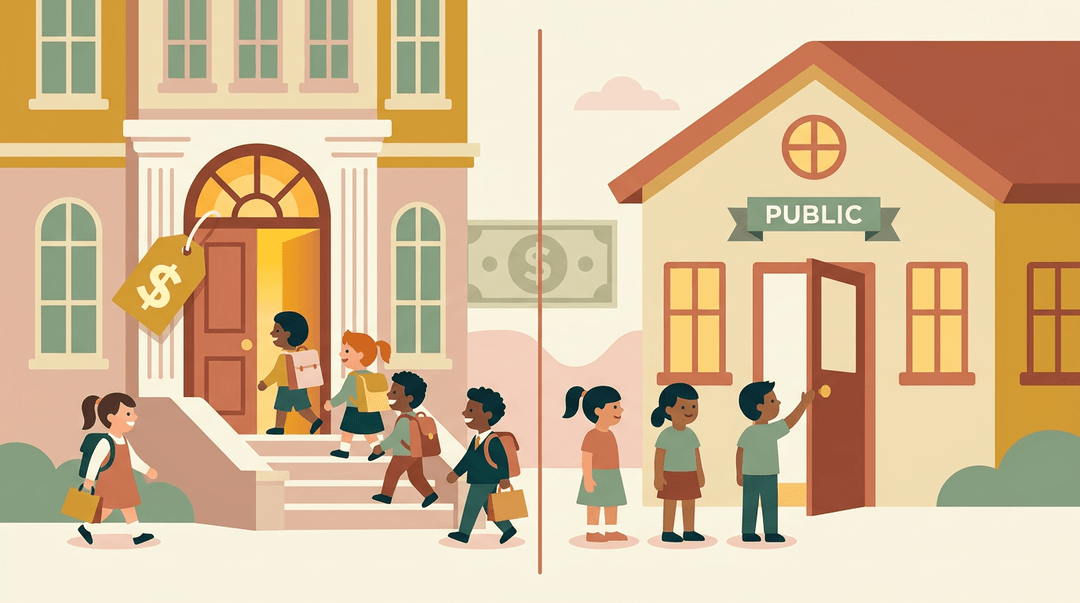
The biggest, most persistent criticism is money. Most Montessori programs are private and tuition-based, and that price tag shapes who actually walks through the door.
As researchers note in a randomized controlled study published in PMC, "most Montessori preschools are tuition-based, they largely enroll children from high-income families."
That reality limits access for lower-income families, though it's worth knowing that public and charter Montessori schools do exist and are slowly widening the door.
Why Quality Varies So Much
Here's something that surprises a lot of educators: "Montessori" isn't a trademarked name. Any school can put it on a sign, whether or not it follows Maria Montessori's actual principles.
That means implementation quality swings widely from one building to the next, and there's no single, reliable way to verify how authentic a given program really is.
Does It Sacrifice Teamwork for Independence?
Because Montessori classrooms lean so heavily on independent, self-paced work, critics argue students get less practice with collaboration.
The focus on individual progress, the thinking goes, can crowd out group problem-solving, the very skill kids need for team projects later on.
Myths About Montessori, Debunked
A few misconceptions deserve a straightforward correction:
- It's not just for preschoolers. Montessori spans from toddler programs through adolescence.
- It's not religious. The method is secular, regardless of who operates a given school.
- It's not unstructured. Freedom of choice happens inside a carefully designed environment.
- It's not only for gifted kids. It's built to meet learners at every level.
- Imagination is still encouraged, even with the emphasis on hands-on, concrete materials.
Montessori isn't about abandoning structure. It's about building a classroom where independence and guidance work side by side, so students grow into confident, curious learners.
Whether you run a full Montessori program or just borrow a few of its ideas, the goal stays the same: meet each learner where they are.
Ready to put these principles into your weekly rhythm? Check out our Lesson Planning tool to organize and reuse Montessori-inspired lessons across every class you teach.
References
- Schooling Trajectories and the Development of Brain Dynamics: A Comparative Study of Montessori and Traditional Education — doi.org (2026)
- UVA-led national study finds Montessori preschool boosts learning, cuts costs — news.virginia.edu
- Effects of Montessori Education on the Academic, Cognitive, and Social Development of Disadvantaged Preschoolers: A Randomized Controlled Study in the French Public‐School System — pmc.ncbi.nlm.nih.gov
- Montessori method has ‘strong and clear’ impact on student performance — k12dive.com
Frequently asked questions
What is the Montessori method of teaching?
The Montessori method is a child-led, hands-on approach in which students choose purposeful activities and work at their own pace. Teachers, often called guides, observe, introduce materials, and support learning rather than directing every step. The method aims to develop children intellectually, socially, emotionally, and physically.
What is the biggest criticism of Montessori?
The biggest criticism of Montessori is its cost and limited accessibility. Many programs are private and tuition-based, which can make them unavailable to lower-income families, although public and charter Montessori schools also exist.
What is the Montessori method of learning?
Montessori learning is self-directed, hands-on, and exploratory. Children choose from purposeful activities, use specialized materials that isolate specific concepts, and progress from concrete experiences to abstract understanding with guidance from a teacher.
What is the golden rule of Montessori?
The golden rule of Montessori is “follow the child.” Teachers observe each child’s interests, development, and readiness, then provide appropriate activities within a prepared environment that supports independence and discovery.
What are the 5 principles of Montessori?
The five commonly cited Montessori principles are respect for the child, the absorbent mind, sensitive periods, the prepared environment, and auto-education. Together, they express the belief that children learn actively and teach themselves when given suitable conditions and materials.
What are the key differences between Montessori and regular education?
Traditional education commonly uses fixed schedules, whole-class instruction, and teacher-directed lessons. Montessori uses mixed-age groups, child-chosen work, specialized hands-on materials, uninterrupted work periods, and learning at an individual pace, with teachers acting primarily as guides.
What are the 5 Montessori methods?
The five main Montessori curriculum areas are practical life, sensorial work, mathematics, language, and cultural studies. Cultural studies typically include geography, history, science, art, and music.
How is Montessori different from preschool?
Preschool is a broad early-childhood setting, while Montessori is a specific educational method that can be used in preschool and beyond. Montessori preschool generally has a mixed-age group from about ages three to six, child-sized materials, practical-life activities, self-paced work, and a teacher-guided prepared environment rather than a fixed, whole-group schedule.