Benefits of Bilingual Education That Hold Up Under Scrutiny

Jump to section
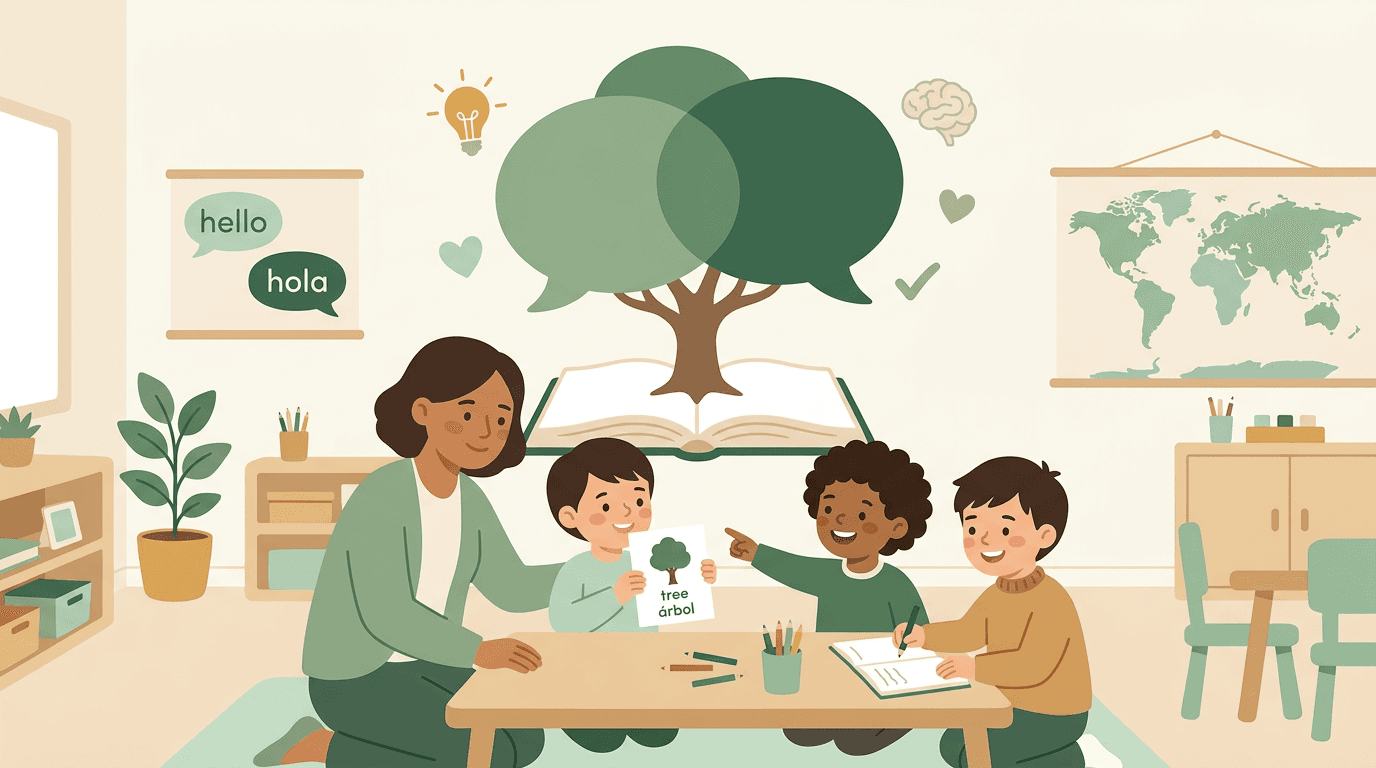
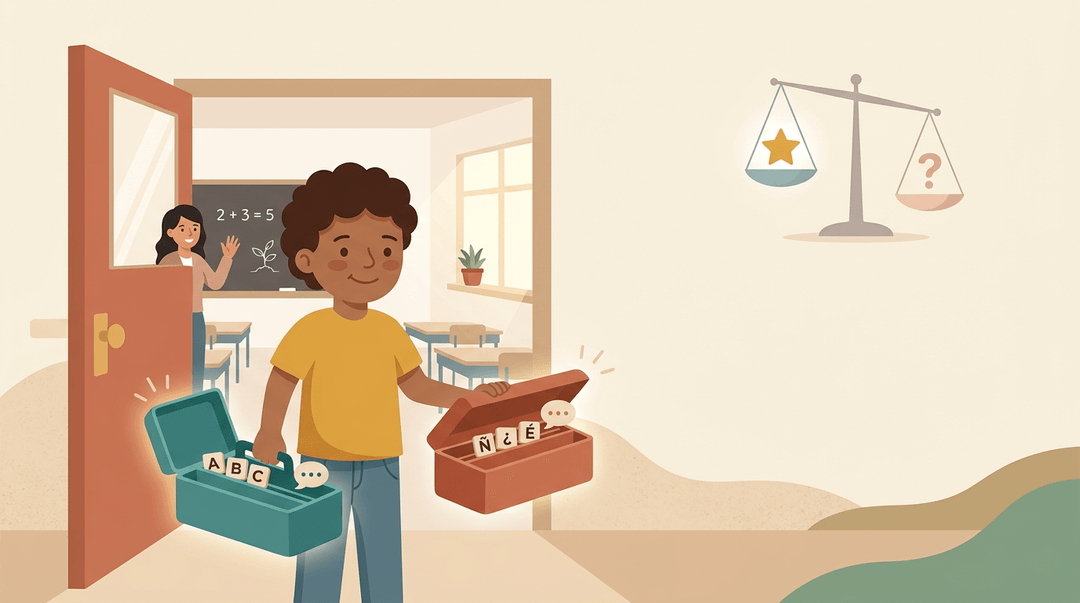
Think of a bilingual student as someone who walks into class with a second toolbox already in hand. Bilingual education builds on that, teaching core content in two languages so students grow strong in both.
The hype around it can get loud, though. Some benefits are well supported, while others are still debated.
In this post, we'll separate the two, tie each benefit to the program model that delivers it, and give you a practical way to plan bilingual lessons.
How Bilingual Education Programs Deliver Benefits
Program models differ, and so does what they deliver. A common framing rests on three pillars:
- proficiency in two languages
- academic achievement
- cultural competence
Main models and what counts as bilingual
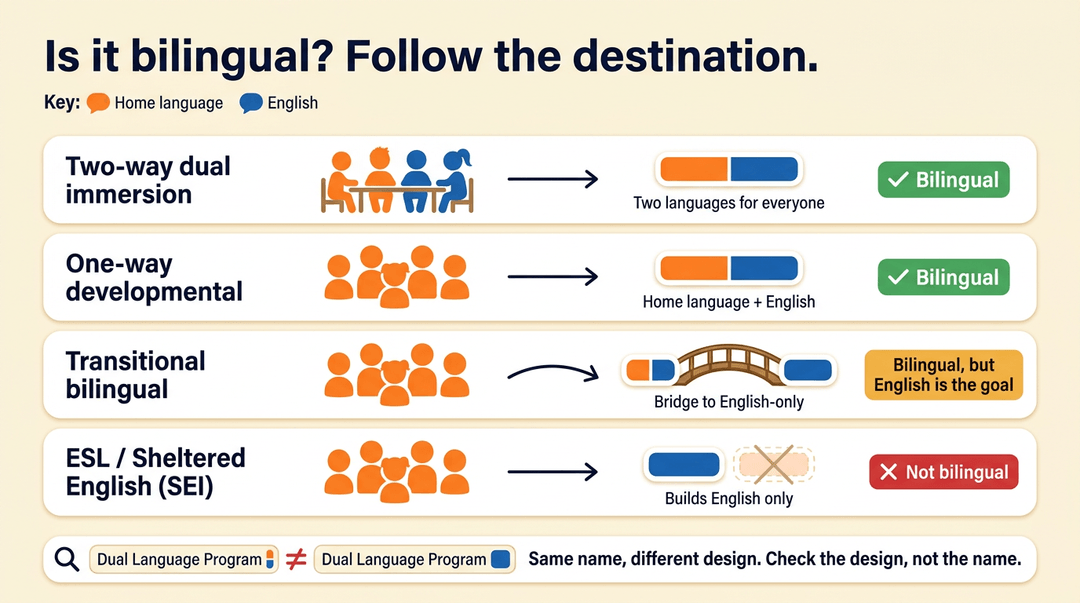
- Two-way dual immersion. Students from two language backgrounds learn together in both languages.
- One-way developmental. Students who share a home language learn in that language and in English.
- Transitional bilingual. Home-language support is a bridge to English-only classes, not the destination.
- English as a Second Language (ESL) and sheltered English instruction (SEI) are not bilingual. They build English but don't grow the home language.
- Inconsistent district labels. One name can mean different designs. Check the design, not the name.
Each model's aim shapes its benefits: two-way programs target two languages for all students, while transitional programs target English. Treat each benefit as a goal, not a guarantee.
Everyday classroom strategies that work
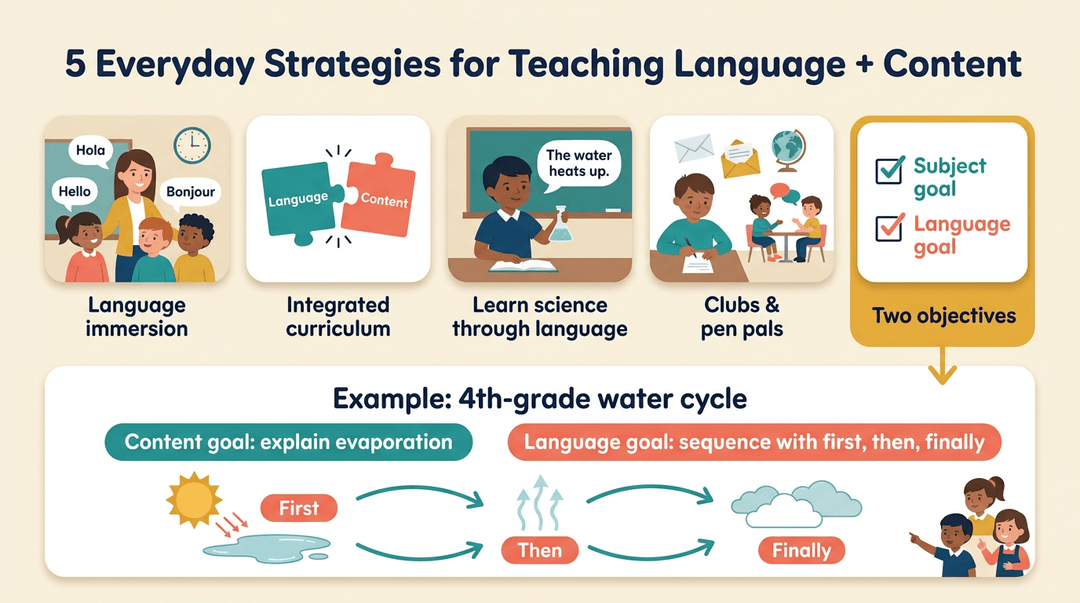
- Language immersion. Students hear and use the target language across the day.
- Curriculum integration. Language and content are taught together, not in separate blocks.
- Content-based teaching. Students learn science through the language they're building.
- Extracurricular and exchange activities. Clubs and pen pals give students real reasons to speak.
- Plan separate language and content objectives. Name the subject goal and the language goal.
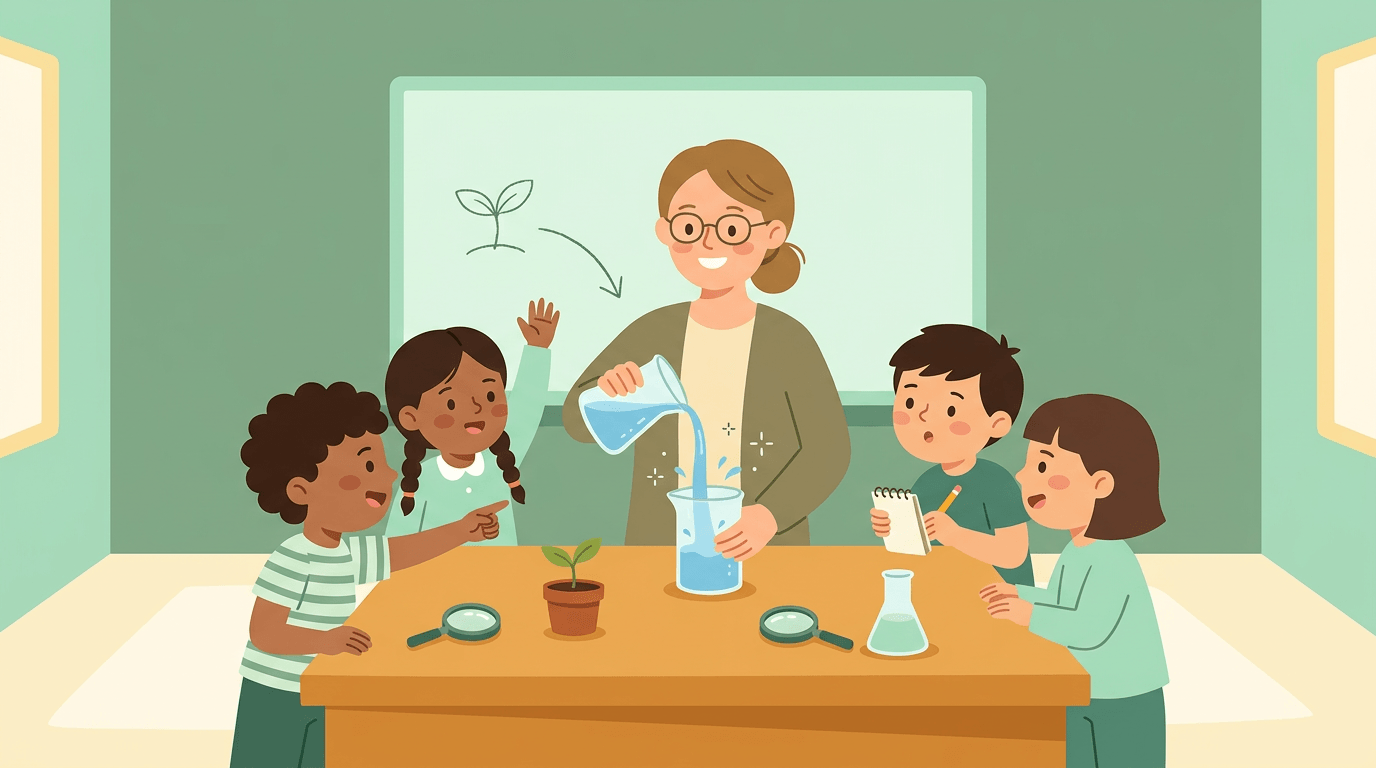
Picture a fourth-grade teacher on a water cycle unit. Her content goal is explaining evaporation, and her language goal is sequencing steps with first, then, and finally. Students explain the science in order and build the language to match.
Training and credentials teachers need
- Continuous teacher training. Ongoing professional development keeps your skills sharp.
- Bilingual endorsements. An add-on to a teaching license that signals bilingual preparation.
- Language proficiency requirements. You'll need academic-level command, not just conversational skill.
- Credentials vary by state. Check your state's requirements before you apply.
Consider a teacher who speaks Spanish fluently at home but has never taught math in it. Speaking a language and teaching in it are different skills, and training closes that gap.
English-taught immersion as an alternative
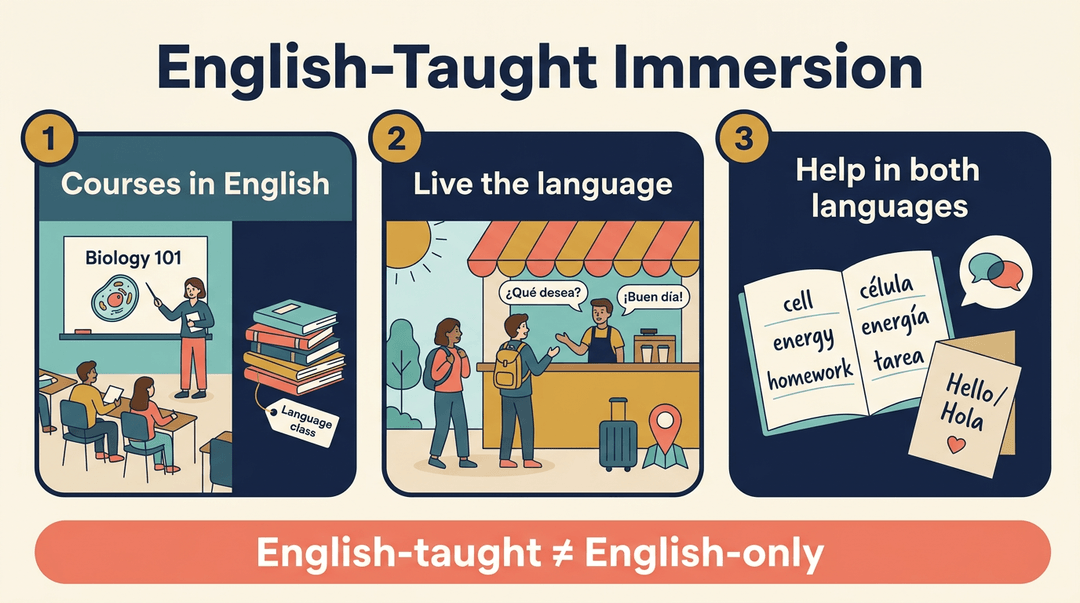
- Full English university programs. Courses are taught in English, and the second language is studied separately.
- Immersion in a second-language environment. Students spend time where the second language is everyday speech.
- Support in both languages. English-taught doesn't have to mean English-only. Glossaries and family notes help.
Planning a Bilingual Lesson Step by Step
Use this guide when you're planning any lesson where students learn content while building two languages. Work the four steps in order, then run the check before you teach.
Plan the lesson in four moves
- Write the content objective
- Say what students will know or do, as on the board: "I can explain how water moves through the water cycle."
- Add a language objective
- Name the language students need to show it: "I can use first, next, then to describe the cycle, aloud and in writing."
- Choose target vocabulary
- Pick 4 to 6 words the lesson can't work without: evaporation, condensation, precipitation.
- Note cognates (evaporation / evaporación) so students can use what they already know.
- Build supports in both languages
- Pick from the table below, then write each support into your plan.
| Support | What it looks like |
|---|---|
| Sentence frames | "First, the water ___. Next, it ___." Post in both languages. |
| Visuals and gestures | A labeled diagram; one hand motion per key word. |
| Bilingual glossary | Word, home-language word, small picture, on one half-page. |
| Partner talk in home language | 2 minutes to rehearse the idea before sharing in the target language. |
Supports aren't a crutch to remove on day two. Fade them as students show they don't need them.
See it by grade band
The four moves stay the same. What changes is the routine that carries them.
| Band | Routine | Sample move |
|---|---|---|
| K-2 | Picture-word routine | Show a picture, say the word in both languages, students gesture and repeat. |
| 3-5 | Paired reading | Partners read a short text, stop at each paragraph, retell using a frame. |
| 6-12 | Bilingual discussion task | Students prepare ideas with a partner in home language, then debate in the target language. |
Example: A fourth-grade teacher plans the water cycle lesson with the objectives above. Partners read a short text together, pointing to the glossary for unfamiliar words. They retell each stage using the First, next, then frames. The content goal and the language goal are taught in the same twenty minutes.
Check the plan before you teach
Confirm each of these on paper first:
- Objectives in both languages: the content and language objectives are written, and students can read them in either language.
- Planned language supports: frames, visuals, glossary, and partner talk are each named in the plan, not left to improvise.
- Exit ticket in either language: students can show understanding in whichever language they choose.
- Reuse plan across classes: you've noted what to keep, and what to swap for a different grade or home language.
⚠️ Watch out: If the exit ticket only works in the target language, you're measuring language, not content. Let students answer in either one.
Here's a sample exit ticket: "Draw one stage of the water cycle. Label it and write one sentence about it in English or Spanish."
Build and reuse bilingual lesson plans with dual objectives in EMStudio's online lesson planner.
Brain Benefits and the Bilingual Advantage Debate
Bilingualism is linked to some thinking skills, but the evidence is more mixed than the headlines suggest. Here's how to sort the well-supported from the contested.
How bilingualism affects attention and control
Much of the buzz centers on executive function, the mental skills behind planning, focus, and task switching. A review pooling many studies of bilingual children found a small overall advantage in these skills.
Claims like better concentration, language switching as a mental workout, and both brain hemispheres engaged aren't tested by our verified sources, so treat them as possibilities.
Cognitive flexibility in children falls under the same executive umbrella, so the same modest evidence applies.
Consider a fourth-grade teacher who has students retell a Spanish story in English. That gives them practice switching languages and gives you a quick check on comprehension.
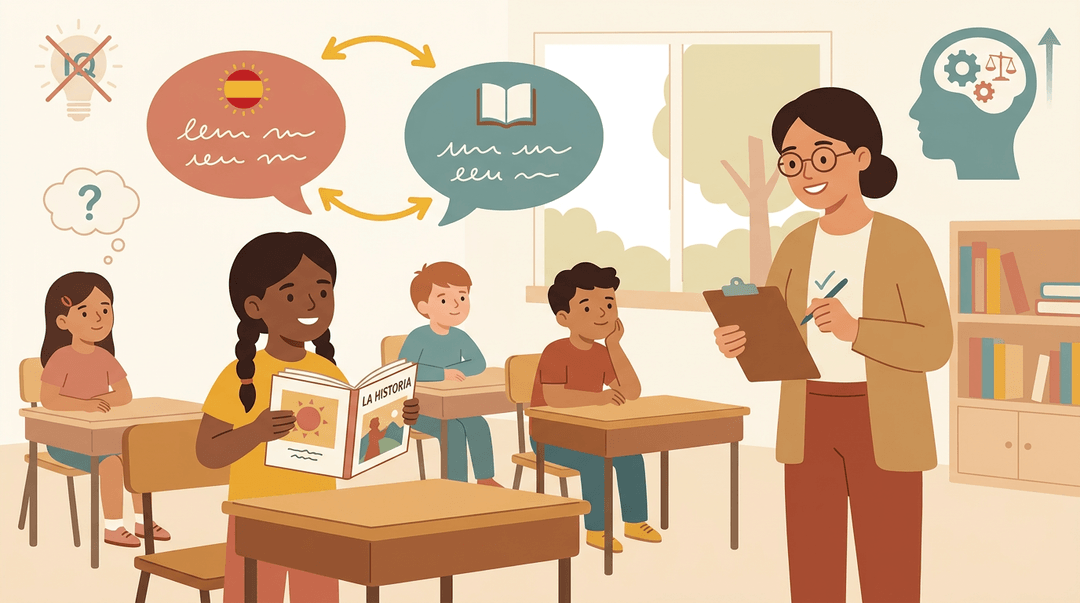
So do bilinguals have a higher intelligence quotient (IQ)? The studies we have test specific skills, not overall intelligence, and even there the advantage is small.
Effects on memory and problem-solving
Improved memory, multitasking ability, better problem-solving, and decision-making skills are often claimed, but none of our verified sources test them directly. Mental flexibility overlaps with the executive function evidence above.
Treat all of these as open questions, not promises for families.
Creativity and seeing other viewpoints
Creative thinking, multiple perspectives, and awareness of how language works are often claimed, but only the theory-of-mind research below comes close to testing them.
That research centers on theory of mind, the ability to understand that others have their own thoughts.
A study called Seeing Through Other Eyes found the overall difference wasn't statistically significant, but bilingual toddlers outperformed monolingual peers on perspective-taking trials. That's an edge on some tasks, not across the board.

Possible protection against mental decline
A systematic review of dementia studies found bilingualism is associated with a delayed onset of dementia but not with a lower risk of developing it. Delayed cognitive aging is the better-supported idea; possible dementia protection is the bolder one.
Some studies link bilingualism to later onset and others don't, so treat dementia protection as contested, not proven. Promising, but unsettled.
Where the research falls short
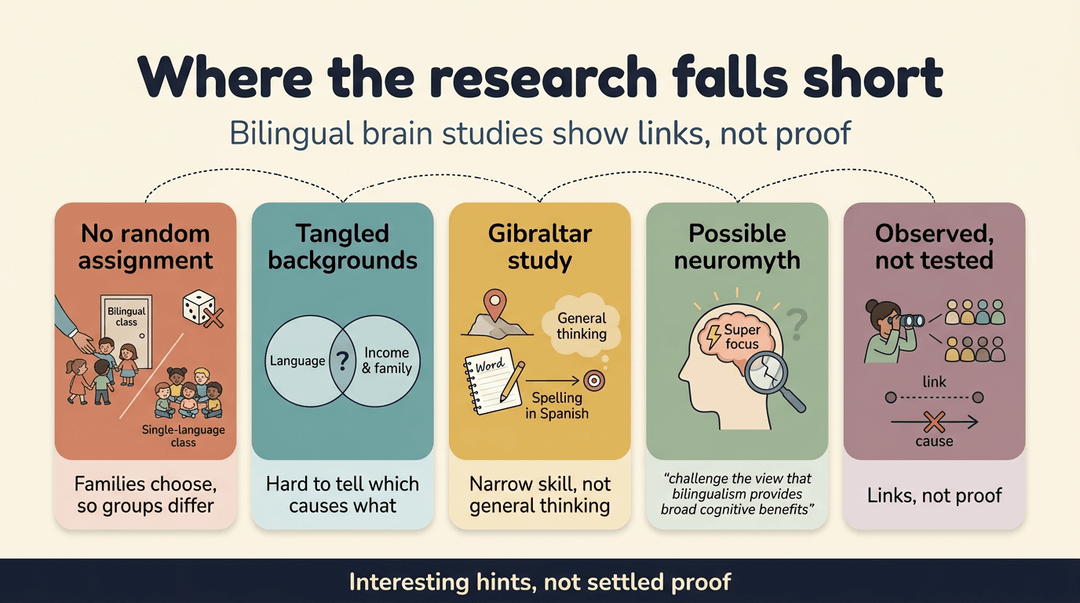
- No random assignment. Children can't be randomly assigned to bilingual education, so families who choose it may differ in other ways.
- Socioeconomic confounds. Income and family background often overlap with language background, making the cause hard to isolate.
- Gibraltar natural-control study. A Gibraltar study in Porta Linguarum used the area's bilingual setting as a natural control, but it measured spelling (orthographic competence) in written Spanish. That's a narrow skill, not general thinking.
- Executive advantage possibly a neuromyth. Some researchers describe it as a possible neuromyth, a popular brain belief the evidence doesn't back up. A reality check on bilingualism and executive functioning says these findings "challenge the view that bilingualism provides broad cognitive benefits."
- Observational, contested evidence. These studies observe existing differences rather than create them, so they show links, not proof of cause.
Academic Benefits of Bilingual Education
Bilingual programs show real academic gains, but the evidence is firmer on some outcomes than others. Here's how we can separate solid results from contested claims.
Test scores and overall school success
According to National Public Radio's education coverage, students in bilingual programs have achieved higher standardized test results than comparison students.
Across studies in six states and 37 districts, dual-language students had somewhat higher scores than peers in English-only or one-way immersion classrooms, and they seemed happier in school. The edge is modest, not dramatic.
Students in these programs also show greater academic achievement, with better attendance and fewer behavior problems.
English skills and when learners exit support
English learner (EL) students often start with a short-term English lag, with early scores trailing their peers. Research on well-structured dual language programs suggests English learners may catch up in English proficiency by fifth grade.
According to a University of California, Los Angeles education article, students in bilingual programs may also be more likely to exit EL services.
Judge a program by its trend over several years, not one snapshot. Fluent bilinguals outperform monolingual peers over time. Patience pays off.
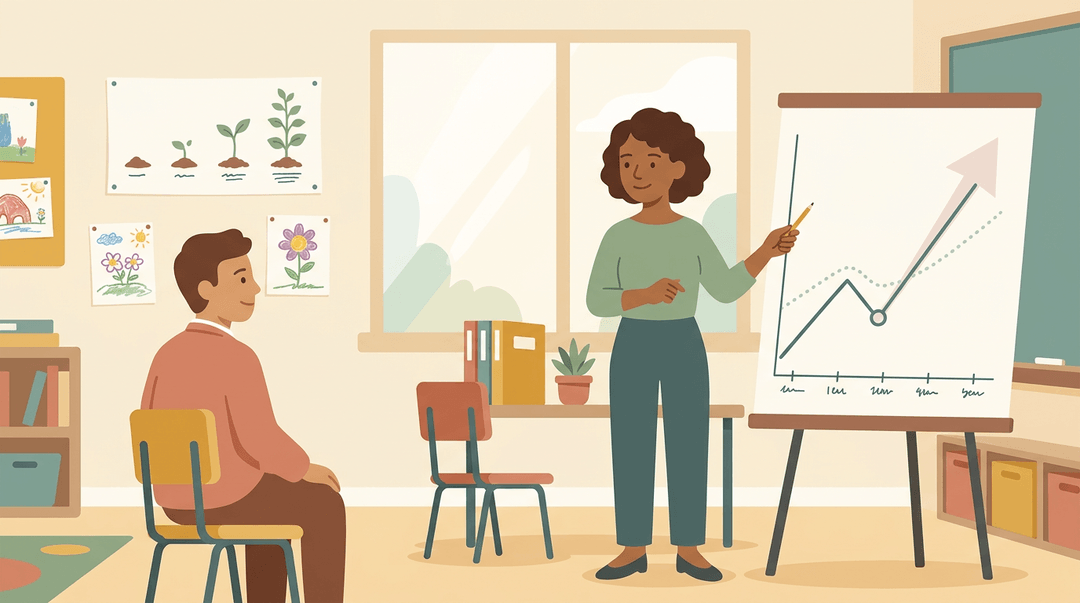
Consider a fourth-grade teacher who charts each EL student's English growth every year. When one score dips, she sees the bigger picture instead of panicking, and she has clear evidence for parent conferences.
Reading and writing in the home language
Students in these programs often read and write better in Spanish. Home language retention keeps that first language strong as English grows, and biliteracy (reading and writing in two languages) is the destination.
Translanguaging is a learning tool: a learner might talk through a science idea in Spanish, then write about it in English. The goal isn't to replace one language with the other. It's to use both.
Challenges for learners still building English
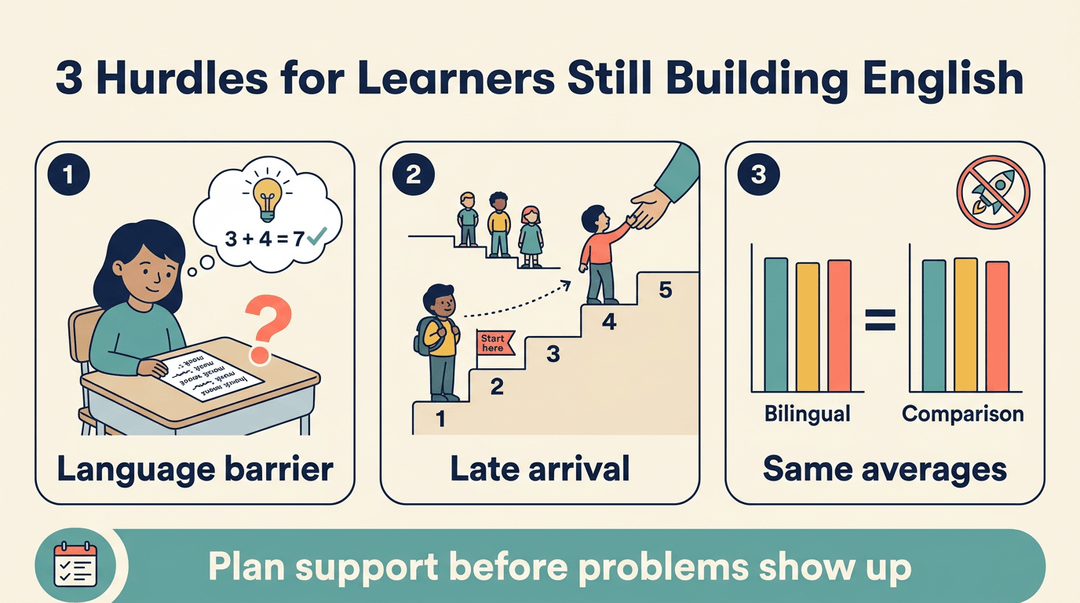
Learners still building English face real hurdles:
- Language barrier difficulties. Students may struggle with directions or word problems even when they grasp the idea.
- Late arrivals. Students who arrive later need support that starts where they are.
- Similar averages. Overall, average attainment is similar to comparison groups, so bilingual education isn't a shortcut that lifts every score.
Knowing these challenges lets you plan support before problems show up.
Why Is Being Bilingual Helpful?
So why is being bilingual helpful? It changes more than what a student can say: it shapes how they see others, connect with family, and handle new situations. Where research backs a benefit, we'll say so.
Becoming more open to other cultures
Learning a language is less about memorizing phrases and more about using them with real people.
Research archived by Oxford University has associated learning another language with less prejudice toward people from other cultures, and it points to perspective-taking as the route.
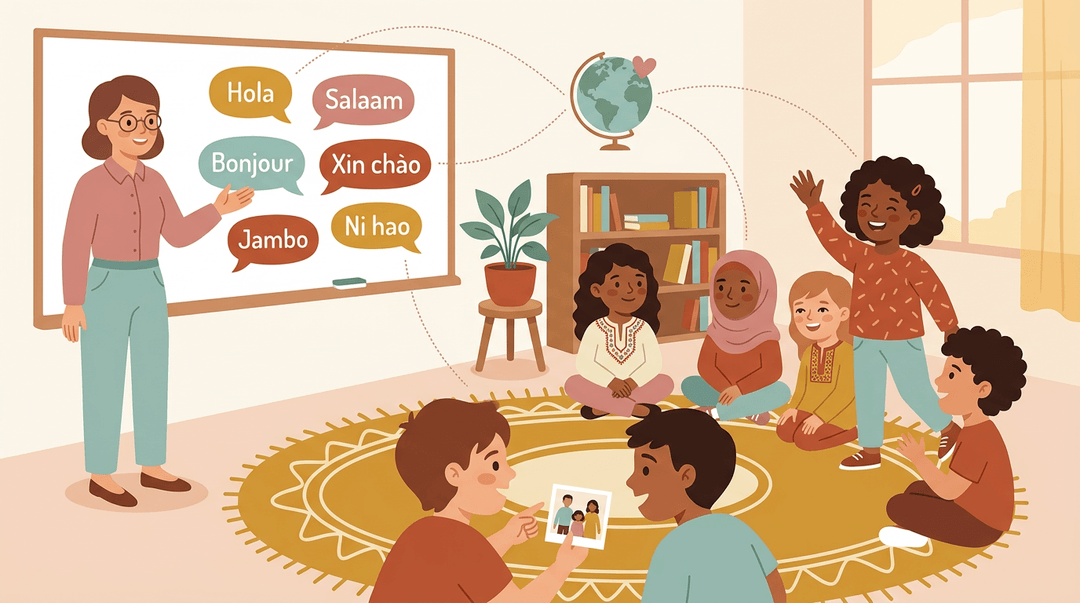
When a fourth-grade teacher invites students to share home-language greetings, the class starts asking about families and valuing its differences.
Bilingual students also build global citizenship, a sense of belonging to the wider world, and gain additional social networks.
Emotional wellbeing and better communication
A child who can describe a hard day in their strongest language has more ways to work through it, which supports socio-emotional wellbeing, meaning how students handle their feelings.
Bilingual students also practice communication adaptation, slowing down or simplifying for a grandparent or a classmate still learning English. That same work builds empathy, the ability to see the world from someone else's side.
Infants tune in to the sounds around them, so talking and singing in more than one language gives them more to listen to.
Keeping heritage and strengthening family ties
Language carries culture across generations, and bilingual education helps keep that thread intact. Preserving heritage means passing on family stories, songs, and sayings. It's less about speaking the language and more about passing it on.
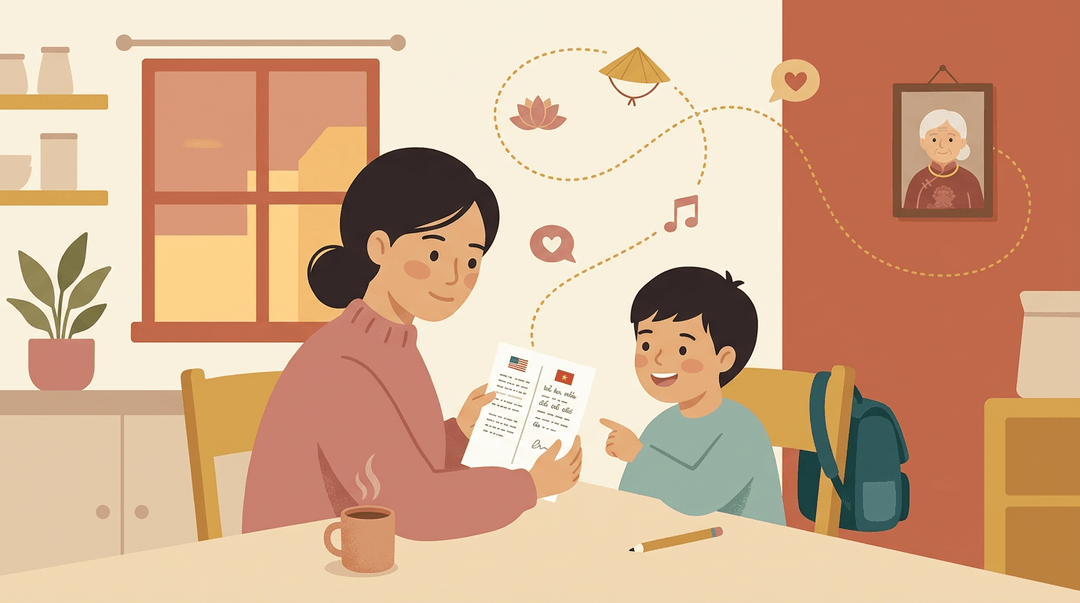
Seeing their home language valued at school also strengthens identity. Consider a mother who speaks mostly Vietnamese at home. When a bilingual reading note comes home from school, she can read it with her son and talk about his day.
Some parents even request bilingual programs for this reason.
Building confidence and adapting to change
Moving between two languages is flexibility in practice, and that habit feeds self-confidence. You can see that confidence when a student walks into a tricky task expecting to find a way through.
The same skill eases the move to a new school or a substitute's unfamiliar room. It also supports resilience under pressure: when one approach isn't working, there's always another way to say it. Flexibility travels well.
Career and Earning Benefits
Searching for the 7 benefits of learning a language? Here are the career-related ones, with solid claims separated from shakier ones.
Why employers want bilingual workers
Bilingual workers are highly sought by employers:
- Broader career opportunities. A second language widens the jobs you can apply for.
- Access to international jobs. Bilingual skills can open doors to work across borders.
- Appeal to global companies. Businesses serving customers in several languages have a practical use for bilingual staff.
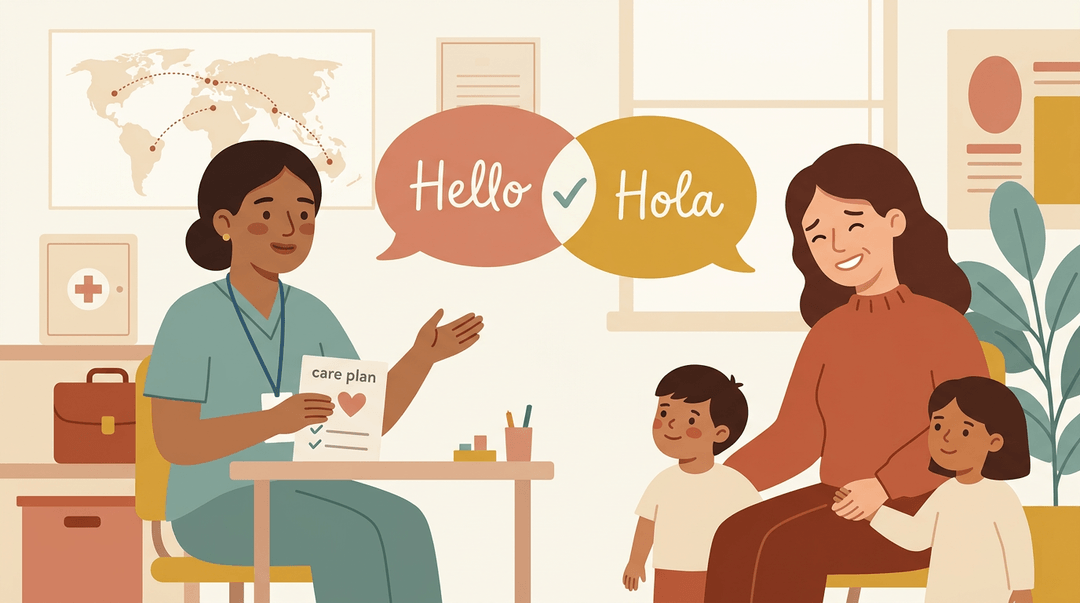
Think of a school nurse who explains a care plan to a parent in the parent's first language. The parent leaves knowing what to do.
What research shows about earnings
You'll often hear that Hispanic bilinguals earn more and that employers lack proficient bilinguals. We don't have a verified source for either claim, so check before you repeat them.
Studies outside that context report modest income benefits.
One example is research on the long-term effects of bilingualism on children of immigration, which shows that balanced bilingual students earn significantly more as adults at the beginning of their careers than students who are dominantly proficient in English only.
Economic and social cohesion, or how well communities connect across language lines, is a broader outcome tied to bilingualism.
Skills that carry over to any job
These habits go with students into any job:
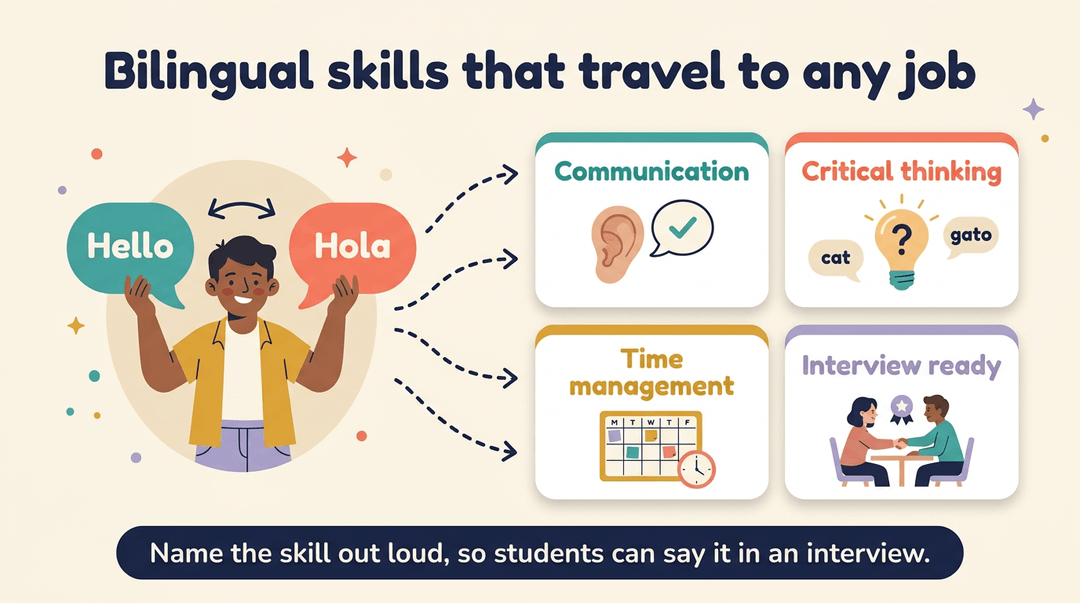
- Communication skills. Working between two languages sharpens how students listen and choose their words.
- Critical thinking. Comparing how two languages express one idea invites students to ask why.
- Time management and organization. Keeping two languages straight across subjects takes planning.
- Professional readiness. Students who work in two languages arrive at interviews with a practical edge.
Name these skills out loud so students can name them in an interview.
Trends, Policy and the Bigger Picture
Planning a lesson starts with the bigger picture: how common bilingualism is, what the law allows, and what research says.
How common bilingualism is worldwide
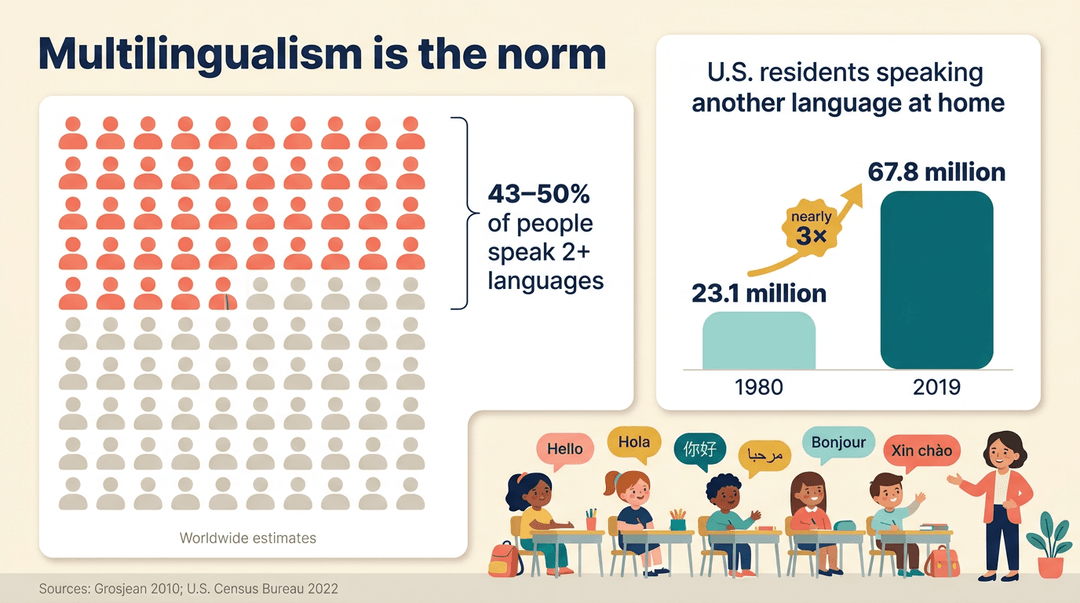
Estimates vary: one figure puts the bilingual share at 43%, while Grosjean (2010) says approximately half of the world's population is bilingual.
Between 1980 and 2019, the number of U.S. residents speaking a language other than English at home nearly tripled, from 23.1 million to 67.8 million, per U.S. Census Bureau data (2022), as cited in a Springer Nature review.
Open borders, travel, and remote work after Covid bring more languages into your classroom. Multilingualism is the norm, not the exception.
Laws that shape bilingual schooling
Laws shape what a program can look like:
- Seal of Biliteracy: recognizes students who've built skills in more than one language.
- State funding for dual-language programs: varies, so check what your state offers.
- Proposition 227 and Proposition 58: show how much these rules can shift over time.
- Massachusetts' LOOK Act and Arizona's English immersion law: take different paths, so your model depends on where you teach.
Know the rules before you plan.
Strengths over deficits and the age myth
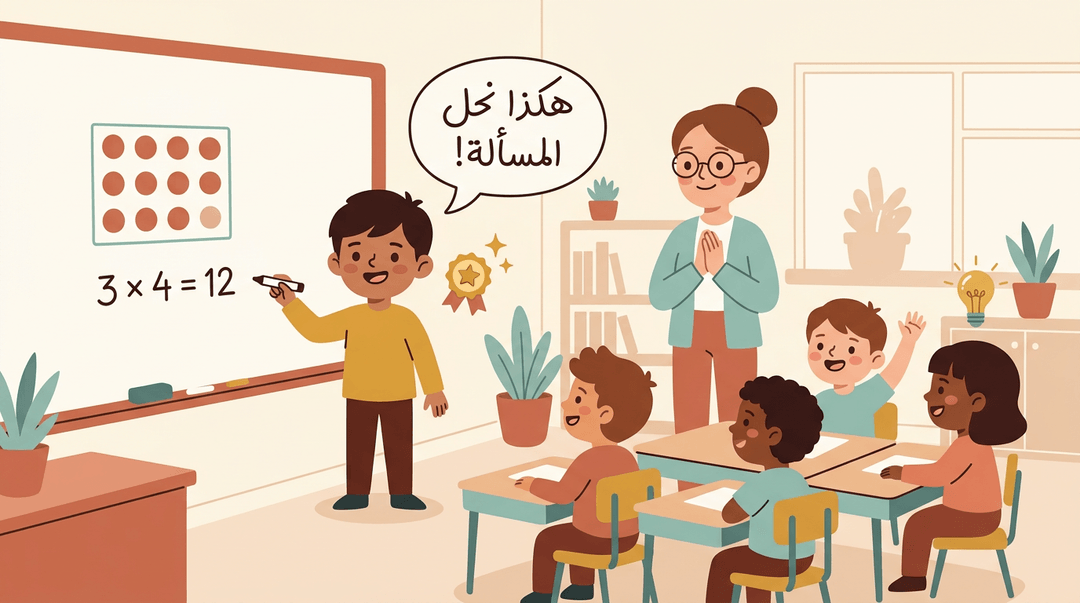
Start with mindset: home languages are an asset, not a deficit. Picture a fourth-grade teacher with a newcomer who speaks only Arabic at home. Instead of waiting for English to catch up, she has him explain a math strategy in Arabic first.
The class gets the idea, and he becomes the expert.
An early start also aids pronunciation.
Adults still learn languages, too. The article Three Misconceptions About Age and L2 Learning (L2 means second language) notes that adults can become highly proficient, even nativelike, speakers of one.
Read as a hard cutoff, the critical window is a myth. Later starters aren't locked out.
Bilingual education can offer real value, but its strongest case rests on the outcomes that are well supported and on programs designed to deliver them.
When you keep those solid benefits separate from the debated claims, you can make clearer, more honest choices for your classroom.
Ready to plan your next bilingual lesson? Check out Lesson Planning, where you'll write, organize, and reuse lesson plans across multiple classes from one place.
References
- Bridges or Barriers? A Systematic Literature Review of Multilingualism in Counseling | International Journal for the Advancement of Counselling — link.springer.com (2025)
- Seeing Through Other Eyes: How Language Experience and ... — pmc.ncbi.nlm.nih.gov (2025)
- Bilingualism Is Associated with a Delayed Onset of Dementia but Not with a Lower Risk of Developing it: a Systematic Review with Meta-Analyses — research-repository.uwa.edu.au (2026)
- Influence of the sociolinguistic and educational context of Gibraltar on the development of orthographic competence | Porta Linguarum. An International Journal of Foreign Language Teaching and Learning — revistaseug.ugr.es (2026)
- Voir La Vie Sans Rose-Colored Glasses: A Reality Check on Bilingualism and Executive Functioning — pmc.ncbi.nlm.nih.gov (2025)
- How Bilingual Children Outperform Monolingual Peers by ... — yhis.org (2026)
- Bilingual education reduces ethnic outgroup discrimination - ORA — ora.ox.ac.uk (2025)
- The Long-Term Effects of Bilingualism on Children of Immigration — doi.org (2026)
- The Bilingual Advantage in Children’s Executive Functioning Is Not Related to Language Status: A Meta-Analytic Review — uwo.scholaris.ca
- The contribution of bilingualism to cognitive reserve in healthy aging and dementia. — psycnet.apa.org
- Bilingual Education Is America’s Future — seis.ucla.edu
- Three Misconceptions About Age and L2 Learning — onlinelibrary.wiley.com
- Understanding multilingualism and its implications — pmc.ncbi.nlm.nih.gov (2014)
- Bilingual Education: 6 Potential Brain Benefits : NPR Ed : NPR — npr.org
Frequently asked questions
What are the 7 benefits of learning a language?
Seven benefits of learning a language include broader career opportunities, access to international work, greater appeal to global employers, stronger communication skills, more opportunities to connect across cultures, stronger family and heritage ties, and greater confidence and flexibility. These are potential benefits, not guaranteed outcomes.
What are the three pillars of bilingual education?
The three pillars of bilingual education are proficiency in two languages, academic achievement, and cultural competence.
Why is being bilingual helpful?
Being bilingual can help you communicate with more people, connect with family and heritage, and engage with other cultures. It can also support confidence and adaptability, while offering potential academic and career advantages.
Do bilinguals have higher IQ?
No. Bilingual people do not necessarily have higher IQs. Research has examined specific skills such as executive function, where any overall advantage appears small; those findings do not show higher overall intelligence.