Montessori Curriculum: A Complete Guide to How It Works

Jump to section
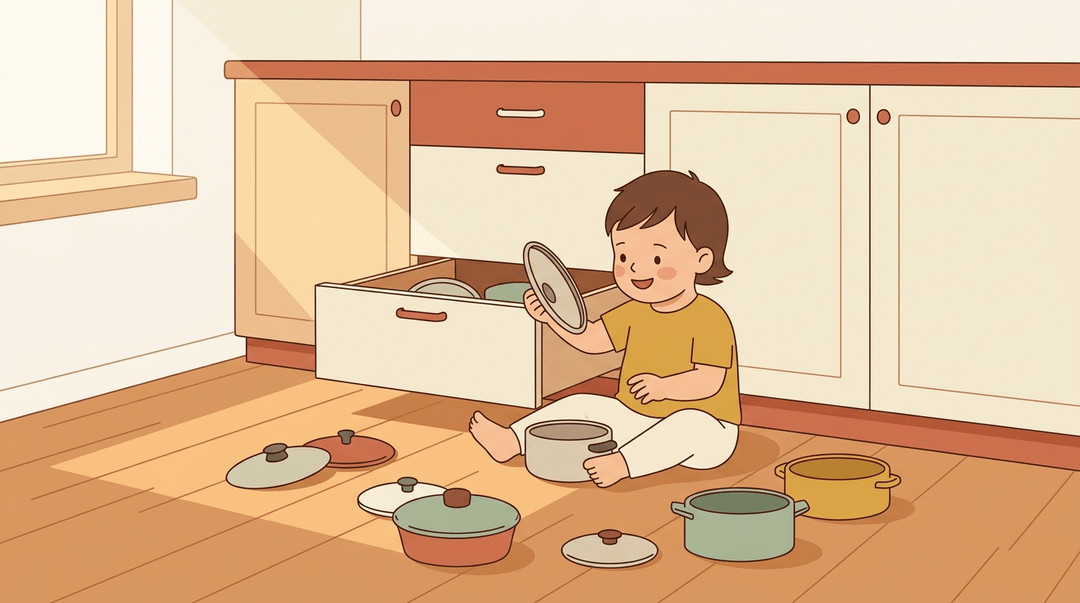
Watch a toddler explore a kitchen drawer: pulling out lids, testing which pot fits where, moving at their own pace with no worksheet in sight. That's curiosity doing the teaching.
The Montessori curriculum works the same way. It's a child-led, hands-on approach built around real materials, mixed-age classrooms, and a teacher who guides rather than lectures.
Here, we'll walk through its philosophy, how it grows with age, the subjects it covers, and how you can borrow its best ideas for your own classroom.
The Philosophy Behind the Montessori Curriculum
Maria Montessori built her method on a simple belief: children learn best when adults step back and let them lead. That belief shows up in seven core principles:
- respect for the child
- the absorbent mind
- sensitive periods
- the prepared environment
- auto-education (self-teaching)
- hands-on learning
- following the child
Critics raise a real concern here too: the biggest criticism of Montessori is that its unstructured pace can leave some kids without enough direct guidance, especially when they move to a traditional school later.
Here's how the philosophy actually plays out in the classroom.
Letting kids direct their own learning
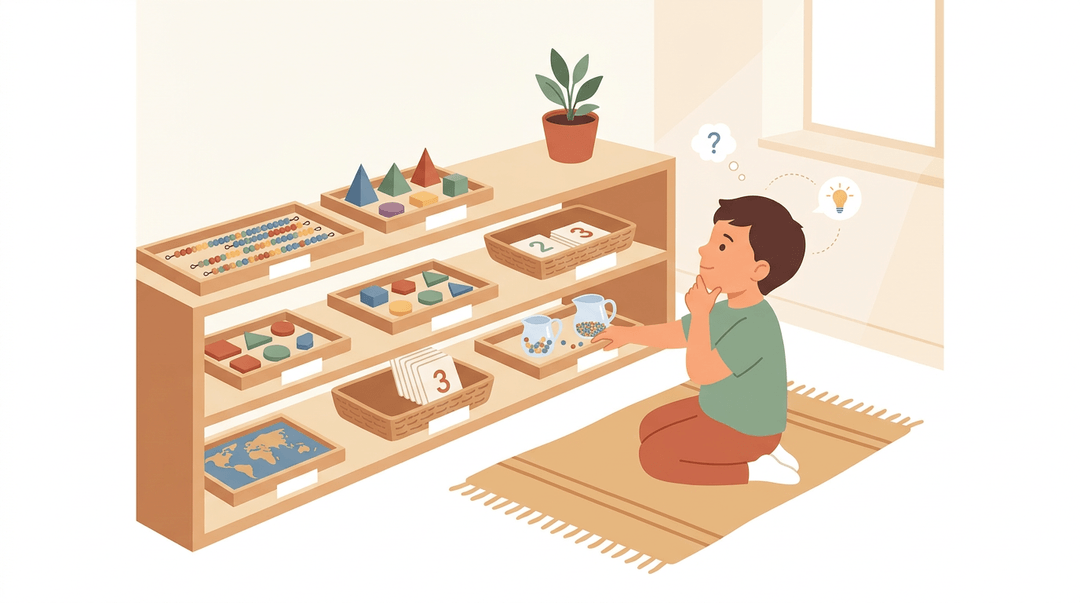
Montessori treats every child as a natural learner, someone curious and capable long before a teacher steps in. Students choose their own work from a set of prepared options, building independence and self-confidence with every choice.
That freedom also sharpens critical thinking: a student deciding what to tackle next has to weigh options, not just follow instructions.
Learning through hands-on, sensory play
Montessori classrooms lean hard on kinesthetic activities: think tracing sandpaper letters or pouring rice between containers. These tasks engage sight, touch, and sound all at once.
Movement is tied directly to learning rather than treated as a distraction from it, and manipulative materials like bead chains or number rods let abstract ideas become something a child can actually hold.
Is Montessori good for kids with ADHD?
Is Montessori good or bad for ADHD? Research suggests it can be a strong fit. Montessori education has been studied for its role in physical, emotional, and cognitive growth, and for building social-emotional skills like patience and self-regulation.
According to the American Montessori Society, Montessori's inclusive design already extends to "children with disabilities and neurodivergences, including physical disabilities; learning differences in reading, writing, spelling and/or math; ADHD; and autism spectrum disorders."
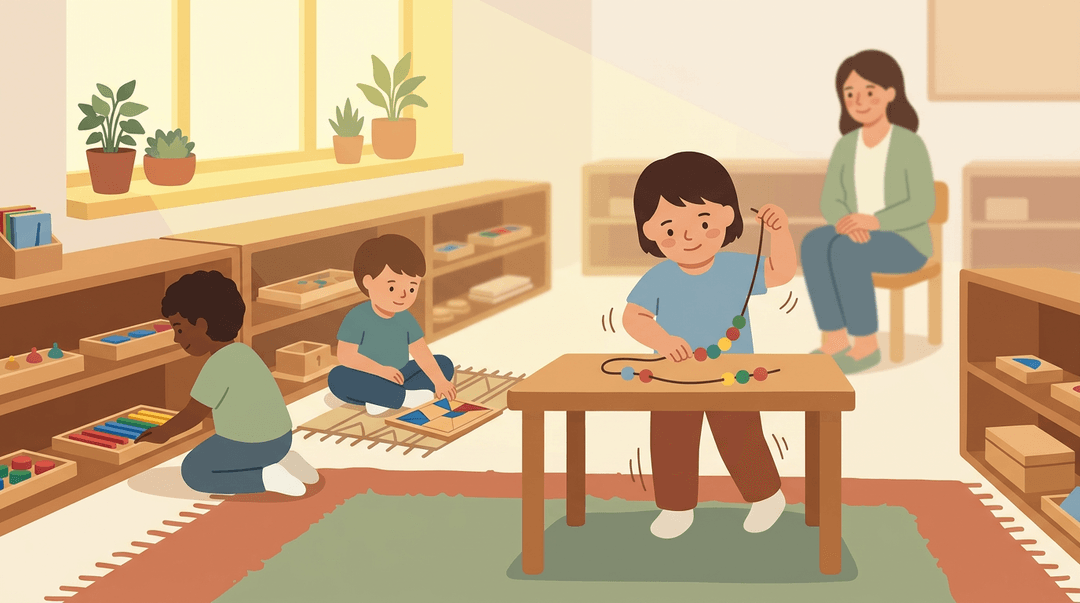
Respect for individual differences sits at the center of that fit: a child who needs to stand and move while working isn't disruptive, they're just working the way they work.
That same structure fosters responsibility, since each student manages their own materials and time.
Raising peaceful, globally minded kids
Montessori also aims to raise peaceful, globally minded kids. Students practice conflict resolution as part of daily classroom life, learning to work out disagreements with words instead of escalation.
Lessons build respect for people and living things, and cultural diversity awareness helps students see the wider world as something to appreciate, one small step toward a more peaceful world.
How the Montessori Curriculum Grows with Age
Montessori isn't one-size-fits-all by grade. It's built to match how a child develops, shifting focus and materials as they move through distinct stages.
What ages Montessori covers
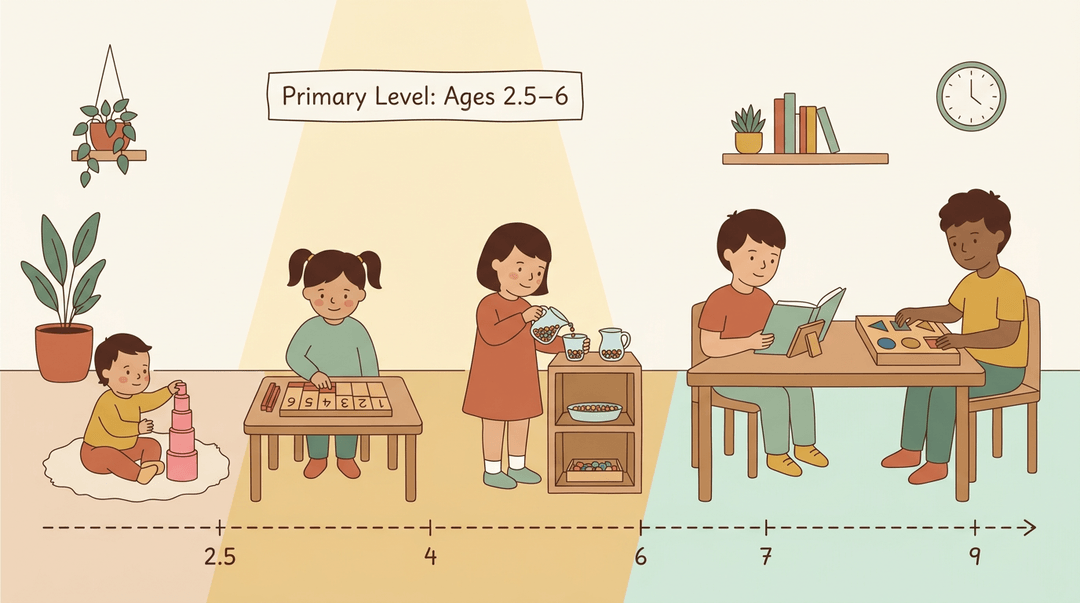
The core curriculum spans ages 2.5 to 6, covering toddler through kindergarten. This stretch is usually called the primary level, and it's the heart of most Montessori programs.
Some schools extend the model through age 9, blending in elementary work as students grow more independent.
The multi-year classroom cycle
Primary classrooms typically run on a three-year cycle, keeping the same mixed-age group together from age 3 through kindergarten. Add the toddler year before it, and many schools describe the whole span as a four-year curriculum bundle.
Mixed-age grouping means a 4-year-old can work right next to a 6-year-old, watching older peers model a skill before trying it alone.
Kindergarten caps the cycle: it's the year children become the classroom mentors themselves, the culmination of everything the earlier years built toward.
How the daily work cycle flows
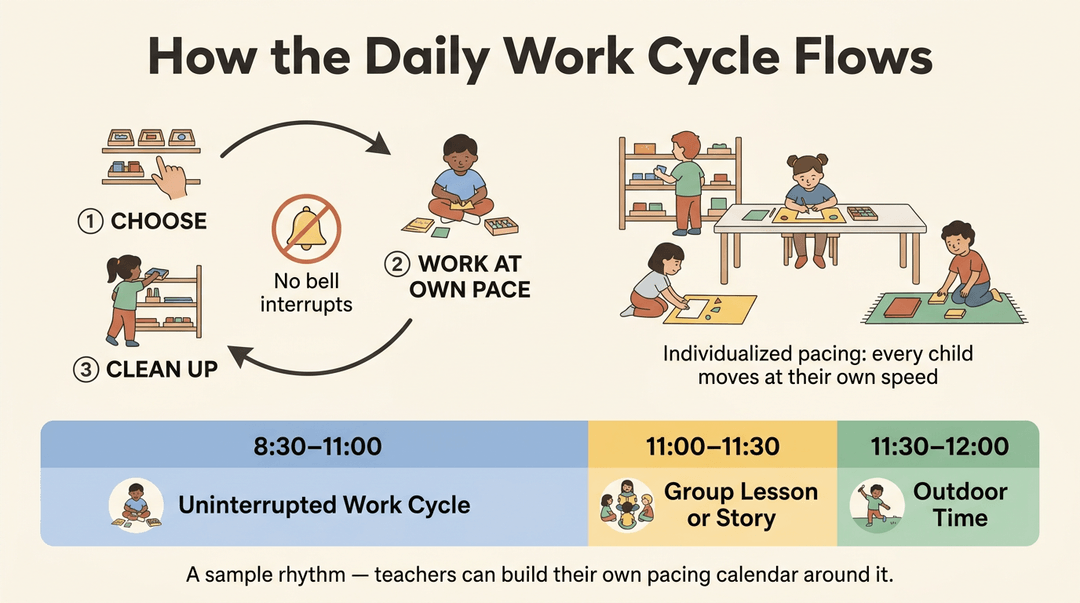
Each day centers on uninterrupted work blocks, often two to three hours long, where children choose an activity, work through it at their own speed, and clean up before moving to the next.
That choose-work-clean up rhythm is what gives every child individualized pacing: no bell forces a switch mid-task.
A sample daily work-cycle schedule might look like this:
| Time | Activity |
|---|---|
| 8:30-11:00 | Uninterrupted work cycle |
| 11:00-11:30 | Group lesson or story |
| 11:30-12:00 | Outdoor time |
Teachers can build their own pacing calendar around this same rhythm instead of following a fixed, grade-by-grade curriculum map.
Core Subjects in a Montessori Curriculum
Walk into a Montessori classroom and you won't find subjects taught in isolation. Five core areas weave together instead, each one building the skills a child needs for the next.
Practical life skills for everyday living
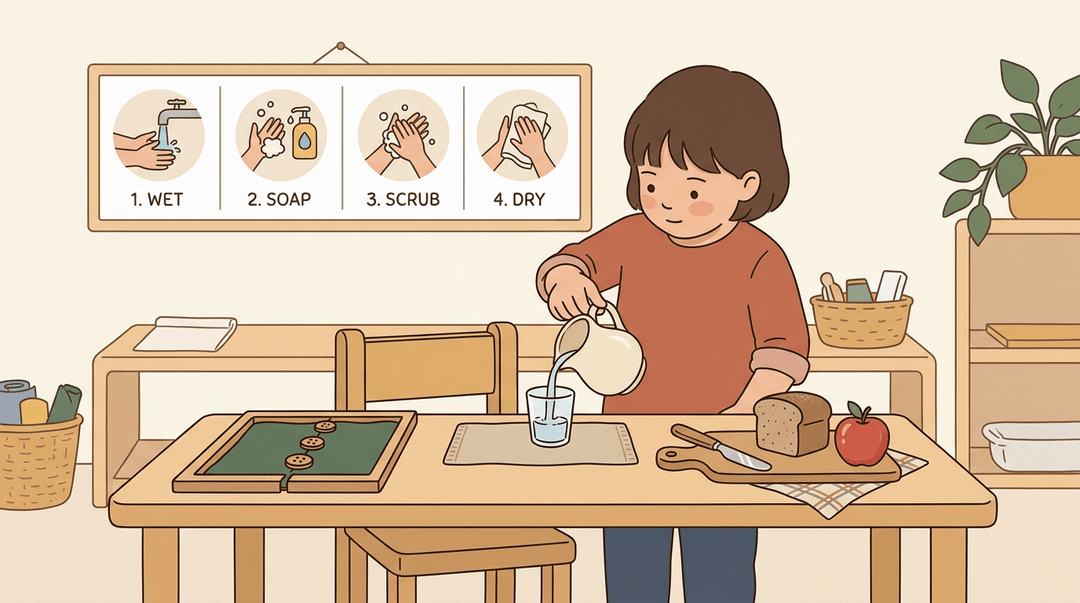
Practical life work is where every Montessori day starts. Children practice daily living skills like pouring, buttoning, and sweeping, alongside self-care and food prep tasks such as washing fruit or spreading butter.
These activities quietly build fine and gross motor development, the same muscles a child later uses to hold a pencil or balance on a step stool.
For toddlers, routine cards break a task like handwashing into simple, sequenced pictures they can follow on their own.
Sharpening the five senses
Sensorial work comes next, aimed at refining the five senses through materials that isolate one quality at a time:
- Color
- Texture
- Weight
- Sound
Sorting and classification tasks, like matching swatches by shade or nesting cylinders by size, train an analytical mindset before a child ever opens a textbook.
Because each activity has a built-in stopping point, it also builds concentration and grit: a preschooler learning to finish what she started, one bead frame at a time.
Teaching math with hands-on materials
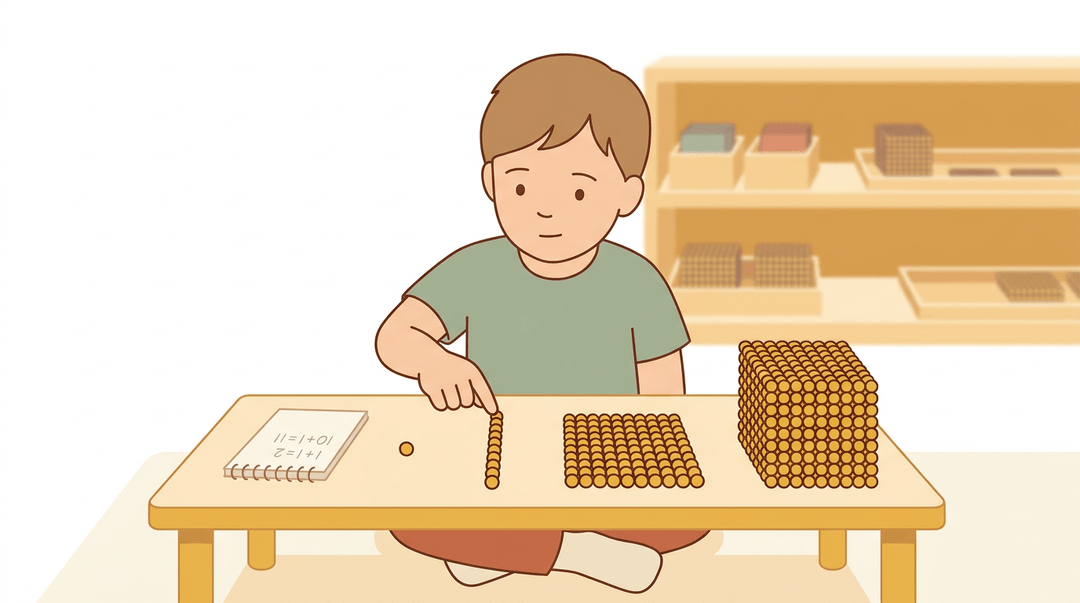
Montessori math starts concrete, not abstract. Children use manipulatives like the golden beads to feel the difference between a unit, a ten, and a hundred, which grounds decimal and place-value concepts long before a worksheet ever shows up.
From there, they move through addition, subtraction, multiplication, and division using those same physical materials, building real number sense rather than memorized facts.
Teachers watch for concrete-to-abstract checkpoints: the moment a child stops counting beads and writes the equation from memory is the cue to introduce the abstract symbol.
Building language skills before reading
Language work flips the usual order: children learn to write before they read.
They trace sandpaper letters to build letter-sound association by touch, grow their vocabulary through naming games, and move from pre-reading exercises, like matching objects to labels, to composing their own short words with a moveable alphabet, well before formal reading instruction begins.
Exploring geography, science, art and history
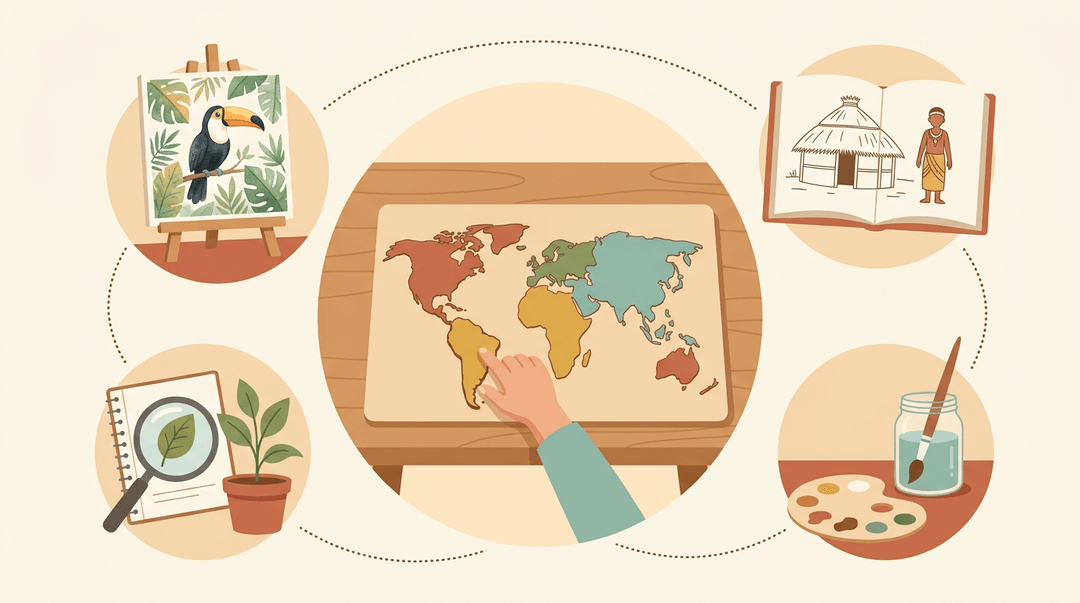
The cultural subjects, geography, science, art, and history, are taught as one interdisciplinary study rather than four separate periods.
A student tracing a puzzle map of the continents might spend the same week learning about the animals that live there, painting them, and hearing how people in that region live.
That blend of physical and cultural geography, hands-on science exploration, and art appreciation gives students a feel for the whole world, not just isolated facts about it.
Setting up the Classroom Environment
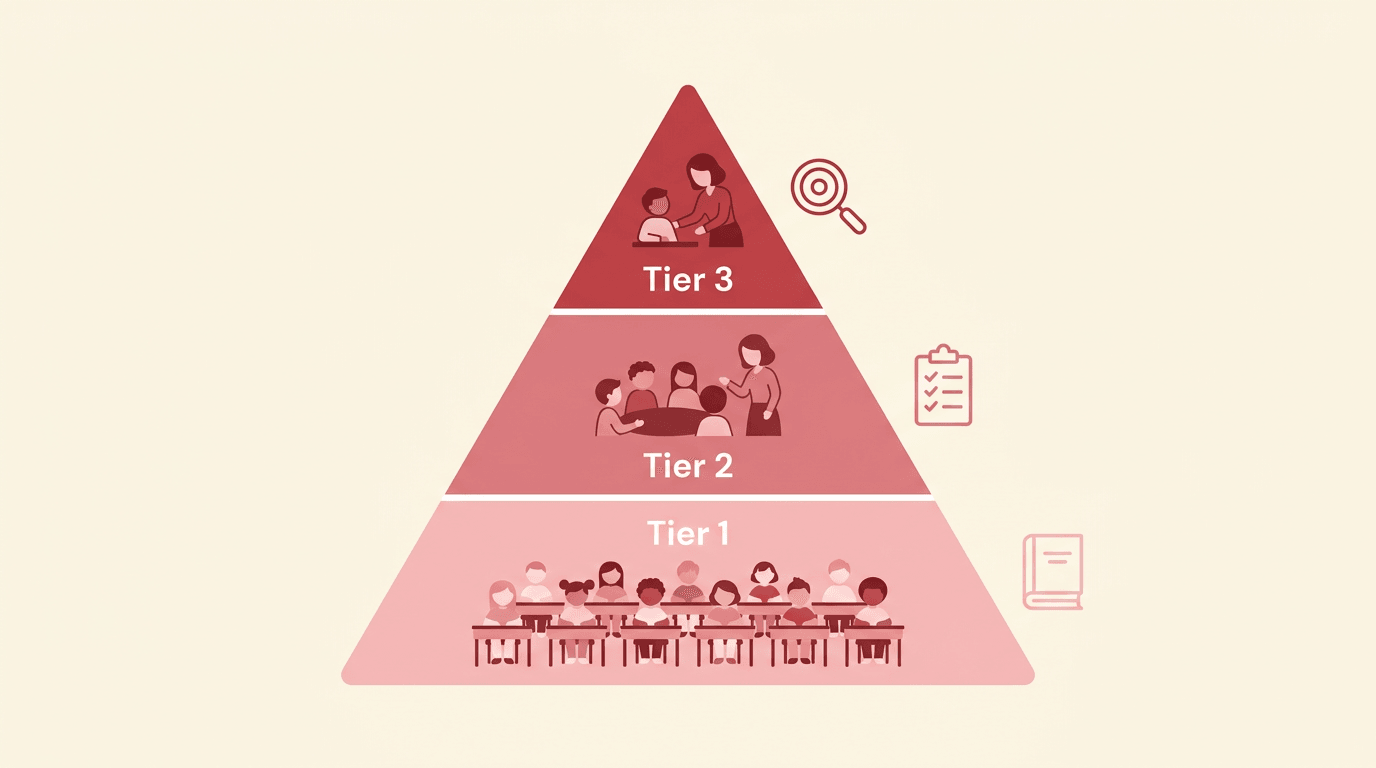
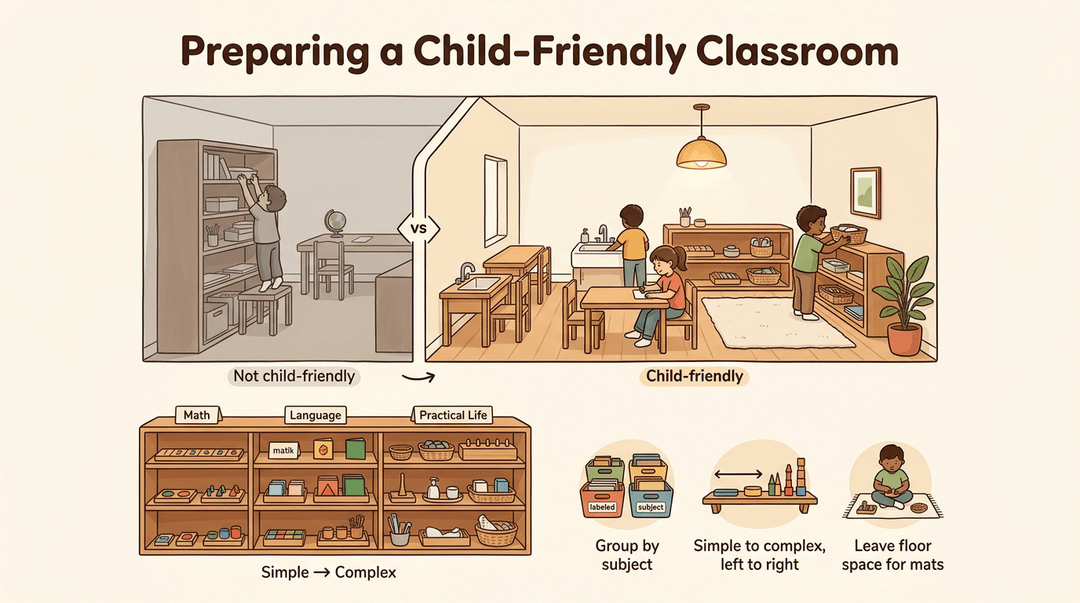
Step into a Montessori room and you'll notice something right away: everything is built for small hands and short reaches. The space itself does a lot of the teaching before a lesson even starts.
Preparing a child-friendly classroom
- A Montessori room starts with child-sized furniture: tables, chairs, and sinks scaled so kids can sit, stand, and reach without help.
- Materials live on open shelving, low enough to grab and put back independently, which quietly builds ownership of the space.
- Rugs, plants, and soft lighting give the room a home-like atmosphere instead of a sterile, institutional feel.
For a teacher setting one up, prep is straightforward:
- group materials by subject
- arrange them left to right and simplest to most complex
- leave enough floor space for kids to work on mats rather than only at desks
Iconic materials kids work with
A handful of materials show up in nearly every Montessori classroom:
- Sandpaper letters. Textured letters kids trace with their fingers to link shape and sound before writing.
- Golden bead material. Beads bundled by ones, tens, hundreds, and thousands to make place value tangible.
- Pink tower. Ten graduated cubes that teach size, sequencing, and fine motor control.
- Metal insets. Geometric shapes traced to build pencil control ahead of handwriting.
- Binomial cube. A puzzle that hints at algebraic patterns years before the equation shows up.
How materials teach self-correction
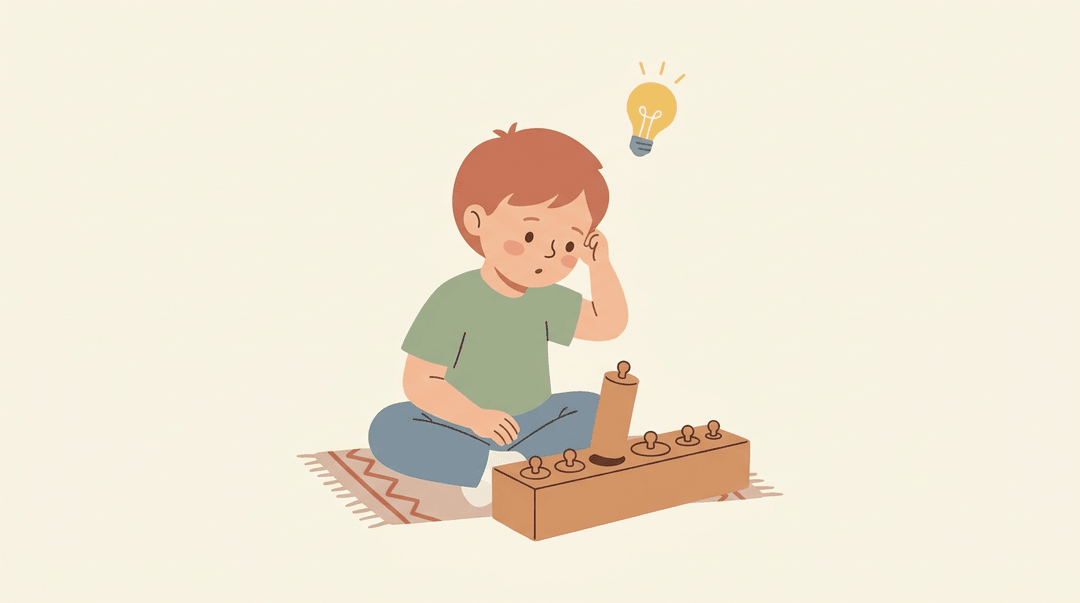
Each material is built to teach one skill, isolated from the rest, so a child isn't juggling several new ideas at once.
Most include a built-in control of error: a missing piece, an uneven tower, a mismatched inset that shows a mistake before a teacher ever points it out.
That independent error-checking builds real confidence, because the child solves the problem alone, and it quietly promotes self-teaching instead of dependence on constant correction.
Printable and visual teaching aids
Beyond the classic materials, printable manipulatives and eye-catching visuals (labeled diagrams, sorting cards, sequencing strips) extend the same hands-on approach to new subjects.
Clear presentation instructions keep the lesson consistent from one use to the next, and simple assessment rubrics let a teacher track progress without turning the room into a test-prep space.
Plan a Montessori-inspired Lesson Step by Step
Use this guide when you want to bring the Montessori arc (prepare, present, observe, record) into your own classroom, whether or not you teach in a certified school. Each phase below stands alone, so you can adopt one at a time.
Before the lesson: prepare the environment
- Pick an activity matching a sensitive period. Follow what the child is already drawn to.
- A child tracing letters on every surface is signaling readiness for sandpaper letters.
- Prep the shelf materials. Every piece present, clean, and arranged left to right.
- A missing bead or chipped cylinder breaks the child's concentration before you can.
- Write one clear objective. One skill, observable, in a single sentence.
Objective as you'd write it: "The child isolates the /m/ sound by tracing the sandpaper letter while saying it aloud."
During the work cycle: present, then step back
- Observe, don't lecture. Sit at the child's level, hands still, and let the material teach.
- Give a three-period vocabulary lesson when introducing new terms.
| Period | You say | The child does |
|---|---|---|
| 1. Name | "This is rough. This is smooth." | Touches each card |
| 2. Recognize | "Show me rough." | Points to the right card |
| 3. Recall | "What is this?" | Names it independently |
- Protect uninterrupted work time. No mid-task praise, corrections, or transitions.
- Note errors silently; the material's built-in control of error does the correcting.
⚠️ Watch out: interrupting a concentrating child to compliment them still breaks the work cycle. Save feedback for after the child returns the material to the shelf.
After the lesson: close the loop
Before the day ends, confirm you've captured three things:
- Observation notes recorded. Date, material chosen, and one behavior, not a paragraph.
- "3/12: Chose pink tower twice. Hesitated at cube six, self-corrected."
- Material mastery logged. Mark each material presented, practicing, or mastered.
- Next presentation planned. Mastery of one material tells you which comes next.
- Mastered the pink tower? The brown stair is the natural next presentation.
Example: A preschool teacher notices a four-year-old pouring water at the snack table over and over. She presents the pouring work with two small pitchers, watches from a distance for ten minutes, then logs "pouring: practicing" and plans the funnel work for next week. That's the full arc in one morning.
Track observations and map each child's material mastery in one place with EMStudio's curriculum planner.
Where the Montessori Curriculum Works Best
Montessori isn't locked to one kind of room. Whether you're running a home daycare or weighing it against a traditional preschool down the street, the method bends to fit its setting while keeping its core intact.
Using Montessori at home or daycare
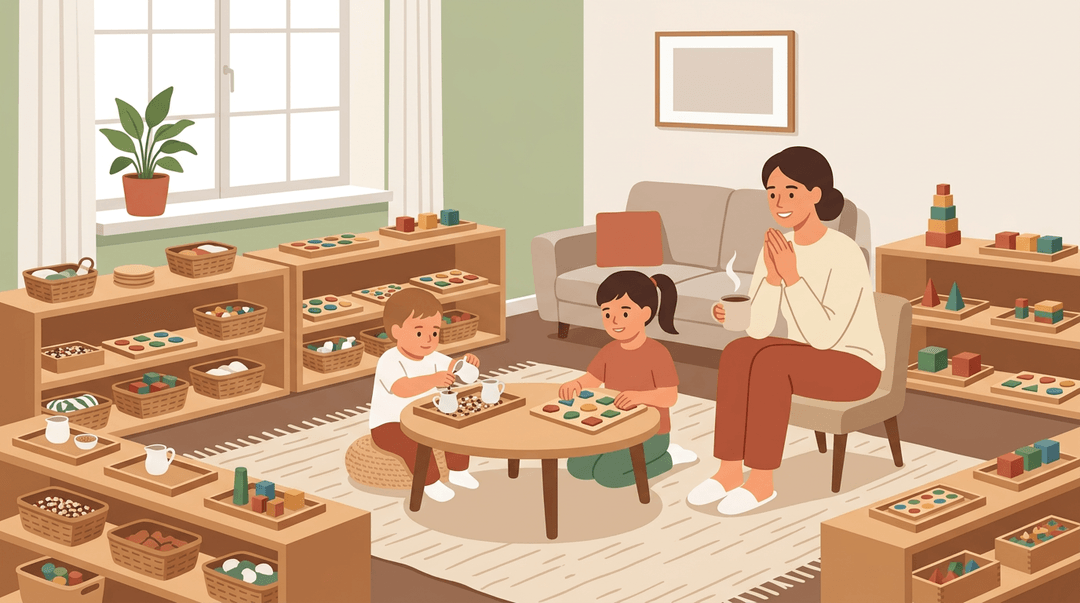
Think of a home daycare provider juggling toddlers and preschoolers in one small living room. This isn't a traditional classroom with rows of desks: it's a set of shelves, low tables, and child-sized tools that let kids choose their own work.
That structure actually reduces your workload as a caregiver, since children who know how to use the materials can self-correct and stay occupied without constant redirection.
Many providers lean on group coaching support, cohorts of caregivers troubleshooting setups together, to keep things running.
For a home or daycare with several age groups, license options let you train once and apply the method across multiple children instead of building a new routine for every new enrollee.
How is Montessori different from preschool?
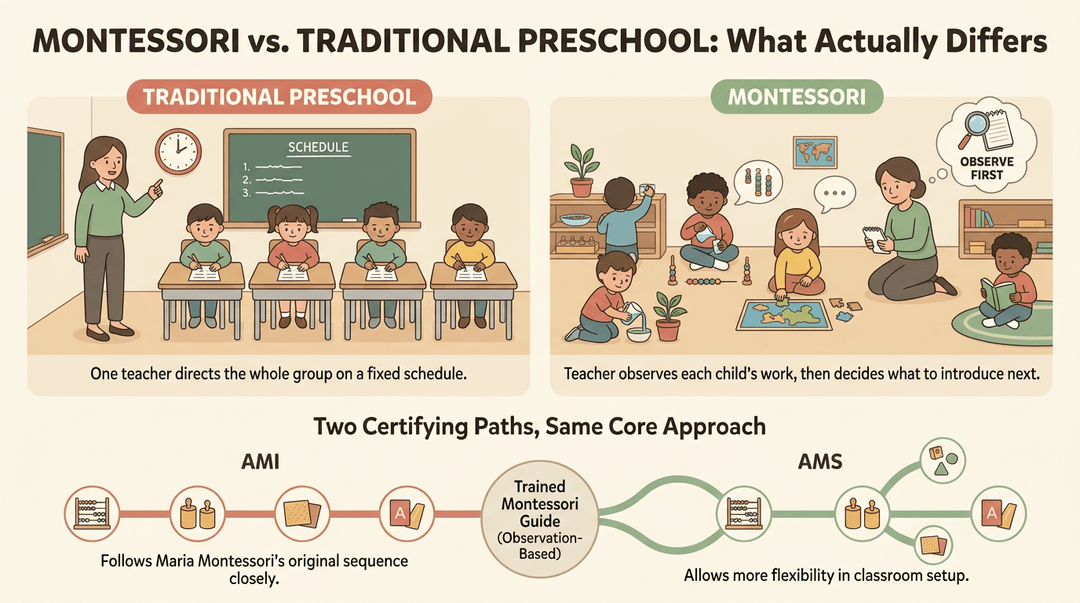
A traditional preschool often centers on one teacher directing a set schedule for the whole group. Montessori flips that.
Teachers are trained specifically in observation-based lesson planning, watching each child's work before deciding what to introduce next, and they act as a guide rather than a lecturer.
That guidance is formalized through certification, and AMI and AMS differ in their training pathways even though both organizations emphasize the same trained-teacher, observation-first approach.
As Montessori Scientific Research notes, "Two major organizations are globally recognized for maintaining the integrity of Montessori training: the Association Montessori Internationale (AMI) and the American Montessori Society (AMS)."
AMS-certified guidance tends to allow more flexibility in classroom setup, while AMI holds closer to Maria Montessori's original sequence, a distinction worth knowing before you choose a program.
What You Get and How to Access It
Knowing the philosophy behind Montessori is one thing. Knowing what actually shows up on your desk (or your screen) is another. Here's a look at what a typical package includes and how you actually get it into your classroom.
What's included in the curriculum package
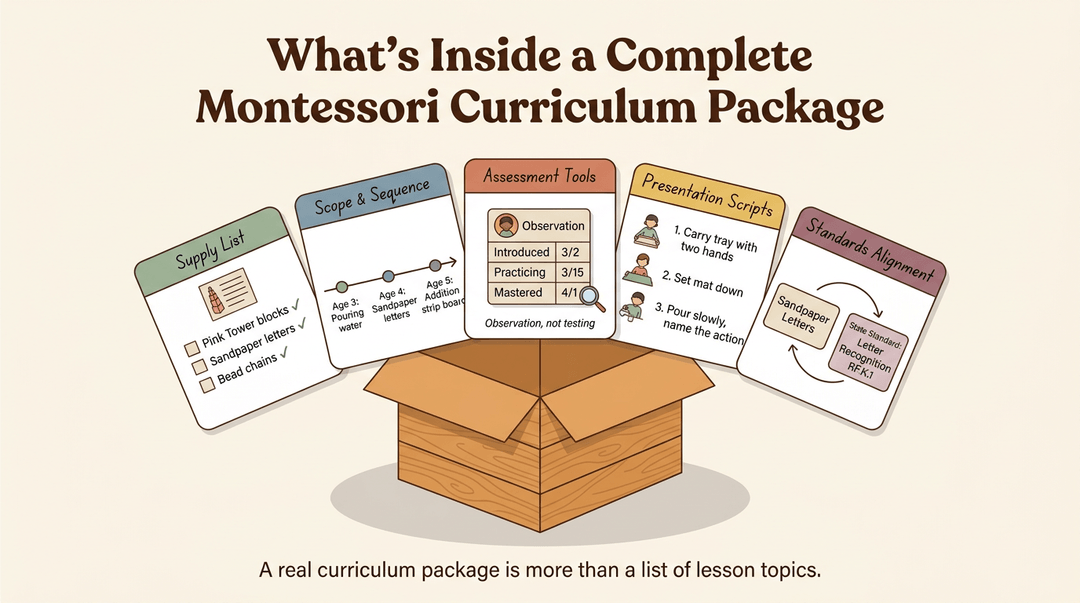
A solid Montessori curriculum is more than a list of lesson topics. Most complete packages bundle:
- Supply list. The exact materials each lesson calls for, so you're not scrambling the night before.
- Scope and sequence rubrics. A map of what gets taught, in what order, and when a child is developmentally ready for it.
- Assessment and record-keeping tools. Simple trackers for noting mastery and growth, since Montessori favors observation over traditional testing.
- Presentation instructions. Step-by-step scripts for introducing a material the way it's meant to be shown.
- Standards alignment considerations. Notes on how the sequence maps to state or national benchmarks, useful if you answer to a school board or licensing body.
How the curriculum is delivered and licensed
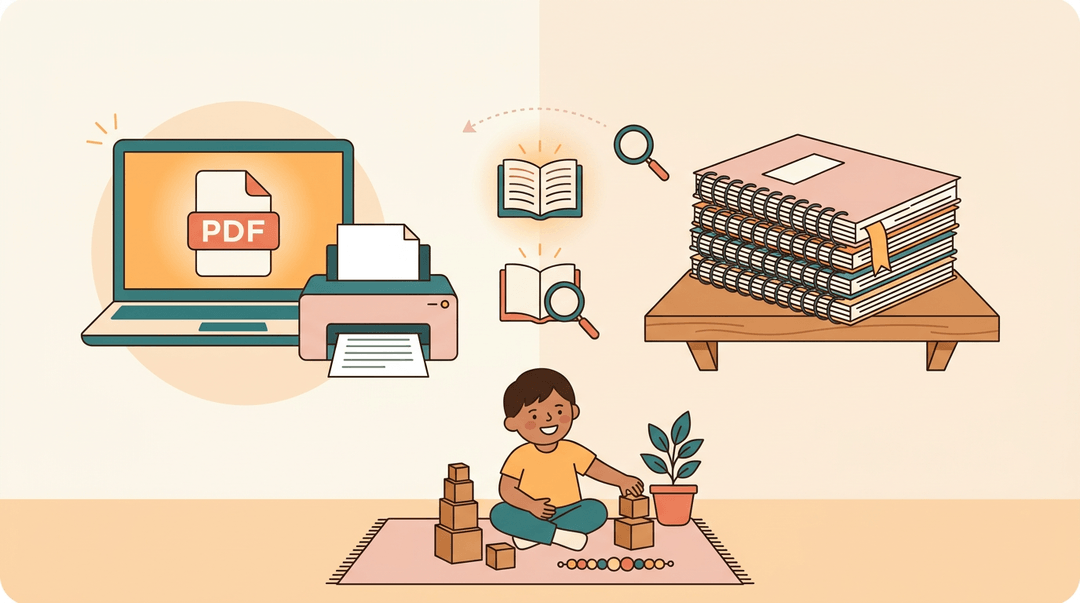
Most providers give you a choice: a digital PDF you can print on demand, or printed bound copies shipped ready for the shelf.
Digital works well for a teacher who likes to tweak and reprint; bound copies suit a classroom that wants something durable on hand every day.
Licensing usually comes in two flavors: a personal license for one teacher or family, and a multi-family license for co-ops, small schools, or a homeschool group sharing materials. If you're not sure it's the right fit, look for a free curriculum sample.
Most providers offer one, and it's the easiest way to see the presentation style before you commit.
The Montessori curriculum isn't a rigid script. It's a philosophy: respect the child's pace, hand them real materials, and let curiosity do the heavy lifting.
Whether you run a full Montessori classroom or just borrow a few ideas, the goal stays the same: students who learn how to learn, not just what to memorize.
Ready to turn these ideas into an actual lesson plan? Check out our Curriculum Planning feature to map units, lessons, and standards across the whole year.
References
- Overview of Certifications and Programs for Aspiring Montessori Educators — montessori-scientific-research.org (2025)
- Montessori for Children with Disabilities & Neurodiversity — amshq.org
Frequently asked questions
What is the Montessori curriculum?
The Montessori curriculum is a child-led, hands-on educational approach built around real materials, mixed-age classrooms, and individualized pacing. Teachers observe and guide rather than lecture, while children choose activities, work independently, and learn through practical life, sensorial, math, language, and cultural studies.
What is the biggest criticism of Montessori?
The biggest criticism of Montessori is that its relatively unstructured pace may not provide enough direct guidance for every child. Some children may also need support adjusting to a traditional school later, where lessons, schedules, and transitions are more teacher-directed.
What are the 7 principles of Montessori education?
The seven principles are respect for the child, the absorbent mind, sensitive periods, the prepared environment, auto-education or self-teaching, hands-on learning, and following the child. Together, they emphasize independence, purposeful activity, and learning that follows each child's development and interests.
How is Montessori different from preschool?
Preschool is a broad term for early-childhood education, while Montessori is a specific educational method that can be used in preschool settings. Traditional preschools often use teacher-directed group schedules, whereas Montessori classrooms emphasize mixed ages, child choice, uninterrupted work periods, hands-on materials, and observation-based guidance.
How is Montessori different from kindergarten?
Montessori kindergarten is typically the final year of a three-year primary classroom cycle, usually serving children ages 3 through 6. Unlike many traditional kindergartens, it usually continues individualized, hands-on work in a mixed-age class, with children choosing activities and working at their own pace rather than following one fixed schedule.
Is Montessori good or bad for ADHD?
Montessori can be a strong fit for some children with ADHD because movement, choice, hands-on materials, and individualized pacing can support attention, self-regulation, and independence. It is not automatically the best option for every child, so families should evaluate the specific classroom, teacher training, structure, and any accommodations available.