What Is Kinesthetic Learning and How Does It Work?

Jump to section
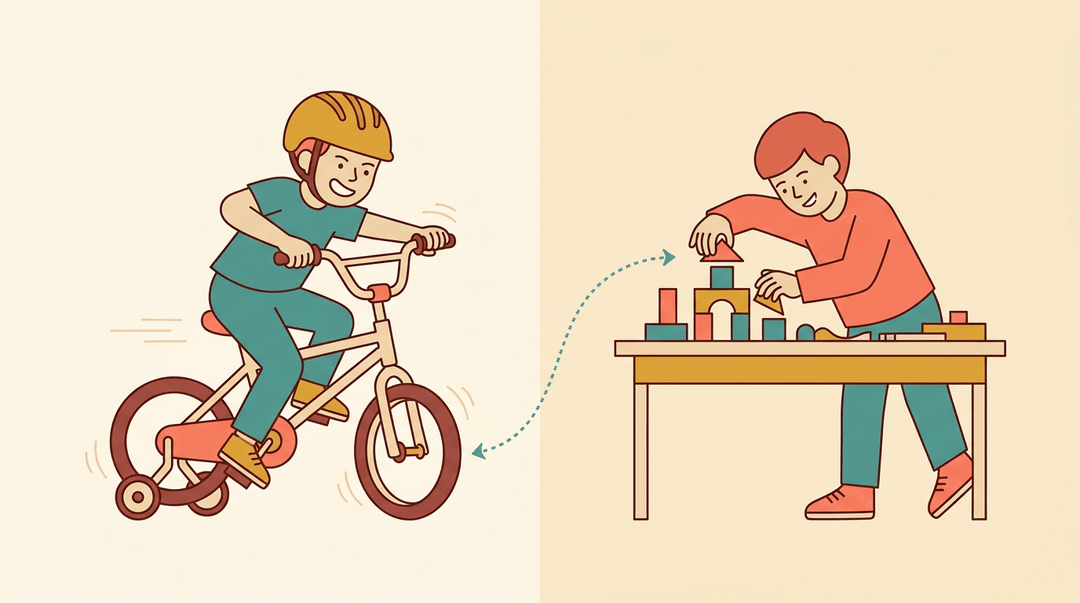
Think about learning to ride a bike. No amount of reading about balance or pedaling gets you there. You need to feel the wobble, push off, and adjust in real time.
Kinesthetic learning works the same way: it's learning by doing, where movement and touch carry the lesson instead of just watching or listening. Some students absorb a concept fastest through their hands and bodies, not their eyes and ears.
Below, we'll cover what it looks like, how to spot it, and how to plan for it.
What Is Kinesthetic Learning?
Some students can't sit still through a lecture, and that's not a discipline problem. It's often just how their brain learns best.
Learning through movement and touch
Kinesthetic learning is hands-on, physical learning: students grasp new ideas by moving, building, and doing rather than sitting and absorbing.
The term traces back to kinesthesia, the sense that lets you feel your body's position and movement without looking. That's the mind-body connection at the heart of this style: physical action and mental understanding develop together.
You'll also hear it called tactile learning or physical learning, and it's one of four modes in the VARK model, alongside visual, auditory, and reading/writing.
How it differs from visual and auditory learning
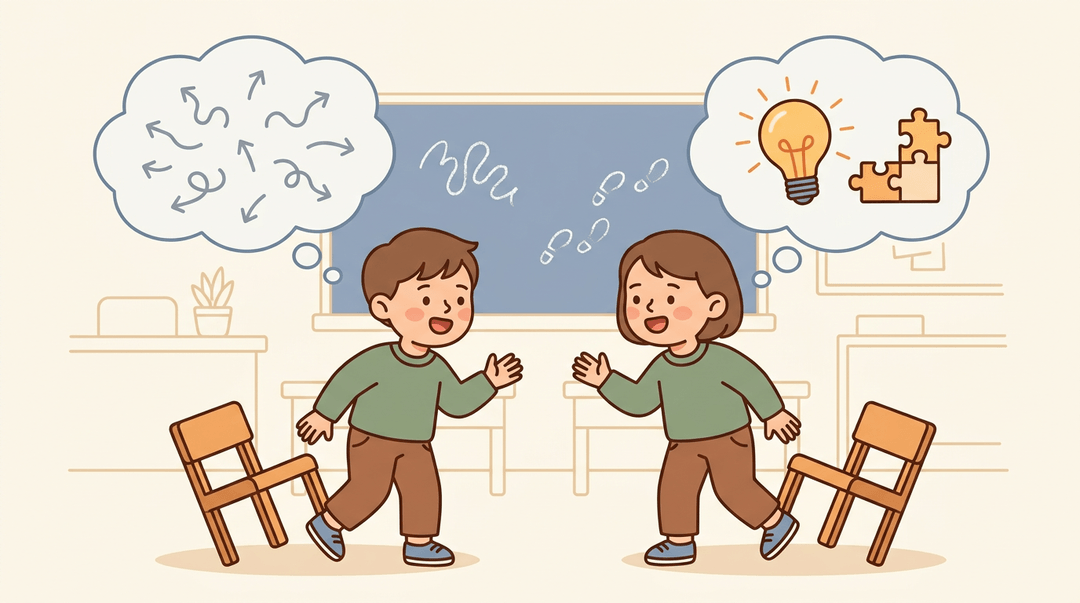
- Visual learners absorb information by watching: diagrams, charts, a teacher's demonstration.
- Auditory learners lean on listening: lectures, discussions, read-alouds.
- A kinesthetic learner is defined by doing, not watching or listening.
Hand a visual learner a diagram of a plant cell, tell an auditory learner about it, and give a kinesthetic learner a model to build, and that third student is often the one who remembers it come test day.
Signs of a Kinesthetic Learner
So how do you spot a kinesthetic learner before it ever shows up on a report card? A handful of classroom habits usually give it away.
Are ADHD people kinesthetic learners?
Not exactly, though it's easy to see why the two get mixed up.
A student with attention-deficit/hyperactivity disorder (ADHD), a medical diagnosis marked by trouble sustaining attention and regulating activity, can look a lot like a kinesthetic learner on the surface.
Both get bored with seatwork fast, both fidget and shift in their seats, and both seem to think better while moving than while sitting still.
The overlap is real, but the two aren't the same thing. Kinesthetic learning is a preference, not a disorder: plenty of kids who learn best through movement have no attention difficulties at all. Watch for the pattern instead of the label.
A kinesthetic learner gestures while explaining an idea, needs frequent breaks to reset, and genuinely learns better on their feet, whether or not ADHD is part of the picture.
Hobbies and activities these learners love
Outside the classroom, these students gravitate toward anything that moves. Sports and dance are common favorites, along with building sets like LEGOs, where hands do the thinking.
Field trips and outdoor lessons light them up in a way a worksheet never will, and they're often the first to volunteer for an experiment.
New experiences excite them, while a straight lecture, no matter how interesting the content, tends to lose them fast. Give them something to touch, and they're in.
Planning Lessons for Kinesthetic Learners
You don't need to rebuild your curriculum for kinesthetic learners: you need a bank of movement-based activities and a quick check that every lesson includes them. Here's both, ready to lift into next week's plans.
Activity menus by age
Elementary: whole-body movement. Young kinesthetic learners do their best thinking on their feet, so put the content on the floor.
| Activity | How to run it |
|---|---|
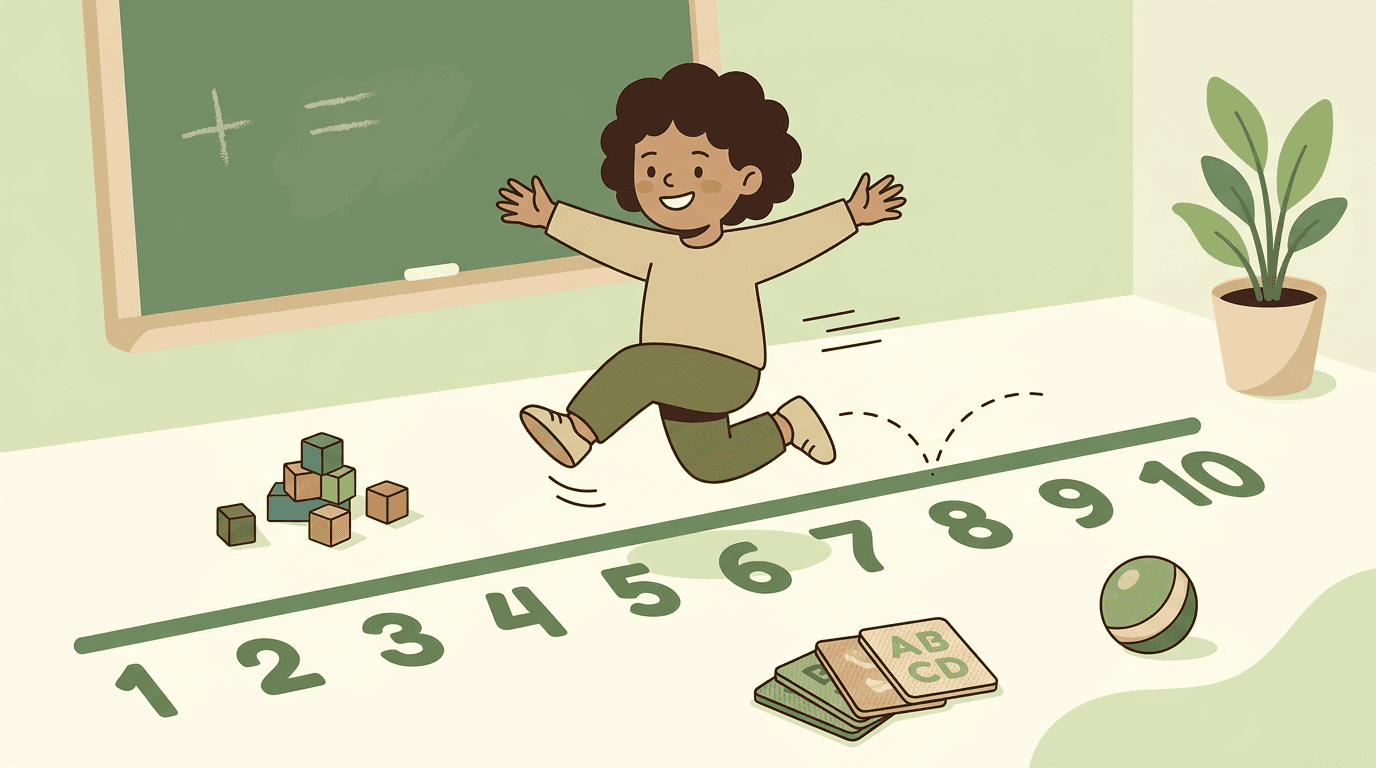
| Counting hopscotch drills | Chalk skip-count grids; hop and say each number |
| Alphabet body letters | Call a letter; pairs form it with their bodies |
| Sorting/matching walk stations | Walk word cards to labeled baskets across the room |
Middle and high school: hands-on complexity. Older students still need to touch the content; the tasks just get more sophisticated.
- Lab-based experiments. Students run every step themselves, not watch a demo.
- Instance: test which paper towel absorbs most, measured with real beakers.
- Role-play debates. Assign a stake, not just a side.
- Say: "You're the mayor. Defend the new park budget to these voters."
- Build-a-model projects. The model replaces the worksheet, not decorates it.
- Instance: a clay-and-pipe-cleaner cell with every organelle labeled.
⚠️ Watch out: movement isn't a reward for finishing the "real" work. In these lessons, the movement is the delivery method.
The pre-flight checklist
Before you teach, scan your plan and confirm:
- A movement break is scheduled. Sixty seconds of stretching, written at a fixed point in the plan.
- Manipulatives or tools are ready. Fraction tiles, dice, clay, or lab gear on desks before students arrive.
- The activity changes every 10 to 15 minutes. Jot the switch times in your plan's margin.
- The exit ticket is hands-on. Students build, sort, or demonstrate the answer instead of writing it.
Example: A second-grade teacher drilling skip counting chalks a hopscotch grid of multiples of five by the door. Students hop the grid saying each number aloud as they line up for lunch: two minutes of movement, one full round of practice, zero extra lesson time.
Here's a plan slot you can copy for any lesson:
Opener (10 min): movement activity from the menu above Core task (15 min): hands-on work with manipulatives Break (1 min): stand and stretch Exit ticket (5 min): build or sort the answer
Once you've run an activity that works, don't rewrite it from scratch next term: save these movement-based activities as reusable lesson blocks in EMStudio's lesson planner.
Benefits of Kinesthetic Learning
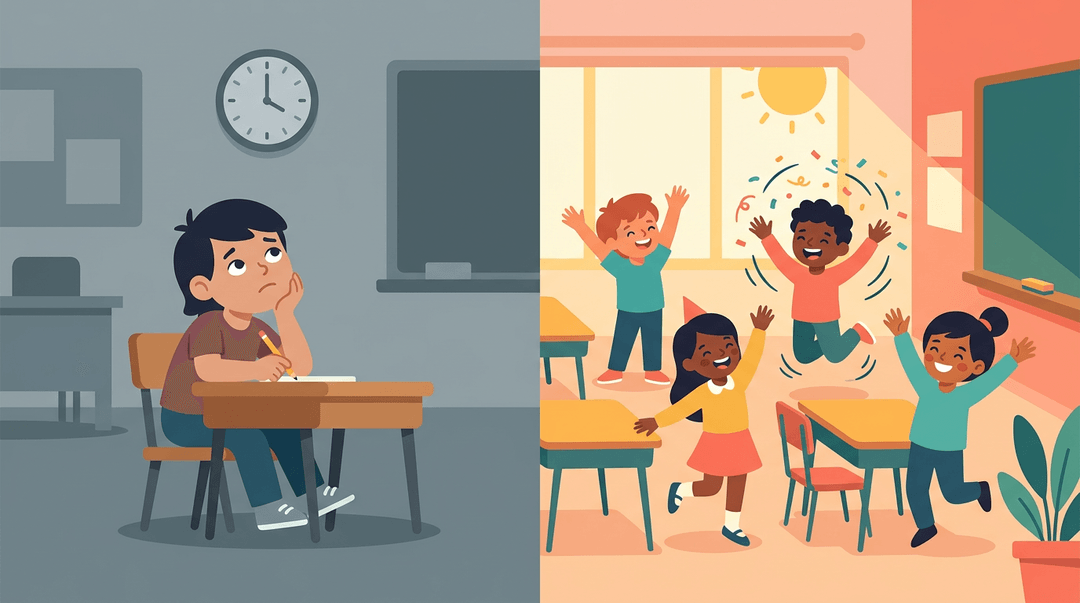
Sit-still-and-listen classrooms can leave hands-on learners stuck, restless, or checked out entirely. Kinesthetic learning flips that script, and the payoff shows up in the brain, in new skills, and in how long students stay tuned in.
How movement boosts understanding
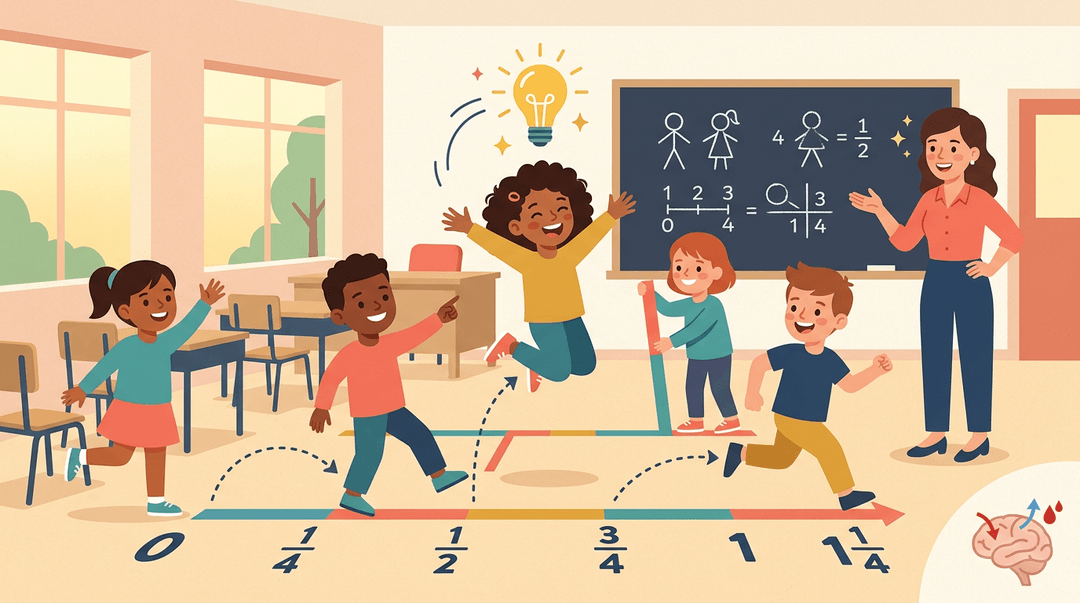
Movement isn't just a break from learning: it fuels it.
Physical activity increases blood flow and oxygen to the brain, supporting the kind of neural activity that helps new information stick, as research on movement's effect on executive functioning in children shows.
That's part of why a lesson built around motion can produce better comprehension than one delivered from a seat. In a study of active learning in a university physiology class, students in kinesthetic sessions scored especially well on exams.
Ask any teacher who's watched a concept finally click mid-activity: something about moving makes ideas concrete.
Skills kinesthetic learning helps build
Beyond content, movement builds skills that outlast the lesson:
- Creative thinking grows when students act out or physically model an idea instead of just hearing about it.
- Problem-solving improves as students test, adjust, and try again with their hands.
- Social and teamwork skills develop naturally through group activities, partner tasks, and games.
- Observation skills sharpen as students watch cause and effect play out in real time.
Why it keeps students engaged
Movement breaks the monotony of desk work, and it cuts down on the fidgeting and restlessness that build up when kids sit too long. It also nudges students toward an active, healthy habit that outlasts the school day.
And it adds genuine variety: a bit of fun and creativity that keeps students looking forward to what's next, instead of watching the clock.
Teaching Strategies for Kinesthetic Learners
Once you've spotted a kinesthetic learner, the real question is what to do about it. The good news: most of these strategies cost nothing but a little classroom rearranging.
Everyday classroom techniques that work
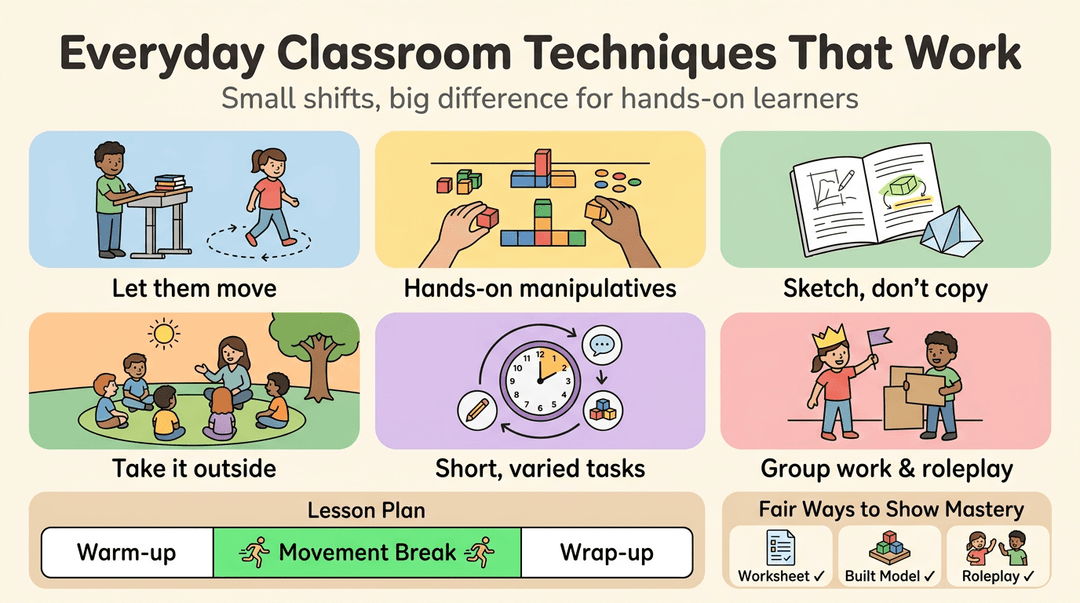
Small shifts make a big difference for students who learn by doing:
- Let them move. Skip the "sit still" rule and allow standing desks or a spot to pace while thinking.
- Bring in manipulatives. Blocks, counters, and other tactile tools turn abstract ideas into something hands can hold.
- Try hands-on note-taking. Sketching, highlighting, or building a quick model beats copying text word for word.
- Take the lesson outside. Fresh air and open space give restless energy somewhere useful to go.
- Keep activities short and varied. Swap tasks every 10 to 15 minutes instead of running one long stretch.
- Use group work and roleplay. Acting out a scene or building something together helps the concept stick.
- Build movement breaks into the plan itself, not as an afterthought once attention drops.
Assessing these learners fairly means looking past the traditional sit-and-write test. A quick demonstration, a built model, or a roleplay can show mastery just as well as a worksheet, sometimes better.
Hands-on activity ideas by subject
Math lends itself especially well to movement:
- Hopscotch math for practicing number sequences.
- Counting manipulatives like beads or blocks for early operations.
- Geometry building blocks to construct shapes instead of just drawing them.
- Sports-based math, tracking scores or distances during PE.
- Number line races across the classroom floor.
- Scavenger hunt math, solving problems hidden around the room.
- Measuring and fraction activities using real objects like cups or rulers.
Save these templates once you build them. Reuse them year after year, and tweak instead of starting from scratch.
Related Concepts and Common Questions
Kinesthetic learning doesn't sit in isolation. It connects to a few related ideas and open questions worth clearing up before you plan your next lesson.
Questioning the learning styles theory
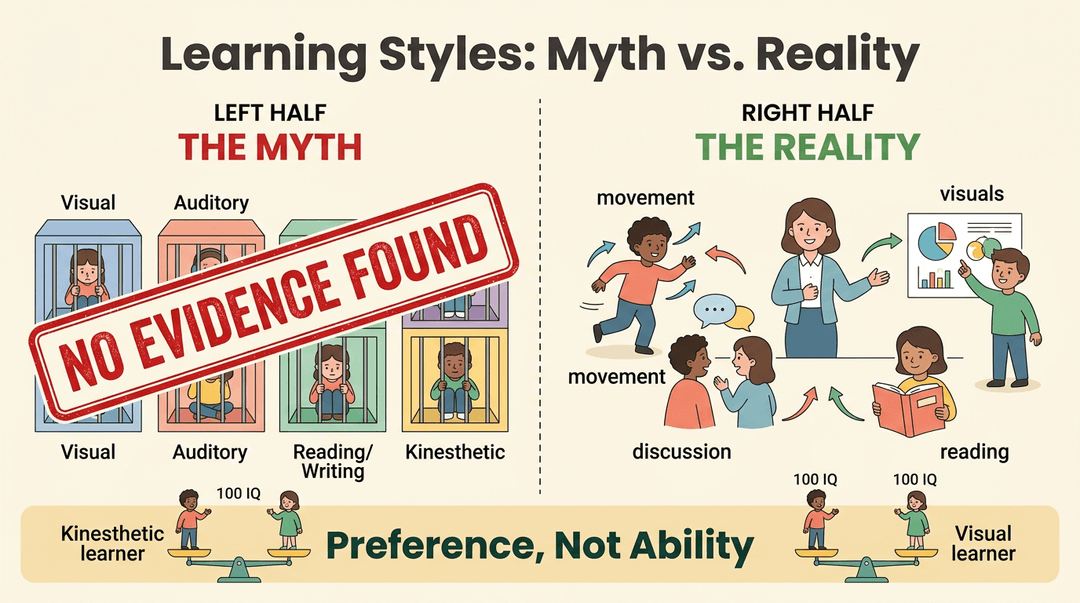
Researchers have pushed back hard on the idea of fixed learning styles.
The VARK model (visual, auditory, reading/writing, kinesthetic) is the most familiar framework, but a review by Pashler and colleagues found "no adequate evidence base to justify incorporating learning style assessments into general educational practice."
That doesn't make kinesthetic learning fiction, just one preference among several, not a fixed box. Mix your teaching methods:
- movement
- discussion
- visuals
- reading
And skip the myth that one learning style comes with a higher IQ. A review of learning styles theories makes clear these are preferences for processing information, not differences in ability.
Tailoring lessons to each student
Every classroom holds a mix of needs, and no two kinesthetic learners need exactly the same lesson. Customizing tasks, some movement, some visuals, some discussion, respects those individual differences.
The same logic applies for students with autism: being a kinesthetic learner doesn't mean a student is autistic, but a study on multisensory music education for children with autism shows combining auditory, visual, and kinesthetic input, grounded in sensory integration theory, can enrich learning for kids on the spectrum.
Spotting signs and mixing learning styles
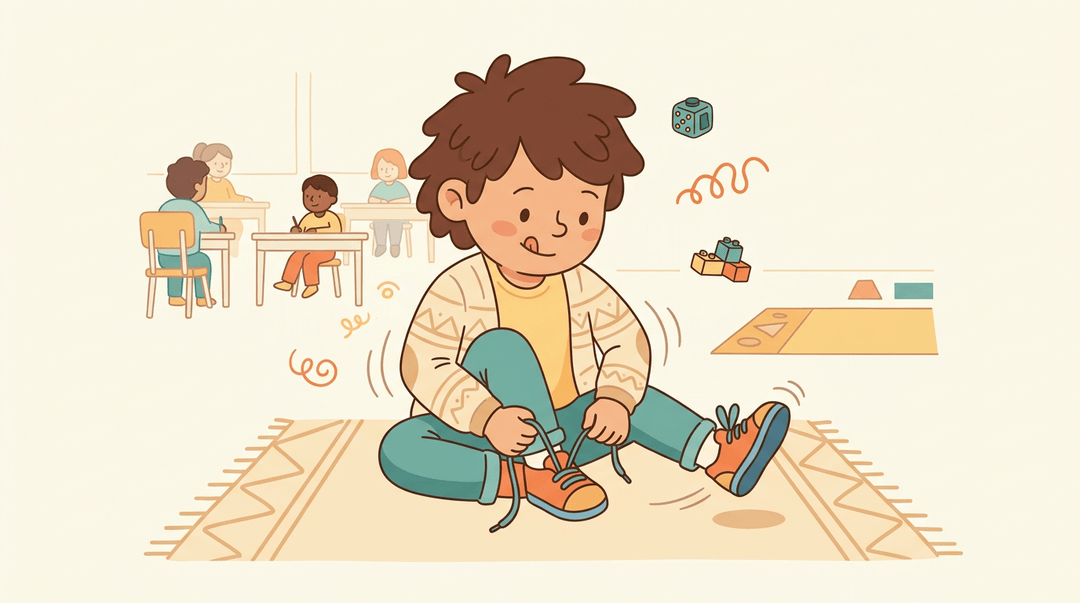
In young children, kinesthetic signs show up early:
- fidgeting
- needing to touch objects
- learning to tie shoes by doing rather than watching
Most students blend styles rather than fit one label, and kinesthetic learners can still succeed in a traditional, mostly seated classroom.
Where they tend to struggle is long stretches of stillness, reading-heavy tasks, and lessons with no hands-on component. Build in even a short movement break, and that struggle eases.
Kinesthetic learners aren't distracted or restless for no reason: movement is often how they think.
Once you can spot the signs and build lessons around hands-on activity, that same energy becomes your classroom's biggest asset instead of its biggest challenge. Ready to build lessons that give kinesthetic learners room to move?
Check out our Lesson Planning tool to organize and reuse hands-on activities across every class you teach.
References
- Individual Differences in the Neurocognitive Effect of Movement During Executive Functioning in Children with ADHD: Impact of Subtype, Severity, and Gender — mdpi.com (2025)
- The Impact of Active Learning Instruction on Student Performance in a Large University Physiology Class — doi.org (2026)
- Learning Styles, Preferences, or Strategies? An Explanation for the Resurgence of Styles Across Many Meta-analyses | Educational Psychology Review — link.springer.com (2025)
- Technology-enhanced multisensory music education for children with autism: Effects on sensory integration and learning behaviors — doi.org (2025)
- The Scientific Status of Learning Styles Theories — journals.sagepub.com
Frequently asked questions
What type of learner has the highest IQ?
No type of learner has a highest IQ. Visual, auditory, reading/writing, and kinesthetic learning describe preferences for processing information, not intelligence or ability.
Are ADHD people kinesthetic learners?
Not necessarily. ADHD can look similar to kinesthetic learning because both may involve fidgeting, restlessness, and thinking better while moving, but kinesthetic learning is a preference, not a disorder, and many kinesthetic learners do not have ADHD.
What do kinesthetic learners struggle with?
Kinesthetic learners often struggle with long periods of sitting still, reading-heavy assignments, and lessons without hands-on activities. Short, varied tasks and opportunities to move, build, or handle materials can make learning easier.
Are kinesthetic learners autistic?
No. Kinesthetic learning does not mean someone is autistic. Autism and kinesthetic learning are separate, although some autistic students may benefit from multisensory activities that include movement and touch.