Is the Didactic Approach to Learning Right for Your Lessons?


Jump to section
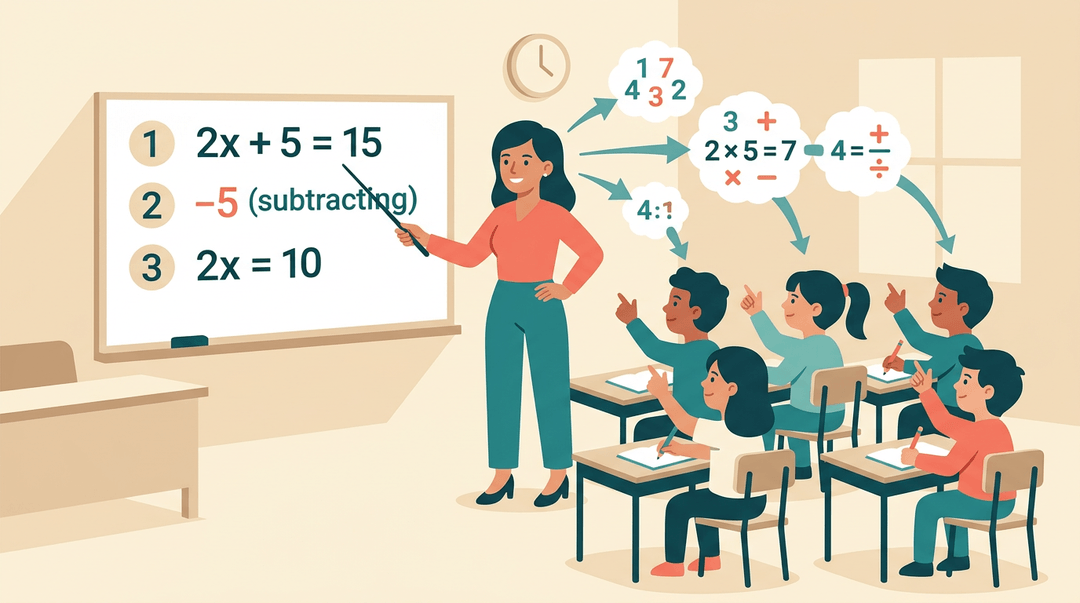
Picture a teacher at the front of the room, walking students step by step through a new idea and modeling each move before anyone tries it alone. That's the didactic approach in action.
It's a teacher-led way of teaching where clear explanation, guided practice, and structured feedback do most of the heavy lifting.
In this post, we'll cover what the approach means, the theory behind it, where it came from, and where it shines or falls short. Then we'll show you how to use it, or balance it, in your own lesson plans.
What Is the Didactic Approach to Learning?
The didactic approach is teacher-led instruction: the teacher presents clear information, and students learn it through structured explanation. Here's where the term comes from and how it compares to other methods.
Where the word didactic comes from
The word didactic comes from the Greek didáskein, meaning to teach. That roots it in a simple idea: a teacher passing knowledge to students.
Didactic lessons are consistent and systematic, following a planned sequence rather than letting each class wander.
For example, a seventh-grade science teacher introducing photosynthesis might walk the class through each step on the board: what plants take in, what they release, and why it matters. Students copy the sequence into their notes, then answer a quick quiz.
By the end of the period, every student can name the inputs and outputs, giving the class a shared foundation before any discovery work begins.

How didactic teaching differs from other methods
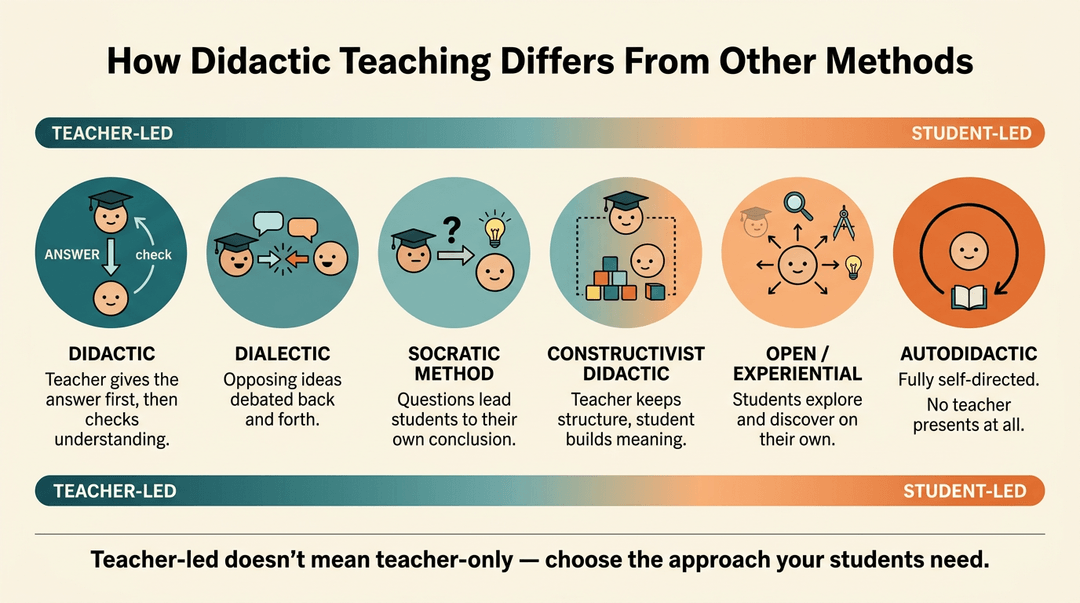
Didactic teaching is often clearest by contrast. Dialectics works through debate and opposing ideas, while the Socratic method uses questions to lead students toward their own conclusions.
In a didactic lesson, the teacher gives the answer first, then checks understanding.
A constructivist didactic variant keeps the teacher in charge of structure but adds more chances for students to make meaning from what they're shown. Open or experiential learning goes the other way, letting learners explore and discover on their own.
Autodidactic learning is self-directed, with no teacher presenting at all.
Teacher-led doesn't mean teacher-only. Choose the approach your students need.
Didactics as the Science of Teaching
Before you plan a single lesson, it helps to know what kind of thinking goes into it. Didactics gives that thinking a name and a structure.
How didactics differs from pedagogy and mathetics
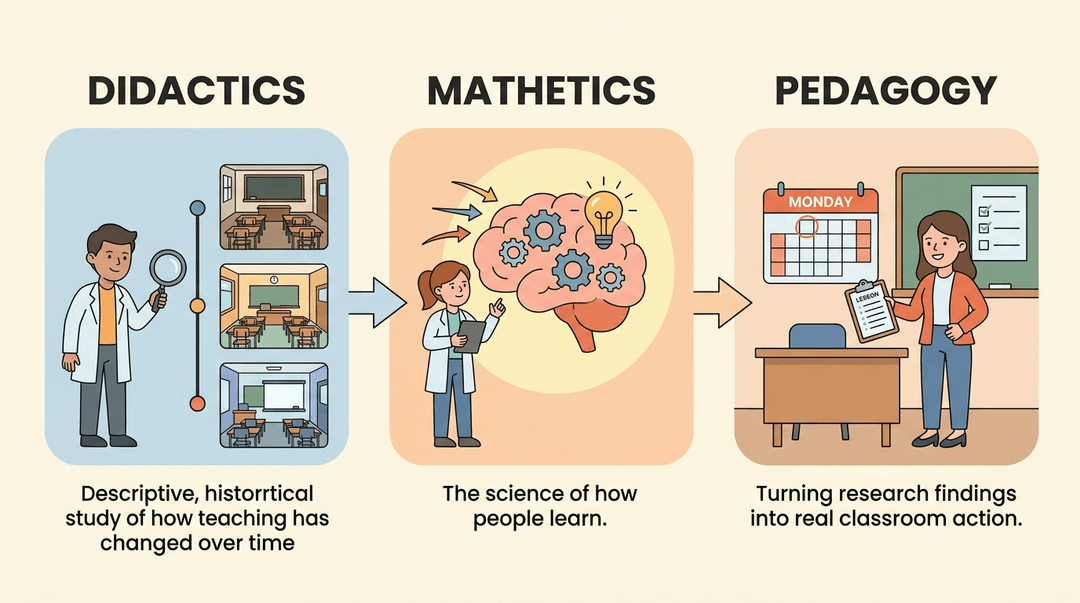
At its core, didactics is the science of teaching: the study of what gets taught, how it gets taught, and why certain approaches work. Mathetics is the science of learning, focused on how people actually acquire knowledge and skills.
The two work together, but they ask different questions. Pedagogy is normative, meaning it tells you what you should do in the classroom.
Didactics is descriptive and diachronic (studying change over time), so it looks at how teaching has been and is done across contexts.
In practice, pedagogy applies the findings of didactic research, turning what the research shows into what you do on Monday.
The three levels of didactics
Didactics operates on three levels:
- The theoretical level is research: it asks what learning is and what conditions support it.
- The practical level is curricular: it shapes what goes into a unit, a sequence, and a lesson.
- The discursive level is professional dialogue, where teachers, coaches, and researchers talk through what works and why.
Consider a sixth-grade math team that meets each week. When they debate whether a fraction unit should start with models or with procedures, they're working at the discursive level, drawing on research and feeding it back into their curriculum.
Balancing teacher authority and learner needs
The teacher is an authoritative figure who sets direction, but the best teachers also act as a guide and resource.
Didactics pays close attention to learners' cognitive characteristics, the way students process, remember, and make sense of information, and it builds on their baseline knowledge, what they already bring to the room.
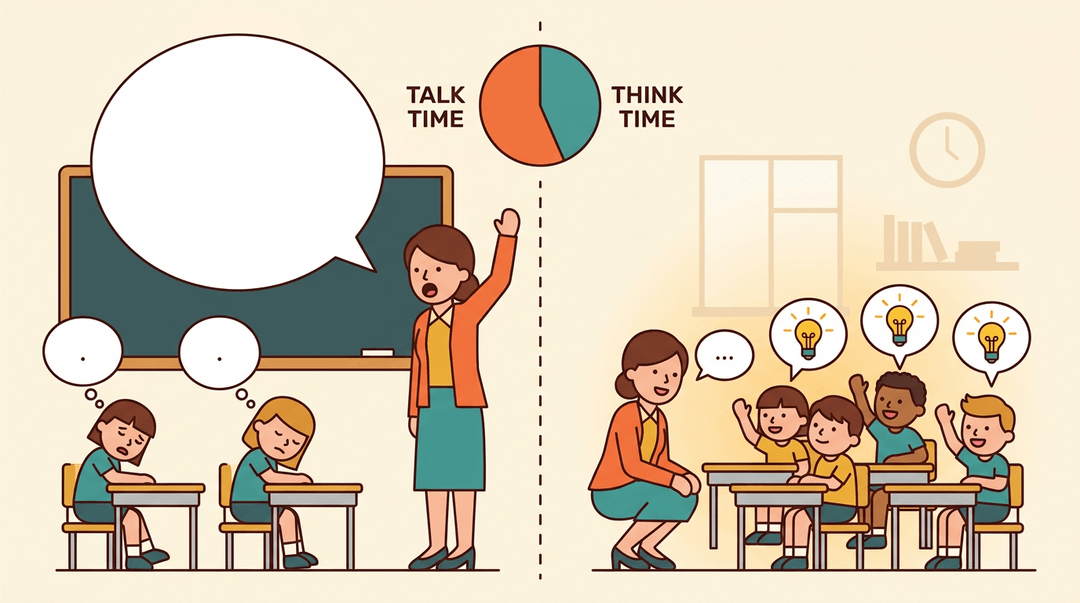
It's less about how much you talk and more about how well students think. A quick check is your teacher talk-time ratio. If you're speaking most of the period, learners may be listening without thinking.
Record one lesson and note who's doing the heavy lifting. Small shifts, big payoff. These ideas slot neatly into modern lesson frameworks, where you set direction, guide practice, and then step back.
Understanding Didactic Transposition Theory
Before you plan a single lesson, it helps to know where the content came from. Didactic transposition theory explains that journey.
Where the idea of didactic transposition began
Michel Verret introduced the concept of didactic transposition in 1975, and Yves Chevallard elaborated it into a fuller framework. The idea first took root in mathematics didactics, where it's perhaps most evident.
Over time it was generalized to other disciplines, making it one of the most visibly cross-disciplinary concepts in the field.
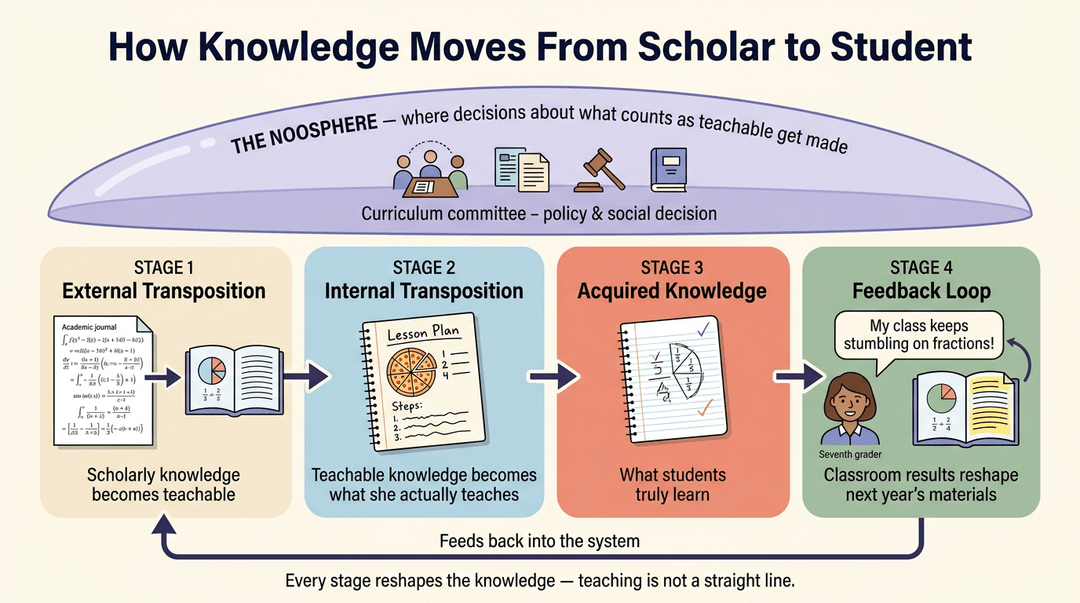
How knowledge moves from scholar to student
Knowledge doesn't jump from a research journal into your lesson plan. It moves through a sequence of stages:
- External transposition: scholarly knowledge is reshaped into something teachable.
- Internal transposition: teachable knowledge becomes the knowledge you actually teach.
- Acquired knowledge: what students truly learn.
- Feedback loop: what happens in the classroom flows back into the didactic system.
Knowledge isn't just what gets taught; it's how it changes along the way. Every stage reshapes it.
Sitting above these stages is the noosphere, the socio-political context where decisions about what counts as teachable get made. Consider a seventh-grade teacher whose class keeps stumbling on a fractions unit.
When she shares that pattern with her curriculum team, her feedback can reshape next year's materials, so her classroom directly shapes what students learn after her.
Using the Didactic Approach in Your Lessons
Use this guide to decide when direct, teacher-led instruction is the right tool, and how to pair it with active learning so it never stands alone.
Reach for it when
Confirm at least one of these is true:
- The content is new. Students have nothing to attach it to yet, so explain first.
- You're building foundations. Vocabulary, facts, and procedures come before reasoning.
- The group is large. One clear explanation reaches everyone at once.
- Time is limited. A focused segment beats an open-ended task.
If none apply, students probably know the basics already. Lean toward inquiry instead.
The mixing routine
Didactic teaching works best as the first beat of a short cycle, not the whole lesson.
- Teach one chunk directly.
- Say: "Today's one idea is how to isolate a variable."
- Pause for guided questions.
- Try: "What do we do first, and why?"
- Hand over practice.
- Students try two problems while you circulate.
- Add an inquiry task.
- Try: "Find a case where this rule doesn't work."
- Close with an exit ticket.
- One question, such as "Explain the first step in your own words."
⚠️ Watch out: A long lecture with no check hides confusion until the test. If you've talked through two ideas without a question, stop and ask.
Example: A middle school math teacher models two-step equations for five minutes, then asks guided questions. Students solve two problems in pairs, and a puzzle where the rule fails comes next. The exit ticket asks for the first step in a student's own words. The next day's grouping comes straight from those tickets.
What it looks like by level
| Level | Didactic move | Pair it with |
|---|---|---|
| Elementary | Phonics drills | Reading the new sounds in short words with a partner |
| Middle school | Direct math instruction | Two practice problems, then a puzzle |
| High school | Lecture plus notes | A pause to compare notes with a neighbor |
| Tutoring | Concept walkthrough | The student explains the next step back to you |
Build and reuse didactic-style lesson segments quickly with EMStudio's lesson planner.
Cultural Traditions Behind Didactic Teaching
Teaching ideas carry baggage. Where you learned to teach shapes how you hear the word didactic.
Anglo-Saxon versus European teaching traditions
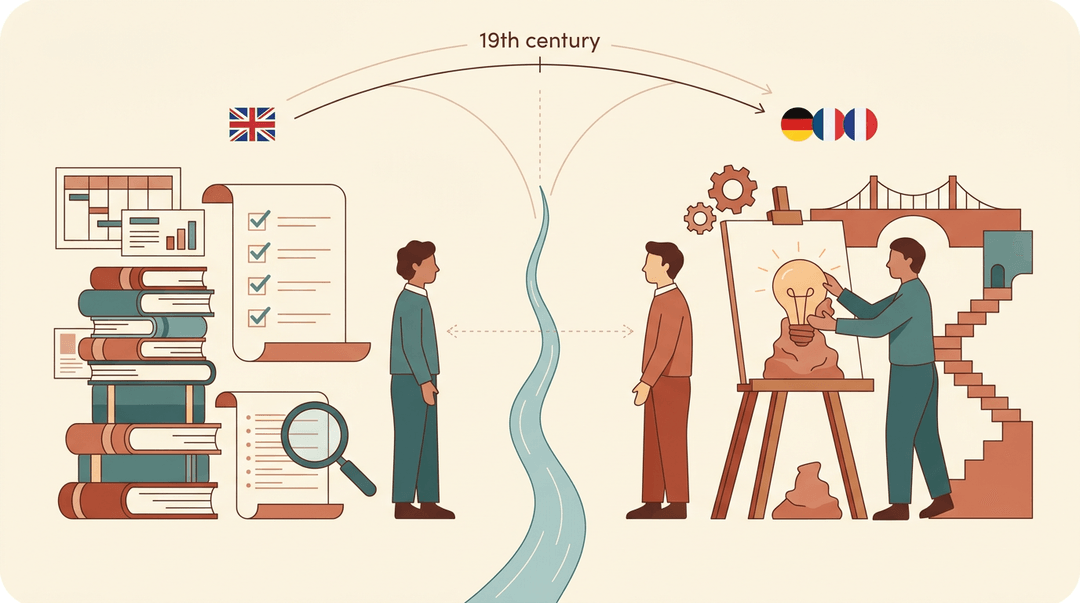
The Anglo-Saxon world built its thinking on a curriculum studies tradition, which asks what should be taught and how it's organized. Continental Europe developed a didactics tradition, which asks how content can be shaped so students can grasp it.
English-speaking countries gave far less weight to that second question, and the gap widened through the 19th century as the two traditions drifted apart.
Historical figures who shaped the approach
Romanticism and Aestheticism shaped the Anglo-Saxon view, often framing learning as personal discovery and beauty. Enlightenment figures went another way, removing the moralizing edge from teaching and focusing on reason and understanding.
Voltaire, Rousseau, and Pestalozzi each left a mark on how educators think about the learner.
The word itself picked up baggage along the way. Didacticism came to carry a pejorative (negative) connotation, suggesting dry lecturing at students. Consider a new science teacher whose department head calls her lessons "too didactic."
She doesn't need to apologize for a clear explanation. The real question is less about whether to explain and more about when to step back and let students practice. The clarity was never the problem.

Where Didactic Teaching Works and Falls Short
Direct instruction has earned its place in many classrooms, but it has real limits. Here's what it does well, where critics push back, and how to pair it with quick checks so you know what's actually landing.
What didactic teaching does well
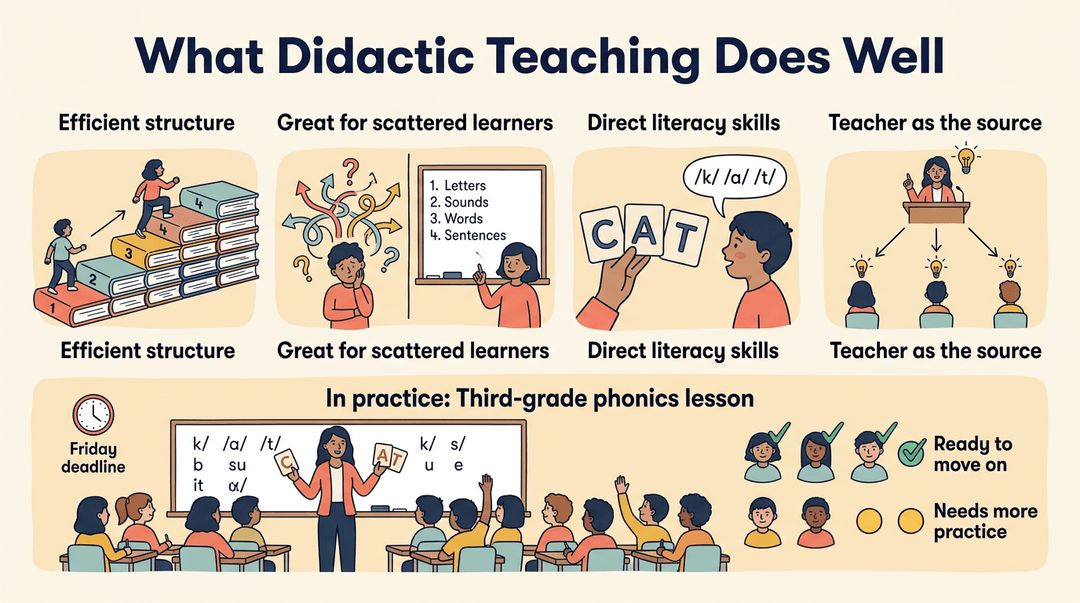
Didactic teaching gives students theoretical knowledge: the facts, rules, and concepts they need before they can apply anything. Its main advantages include:
- Students receive a structured body of knowledge efficiently
- It works well for unorganized learners who need a clear sequence
- It teaches basic reading and writing skills directly
- The teacher serves as the source of knowledge transmission
Consider a third-grade teacher who needs every student to learn letter sounds by Friday.
A short, teacher-led phonics lesson with a whiteboard, letter cards, and a read-aloud gets the whole class moving together, and she sees within minutes who's ready to move on.
Common criticisms of didactic teaching
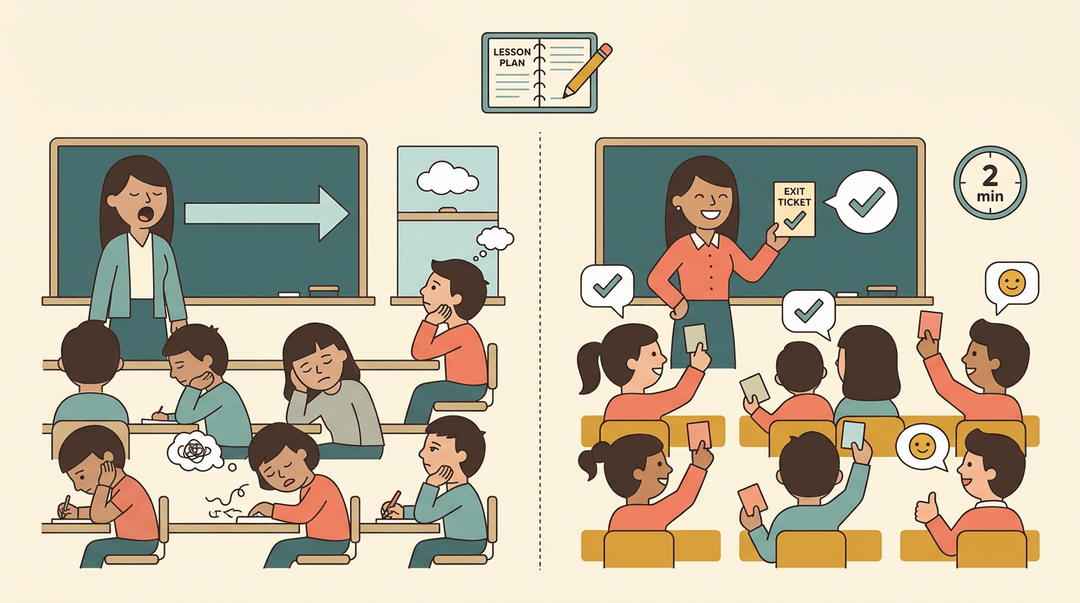
Critics point out that this approach doesn't satisfy all student needs. Lecture-heavy lessons can feel tedious, and minimal teacher-student interaction means some students quietly drift.
It may also fail to motivate interest, because it's largely a monologue process in which student experience plays a minimal role.
The common issues are:
- It doesn't satisfy all student needs
- It can be tedious and lecture-heavy
- Teacher-student interaction is minimal
- It may fail to motivate interest
- It runs as a monologue, with student experience playing a minimal role
The fix isn't to abandon direct instruction. Pair it with quick formative checks, such as an exit ticket, a thumbs-up poll, or three questions at the end of a mini-lesson. The goal is checking in, rather than hoping it landed. Two minutes is all it takes.
The didactic approach gives you a dependable structure: explain clearly, model thoughtfully, and check for understanding before students work on their own.
It works best when you pair that structure with room for discovery, so students get both direction and independence.
Ready to put this into practice? Check out our Lesson Planner to write, organize, and reuse your lesson plans across multiple classes from one place.
References
- The Didactic Transposition : Practices and Pedagogical ... — ijirme.com
- Introduction au numéro thématique « La transposition didactique : enjeux actuels dans différentes didactiques disciplinaires » — doi.org (2021)
- Yves Chevallard Unit – Anthropological Theory of the Didactic — mathunion.org
- Staf 11 > concept 2 — tecfaetu.unige.ch
Frequently asked questions
What is a didactic approach to teaching?
A didactic approach to teaching is a structured, teacher-led method in which the teacher explains information, models skills, guides practice, and checks understanding. It usually follows a planned sequence and gives students clear foundations before they work independently or explore ideas.
What is didactic vs. pedagogy?
Didactics is the study of what is taught, how it is taught, and why teaching approaches work. Pedagogy is the broader practice and set of principles that guides what teachers should do in the classroom, often applying insights from didactic research.
What is an example of didactic learning?
A teacher modeling how to solve a two-step equation on the board, asking guided questions, and then having students complete practice problems is an example of didactic learning. A phonics lesson in which the teacher directly teaches letter sounds and students practice them is another example.
What does didactic learning mean?
Didactic learning means learning through clear, structured instruction led by a teacher. Students receive explanations, observe modeled steps, practice with guidance, and receive feedback before applying the knowledge independently.