What Is Constructivism Learning Theory? A Complete Guide

Jump to section
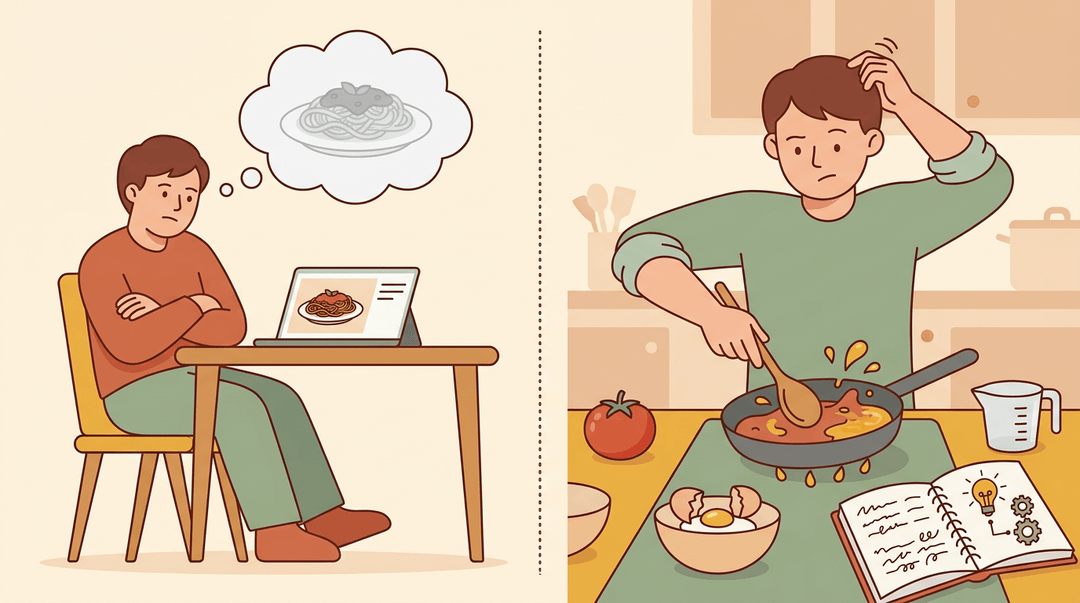
Think about learning to cook by watching someone else make a dish versus standing in the kitchen, tasting, adjusting, and figuring out why the sauce split. The second way sticks, and that's the core idea behind constructivism.
Constructivism learning theory says learners build their own understanding by connecting new ideas to what they already know, rather than simply absorbing facts handed to them.
This guide covers what the theory is, its main types, the key thinkers behind it (including John Dewey), how it plays out in real classrooms, and where critics push back.
Along the way, we'll share ready-to-use lesson examples and a planning checklist you can try on Monday.
What Is Constructivism Learning Theory
Have you ever watched a student's face light up right after they figured something out on their own? That moment is the heart of constructivism.
Learning means building knowledge actively
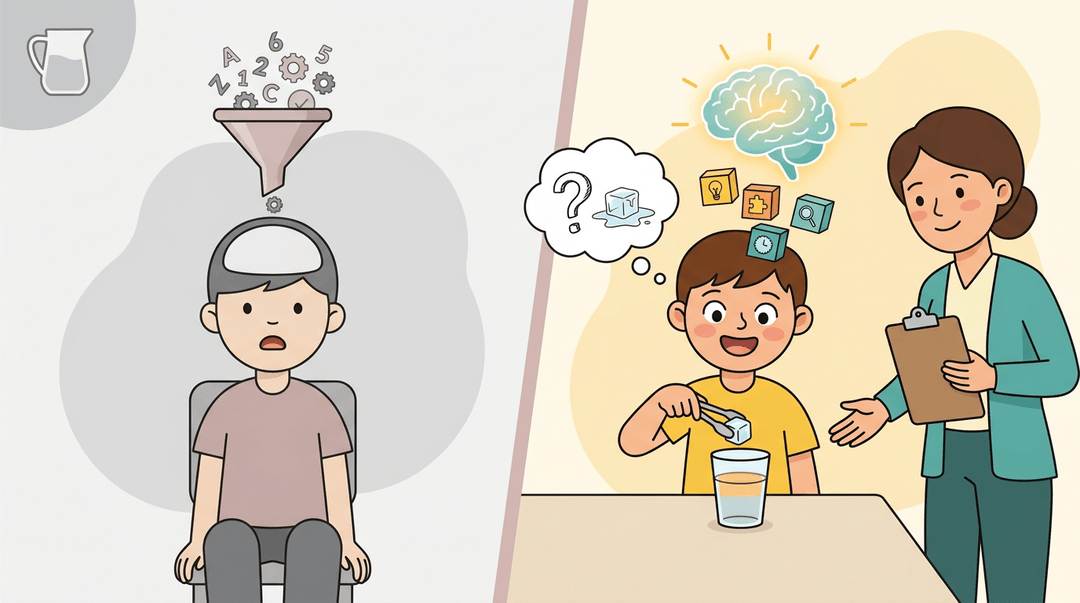
Constructivism starts from one core idea: learning is less about receiving information and more about making sense of it. Learners build their own knowledge by actively working with what they encounter.
That's the big difference from behaviorism, which focuses on observable responses to stimuli and treats learning as something delivered to the learner. Constructivism opposes that passive model of information absorption. Knowledge is built, not poured in.
Consider a fourth-grade teacher who asks students to predict what will happen when ice goes into warm water before she explains it. The students who test their guesses are doing the building. The explanation just gives them something to build with.
New learning builds on what you know
New information doesn't land in an empty mind. It attaches to what a learner already understands, so each new idea rests on prior knowledge. Personal experience shapes that foundation too.
A student who has helped bake bread at home may find fermentation easier to picture than a classmate who has never seen dough rise. Use that connection: ask what students already know before you introduce something new.
Why everyone experiences knowledge differently
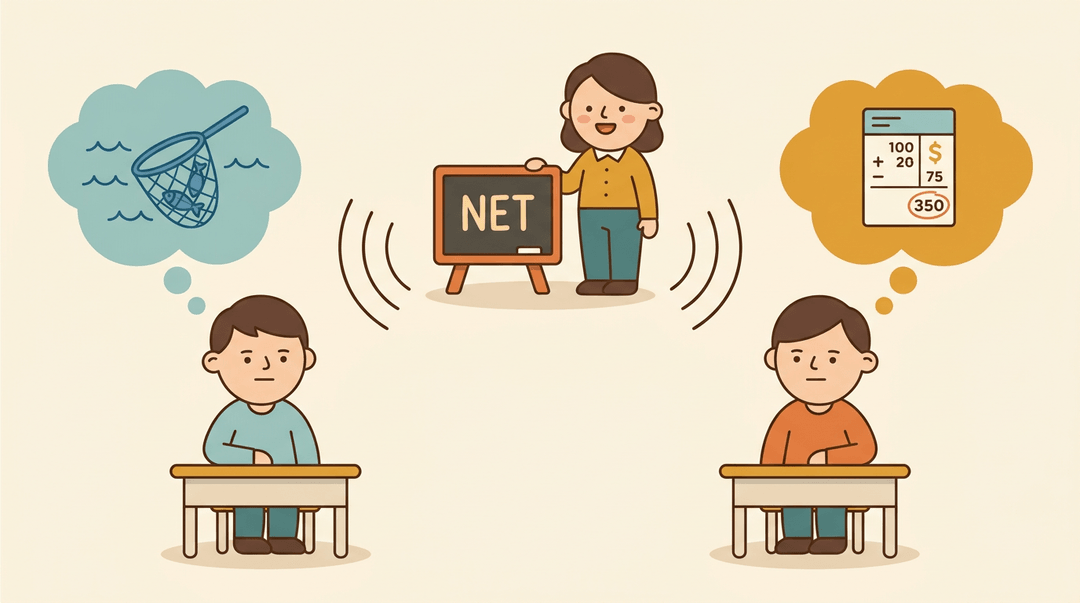
Every learner carries an individualized knowledge base, a unique mix of experiences, assumptions, and understandings. That means reality is experienced uniquely, and the same information can be interpreted differently from one student to the next.
Picture two students who hear the word 'net' in a math lesson. One thinks of a fishing net. The other thinks of a net total. Both are reasoning from what they know, which is exactly why checking for understanding matters so much.
Where constructivism came from
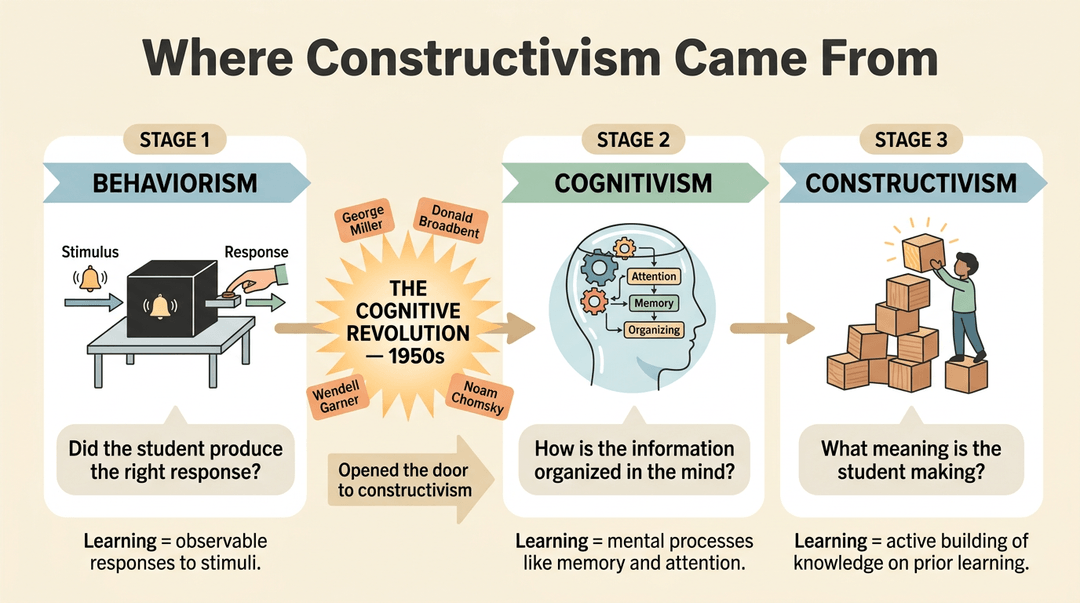
Constructivism grew partly as a reaction to behaviorism, and its roots are multidisciplinary.
According to the Association for Psychological Science, the cognitive revolution of the 1950s, shaped by the experimental work of George Miller, Donald Broadbent, and Wendell Garner along with the writings of Noam Chomsky, led psychology from the dark ages into the light of a new era.
That shift helped open the door to constructivism.
Here's how the three major views compare:
| Theory | What learning is | Ask yourself |
|---|---|---|
| Behaviorism | Observable responses to stimuli | Did the student produce the right response? |
| Cognitivism | Mental processes like memory and attention | How is the information organized in the mind? |
| Constructivism | Active building of knowledge on prior learning | What meaning is the student making? |
The Main Types of Constructivism
Constructivism isn't one idea but three major strands, each spotlighting a different piece of how learners build knowledge:
Piaget's cognitive constructivism
Piaget's theory centers on individual cognitive development. Students build understanding as their thinking matures, using two processes.
Assimilation fits new information into an existing mental framework, while accommodation reshapes that framework when new information doesn't fit.
Picture a young student who calls every four-legged animal a "dog" until a cat and a horse force a rethink. That rethinking is the learning.
Vygotsky's social constructivism
Vygotsky's theory shifts the focus to culture and language. Learning happens with others before it happens alone.
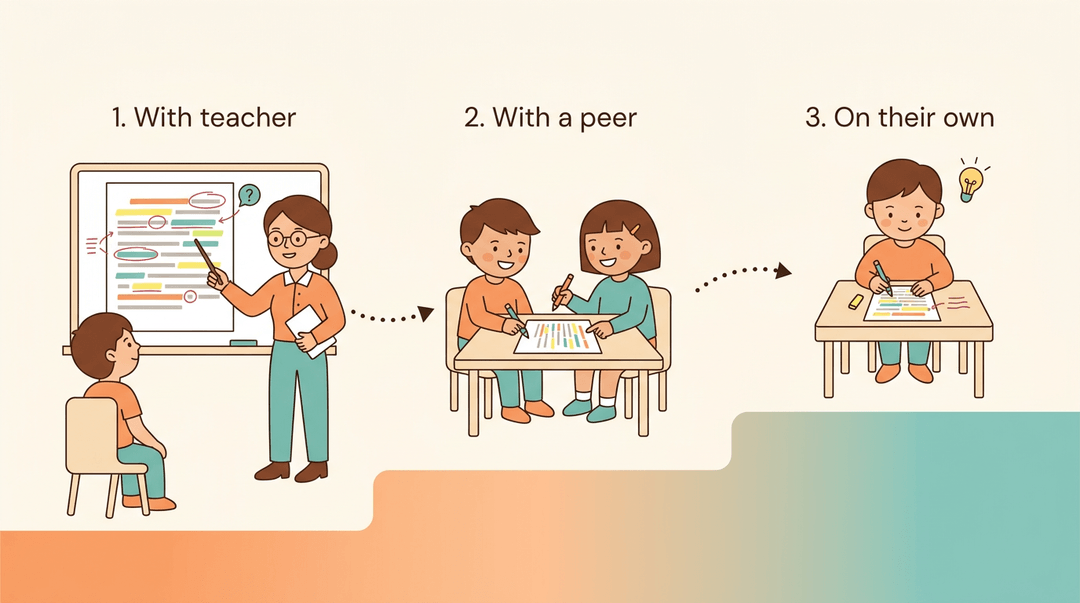
The zone of proximal development is the gap between what a learner can do solo and what they can do with help, and scaffolding is the support a teacher provides and gradually removes.
Consider a fourth-grade teacher who models how to annotate a paragraph, then has students try it with a partner before working on their own. Students move from doing it with help to doing it independently.
von Glasersfeld's radical constructivism
von Glasersfeld's radical constructivism goes further. It denies objective reality, so knowledge is entirely subjective: each learner builds their own version of the world.
For teachers, a student's answer makes sense from inside their own understanding, even when it's wrong. Your job is to help learners test and refine what they've built.
Key Thinkers Behind Constructivism
Constructivism didn't come from one person's notebook. Several thinkers asked the same question: how do people build understanding? Here are the names you'll run into most.
Who is the father of constructivism?
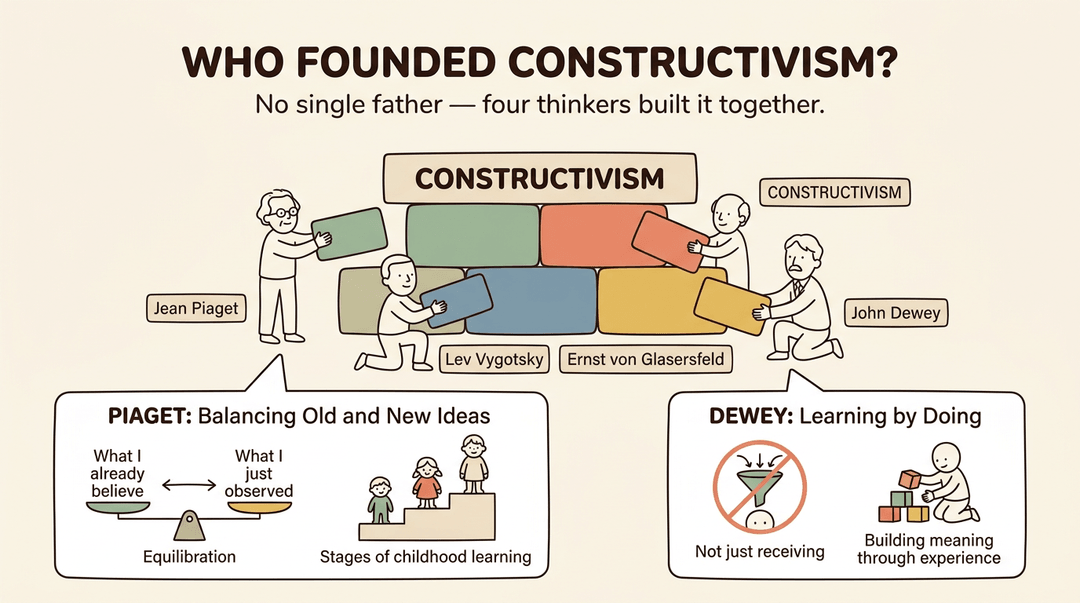
There's no single universally credited founder. Its development is traced to multiple theorists, including:
- Jean Piaget
- Lev Vygotsky
- Ernst von Glasersfeld
- John Dewey
Piaget is the name most tied to childhood cognitive development. He described how children move through stages of learning and reach equilibration, the process of balancing what they already believe against what they newly observe.
Dewey is also a co-founding figure. Constructivism, as he shaped it, holds that learners build meaning through experience rather than simply receiving it. That's why his name sits alongside Piaget's and Vygotsky's.
Lev Vygotsky and learning through others
Vygotsky, an early 20th century Russian psychologist, placed the social context of learning at center stage. Students build understanding through conversation and collaboration.
His zone of proximal development is the gap between what a learner can do alone and what they can do with help. Mentors close that gap through scaffolding, temporary support that fades as the learner gains independence.
Consider a fifth-grade teacher who models how to annotate a passage, then steps back as her students try it in pairs. The support fades as they gain confidence, and the skill becomes theirs.
Ernst von Glasersfeld's take on reality
Ernst von Glasersfeld is credited as the founder of radical constructivism. His view stresses the subjective reality concept: we never access reality directly, and each of us builds a working model of it from our own experiences.
In a classroom, two students can sit through the same lesson and leave with different understandings, both built from their own starting points.
How schemas shape understanding
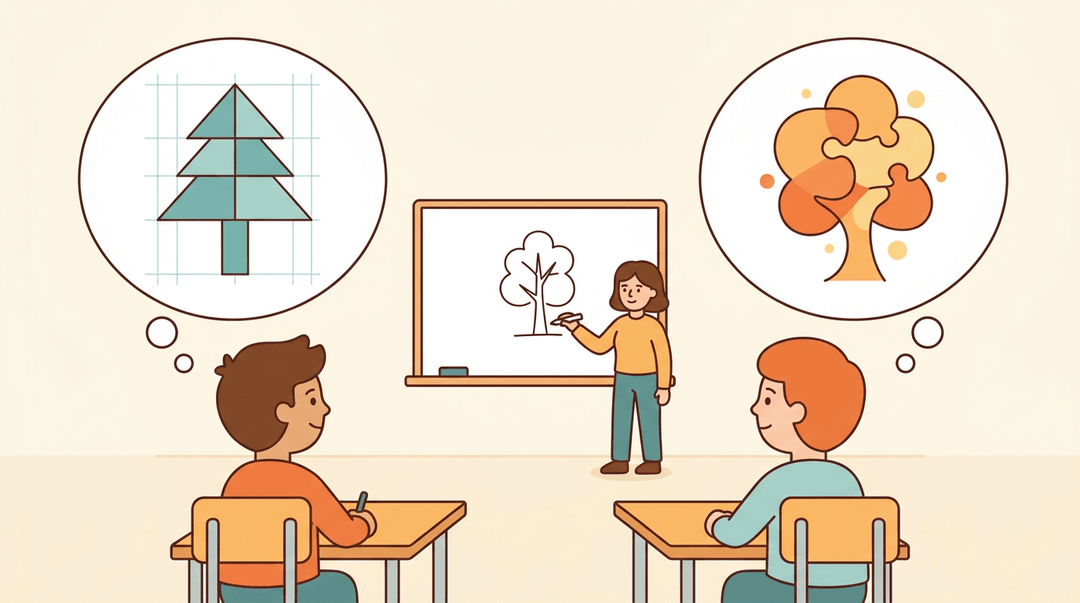
A schema is a mental framework for organizing ideas. Learning happens in two ways. Assimilation fits new information into an existing schema. Accommodation changes the schema itself when new information doesn't fit.
Think of a student who believes whales are fish because they live in water. When she learns whales breathe air and nurse their young, her schema for animals has to shift.
That revision, not the memorized fact, is the real learning, and it's what makes the new understanding stick.
How Constructivism Works in the Classroom
So what does this look like on a Tuesday morning? Constructivism moves the classroom from knowledge delivery to knowledge building, and the shift shows up in how you talk, plan, and check learning.
Teachers guide instead of lecture
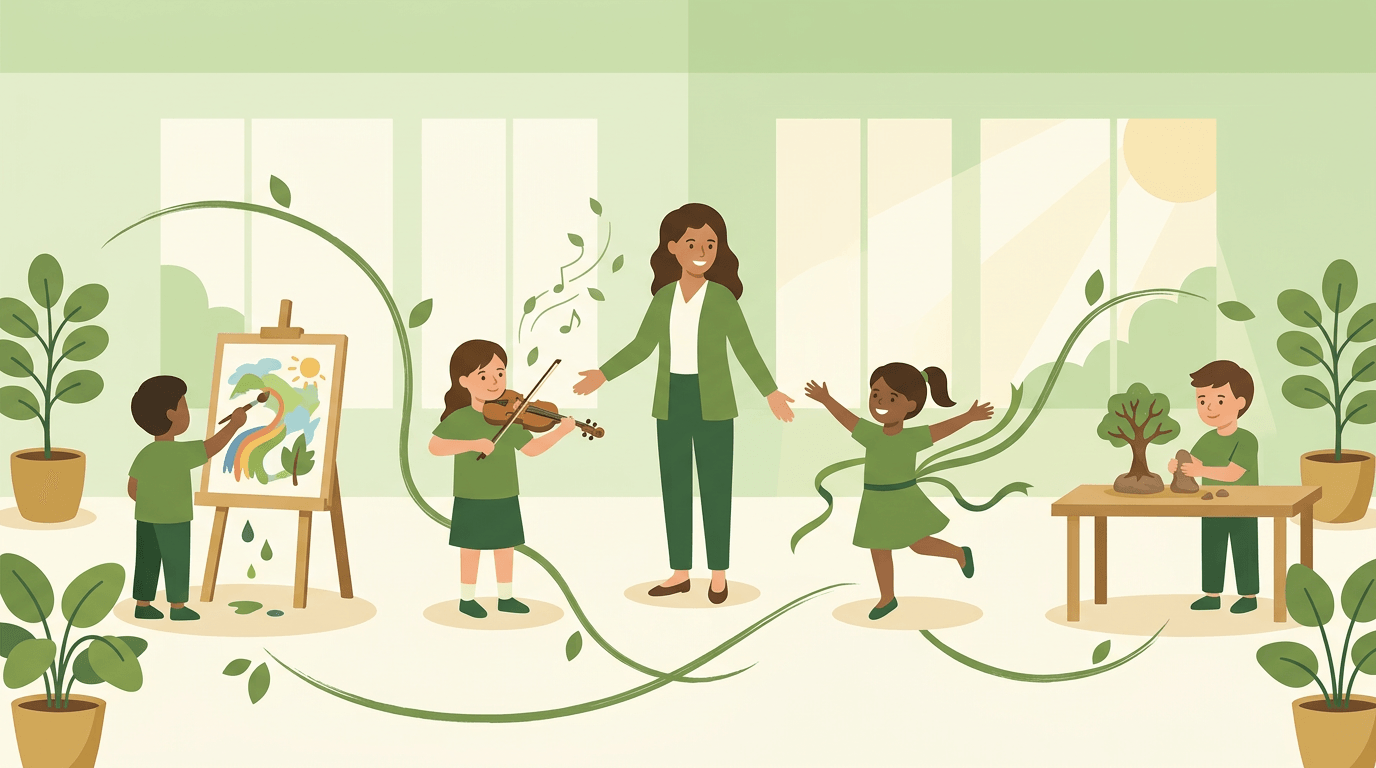
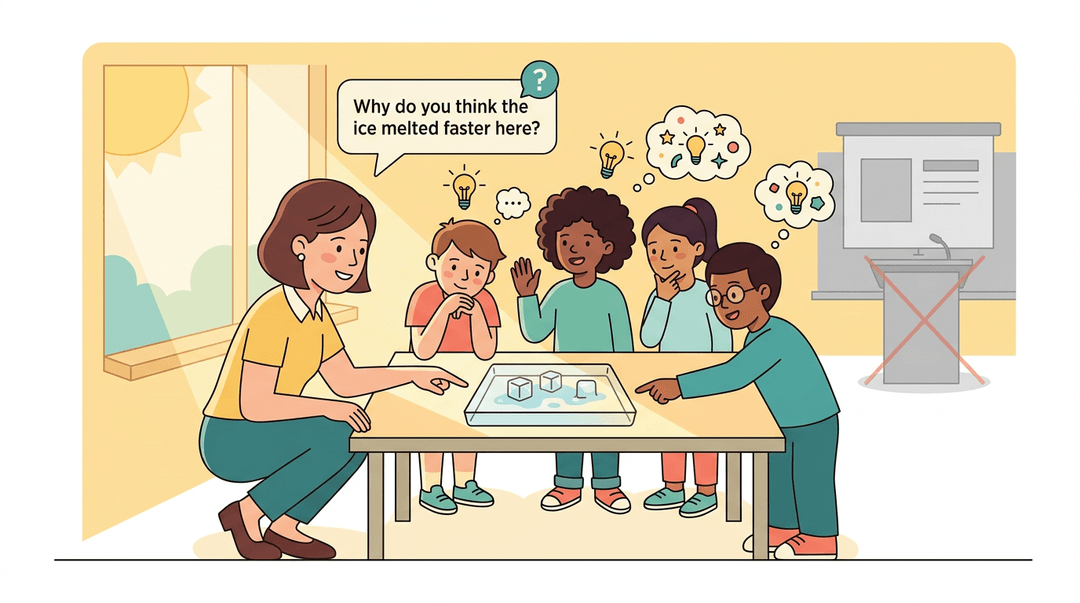
In a constructivist room, you're the guide, not the lecturer. You ask questions, listen closely, and steer students toward their own conclusions.
Think of a seventh-grade science teacher who asks, "Why do you think the ice melted faster in the sun?" instead of reading the answer from a slide. That dialogue with students shows you how they think.
Authority is also open to negotiation: students help shape how the class runs, and your expertise becomes a resource they can question.
Engaging students through collaboration and questions
Strong questions drive the work. Pose problems students can't solve in one step, and have them test ideas in small groups. Real-world context gives those problems a reason to matter.
Consider a fourth-grade teacher whose class tracks water use at home, compares data in groups, and decides what to recommend to the principal. The payoff is student autonomy: students own the question, not just the worksheet.
How constructivist classrooms differ from traditional ones
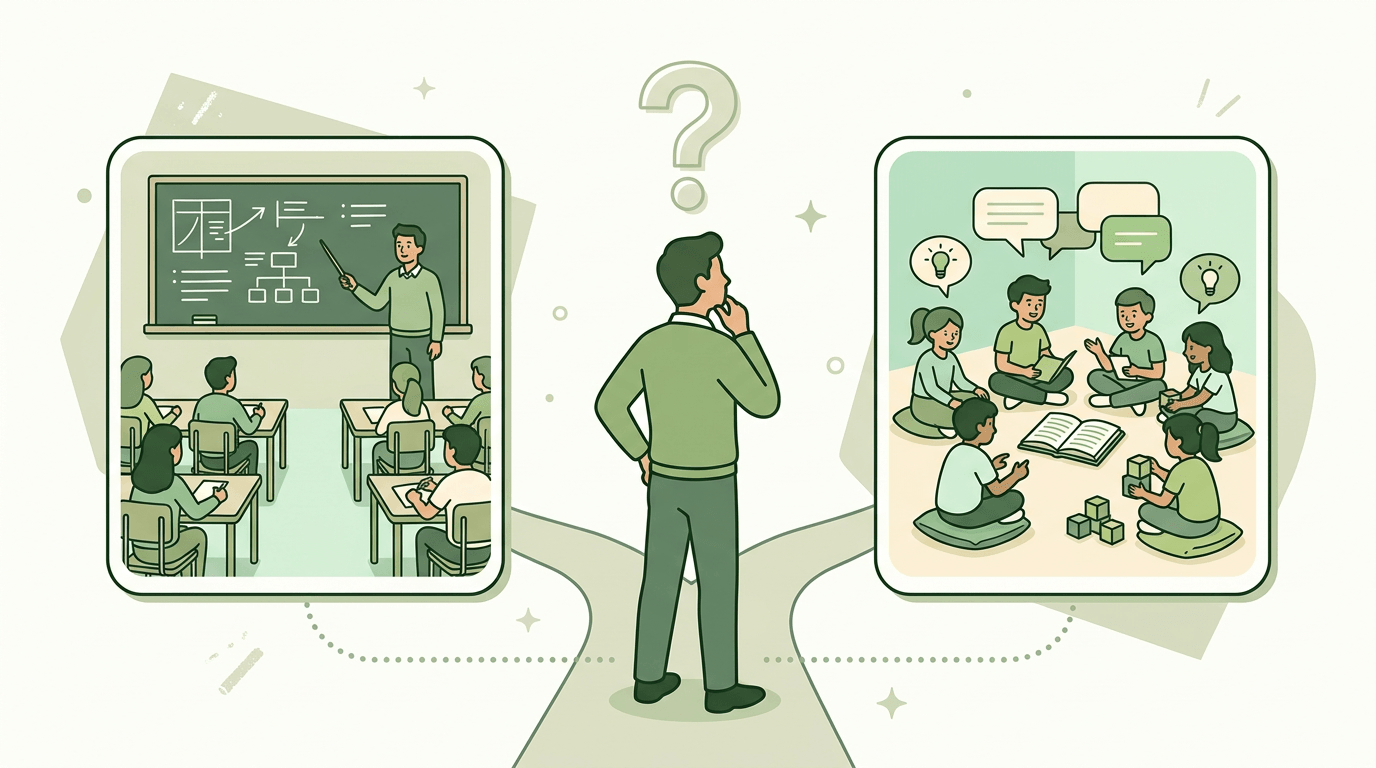
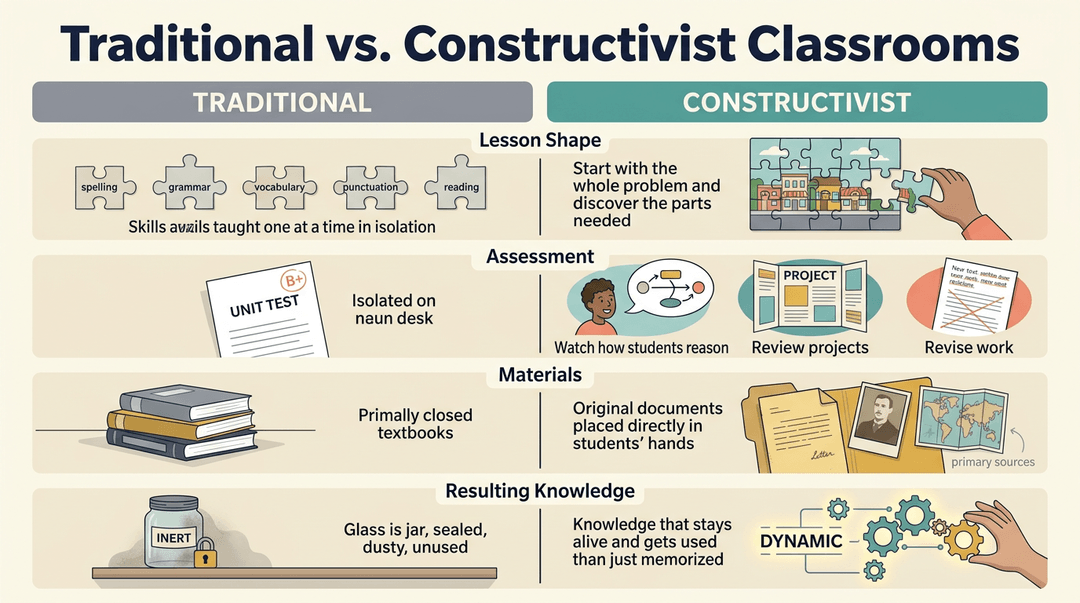
The biggest difference is the shape of the lesson. Traditional classrooms teach curriculum in parts, one skill at a time. Constructivist classrooms start with the whole problem and let students find the parts they need. Assessment shifts too.
Instead of relying only on a unit test, you watch students explain their reasoning, review their projects, and revise their work, so you see how they reason, not just what they recall.
Materials shift from textbooks to primary sources, which put original documents in students' hands. The result is knowledge that stays dynamic, something students use, rather than inert, something they only memorize.
Frameworks for constructivist teaching goals
Several frameworks can anchor your planning:
- Brooks and Brooks principles. Brooks and Brooks proposed a set of principles for constructivist teaching and classroom practice.
- Honebein's seven goals. Honebein's seven pedagogical goals guide designers of constructivist learning environments.
- Baviskar's essential components. Baviskar's review identifies four essential features:
- eliciting prior knowledge
- creating cognitive dissonance
- applying new knowledge with feedback
- reflecting on learning
The five stages of constructivist learning
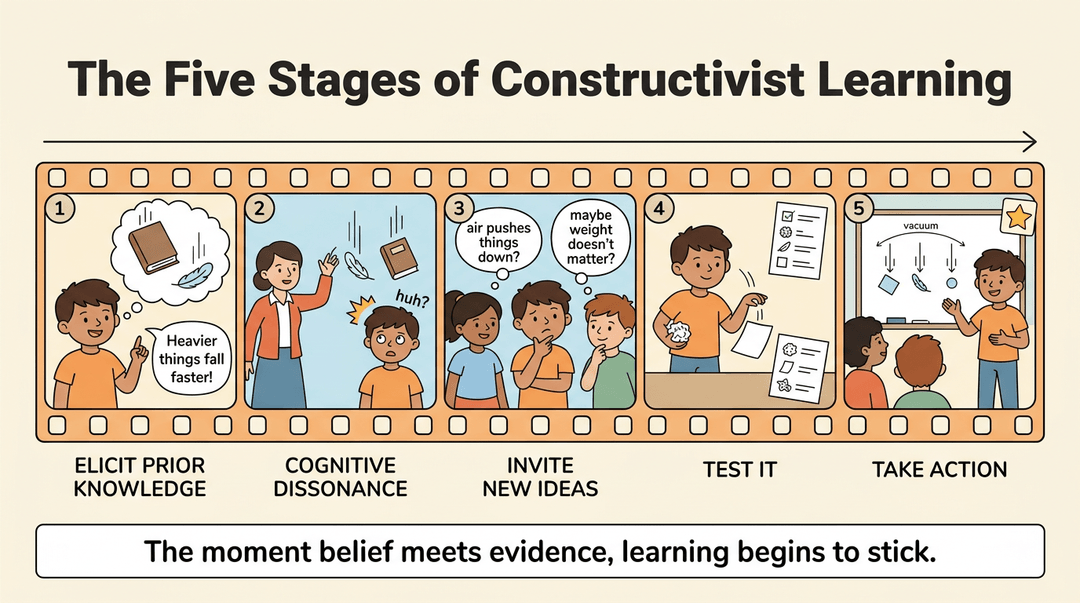
One staged model begins by eliciting prior knowledge, since new knowledge is built on what learners already believe. Next comes cognitive dissonance, a moment when that belief doesn't fit the evidence.
Then students invite new ideas and test them, and the process culminates in taking action. Picture a fourth-grader who insists heavier objects fall faster. When you drop a feather and a book side by side, the belief gets challenged in front of everyone.
That's the moment learning begins to stick.
How to Build a Constructivist Lesson Plan
Use this guide when you're planning a lesson where students build understanding themselves instead of receiving it. Fill in the five slots first, then check them against the two sample lessons.
The planning card
Copy these slots into your plan and fill each one before you pick an activity.
| Slot | What to write |
|---|---|
| Prior knowledge | One opening prompt that surfaces what students already think |
| Open-ended questions | Two or three questions with no single right answer |
| Core activity | What students handle, build, or solve together |
| ZPD match | Where help is needed, and what support you'll offer |
| Reflection | Five minutes at the end to compare old and new thinking |
Prior knowledge. Try: "What do you already know about floating and sinking?"
Open-ended questions. Ask for explanations, not answers.
- ✅ "Why do you think this one sank?"
- ❌ "Does this one sink, yes or no?"
- The difference: the first can't be answered with one word, so students must share their reasoning.
ZPD match. The zone of proximal development (ZPD) is the gap between what a student can do alone and what they can do with help. Plan hints, partners, or sentence starters, not answers.
Reflection. Say: "What did you think at the start, and what do you think now?"
⚠️ Watch out: Constructivist doesn't mean hands-off. Students discover more when your questions and groupings are planned in advance.
Two sample lessons
Elementary: sink or float. Here's the sequence, start to finish.
- Open with a prior-knowledge prompt.
- Students jot or share what they think makes things float.
- Let groups explore real objects.
- Each group gets a water tub and a mixed bucket of items.
- Collect student-led questions.
- Post their "I wonder..." questions on the board.
- Run a group discovery activity.
- Groups pick one question and test it.
- Close with reflection.
- Groups report what changed in their thinking.
Example: A second-grade teacher hears "heavy things sink" at the start. During testing, a group finds a heavy plastic bottle that floats. Their own question, "What's different about it?", drives the next ten minutes, and the teacher only supplies hints.
Middle and high school: a problem-based project. The phases are the same; the problem gets bigger.
| Phase | What students do |
|---|---|
| Real-world case study | Read a local problem and list what they already know |
| Problem-based project | Teams design a solution to that problem |
| Peer teaching roles | Each member becomes the expert on one part and teaches the team |
| Reflection | Write how their first approach changed |
Rotate the expert roles so the same student doesn't always teach.
At a glance: Surface prior knowledge, ask open questions, let students work it out, support them within their ZPD, then have them reflect.
Draft and reuse these constructivist lesson steps right in EMStudio's lesson planner.
What Are Examples of Constructivism in the Classroom?
Yes, and it's easier to spot than you might think. Picture a class studying weather that keeps a daily log, predicts tomorrow's sky, and checks those predictions against the forecast. Here are five common approaches that put that same idea to work.
Inquiry-based learning
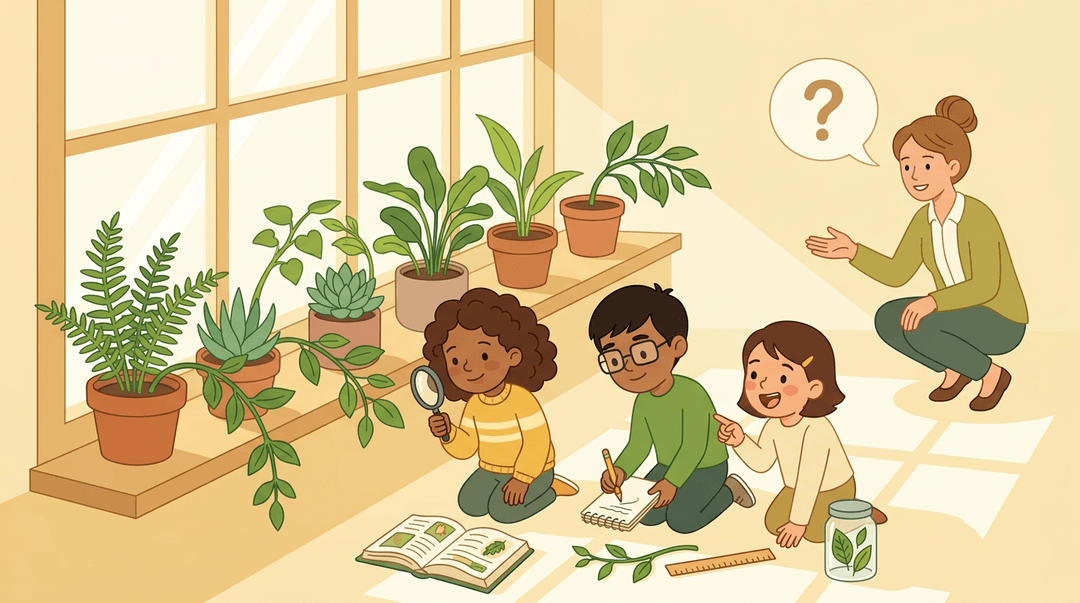
In inquiry-based learning, students drive the lesson by asking the questions. Consider a fifth-grade science teacher who asks, 'Why do some plants grow toward the window?' and then lets students decide what to investigate next.
Students research and observe, collecting evidence from books, experiments, or classroom walks. Then they draw their own conclusions and defend them with what they found.
The teacher's role shifts from giving answers to guiding the search. That's the whole idea.
Problem-based learning
Problem-based learning starts with a real-world problem rather than a textbook chapter. For example, a middle school math teacher might ask groups to plan a school garden within a fixed budget.
Students collaborate in groups, test their ideas, and stay focused on a workable solution. The payoff is practical: they practice reasoning through messy problems, the kind they'll face well beyond school.
Cooperative learning
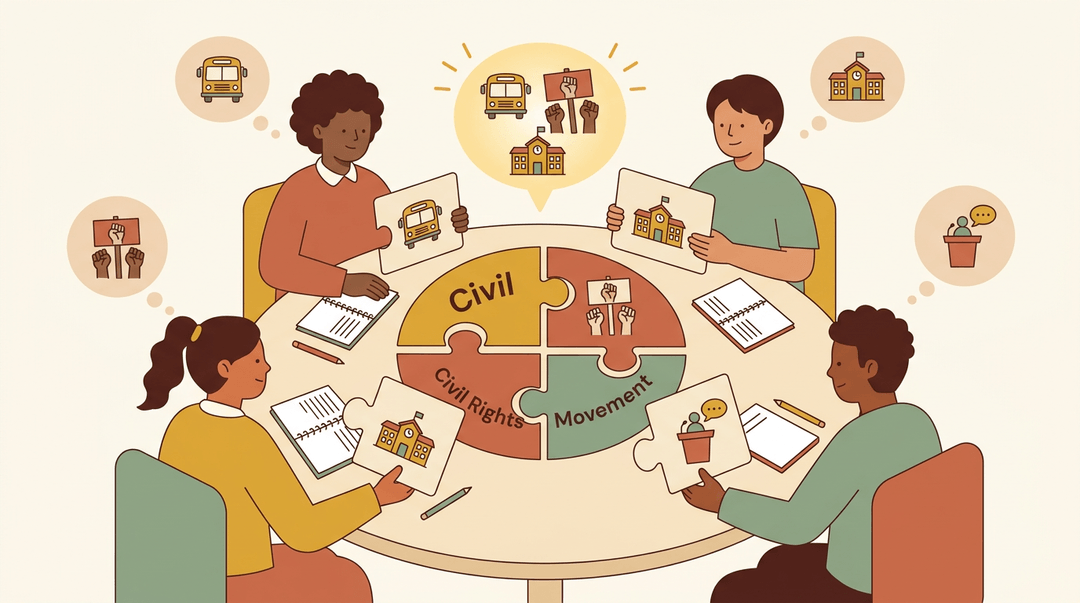
In cooperative learning, small groups work toward a shared goal. A high school history teacher might assign each group a different event from the Civil Rights Movement, with each student responsible for one part of it.
Groups pool what they know, so every member leaves with the full picture. Because each student's contribution matters, the group depends on every member. That interdependence is what makes the structure work.
Hands-on and experiential activities
Learning by doing sits at the center here. Students run experiments in science class, measuring results and revising their hypotheses as the data comes in. A biology class testing how light affects seed sprouting is a classic example.
Field trips extend the classroom, too. A visit to a local history museum or nature preserve gives students direct contact with the subject.
Primary source engagement works the same way: students examine original letters, photographs, or documents from the period and build their own interpretations rather than relying only on a summary.
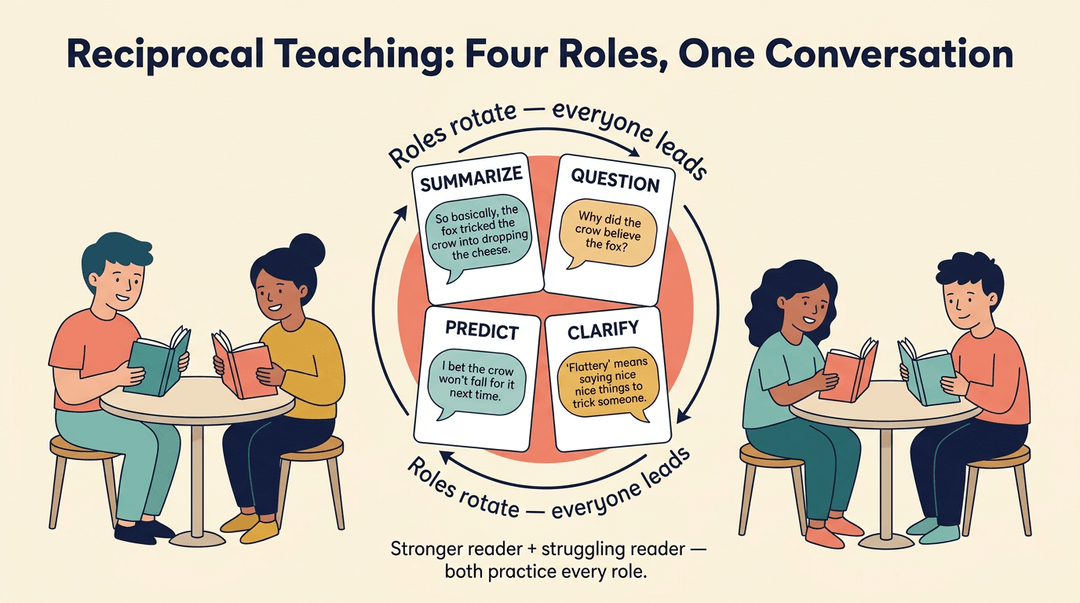
Reciprocal teaching
In reciprocal teaching, students take turns leading the discussion, which means they have to explain ideas in their own words. A reader might:
- summarize a paragraph
- ask a question
- clarify a tricky word
- predict what comes next
This works especially well in pair-based learning. A struggling reader works with a stronger partner, and both get practice explaining. Roles rotate, so each student practices every part.
Pros and Cons of Constructivism
Constructivism has real strengths and real limits. Here's what to weigh on each side.
Benefits of a constructivist approach
Consider a fifth-grade teacher who asks her class why ice melts faster in a warm room. Students test it, argue over the results, and revise their guesses. Here's what this kind of learning offers:
- Increased student engagement. Students solving a problem they care about stay focused longer.
- Deeper critical thinking. Learners explain why something works, not just what the answer is.
- Stronger social skills. Group work builds listening, negotiation, and the ability to defend ideas.
- Personalized learning. Each student starts from what they already know.
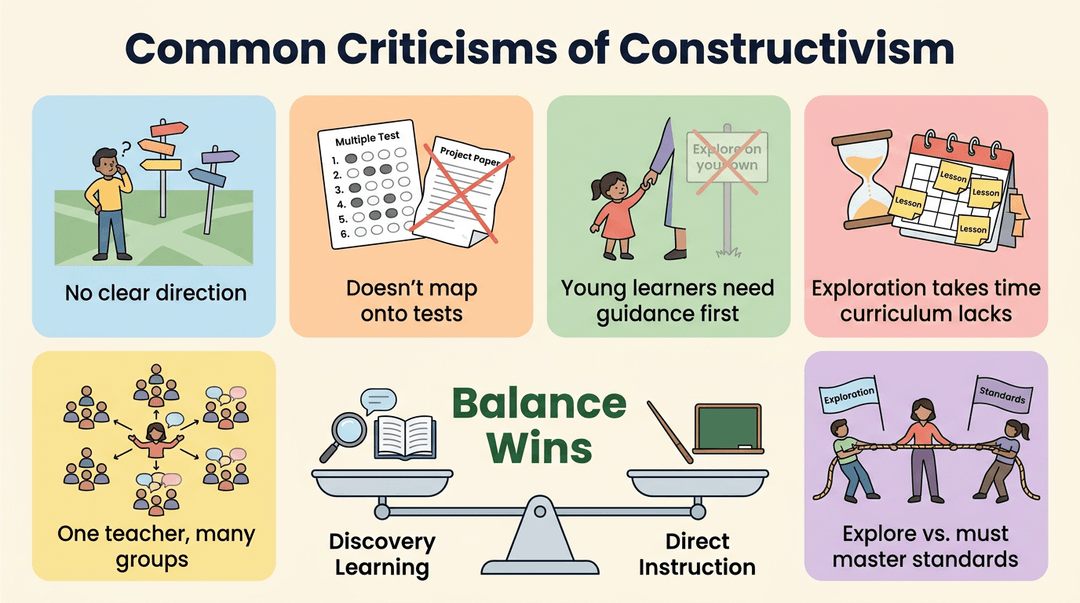
Common criticisms of constructivism
Critics raise fair concerns:
- Lack of structure. Open-ended tasks can leave some students without clear direction.
- Difficulty with standardized testing. Discovery learning doesn't always map neatly onto test formats.
- Not suited for all ages. Younger learners often need more explicit guidance first.
- Time-consuming for curriculum coverage. Exploration takes time that a packed scope and sequence doesn't have.
- Challenges in large classrooms. Facilitating small groups for thirty students is demanding.
- Balancing structure with standards pressure. You want exploration, but you also owe students mastery of standards.
The answer is rarely all discovery or all direct instruction. Balance wins.
Who Can Use Constructivism Learning Theory
Constructivism isn't reserved for one grade level or one kind of learner. Whether you teach kindergarten, coach adults, or tutor at the kitchen table, the core idea holds: learners build understanding rather than simply receive it.
How it works across different ages
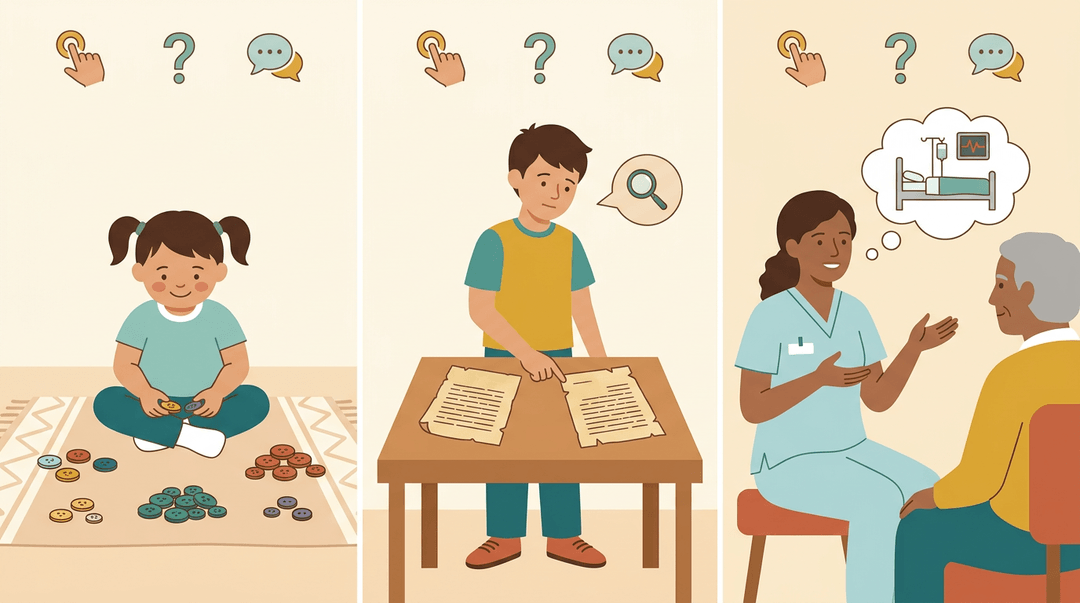
- Young learners: Hands-on play does the heavy lifting. A first-grade teacher might have students sort buttons by color and size before naming any attributes.
- Older students: Questions, debates, and projects take center stage. A middle school history teacher could ask students to weigh two primary sources and explain which they trust more.
- Adult learners: Start with experience. Ask new nurses to share a shift they remember, then build the protocol around it.
Is Montessori a constructivist approach? The two share common ground, since both center hands-on exploration and self-directed discovery.
Montessori, though, follows its own materials and sequence, so it's best seen as a related method rather than an identical one.
Starting small with one lesson
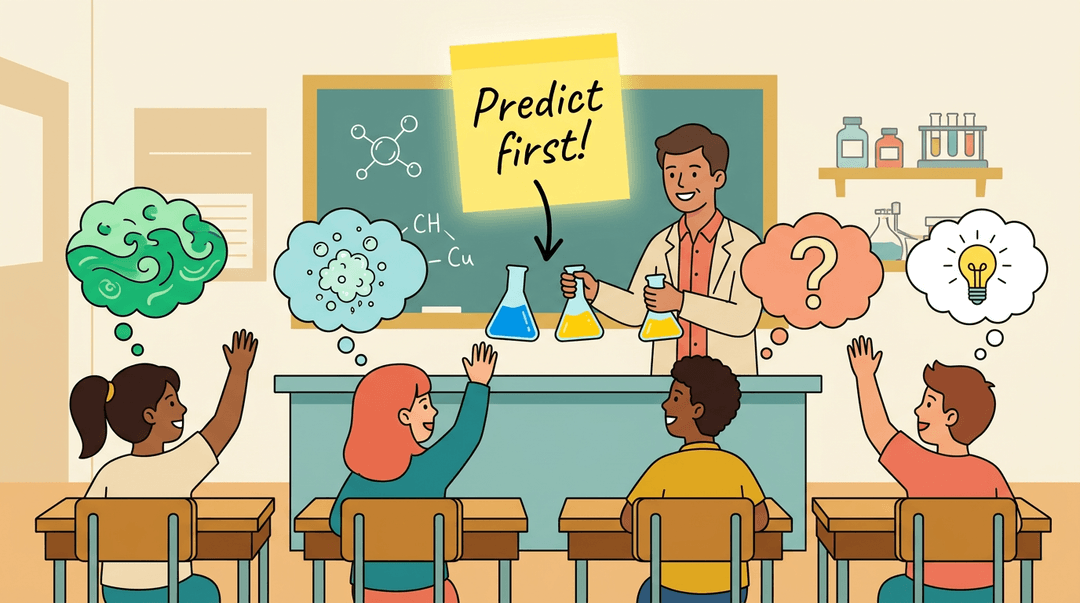
You don't have to overhaul your whole year. Pick one lesson and add a single move, such as asking students to predict an outcome before a demonstration.
A high school chemistry teacher can have students guess what happens when two solutions mix, then test their guesses. Small steps count.
Tutors and homeschool parents can use the same approach one-on-one. A single open question, like "What do you already know about this?", often shows exactly where a learner's understanding begins.
Constructivism comes down to one simple shift: students learn best when they actively build meaning, and teachers guide that process.
It asks you to plan for discovery, check for understanding along the way, and make room for the messy middle where real learning happens.
Ready to put this into practice? Check out our Lesson Planner to write, organize, and reuse constructivist lesson plans across all your classes from one place.
References
- RADICAL CONSTRUCTIVISM - Ernst von Glasersfeld — books.google.com
- DesignConstructivistHonebein — studentcenteredlearning.pbworks.com
- Constructivism - Office of Curriculum, Assessment and Teaching Transformation — buffalo.edu
- Dewey, Vygotsky, and the Social Administration of the Individual: Constructivist Pedagogy as Systems of Ideas in Historical Spaces — journals.sagepub.com
- In Search of Understanding: The Case for Constructivist Classrooms — search.ebscohost.com (1993)
- Essential Criteria to Characterize Constructivist Teaching: Derived from a review of the literature and applied to five constructivist‐teaching method articles — doi.org (2008)
- The Success or Failure of Constructivist Instruction: An Introduction — doi.org (2009)
- What Happened to Behaviorism – Association for Psychological Science — psychologicalscience.org
Frequently asked questions
What is the main idea of constructivism theory?
Constructivism holds that learners actively build knowledge by connecting new ideas with prior knowledge and experience. Learning is therefore a process of making meaning, not passively absorbing information from a teacher.
What are the main theories of social constructivism?
The main strands are cognitive constructivism, associated with Jean Piaget; social constructivism, associated with Lev Vygotsky; and radical constructivism, associated with Ernst von Glasersfeld. They emphasize individual cognitive development, learning through culture and interaction, and subjective interpretations of reality, respectively.
What is Jean Piaget's constructivism theory?
Piaget’s constructivism explains learning as individual cognitive development. Learners use assimilation to fit new information into existing schemas and accommodation to change those schemas when new information does not fit.
Can you give me an example of constructivism in education?
A teacher might ask students to predict whether different objects will sink or float, test their predictions in groups, and explain how the results changed their thinking. The teacher guides the investigation with questions instead of simply giving the answer.
What is Vygotsky's theory of constructivism?
Vygotsky’s theory says that learning develops through social interaction, language, and culture before becoming an individual ability. His zone of proximal development describes what learners can do with support, while scaffolding is the temporary assistance that gradually fades.
Can you give me an example of social constructivism?
Students studying a historical event might work in groups, examine primary sources, teach one another different aspects of the event, and combine their findings into a shared explanation. Their understanding is built through discussion, collaboration, and interpretation of evidence.
Is Montessori a constructivist approach?
Montessori is generally considered compatible with constructivist principles because it emphasizes hands-on exploration, active learning, and learner independence. However, Montessori is a distinct educational method with its own materials, sequence, and classroom structure, not simply another name for constructivism.
Who is the father of constructivism?
There is no single universally accepted father of constructivism. Jean Piaget is often most closely associated with cognitive constructivism, while John Dewey, Lev Vygotsky, and Ernst von Glasersfeld also made major contributions to its development.