Errorless Teaching ABA: How It Works and How to Use It


Jump to section
Imagine handing a new driver a map with the route already highlighted, then slowly letting them read the signs on their own.
That's the core idea behind errorless teaching, an ABA (applied behavior analysis) approach where you arrange prompts so learners get it right from the very first try, then fade that help over time.
Instead of letting mistakes pile up, you build success step by step. In this post, we'll cover what errorless teaching is, how it works, how to build a lesson plan around it, and where it fits alongside other methods.

What Is Errorless Teaching in ABA?
Picture a lesson that keeps going sideways because a student guesses wrong again and again. Errorless teaching is built to prevent that spiral.
Prompting learners to answer correctly
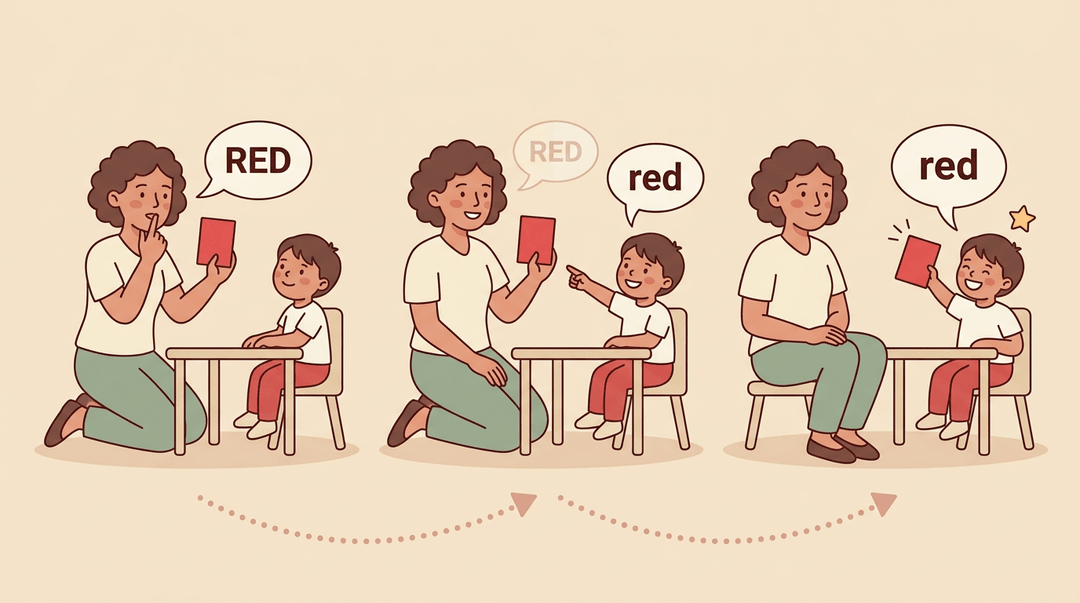
Errorless teaching is a method from applied behavior analysis (ABA) in which the teacher gives a prompt before the learner responds, so the learner gets it right.
Picture a special education teacher working on colors: she holds up a red card and says "red" before asking the question. The learner responds correctly, which is the opposite of trial-and-error.
Over time, the prompt is gradually removed until the learner answers on their own. Success comes first. Independence follows.
Rooted in Skinner's operant conditioning
This approach is rooted in Skinner's operant conditioning, the idea that behavior changes based on its consequences. Positive reinforcement drives that change: when a response is followed by something rewarding, the learner is more likely to repeat it.
Classical conditioning works differently, linking two stimuli together rather than a behavior and its outcome. Errorless teaching uses reinforcement to make sure correct responses are the ones that get rewarded.
Errorless doesn't mean zero mistakes
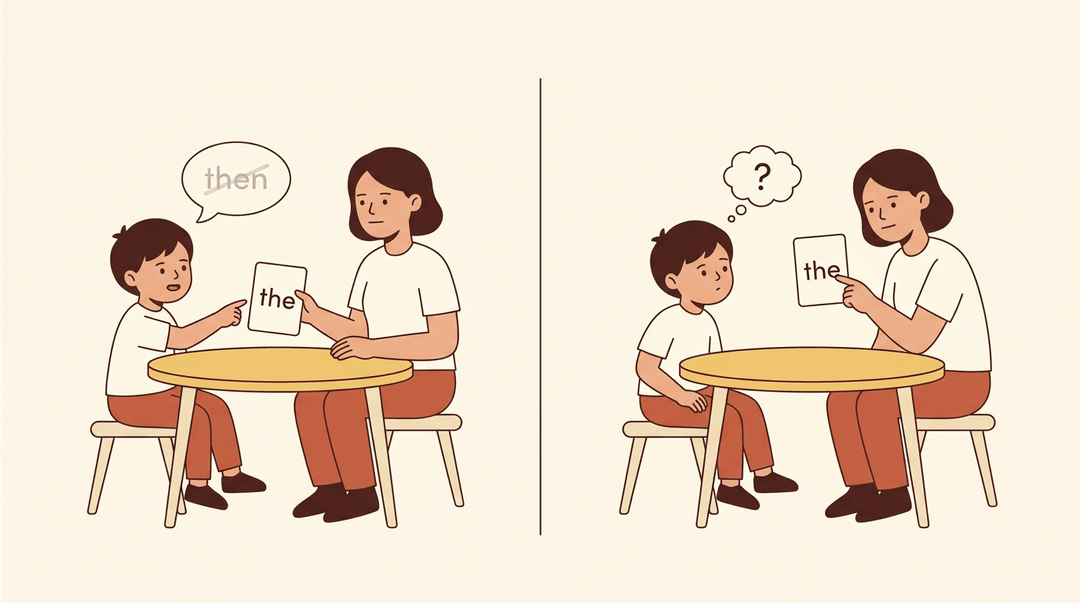
Mistakes can still happen, especially when a prompt is faded too quickly. What matters is how you respond. Incorrect responses get no reinforcement, so you withhold praise and repeat the instruction with the prompt back in place.
Errorless doesn't mean giving the answer, either. The goal is for the learner to produce the response.
For example, a tutor helping a student read "the" might say nothing positive after a wrong "then," then repeat the word with the flashcard and wait for another try.
How Errorless Learning Actually Works
Errorless learning sets the learner up to succeed, then hands the work back piece by piece. Here's how that plays out.
Types of prompts and their hierarchy
A prompt is any cue that helps a learner respond correctly:
- Physical prompts: hand-over-hand guidance
- Gestural prompts: pointing or nodding
- Verbal prompts: a spoken hint
- Visual prompts: a picture or a model
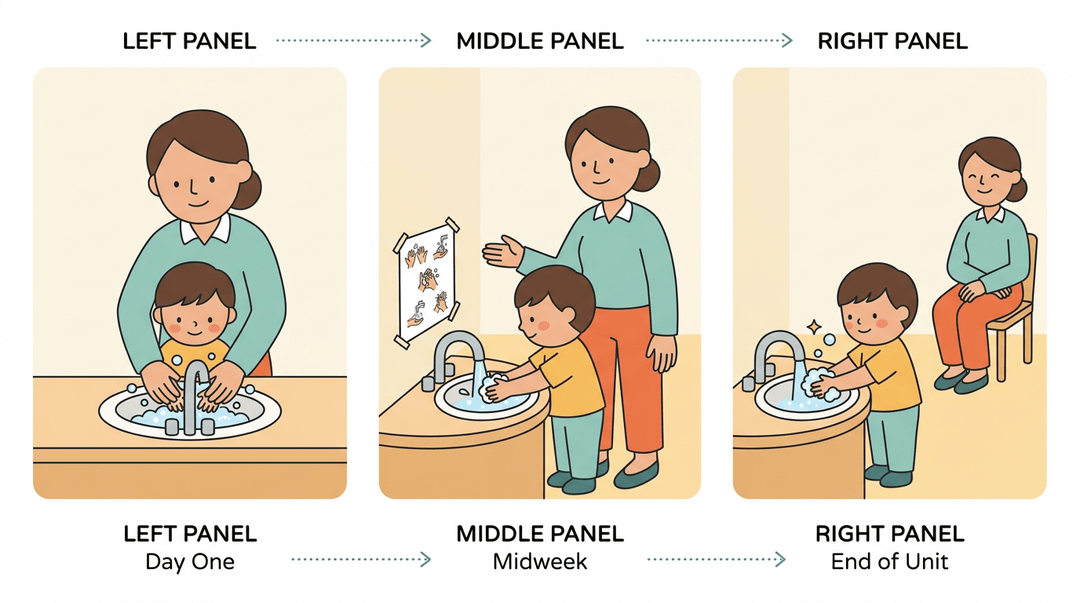
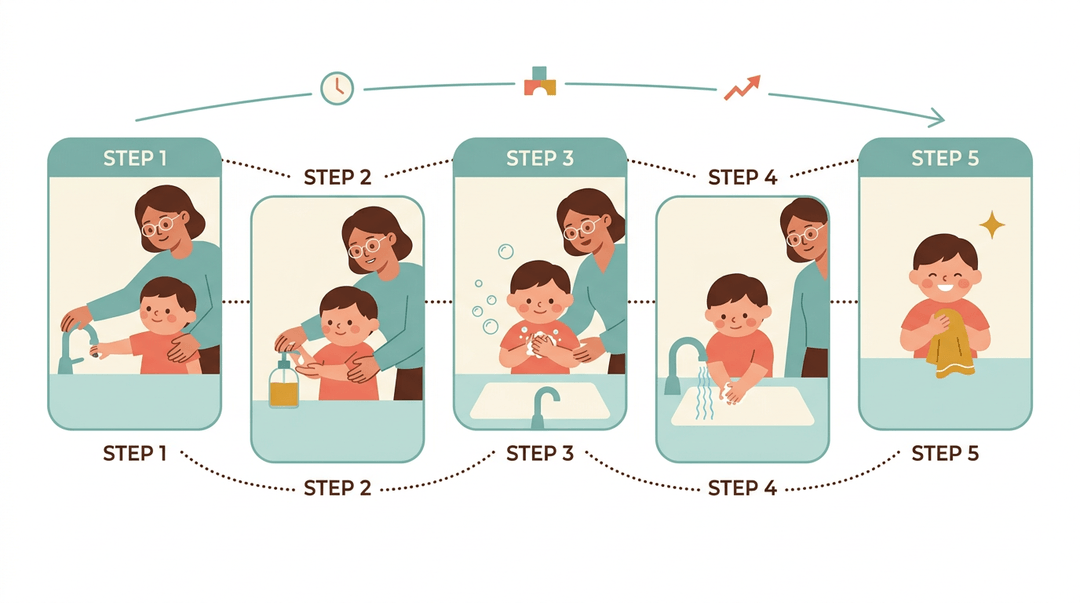
Most-to-least prompting starts with the strongest help and removes it as skill grows. Consider a special education teacher teaching handwashing.
On day one she guides the student's hands, by midweek a picture card does the cueing, and by the end of the unit the student washes alone. That shift from intrusive prompts to independent responding is the prompt hierarchy in action.
Gradually fading prompts over time
Time-delay prompting gives the prompt right away at first, then waits a little longer each trial so the learner can respond on their own. Stimulus fading changes the materials gradually until only the real task remains.
Either way, you remove support systematically, not all at once. The aim is independence rather than reliance on a cue, because prompts that never fade become a crutch.
Timing and level of reinforcement
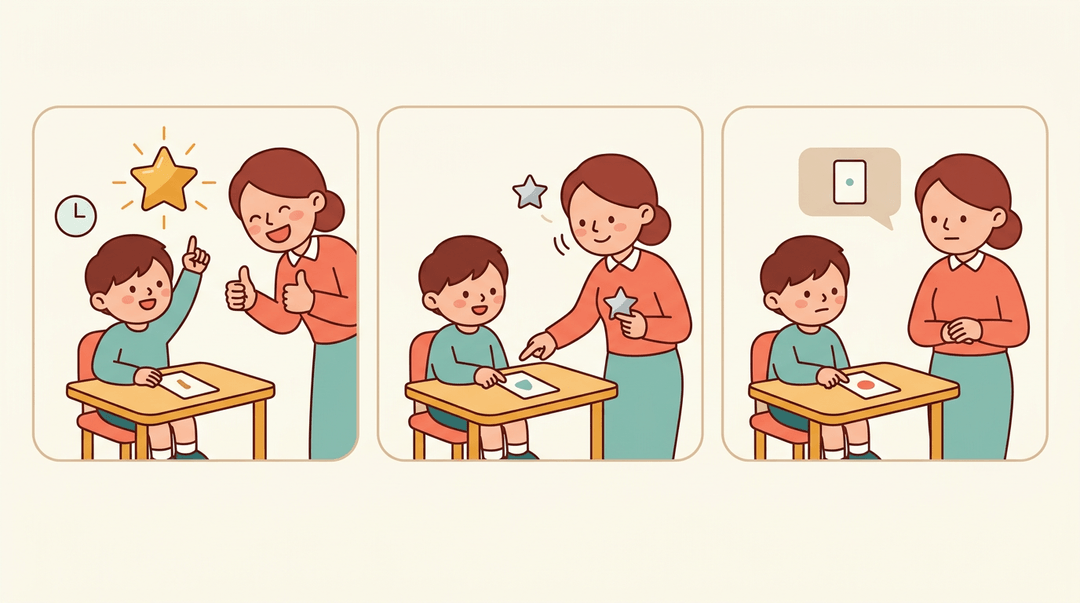
Praise right after a correct response so the connection is clear. Match the reward to the help needed: independent answers earn your strongest reinforcement, while heavily prompted ones get a lighter touch. Wrong answers earn nothing.
Mistakes get no reward, and they never get punished.
What are the 5 steps of DTT?
Discrete trial training (DTT) breaks a skill into short, repeatable trials, and each trial follows five steps:
- Instruction given: present one clear direction or question.
- Prompt provided immediately: supply the help the learner needs right now.
- Success and reinforcement: reward the correct response.
- Prompt faded over trials: use a little less help each time.
- Lesson-plan match: the sequence follows the same arc as a daily lesson plan, so it fits the routine you already use.
That's the whole loop, and you'll find it easy to repeat.
How to Build an Errorless Lesson Plan
Use this guide when you're turning one skill into an errorless lesson: check your setup, build the five steps, then borrow a filled-in example for your learner.
Before you start
Confirm all five before the first trial:
- Baseline assessed. You know what the learner can already do without help.
- Prompt hierarchy chosen. Your levels are listed, most help to least.
- Reinforcement ready. The praise, token, or item is in your hand.
- Data sheet prepared. It has a row for every trial.
- Fading plan set. You've decided what moves the learner down a level.
The five-step build
- State a clear objective.
- Name the learner, the skill, and the standard.
- "Given a red and a blue card, Mia will hand over the one you name, with no prompt."
- Give the instruction, then prompt immediately.
- Say: "Touch red." and point to red right away.
- No wait time, so the learner has no chance to err.
- Reinforce the correct response.
- Deliver the praise or reward the moment the response happens.
- Fade the prompt systematically.
- Step down one level at a time: full help, partial help, gesture, none.
- Move down only after correct responses at the current level.
- Record data each trial.
- Mark correct or incorrect and the prompt level used.
⚠️ Watch out: If errors start to appear, you've faded too fast. Go back one prompt level and rebuild from there.
Four lessons, filled in
Same five steps, different learners. Lift the row closest to yours and adapt it.
| Setting | Target skill | Starting prompt | Fade move |
|---|---|---|---|
| Preschool | Color matching | Point to the matching card | Point, then glance, then nothing |
| Elementary | Sight words | Say the word as you show it | Say only the first sound |
| Special ed | Self-care sequence | Hand-over-hand guidance | Shadow the hands, then gesture |
| Tutoring | Math fact recall | Answer shown on the card | Cover part of the answer |
Example: A tutor teaching 7 × 8 shows the card with the answer visible and says, "What's 7 times 8?" The student reads 56 and gets praise. Over the next sessions, the tutor covers one digit, then both, and logs the prompt level on each trial.
Build and reuse errorless lesson plans quickly in EMStudio's online lesson planner.
Why Errorless Learning Helps Learners
Errorless learning keeps learners succeeding while they build a skill. Here's what that looks like in practice and what the research shows so far.
Building confidence and reducing frustration
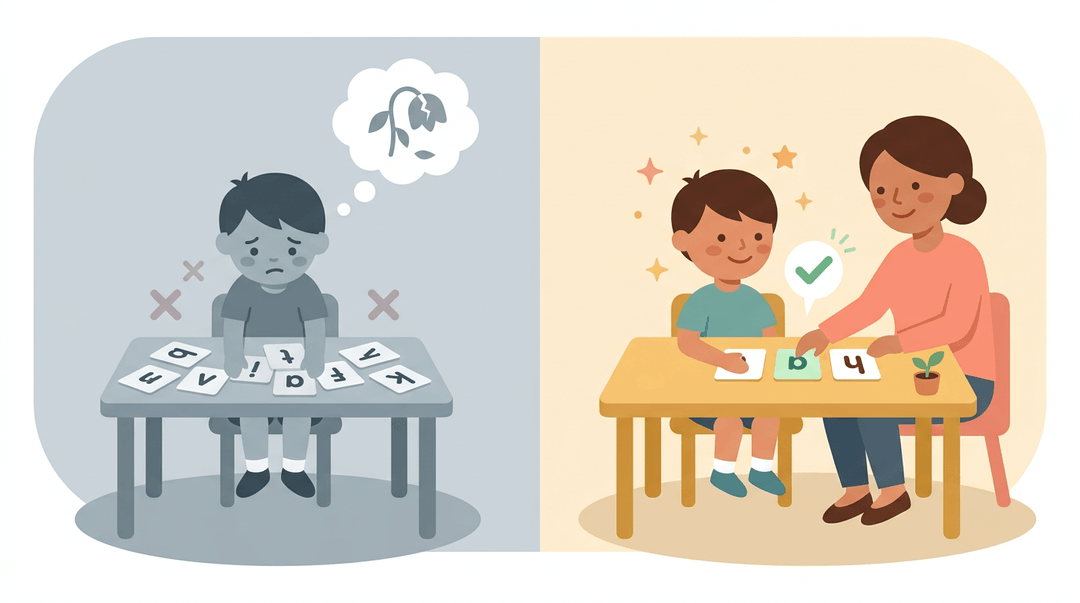
When a learner gets every attempt wrong, frustration builds fast. Errorless teaching makes success the normal outcome, which eases anxiety and builds confidence and self-esteem.
Over time, that helps prevent learned helplessness, the belief that effort won't change the result. Think of a special education teacher working on letter sounds with a student who shuts down after two misses.
Prompts that guarantee an early correct answer keep that student engaged and the lesson moving.
Faster learning and better retention
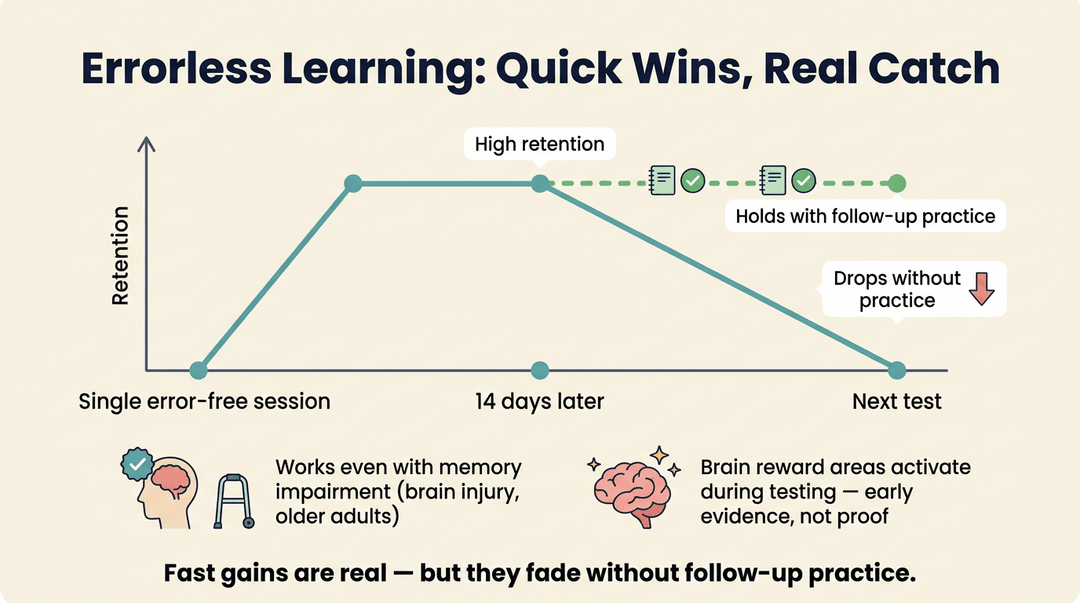
A study on children with acquired brain injury notes that the principle has proven efficacy for adults and older adults learning new information despite memory impairment.
For retention, one set of experiments found an advantage for errorless conditions in both severely and moderately memory-impaired participants.
Brain research adds a lead. A PNAS study found that testing and prediction error activate reward-related areas of the brain. It's promising, but it isn't a direct test of errorless practice, so treat it as early evidence.
Speed claims need care. The real question is how fast, and for how long. One study found that a single error-free session predicted high retention after 14 days, but that retention significantly declined by the second posttest.
Quick gains are real, but they need follow-up practice.
Skills You Can Teach with This Method
Errorless teaching isn't limited to one kind of skill. Here's where it fits, from daily routines to classroom academics, and who else has benefited.
Teaching communication and language skills
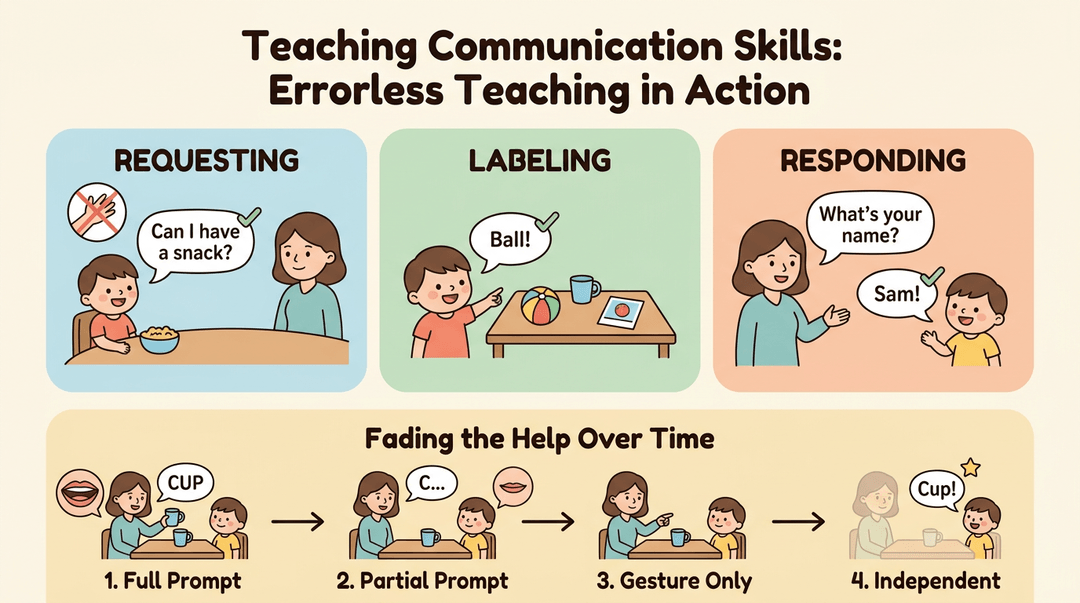
Communication is a natural starting point. You can use errorless teaching to build:
- Requesting items: a student asks for the snack instead of pointing or reaching.
- Labeling objects: a student names a ball, a cup, or a picture card.
- Responding to questions: a student answers 'What's your name?' correctly.
Think of a speech aide who puts one familiar item on the table and offers only the word the student needs. The student gets it right first, and the aide fades that help over time.
Everyday self-care and life skills
Toothbrushing, dressing, toileting routines, and handwashing sequences all break into small, ordered steps, which makes them a natural fit.
For example, a paraprofessional teaching handwashing might guide every step at first, then cue only the water, then only a gesture.
Early academic and learning skills
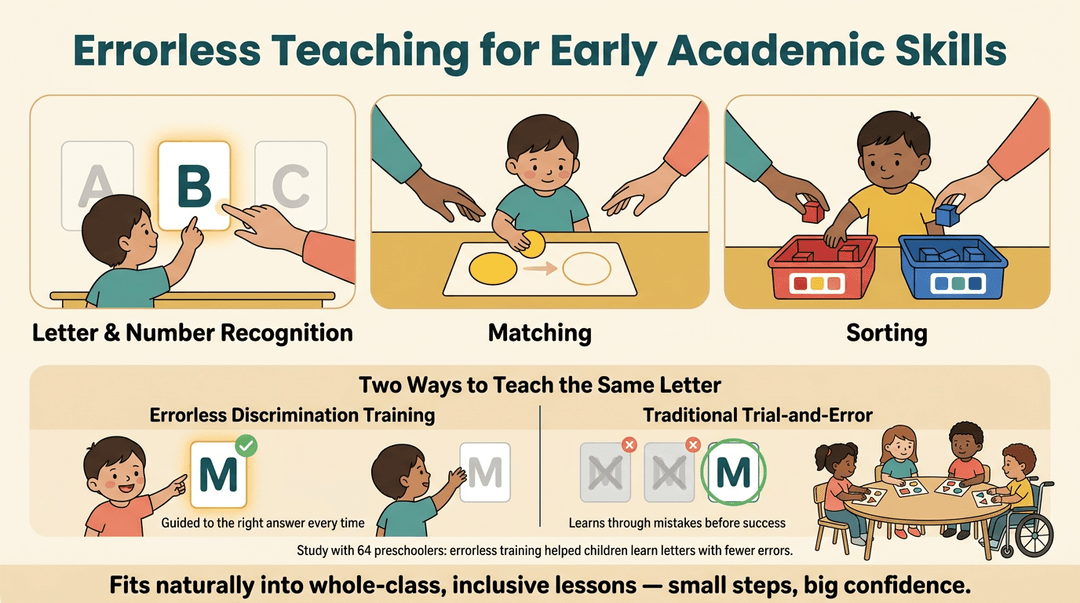
Errorless teaching has been used to support:
- letter and number recognition
- matching
- sorting
In one study on teaching letters of the alphabet, 64 inner city preschool children learned letters through errorless discrimination training (EDT) or a traditional reinforcement-extinction approach.
Reading comprehension gains need more evidence than we have here, so treat them as an area to explore. It also fits inclusion settings, where small, visible steps slot into whole-class lessons.
Safety skills and following directions
Responding to a name, stopping at the curb, and following one- and two-step instructions carry real stakes. Teach the response first. Picture a teacher practicing curb stops: she starts with a raised hand the student can't miss, then fades that cue.
Once one step is reliable, add the second. The goal is to get it right first, then do it on their own.
Who benefits beyond autism
Errorless learning has also been used with several other groups:
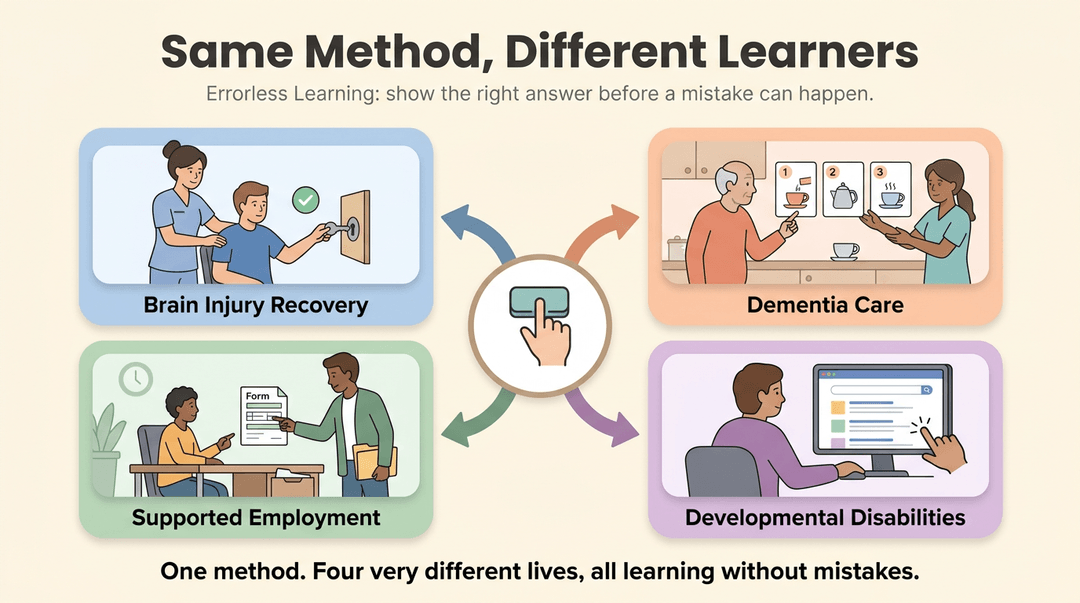
- Traumatic brain injury: a Queensland Health project randomly assigned participants to an error-based or an errorless learning group.
- Dementia and memory impairment: a PMC article on everyday tasks in people with dementia notes that earlier studies used lab tasks with little practical relevance, though they showed positive effects.
- Schizophrenia: researchers including Michael Green have applied errorless learning in supported employment for serious mental illness.
- Adults with developmental disabilities: one study on internet skills paired errorless learning with backward chaining to teach adults with autism to access age-appropriate websites.
Same method, different learners.
Putting Errorless Teaching into Practice
Here's how to turn errorless teaching into a plan you can run. Behavior Skills Training (BST) has four steps:
- instruction
- modeling
- rehearsal
- feedback
You can use them to teach the procedure itself. A BCBA (board certified behavior analyst) designs the program, an RBT (registered behavior technician) implements it, and supervision keeps the two aligned.
Starting with a baseline assessment
Standardized tools like the VB-MAPP (Sundberg) and ABLLS-R (Partington), covered in Assessment of Verbal Behavior Repertoires, help you identify skill levels and barriers such as attention or motor challenges.
Think of a teacher who receives a new student midyear and learns in two weeks that the student has no reliable way to request a break. That becomes the first target, so the student gets a useful skill right away.

Breaking skills into smaller steps
Break complex skills into small steps, then sequence them from simple to complex. Handwashing, for example, breaks into:
- turning on the water
- wetting hands
- applying soap
- scrubbing
- rinsing
- drying
Keep one reusable task analysis template with a row for each step, a column for the prompt level, and a column for the date mastered. Small steps mean more wins.
Tracking data and progress over time
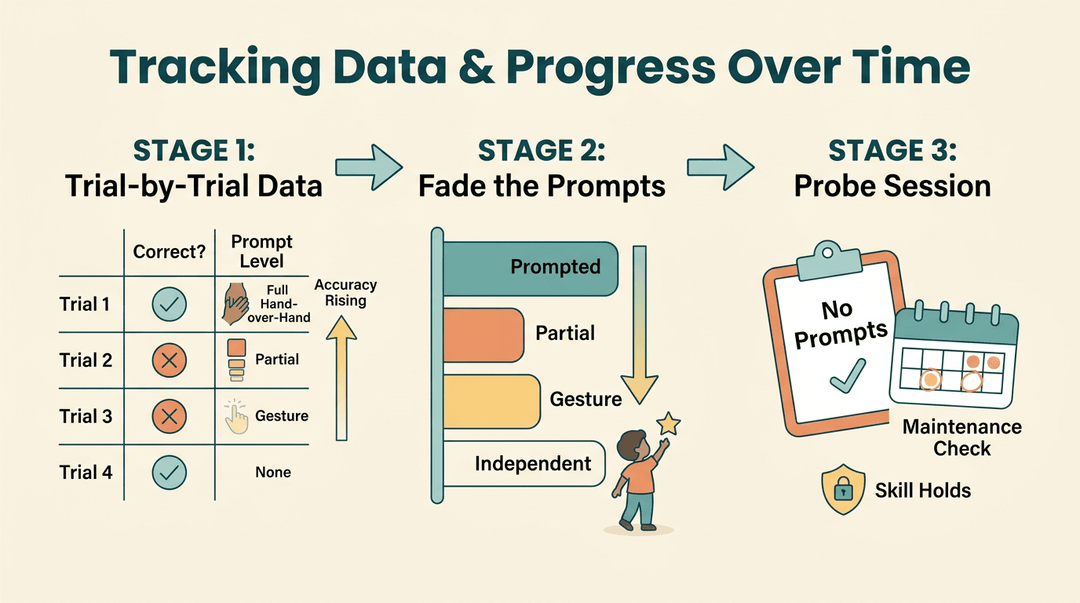
Record trial-by-trial data on every attempt, noting whether the response was correct and which prompt level you used. As accuracy climbs, fade prompts and aim for independent responding rather than prompted responding.
Run a probe session with no prompts to confirm the skill holds, then schedule maintenance checks so mastered skills don't slip.
Making skills stick across settings
Practice across settings, people, and materials so the skill isn't tied to one room or one adult. A student who orders lunch from only one cafeteria worker may freeze when someone else is on shift.
Regular maintenance sessions are how you prevent skill regression, the gradual loss of skills that go unused.
Tailoring the approach to each learner
Match the approach to each learner's learning style and sensory needs, and shorten targets when attention span runs short. Staff and family should also use the same prompts and steps. That shared language is what turns a lesson into a habit.
Where Errorless Teaching Came From
Errorless teaching didn't appear overnight. It grew out of decades of research on how behavior is shaped, and knowing that history helps you plan better sessions.
Roots in early behaviorist theory
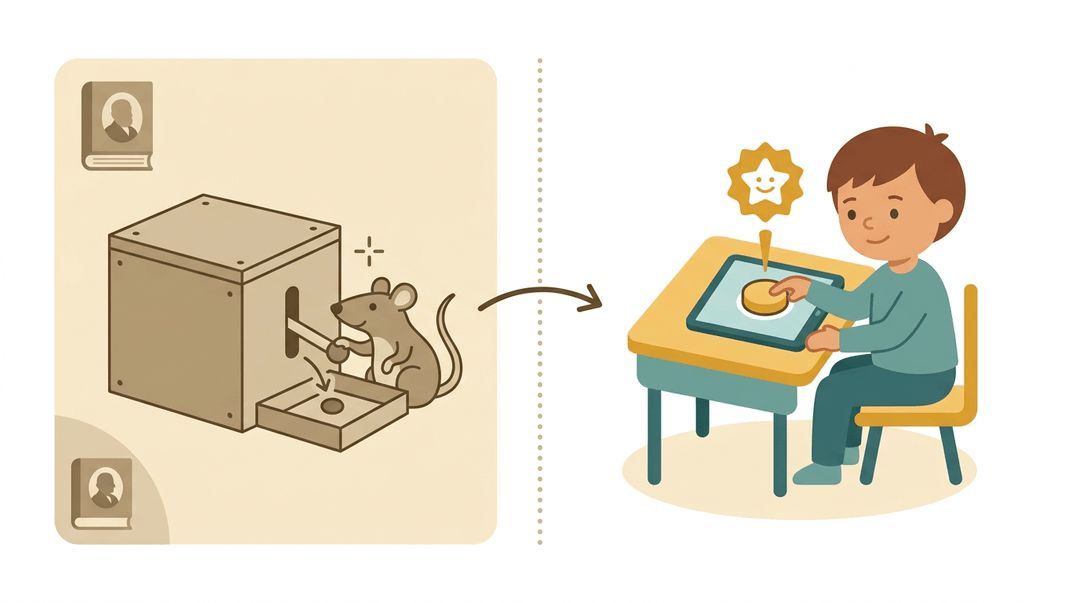
Say a tutor wants a student to learn that pressing a button leads to a reward. That idea traces back to B. F. Skinner's operant conditioning theory, which dates to the 1920s.
Skinner's work shifted attention away from automatic responses and toward consequences as the force that shapes what learners keep doing. Errorless teaching builds on that idea.
Pioneers who shaped the method
Jeanne Simons began applying these principles at Linwood Children's Center in 1955. Charles Ferster, whose roots ran through the Skinner lab and its animal research, became a key figure in that work.
The Linwood Method was defined between 1965 and 1968, giving the approach a name and a clear structure.
How it merged with discrete trial training
The use of ABA for autism was developed in the 1970s by Ole Ivar Lovaas, a clinical psychologist from the University of California. This is the late 20th century roots of what became discrete trial training (DTT).
DTT relies on a task analysis that breaks skills into teachable steps, and errorless procedures have been built into that structure.
Think of a tutor teaching a student to wash hands. The tutor lists each step, prompts the first one, and fades support as the student succeeds. Small steps make success likely.
Pairing errorless procedures with DTT has been reported to improve results, because learners practice correct responses rather than recovering from mistakes.

How Errorless Teaching Compares and Combines
Errorless teaching doesn't work alone. Knowing how it compares to other approaches, and where it fits alongside them, helps you pick the right tool for each learner.
Errorless learning vs. error correction
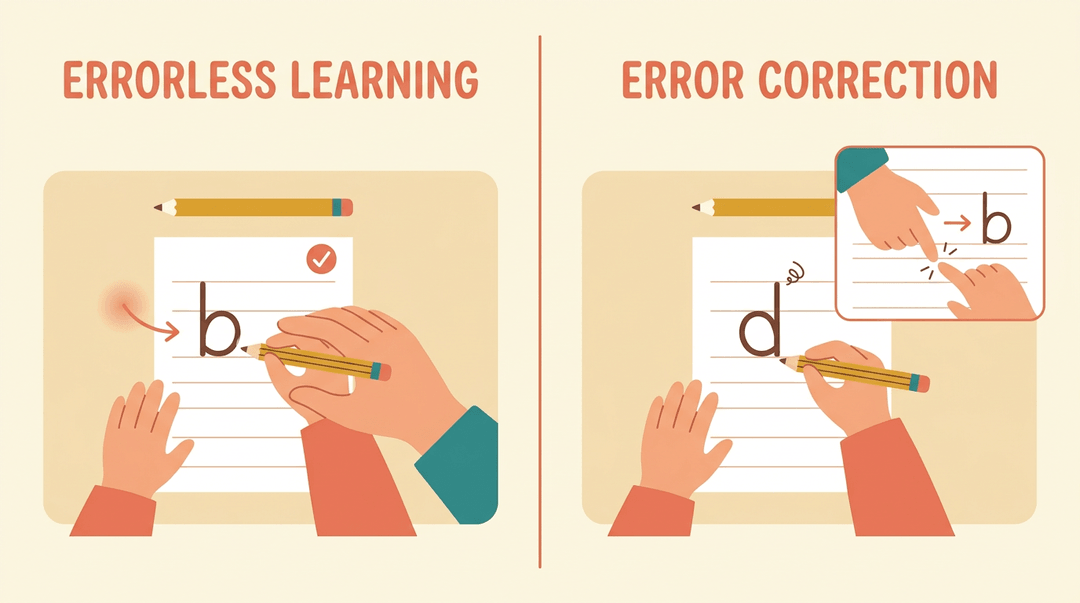
The biggest difference is timing of support. Errorless learning gives help before the learner responds, so mistakes stay rare. Error correction lets the learner make an independent attempt first, then steps in after a miss.
Picture a student practicing the letter "b." Errorless, you guide the pencil from the start. With error correction, the student tries alone, and you help only if it comes out backward.
Both have a place, depending on the skill and how much the learner can handle independently.
When errorless learning isn't ideal
Errorless teaching isn't always the answer. It may fall short when:
- A skill is already mastered and the learner needs to generalize it to new people, places, or materials.
- The learner thrives on trial-and-error and learns well by working through a mistake.
- The skill calls for exploration, where some mistakes are part of the learning.
What are teaching strategies in ABA?
Teaching strategies are the methods you use to build new skills. Core ABA (applied behavior analysis) strategies include shaping, which reinforces steps closer to a target behavior, and chaining, which teaches a sequence one link at a time.
Errorless teaching is used with both. Consider a special education teacher working on hand-washing. She breaks the routine into steps and teaches each in order, so the student practices every link, not just the final one.
These strategies also pair with natural environment teaching, which builds skills during everyday routines, and they belong inside a comprehensive treatment plan.
Errorless teaching gives learners an early taste of success, then gradually hands them more of the work. Start with a clear target, choose the right prompt, and plan your fading steps before the lesson begins. Ready to put this into practice?
Check out our Lesson Planner to write, organize, and reuse your plans across every class from one place.
References
- THERAPEUTIC INTERVENTIONS IN AUTISM THROUGH THE PRISM OF EVIDENCE-BASED MEDICINE: FOCUS ON BEHAVIORAL TECHNIQUES — doi.org (2025)
- Assessment of Verbal Behavior Repertoires — doi.org (2025)
- Michael Green — profiles.ucla.edu (2025)
- What is the locus of the errorless-learning advantage? — uhra.herts.ac.uk (2025)
- Neural and computational evidence for a predictive learning account of the testing effect — pnas.org (2025)
- Predicting Long‐Term Knowledge Retention by the Number of Error‐Free Practice Sessions — doi.org (2026)
- Discrete Trial Training (DTT) - ---EBP Brief Packet — files.eric.ed.gov
- Teaching Children to Discriminate Letters of the Alphabet through Errorless Discrimination Training — journals.sagepub.com
- Error-based Learning Project — health.qld.gov.au
- Errorless learning of everyday tasks in people with dementia — pmc.ncbi.nlm.nih.gov
- The Effects of Errorless Learning and Backward Chaining on the Acquisition of Internet Skills in Adults with Developmental Disabilities — pmc.ncbi.nlm.nih.gov
- Errorless learning improves memory performance in children with acquired brain injury: a controlled comparison of standard and self-generation techniques — pubmed.ncbi.nlm.nih.gov
- The etymology of basic concepts in the experimental analysis of behavior. — pmc.ncbi.nlm.nih.gov (2004)
- History — linwoodcenter.org
Frequently asked questions
What is the difference between error correction and errorless learning?
Errorless learning provides a prompt before the learner responds, preventing most mistakes and gradually fading support toward independence. Error correction allows an independent attempt first and provides assistance after an incorrect response. Both approaches can be useful depending on the learner and skill.
What are the 5 steps of DTT?
The five steps of DTT are: give a clear instruction, provide an immediate prompt, reinforce the correct response, fade the prompt over repeated trials, and follow the planned lesson sequence while recording progress. Each trial is short, structured, and repeatable.
What are teaching strategies in ABA?
Common teaching strategies in ABA include shaping, which reinforces successive approximations of a target behavior, and chaining, which teaches a multistep skill one link at a time. Other strategies include errorless teaching, natural environment teaching, prompting and fading, modeling, reinforcement, and discrete trial training.
What are the four steps of BST in ABA?
The four steps of Behavior Skills Training are instruction, modeling, rehearsal, and feedback. The teacher explains the skill, demonstrates it, has the learner practice, and gives feedback to improve performance.