Action Research in Education Explained, Step by Step

Jump to section
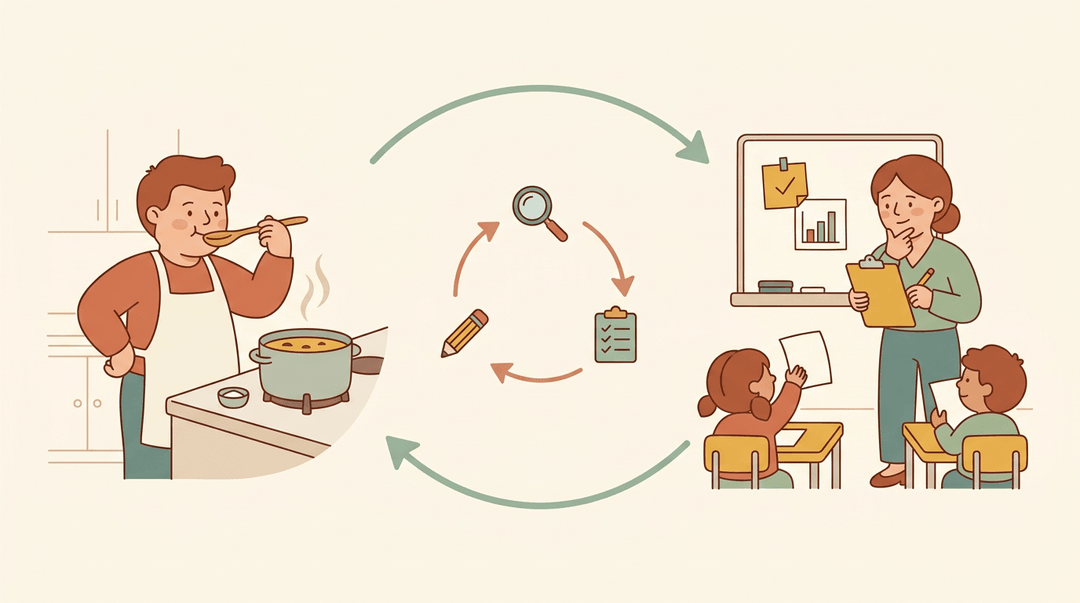
Think of a cook who tastes the soup, adds a pinch of salt, and tastes again. That small loop of trying, checking, and adjusting is the heart of action research, and teaching works the same way.
Action research is a practical, teacher-led inquiry: you notice a question in your own classroom, try a change, collect evidence on what happens, and refine your approach based on what you learn.
In this post, we'll cover the cycle, the models, the methods, and the ethics, plus a classroom-ready guide for running your own mini cycle.
Why Action Research in Education Matters
Action research gives you a way to study your own classroom and act on what you find.
The core traits of this inquiry
Action research has a few defining traits:
- Inquiry to understand and change. You study a real problem, then act on it.
- Practitioner-led, context-based. The question comes from your room, your students, and your school.
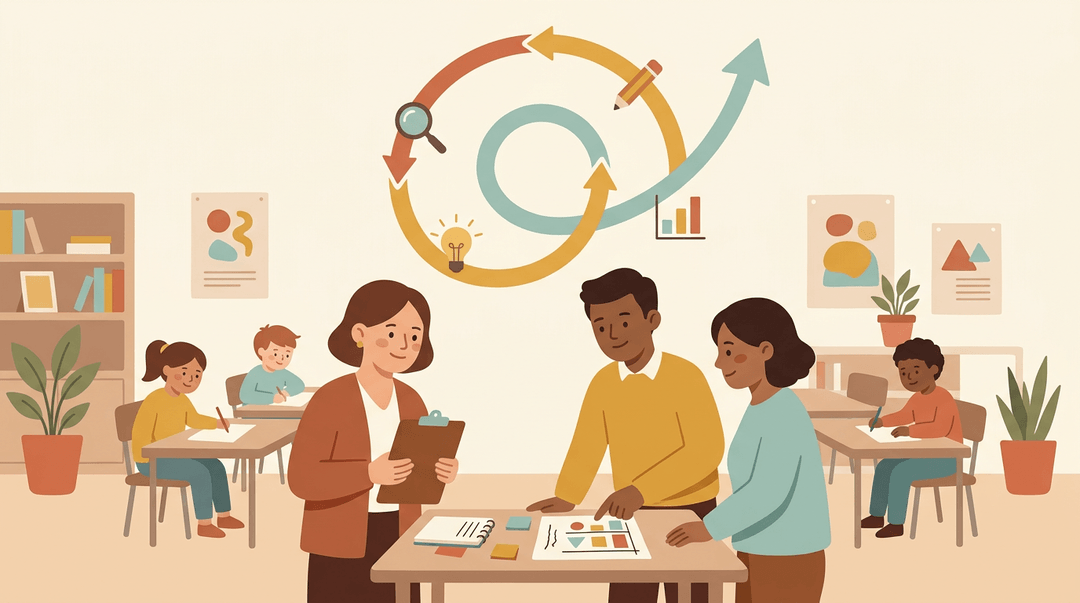
- Participative and collaborative. Colleagues and coaches help shape the work.
- Systemic inquiry by educators. Teachers run it systematically, with a plan for gathering evidence.
- Findings ongoing, not conclusive. Each result shapes your next step.
How it improves teaching and schools
Action research aims to improve practice and learning, and it's built to solve specific school problems. Decisions stay local, made by the people closest to the issue, and the work invites you to challenge existing practices.
The routine everyone assumes works gets tested, not just repeated.
Consider a fifth-grade teacher whose students stall on multi-step word problems. She tries one new routine for two weeks, tracks the results, and plans her next lesson from the evidence. Less guessing, more evidence.
According to Mertler (2020a), action research can boost teacher effectiveness.
How reflection fuels teacher growth
Most teachers already reflect, often on the drive home. Action research gives that habit a formal structure: a question, a change, evidence, and a next step. Reflection with a plan.
It also models the continuous learner disposition you want to see in students, and it treats your observations as teacher knowledge, not just anecdote. Over time, that supports your personal and professional development.

What sets it apart from other research
Four features set it apart:
- Researcher as participant. You're the teacher and the researcher at once.
- Continuous evaluation and modification. You check and adjust while the work is still underway.
- Theory emerges from data. Ideas grow from what you observe, not the reverse.
- Open-ended outcomes. You won't know exactly where the cycle lands.
Action research shares plenty with traditional educational research, but its defining feature is a process that improves education by incorporating change and involving educators working together, as Mertler (2020a) explains.
Steps and Models That Guide the Process
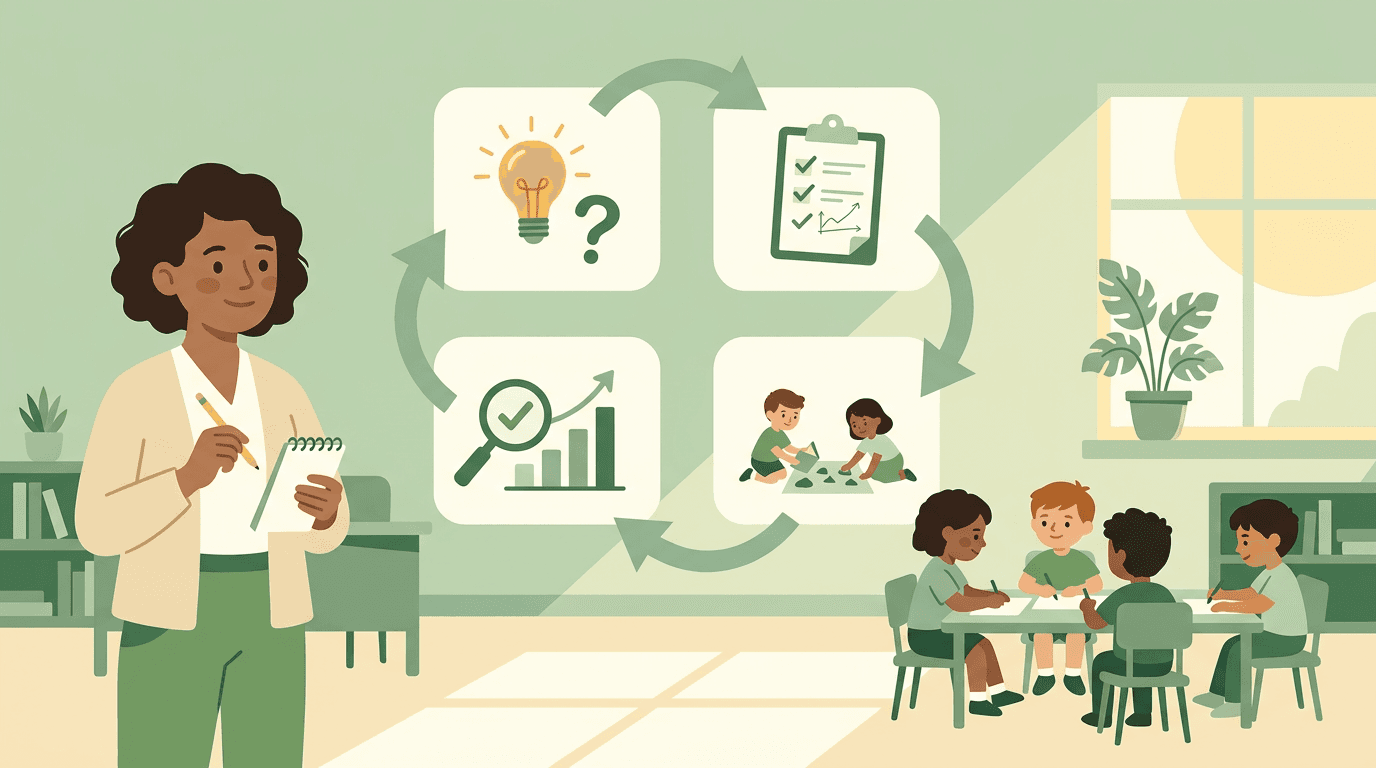
Action research runs in a loop, not a straight line. Here's how that loop works and how to stay rigorous.
The basic cycle, step by step
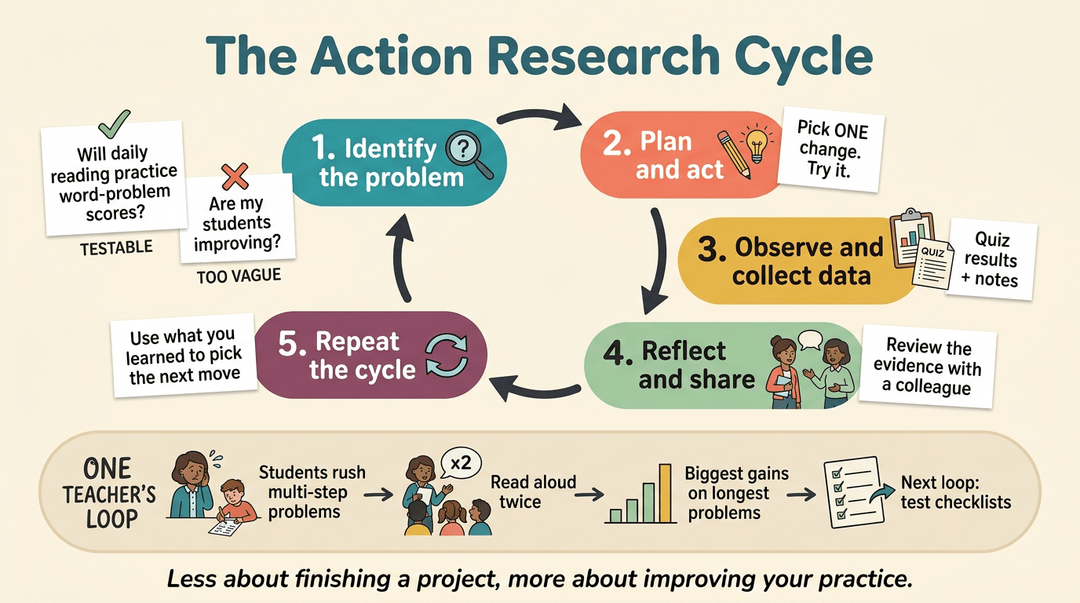
What are the five parts of action research? They're the five steps of the basic cycle, in order:
- Identify the problem or area. Make it testable, like 'Will daily reading practice raise word-problem scores?' rather than 'Are my students improving?'
- Plan and act. Choose one change and try it.
- Observe and collect data. Gather evidence like quiz results and notes.
- Reflect and share. Review the evidence with a colleague.
- Repeat the cycle. Use what you learned to pick the next move.
Consider a fifth-grade teacher whose students rush through multi-step problems. She reads each one aloud twice and notes who still stalls, then sees the biggest gains on the longest problems. Her next loop tests checklists.
Action research is less about finishing a project and more about improving your practice.
Popular models and frameworks to know
Each name offers a different angle on the loop:
- Kemmis and McTaggart spiral: a cycle that winds forward, each turn building on the last.
- O'Leary observation cycles: a model built around watching and recording the room.
- Macintyre messy model: a reminder that classrooms rarely follow neat steps.
- McNiff and Whitehead cycle: another loop to compare against the rest.
- Kolb experiential learning cycle: learning through direct experience, like classroom trials.
Repeating cycles while staying rigorous
Sequential cycles of improvement mean each loop starts with what the last one taught you. Treat any model as a guide rather than a rulebook, and bend it to fit your room. Rigor comes from honest reflection, not a fancy framework.
Validity asks whether your evidence reflects what really happened. Workability asks whether the change works in practice. Evidence first, conclusions second.
Run a Mini Cycle on Your Lessons
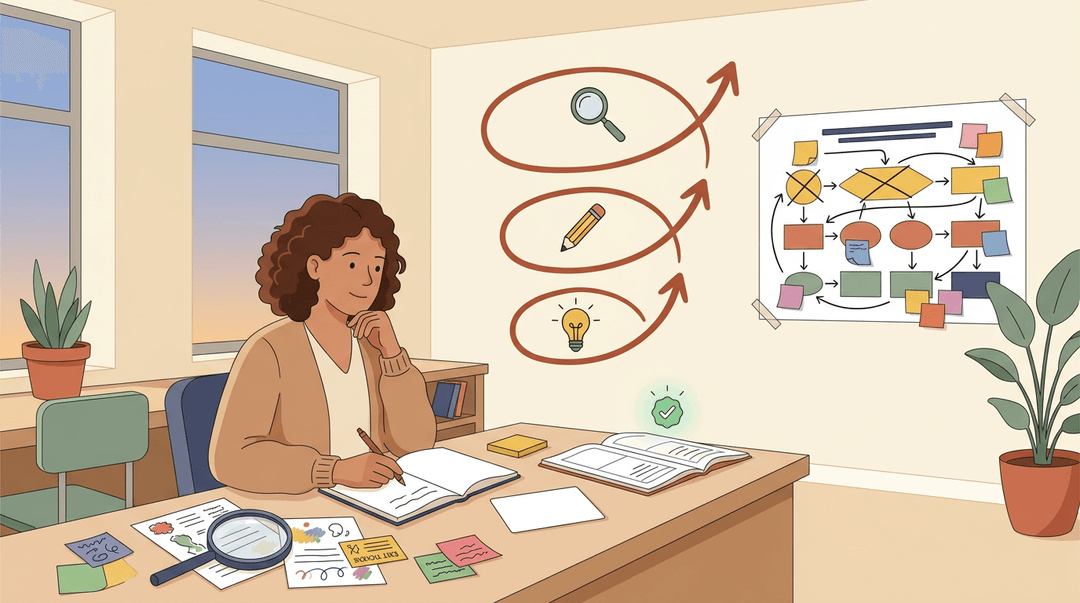
This is a mini cycle playbook for testing one change to one lesson, from question to revised plan. It's small enough to finish in a couple of weeks alongside your regular teaching.
Before you start
Confirm these three things first:
- Consent is covered. Tell your admin, and check whether your school wants families informed.
- Privacy is protected. Use initials or numbers in notes, never full names, and store notes securely.
- Notes are ready. Keep one page per cycle: date, question, strategy, data, what you changed.
Set up your cycle
- Pick one lesson problem.
- Choose something you can see and count, like "Transitions from carpet to desks eat up our first ten minutes."
- Write a focused question.
- Say: "Will a visual timer shorten transitions during our math block?"
- Choose one strategy to try.
- Change one thing only, so you know what caused any shift.
⚠️ Watch out: A question like "How do I improve my teaching?" is too big to answer. If you can't answer it in two weeks with a quick count or a short sample of student work, narrow it.
Collect data in class
Pick one or two methods, not all three. Collect a baseline first: the same data from a few lessons before you change anything.
| Method | What it looks like | Time cost |
|---|---|---|
| Exit tickets and quick checks | One question on a sticky note at the door | 2 minutes |
| Short observation notes | Tally or jot three lines during the activity | Under 1 minute |
| Student survey or reflection | "What helped you most today?" on a half sheet | 3 minutes |
Observation notes are easiest if you decide what to watch before the lesson starts. Try a simple tally: "How many students started within 30 seconds?"
Reflect and adjust the plan
- Compare results to baseline.
- Put the before and after numbers side by side.
- Ask: "What changed, and what else could explain it?"
- Revise the lesson plan.
- Keep what worked, cut what didn't, and write the change into the plan itself.
- Re-teach and repeat the cycle.
- Teach the revised lesson and collect the same data again.
- Your new results become the next baseline.
If results are mixed, that's still a finding. Adjust the strategy and run another round.
Examples by grade band
Each row is a complete mini cycle you can adapt.
| Grade band | Focus | Strategy to try | Data to collect |
|---|---|---|---|
| Elementary | Transition routines | Visual timer plus a cue song | Tally of students ready on time |
| Middle school | Discussion protocols | Think-pair-share before whole-class talk | Count of different voices heard |
| High school | Feedback on writing | One comment plus a required revision | Exit ticket on thesis strength |
Example: A middle school teacher notices the same five students dominate discussion. She asks, "Will think-pair-share before whole-class talk bring in more voices?" For three lessons she tallies who speaks, then adds the protocol for three more. The tally rises, and a quick student reflection says partner talk made sharing feel safer. She writes the protocol into her plan and tests a new question next cycle.
Save each revised lesson version and reflection notes in EMStudio's lesson planner to track what changed between cycles.
Collecting Data and Choosing Your Methods
Once you have a question, you need evidence to answer it. We'll walk through how to gather that evidence and choose the right approach.
Common ways to gather data
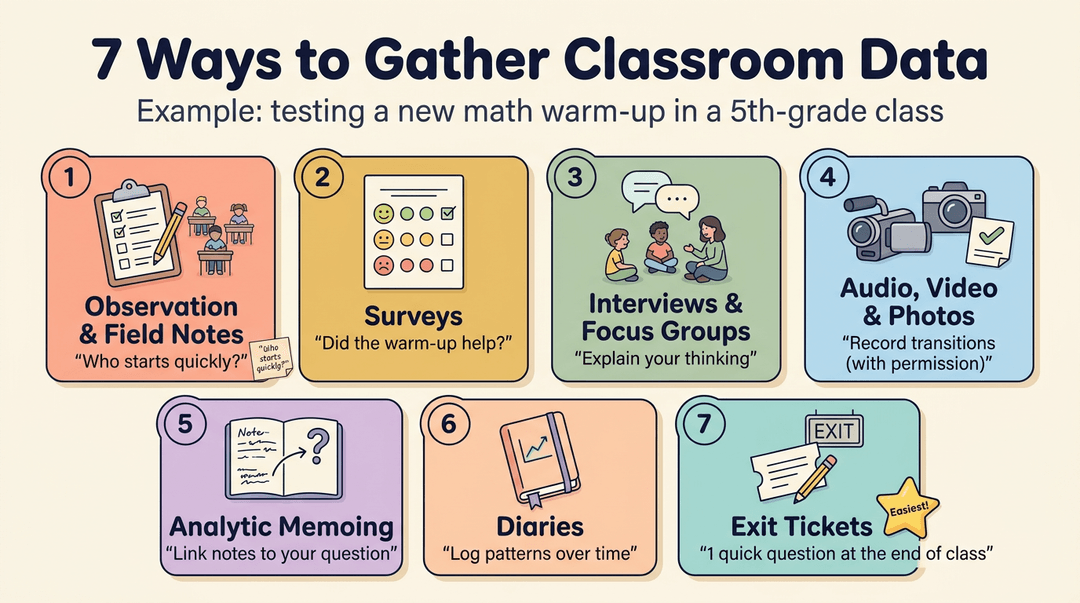
Think of a fifth-grade teacher testing a new math warm-up. She might use:
- Observation and field notes: Watch a small group and jot down who starts quickly.
- Surveys and questionnaires: Ask a few short, consistent questions about the routine.
- Interviews and focus groups: Hear students' reasoning in small conversations.
- Audio, video, and photography: Record transitions to review later, with permission.
- Analytic memoing: Write brief notes linking what you noticed to your question.
- Diaries: Keep a running log of patterns across the cycle.
- Exit tickets: A quick end-of-class question gives you daily data with almost no extra work.
Choosing qualitative, quantitative or mixed methods
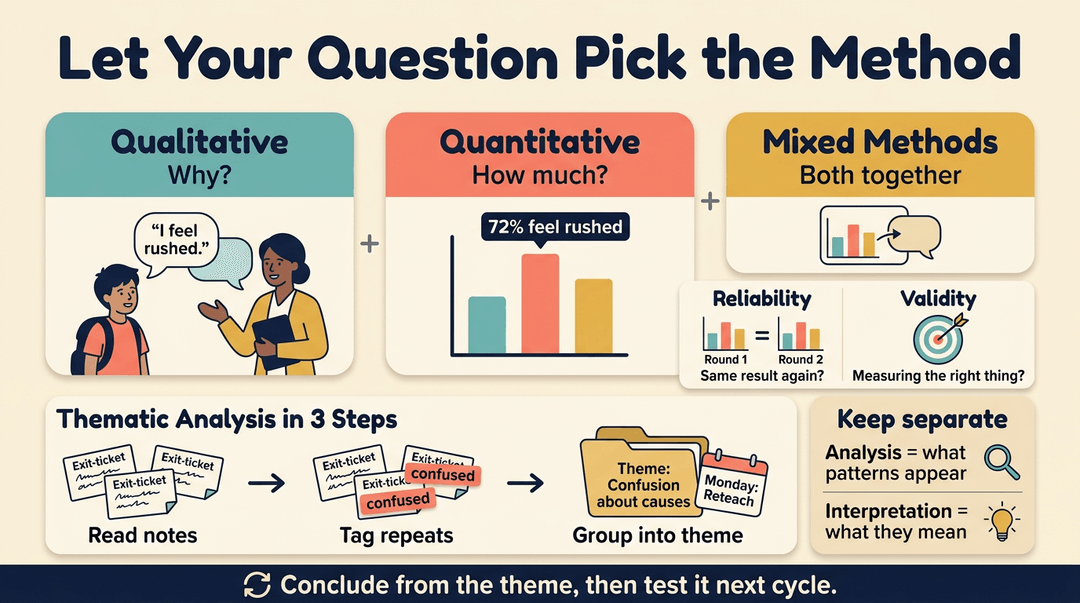
Let your question drive your method. Qualitative methods help you understand why, while quantitative methods show how much. Mixed methods combine both, such as a survey showing many students feel rushed plus interviews explaining why.
Reliability asks whether your data would stay consistent if you collected it again. Validity asks whether it measures what you actually care about.
Analysis organizes your data and spots patterns. Interpretation decides what those patterns mean. Keep them separate in your notes so a hunch never passes for a finding.
Thematic analysis means reading your notes, tagging recurring ideas, and grouping them into themes. A high school history teacher who sees the same confusion on three exit tickets can reteach exactly that on Monday.
Draw your conclusion from the theme, then test it in your next cycle. That's the real test.
Types and Approaches to Action Research
Action research isn't one fixed method, so how you run it depends on who's involved and how far the question reaches. Here's how the main approaches differ.
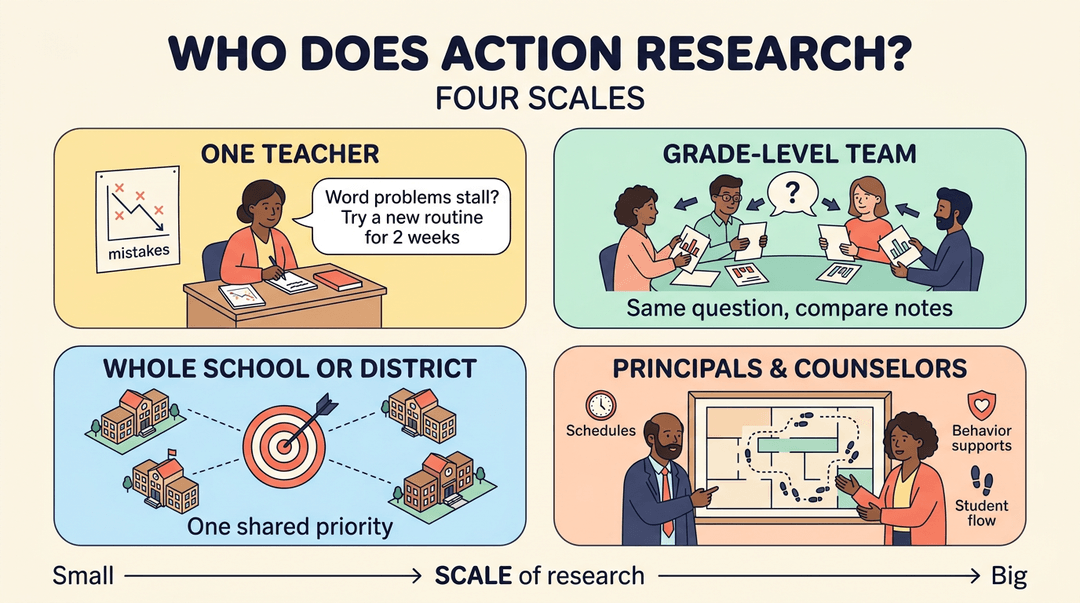
Who takes part and at what scale
- Individual teacher research. One teacher studies a single question in their own room. Think of a fourth-grade teacher who notices students stalling on word problems. She tries one new routine for two weeks, then checks whether the mistakes shrink.
- Collaborative teacher teams. Grade-level or subject teams share a question and compare what they see across classrooms.
- School-wide or district-wide. A whole building or district tackles one shared priority.
- Administrators and counselors involved. Principals and counselors can study schedules, behavior supports, or how students move through the building.
Team-based and participatory research styles
Some approaches put teams, and even the people a problem affects, at the center.
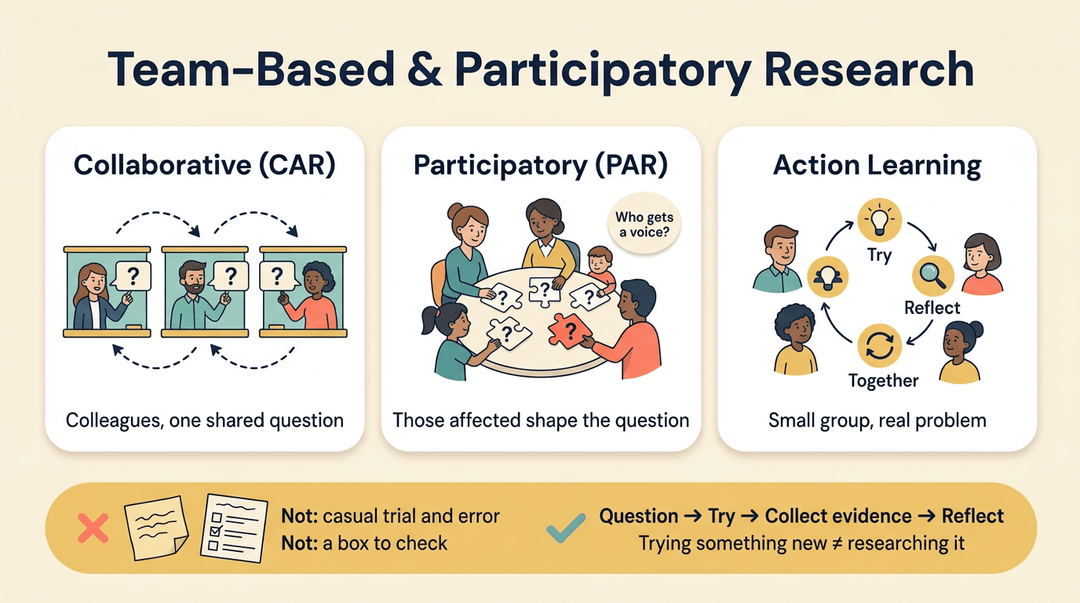
- Collaborative action research (CAR) puts colleagues side by side on a shared question, so each cycle gets checked across several classrooms.
- Participatory action research (PAR) invites the people a problem affects, like students or families, to help shape the question. The focus shifts to who gets a voice, not just what gets studied.
- Action learning is often paired with action research. A small group tackles a real problem, tries something, and reflects together on the results.
Action research is also a widely misunderstood paradigm, or way of thinking about research. It's often mistaken for casual trial and error, or treated as a box to check on a form. Trying something new isn't the same as researching it.
What Are Some Good Action Research Topics?
The best action research topics start with a focus question you're already asking about your students. Look for questions about how students learn, not just whether they pass. Start with one question, not five.
Classroom topics teachers have explored
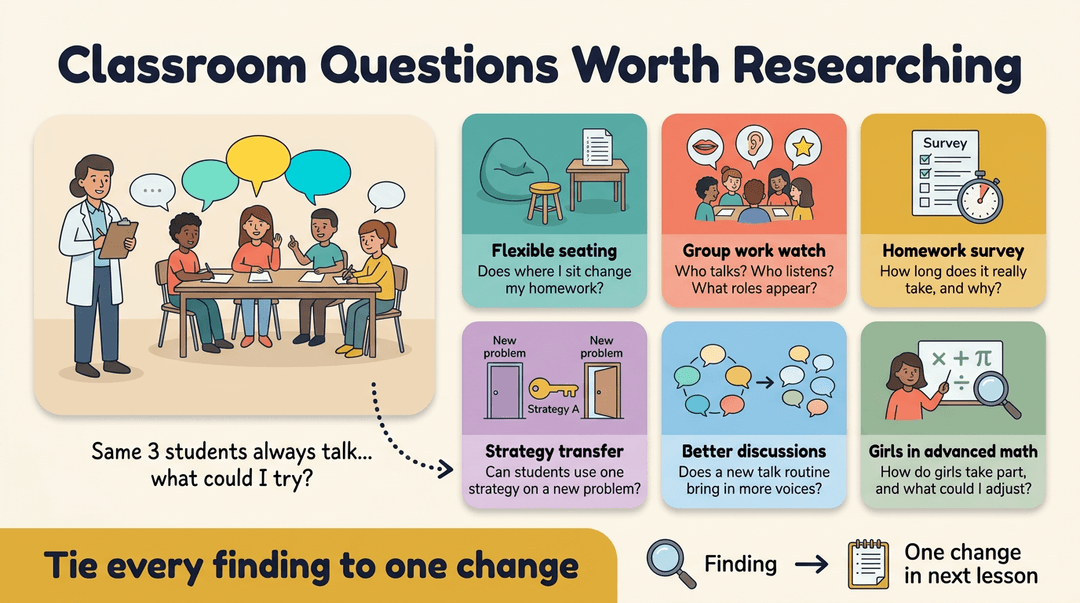
Consider a science teacher who keeps noticing the same three students dominating group talk. That's a researchable question with a clear next step:
- Flexible seating and homework: Does where students sit change how they handle homework?
- Group work observation: Watch who speaks, who listens, and which roles emerge.
- Homework survey: Ask students how long homework really takes and why.
- Math problem-solving transfer: Can students use one strategy on a new problem type?
- Improving classroom discussions: Does a new talk routine bring in more voices?
- Girls in advanced math: How do girls take part in advanced math, and what might you adjust?
- Link examples to lesson changes: Tie each finding to one change in your next lesson.
Where to find student capstone projects
- Graduate action research projects: Full studies from question to findings.
- Annual project listings: Scan yearly titles to see what peers already studied.
- Exemplars for students: Share a finished model so students see a strong study.
- Multi-cycle study designs: Projects that run several cycles, each refining the last.
Themes that show up again and again
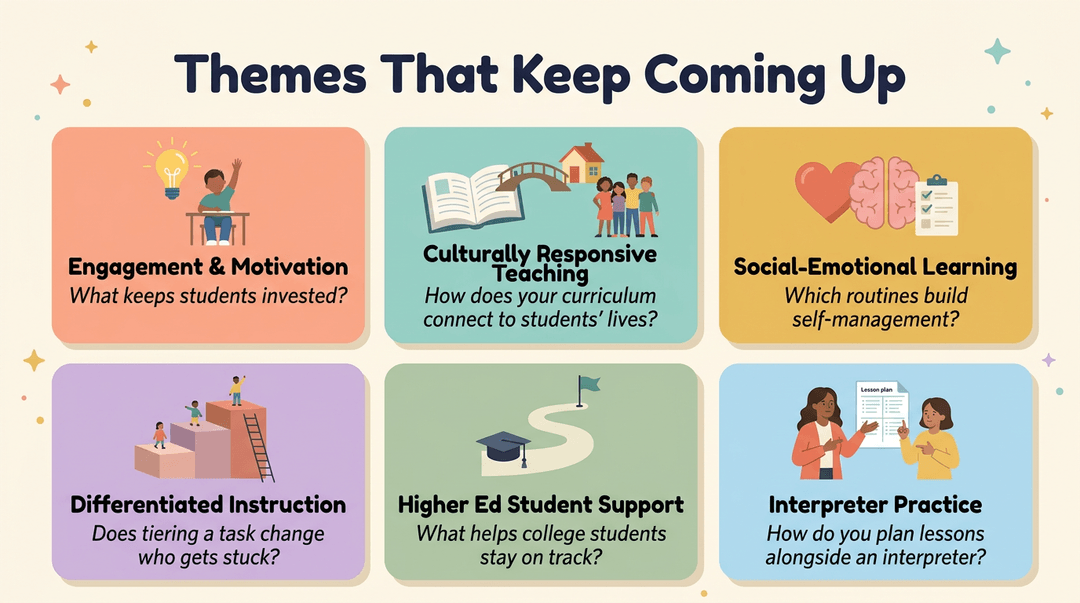
- Student engagement and motivation: What keeps students invested?
- Culturally responsive teaching: How does your curriculum connect to students' lives?
- Social-emotional learning: Which routines build self-management?
- Differentiated instruction: Does tiering a task change who gets stuck?
- Higher education student support: What helps college students stay on track?
- Interpreter practice: How do you plan lessons alongside an interpreter?
Risks, Ethics and Helpful Resources
Action research has real limits and responsibilities. Here's what to watch for and where to look for help.
Pitfalls and ethical concerns to watch
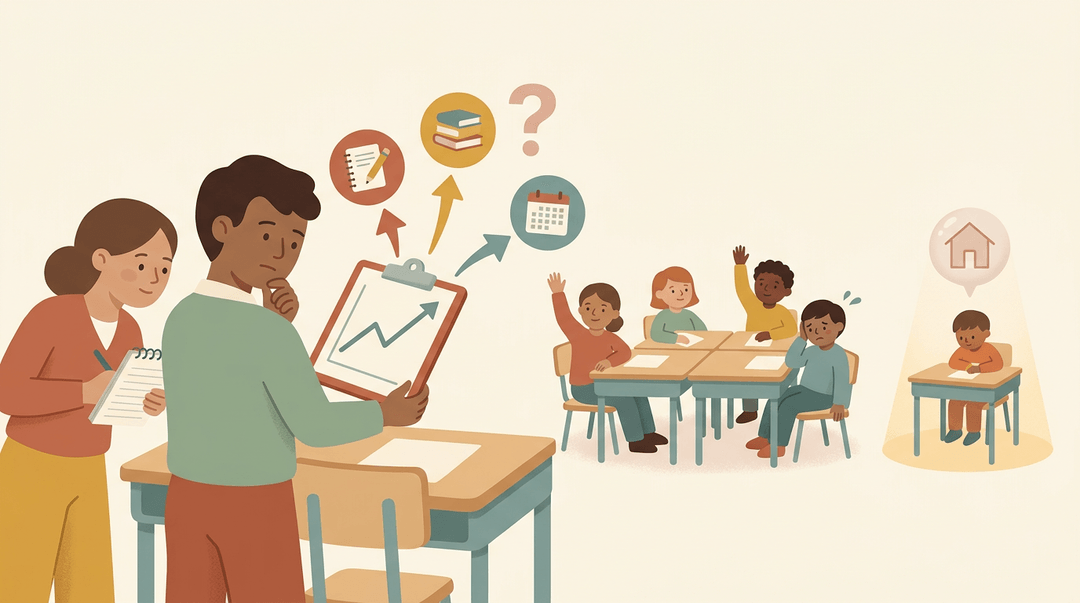
Multiple uncontrolled factors. Classrooms shift constantly: a new routine, a seating change, a holiday week. Think of a teacher who launches a new writing workshop the same month her school starts a literacy push.
If scores jump, which change deserves the credit? Jot down other changes as you go.
Individual research without review. Working alone, it's easy to see only what you hoped to see. Share your plan and data with a colleague or coach, and check whether your school requires its own review.
Unforeseen harm to students. A well-meant change can backfire. Picture a math teacher who tries ability grouping and notices some learners stop raising their hands because they feel singled out. Watch for signs like that, and be ready to pause or adjust. Moments like this raise questions of equity in education that deserve a closer look.
Students come before your research question.
Context-specific knowledge. Your results show what works for your students, not what works for every classroom. Treat them as evidence for your room, not a universal rule.
Books and databases to learn from
- Action research textbooks. Look for introductory books written for teachers, which explain the cycle in plain language.
- Education research databases. Searchable collections of published studies show whether someone has already tested an idea like yours.
- Checklists, templates, and exercises. Planning sheets keep your question, data plan, and timeline in one place.
- Reflective practice exercises. Quick prompts after each lesson help you examine your assumptions. Ask yourself what your students actually did and what you expected. Examine what happened, not what you hoped would happen.
The Theory and Philosophy Behind the Method
Action research rests on big ideas about knowledge and reality. You don't need a philosophy degree, but these ideas help you trust your evidence.
How people build knowledge together
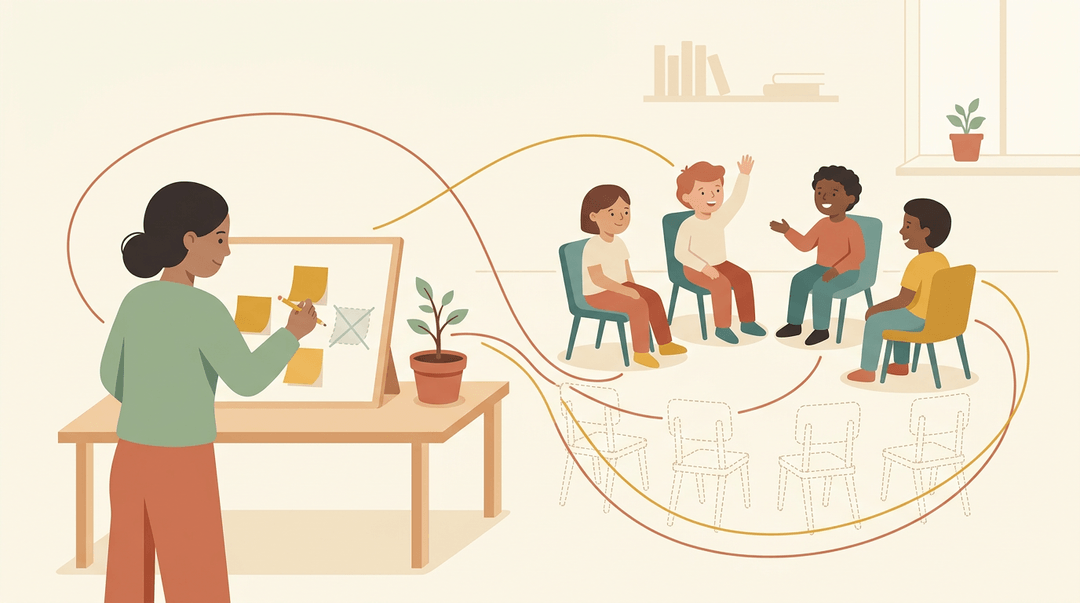
Action research treats knowledge as actively constructed. Teachers test ideas and revise them, and that's the living knowledge concept: what you know keeps evolving as your students change.
Schools are socially constructed too. Routines, expectations, and who gets called on are built through daily interaction, so change one routine and the whole reality shifts. Problem-posing education offers a way for students and teachers to question those everyday realities together.
What we know and what is real
Every study rests on two questions: how do we know something, and what is real? Those are epistemology and ontology, together your theory of knowledge and being.
A positivist stance holds that one objective truth can be measured. A postmodern stance questions whether a single truth exists at all. Between them sits a range of epistemologies, such as interpretive and critical approaches.
Ontological challenges show up fast:
- Is a reading level a fixed trait or something instruction can shape?
- Is "engagement" one thing you can count, or several look-alike behaviors?
Where you stand as the researcher
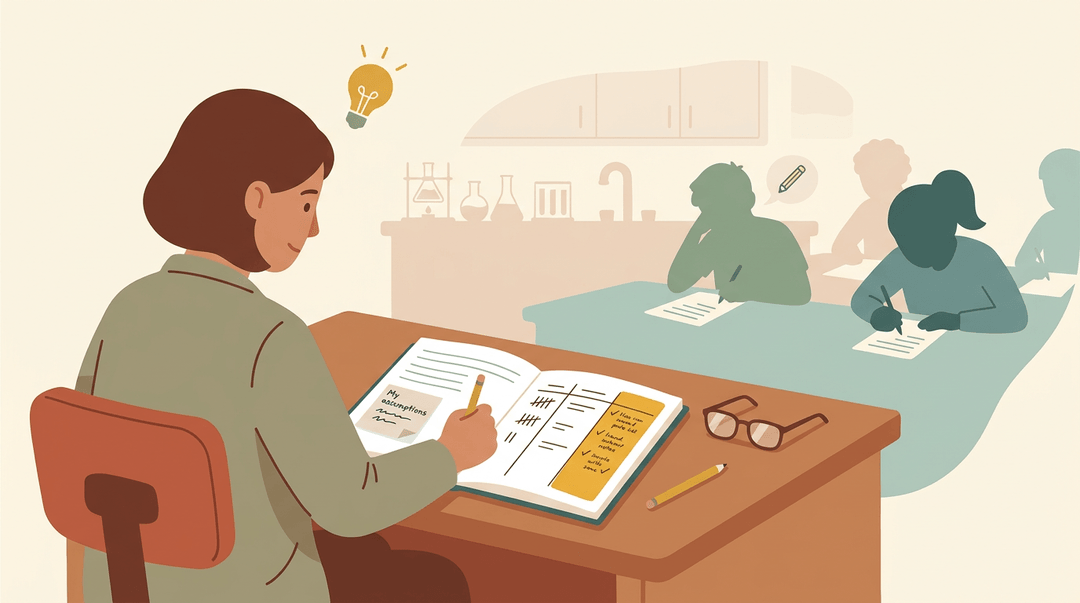
Your identity shapes what you notice. Take a middle school science teacher who keeps seeing the same few students "shut down" during labs. After she writes down her assumptions about engagement, she realizes she's been counting talk, not thinking. Asking students to explain their reasoning is central to the socratic method of teaching.
Adding a column for written reasoning shows that more students are working than she thought.
Acknowledging the knower's position means naming your role and beliefs before you analyze, showing where you're looking from rather than hiding it.
That openness increases trustworthiness: a Wonkhe piece on positionality statements notes that acknowledging your subjectivity is a benefit, not a detriment. Your lens isn't the problem. Hiding it is.
Action research turns everyday teaching into a steady habit of learning. You don't need a research lab, just a clear question, a small change, and a way to see what happened. Start small, keep simple notes, and let the evidence guide your next move.
Ready to try your first mini cycle? Check out Lesson Planning to write, organize, and reuse your lesson plans across multiple classes from one place.
References
- EJ1314304 — files.eric.ed.gov
- Positionality statements are relevant for all research — wonkhe.com
Frequently asked questions
What are the 5 C's of action research?
The five C’s of action research are not a single universally fixed list. A common version is **commitment, collaboration, concern, consideration, and change**: commit to investigating an issue, work with others, focus on a genuine concern, carefully reflect on evidence, and use what you learn to improve practice.