How Does Grading on a Curve Work? A Complete Guide

Jump to section
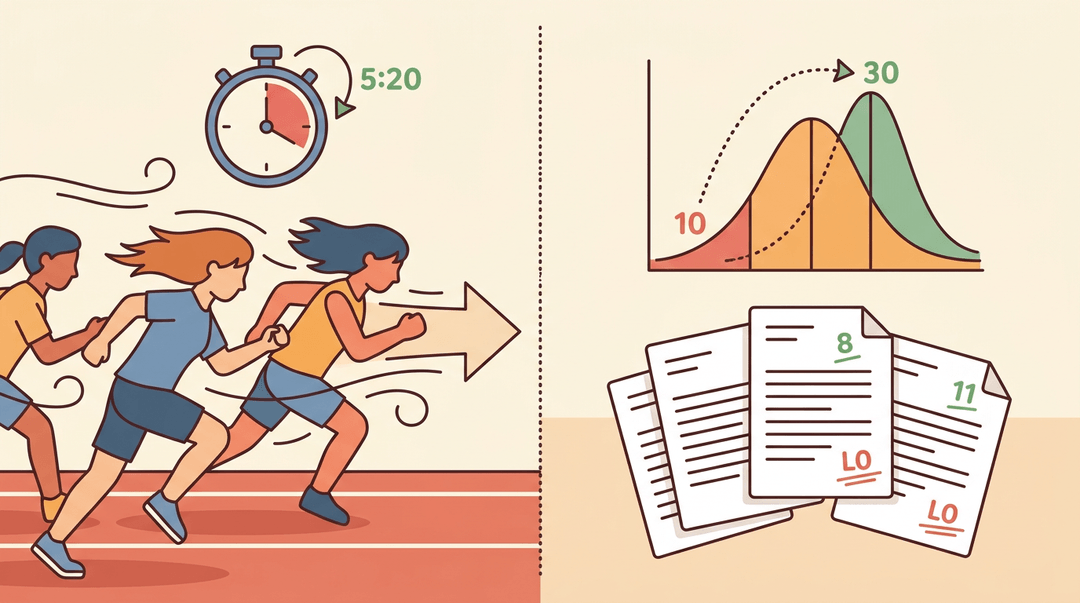
Picture a race run into a stiff headwind. Every runner finishes slower than usual, so officials adjust the times to reflect how hard everyone actually worked.
Curving grades works the same way: instead of judging every answer against a fixed scale, you adjust a set of scores based on how the whole class performed. It matters most after a tough exam, when raw scores don't tell the real story.
This post walks through the math behind it, how common it actually is, and a checklist for deciding if and how to use one.
How Does Grading on a Curve Work
So what actually happens when a teacher says they'll "curve" a grade? At its core, it's a math adjustment, not a mystery, and once you see the mechanics, the rest makes sense.
What curving your grade actually means
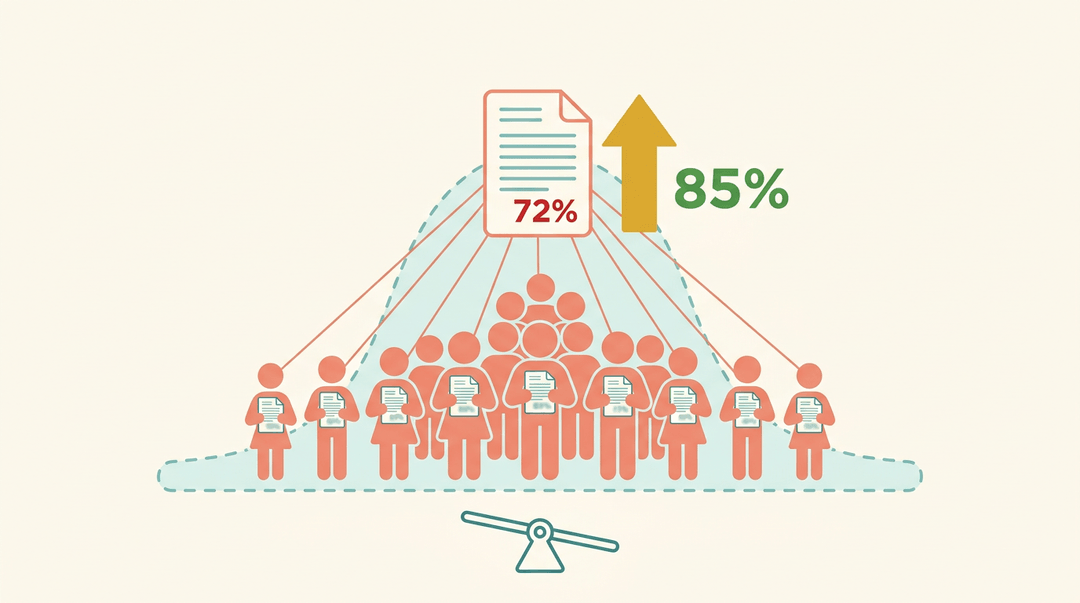
Curving means adjusting scores after an exam is already graded, shifting the whole class's results up or down. A curve can raise the average when a test ran harder than expected, or lower it if scores came in too high. Either way, your grade ends up tied to how the whole class performed, not just your own answer sheet.
Why it's called a bell curve
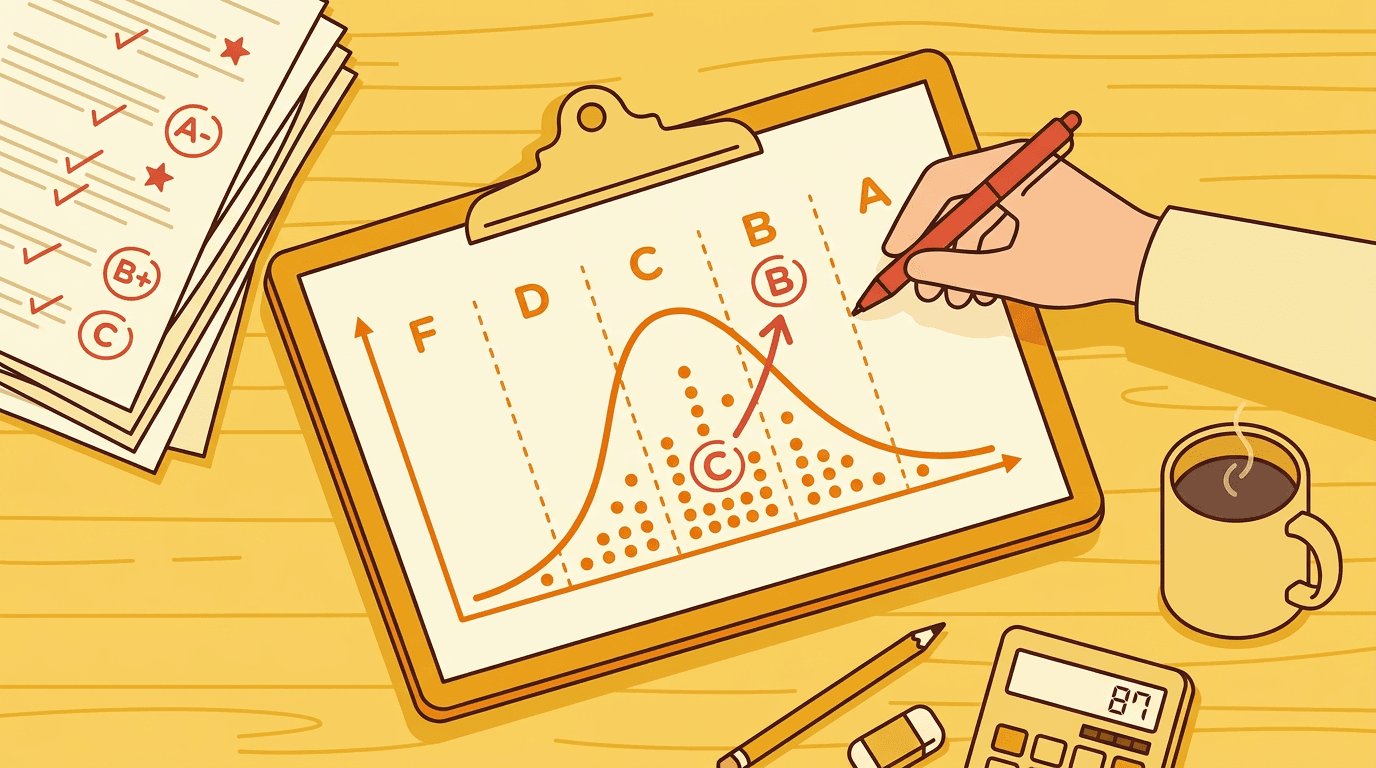
The name comes from the bell curve, the classic bell-shaped normal distribution that shows up when you plot random events. It's symmetrical: most scores cluster in the middle as a C average, with smaller tails of A's and F's trailing off on either side. Teachers borrow this idealized shape as a model for how scores "should" spread across a large group.
When teachers decide to curve grades
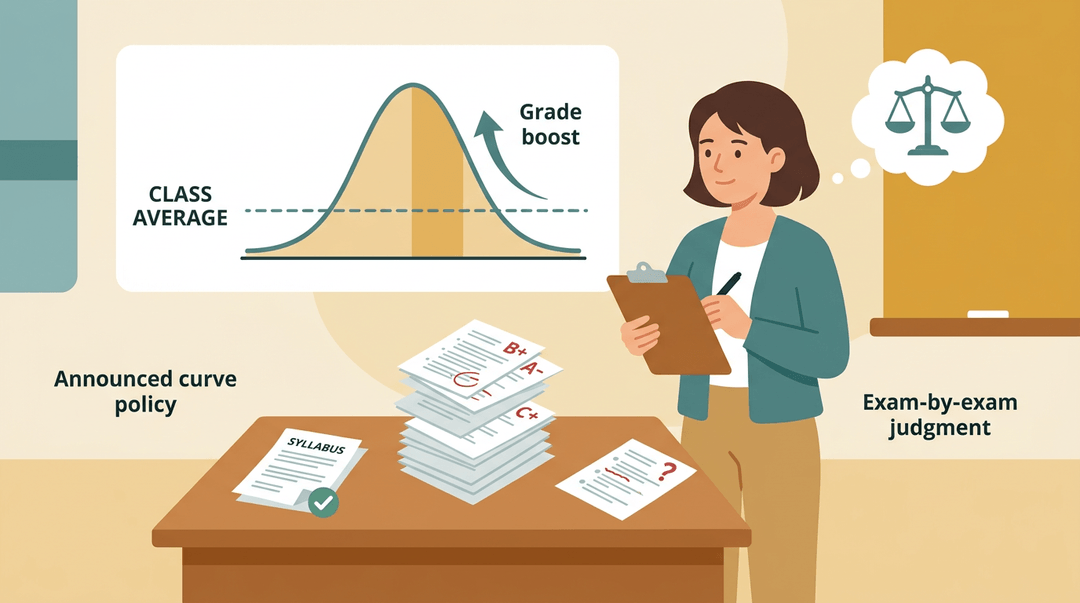
Curving isn't automatic. A teacher might apply one when the class average comes in low, signaling the test was tougher than intended, or when a specific question turns out to be flawed or confusing. Beyond that, it's usually professor discretion: some announce a curve policy in the syllabus upfront, while others decide exam by exam, after seeing how the class actually did.
Different Ways Teachers Curve Grades
"Curving" isn't one method, it's a handful of them, and which one your teacher picks decides how much (and even which direction) your grade moves. Some versions only push scores up. Others can shuffle you down relative to your raw score.
Here's how the common ones actually work, math included.
How do you calculate your grade on a curve?
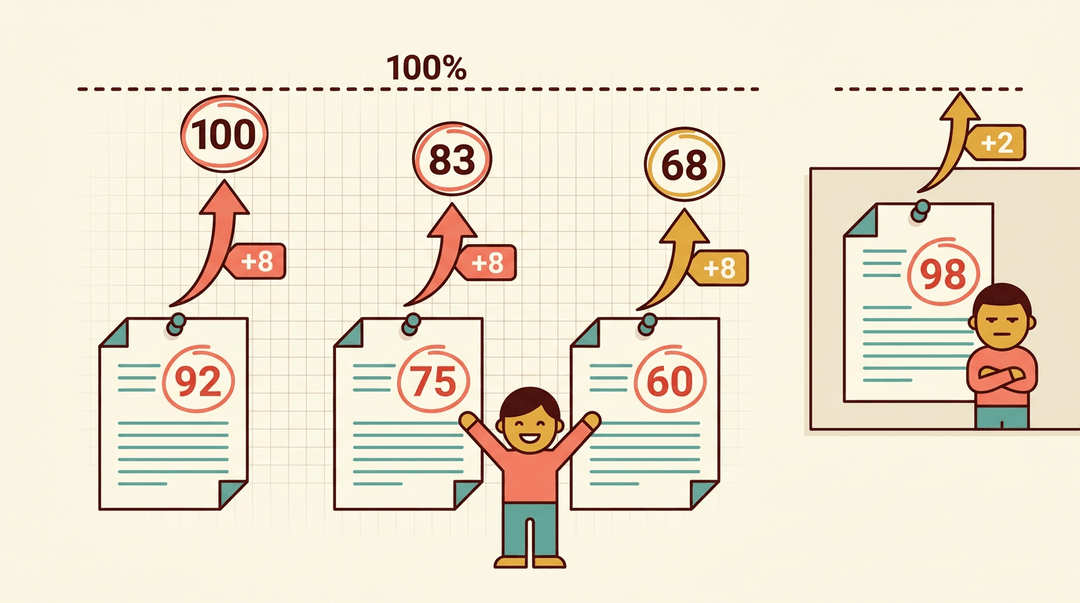
The most common version is the highest-score method: the top score in the class gets bumped to 100%, and whatever gap it needed to get there gets added to every other score.
Say the highest score is 92. That's 8 points short of 100, so every student gets 8 points added: a 75 becomes an 83, a 60 becomes a 68. The catch is a consistently high scorer.
If someone's already sitting at 98 or 99, there's barely any gap to redistribute, so this method quietly fails the rest of the class.
Depending on how far the top score sits below 100%, a curve like this can move a grade anywhere from a single point to double digits.
Adding flat points to every score
Instead of calculating a gap, some teachers just add a fixed number of points to everyone, say 5 or 10, which shifts the average by that same set amount. It's simple enough to bump a D into a C for a student sitting right on the line.
The risk: someone who already scored a 95 or 98 can land over 100%, so you'll need a rule for whether that's capped or left alone.
Curving grades to fit a bell shape
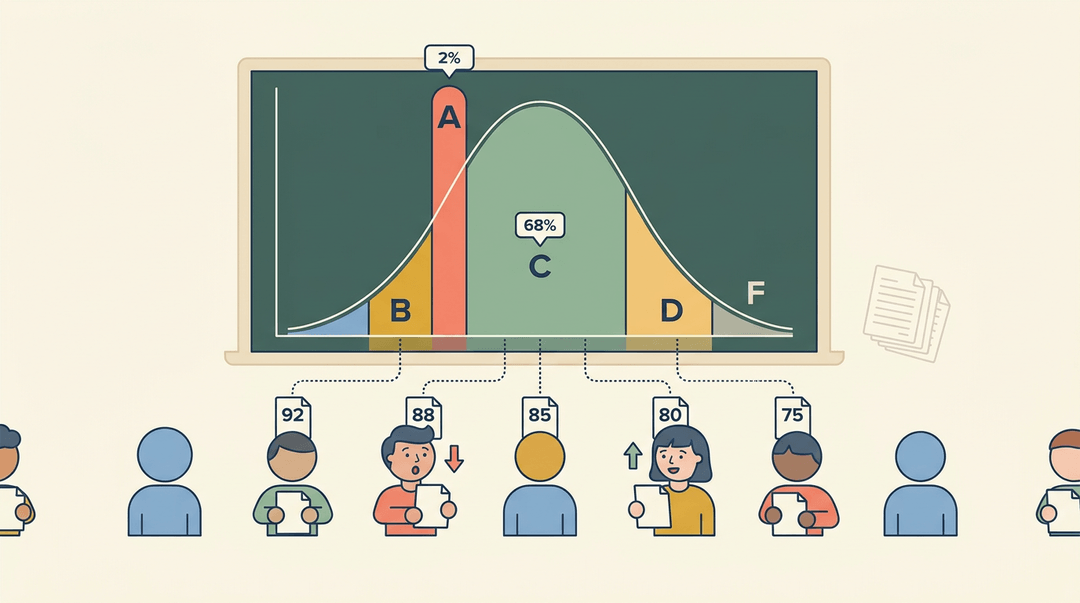
This method fits grades to a bell curve based on rank, not raw points: a fixed percentage of the class gets each letter grade regardless of the actual scores.
A common split is the top 2% earning an A and 68% landing in the C range, though plenty of teachers use their own split, like the top 15% getting an A. Because it's rank-based, this is the one version where a curve can genuinely lower a grade: a solid raw score can still land in a lower band if enough classmates scored higher.
It also only reshapes that one assignment's letter grade, not the underlying points feeding into a weighted total.
Other tricks for adjusting grades
Not every adjustment is a formal curve:
- Dropping the hardest question class-wide.
- Allowing a redo of missed questions.
- Offering extra credit to offset a rough test.
- Uploading a spreadsheet formula into Blackboard to recalculate scores at scale.
- A quiet manual override in the LMS for one student or one assignment.
Any of these can move a grade without ever touching the word "curve."
A Teacher's Checklist for Curving Grades
A good curve fixes a flawed test; a bad one papers over a teaching gap. Run these four checks in order before you touch a single score.
First, confirm the problem is the test
Before curving, verify at least one of these:
- The class average dropped hard. A class that usually averages 78 lands at 61.
- Scores cluster instead of spreading. A pile-up in the 50s points to the test, not effort.
- One question tripped most students. If 80% missed item 12, reread item 12.
- Flawed wording or untaught material means the item, not the class, failed.
If none of these apply, skip the curve: the test did its job.
Match the method to what went wrong
Different problems call for different fixes. Find your row:
| What you found | What to do |
|---|---|
| The whole test ran too hard | Flat points: add the same amount to every score |
| One or two flawed questions | Drop them and rescore out of the new total |
| You must hit a set grade distribution | Bell curve: rank scores, assign grades by percentile |
⚠️ Watch out: a flat add can push top scores past 100%. Cap every curved score at 100, or add fewer points so nobody crosses it.
Example: A chemistry teacher finds 2 of 25 questions covered a section the class never reached. She drops both and rescores out of 23, so a raw 18 becomes 78%, not 72%.
Tell students before they ask
A curve that surfaces without warning invites suspicion. Get ahead of it:
- Put the policy in your syllabus. Something like:
"Test grades may be adjusted upward when results point to a flawed assessment. A curve will never lower your score."
- Explain the curve the day you return the test. Say: "Question 7 covered material we hadn't reached yet, so everyone earned those four points back."
- Mention it in parent updates, so a sudden grade jump doesn't look like a data-entry error.
Record it so it holds up later
- Log both scores, original and curved.
- Format each entry like: "Unit 3 test: 61 → 68 (+7 flat)."
- Write a one-line rationale and keep it.
- "Curved +7: item 12 flawed, class average 14 points below norm."
- This is your answer when a student or parent disputes a grade months later.
- Recalculate every weighted average the curve touches.
- A curved test in a 40% category shifts the semester grade too; don't leave the old total standing.
That last step is the one teachers forget, and it's the easiest to automate: EMStudio's gradebook auto-recalculates weighted averages the moment you adjust a curved score.
Where and When Curving Gets Used
Curving isn't a blanket policy. Whether it shows up, and how, depends heavily on the subject, the class size, and the level of schooling. Knowing the pattern helps you figure out if your own course even fits the mold.
How common is grading on a curve?
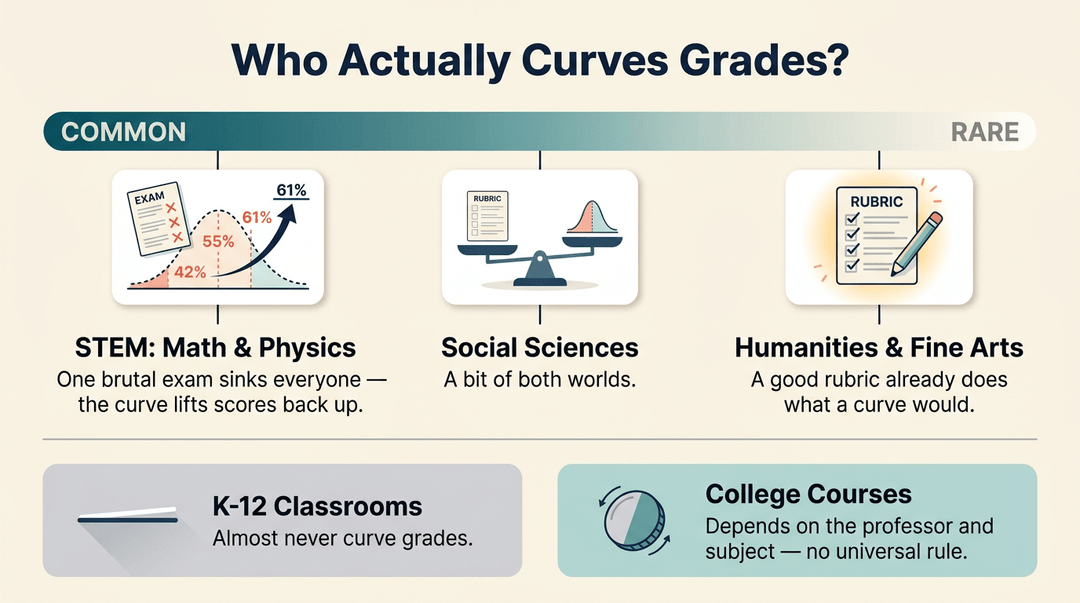
Curving shows up unevenly across subjects.
- It's most common in STEM courses like math and physics, where hard, objective problem sets mean one brutal exam can sink scores across the board.
- It's rare in humanities and fine arts, where grading already leans subjective and a good rubric does the work a curve would otherwise do.
- Social sciences land somewhere in between, borrowing a bit of both worlds.
Do colleges grade on a curve? Some do, some don't: it's discipline- and instructor-dependent, not a universal rule. K-12 classrooms rarely curve at all.
A review of grade adjustment practices notes that curving is generally limited to undergraduate education, which is a big part of why K-12 and higher-ed run on different norms.
How class size and level affect curving
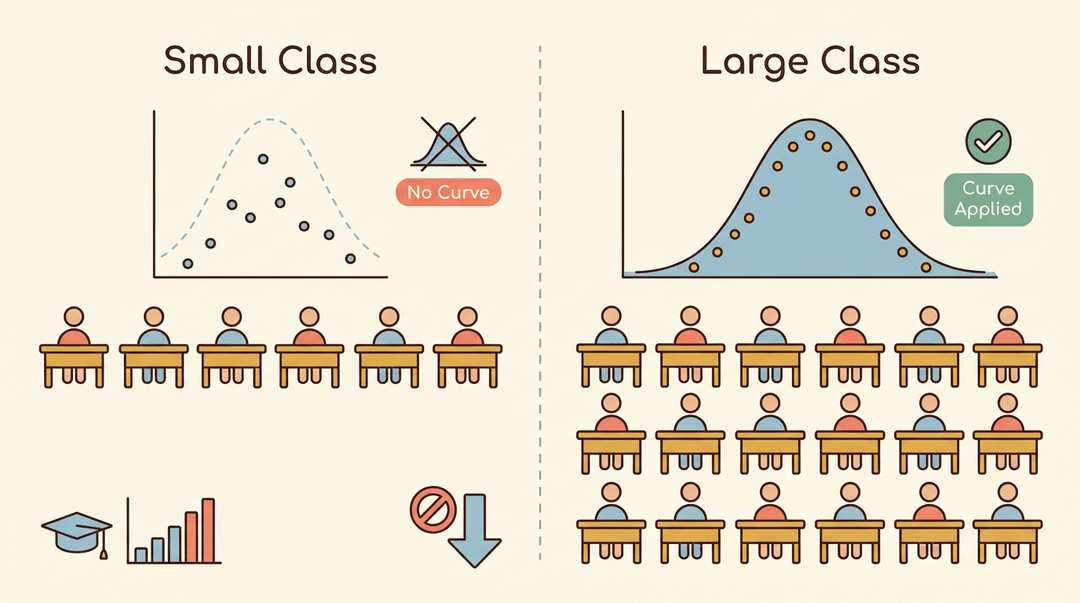
Class size matters just as much as subject. Instructors often skip curving in small classes, generally anything under 30 to 40 students, since a handful of scores can't reliably form a bell curve.
Villanova Law School's grading policy, for instance, applies its curve only to classes with 30 or more students enrolled.
Upper-division and graduate courses often skip it too. Seniors and grad students have already cleared out the weaker prerequisites, so their scores cluster high to begin with.
Curving that group could actually lower grades that reflect real mastery, the opposite of what a curve is supposed to do.
Law and graduate programs flip that logic for required courses: many mandate a fixed curve no matter the class size. Seton Hall Law's grading system requires a mandatory B+ curve on courses like Contracts, Torts, and Criminal Law.
That's what a "B+ curve" means in practice: the course's average grade point is locked near a B+, whatever the raw scores actually show.
How Curving Affects Students
Curving doesn't just shuffle numbers on a page. It changes how students feel about a grade, and what that grade actually says about their learning.
The upside students see in curving
For students, a curve often feels like a gift. It raises individual grades across the board, which matters most right after a brutal exam that left half the class stunned. Think of a high school chemistry teacher whose test average lands at 58%: a curve can turn a room of D's into a room of C's overnight. Most students see that as generous, even if they never ask how the math got there.
The hidden downsides of curving grades
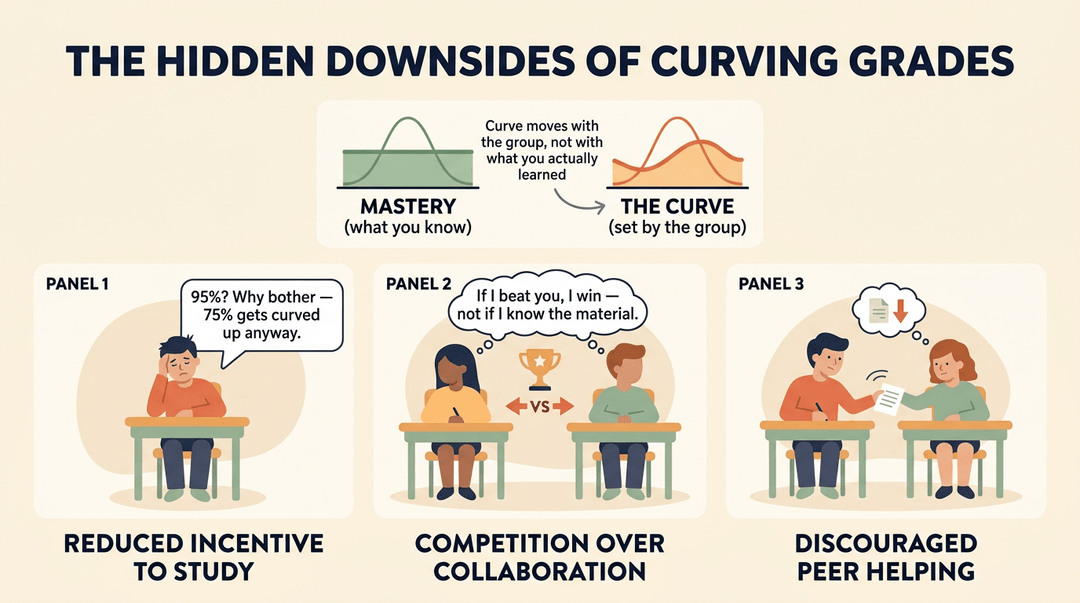
But the goodwill has limits. Because a curve is set by the group, not by mastery, it can feel arbitrary rather than earned. Students who study hard and land in the middle of the pack sometimes resent classmates whose high scores drag everyone else's curve down. That resentment ripples outward:
- Reduced incentive to study. Why push for 95% when 75% gets curved up anyway?
- Competition over collaboration. A curve rewards beating your peers, not just knowing the material.
- Discouraged peer helping. Some students quietly stop helping classmates once they realize a friend's higher score could lower their own.
How curving changes what grades mean
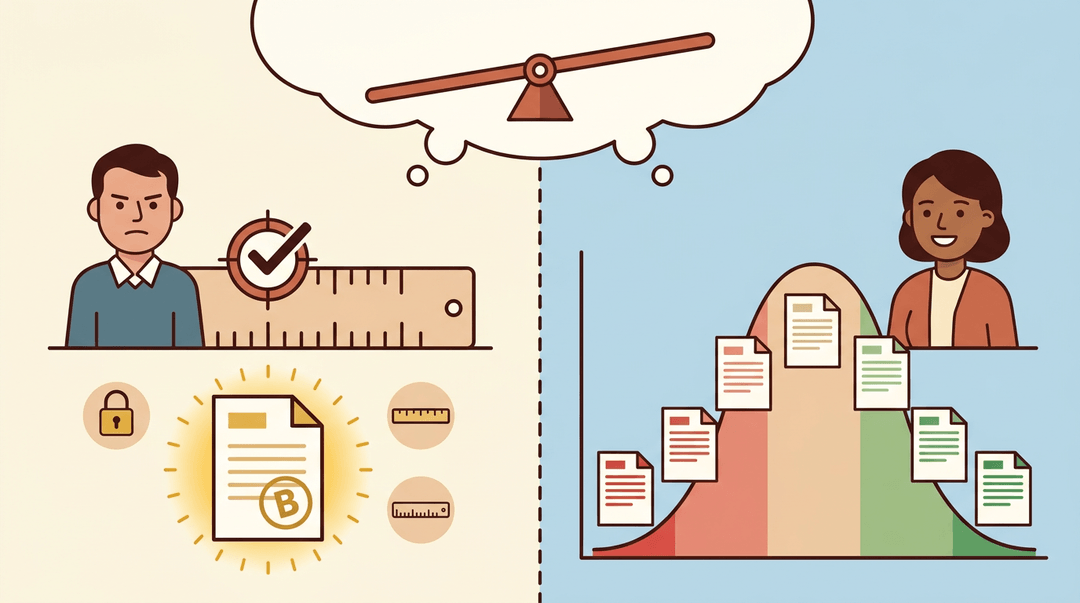
Maybe the biggest shift is the quiet one: a curve turns a grade from an absolute measure into a relative one. The same 82% earns an A in one class and a C in another, depending on the cohort around it. That's relative standing, not absolute mastery, and it can mask real learning gaps. A class where everyone struggles can still produce A's. Under a standard curve, it can even penalize top performers, capping their grade to keep the distribution intact.
The Ongoing Debate over Curving Grades
Ask a room full of teachers whether curving is fair, and you'll get as many answers as there are grading philosophies in the room. It's less a settled policy than an ongoing argument, and it's worth understanding both sides before you pick one.
Why teachers disagree about curving grades
Some professors never curve, full stop: they see a grade as a fixed measure of mastery, not a moving target. Others announce their curve policy on day one, so students know exactly what they're working toward.
Talk to enough educators and you'll hear the anecdotes pile up: one teacher who curved a brutal midterm and watched morale recover, another who refuses because it once let a weak class coast.
Underneath the stories sits a real philosophical split: relative grading (how you rank against classmates) versus absolute grading (how you measure against a fixed standard).
Equity concerns tied to curving grades
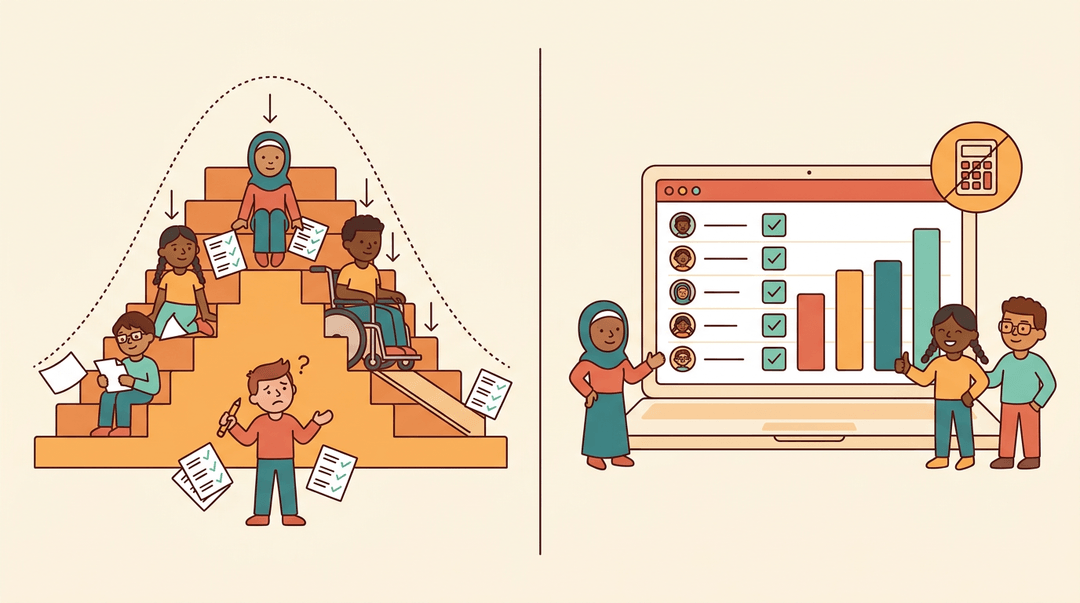
Curving carries real equity baggage. Critics argue it disadvantages students from underrepresented or underprepared backgrounds, a concern raised in equitable grading research from UC Berkeley's Center for Teaching & Learning.
By design, a strict curve assumes some students must land at the bottom, forcing a bell-shaped distribution onto learning that rarely happens in bell-shaped patterns.
Empirical evidence linking curves directly to inequity is thin, but the cultural fallout is documented: curving has been tied to attrition from STEM majors, with many students citing grading curves and weed-out culture as reasons for switching out.
Curving isn't a magic fix, and it isn't a shortcut either. It's one more tool for making sure a grade reflects what a student actually learned, not just how brutal the test happened to be.
Used with a clear method and a fair rationale, it can turn a rough exam day into an honest measure of progress. Ready to keep those numbers organized without the manual math?
Check out our Grading & Assessment feature to see how an online gradebook handles the calculations for you.
References
- A Practical Guide to Grade Adjustment or Curving for Pharmacy and Other Professional Health Programs — pmc.ncbi.nlm.nih.gov (2025)
- Academic Rules - Student Handbook — libguides.law.villanova.edu
- Equitable Grading Strategies — teaching.berkeley.edu (2025)
- Curving Our Enthusiasm: The Downsides of Grading Curves — digitalcommons.calpoly.edu (2026)
- Grades — law.shu.edu
Frequently asked questions
What is the bell curve grading system?
A bell curve grading system assigns grades based on how students perform relative to one another, often using a normal, bell-shaped distribution. Instead of relying only on fixed score thresholds, it may designate certain percentiles for A, B, C, and other grades.
What are the disadvantages of grading on a curve?
Disadvantages include increased competition, reduced collaboration, and less incentive to master material when ranking matters more than achievement. A curve can also make grades feel arbitrary, hide learning gaps, penalize strong students, and disadvantage students in classes where some learners begin with fewer academic resources.
How much can a curve change your grade?
There is no fixed limit. A curve may change a grade by one point, several points, or double digits, depending on the method and class results. For example, if the highest score is 92, adding the eight-point gap to every score raises each grade by eight points, while a rank-based curve could raise or lower a student’s letter grade.
How do you calculate your grade on a curve?
One common method is to subtract the highest class score from 100 and add that difference to every student’s raw score. If the highest score is 92, add 8 points to each score, so a 75 becomes 83. Teachers may cap adjusted scores at 100 or use a different method such as dropping flawed questions or assigning grades by percentile.
How to calculate grading on a curve?
To calculate grading on a curve, first identify the method being used. You might add a fixed number of points, rescore after removing a flawed question, or rank students and assign letter grades by percentile. The exact calculation depends on the instructor’s stated policy.
Is it better to be graded on a curve?
Being graded on a curve can be beneficial when an exam was unusually difficult or contained flawed questions, because scores may be adjusted upward. It is less beneficial when it forces students to compete, makes grades depend on classmates, or lowers a strong raw score to maintain a distribution.
Is bell curve grading fair?
A curve can be fair when it corrects an unusually difficult or flawed assessment and the method is transparent and applied consistently. A strict rank-based curve is more controversial because it measures relative standing rather than mastery and may require some students to receive low grades even when they understand the material.
Is grading on a curve good?
Grading on a curve can be useful as a targeted adjustment, but it is not always good as a permanent system. It works best when a test was clearly too difficult or defective, while fixed standards and clear rubrics are generally better for measuring whether students mastered the material.