American Grading System GPA Explained: Letter Grades to 4.0


Jump to section
Ever had a report card that left you scratching your head? Maybe a friend mentioned a 3.5 GPA and you weren't sure whether that was great or just okay. You're not alone, and the American grading system can feel like its own language.
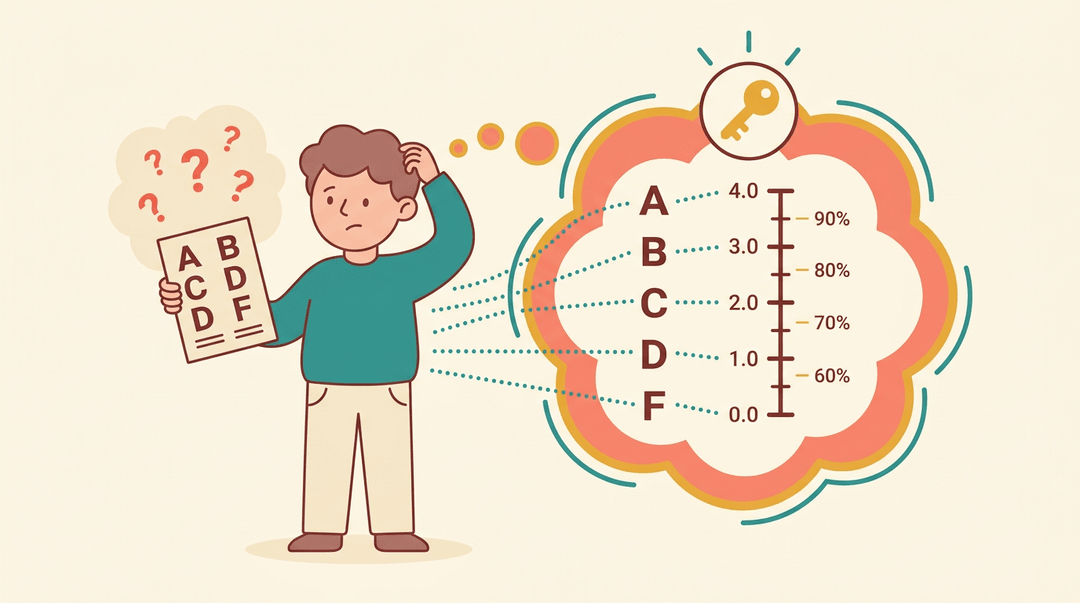
Here's the plain answer: the American system uses letter grades, A through F, that map to numbers on a 4.0 scale, and a grade point average (GPA) is the average of those numbers.
This post walks through how letter grades match percentages, how to calculate GPA, and how weighted scales and other variations change the math. We'll also share a classroom lesson you can use to teach it.
Understanding the American GPA Grading System
Ever wondered what that single number on a transcript really says? Here's the short answer, and why it carries so much weight.
What your GPA actually measures
Your grade point average (GPA) is a numerical summary of how you performed across your courses. Each letter grade is converted to a point value, and those points are averaged.
That makes it an arithmetic mean of grade points, so an A in one class and a C in another blend into one number.
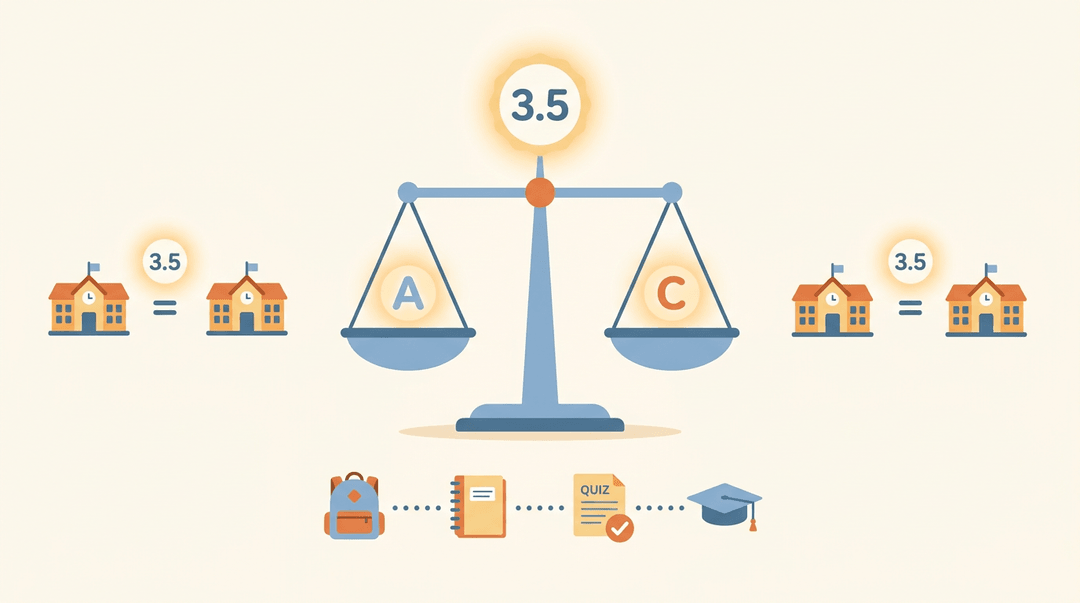
The real power is that it's standardized. A 3.5 at one school is read the same way as a 3.5 at another, which lets colleges compare applicants from very different places. It also reflects consistency rather than a single moment.
Consider a senior who worked steadily through four years of homework and quizzes. That pattern tells a fuller story than one exam day. Consistency counts.
Why your GPA matters so much
Colleges use GPA as a core part of admissions decisions, and many scholarships set GPA cutoffs for eligibility. Employers sometimes use it as a quick comparison point when reviewing recent graduates.
GPA is also a strong predictor of success after high school.
A study from the UChicago Consortium on School Research found that high school grade point averages are five times stronger than ACT scores (the college admissions test) at predicting college graduation.
How Letter Grades Match Percentages
Letter grades are shorthand for a percentage, so knowing the cutoffs tells you exactly where a student stands. Here's how that translation works and how it turns into a GPA.
How percentages translate to letter grades
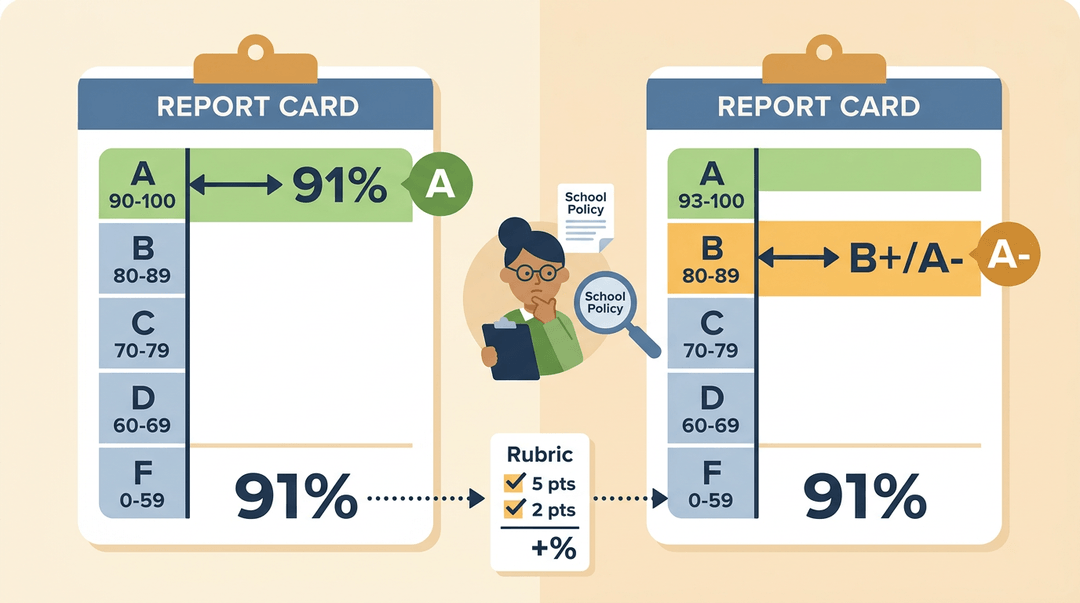
Most U.S. schools use a letter scale of A, B, C, D, and F, and many add plus/minus grades to split each band. Scales differ from school to school, though. Some set an A at 90-100, while others start it at 93-100.
A student who scores 91 earns an A on the first scale and only an A- on the second, so always check your school's policy before you assign a letter.
When you grade a rubric (a checklist of criteria, each with points attached), add up the points, convert the total to a percentage, and then match that percentage to the letter.
For example, a high school science teacher who totals a lab rubric at 91 percent can record the grade with confidence once she knows which scale her school uses.
What is a C+ grade GPA?
A GPA (grade point average) converts letters into numbers:
- A is 4
- B is 3
- C is 2
- D is 1
- F (or E, at some schools) is 0
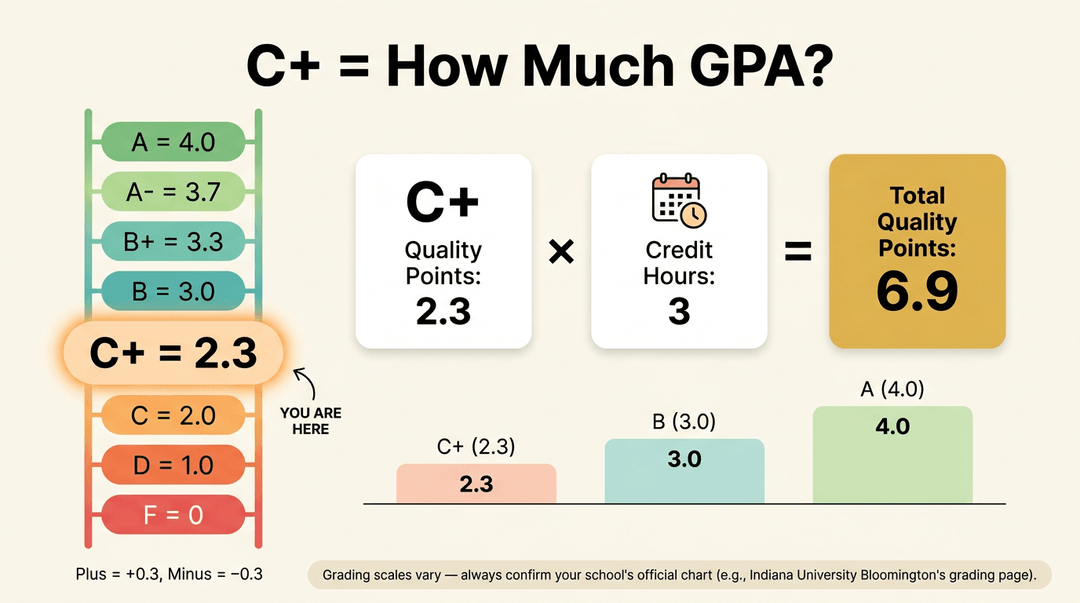
Plus and minus grades shift those values by fractions, such as 3.7 for an A- or 3.3 for a B+. Each letter's number is its quality points, which get multiplied by credit hours.
A C+ is generally worth 2.3, so a 3-credit course earned with a C+ adds 6.9 quality points. Values vary by institution, so confirm your school's chart.
Indiana University Bloomington publishes its own grade scale, so check its official grading page for the exact cutoffs and point values before relying on any general chart.
Minimum grades needed to pass
A D or D- is generally passing, but passing and counting are not the same thing. Many schools require a C or better in major courses, and graduate programs often require a C or better as well.
Picture a college junior who earns a D in a required biology course: the class is technically passed, yet it may not count toward her major and may need to be retaken. Anything below 60 percent is an F and fails outright.
How to Calculate Your GPA
Your grade point average (GPA) is just a weighted average, and once you see the pattern, you can check any transcript yourself.
The GPA formula step by step
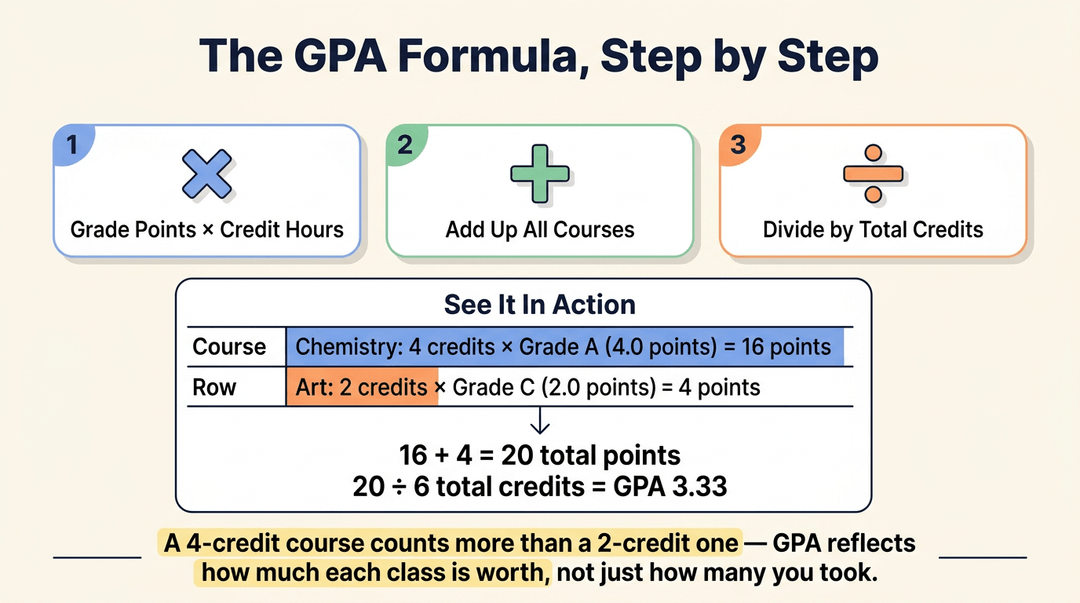
- Multiply each course's grade points by its credit hours.
- Sum those products across all courses.
- Divide that total by the total credits attempted.
The result is a credit-weighted average, so a 4-credit course counts more than a 2-credit one. That reflects how much each class is worth, not just how many you took.
GPA calculation examples you can follow
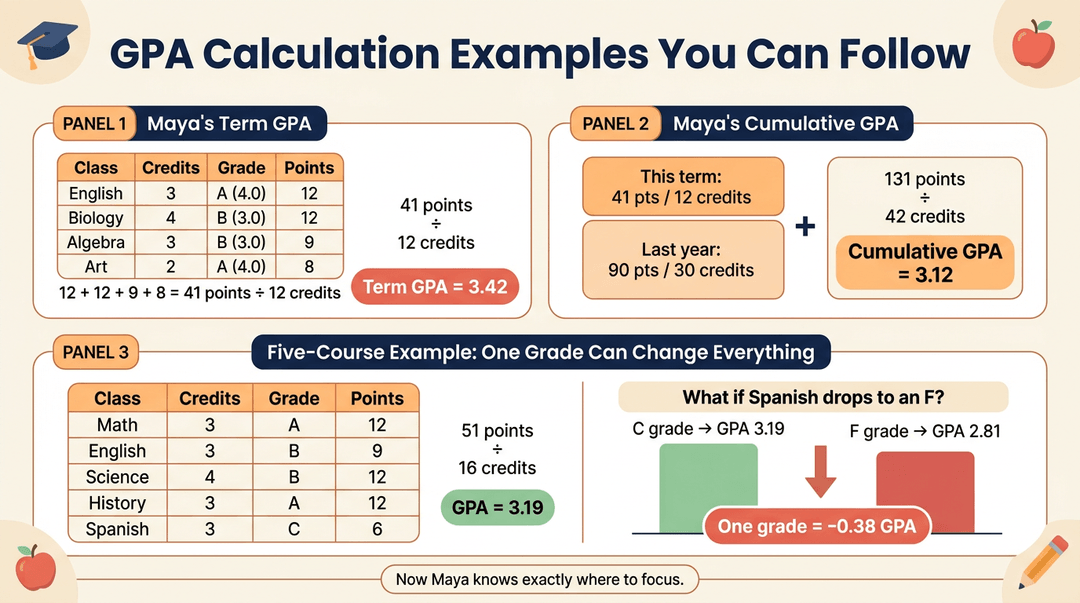
Consider Maya, a high school junior with four classes this term: English (3 credits, A = 4.0), biology (4 credits, B = 3.0), algebra (3 credits, B = 3.0), and art (2 credits, A = 4.0).
Her term GPA is 12 + 12 + 9 + 8 = 41 points, divided by 12 credits: 3.42.
Her cumulative GPA adds last year's 30 credits at a 3.0 (90 points). That gives 131 points over 42 credits: 3.12.
Now try five courses with mixed grades: math (3 credits, A), English (3, B), science (4, B), history (3, A), and Spanish (3, C). That's 51 points over 16 credits: 3.19.
One low grade can reshape the whole number. If Spanish drops to an F, the total falls to 45 points and the GPA to 2.81. That single course cost Maya about 0.38, so she knows exactly where to focus.
Teaching GPA in Your Classroom
Here are three short lessons, one for each stage of a student's GPA journey. Pick the one that fits your class, or run them across a year.
⚠️ Watch out: Grading scales differ from school to school. Always teach from your school's scale, not a generic chart.
Middle school: letter grade basics
Start with what a letter means before any math shows up.
- Explain the A-F scale
- Say: "A letter is shorthand for how much of the work you've shown you understand."
- Practice percentage-to-letter conversion
- Post your school's scale, then give students five scores to convert.
- Try 88%: on a common 90/80/70 scale, that's a B.
- Use real report cards
- Hand out sample report cards (never a real student's) and have students find each letter.
High school: the GPA workshop
Walk students through the formula first, then let them run it themselves.
- Assign points to each letter
- The common unweighted scale: A = 4, B = 3, C = 2, D = 1, F = 0.
- Add up the points
- One grade point per course, summed across the semester.
- Divide by the number of courses
- If credits differ, multiply points by credits, then divide by total credits.
Example: A student earns an A in English, an A in Math, a B in Science, and a C in History. That's 4 + 4 + 3 + 2 = 13 points. Divide by 4 courses and the semester GPA is 3.25.
Once that clicks, bring in weighted versus unweighted.
| Unweighted | Weighted | |
|---|---|---|
| Every course counts | The same | By difficulty |
| An A in an honors or AP class | Usually 4.0 | Often higher, per your school |
| Best for | Simple comparison | Rewarding harder coursework |
Seniors: college GPA expectations
These are discussion-based, so give students time to research and talk.
- Admissions benchmarks. Students look up the typical GPA range on each target college's admissions page.
- Grade trends. Ask: "If your early grades were lower and your recent ones are higher, what story do they tell?"
- Latin honors. Introduce cum laude, magna cum laude, and summa cum laude, then have students find each school's cutoffs.
Cutoffs vary by institution, which makes the research itself the lesson.
Track weighted grades and auto-calculate GPA instantly with EMStudio's online gradebook.
Different GPA Scales and Weighting Systems
Not every transcript reads the same way, so it helps to know which grade point average (GPA) scale you're looking at. Here's how the common versions compare.
The standard unweighted 4.0 scale
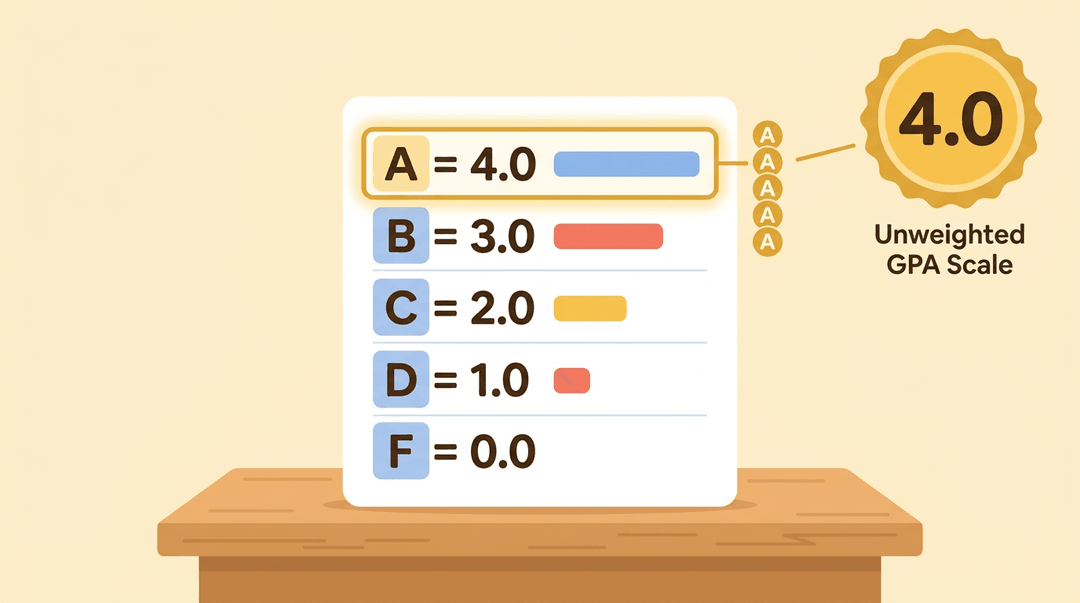
The standard US scale is the baseline most schools use. Straight A's earn a 4.0, and it's the scale most people picture when they hear unweighted GPA.
Understanding weighted GPA for AP and honors
A weighted GPA adjusts for course difficulty. An A in an AP or honors class is worth 5.0 instead of 4.0, so the number can climb above 4.0.
Consider a junior who earns an A in AP Chemistry: that grade lifts her GPA more than the same A in a standard class. The system rewards rigor rather than just the letter.
Colleges may recalculate an unweighted GPA from your transcript, though, so check what they use.
Other GPA scales used worldwide
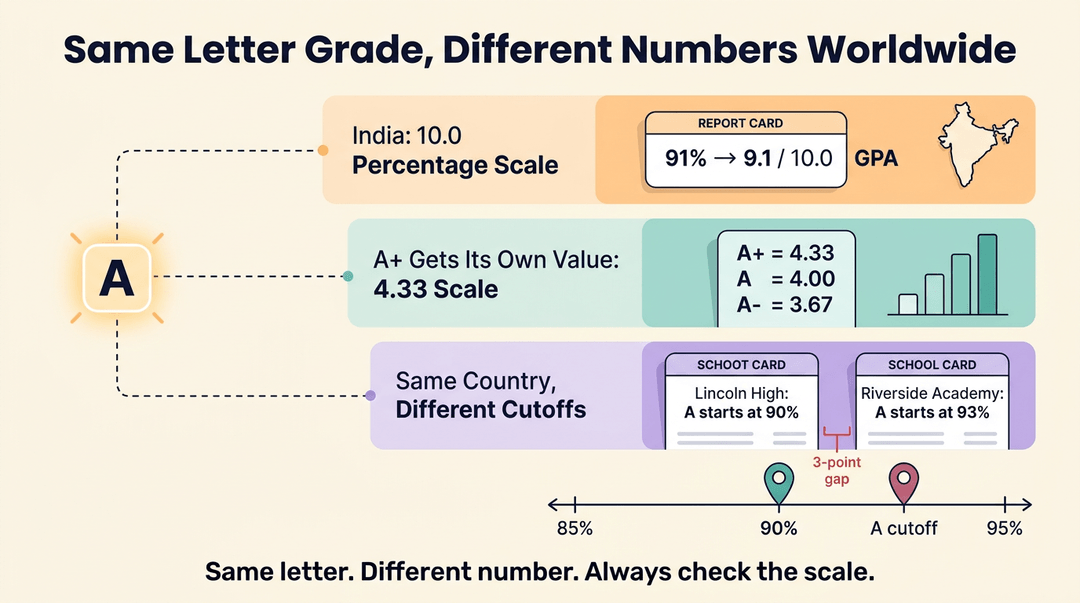
India uses a 10.0 percentage-based scale, and some systems use a 4.33 scale that gives A+ its own value. Even within the US, the A threshold varies: one school may require 90%, another 93%.
Institution-specific cutoffs add another layer. Same letter, different number.
Different Types of GPA Explained
Not every GPA tells the same story. Here's how the main types differ.
Semester GPA versus cumulative GPA
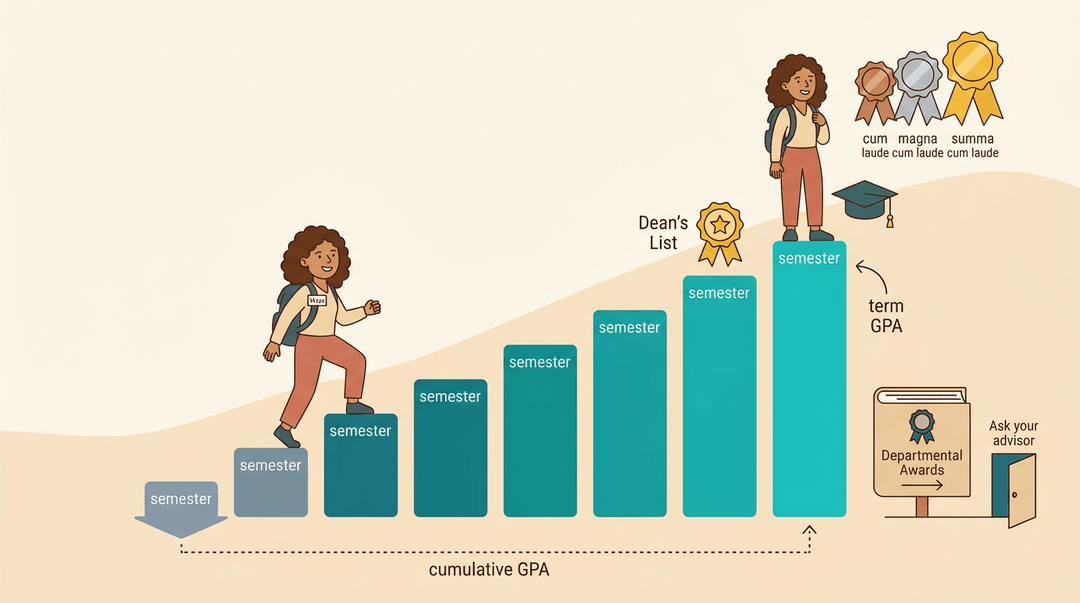
A term GPA covers a single term. A cumulative GPA covers your full career. One shows how you did this semester; the other shows your overall record.
Term GPA is often used for Dean's List recognition, while degree honors rely on cumulative GPA. Think of a student with a rocky first semester and stronger grades after that. Her cumulative GPA reflects that full climb.
Colleges typically request cumulative GPA, so that's the number to know well.
How to calculate accounting GPA?
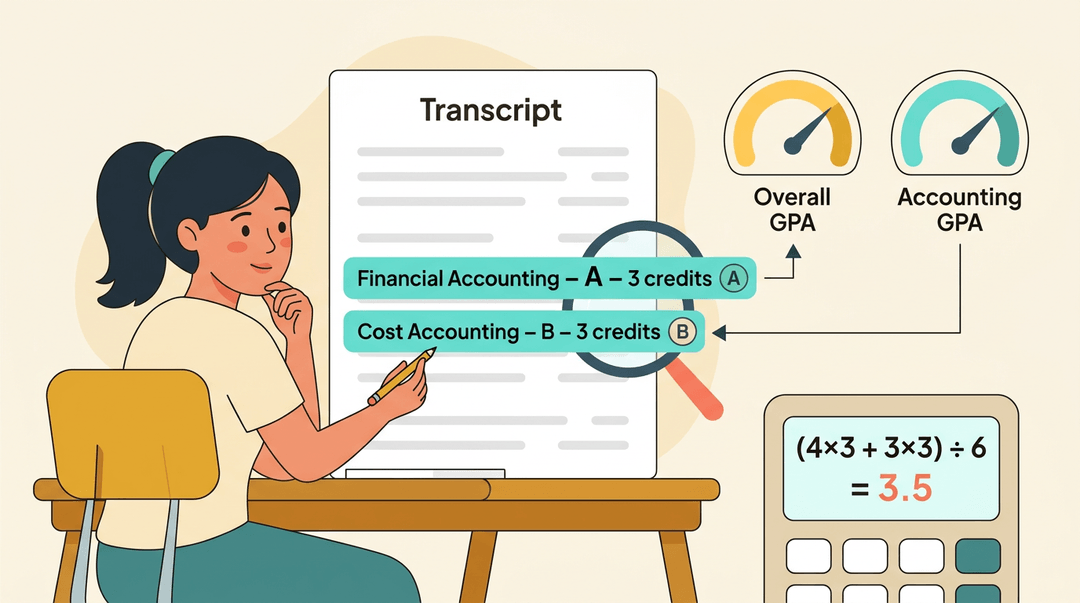
An accounting GPA counts only your accounting courses, and it's tracked apart from your overall record. Undergraduate and graduate GPAs are typically separate too.
Some programs also set core course GPA minimums, so a strong overall average won't cover a weak major.
Schools generally multiply each course's grade points by its credit hours, add those products, and divide by total accounting credit hours. Say a student earns an A in a 3-credit financial accounting course and a B in a 3-credit cost accounting course.
She can see exactly which class is pulling her accounting GPA up or down.
Converting GPA Across Countries
Students moving between countries often find that their grades don't line up neatly. Conversion bridges that gap, but the result is always a starting point.
How to convert GPA between scales
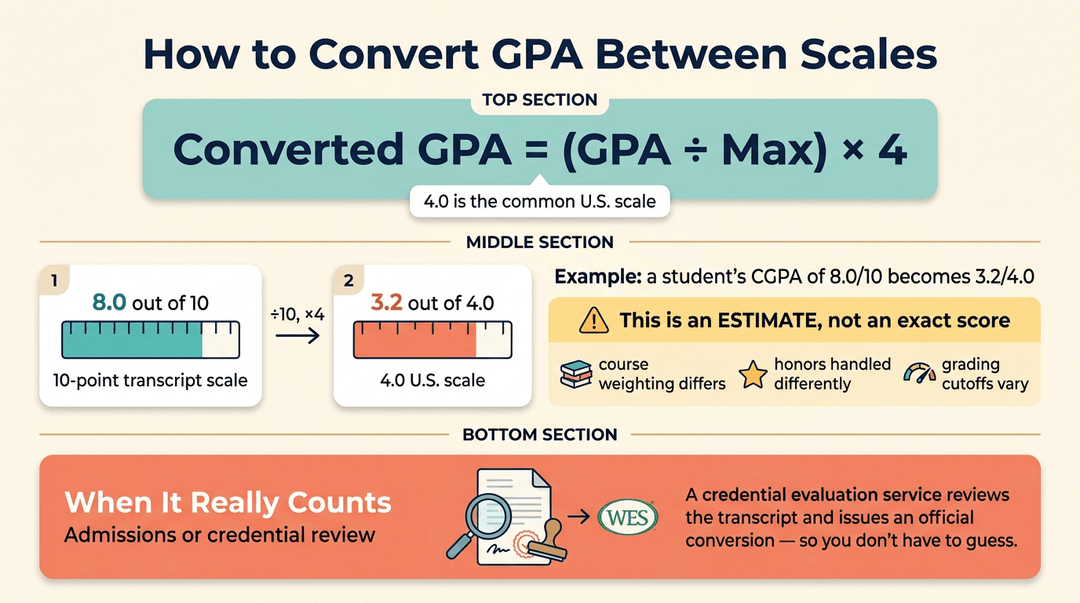
Most conversions rely on one idea: find the grade point average (GPA) as a fraction of the highest possible score, then multiply by 4.0, the common U.S. scale. The formula looks like this:
Converted GPA = (GPA/max) x 4
Consider a high school counselor helping a family whose transcript uses a 10-point scale. A cumulative grade point average (CGPA) of 8.0 out of 10 works out to (8.0/10) x 4 = 3.2 on the 4.0 scale, a number the family can actually use.
Treat that result as an estimate rather than an exact score. Schools weight courses, set grading cutoffs, and handle honors differently, and no single formula captures all of that. Precision isn't possible here.
When a decision carries real weight, such as admission or a credential review, institutions often turn to a credential evaluation service like World Education Services (WES).
These services review foreign transcripts and produce an official evaluation, so you don't have to guess.
Special Grading Rules You Should Know
Not every grade fits neatly on the A-to-F scale. Some grades pause the clock, some sit outside the GPA, and some give students a second chance. Here's how these rules work and what to tell families when they come up.
How incomplete grades affect your GPA
An incomplete grade is awarded when a student has unfinished coursework. It's a placeholder, not a final grade. It must convert to a letter grade once the work is done, and it doesn't affect the GPA until then.
An incomplete can also extend a student's degree date. When a parent asks why a senior's graduation timeline shifted, you can explain it simply: the course isn't finished yet, so it isn't counted yet.

How pass or fail grading works
With pass/fail grading, a course is marked P or F instead of a letter grade, and P/F marks are not counted in the GPA. Some schools use S/P/F for research or thesis courses, where "satisfactory" recognizes ongoing progress.
A pass still requires work equivalent to a C, so the standard is real even though no letter appears. Students with special needs may follow a unique path under these rules, so confirm the specific route with your school.
Retaking courses and transfer credit rules
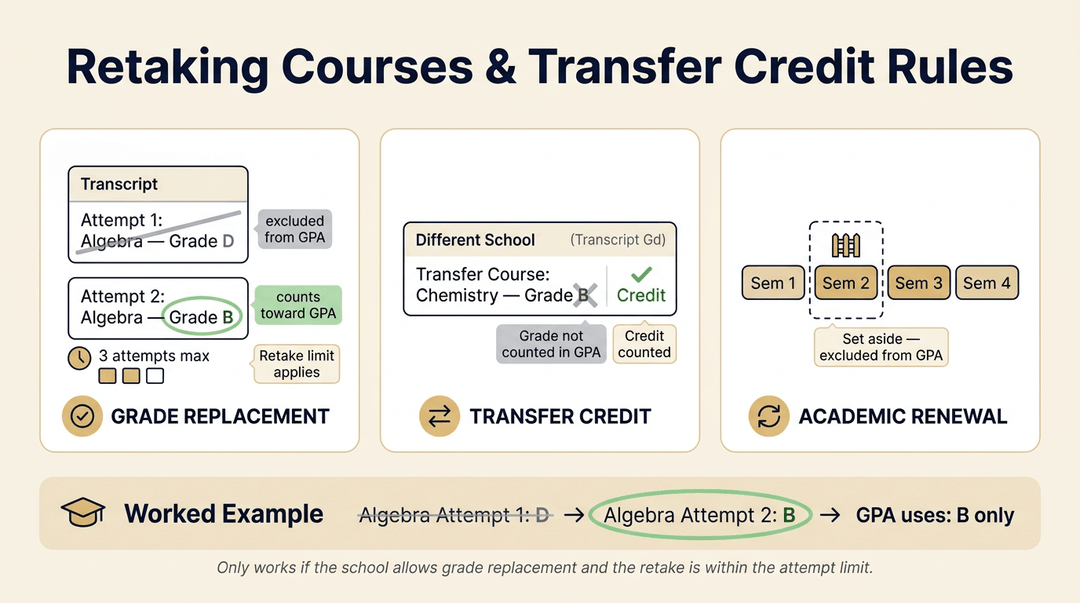
Many schools offer grade replacement, where a retaken course's new grade takes the place of the old one in GPA calculations. Transfer grades are excluded from the GPA. Repeat attempts are often limited, so students can't retake a course indefinitely.
Some institutions also offer academic renewal, a program that sets aside a period of poor performance so it no longer drags down the GPA.
Consider a student who earned a D in algebra and retakes it under grade replacement: only the new grade counts, but only if the policy allows it and the attempt falls within the limit.
How to appeal a grade
Valid appeals are usually tied to the rules, such as a calculation error or a policy violation. A disagreement about how hard a student worked generally isn't grounds for appeal.
Every university sets its own deadlines, and most appeals must begin with a conversation with the instructor. Picture a student who spots a miscounted quiz score the week after report cards post.
A quick talk with the instructor, before the deadline, can fix it in one meeting.
Academic Honors Tied to Your GPA
Your GPA can do more than sit on a transcript. It can also unlock honors. Just know that GPA measures what you earned, while class rank measures where you stand against your classmates.
Earning Dean's List and Latin honors
Dean's List usually looks at your term GPA, the average for a single semester, so one strong term can earn it. Latin honors rely on your cumulative GPA, the average across all your coursework, so they reward consistency over time.
Consider a student named Maya who had a rough first semester but posted strong grades every term after that.
Her early term still counts toward her cumulative GPA, but her recent terms can earn her a spot on the Dean's List while her overall average builds toward graduation honors.
Latin honors come in three tiers:
- cum laude (with honor)
- magna cum laude (with great honor)
- summa cum laude (with highest honor)
Each school sets its own cutoffs, so check your catalog for the exact numbers.
Departmental awards are a separate track. Many departments recognize students who excel in their subject, and the criteria vary from one department to the next. Ask your advisor which awards your major offers.
How GPA Affects Admissions and Scholarships
Your GPA is often the first thing an admissions reader sees, so it pays to know how it's used and what you can do about it.
How colleges weigh your GPA
Many colleges use GPA as a first screening filter. Most then practice holistic review, weighing essays, activities, and recommendations too.
They also consider strength of schedule: a 3.5 in honors and AP courses reads differently than the same average in standard classes. As more schools go test-optional, GPA carries even more weight.
Ways to offset a low GPA
A low GPA doesn't end the conversation. Strong standardized test scores can show readiness, and professional work experience shows maturity. A personal statement can explain what happened.
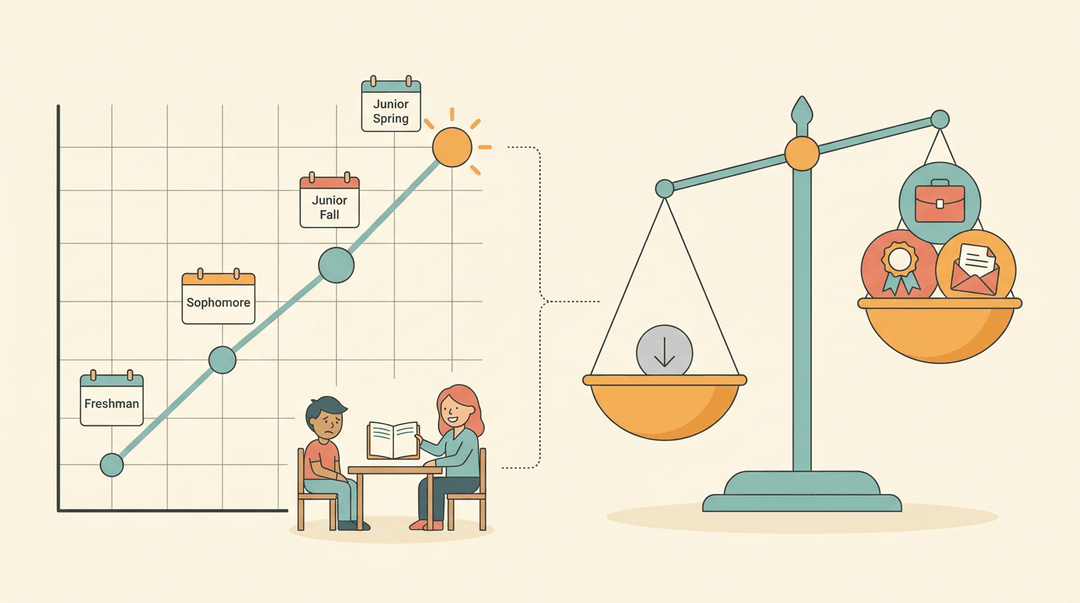
Consider a junior who struggled freshman year, then met with her counselor weekly and improved every semester. An upward trend tells a story of growth, and admissions readers often value that trend over an early snapshot.
To raise your GPA quickly, start with the classes that carry the most weight and build a steady study routine.
What counts as a good GPA
A 3.0 is generally considered a competitive baseline. Highly selective schools look higher: Ivy League averages run 3.7 to 4.0. Many financial aid and scholarship programs set their own minimum GPA, so check each one's rules early.
Where the Grading System Came From
Ever wondered why a B means what it does? The answer starts more than a century ago, and it's a useful story for any teacher who has stared at a gradebook and asked where all this came from.
The origin of letter grades
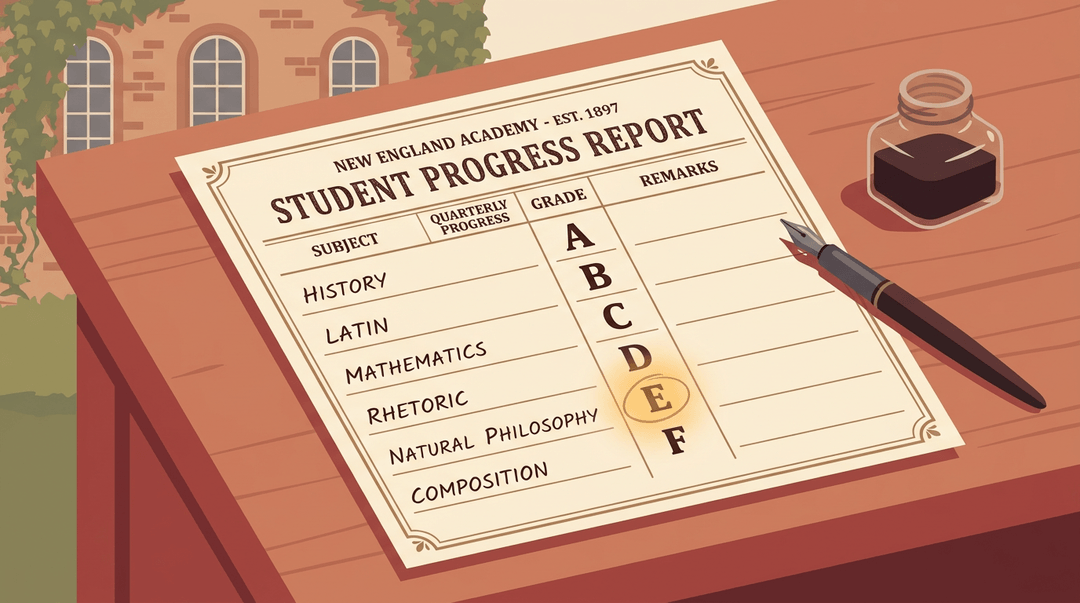
Letter grades weren't always part of American schooling. Mount Holyoke College developed the letter grading system in 1897, making it the first recorded school to do so. Its original scale included an E, and that's where things get interesting.
Why E became F
The E caused trouble. Many people read it as "Excellent," which made the scale confusing. According to a scholarly study of American school work ethic, the scale moved from ABCDE to ABCDF as forces stressed the negative connotations of "failing."
The bottom grade got its own clear letter, and F stuck.
A long-running trend: grade inflation
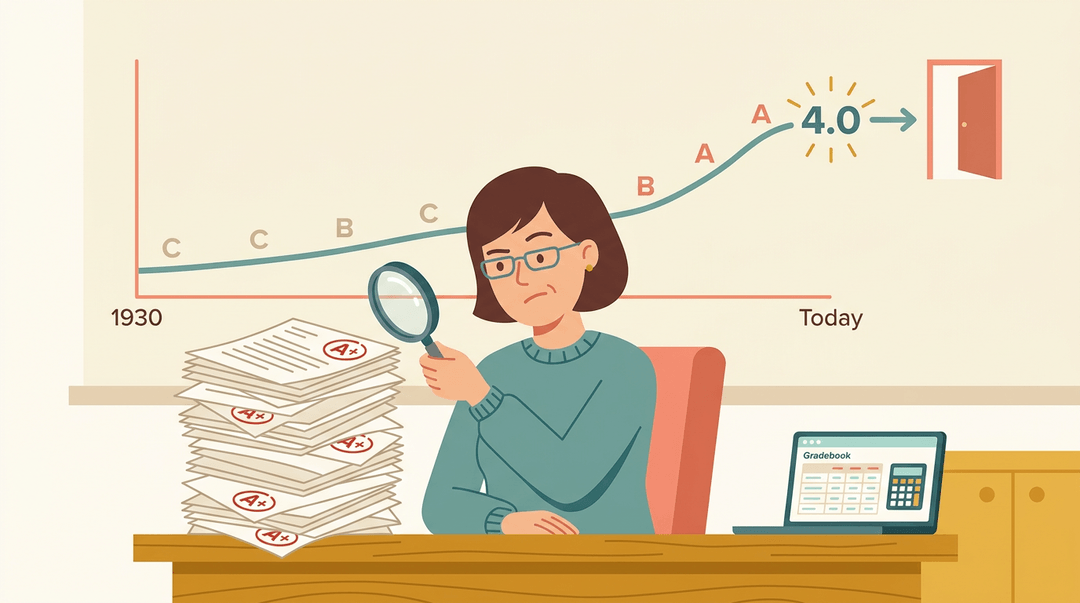
Grade inflation, where grades climb without a matching jump in learning, isn't new. The Economic Policy Institute reports that Harvard dean Harry R. Lewis calculated that grades rose as much from 1930 to 1966 as from 1967 to the present.
Picture a teacher staring at a stack of A's on a final and wondering whether the work really earned them. Educators have been asking that question for generations.
The trend is older than most of us realize, and it's less about how many grades are high and more about what those grades actually measure.
Once you see how the pieces fit, the American system is much easier to read. Letter grades turn into points, points average into a GPA, and that number can open or narrow doors for students later on.
For teachers, the same math can become a lesson in itself. If you're tracking your own class averages, try Grading & Assessment in EMStudio's all-in-one online teacher planner.
It records and organizes grades with automatic calculation in a digital gradebook, so you can spend less time on arithmetic and more time teaching.
References
- Know Our History: Grading at MHC — lits.mtholyoke.edu
- Test scores don't stack up to GPAs in predicting college success — consortium.uchicago.edu
- AUTHORITARIAN AND EGALITARIAN FORCES SHAPE T·HE SCHOOL WORK ETHIC — doi.org (1981)
- Lessons—Doubling of A’s at Harvard: Grade Inflation or Brains? — epi.org
Frequently asked questions
What is a C+ grade GPA?
A C+ is generally worth 2.3 grade points on a standard 4.0 GPA scale. Its value can vary by institution, so check your school’s official grading chart.
What is the grade scale at Indiana University Bloomington?
Indiana University Bloomington uses its own official grading scale, including institution-specific grade cutoffs and grade-point values. Consult IU Bloomington’s current grading policy or transcript key for the exact scale, since general 4.0 conversions may not match it.
How to calculate accounting GPA?
List only the accounting courses, multiply each course’s grade points by its credit hours, add those quality points, and divide by the total accounting credit hours. For example, a 3-credit A and a 3-credit B produce (4.0 × 3 + 3.0 × 3) ÷ 6 = 3.5 accounting GPA.
What does a weighted 5.0 GPA scale mean?
A weighted 5.0 GPA scale gives extra value to grades earned in more difficult courses, such as honors or AP classes. On many such scales, an A in an advanced course may be worth 5.0 instead of the usual 4.0, allowing the GPA to exceed 4.0. Exact weighting rules vary by school.