Asian Grading Scale Explained, Country by Country

Jump to section
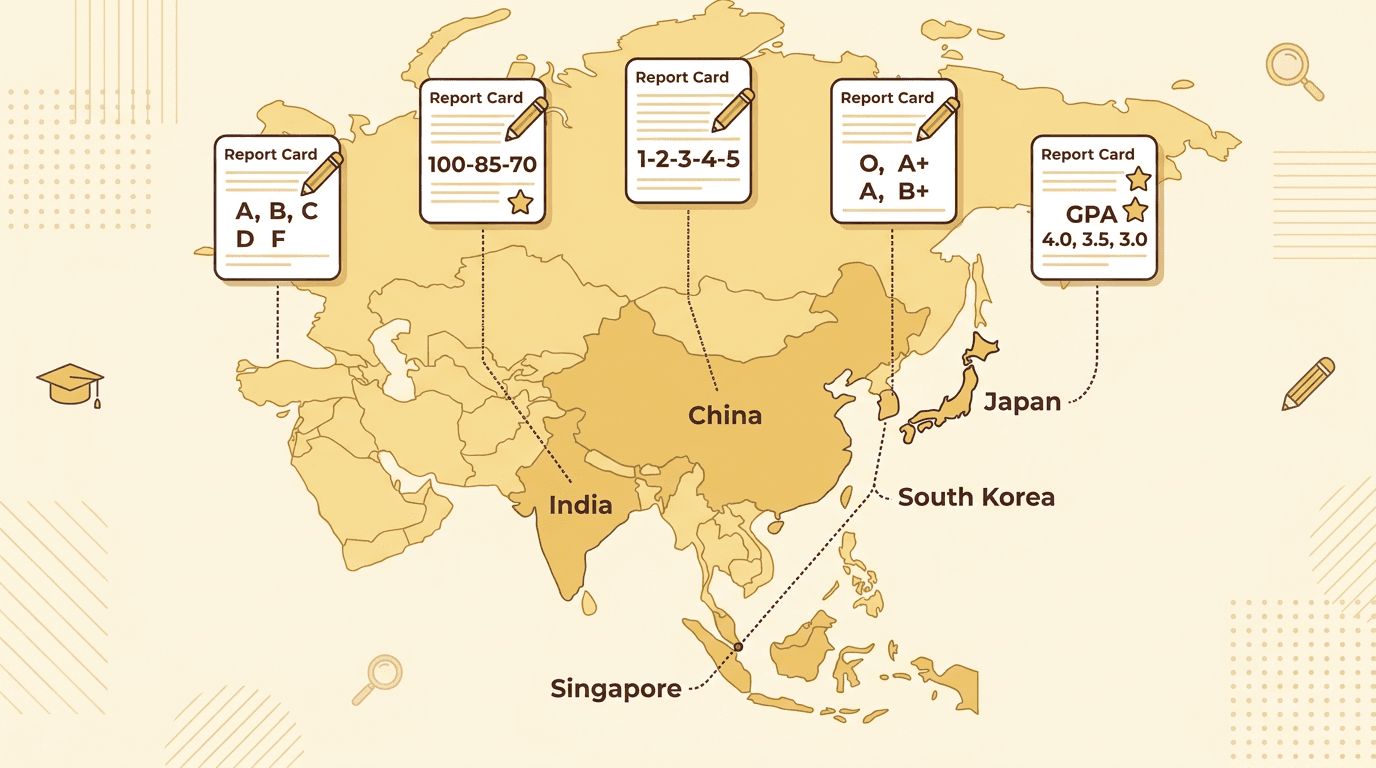
Ever glanced at a report card from another country and wondered what those numbers actually mean? If so, you're in good company. Many teachers have heard the phrase "Asian grading scale," but there isn't one single system behind it.
Japan, Korea, China, and India each use their own scales, with their own percentages and labels. Once you understand how they work, converting them to US letter grades becomes far less of a guessing game. Here's what this post covers.
How the Asian Grading Scale Breaks Down
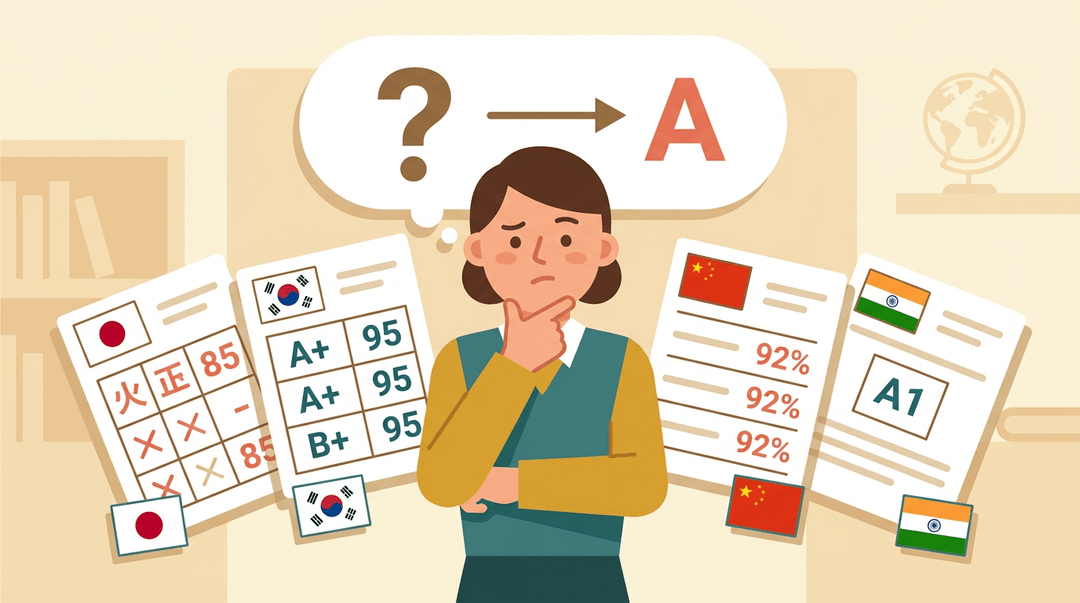
Ever wondered why a number that looks solid in one country can fail in another? Here's how the main scales work.
Is 92% an A or B?
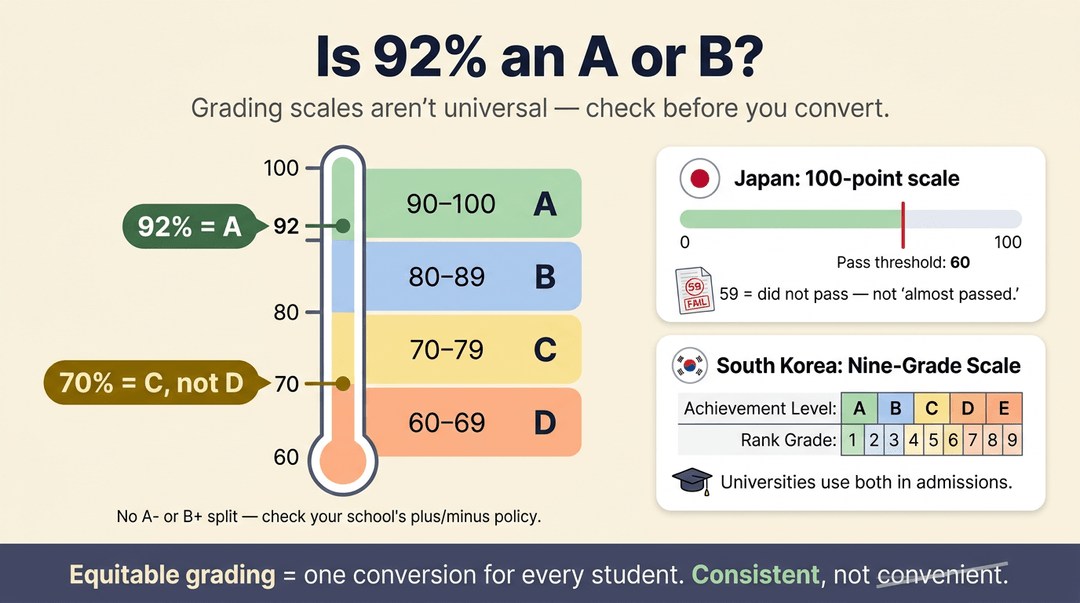
Yes, 92% is an A. In one verified source's traditional scale:
- 90 and above is an A
- 80 to 89 a B
- 70 to 79 a C
- 60 to 69 a D
That same scale makes a 70% a C, not a D. It doesn't split out A- or B+ bands, so check your school's plus/minus policy before converting.
Japan's 100-point scale sets a passing threshold at 60, per Matsuyama University. So a 59 is a fail. Picture a transfer student's transcript on your desk: that 59 means the course wasn't passed, not that it was close.
South Korean high schools use a nine-grade scale. Report cards list an achievement level from A to E and a rank grade from 1 to 9, and Financial News reports universities use both in admissions.
For a country-by-country view, line up thresholds before converting. We don't have verified GPA tables, so confirm transcript formulas with your district. Equitable grading means one conversion for every student: consistent rather than convenient.
A Teacher's Guide to Asian Grade Conversion
Reach for this when a transcript from Japan, Korea, China, or India lands on your desk and you need a US equivalent you can explain and defend.
Cheat sheet: identify the scale first
| Country | What you're looking at | How to convert |
|---|---|---|
| Japan | 100-point scale, often with letters | Map score ranges to letters |
| Korea | 1-9 scale, where 1 is the top band | Read as a rank band, not a percent |
| China | Percentage marks | Use the school's own GPA scale |
| India | CGPA | Use an evaluator's 4.0 conversion |
There's no single official table, so here's what the sources tell us:
- Japan: OpenEduCat notes that Japanese universities predominantly used a 100-point scale with letter grades, without a standardized GPA equivalent. Set your cutoffs, then apply them the same way every time.
- China: A study of 12 Chinese medical schools found universities used 4.0, 4.3, and 5.0 GPA systems. Check which one the transcript uses.
- India: GlobalStudyBoard explains that evaluators like World Education Services (WES) produce a US GPA on a 4.0 scale in their Course-by-Course report. Borrow that approach.
Put conversions to work
| When you're... | Do this |
|---|---|
| Evaluating a transfer transcript | Convert course by course, not one overall number |
| Placing a new international student | Pair the converted grade with a quick skills check |
| Explaining the scale to parents | Show their scale and the US equivalent side by side |
| Documenting your rationale | Write down the scale, method, and date |
Say: "In this system, 1 is the top band. Here's how we're reading it for placement."
Example: A counselor receives a Korean transcript with 2s and 3s. She notes the 1-9 scale, records that lower numbers are better, and places the student in the on-level math section pending a short diagnostic. The note goes in the file.
A documentation note you can copy:
Source scale: [country, scale, top and bottom values]. Method: [your cutoffs or evaluator]. Converted by: [name, date].
Common mistakes to avoid
| If you notice... | Then... |
|---|---|
| A score looks low and you want to "fix" it | Don't assume a curve equals US grading. Ask how marks are distributed. |
| A "passing" mark that would fail here | Check the pass threshold. It varies by country and school. |
| Two grades that look equal | Clarify weighting. Exams, homework, and finals may count differently. |
⚠️ Watch out: Never convert a Korean 1-9 band by guessing a percentage. Ask the sending school what the band means.
Record converted grades and weighted averages instantly in EMStudio's online gradebook.
How Asian Parents View Grades
Stereotypes do a lot of the talking about grades, so let's look at what families actually do. Here's the fuller picture:
How strict are Asian parents really
Not every family is strict. Some parents focus on effort and are happy with a solid B, while others expect straight As as a matter of course. Many families have also loosened their rules over time, especially as kids get older.
- Unspoken high expectations. Some parents never say "get an A," yet students still feel the standard clearly.
- Non-Asian parents are strict too. High bars show up in families of every background.
Consider a ninth grader whose parents never bring up grades at dinner but go quiet whenever a test comes back below 90. She gets the message anyway, and it's a reminder that tone can say as much as a rule.

What happens when grades slip
When grades drop, privileges like screen time or weekend plans are often the first thing to change. Parents also typically ask for an explanation of what went wrong, so students learn to name the cause.
The focus is on why a grade slipped rather than simply that it did.
For you, that's a useful model: a student who can explain a low grade is already halfway to fixing it. Understanding comes first.
Rewarding Kids for Good Grades
Parents and teachers have long asked whether rewards actually push kids to work harder. Here's how the most common approaches compare.
Paying cash for good grades
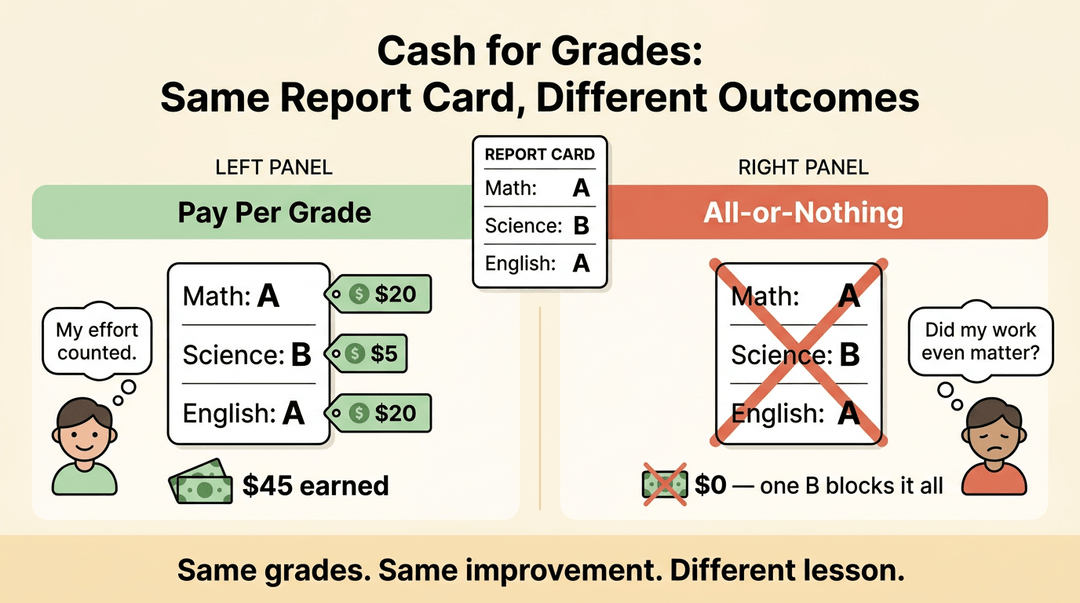
Some families offer cash rewards for report cards. A common version is $20 per A, which turns each grade into a small paycheck. Smaller motivators, like a few dollars for a solid B, are common too.
Some families require every subject to earn an A before any money changes hands. That all-or-nothing rule can feel harsh when a student works hard but still lands a B. At the far end, some parents promise big rewards like a car.
Picture a student who earns an A in math, a B in science, and an A in English. Under an all-or-nothing rule, she gets nothing, even though her grades improved. The real question is less about how much the reward is and more about what it teaches.
Rewards that aren't about money
Not every reward comes with a price tag. Some hand over books after a perfect exam score, which keeps the focus on reading. Others lean on personal pride, celebrating a student's own progress rather than a comparison with classmates.
A teacher might display an improved essay on the wall and say, "You earned that." Watch for self-imposed pressure to excel, though. When a student sets the bar impossibly high, even a strong grade can feel like failure. Pride should feel earned, not owed.
Grades as a Cultural Punchline
Ask a room of teachers about grading across cultures and someone will probably laugh first. That reaction is worth understanding before we get into the actual scales.
The high expectations Asian father meme
The High Expectations Asian Father meme is one of the most recognizable images in online parenting humor. It shows a stern father who won't accept anything less than perfect marks, and people mostly share it as a laugh.
The image also got a mention on a Tumblr blog, one of many places where it circulated.
The humor works because it exaggerates something people think they've seen: a parent who pushes hard for top grades. The joke is about how hard a parent pushes, not about the student working to meet that goal.
Consider a Korean-American student who earns an A-minus on a chemistry test and hears a classmate crack a joke about her father at lunch. The laugh lands on her, not on the stereotype.
That's the catch: the stereotype is the punchline, and the student pays for it.
Grading systems vary widely, but the goal stays the same: an honest picture of what each student has learned. Knowing how country-specific scales convert to US letters helps you explain a grade to a family and place a new student with confidence.
Ready to keep those conversions organized? Check out our Grading & Assessment page to see how EMStudio's digital gradebook calculates grades automatically.

References
- 試験・成績評価について — 100th.matsuyama-u.ac.jp (2025)
- The impact of grade point average on medical students’ perception of the learning environment: a multicenter cross-sectional study across 12 Chinese medical schools — pmc.ncbi.nlm.nih.gov (2025)
- PSYC 470-01 Consumer Behavior — exa.ai (2007)
- Japan University Grading System: GPA, Grades, — openeducat.org (2026)
- 고교 내신, 절대평가 A등급 받아도 절반은 1등급 못 받아 — fnnews.com (2025)
- Converting an Indian Percentage or CGPA to a US 4.0 GPA — globalstudyboard.com (2026)
Frequently asked questions
What is the grading scale used in South Korea for high schools?
South Korean high schools use a nine-grade ranking scale, with 1 as the highest rank and 9 as the lowest. Report cards may also show an achievement level from A to E, so both the rank grade and achievement level can be relevant, especially for university admissions.
Is a 59 good in Japan?
No. In Japan’s 100-point grading system, 60 is generally the passing threshold, so a score of 59 is typically failing. The exact rules can vary by school or institution.