Meaning of Summative Assessment: A Complete Guide


Jump to section
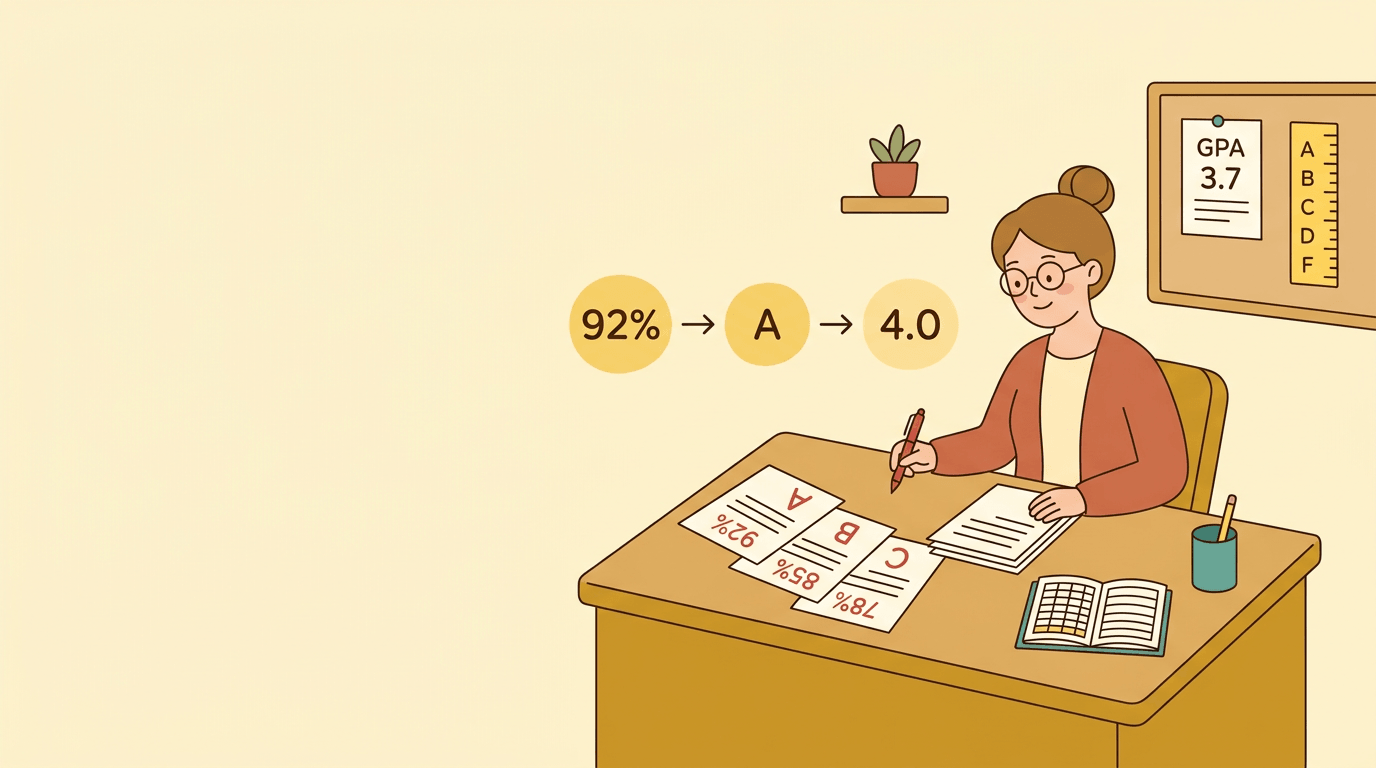
Think of a baking competition. The judges don't taste every batter along the way. They wait for the finished cake, then score it against what the recipe promised. That final verdict is the heart of summative assessment.
In your classroom, summative assessment is the check at the end of a unit, course, or term that measures how much learning actually stuck. Think end-of-unit tests, final projects, and final exams.
Here, we'll cover what it is, when to use it, how it differs from formative assessment, and how to design and grade it well.

Meaning of Summative Assessment and Its Purpose
The purpose of assessment in education is to show where students stand so you know what to do next. Summative assessment looks back instead, judging how much learning happened once instruction ends.
When should summative assessment happen?
Summative assessment happens after instruction ends, once there's a full chunk of learning to judge. It measures what students learned, usually at the end of a unit, a course, or the school year.
Consider a seventh-grade math teacher who tests students after the final ratio lesson. Her results show who can solve ratio problems independently, compared against the standards and benchmarks her class is working toward.

Why summative results carry real consequences
Summative results carry more weight than formative ones. A quick check that shapes tomorrow's lesson is low-stakes, but a final exam that feeds a grade is high-stakes. These results often show up in:
- Grades: report cards and course credit
- Accountability: school and district reporting
- Selection and placement: choosing students for programs
- Promotion and graduation: whether a student moves up or finishes
For example, a high school English teacher whose exam counts toward credit checks that every question matches what the class practiced, so the grade reflects real learning rather than a surprise on test day.
Quick way to remember the difference
Here's an easy way we like to remember it: summative assessment is a test of learning, and formative assessment is for learning. Summative checks what was learned, while formative guides what happens next.
The difference is less about the tool and more about when you use it and what you do with the results. Same quiz, different job.

What Are the Different Types of Assessment Styles?
Summative assessments fall into two families: traditional tests, and tasks where students build something to show what they know.
Classic tests like finals and midterms
Classic tests usually come in a few forms:
- End-of-unit tests check a single unit.
- Midterms and final exams cover larger chunks of a course.
- End-of-course tests wrap up a whole course.
Any of these should be valid (it measures what it's meant to) and aligned to your standards (its questions match what you taught).
A high school biology teacher who builds a cell test from the standards she covered can see which students need reteaching before the next unit.
Statewide tests required for federal accountability
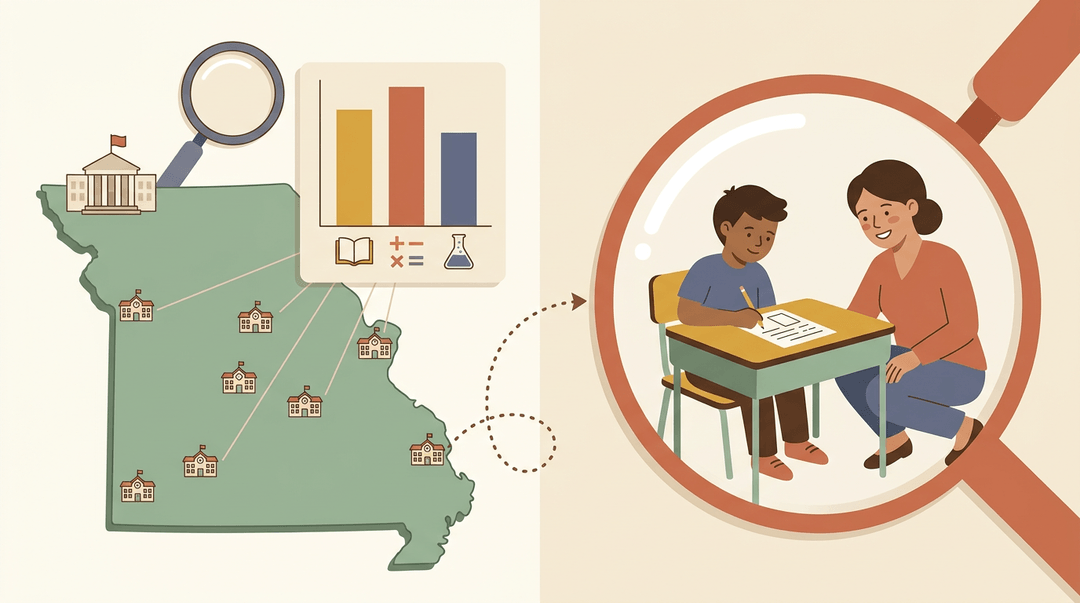
State summative tests are given across a whole state, and federal accountability requirements include them. According to the U.S. Department of Education, the Every Student Succeeds Act (ESSA) requires every state to measure performance in:
- reading,
- math, and
- science.
Those results are also reported publicly. Statewide tests zoom out to school performance, while your tests zoom in on student learning.
Non-test ways students show learning
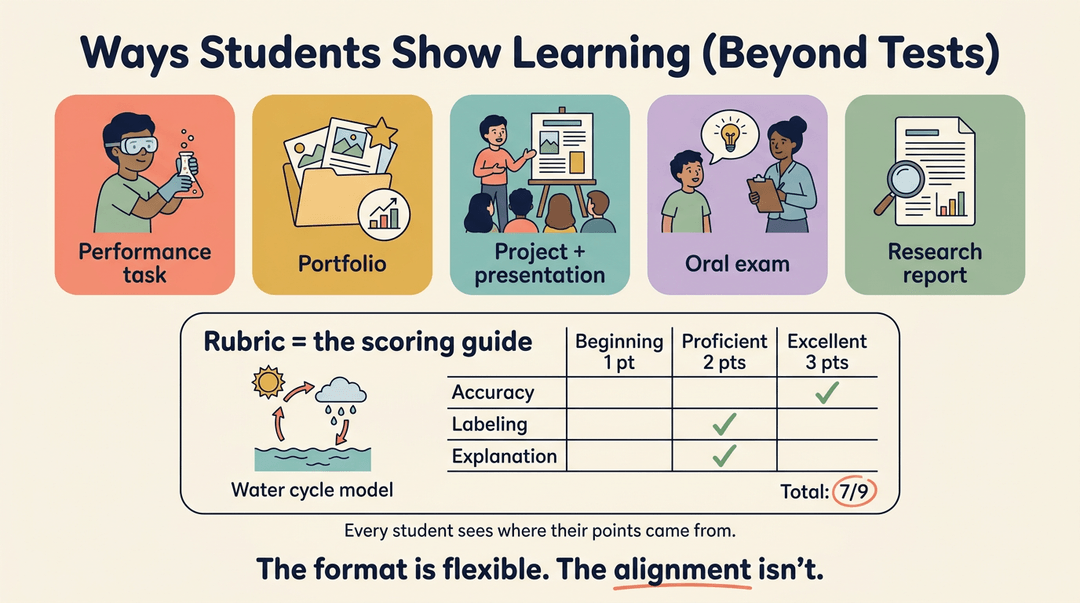
Beyond tests, students can show learning through:
- Performance tasks: hands-on work like a lab or demonstration
- Portfolios: a collection of work gathered over time
- Projects and presentations: finished products students explain to an audience
- Oral exams: students explain their thinking out loud
- Research reports: written findings from a student's own investigation
Performance tasks need a rubric: a scoring guide listing the criteria and what each level of quality looks like. A seventh-grade science teacher scores student water cycle models on accuracy, labeling, and explanation.
Every student knows exactly where their points came from.
The format is flexible. The alignment isn't.
Plan and Grade Summative Assessments Well
Use this guide when a unit is nearing its end and you need a final test, project, or portfolio that's fair and measures what you actually taught. We'll go from learning goals to the gradebook.
Plan it in four steps
- Start from learning goals
- Write each goal as something students do: "Students can explain how water moves through the water cycle."
- Match items to standards
- Tag every question or rubric row with its standard, then cut anything that doesn't fit.
- Build a test blueprint
- Sketch a small grid before writing items (see below).
- Schedule at unit end
- Place it after final practice and feedback, and put the date on the calendar when the unit starts.
A blueprint can be this simple:
| Learning goal | Item type | Points |
|---|---|---|
| Explain the water cycle | Short answer | 10 |
| Interpret a cycle diagram | Labeling | 5 |
| Predict a weather outcome | Written response | 10 |
The grid shows at a glance whether your points follow your priorities. If a minor goal holds half the points, rebalance before you print.
Pick a format that fits your setting
| Setting | Summative format | What it could look like |
|---|---|---|
| Elementary | Unit project | A plant life cycle poster with labeled stages |
| Middle school | Lab report | Question, data table, and conclusion from a density investigation |
| High school | Final exam | Multiple choice plus an essay, built from your blueprint |
| Homeschool | Portfolio review | Best work samples, discussed together with a parent |
Example: A middle school science teacher ends a density unit with a lab report. The rubric rows (question, data, conclusion) match the unit's three goals, so each score tells students exactly which goal they've met.
Grade it fairly
Run this before you hand anything back. Each item is a check, not a step:
- Share the rubric beforehand. Give it out when you assign the task, so students know what strong work looks like.
- Weight categories clearly. Post the split in the syllabus, for example tests, projects, and homework, with a percent for each.
- Allow a retake policy. Put it in writing: who can retake, by when, and which score counts.
- Give written feedback. Name one strength and one next step on every paper.
⚠️ Watch out: A rubric revealed only after grading feels like a trap. Students can't aim at a target they've never seen.
Record summative scores and weighted category averages automatically with EMStudio's online gradebook.
How Formative and Summative Assessment Differ
Both formative assessment and summative assessment measure learning, but they do different jobs. Here's how we see the difference.
When each type of assessment happens
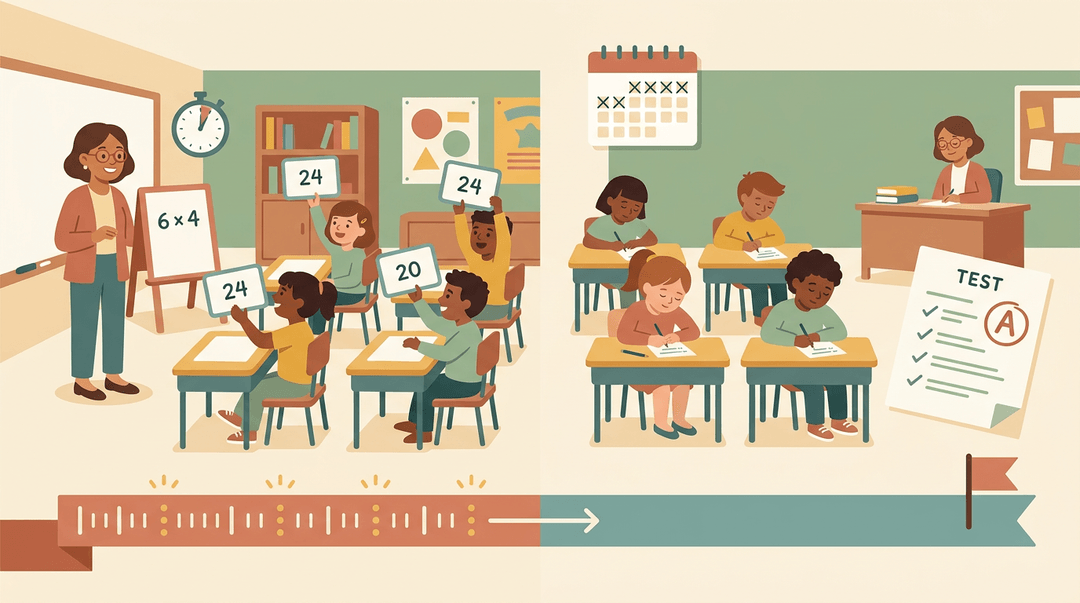
Formative assessment happens during learning, and it's frequent: you can check in at any natural stopping point, like the end of a mini-lesson. Summative assessment comes after instruction, at bigger stopping points such as the end of a unit or course.
Consider a fourth-grade teacher who has students hold up whiteboards after a multiplication lesson. In under a minute, she sees who's ready to move on. The unit test two weeks later shows what stuck.
Guiding instruction versus judging final outcomes
The real difference is less about when you test and more about why. Formative assessment guides instruction: its results show what to reteach or extend tomorrow. Summative assessment judges outcomes: it shows how much was learned by the end.
Formative information is rich, like which misconception keeps popping up. A summative score is an end point, a grade that says where things landed. Scores matter, but they rarely tell you what to do next.
Whether each type counts toward grades
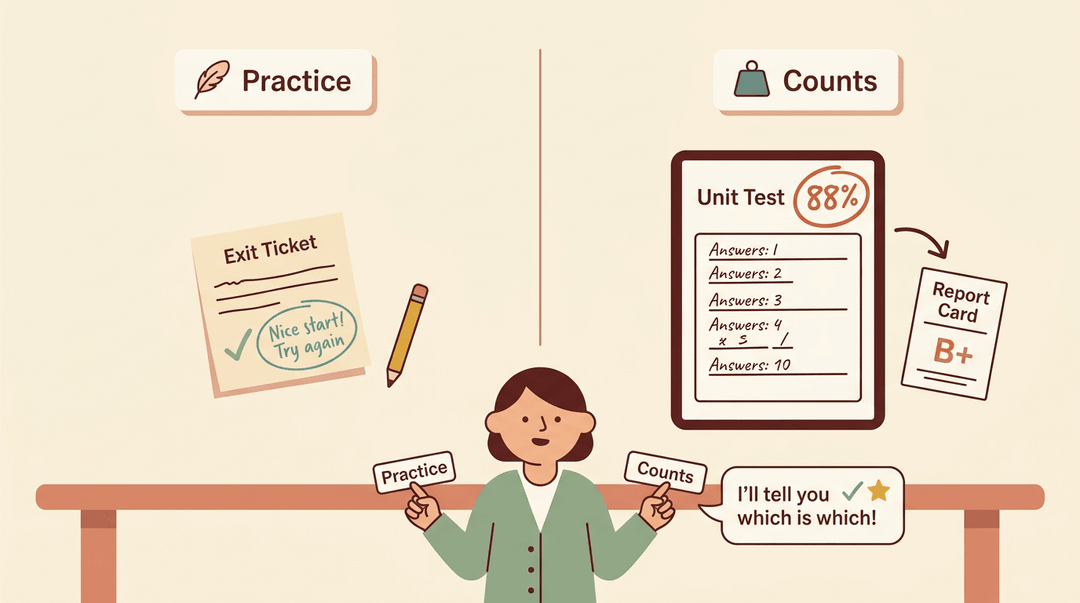
Formative assessment isn't necessarily graded. An exit ticket can serve purely as practice, with feedback but no points attached. Summative assessment usually affects final grades, like the unit test that shapes the report card. The stakes are higher.
Decide on purpose which tasks count, and tell students which are which.
What are the different types of formative assessment?
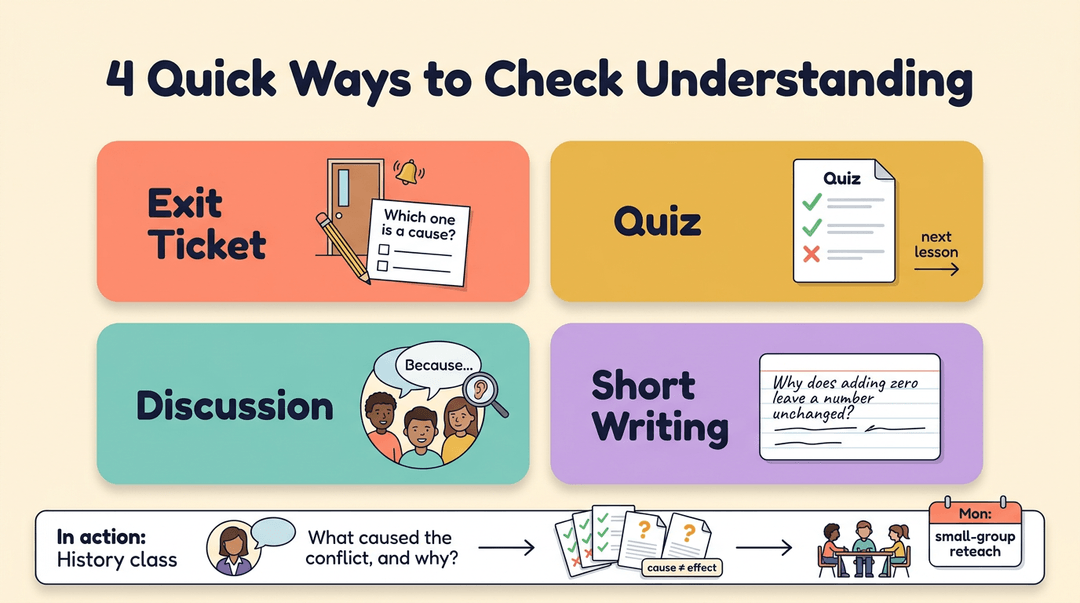
Formative assessment takes many quick, low-stakes forms. The most common include:
- Exit tickets: One or two questions students answer as they leave. They show who got it before the bell rings.
- Quizzes: Short, frequent checks used mainly to shape what comes next.
- Discussions: Whole-class or small-group questions where you listen for reasoning and misconceptions.
- Short writing prompts: A sentence or two answering a focused question, such as "Why does adding zero leave a number unchanged?"
A high school history teacher ends class with the prompt "What caused the conflict, and why?" Two answers mix up cause and effect, so she plans a small-group reteach for Monday.
Why using both beats choosing one
Neither type is enough on its own. Formative checks keep you responsive, but without a summative measure, you never see what students can do at the end.
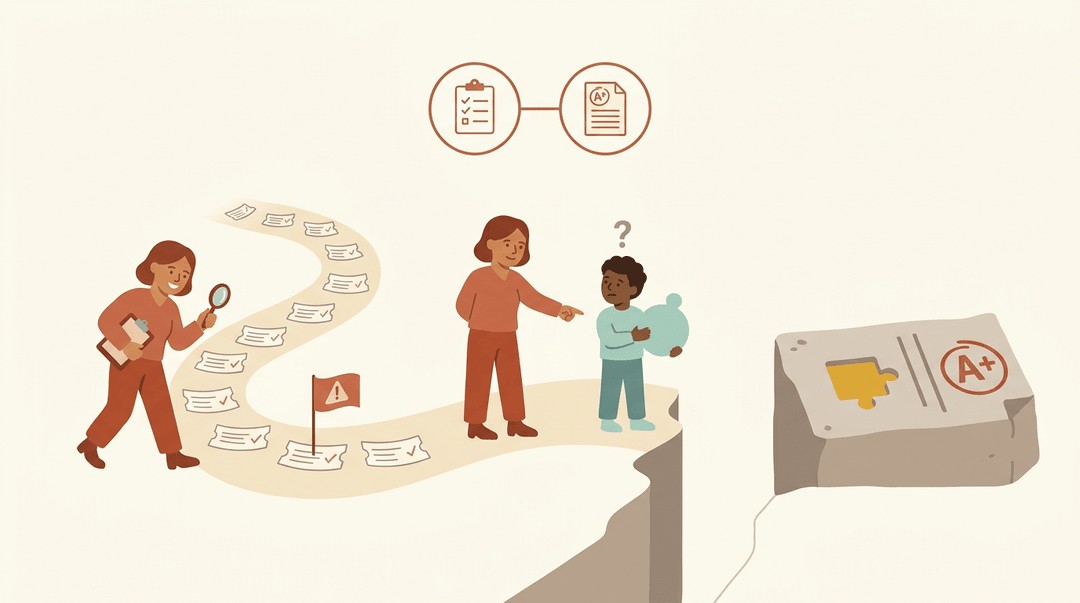
Research points to a useful link. According to a study of an anatomy course published in Discover Education, performance on formative assessments "reliably predicts performance on summative exams."
That's why quick checks can flag at-risk students before the big test.
A mismatch is useful information, too. If students ace every exit ticket but struggle on the unit test, the test may ask for skills your checks never practiced. That's misalignment: the summative assessment doesn't match what you taught.
They're a pair, not a choice. Use both, and let each do its job.
How Schools Put Summative Data to Use
Once a unit closes, summative data (end-of-unit scores that sum up learning) shapes decisions for each student and for the whole school.
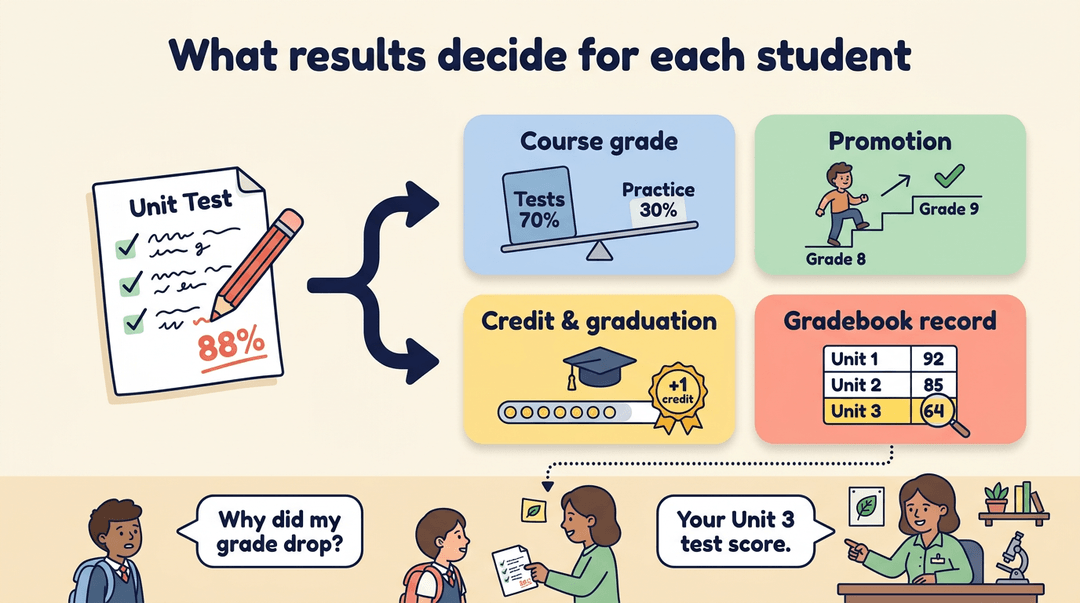
What results decide for each student
Four decisions follow from summative results:
- Course grades. Many teachers use weighting to count summative scores more heavily than practice work.
- Promotion decisions. Results help decide whether a student moves on to the next grade or course.
- Credit and graduation. Passing results can earn course credit and count toward graduation requirements.
- Recording results in gradebook. Each score creates a record that students, families, and teachers can review.
Picture a biology teacher fielding a question about a dropped grade. The gradebook shows exactly which unit caused it, and a clean record makes that talk easier.
How whole school systems use results
Across many classrooms, results guide bigger choices:
- Program evaluation. Leaders check whether a program is meeting its goals.
- Curriculum review and planning. Patterns show which units need rewriting before next year.
- Professional development needs. Widespread misses on one skill point to where teachers need training.
- Resource allocation. Results guide where time, staff, and materials go.
- Look for trends. Compare results across years and groups to see whether growth holds or slips.
Where summative data falls short
Summative data arrives too late to change instruction for the students who took the test. The score closes the unit. It doesn't reopen it.
Use it with other data. One test is a snapshot, so you'll want to pair it with formative checks and classwork.
It's evaluative more than instructional. Summative results show how much students learned, not why or what to do next.
Interim Tests and Balanced Assessment Systems
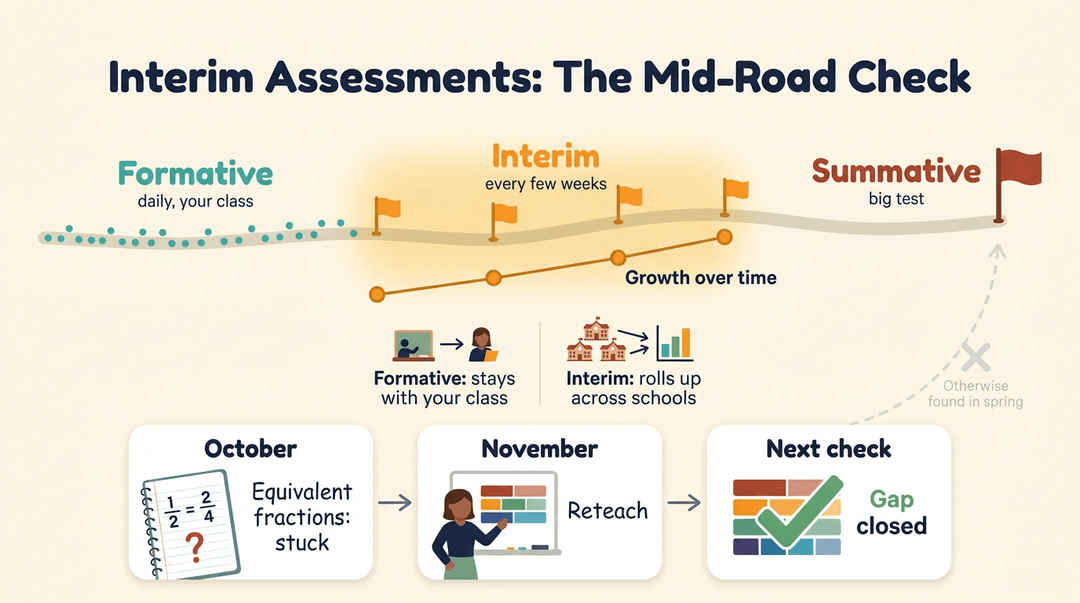
Formative checks shape tomorrow's lesson, and summative tests measure final mastery. So where do interim assessments fit? In the middle, at set points during the year.
Where interim assessments fit in between
Interim assessments sit between formative and summative assessment. They're given every few weeks or at set points, so you can check progress before the big test.
- Progress check-ins: See whether students are on track at the midpoint.
- Growth measurement: Compare results over time to track how each student is growing.
- Predictive and evaluative purposes: Patterns can hint at later results, while scores show where students stand against standards right now.
Interim results often roll up across classrooms or schools, so leaders can spot patterns. Formative data usually stays with your class and guides your next lesson.
Consider a fifth-grade math teacher whose October check reveals students struggling with equivalent fractions. She reteaches the skill in November, and the gap closes by the next check.
Without that midyear data, it might have surfaced only on the spring test.
Use all three types, timed well
A balanced assessment system uses formative, interim, and summative checks together, with each doing a different job. Match the type to the moment: quick checks during learning, interim checks across weeks, and summative tests once learning wraps up.
A final exam can't steer Tuesday's lesson.
More testing doesn't mean better information. How many assessments you give matters less than how well they connect. Coherence beats volume.
Commercial Assessment Tools and Platforms
Once you know what a summative assessment is, the next question is which tools can help you build and score one. Here's what three commercial options signal before you commit.
What specific products offer you
Balanced Assessment by Formative. The name promises balance, so look closely at what it balances and whether that matches your school's grading needs. Ask yourself whether the mix of ongoing checks and end-of-unit tests fits the way you report progress.
AI-powered next steps. Consider a seventh-grade math teacher who hands back a unit test on Thursday and needs to know what to reteach on Monday. An AI (artificial intelligence) tool that recommends next steps from the results can turn a stack of scores into a plan. Use it to inform your reteaching, not replace your judgment about which students are ready. Treat its recommendations as a starting point, so check them before you act.
MAP Growth adaptive interim test. Interim assessments are checkpoints given during the year rather than at the end of a unit. MAP Growth is adaptive, meaning its questions adjust as each student answers, so it's a snapshot of where a class stands rather than a final grade.
Summative assessment answers one big question: did the learning happen? When you align each test with the goals you taught and grade it consistently, the results tell you something useful about your students and your teaching.
Use those findings to decide what comes next, whether that's reteaching a tricky skill or moving the class forward with confidence.
Ready to keep those results organized? Check out Grading & Assessment to record grades and let automatic calculations do the math in a digital gradebook.

References
Frequently asked questions
What is the best definition of formative assessment?
Formative assessment is a low-stakes check of student understanding during instruction, used to guide teaching and help students improve. Its value comes from how the results shape the next steps, not from a particular test format.
What is the purpose of assessment in education?
Assessment helps show where students stand in their learning so teachers can decide what to do next. It can guide instruction, measure learning, and inform grades or broader educational decisions.
What is the primary purpose of assessment?
The primary purpose depends on the assessment: formative assessment guides learning and instruction, while summative assessment measures what students learned after instruction ends. Together, they help teachers respond during learning and evaluate outcomes afterward.
What are the different types of formative assessment?
Common formative assessment types include exit tickets, short quizzes, class discussions, and brief writing prompts. Any of these can be formative when teachers use the results to identify misunderstandings and adjust instruction.
What are the different types of assessment styles?
Assessment styles include traditional tests, such as quizzes, unit tests, midterms, and final exams, as well as performance-based tasks. Students can also demonstrate learning through projects, portfolios, presentations, lab work, oral exams, and research reports.
What are some examples of formative assessments?
Examples include an exit ticket with one or two questions, a short quiz, a discussion that reveals students’ reasoning, or a brief written response to a focused prompt. These are formative when their results guide what the teacher teaches or reviews next.
What's the difference between formative and summative exams?
Formative assessments happen during learning and provide feedback to guide next steps; they are often low-stakes and may not count toward a grade. Summative exams happen after instruction to measure what students learned, and they often contribute to final grades.
When to do summative assessment?
Give a summative assessment after instruction is complete and students have had final practice and feedback. It commonly takes place at the end of a unit, course, or school year, and should assess the learning goals and standards that were taught.