British Grading Scale: All Three UK Systems Explained

Jump to section
Picture the last time you picked up a student's work and thought, "What would this be worth somewhere else?" Maybe you're a homeschool parent trying to make sense of a UK curriculum resource.
Maybe you're a teacher with international students whose transcripts list something called a "2:1" or a "Merit" and you're not quite sure where that lands.
The British grading scale has its own logic, and once you see how it fits together, it makes a lot of sense.
The UK doesn't use a single universal scale: it runs separate systems for secondary school, undergraduate degrees, and postgraduate study, each with its own language.
This post walks through all three, shows how they compare to the US system, and gives you the practical conversion guidance you need to apply UK grades in your own context.

The British Grading Scale for UK Degrees
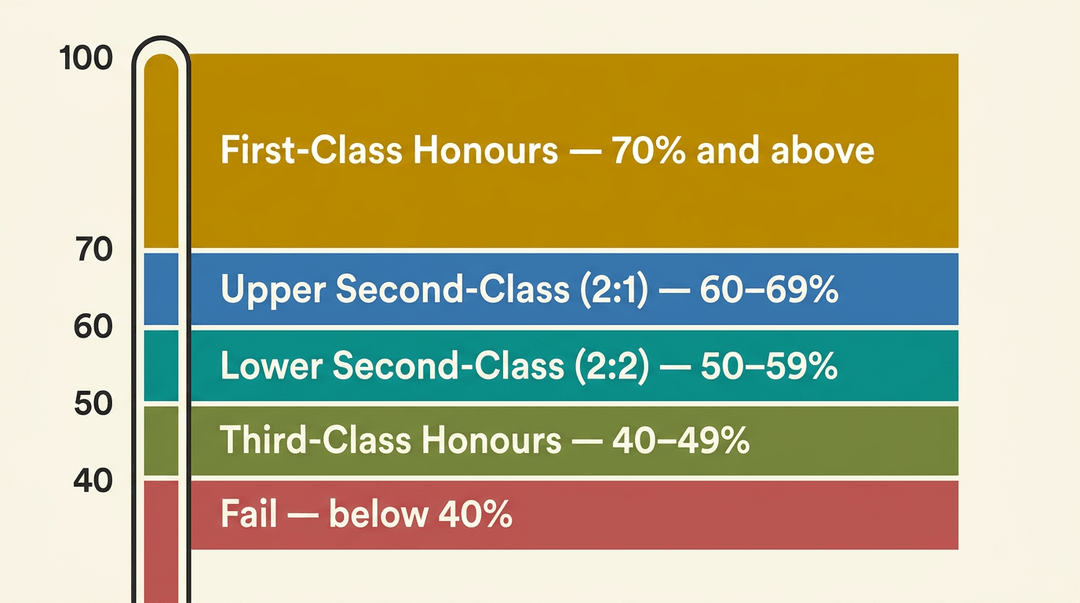
UK undergraduate degrees don't use letter grades or a 4.0 GPA. Instead, they sort graduates into five classification bands based on a weighted average of their module results. Here's how those bands break down:
Classification bands and percentage ranges
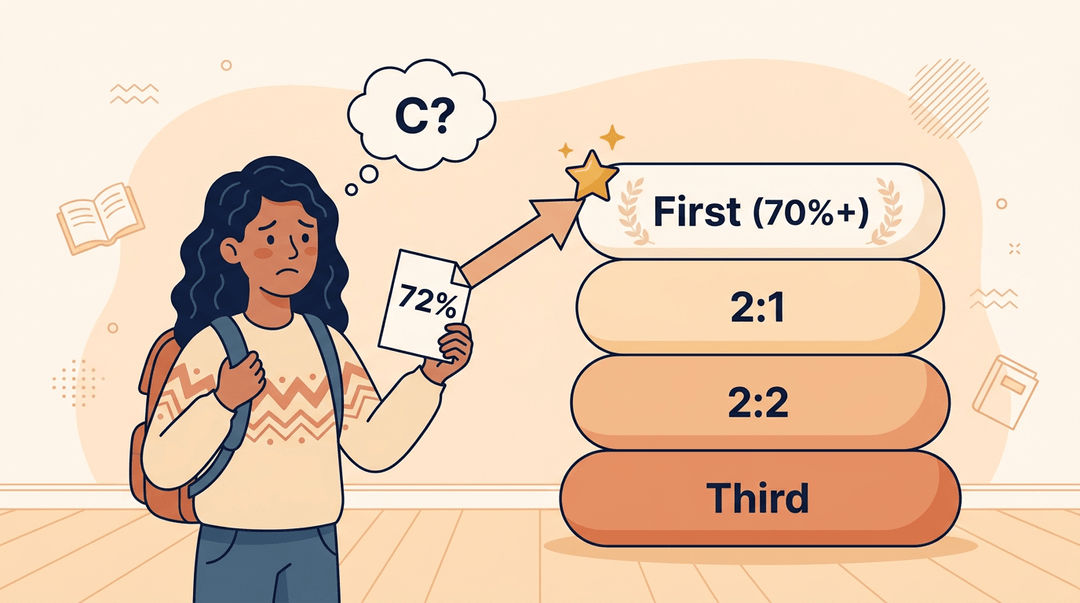
- First-Class Honours: 70% and above
- Upper Second-Class Honours (2:1): 60–69%
- Lower Second-Class Honours (2:2): 50–59%
- Third-Class Honours: 40–49%
- Fail: below 40%
What each degree classification actually means
A First is the highest classification a UK university can award, and it signals exceptional academic achievement.
One thing that trips up international students: 70% in a UK degree is outstanding, not a middling B. The scale simply works differently from the American model.
According to OpenEduCat's guide to UK undergraduate grading, approximately 50% of UK graduates achieve a 2:1, making it the most common classification. Most graduate employers and postgraduate programs list a 2:1 as their minimum entry requirement.
A 2:2 is still widely accepted, particularly for roles where relevant experience matters as much as academic results. A Third is the minimum pass for an honours degree, carrying full degree status even if it limits some postgraduate pathways.
How universities calculate your final grade
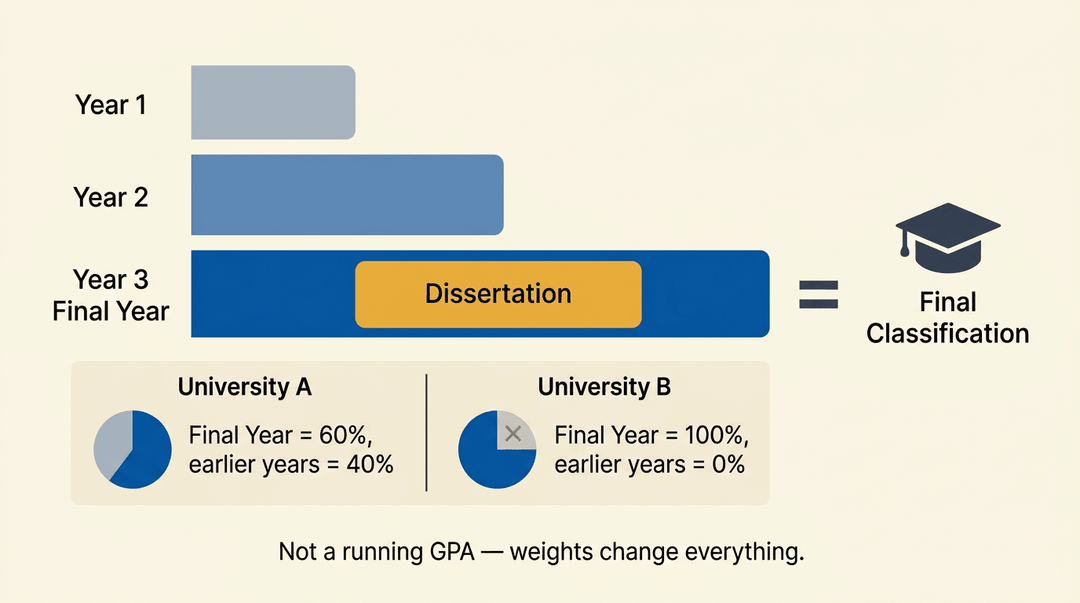
Your final classification comes from a weighted average of your module results across the degree, not a single cumulative GPA.
Final-year exams and your dissertation typically carry the most weight, sometimes accounting for the majority of your overall mark. The exact weighting varies by institution: one university might weight the final year at 60%, another at 100%.
If you're comparing results across universities, or building a gradebook that mirrors this structure, factor in that module weighting carefully.
Letter Grades Used in the UK
The UK doesn't use the A–F letter system the way the US does, but it does map letter grades to percentage bands. Here's how those bands break down:
| Letter Grade | Percentage Range | Descriptor |
|---|---|---|
| A | 70–100% | Excellent |
| B | 60–69% | Good |
| C | 50–59% | Satisfactory |
| D | 40–49% | Sufficient |
| E / F | Below 40% | Fail |
Is 70% an A in the UK?
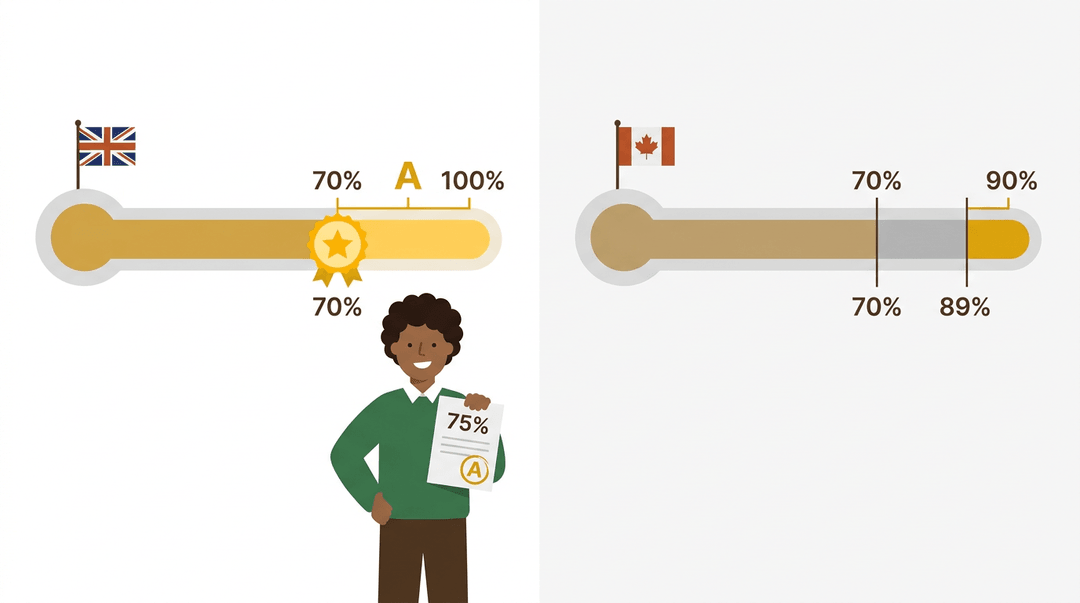
Yes. In the UK letter-grade framework, 70% is the threshold for an A, which maps to "excellent" work. That's a notably lower bar than in many other countries, where an A typically requires 90% or above.
So if you're used to a North American scale, a UK score of 70% can feel underwhelming at first glance. It isn't. Hitting 70% in a British university course is genuinely strong performance, and anything above it sits in the same top band.
Is 75% also an A in the UK?
Yes. Because the A band runs from 70% all the way to 100%, a 75% is just as much an A as a 95% is. Both sit in the "excellent" tier. At undergraduate level, this range corresponds to a First Class Honours degree, the highest classification available.
For a student or parent converting a UK transcript, any mark of 70 or above deserves to be read as top-tier work.
UK vs US Grading System Compared
The two systems measure the same thing, achievement, but they measure it differently. The UK and US also have different school year structures: a US Grade 4 student is roughly the same age as a UK Year 5 pupil.
Understanding those structural differences is the first step to reading a transcript accurately.
Is UK grading easier than the US?
Neither system is inherently easier: they're built on different philosophies. The UK awards degree classifications (First, 2:1, 2:2, Third) rather than a cumulative GPA.
A UK student's final grade rests heavily on end-of-year exams and a dissertation, so one strong performance can carry a lot of weight.
The US uses letter grades and a 4.0 GPA scale, rewarding consistent work across essays, quizzes, midterms, and finals throughout the year. If you thrive under pressure and peak at exam time, the UK model may suit you.
If you prefer steady credit-building, the US approach rewards that instead.

How UK grades convert to US GPA
Direct conversion isn't an exact science, but these equivalencies are widely used:
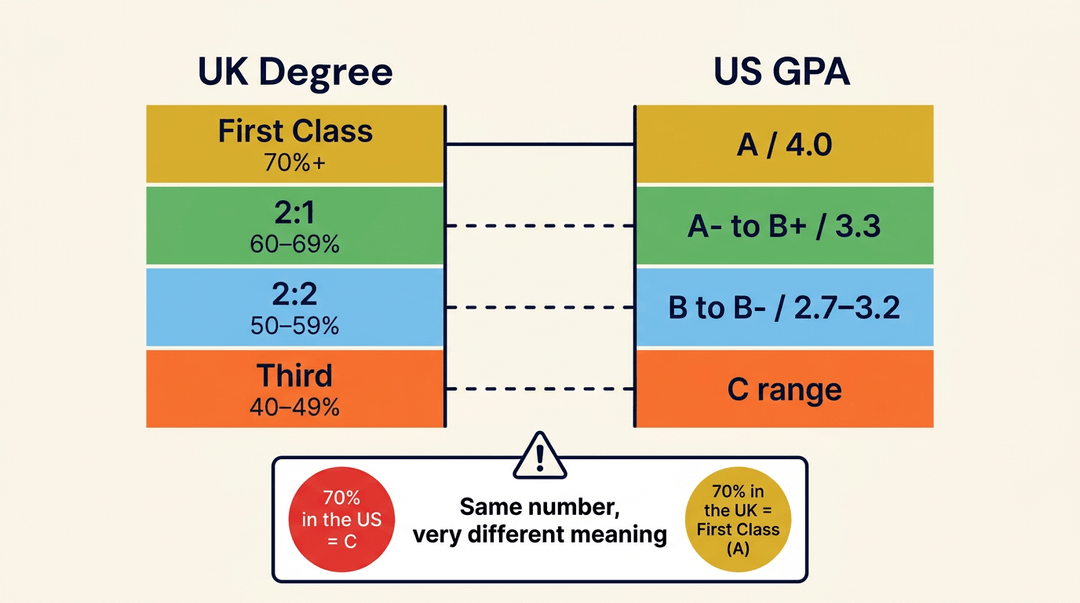
- First-Class (70%+): roughly an A / 4.0 GPA
- 2:1 (60–69%): roughly an A- to B+ / 3.3 GPA
- 2:2 (50–59%): roughly a B to B- / 2.7–3.2 GPA
- Third (40–49%): roughly the C range
One detail that trips people up: a 70% in the UK is a First-Class mark, not a C as it would be in the US. The scales are not parallel. A 2.5 GPA in UK terms sits between a 2:2 and a Third, broadly in the lower-pass range.
US academic honours explained
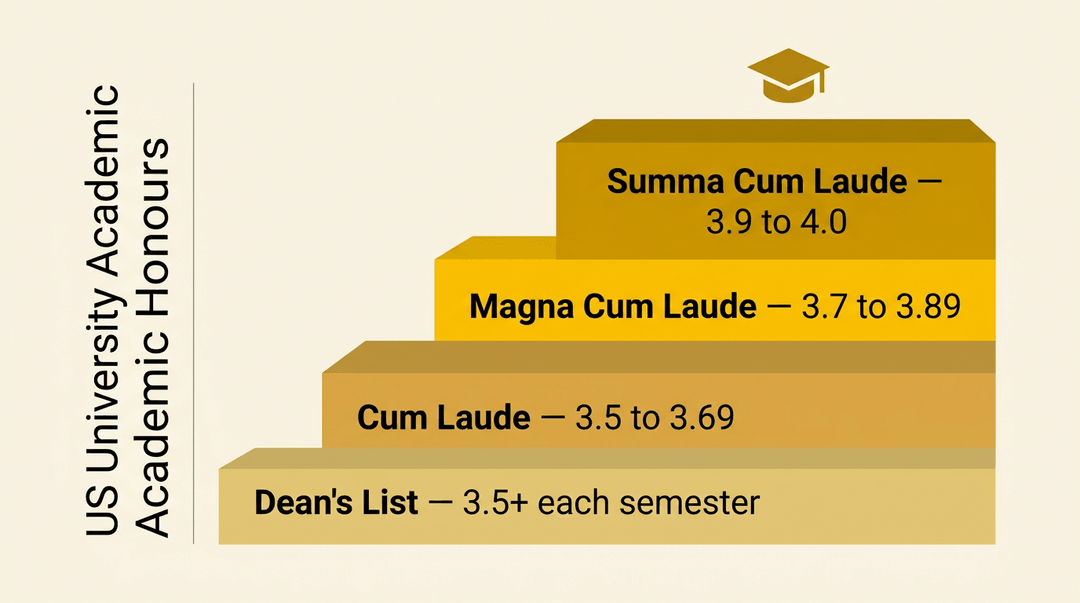
US universities recognise high-achieving graduates with Latin honours. Thresholds vary by institution, but common benchmarks are:
- Summa cum laude: 3.9–4.0 GPA
- Magna cum laude: 3.7–3.89 GPA, per graduation honour guidelines from Ohio State's College of Education and Human Ecology
- Cum laude: 3.5–3.69 GPA, per the same Ohio State guidelines
- Dean's List: awarded each semester for a GPA of 3.5 or higher, according to the Penn State Office of the University Registrar
GPA scores UK universities expect
If you hold a US GPA and want to study in the UK, most universities prefer a 3.3 or above, with a 3.0 as a common minimum. Selective institutions set the bar higher: Oxford and Cambridge typically require around a 3.7 GPA.
UCL's Summer School specifies a GPA of 3.3 to 4.0 for most modules. The stronger your GPA, the more doors stay open.
How Postgraduate Grading Works in the UK
Postgraduate grading follows a different structure from undergraduate study, and it shifts again depending on whether your degree is taught or research-based.
Taught master's degree classifications
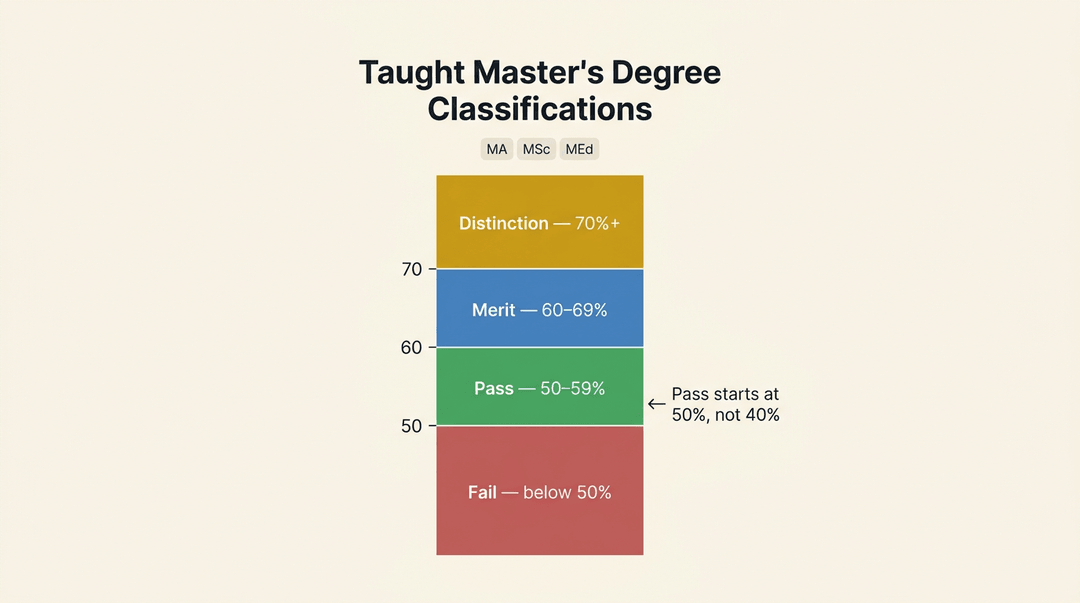
Taught master's programmes (MA, MSc, MEd, and similar) use four bands:
- Distinction: 70% and above
- Merit: 60–69%
- Pass: 50–59%
- Fail: below 50%
These boundaries look similar to undergraduate classifications, but the thresholds for Pass and Merit are higher than most students expect coming from other systems.
How research degrees are graded
Research degrees work differently. An MRes (Master of Research) or MPhil (Master of Philosophy) is graded as pass or fail only, with no merit or distinction band.
A PhD follows the same principle: the outcome is pass or fail, determined largely by the viva voce (the oral defence of the thesis).
The one exception is the integrated master's (MEng, MPharm, and similar), which is classified on the undergraduate scale of First, Upper Second, Lower Second, and Third.
Retakes, deferrals and grade appeals
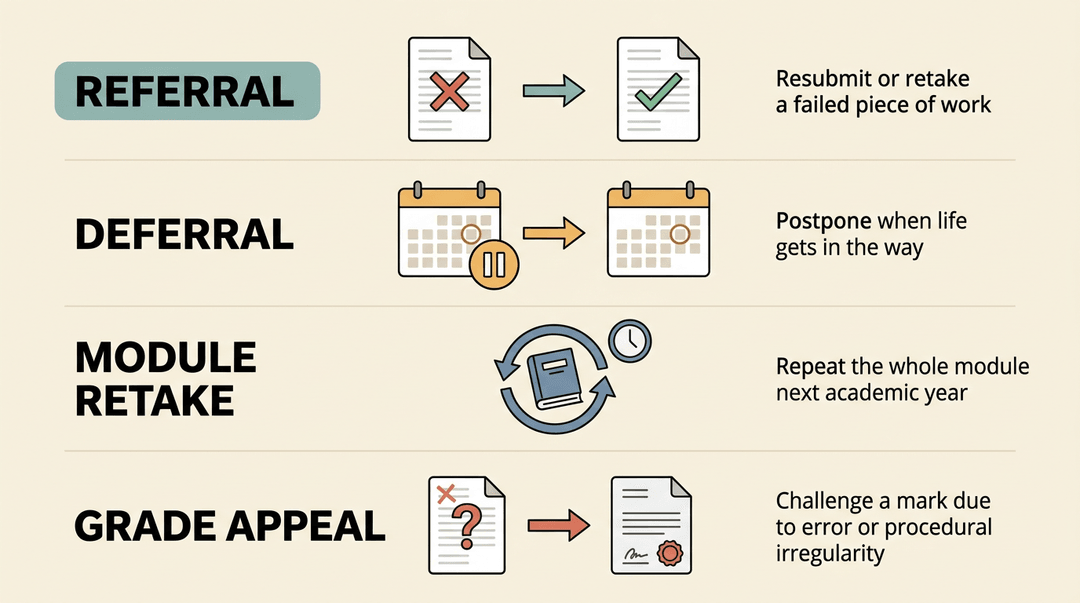
If you don't meet the pass threshold first time, a few routes are available:
- Referral assessments are the standard resit option, allowing you to resubmit or retake a failed piece of work.
- Deferrals let you postpone an assessment when personal circumstances get in the way.
- Module retakes can be possible across academic years, though policies vary by institution.
- Grade appeals give you a formal route to challenge a mark if you believe there was an administrative error or procedural irregularity.
Applying UK Grading in Your Classroom or Homeschool
When your students are headed for UK universities or sitting UK qualifications, you need to read British bands and report grades in a way admissions tutors recognise.
This guide maps UK tiers onto a standard rubric and shows you how to translate both directions.
Map UK bands onto your 4-point rubric
The UK degree classifications line up cleanly with a 4-point scale once you anchor the thresholds.
| UK classification | Percentage | Your rubric level |
|---|---|---|
| First (1st) | 70%+ | Exceeds standard (4) |
| Upper second (2:1) | 60–69% | Meets standard well (3) |
| Lower second (2:2) | 50–59% | Meets standard (2) |
| Third | 40–49% | Minimum pass (1) |
Two thresholds do the heavy lifting:
- 70% is "exceeds standard." In the UK system, 70% is excellent, not a B-minus.
- 40% is the pass boundary. Below it, the work fails outright.
⚠️ Watch out: US-trained graders instinctively read 70% as mediocre. In UK marking it's the top band, so don't deflate your strong students by scoring them against an American curve.
Report grades clearly to UK-bound students
UK universities don't all weight modules the same way, so a clean conversion plus context beats a bare number.
- Convert the percentage to its classification band. State both: "68%, upper second (2:1)."
- Note that module weighting varies. Final-year modules usually count more than first-year ones.
- Flag dissertation and exam weighting in comments. Tell the student what carried the grade.
Try a comment like this:
Example: "Coursework average 72% (First). Dissertation, weighted at 40% of the module, scored 75%. Note that the destination university may weight final-year work more heavily in the overall classification."
Translate secondary grades for your students
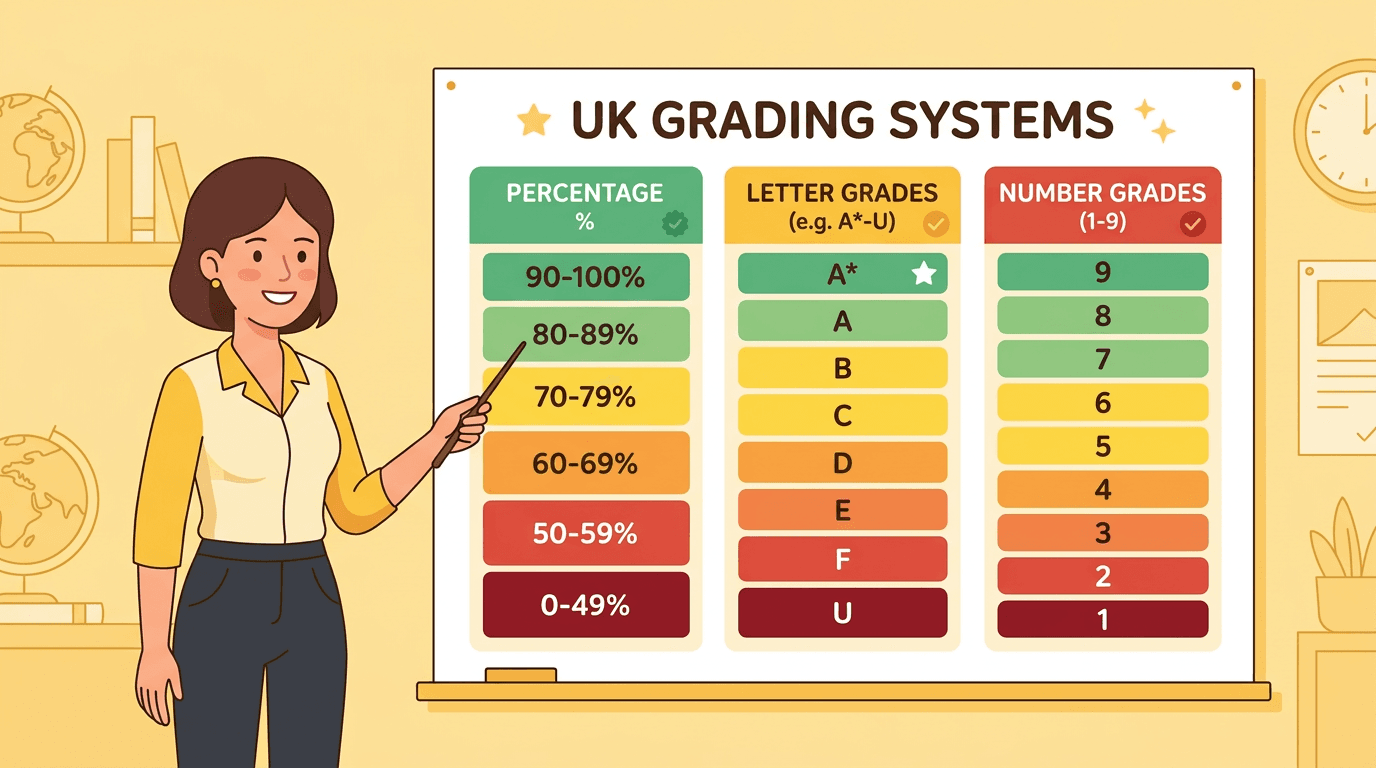
GCSEs now use the 9–1 numerical scale; A-levels still use letters. Here's what the numbers actually signal for the next stage.
| Grade | What it signals |
|---|---|
| GCSE 9–7 | Strong A-level readiness |
| GCSE 4 | Minimum pass for core subjects |
| A-level A*–B | Typical university entry requirement |
- GCSE 9 to 7 marks a student ready to take that subject at A-level.
- GCSE 4 is the standard "pass" for core subjects like English and maths.
- A-level A to B* is the entry range most universities ask for; competitive courses want the top end.
When you report, give the student the threshold they're aiming at, not just the mark they earned:
💡 Tip: Pair every secondary grade with the boundary it clears. "Maths: grade 6, comfortably above the grade 4 pass and on track for A-level."
Building these bands into one place keeps reporting consistent across a year. EMStudio's gradebook lets you set custom weighted scales and percentage bands, matching any UK grading tier to your own assessment structure.
Pre-university and Secondary School Grades
The UK doesn't use a single grading scale at secondary level. England, Wales, Northern Ireland, and Scotland each do things differently, and qualifications like the IB and BTEC sit alongside them. Here's what each one actually means.
Is a 6 a B+ in GCSE?
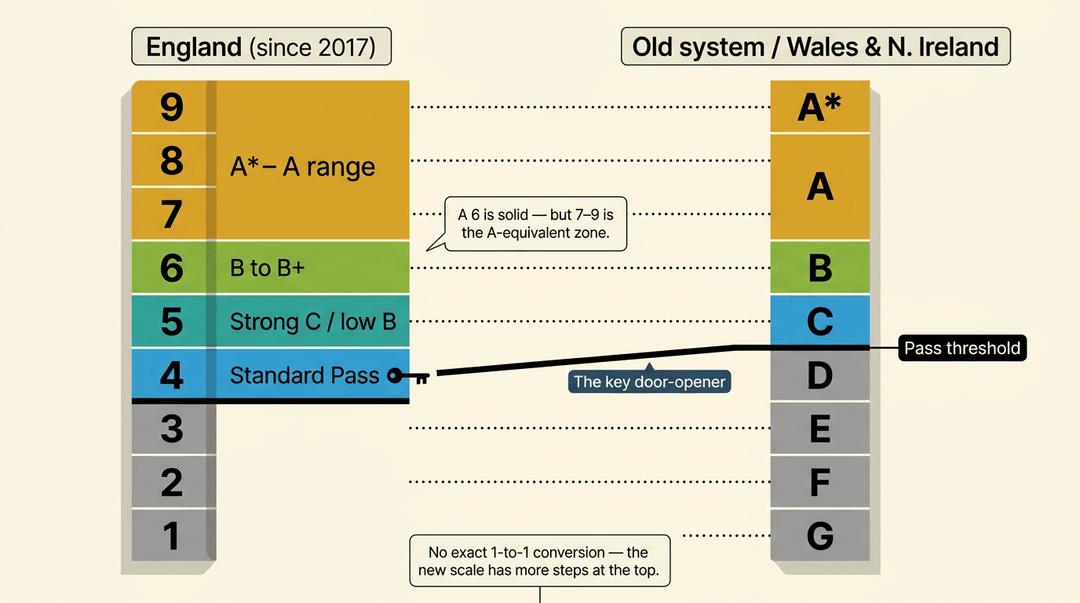
In England, GCSEs use a numeric 1–9 scale. According to GOV.UK's GCSE grade scale guidance, GCSEs in England have been graded on this 9 to 1 scale since 2017, replacing the older A*–G letters.
The critical threshold is grade 4, which represents a standard pass and is broadly equivalent to the old grade C. Schools and employers use the 4/C boundary as the key pass/fail marker, so a 4 in English or maths opens most doors that a C used to.
A grade 6 sits roughly in the B to B+ range under the old letter system, but there's no exact one-to-one conversion.
The numeric scale was deliberately designed with more granularity at the top end, so a 6 is a solid grade without quite reaching the A-equivalent territory (grades 7–9).
Wales and Northern Ireland still use the traditional A–G letter grades*, so a C there maps directly to the 4 in England.
How A-level grades work
A-levels are graded A down to E, with a U (unclassified) grade for results that don't meet the E threshold. The A was introduced in 2010 to differentiate the highest-performing students at the top of the A grade.
Notably, the AS-level (the standalone qualification in Year 12) does not include an A* grade: it runs from A to E only.
Scotland's grading system
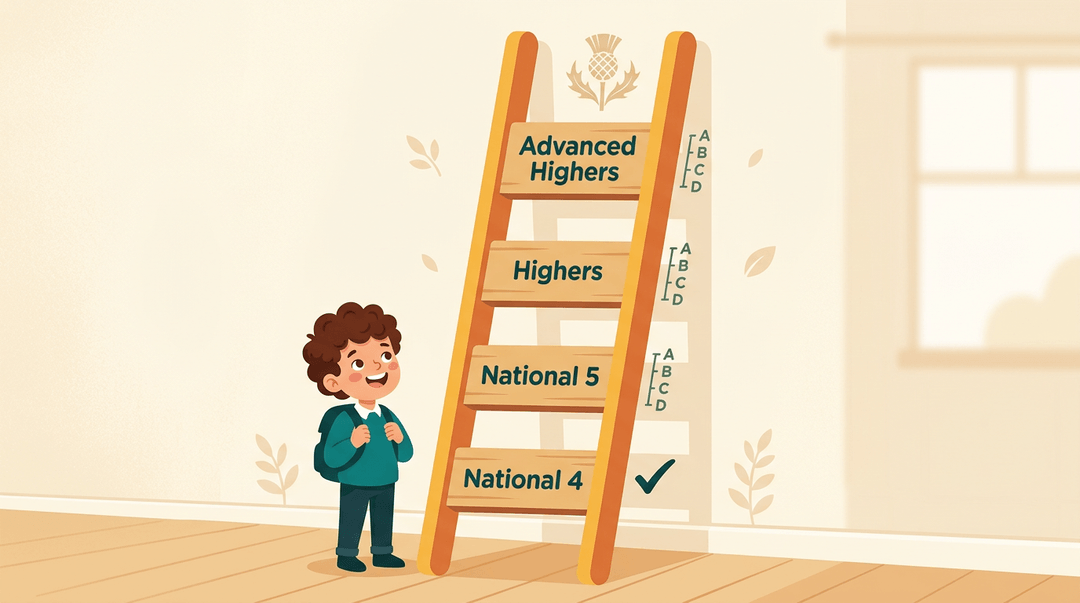
Scotland runs its own qualifications ladder.
- National 4 is assessed on a straightforward pass/fail basis, with no grade attached.
- National 5, Highers, and Advanced Highers all use an A–D grading scale, and each grade is further divided into bands to reflect performance within that level.
BTEC, IB, and other qualification grades
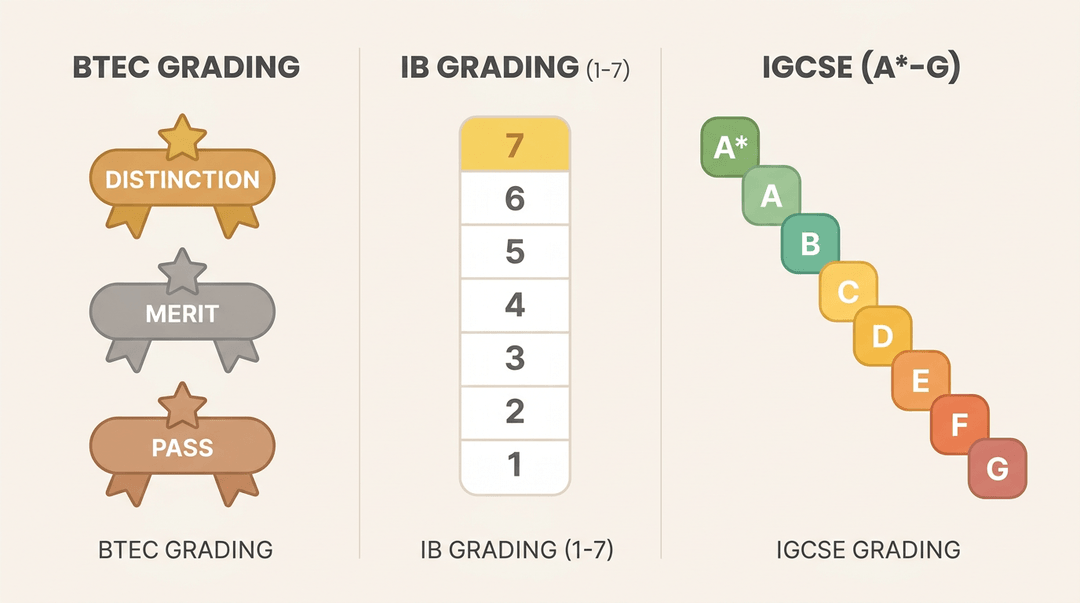
BTEC qualifications use a three-tier scale: Distinction, Merit, and Pass. The International Baccalaureate (IB) Diploma runs on a 1–7 numeric scale, where 7 is the highest.
The IGCSE (International General Certificate of Secondary Education) uses A–G letter grades*, each tied to percentage band thresholds.
UK Grades in an International Context
If you're applying to a graduate program, a job, or a professional body outside the UK, you'll need to translate your degree classification into a framework the other side recognises.
Two systems come up most often: Europe's ECTS scale and India's 10-point GPA.
How UK classifications map to ECTS grades
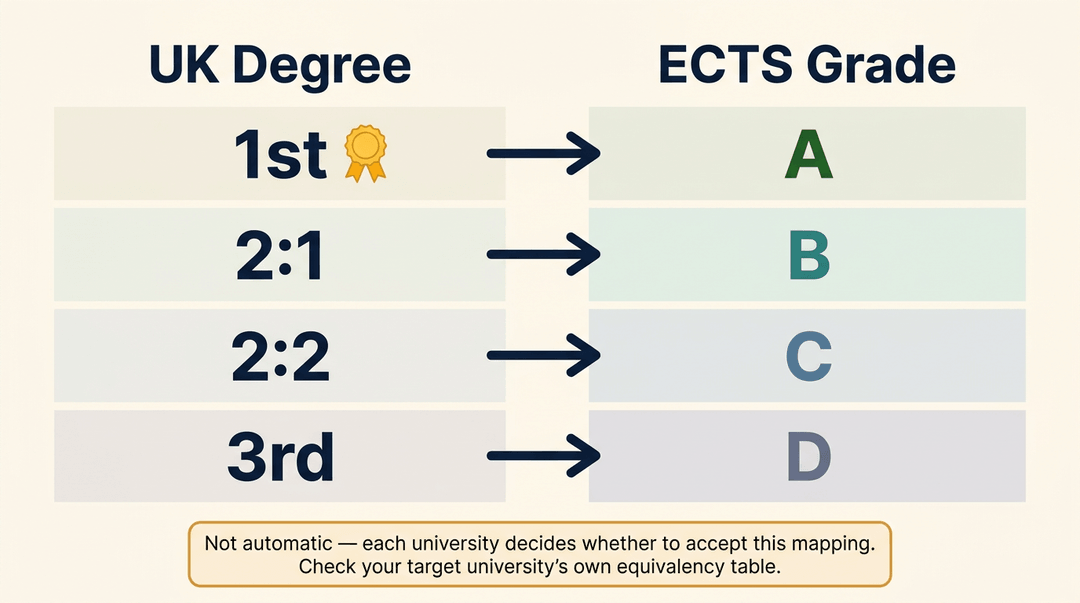
The European Credit Transfer and Accumulation System (ECTS) uses letter grades from A to F, and UK honours classifications line up with it fairly cleanly:
- A First-Class (1st) corresponds to an ECTS A
- A 2:1 (Upper Second) corresponds to an ECTS B
- A 2:2 (Lower Second) corresponds to an ECTS C
- A Third-Class corresponds to an ECTS D
ECTS conversion isn't mandatory: individual universities decide whether to adopt it. If you're applying to a European institution, check whether your target university lists its own equivalency table before you submit.
UK degree grades compared to India's GPA system
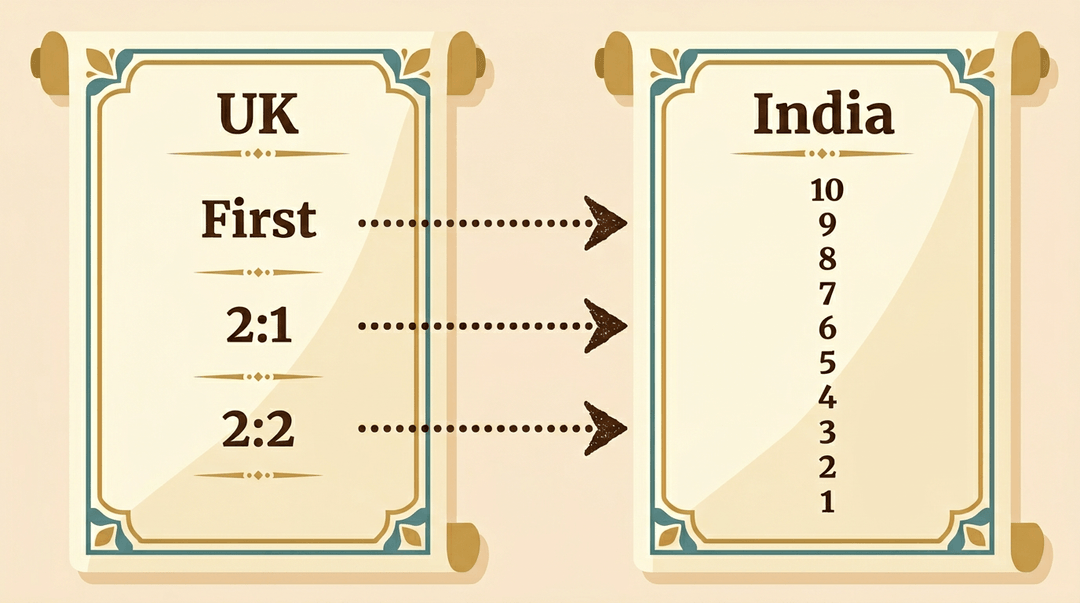
India uses a 10-point GPA scale, and the rough equivalencies look like this:
- A First-Class degree equates to a 4.0 GPA
- A 2:1 falls in the 3.3–3.9 range
- A 2:2 falls in the 2.7–3.2 range
These are widely accepted approximations, not officially standardised figures, so individual institutions may apply their own conversion.
If a university or employer asks you to verify your GPA equivalent, an official transcript alongside your degree certificate is usually enough to settle any questions.
The British grading scale rewards depth, not just correctness, and once you understand its tiers, a "2:1" or a "Distinction" tells you something real about a student's work.
Whether you're converting transcripts, supporting an international student, or adapting a UK resource for your classroom, the logic is consistent across every level: strong performance has a clear ceiling, and every grade means something specific.
Ready to track and apply grades more easily across your classroom or homeschool? Check out our Grading & Assessment tools to keep every student's progress organized in one place.

References
- GCSE 9 to 1 grade scale explained — gov.uk
- Comparative analysis of A level assessment outcomes for ... — assets.publishing.service.gov.uk
- UCL Summer School 2026 ━ University College London — cge.hksyu.edu
- Graduation Honors — ehe.osu.edu
- University of Cambridge Access and participation plan 2025-26 to 2028-29 — undergraduate.study.cam.ac.uk
- Dean's List — registrar.psu.edu
- UK Undergraduate Grading: First, 2:1, 2:2, Third Class Honours and How They Work — openeducat.org
- GPA Score of 3.9: What It Means (94th Percentile) | Cogn-IQ — cogn-iq.org
Frequently asked questions
What is the UK grading scale?
The UK grading scale differs across education levels. For undergraduate degrees, it uses classification bands like First Class Honours (70%+), Upper Second-Class Honours (60-69%), Lower Second-Class Honours (50-59%), and Third-Class Honours (40-49%). Secondary school qualifications like GCSEs and A-levels use numerical and letter grades, respectively.
What is a 4.0 GPA in the UK?
A 4.0 GPA in the US system is roughly equivalent to a First-Class Honours degree in the UK, which is awarded for academic achievement of 70% and above. This is the highest classification a UK university can award, signifying exceptional performance.
What is a 2.2 bachelors degree in the UK?
A 2.2 Bachelor's degree in the UK refers to a Lower Second-Class Honours degree, awarded to students who achieve an average of 50-59% in their undergraduate studies. This classification is widely accepted for many roles, especially where practical experience is also valued.
What is USA grade 4 equivalent to in the UK?
A US Grade 4 student is roughly equivalent in age to a UK Year 5 pupil. In the UK, academic performance is measured using different scales for secondary, undergraduate, and postgraduate education, not a direct grade-level conversion.
Is a 6 a b+ in GCSE?
A Grade 6 in GCSEs is roughly equivalent to the B to B+ range under the older letter grading system. The current GCSE numerical scale (1-9) in England replaced the A*-G system, with Grade 4 being a standard pass.
Is UK grading easier than the US?
Neither the UK nor the US grading system is inherently easier; they operate on different philosophies. The UK system often emphasizes performance in end-of-year exams and dissertations, leading to degree classifications. The US system, conversely, uses letter grades and a 4.0 GPA, rewarding consistent performance across various assignments throughout the academic year.