Bloom's Taxonomy of Learning: The Six Levels Explained

Jump to section
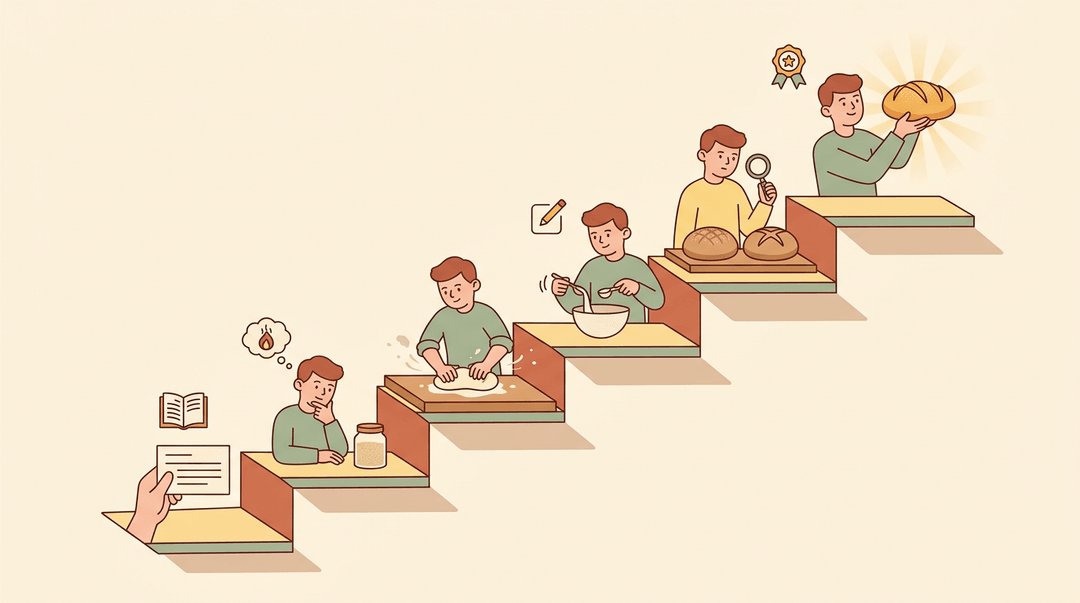
Think about how you learn to bake bread. First you just remember the recipe, then you understand why the yeast needs warmth, then you actually try it, tweak it, and finally judge whether your loaf beats the last one.
That's the climb Bloom's Taxonomy maps for the classroom.
Bloom's Taxonomy of Learning is a framework that sorts thinking into levels, from simple recall to complex creation. It's still one of the most useful tools you have for planning lessons that actually stretch students.
Here's where it came from, how the levels work, and how to put them to use this week.
Where Bloom's Taxonomy of Learning Began
Every classroom framework has a starting point worth knowing, and understanding this one makes it easier to see why it still shapes how you write objectives and plan lessons today.
How Bloom's taxonomy was created in 1956
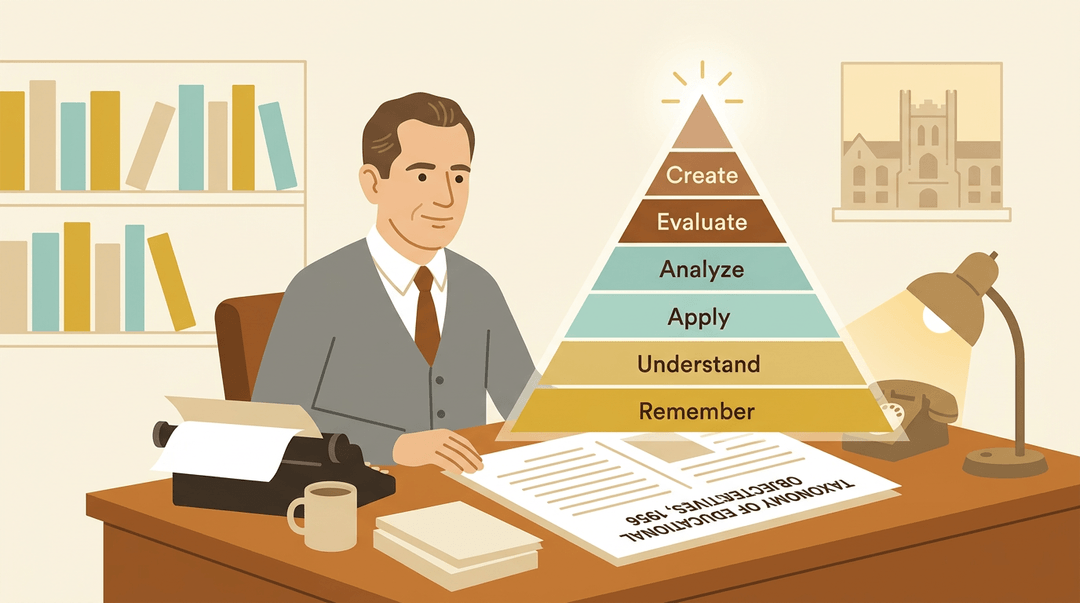
In 1956, Benjamin Bloom edited Taxonomy of Educational Objectives: The Classification of Educational Goals, the publication that introduced Bloom's Taxonomy as a classification of educational goals.
Bloom worked as a psychologist at the University of Chicago, where his research on how students learn helped reshape how teachers set goals for a lesson.
What Bloom's taxonomy is for
At its core, Bloom's Taxonomy sorts learning objectives into cognitive skill levels, from simple recall to complex reasoning.
That structure helps you tell the difference between a task that asks students to remember a fact and one that asks them to create something new with it. It's a practical aid for both planning a lesson and building the assessment that follows.
The 1956 original versus the 2001 revision
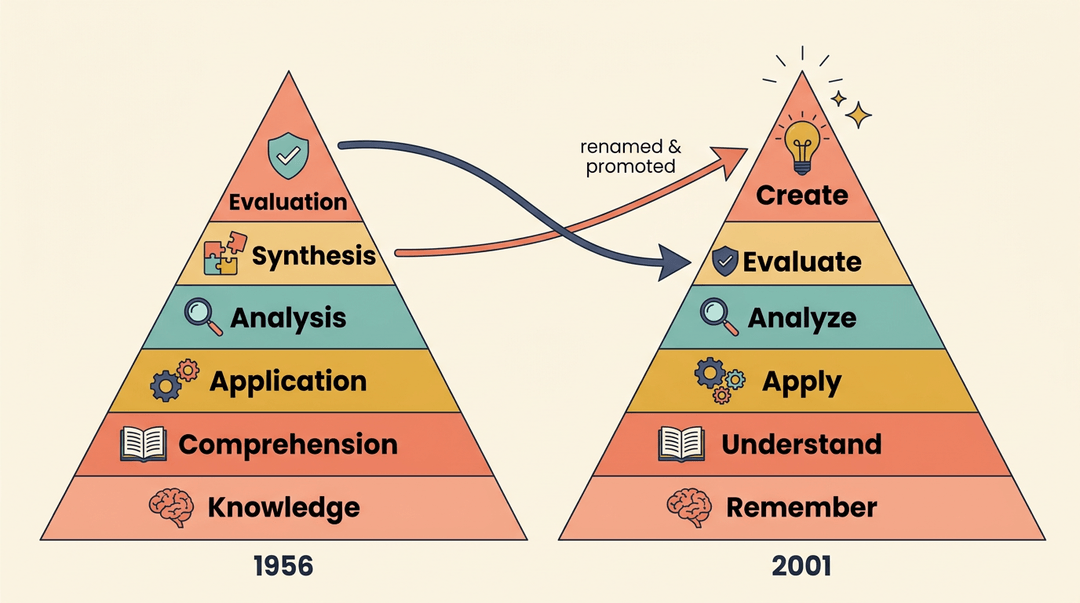
In 2001, Anderson and Krathwohl revised Bloom's original six levels:
- knowledge
- comprehension
- application
- analysis
- synthesis
- evaluation
into six action verbs:
- remember
- understand
- apply
- analyze
- evaluate
- create
The biggest change renamed synthesis as create and moved it to the very top of the hierarchy, placing the act of building something new above simply judging what already exists.
Critics argue that neat hierarchy oversimplifies how students actually think: real learning often loops between remembering and creating instead of climbing a straight ladder, and the levels can blur together in practice.
Even so, Bloom's Taxonomy remains a fixture in classrooms today, because it still gives you a quick, shared vocabulary for setting objectives and checking whether a lesson asks students to do more than just recall.
The Six Levels of Bloom's Taxonomy
Bloom's original framework isn't a random list. It's a ladder, with each level asking a little more of your students than the one below it. Here's what each rung actually looks like in a real classroom.
Remembering basic facts and information
This is the foundational level: simply retrieving facts from memory. Think of a history teacher checking whether students recall which year a treaty was signed or which president served during a specific war.
A multiple choice assessment is the classic tool here, since it tests recall without asking students to do anything with the fact yet.
Understanding ideas in your own words
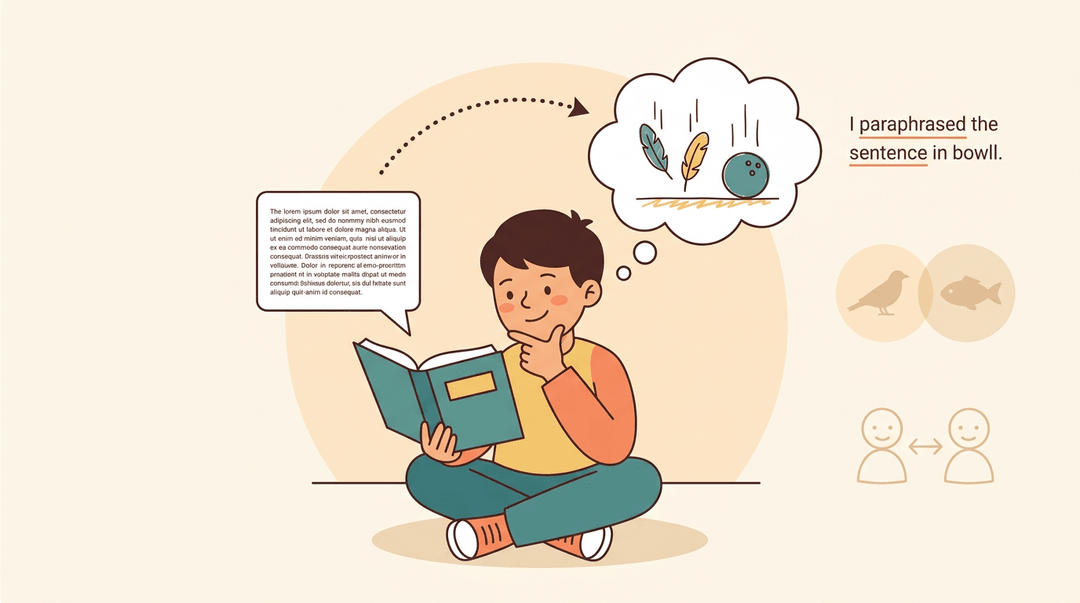
Understanding means constructing meaning, not just repeating it. A student paraphrasing a science concept, classifying animals into groups, or comparing and contrasting two characters in a novel is working at this level.
So is a student who can explain a principle, like why objects fall at the same rate, in their own words instead of the textbook's.
Applying skills to new situations
Applying is where knowledge starts to move. Students use a procedure or skill in a new situation rather than the one it was taught in.
For example, a student who learns a literature searching strategy in one research unit and then reuses it, unprompted, for a completely different project is applying, not just remembering how the process works.
Breaking information into parts to analyze it
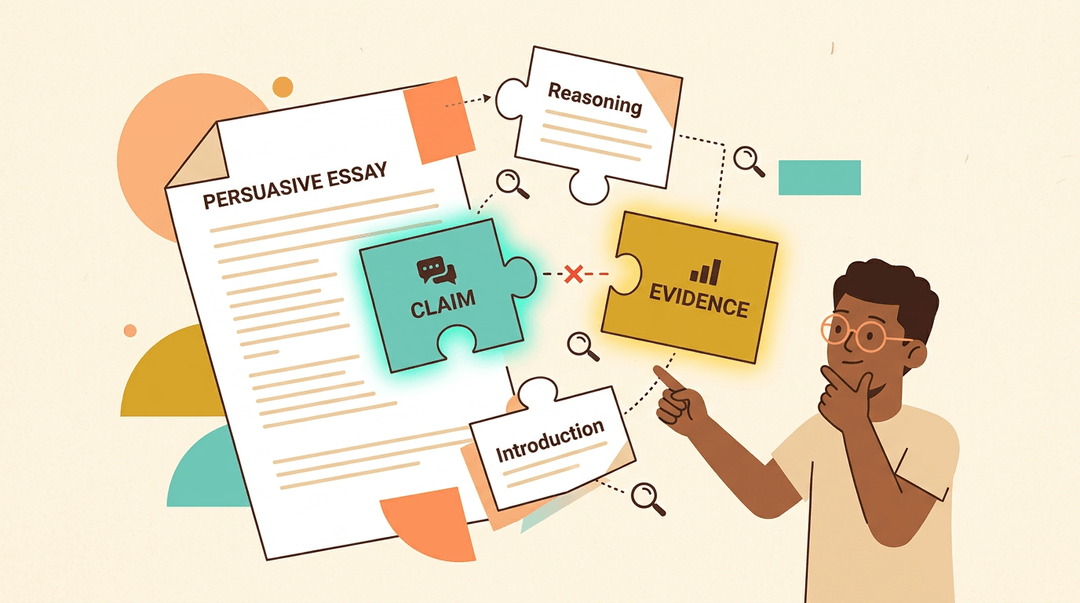
Analyzing asks students to break information into parts and examine how those parts relate. This is critical thinking in action: identifying the claims in a persuasive essay, then determining how the evidence connects (or doesn't) to those claims.
A student who can point out that an author's conclusion doesn't actually follow from the data cited is analyzing.
Judging ideas against clear criteria
Evaluating means making a judgment using clear criteria and standards, not just an opinion.
Consider a student critically appraising two sources for a research paper and judging which is more relevant and reliable based on publication date, author expertise, and evidence quality. That's evaluation with a defined bar, not a guess.
Creating something new from what you've learned
At the top sits creating: reorganizing elements into a coherent whole to generate something new.
A student formulating an original research question, designing an experiment, or drafting a short story that pulls together several units' worth of skills is working here.
It's worth clearing up a common myth: there's no official level 7 of Bloom's taxonomy. Creating is the top of the ladder, full stop.
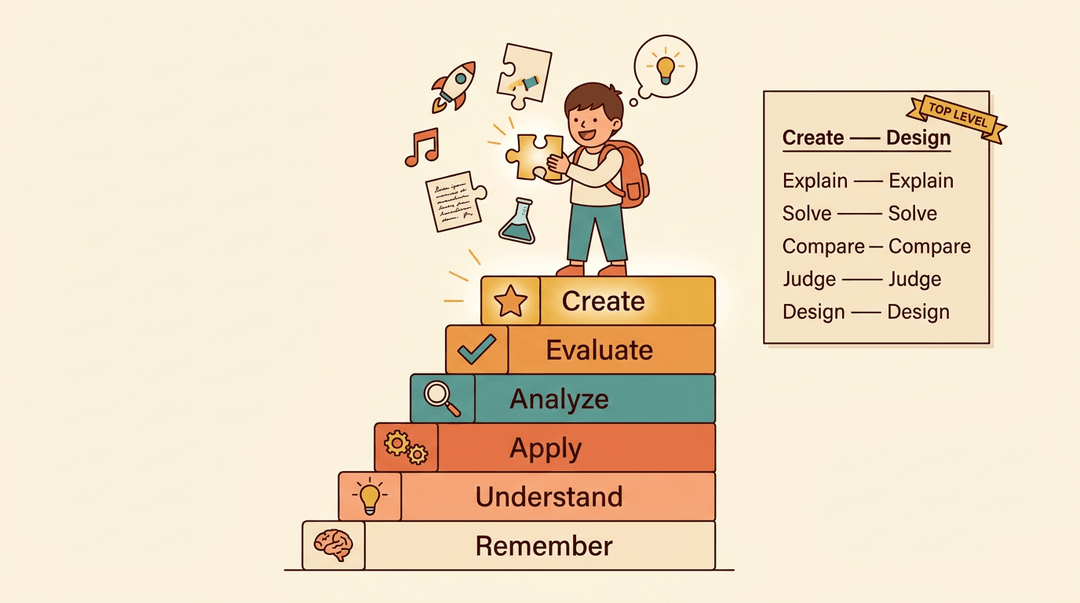
Many elementary and middle school teachers post kid-friendly verb posters (remember, understand, apply, analyze, evaluate, create, each paired with action verbs like "list," "explain," or "design") right on the classroom wall.
It's a small, low-effort way to keep the levels visible and make them second nature for students, not just for you.
Why the Levels Build on Each Other
Bloom's Taxonomy isn't a random checklist. It's a sequence, and each level depends on the one below it. Understanding why that order matters is what turns the taxonomy from a poster on the wall into a real planning tool.
How each skill builds on the last
You can't ask a student to evaluate an argument they don't yet understand, and you can't expect them to create something new from facts they haven't remembered in the first place.
The lower levels (remembering and understanding) act as prerequisites: they supply the raw material that higher-order thinking depends on. Skip them, and the higher levels have nothing to work with.
Moving up the taxonomy also means moving into deeper mental processing. Recalling a date takes far less cognitive effort than analyzing why that date mattered or designing a project around it.
Each step up asks students to do more with what they know, not just know more.
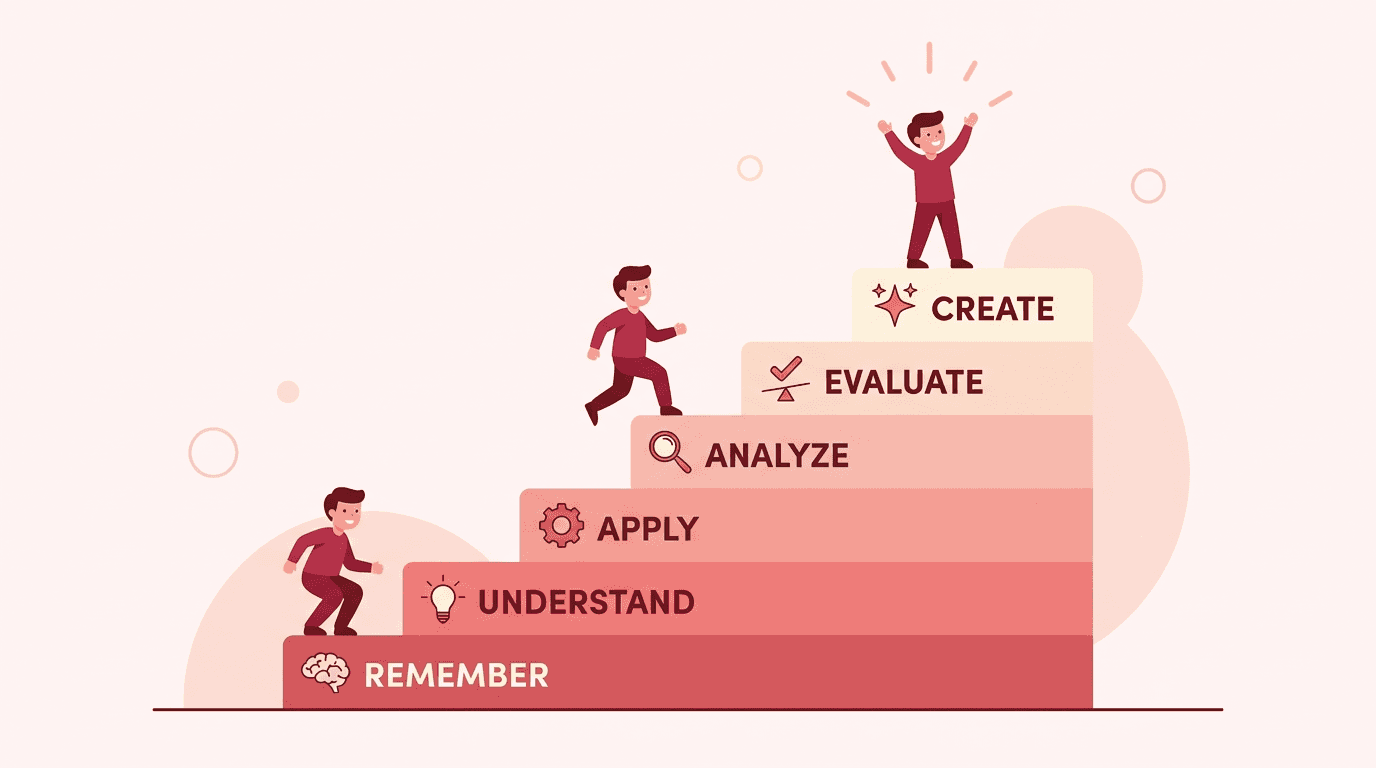
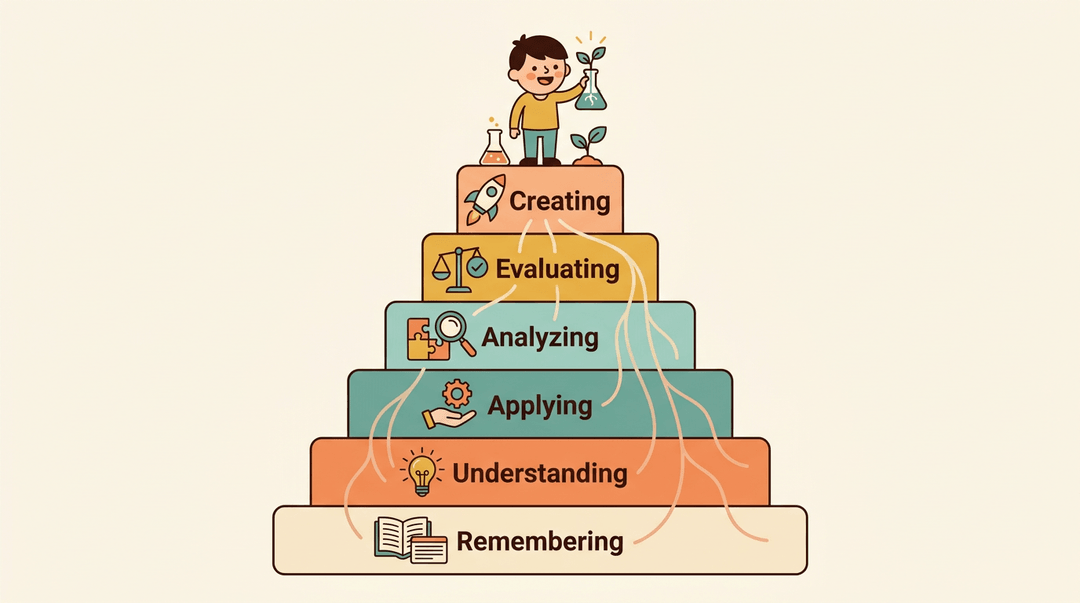
That's why the taxonomy is so often drawn as a pyramid or a layered cake, with remembering as the wide base and creating as the narrow top. The shape isn't just decorative. It shows that higher skills don't replace lower ones, they incorporate them.
A student creating an original science experiment is still remembering vocabulary, understanding concepts, and applying procedures, all at once, just wrapped inside a more complex task.
Using Bloom's Taxonomy to Plan Lessons
Here's how to turn the taxonomy into an actual lesson plan: pick a level, write the objective, then build the activity and assessment to match. Four steps, in order, every time.
The four-step planning sequence
- Pick the target cognitive level. Ask what students should do with the content.
- Recall it? Explain it? Judge it? That answer is your level.
- Write a measurable objective using a verb from that level.
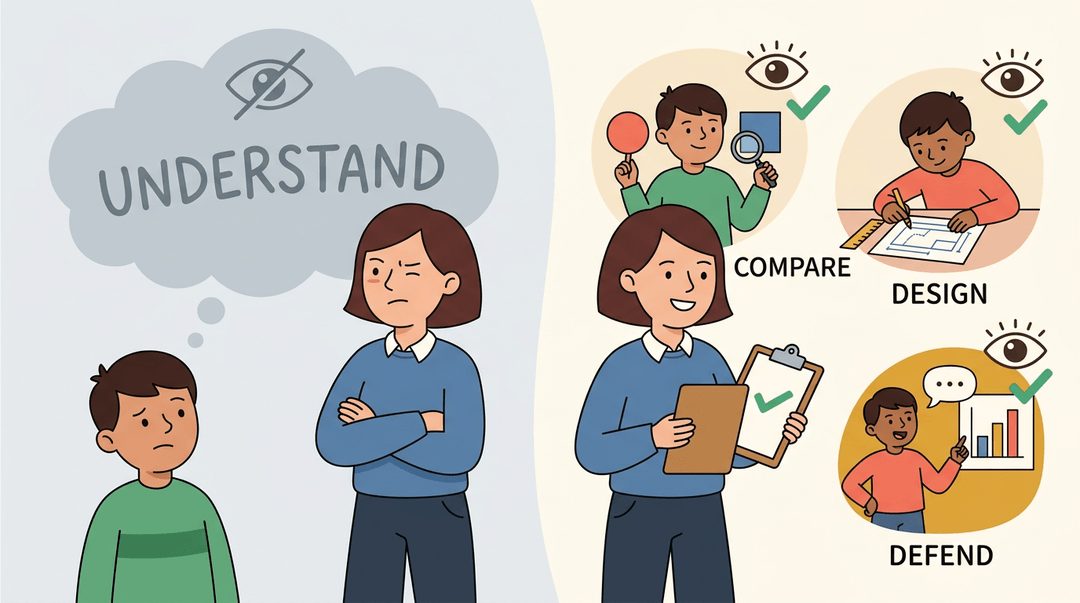
- ✅ "Students will compare two characters' motivations using text evidence." (observable: analyzing)
- ❌ "Students will understand character motivation." (you can't see "understand")
- Match the activity to the level.
- An analyzing objective needs a comparison chart or debate, not a recall worksheet.
- Align the quiz or task to the same verb.
- If the objective says "compare," a multiple-choice recall quiz doesn't measure it.
⚠️ Watch out: the most common misalignment is a high-level objective graded with a low-level test. Whatever verb you wrote in step 2 is the verb students must perform in step 4.
What each level looks like by grade
These are starting emphases, not ceilings: kindergartners can create and seniors still need to remember.
| Grade band | Typical focus | Sample task |
|---|---|---|
| K-5 | Remembering, understanding | Retell a story in order; explain why seasons change |
| 6-8 | Applying, analyzing | Use area formulas to design a garden plot; compare two articles' claims |
| 9-12 | Evaluating, creating | Critique a source's credibility; design an original experiment |
Your quick verb reference
Keep these verbs where you plan. One glance tells you which level an objective actually targets.
| Level | Verbs to reach for |
|---|---|
| Remember | list, name, recall |
| Understand | explain, summarize, restate |
| Apply | solve, demonstrate, use |
| Analyze | compare, categorize, differentiate |
| Evaluate | justify, critique, defend |
| Create | design, compose, construct |
💡 Tip: post this as an anchor chart in your classroom. Students start naming their own thinking ("we're analyzing today"), and you reuse the same chart across every unit: the verbs stay constant while the content changes.
Keep the unit balanced
Before you finalize a unit, scan every objective and confirm:
- Every verb maps to a level. Tally them: the tally shows your unit's real shape.
- You're not stuck at the bottom. If every objective says list or name, students never think past recall: rewrite at least a third with analyze-or-above verbs.
- Rigor climbs gradually. Open the unit at remembering and understanding, then step up, so the final task (evaluate or create) rests on skills already built.
At a glance: pick the level, write the verb, match the work, align the test, then check the whole unit's spread. Map these objectives and verbs straight into a year-long sequence with EMStudio's Curriculum Planner.
Using Bloom's Taxonomy for Instructional Design
Knowing the six levels is one thing. Building a lesson around them is another, and that's where Bloom's taxonomy earns its keep as a planning tool rather than a wall poster.
Choosing action verbs for learning objectives
Every objective needs a verb that names something a student does, not something a student vaguely feels. "Understand" and "know" are comfortable words, but you can't watch a student understand. You can watch them identify, compare, design, or defend.
That's the whole point of a behavioral term: it gives you something observable to check for.
Instructional-design guidance backs this up directly.
The University of Connecticut's Center for Excellence in Teaching and Learning advises writing objectives with "measurable action verbs" that describe what students need to do to demonstrate their learning.
Pick the verb after you pick the taxonomy level, not before, so the two stay in sync.
Verb tables and example objectives by level
A quick verb table saves you from reinventing this every unit. A few starting points:
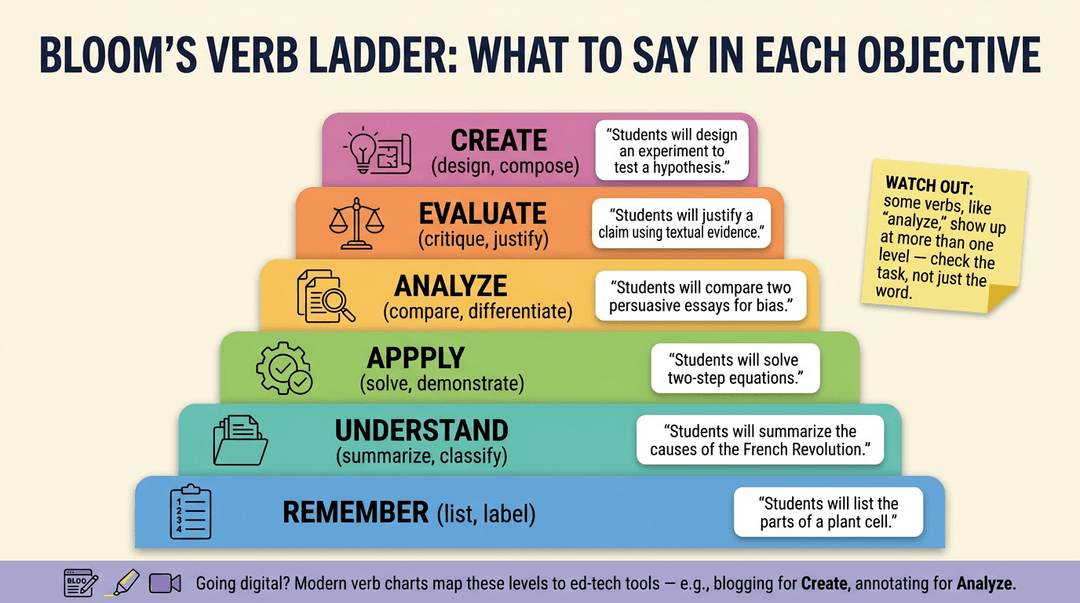
- Remember: list, label, recall. "Students will list the parts of a plant cell."
- Understand: summarize, classify. "Students will summarize the causes of the French Revolution."
- Apply: solve, demonstrate. "Students will solve two-step equations."
- Analyze: compare, differentiate. "Students will compare two persuasive essays for bias."
- Evaluate: critique, justify. "Students will justify a claim using textual evidence."
- Create: design, compose. "Students will design an experiment to test a hypothesis."
One caveat: several verbs ("analyze," for instance) show up at more than one level depending on context, so check the surrounding task, not just the word.
Free verb charts are widely available online if you want a fuller reference, including versions built for a digital taxonomy, Bloom's framework mapped to ed-tech tools like blogging for "create" or annotating for "analyze."
Matching objectives to your students' level
A ninth-grade intro course and an AP senior seminar shouldn't use the same verbs. Introductory courses lean on lower-order objectives (remember, understand) to build the vocabulary and facts students need first.
Advanced students can handle higher-order verbs sooner because they already have that foundation. Aim too low for upperclassmen and you'll get boredom; aim too high for freshmen before they're ready and you'll get frustration.
Differentiating objectives by grade band keeps both ends of the hallway challenged, not stalled.
Course objectives versus lesson objectives
Course objectives are broad and usually can't be measured in a single lesson. Lesson objectives are where students actually demonstrate mastery, day by day.
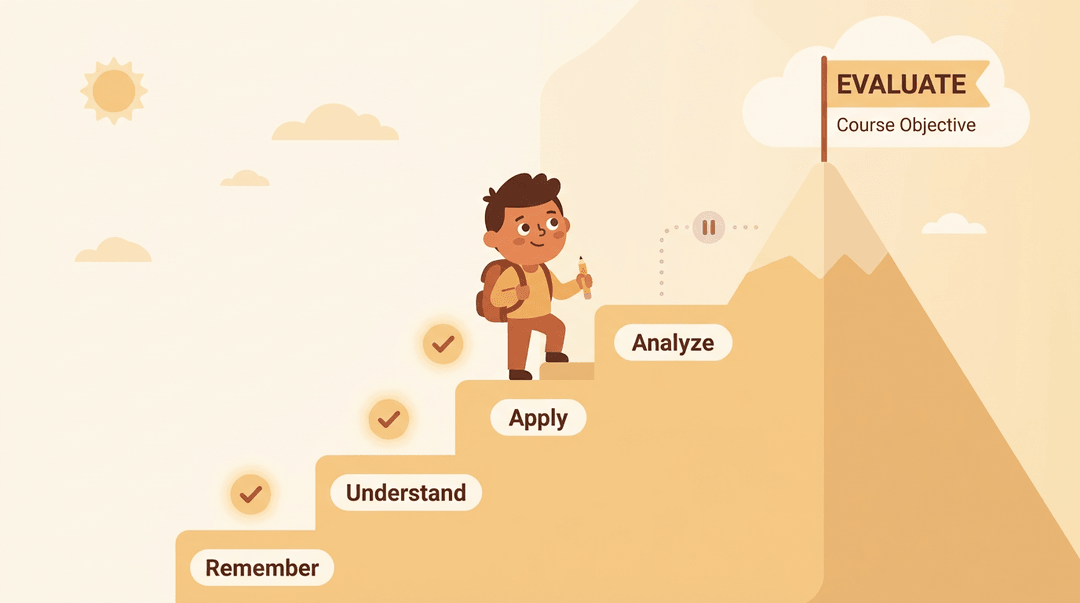
Keep lesson verbs at or below the course's target level: if a course aims for "evaluate," a lesson can build toward that with "analyze" without exceeding it too early. Each lesson is a step toward the course-level outcome, not a substitute for it.
Aligning objectives with assessment standards
Quality Matters standards, widely used in course review, call for assessments that align tightly with stated objectives.
Skip unquantifiable verbs and give each objective exactly one measurable verb, so what you teach, what you test, and what you claimed you'd teach all point at the same target.
Other Domains and Types of Knowledge
Cognitive skills get most of the attention, but Bloom's original team never meant the taxonomy to stop there. Learning also happens through what students know and what they do, and both deserve a place in your planning.
Four types of knowledge in the revision
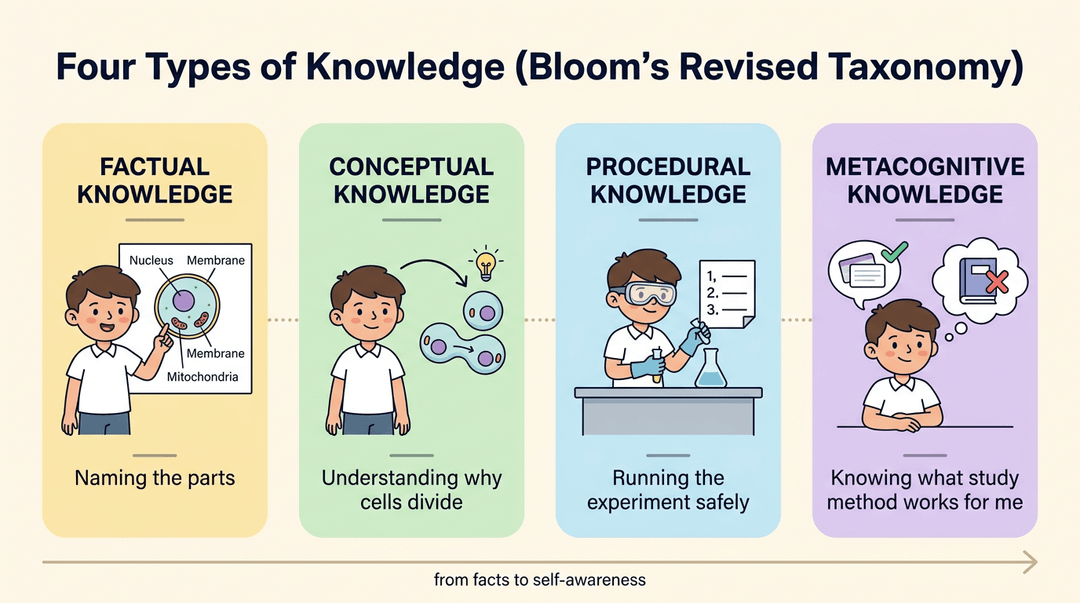
The 2001 revision added a knowledge dimension alongside the six cognitive levels, splitting what students learn into four categories:
- Factual knowledge. The basic building blocks: vocabulary, dates, terminology. A student naming the parts of a cell.
- Conceptual knowledge. How those facts connect: principles, models, categories. Understanding why cells divide, not just what they're called.
- Procedural knowledge. The how-to: methods, techniques, step-by-step skills, like running a lab experiment safely.
- Metacognitive knowledge. Awareness of one's own thinking, like a student recognizing which study strategy actually works for them.
Who gave three domains of learning?
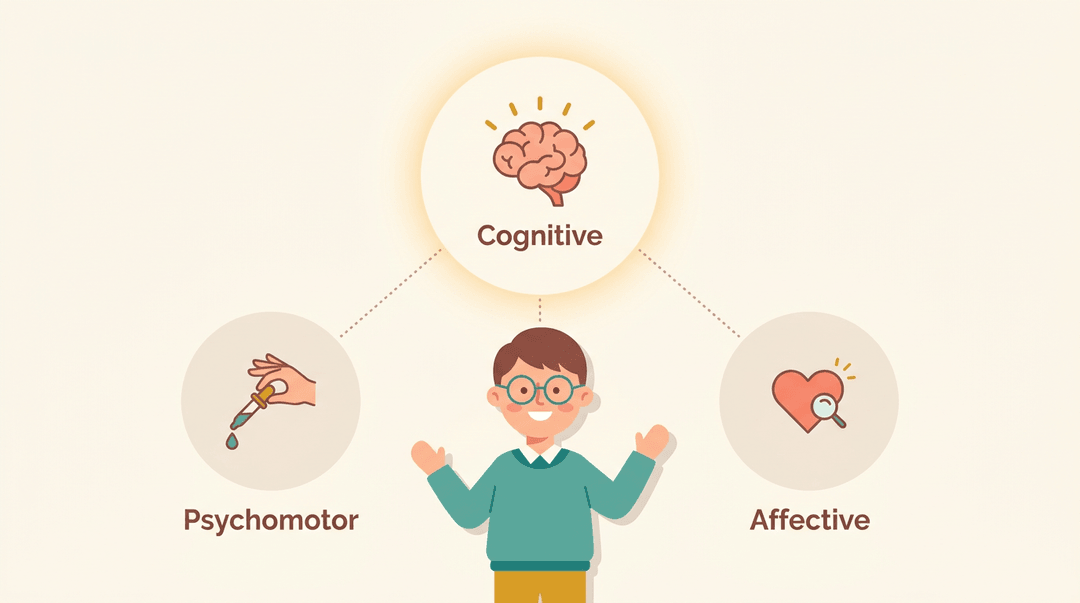
According to the Center for the Advancement of Teaching Excellence at the University of Illinois Chicago, "Bloom's Taxonomy consists of three learning domains: cognitive, affective and psychomotor."
- The cognitive domain covers thinking and knowledge, which is why it's the one most teachers reach for first.
- The psychomotor domain covers physical skills: think of a student learning to hold a pipette correctly in chemistry.
- The affective domain covers attitudes and values, like a student developing genuine curiosity about a subject rather than just tolerating it.
Both psychomotor and affective domains are less commonly addressed in everyday lesson plans, even though they shape how well learning actually sticks.
How Health and Medical Educators Use It
Bloom's Taxonomy isn't confined to K-12 classrooms. It shows up just as often in medical schools, nursing programs, and even tutoring sessions at the kitchen table: anywhere a learner needs to move from recalling facts to using them under real pressure.
How medical librarians and clinicians use it
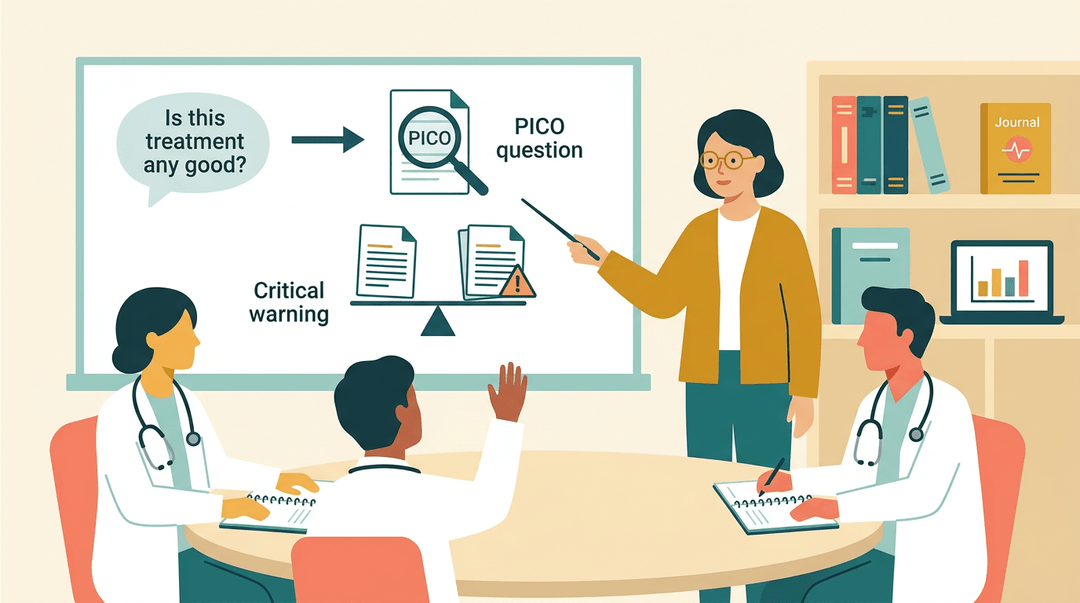
Medical librarians rely on the taxonomy heavily when training clinicians in evidence-based medicine: the practice of grounding patient care in the best available research rather than habit alone.
Instead of just teaching residents to memorize drug interactions, a librarian running a workshop pushes them toward analysis and evaluation: comparing studies, spotting bias, and judging whether a paper's conclusions actually hold up.
That shows up in two concrete skills. Clinical question formulation asks a resident to turn a vague worry ("Is this treatment any good?") into a precise, answerable question.
Critical appraisal of literature asks them to weigh a study's methodology before trusting its results. Both sit firmly in the taxonomy's higher tiers, not the lower ones.
Common gaps in real-world use
Even here, familiar gaps creep in. Continuing education modules often lean hard on knowledge and comprehension: memorize the guideline, recall the dosage, and move on. That's useful, but it stalls right where the real value starts.
The fix mirrors what works in any classroom, including tutoring and homeschool settings: build objectives that demand application and evaluation from the outset.
A tutor helping a nursing student prep for boards gets further asking "What would you do if the labs contradicted the chart?" than by drilling flashcards alone.
Bloom's Taxonomy isn't a dusty chart from an education textbook. It's a working map you can hold up against any lesson and ask: are my students just remembering, or are they truly thinking?
Used well, it turns a good lesson into one that builds real, lasting understanding.
Ready to build lessons that climb the full taxonomy instead of stalling at recall? Check out our Curriculum Planning tools to plan units and lessons that grow with your students all year.

References
- Bloom’s taxonomy of cognitive learning objectives — pmc.ncbi.nlm.nih.gov
- Bloom, influential education researcher — chronicle.uchicago.edu
- Aligning to Course Objectives | Center for Excellence in Teaching and Learning — cetl.uconn.edu
- Bloom’s Taxonomy of Educational Objectives | Center for the Advancement of Teaching Excellence — teaching.uic.edu
Frequently asked questions
What is the Bloom's taxonomy of learning?
Bloom’s Taxonomy of Learning is a framework for organizing educational objectives by cognitive complexity. Its revised six levels move from remembering and understanding to applying, analyzing, evaluating, and creating.
What is level 7 of Bloom's taxonomy?
There is no official level 7 in Bloom’s Taxonomy. The revised taxonomy has six levels, with creating as the highest level.
What is the taxonomy of education?
The taxonomy of education is a system for classifying educational goals and learning outcomes. Bloom’s Taxonomy is the best-known example, organizing cognitive skills from basic recall to complex creation and also recognizing affective and psychomotor domains.
What are the criticisms of Bloom's taxonomy?
Critics say Bloom’s Taxonomy can oversimplify learning by presenting thinking as a fixed, linear hierarchy. Students often move between levels, and the categories can overlap, so creating is not always more difficult than evaluating in every situation.
How to explain Bloom's taxonomy to students?
Explain Bloom’s Taxonomy as a staircase of thinking skills, beginning with remembering and ending with creating. Use familiar examples, such as recalling a recipe, explaining it, applying it, analyzing the result, evaluating the loaf, and designing a new recipe.
What are the 6 levels of Bloom's taxonomy with examples?
The six revised levels are: remember, such as listing cell parts; understand, such as explaining a concept; apply, such as solving an equation; analyze, such as comparing claims and evidence; evaluate, such as judging a source’s reliability; and create, such as designing an experiment.
Who gave three domains of learning?
Benjamin Bloom and his colleagues are associated with the three learning domains: cognitive, affective, and psychomotor. The cognitive domain concerns thinking, the affective domain concerns attitudes and values, and the psychomotor domain concerns physical skills.
Do teachers still use Bloom's taxonomy?
Yes. Teachers still use Bloom’s Taxonomy to write measurable objectives, plan activities, and align assessments with the thinking skills students are expected to demonstrate. It remains useful as a planning framework, although teachers should not treat its levels as a rigid sequence.