Psychomotor Learning Domain: A Complete Guide to Bloom's Domain 3

Jump to section
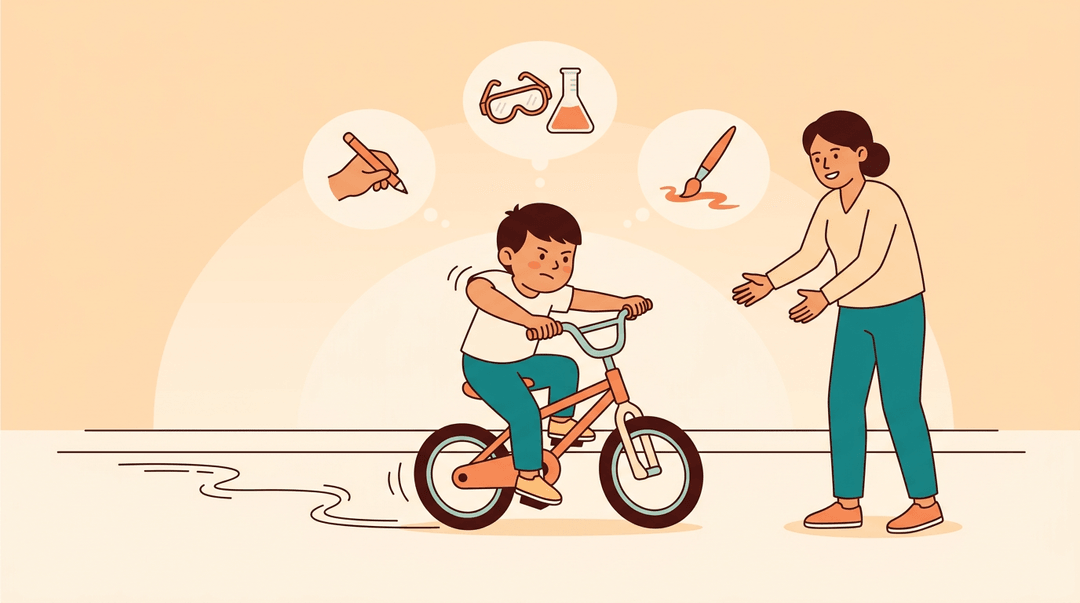
Think about the first time you learned to ride a bike. No one could hand you a list of rules that kept you balanced. You had to wobble, correct, and try again until your body simply got it.
That kind of learning sits at the heart of the psychomotor learning domain.
In plain terms, the psychomotor domain covers skills that involve physical movement, coordination, and hands-on control, from holding a pencil to running a science lab safely.
It's the third domain in the classic framework, which is why you'll often see it called domain 3.
In this post, we'll explore what the domain means, how to write clear action verbs for it, and how to teach and assess these skills in your classroom.
Bloom's Taxonomy and the Psychomotor Learning Domain
Before we get to the psychomotor domain, it helps to know where the whole framework came from and what else sits alongside it.
Where Bloom's taxonomy came from
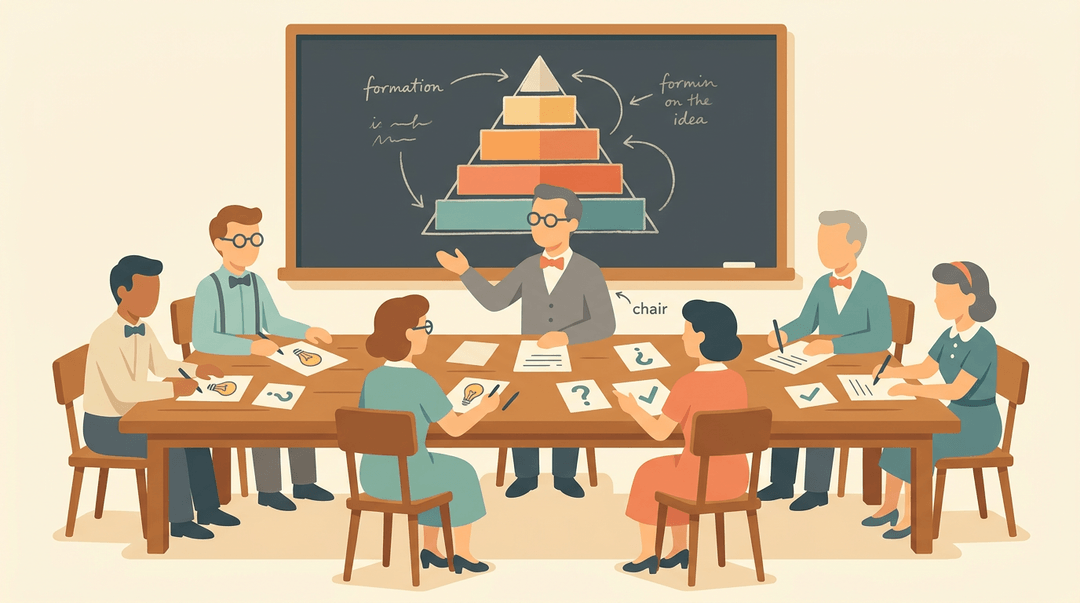
A committee started it. According to the Center for the Advancement of Teaching Excellence at the University of Illinois Chicago, Bloom's taxonomy emerged from a 1948 meeting of university educators, chaired by Benjamin Bloom.
The group brainstormed a model of learning that identified educational objectives, which helped teachers create testing items. Over time, that work expanded into three domains of learning.
The three domains of learning
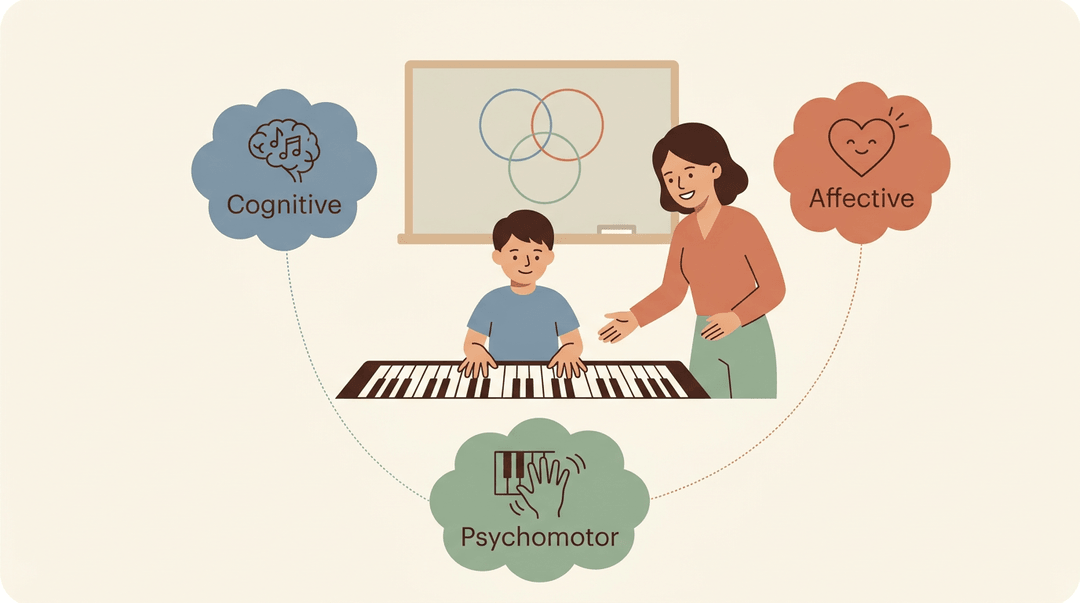
Bloom's framework sorts learning into three areas:
- Cognitive: knowledge and thinking
- Affective: feelings and attitudes
- Psychomotor: physical and motor skills
Each domain guides instructional design. Rather than asking what a student knows, you also ask what the student can do. Consider a music teacher whose goal is a clean scale.
The finger movement is the psychomotor target, but she also builds the cognitive understanding of the notes and the affective confidence that comes from playing for others. One lesson covers all three.
Students also show different strengths across domains. Some think through problems quickly but struggle with hands-on tasks, and others do the reverse. Plan with that range in mind.
Other theories that expand on Bloom's
Bloom's isn't the only lens. Jean Piaget's constructivist theory of learning covers cognitive, social, moral, and other areas of development.
Erikson's stages of psychosocial development, first presented in the 1950s, trace personality development across the life span.
Some educators also point to a social domain (interpersonal skills) and a digital domain (tech literacy) as areas Bloom's three domains don't directly name.
Howard Gardner's multiple intelligences is another useful framework, and its ideas apply to anyone helping people learn.
Learning is bigger than one chart.
Understanding the Cognitive Domain
The cognitive domain covers how learners think, know, and reason. Here's how its pieces fit together.
From remembering to creating knowledge
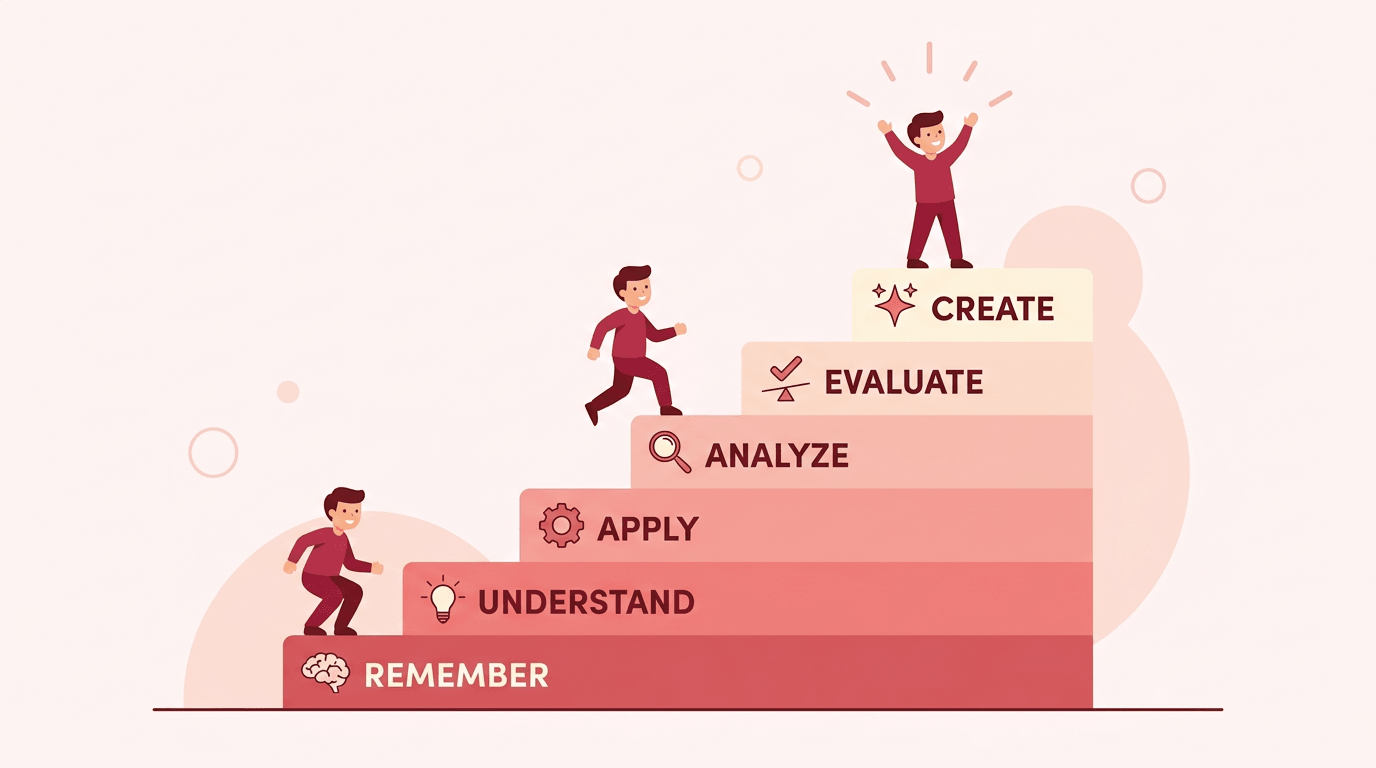
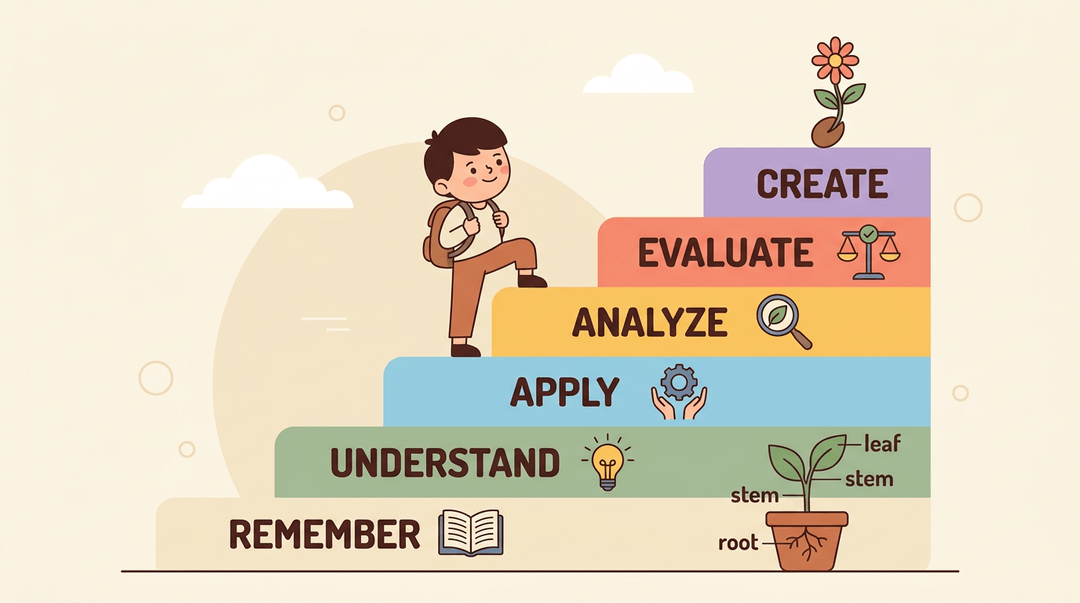
The cognitive domain moves through six hierarchical levels, often called Bloom's Taxonomy:
- remember
- understand
- apply
- analyze
- evaluate
- create
Each level builds on the last, so remembering facts is foundational to higher-order thinking. Anderson and Krathwohl revised the framework in 2001, changing the category labels from nouns to verbs.
That shift captures the core idea: thinking is something learners do, not just something they have.
A fourth-grade teacher might have students remember the parts of a plant, then analyze how roots and leaves work together. Each step asks a little more of them.
Combining knowledge types with thinking skills
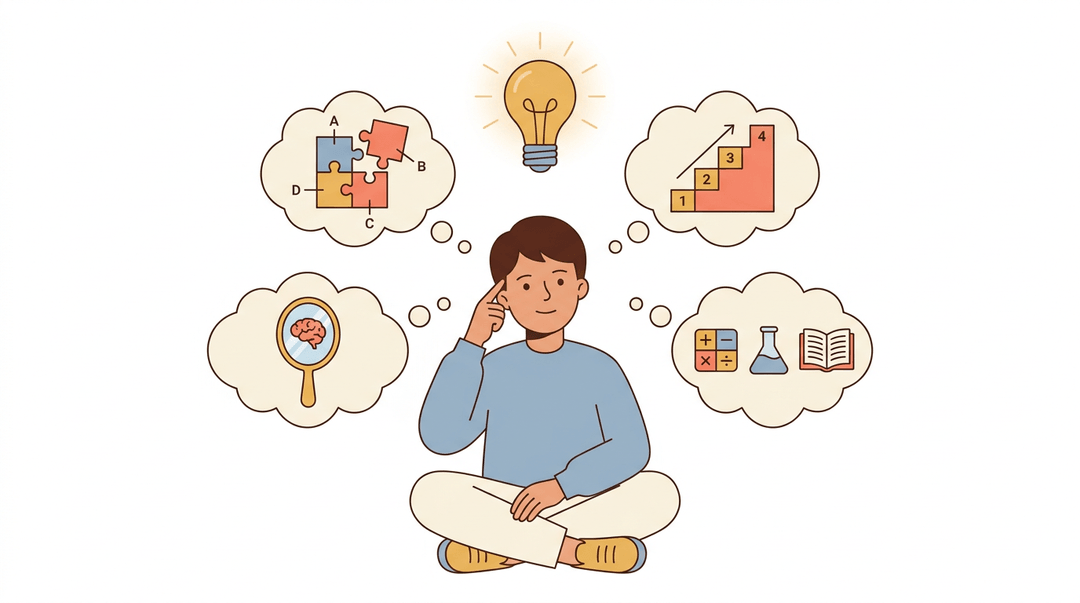
Thinking doesn't happen in a vacuum. Learners also draw on four knowledge types:
- Factual: basic terms and facts
- Conceptual: relationships between ideas
- Procedural: how to carry out a process
- Metacognitive: awareness of one's own thinking
These knowledge types form one axis of a two-dimensional matrix, and thinking processes form the other. The matrix combines process and knowledge, so you can see not just what a student knows but how they're using it.
A student who applies long-division steps to a new word problem shows far more than one who only recites them.
Who the cognitive domain suits best
The cognitive domain tends to suit learners with these strengths:
- Analytical problem-solving, especially those who enjoy breaking questions into parts
- Metacognitive awareness, meaning they can reflect on their own thinking
- Sequential learning, where lessons that build step by step click
- Academic subject strength in areas like math, science, and reading
Know your learners, and the match gets easier.
Understanding the Affective Domain
The affective domain is less about what students know and more about how they feel about learning and what they come to value. Here's how it works.
Five stages of emotional growth
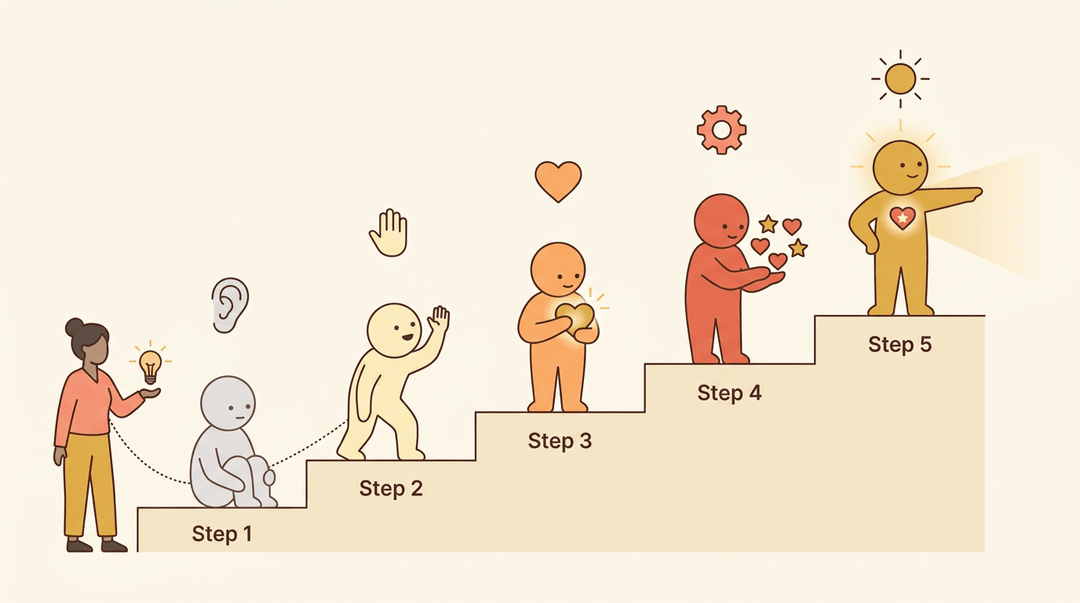
The affective domain describes how learners grow in their attitudes, values, and feelings. It's organized into five hierarchical levels, meaning each one builds on the last.
The journey starts at receiving, where a student simply pays attention, and ends at characterizing, where a value becomes part of who the learner is. Along the way, motivation shifts from something the teacher supplies to something the student owns.
In 1964, David Krathwohl, along with Benjamin Bloom and Bertram Masia, published this five-level framework, and it remains a useful map for planning lessons that go beyond content.
Who the affective domain suits best
This domain shines in classrooms that focus on emotional intelligence, the ability to recognize and manage feelings in yourself and others. It also supports value and attitude formation, such as respect, perseverance, and fairness.
Counselors and leaders find its language helpful for shaping how people respond to challenges.
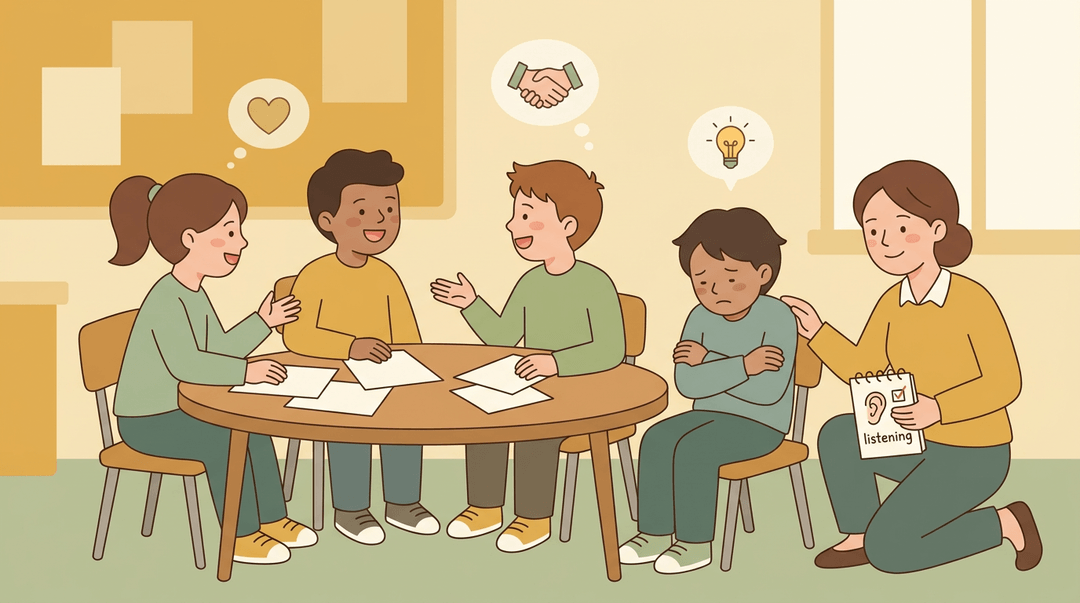
Consider a seventh-grade teacher who notices one student shutting down during group projects. Instead of grading only the final product, she sets a goal around listening to peers and checks in on it each week.
The aim is a student who begins to see teamwork as worth the effort.
Group discussion suits this domain well, since students hear different views and test their own. Pairing discussion with reflection gives learners room to notice how their attitudes shift. Feelings count.
Understanding the Psychomotor Learning Domain
Some of the most important learning happens with your hands, not just your head. Here's how this domain works in your classroom.
What is domain 3 in education?
The psychomotor learning domain covers physical motor skills, which depend on your body moving with control. Educators often call it domain 3.
Think of a PE teacher helping a student dribble a basketball, where hand-eye coordination improves with every attempt. These skills are measured by speed and precision, and they require practice to develop. Surgery, sports, and the arts all rely on them.
It's less about knowing a skill and more about performing it well.
From simple moves to complex skills
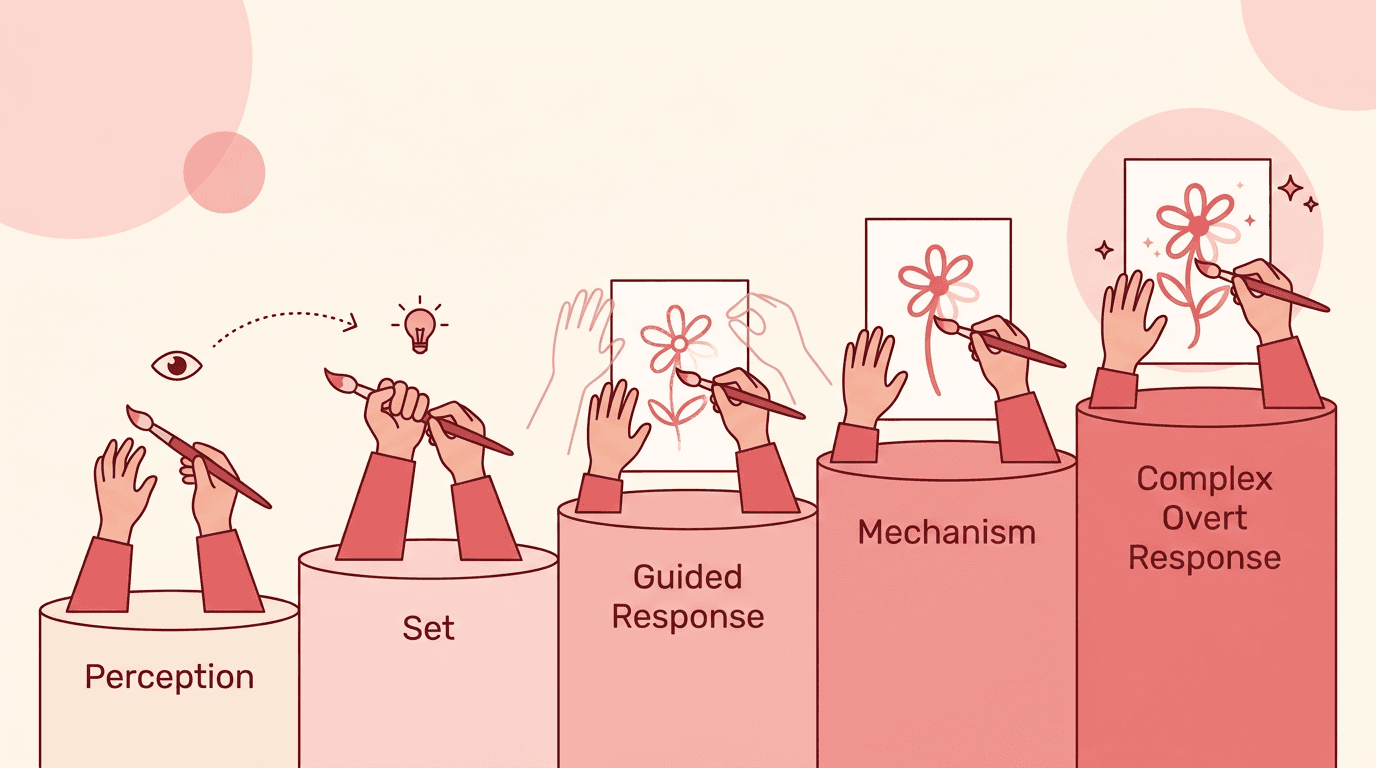
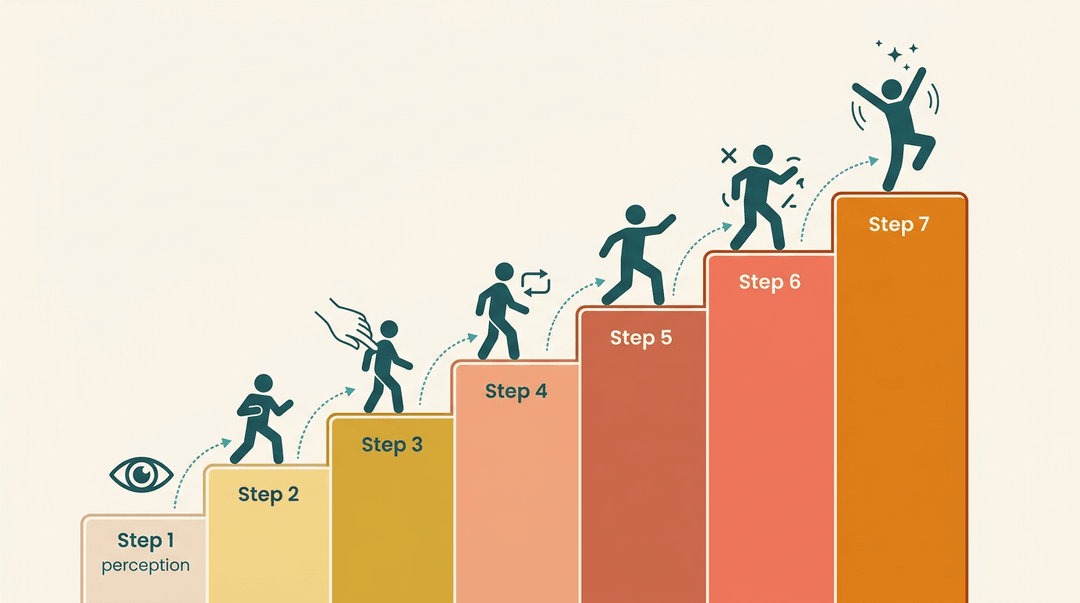
Simpson complemented Bloom's proposal by adding psychomotor aspects, with seven levels from perception to origination:
- Perception
- Set
- Guided response
- Mechanism
- Complex overt response
- Adaptation
- Origination
Dave's and Harrow's frameworks offer alternatives for categorizing these skills. Either way, learning moves from simple movements to complex skills, one level at a time.
Which is an example of psychomotor outcome?
A psychomotor outcome is a skill a student can show with their body. Consider a typing class building keyboard speed, or a science student using a pipette correctly in lab.
Hands-on experience matters here because physical engagement with materials makes a skill real.
Which patient is learning in the psychomotor domain? The trainee, not the patient. A nursing student practicing a blood pressure check on a training arm builds that skill before working with a real patient.
Checklists list each step, and rubrics score speed and precision, so you can see progress.
How to Teach and Assess Psychomotor Skills
Use this guide to take a physical skill from "watch me" to "I've got it," then check it fairly. It works for anything students do with their hands or bodies.
The teaching sequence
- Break the skill into sub-skills
- Jot the chain, like pipetting: set volume → attach tip → draw liquid → dispense → eject tip.
- Model the whole skill first
- Say: "Watch my hands first. Then I'll slow down and say each move aloud."
- Run guided practice
- Walk the room and fix one thing at a time.
- Say: "Show me step two again. Keep your elbow in."
- Release to independent practice
- Your goal: the full skill, smooth, with no prompts from you.
Don't skip step 2 to save time. Students need to see the finished skill before the parts make sense.
Examples across grade levels
Find your level, read across, and borrow the first sub-skill.
| Level | Skill | Start by isolating |
|---|---|---|
| Elementary | Pencil grip | Thumb and index finger pinch |
| Middle school | Lab pipetting | Drawing liquid without bubbles |
| High school | Welding technique | Steady hand position and travel |
| PE | Free-throw form | Elbow under the ball |
Assessing with clear criteria
Tell students the criteria before they practice. A rubric or checklist makes that easy, because each criterion names something you can see.
Free-throw rubric
Criterion Developing Secure Stance Feet uneven Feet shoulder-width, balanced Release Ball pushed from chest Elbow under ball, wrist snaps Follow-through Arm drops early Arm held until ball lands
Then layer on the other checks:
- Measure speed and precision. Time the task, or count accurate attempts out of a set number.
- Add peer or self-assessment. Partners use the checklist and name one thing done well.
- Try: "What's one criterion you nailed, and one you'd fix next?"
- Use video review. Film a short attempt, then watch it together against the criteria.
- Students often spot a dropped elbow on screen that they can't feel in the moment.
⚠️ Watch out: Don't grade only the result. A ball that goes in with poor form is still a form problem. Score the process and the outcome separately.
Example: A middle school science teacher models pipetting, then has pairs use a four-line checklist while their partner draws liquid. Each student films one attempt and compares it to the checklist. By the next lab, most students catch their own bubbles.
Map psychomotor objectives to standards in seconds with EMStudio's Curriculum Planner.
Turning the Taxonomy into Learning Objectives
Knowing the levels is one thing. Putting them to work in your lesson plans is where the taxonomy earns its keep.
How to write clear learning objectives
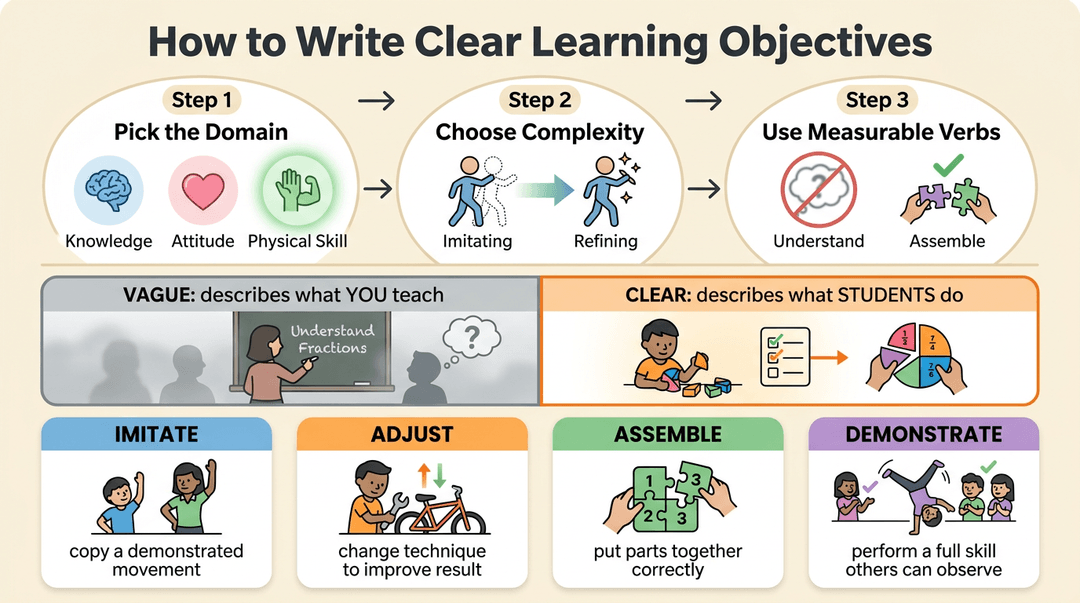
Start by selecting the domain first. Decide whether the goal is knowledge, attitude, or physical skill, since that choice shapes every verb that follows.
Then choose the complexity level: are students imitating a model, or refining a skill until it's precise?
Next, use aligned action verbs. Words like imitate, adjust, and assemble show what learners will do, while vague words like understand can't be seen or measured. Make each outcome observable and measurable so you can actually check it.
Vague goals describe what you'll teach; observable objectives describe what students can do.
A few psychomotor action verbs to start with:
- Imitate: copy a demonstrated movement
- Adjust: change a technique to improve the result
- Assemble: put parts together in the correct order
- Demonstrate: carry out a complete skill that others can observe
Why it matters for teaching and assessment
Clear objectives clarify your course goals: you know what success looks like before the first lesson. They also align activities to objectives, so every practice station builds toward the skill you'll assess.
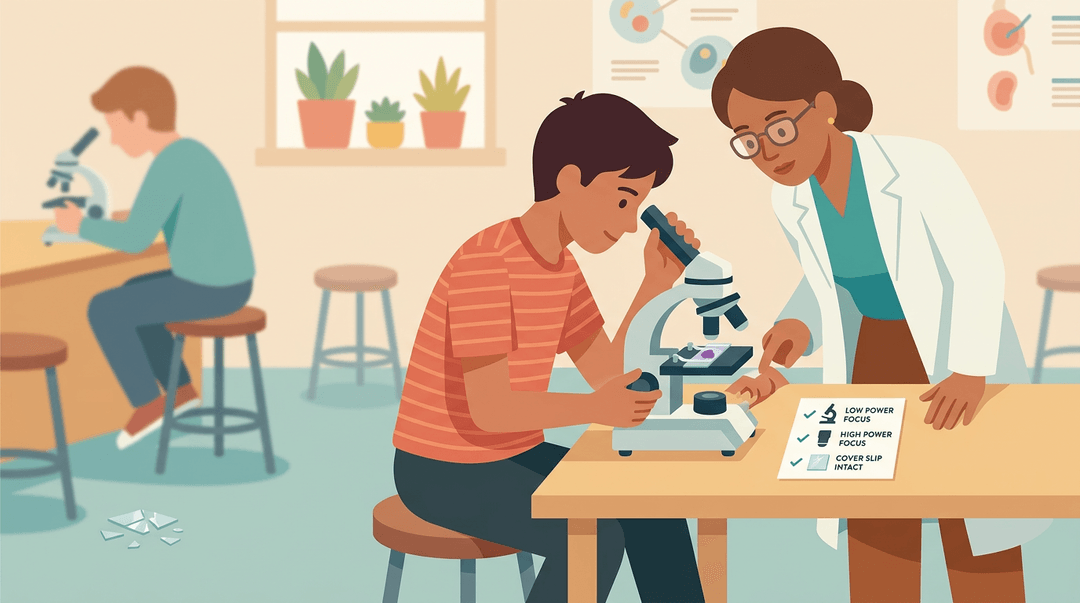
That alignment supports valid assessment design. If the objective is focusing a microscope, your check should watch exactly that.
Consider a high school biology teacher planning a microscope unit. Her objective: students focus a prepared slide on low power, then high power, without cracking the cover slip.
She runs a model demo, guided practice, and a short check where she watches each student. When one student keeps cracking slips, she spots the problem in handling, not the focus knob, and fixes it in the next lab.
Adjusting a technique also asks students to reason about why it works, which enhances critical thinking skills. Each adjustment becomes a decision, not just a copy of someone else's movement.
How Domains Interact and Evolve
Learning rarely lives in just one domain. Cognitive, affective, and psychomotor learning overlap in nearly every lesson. It's less about which domain matters and more about how they work together.
Finding your personal learning strengths
Most learners combine strengths across domains. A student who reasons through a problem well might struggle to turn it into hands-on practice, while another excels at building but needs help explaining their thinking.
Knowing this guides educational choices, like which electives or projects suit each learner. It also informs study strategies. Strong in doing? Practice with a model before you write. Strengths matter more than labels.
How teachers can use all three domains
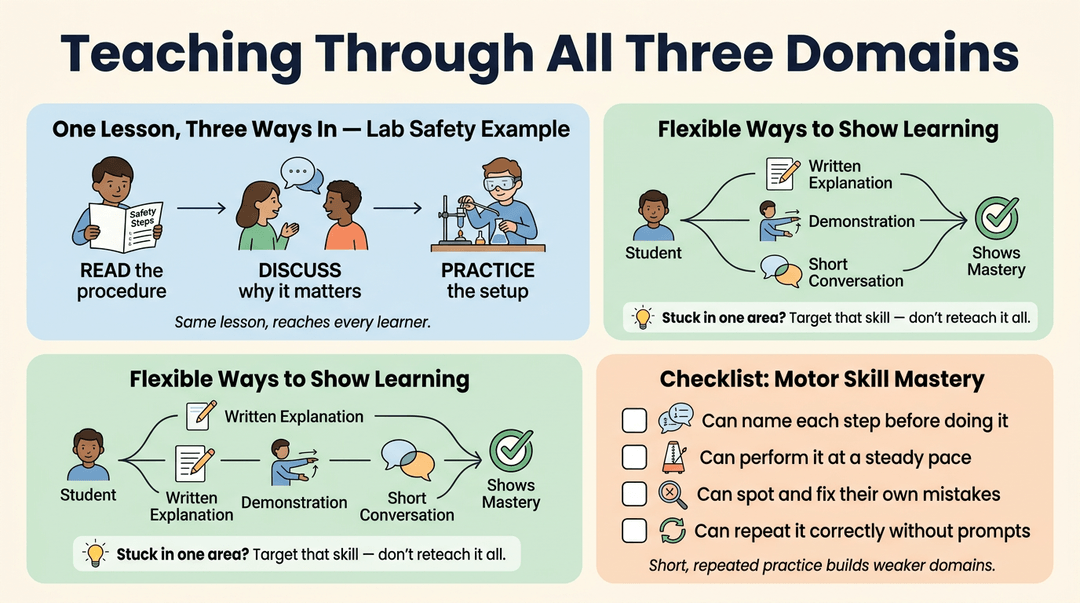
Design lessons with multi-modal learning so students reach the content more than one way. Consider a middle school science teacher introducing lab safety: students read the procedure, discuss why each rule matters, then practice setting up equipment.
Flexible assessment helps too, letting students show learning through a written explanation, a demonstration, or a short conversation. When a student stalls in one area, use a targeted intervention there instead of reteaching everything.
Strengthening weaker domains takes short, repeated practice.
Checklist for motor skill mastery:
- Can the student name each step before attempting it?
- Can they perform the skill at a steady pace?
- Can they spot and correct their own errors?
- Can they repeat it correctly without prompts?
How learning domains change over time
The prominence of each domain shifts by age. Young learners often lean on hands-on exploration, while older students tend to do more abstract reasoning.
Neuroscience continues to shape how we understand these changes, and researchers keep exploring new domains. Technology is evolving too, offering tools that give you fresh ways to support every domain at once.
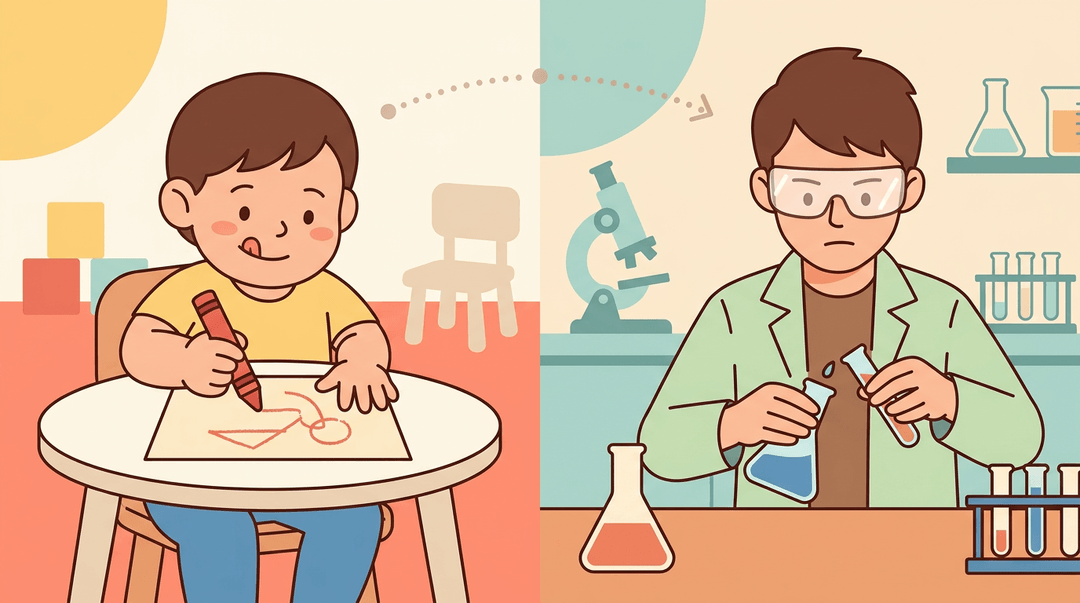
Psychomotor skills show up across the whole school day, from a kindergartner gripping a crayon to a high schooler handling lab equipment with care.
When you name the movement clearly, break it into small steps, and check it through simple observation, students build skills they can use for life.
Ready to map those skills across your year? Check out our Curriculum & Standards page to plan units, lessons, and standards in one place.
References
- Bloom’s Taxonomy of Educational Objectives | Center for the Advancement of Teaching Excellence — teaching.uic.edu
- Krathwohl, D. R., Bloom, B. S., & Masia, B. B. (1964). Taxonomy of educational objectives The classification of educational goals, Hand book II Affective domain. New York David Mckay Company In corporated. — scirp.org
- A Framework for Discipline-Specific Learning, Teaching, and Assessment of Psychomotor Skills in Higher Education — doi.org (2025)
- Jean Piaget's Constructivist Theory of Learning — doi.org (2022)
- An Analysis of Psychomotor Assessment Levels Based on Anderson and Krathwohl's Taxonomy in Integrated Thematic Books — doi.org (2022)
- Sage Research Methods - The SAGE Encyclopedia of Educational Research, Measurement, and Evaluation — methods.sagepub.com
- Doing it MI Way: Practical Applications of Howard Gardner's Multiple Intelligence Theory — jalt-publications.org
Frequently asked questions
What is domain 3 in education?
Domain 3 in education is the psychomotor learning domain. It focuses on physical movement, coordination, and hands-on motor skills performed with control, such as dribbling a basketball or safely using lab equipment.
Which is an example of psychomotor outcome?
An example of a psychomotor outcome is correctly using a pipette in a science lab. Typing accurately, demonstrating free-throw form, and assembling equipment are other examples.
What does psychomotor learning mean?
Psychomotor learning means developing physical and motor skills through practice. It involves coordinating the body to perform movements with increasing control, precision, speed, and independence.
Which patient is learning in the psychomotor domain?
The trainee is learning in the psychomotor domain, not the patient. For example, a nursing student practicing how to measure blood pressure is developing a psychomotor skill.