Class Assessment Explained: From CLASS Scores to Daily Checks

Jump to section
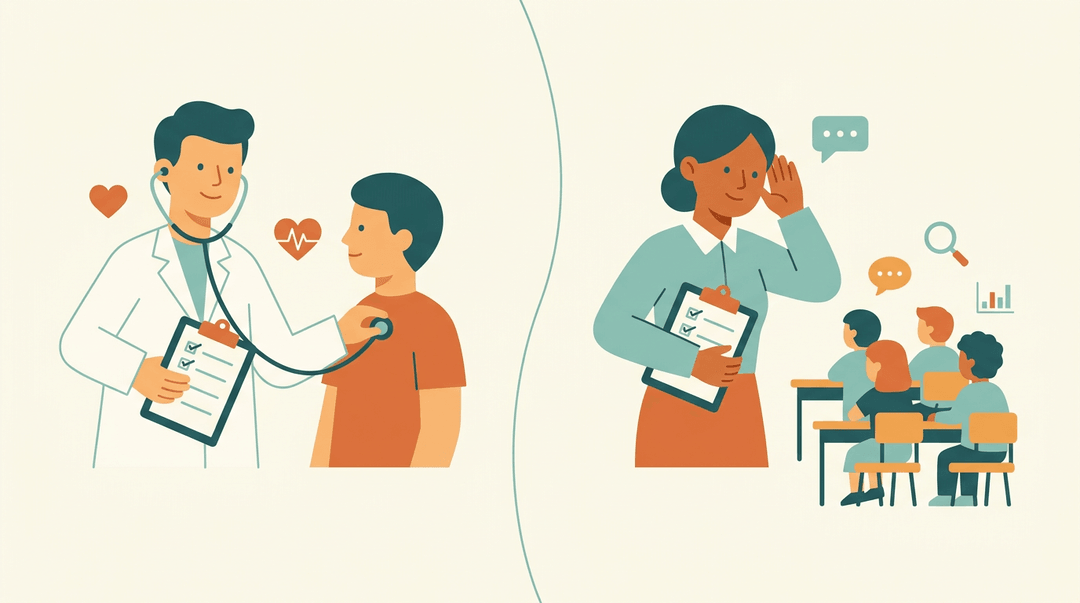
Think about the last time a doctor checked you over. Before any treatment, they looked at the basics, listened closely, and noticed what was working and what wasn't.
Class assessment works the same way: it's how you find out what's really happening in your classroom, not just what you hope is happening.
In this post, we'll explain what class assessment means, from the formal CLASS (Classroom Assessment Scoring System) observation tool to the everyday checks you use with students.
We'll also share a practical readiness checklist for new, virtual, and substitute teaching.
What the CLASS Assessment Is For
Plenty of educators hear the word assessment and picture a test. CLASS is different, and knowing what it's for helps you read it correctly.
What are the three main types of classroom assessment?
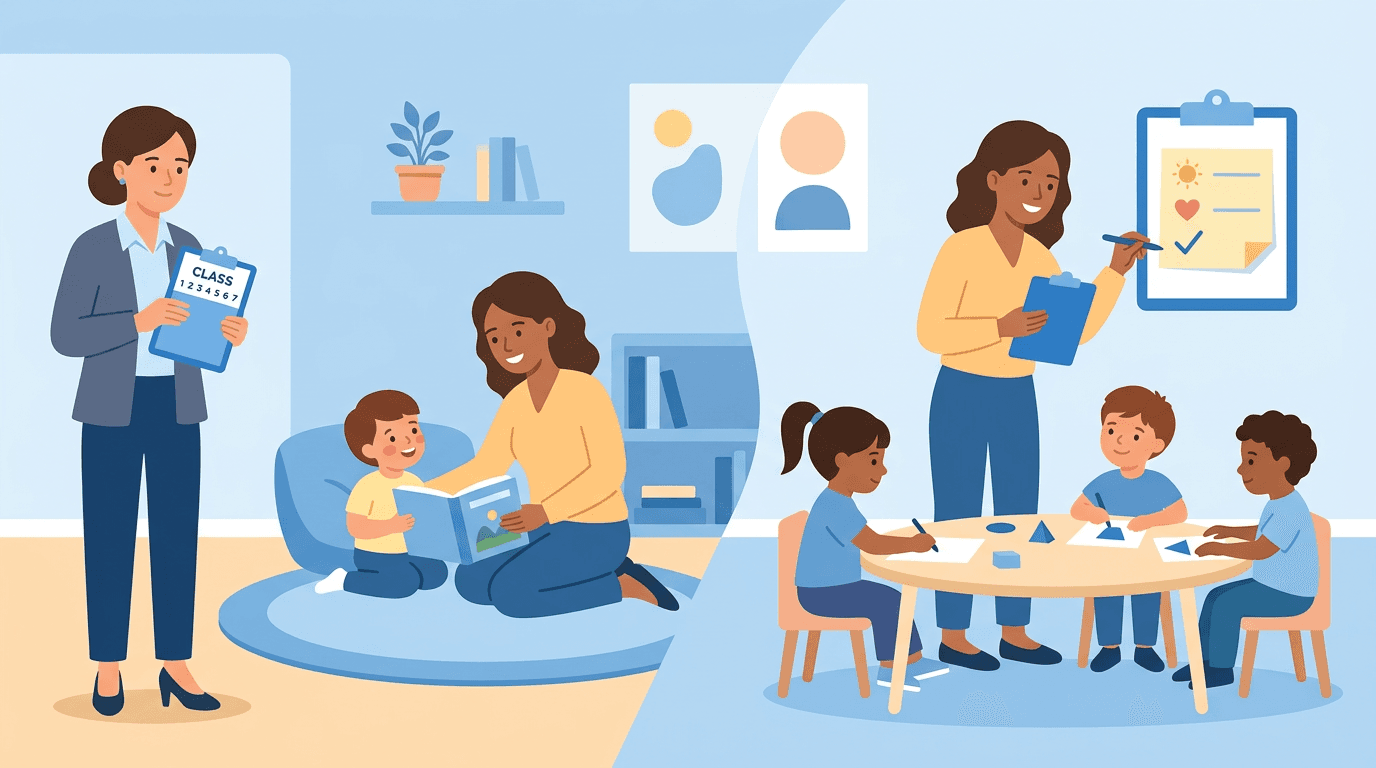
The Classroom Assessment Scoring System (CLASS) is an observation instrument for teacher-child interactions. It assesses the quality of preschool classrooms across three domains of interactions, and programs often use it as a quality monitoring tool.
Picture a pre-K teacher whose room looks busy and bright on the surface. CLASS looks past the decorations to how she talks with children, responds to their questions, and keeps the day moving.
Classroom assessment in general is often sorted into three types:
- formative
- summative
- diagnostic
CLASS doesn't fit neatly into that list. It judges the quality of interactions, not what each child has learned.
Why Teacher-Child Interactions Matter
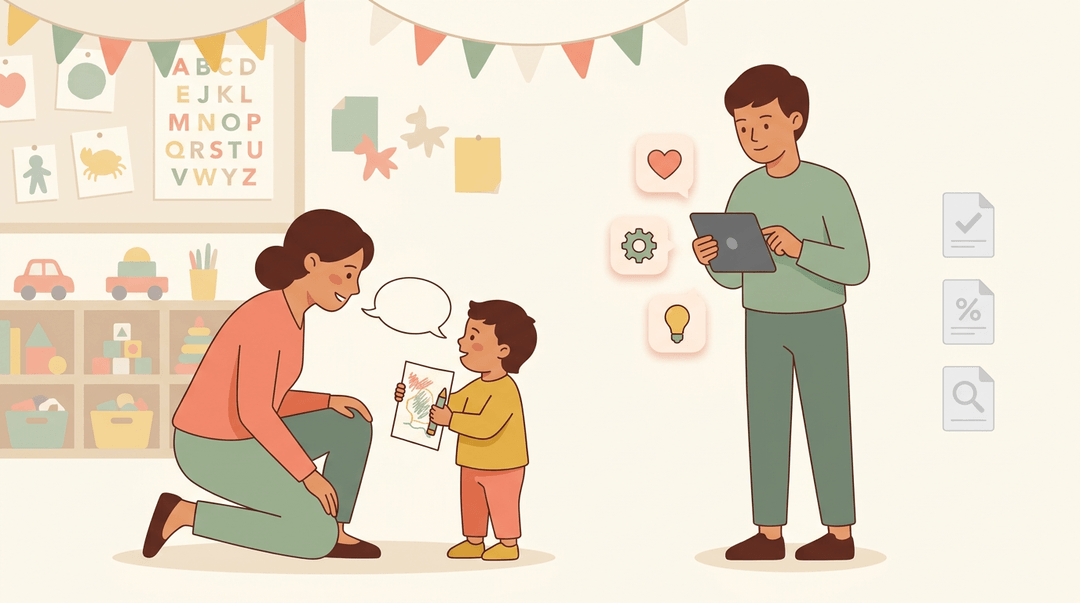
CLASS is built on developmental theory, which treats everyday back-and-forth between teacher and child as a foundation for learning.
Jean R. Ubbelohde notes there is a strong body of research suggesting teacher-child interactions have a positive impact on child outcomes. Small moments add up.
That's why the instrument looks at how adults engage with children, not just what the room contains.
What CLASS Doesn't Measure
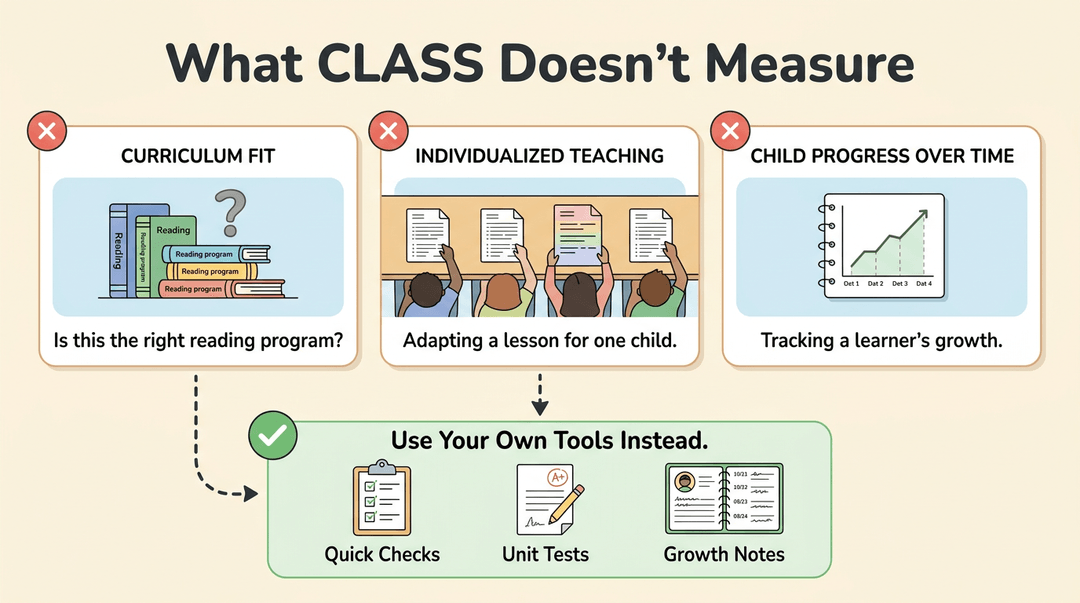
CLASS has clear limits, and it's worth knowing them before you rely on it. It does not measure curriculum, so it won't tell you whether your reading program is the right fit.
It also excludes individualized teaching, meaning it doesn't score how you adapt lessons for one child. And it does not track child progress. For that, you'll still rely on your own tools:
- quick checks
- unit tests
- notes on each learner's growth.
What Are the Four Components of Classroom Assessment?
The CLASS (Classroom Assessment Scoring System) observation tool looks at four areas that shape whether a room actually helps students learn. Each one covers a different part of your day, and each one is easier to improve than it sounds.
Creating Emotional Support in the Classroom
Students learn best when they feel safe. This component looks at your positive classroom climate: the warmth in your tone, the respect in your interactions, and how responsive you are to children's needs.
It also asks whether you acknowledge feelings and emotions, not just behavior, and whether you support peer relationships.
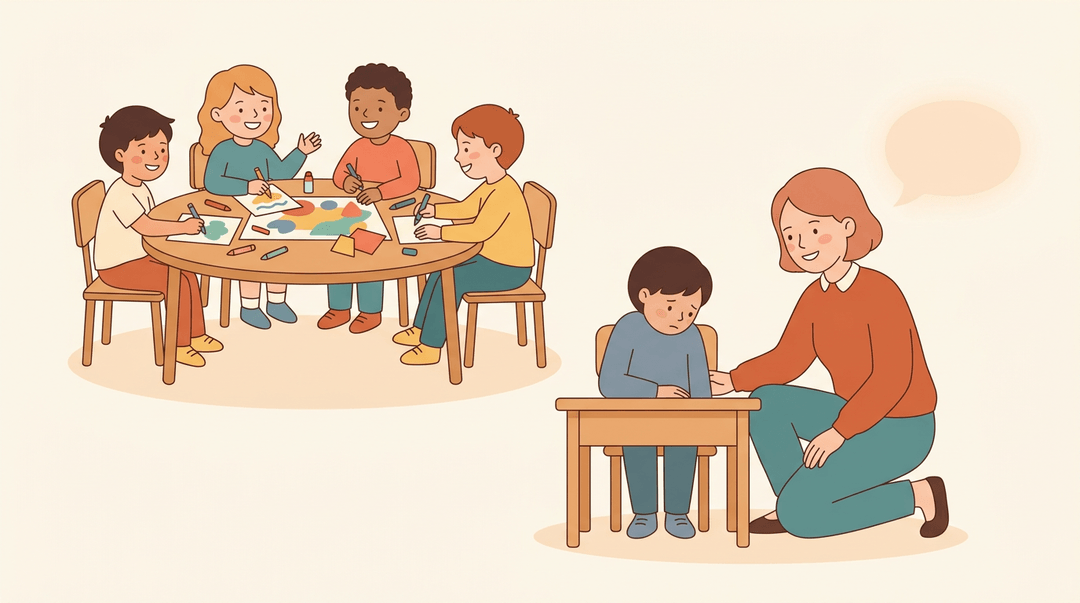
Consider a fourth-grade teacher who notices one student sitting apart during group work. Instead of pushing ahead, she checks in privately, offers a quiet acknowledgment, and moves the student beside a friendly partner.
The student rejoins the group, and the lesson goes on with everyone included.
Managing Routines and Classroom Organization
Behavior and time management are the routines that hold a room together. Consistent routines and schedules let students predict what comes next, so less time goes to transitions and more goes to learning.
Well-designed learning centers give students clear, purposeful places to work, and staff teamwork keeps everyone aligned.
Think of a kindergarten teacher who posts a visual schedule and teaches a clap-to-stop signal. The room settles faster, and more of the morning goes to reading. That's the payoff of a predictable day.
Boosting Learning Through Instructional Support
This component focuses on how you teach during the lesson. It looks at how well you promote cognitive and language growth, develop concepts, and give feedback.
It also measures questioning for analysis and reasoning, along with vocabulary and problem-solving support.
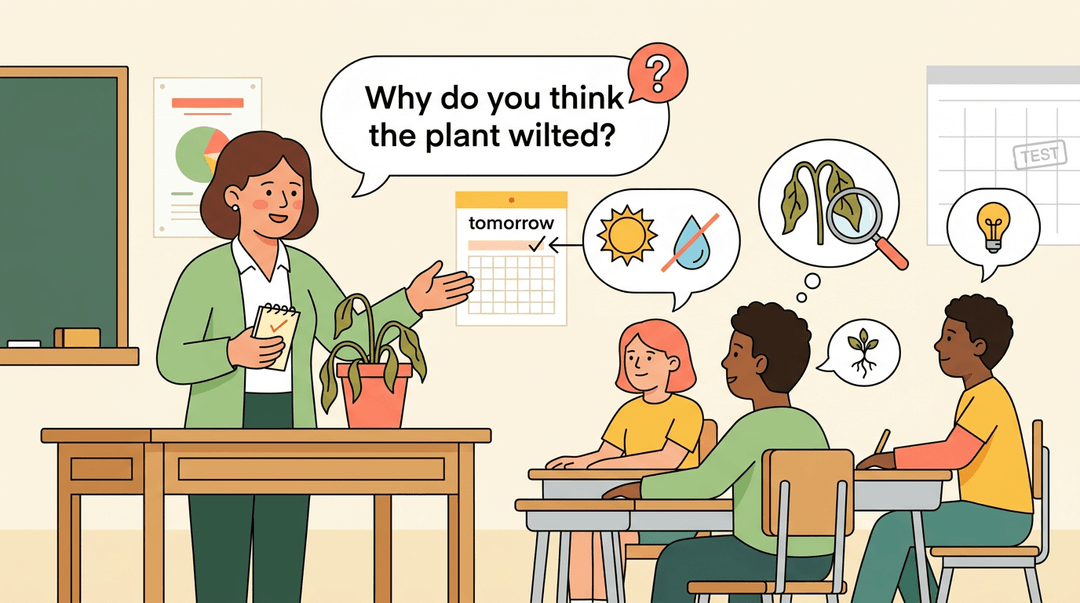
For example, a high school biology teacher asks, 'Why do you think the plant wilted?' instead of 'What's the answer?' Students talk through their reasoning, and the teacher hears misconceptions in real time.
She can adjust tomorrow's lesson before the unit test, not after.
Assessing the Physical Learning Environment
The physical space matters too. The CLASS Environment tool, described by Teachstone, measures the physical learning environment, and its Pre-K/K version assesses 29 items.
It's used alongside the CLASS 2nd Edition observation tool, so you get a fuller picture of both the room and the interactions inside it.
This part is less about how the room looks and more about who can use it.
A teacher auditing materials and displays might ask whether the posters show diverse families and whether supplies sit within reach of every student. Your room is part of the lesson.
A Classroom Assessment Checklist for Teachers
Use this before an observation, or before any day when someone else will see how your room runs. Find your context (new, virtual, or substitute) and work that block.
New teacher: ready by day one
Confirm each of these before anyone walks in:
- Routines are posted where students can see them. Try three lines on the board: "Enter. Sit. Start the warm-up."
- Transitions were modeled early, not assumed. Do one slowly together, then let students repeat it.
- Behavior notes take seconds to log. Keep a roster on a clipboard and jot as you move.
Say: "Watch me do it first, then you try."
Example: A first-year teacher keeps one line per moment: "Tues, 2nd period: Dani drifted during the handout transition, quiet redirect, back on task." Weeks later, those lines show a pattern worth acting on.
Virtual classroom: run the same loop every session
A virtual room stays observable when each session follows the same three moves.
- Open with a digital check-in.
- Same prompt every time: "Type one word for how today feels."
- Cue every breakout room move.
- Post the task and group names in the chat before you send anyone.
- Log engagement before you sign off.
- Note who spoke, who used chat, and who stayed silent.
Substitute day: leave one page
A substitute can't ask you what "normal" looks like. Fill in these three slots and leave them on top of the desk.
| Slot | What to write | Looks like |
|---|---|---|
| Seating chart | Names in actual seat positions | A simple grid, not a list |
| Daily routines | Order of the period, in plain steps | "Bell work, notes, partner practice" |
| Behavior triggers | What sets students off, and what helps | "Group work with Sam and Leo: separate them early" |
💡 Tip: Lead with the triggers. A sub who knows them early can head off trouble instead of reacting to it.
Build your routines, rosters, and notes once in EMStudio and reuse them for every observation.
Understanding CLASS Scores
Ever wondered what a CLASS (Classroom Assessment Scoring System) score actually tells you? It's a snapshot of how learning happens in your room, not just what is on the board.
Before an observation, a quick pre-observation self-check helps you walk in ready: review the dimensions being scored, confirm your lesson flow, and note where students get the most chances to talk and think.
What the 7-Point Score Ranges Mean
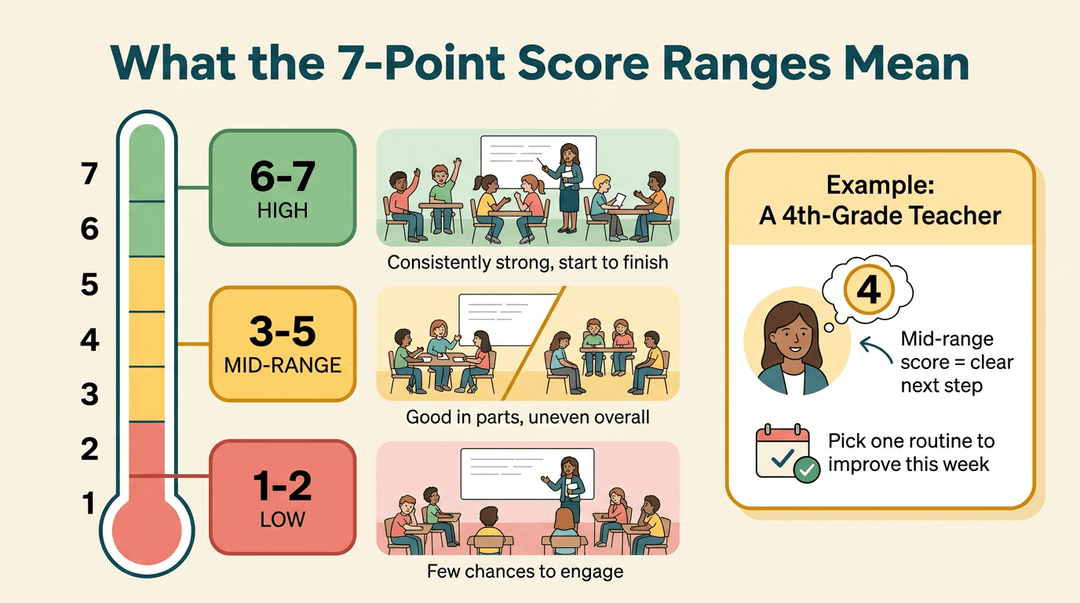
Scores run on a 7-point scale, and each range tells a different story:
- Low (1-2): Interactions are minimal or inconsistent, and students have few chances to engage.
- Mid-range (3-5): Strengths show up in places, but quality varies from one part of the lesson to the next.
- High (6-7): Classroom quality is consistent, with interactions that support learning throughout.
Consider a fourth-grade teacher who scores a 4 in one dimension. That's not a failure. It's a mid-range result with a clear next step, and she can focus on one routine change for the coming week.
Combining Scores Across a Grantee
A grantee is the organization being evaluated, and its classrooms are scored together. Scoring is completed on computer through OHSMS, the online system that compiles observation results.
Dimension scores are averaged across the grantee, and domain scores are then calculated from those dimensions. Reviewers are blind to the grantee's score, so their judgments stay independent.
How CLASS Observations Are Conducted
Ever wondered what actually happens when a reviewer walks into a classroom? The CLASS (Classroom Assessment Scoring System) observation follows a clear set of rules so every classroom is measured the same way.
Here's how it works, from observer training to the classroom visit.
How to become a CLASS observer in Louisiana?
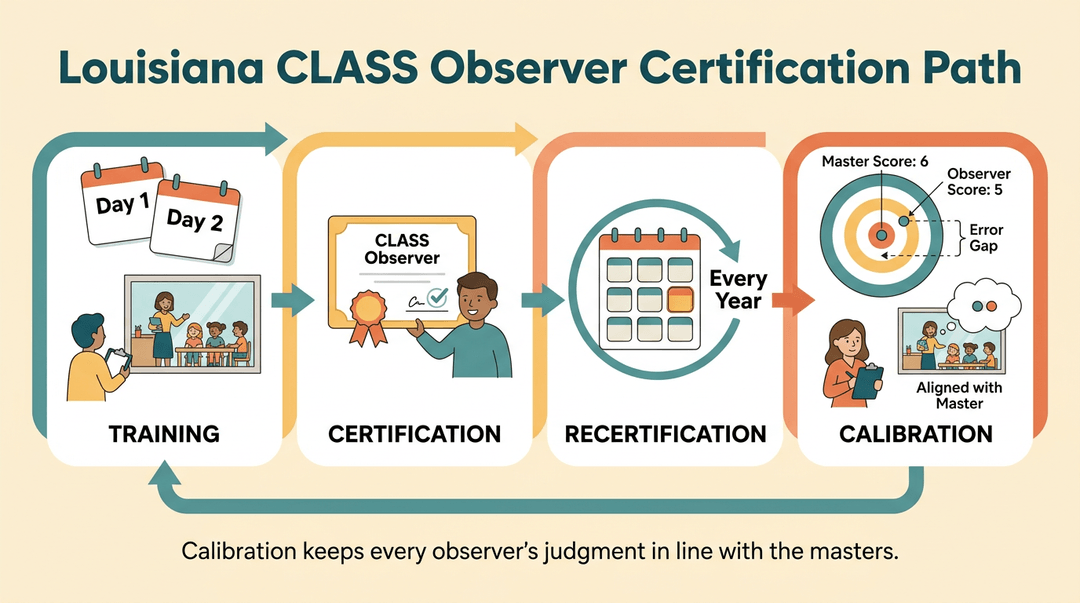
Observers earn their credential through Teachstone's certification process, which begins with two-day observation training. Certification isn't permanent: observers must complete annual recertification.
Along the way, a study on monitoring rater quality describes how raters typically score a standardized set of master-scored videos, and the gap between their scores and the masters becomes a measure of rater error. That's why calibration checks matter.
Think of a new observer scoring her first classroom. Calibration keeps her judgment in line with everyone else's. Put together, this is the Louisiana CLASS observer certification path:
- training
- certification
- recertification
- calibration
How Long and How Many Observation Cycles
Each observation lasts 20 minutes. Reviewers conduct two cycles per classroom, even though the CLASS manual recommends four. The goal is a fair snapshot rather than a perfect day.
If an interruption like a fire drill stops a cycle, it can still count when at least 10 minutes were observed, according to Louisiana's observation plan guidance. Ten minutes is the line.
How Classrooms Are Randomly Selected
A computer generates the sample, so classrooms are chosen at random rather than hand-picked, based on the program's classroom data. If a classroom can't be observed, the guidance for replacement classrooms determines which room takes its place.
When Observations Can't Take Place
Some windows are off-limits:
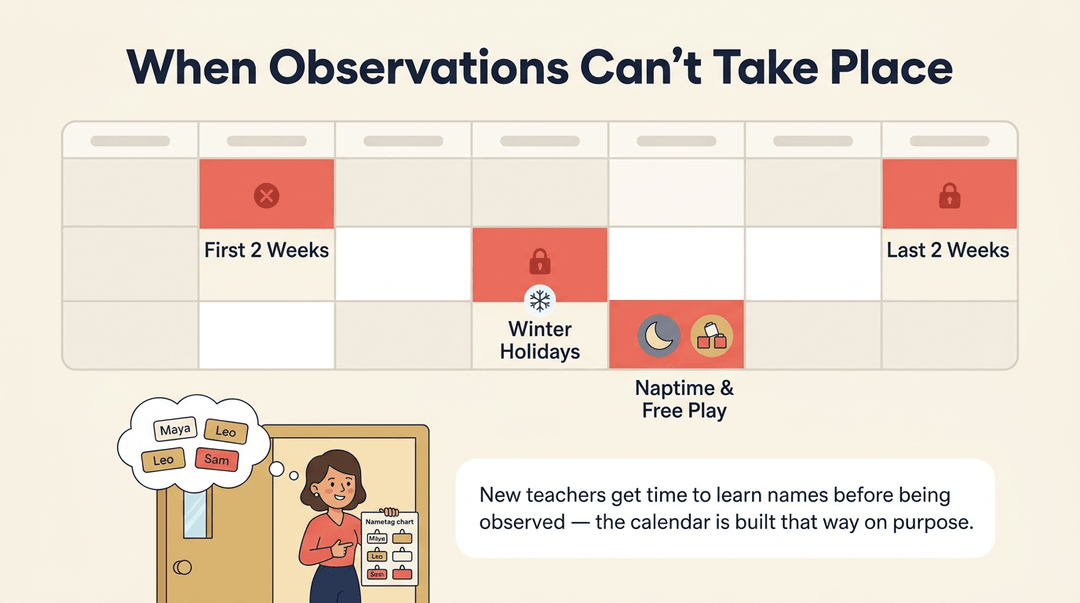
- No reviews in the first or last two weeks
- No reviews during winter holidays
- No observations during naptime or free play
Think of a teacher in her first two weeks, still learning every student's name. She won't be observed yet, and the calendar is built that way on purpose.
Special Situations During Observations
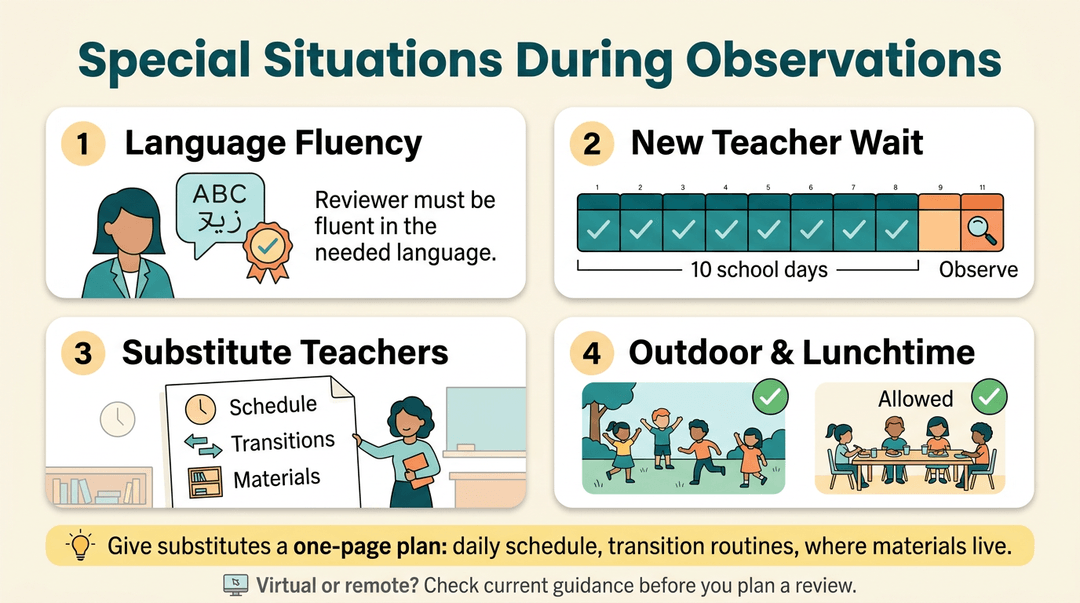
- Language fluency. Reviewers must meet a language fluency requirement.
- New teacher eligibility. Per Head Start's CLASS guidance, a teacher must have been in the classroom for 10 or more consecutive school days before an observation can occur.
- Substitute teachers. Substitutes have their own eligibility rules.
- Outdoor and lunchtime. Structured outdoor activities are allowed, and lunchtime observations are permitted.
Consider a substitute walking into an unfamiliar room. A one-page plan with the daily schedule, transition routines, and where materials live gives her a steady start.
Virtual and remote settings call for adapted procedures, so check current guidance before you plan a review.
How CLASS Scores Affect Policy
CLASS scores don't just sit in a file. They shape what happens to programs, which is why they matter well beyond the observation room.
How Head Start Uses Score Thresholds
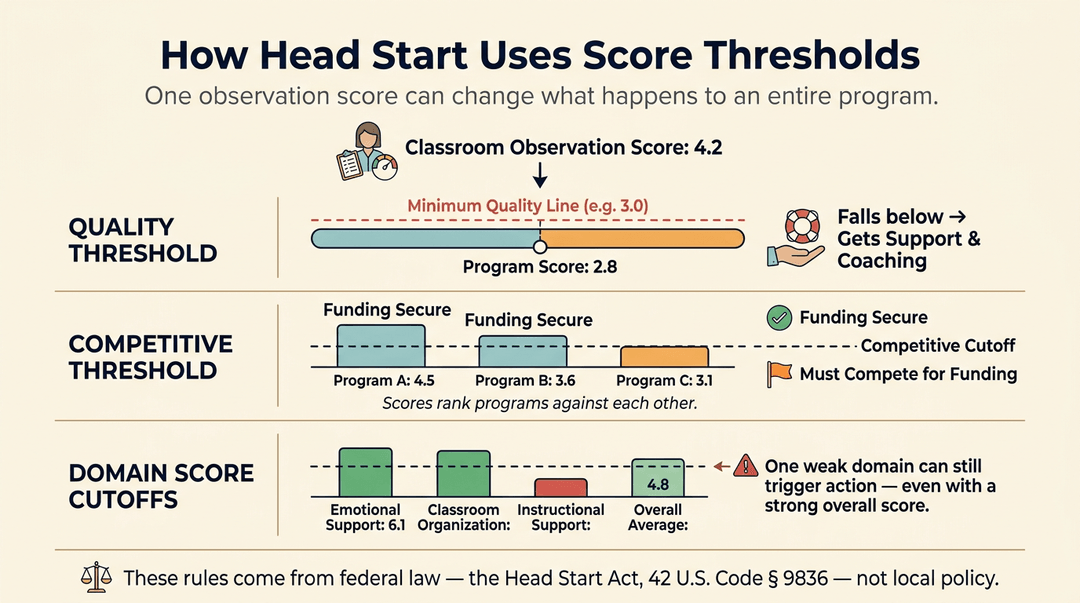
Picture a Head Start teacher whose classroom is observed on a regular cycle. The observer's scores can determine what happens next for the whole program:
- Quality thresholds trigger support, so a program that falls below the line gets help.
- Competitive thresholds trigger funding competition, so scores also rank programs against one another.
- Domain score cutoffs are set for specific CLASS domains, so a solid overall picture can still hide one weak area.
The rules rest on law. The designation renewal system has a statutory basis in the Head Start Act, found in 42 U.S. Code § 9836, so these rules come from federal law, not local preference.
California's Mandate to Use CLASS
In California, using CLASS isn't optional. The California Department of Education chose CLASS for the California State Preschool Programs (CSPP) under Section 106 of Senate Bill 114.
For a CSPP teacher, that means her observation results feed a state requirement, not just a private feedback form.
The day-to-day guidance comes from Management Bulletin 23-10, which updates data requirements and stays in effect until another bulletin supersedes it.
CLASS also integrates with the QRIS (Quality Rating and Improvement System) Block Grant, so scores connect to statewide quality work. Know the rules, and you'll know what your scores can do.
Equity and Inclusion in CLASS
Every classroom holds learners with different needs, so the tools we use to measure teaching must serve all of them. Here's how equity shows up in the Classroom Assessment Scoring System (CLASS).
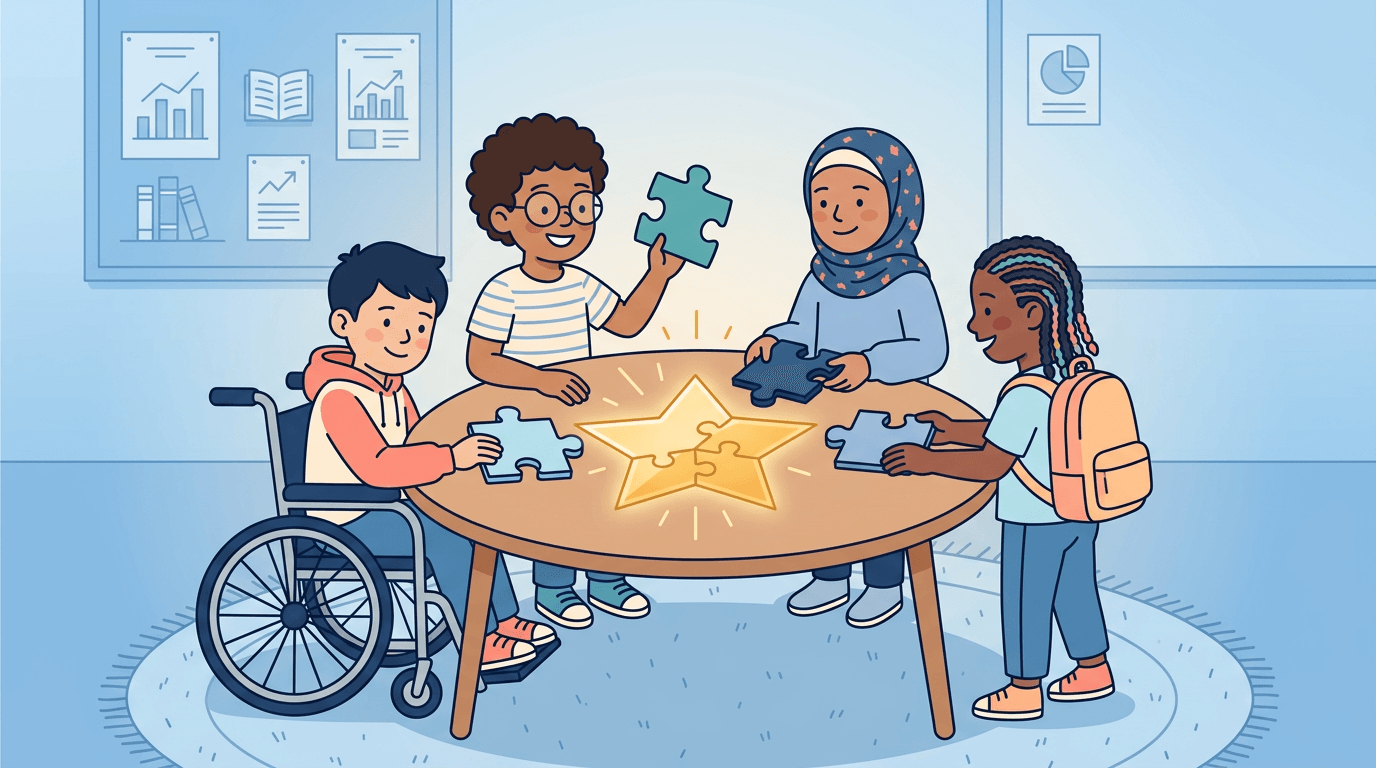
Supporting Children with Disabilities in Class
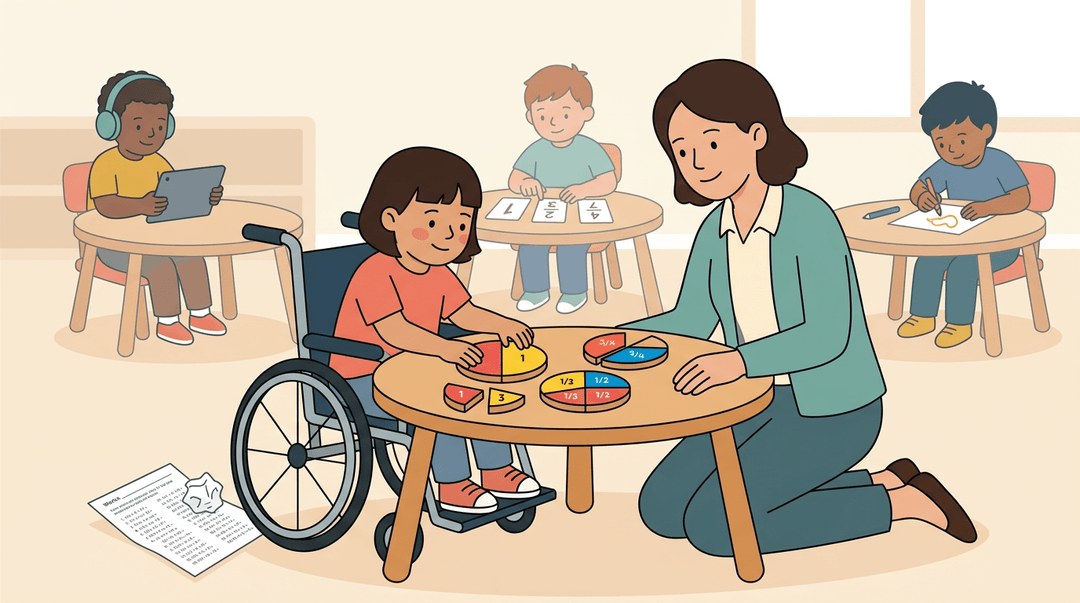
Think of a special education teacher adapting a math lesson for a student with an individualized education program (IEP). She swaps a dense worksheet for a tactile fraction kit.
Success means inclusive definitions of effectiveness: asking whether every child is engaged and learning, not just the average student. Adapted materials, resources for diverse settings, and video examples of interactions help you do the same.
How CLASS 2nd Edition Centers Equity
The CLASS 2nd Edition is built around the communities it serves. Its developers centered diverse communities and drew on diverse expert input. Increased accessibility and ease of use mean it's simpler to put into practice.
Equity is built in from the start, not bolted on. Unlike quizzes that check what students know, CLASS observes how teachers and students interact.
How ASPIRE Funds CLASS Implementation
Per the California Department of Education, the ASPIRE program is funded by the state budget act. That support drives CLASS implementation statewide through regional and statewide leads.
Picture a preschool teacher who gets regular coaching, reviews her own recorded lessons, and tries one change a month. Coaching and continuous improvement keep growth going.
Class assessment is really about seeing your classroom clearly. Whether you're using the formal CLASS observation framework or a quick daily check like an exit ticket, the goal stays the same: understand what students need, then respond.
Keep the readiness checklist close for those first days in a new room or a virtual setting, and you'll be prepared for whatever comes up.
Ready to bring more order to your day? Check out our Classroom Management feature to organize your classes, sections, rosters, and timetables in one place.
References
- Early Education Email Guidance — cde.ca.gov (2026)
- Use of Classroom Assessment Scoring System (CLASS®) ... — headstart.gov (2026)
- Guidance for Completing the CLASS Observation Plan and ... — doe.louisiana.gov
- Classroom Assessment Resources — cde.ca.gov
- Monitoring Rater Quality in Observational Systems: Issues Due to Unreliable Estimates of Rater Quality — doi.org (2024)
- "The Effect of Teacher-Child Interactions on Child Outcomes" by Jean R. Ubbelohde — digitalcommons.unomaha.edu
- 42 U.S. Code § 9836 - Designation of Head Start agencies | U.S. Code | US Law — law.cornell.edu
- On the Chopping Block: Examining the Fairness of Observational Data of Teacher Effectiveness — doi.org (2014)
- How Does CLASS® Work? — teachstone.com (2025)
- Early Learning Environments Play a Crucial Role in Child Development — info.teachstone.com
Frequently asked questions
What is the meaning of CLASS assessment?
CLASS assessment usually means the Classroom Assessment Scoring System, an observation framework for evaluating the quality of teacher-child interactions. It focuses on how teachers support learning, rather than testing what children know or measuring curriculum and child progress.
What is a CLASS assessment tool?
The CLASS assessment tool is a structured observation instrument that rates classroom interactions on a 7-point scale. It examines areas such as emotional support, classroom organization, instructional support, and, in the CLASS Environment tool, the physical learning environment.
What is a CLASS observation?
A CLASS observation is a scheduled classroom visit in which a trained observer watches teacher-child interactions and assigns scores using the CLASS framework. A typical observation cycle lasts 20 minutes, and Louisiana observations generally use two cycles per classroom.
What is the 3-2-1 classroom assessment technique?
The 3-2-1 classroom assessment technique is a reflection or exit-ticket method in which students identify three things they learned, two questions or important ideas, and one remaining question, takeaway, or action. Teachers use the responses to check understanding and plan follow-up instruction.
What are the three main types of classroom assessment?
The three main types of classroom assessment are formative, summative, and diagnostic. Formative assessment checks learning during instruction, summative assessment evaluates learning at the end of a unit or course, and diagnostic assessment identifies prior knowledge, strengths, and learning needs.
What are the four components of classroom assessment?
The four commonly cited components of classroom assessment are measurement, evaluation, documentation, and communication. Together, they involve gathering evidence, interpreting it, recording results, and sharing useful information with students, families, or other educators.
What are the five types of classroom observation?
The five common types of classroom observation are structured, unstructured, participant, nonparticipant, and naturalistic observation. They differ according to how planned the observation is and whether the observer takes part in classroom activities.
How to become a CLASS observer in Louisiana?
To become a CLASS observer in Louisiana, complete Teachstone's two-day observation training and pass the certification process. Certified observers must complete annual recertification and participate in calibration activities to keep their ratings aligned with master scores.