Diagnostic Assessment Explained: Types, Examples & Tips

Jump to section
Think about the first day of a road trip with a car full of passengers. Before you pull out of the driveway, you want to know who needs a snack stop in an hour, who can last until lunch, and who gets carsick on winding roads.
You could ignore all of that and just drive. Or you could ask a few quick questions and plan a trip that actually works for everyone.
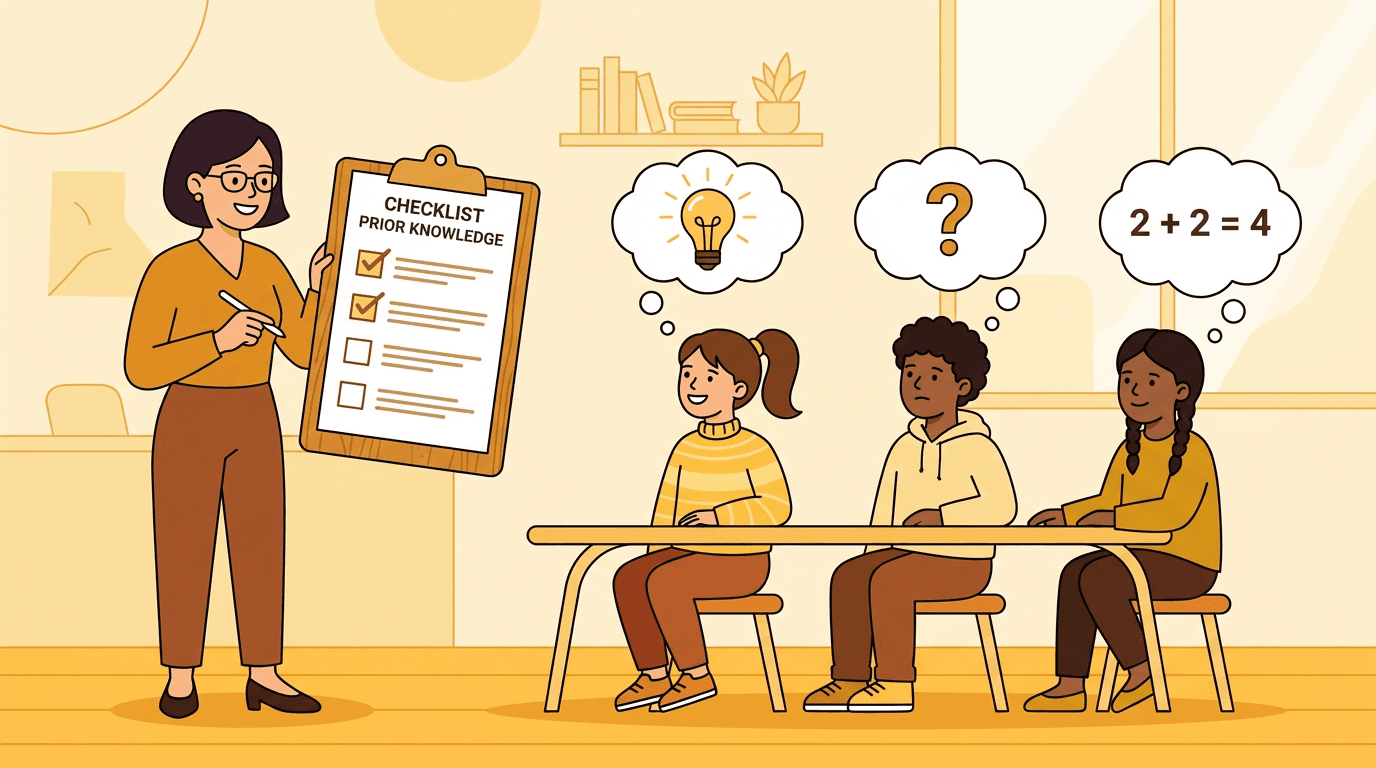
That's the idea behind diagnostic assessment: a quick, deliberate look at what your students already know, and where the gaps are, before you start teaching. It's not about grades. It's about getting the information you need to teach smarter from day one.
In this post, we'll cover what diagnostic assessment is, how it compares to other assessment types, what it looks like in practice, and, most importantly, how you can act on the data to reach every learner in your classroom.

What Is a Diagnostic Assessment?
Before you teach, it helps to know what your students already understand. A diagnostic assessment (also called a pre-assessment or formative pre-test) is a snapshot of what learners know, can do, and misunderstand at the start of a unit or course.
It can be formal (a written quiz, a reading inventory) or informal (a quick class discussion, an exit ticket from the year before).
What diagnostic assessment actually measures
A diagnostic assessment sits before instruction, not after. It identifies prior knowledge, surfaces gaps, and catches misconceptions before they harden.
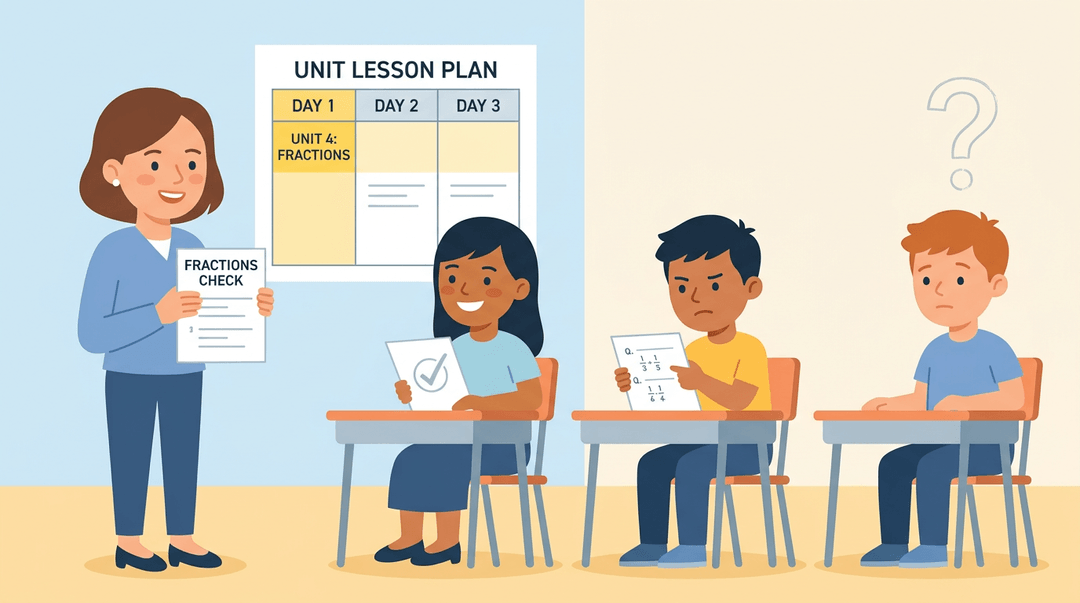
Think of a fifth-grade teacher handing out a short fractions check on the first day of a new unit: the results tell her which students are ready to move forward and which ones are still shaky on the basics she was planning to skip.
How it shapes better teaching from the start
That snapshot matters because it lets you tailor what comes next.
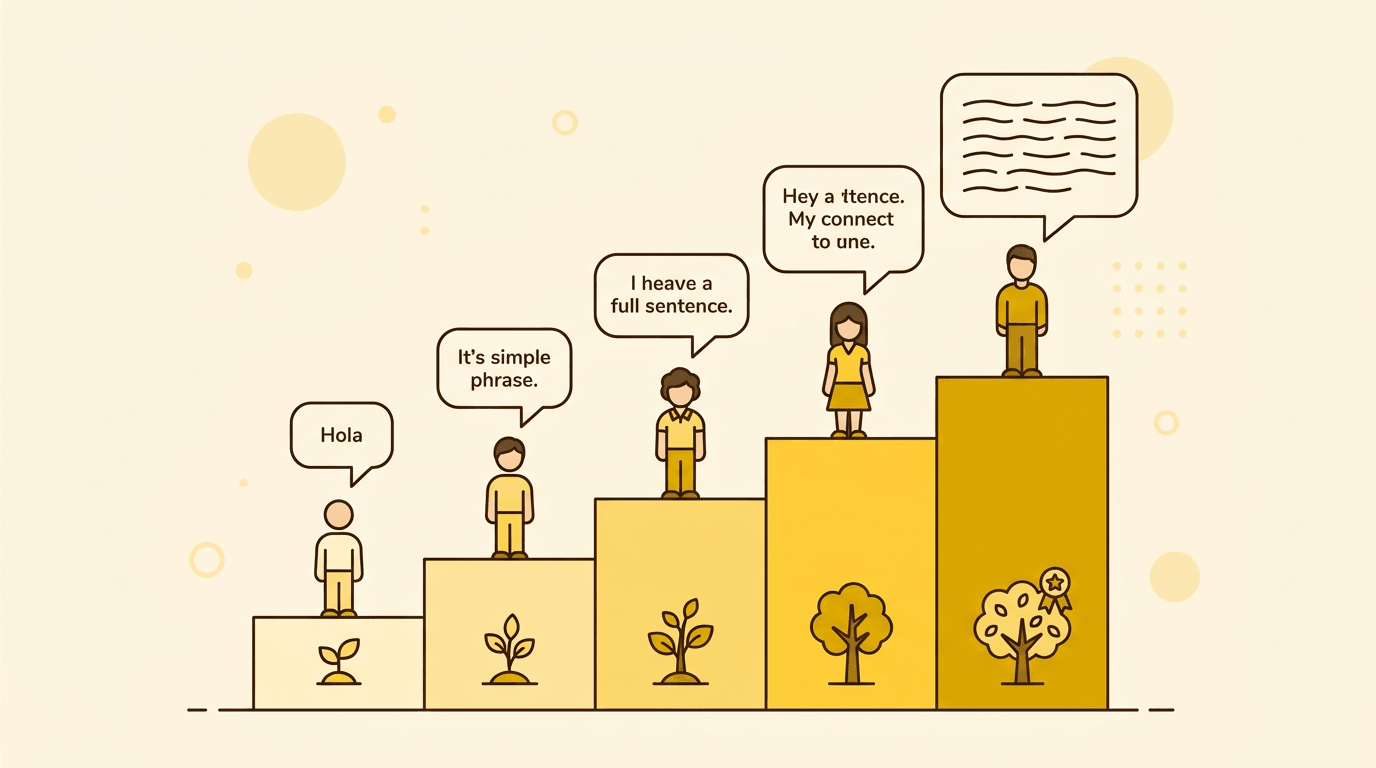
Instead of pitching every lesson at the middle and hoping for the best, you can group students more accurately, set realistic targets, and build learning paths that meet each learner where they actually are.
Addressing misconceptions early is far less work than untangling them weeks later.
True diagnosis vs. probabilistic screening
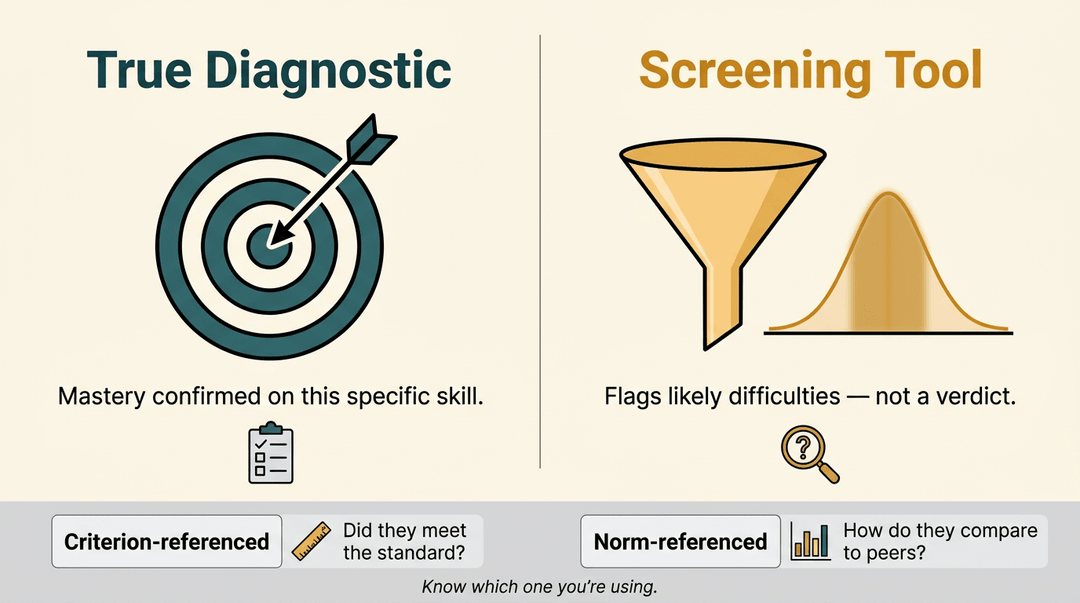
One note worth making: the word diagnostic is often borrowed loosely. A true diagnostic tool gives you mastery-level certainty about a specific skill.
Many tests described as diagnostic are actually screening tools: they make probabilistic inferences about likely difficulties, not definitive verdicts.
It also matters whether a tool is criterion-referenced (measuring against a defined standard) or norm-referenced (comparing a student to peers). Knowing which type you're using keeps your conclusions honest.
Diagnostic, Formative, and Summative Assessment Compared
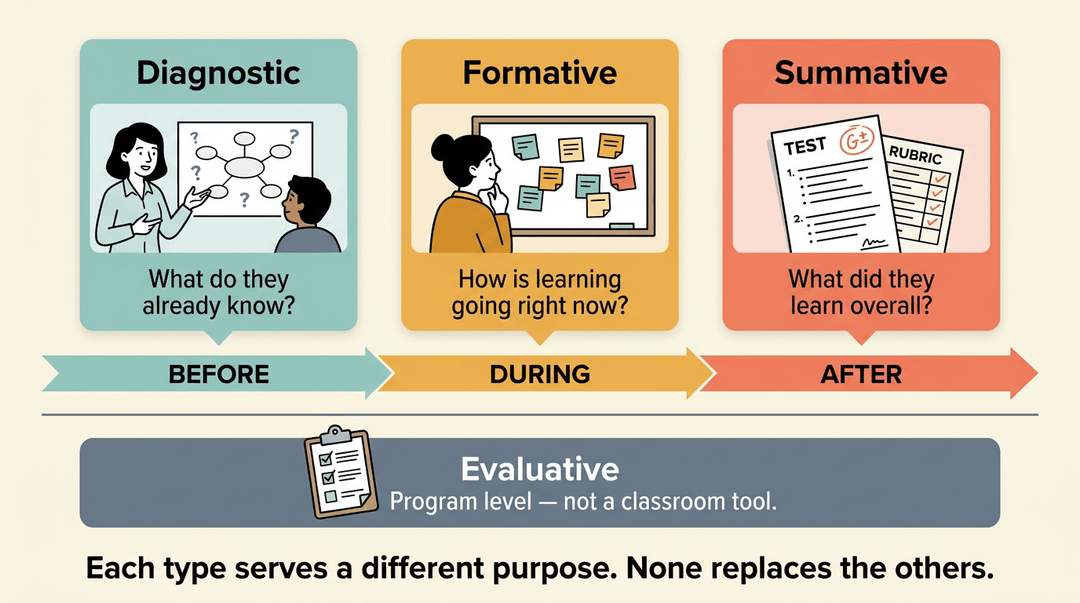
Assessment falls into four main types: diagnostic, formative, summative, and evaluative. Each has a distinct job, and knowing which to reach for (and when) makes all the difference.
When each assessment type belongs
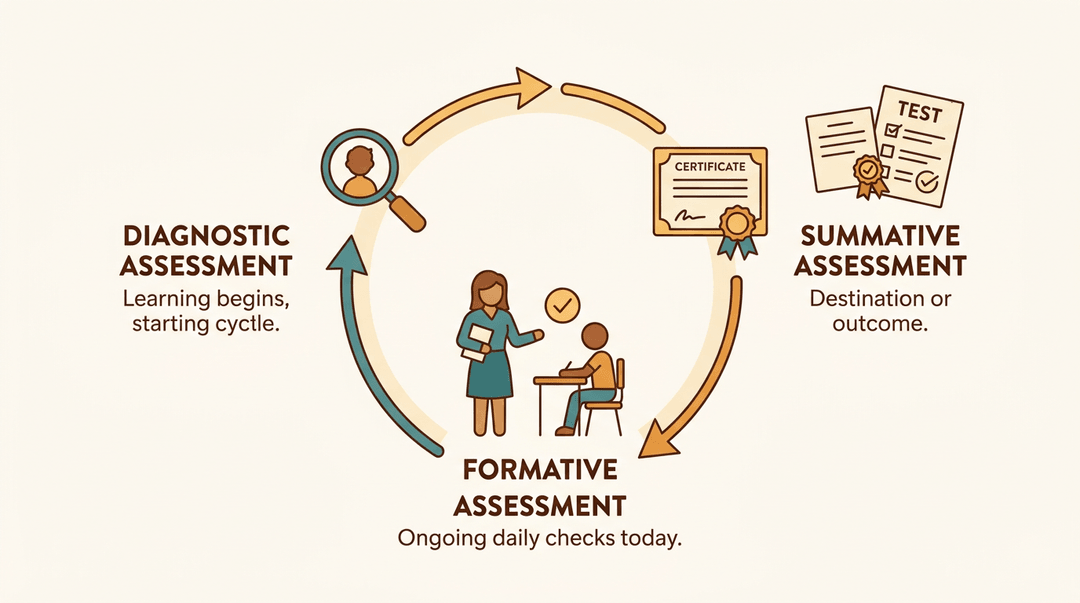
Think of the three most common types as a timeline:
- Diagnostic happens before instruction. It tells you what students already know and where the gaps are.
- Formative happens during instruction. It gives you a read on how learning is progressing in real time.
- Summative happens after instruction. It measures what students have ultimately learned by the end of a unit or term.
Evaluative assessment sits at the program level, judging the effectiveness of a course or curriculum overall. It's less a classroom tool and more an institutional one.
Each type serves a distinct purpose. None replaces the others.
How all three types work together
The three don't just coexist: they form a complete learning cycle.
Diagnostic assessment sets the starting point. That data shapes your formative checks, so you're not asking whether students understand something they already mastered or skipping over a genuine gap.
A third-grade teacher who runs a quick diagnostic on number sense before a fractions unit, for example, knows exactly which students need extra work on the concept of equal parts before the first lesson even begins.
Formative and summative must work together too. Formative checks keep learning on track day to day; summative assessment confirms whether it arrived.
Diagnostic bridges the whole cycle by making sure formative and summative are both aimed at the right target from the start.
Types and Examples of Diagnostic Assessments
Diagnostic tools range from structured, standardized instruments to quick classroom routines you can run before the bell rings. Here's a look at the main categories:
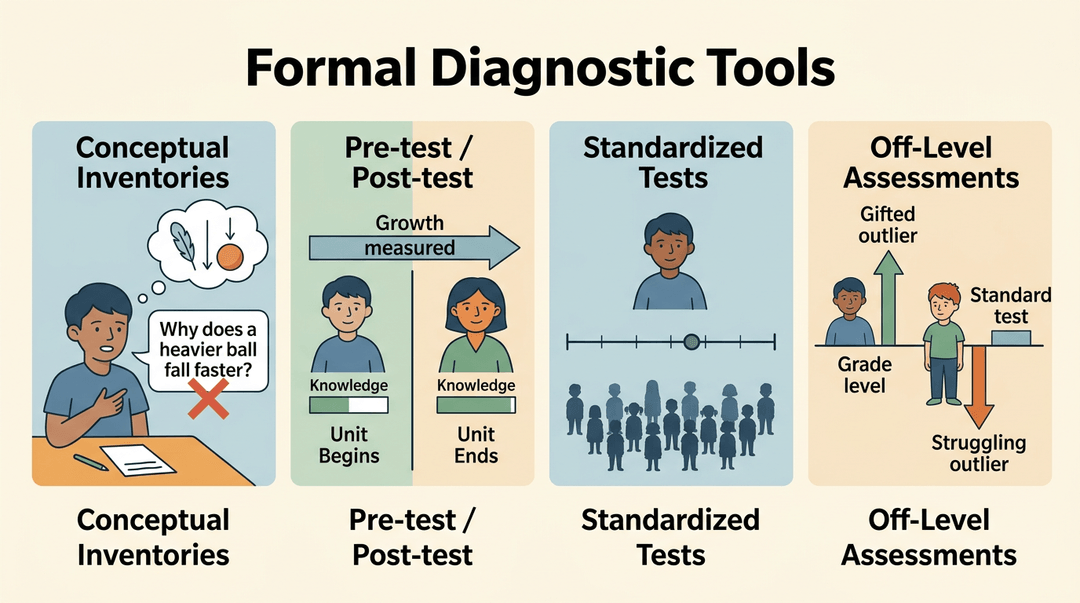
Formal diagnostic tools worth knowing
Formal tools give you structured, comparable data across students. Conceptual inventories probe discipline-specific misconceptions (think a physics Force Concept Inventory or a math number-sense screener).
Pre-tests and post-tests bracket a unit to show you exactly where students started and how far they've traveled.
Standardized achievement tests offer a broader benchmark, while off-level assessments test students above or below grade level to catch the outliers your regular tools might miss.
Informal methods you can use tomorrow
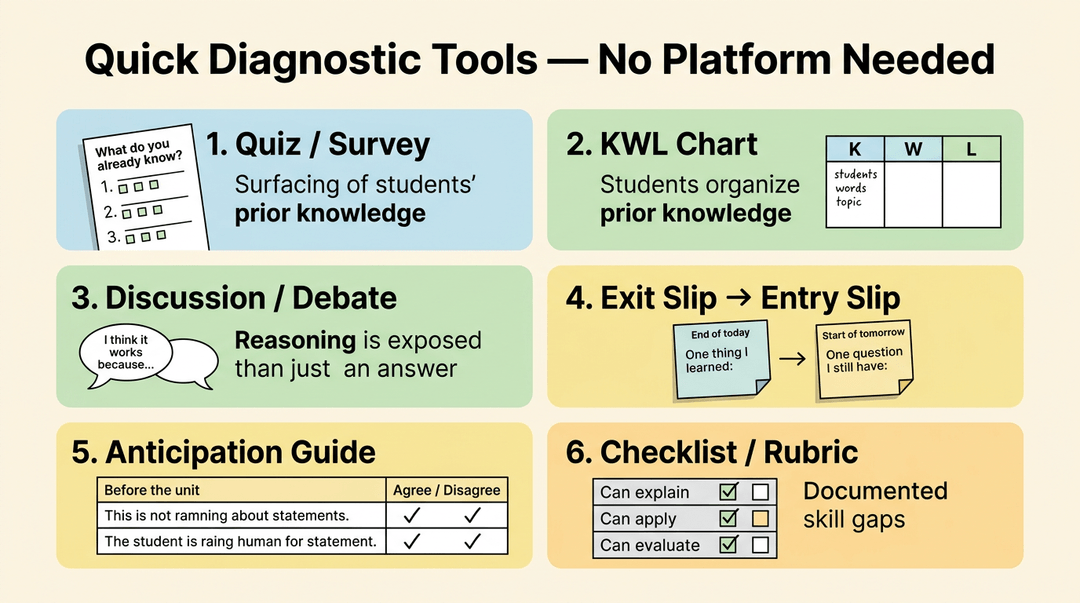
You don't need a testing platform to get useful data. Most of these take five minutes or less:
- Quizzes and surveys to surface prior knowledge quickly
- KWL charts and mind maps to reveal how students organize what they already think they know
- Discussion boards and debates to expose reasoning, not just recall
- Exit slips to close a lesson; entry slips to open the next one with a low-stakes daily diagnostic pulse
- Anticipation guides that ask students to agree or disagree with key ideas before the unit begins
- Checklists and rubrics to document skill gaps systematically
Letting students assess their own knowledge
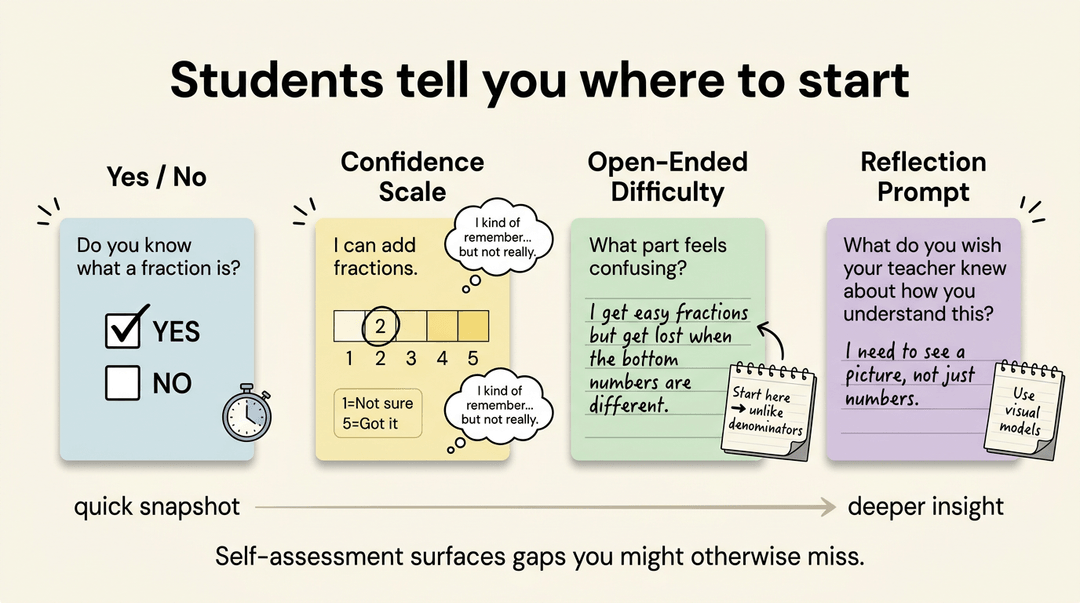
Self-assessment turns students into partners in the diagnostic process. Yes/no familiarity questions give you a fast snapshot. Confidence rating scales go a step further, separating whether a student knows something from how sure they are.
Open-ended difficulty questions and reflection prompts surface the gaps students themselves can name, which often point you straight to where instruction needs to start.
How to Run a Diagnostic Assessment Well
Knowing that a diagnostic assessment matters is one thing. Knowing how to run one well is where the real payoff is. Here's a practical sequence to get it right.
What happens in a diagnostic assessment?
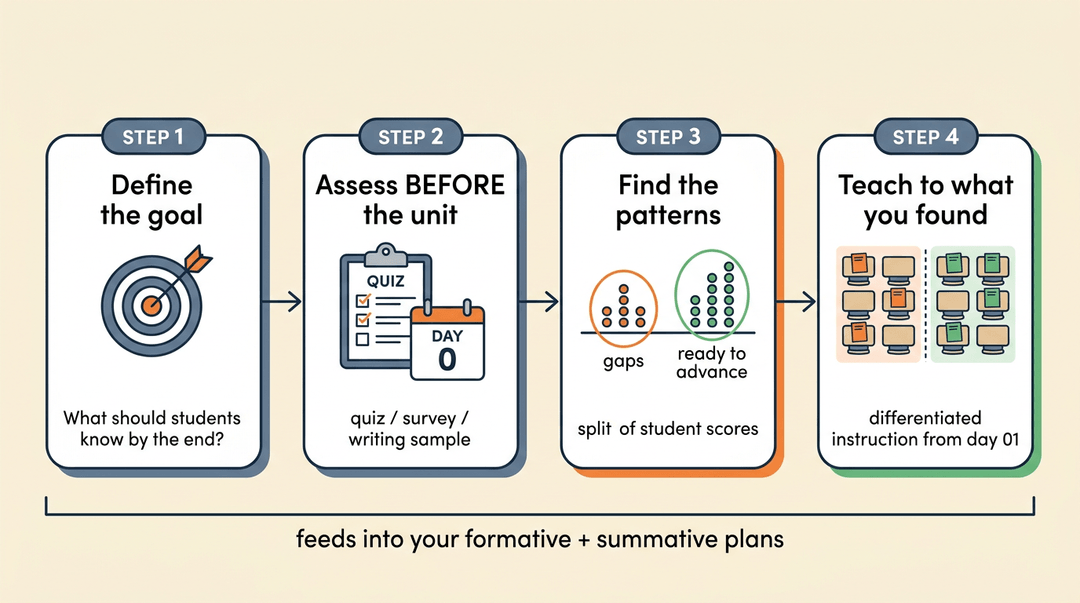
Start by defining your learning objectives: what should students know or be able to do by the end of the unit? That answer shapes every tool you choose.
Then select an appropriate method (a brief quiz, a skills survey, a short writing sample) and administer it before the unit begins, recording those baseline scores before a single lesson starts.
Once you have results, the work begins. Analyze the data for patterns: who's missing a foundational concept, who's ready to move faster.
Use that to group students and differentiate your instruction from day one, then weave findings into your formative and summative plans so your whole assessment picture stays coherent.
Using technology to deliver and analyze results
A learning management system's built-in survey tools can distribute and collect responses quickly. Adaptive digital platforms go further, adjusting question difficulty in real time so you get a sharper read on each student.
Automated data analysis cuts the time between giving the assessment and acting on it, and the best tools integrate cleanly with your existing gradebook and assessments so nothing lives in a silo.

Screen first, then go deeper
Not every student needs a deep diagnostic. A brief screener flags areas of concern quickly. From there, a targeted diagnostic zeroes in on specific weak skills for the students who need it.
Keep in mind: measuring true mastery requires more items than a quick screener provides. Use detailed diagnostics sparingly and strategically, where the data will genuinely change what you do next.
Putting Diagnostic Results to Work in Your Classroom
A diagnostic only earns its time when it changes what you do next. Here's how to turn baseline data into grouping and growth, starting day one of the unit.
Start with a baseline you can act on
- Run a short pre-test or KWL chart. Keep it to 10 minutes so it never eats the lesson.
- A KWL chart asks: what you Know, Want to know, and later Learned.
- Record baseline scores in your gradebook. Mark them as diagnostic, not graded.
- Name 2 to 3 priority gaps per student. Specific, not "needs help."
- Jot them as a chain: "regrouping ← place value ← number bonds."
Example: A fourth-grade teacher's pre-test shows eight students can't subtract across zeros. That single gap becomes Group B's whole first task, while the rest move ahead.
Group by skill, and keep it loose
Sort students into flexible skill-based groups: clusters built around a shared gap, not a fixed ability label.
- Assign each group one targeted task. Match the task to the gap you named.
- Regroup after every formative check. Groups expire the moment the data does.
⚠️ Watch out: Skill groups are not tracks. A student stuck on one skill this week may lead the next. Never let a temporary group harden into a permanent label.
| When you see... | Try... |
|---|---|
| One group finishing far ahead | An extension prompt while you reteach the others |
| A student misplaced in a group | Move them mid-task; groups aren't sacred |
| The same gap across most groups | Pause and reteach it whole-class |
Track growth from baseline to exit slip
Growth is only visible when you log it next to where you started.
- Keep baseline and formative scores side by side. Same student row, two columns.
- Compare diagnostic to exit-slip data. The gap between them is the learning.
- Show students their own growth. Ownership follows visibility.
Say: "In your pre-test you got 3 of 10 on these; today you got 8. That's the work paying off."
At a glance:
| Phase | Key move | What you get |
|---|---|---|
| Baseline | Pre-test or KWL, logged | A starting point per student |
| Group | Flexible skill clusters | Targeted tasks, not tracks |
| Exit | Compare to baseline | Visible, shareable growth |
Keeping all three in one record is the difference between data you collect and data you use: EMStudio's gradebook lets you log diagnostic baselines and track growth alongside formative and summative scores, all in one place.
How Diagnostic Assessment Benefits Students
Diagnostic assessment isn't just useful for teachers. When students know where they stand before a unit begins, it changes how they approach the learning ahead. Here's what that looks like from their side of the desk.
What students gain from being assessed early
A well-designed diagnostic gives students a preview of what's coming: key vocabulary, core concepts, skills they'll need to build. That preview does something quiet but powerful.
It reduces test anxiety by removing the mystery of what the course or unit will demand. Students know the terrain before they have to navigate it.
There's also a motivational nudge. Seeing what they don't yet know pushes many students to close the gap, especially when the diagnostic feels low-stakes and non-threatening.
And the act of being tested itself pays a retention dividend: the Beckman Institute at the University of Illinois found that testing during studying improves memory and the ability to make inferences, because retrieval practice strengthens how material is stored.

Building student ownership through metacognition
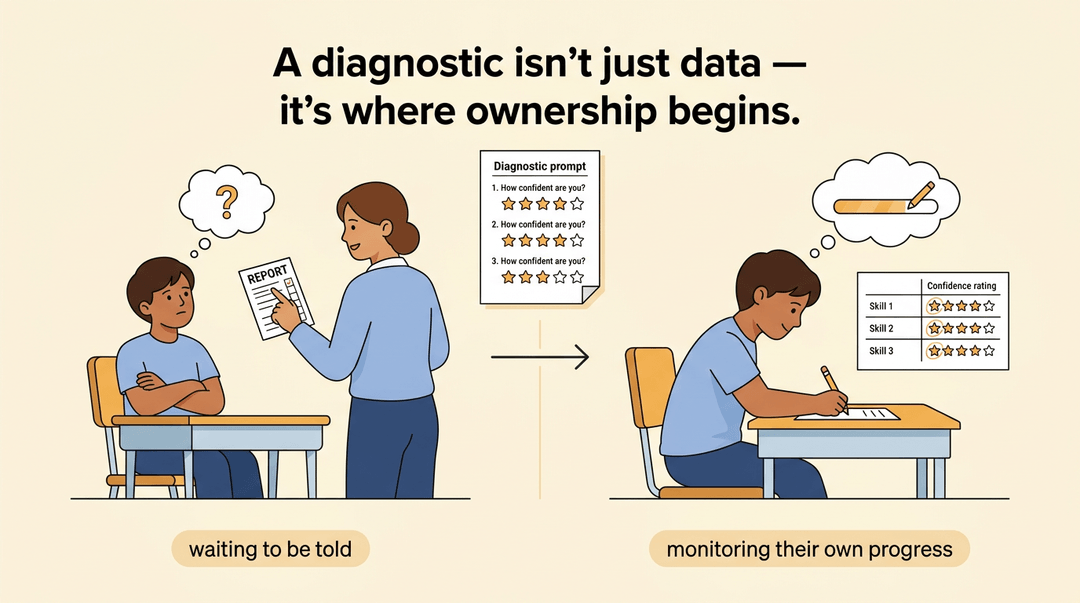
When students reflect on what they already know, and what they don't, they start taking an active role in their own learning. A diagnostic prompt can be the spark for that.
Ask students to rate their confidence on a few key skills, and you've turned a data-gathering tool into a self-assessment exercise.
Paired with your own diagnostic data, student self-assessments become a richer picture.
Students identify their personal gaps, set a starting point, and begin building the habit of self-regulated learning: monitoring their own progress rather than waiting to be told how they're doing. That sense of ownership rarely shows up by accident.
A simple diagnostic, used well, is one of the most reliable ways to build it.
Limitations and Barriers to Watch For
Diagnostic assessment is genuinely useful, but it's not a silver bullet. Two categories of friction can get in the way: the practical realities of the classroom, and the limits baked into the tools themselves.
Practical obstacles teachers face
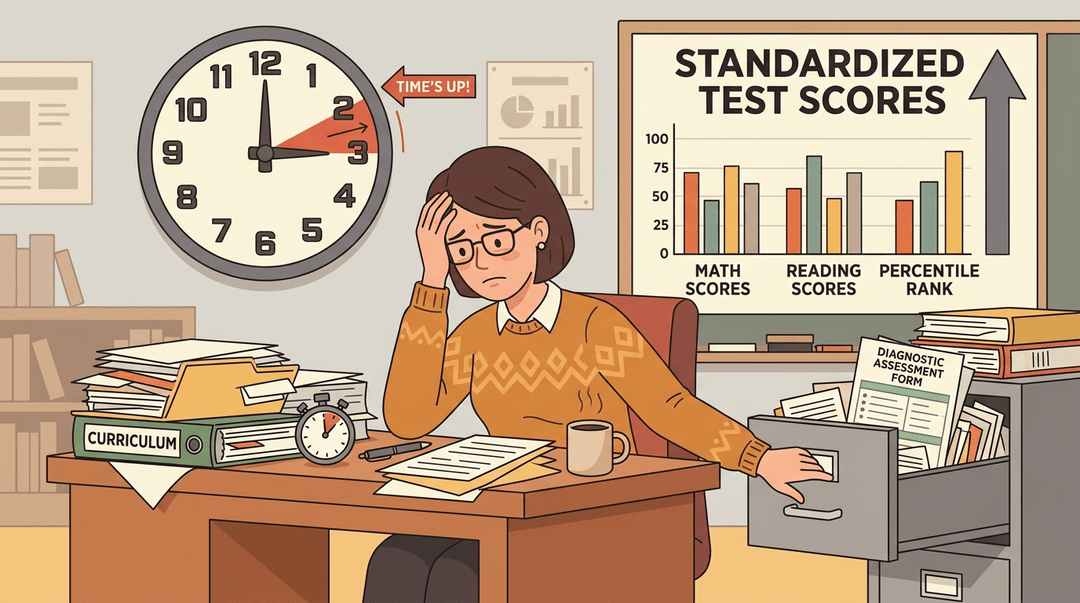
Time is the first hurdle. Designing a thoughtful diagnostic, administering it, and acting on the results takes more than a spare period.
Add curriculum coverage pressure, and many teachers feel they can't afford the day it takes before "real" teaching begins.
Training compounds the problem. Without clear guidance on how to interpret diagnostic data, even a well-designed instrument can end up filed away unused.
And in schools where success is measured almost entirely by summative standardized tests, there's little structural incentive to invest in front-end diagnosis.
Where the instruments themselves fall short
The tools have limits, too. Constructed-response items and selected formats can't anticipate every misconception a student carries into the room.
A correct answer doesn't always mean genuine understanding: a student can guess right or apply a memorized procedure without grasping the concept underneath.
Mastery-based diagnostic measures are often thorough but slow, which makes them hard to use when you need a quick read on day one.
And some tools marketed as diagnostic are really predictive: they flag risk levels probabilistically rather than pinpointing specific gaps.
There's also a quieter risk worth naming. When data gets attached to students too early and too firmly, it can slide from informing instruction into labeling the learner. Diagnostic information should open doors, not close them.
Diagnostic assessment won't tell you everything, but it tells you what matters most before you begin: where your students are, what they're ready for, and where they need your support. That's not extra work.
That's the foundation of teaching that actually sticks.
When you start with the right information, every lesson, every group, and every student gets a better shot. Ready to track and act on what you learn? Explore our Grading & Assessment tools to make the whole process smoother.
Frequently asked questions
What is a diagnostic assessment?
A diagnostic assessment, also known as a pre-assessment or formative pre-test, is a snapshot of what learners already know, can do, and misunderstand at the beginning of a unit or course. It can take formal forms, such as a written quiz, or informal ones, like a quick class discussion.
What is the main purpose of a diagnostic test?
The main purpose of a diagnostic test is to identify students' prior knowledge, uncover any existing gaps in their understanding, and catch misconceptions before instruction begins. This information allows educators to tailor their teaching methods to meet students' actual needs.
What are the 4 types of assessment?
The four main types of assessment are diagnostic, formative, summative, and evaluative. Each type serves a distinct function in the educational process, from initial understanding to overall program effectiveness.
What are the 4 types of assessments in education?
In education, the four types of assessments are diagnostic, formative, summative, and evaluative. Diagnostic assessments occur before instruction, formative during, summative after, and evaluative assesses the overall effectiveness of a program or curriculum.
What are examples of diagnostic assessments?
Examples of diagnostic assessments include formal tools like conceptual inventories, pre-tests, and standardized achievement tests, which provide structured data. Informal methods often used are quizzes, KWL charts, discussion boards, exit slips, and anticipation guides.
What is an example of a diagnostic test?
An example of a diagnostic test is a fifth-grade teacher giving a short fractions check on the first day of a new unit. The results help the teacher understand which students are prepared to advance and which ones require additional support on fundamental concepts.
What's the difference between formative and diagnostic?
Diagnostic assessment happens before instruction to identify what students already know and their initial gaps, while formative assessment occurs during instruction to monitor learning progress in real-time. Diagnostic sets the starting point, and formative keeps learning on track.