Students Working Together: A Complete Guide to Group Success

Jump to section
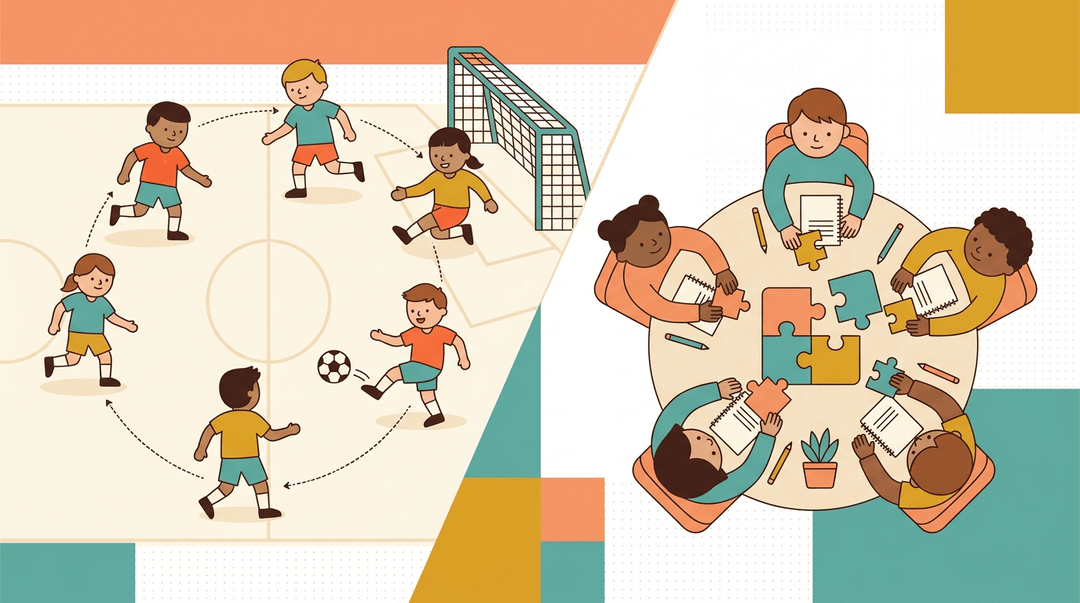
Think about a soccer team. Nobody wins a match by running around alone, and every player's role shapes the final score. A classroom works the same way when students learn together.
Working together means students share a task, rely on one another, and build understanding side by side instead of in isolation.
In this post, we'll explore what that looks like, why it helps learners, and how to set up, structure, and manage groups that actually work, plus how to teach the collaboration skills students need along the way.
What It Means When Students Work Together
When students test ideas and solve problems as a team, learning gets richer. Here's what that looks like and how to set it up.
What is it called when students work together?
Educators usually call it collaborative learning or cooperative learning. Collaborative learning is the broader idea, while cooperative learning adds structure with defined roles and a shared task.
It's less about who sits together and more about how students think together. Key elements include:
- Active learning with peers: students explain and question instead of just listening.
- Common goal focus: everyone works toward the same outcome.
- Clarifying misconceptions together: classmates catch errors before they harden.
- Thought-partner role: each student becomes a sounding board for the others.
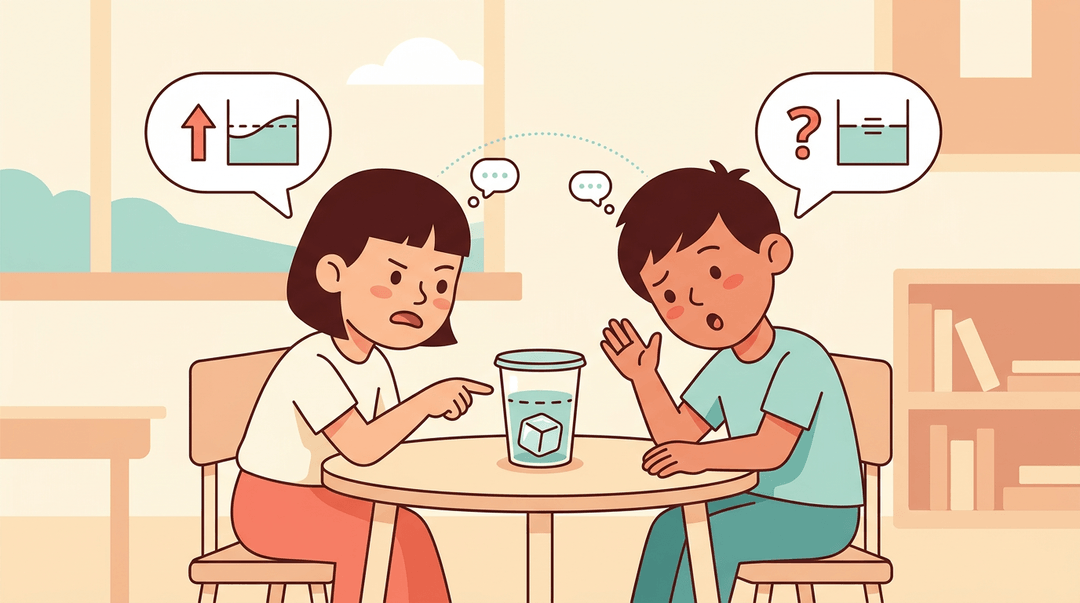
Consider a science teacher whose students predict what happens when ice melts in a sealed cup. When one student insists the water level will rise, her partner pushes back, and the misconception surfaces before the experiment starts.
Different ways to structure group work
Group work comes in several forms:
- Small group projects: teams tackle a multi-day task together.
- Discussion groups: students dig into a question or text, then report back.
- Peer review workshops: classmates give feedback on drafts or solutions.
- Pair work: two students practice a skill quickly with minimal setup.
In-class groups let you monitor and adjust in real time, while outside-class work stretches collaboration into homework and longer projects.
Virtual breakout rooms need extra structure, so assign roles and a clear task before students leave the main session.
Teaching methods built around collaboration
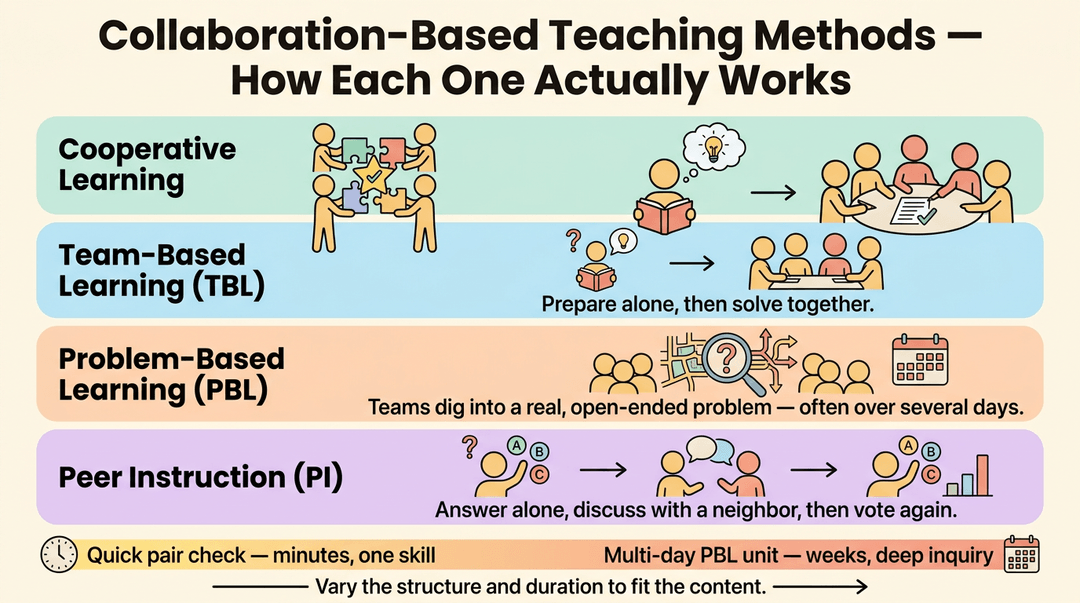
Several established models build collaboration into the lesson itself:
- Cooperative Learning: a structured approach built on shared responsibility for group success.
- Team-Based Learning (TBL): students prepare individually, then solve applied problems in teams.
- Problem-Based Learning (PBL): teams investigate an open-ended, real-world problem.
- Peer Instruction (PI): students answer a concept question alone, discuss it with a neighbor, then vote again.
Vary the structure and duration to fit the content. A quick pair check suits a single skill, while a multi-day PBL unit supports deeper inquiry.
How to Set up Student Groups
Find your setting below and use the moves that fit. Each one works on its own, so you can start with just one.
Elementary: small groups, one clear job each
Younger students do best when the group is tiny and everyone knows their part.
Start with think-pair-share. Pairs are the easiest first group.
- Pose one question and let students think.
- Say: "Think quietly for a moment. Don't talk yet."
- Have partners share with each other.
- Say: "Turn to your partner and tell them your idea."
- Call on a few pairs to share out.
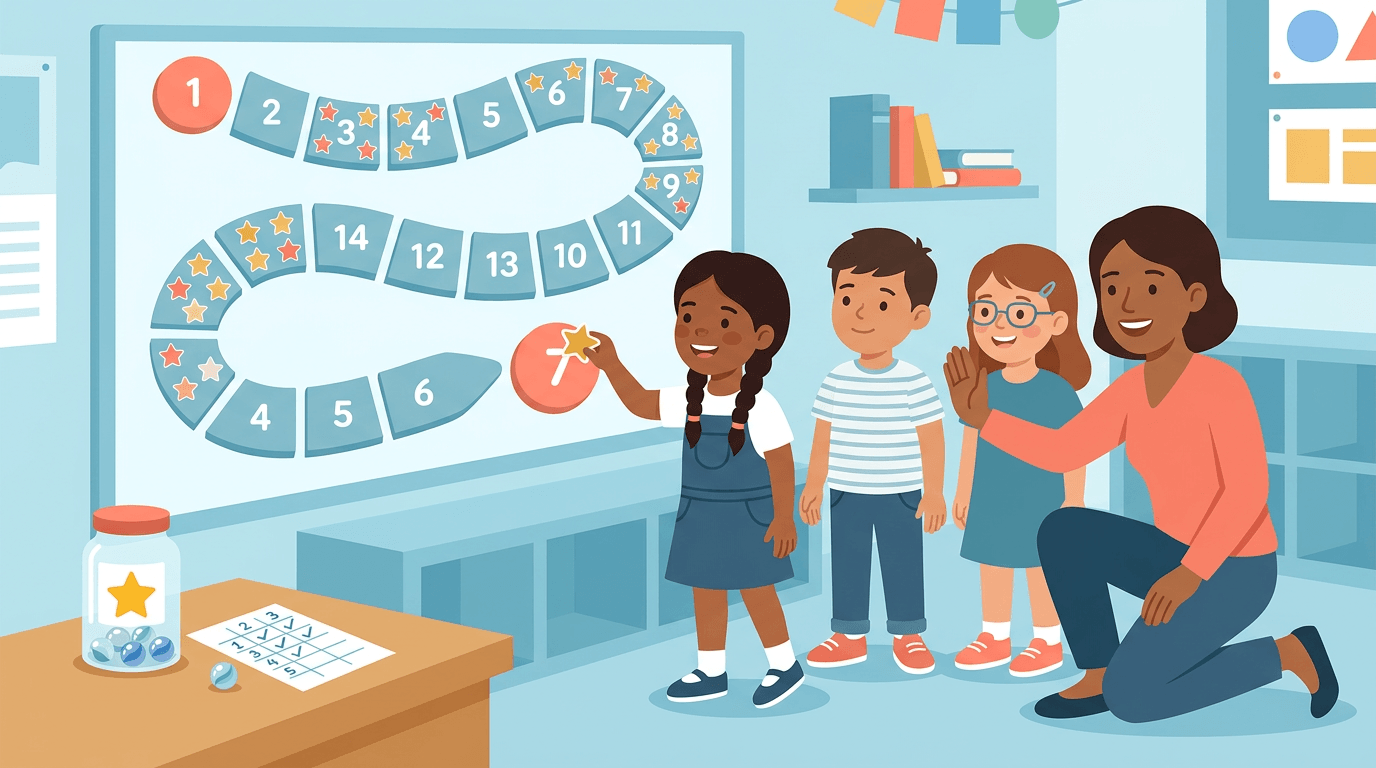
Rotate classroom jobs weekly. Every student gets a turn, and no one is stuck with the same job.
Use visual team roles. Put a picture card on each desk so students can see their job without reading it.
- Materials Manager: a picture of a box
- Reporter: a picture of a megaphone
Middle and high school: match the role to the student
Older students need roles that feel real and a grade that feels fair.
| Move | What it looks like |
|---|---|
| Assign roles by strength | Your strongest writer is Recorder; your confident speaker is Reporter |
| Grade with group rubrics | Score "shares ideas," "listens," and "finishes their part" as separate rows |
| Rotate seating for new partners | Update the chart each unit so students work with someone new |
Example: A 10th-grade science teacher gives each lab group a rubric before the lab starts. Students see that "finishes their part" is graded individually, so the quiet partner can't coast and the loud one can't take over.
Virtual classrooms: set roles before you open the rooms
- Assign online roles first.
- Name a Facilitator, a Note-taker, and a Reporter before anyone leaves the main room.
- Send groups to breakout rooms.
- Post the task and role names where students can still see them.
- Check in via chat.
- Say: "Type 'started' in the chat once your Facilitator has begun."
Substitute-ready groups
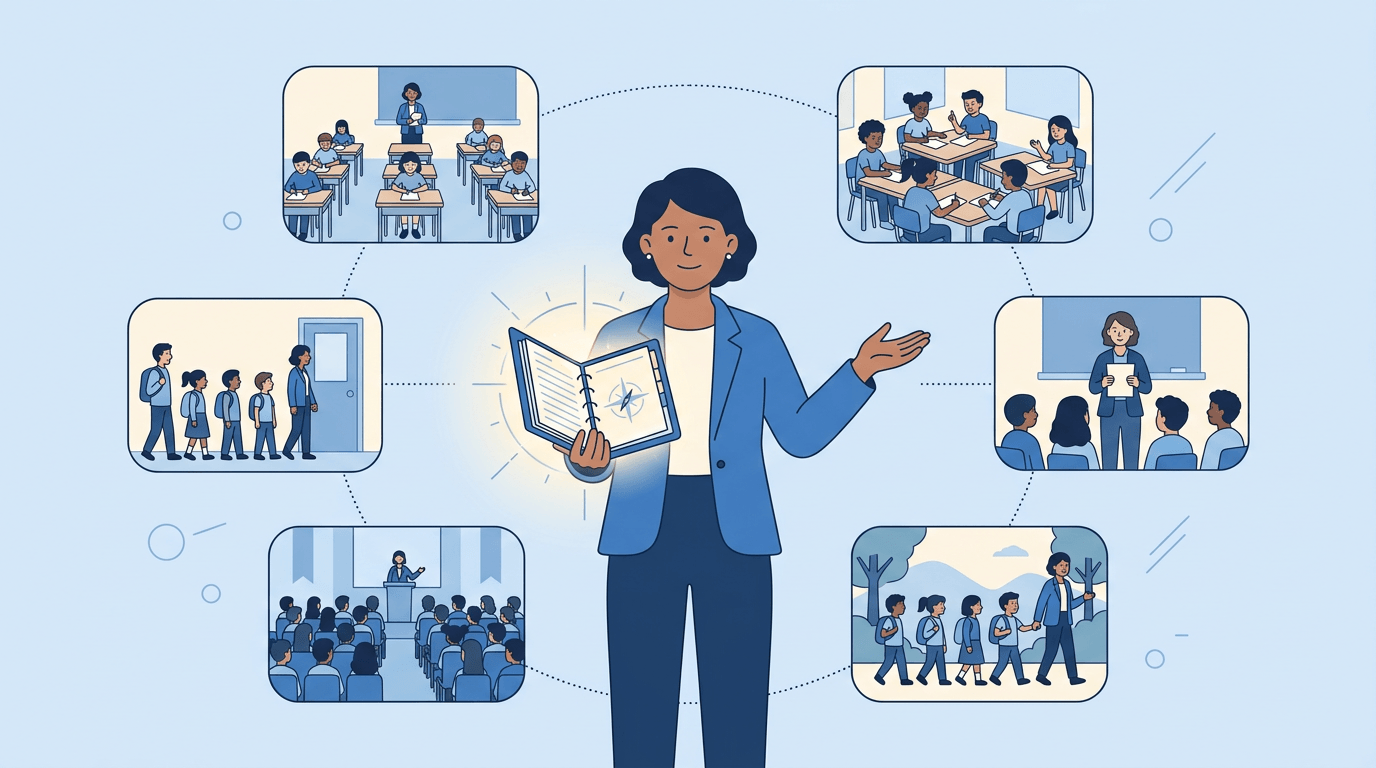
Groups should run even when you're out. Before you leave, confirm:
- Group rosters are clear. One page lists every group and each student's role.
- A visual seating chart is posted. The sub can match faces to names at a glance.
- A simple backup task is included. It needs no special materials.
- Example: "Each group writes three questions about yesterday's reading."
Build and update seating charts and class rosters in seconds with EMStudio's Class Management tool.
Why Students Benefit from Working Together
Working together builds skills no worksheet can fully teach. Here's why it matters.
Building social and emotional skills
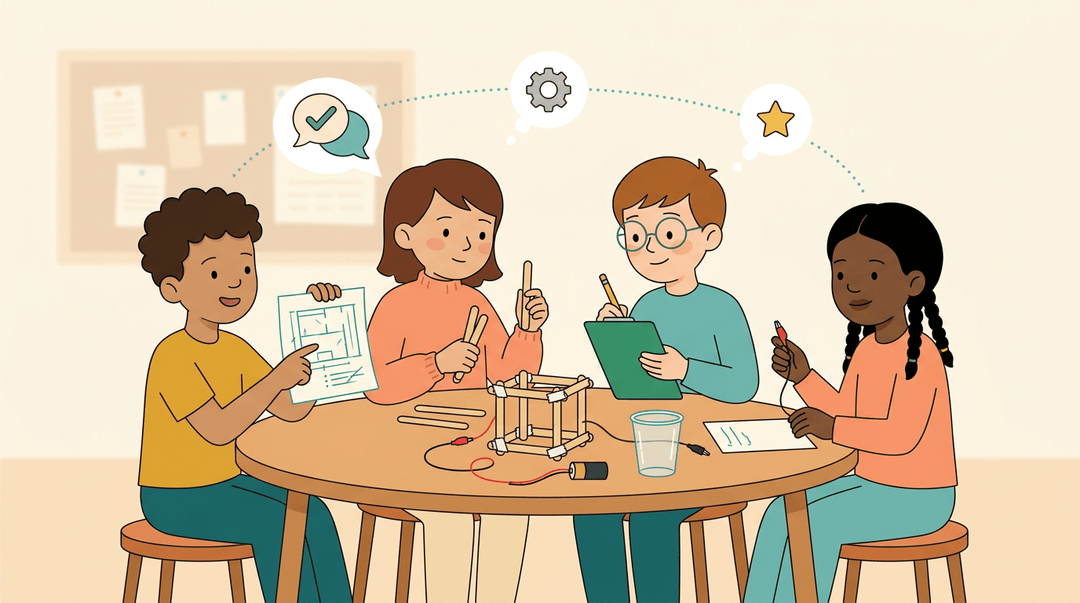
Group work asks students to make choices as a team. Picture a fourth-grade table tackling a science challenge: they agree on a plan, divide roles, and choose what to try first. They practice deciding together rather than following the loudest voice.
Those moments build decision making, problem solving, and leadership. Accountability and communication grow too, as each student's contribution shapes the group's result.
Boosting understanding through active engagement
Collaboration also deepens learning. Cornell's Center for Teaching Innovation notes that students deepen their grasp of course concepts through discussion and problem solving. Active talk beats passive listening, and that's where retention comes from.
A BMC Nursing study found that collaborative testing significantly enhanced retention of nursing concepts compared to individual testing.
Engagement rises too: a systematic review of active learning methodologies reports moderate positive effects on motivation and engagement. Age shapes the task.
A first-grade pair sorting shapes talks through each choice, while a high school biology group tests one another's hypotheses.
Building belonging through peer connections
Low-stress interaction is a big win. Think of a shy seventh grader who won't raise a hand in whole-class discussion but chats easily in a group of three. Those small exchanges help students build relationships and a sense of community.
Groups also expose them to diverse perspectives, so a classmate who thinks differently becomes a resource.
How to Structure Groups for Success
Groups don't succeed by accident. How you form them, seat them, and hand them work shapes whether students actually collaborate, so it's worth planning each piece with intention.
Choosing the right group formation strategy
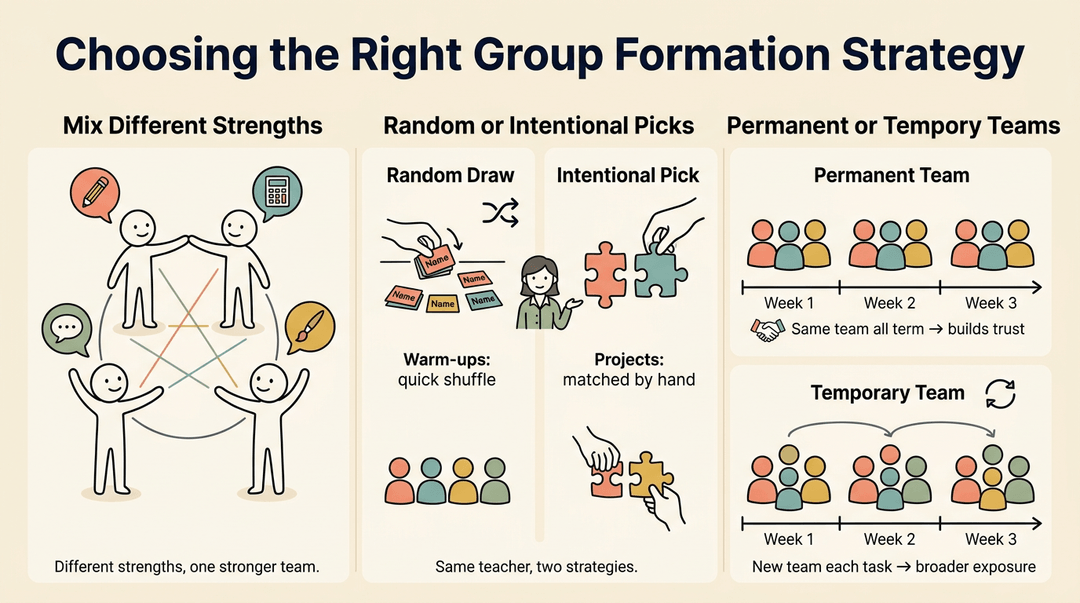
Start with heterogeneous grouping, where you mix students with different strengths, backgrounds, and skill levels. Each student brings something different, so the group has more to draw on than any one member.
You can use random draws for a quick shuffle or intentional picks when you know a pairing will work. Consider a fifth-grade teacher who randomizes groups for warm-ups but builds project teams by hand.
Decide whether groups are permanent teams that last a unit or semester, or temporary ones that change with each task. Permanent teams build trust, while temporary ones give everyone a chance to work with different peers.
Setting clear roles and expectations
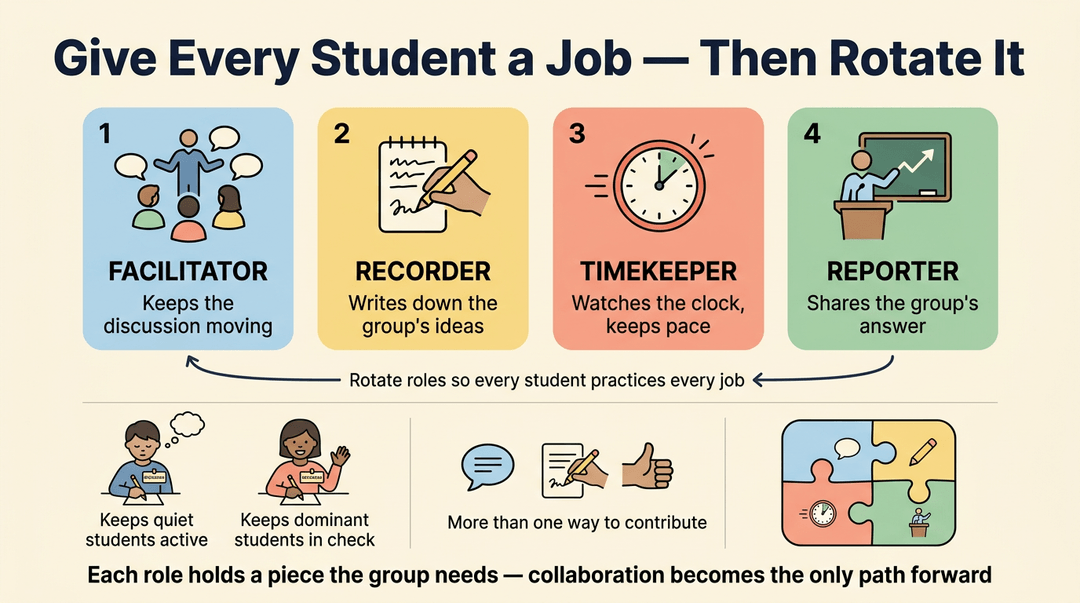
Groups without roles tend to drift, so assign defined roles like:
- facilitator
- recorder
- timekeeper
- reporter
each with a clear responsibility. Rotate them so every student practices each job. For a student who dominates or disengages, give them a specific role, such as recorder, which keeps them active without letting them run the group.
Cultural considerations matter too. Some students are uncomfortable speaking up or are used to different norms for participation, so offer more than one way to contribute. Finally, structure tasks so no one can succeed alone.
When each role holds a piece the group needs, collaboration becomes the only path forward.
Designing tasks that require collaboration
Try giving each group a single handout rather than one per student. Everyone has to look at the same page, which pulls the group together. A shared laptop strategy works the same way: one device, with the recorder typing what the group agrees on.
Look for tasks that can't be divided, where each part depends on the others. A middle school science teacher, for example, might give each group one lab sheet with questions that need data from every member, so no one can coast.
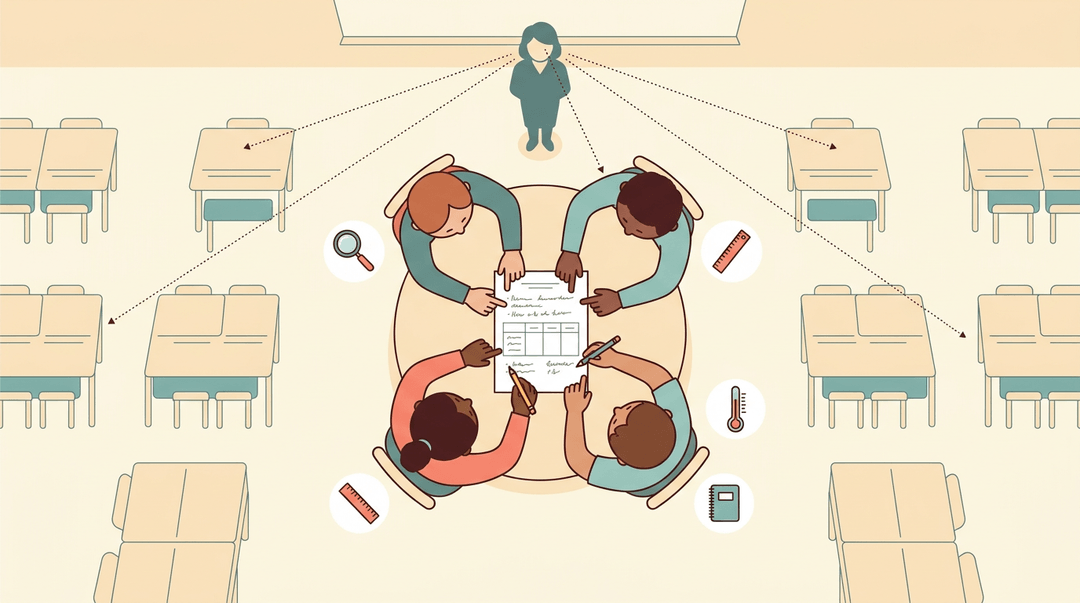
Minimizing off-task behavior starts with layout. Cluster desks so members face each other and keep walkways clear, so you can see every group from where you stand. Good structure does most of the managing for you.
Keeping Students Accountable in Groups
Students pull their weight when accountability is built into the design. Here's how to set that up.
Grading individual work versus group work
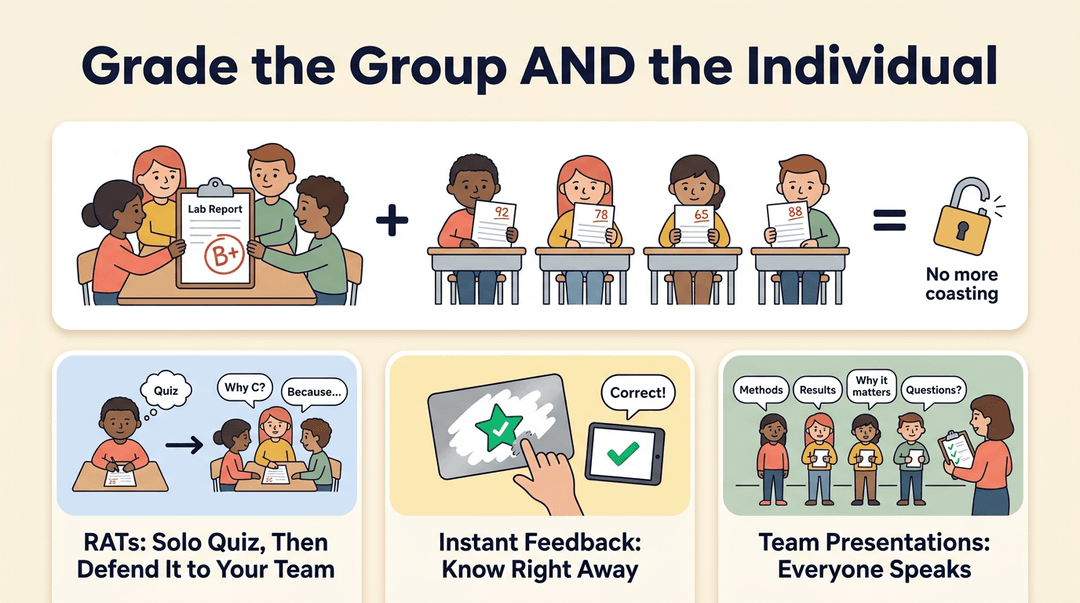
Grade both individual and group work. A middle school science teacher, for example, might score the group's lab report together, then give each student a short quiz on the procedure. Pairing the two makes coasting hard. Other tools help too:
- Readiness Assessment Tests (RATs): Students answer short quizzes alone, then retake them with their group so they must justify answers to each other.
- Immediate feedback systems: Scratch-off cards or digital quizzes tell teams right away whether an answer is correct.
- Team presentations: Every member speaks or fields questions, so the whole group is visibly accountable.
Handling conflict and group dysfunction
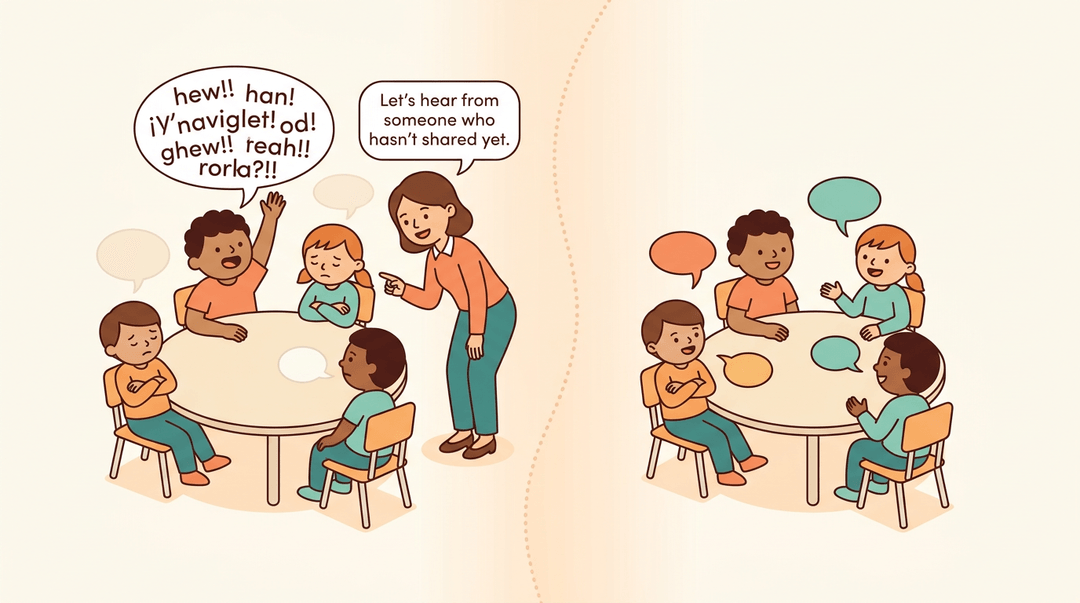
Most trouble follows a few patterns: one student dominating while others disengage, or a group that divides the work and never actually collaborates. Balance things by rotating roles and giving each student a clear job.
These scripts help you step in without scolding:
- "Thanks for that idea. Let's hear from someone who hasn't shared yet."
- "Before we move on, what does everyone think?"
- "Tell me what your teammate just said, in your own words."
A sixth-grade teacher noticed one student answering every question at her table. After using the first script, two quieter classmates joined in. That's the shift you're after.
Using peer feedback and reflection
Peer feedback works best with a simple routine: each student names one strength and one next step for a teammate. Self-assessments ask students to rate their own contribution honestly. Afterward, teams ask, "What worked, and what will we change?"
Make this a routine, not a one-time survey, so reflection becomes a habit.
Teaching Students How to Collaborate
Group work doesn't run itself, and a little planning goes a long way.
Why teamwork needs to be taught
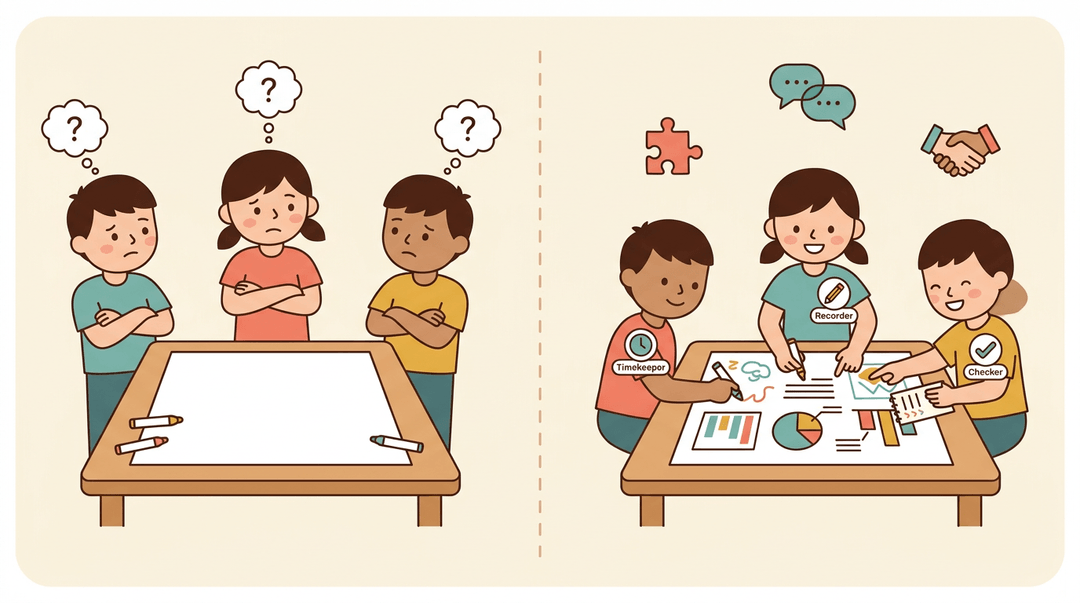
Teamwork isn't innate. Students need to learn how to split a task, disagree respectfully, and check on a classmate. A fifth-grade teacher might see three science partners each waiting for someone else to start the poster.
Teach the skill directly with explicit guidance on working together: model a conversation, post the steps, and practice before the real project.
Start small with team-building exercises, like a quick timed puzzle or a 'two truths and a lie' game, so students learn each other's strengths.
Then assign roles (timekeeper, recorder, checker, presenter) so every student has a job and equal participation becomes the default rather than a hope.
A thesis on teamwork strategies in a Chiclayo school credits Peters and Waterman (1988) with the 5 C's of teamwork, a framework of five core elements for improving collaboration.
Five examples of teamwork in class:
- Lab partners who split the procedure, data, and write-up
- Jigsaw reading, where each member becomes the expert on one section
- Peer-editing pairs that swap drafts and give two specific comments
- Math groups comparing different strategies for the same problem
- Project teams that each own one part of a final presentation
Absent that day? Leave a sub plan naming each group's roles, task, and reporting step, so a substitute can keep things moving.
When students work together well, they learn more than the content. They practice listening, sharing ideas, and taking responsibility for a shared result.
With clear roles, a sensible group structure, and some direct teaching of collaboration skills, group work becomes a powerful part of your routine instead of a source of chaos.
Ready to make group setup simpler? Check out our Class Management feature page to organize classes, rosters, and timetables in one structured workspace.
References
- Estrategias docentes para fortalecer el trabajo en equipo de una institución educativa de José Leonardo Ortiz- Chiclayo — hdl.handle.net (2023)
- Unlocking students’ potential beyond traditional exams: the influence of collaborative testing on nursing students’ retention and soft skills | BMC Nursing — link.springer.com (2025)
- Motivational Teaching Techniques in Secondary and Higher Education: A Systematic Review of Active Learning Methodologies — doi.org (2025)
- Collaborative Learning — teaching.cornell.edu
Frequently asked questions
What is it called when students work together?
When students work together to share ideas, solve problems, or complete a task, it is usually called collaborative learning. Cooperative learning is a more structured form that uses defined roles and shared responsibility for the group’s success.
What are the 5 C's of teamwork?
The 5 C’s of teamwork are communication, cooperation, coordination, collaboration, and commitment. Together, these principles support clear interaction, shared effort, organized action, productive teamwork, and responsibility for a common goal.
Why is it important for students to work together?
Working together helps students deepen understanding through discussion, explanation, and problem solving. It also builds communication, decision-making, leadership, accountability, problem-solving, belonging, and respect for different perspectives.