Classroom Culture Explained: Trust, Routines, and Belonging

Jump to section
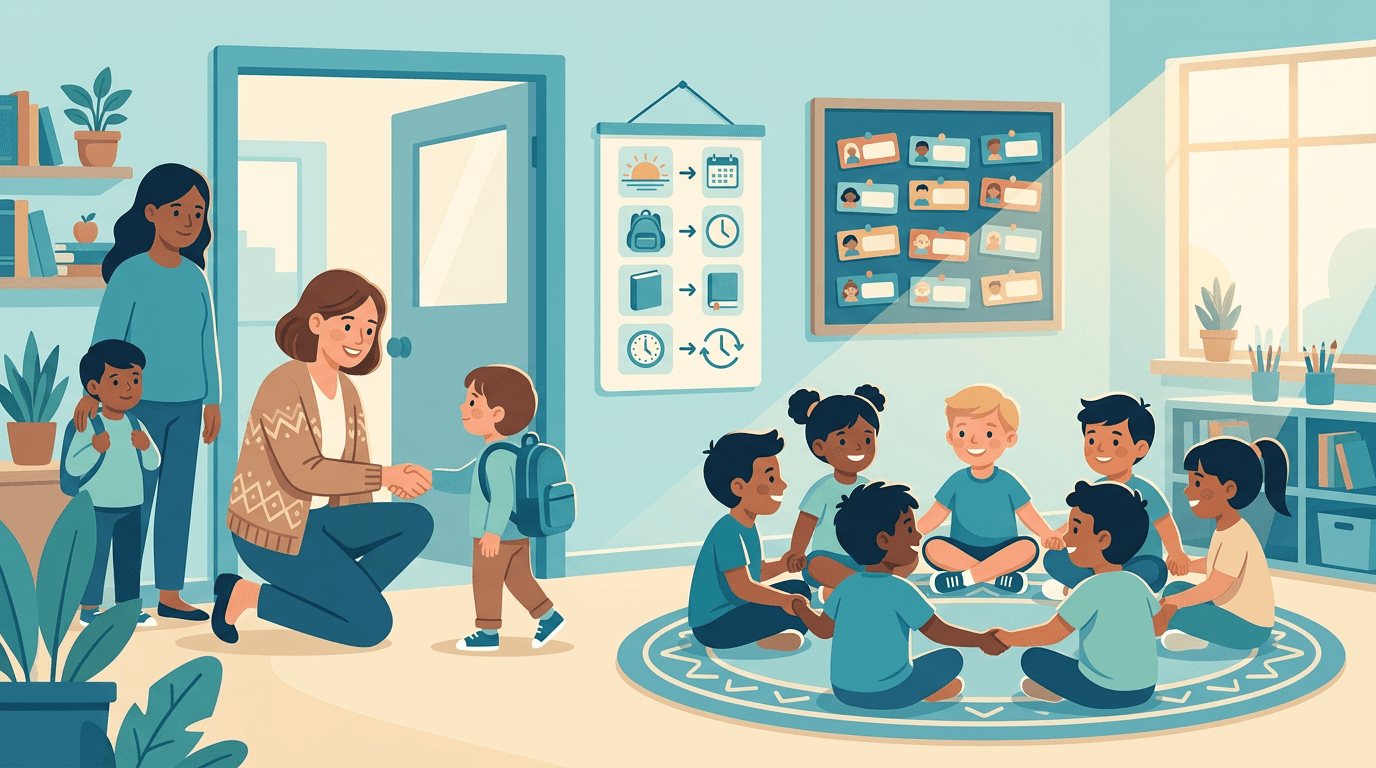
Walk into a friend's house and you can feel it before anyone says a word: tidy or chaotic, warm or tense. Classrooms work the same way.
Classroom culture is that felt sense of how a room runs, the norms, relationships, and routines that decide whether students feel safe enough to take real risks. Get it right and everything else, from lessons to behavior, gets easier.
This guide covers what actually builds that culture: trust, rituals, student voice, equity, and the systems most guides skip.
Classroom Culture and Why It Matters
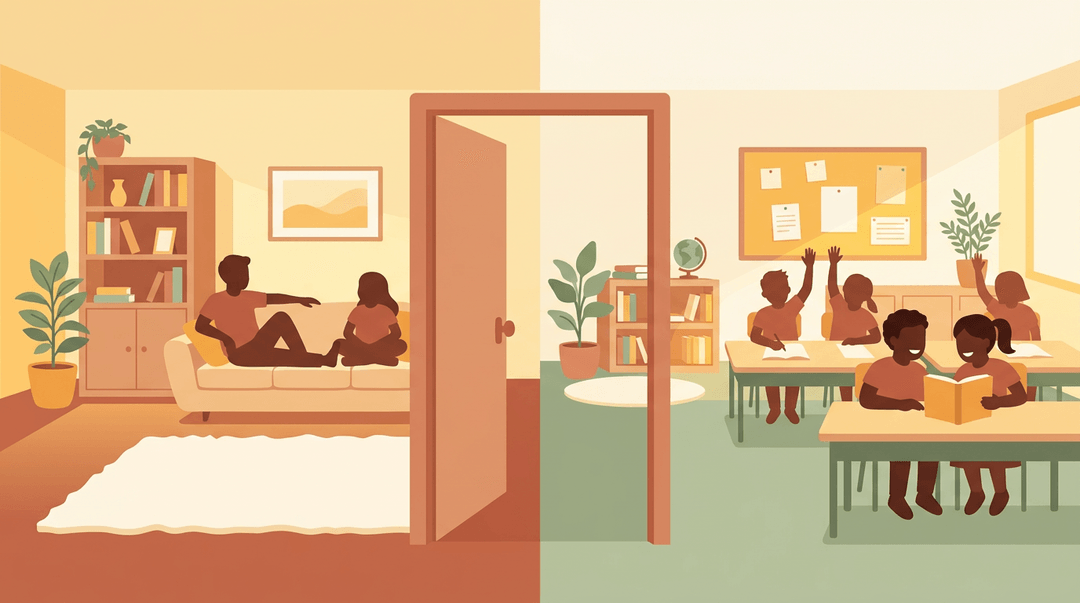
Walk into two classrooms on the same hallway and you can feel the difference before anyone says a word. That feeling has a name: classroom culture, and it's worth understanding before you try to build it.
What classroom culture really means
Classroom culture is the overall vibe of a room: what gets valued and what quietly doesn't. It shows up in the language you use, who holds which responsibilities, and the daily procedures that repeat until they become habit.
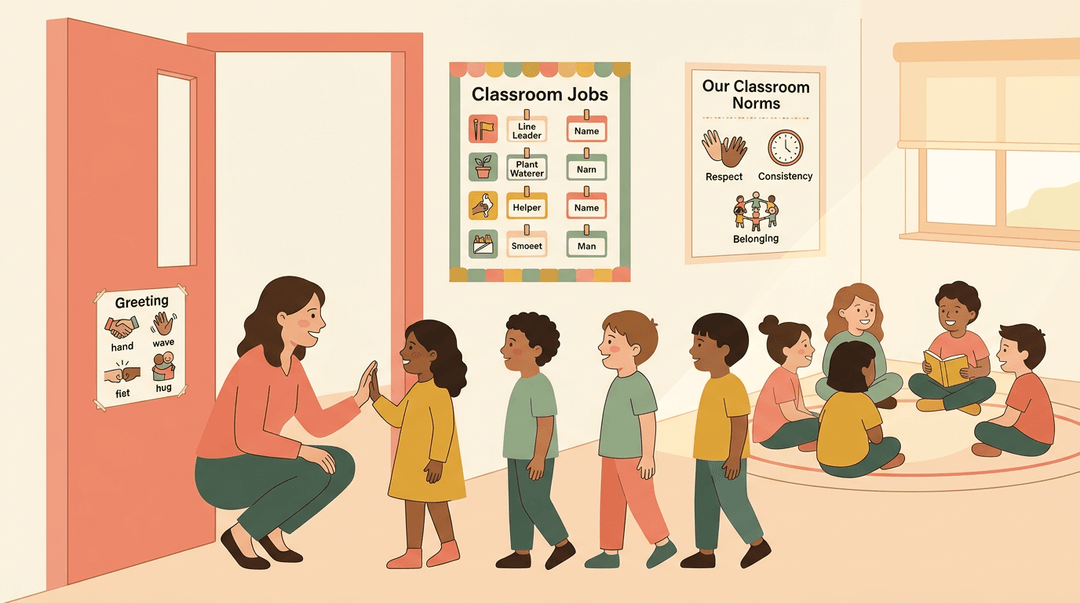
It's built on a handful of guiding principles (consistency, respect, shared ownership, clear expectations, and belonging) that show up in concrete ways, from a shared set of classroom norms to a student-run job chart or a morning greeting ritual.
Culture doesn't just happen. It takes reflection and planning, whether you're a veteran teacher or new to the room entirely.
Why classroom culture matters for learning
A strong culture drives how students connect to the content, to each other, and to you.
It supports social-emotional development and gives students the safety to take risks: raising a hand with an unsure answer, trying a problem a new way, admitting confusion out loud. None of that happens without trust.
Think of a new teacher building norms for the first time, or a substitute walking into an unfamiliar room for a single day. Culture isn't instant for either of them.
It's a long-term normalization process, built one routine at a time, in person or on a screen.
Building Trust and Relationships with Students
No classroom culture takes root without trust, and trust isn't built in one big gesture. It's built in dozens of small, repeated moments.
Start each day with a warm welcome
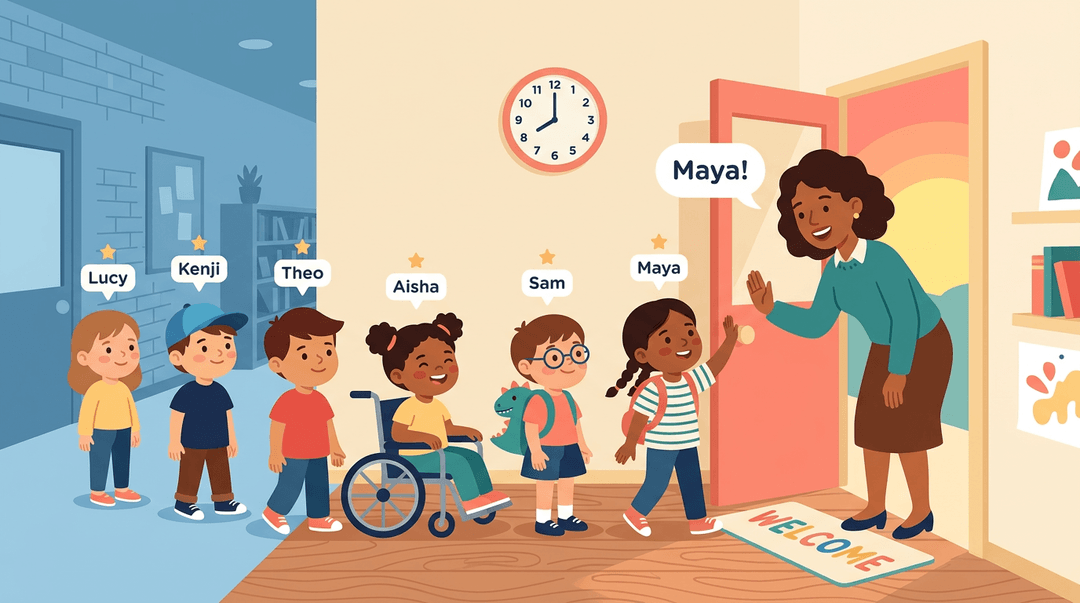
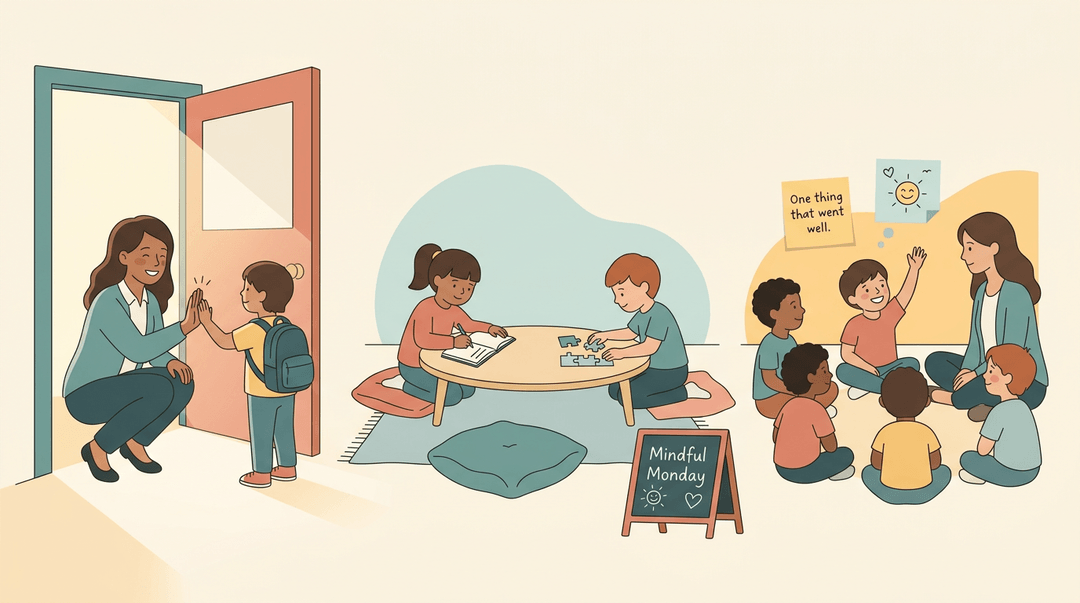
Stand at the door every morning. A quick high-five, a genuine smile, a name spoken out loud: these tiny rituals tell each student they were noticed before the lesson even starts.
Think of a fourth-grade teacher who greets all thirty-two kids by name at the threshold, rain or shine. That consistency matters more than any single greeting.
Skip the favorites, too: a de-siloed greeting means every student gets the same warmth, not just the ones who make it easy.
How to earn your students' trust
Trust isn't handed to you because of your title. You earn it.
- Listen without judgment when a student opens up, even about something messy.
- Keep your promises: if you say you'll check in after lunch, do it. That kind of follow-through builds integrity in a student's eyes faster than any lecture on respect.
- Show genuine interest, too. Ask about a student's weekend soccer game or their new puppy, and actually remember the answer next time.
Getting to know students and families
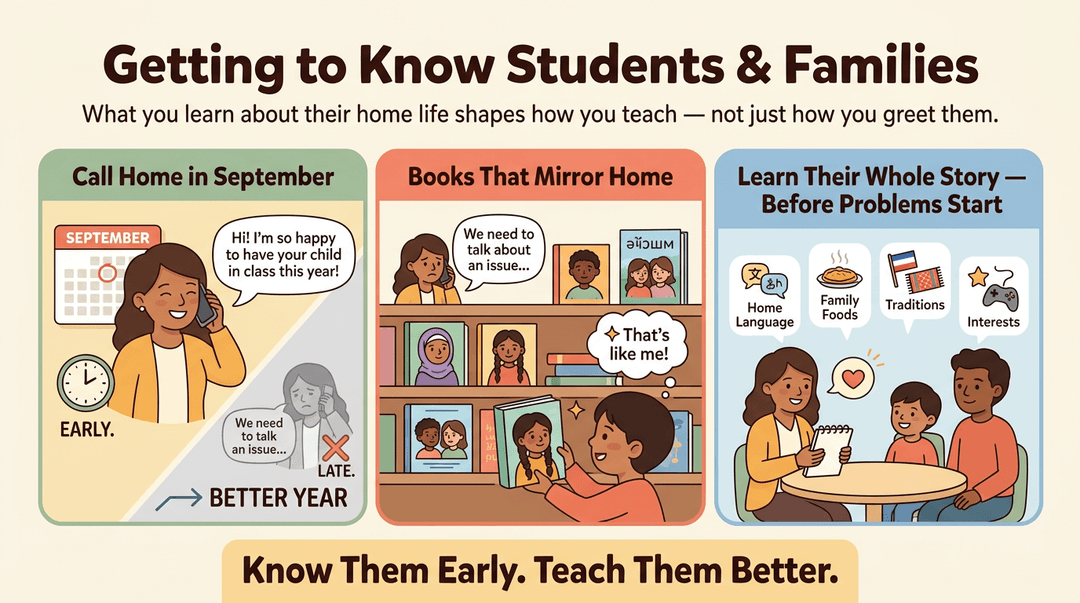
Learning a student's home culture and background shapes how you teach them, not just how you greet them.
- Get to know families early, not just when there's a problem.
- Stock your shelves with culturally relevant books so students see themselves in what they read.
- A quick, friendly call home in September (before anything's gone wrong) sets a tone families remember all year.
Creating Routines, Rituals, and Systems
Principles set the tone, but routines are what students actually feel. The small, repeated moments (how a day opens, how a line forms, how a week closes) build the predictable rhythm that lets a classroom feel safe enough to take risks.
Daily routines that anchor the day
Think of a second-grade teacher who greets every student at the door, then opens with a soft landing: quiet journaling or a puzzle instead of diving straight into math. That low-demand start settles nerves before the day asks anything hard.
Themed days like Mindful Monday give the week a shape, and a short end-of-day reflection, even just "one thing that went well," closes the loop so nothing carries home unprocessed.
Keeping procedures consistent and clear
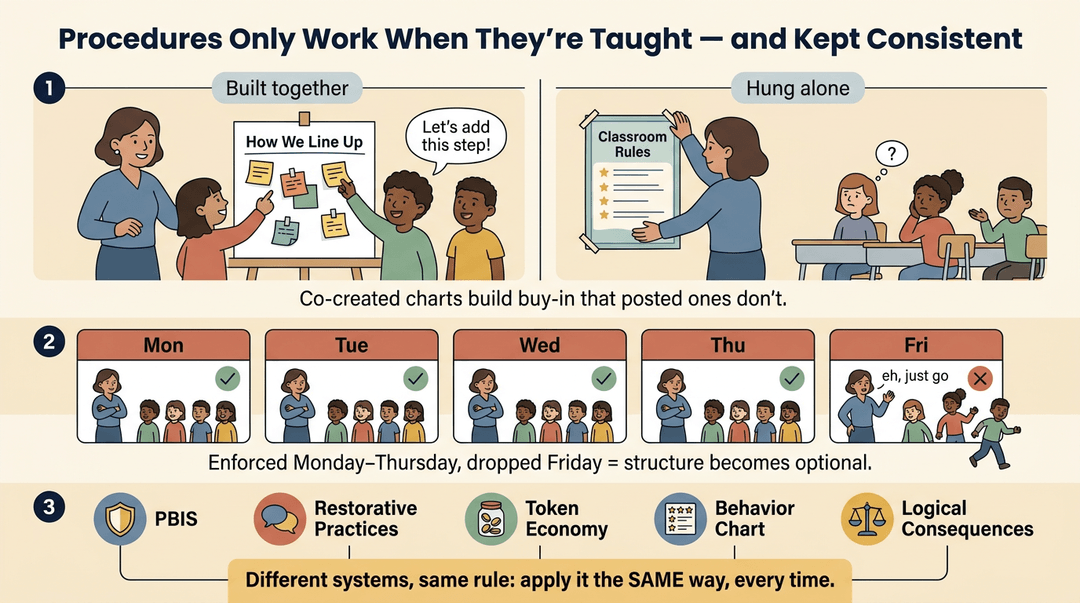
Lining up, taking attendance, grabbing materials: these only work when they're taught, not assumed. Co-creating an anchor chart with students for a tricky procedure builds buy-in they won't get from a poster you hung alone.
Even a seating chart sends a message about who belongs where. None of it holds, though, without consistency from the teacher: a procedure enforced on Monday and ignored on Friday teaches students that structure is optional.
The same goes for behavior frameworks like PBIS (Positive Behavioral Interventions and Supports), restorative practices, and conscious discipline, along with systems like token economies, behavior charts, and logical consequences: they only build trust when applied the same way, every time.
Adding joy and play to transitions
A silly class song, a themed transition (tiptoeing like spies to the rug), or a call-and-response attention signal turns a logistical moment into a shared joke.
Playing music during cleanup does the same work: it makes a chore feel like a countdown, not a punishment.
Weekly check-ins and reflection time
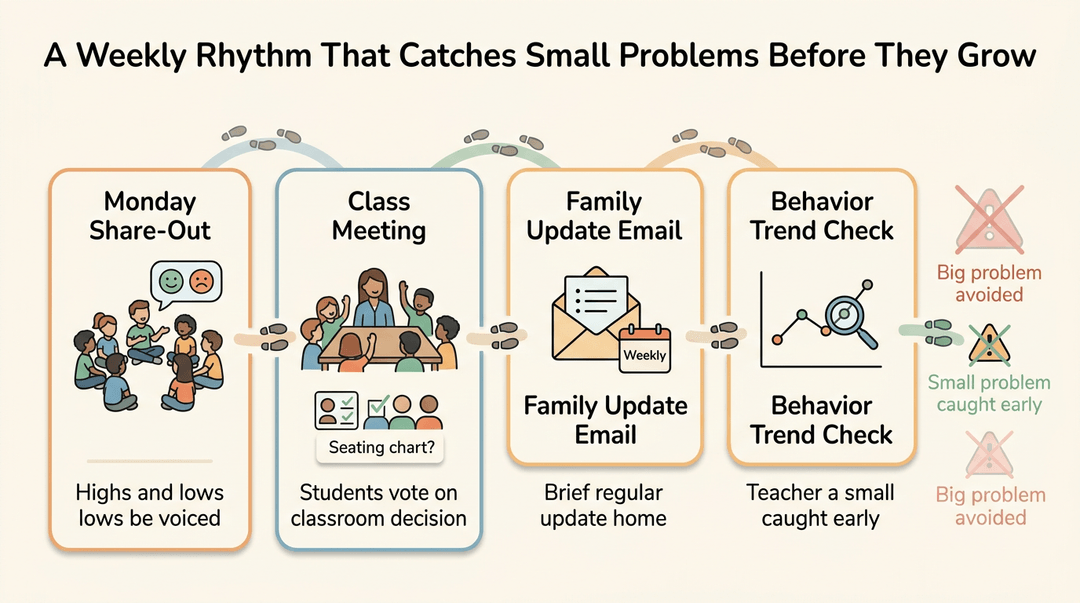
A Monday share-out or an advisory highlight/lowlight gives students a regular outlet for their voice, and a class meeting lets them weigh in on decisions that affect them.
Pair that with a short weekly email update to families and a quick look at behavior trends, and you've got a rhythm that catches small problems before they become big ones.
Building Classroom Culture Step by Step
Culture isn't a poster; it's a set of routines you build deliberately and maintain on a schedule. Here's the full build, from the week before students arrive to month three and beyond.
Before day one: prep your anchors
Before students walk in, confirm these four things exist on paper:
- Seating chart drafted. Pods of four, every seat facing the board, aisles clear.
- Welcome routine ready. You at the door, greeting each student by name, every day.
- Classroom jobs listed. Line leader, materials manager, tech captain, board eraser.
- Class agreements drafted. Three to five lines, in student language, deliberately unfinished.
A draft worth bringing: We listen when someone's speaking. We ask before we borrow. We fix what we break.
Leave the agreements as a draft on purpose: students finish them in week one, and finishing is what makes them theirs.
The first week: teach it, don't announce it
- Teach procedures explicitly, one at a time.
- Model entering the room, have students practice, then rerun it.
- Say: "Show me what entering looks like. Let's try it again."
- Co-create norms from your draft.
- Try: "What do you need from each other to do your best work here?"
- Add their answers to your draft, then post the final version where everyone sees it.
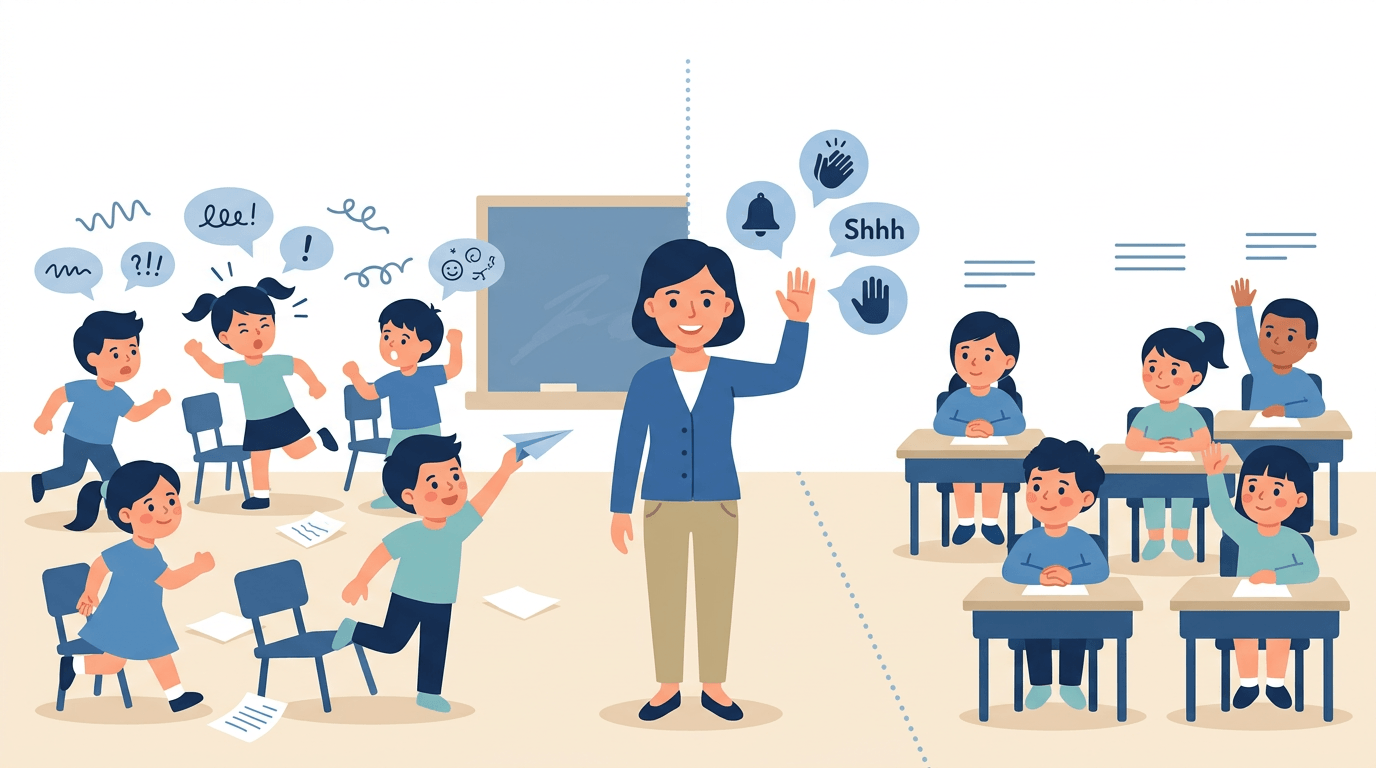
- Introduce one attention signal.
- A clap pattern or "give me five": practice until the room responds in under five seconds.
- Start the morning meeting routine.
- Greeting, one share question, one quick activity. Ten minutes, same order, every day.
⚠️ Watch out: When a procedure breaks down in week one, re-teach it; don't punish it. Students can't follow a routine they've only heard described once.
Month to month: maintain the rhythm
Culture fades without a maintenance schedule. Put these four moves on a recurring cadence:
| Cadence | Move | What it looks like |
|---|---|---|
| Weekly | Run check-ins | Friday exit ticket: "one win, one worry" |
| Weekly | Track behavior patterns | Tally incidents by time and transition; fix the transition, not the kid |
| Monthly | Refresh the calm-down corner | Swap worn tools, re-teach the timer, update the feelings chart |
| Ongoing | Update the family communication log | Columns for date, student, topic, and follow-up needed |
Fit it to your grade and setting
The build is the same everywhere; the anchor ritual changes with your students:
- Elementary: rotate class jobs weekly. Post the rotation chart; every student holds a job each month.
- Middle school: run advisory circles. One prompt, a talking piece passes; everyone speaks or passes aloud.
- High school: let students lead the norms. They draft, debate, and vote; you sign the document alongside them.
- Virtual or subbing: open with a digital check-in. An emoji poll or chat waterfall: "Type one word for your morning."
However you adapt it, the paperwork shouldn't be the hard part: keep rosters, seating charts, and behavior notes organized in one place with EMStudio's Class Management tools.
Giving Students Voice and Ownership
A classroom culture takes root when students feel like co-authors of the room, not just occupants of it. Voice and ownership turn passive sitting into active belonging.
Asking better questions in class
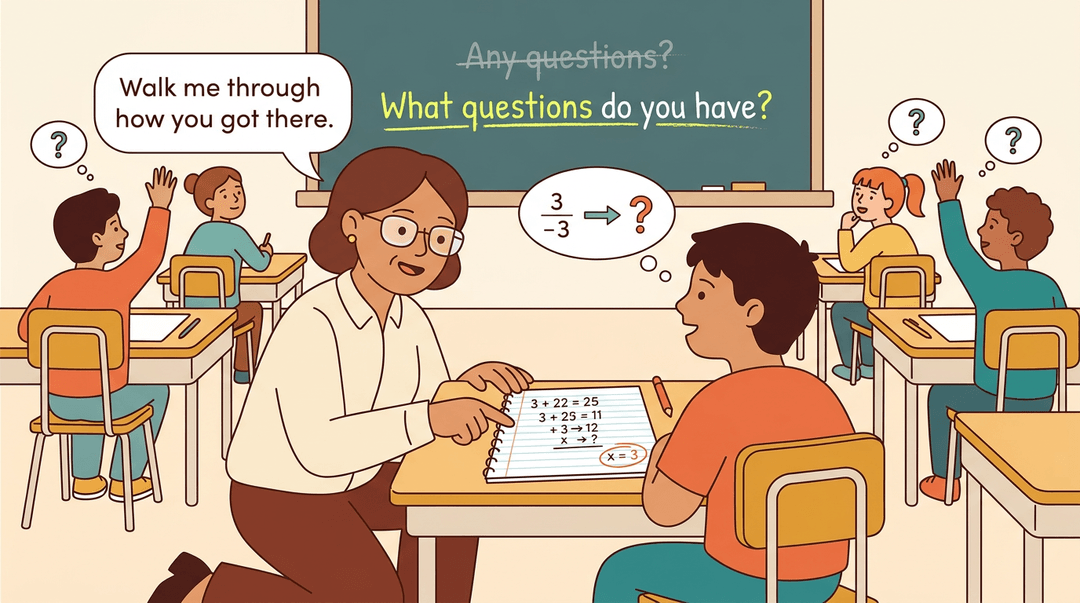
Swap "any questions?" for "what questions do you have?" The first invites silence; the second assumes curiosity exists and just needs an opening. Push further by asking students to share their thinking out loud, not just their answer.
Consider a middle school math teacher who asks, "Walk me through how you got there," even when the answer's wrong. That one habit values process over the right answer, and it tells students that reasoning matters more than guessing correctly.
Making it safe to take risks
Mistakes need to be normalized as learning, not something to hide. Low-floor, high-ceiling tasks (problems anyone can start but that stretch further for those ready to go deeper) give every student an entry point without a ceiling on growth.
Teachers can model this by naming their own mix-ups out loud: a teacher who says "I misspoke, let's fix that together" shows vulnerability is safe here too. That honesty builds a space where authenticity, not performance, is the norm.
Handing students responsibility and leadership
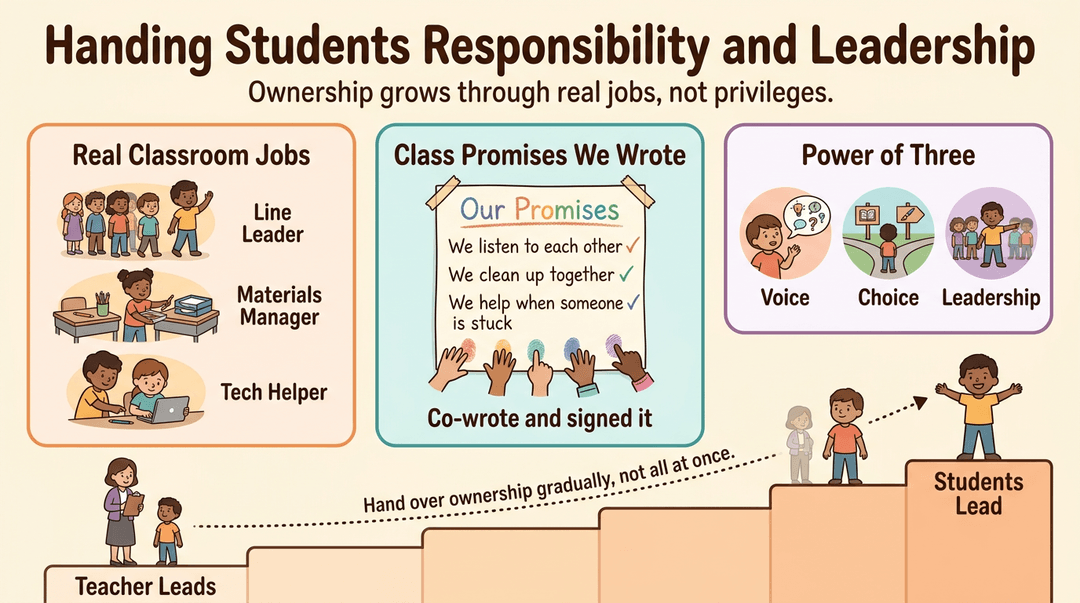
Ownership grows through real jobs, not just privileges. Classroom roles (line leader, materials manager, tech helper) give students a stake in how the room runs.
Co-creating norms, sometimes framed as class "promises," works the same way: students keep agreements they helped write.
The Power of Three framework (voice, choice, and leadership for every student) builds this habit deliberately, and it works best when ownership is handed over gradually, not all at once.
Creating classroom norms together
When students help write the classroom agreements, they're far more likely to live by them. Build this in a few ways:
- Invite input on rules before finalizing them.
- Encourage peer discussion and questions during the process, not just teacher-led talk.
- Rotate leadership roles so every student, not just the confident few, gets heard.
The result isn't just a tidier room. It's a culture students actually helped build.
Inclusion, Belonging, and Equity in Class
A classroom only feels fair when every student can see themselves in it. That means building habits that make room for different backgrounds, abilities, and starting points, not just posting a poster about kindness.
Making every student feel they belong
Culturally and linguistically responsive practices matter here: a teacher who learns how to pronounce every name correctly and weaves students' languages and traditions into lessons sends a quiet, constant signal that everyone belongs, not just the majority.
Anti-ableist strategies matter just as much. Think of a teacher who builds in flexible seating, extra processing time, and multiple ways to show understanding before any student asks for it, not after.
Holding high expectations for all students rounds this out. Lowering the bar for some students doesn't protect them; it tells them you doubt them.
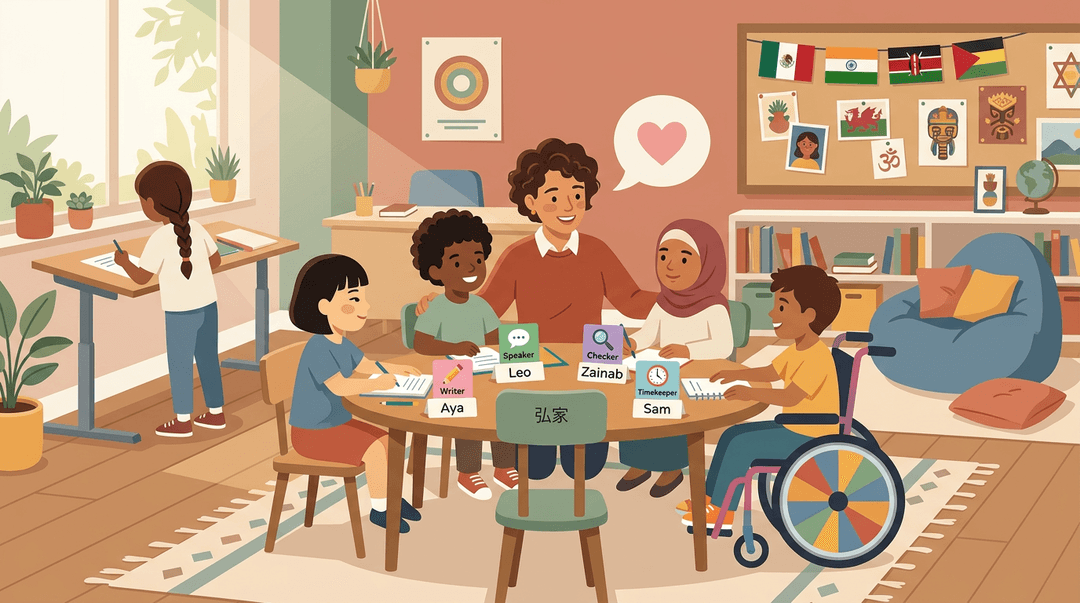
Structured cooperative group work gives those expectations somewhere to live: assign clear roles, mix students deliberately, and watch a struggling reader contribute in ways a worksheet never lets them.
Using 'we' language to build community
Words shape culture faster than rules do. Swapping "my class" for "we," "us," and "our" turns the room into something students help run, not something done to them.
Many teachers make this concrete with a class promise: a short set of agreements students help write and then sign, creating a real sense of shared ownership instead of a list handed down from the front of the room.
The payoff is a community where students act as collaborative partners in their own classroom, not passengers in it.
Mindfulness and Emotional Regulation in Class
A classroom's culture shows up most clearly on the hard days, when a student melts down or the whole room gets jittery before lunch.
Setting up a calm-down corner, a quiet spot with a cushion, a sand timer, and a few fidget tools, gives students somewhere to reset before a feeling turns into a disruption.
Starting the day with mindful breathing
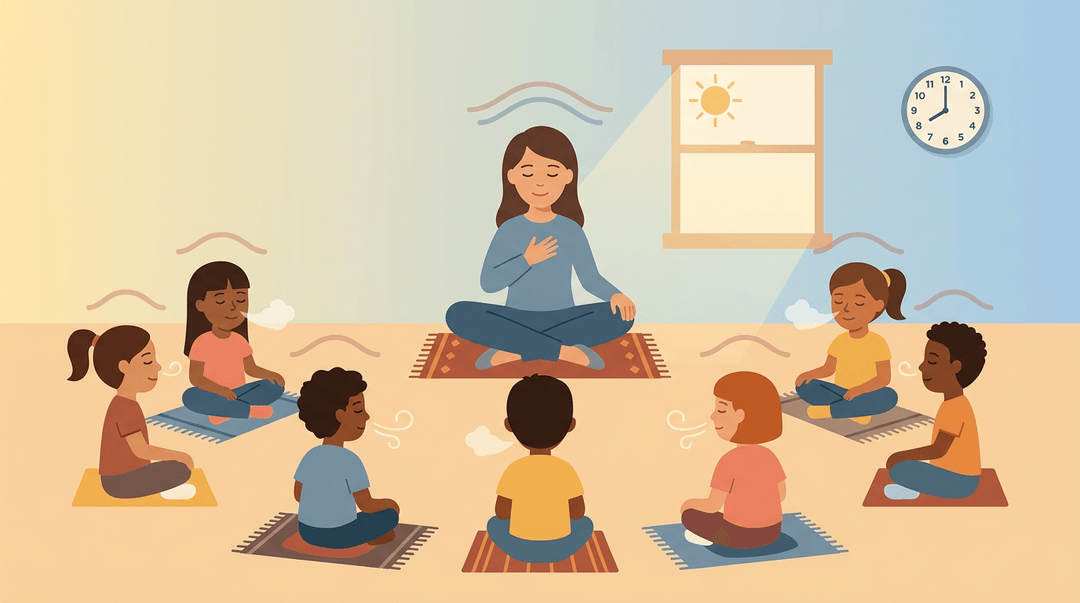
Think of a fourth-grade teacher who opens every morning with a one-minute centering exercise: lights dimmed, everyone breathing slowly in through the nose and out through the mouth.
That mindful minute doesn't need any special training or equipment, just a consistent slot in the morning routine.
It's also backed by research. A systematic review of breathing interventions found that pairing faster breathing with slower paces or holds reliably reduced stress and anxiety across every intervention studied.
For students walking in anxious or wound up, that minute of guided breathing can be the difference between a rocky start and a focused one.
Adults need to do the exercise too, not just narrate it. When you breathe along with your students instead of just counting off seconds, you show them what regulation actually looks like in the body.
Modeling calm for your students
Calm is contagious, and so is panic. If you snap at a disruption, the room's energy spikes with you; if you stay steady, students borrow that steadiness.
That doesn't mean pretending everything's fine. Acknowledge hard moments out loud: "That was a tough transition, let's take a breath and try again."
Model labeling your own emotions ("I'm feeling frustrated right now") so students learn the language for their own.
A simple feelings chart posted near the calm-down corner gives younger students a visual way to point to what they're feeling when words don't come easily yet.
Engaging Families in Classroom Life
Classroom culture doesn't stop at the door. Families are part of it too, and a little consistent outreach builds the same sense of belonging you're working to create inside the room.
Keeping families in the loop
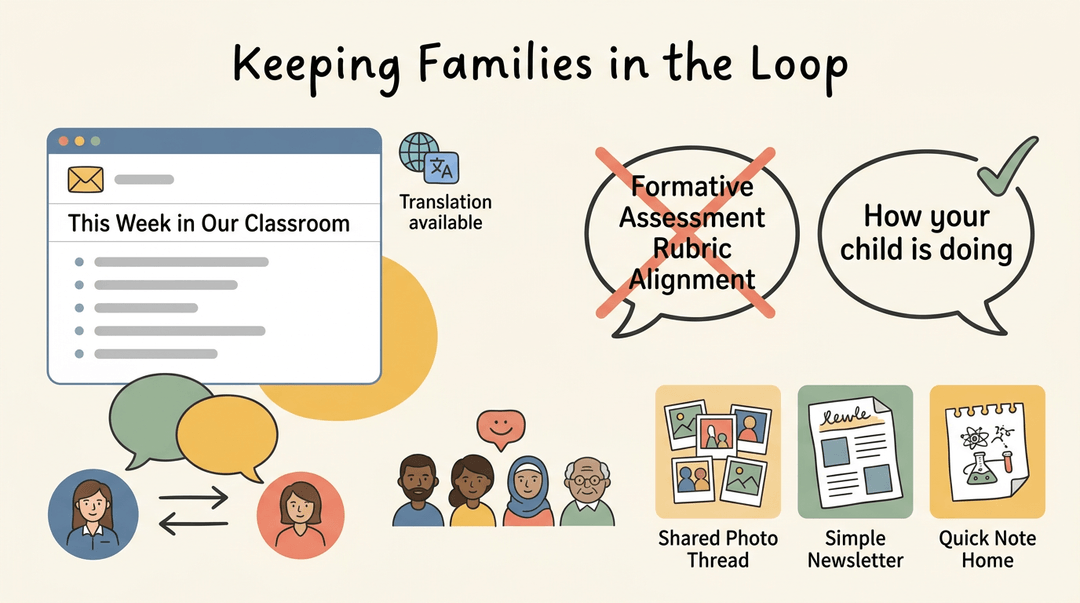
A short weekly update email, even five bullet points, keeps parents in the loop on what's happening and why it matters. Make communication two-way: offer translation for families who need it, so language is never the reason someone misses an update.
Skip the jargon, too. A note about "formative assessment" shouldn't need a decoder ring, and staying mindful of cultural differences in how families expect to hear from you goes a long way. Invite families to follow along with everyday classroom life:
- a shared photo thread
- a simple newsletter
- or a quick note home after a fun project
Bringing families into classroom life
Welcome every family configuration you encounter:
- two parents
- one
- grandparents raising grandkids
- foster families
Early in the year, ask families directly about their child's strengths and needs; a short survey works fine. Consider a parent working night shifts who can't make a 9 a.m. conference.
Address that barrier before it becomes one, with evening calls or flexible windows instead of a missed meeting.
Building trust early means families already feel like partners by the time a harder conversation comes up, not strangers you're meeting for the first time.
Supporting Staff Well-Being and Behavior
Classroom culture isn't just something you build for students. It's something a school builds with its teachers, and that means protecting the people doing the day-to-day work of caring for kids.
Taking care of teacher wellness
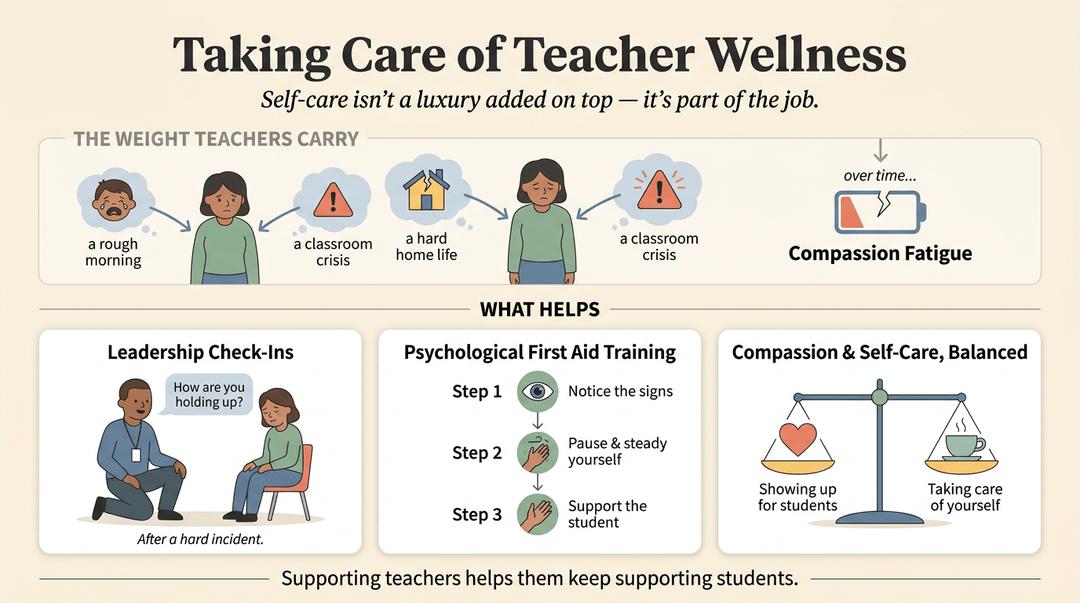
Teachers absorb a lot: a student's rough morning, a hard home life, a crisis that spills right into the lesson. Over time, that adds up.
Deliberately supporting teacher wellness reduces compassion fatigue, according to a study published in School Mental Health, which treats self-care as part of the job, not a luxury layered on top of it.
A few things help:
- Leadership check-ins after a crisis. A quick, genuine "how are you holding up?" from a principal or coach after a hard incident tells staff their well-being matters too.
- Psychological first aid training, so teachers know how to steady themselves and their students the moment something goes wrong.
- A conscious balance between compassion and self-care: showing up for students without quietly running yourself empty.
Moving away from exclusionary discipline
The old playbook of removing a struggling student from the room is losing ground, and for good reason. Schools are shifting toward:
- Avoiding restraint and isolation whenever possible.
- Proactive behavior support that heads off a blow-up before it starts.
- De-escalation training for staff.
- Trauma-informed responses that ask what happened to a student, not just what's wrong with them.
Taken together, these shifts protect students and the teachers holding the room together.
Technology and Digital Culture in Class
Classroom culture doesn't stop at the classroom door anymore. How you handle screens, apps, and online spaces shapes how students treat each other and themselves, both logged in and logged off.
Using a class social media account
Consider a fifth-grade teacher who opens a class Instagram account just for her students' projects and celebrations. It becomes a running highlight reel: book reports, science fair volcanoes, a shy student's first solo presentation.
Parents get a window into the room, and students get recognition, not just a grade on a rubric.
Used well, a class account does two jobs at once. It lets you showcase student work in a way a folder sent home never could, and it gives you a live, low-stakes space to model digital citizenship:
- commenting kindly
- crediting classmates
- thinking before posting
When a student types something careless in the comments, that's a real teaching moment, not a hypothetical one.
None of this works without a plan for privacy, though. Get parent permission or signed waivers before a single photo goes up, and keep a clear list of which students can't be pictured or named.
Many families aren't comfortable with their child online, and that's worth respecting without pressure. A class account should feel like an invitation into your culture, never an obligation families didn't sign up for.
Classroom culture isn't one big initiative. It's dozens of small, consistent choices: how you greet students, how you handle a rough morning, how you make room for every voice in the room.
Build it intentionally, and the ripple effects show up everywhere, in behavior, engagement, and how safe students feel to try something new.
Ready to bring more structure to the systems behind that culture? Check out our Classroom Management feature to organize your classes, rosters, and routines in one place.

References
- Breathing Practices for Stress and Anxiety Reduction: Conceptual Framework of Implementation Guidelines Based on a Systematic Review of the Published Literature — pmc.ncbi.nlm.nih.gov
- Compassion Fatigue in Swedish Teachers: Reduced Compassion and the Role of Teacher–Student Interaction Quality and Professional Self-care | School Mental Health — link.springer.com
Frequently asked questions
What are the five principles of classroom culture?
The five principles of classroom culture are consistency, respect, shared ownership, clear expectations, and belonging. They shape how students interact, how responsibilities are shared, and how safe students feel participating and taking risks.
How do you build classroom culture?
Build classroom culture through consistent routines, trusting relationships, clear expectations, student voice, and inclusive practices. Greet students warmly, teach and practice procedures, co-create class agreements, provide meaningful responsibilities, normalize mistakes, communicate with families, and regularly reflect on what is working.
What are some examples of culture in the classroom?
Examples include greeting students by name at the door, starting with a morning meeting or soft landing, using a calm-down corner, co-creating classroom agreements, rotating student jobs, holding class meetings, using call-and-response signals, playing music during cleanup, and ending the day with reflection. Culturally relevant books, flexible ways to show learning, and structured cooperative groups are also examples of an inclusive classroom culture.