Calm Down Corner: The Complete Guide to Setup and Use

Jump to section
Think about the last time you felt overwhelmed. Maybe you stepped outside for a breath, or sat quietly until your shoulders unclenched. Kids need that same release valve, just smaller and closer at hand.
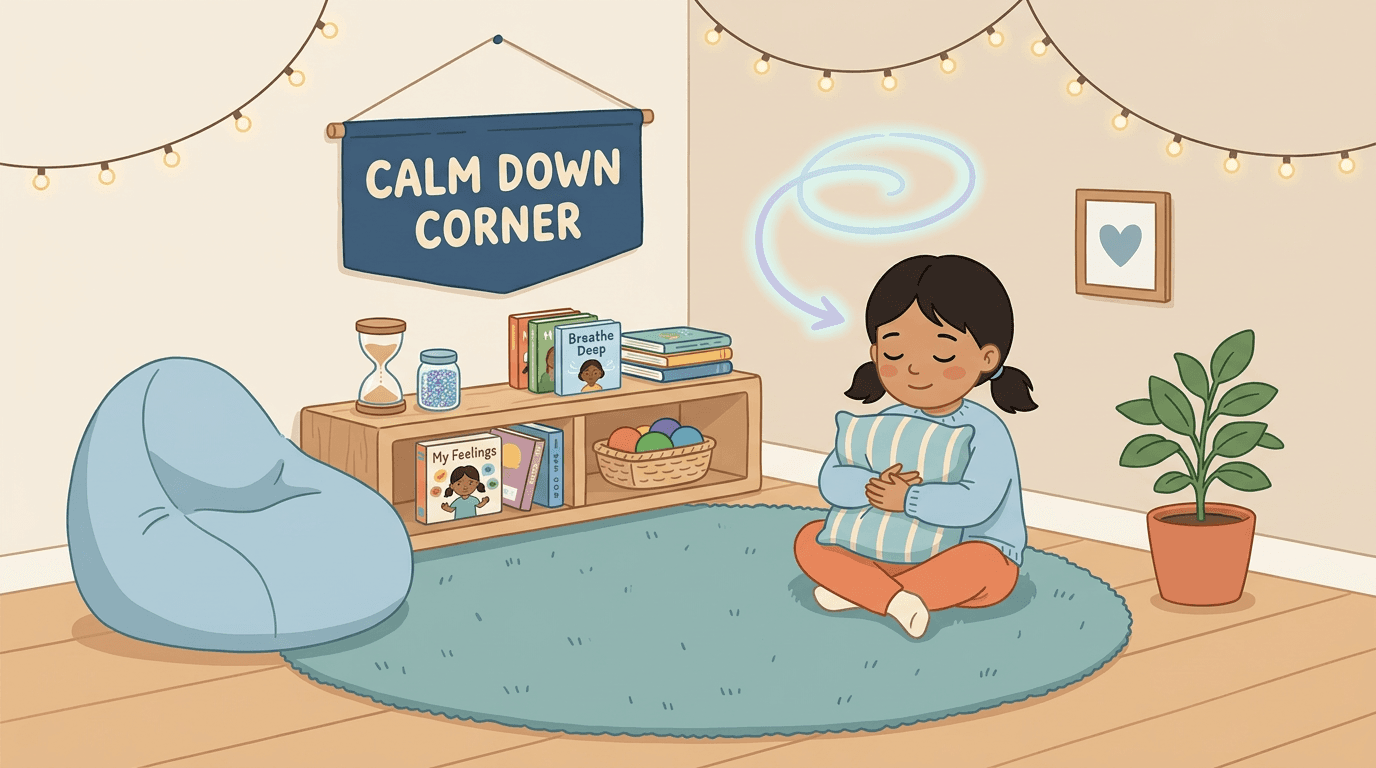
That's exactly what a calm-down corner is: a designated classroom space where a student can self-regulate before big feelings turn into big disruptions.
In this post, we'll walk through setup, tools, rules, coping skills, the sensory science behind it, and a rollout checklist you can actually use Monday morning.
What a Calm Down Corner Is
A calm down corner is exactly what it sounds like: a small, dedicated spot in the classroom set aside for a student to pause and reset. It's not a punishment and it's not time-out.
Think of it as a personal bubble where a student can step out of the noise and get their footing back.
A Safe Spot to Pause and Reset
The core idea is simple. When a student feels overwhelmed, a calm down corner gives them somewhere safe to go instead of melting down at their desk. It's a short break from big emotions, not an escape from class.
For a first grader who's just been told no for the third time that morning, thirty seconds in a quiet corner can be the difference between a meltdown and a reset.
Do Calm Down Corners Work?
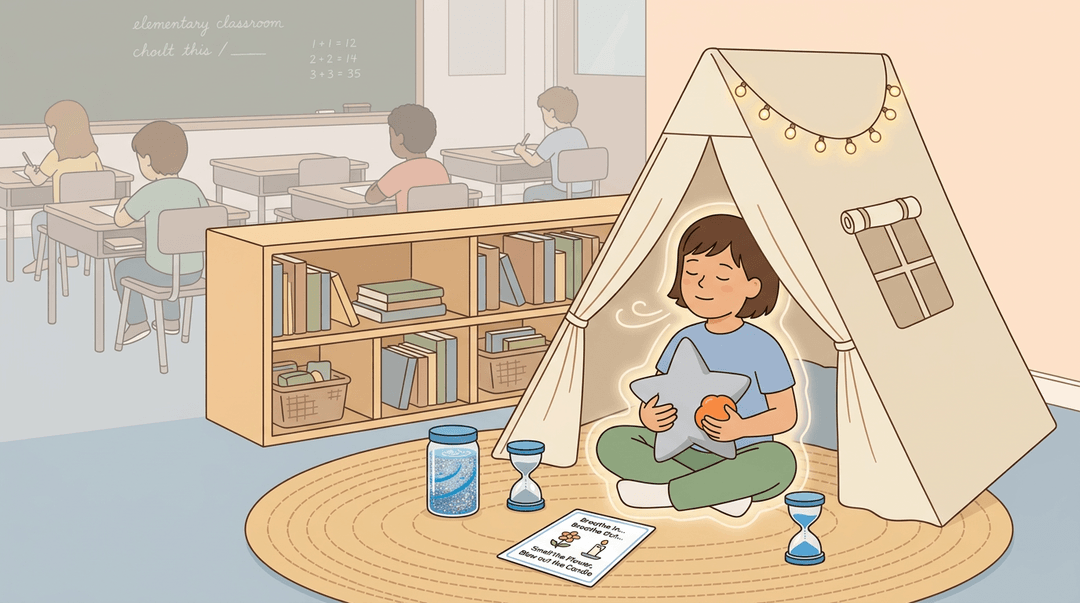
They do, and not just anecdotally. Research on calm spaces in schools found that "the findings showed that calm spaces were widely used and positively perceived by both groups," supporting their use for regulation, resilience, and healthy coping.
According to the Children's Home Society of California, these spaces let kids "regulate their strong emotions and learn to calm their body and mind independently," calming the brain before problem-solving even starts.
That calm-first approach also lines up with restorative frameworks and PBIS (Positive Behavioral Interventions and Supports), which favor teaching regulation over punishing dysregulation.
The payoff shows up in fewer overstimulated outbursts and more time actually spent learning.
Other Names You Might Hear
You might see the same idea called:
- a calming corner
- a cozy corner
- a reset space
- a sensory corner
- a chill-out zone
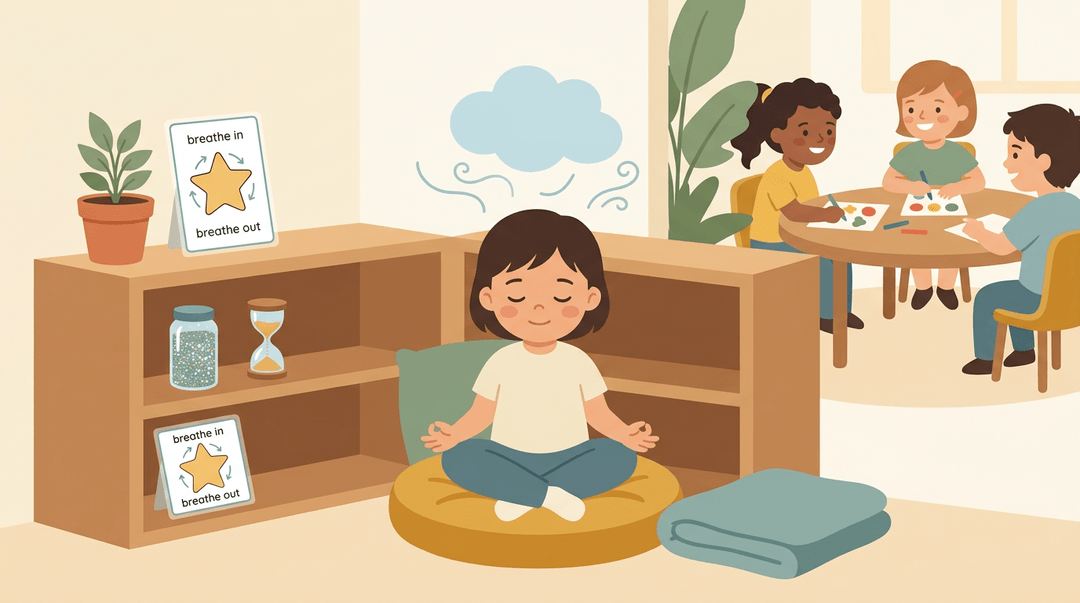
Different name, same job: a safe place to pause and come back ready to learn.
Setting up Your Calm-Down Space
A calm-down corner only works if you set it up with real intention. Where you put it, who helps design it, and how much privacy it offers all decide whether a child actually walks over there when big feelings hit, or ignores it completely.
Picking the Right Spot
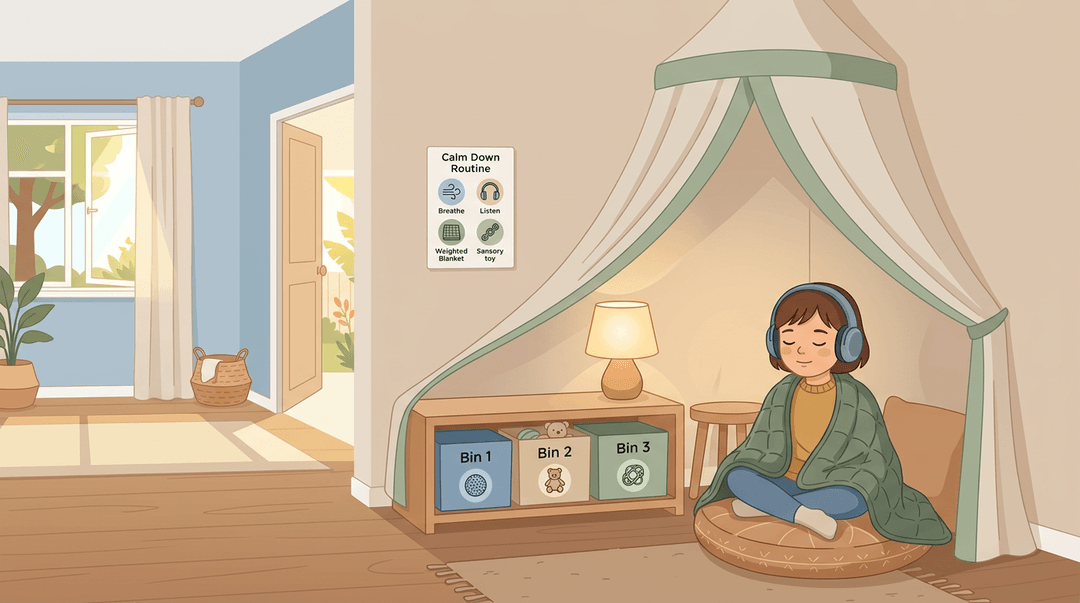
Start with a quiet, low-traffic area: away from doorways, speaker systems, and windows that flood the space with light or street noise. For a child on the autism spectrum, this matters even more.
A calming corner for autism leans harder on sensory control: dim lighting, noise-canceling headphones, a weighted blanket, and uncluttered, predictable visuals all help prevent sensory overload before it turns into a meltdown.
Keep everything accessible at the child's level: low shelves, reachable bins, nothing that requires asking an adult for help. And think about who's using it.
A single child's bedroom nook can reflect their specific triggers and comforts, while a shared family space needs a more neutral setup that works for every kid in the house, not just one.
Let Your Child Help Design It
Hand the child some ownership. Let them name the space ("the cozy cave," "my quiet spot") and pick a few items for it: a pillow, a favorite stuffed animal, a specific color scheme.
A second grader who helped build the space is far more likely to actually use it than one who was just handed a corner and told to sit there.
Adding Privacy and Boundaries
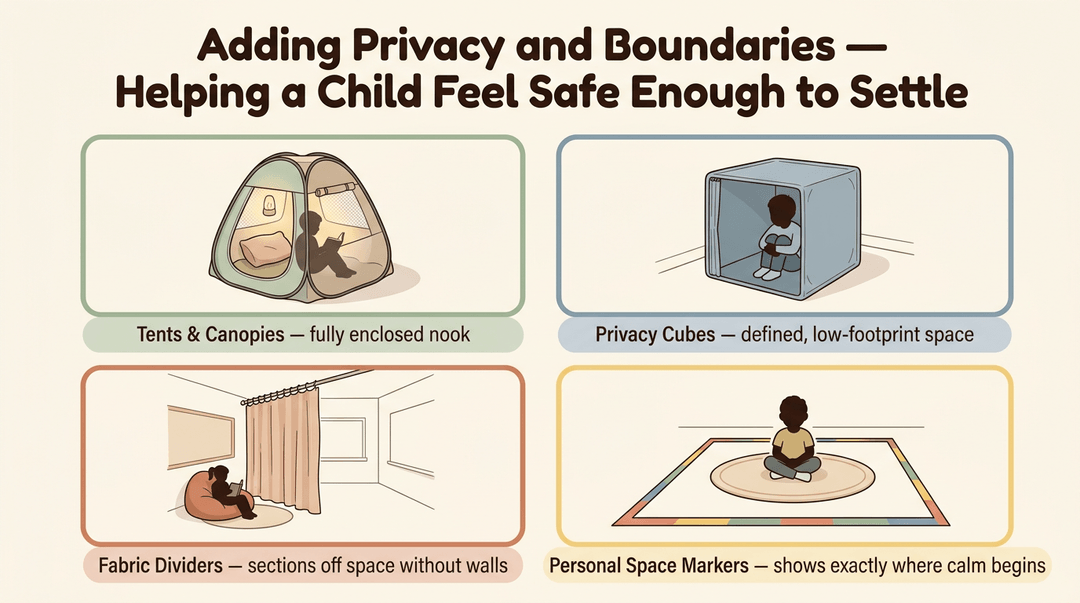
Privacy helps a child feel safe enough to actually settle. Consider:
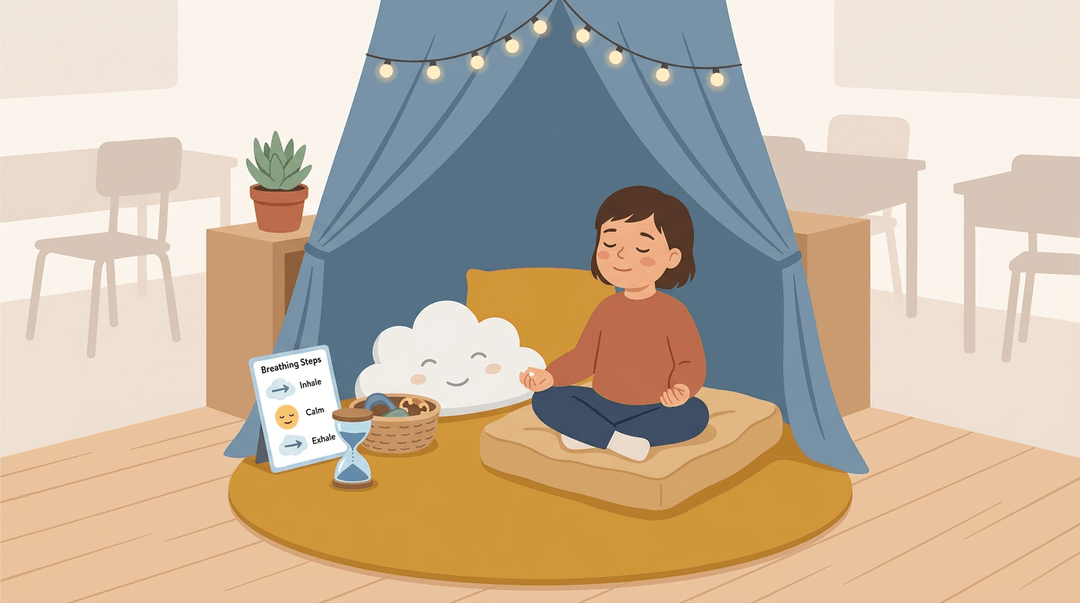
- Tents or canopies that create a fully enclosed nook
- Privacy cubes for a defined, low-footprint boundary
- Fabric dividers that section off part of a room without permanent walls
- Personal space markers, like a small rug or floor tape, that mark exactly where the calm zone begins and ends
Taking the Calm Corner Outdoors
Calming doesn't have to happen indoors. A garden nook, an outdoor swing, or a shaded quiet area under a tree can work just as well, sometimes better.
A sensory table set up outside adds texture and movement to the mix, and the fresh air and natural surroundings bring their own nature-based calming effect that four walls can't replicate.
How Can I Create a Calming Corner in My 5th Grade Classroom?
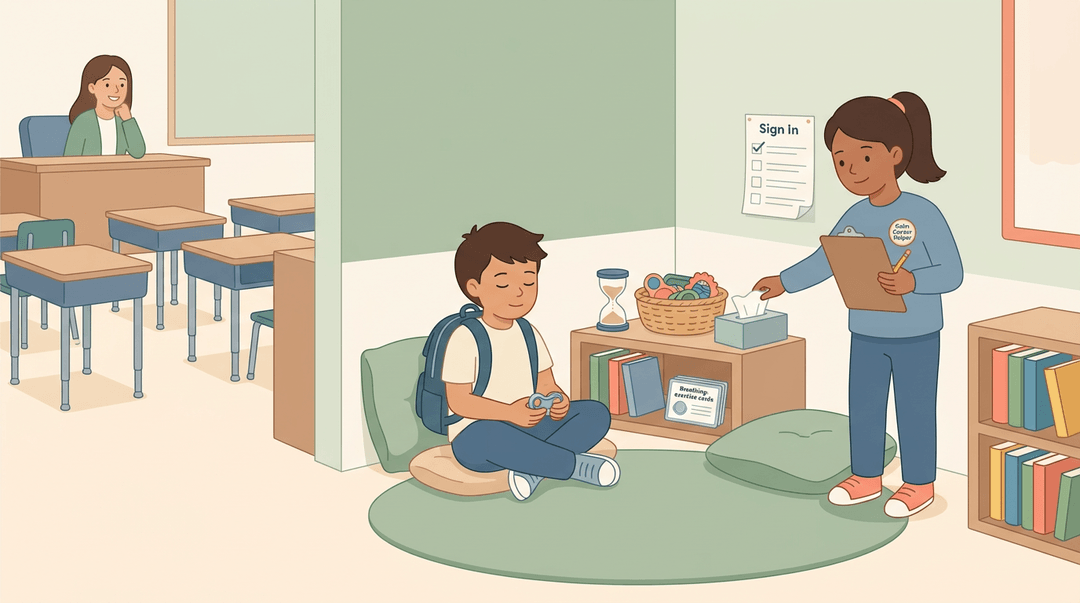
For a 5th grade classroom, placement is everything. Tuck the space away from busy centers and near the library or another naturally quiet area, but keep it visible enough for supervision at a glance.
Students should be able to use it during transitions, not just full-blown meltdowns: a quick reset between subjects counts just as much as a bigger break.
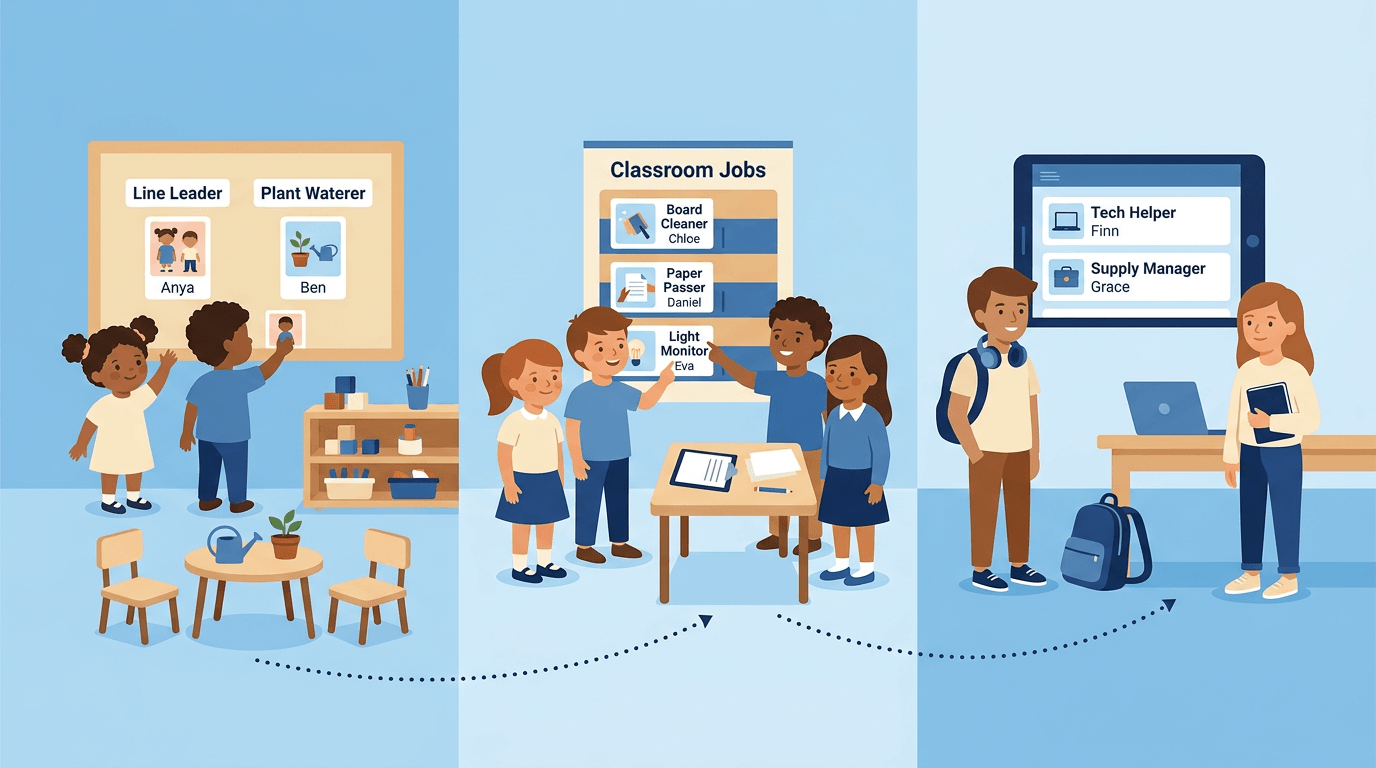
Assigning a peer monitor as a classroom job (restocking supplies, keeping the sign-in sheet current) gives older students ownership of the space and keeps it running smoothly without constant teacher check-ins.
What to Put in the Space
A calm-down corner works best when it's stocked with more than a beanbag in the corner: think comfort, sensory input, and feelings language, all in one small space. Here's what you'll want to gather for each purpose.
Comfy Seating and Cushions
Start with the basics: something soft to land on. Bean bags, pillows, and cushions or mats give a student a physical spot to settle into, while a soft blanket adds a layer of warmth that feels almost like a hug. Toss in a stuffed animal or two. For younger students especially, holding something familiar can shortcut the spiral from upset to calm.
Breathing Tools and Calming Visuals
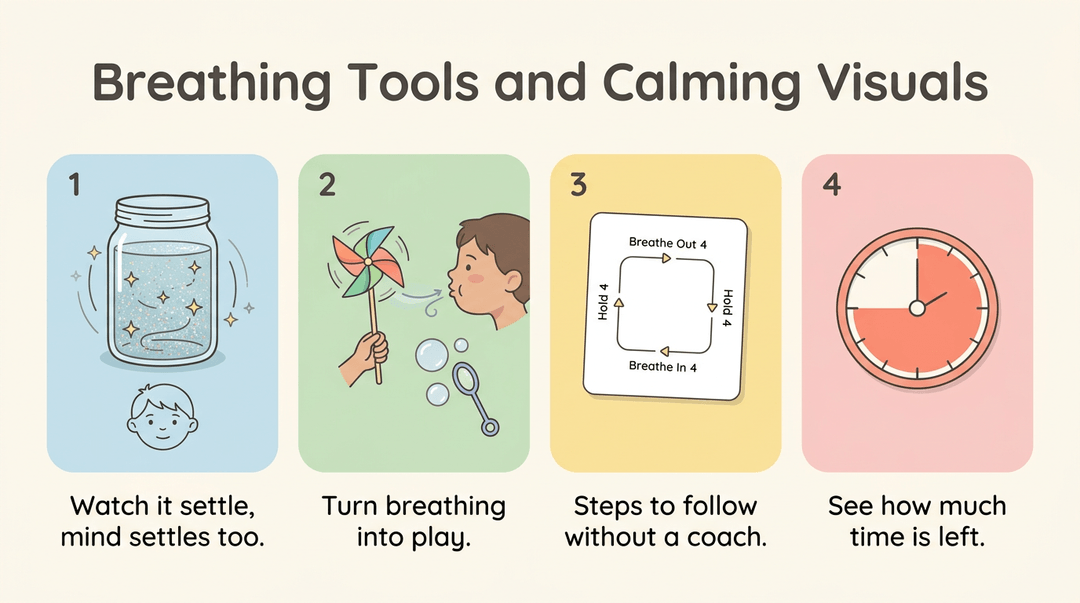
Once a student is seated, they need something to focus on besides the feeling that sent them there. A glitter jar gives restless eyes something to track as the sparkle settles, mirroring the mind settling right along with it. Pinwheels and bubbles turn deep breathing into a game instead of a chore. Deep breathing printables walk a student through the steps when you can't coach them through it in the moment, and a visual timer shows, without a word, how much longer they have before check-in.
Sensory and Movement Tools
Some students don't need to sit still: they need to move or press against something first. A weighted blanket or a stress ball gives calming, steady input through touch. Play-doh or putty gives busy hands something to squeeze and shape. For bigger releases, a small trampoline or a sensory swing lets a student burn off the energy that's making it impossible to focus, before they ever try to talk it out.
Creative and Reflective Activities
Once the body settles, the mind often needs its own outlet. Coloring pages and journaling prompts give a student something to do with their hands and their thoughts. Picture books offer a quiet escape, especially ones that model characters working through big feelings. Yoga cards combine movement and stillness, giving a student a structured way to reset without needing an adult to lead them through it.
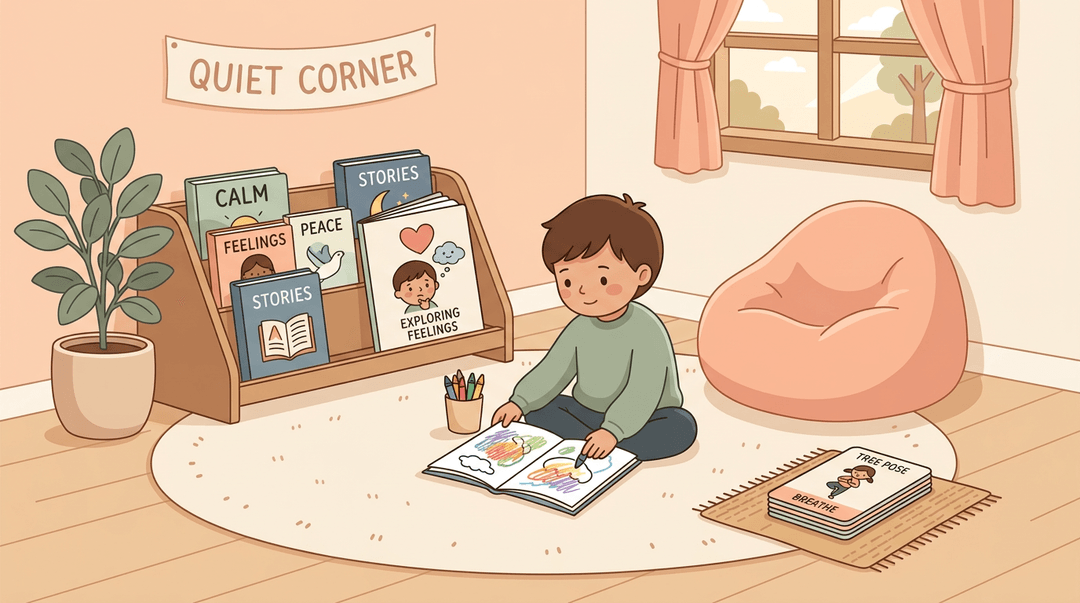
Tools for Naming Feelings
The real goal of a calm-down corner isn't just calm: it's the vocabulary to explain what happened. A feelings chart or feelings check-in tool helps a student point to "frustrated" or "overwhelmed" when the words won't come. Emotion-themed playdough mats turn that same identification into something tactile, and visual coping skill reminders give a student a next step once they've named the feeling, so the corner leads somewhere instead of just being a pause.
Using the Space the Right Way
A calm-down corner only works if the routine around it is solid. Get the framing wrong and even the best-stocked space turns into something kids avoid, or worse, dread using at all.
It's Not a Punishment Tool
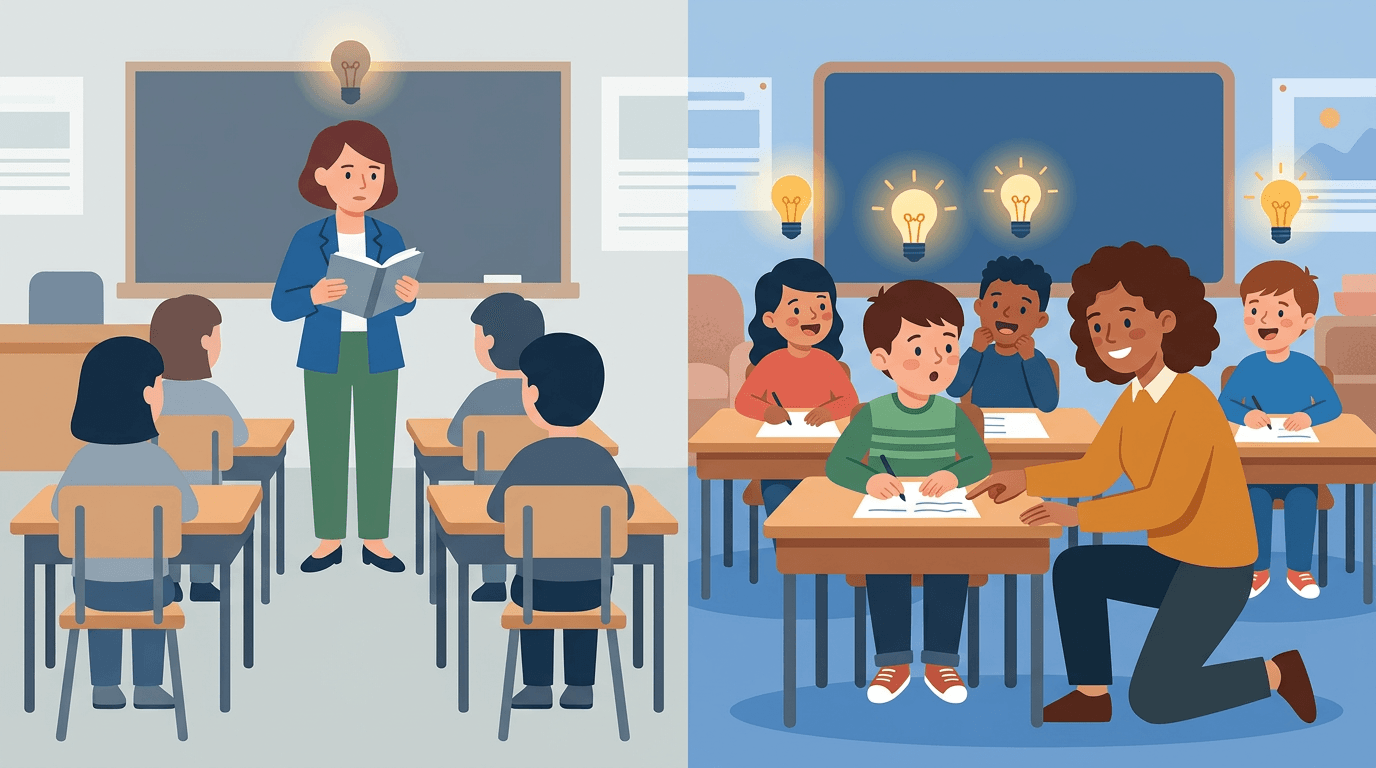
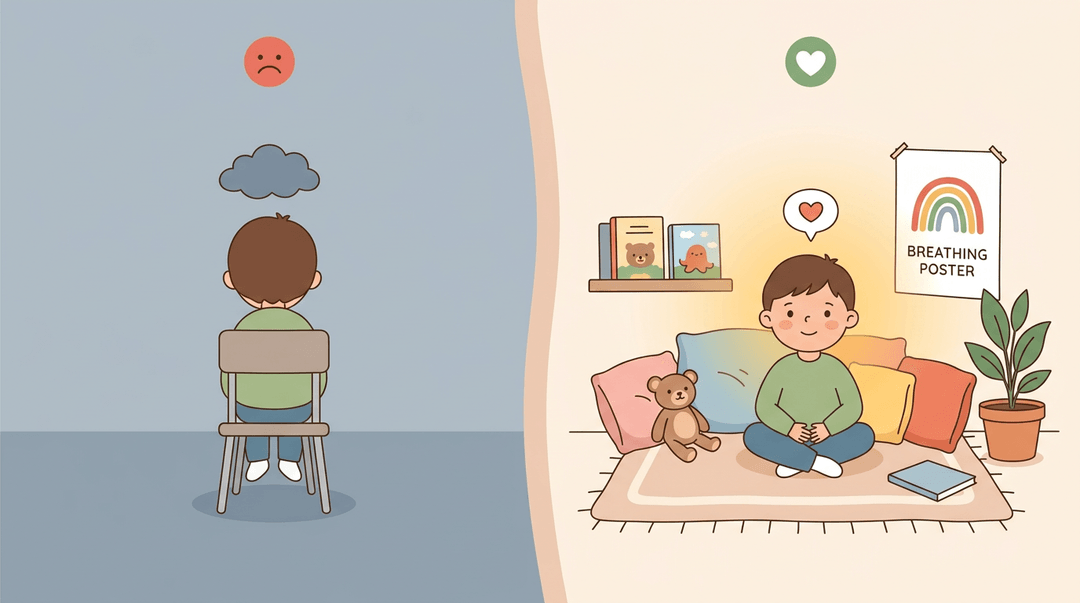
A time-out sends one message: you did something wrong, now sit here. A calm-down corner sends the opposite one: your feelings are big right now, and this is a safe place to work through them.
That's the real difference between the two, and it's worth naming out loud for your class. Frame the space with positive language, never as a discipline tool, and make sure no student feels shame for heading there. It's a resource, not a sentence.
Letting Kids Choose When to Use It
Think of a second grader who feels frustration building during a math worksheet. If she's learned the corner is hers to use whenever she needs it, she can head there before things boil over, not after a blow-up forces the issue.
Let the child decide when to go. Forcing a student into the space, even with good intentions, undoes the trust you're trying to build. Trust their judgment: they usually know when they're overwhelmed before you do.
Setting Time Limits Together
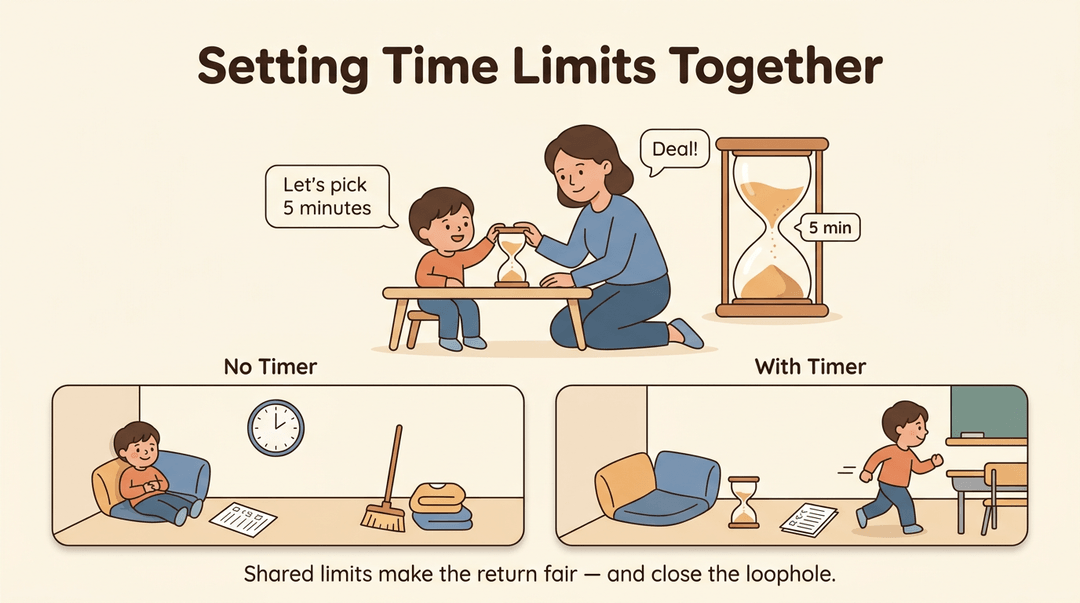
A sand timer or a visual countdown clock gives kids a concrete sense of how long they have, which makes the transition back to class feel far less abrupt. Set those limits with students, not for them, so the expectation feels fair rather than imposed.
Clear, shared expectations also close a loophole: without a time cap, the corner can quietly turn into an easy way to dodge chores or classwork.
Adjusting the Space as Needs Change
If a student who once loved the corner stops using it, don't assume everything's fine. Have an open conversation and ask what changed. Sometimes the fix is relocating the space to somewhere quieter or less visible.
Other times it's swapping out tools that no longer help for ones that better match where that student is now.
Rolling Out Your Classroom Calm Corner
You've got the space and the science; now here's the rollout, start to finish. Set up before students arrive, teach it in week one, adapt it to your group, then track what's working.
Set it up before students arrive
Before day one, confirm:
- Low-traffic corner picked. Away from the door and pencil sharpener, still visible from your desk.
- 3 to 5 tools, no more. A glitter jar, putty, and a breathing card beat a toy bin.
- Visual rules poster made. Pictures plus short lines, posted at student eye level.
- Peer monitor job assigned. Rotate weekly; they reset the timer and restock tools.
Poster text you can lift: 1. One friend at a time. 2. Flip the timer. 3. Pick one tool. 4. Come back ready.
Teach it in week one
Students only use the corner well if they've practiced it while calm. Run these four moves in your first week:
- Model it at morning meeting.
- Say: "I'm feeling frustrated, so I'm going to squeeze the putty for two minutes."
- Practice the timer while everyone's calm.
- Every student takes one two-minute practice visit; no one's first trip happens upset.
- Role-play a sample scenario.
- Try: "Your tower got knocked over." Student walks over, uses one tool, returns.
- Praise use, skip the rewards.
- Say: "You noticed you needed a break. That's the skill."
⚠️ Watch out: Stickers or points turn the corner into a prize. Students start visiting to earn, not to regulate, and the whole thing backfires.
Adjust for your students
The core routine stays the same; the supports change with age and setting.
| Your setting | Swap in... |
|---|---|
| K-2 | Picture cue cards (a belly-breathing image, not written steps) |
| 3-5 | A written coping menu students check off |
| 6-12 | A discreet pass system: hand you the pass, no announcement |
| Homeschool | A shared family nook that adults visibly use too |
Track it over time
The corner isn't set-and-forget. Each week:
- Log every visit. A tally sheet works: date, student, tool used.
- Review with frequent visitors. A two-minute chat: "Which tool helped most this week?"
- Swap unused tools. Untouched for two weeks? Replace it with something new.
- Flag patterns for the IEP team. Daily visits at the same time each day is data; bring the log.
That log gets easier when it lives where your other records do: track calm-corner check-ins alongside attendance and behavior notes in one teacher planner like EMStudio's classroom management application.
Teaching and Practicing Coping Skills
A calm-down corner only earns its name once students know what to do inside it. Teach the tools before the storm hits, and you won't be scrambling to explain them mid-meltdown.
How to Introduce a Calm Down Corner in Class
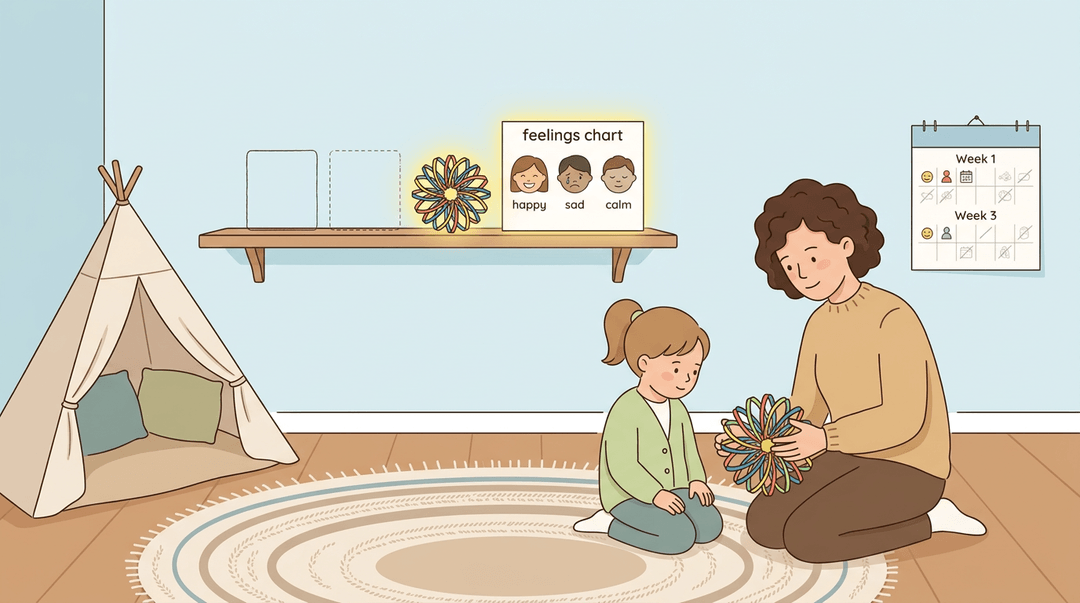
Start small. Handing your class ten coping tools on day one just trades one overwhelm for another. Introduce one or two strategies at a time, model them yourself, then add more as students get comfortable.
Think of a kindergarten teacher who introduces a breathing ball in week one and a feelings chart in week three, building the toolbox gradually instead of all at once.
Because no single strategy works for every child or every mood, aim for a small collection students can choose from, not a checklist they need to memorize.
Practicing Skills Before They're Needed
Teach coping skills during calm, ordinary moments, not in the middle of a meltdown. Rehearse the breathing exercise or the sensory bottle as a whole-class activity so it feels familiar rather than foreign under stress.
One easy tool to practice together is the 3-3-3 rule:
- name three things you can see
- three sounds you can hear
- move three parts of your body
It's simple enough for young kids to remember, and it grounds attention fast when anxiety spikes. Repetition builds the confidence kids need to use these tools independently, without you walking them through every step.
Helping Kids Calm Down Together
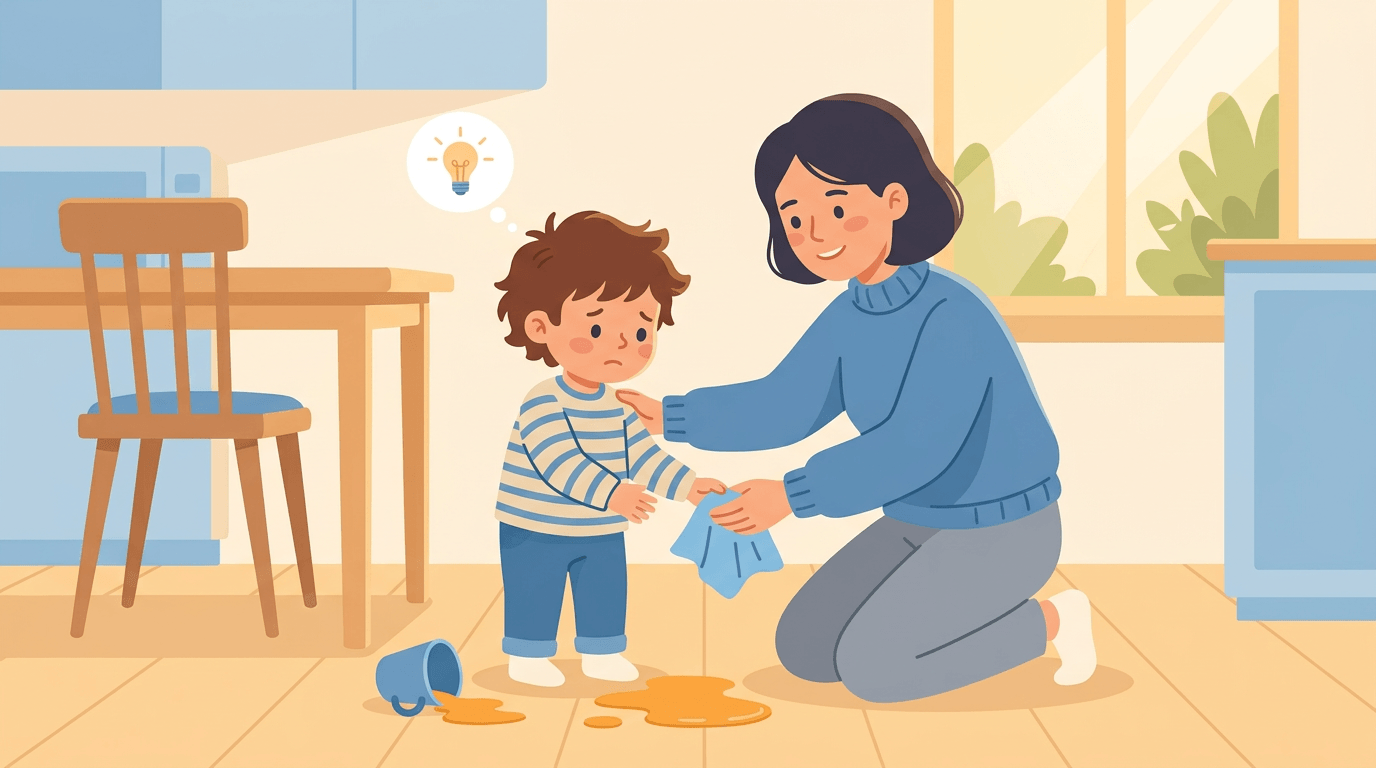
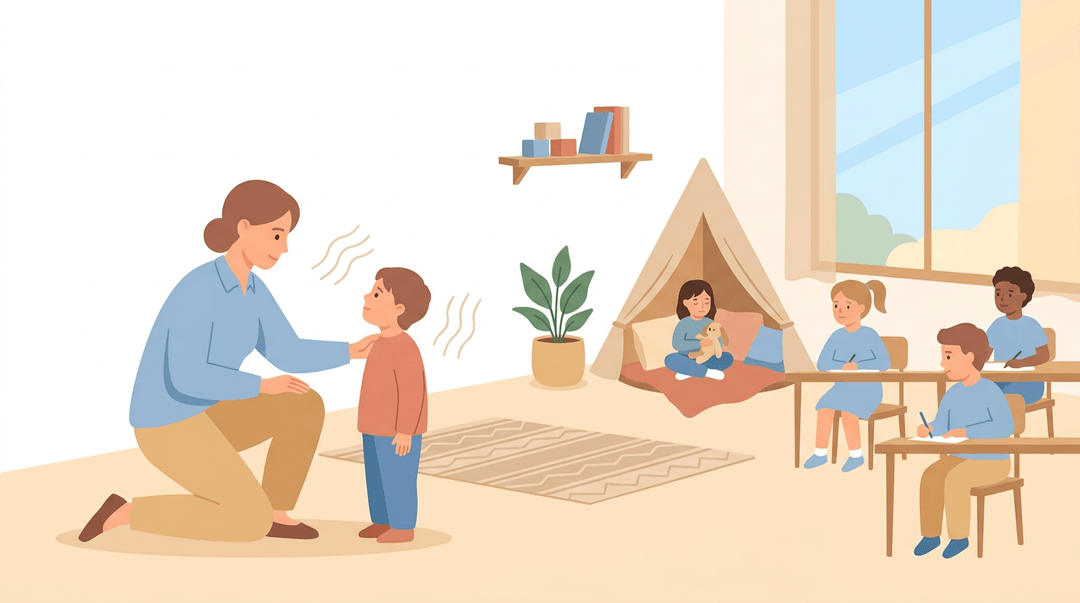
Watch a child's mood and match your response to it: a quiet nod for one student, a few calm words for another. Model the calm you want to see, since kids borrow regulation from the adults around them.
Talk openly with your class about why breaks happen, so peers see a classmate stepping away as normal, not something to stare at.
The Science of Sensory Calming
A calm-down corner isn't just a cozy nook with a beanbag. The tools that live there work because they tap into how a student's nervous system actually processes input, and that's worth understanding before you set one up.
Heavy Work to Ease Anxiety
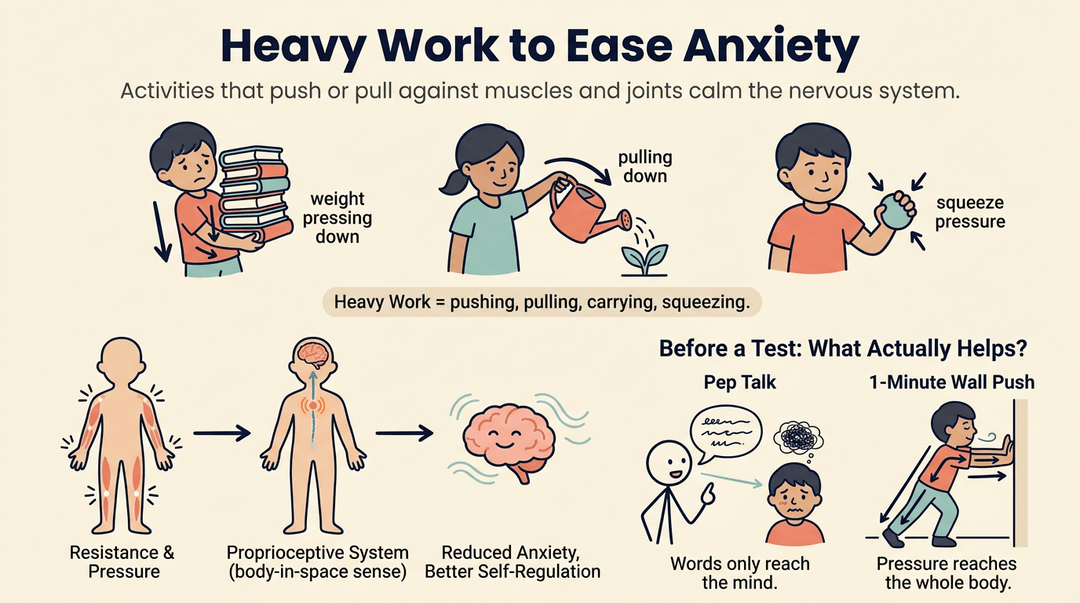
Heavy work means any activity that pushes or pulls against the body's joints and muscles:
- carrying a stack of books
- watering plants
- squeezing a weighted ball
That resistance activates the proprioceptive system, the sense that tells the brain where the body is in space.
According to The OT Toolbox, "the resistance and pressure involved in heavy work helps to activate the proprioceptive system, which is known to reduce anxiety and improve self-regulation."
For a student spiraling before a test, a minute of pushing against a wall can do more than a pep talk.
Swinging and Rocking to Regulate
Swinging, rocking, jumping, and dancing all stimulate the inner ear's vestibular system, the sense that governs balance and movement.
That input can go either way: a slow rock in a chair tends to settle a wound-up student, while jumping jacks can wake up a sluggish one. Rotate a few options in your corner so students find what actually calms them.
How Movement Breaks Boost Focus
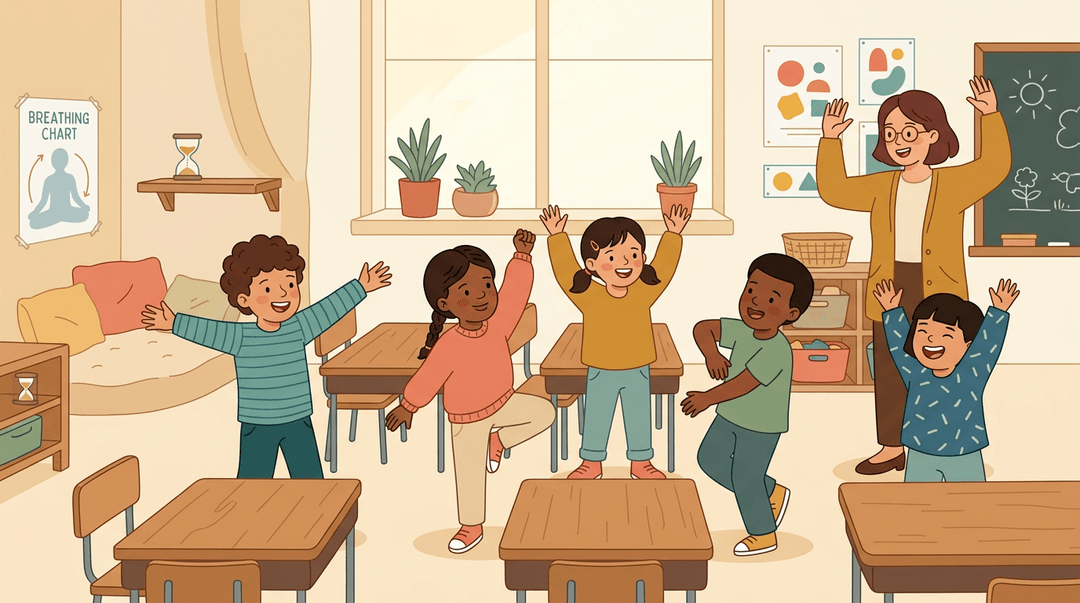
Movement isn't just for the corner. A quick round of freeze dancing or marching in place resets a restless classroom fast.
Understood.org reports that "movement breaks in particular can improve focus and attention by increasing blood flow to the brain," giving the whole nervous system a chance to reset before the next lesson starts.
A calm-down corner isn't a time-out in disguise. It's a quiet, structured space that teaches students to recognize big feelings and work through them, one breath at a time.
Get the setup, tools, and rules right, and you'll spend less time managing meltdowns and more time teaching.
Ready to build routines that make this easier to manage all year? Check out our Classroom Management feature to keep your rosters, sections, and schedules organized in one place.
References
- The Impact of Calm Spaces on Behavior, Emotional ... — ijmehd.com
- Aug 2025 Positive Outcomes in Creating a Calming Corner — chs-ca.org
- Calm Down Corner Ideas & Tips — theottoolbox.com
- Brain breaks: An evidence-based behavior strategy — understood.org
Frequently asked questions
What is a calm down corner in a school?
A calm down corner is a designated classroom space where students can pause and reset when they feel overwhelmed. It is a safe, structured place for self-regulation, not a punishment or time-out, and students return to learning when ready.
What is a calming corner for autism?
A calming corner for autism is a predictable, low-stimulation space designed to reduce sensory overload and support self-regulation. Helpful features may include dim lighting, uncluttered visuals, noise-canceling headphones, and carefully selected sensory tools such as a weighted blanket, adapted to the child’s needs and used safely.
What are 10 calming activities I can do?
Ten calming activities include slow deep breathing, squeezing putty or a stress ball, watching a glitter jar, blowing bubbles, using a pinwheel, coloring, journaling, reading a picture book, practicing yoga poses, and trying the 3-3-3 grounding rule. The 3-3-3 rule involves naming three things you see, three sounds you hear, and moving three parts of your body.
What are some ideas for creating a calm corner for kids?
Create a quiet, low-traffic space with soft seating, a pillow or blanket, and a small number of accessible tools. Add privacy with a tent, canopy, divider, rug, or floor marker, while keeping the space visible enough for supervision. Let children help choose the name, colors, and a few items so they feel ownership.
What are some good sensory items to use in a calming corner?
Useful sensory items include putty, play-dough, stress balls, weighted blankets, stuffed animals, noise-canceling headphones, sensory bottles, and movement options such as yoga cards, a rocking seat, or a small trampoline. Choose only a few items at first and match them to the child’s sensory preferences. Weighted and movement equipment should be used appropriately and supervised when needed.
Do calm down corners work?
Calm down corners can work when they are taught as self-regulation spaces rather than discipline areas. Evidence indicates that calm spaces are widely used and positively perceived, and they can help children regulate emotions, build coping skills, and return to learning. Their effectiveness improves when children practice using the space while calm and have clear, shared expectations.
What should I put in a calm down corner?
Include comfortable seating such as a beanbag, cushion, mat, pillow, blanket, or stuffed animal. Add a few calming tools, such as a glitter jar, breathing card, pinwheel, bubbles, putty, stress ball, or weighted blanket, plus a visual timer and feelings chart. Keep the selection simple, accessible, and focused on helping children calm their bodies and identify their feelings.
What to put in a quiet corner?
A quiet corner can include a soft rug or cushion, pillows, a blanket, books, stuffed animals, dim or gentle lighting, and a small feelings or breathing chart. If appropriate, add headphones, putty, coloring materials, or a sensory bottle, but avoid clutter and excessive stimulation. Set clear expectations so the space remains a short, supportive place to pause and reset.