Learning Pyramid: Origins, Evidence, and How to Use It

Jump to section
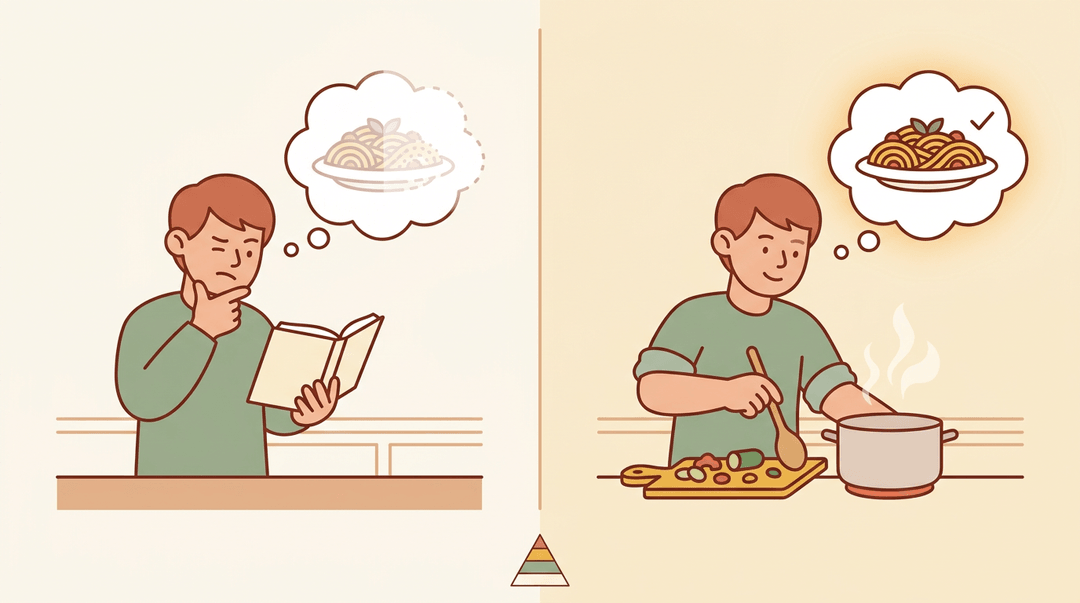
Think about the last time you tried to learn a new recipe just by reading it, versus the time you actually cooked it yourself. One stuck. One didn't.
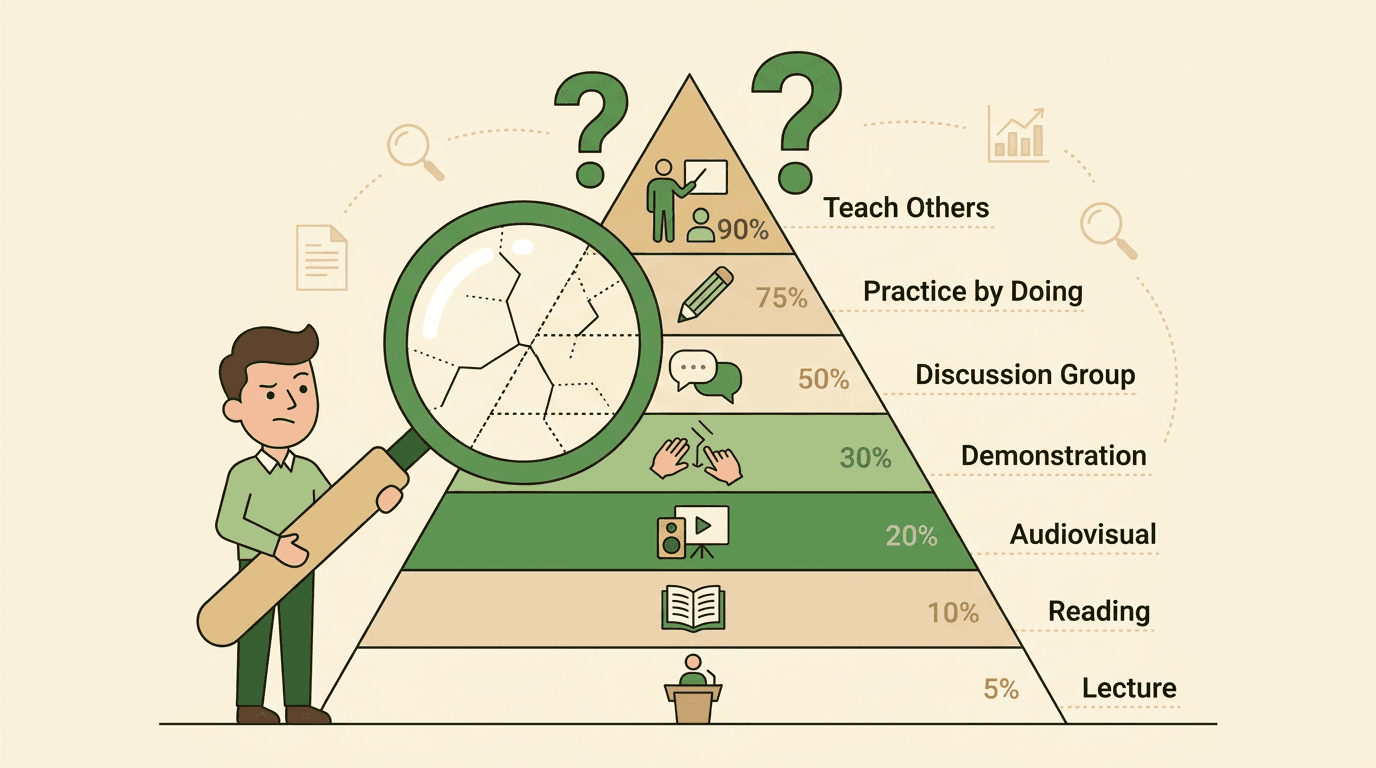
That's the whole idea behind the learning pyramid: a chart claiming we remember far more of what we do than what we simply hear or read. It's one of the most-cited (and most-debated) images in education.
In this post, we'll trace where the pyramid actually came from, whether the numbers hold up, and how to turn its ideas into lesson plans that work.
Where the Learning Pyramid Came From
You've likely seen this chart pinned to a staff-room wall, but its tidy percentages hide a story we should unpack first.
Other Names for the Learning Pyramid
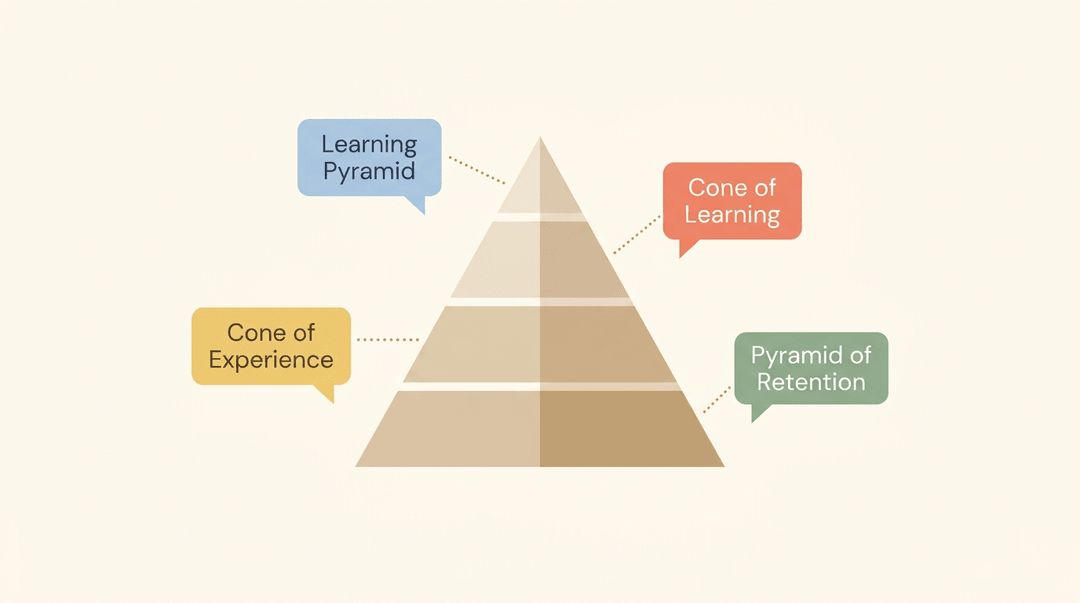
You might know it as the cone of learning, the cone of experience, or simply the pyramid (or cone) of retention. Same shape, same numbers, just a different label depending on who's presenting it.
The Murky History Behind the Pyramid
Edgar Dale first sketched a version, without percentages, in his 1946 book Audio-Visual Methods in Teaching.
That same era also produced his separate five-stage learning process and five-level hierarchy of learning outcomes, models often confused with the pyramid but not its actual source.
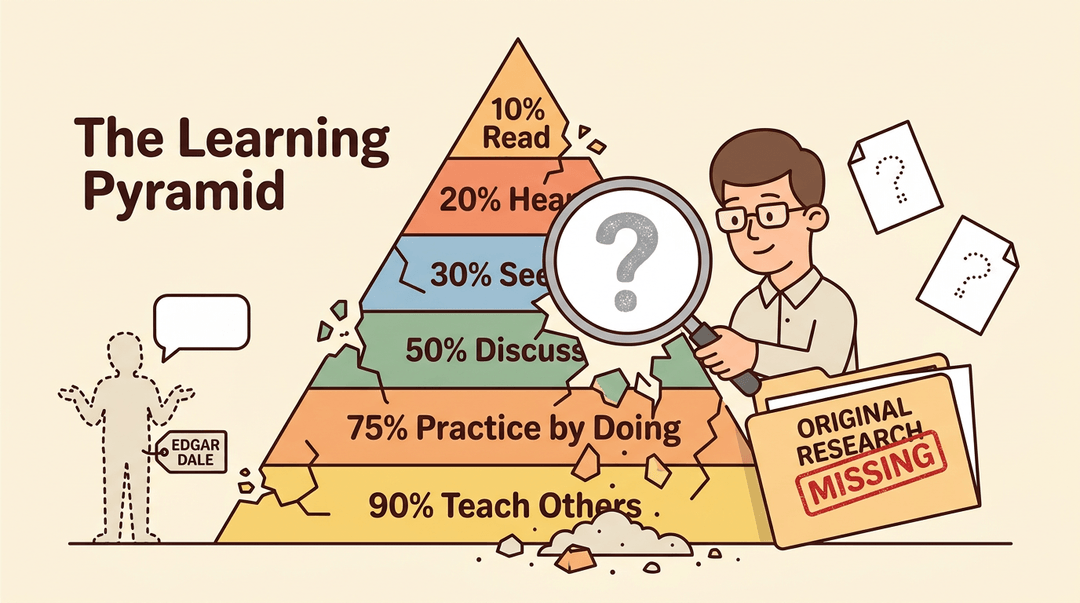
Decades later, the National Training Laboratories Institute in Bethel, Maine renamed the chart and attached the retention figures still quoted today. The original study behind those figures was never published, and it may never have existed at all.
Seven Methods and Their Retention Rates
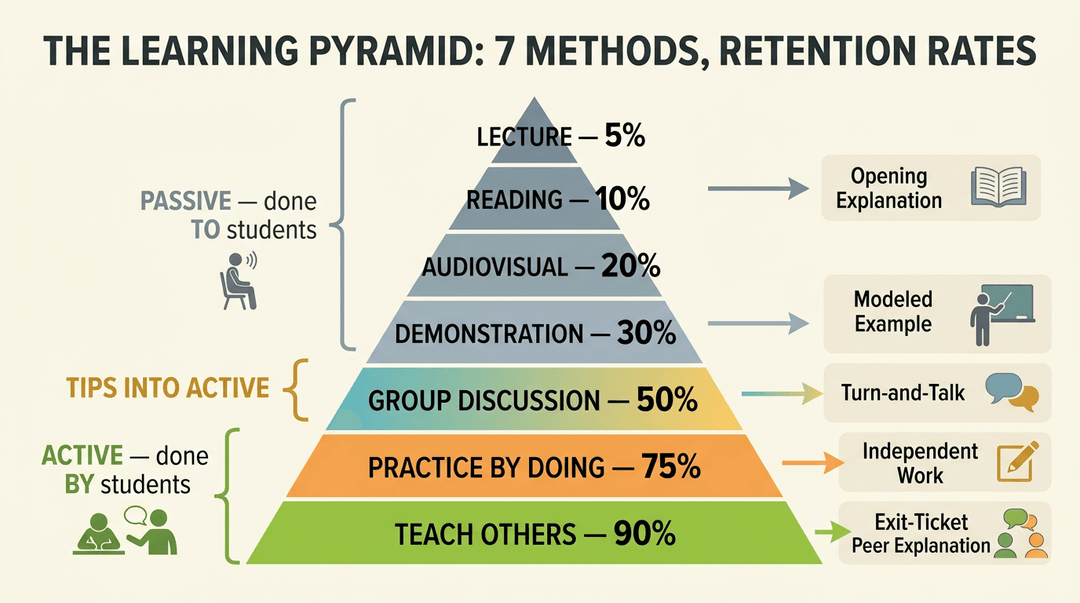
Whatever you call it, the pyramid stacks seven methods from passive to active, each with its own claimed retention rate:
- Lecture: 5%. Oak Hill Academy cites the NTL figure: students retain just 5% of what they hear in a lecture.
- Reading: 10%, per a rebuttal of the NTL pyramid.
- Audiovisual: 20%.
- Demonstration: 30%.
- Group discussion: 50%.
- Practice by doing: 75%, per an engineering-education study.
- Teach others: 90%, a figure the same rebuttal traces to the identical claim.
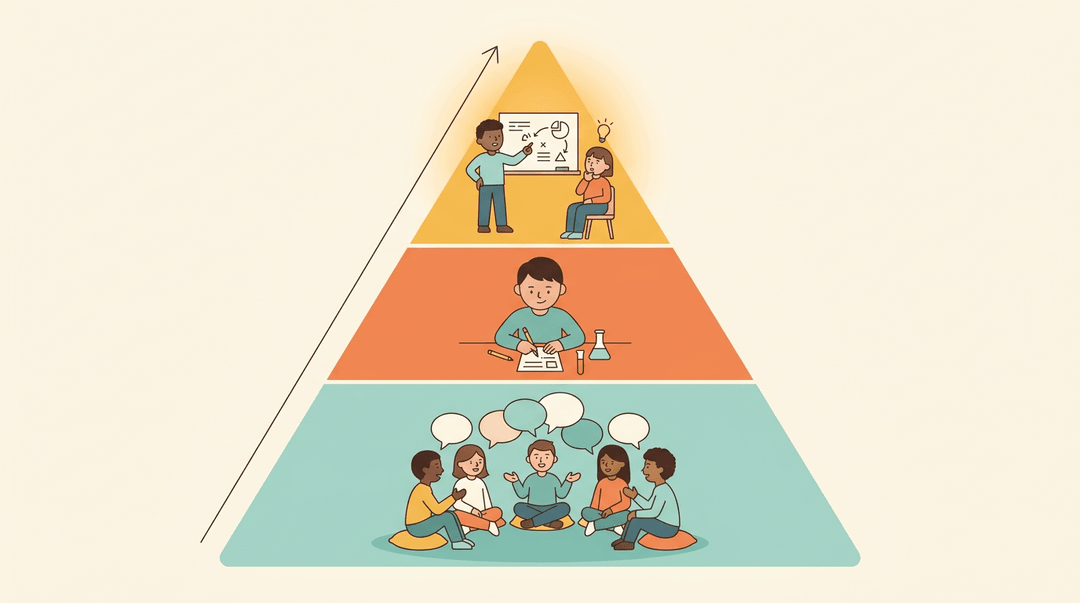
The bottom four are passive methods: things done to students. Discussion tips into active territory, and practice and teaching others are fully active: things students do themselves. Map that onto your lesson:
- lecture and reading become your opening explanation
- demonstration your modeled example
- discussion your turn-and-talk
- practice your independent work
- teaching others your exit-ticket peer explanation
Active Learning vs Passive Learning
Not all study methods pull their weight. The pyramid draws a clear line between watching and doing, and that line matters more than the debated percentages ever could.
Passive Methods Lecture Reading and Video
Lecture, reading, and audiovisual content (videos, slideshows, podcasts) sit at the base of the pyramid. Students absorb information passively.
Demonstration ranks highest among the passive methods: watching a teacher solve a problem step by step beats a silent lecture, since it gives students something concrete to picture before they try it themselves.
Active Methods Discussion Practice and Teaching
Move up the pyramid and students start doing the work.
- Group discussion forces students to articulate half-formed ideas aloud.
- Practice by doing (a worksheet, a lab, a role-play) turns knowledge into a skill.
- Teaching others sits at the top: a student who explains a concept to a struggling classmate has to organize it well enough to survive someone else's questions.
Why Retrieval Practice Improves Retention
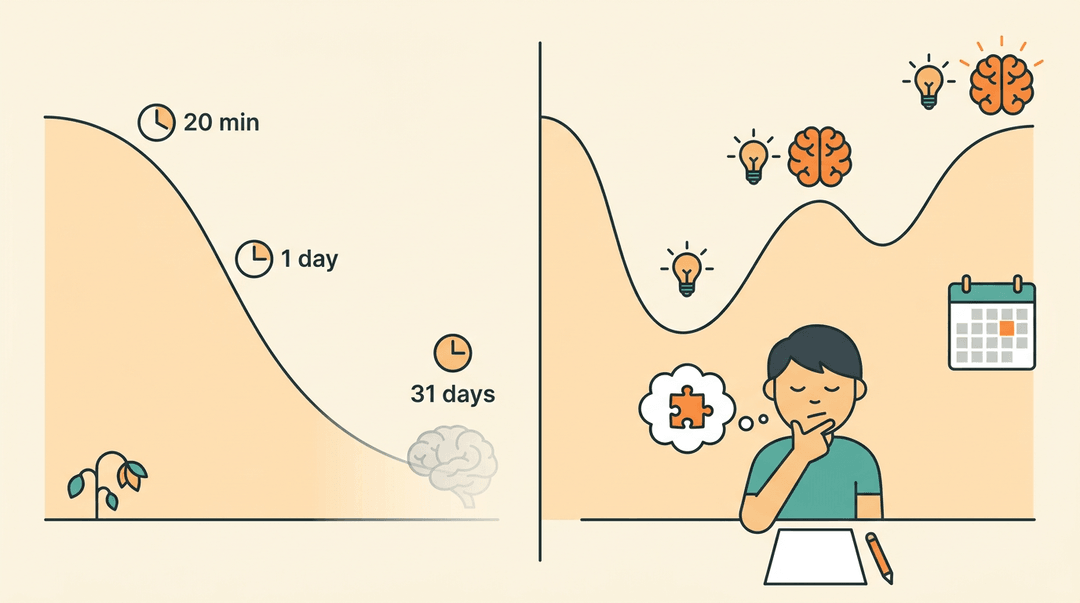
Hermann Ebbinghaus's forgetting curve still holds up: a modern replication tracked forgetting across intervals from 20 minutes to 31 days and found the same steep early drop.
Retrieval practice, pulling an answer from memory instead of rereading it, pushes back against that curve.
In one study, students who retrieved word pairs from memory remembered them significantly better than students who simply reread them, a result researchers link to the generation effect: generating an answer yourself carves a deeper memory trace than recognizing one on a page.
Trials in real primary school classrooms confirm retrieval and spaced practice work outside the lab too. Schedule a five-minute retrieval task weekly (a quick quiz, a blank-page recall) and watch retention outlast the unit test.
Using the Learning Pyramid in Lesson Plans
You don't need to redesign your lessons to use the pyramid's real lesson: the further down you push students (doing, discussing, teaching), the more sticks. The slots you already have can carry the active methods.
This guide maps them, gives you a version for your grade level, and ends with a weekly check.
Map your lesson slots to the pyramid
Each slot you already plan has a natural active-learning partner. Find your slot, read across:
| Your lesson slot | Pyramid method | What it looks like |
|---|---|---|
| Bell ringer | Retrieval practice | Three quick questions from last lesson, no notes |
| Guided practice | Practice by doing | Students work the problem while you circulate |
| Exit ticket | Teach-back check | "Explain today's idea to a new student" |
| Closure | Student summarizing | One student sums up, class adds or corrects |
A liftable exit ticket prompt, exactly as you'd print it:
Exit ticket: "A student who was absent today asks you what we learned. Write what you'd tell them in 2 to 3 sentences."
💡 Tip: The bell ringer's power is that students pull the answer from memory, not their notes. Keep notebooks closed for those first three minutes.
Pick the version that fits your students
The teach-others layer looks different at every age. Choose your row:
- Preschool: hands-on sorting tasks. Sorting buttons by color or shape is practice by doing at this age.
- Elementary: partner explain-back. Say: "Turn to your partner and explain it like they missed class."
- Secondary: peer teaching stations. Each group masters one sub-topic, then rotates and teaches the next group.
- Tutoring: student re-explains the concept. End every session with "Now you teach it back to me."
Example: A high school biology teacher splits photosynthesis into four sub-topics, one per station. Groups get ten minutes to master theirs, then rotate as teachers. Every student both practices and teaches in one period.
The weekly check
You don't need every method every day. Before the week starts, confirm:
- One active task daily. Every lesson plan has at least one doing, discussing, or teaching moment.
- Discussion and practice rotate. If Monday was discussion-heavy, Tuesday leans toward hands-on practice.
- Retrieval practice appears weekly. At least one no-notes recall moment, beyond the bell ringers.
- Teach-others time is reserved. One slot this week where students explain to someone else, not just to you.
At a glance: bell ringer retrieves, guided practice does, exit ticket teaches back, closure summarizes. That's the whole pyramid, inside a lesson you already run.
Build these active-learning components once and reuse them across every class in EMStudio's lesson planner.
Is the Learning Pyramid Actually Science?
Short answer: not quite. The pyramid's neat percentages get repeated in staff meetings everywhere, but the research behind them doesn't hold up, even though its core message about active learning still has real science behind it.
Why Critics Call It Pseudoscience
Researchers including Letrud, Subramony, Molenda, and Masters have picked the pyramid apart, and the verdict is blunt. According to a review from the University of Strathclyde, the model has been "labeled a pseudoscientific model."
The original research is lost or was never published in the first place, since "the data portrayed don't relate to any other research in the scientific literature on learning."
Nobody can verify the sample size, the age group, or the methodology behind it.
As Masters wrote in a review of evidence-based simulation training, "Given that there is no research on which to base the Pyramid, and that Edgar Dale did not ever produce anything resembling the Pyramid, it is safe to say that the Pyramid and its associated percentages are entirely mythical."
The Numbers Don't Actually Add Up
Even setting the missing research aside, the math doesn't work either.
Reading sits at 10%, lecture at 5%, teaching others at 90%, but combine a few methods in one lesson (reading a passage, then discussing it, then teaching a peer) and retention would have to climb past 100%, which is impossible.
The numbers don't add up, literally or figuratively.
Is the Core Idea Still Valid?
Here's the twist: the core idea, that doing beats watching, still holds up.
Defenders point to the generation effect and retrieval practice: psychologists studying memory encoding have long shown that organizing material and practicing retrieval genuinely boosts retention. Bloom's taxonomy backs this up too.
Level 3, application, asks students to use knowledge in a new situation rather than just recall it, the same kind of active engagement the pyramid gestures at.
Many practitioners still find it a useful heuristic for planning lessons, while critics argue the fabricated numbers undermine the very message it's trying to teach.
Putting the Pyramid to Work in Training
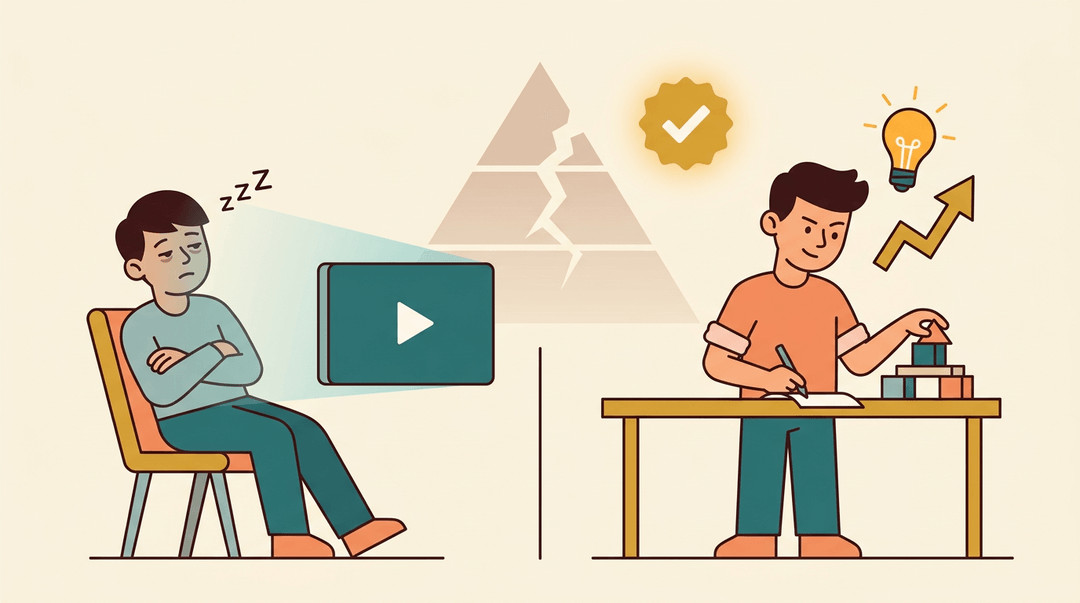
Once you set aside the shaky percentages, the pyramid still points to something real: learners tend to hold onto material better when they do something with it instead of just receiving it.
The question for any training provider is how to build that doing into the format itself.
Making Instructor Led Training Less Passive
A lecture doesn't have to stay passive just because it's live.
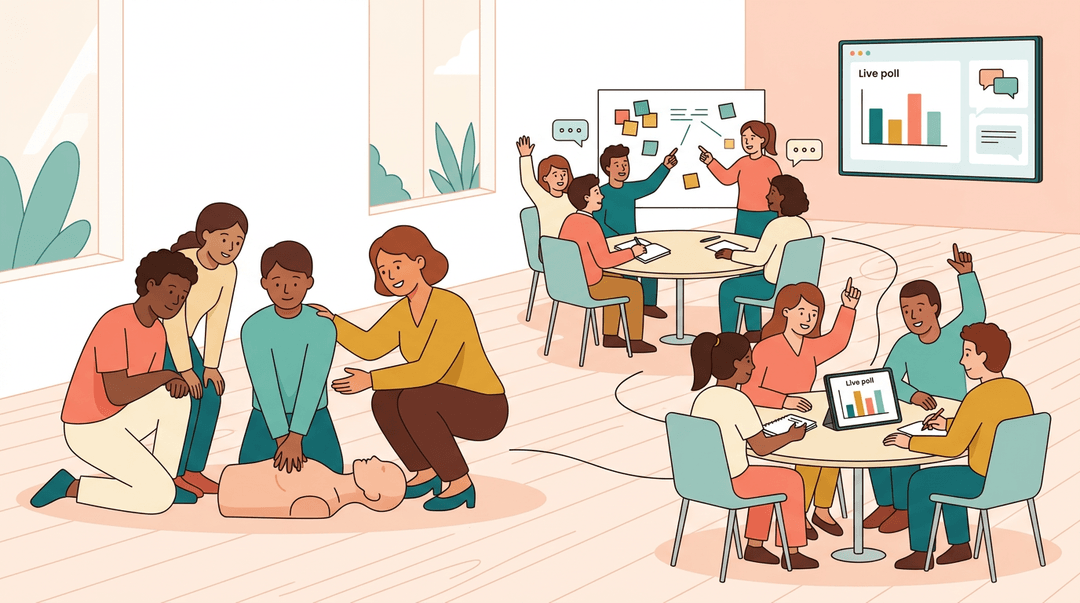
Collaboration tools like breakout rooms and shared whiteboards turn a large group into small teams working a problem together, while live polls, chat prompts, and quick surveys keep every learner responding rather than watching.
Discussion forums and social media groups stretch that participation past the session itself, letting learners keep testing ideas with each other afterward.
For example, a first aid instructor teaching CPR doesn't just describe compressions: they demonstrate on a mannequin, then have each learner practice the motion, echoing the pyramid's push toward doing over listening.
Designing a Blended Learning Course
A blended learning course structures that mix on purpose instead of leaving it to chance.
A typical outline might open with a short video to introduce a concept, move into a live classroom session to apply it, and close with an eLearning module and quiz to check what stuck.
Picture a new-hire onboarding course built this way: overview video, hands-on workshop, scored eLearning check. Follow-up surveys after the course catch what actually landed, and peer forums or tutoring keep learners engaged once the formal sessions end.
Using Microlearning to Boost Engagement
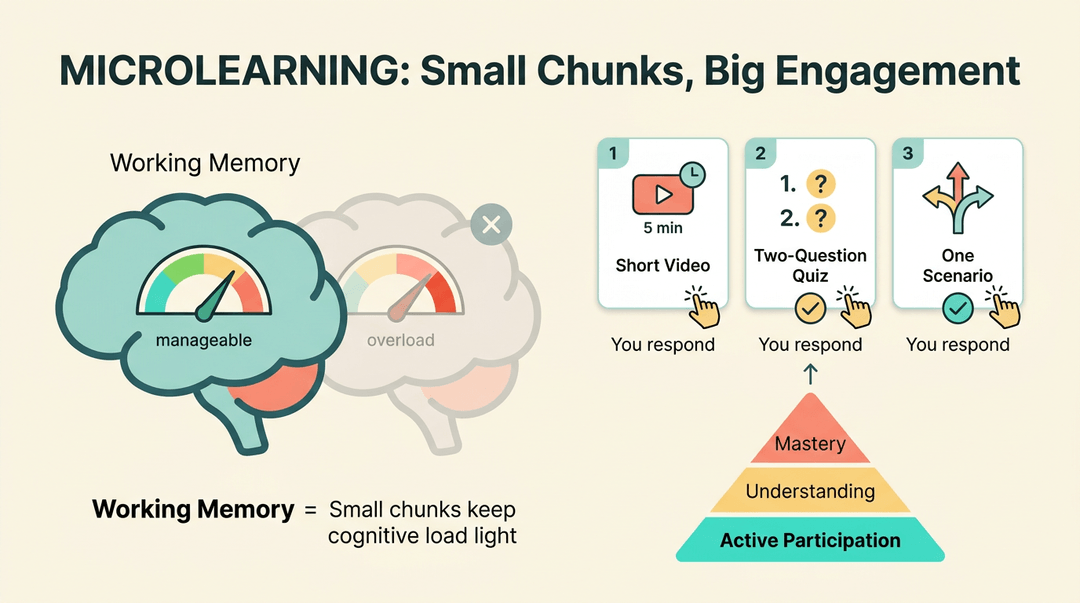
Microlearning breaks a topic into short, focused chunks: a five-minute video, a two-question quiz, one scenario to work through. That size isn't just convenient, it protects attention.
Research on cognitive load theory from the NSW Department of Education notes that processing new information creates cognitive load on working memory, which can affect learning outcomes, so keeping chunks small keeps that load manageable.
Each chunk also asks for a response: answer the quiz, solve the scenario, react to the video, which supports the active participation the pyramid puts at its base.
What's Next for Training Providers
The pyramid's lasting value isn't a percentage table, it's a design question: how will learners engage, not just receive?
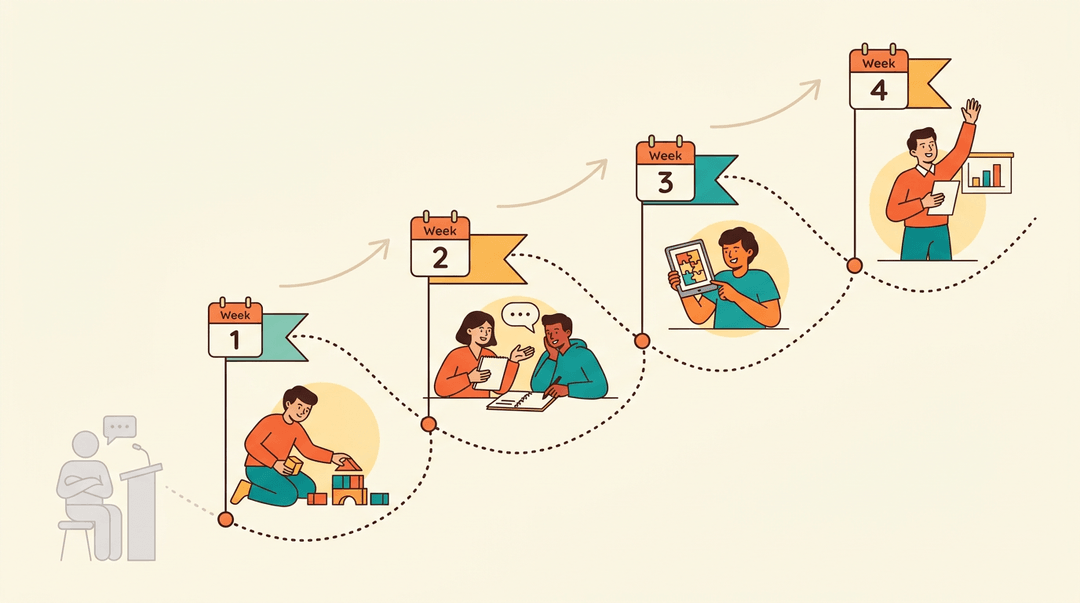
Providers are answering that by building longer learning journeys instead of single-format events, with reinforcement and follow-up woven in weeks after the initial session.
A blended approach remains the most practical way to deliver on that: mix formats, check in, and give learners real chances to use what they've learned.
The learning pyramid's exact percentages don't hold up to scrutiny, but the instinct behind it does: students remember more when they do rather than just listen. That's the real takeaway, backed by decades of cognitive science on active learning.
Ready to turn that into your next lesson? Check out our Lesson Planning tool to write, organize, and reuse active-learning lesson plans across all your classes.
References
- The Brain is a Forgetting Machine: Why Active Participation Is the Only Path to Comprehension | Oak Hill Academy — oakhillacademy.com
- Debunking educational myths: towards evidence-based simulation training — pmc.ncbi.nlm.nih.gov (2025)
- A Guide to Student-active Online Learning in Engineering — exa.ai (2020)
- ERIC - EJ996977 - A Rebuttal of NTL Institute's Learning Pyramid, Education, 2012 — eric.ed.gov
- A rebuttal of NTL Institute's learning pyramid — researchgate.net
- Learning Pyramid National Training Laboratories Bethel, Maine — fitnyc.edu
- Remembering 90 percent of What You Do — strath.ac.uk
- The Generation Effect: Activating Broad Neural Circuits During Memory Encoding — ncbi.nlm.nih.gov
- Retrieval practice enhances learning in real primary school settings, whether distributed or not — pmc.ncbi.nlm.nih.gov
- Cognitive load theory: Research that teachers really need ... — education.nsw.gov.au
- Replication and Analysis of Ebbinghaus’ Forgetting Curve — journals.plos.org (2015)
- Friday Fresh #2: How To Get Your Learning To Stick — cpdstandards.com
- Tales of the Undead…Learning Theories: The Learning Pyramid — acrlog.org
- Mythical Retention Data & The Corrupted Cone — worklearning.com
Frequently asked questions
What is the hierarchy Pyramid of Learning?
The learning pyramid is a visual hierarchy that places passive learning methods, such as lectures and reading, below more active methods, such as discussion, practice, and teaching others. It is also called the cone of learning, cone of experience, or cone of retention. Its commonly cited percentages are not supported by verifiable original research, but its emphasis on active participation is useful for lesson planning.
What is level 3 of Bloom's taxonomy?
Level 3 of Bloom's revised taxonomy is **applying**. It involves using knowledge, procedures, or concepts in a new situation, rather than simply recalling or explaining them.
What is Dale's Pyramid of Learning?
Dale's Pyramid of Learning generally refers to a version of Edgar Dale's Cone of Experience, which organized learning experiences from more abstract, symbolic forms such as verbal descriptions to more concrete experiences such as demonstrations and direct participation. Dale's original 1946 model did not include the familiar retention percentages later attached to the pyramid.
What are the 7 levels of learning?
There is no single universally accepted set of seven levels of learning. In the commonly cited learning pyramid, the seven methods are lecture, reading, audiovisual learning, demonstration, group discussion, practice by doing, and teaching others.
What are the 5 stages of the learning process?
A commonly used five-stage learning process is preparation, acquisition, practice, performance, and feedback. Different educational models use different names, but these stages generally move from getting ready to learn through acquiring and practicing knowledge, applying it, and receiving feedback.
What are the 7 teaching theories in education?
Seven widely discussed teaching theories are behaviorism, cognitivism, constructivism, humanism, connectivism, social learning theory, and experiential learning. Educators often combine these approaches depending on the learners, subject, and learning goals.
How to retain 90% of what you learn?
You cannot reliably guarantee that you will retain 90% of what you learn, because the learning pyramid's 90% figure is not supported by verifiable research. To improve retention, use retrieval practice, spaced review, hands-on practice, discussion, and explaining the material to someone else.
Is Learning Pyramid true?
The learning pyramid is not scientifically valid as a percentage-based model. Its original retention study cannot be verified, and the percentages do not consistently add up, but the broader principle that retrieval, practice, discussion, and teaching can support learning is consistent with established cognitive-science research.