What Are Formative Summative Assessment Examples?


Jump to section
Think about the last time you checked a recipe while cooking, tasted the sauce, and adjusted the seasoning before serving. That quick taste mid-cook is doing something completely different from the final dish you set in front of your guests.
One helps you course-correct; the other shows how it all turned out.
Assessment works the same way. Formative assessment keeps you informed while learning is still in progress, and summative assessment captures what students have achieved at the end.
Both matter, and knowing how to use each one well is one of the most practical skills you can have in the classroom.
This post covers the major types and examples of both, the key differences, and how to design and sequence them so they actually do their jobs.

Formative Summative Assessment Examples and Core Differences
Assessment isn't one thing. The word covers four distinct types, each with a different job, a different moment in the learning cycle, and a different set of stakes. Get those jobs confused and you'll use the wrong tool at the wrong time.
What formative assessment actually means
Formative assessment is the ongoing feedback loop that runs during learning, not after it.
A quick thumbs-up/thumbs-down check, a partner discussion, an exit ticket: these are low-stakes or ungraded moments designed to surface gaps and misconceptions while you can still do something about them.
When half your class misses a concept on Tuesday, formative data tells you to slow down on Wednesday. That's the point.

What summative assessment actually means
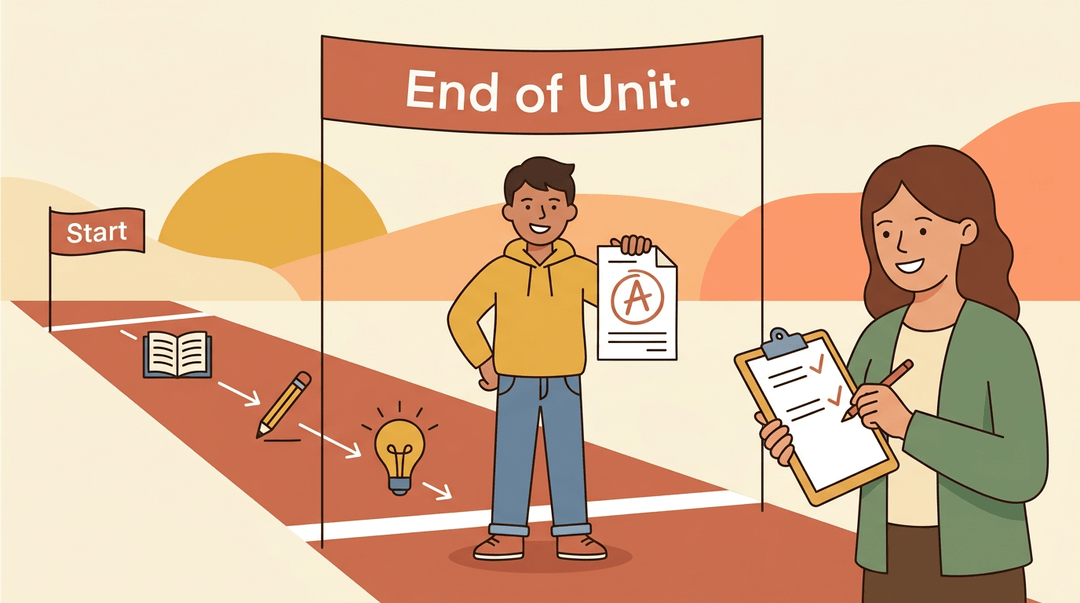
Summative assessment evaluates what students learned at the end of a period: a unit, a semester, a course. It's formally graded, high-stakes, and measured against a benchmark. Think final exams, standardized tests, or a capstone project.
The focus is on the product: what a student can demonstrate once instruction is complete.
Diagnostic assessment and why it stands apart
Before you teach, you need to know what students already know. That's where diagnostic assessment comes in.
A pre-test, a KWL chart, or a quick show-of-hands survey at the start of a unit reveals prior knowledge and flags misconceptions early, before they harden.
Diagnostic assessment isn't formative (it precedes instruction) and it isn't summative (nothing is being evaluated at the end). It's a genuine third type with its own distinct purpose.
What are the 4 types of assessments?
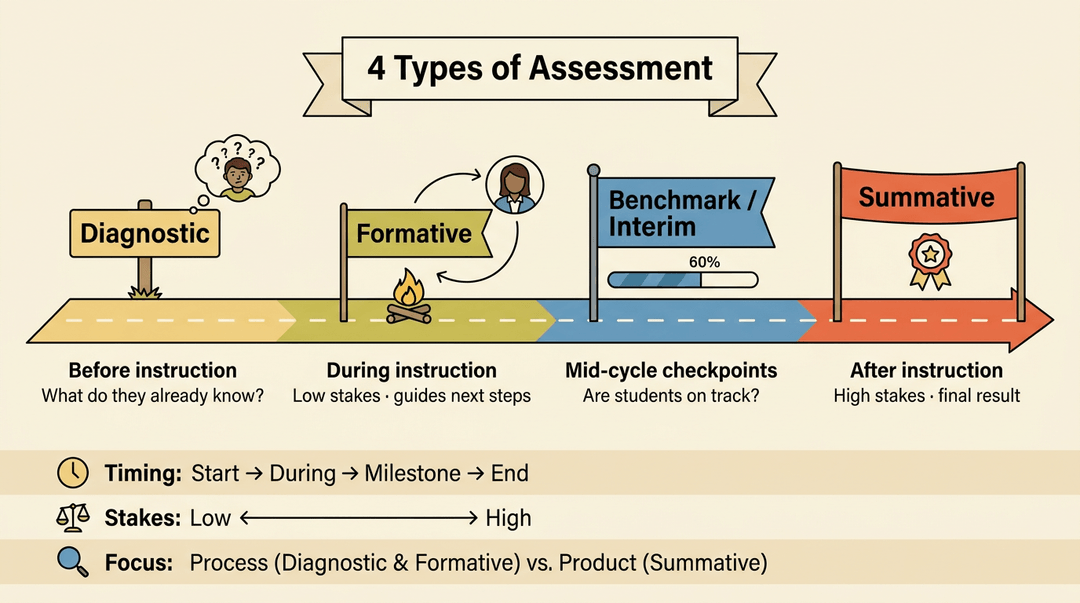
The four types break down along a few key lines:
- Diagnostic: before instruction begins; maps prior knowledge
- Formative: during instruction; low-stakes, process-focused, guides your next move
- Benchmark/interim: mid-cycle checkpoints; measures progress toward a standard at set milestones, often across a grade level or school
- Summative: end of instruction; high-stakes, product-focused, bottom-line results
Timing, stakes, and focus are the real dividers. Formative and diagnostic are about where learners are going. Summative is about where they landed. Benchmark sits in between, flagging whether students are on track before the final reckoning.
Why Each Assessment Type Matters
Formative and summative assessments each do a distinct job in your classroom. Understanding what each one does well makes it easier to use both with intention.
How formative assessment helps students learn
Formative assessment is the ongoing pulse-check that keeps learning moving forward. It surfaces misconceptions before they calcify, so you can course-correct on Tuesday instead of discovering the gap on Friday's test.
It also builds metacognition: when students see their own progress in real time, they get better at knowing what they know and what they still need to work on.
The Poorvu Center for Teaching and Learning at Yale notes that using both assessment types together promotes student motivation, metacognition, and deeper understanding of content.
Research published in SN Social Sciences backs that up: studies found significant increases in both academic achievement and engagement, with the strongest gains tied to immediate, content-directed feedback.

What summative assessment tells you
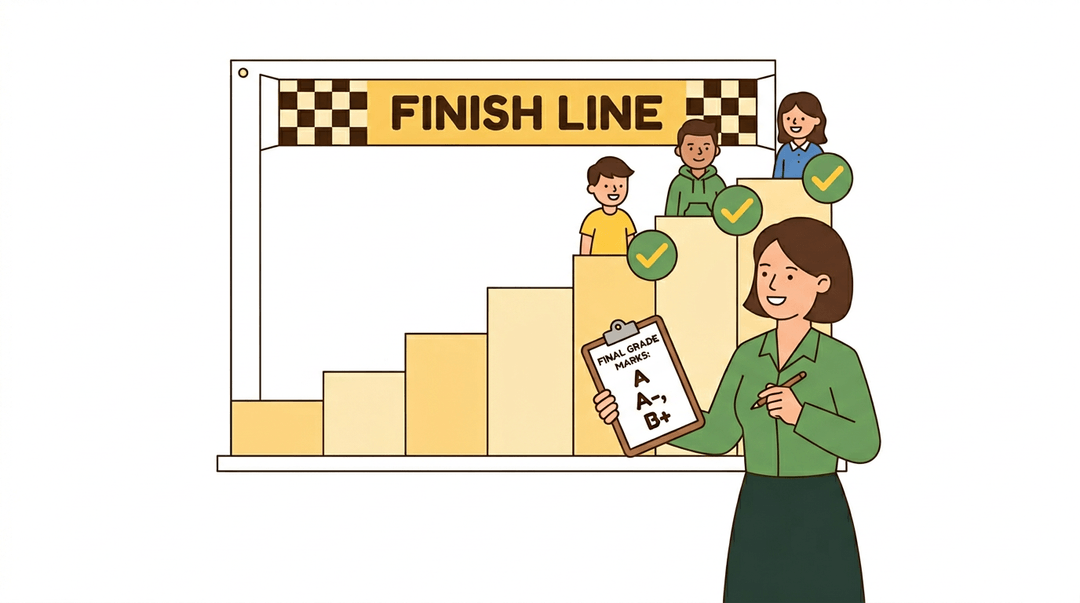
Summative assessment measures what students have achieved at the end of a unit, semester, or course. It answers the big question: did they get there? That data does three things:
- It gives students a final grade or mastery mark.
- It tells you whether your instruction hit the target.
- And it prepares students for the next level by confirming they've met the prerequisite bar.
Is formative or summative assessment better?
Neither. They're complementary, not competitors. Formative assessment shapes how students arrive at the end; summative assessment confirms where they landed.
The relationship also runs both ways: summative results can feed back into planning, effectively used formatively for the next group of students. As the Poorvu Center puts it, both assessment types can advance student learning. Balance is the point.
Formative Assessment Examples
Formative assessment isn't one thing: it's a whole toolkit you can reach into at any point in a lesson. Here are the main types, organized by how and when you'd use them.
Fast in-class checks that reveal gaps
These are your real-time read on whether the class is with you.
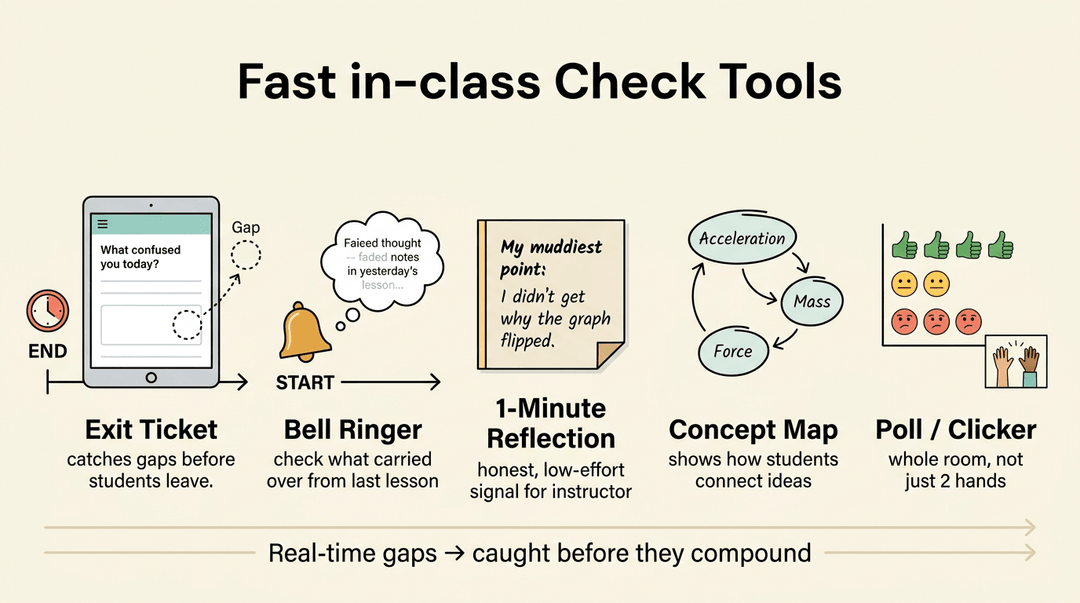
Exit tickets are one of the highest-return tools in the set. A quick digital form at the end of class surfaces gaps immediately, before students leave and before those gaps compound.
Bell ringers do the same at the start, helping you gauge what carried over from last time. One-minute reflection writing ("write the muddiest point from today") takes almost no class time and gives you honest signal.
Concept maps drawn in class show you not just what students know, but how they're connecting ideas. Polls and clicker questions let you see the whole room at once, not just the few hands that go up.
Discussion and observation as ongoing feedback
Some of the richest formative data doesn't come from a task at all.
Listen during in-class discussions and Q&A sessions: the questions students ask (and avoid) tell you a lot. Deliberate teacher observation, circulating while students work, catches misconceptions before they calcify.
A quick informal one-on-one chat with a struggling student often surfaces the specific sticking point that a written check never would.
Quizzes and homework for regular practice
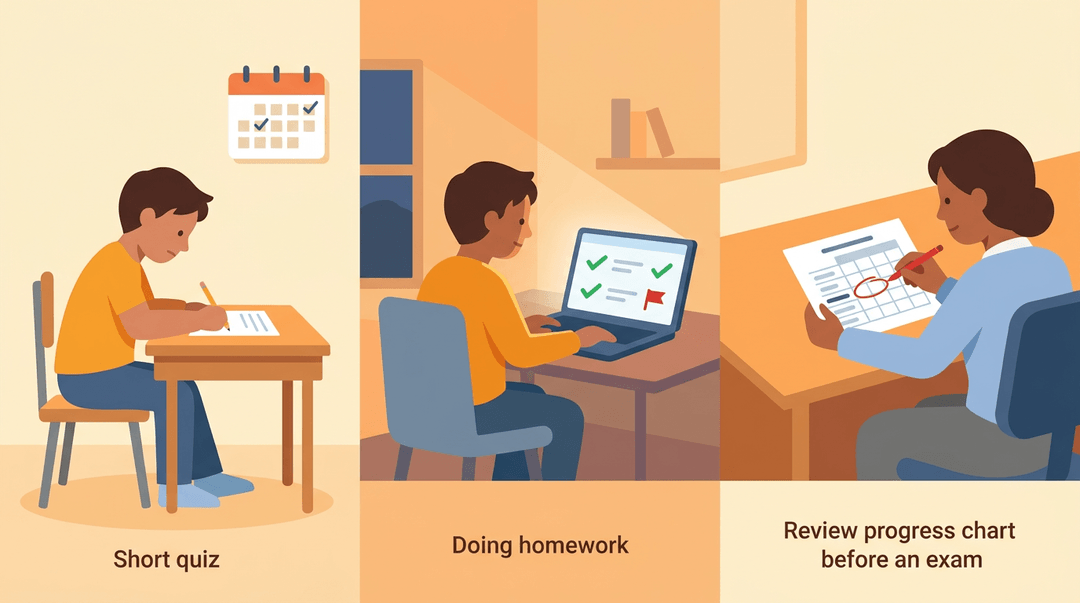
Weekly quizzes keep retrieval practice consistent and give you a running record of each student's progress. Homework practice exercises extend thinking beyond class time, and online automated quizzes can grade and flag gaps for you overnight.
Review exercises before exams serve double duty: students consolidate, and you see who still has shaky foundations in time to help.
Peer and self-assessment activities
When students evaluate work, they build metacognitive skills alongside subject knowledge.
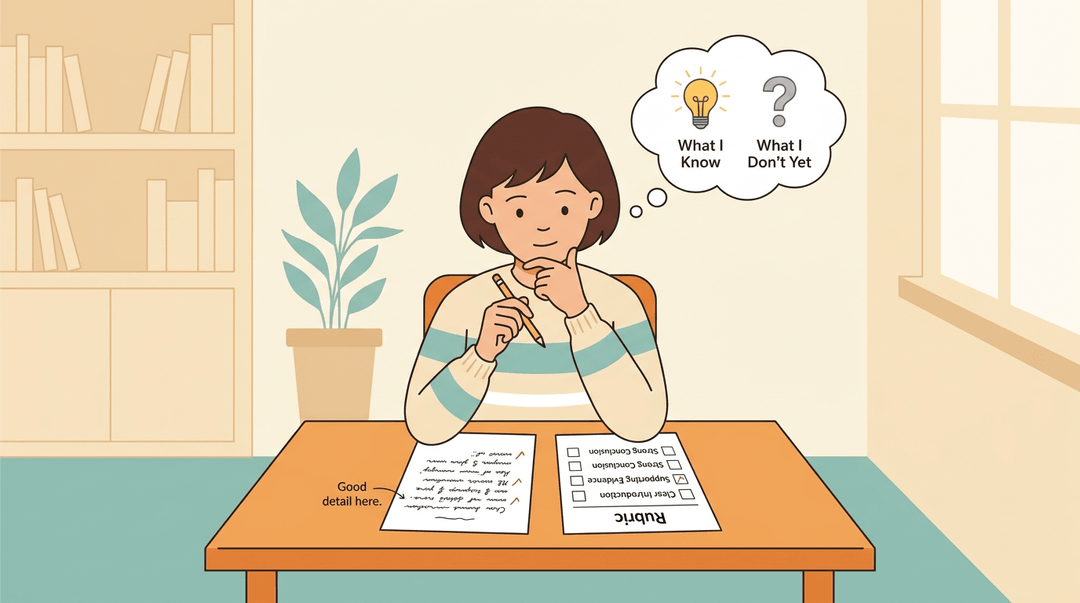
Peer review asks students to give specific, criterion-based feedback on a classmate's draft or problem set. Trade-and-grade activities are a lighter version: swap papers, apply a shared rubric, discuss.
Self-reflection prompts ("what did you master this week, and what still feels unclear?") help students identify their own weaknesses rather than waiting for you to tell them.
That shift matters: students who can name a gap are far more likely to address it.
Creative ways to check understanding
Not every check needs to look like a quiz.
Ask students to write a short advertisement for a concept ("sell mitosis to someone who's never heard of it") and misconceptions surface fast.
Idea comparison exercises (compare photosynthesis to respiration in two sentences) reveal whether students understand relationships, not just definitions.
Misconception debunking discussions, where students argue against a common wrong answer, push deeper thinking. Group presentations and games like quiz-bowl formats add energy and still give you plenty of observation data.

Summative Assessment Examples
Summative assessments arrive at the end: of a unit, a semester, a course. They measure what students have actually learned against a clear standard, and they usually carry real weight.
The formats vary widely, but they share a common purpose: capturing the sum of a student's progress.
Exams and standardized tests
The most familiar summative format is the exam. Instructor-created final exams let you test exactly what you taught, while midterm and cumulative exams check how well students are retaining and connecting material across a longer stretch.
Beyond the classroom, standardized tests like state assessments and national benchmarks measure students against a common bar.
The SAT and ACT are the most recognized examples: high-stakes, norm-referenced, and designed to compare students across schools and districts.

Papers and research reports
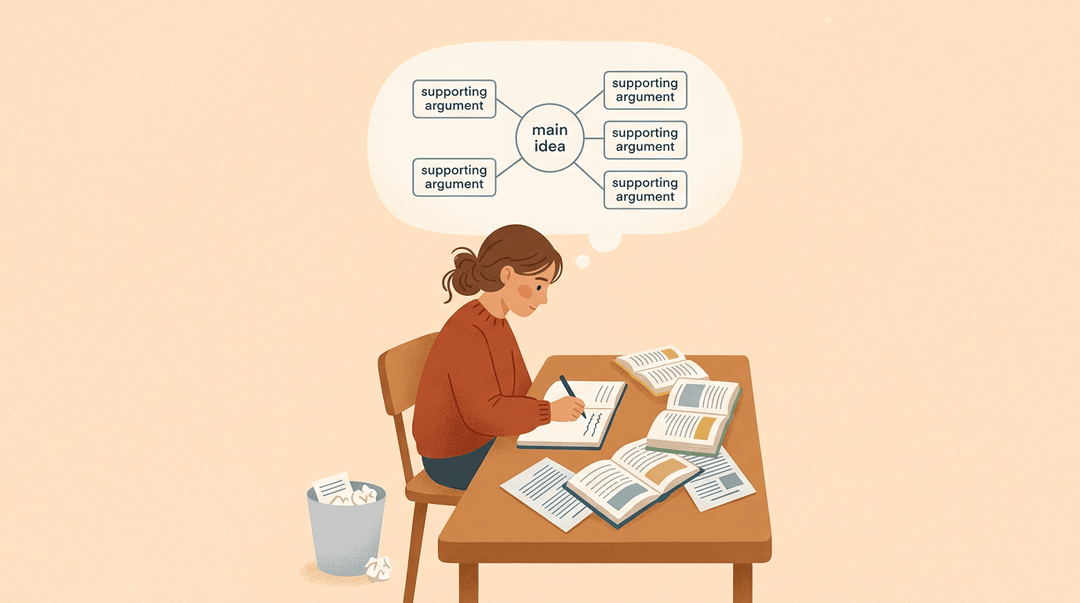
Written work is one of the richest summative formats because it asks students to do more than recall: they have to organize, argue, and explain. Final essays and term papers measure a student's ability to sustain an idea over several pages.
In-depth research reports go further, requiring source evaluation and synthesis.
Personal evaluation papers and written analyses of course topics round out this category, each asking students to bring their own thinking to the material rather than just repeat it back.
Projects, portfolios, and presentations
Some learning is best shown, not written. Final cumulative projects let students apply everything they've learned to a real task or product.
Oral and slide presentations add a performance layer: students have to know the material well enough to explain it live. Practical application projects ground the work in something concrete, like a built model, a designed solution, or a produced piece.
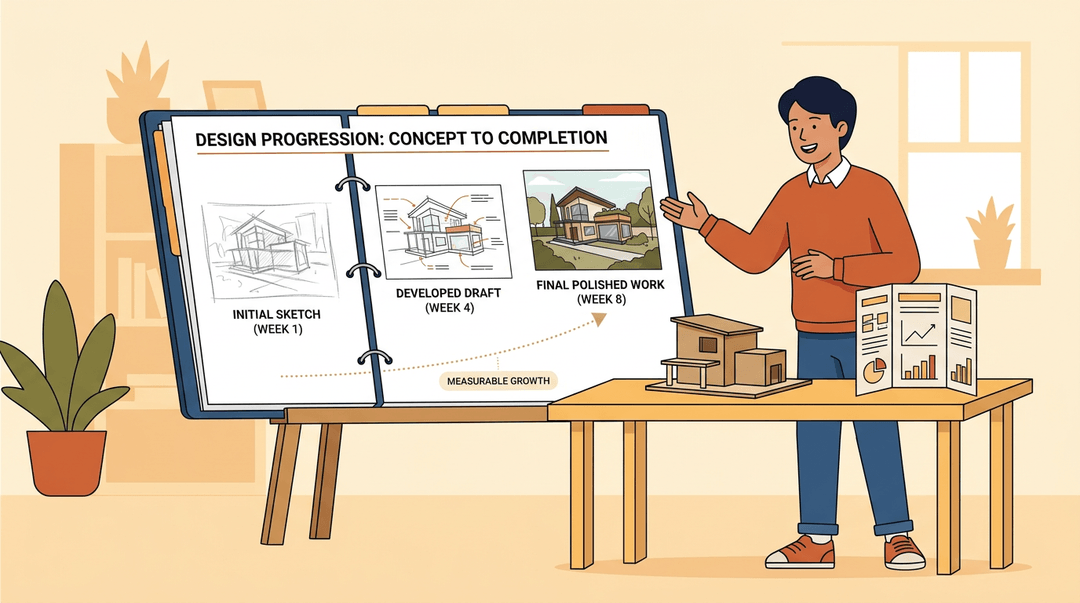
Portfolios occupy a special position here. They collect work gathered across a course or year, so they bridge the formative process and the summative product: you can see both the growth and the final result in one place.
Performances and other final formats
Not every summative moment involves a pen or a keyboard. Senior recitals and performances are the capstone for arts and music students. Student course evaluations and instructor self-evaluations close the loop on teaching itself.
And at the broadest level, final grades are themselves a summative outcome: a single number or letter that tries to represent everything a student has done.

How to Design Assessments That Actually Work
Formative always comes first. You need to know where students are before you can judge where they ended up. Think of formative work as your early-warning system, and the summative as the final reckoning. Here's how to make both count.
Making formative feedback more actionable
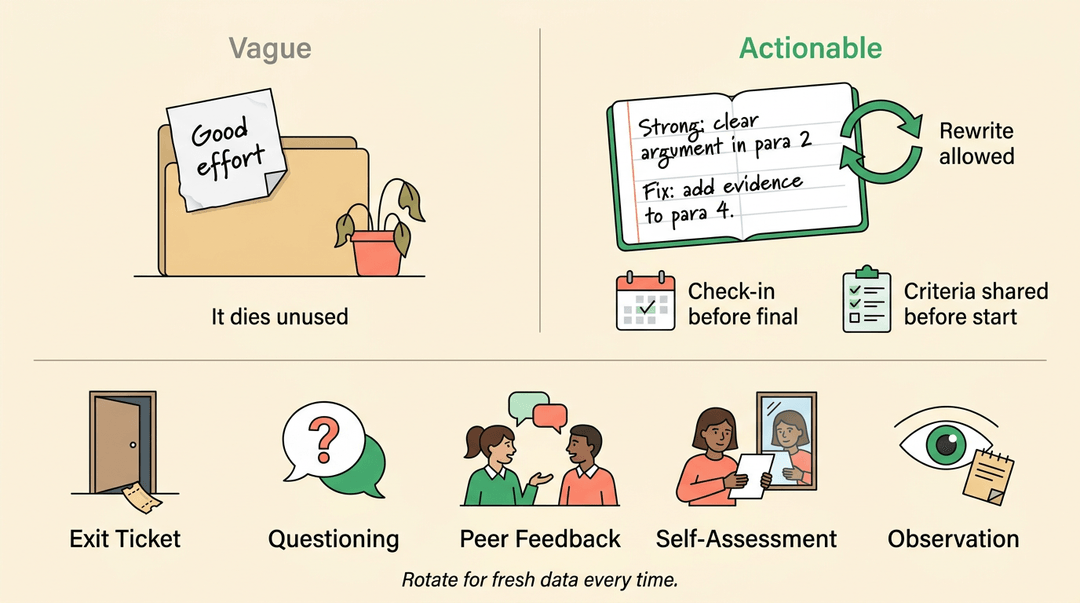
Vague feedback sits in a folder and dies. Specific feedback changes the next draft. When you return work, name exactly what's strong and exactly what to fix, then allow rewrites and resubmissions so students can actually use what you told them.
Share clear criteria before the work begins, not after. And schedule at least one mid-semester feedback session: a brief check-in where students can ask questions and recalibrate before the summative is anywhere near.
The five formative strategies worth building into your routine:
- exit tickets
- questioning
- peer feedback
- self-assessment
- observation
Rotate them so students stay engaged and you get data from more than one angle.
Building a stronger summative assessment
Every question or prompt should map to a course objective. If you can't point to the objective, cut the question.
Use a rubric to define what mastery actually looks like, and wherever possible, let students demonstrate learning creatively, not just through a single test format. Define parameters clearly upfront: length, format, sources, deadlines. No surprises.
Formative data isn't just feedback. When you spot a consistent gap across your class, that's a signal to adjust how you weight or approach the summative, before students walk in unprepared.
Tracking and grading student progress
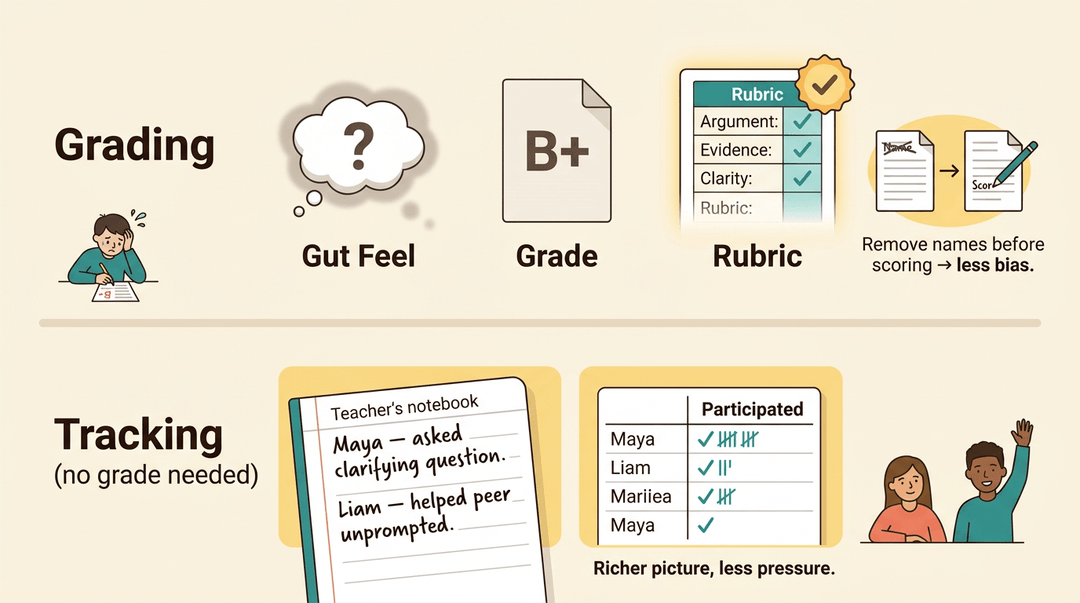
You can track progress by gut feel, by grade, or by data. Data wins. Rubrics make summative grading objective and defensible. Blind grading (removing student names before you score) cuts unconscious bias further.
Not everything needs a grade. Non-graded tracking, such as observational notes or participation tallies, gives you a richer picture of student growth without the pressure that shuts some learners down.
Give students the rubric before they start
This one move does more than most. A rubric handed out at assignment launch sets clear performance expectations, gives students a self-check tool as they work, and makes your summative grading consistent.
Summarize it again at term start so students know the standard from day one. Save it for grading, and it's too late.

Mix Formative and Summative Assessments in Your Classroom
A formative check tells you what students know today; a summative one records what they've mastered. This guide helps you sequence the two across a grade band, weight them fairly, and act on what the formative data tells you before the test arrives.
Sequence by grade band
Match the rhythm of your checks to how your students learn at their age.
| Grade band | Formative rhythm | Summative anchor |
|---|---|---|
| K–5 | Daily exit tickets | Unit tests |
| 6–8 | Weekly quizzes | Project finals |
| 9–12 | Socratic discussions | Cumulative exams |
The pattern holds across all three: frequent low-stakes checks feed one larger, spaced-out judgment.
Weight the two categories
Decide the split before the term starts, not when grades are due.
- Start from a common 30/70 split. Formative work counts for 30%, summative for 70%, the same balance one school adopted in its new grading policy.
- Adjust to your course goals. A skills-heavy course may lift formative weight; a gatekeeper exam course may not.
- Document the policy in the syllabus. Write it where families see it day one.
💡 Tip: Phrase it plainly: "Quizzes, exit tickets, and homework count for 30% of your grade. Tests and projects count for 70%."
Act on the data before the summative
Formative checks are worthless if the numbers don't change your next move.
- Re-teach when more than 30% miss it. One-third of the room stuck means the concept, not the kids, needs another pass.
- Offer targeted practice, then retest. Pull the strugglers a small set on that one skill, then re-check before the exam.
- Log every adjustment. Jot what you changed and why, so next year's plan starts ahead.
Example: A 6th-grade teacher's Tuesday quiz shows 40% can't divide fractions. She re-teaches Wednesday with fraction strips, runs a 3-problem re-check Friday, and the unit test (the summative) lands a week later on solid ground.
Your daily quick-check toolkit
Reach for these when you need a read on the room in under a minute. None of them go in the gradebook; they steer the lesson.
- Thumbs up/down. Instant whole-class confidence read after a worked example.
- Whiteboards. Every student solves; you scan 30 answers at a glance.
- Live polls. A single multiple-choice question, results projected.
- One-sentence summary cards. "In one sentence, what did today's lesson prove?"
- Peer quiz swaps. Students write one question, trade, answer, and grade each other.
⚠️ Watch out: A quick check only counts as formative if you use the result. A thumbs-down you ignore is just decoration.
At a glance:
| Phase | Key move | What you get |
|---|---|---|
| Sequence | Frequent checks → spaced tests | A predictable rhythm |
| Weight | 30/70, written in the syllabus | A fair, defensible grade |
| Act | Re-teach above 30% miss rate | Fewer surprises on the test |
Keeping both categories straight gets easier when the tool does the math: EMStudio's gradebook lets you weight formative and summative categories separately and tracks both in one place, no spreadsheet needed.
Formative and summative assessments aren't competing tools: they're partners. One tells you where to steer; the other shows how far you've come.
When you use both with intention, you get a clearer picture of every learner in the room, and your students get the feedback they need to actually grow.
Ready to bring it all together? Explore our Grading & Assessment tools to track formative and summative data in one place, without the paperwork piling up.

References
- Bridging theory and practice in formative assessment: empirical strategies for enhancing student engagement and performance | SN Social Sciences — link.springer.com (2026)
- Formative & Summative Assessments — poorvucenter.yale.edu
- 70/30, the new grading policy – The A-Blast — thea-blast.org
Frequently asked questions
What are the four types of formative assessments?
The four types of assessment are diagnostic, formative, benchmark/interim, and summative. Diagnostic assessments precede instruction to map prior knowledge, while formative assessments occur during instruction to guide ongoing learning. Benchmark/interim assessments are mid-cycle checks, and summative assessments evaluate learning at the end of instruction.
What are some good school improvement ideas?
Good school improvement ideas often involve making formative feedback more actionable, such as allowing rewrites and resubmissions, and providing clear criteria before work begins. Building stronger summative assessments by aligning them with course objectives and using rubrics also contributes to school improvement. Tracking student progress with specific data rather than just grades helps to identify areas for adjustment and targeted practice.
What are the 5 formative assessment strategies?
The five formative assessment strategies worth building into a routine are exit tickets, questioning, peer feedback, self-assessment, and observation. These strategies help educators gather ongoing feedback to inform instruction and allow students to monitor their own learning. Rotating these methods keeps students engaged and provides diverse data perspectives.
What are formative and summative activities?
Formative activities are ongoing feedback loops that run during learning, such as quick checks, discussions, or quizzes, designed to identify gaps while instruction is in progress. Summative activities evaluate what students have learned at the end of a period, like final exams or projects, and are typically high-stakes and formally graded.
What is an example of a formative and summative assessment?
An example of a formative assessment is a quick thumbs-up/thumbs-down check during a lesson to gauge understanding or an exit ticket at the end of class. An example of a summative assessment is a final exam at the end of a unit or a capstone project that evaluates overall learning for a course.
What is the best example of summative assessment?
The best example of a summative assessment is typically an instructor-created final exam. This type of assessment allows teachers to test exactly what was taught and measures students' retention and connection of material across a longer period, confirming they have met prerequisite bars for the next learning level.
What are some examples of formative and summative assessments?
Examples of formative assessments include exit tickets, bell ringers, one-minute reflection writing, concept maps, polls, in-class discussions, and weekly quizzes. Examples of summative assessments include final exams, standardized tests, term papers, research reports, cumulative projects, portfolios, and presentations.
What is a good example of a summative assessment?
A good example of a summative assessment is a final cumulative project. This type of assessment allows students to apply everything they have learned to a real task or product, demonstrating their mastery of the material at the end of a unit, semester, or course.